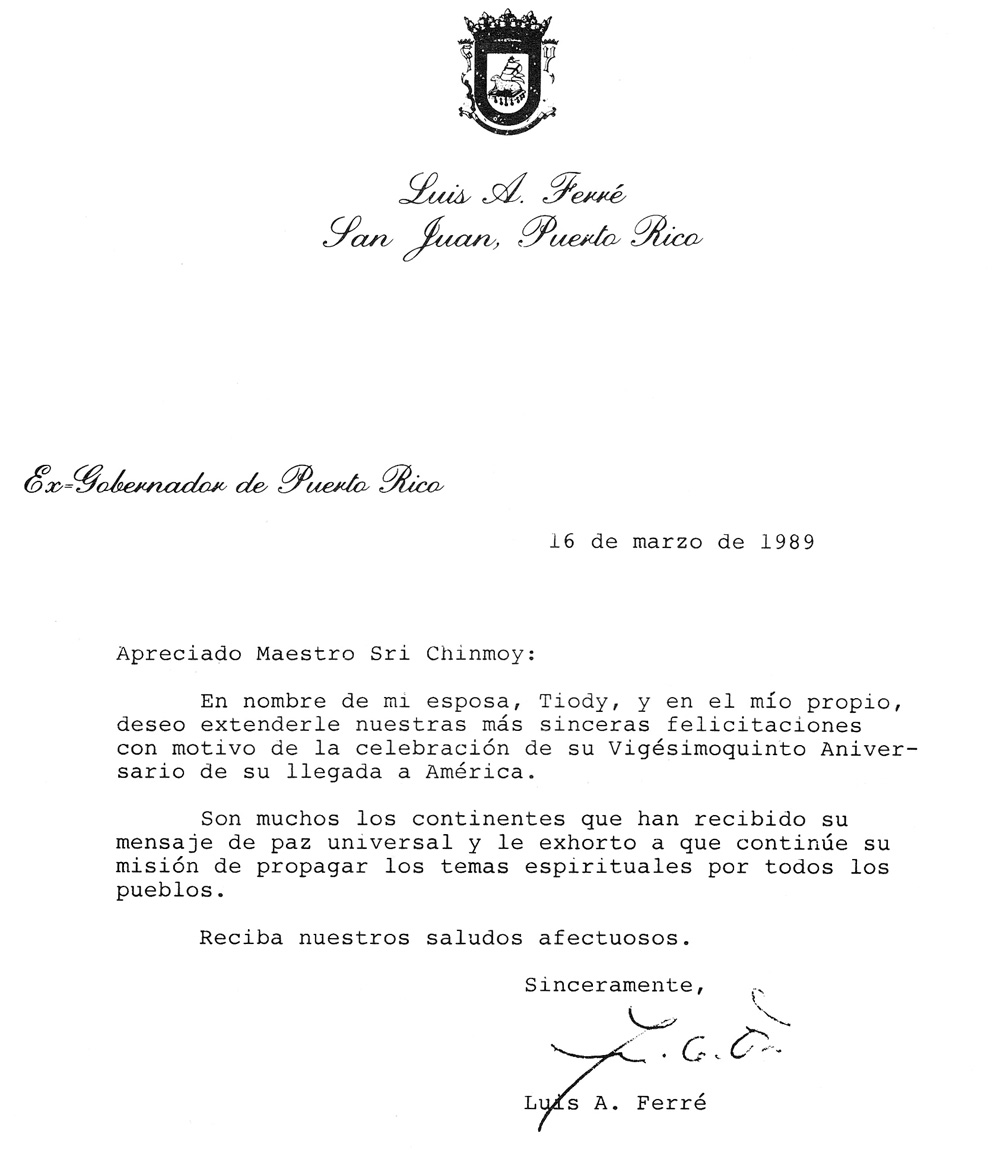
From:
The Hon. Luis A. Ferré Former Governor of the
Commonwealth of Puerto Rico
Translation:
16th March 1989
Dear Master Sri Chinmoy,
On behalf of my wife, Tiody, and myself, I wish to convey our most sincere congratulations with regard to the celebration of the twenty-fifth anniversary of your arrival in America.
Many are the continents which have received your message of universal peace, and I urge you to continue your mission of spreading spiritual teachings to all people.
On 16 January 1998, while staying at the Merida Holiday Inn in Mexico, Sri Chinmoy offered comments on a number of folk proverbs from various nations.
1.
“A stumble is not a fall.” – Haitian
When I do not meditate regularly, it is, indeed, a stumble. But when I give up the spiritual life altogether, it is, indeed, a fall.
2.
“People in trouble remember Allah.” – Hausa
Kunti, the mother of the Pandavas, in India’s greatest epic the Mahabharata, prayed to Lord Krishna to inundate her life with troubles so that she would never forget Lord Krishna even for a fleeting second.
3.
“Every tear has a smile behind it.” – Iranian
Every mind-jungle has a heart-garden behind it.
4.
“Give advice.
If people do not listen, let adversity teach them.” – Ethiopian
I give advice, and if my spiritual children do not listen to my advice, I give advice again and again unconditionally, for I do not want adversity to be their teacher. God wants me to be their soul-teacher, at least for this incarnation.
5.
“It is easy to advise the wise.” – Serbian
Those who have accepted the spiritual life seriously, consciously and self-givingly are really the wise ones, and for them to accept any advice from their Inner Pilot is not at all a difficult task.
6.
“An illiterate king is a crowned ass.” – English
An illiterate spiritual Master can be a God-crowned emperor.
7.
“A word spoken in anger may mar an entire life.” – Greek
Some spiritual Masters do not fail to see eye-to-eye with this sublime realisation.
8.
“God did not create hurry.” – Finnish
True, God did not create hurry, but He did create my destination.
9.
“To be willing is to be able.” – French
The outer willingness is the manifestation of the inner ability.
10.
“An artist lives everywhere.” – English
Definitely true. Again, a God-manifestation-artist not only lives everywhere, but he is for God, only for God, everywhere.
11.
“Buying on credit is robbing next year’s crop.” – African-American
I do not believe in the future. Therefore, I deliberately keep myself away from being a credit card exponent.
12.
“Beware the person of one book.” – Latin
Do not forget to read the only book, the book of books: your life-tree.
13.
“Six feet of earth make us all equal.” – Italian
Alas, how is it that we forget this? How and why?
14.
“Virtue is not knowing but doing.” – Japanese
A truth-seeker and God-lover goes one step ahead: he feels the real virtue, only virtue, is in becoming God-Infinity’s Heart and God-Eternity’s Eye.
15.
“Tie your camel, then trust in Allah.” – Arabic
First, you must know that God is in you. Then only can you feel that God is for you.
16.
“Stones decay. Words last.” – Samoan
Not the mind-factory-words, but the soul-garden-words.
17.
“Not to know is bad; not to want to know is worse.” – Gambian
It is bad for me not to know where God is and who God is. But not to want to know who He is and where He is, is infinitely worse.
18.
“The best way to get praise is to die.” – Italian
The best way to get praise is to tell the world openly you will do everything for the world and secretly you will actually do everything for God and God alone. In that way, you will get praise both from stupid mankind and from the Compassion-satisfied God.
On 16 January 1998, while staying at the Merida Holiday Inn in Mexico, Sri Chinmoy offered comments on a number of folk proverbs from various nations. Read more...
Having crossed the threshold of the millennium, we begin to survey the unhorizoned timescape of possibilities before us. Yet with reflections of the past still in our thoughts, and so much of our lives still influenced by the twentieth century, we may be tempted to ask just how will the last 100 years be judged by future generations?
The question may at first appear absurdly out of context. We may as well ask a drop of water in a flowing stream to qualify its purpose or to quantify its contribution. Certainly, in relation to the past 200,000 years — the estimated time since the first human beings (Homo sapiens) walked the earth — the twentieth century can be easily regarded as parenthetical to this vast sweep of time.
We may never have a definitive answer, or we may have to wait centuries before historians arrive at a consensus. Nevertheless, as misplaced as the question may be at this time, let us be bold in our attempt to proffer a plausible answer.
To a cynical mind, the twentieth century marks the most recently completed chapter in a sorry saga that has been played out since time immemorial. Conflicts in our own age tend to confirm that humanity has made little or no progress towards peaceful coexistence. From the conquests of the Roman Empire, the Vikings and the Mongol hordes, to the global wars of the twentieth century, it would seem that human nature has stayed much the same — only the weapons have changed.
But in the light of a more optimistic universal view of history, life on earth can be seen not as one sad chapter after another, but as an epic account of an eternal search for freedom, knowledge and peace. It is the story of the evolving consciousness of mankind.
We cannot merely extrapolate from the past or rely on commentators of current affairs to predict the future — we must be willing to see through the eyes of a visionary.
While volumes have euphemistically recorded the ‘greatness and goodness’ of the victors, the pain and suffering that warring forces have inflicted upon the planet is concealed by their official legacies. Tyrants, dictators and miscreants have claimed disproportionate glory. Hence, the ledger of history has never truly been balanced by the narrative of those who have given their lives to serve the ideal of world peace.
When we look back to men and women who stood apart from the ethos of their day, their efforts were very often unrewarded and overlooked in their own time, yet we now regard them as characterising the spirit of their age. They were the ones who pointed to the future — they were the visionaries.
In the East, many thousands of years ago, Krishna came to establish righteousness among men at a time when virtue had all but been lost; Buddha, shunning both the indulgence and the asceticism of his era, pointed to a new way to ease humanity’s suffering; to an age of barbarism came Christ to preach the gospel of love; and in Western Europe in later centuries, against a backdrop of religious insularity and national enmities, rose the great voyages in seafaring and discoveries in science that eventually opened the way to global communication and understanding.
Whether the twentieth century is viewed as the precursor to the fulfilment of the noble dream of peace on earth or it becomes a mere footnote to the age-old unresolved conflicts of human life is uncertain. What is certain is that the balance of power swings precariously between ignorance and knowledge. And for the sake of generations to come, it is incumbent upon all those of goodwill and integrity to counter the fallacies of their age. The future, let us hope, will give true credit to the harbingers of peace of the twentieth century.
Just as each drop adds to the fulness of a stream, so each century adds its unique character to the story of mankind. And as a moving course of water turns on a single point, so too history can quite often turn on a single moment.
As we look back over the past one hundred years through the glazed eyes of materialism we cannot help but ask, what manner of man could possibly counter the icy chill of soulless hostilities with the poetry of his life, or quench the arid deserts of intellectual arrogance from the fountain of art, or expel the desperate fears of a frightened world with the music of his aspiration?
A man foremost among men of the twentieth century must bring together a global peace-family through his spiritual wisdom and multi-faceted talents; the beneficence of his life must be able to transform forests of ignorance; and he must be able to lift up the world with a oneness-heart.
There is one person, in recent times, whose life and work has given certainty to the inevitability of humanity’s brightest future; whose subtle influence has given new direction and inspiration to national leaders; and whose soulful expression of love has awakened humanity’s heart. The scope of his vision leaves no doubt that he is one of the twentieth century’s rare treasures. His name is Sri Chinmoy.
A Dreamer of World Peace
Like the visionaries of old, Sri Chinmoy stood firmly against tyranny, injustice and oppression, but not in a combative way. The so-called ‘evils of the world’ are, in truth, the enemies within. In our own lives, we see the tyranny of our own thoughts, the injustice of our own actions and the oppression of our own self-imposed limitations. And Sri Chinmoy’s answer to this is expressed in his conviction that the indomitable strength of the human spirit is destined to prevail.
To Sri Chinmoy the soul and the spiritual heart are not hypotheticals, they are ever-present realities with capacities that need to be nurtured and developed. He calls his philosophy the ‘Path of the Heart’.
“It is we who have to see the capacity and the quality of the heart … the heart has limitless capacity on the strength of its oneness with the soul.” — Sri Chinmoy
It is this quality of the heart that has endeared him to so many. And it is the capacity of the heart that Sri Chinmoy sees as the way to world peace: “I have not come into this world to change it. I have come only to love the world in such a way that you and I and everyone else can work together. I pray to God to give me the capacity to be of service to Him. One individual can never, never change the world, but collectively everybody has to work together. Jointly, with a oneness-heart, we hope to bring about world peace.”
Sri Chinmoy’s name is not one that would be readily linked to the political decision-making process, yet he had a long association with the world’s peak forum for international affairs, the United Nations.
The Preamble to the UN Charter, signed by the representatives of 50 countries in San Francisco on June 26, 1945, gave voice to the high ideals to which the nations of the world aspired: “We the peoples of the United Nations determined … to reaffirm faith in fundamental human rights, in the dignity and worth of the human person, in the equal rights of men and women and of nations large and small … and for these ends … to practice tolerance and live together in peace with one another … have resolved to combine our efforts to accomplish these aims … and do hereby establish an international organisation to be known as the United Nations.”
Since then, the United Nations has sought to bring about understanding through political dialogue and diplomatic agreements and its efforts in this area have claimed much success. But as an end in itself, inter-governmental discussions and conflict resolution have quite often resulted in uneasy truces and fragile rapprochements rather than real peace.
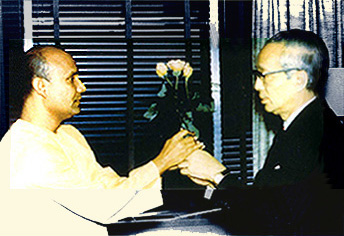
Sri Chinmoy meeting with UN Secretary-General U Thant in 1970
In 1970, Sri Chinmoy brought a new perspective to the word ‘peace’ when, at the invitation of the third Secretary-General U Thant, he began conducting twice-weekly silent peace meditations at the United Nations.
As a child, Sri Chinmoy spontaneously embraced the custom of meditation that was part of his centuries-old Indian heritage. Later, during his 20 years at the Sri Aurobindo Ashram in southern India, he perfected his spiritual practice, reaching transcendental heights of meditation achieved by only the very few. In 1964, at the age of 32, he came to New York to offer his service to aspiring seekers in the West. At this time the concept of a spiritual master to the average westerner was unusual, but those who came in contact with Sri Chinmoy saw and felt in him an overwhelming sense of inner peace. Those who meditated with him described a feeling of peace so profound that it was literally tangible: “Seated there in silence, I was aware of a powerful wave of peace and saintly love emanating from Sri Chinmoy himself,” as one meditator put it. And this ‘feeling of peace’ was certainly evident at the regular meditations he conducted in the Dag Hammarskjöld Auditorium at the UN Headquarters.
In one sense, his was a radical approach. But from Sri Chinmoy’s perspective: “Peace is something spontaneous; it is something that unites us. Peace is something that we have to spread. But unless and until we have peace deep within us, we can never hope to have peace in the outer world.”
“Peace,” says Sri Chinmoy, “does not mean the absence of war. Peace means the presence of harmony, love, satisfaction and oneness.”
U Thant clearly saw that the essence of peace — peace in its undiluted pristine form — that Sri Chinmoy was offering through his meditations was the real underpinning of the mission of the United Nations:
“Whoever speaks to me about you is all appreciation and admiration, and I personally feel that you have been doing a most significant task for the United Nations … You have indeed instilled in the minds of hundreds of people here, the moral and spiritual values which both of us cherish very dearly.”
Bridging the Divide
Whether through the United Nations or by his own credentials as a universal man of peace, Sri Chinmoy’s meetings with world leaders have had a subtle, yet quite a profound effect.
Whenever Sri Chinmoy met with politicians he tried to speak to the heart of the individual and not to the partisan mind. One who wholeheartedly embraced the importance of Sri Chinmoy’s message of peace was President Mikhail Gorbachev of the former USSR.
“Your loving heart and profound wisdom,” he once wrote, “are a matter of my boundless admiration.” The two close friends met on numerous occasions and corresponded regularly over many years.
Another world leader Sri Chinmoy was honoured to call a dear friend was President Nelson Mandela of South Africa. Even the great at times need inspiration and Nelson Mandela called it, “a real shot in the arm,” when he was presented with the ‘U Thant Peace Award’ by Sri Chinmoy in 1996. He went on to say: “This award from you is one that I am going to respect a great deal, and which encourages me in the difficult work that we are doing.”
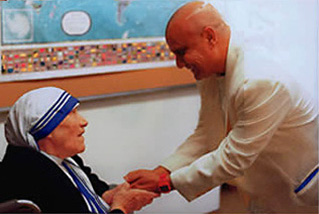
Mother Teresa meeting with Sri Chinmoy
Sri Chinmoy’s universal philosophy transcends religious differences and it endeared him to leaders of all faiths.
He first met with Pope Paul VI at the Vatican in 1970 and met numerous times with Pope John Paul II, with whom he shared a dedication to bridging the religious divide. His tender relationship with Mother Teresa, the tireless worker for the poor, also took him to Rome to honour her lifetime of service. They shared the same birthday, August 27, and in her last telephone conversation with him on that day in 1997, Mother Teresa said: “Your works of love are works of prayer, and your works of prayer are works of God.”
When Sri Chinmoy visited Egypt in 1989, international Muslim leader and spiritual mentor to millions, the Grand Mufti, paid great respect to Sri Chinmoy’s global peace initiatives by declaring: “He is a man of Peace. He is welcome to visit me at anytime.” In Sri Lanka he was uniquely honoured by becoming the first non-Buddhist ever to receive an honorary degree from Asgiriya University. Hinduism Today magazine declared him Hindu of the Year for 1997 and presented him with the ‘Hindu Renaissance Award’.
In 1993, Sri Chinmoy was invited to open the plenary session of the ‘Parliament of the World’s Religions’ in Chicago. There he reverently took the stage to offer a prayerful silent meditation. And just as 100 years earlier his countryman Vivekananda had captured the audience with his striking countenance and inspiring oratory, so too Sri Chinmoy’s powerful spiritual presence drew all to the silent contemplation of the soul.
During the 1990s, as a tribute to his far-reaching efforts toward world peace, Sri Chinmoy was proclaimed ‘The Twentieth Century’s First Global Man’. The citations came from every quarter of the social spectrum — from Prime Ministers to TV shows, from sporting institutions to religious orders. He was also honoured by his homeland of India, when The Institute of Indian Culture, Bharatiya Vidya Bhavan, presented him with the ‘Mahatma Gandhi Universal Harmony Award’.
Symbolising Sri Chinmoy’s vision of people united in peace and in harmony with nature, governments and local authorities have dedicated over 800 significant landmarks — gardens, parks, bridges, natural wonders, historic sites and even countries — as ‘Sri Chinmoy Peace-Blossoms’. They include such special places as Moscow’s Gorky Park, Niagara Falls, Mt. Fuji, the Island of Puerto Rico, and the continent of Australia. A simple plaque at these sites, bearing an inscription of one of Sri Chinmoy’s peace aphorisms, is quite often a subtle reminder of the responsibility we all share as human beings to value the international bond of peace.
Creativity of the Soul
Sri Chinmoy’s aspiration for peace left no opportunity unexplored. In action and in silence, in word and in deed, he was a universal peace-lover and an eternal peace-dreamer. His life of creativity speaks to the modern age with the certainty and authenticity of an ancient seer. His is the voice of a truth so fundamental to our existence, that it completely bypasses the mind and directly touches the human soul. Sri Chinmoy’s place in the twentieth century is absolutely unique.
Much of what we think of as original, is derivative in nature — new concepts are very, very rare. Like an image caught between opposing mirrors, reflected back and forth ad infinitum, gradually diminishing in form and intensity, a unique idea, confined by the norms of society, loses its clarity and power with each successive iteration of the mind. Originality is reinvented, rephrased, repackaged and finally retailed with a new name. So to have a body of work, in any of the arts, recognised as truly original is a high accolade indeed.
No author, artist or musician in the twentieth century has been less influenced by the prevailing culture than Sri Chinmoy. He took his inspiration, not from the outer world of human affairs and events; not from the world of the mind or subconscious impressions; and not from the world of vital excitement, but directly from the inner world of the soul and the spiritual universe which he inhabits. Sri Chinmoy was a true original, far ahead of his time in many respects, and consequently, his own era may not have fully recognised him for the prolific, creative genius that he was.
Sri Chinmoy’s artistic life began as a young boy in India when he started writing poetry. Since that time he authored many hundreds of books containing thousands of poems, plays, stories and essays. Because his inspiration came from a deep boundless source, he never lacked creativity and never experienced that state of helplessness known to many authors as ‘writer’s block’. This prolific capacity was evidenced in one of his early books of poetry entitled Transcendence-Perfection — a volume containing 843 poems, all written in a 24-hour period. It is this kind of prodigious output that characterises not only his writing but also everything he undertook.
Sri Chinmoy’s Art Exhibition in Manhattan
Another example of this is his art, which he called Jharna-Kala (the Bengali word for Fountain-Art). And just like a fountain bursting forth in all its profusion, his first drawing of a simple rose in Ottawa, Canada, in 1976, released a dazzling spectacle of colour and form that has resulted in over 150,000 abstract paintings, some of them as large as 13 x 70-feet.
Sri Chinmoy not only used traditional materials of paint, ink or crayon, but in some quite remarkable way he was able to employ the non-material as well. His art is touched by the soul. This is most obvious when his paintings are viewed en masse in a gallery setting. The viewer is not only aware of the form and beauty conveyed by physical light, but is also awakened to the spiritual content borne on an ethereal luminescence emanating from them. Sri Chinmoy would meditate before and as he created, consequently his art is imbued with a deep meditative character and, in that sense, the paintings themselves are quite literally a manifestation of his spiritual consciousness. Even the most casual of viewers would find it hard to remain unmoved by their power.
Whether he was meeting with world leaders; performing a musical concert; or silently meditating, Sri Chinmoy was rarely seen without a pen and notepad close by. And from time to time, in those typically idle moments between activities, he could be seen writing a poem, composing a song or drawing small line sketches of ‘Dream-Freedom-Peace-Birds’. These are quick, seemingly effortless creations — a few flicks and swishes of the pen; a dot here and there, giving life to the eyes; and the occasional signature or inscription from the artist. And like a magician manifesting doves from the illusion of space and time, in the blink of an eye, another bird would take flight from Sri Chinmoy’s hands. These tiny, delicate soul-birds number in the millions and have been exhibited around the world, from Le Carrousel du Louvre, in Paris, to the Sydney Opera House.
Sri Chinmoy’s Peace Concert at the Royal Albert Hall in London
Very rarely throughout history have the Muses showered their blessings so generously upon one person. Sri Chinmoy was able to turn his hand from art to literature, to music, all with consummate ease and equal creativity. His poetry transformed itself into song with a soulful lift of inspired melody played unadorned on a simple harmonium. And the same spontaneity that gave rise to his art revealed its capacity for limitless improvisation on instruments from piano to flute, pipe organ and esraj in his virtuoso concert performances.
Throughout his lifetime, he composed over 23,000 songs, and though many were written in English, the majority bear the lilting heavenly cadence of his native Bengali language. His more than 750 Peace Concerts were enthusiastically attended by music lovers the world over — one of the largest, with an audience of 15,000, was held in Prague, Czech Republic, in 1995; and the longest, which lasted 14 hours, was held the same year in New York, where he played 50 instruments in honour of the United Nations 50th Anniversary.
The Physical and the Spiritual
Sri Chinmoy had the stamina of an endurance athlete, and it was hardly any wonder that he himself ran more than 20 marathons and ultra-distance races during his lifetime.
A talented sprinter and decathlete in his youth, Sri Chinmoy maintained a lifelong commitment to sport and fitness. It perfectly complemented his philosophy that spirituality cannot only coexist with physical activity, but the two can also go hand in hand in the integral development of the human character.
In 1977, he formed the Sri Chinmoy Marathon Team to be of service to the global running community. The Team organises a range of diverse public events — two-milers, middle-distance runs, cross-country races, marathons, and triathlons. Whether participating for the sheer joy of running or to better a personal record, runners around the world find these well-organised, friendly events to be highlights in their sporting calendars.
There is a special type of race, however, that few runners ever attempt, and it seems, not unexpectedly, to be a natural expression of Sri Chinmoy’s philosophy of self-transcendence in action. It is the ultra-marathon, a race beyond the traditional marathon distance of 42.195 kilometres, and it requires abilities of the body — fitness and stamina; as well as abilities of the mind — perseverance and discipline. And when the reserves of both body and mind have long since expired, the ultra-distance runner must call upon the indomitable spirit within.
Oddly, we usually attribute qualities of courage and heroism to those who have fought in wars or battled extreme natural disasters. Opportunities to experience self-transcendence in ordinary life are very rare and very few organisations have the capacity and dedication to stage ultra-distance events. But over the decades, the Sri Chinmoy Marathon Team has become recognised as the leader in this field. Twenty-four-hour races are organised in Australia, New Zealand, Great Britain and Switzerland and are recognised in their respective countries as official championships, resulting in many national and world records.
Just as the marathon distance for many years set an artificial barrier to the limits of human endurance, so too not many people dare to run longer than 24 hours. Yet races where the clock does not stop for days, eventually took running to another level altogether. And while the Sri Chinmoy Marathon Team did not invent multi-day races, they took runners further in time and distance than they had ever gone before.
Five, six, seven and ten-day events, as well as 700 and 1,000-mile races, have all been part of the Sri Chinmoy Marathon Team’s programme over the years. In 1987, Sri Chinmoy inspired the ultra-running world to take on even greater challenges with his vision of a 1,300-mile race and, then again, in 1996 he extended the distance further, to 2,700 miles.
But surely, the title of the ‘Ultimate Ultra’ must go to the Self-Transcendence 3100 Mile Race — the longest certified footrace in the world. Since 1997, the Sri Chinmoy Marathon Team has held this event in New York where it is staged on a course just slightly more than half a mile in circumference, over a 51-day period between June and August. To finish within the time limit, and to complete the 5,649 laps, runners must average close to 100 kilometres per day!
Sri Chinmoy’s love of running; his commitment to world peace; and his vision of nations great and small united in friendship, naturally led to one of his most widely acclaimed global initiatives — the Sri Chinmoy Oneness-Home Peace Run — an annual relay, involving millions of people in thousands of communities throughout the world. Passing a flaming torch from hand to hand, from Prime Ministers and Presidents to ordinary citizens and school children, the relay runners weave a path of peace through more than 100 countries. The ‘Peace Run’ is not a political statement, a religious rally, or a fundraiser; it is simply a gesture of goodwill — a symbol of the vision common to all people — and a dream of a world in harmony.
Sri Chinmoy’s multifarious activities have inspired millions, but what is it that inspired him? What drove him to reach for the impossible? The truth is simple — Sri Chinmoy did not have a plan, or a strategy in the conventional sense of the term — the decision was never his; he devotedly followed what he called his ‘Inner Pilot’: “When we pray and meditate, we get inner guidance. He who guides us is our Inner Pilot … My Inner Pilot is the God who is within me, and all the time I listen to His Dictates … I attribute 100 per cent to God. I know that I am nothing, but with God’s Grace everything is possible.”
In 1985, Sri Chinmoy faced a particular challenge that would have daunted any lesser mortal. Yet it was to prove beyond any doubt the power of the spirit to overcome the inertia of matter.
One could hardly imagine a world more diametrically opposed to the peaceful meditative life or the scholarly pursuit of the arts, than that of weightlifting. But Sri Chinmoy took up this physically unforgiving sport and made it his own.
At an age when most people begin restricting physical activity in line with the demands of their bodies, Sri Chinmoy, in his 54th year, started lifting weights. He shattered the concept that physical strength diminishes with age, as he trained day in and day out for hours at a time. The modest single-arm lifts with dumbbells, weighing just 40 pounds, soon gave way to a progression of lifts that began to astound the global weightlifting community.
Just over eighteen months after Sri Chinmoy started weightlifting, he had managed to lift a massive weight of 7,063¾ pounds using only his right arm. And again another eighteen months later he proved equal strength in his left arm with a lift of 7,040¼ pounds. Contemporaneously, Sri Chinmoy also experimented with other types of lifts — using both arms; seated and standing calf raises; special platforms to lift boats, aeroplanes, cars, elephants and people — each of which were spectacular and record-breaking in their own right.
When people take up an individual sport they compete against others, to defeat their opponent, to claim victory, to become the best. However, Sri Chinmoy had a completely different view of achievement. He says, “I do not have any set goal; my goal is self-transcendence. I always try to transcend myself. I do not compete with the rest of the world. I compete only with myself, and I try to become a better human being. This is my ultimate goal. Every day I pray to become a better human being so that I can be of better service to mankind.”
The sport of weightlifting can certainly be considered as a path of self-development, but rarely is it seen as a ‘service to mankind’. Yet this philosophical perspective found unique expression in the skills Sri Chinmoy had honed throughout his years of weight training and his aspiration to honour people who had contributed something significant to the progress of the world.
It is common for the members of a team to display their joy in winning a game by hoisting the hero of a match upon their shoulders. But Sri Chinmoy took the inspiration far beyond the field of play; he wanted to honour people from all walks of life in a very special way. And so a programme called ‘Lifting Up the World with a Oneness-Heart’ was born.
Over a period of 20 years, Sri Chinmoy physically lifted 8,300 people — athletes, scientists, mountain-climbers, actors, monks, doctors, children and centenarians — on a specially constructed platform. Usually, he would lift the person using one arm, and occasionally he would lift a whole group of people at one time using a standing calf-raise. To many, this unique honour of being lifted was also Sri Chinmoy’s way of raising up their spirits. Lifting Up the World with a Oneness-Heart, very well sums up Sri Chinmoy’s philosophy, that a true feeling of oneness between individuals, communities and nations would indeed bring about world peace.
In 1976 at the Wayside Chapel in Sydney, Australia, Sri Chinmoy gave this historic address:
“Right now fear, doubt, anxiety, tension and disharmony are reigning supreme. But there shall come a time when this world of ours will be flooded with peace. Who is going to bring about that radical change? It will be you: you and your sisters and brothers who are an extension of your reality-existence. It will be you and your oneness-heart, which is spread throughout the length and breadth of the world. Peace is unity. Peace is oneness, within and without.”
Past, Present and Future
We mould the epic play of ideas and human enterprise into an edited chronicle of events we call ‘history’. We look back in time through the filtered lenses of our modern perceptions, trying to shed light upon the past, sorting out the meaningful from the mundane, the treasure from the trash. Yet if we were to record the parade of world events in terms of outer significance alone, and fill countless volumes with it, we would still be only able to tell a small portion of the story — the inner reality, for the most part, would remain silent.
History in this sense, says as much about the present as it does about the past. And despite the hubris of our anthropic bias, we too are evolving along with the story we write.
No doubt eager historians have already penned their sagas of the twentieth century ready for publication, and they will most likely ignore the peace dreamers, the beacons of spiritual light, the noble and the holy, or at best they may ascribe them a footnote in their bulging tomes.
Sri Chinmoy’s self-transcendent achievements offer a glimpse of the infinite capacity within every human being; his art and music reveal a subtle world of beauty and light; his writings and lectures offer an eternal wisdom to a contemporary culture seeking answers; and his sublime meditations hold the capacity to transform the unsettled mind of man. Yet no amount of counting, measuring, quantifying or cross-referencing can validate Sri Chinmoy’s achievements if one ignores the inner reality upon which his life was based.
Sri Chinmoy’s life has been framed by events of the twentieth century but his creative spirit cannot be contained, nor can his universal message be limited. His finest work has yet to be published. He has written a twentieth-century spiritual epic on the tablets of the hearts of all those who have been touched by his grace.
Eventually, those things integral to the human spirit will come to the fore, they will never fade; men and women of honour will always find a place in our world’s grand life-story because they transcend both time and place. Their message of peace will echo down the generations forever. In this respect alone, there is no doubt Sri Chinmoy’s life will have a lasting effect upon humankind, but what of the here and now, and what of the immediate future?
Sri Chinmoy’s own words are typically philosophical: “After fifty, sixty, eighty or a hundred years, you will see the result of the seeds that we are now sowing.”
And as the twentieth century is fast fading from our collective memory and the future seems as uncertain as it ever did, Sri Chinmoy’s irrepressible optimism is again captured with characteristic charm in one of his poems from his book, The New Millennium, dedicated to the next one hundred years and beyond:
TWENTY-FIRST Century,
No more hungry penury.
Twenty-first Century,
A newness-fulness-glory.
Twenty-first Century,
World-transformation-story.
“The fulfilment of the mind,” he says, “has been the hope of the past few centuries. Now the fulfilment of the heart will be the hope of the next generation and of all the generations to come. Indeed, this will be a unique contribution of the twenty-first century to humanity.”
Sri Chinmoy, this humble man of peace, could have easily been content to lead a private contemplative life within the cloisters of a spiritual community, never writing a word, never inspiring a single soul, and never trying to express the inexpressible, but that was never to be. He was always destined to be the voice of the twentieth century — the hope of the future.
This article was first published in Thikana, the most widely circulated Bengali newspaper in New York, on October 25, 2007. It was translated from the Bangla original by Mahatapa Palit.
Some have teardrops trembling in their eyes, some have the monsoon rains flowing from theirs, hands folded on the heart, all heads are bowed in sorrow. The world peace messenger, Guru Sri Chinmoy has left us all immersed in an ocean of grief. His body lies in wake at the ashram that he built; devotion-filled songs composed by him on every lip – ‘Amar Guru, Sabar Guru…’
Leaving behind thousands of disciples and millions of peace-loving people heart-broken, Sri Chinmoy left his body on the morning of October 11 at his own home. All deaths are full of pain and sorrow, but it is hard to describe the sadness that filled people at his passing. We have to ask what makes one the object of such fondness, tears, reverence and love for thousands of people all over the world. Orphaned at the age of 12, Sri Chinmoy grew up in an Ashram. Breaking asunder many barriers, he finally came to New York, America in 1964. From a remote area of Chittagong in Bangladesh to the country of dreams, America, Sri Chinmoy could have climbed very high, if he had chosen, to fulfil his own personal agenda. He had more than the ability to do so. However, he did not limit himself with his personal dreams. He gave his life completely to others. He dedicated himself to the most difficult work in this world – giving hope to people in despair, offering a haven of peace to a world seething in the fire of hostility, restlessness and aggression. This most difficult task he took on his shoulders. He could not bear the defeat and degradation of humanity. He went running in all directions – east, west, north and south – with the message of liberation, with the message of peace.
Sri Chinmoy was a person of multifaceted talents. From his music, melody, art, writing, and sports - from all of these would rise only his love for humanity. And with the incantation of this love he completely immersed himself in spreading the message of peace in a world that was full of strife, violence, anger and jealousy.
The entire world respects Sri Chinmoy because he melted all differences between castes, creed, colour, race, rich and poor. He made people of all religions stand in a single file binding them with the consciousness of oneness. For him, the greater religion was the religion of humanity and oneness. For his language and culture, he had extreme devotion and love. Most of the songs he composed were in Bengali. Even though he conveyed his message of peace in English, at heart, he was a true Bengali. He gave each of his disciples a Bengali name, and he called them by that name. He had great pride in the Bengali language and people.
So immense was his dedication to the progress of humanity that 600 well known figures submitted his name for the Nobel Prize in 2007 to the Nobel Foundation. That he did not win the Nobel Prize is no loss to him. It is but a great loss to the Nobel Foundation that they were not able to offer the Nobel Prize to such a great soul. In the same way that the Nobel Foundation expressed its sorrow for not being able to confer the Peace Prize to Mahatma Gandhi, perhaps one day, they will also regret that they were not able to give the Peace Prize to Sri Chinmoy, the advocate of peace.
Sri Chinmoy left at a crucial time when his presence his badly needed to establish world peace. Perhaps if he had lived for another twenty years then not bombs but his message of peace would rule the world. Now our only consolation will be that the flaming torch of his ideals will be kept alive by hundreds of his disciples, devotees, and followers and with his peace-mantra, they will light up the entire world.
His death, has affected the members of the Thikana family very deeply. Over the years, a deep relationship had grown between him and Thikana. Sri Chinmoy had great affection for Syed-ur-Rabb, the President of Thikana, who he considered like a younger brother. We all pray for the peace of his soul.
– End–
Note on the Author
Mr. Fazlur Rahman is the News editor of the New York-based Bengali weekly Thikana. He started his career as a college lecturer in Bangladesh in 1973 after completing his Masters in Philosophy. Writing since he was in college, in 1978 he formally began his career as a journalist and has been working for various Bangla newspapers ever since.
Most of the stories in this section were told by Sri Chinmoy on 2 December 1991. He was very fond of narrating stories from his early days in the West and he had the unique gift of being able to re-enact each circumstance so that it was vividly impressed on our imagination. Frequently, his wonderful delivery and timing would cause the entire audience to burst into laughter.
– Vidagdha (Editor)
“During the day, if you did not get a chance to laugh – even if you have not laughed even once – today is the golden chance for you to laugh and get rid of all your mental fever from depression and frustration.” — Sri Chinmoy
In 1964 I came to America. It was the first time I had been in an aeroplane. I was travelling by myself. I was half in this world and half in another world. At one point, the stewardess brought me a cup containing hot water. On the side was a tea bag. For the longest time I looked at the hot water and I looked at the bag. Then I saw that there was tea inside the bag. Immediately, I tore open the bag and emptied it into the hot water. Then all those little, little leaves were swimming in the cup. The whole cup was full to the brim with leaves!
I said to myself, “What is this? Is this what I am going to drink? This is not tea.”
My stupidity never ended. I made a complaint to the stewardess. I said to her, “I asked for tea but this is something else that you have given me. I do not see tea. Something else is floating on the water.”
With greatest difficulty, the stewardess checked her laugher. She saw that she was dealing with an idiot of the first water. Of course she knew that I was the one who had made the mistake, but she did not say anything. She took away that cup and brought me another cup of hot water and a fresh tea bag, but this time she put the tea bag inside the water herself and, when it was ready, she gave it to me. Then she smiled at me and went away.
When I watched her making the tea, I knew what I had done wrong. I thought to myself, “What an idiot I am!”
2. A Sea of Confusion
When I came to America for the first time on the 13th of April 1964, at Eidelwild Airport [now John F. Kennedy Airport], I was literally thrown into a sea of confusion. I had come from the tiniest town of Pondicherry to the capital of the world, New York. Was it not farther than the farthest from my imagination-flight that twenty-seven years later the capital of New York, Albany, would become a Sri Chinmoy Peace Capital?
It was late afternoon. My boat was plying between incapacity and helplessness-shores. All on a sudden, an Indian gentleman came up to me. He said to me, “I see you are completely lost, and I am here to help you.” He carried my suitcase and brought me out to where my sponsors were anxiously and eagerly waiting for me.
Alas, although I have been in the United States for the past twenty-seven years, I am still swimming in the sea of confusion. I see no shores. I do hope that one day the unknowable shore will become unknown and then, finally, it will become not only knowable but also known by me. How eagerly I am waiting for that red-letter day!
3. Learning to Ride an Escalator
When I went to the United Nations building for the first time, I was only two weeks old in my American life. My sponsor’s mother, who was all affection and compassion for me, took me there. First she took me to the visitors’ section and very lovingly showed me how to step on the escalator. In spite of her wise and compassionate instructions, I did a semi-somersault. Luckily, at that time my athletic heart was strong enough to brave the experience.
And then she took me to a young lady who was talking about the UN. At one point she said to the guide, “Hey, young lady, why do you have to speak so fast? My Indian son cannot understand a thing. So, for God’s sake, speak slowly so that he can understand you. What is the use of bringing foreign visitors here if they cannot understand you?”
4. Crossing the Border into Canada
When I went to Canada for the first time in 1964, in spite of having a diplomatic passport, I was delayed for a long time at the border. The officials asked me many, many unnecessary questions. What an experience! But God has compensated by giving me over two hundred devoted Canadian disciple-children.
5. A Similar Experience
Quite recently, on the 29th of October 1991, I was in the Frankfurt Airport on my way back to New York. I was having serious problems with the authorities. For no rhyme or reason, they were harassing me. One security guard was asking me so many questions.
“What hotel were you in?” he asked.
“Just a moment. Let me ask my students,” I replied.
“No! You answer the question yourself. I cannot allow you to ask other people!”
I said, “Sir, I do not know. But my students will easily be able to tell.”
Just then an Indian man who was also an official came up to me and immediately spoke to me in Bengali. He said, “I am taking care of you.” He took me here and there, from desk to desk.
Then he asked me who I am. I said, “I am just an ordinary person.”
He said, “You cannot be an ordinary person. You have so many admirers. I asked one of them your name and he said you are Sri Chinmoy Kumar Ghose. This is a Bengali name and that is why I started talking with you in Bengali.”
Everything he was doing for me. He took my carry-on bag and went with me to the plane. I was about to enter into the plane when he said, “I am taking you onto the plane to see where you are sitting.”
The officials allowed me to enter without showing my ticket, but when he tried to get on, they asked him for his ticket. He showed his badge, but even then they would not let him on the plane. So he showed them something else from his pocket. He started dancing in front of them and scolding them. “You idiots! I have been working here for so many years.” I was a little amused that they were harassing one of their own workers.
He took me to my proper seat. Then he said something to the stewardess about me. Immediately the stewardess became so kind to me, even though I was not in first class. She asked, “May I get you anything? Is everything all right?”
Then, before he left the plane, the man said to me, “You cannot be an ordinary man. So many people are admiring and adoring you. You cannot be an ordinary man.”
6. The Enchanting Soul of Puerto Rico
When I went to Puerto Rico for the first time in 1965, I stayed in the Sea and Sun Guest House facing the Caribbean. The most enchanting soul of Puerto Rico appeared before me and we had a most fruitful conversation. Pointing at the sea, the soul said, “This is the saddening confusion-mind of Puerto Rico.” Then, showing the sun, it said, “This is the climbing aspiration-heart of Puerto Rico.”
It seems to me that my beloved Puerto Rico is still the same. My heart and I are all for the great success and good progress of Puerto Rico.
7. Pronunciation Difficulties
I went to Connecticut for the first time at the beginning of 1965. I went to visit the elderly aunt of one of my students. During the conversation, this particular aunt said to me, “Young man, how is it that you have been here in the States for about a year and you do not know how to pronounce Connecticut? Instead of saying ‘Con-NET-i-cut’, you are saying ‘Con-NECT-i-cut’.”
Even now, to my amazement, some of my Indian friends who live in Connecticut say ‘Con-NECT-i-cut’. Believe it or not, the father of an Ashram friend of mine came and stayed in Connecticut for almost a year. And when I met him in the Ashram after he had returned, he pronounced it ‘Con-NECT-i-cut’.
Since he and his son are close friends of mine, I said to him, “Luckily you do not have anybody to embarrass you. When I went to Connecticut for the first time, an old lady corrected me.”
8. My Love for Japan’s Beauty
When I went to Japan for the first time in 1969, as soon as I landed at the Tokyo Airport, I said to the soul of Japan, “Towards the end of World War II, you came to destroy me. Japanese planes were bombing Chittagong like anything. You were able to destroy our father’s bank. It turned into a pond. You were able to destroy our house in town. You wanted to destroy my life, but you could not destroy me. Now I am coming to destroy your ignorance.”
For three months we suffered so much at the hands of the Japanese. Always there was fear, fear. We could not sleep at night. One Japanese pilot was shot down and landed in a paddy field just three or four miles away from our village.
One supreme revolutionary of Mother Bengal – Netaji Subhas Chandra Bose – singlehandedly saved Bengal. He was there in Japan. He said to the government leaders, “What are you doing? This is Bengal. This is my birth place.” And the Japanese stopped the bombing of Bengal.
Now I like Japan so much. My love for Japan’s beauty, inner and outer, can only be felt by my heart and never, never expressed in words.
9. Entering France
When I went to France for the first time in 1970, I landed at Charles de Gaulle Airport in Paris. There one immigration officer said to me, “How is it that you do not have a visa?”
I said to him, “I enquired in New York. I used to work at the Indian Consulate there. They told me that if you are going to stay in France less than two days, then you do not need a visa. I am going to stay in France less than two days.”
The officer said to me, “No, you cannot enter. You have to go back.”
Either he saw my sad face or he felt my sad heart. Anyway, he said to me, “Let me see what I can do for you. Can you speak to the Indian passport officer at the Indian Embassy in Washington, DC?”
I said, “Certainly I can.”
He went on, “If he takes responsibility for you, then I shall let you stay for three days without a visa.”
O God, he dialled the number in the USA for me! I spoke with the secretary of the passport office. I told her, “I have to give a talk at the American College in Paris.”
She said, “No, no, you cannot enter the country without a visa.”
Then the secretary asked me my name. I told her, “Chinmoy Kumar Ghose. I come from Bengal.”
She said, “My boss is also Bengali, Mr. Mukherjee. You do not have to worry. I will talk to him.”
Then her boss came on the line and began speaking with me in Bengali. Then he wanted to speak with the French officer. God knows what he said to the French customs officer, but the French officer just smiled at me and said, “You can go.”
Then he said, “You do not know how to wear a tie.” He very kindly fixed it for me and said, “Now you look like a real gentleman!”
10. This is My Place
I went to Switzerland for the first time in November 1970. I was supposed to give a talk at the American International School in Zurich. It was evening and I was standing outside a flower store.
With utmost delight, I said, “This is absolutely my place, my place for God-manifestation. Here I see and feel inner power and outer strength.”
The spiritual receptivity of Switzerland in its inner openness and outer fulness conquered my very breath.
11. My Predicament at the Governor’s Residence
In 1972, I went to see the Governor of Puerto Rico, Luis Ferré. He was very, very kind to me. Governor Ferré was extremely fond of playing the piano, and he played for me on this occasion. I knew nothing about the piano. Even now, I know nothing about the piano. But, in spite of knowing nothing, I highly appreciated his performance.
Then he asked his attendant to bring us breakfast. We sat at the table. There was pineapple juice, fruits, a complete breakfast. I had never used silver before. I did not know which hand to use for the spoon and which hand to use for the fork, right or left. The Governor asked me to please start.
I said to him, “Please start.” Neither one of us would start before the other. I was totally helpless. Two of my students, Kanti and Bansidhar, were also present. So pathetically I was looking at them and praying to them to start. Inwardly I was begging them. But how could they start before their spiritual Teacher?
Finally, I was looking at them so pitifully and helplessly that Governor Ferré’s soul felt my predicament and he started first. I looked at his hands and I did exactly as he did. In that way, I was saved.
How he conquered my heart with his love and kindness, Governor Ferré!
12. Unique American Names
When I went to Arkansas for the first time in 1974, to give one of my fifty-state university talks, just two or three minutes before the talk, a professor at the University of Arkansas came up to me. He said, “Sri Chinmoy, you are a godly man. I am so happy that you have come to our university to illumine us.”
I said to him, “I am so happy to come to ‘Ar-Kan-SAWS’.”
The kind-hearted professor most kindly said to me, “Sri Chinmoy, it is pronounced ‘Ar-Kan-SAW’, not ‘Ar-Kan-SAWS’. This has nothing to do with your spiritual wisdom, which you have so kindly come to share with us.
Even now, some of my younger students correct my pronunciation. On the whole, boys do not dare to correct my unbearable pronunciation. But girls lovingly and compassionately correct my pronunciation.
In the case of the word ‘magnificent’, I used to put the accent on ‘mag’ and would say ‘MAG-nificent’.” They told me, “No, it is ‘mag-NIF-icent’.”
For ‘unique’, I used to say ‘U-nique’.” They said, “No, it is ‘u-NIQUE’.”
These two words perhaps I pronounce correctly nowadays, But, alas, when it comes to ‘Massachusetts’, I still fearfully perspire when I have to pronounce it correctly!
13. The Soul of Australia
When I went to Australia for the first time in 1976, as soon as the plane landed at the airport in Perth, the soul of Australia and I began our inner colloquy.
I said to the soul, “In India, every day we hear about cricket between Australia and India. For an Indian, as soon as we use the word ‘cricket’, it is all Australia. There is no other place. Now, you have defeated India many more times than India has defeated you.”
I went on, “I will play a game where nobody will win or lose. It is a totally different kind of game. It is God’s Game. There is no cricket here. You do not have to worry about winning or losing. Here there is no competition; there is no rivalry. It is all oneness. It is our oneness-game. I have come here to devotedly offer my light to you.”