A Dream

12 March 1990

In the morning, I had a dream about my running. There were two runners: the human runner and the divine runner, my human runner and my divine runner. I was at once the human runner and the divine runner. These two runners had a race, a 100-metre dash.

When the race started, the human runner took the lead. After the first twenty metres, the divine runner was behind the human runner. Then the divine runner, while running, put his right palm on the human runner and said, “Bless you.”

Then the divine runner went so fast. By the time the human runner had gone another ten metres, the divine runner had finished the race. Then the divine runner came back and blessed the human runner.

The human runner said, “I am so grateful to you. The divine runner in you allowed me to run with you.”

The divine runner said, “I am so proud of you that you took the lead. I was behind you. And, at the same time, I am grateful to you because you inspired me. It is your own human aspiration that brought me, the divine runner, to show my capacity. Otherwise, if you had not run, if you did not want to run, if you did not inspire me to run, I would not have run. I do not have to run on the physical plane. But you wanted me to run on the physical plane, so I ran. I am very proud of you because you went ahead of me for twenty metres, and I am grateful to you that you inspired me to run on the physical plane. Otherwise, I do not have to run on the physical plane, being a divine runner.”

There were many judges. Now, the judges were confused, puzzled. They were divine judges. Anyway, the judges said, “If we accept this timing, then there will be no hope for human runners on earth to run. If we accept it, others will say it is like those runners who take help from drugs.

In my case, the divine runner is receiving divine things from within, not undivine help from outside. But if earth’s receptivity or earth’s standard is so far behind, then who will accept the divine runner’s achievements on the physical plane? The divine runner has to achieve significant things on the spiritual plane because he is the divine runner. Again, if the divine runner does not inspire the human runner, if he does not work on the physical plane, then human beings will not make progress. Divinity has to walk side by side with humanity. Otherwise, if there is any race between divinity and humanity, divinity will always win. If you care for humanity, then divinity has to come down and walk side by side with humanity, to raise it.

So now the judges were saying that they would take ten days in order to make their final decision as to whether this timing would be accepted as legitimate timing. They are all divine judges. Divine judges have so much compassion for the evolution of earth, that if it is too fast evolution, if it takes place too fast on the physical plane by the divine runner, it may confuse the human runner and he will give up if we accept the timing of the divine runner.

If somebody does something miraculous, we may think, what is the use of doing it? If I have to play tennis with Ivan Lendl, then before I even start, I will give up. So like that. But if Lendl is kind, he will say, “No, let us play. I want to make your standard better.”

If somebody is infinitely better than me in anything, and if he does not come down to my level, then what good is it? Take a professor. He has to come down to the level of the student to teach him. If he remains on his level, with his wisdom, the student will not receive anything. When a teacher teaches a little child the ABC, he knows he has read thousands and millions of books, but he comes down to the ignorance-level or you can say the capacity of the child who has to learn the ABC. At the same time, the teacher maintains the knowledge and wisdom that he has gained from reading so many books. If he does not come down to the level of ABC for the little child, then how will the little child learn the alphabet and eventually read books for himself?

So the divine judges were very pleased with the divine runner. The human runner also was pleased that he inspired the divine runner to participate on the physical plane, the earthly plane.

If you have this kind of sweet dream, will it manifest itself or will the dream remain a dream? If such dreams are manifested, then the evolution of this world, the progress of this world, will be unimaginable.


(Sri Chinmoy dictated this to me on the same day he had the dream. He commented afterwards, “If you give it to some dream analyst, they will give a wonderful explanation.” – Vidagdha)

Floods in Europe

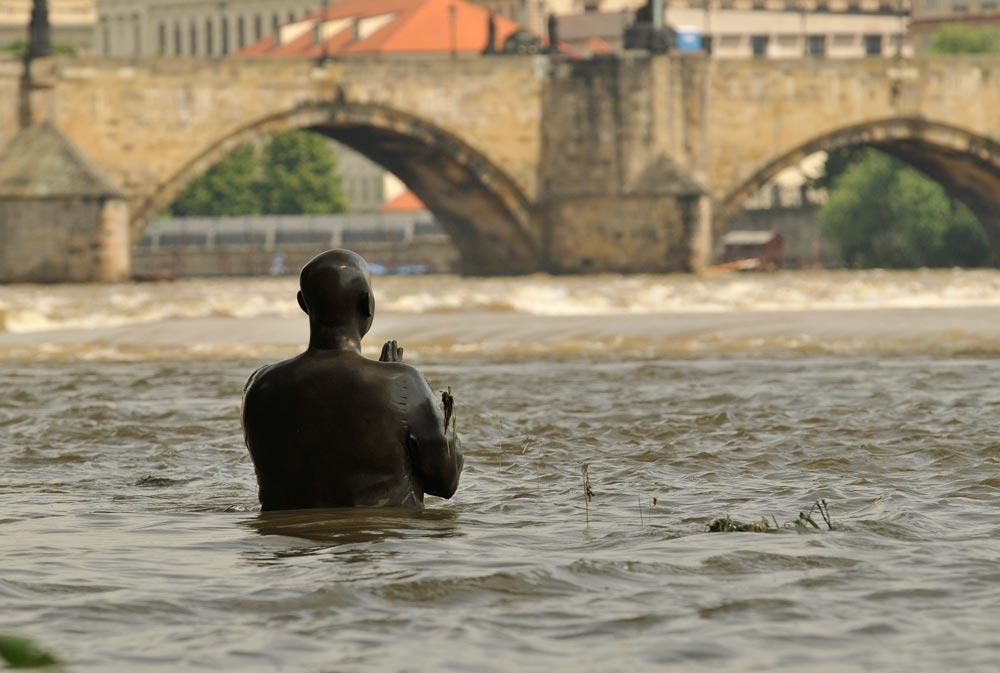
As floods ravaged Europe, a symbol of hope stood above the rising waters. Media outlets around the world – from Australia to China; from India to the USA; and from South Africa to the Middle East – published remarkable photographs of the statue of Sri Chinmoy in the flooded Vltava River in central Prague, Czech Republic, June 2, 2013.

The full-size, bronze statue of Sri Chinmoy, made ​​by British sculptor Kaivalya Torpy, was inaugurated in Prague on October 23, 2009. Now standing on the grounds of the Museum Kampa, it was the second statue of Sri Chinmoy in Europe – the first statue, inaugurated 2 years earlier, is in Oslo, Norway.


The statue of Sri Chinmoy can be seen is this local video of the Vltava River in flood.


Overview


The write stuff: Giving peace a chance

Scottish poet and author Alan Spence
writes about Sri Chinmoy’s message of peace.

A few weeks ago, I switched on the TV and tuned in to Channel 4 News. The main story was about the sudden floods affecting Europe. Jon Snow was talking about the damage caused, the lives lost, and film footage appeared behind him. One image in particular stayed on screen for some time. It showed a statue on the banks of the Vitava River in Prague. Read more in The Scotsman…
 

.
 

Sri Chinmoy’s Statue in Prague – calm in the midst of the storm

As floods ravage Europe, a symbol of hope rises above the waters.

Media outlets around the world – from Australia to China; from India to the USA; and from South Africa to the Middle East – have published remarkable photographs of the statue of Sri Chinmoy in the flooded Vltava River in central Prague, Czech Republic, June 2, 2013. Read more...
 

.
 

A Truth Must Be Lived

by Aparajita (Adam) Fishman

As Westerners, hence outsiders, we are most often struck by two aspects of Indian religion. At first, we are struck by the overwhelming multitude and diversity of forms in which God is worshipped. To our sensibilities, religion infects everyday life with almost brute force. In short, Indian religion is radically experiential in nature.

Next to this plethora of outer manifestations, perhaps even more striking is the astounding height and depth with which Indian philosophy probes the nature of the Cosmos, the amazing subtlety of the vision of reality it espouses. Read more...
 

.
 

Reflections on Meditation

Inspired by his spiritual teacher Sri Chinmoy, award-winning writer Alan Spence considers the meaning of meditation and its practice from a Hindu perspective.

The nice thing about being up early in the morning is the stillness, the silence. The hustle of the day hasn't really started, and it's a good time to just sit, quiet and meditate. My spiritual teacher Sri Chinmoy — a man I've known for over 30 years — expresses it beautifully: “Meditation is silence, energising and fulfilling. Silence is the eloquent expression of the inexpressible. Read more...
 

.
 

Why things go amiss with mysticism

Opinion piece from The Economic Times (The Times of India) by Mukul Sharma

Sri Chinmoy...once wrote: “Mysticism, poor mysticism! When it is under-estimated and oversimplified, it comes down from its original sphere and stands beside religion. But even here if a person is sincere, he will realise that his highest religious experience is nothing more than an uncertain, obscure and faint perception of Truth; whereas, no matter what kind of mystical experience he has, he will feel the intensity, immensity and certainty of Truth.” Read more...
 

.
 

The Voice of the Twentieth Century – Hope of the Future
A Commentary

by Animesh Harrington

Having crossed the threshold of the millennium, we begin to survey the unhorizoned timescape of possibilities before us. Yet with reflections of the past still in our thoughts, and so much of our lives still influenced by the twentieth century, we may be tempted to ask just how will the last 100 years be judged by future generations? We may never have a definitive answer, or we may have to wait centuries before historians arrive at a consensus, but we cannot merely extrapolate from the past or rely on commentators of current affairs to predict the future – we must be willing to see through the eyes of a visionary. Read more...
 

.
 

Remembering Sri Chinmoy

by M. Fazlur Rahman

Some have teardrops trembling in their eyes, some have the monsoon rains flowing from theirs, hands folded on the heart, all heads are bowed in sorrow. The world peace messenger, Guru Sri Chinmoy has left us all immersed in an ocean of grief. His body lies in wake at the ashram that he built; devotion-filled songs composed by him on every lip – ‘Amar Guru, Sabar Guru…’ Read more...
 

.
 

The Many Names of the Master

by Dr. Vidagdha Bennett

Sri Chinmoy came into this world between 5:13 and 5:30, an hour before sunset, on Thursday, August 27th, 1931. According to the Indian calendar, it was the month of bhadra, towards the end of the monsoon season. Throughout his lifetime, the child that was born on that day to Shashi Kumar Ghosh and his wife Yogamaya was known by many different names and appellations. This is a humble attempt to reveal the significance of some of these names. Read more...
 

.
 

Sri Ramakrishna and Sri Chinmoy

by Dr. Kusumita P. Pedersen

Sri Chinmoy is widely known as the exponent of a spirituality of transformation, a philosopher, a poet, a musician and artist, a humanitarian, and a server of peace.… For his entire life, Sri Chinmoy cherished a most intimate inner connection with Sri Ramakrishna, whom he profoundly loved and held in the highest possible regard. In addition to the special kinship claimed by many Bengalis, this connection was a spiritual one. this PDF article on page 120.
 

.

Ignorance-Night and Aspiration-Light


A lecture1 delivered at

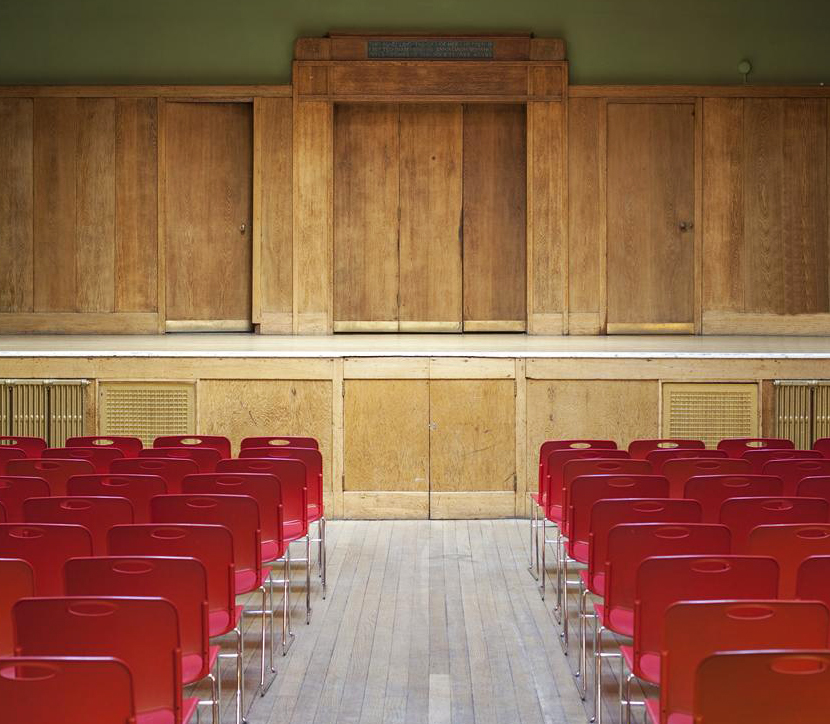
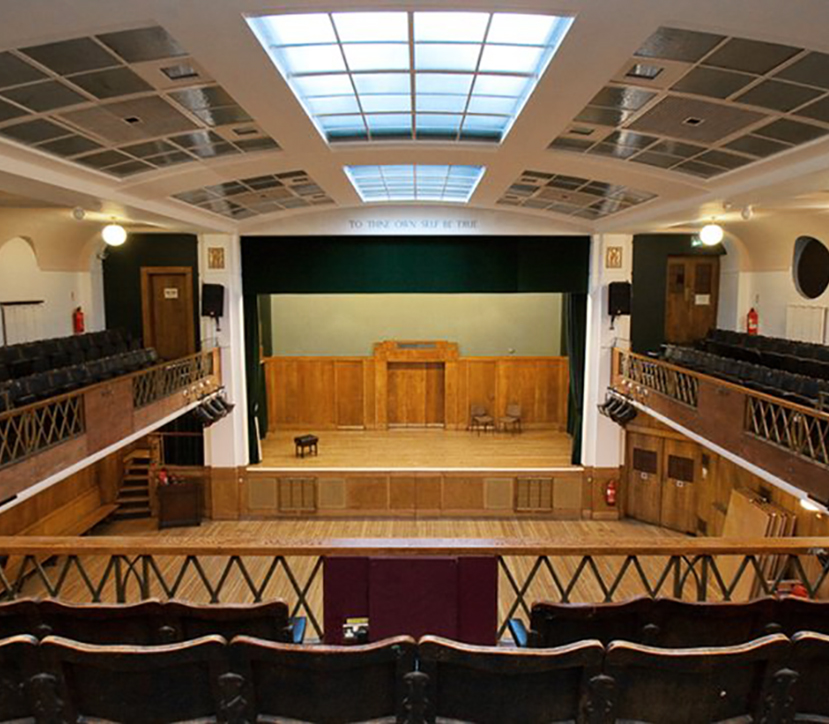
Conway Hall2, London

3rd December 1970
 

Ignorance is night. Night is ignorance. Aspiration is light. Light is aspiration. Today’s man has a name: ignorance. Tomorrow’s man has a new name: aspiration. The man of the day after tomorrow will have his real name: realisation.

Ignorance tells us: “No God! No God! There is no such thing as God.”

Aspiration tells us; “God is! God is! He is here. He is there. He is all-where.”

Realisation tells us: “God is everything, God is everywhere. Everything is God and everyone is God.”

Ignorance limits our earthbound consciousness. Aspiration heightens our Heavenward consciousness. Realisation liberates our soulful consciousness.

What is ignorance? What is aspiration? What is realisation? Ignorance is imperfection in the purest sense of the term. Aspiration is our inner cry for the highest illumination. Realisation is God’s Transcendental Smile on the seeker’s devoted head, aspiring heart and surrendered soul.

Now, what is consciousness? Consciousness is God’s open secret and man’s fulfilling life. Consciousness is the connecting link between aspiring humanity and illumining divinity. Consciousness is the connecting link between the glowing ascent of, our Mother Earth and the flowing descent of the fulfilling Heaven. Consciousness is the connecting link between earth’s transformation and Heaven’s absolute compassion. Consciousness is the illumining language that enables us to speak to God face to face. When consciousness is illumined, when consciousness is totally liberated and no longer earthbound, when consciousness becomes Infinity itself, then man has a free access to God. Then, at every moment he can listen to the dictates of his Inner Pilot.

In the life of aspiration, we come to realise eventually that God is everything and everyone. He is the Creator and He is the creation as well.

I am sure most of you have heard or read about a great spiritual figure named Vivekananda. Once he said, “Who else is God, if not I myself?” Now, if we think that he uttered these words on the strength of his own ego, we are mistaken. It was his total identification with the Highest that made it possible for him to speak this way. Similarly, the Son of God, the great Saviour Christ said, “I and my Father are one.” He said this on the strength of his conscious, absolute oneness, his inseparable oneness with his Inner Pilot. In days of yore our Vedic seers said, “Brahmasmi” — “I am the Brahman, the One Absolute.” They were able to say this on the strength of their own highest and deepest realisation. Each individual has not only the possibility but also the inner capacity to realise and grow into this truth. Possibility and potentiality we all have, but when we exercise our possibility and potentiality, then inevitability dawns and we reach our ultimate Goal.

Sat-chit-ananda: Sat means Existence, Chit means Consciousness, Ananda means Bliss or Delight. Existence, Consciousness and Bliss—this is the highest height, the triple consciousness. There, creation began its journey; there, the Truth is one. But when we come down one step, the song of multiplicity starts, because God wants to be fulfilled in millions and billions of forms. He wants to enjoy Himself divinely and supremely in infinite ways and in infinite forms and shapes. That is why creation started.

God has given to each individual limited freedom. This limited freedom we are misusing every day in our ordinary life. That is why it is almost impossible for us to come out of the meshes of ignorance. In the inner life, we have abundant freedom. But because we are not aware of this freedom, we are constantly caught in the in ire of ignorance.

One of our Upanishads, the Isha Upanishad, teaches us something significant. It says: Andham tamah pravishanti…. “Into tenebrous gloom and darkness one enters if one follows after ignorance; but into darker, more tenebrous gloom one enters if one follows knowledge alone.” Now, what is meant by knowledge in this case? This knowledge is the knowledge that we get from the physical mind, the reasoning mind, the doubtful mind, the sophisticated mind and the unillumined, intellectual mind.

The one who is in ignorance and darkness is simple and sincere to himself. He knows that he is ignorant of everything. This he says and feels in the inmost recesses of his heart. But those who are considered to be men of knowledge are constantly doubting God’s creation and doubting themselves. They feel they have come out of the animal kingdom and are a little bit superior to those who are still unlit, but they do not know what they are doing with their physical mind. This physical mind they are using to doubt, to break and to destroy — unfortunately, all unconsciously.

The Upanishad carries us farther. It says, Vidyam cavidyam ca yas tad vedobhyam saha. Avidyaya mrityum tirtva vidyayamritam asnute. “Ignorance and knowledge must be taken as one.” Avidyaya means ignorance and vidyam means knowledge. What we call ignorance eventually we will turn into human aspiration. Through human aspiration, we shall try to conquer death, and through divine knowledge, we shall enjoy Immortality.

Very often we meet people who have no faith in God, who are atheists. What do they do? They mock us. They think that spiritual people, sincere seekers, are all living in the land of the moon. They think that we do not want to face reality. I wish to tell you an incident. Two friends, one a stark atheist and the other a staunch theist, were talking together. The atheist said to his friend, “My friend, look what you have done. You have given up everything for God. You have given up your family. You have given up worldly pleasures, everything, all for God. You are really great.” That was pure sarcasm. But the immediate reply he got from his friend was, “My friend, you are greater than I. I have given up everything for God, but you are so great that you can live without Him! You are far greater than I.”

A problem arises for the householders, for anyone who wants to live a family life and, at the same time, realise God. They feel that it is next to impossible to realise God while living with their family while working and while using their earthly mind. I wish to say only that they should change their attitude toward life. They should try to see the divinity in humanity.

Suppose you think that your father is torturing you, that he has no wisdom. You don’t want to listen to him. All right, this is your outer father. But you should try to see inside him the living presence of God, your inner Father. The outer father may be totally ignorant, but the inner Father is all Knowledge, all Wisdom. Your outer mother — her outer existence, her physical mind — may be totally ignorant, but try to see the Goddess inside your mother. Try to feel the presence of God inside her. Try to see in your wife the divine beauty that inspires you toward perfection. Try to see inside your son or daughter a little divine child, God the Eternal Child. In this way, if you can see the divine in the human, then you don’t have to go to the Himalayan caves. You don’t have to leave your family and go to the top of Mount Everest to realise God.

Ignorance we all know. We are all swimming in the sea of ignorance. What we need is knowledge. Now, what is knowledge? If we go deep within, we come to realise that what we call knowledge, earthly knowledge, is our surrendering and dying strength for the new life and light. Every day, every moment, new life and new light are coming. Then we go a little farther and enter into the domain of wisdom. Wisdom is our illumining and fulfilling power, will-power, soul-power for the eternal Life and light.

There are two types of wisdom: human wisdom and divine wisdom. Love of God is the beginning of our human wisdom. Surrender to God’s Will, conscious surrender to God’s Will is the dawn of our divine wisdom. When the divine wisdom dawns soulfully, man’s forgotten essence is God and God’s fulfilling substance is man.
 

— End — 3


Endnotes:

1 ‘Ignorance-Night And Aspiration-Light’ was originally published in a personal account of Sri Chinmoy’s European lecture tours (1970-74) entitled Sri Chinmoy in Europe by Mahalakshmi, printed by Agni Press, New York, 1974. The lecture’s omission from My Rose Petals, Part 1 by Sri Chinmoy, in which all other lectures from the 1970 European Tour were collected, was cited by the author (Sri Chinmoy in Europe, p.21). It has subsequently never been published as part of Sri Chinmoy’s writings.

2 Conway Hall is owned and operated by Conway Hall Ethical Society, a membership organisation and educational charity with a history spanning two centuries. The name was chosen in honour of anti-slavery advocate and outspoken supporter of free thought Moncure Daniel Conway (1832-1907). The hall has become renowned as a hub for free speech and independent thought.

 
Conway Hall of yesterday...
 
and Conway Hall today.


3 After the lecture, Sri Chinmoy was asked several questions by the audience. The questions and answers were subsequently published in Sri Chinmoy’s book, Earth’s Cry Meets Heaven’s Smile, Part 2, printed by Agni Press in 1974.


Lectures


.
 

Long-Forgotten Lecture Rediscovered

The original speech at Conway Hall by Sri Chinmoy

Sri Chinmoy's first European lectures in 1970 were published in his book, My Rose Petals. However, his final lecture at Conway Hall in London on December 3rd, entitled ‘Ignorance-Night And Aspiration-Light’, was not included in this collection. It has hitherto remanned long-forgotten, never before published as part of as part of Sri Chinmoy’s writings. Read more…


.

Early writings 1945–1949

Preface

During his Ashram years, the young Chinmoy kept a vast number of soft-covered and inexpensive lined notebooks in which he recorded his poems, essays and dramatic works. He used English, Bengali and French as his medium of expression and frequently decorated the pages with artwork. Some of these notebooks are still in existence, while others were lost over the years, mostly in transit between India and America.

The first piece in this selection records an experience Chinmoy had at the tender age of fourteen — that is, in late 1945 or early 1946. The pieces that follow describe various inner experiences that took place when he was seventeen years old. They were initially printed in AUM Magazine, December 1972. Subsequently, several appeared in the slim volume Awakening, compiled and published by Janaka Alan Spence in Scotland in 1988.

In his Introduction to the book, Janaka describes these outpourings of the heart in the following way:

In an intensely heightened and consciously poetic language, [Sri Chinmoy] describes profoundly visionary experiences — meetings and sweet exchanges with personal forms of his ‘Beloved Supreme.’ These are both beautiful and deeply moving.

These lofty writings give us a rare insight into the earliest inner spiritual experiences and realisations of this great soul. They glow with astonishing freshness even across the divide of sixty years.


Compiled by Vidagdha Bennett


Table of Contents


1. A Sea of Light

Whenever I had the opportunity, I flew to the edge of the ever-blue sea and took my seat there in solitude. My bird of consciousness, dancing slowly, rose to the sky and lost itself up there.

On this occasion — it was a full-moon night — as I gazed and gazed upon the blue-white horizon, I found only light, a sea of sweet and serene light. All was engulfed, as it were, in an infinite Ocean of Light which played lovingly on the sweet ripples.

My finite consciousness was in quest of the Infinite and Immortal. I drank deeply of Ambrosia and was floating on an illumined ocean. It seemed that I no longer existed on this earth.

All of a sudden — I do not know why or how — something put an end to my sweet dream. No longer did the air emit its honey-like immortal Bliss, for my own depressed thoughts had come to the fore: “Useless, everything is useless. There is no hope of creating a divine world here on earth. It is only a childish dream.” I felt, too, that I could not go on even with my own life. This seemed to be nothing but a thorny desert strewn with endless difficulties.

“Why should I suffer these unbearable pains and sorrows here? I am the son of the Infinite. I must have freedom. I must have the ecstasy of Paradise. This ecstasy resides ever within me. Why then should I not leave this mortal world for my Eternal Abode in Heaven?”

A sudden flash of lightning appeared over my head. Looking up with awe and bewilderment, I found above me my Beloved, the King of the Universe looking at me. His radiant Face was overcast with sorrow.

“Father,” I asked, approaching him, “what makes Thy Face so sad?”

“How can I be happy, My son, if you do not wish to be My companion and help Me in My Mission? I have, concealed in the world, millions of sweet plans which I shall unravel. If My children do not help Me in My Play, how can I have My Divine Manifestation here on earth?”

Profoundly moved, I bowed and promised: “Father, I will be Thy faithful companion, loving and sincere, throughout Eternity. Shape me and make me worthy of my part in Thy Cosmic Play and Thy Divine Mission.”


2 i). A Vision

A radiant figure with a golden lyre of very soft and sweet cadence was seen singing in my heart. I asked Her, “Who and what art Thou?”

She answered, “I am the Divine Mother. As a fruit of penance covering many aeons I have got thee from my Beloved. I have brought thee forth on the bosom of the universe. In thy happiness and sorrow, in thy victory and defeat, I reside ever with thee. On thy journey to the Goal I lead and guide thee with infinite love and care of the Mother. It is I who am to unite thee, when thy part in the Play is over, with the ever-pure Self of my Beloved, thy Father. Thou art a hero, a prince, a lord of the cosmos. In thee is the seed of the whole immortal Self. And I am the eternal Life-Force, delightful and superconscient, come out from the bosom of the Supreme for Play.”

(1948)


2 ii). Lord of My Heart

“Who and what am I? Why have I come into this mortal world? And what is the aim of my life?” Some sort of answers to these questions arose in my mind. But my mind was not at all satisfied with them. All of a sudden, in a full moon night of spring, a young boy appeared before me. His face was so beautiful! And it seemed to me that his twinkling eyes were playing with the little waves of light.

He must have been in his teens, most probably fourteen or fifteen. I asked him very gently, “Where have you come from? And what do you want?”

He answered, “From your own heart I have appeared to fulfil your wish. Can’t you recognise me?” Soon I came to know that he was no one else but my Lord. I bowed down before His Lotus Feet and prayed to Him not to leave me alone any more.

My Lord said, “I will never leave you. Remember ever that he alone who loves Me wholeheartedly, without any desire, and likes to play ever with Me, is dear to Me. He is my very soul. Alas! Only a few companions I have in this world.”


2 iii). Farewell of Ahana

Slowly, very slowly Ahana (Dawn) puts off the veil of darkness and shows her face to Dharitri (Earth) for a while. When she appears before Dharitri, Dharitri asks, “Ahana, my sister, where do you go after staying with me?”

“My sister, you do not want me. When I approach you, having smiled a little, you bid me farewell and invite Savita (Sun-God). You know I cannot stay when the chariot of seven lighted horses is seen.”

Savita is seen ready in his golden chariot of light, to court Dharitri. All of a sudden, she cries aloud, “Savita, my friend, and beloved! I shall no more invite thee and thou must not come to me henceforth,” and instantly closes her eyes. Savita is shocked and retires to his home of the other firmament.

Aeons pass away in a sweet and serene trance in expectation of Light. Suddenly Ahana murmurs into the ear of Dharitri, “Sister, my sister! Are you awake? My sisters that are to follow me — the dawns of the future — cannot appear if Savita does not finish his courting with you. Invite then your beloved! I must take leave of this form. I must make way for my sisters — myself in other forms. I come forth from Savita and vanish in him. I must come again and again to paint the sky for the chosen illumined.”

Au revoir, then my sister, au revoir.

(1948)


2 iv). Slowly — but Steadily and Unerringly

Millions and millions of years our mother earth Basundhara was in one body with Savita, the Sun. Our mother on whose laps we are born, grow, play and retire after finishing our part has taken millions and millions of years to be what she is now.

Banaspati, the King of the trees, hides himself in a tiny seed. With the help of light, air and food gradually it becomes a huge tree. Who will believe by seeing a little particle of seed that it will one day grow into a gigantic banyan tree and will live thousands of years? A time may come when a weakling of today may, gathering courage and strength, become a Timur or Hitler before whom nations trembled in horror. Or an ordinary child of today may grow up as Christ, Ramakrishna, Buddha, or Sri Aurobindo through whom God will reveal Himself to the Earth. Even if we see no mark of progress, no appreciable change, progress and change are going on. Unnoticed yet, under the secret guidance of God through nature.

We should remember what the world-famous poet, Tagore, once sang with so beautiful and sweet voice, “I know well, very well, the river that has lost her flow in the desert-way has not lost herself nor her way.”

One’s endeavour is not finished even when one’s days are numbered with the dead. Death is nothing but changing one flow of life for another. Man is going on slowly, but steadily and unerringly to fulfil his mission, to be the Divine. The finite is going to realise the Infinite hidden in its core. Seeming weal and woe, seeming light and darkness, seeming success and failure are the process through which the Incarnate Supreme is becoming the Transcendent. Everything exists, nothing does perish. What is within, under the pressure of the omniscient and omnipotent is becoming what is above — slowly — though it may seem — but steadily and unerringly.

(4/26/49)


2 v). Awakening 

Midnight. The sky was overcast with clouds. It was raining in torrents. I do not know why and what for a sweet surge of bliss entered my heart and awakened me from my sleep. I got up. After a while I began to look hither and thither. I found nobody and was unable to know from whom the sweet bliss had come. So with a heavy heart I was going to have my sleep again. All of a sudden someone in me cried aloud, saying, “Look to the sky, my dear, just have a look to the sky.” I looked to the sky. It was raining no more. No cloud was seen in the sky. The eternally pure face of the moon was shining brightly.

Soon I felt my bird of consciousness was dancing merrily in the bosom of the Moon. Thither I found a sweet and flower-like hand calling me with great love. Soon dancing with infinite joy, my heart began to fly up to the blue sky from where my friend was beckoning me.

On the way only once I looked down on the earth. There I saw some earthly beings calling me with great affection and requesting me not to go to my Goal. While on the other hand, some were saying, “Our loving friend, proceed on, onward. Hearken, our Beloved is calling you.” I responded to the ardent wish of the latter.

I reached my Goal. The flower-like hand commanded me to go into the depth of my heart and see His whole creation. With what a joy I saw His entire creation in me. Soon the Hand touched my head lightly and transformed me into light, love, and beauty.

(6/1/49)1


Editor's notes:

1 These dates are in American format.


Ashram Notebooks


.
 

Early Writings

by Sri Chinmoy

During his Ashram years, the young Chinmoy kept a vast number of soft-covered and inexpensive lined notebooks in which he recorded his poems, essays and dramatic works. He used English, Bengali and French as his medium of expression and frequently decorated the pages with artwork. Some of these notebooks are still in existence while others were lost over the years, mostly in transit between India and America. Read more…


.
 

Notebook: 1948

by Sri Chinmoy

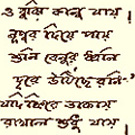
The following eleven poems are photocopied from Sri Chinmoy’s Notebook of 10 and 11 January 1948, with the addition of one poem from 15 August 1948. These poems were all written when he was sixteen years old. Sri Chinmoy’s original Bengali handwriting is hereby reproduced, as well as his own English translations. Read more…


.
 

Enter We Must

by Sri Chinmoy

This is a rare excerpt from Sri Chinmoy’s unfinished epic, begun in India in 1948. He worked on it extensively over the next few years, but it seems he did not continue with the project after he came to the West in 1964. Like Sri Aurobindo’s “Savitri”, this epic is also written in unrhymed iambic pentameter. Read more and listen to Sri Chinmoy’s own recitation…


.

Enter We Must


Enter we must into the Core of the One

And breathe the Eye of sovereign Absolute.

Him we desire and Him we love and serve

And Him to manifest our earth descent.

No, not our choice Nirvana’s height and depths.

No, not our choice the Superman’s world surprise.

No, not our choice Heaven’s rare splendour-smile.

But God blossoms in the world throes and penuries;

God blossoms all-where on earth, our choice supreme.
 

(1948)


Sri Chinmoy Recites this Poem.


Notes:

1. This is a rare excerpt from Sri Chinmoy’s unfinished epic, begun in India in 1948. He worked on it extensively over the next few years, but it seems he did not continue with the project after he came to the West in 1964. On 24 November 1995, Sri Chinmoy was inspired to set the above portion to music, thus giving us a rare glimpse of the striking power that the poem embodies. Like Sri Aurobindo’s “Savitri”, this epic is also written in unrhymed iambic pentameter.

2. The recording of Sri Chinmoy’s recitation is from My Prayerful Salutations To The United Nations CD 4, released in 1996.


Copyright © Sri Chinmoy. All rights reserved.

Enlightening

Table of Contents


Sri Chinmoy narrated the following three stories to his students who were gathered in Cairns, Australia, on 5 January 2003 for their annual Christmas trip.

1. Beethoven’s Sincerity Speaks

Sincerity inspires, encourages, illumines and fulfils the world. Ludwig van Beethoven, an immortal composer and a musician of the highest order, once offered a magnificent piano performance. The audience gave him a standing ovation, which lasted for a long, long time.

At the end of the programme, an elderly lady came up to Beethoven and said, “How I wish I could be a genius like you! How I wish I could have magic hands like yours!”

Beethoven immediately replied, “Madam, there is no genius involved; there is no magic involved. If you are prepared to practise eight hours a day for forty years, like me, then you can easily play like me. Just start practising many hours a day, and do it for many, many years. One day you shall most definitely play as well as I do, I assure you.”

Just as soon as many other great musicians are admired by the world as a true genius, they most assuredly think and feel that their musical capacities are far, far beyond the reach of ordinary and even extraordinary human beings. They will act as if they are divinity’s most precious gift to humanity. In Beethoven’s case, he was one of the greatest musical geniuses the world has ever seen. But he was not at all bloated with pride or arrogance. What wonderful encouragement he offered the elderly lady! Other musicians would not have been sincere. Others would proudly say, “Thank you! It is true that I am a genius, and this genius capacity comes directly from God. Right from my birth, God created me as a supreme musician.”

We all need to receive the sincere encouragement that Beethoven offered. For, when this encouragement comes from the greatest human beings in any field, it has tremendous power. How hard these geniuses work for years and years, and often they go totally unrecognised for decades. There are so many extraordinary and pre-eminent scientists, musicians, artists and others who work extremely, extremely hard day in and day out for years and years.

In the days of Beethoven, and for centuries before, people who created or discovered something really great simply offered it to the world. Usually they did not receive any special recognition or extra money.

Nowadays, if a scientist, for example, discovers something most significant, the Nobel Committee is there to present the scientist with millions of dollars. If not that, then a major university will offer the scientist a new laboratory and so on. Then the person becomes very rich. They offer their great discoveries and also receive great compensation. Yet in no way were the discoveries of the hoary past inferior to the modern-day discoveries. What did the brilliant scientists of some two or three hundred years ago receive? On the one hand, they did not or could not fill their pockets with very large amounts of money. On the other hand, they were inundated with appreciation, admiration and love. Because of their big hearts, they offered their discoveries and services for the betterment of mankind without charge. God Himself compensated these great scientists with His infinite Blessings, Love and Pride.

Each person must choose what they want: money-power or heart-power. While the two sometimes go hand in hand, it is the inner aspiration of the individual that is of paramount importance. Do we desire the increase of our money-power or do we aspire for the expansion of our heart-power?


2. Napoleon Bows before Saint Francis

Napoleon the Great was travelling once through Italy with his mighty troops, including several of his generals. He was at the front of a very large and majestic procession, having already conquered many lands.

On the way to their next destination, Napoleon saw a statue of St. Francis of Assisi. Napoleon commanded the entire procession to come to an immediate halt. He then removed his headgear and bowed. The generals were shocked. They said to Napoleon, “Sir, you are the greatest man in the world. You never bow to anyone, nor do you show respect to any other human being on earth. The entire world knows you and reveres you as the most indomitable figure ever to walk on this earth. How is it that you have taken off your headgear now?”

Napoleon replied, “I need guns and cannons to conquer the world. Once I conquer one country, another country revolts and then I must go there to quell their revolt and re-conquer the country. My victories are in no way permanent.

“Look at St. Francis! He was such a great saint. He had no weaponry – not one gun, not one cannon. I have countless weapons, but he had only one weapon: love. With that love-weapon, St. Francis conquered the entire world. With all my guns, cannons, ammunition, armies and more, my victories are never, never lasting. But his victory is everlasting, and his sole weapon was love.”

The generals were deeply moved by Napoleon’s humility. The greatest and most powerful man on earth recognised his own limitations. Napoleon Bonaparte announced to all his troops that one simple saint was far, far more powerful than himself. In this way, Napoleon won the one-pointed love, admiration, devotion and loyalty of his troops.


3. Abraham Lincoln chooses God’s Victory

The great American President, Abraham Lincoln, had many saintly qualities. He did so many good and great things for America. This story took place when he was fighting alongside his army during the Civil War. There was a tremendous battle going on and God alone knew which side was going to win.

Lincoln’s Commander-General asked him, “Do you know what is in God’s plan? Do you feel that we are going to be victorious, or shall we go down in shameful defeat?”

Abraham Lincoln replied, “My problem is not the victory. My problem is to be certain that I am on God’s side. I am praying to God. I do not know if we shall win or lose this war. But my constant prayer is for God’s Victory. I pray that He will accept me and this nation to be on His side. I am not at all praying to God to take our side and defeat our enemies. No, never! I want God’s Victory, not my victory. This is my only prayer.”

The Commander-General and all his men were profoundly moved by Lincoln’s spiritual depth, which he maintained even during the thick of battle.

During his second inaugural address, soon before his victory, Lincoln once again affirmed his faith in God and his prayer for God’s Will to be done. Referring to the North and the South, Lincoln said, “Both read the same Bible, and pray to the same God; and each invokes His aid against the other. It may seem strange that any men should dare to ask a just God’s assistance in wringing their bread from the sweat of other men’s faces; but let us judge not, that we be not judged … The Almighty has His own purposes.”

As it turned out, God’s Victory was definitely won in and through President Lincoln’s most courageous leadership. Alas, he was assassinated just a few days after that immortal victory.

Sri Chinmoy narrated the following stories in Cairns, Australia, on January 20 and 23, 2003.

4. The Power of Kindness

The kindness aspect of life carries us far, very far, towards our destination. How kindness can change human nature for the best!

There was a school with quite a few students. Most of the students were excellent. There was only one unfortunate boy who was not at all a good student. At the same time, he had a very bad habit: he used to steal. Quite often this boy missed class in order to steal people’s money and other valuables.

Some of the boys lived in a dormitory and, from time to time, they found that their money was missing. This went on for a long time and the students became extremely frustrated. They had no idea who the actual thief was.

A brilliant idea flashed across the mind of one of the most intelligent students. On one particular day, this boy pretended to be sick and did not come to class. He was hiding in the dormitory. As fate would have it, the student who was in the habit of stealing came into the room to steal something and he was caught red-handed. The good student immediately informed the school authorities. Word spread very quickly around the school that the thief was caught. All the students came to know who the culprit was, and they started insulting him ruthlessly.

The teachers wanted to take the matter to the police. They said, “This boy should be punished! He should be put in jail!”

The headmaster firmly told them, “No, I will not allow that. It will bring disgrace to my school. Plus, I really want to help this boy and also help the other students.”

The headmaster called all the students and teachers together, including the boy who stole the money. He said to the students, “You people must be frank with me. I would like each one of you who has lost money to tell me how much you have lost.”

One student said, “I have lost ten dollars.” Others said twenty, thirty, forty and so on. The whole amount came to $300. There and then, the headmaster took out $300 from his own wallet and returned the exact amount that had been stolen to each student who had lost money.

The boy who stole all this money was badly humiliated. Then the headmaster said to him, “You may return to your classroom. You should complete all your courses.”

The boy obeyed the headmaster and resumed his classes. However, the other students continued to look down on this boy. They spoke about him behind his back and made fun of him to his face. When the headmaster heard what was going on, he was extremely sad. He told the students, “The way you are behaving is not good. We have to conquer people with our kindness. You are all my students. I will be the proudest person if you please try to develop kindness, compassion and forgiveness.”

The head of the school was truly an excellent human being. Unfortunately, neither the students nor the teachers listened to him. They simply could not look upon this particular student kindly or favourably. Immediately after being caught, the boy had stopped his stealing. He was determined to live a good life, but he was taunted again and again because of his past actions.

The headmaster repeatedly pleaded with his students and teachers, “I am begging you to please be kind to this boy. He has totally given up his stealing. All of us have weaknesses that we must conquer. Please try to find kindness, compassion and forgiveness inside your hearts.”

Slowly but surely, the headmaster’s pleading worked. People began treating the boy with sincere kindness and concern.

After four or five years, he completed his studies and went to work. He obtained an excellent job building houses. After he received his first pay check, the first thing he did was to withdraw $300 in cash and go to his old school. The headmaster was still there.

With folded hands, the young man offered the money to the headmaster and said to him, “I am eternally grateful to you. You saved my life. Everyone else wanted to cast me into jail, but you did not allow them to do so. I stole $300, which you yourself gave to the students from whom I had stolen the money. Now I am returning the $300 to you.”

The headmaster began shedding tears of joy and pride. He embraced the young man and said, “My son, my kindness has been most powerfully rewarded. I am so proud of you and so grateful to you. In the future, my boy, do not steal. Never steal.”

The young man replied, “I have completely stopped stealing. Never again in my life will I steal. I have turned over a new leaf, and it is all due to your kindness. I assure you, if and when I have children, my children will not be affected by what I have done. They will not be like me. I will only instil sincerity, kindness, concern and compassion into my children’s hearts and lives, just as you have done to me.”

Again and again the young man offered his gratitude to the headmaster, saying, “You saved my life! You saved my life!” Then the young man bowed to the headmaster very deeply once again and took his leave.

The following day, the headmaster related this particular incident to all the students. Most of the students who knew about the stealing episode had already passed their examinations and graduated.

The headmaster said, “Many years ago, somebody was not doing the right thing in this school. He stole money from so many students during the day while they were having their lessons. When he was finally caught, someone showed kindness to this boy. Most people wanted to put him in jail, but someone did not allow that to happen. The boy immediately turned over a new leaf and became very, very good and nice. I am telling you all this because I do not want you to repeat the same story.

“You must not develop the habit of stealing. At the same time, you must not develop the habit of looking down upon others. We all have weaknesses. At what point weaknesses will dominate us, we have no idea. If we become kind and compassionate to others, there is every possibility that our compassion, kindness and forgiveness will work miracles in their lives and in our lives as well.”


5. The Divine Curse

There was once a spiritual Master in India who had about ten disciples. The Master was extremely strict with all his disciples. Sometimes he used to actually strike them if they were not behaving well.

It so happened that once the Master was very sick. Even so, he was scolding three disciples most powerfully because they were not pleasing him with their aspiration. The disciples could not control their anger and they started beating the Master black and blue.

The poor Master was close the death. He said to those three disciples, “You have badly beaten me. I am dying now. But I am going to curse you. You will not believe what my curse is: from the inner world, I shall send you to a Master who is infinitely higher than me.”

In a few days’ time, the Master passed behind the curtain of Eternity. About one year later, the Master was repeatedly coming to those three disciples in their dreams. He was inspiring, begging and commanding them to go to another spiritual Master. He told them, “You will not be able to strike this Master. He is infinitely higher than I am. You go! Your new Master will be near the Bay of Bengal, and he has many disciples.”

Their Master gave a full description of the new Master. Only he did not mention his name. So the three disciples searched for the new Master and found him near the Bay of Bengal. They joined his Ashram and began to aspire most sincerely. Eventually, they wrote a book about how they were responsible for their former Master’s death. Look at the nobility and vastness of their Master’s heart! Their punishment was to go to a higher Master.


6. Only God can Cure Her

About one hundred years ago, there lived in India a very good and kind spiritual Master. Let us call him Guru Raghunath. At that time, he was eight-five or ninety years old and he was extremely ill. His dearest disciple was a woman. One day she came to care for her Master and, instead, she got angry with him for some silly reason. She struck him with a very large wooden spoon. Guru Raghunath fell down from his bed and died.

There were three or four other disciples present in the room and they witnessed everything. They hated this lady, but they did not report her to the authorities.

This story never ends! Many years later, another Master – let us call him Guru Achal – was in northern India to give a talk. Before it started, one man stood up and came near him. The man was screaming, “Where is your cross? Where is your cross?”

The man wanted Guru Achal to show his cross. Otherwise, he felt that Guru Achal was not authorised to speak.

Another man stood up and said, “Jesus Christ himself was a Jew!”

Yet another party came to the Master’s rescue and screamed at the first man, “You show Jesus Christ your cross!”

Finally, everyone calmed down and the Master was able to give his talk. After everything was over, a lady came up to the Master and said, “Guru Achal, Guru! Please do me a favour.”

He asked her, “What kind of favour would you like?”

She replied, “Please tell me the truth. I am Guru Raghunath’s disciple. People say that I struck my Master and killed him. Is it true?”

This was the question that lady was asking the other Master! He was so shocked. He said to her, “Am I the one to answer this question for you? You killed your Master and you do not know?”

“Oh, no, you have to tell me!”

He replied, “I do not know whether you struck your Master or not. You are the one to answer this question.”

Then the lady put her hands on her throat and started massaging it. She said, “Please save me!”

“What has happened?” he asked.

“I have got a growth in my throat. You can cure me!”

“I do not have that kind of power,” Guru Achal told the lady. “There are other Masters who have that power, but I do not.”

She continued, “No, no. I know you can cure me. Can you not at least touch my throat?”

“O God! I cannot touch your throat. I am very sorry,” said Guru Achal. “But I can do one thing.”

“What?” she asked.

The Master answered, “I can pray to God to cure you.” The lady was very happy that he would pray to God on her behalf. Actually, he could never pray to God to cure her. Only he prayed to God, “Let Thy Will be done.”


7. One Spiritual Master Saves Another

There was a very, very high spiritual Master. Let us call him Master Balakrishna. One day he was meditating most powerfully in a forest. Alas, the forest was extremely dry and it caught fire. Master Balakrishna was about to be burned to ashes.

Another spiritual Master – let us call him Lalit – became aware of Balakrishna’s plight. Lalit had conquered fire and, therefore, it could not burn him. He assumed another form so that Balakrishna would not be able to recognise who he was. He went to Balakrishna and grabbed him in his arms like a child. Then he carried him away from the fire. In this way, Lalit saved Balakrishna’s life.

Many years later, Balakrishna went to see Lalit because Lalit was such a great spiritual Master. When Lalit saw Balakrishna, he said to him, “Do you remember an incident where you were meditating in a forest and then the forest caught fire?”

“I do seem to recall something,” answered Balakrishna.

“Somebody came and … ”

“Yes!” exclaimed Balakrishna. “Somebody came out of the blue. He grabbed me and took me out of the forest to safety. That person saved my life!”

Lalit asked, “Who was that person?” Then he assumed the same form that he had taken when he saved Balakrishna. “You see,” he said, “I am the one who saved you.”

Balakrishna knew that someone had come and saved him from the fire, but he had no idea who it was. There was no resemblance at all between Lalit’s ordinary form and the form he took when he entered into the forest to save Balakrishna.

After this, Balakrishna and Lalit became very close to each other. Lalit always wanted Balakrishna to go much higher than his own present spiritual height. He would tell him, “You can still go much higher, much higher! Why are you not going as high as you can?”

At that time, Balakrishna had many disciples. To them, Lalit also criticised Balakrishna. “You have such a bad Master!” he would say. “He is not going nearly as high as he is able to go.”

The disciples used to get furious. They would say, “You have no right to speak ill of our Master. How dare you criticise him!”

The time came when Lalit decided to take his earth-departure. He said to Balakrishna, “When I leave the body, I would like you to take care of my Ashram and all my disciples.”

Balakrishna was stunned. “No, I can never do that,” he said. “You always say such bad things about me. You constantly criticise me. How can I take care of your disciples?”

Master Lalit said, “No, no! My disciples are no match for you. You are much, much more developed than they are. Only I want you to go higher yet. That is why I have criticised you in front of your disciples.”

Master Balakrishna answered, “I do not want to take your position. I will not do that.”

“All right, all right,” said Lalit. “All I am asking you to do then is to pray and meditate more sincerely.”

By that time, Balakrishna had acquired much occult power and he had had many, many high, higher and highest spiritual experiences. He also had many disciples of his own. He never accepted a single spiritual Master. He had three or four Masters who helped him greatly. For a few years, he would have one Master and then somebody else would be his Master.

Sri Chinmoy narrated the following story on 12 December 2004 in Xiamen, China.

8. Not to Judge, But Only to Love

Once a prominent spiritual Master was invited to offer a talk by the mayor of a certain town. The spiritual Master had never been to that town before. He very happily accepted the invitation and decided to travel there alone. Though he had many, many disciples throughout the land, he had none in this town.

The mayor made all the arrangements for the Master’s visit. He reserved a large hall where the Master could offer his talk, and he had notices put up everywhere inviting all those interested to attend. Everyone was extremely happy and proud that such a famous spiritual Master was coming to their town.

One spiritual seeker named Jyotish asked his friend, “Have you heard the news? A very great Master is coming to town. He will meditate and give a talk. Who, know, he may even show us some of his occult power!”

His friend Madhu replied, “Fantastic! I did not know of this. We cannot miss it.”

Like this, the Master’s forthcoming visit became the talk of the town. Everyone was most eagerly looking forward to the renowned Master’s arrival. Finally, the day of the talk arrived. People from the town, and even many people from the surrounding villages, had come to listen to the Master and meditate with him.

Madhu excitedly telephoned his friend early in the morning. “Jyotish, we must arrive at least four hours early in order to get a good seat!”

“Yes, of course,” Jyotish replied.

The friends agreed to leave at eleven o’clock to walk to the town hall where the Master would be speaking. It was the largest meeting hall in the entire town. The talk was to begin at four o’clock in the afternoon. As usual, the mayor himself would not be attending, but he had done an excellent job of letting all his townspeople know about the Master’s coming.

A wave of tremendous spiritual excitement had spread throughout the town. All the people were thrilled in anticipation of being in the presence of a great spiritual figure. The men were wearing their cleanest white dhotis and kurtas, and the women were wearing pure white saris.

Hours before the master’s talk, people were streaming down the main road of the town in large numbers. Just near the mayor’s mansion, and a few blocks from the town hall, all those who were passing by saw an old, unkempt man sleeping on the side of the road. His grey hair was long and dishevelled. His beard was completely uncared for. His clothes were simpler than the simplest. Nobody had ever seen this old man before.

Because people were going to attend a spiritual function and were in a good consciousness, most of them took compassion on the old man. Some kind-hearted people gave him bananas and other food.

“Here, take this, old man,” one nice mother said. She was going to hear the Master with her four young children. She put a small bowl of rice right in front of the old man. Then she and her children went on their way.

A few people were far less kind, and some of them even cursed the man. “Horrible! Horrible! Are you even a human being? Get out of here!” they cried to the poor, dishevelled man. “How dare you to be here dressed like that on such a sacred day as today! Go! Go away!”

But the old man seemed only to sleep and sleep.

Finally, the time came for the Master’s talk. When the Master entered the hall, there was a stunned gasp from the audience. “What! This is the Master? This is the Master? There must be some mistake!” they exclaimed. They were all shocked, for the Master was none other than the same old beggar they had all passed by, who was lying down on the road and sleeping.

The Master simply bowed his head and meditated in complete silence for several minutes. Then he spoke slowly and with tremendous intensity. “I am extremely grateful to all of you for coming here today to attend my talk. I have not come here to judge you. I have come here only to love you.”

Then the Master continued, “All of you who passed by me this afternoon judged me. You said to yourselves, ‘This man is so poor! He is so dirty! What is this old man doing sleeping on the road like this on such an important day? How dare he?’ Some of you were extremely kind to me and even offered me your food. Others were less kind. They made fun of me or showed their anger. I wish to tell you that the spiritual life is not to judge, but only to love. If you can all follow this one divine teaching, then you will make tremendous progress in your spiritual lives. You will see immediately what a difference this will make in your own inner life of aspiration and in your outer life of dedication.”

Without saying another word, the Master blessed each and every person in the hall in silence. Then he bowed his head once more and slowly walked out of the hall.

When the Master returned home, his spiritual children were extremely eager to hear how his trip had gone. The Master simply smiled and said, “I gave a talk. It went very well. I said that I have not come into the world to prove anything. I have not come into the world to judge anyone. I came into the world only to love everyone and everything.”

All the disciples were deeply moved. They bowed to the Master and silently filed out of the room.

Sri Chinmoy told the following story on 2 December 2005 at Pangkor Island Beach Resort in Malaysia. Later he said to his students, “This is a most significant story. I shall be grateful if you occasionally read this particular story. Then you will know the real meaning of obedience.”
 

9. The Obedient Student

A Teacher, or Guru, was teaching religious as well as regular studies. In India, even a schoolteacher is called a Guru. In the morning, about fifteen or twenty young boys used to go to their Teacher’s school to study and play, and in the late afternoon they used to come back home.

One day the Teacher (or Guru) asked a particular boy to do something. What was it? While the students were playing, the Teacher summoned the young boy and said to him, “Throw my child into the well.” The Teacher’s child was only five or six years old, but the student did not hesitate, even for a fleeting moment. He grabbed the child and threw him into a nearby well. The other students noticed it and came running. Two or three entered into the well and brought the child back out, and other students thrashed the particular student who had thrown the child into the well. The student did not say a word. Meanwhile, the Teacher was watching the whole situation. He also did not say anything.

A few months later, while the students were playing, the Teacher summoned the same boy and said to him, “Set fire to my house.” Again, the boy did not hesitate for a second. He immediately set fire to his Guru’s own house. The Guru’s wife was inside, and she was shouting and screaming. Then, as usual, the rest of the students struck him mercilessly, saying, “How did you dare to set fire to your Guru’s house?” Again, the boy did not say a word. He did not say that his Guru had asked him to do this, and the Teacher also was silent, not saying anything. The other students could not fathom it: how could the Teacher be so indifferent?

As the days ran into weeks, the weeks into months, and months into years, there came a time when the students grew up and entered into their own way of life. By this time, the Teacher had become very, very old, so he invited all his various students, past and present, to come and see him. They all came, and the Teacher started blessingfully giving them some material objects, such as plots of land and other things. Whatever he had, he wanted to give away to his students. They were all very happy. Then they noticed that for some reason, that particular student did not receive anything, perhaps because the Guru felt that he had not been a good student. The others were wondering why the Guru had not given him anything.

At long last, the Teacher said to the boy, “I have nothing to give you on the material plane that will equal your obedience. I have never seen, and I will never see, anybody who is so devoted to his Teacher. I have never seen anybody as obedient as you are, and whatever I give on the material plane will not be equal to your obedience.”

Then the Teacher said, “I am giving you a boon. The boon is this: in a few years, the Lord Himself will come to you as your student. Lord Krishna will come and be your student. This is the greatest gift that I can give you. I am the happiest person to tell you that the Lord Himself will come and study with you.”

The name of this particular student was Sandip Muni. He became the Guru of Sri Krishna. He had this kind of obedience to fulfil his Teacher’s requests.

Sri Chinmoy told the following story at his house in Jamaica, Queens, on 6 June 2007.

10. This World is Boring

There was once a very, very good king, a superlative king. He was kind-hearted, compassionate and wise. In every way, he was so good, unimaginably good. All his subjects took him as their father. They were so fond of him.

One day the queen was massaging the king’s head with coconut water. While massaging him, there were tears in her eyes and these tears were dripping on the king’s nose and on his whole body.

The king became so concerned. “Why are you crying? Why are you shedding tears? Have I done anything wrong? Is there anything that I will not do for you? Tell me! If anybody has insulted you, I shall punish them. Although I am a very kind-hearted person, I will not forgive anybody who has misbehaved towards you. So please tell me what is wrong. You are dearer than the dearest to me.”

The queen said, “No, no, nobody has insulted me. I am crying because just now I found one white hair on your head.” She showed it to her husband and said, “I am crying because you are getting old. One day soon you will die. Then how can I live without you? Who will take care of me?”

The king tried his best to console the queen. He said, “Is there anybody who will not become old? Life is like that. Everybody will eventually be old. I am getting old, you will become old, everybody.”

But the queen was crying and crying. “Oh, you are getting old, you are getting old. You will die soon.”

Finally, the king said, “You are right.” He ruled only for a few more years. Then he placed his son on the throne and went with his wife to the forest. He said, “I cannot deal with the problems of my kingdom any more. Now I am really old. Let me spend the rest of my days in prayer and meditation.” So the king entered into the spiritual life.

The king’s subjects loved him so much that they accompanied him to the forest and then they did not go home. All of them stopped eating and then they started praying to the sun god. They prayed and prayed for a long time. The sun god was pleased with their prayers and he appeared before them. “All right,” he said, “what do you want?”

They answered, “We want our king back so that he can rule us for ten thousand years.”

The sun god granted the boon and then they went to the king to inform him. The king said, “I do not want, I do not want, no!”

But the sun god forced the king to come back to the kingdom and rule for ten thousand years. The poor king said, “O my God, O my God! What am I going to do?” Then, as the years went by, he saw that people who were younger than him were all dying in front of him. One by one, his subjects were all leaving the earth plane. The king cried, “What kind of boon is this?”

Then he started praying and praying to the sun god. His prayer was, “Please, please, please give them also ten thousand years. Since I am supposed to live for ten thousand years, let my subjects be with me.”

After many years, the sun god was pleased with the king’s prayer and granted the boon he desired. So they were all living for ten thousand years. Now it happened that after a few years, some people became so miserable. They were saying, “We are living for ten thousand years here on earth, but there is no joy. This world is boring, boring! We do not want to be here for so many years.” They were murmuring that they were not pleased with their boon.

It seemed that nobody was satisfied. So the king prayed and prayed to the sun god once more. This time he prayed, “Please give us some wisdom what to do with your boon.”

The sun god replied, “Never stand against God’s Will. If God wants you to die today, you die. If He wants somebody else tomorrow, then that person has to surrender. It is all God’s Will. When God wants you to die, you should take it happily. Otherwise, you will go against His Will.”

Here people were thinking, “We are immortal.” But afterwards, they discovered it is boring. What are they going to do on earth for ten thousand years? Are they happy living on earth for so long? God fulfilled their desire, true, but when God fulfils our desires, it does not mean that we are going to remain happy. On the contrary, we will feel miserable.

God says to us, “You will always be miserable if you want to please yourself in your own way. But if you please Me in My own Way, then only you will be happy.”

Sri Chinmoy told this story on 17 June 2007 at Aspiration-Ground, New York, during a special Father’s Day function.

11. The Riddle

There was once a king who had a most beautiful daughter. She was endowed with beauty, intelligence, self-giving and many other virtues. When she was of age, her father wanted her to get married. She told her father, “I am ready to marry, but first I shall have to ask the person only one question. Whoever can answer the question correctly, I shall without fail marry.”

Many, many prospective bridegrooms came to the court. They were from different walks of life and they were all eager to marry such a beautiful, intelligent and pious girl. To each one, she posed the same question. Her question was: “Who is both blind and not blind at the same time?”

Some of them were puzzled; others became angry or disgusted. A few of them even cursed her. All of them said, “Either one has to be blind or not blind. How can one person be both blind and not blind at the same time?”

Then they insulted and even cursed the king for allowing his daughter to make such an unreasonable request. “Your daughter has many good qualities,” they said, “but she is very haughty.”

The poor king was so disappointed. Among all the young men who had come to the court with the hope of marrying his daughter, not one had passed the test.

At long last, after everyone else had gone home, an old man approached the king and his daughter. His hair was long, his beard was long and he had a long moustache. Everything about him was old, old.

As soon as the princess saw him, she became furious. “Am I going to marry you? You should be ashamed that you are thinking of marrying me! I will never, never marry you. You are such an old man. It is absurd!”

The old man said, “You had a question. If I answer the question, will you marry me?”

The princess said, “You will never be able to answer that question.”

He said, “No, I can. Let me try.”

“All right,” said the princess, “see if you can answer my question. Who is both blind and not blind at the same time?”

This old man happened to be a very great sage. He said to her, “See, I am definitely blind. At this age, I still have lower vital problems. Otherwise, why would I want to marry you? You are beautiful, true, but I should have controlled my senses. So I am blind. I am blind because I have not yet conquered my vital forces. My weaknesses are nothing other than my blindness.”

Then he continued, “Now I want to prove that I am not blind. I see God inside every human being. There is not a single person in whom I do not see the living Presence of God. This is all due to my yoga, which I have practised for so many years. In your case, I see God inside you very vividly. Very clearly I see the Presence of God. That is why I love you. According to your understanding, I have weaknesses; I am old and so forth. But I want to tell you, I see God so vividly inside you. God is infinitely, infinitely more beautiful than you are, so I want to marry that infinitely more beautiful Person inside you.”

When the princess heard that, she immediately garlanded the old man and said, “You have answered my question.” As soon as she garlanded him, the old man became very young, of her age.

The king was so delighted. He said, “O my God, how can you become so young? Just a few moments ago, you arrived here as an old man.”

The sage said, “This is what yoga has done. Your daughter saw me as an old man, but I am so proud of her that in spite of that, she wanted to keep her promise and marry me. I knew that she would keep her promise. And now, you see, I am quite young.”

He and the princess got married and they lived for many years happily, happily, happily.

Cosmic Gods

Table of Contents


1. Parvati Becomes a Fisherman’s Daughter

Sri Chinmoy narrated the following story on 29 November 2004 in Sanya, China.

I would like to tell a story because Kailash is massaging me. As you know, Mount Kailash is our most sacred mountain. So I am inspired to tell a story that has to do with Mount Kailash. And our Kailash is good at skiing in the snow, so still he is carrying some connection!

Lord Shiva can be pleased sooner than the soonest. You can worship him with only one simple leaf, tulasi, which in India is everywhere available. If you sprinkle just a little water on top of the leaf and then place it at the feet of Lord Shiva, he will give you everything. Sometimes, by giving human beings boons, he creates such problems for himself!

Lord Shiva’s consort is Parvati and their dwelling-place is on top of Mount Kailash. Every day Lord Shiva used to explain difficult, difficult things from the Vedas to Parvati. Many things in our sacred books are very difficult to understand, so he used to carefully explain them to her. This went on for years.

It happened that one day Parvati found Lord Shiva’s explanation boring and she lost concentration. When Lord Shiva saw that she had lost her concentration, with his third eye – which is his destruction-aspect – he cursed her. He said, “You are not paying any attention to me, so I am cursing you. You have to take human incarnation as a fisherwoman.”

A curse is a curse, so Parvati had to come down to earth. She took the form of a four-year-old girl and she appeared at the foot of a tree. The little child was very beautiful.

The chief fisherman of that area found the helpless child and brought her to his cottage. He adopted her and began to lavish all his affection, love, sweetness and fondness on her. He himself did not have any children. The funniest thing is that the fisherman also gave her the name Parvati. Her original name on Mount Kailash was Parvati and when she played the role of the daughter, it was the same.

In the meantime, Lord Shiva was so miserable. He was crying pitifully, “What have I done? What have I done? Why did I express my anger? Now look at me! Without her, I cannot exist even for a moment.”

Lord Shiva’s main attendant is a white bull. Nandi, his name is. Although he is a bull, Nandi can talk. He felt so miserable that Lord Shiva was suffering. So he said, “Why do you not bring Parvati back here? You have so much occult power. You have only to use your third eye and bring her back.”

Lord Shiva replied, “No, I cannot do that. I am seeing very clearly that she is going to marry a fisherman. Now she is still growing up. Alas, I do not know when she will be able to come back to me.”

Nandi said, “I cannot see you suffering. It is unbearable! I shall solve your problem.”

Lord Shiva was so surprised. “You will solve my problem?” It was like a slave saying that he will solve the master’s problem. Then Lord Shiva continued, “Then please solve my problem.”

So what Nandi did was to take the form of a whale. He entered into the water where the fishermen of that village used to fish. Every day, in their tiny boats, they would go out and catch fish. Then they would sell their fish at the market. So now this huge whale started torturing the fishermen and also it was consuming the small fish that they used to catch. The fishermen were so helpless. They were not catching any fish and their boats were quite often capsized by the whale. They all became so sad and miserable.

The fisherman came to the chief of their community, Parvati’s adopted father, and told him of their present misfortune. He said, “I am also helpless. Now what can we do with this whale?”

Then a brilliant idea flashed through his brain. He said, “Whoever can kill the whale, I will give my daughter to him in marriage. This is my promise. And my daughter is extremely beautiful.”

So many fishermen tried in vain to kill the whale. Alas, instead of killing it, many were devoured by the whale. They all lost! By now, people were afraid of the whale. Those fishermen who were still remaining did not dare to go near it and they did not want to make any more attempts to kill it. Now they were even more miserable than before. They could not catch any fish to earn their livelihood and they knew that they were not going to get this beautiful girl in marriage.

One day Nandi returned to Lord Shiva with a message. He said, “The chief fisherman is saying that whoever can kill the whale – by which he means me – will be able to have his beautiful daughter in marriage. This is his promise. So can you not take the form of a fisherman and appear there as the strongest and most powerful man? You can kill the whale and then you will be able to bring back your most beautiful wife.”

“Oh, it is a splendid idea!” said Lord Shiva. “I am going.”

So Lord Shiva took the form of a young man, most powerful and again handsome in every way. Then he appeared before the fishermen of that village. They had never seen such a strong and handsome man. They were so happy to welcome him in their midst. The chief of the fishermen said, “I am so happy! Who are you?”

Lord Shiva replied, “I do not want to say who I am. Just tell me, will you keep your promise if I kill the whale?”

The chief fisherman said, “Definitely! If you kill the whale, then I shall definitely keep my promise. You will have my daughter.”

So Lord Shiva entered into the water and killed this whale. Nandi was killed by his own master. Then Shiva and Parvati were married on earth and came back again to Mount Kailash. Nandi also came back and again became Lord Shiva’s closest attendant.

After that, Lord Shiva said that he would never teach his wife the Vedas any more. He did not want to lose Parvati a second time.


2. The Asura is Burnt to Ashes

Sri Chinmoy narrated the following story on 29 November 2004 in Sanya, China.

This second story about Lord Shiva is one which all of you know, but I will just decorate it a little in my own village way.

Our Cosmic Gods and Goddesses are wise in giving boons. They see if the person really deserves it and then they give. But in the case of Lord Shiva, he does not care. If he is pleased with the person, he does not want to know even if the person deserves the boon or not.

There was once an asura called Bhasmasur. He enjoyed life to the hilt in his own way for years and years. Then he came to realise that there is no real happiness in mere enjoyment. He was very powerful, he was destroying people here and there, but he was not getting any inner happiness. So he started meditating and meditating and meditating. He meditated for centuries.

Every day he would cut off a portion of his body. To please Shiva, little by little, he was sacrificing his own body. Formerly he was a huge asura. Gradually he became a skeleton.

At last Shiva appeared before Bhasmasur and asked, “What do you want?” The asura replied, “I have prayed and meditated. I have pleased you. Now I want to have something in return, a power which nobody else on earth has. Please tell me that you will not give this boon to anybody else.”

Lord Shiva said, “All right, I will give you a boon which I will not grant to anybody else. You will be the only one to have that miracle-power.”

The asura said, “I want to have this boon: the moment I touch the head of any human being, that person will turn into ashes.”

So Shiva said, “Oh, it is such an easy thing for me to give you that kind of boon. I am going to give it to you now easily. You have pleased me immensely with your prayer and meditation. Also I promise that I will not give this particular boon to anybody else.”

Right there and then, Shiva gave Bhasmasur the boon he desired. Then the asura was so happy, so thrilled, that he was the only one to be the possessor of this particular boon. Whomever he touched, that person would turn into ashes. The asura immediately wanted to apply the boon to Lord Shiva himself!

Lord Shiva said, “O my God! What have I done, what have I done, what have I done?” Then Lord Shiva ran and ran and ran, faster than the fastest. Lord Shiva had faster speed than this asura. Shiva arrived at Vishnu’s palace. Lord Vishnu is one of the trinity: Brahma, Vishnu, Shiva. One creates, one preserves, one transforms. Lord Vishnu is the preserver.

“Save me, save me!” Shiva said to Vishnu.

Vishnu asked, “What is wrong?”

Shiva explained, “I gave one asura a boon: the moment he touches anybody, that person will be burned to ashes. Now he wants to test the boon on my head!”

Vishnu said, “Do not worry. I have a very big palace. You hide somewhere. I will take care of him.”

So Lord Shiva was hiding in Vishnu’s palace.

Now, panting and panting, Bhasmasur came to Vishnu. He said, “What has happened, what has happened? Shiva gave me a boon and then, when I wanted to experiment to see if the boon really worked, he just started running and I could not keep pace with him. Now what am I going to do?”

Lord Vishnu showed the asura a sympathetic face. He said, “Do not worry. You are now here. You can stay at my palace and I will treat you very nicely. Shiva? He is a number-one liar, first of all! You know, he always drinks, drinks, drinks, and he does not know what he says, even. How did you come to believe him in the first place? Nobody believes what Shiva says, nobody! So you are a fool! You should not have believed him. He is always dealing with snakes, he eats all kinds of things, he does not even know what day of the week it is. He is always enjoying his own life. You should not have trusted him. I tell you, he does not have that kind of power. I know. He is a friend of mine. Anyway, if he had given you that boon – and you are saying that nobody else has that power – then why do you have to take the trouble of going and searching for him? You just try it on your own head. I tell you, nothing will happen. No, nothing will happen because Shiva does not have that kind of power. Shiva just brags.”

“That is true,” said Bhasmasur.

Then Vishnu continued, “I assure you, nothing will happen to you, nothing will happen. Since nothing will happen, you can put your hand on your head. Then I will help you to catch Shiva because he is such a liar. You can trust me!”

The asura trusted Vishnu and he placed his hand on his own head. Immediately, he turned into ashes and died then and there. Then Vishnu sent for Shiva who was hiding in his palace. When Shiva came, he could not believe what had happened. Vishnu had solved his dilemma.

These three Cosmic Gods – Brahma, Vishnu, Shiva – help each other mutually. When Vishnu is in trouble, Shiva will come to help. When Brahma is in trouble, the other two come to his assistance. They are friends, but not human friends. Human friends will not have the capacity to glorify somebody else. Always one friend will be at the top; he will be the best of the three. But when it comes to the Cosmic Gods, they try to humble themselves. They say, “No, that one is greater than me, the other one is greater.” Each one tries to glorify the others.

So this is the story all of you know. I am only embellishing it. Many, many times in New York while I am doing bench press – 1,000 pounds lying down, around four-thirty or five o’clock in the morning, upstairs in my second room – I will see Lord Shiva seated on my bed. With such joy, such love, such compassion-power, he is watching me, watching me, watching me.


3. Lord Vishnu’s Great Devotee

Sri Chinmoy told the following story on 2 December 2004 in Sanya, China.

There was a very, very famous king who was kindness incarnate, compassion incarnate and self-giving incarnate. It is said that it is impossible for any one person to please everyone but, in his case, all his subjects were extremely pleased with him, extremely grateful to him and extremely proud of him. The king’s name was Ambarish.

The king was a very great and very sincere devotee of Lord Vishnu. Once he decided to fast and pray and meditate for three days without rest in order to receive special blessings from Lord Vishnu. It was a special religious rite that he wanted to perform.

So for three days Ambarish fasted and prayed and meditated. Then he was so elated and so grateful that he had been able to fulfil his desire that he decided to fulfil the desires of all his subjects.

“Since it will be difficult for me to bring all my subjects to my palace, let me start with the priests,” said Ambarish. “We have so many priests. Since they are spiritual people, I want to please them first.”

So the king invited all the priests to an elaborate banquet. After the banquet, he was planning to give boons to each guest. Ambarish himself was not supposed to take even a morsel of food or a single drop of water. Nothing at all! This kind of fasting is not the same as threatening to fast unto death, as some people have done in India. There was no threat involved. Ambarish was only trying to win Lord Vishnu’s special blessings by performing this penance.

The priests were all ready to begin eating. All of a sudden the great sage Durvasha appeared. Durvasha was known for his very quick temper. In a second, he could destroy anyone. This kind of occult power he had, and he misused it millions of times.

Everyone was shocked to see Durvasha. King Ambarish greeted him very respectfully. “O great sage,” he said, “we are honoured by your presence. You are our guest of honour. Please allow me to serve you first.”

“No, Ambarish,” replied Durvasha, “I am going to bathe in a nearby river. After I have washed myself completely, I shall come to eat.”

So Durvasha went to the river. Half an hour passed, then an hour, two hours, three hours. He was enjoying himself. Even after four hours, there was no sign of his return. For the special kind of worship that King Ambarish was performing, you have to resume eating at a certain hour, after having completed the fast. One of the priests said to Ambarish, “O King, if you do not eat during this special hour, you will commit a sin, according to our Shastras.”

“What am I going to do?” asked the king. “If I do not wait for Durvasha and offer him food first, he will curse me. And if I do not eat during this most auspicious hour, I shall be committing a sin.”

The priests held a consultation and then they advised the king, “You are such a good, kind-hearted king. We do not want you to suffer. This anger-flooded sage should suffer! Drink just a drop of water. Then you will be able to say to Durvasha that you have not eaten, but at the same time you will be able to please God because you have taken something.”

So Ambarish put a little drop of water in the palm of his hand and was about to drink it when, lo and behold, Durvasha appeared. He was furious. “What kind of audacity is this?” he shouted. “I am such a great sage. How dare you drink without giving me food first? I curse you!”

From his matted hair, Durvasha removed a few strands and turned them into a chakra, a disc. He released the disc and it flew very fast towards Ambarish to kill him. Ambarish prayed to Lord Vishnu, “O Vishnu, what have I done? I did not want to drink, but my priests said I should. They said that otherwise I would be committing a sin because I would not fulfil my vow. Now I have to face Durvasha’s wrath.”

Lord Vishnu immediately sent his Sudarshan chakra to intervene. This chakra came down from Above and broke Durvasha’s chakra into pieces. But that was not enough. Vishnu’s all-conquering Sudarshan chakra started chasing Durvasha here, there and everywhere. Durvasha ran for his life. He ran into the river, thinking that the disc would not follow him there, but no matter where he went, Vishnu’s Sudarshan chased him. At any moment, he was about to lose his life.

Finally, he went to Brahma, the Creator, and pleaded, “O Brahma, please, please, save me, save me! Vishnu’s chakra is about to kill me.”

“You fool!” Brahma replied. “How will I dare to challenge Vishnu’s chakra? I am not going to do anything.”

Then Durvasha went to Lord Shiva. Shiva is so fond of Vishnu. Shiva became furious with Durvasha. “Just run away from here, otherwise I will destroy you! You will not have to wait for Vishnu’s chakra, I am going to destroy you here and now! What an unthinkable thing you have done to Vishnu’s devotee. Our devotees are dearer than our lives themselves.” Shiva scolded and insulted Durvasha mercilessly.

In our Indian theory, if someone has a very sincere and excellent devotee, the Masters are ready to sacrifice their own lives for them.

Then the helpless, useless and hopeless Durvasha went to Lord Vishnu for forgiveness. “Am I going to forgive you?” said Vishnu. “Ambarish is dearer than the dearest to me. He is dearer than my life itself. I am not going to help you. How could you do such an unthinkable thing to such a good king? Go and beg Ambarish for forgiveness.”

So poor Durvasha had to go to Ambarish. “Please, forgive me, forgive me, forgive me! Save me!” he wept.

Ambarish said to Durvasha, “I can only pray to my Lord Vishnu. I have no power. He is the one who is about to kill you.” So Ambarish prayed to Vishnu, “My Lord, please, please, forgive him.”

Vishnu said, “Only because of you, I am forgiving him. Because you are so dear to me, I will always listen to your request, but not to his request.”

Then Vishnu forgave Durvasha and Vishnu’s chakra stopped chasing him. Durvasha asked Ambarish, “How is it possible? Brahma did not dare to challenge Vishnu’s chakra. Shiva did not dare. On the contrary, they both insulted me and scolded me brutally. And Vishnu himself did not forgive me. But your forgiveness immediately produced results.”

“O Durvasha, you know that it is not my power,” replied Ambarish. “It is my Lord Vishnu’s Compassion-Power. I prayed to him only to become a better king. That is why I observed that particular religious rite of fasting for three days. It was nothing. Anybody could do it. Just three days of fasting. I did not drink; I did not eat anything. But my Lord Vishnu’s Compassion is infinite. His Love for me is infinite. It is his Love for me that wanted to punish you. It is his Compassion for me.”

In India, there are millions of mythological stories about this kind of injustice and retribution. If someone does something wrong to a sincere devotee, then from Above not only these three main Cosmic Gods – Brahma, Vishnu and Shiva – but others also, punish the culprit. Whenever their super-excellent devotees are in trouble, the Cosmic Gods immediately take their side.

This is how Vishnu wanted to glorify Ambarish because, as a king, Ambarish was kindness incarnate, compassion incarnate and self-giving incarnate.

This is an authentic story.


4. Lord Ganesha’s Birth

Sri Chinmoy told the following story on 31 March 2007 at Aspiration-Ground in New York.

Lord Shiva was all the time meditating, meditating. On earth, he had so many admirers and devotees. Everybody spoke so highly of Lord Shiva.

Now, Parvati had a few friends who were very dear to her. These friends became very, very jealous of Lord Shiva. Lord Shiva had quite a few guards – Nandi, Bhringi and others. He also had many assistants. Parvati’s friends used to tell her, “We feel so sorry for you that you do not have any bodyguards.”

Then Parvati protested, “I do not need bodyguards, I do not need!”

“But you do need!” they insisted. “Why should everybody appreciate Shiva?”

Parvati answered, “When people appreciate Shiva, I feel they are appreciating me as well.”

Her friends said, “No, no, no! Your name is not Shiva; your name is Parvati. These guards never mention Shiva and Parvati. For them, it is all Shiva, Shiva. Please allow us to do something about this matter. We would like to have some bodyguards, some assistants, for you.”

Once more Parvati said, “No, I do not need, I do not need. People who appreciate him, admire him and adore him, I feel that they adore me and love me also. So I do not need assistants.”

But her friends were not convinced. They said, “There shall come a time when you will also need bodyguards and helpers and so forth. One day you will realise this.”

Alas, it happened that one day Parvati was taking a shower and inadvertently Shiva came into the room. Parvati was very embarrassed. She said, “Why did you come here? I am taking a shower.”

Shiva began to say, “I came here – ”

Before he could complete the sentence, Parvati started shouting and screaming at him. Shiva said he would never embarrass her again. Then he went far away. He was very upset.

Parvati was now alone. One day she was taking a shower and from her body, while using her soap, some dust and dirt dropped. And this became a little four or five-year-old boy. That was her son. Then she gave that little boy all kinds of occult power and spiritual power. The little boy became very, very powerful.

When he was six or seven years old, his father had still not returned. Another six years went by and Lord Shiva wanted to come back home. Parvati had told her son that without her permission, nobody would be allowed to enter her home. So the little boy was all the time guarding, guarding, guarding his mother. When Lord Shiva came, the little boy did not know who he was and so he did not allow his father to enter.

Lord Shiva said, “It is beneath my dignity to fight this little boy!” So he sent Nandi and Bhringi, his guards, to fight with him. Alas, the little boy defeated them badly! Then more Cosmic Gods arrived to help Shiva. They met with the same fate. Finally, Brahma and Vishnu came. They also lost to the little boy. They could not believe how powerful the little boy was. One by one, they all lost to him. Then they begged Shiva to come and fight.

So Lord Shiva came. For a long time he fought with the little boy. At last, Shiva became furious. He said, “I cannot go on like this. Now the only thing I can do is cut off his head. I will kill him. It will not be right for me to win by foul means, but what can I do? I have to kill him.” So Shiva cut off the little boy’s head and threw it away.

When Parvati came to know that her son had been killed, she was so upset and grief-stricken. She was crying and lamenting so pitifully and, at the same time, she was so angry that she wanted to kill all the Cosmic Gods. She kept repeating, “My son, my son!” She was so fond of her little child.

Vishnu, as usual, became the mediator. Vishnu went to Parvati and tried to console her. Alas, there was no consolation. She said, “No, I do not want your philosophy! My son has to get back his life.”

Then Vishnu went to Shiva and begged him, “Please, please, use your occult power. With occult power, bring his life back.”

So Shiva used his occult power and brought life back to the body of the little boy, but the head was still somewhere else. So now Parvati said, “What shall I do with living body without a head? He must have a head. Then only he will be perfect. Otherwise, without a head, how will people recognise him?”

Parvati was still furious with her husband. So then Shiva said, “All right. Tomorrow morning these Cosmic Gods will go out. The first person they see, I will tell them to cut off his head and bring it to me. And I will put it on this little boy.”

When the Cosmic Gods went out the next morning, the first thing they saw was an elephant, not a human being! And the elephant had only one tusk. Shiva had told them, “You have to bring the head of the first living being.” The first living being happened to be an elephant. So they cut off the elephant’s head and brought it back to Shiva and Shiva put it on the body of the little boy.

Parvati was very, very happy. She did not care whether it was a human head or the head of an elephant. She was happy that her son had been restored to her. Then Shiva said, “I really admire this little boy. I take him as my own son.” And he lifted the little boy up on his shoulders and started showing him all affection and love.

Shiva said to his son, “Brahma, Vishnu and I, we three Cosmic Gods, are always worshipped first. But now I am changing it. From now on, my son will be worshipped first. His name will be Ganesha. He has to be worshipped first and then only the devotees will worship us.”

So since then we have to worship Lord Ganesha before we worship any other Cosmic God or Goddess.

This made Parvati extremely happy and Shiva was also very, very happy. He said, “He is my dearest, fondest child.” Everybody was supremely happy. This is how the story ends.


5. How the Gods became Immortal

Now I will tell a story. This story has no mother, no father! Hundreds of people have told this story. The story itself is authentic, but each writer has taken tremendous freedom. I also told this story many years ago. Today I am telling it again and embellishing it in my own way.

We all know that the gods are immortal. But there was a time when the gods were not immortal. They were mortal, like us. So there were constant fights between the gods and the asuras (demons). And quite often the asuras used to defeat the gods. The Preceptor of the asuras is Sukracharya and the Guru of the Cosmic Gods is Brihaspati. They were cousins. From the astrological point of view, Brihaspati is my Guru. I was born on a Thursday and Thursday in Bengali is Brihaspatibar, Brihaspati’s day.

Sukracharya somehow learned the art of immortality. He could revive his followers. When they died, he would utter a particular mantra and bring them back to life. Unfortunately, Brihaspati did not know this mantra. So his followers, the gods, used to suffer like anything.

The gods were very, very sad. So the trinity – Brahma, Vishnu and Shiva – went to Brihaspati for advice. They asked him how they could also acquire immortality. Brihaspati informed them that he had not learnt the art. He also was extremely sad. Brihaspati’s son, Kach, happened to overhear their conversation. He said, “I have a brilliant idea! I shall learn the mantra from Sukracharya.”

Some of them laughed when they heard this. Others were worried because they knew that if Sukracharya saw Kach, he would know why Kach had come and he would kill him. But Kach did not listen to them.

Kach went to Sukracharya and begged to become his disciple. Sukracharya replied, “I am ready to accept you, but how long will you be able to pray and meditate before I am pleased with you?”

Kach said, “I am ready to take ten thousand years if it is needed.”

Then Sukracharya said, “If you can please me within ten thousand years, then whatever boon you want, I shall grant you.”

Kach was so happy that Sukracharya had accepted him as his disciple. He began praying and meditating most intensely. He also took Sukracharya’s cows to graze. He used to do everything to please Sukracharya sooner than the soonest. It went on like this for years.

Meanwhile, the asuras very, very unhappy. They knew that Kach had come to their Preceptor to learn the art of immortality. And so they became very angry and also jealous of Kach. In so many ways, they tried to punish him and torture him. It went on, on, on.

In the meantime, another problem arose for poor Kach. Sukracharya had a daughter named Devyani. She was a few years older than Kach. She became very, very fond of Kach, but Kach was not so impressed with her because he had only one purpose in mind: to learn from her father the art of immortality. Devyani fell seriously in love with Kach. He was very kind to her, but he was not in love with her.

One day, when Kach took the cows to the field, the asuras attacked Kach and killed him. They left his dead body lying in the field where dogs and jackals soon devoured it.

Every day, when Kach returned from the field, he used to chat with Sukracharya and Sukracharya became extremely fond of his nephew. On the day that Kach was killed, he did not come home from the field and Devyani became very worried. She said to her father, “How is it that all the cattle have come home and Kach is not here?”

She began crying and crying. She said, “Father, I love him so much. I cannot live without him.”

Sukracharya replied, “I, too, love him.”

The daughter pleaded, “Then give him back his life. Please revive him.”

So Sukracharya used his third eye to see what had happened. Suddenly he exclaimed, “O my God! Now his body is being devoured by dogs and jackals!”

Then Sukracharya used his tremendous occult power. He brought back the pieces of the dead body from the dogs and jackals. He gave life to Kach once more. Then he was so happy and Devyani was also very, very happy.

But the jealousy of the asuras never left them. They wanted to punish Kach once and for all. So this second time they killed him and, piece by piece, they threw him into the ocean. Now evening had set in and Kach did not come back from the field. The calves came back without him. Devyani started worrying and worrying. Where could Kach be? So her father again used his occult vision and found out that Kach’s body was scattered in the waters. Once more he used his occult power and he was able to bring Kach back from the ocean. Devyani was full of joy and Sukracharya was also happy to see Kach again.

But, alas, these asuras would be satisfied only if Kach was truly dead. So this time they had a most brilliant idea. They knew that Sukracharya enjoyed drinking wine. So they decided to kill Kach and grind his bones into powder. They did this and then they poured the powder, Kach’s bones, into Sukracharya’s drink. The rest of Kach’s body, they threw away.

Now Sukracharya drank his wine as usual. He did not notice anything different. There was nothing, no reaction. But Devyani was again not finding Kach. She started worrying and crying. So her father concentrated. O God, he saw that Kach was inside his own body. He said to his daughter, “Now here is a serious problem. If I use my mantra, then he will come out from me, from my stomach, and I will die. Otherwise, he will remain inside my body. He will be dead. Which one do you want?”

Devyani answered, “Father, I love you and Kach equally. Without you, I cannot live; without him also, I cannot live.”

Sukracharya said, “What can I do?” He thought for a moment and then he said, “Oh, I know what I should do! You people all move away – do not be here. I will secretly teach my mantra to Kach, and then Kach will come out. When Kach comes out of my body, he will use the same mantra to revive me!”

It was a wonderful plan. Sukracharya taught Kach his mantra and he came out of Sukracharya’s body. Then Kach used the same mantra and Sukracharya was restored to life. It was a happier than the happiest moment for everybody, save and except the asuras. They were so miserable because Kach had learnt the mantra.

Now the time had come for Kach to leave. He had learned the mantra; he knew how to revive dead bodies. So Kach said to Sukracharya, “Uncle, you told me that if I could please you, you would fulfil my prayer. This was my prayer: I wanted to learn how to give life back to people who were killed.”

Sukracharya said, “All right, you have pleased me immensely and now you have learned the mantra. You can go back to your father.”

When Kach was all ready to leave Sukracharya’s abode, Devyani came to him. She was distraught. “No, I will not allow you to go,” she said. “You have to marry me.”

Kach was horrified. “My God! I took you as my sister, and you are older than me? How can a brother marry a sister?”

“No, no, you have to marry me,” she said.

Kach refused to listen to her. “I cannot, I cannot, I cannot,” he said. “You fell in love with me, but my affection is for you as an elder sister, elder sister. I always cared for you, loved you, but as an elder sister.”

“No, I loved you and I wanted to be your wife,” Devyani insisted.

But Kach would not be swayed. Just as he was about to depart, Devyani said to him, “I curse you! You will never be satisfied with any woman. I curse you! You will never be happy if you get married.”

Kach smiled and said, “I am a seeker. I will never get married, so I do not have to be miserable. But you have cursed me and I am now cursing you: that no man should trust a woman.”

So Kach went back to his father and the Cosmic Gods were so happy that now they would also be immortal, like the asuras. This is how the story ends.

These stories are very instructive and inspiring. So many people have written about the story of Kach and Devyani. They have used their fertile imagination.


6. The Eye Sacrifice

Sri Chinmoy told this story on 15 April 2007 at York College, Queens.

Long, long ago, the asuras quite often used to defeat the gods. The asuras were the demons and the suras were the devas – the minor gods and the Cosmic Gods. The asuras had the art of their Guru, Sukracharya, who knew the art of reviving people when they die. This meant that when the asuras were killed, they would again come back to life. But the devas, the Cosmic Gods, did not have that art. Eventually they got it in a very clever way and then they, too, became immortal.

Now the story starts. Once the asuras, the demons, were very, very ruthless in defeating the gods. In Heaven, they tortured the gods mercilessly, even the Cosmic Gods. The gods were no match for the demons.

The gods prayed to Lord Vishnu to save them. They prayed and prayed to Lord Vishnu. Lord Vishnu said, “I am sorry. I do not have the power to defeat the demons, so you have come to the wrong person. But I am ready to go to Lord Shiva. You can accompany me. Let us all go.”

Then the gods said, “Oh, no. You go alone. You two are such great friends.” So Vishnu went to Shiva, since he needed Shiva’s help. These Cosmic Gods are so kind to each other. On one occasion, they will make Shiva the supreme God, then they will make Vishnu the supreme, then they will make Brahma the supreme. This time, Vishnu wanted to show Shiva’s supremacy; he wanted to show that he was no match for Shiva. He felt that Shiva had all spiritual power and occult power; he had his third eye to destroy everything.

When Vishnu went to see Shiva, he saw that Shiva was in trance – high, higher, highest trance. Vishnu did not want to disturb Shiva’s trance, so he waited. He waited and waited for hundreds of years. Like this it went on.

Shiva was still not pleased. Then Vishnu decided that every day he would worship Shiva with one thousand lotuses – beautifully, fully bloomed blue lotuses. Every day he would do this to please Lord Shiva. For one thousand yeas, Vishnu prayed to Shiva for hours and hours. While praying, he would keep one thousand lotuses in front of him. One by one, he would lift them up and dedicate them to Shiva. Although Shiva did not physically appear, Vishnu went on and on, praying and praying and praying.

Then one day Shiva wanted to play a trick on Vishnu. In his subtle form, Shiva came. Before Vishnu started praying, he used to collect the beautiful blue lotuses. He would put them at a particular sacred place and then he would sit in front of the flowers and start worshipping Shiva. Alas, on this particular day, before Vishnu sat down to worship Shiva, Shiva secretly came and stole one flower. So the number did not remain one thousand – it became 999. Vishnu did not see this. Vishnu only saw so many flowers. He started offering them to Shiva one by one. Each time he offered a lotus, he was praising Shiva, saying how great, how good, how kind Shiva was.

Alas, at the very end of his offering, Vishnu found that there were only 999 lotuses. He was very, very sad because one lotus was missing. Vishnu began searching and searching for that lotus. Finally, he decided it was a hopeless case, so he plucked out one of his eyes. It was his left eye. His eye also looked like a beautiful lotus. Vishnu put his eye in front of him and with that eye he worshipped Lord Shiva.

Lord Shiva immediately came and stood in front of Vishnu. He could not believe that Vishnu would do this kind of thing. Lord Shiva was so pleased with him. Then Shiva said, “I will give you my Sudarshan chakra, this round disc.”

We all know that this is Vishnu’s chakra, but in the beginning it was not Vishnu’s. In the beginning, it was Shiva’s chakra. Whomever it wants to kill, it will just go round and round and cut the throat of that person.

Vishnu most devotedly took the Sudarshan chakra from Lord Shiva. Then Vishnu gave that Sudarshan chakra to all the gods to fight against the demons, and this is how the demons were killed. Then the gods gave the chakra back to Lord Vishnu. Vishnu said, “Now we know how to kill the undivine forces.” Then he asked Shiva if he would like to take back the Sudarshan chakra.

Shiva said, “Once I give something, I do not take it back. It is yours. You can use it from now on, throughout Eternity.”

So Lord Vishnu used that chakra. When Sri Krishna came to earth, he was an Avatar of Lord Vishnu. He used that chakra and nobody, nobody, could stand against it. So that is how he received it. Shiva gave it to Vishnu and Vishnu gave it to Sri Krishna.

So this kind of sacrifice Vishnu could make. He offered one of his own eyes to Shiva and Shiva was very, very pleased.

A similar story I am sure you know about Gorakshanath. His Guru, Matsyendranath, want him to bring a most delicious meal from a particular lady. That lady had given a feast on the previous day, and Matsyendranath wanted to have the same kind of most delicious food, but on this day there was no feast.

To please his Guru, Gorakshanath went to that particular rich lady. The rich lady told him, “The feast was yesterday. Today it is all over. I cannot prepare another one.”

Gorakshanath begged and begged and begged. Then the lady started scolding him, “You are worse than a dog! Even a dog will leave a person after some time when it does not get food. You are worse than a dog!”

Gorakshanath said, “I am ready to be worse than a dog. I am not going to leave your place until you give me most delicious food for my Master.”

So the lady said, “All right, let me see your love and devotion for your Guru. If you are ready to give me one of your eyes, if you are ready to offer it to me, I will go to the market and buy all the ingredients. Then I will make a most delicious meal for you to bring to your Guru.”

Immediately Gorakshanath took out one of his eyes and gave it to her. The lady could not believe it. She went at once to the market and bought the ingredients and then again she cooked a most delicious meal.

When Gorakshanath came back to his Guru with the meal, his Guru was shocked to see that his dearest disciple had only one eye. He asked, “Why have you done this?”

Gorakshanath explained, “The lady was not willing to prepare a delicious meal again today. She wanted one of my eyes, and I gave it gladly.”

Matsyendranath said, “All right, can you give the other eye gladly to me?”

Gorakshanath said, “Of course!” Then the second eye also he removed and gave it to his Master. The Master was so pleased. He ate the food to his heart’s content, and then he gave back both the eyes to his dearest disciple, Gorakshanath.

These are similar stories about Gorakshanath and Vishnu. Shiva examined Vishnu to see how much love and admiration he had for Shiva, and Shiva was very, very pleased with Vishnu. Matsyendranath was also very, very pleased with his dearest disciple.

When we make a sacrifice, we feel that it is all over. No! God, in His very peculiar Way, gives us back, and He adds more to our inner strength, our surrender-power.


7. King Shibi’s Compassion

Sri Chinmoy told the following story at Aspiration-Ground in New York on 6 May 2007. In 1973, he had written this same story as a one-act play with the title “The Supreme Sacrifice of King Shibi”.

I told this story many years ago, but now that age has descended upon me, I am telling it with new wisdom.

There was once a very great king. This king was kindness, compassion and self-giving incarnate. Not only his own subjects, but the subjects of other kings, appreciated him like anything. Nobody could come near him in virtue. He had a galaxy of virtues.

Now Lord Indra sometimes allowed himself to be tortured by jealousy. He was the king of the Cosmic Gods. So it was too much for him that a mere human being could be so mightily appreciated, admired and adored by the whole world. He decided to examine King Shibi.

Indra went to Brahma to seek Brahma’s opinion and his advice. Brahma and Indra are very dear friends. Brahma immediately gave Indra advice. Both of them took the form of birds and they came down to earth. Indra played the role of a beautiful dove, and Brahma took the form of a hawk.

Now Indra the dove flew down and fell on King Shibi’s lap. The bird was crying for protection; it was utterly helpless. Why? Because Brahma the hawk was chasing it. The hawk wanted to kill and eat the dove.

So the dove was begging and begging Shibi for protection. Shibi said, “Do not worry! You are now in my hands. Nobody will be able to kill you. I will protect you, I will protect you.”

The dove was so happy. It said to the king, “I heard that you are the greatest self-giver. Here is the proof.”

Once more Shibi said, “I will protect you.”

Then the hawk came and said, “Yes, it is your duty, O king, it is your duty to protect the ones who are suffering, to protect the needy. But where is your justice? This dove belongs to me. I found the dove and it is my prey. I am so hungry! I am so hungry! Will you not think of me? Do you not have any concern for me? I must eat, I must eat! Will you not pay any attention to my hunger? This is not my greed; it is my genuine hunger. I chased the bird and now it is mine.” The hawk argued that it had every right to seize the dove.

At first, King Shibi was so surprised that these two birds had the capacity to talk like human beings in a language he could understand. Then he spoke to the hawk, “Can we substitute the meat of some other creature? Will you agree?” This was nothing other than King Shibi’s self-giving nobility.

The hawk answered, “I will only agree if you substitute the meat of a human being – specially your meat!”

O God! All those who were around became furious. They wanted to kick the hawk. What kind of audacity it had to ask for the meat of their beloved king!

It did not take a moment for King Shibi to say, “I am ready. If you want my meat as compensation, I will give you whatever you require from my own body.”

Then the hawk said, “It has to be the same amount. On the scales it has to balance. Whatever the dove weighs, you have to offer the same amount of flesh from your body.”

“Oh, that is nothing!” said Shibi. Then he started chopping off flesh from his own body and he put it on the scales. On one side of the scales was the dove, and on the other side was Shibi’s flesh. He continued cutting off his flesh until the two became equal in weight.

Meanwhile, Shibi’s wife and his entire family and the members of the court were all crying so pitifully. They were cursing and cursing the hawk, but they were helpless to prevent what was taking place.

Then, all on a sudden, the dove and the hawk disappeared and Indra and Brahma took their own forms. Indra blessed Shibi and said to him, “I am really pleased with you. You have such nobility, such courage, such compassion and such generosity. Plus you keep your promise.” In the twinkling of an eye, Indra gave Shibi back his perfect body. Shibi again got back his full health, robust health.


8. Mother Kali Drinks Blood

Sri Chinmoy narrated the following story on 28 May 2007 at Aspiration-Ground in Queens.

As you know, a constant battle was always going on between the suras and the asuras. The suras are the divine forces and the asuras are the undivine forces. Most of the time, I tell you, the undivine forces would win. From time to time, the divine forces would win. Nowadays the story is changed. Now we feel that the divine forces win more often than the undivine forces. We believe in the victory of the divine forces.

Anyway, this story took place thousands of years ago. It is mythological. There were two asuras. They were brothers. Their names were Sumbha and Nisumbha and they were undivine to the extreme! The devas, the divine beings, were all miserable, miserable, miserable. They were losing to these two asuras and they were being humiliated by them at every moment. So the devas begged the Cosmic Goddess to save them. The name of the Cosmic Goddess always changes. In this instance, they addressed her as the Goddess Ambika.

So Ambika decided to spring a trick upon the two asuras. Instead of showing her destruction-prowess and defeating them in battle, she took the form of the most, most, most beautiful woman. Then she said to Sumbha and Nisumbha, “You come! Fight with me!”

They laughed and laughed and laughed. “Your beauty will fight with us? We shall drag you to our king and our king will do the needful!”

Once more Ambika challenged them, “First fight with me. Then take me to your king.”

The two asuras and their generals, Chanda and Munda, began fighting the beautiful woman. To their surprise, they were finding it very difficult to defeat her. By this time, Ambika had given up her beauty-form completely. She had taken the form of the Goddess Kali. Each time she was able to get a large quantity of blood from one of the asuras, she put it in her bowl and then she drank the blood. O God! All the asuras became very frightened. Then quite a few asuras left the scene because they saw the fate of their companions. Each time Kali’s bowl was full to the brim with the blood of the asuras, she would start drinking. It was too much for the asuras and eventually they all left.

After a few days, the two brothers Sumbha and Nisumbha returned. This time they brought with them their most powerful armies. Then again, the Goddess changed her form. Once more she became the most, most beautiful woman. So Sumbha said to Nisumbha, “Brother, it is not worthwhile for both of us to fight against one woman. Since you like rest, please rest. I shall go and defeat her badly and then we shall take her to the king.”

Nisumbha shouted, “You rogue! I know what you are thinking. She is so beautiful, you want to get her for yourself. I will not allow you.”

Then the two brothers fought and fought and fought. They did not want to go together to defeat her, but neither one would allow the other to go alone.

Finally, a comrade of theirs arrived. His name was Raktabija. He was a very powerful asura. He came to put an end to their fight. He said, “How can you fight over this? Both of you are equal. All right, I will make the decision. I will decide who will go and fight with her.”

But the two brothers did not want to listen to him. Finally, Raktabija became disgusted. He said, “Then go on, fight, fight, fight, fight! Both of you fight! I tell you, she will defeat you. She will again take a very horrible form and then you – ”

But the two brothers were not listening. They had gone together with their armies to fight the beautiful woman. Once more she took the form of Kali and started killing the asuras. The fight went on for a long time. Kali was killing, killing, killing so many of them. Even Raktabija joined in the battle. He said to Kali, “These two brothers are useless! They cannot fight with you. I challenge you!”

Raktabija fought very bravely, but Kali killed him and poured all his blood into her bowl. Then she started drinking it drop by drop. She did not drink the whole amount at once.

Then these two brothers said to Kali, “It is unfair! Your way of fighting is unfair!”

Why? Because to help Kali, some other Goddesses came to help. Brahma’s consort, Saraswati, who is in the music-world, came to help. Vishnu’s wife, Lakshmi, came. And Indra’s wife, Sachi. They were all standing near Kali and supporting her with their power. Now look at this! Lakshmi never fought; she is all beauty. She is the mother of wealth. Saraswati is not a fighter; she plays on her vina. She gives wisdom, music, art and so forth. And Sachi was also quite useless. If any of them had to fight with these asuras, they would have been killed. They came only to show their support for Kali.

But the brothers objected. They said to Kali, “One of us shall fight with you alone.”

Kali said, “No, you two brothers fight with me, and these Goddesses will all go inside me because they are part of me.” Immediately the wives of the other Cosmic Gods entered into Kali. Now she was alone on the battlefield.

This time she was very, very furious. She said, “I cannot tolerate you people any more!” So she killed Sumbha, Nisumbha and their armies. Then she went to their king and killed him. The whole kingdom of the asuras she destroyed. She said, “I want peace, peace. My followers, my devotees, will not suffer any more from your undivine actions.”

This is Mother Kali!


9. Parvati’s Extraordinary Boon 

Sri Chinmoy told the following story at his house in Jamaica, Queens, on 6 June 2007.

Lord Sri Krishna had eight wives officially. On the Pandavas side, Bhima was of the same age as Krishna, so he used to make fun of Krishna. In front of Arjuna and his other brothers, Bhima used to tell Krishna, “Eight! We cannot manage with one wife. How do you manage with eight wives?”

Krishna used to laugh at Bhima’s comments. This story is not about Krishna’s wives; it is about his children. By Rukmini, his first wife, Krishna had a son whom he named Pradyumna. Pradyumna was most handsome, most powerful and most courageous. In every way, he was a most exemplary son. Everybody loved him and adored him.

Now Krishna’s second wife was Satyabhama. When she saw that everybody was showering Pradyumna with love and affection, she became jealous and insecure. She said to Krishna, “I need a son like him! I must have a son like Rukmini’s son.”

Poor Krishna said, “What can I do?” He started praying for Satyabhama to have a son, but his prayer was not working. Nothing was happening. So Krishna went to a spiritual Master to seek his blessings and advice. The spiritual Master said, “Oh, no. I cannot do these things. You have to go to Shiva. Shiva can help you.”

So Krishna began praying and praying and praying to Lord Shiva. Usually Shiva does not take a long time to answer prayers but, in this case, he was taking a very long time. Finally, after many years, Shiva appeared before Krishna with Parvati. Shiva asked Krishna, “Why do you have to pray to me? Of all people, you have to pray?”

Krishna replied, “Yes, I have to pray to you. My Guru has told me that I shall have to pray to you, then you will grant me the boon.”

“What boon do you want?” asked Shiva.

Krishna answered, “My wife, Satyabhama, wants to have a child exactly like Pradyumna, who is my first child by Rukmini. Now what can I do, what can I do? Satyabhama is getting upset.”

“So you have to pray for so many years?” said Shiva. Then he went on, “All right, now I will grant you the boon. A son of the same capacity in every way I will grant you.”

Then Parvati spoke. “Oh, no, that is not enough!” she said. “I am giving the boon that you will have ten thousand, one hundred and eight children.” Can you imagine! Parvati’s boon is ten thousand, one hundred and eight!

Shiva was so shocked. “What? What? What kind of boon is this?”

Krishna said, “No, I will be able to manage.”

Then Shiva started criticising Krishna. “You cannot manage anything. You cannot take care of yourself properly, but you will be able to manage?” Shiva turned to Parvati and said, “How will his family take proper care of so many children? Will they accept him with ten thousand, one hundred and eight children?”

Parvati assured Shiva, “No, I am telling you, everything will be perfect. Balarama will be the main one to look after all these children. Balarama loves Krishna so much. He will not mind. He will be so fond of Krishna’s ten thousand, one hundred and eight children.”

So this was Parvati’s boon. I read it in one book. Then I read it again to see if the figure was correct. Shiva gave one boon, that Krishna would have a son exactly like Pradyumna in every way, but Parvati was not satisfied. She said, “No, you will be able to handle ten thousand, one hundred and eight children.” Parvati did not mean that Satyabhama would be the mother of all of them. Krishna had six other wives.

And then Parvati knew that Balarama’s love for his step-brother was such that he would accept anything Krishna did. In the beginning, sometimes, he got angry, but then he accepted it. Balarama was so kind-hearted.


10. The Statue of Termites 

Sri Chinmoy narrated the following story on 23 June 2007 at Aspiration-Ground in New York.

There was a very, very great sage. His name was Rishi Bhrigu. This story is about Bhrigu’s son, Chyavana. Now, before the story starts, let me brag. Thousands and thousands of years ago, Bhrigu cast the horoscope of all Indians, believe it or not! For all Indians that took birth, take birth and shall take birth, he cast the horoscope.

My eldest brother Hriday happened to be a really good astrologer. He could cast horoscopes. In India, there are two ways to cast horoscopes. One is Bhrigu’s way. Then there is another way. My brother had tremendous admiration and adoration for Bhrigu because Bhrigu was a very great sage. So he cast my horoscope according to Bhrigu’s system. There it is written that my horoscope is the same as two spiritual Masters of the highest order. With one spiritual Master, I had eighteen “rooms” in common; with the other spiritual Master, I had twelve or thirteen. My brother could not believe it.

My brother also found that it is written in my horoscope, “At the age of twelve, he will meet his Guru and his fate will entirely depend on his Guru.” There it stopped. Bhrigu did not go on. And I became permanent at the Sri Aurobindo Ashram at the age of twelve! So this is Bhrigu!

Now Bhrigu’s wife’s name was Puloma and they had a son named Chyavana. He also became a very great sage. He was the discoverer of Chyavana Prash, which people still take today. It is a kind of vitamin. If you take it, immediately you become stronger than the strongest!

At a very young age, Chyavana wanted to enter into the forest and pray and meditate. Because his parents were spiritual, they were so happy that at such a tender age their son wanted to devote himself to the spiritual life.

So Chyavana went into the forest and found a very secret and sacred place to live. Nearby was one small pond where he used to bathe every day. He had told his parents not to bring him food or anything. He wanted to depend only on the fruits that he found in the forest. Instead of being concerned or worried, his parents were very happy. They gave Chyavana full permission. They thought that if he went on praying and meditating with such intensity, he would definitely be able to realise God.

So Chyavana meditated for years and years and years at that sacred place. He was self-absorbed. His whole body became covered with termites, but he did not care. He was completely invisible inside the mound of termites. There were only two little holes, near his eyes, and from those two little holes, a little, little light was coming out.

Nearby the forest, there was a small kingdom. One day the king of that kingdom went to the forest with his entourage for hunting, picnic and all that. The king had a young daughter who was most beautiful and she also accompanied her parents. Her name was Sukanya. They were all roaming, roaming in the forest and enjoying themselves.

O God! When the young girl saw a kind of statue covered with termites, she experienced a certain curiosity or malicious pleasure. She took a stick and poked it inside the two holes. Then more light was coming out, but at the same time she heard somebody inside full of agony, crying and crying. She immediately ran away when she heard the human voice.

Then, what happened, all on a sudden the king and the queen and all those who were with them became ill. They started suffering from different diseases. The restless girl saw that her parents were suffering, others were suffering. She said to her parents, “Perhaps it is the result of my poking something into the eyes of somebody inside the termite mound.”

The parents came to the place where the termite mound was. There they saw an old man, covered with dust, holding his eyes. He said to them, “I came here as a young boy. I have been praying and meditating for years. Now I am an old man and this is what your daughter has done! I am suffering so much. See, I have not cursed her. I could have cursed her and I could have killed her with my yogic power immediately. But I did not do that.”

Then the king and his wife were begging for forgiveness, forgiveness, forgiveness. The sage said, “I forgive you, but on one condition: your daughter has to marry me. Who will take care of me now? I am an old man. I cannot remain inside the termite mound any longer. Now I have realised God, but I am suffering so much.”

The king was ready to go on suffering rather than allow his daughter to marry this old man. But Sukanya said, “No, no, no! I will not allow you to suffer, my mother to suffer and our dear ones to suffer. I am ready to marry him and I will give my life to serve him because I am the culprit. I did this. So I shall be very, very devoted to him. And I will marry him.”

So against their will, the helpless parents allowed their beautiful daughter to marry this very old man. Then the old man and his wife went deeper into the forest to live. There they remained for a number of years. Sukanya kept her promise and she was extremely devoted to Chyavana.

One day, Sukanya was roaming around in the forest and she saw two young men. They were the physicians of the Cosmic Gods. Their name is Aswini Kumar. They are very strange. They are two different persons, twins, but in Indian stories they are taken as one because they are so close.

So these two physicians of the Cosmic Gods happened to be in the forest. They were so moved to see this young girl. They exclaimed, “You are so beautiful! Are you married?”

She said, “Yes, I am married.”

Then they asked, “Is your husband as beautiful as you are?”

“Why should my husband be—”

”Oh, you are married. We are sorry. Otherwise, we would have married you.”

Sukanya became furious. “I have been so faithful, so devoted to my husband,” she said. “I take care of him. If I have shown sincere devotion to my husband and if I have rendered him service for so many years, then definitely I have acquired some inner power. I will use my inner power and burn you two into ashes!”

At first the Aswini Kumar were amused. Then, when they looked into her eyes, they got frightened. “O My God!” they said. “No, no, no! Please forgive us, forgive us. Can you take us to see your husband?”

So Sukanya brought them to see Chyavana. When the Aswini Kumar saw that he was so old, they were shocked. Inwardly, they thought, “How could such a beautiful young girl be married to such a shrivelled, old man?”

Outwardly, they said, “We have the capacity to turn your husband into a handsome, young, strong man. Our medicine has that power.”

Sukanya said, “I do not want you to use your power. Even though my husband is old, I have such love for him, such devotion towards him. I do not want you to change anything. I will continue loving my husband as he is. I do not need him to be young and all that.”

Now the sage spoke. He said, “I would like to see what happens if I do not have my old age and my youth is restored to me once more.”

Once more Sukanya objected. “I love you so much! You do not have to be beautiful and strong.”

But her husband insisted. “Please allow me. I want to become beautiful and young and strong.”

Now the two physicians, Aswini Kumar, said to the sage, “If we do this for you, will you do us a great favour?”

“Yes,” he answered, “I shall fulfil your desire if it is within my capacity.”

Hearing these words, Sukanya interrupted. “Your capacity? There is nothing that you cannot do! You can do anything. Let them make you young, since that is your wish, and you will easily fulfil their desire, whatever their desire is.”

Then the Aswini Kumar explained their desire. These two physicians are not actually Cosmic Gods. The Cosmic Gods drink a special kind of nectar. It is called soma rasa. For them, it is like wine, but it is totally different from our earthly wine. You cannot describe it in words. Human beings cannot drink it. But spiritual Masters of the highest order can drink it. I did drink it.

Since the Aswini Kumar are not Cosmic Gods, they were not allowed to drink soma rasa, that very special kind of nectar. They were excluded. So they were very miserable. Chyavana asked them how he could help them to drink it.

They replied, “You will perform a special sacrifice, a yajna. And then, at the end, because you are such a great yogi, you will be able to produce that special nectar. Then they will come to drink it, the Cosmic Gods. And since you are the one who performed this yajna, this sacrifice, you will allow us to drink.”

Chyavana immediately said, “Of course, of course I will allow you!”

Now the story takes another turn. Chyavana agreed to perform the special sacrifice, but he was not rich enough to execute it. For this particular sacrifice, a large amount of wealth was necessary. In the meantime, the physicians kept their promise and turned him into a most beautiful and powerful young man.

Many years had passed since the king and queen had seen their daughter. In their heart of hearts, they were still very sad that she had been compelled to marry such an old man. So they said, “Perhaps, by this time, our son-in-law is dead. He was an old man when first we met him. Perhaps our daughter has also given up her life. Let us go into the forest and see if there is any trace of them.”

So the king and queen and their entourage came to the forest. Soon they saw a young man meditating. Light was radiating from his entire body. The king and queen were so miserable. Where had their beloved daughter gone? Perhaps she had also died with the old man. They decided to approach the young man and ask him.

Very respectfully, they went near him and said, “Many years ago, we left our daughter in the forest. We thought that we would find her here with her husband. He is a very, very old man.”

“I am that old man!” said Chyavana. “I am no longer old.”

“No, you cannot be the same one!” they cried. “We saw you with our own eyes. How old you were! Now how can you be so young, so strong and virile?”

Chyavana assured them, “No, no, I am the same person.”

Then the king and queen saw their daughter walking towards them. They were still stunned. “What has happened, what has happened? We cannot believe this is your husband.”

Sukanya smiled at them and said, “Yes, he is my husband.”

“How? How can you have an old man and now—?”

“No, no, no, this is absolutely true.”

“Then who did it?”

Sukanya explained, “The Aswini Kumar did it and now they have asked us for a favour. So we need your help.”

Without even knowing what they were supposed to do, the king and queen said, “We shall help you. Now that you have such a young and handsome husband, we are so happy.”

So Sukanya told them how they could help her husband to perform the special yajna to obtain the soma rasa. The king spent a very large amount of money and then Chyavana performed the sacrifice. The time came when the soma rasa was produced. Then all the Cosmic Gods came to partake of it. Indra came first. The two brothers, the Aswini Kumar, were watching.

Chyavana, the sage, said to them, “You drink.”

Indra became absolutely furious. He knew those two brothers well. He knew they were not Cosmic Gods, so he wanted to kill them. How did they dare to drink the nectar that was meant for the Gods!

But Chyavana had tremendous occult power. From his forehead he brought out not a divine being, but a demon, and this demon was most, most powerful and most frightening. Chyavana gave it the name Mada. Mada immediately began chasing Indra. It was going to kill Indra, so Indra ran and ran for his life! Then Indra came to the sage Chyavana and begged for forgiveness.

Chyavana said, “These two physicians, the Aswini Kumar, I am now ranking them as Cosmic Gods. From now on, they will be able to drink soma rasa like you.”

So they drank the nectar first and then Indra was allowed. All the other Cosmic Gods who had gathered saw the power of Chyavana. If they disagreed with him, then they, too, would be in serious trouble. So they all drank.

Then Chyavana granted a boon to this demon, Mada, that after the Cosmic Gods had finished drinking, he would also be able to drink the nectar. And this is what happened. Then the sacrifice was all over. The king and queen blessed their son-in-law and their daughter, and Chyavana and Sukanya returned to the forest. There they lived for many, many, many years.