Basketball-Transcendence

Submitted by tejvan on
basket-ball-maral
Photo: Maral

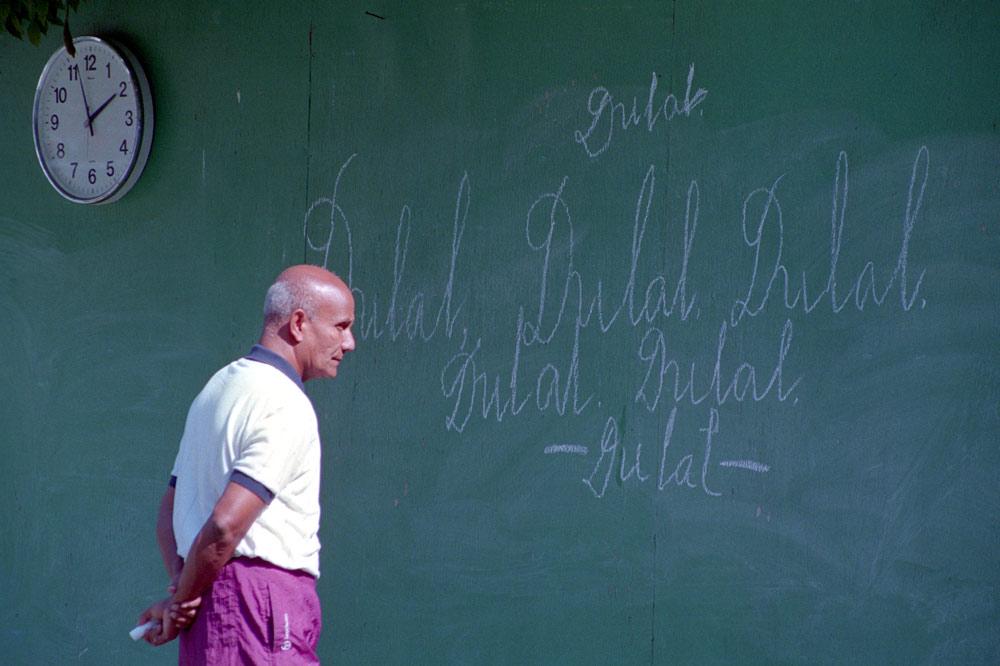
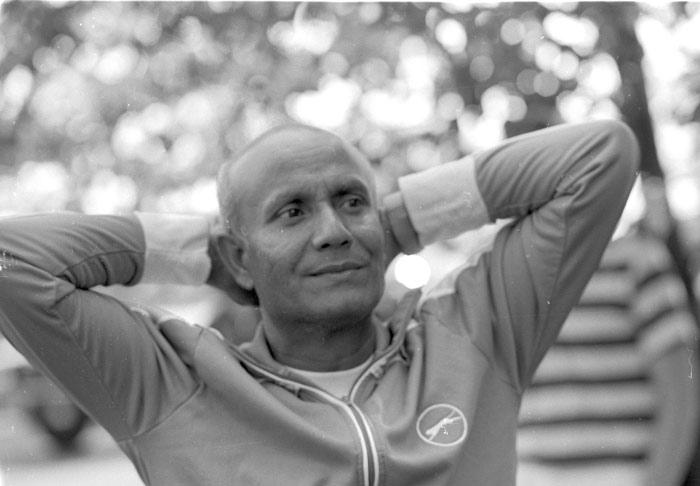
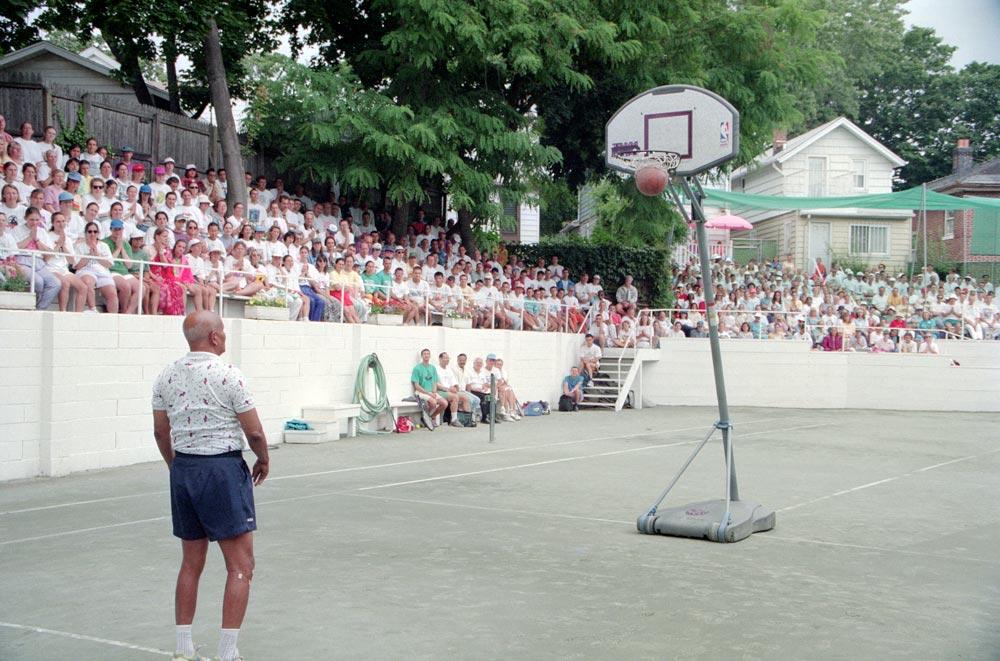
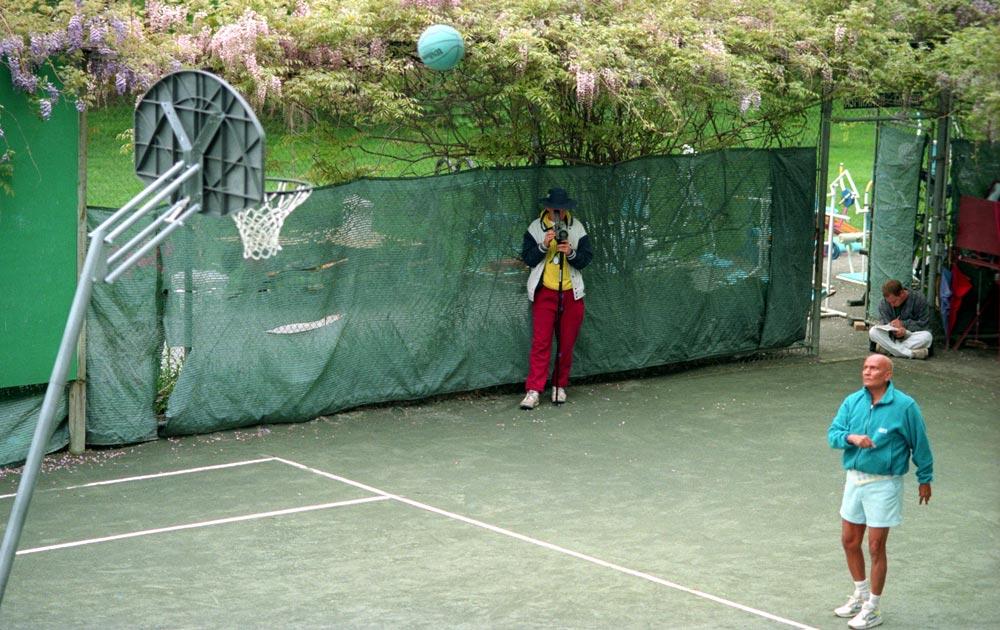
Sri Chinmoy practises basketball throws at Aspiration-Ground, 28 August 1996.

basket-ball
Photo: Dhanu

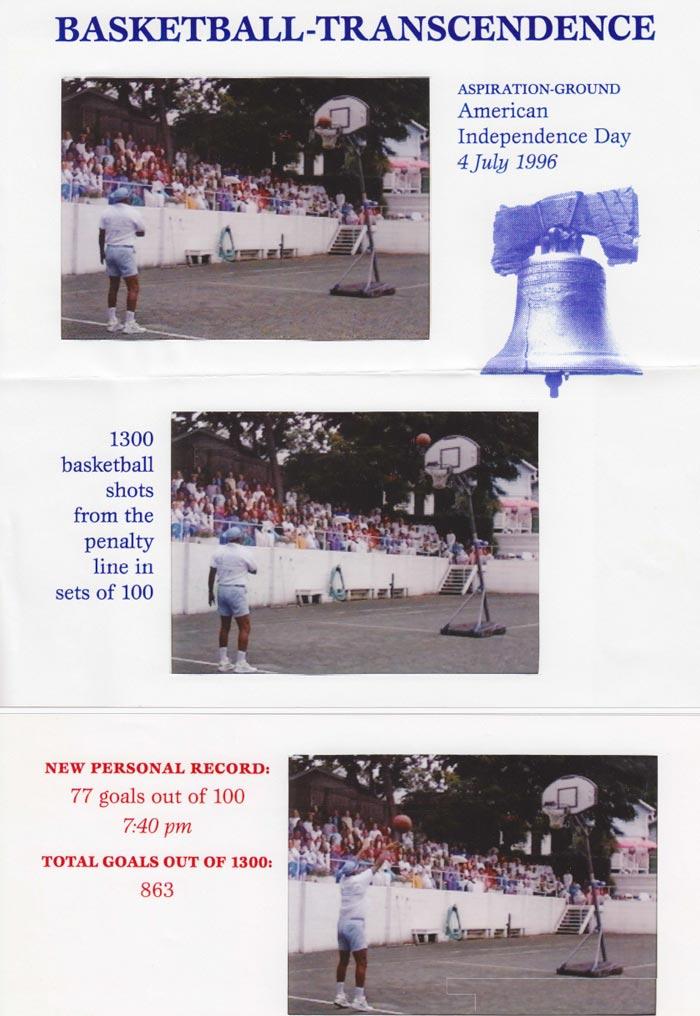
Basketball throws 4 July 1996

Basketball-Transcendence

On 4 July 1996, Sri Chinmoy took 1,300 basketball shots from the penalty line in sets of 100. He achieved a strike rate of 863 out of 1,300, with a best of 77 goals out of 100 at 7:40 pm.

basket-ball-transcendence


This record was later transcended as recorded in Sri Chinmoy Answers —

Interviewer: Do you play basketball?

Sri Chinmoy: In India I used to play basketball. Now I practise taking free throws from the penalty line. Usually I throw a hundred times, and then I take a little rest before throwing another hundred times. I practise on a regular basis when the weather permits it. My highest score is 79.

Interviewer: No kidding — 79 out of 100!

Sri Chinmoy, Sri Chinmoy Answers, Part 11, Agni Press, New York, 1999

Lifting Up the World with a Oneness-Heart — Basketball Players

basketball

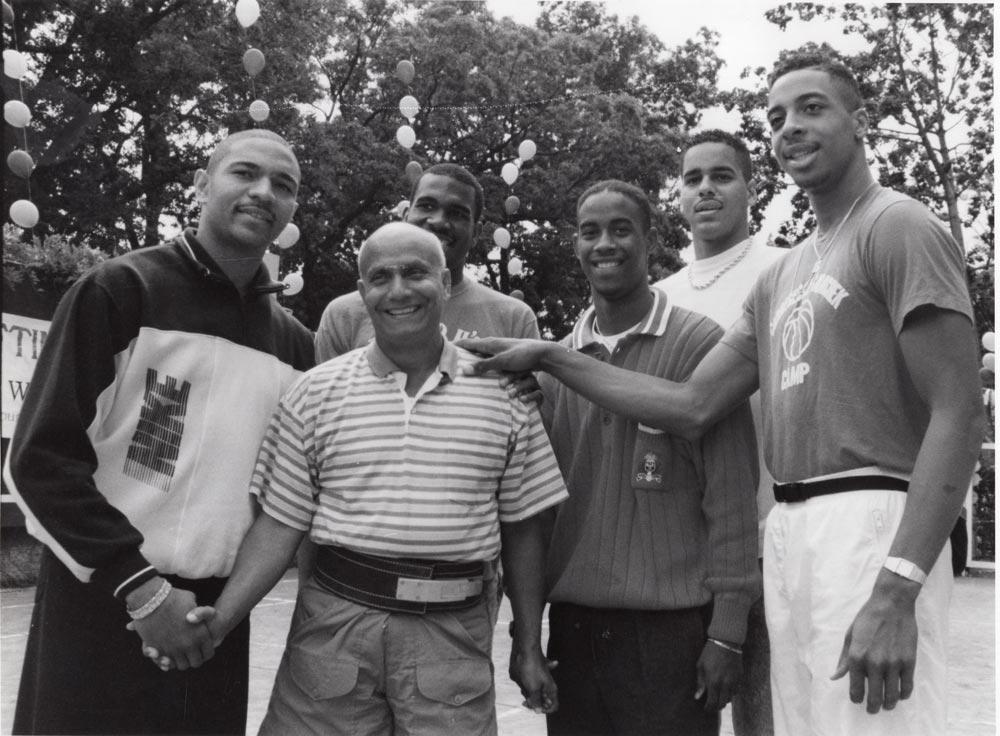
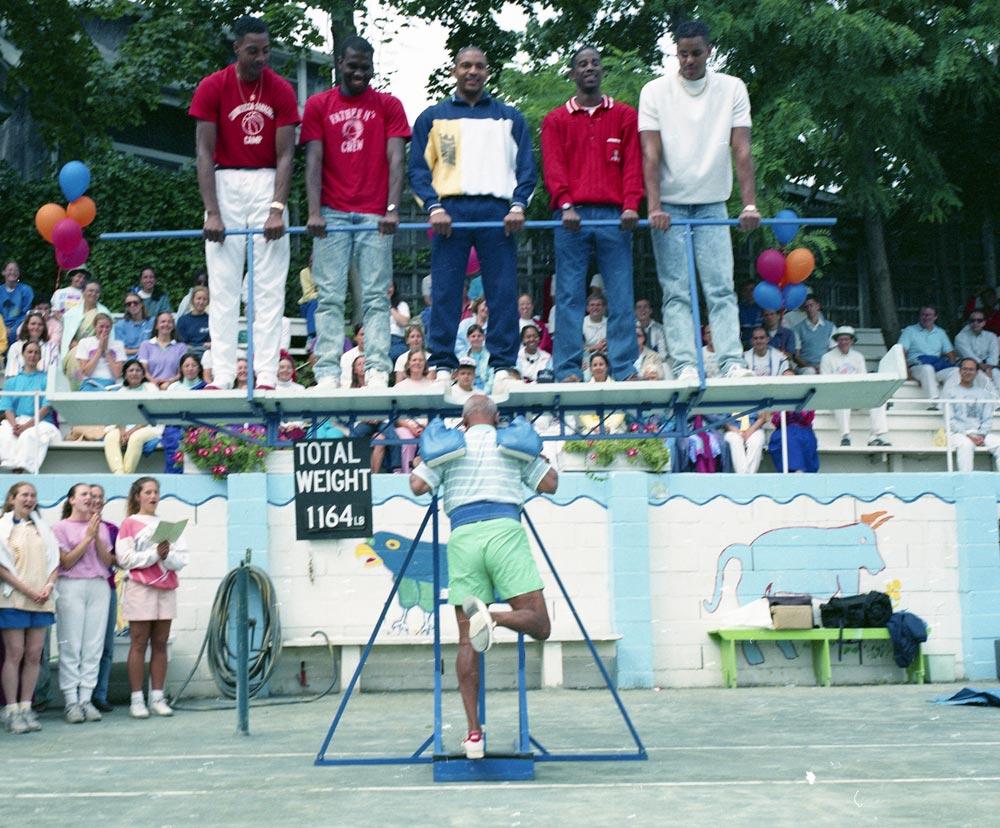
On 17 September 1988, Sri Chinmoy met and lifted several basketball players, such as Mark Jackson and Ken Bannister.

lifting
Photo: Dhananjaya

Sri Chinmoy lifting a total weight of 1,164 lb overhead.

basketball

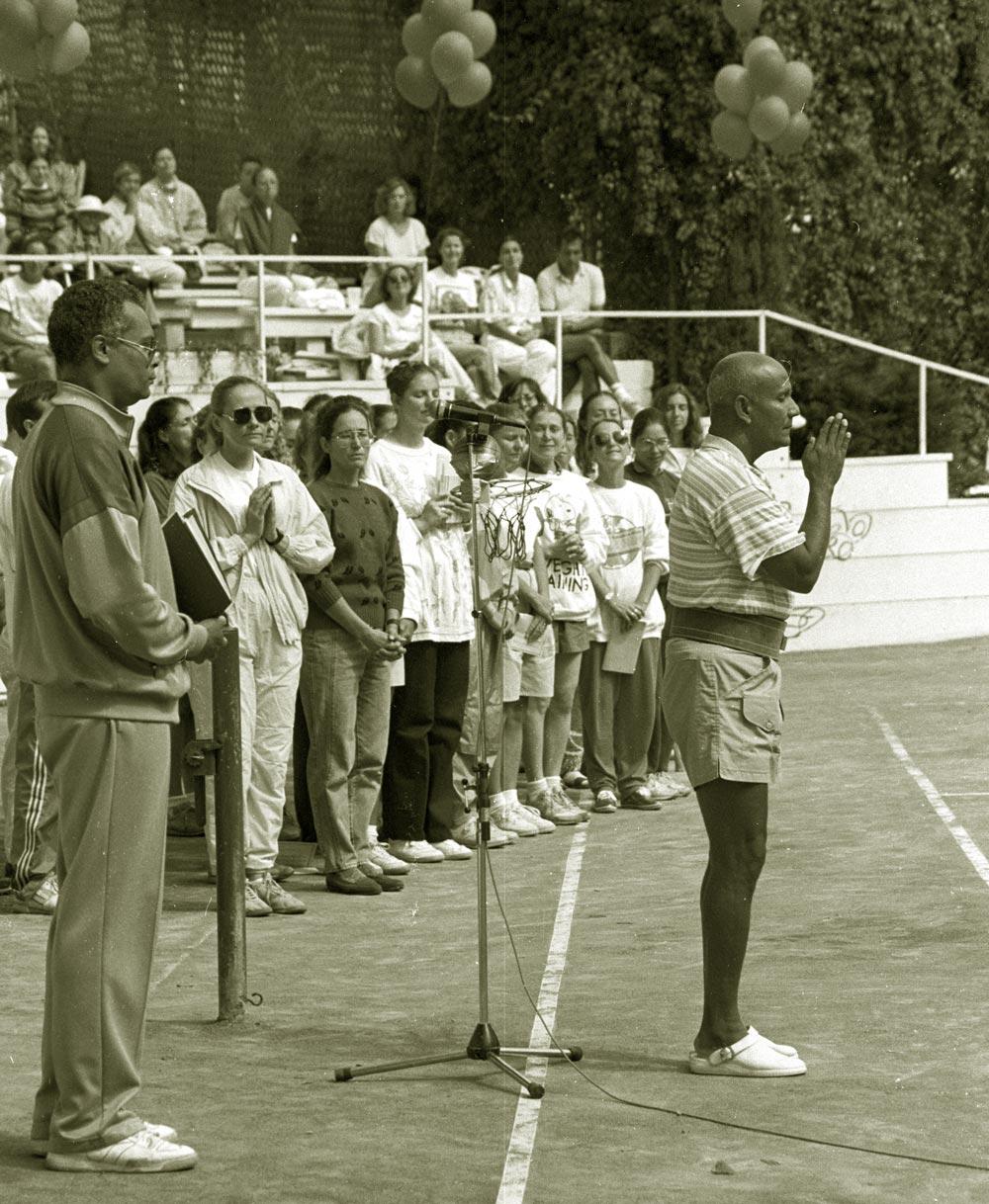
Sri Chinmoy offering prayerful meditation before the lifting.


Songs

my-basketball

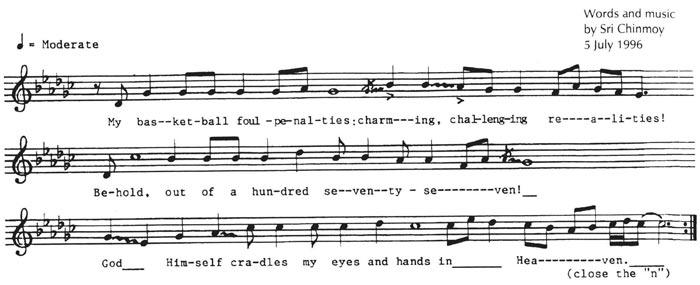
“My basketball foul-penalties: 
Charming, challenging realities! 
Behold, out of a hundred seventy-seven! 
God Himself cradles my eyes and hands in Heaven.” 

— Sri Chinmoy, Sri Chinmoy's Rainbow Dreams

Jharna Kala Gallery September 1985

Submitted by tejvan on

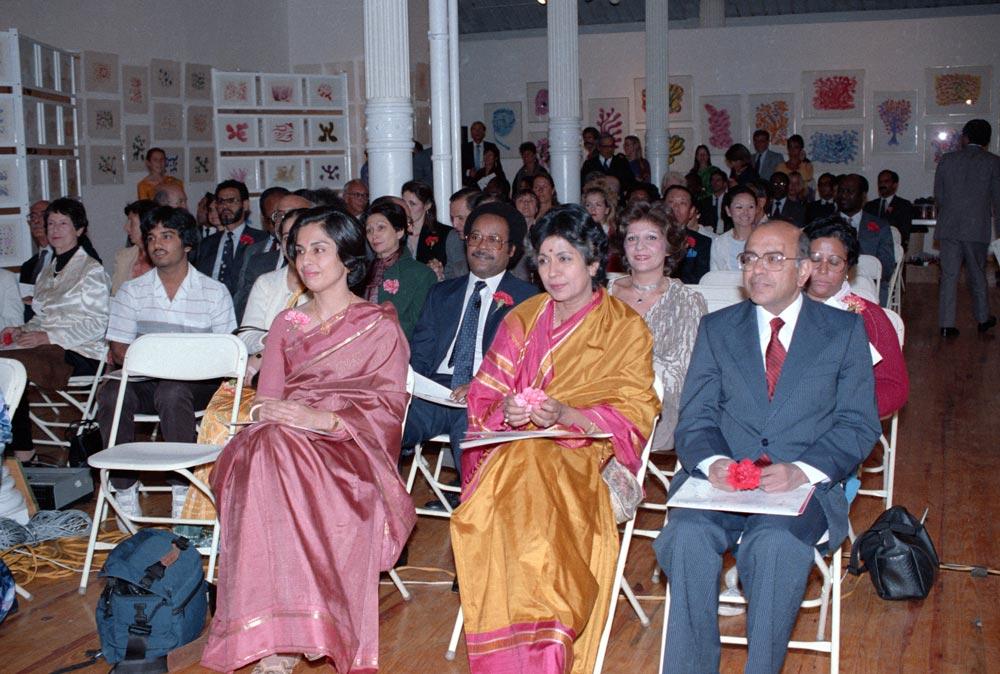
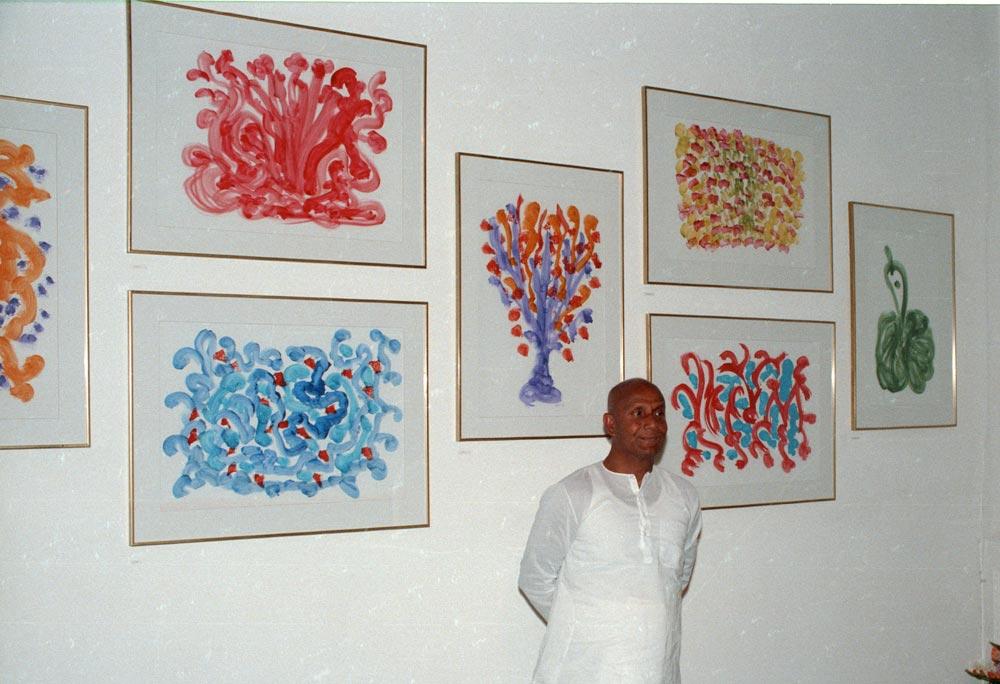
On 13 September 1985, an exhibition of Sri Chinmoy's Jharna-Kala art was held at the Jharna-Kala Gallery in Soho Gallery, New York. United Nations representatives from over 40 countries attended the exhibition, which included songs dedicated to peace and the UN, art, and a short meditation with Sri Chinmoy.

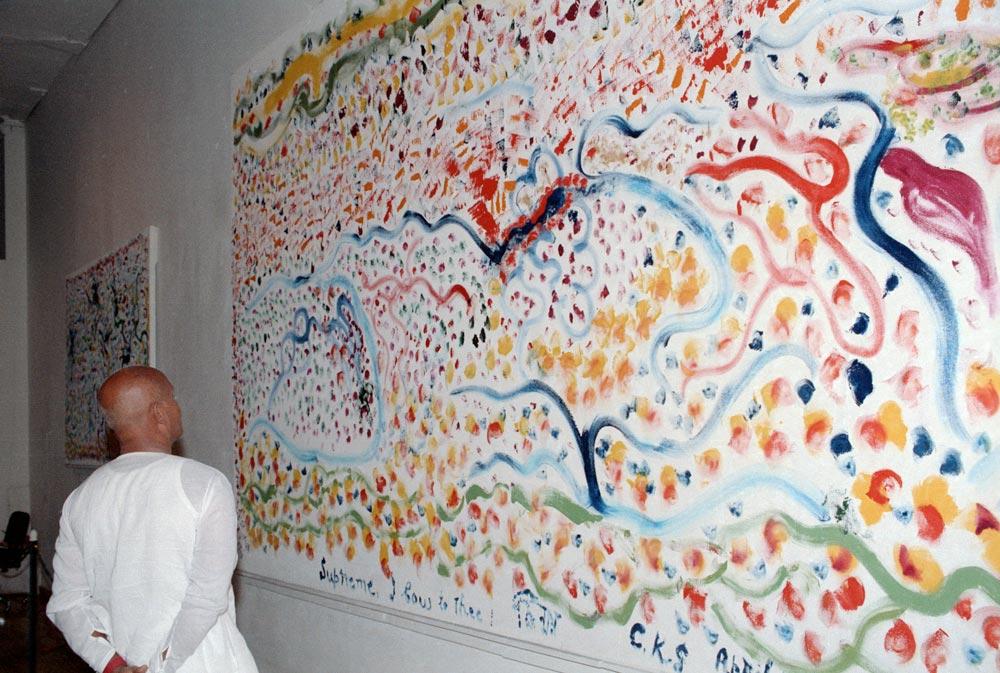
Jharna-Kala painting, Supreme, I bow to Thee!
Jharna-Kala, entitled "Supreme, I bow to Thee!" (April 1975)
sri-chinmoy-meditates
Sri Chinmoy meditates with delegates. Photo: Bhashwar
jharna-kala
Sri Chinmoy in front of Jharna-Kala
ranjana
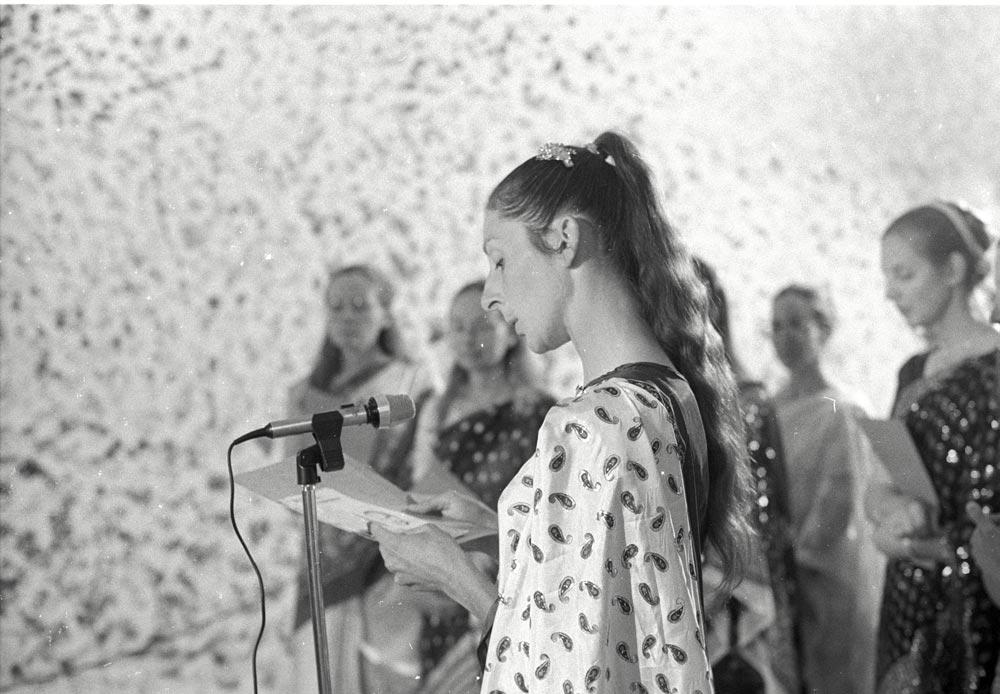
Ranjana K. Ghose, curator of Sri Chinmoy's art, reads an introduction to the exhibition
davidson-hepburn
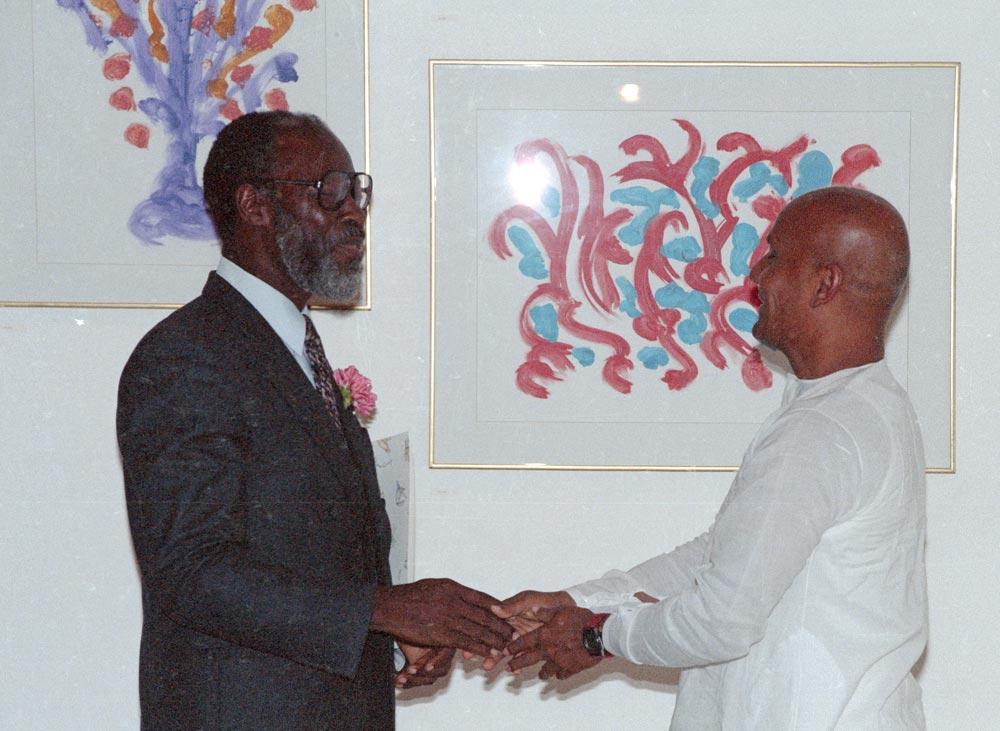
Davidson Hepburn, Ambassador of the Bahamas, greets Sri Chinmoy.

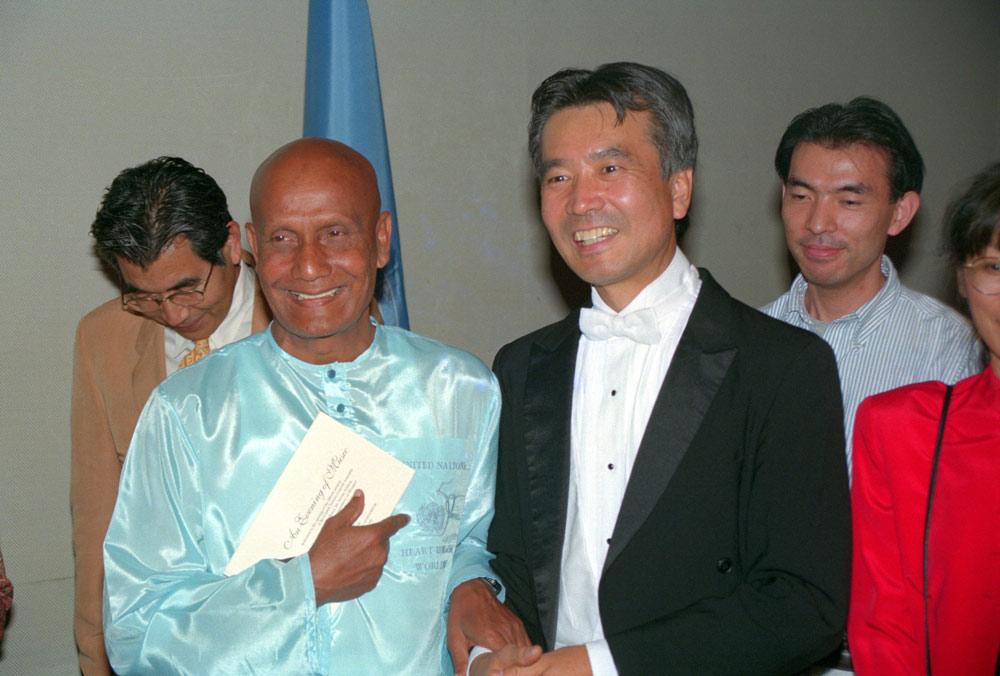
The special programme was hosted by Mr Natarajan Krishnan, the Permanent Representative of India to the United Nations, to celebrate the 40th anniversary of the United Nations (24 October 1985).

krishnan

“I support wholeheartedly Sri Chinmoy’s efforts at the United Nations to establish world peace. I was so happy to be able to host the reception tonight at a gallery exhibiting Sri Chinmoy’s paintings, to welcome diplomats of the Fortieth Session of the General Assembly. It was an unforgettable experience!”

— H.E. Mr Natarajan Krishnan
Permanent Representative of India to the United Nations
13 September 1985

Photos: Ramaniya, Bhashwar

World Gratitude Day

Submitted by tejvan on

World Gratitude Day is celebrated annually on 21 September with the vision of uniting humanity through the quality and uplifting power of gratitude. The first World Gratitude Day was observed in 1965. In 1977, along with Mrs Edna Lemle,  Sri Chinmoy and the Peace Meditations at the United Nations marked the occasson of World Gratitude Day at the United Nations for the first time. 

The holiday was officially recognised by the UN General Assembly in 1977.

Sri Chinmoy meditates
Sri Chinmoy offers his prayerful meditation for World Gratitude Day

On 12 September 1977, Sri Chinmoy and The Peace Meditations at the United Nations group celebrated World Gratitude Day with a special programme at the United Nations in New York.

world-gratitude-day

Sri Chinmoy composed a song for World Gratitude Day

O World Gratitude Day!
I pray for you, I pray.
Man’s feeble climbing ray
Is one with God’s Vision-Play.
Compassion: highest gift.
Gratitude: fastest lift.
Only satisfaction-seed
Can feed man and God’s need.

— Sri Chinmoy (song score)

Song written and performed for a World Gratitude Day celebration at the United Nations sponsored by the Peace Meditation Group on 12 September 1977. The song was also performed several times for programmes at the World Gratitude Day's New York Headquarters.


21 September 1977

edna-lemle-sri-chinmoy
Mrs Edna Lemle and Sri Chinmoy

Nine days later on 21st September, Sri Chinmoy took part in the main World Gratitude Day Ceremony, the first time it was officially recognised by the United Nations.

wgd

World Gratitude Day Award

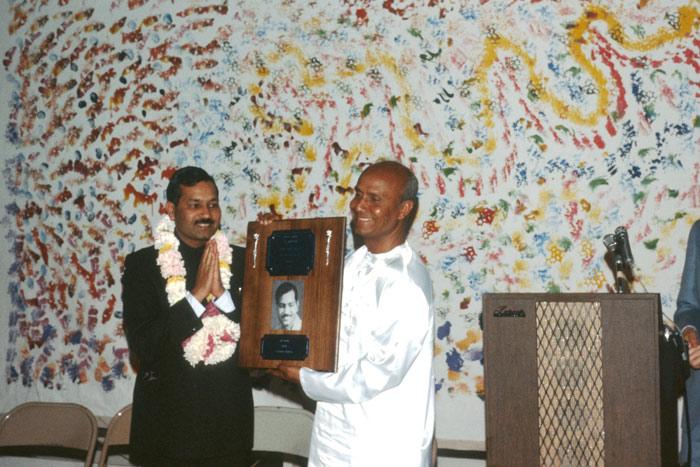
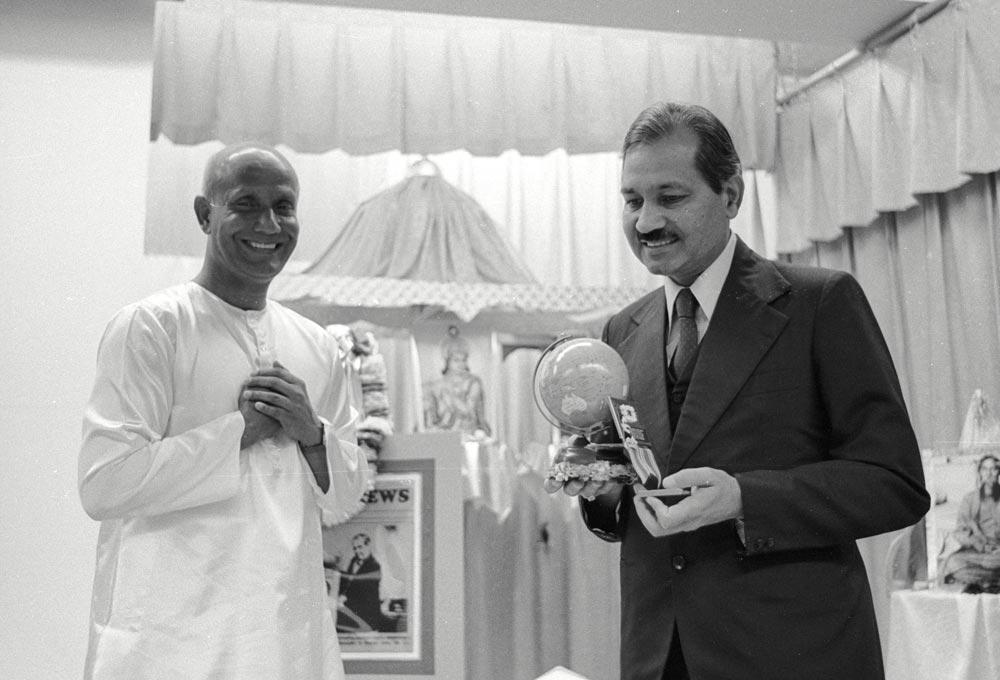
On 21 September 1977 Sri Chinmoy received the World Gratitude Day plaque at a ceremony in World Gratitude Day’s New York headquarters. The plaque was presented to him by Mrs Edna Lemle, president and founder of the organisation dedicated to promoting the cause of worldwide gratitude.

On receiving the award, Sri Chinmoy replied:

"I am accepting this with my heart's boundless gratitude, and this gratitude is something that is glowing and growing within me. Every day I offer to the Beloved Supreme only one thing: gratitude. Man's greatest gift to God is gratitude. Man's self-giving and his gratitude are one and the same.

I am extremely grateful to you, Mrs. Lemle, for you are opening a new chapter in humanity's evolution. The world is in the process of evolution. You know the utmost significance of gratitude, and the awakened soul in you is awakening others. Gratitude is man's conscious oneness with his Beloved Supreme. I am sure that your soul has felt this supreme oneness with the Beloved Supreme and your soul has come to the fore to urge your illumined mind to offer this loftiest message to the world at large..."

"Gratitude is what we must try to grow into at every moment in order to fulfil the divine in us. Gratitude is an earth-born and earth-grown fruit which not only nourishes the Heaven-born cosmic gods but also pleases most the Heavenly Creator, our Eternity’s Beloved Supreme.

Finally, I wish to invoke the presence of the immortal poet Shakespeare, whose soulful prayer I wish to share with you all: “O Lord who lends me life, lend me a heart replete with thankfulness.”

Sri Chinmoy, AUM — Vol. II-4, No. 9, 27 September 1977, Vishma Press, New York, 1977.

world-gratitude-day-21-sep-1977

World Gratitude Day - 21 September 1977 - mini booklet marking World Gratitude Day. Includes; World Gratitude Day Award, Sri Chinmoy's talk. Gratitude Day honourees 1966-77 (including Japan, the first country to recognise World Gratitude Day. Also a proclamation by Jimmy Carter in August 1972 (at the time Governor of Georgia).


External Links

Photos: Bhashwar Hart

Cello

Submitted by tejvan on

On 27 September 1983, Sri Chinmoy began playing the cello in Puerto Rico.


Sri Chinmoy playing the cello The cello became one of Sri Chinmoy's favourite instruments and he would often play it in Peace Concerts, both as an instrumental and accompanied with voice. These two recordings are from the Paris Peace Concert in 1984.

Cello with Singing

Audio file

Cello with vocal accompaniment, recorded at the Paris Peace Concert, Espace Balard, 13 October 1984.

Cello Performance

Audio file

Cello instrumental, recorded at the same concert.

Pablo Casals

Pablo Casals with Sri Chinmoy

It was also in Puerto Rico, in the early 1970s, that Sri Chinmoy met the renowned cellist Pablo Casals — more than a decade before he took up the instrument himself. See: Meeting at Sri Chinmoy Library

Sri Chinmoy recounts the meeting:

I met Maestro Pablo Casals in Puerto Rico. He was on the wrong side of ninety, and I had perhaps scarcely crossed the barrier of forty. I was quite young. I still had a considerable amount of hair!…

At that time I had never thought of playing the cello. He said, “Do you want to hear a piece? I will play a piece by Bach.”

He was an expert, a real expert — a maestro of the highest order. He started playing, and I was listening most devotedly, with deep feeling. He wanted to play another piece, so he played and I appreciated him…

One or two years after his departure from the earth-scene, Pablo Casals started coming from the soul’s world when I gave Peace Concerts. He would sit always facing me, about a metre away, when I was playing. He would meditate very deeply.

(excerpts) Sri Chinmoy, My Golden Children, Agni Press, New York, 2013

Cello in Peace Concerts

Sri Chinmoy playing the cello before the Kamakura Buddha

Sri Chinmoy playing the cello at the foot of the Kamakura Buddha, 24 September 1987.

Sri Chinmoy playing the cello at a Peace Concert
Photo: Piyasi

Sri Chinmoy playing the cello, 26 May 2005.

Sri Chinmoy playing the cello in Milan
Photo: Kedar

Sri Chinmoy playing the cello, Milan, 28 May 2005.

Sri Chinmoy playing the cello at Borobudur
Photo: Piyasi

Sri Chinmoy plays the cello at Borobudur, 25 December 2005.

Listen to the cello performance from Borobudur:

Audio file

Early experiments

Although he did not take up the cello as a serious instrument until 1983, Sri Chinmoy had recorded an album on the cello as early as 1975: Sri Chinmoy Plays the Cello: 1.

Sleeve of Sri Chinmoy Plays the Cello

Recorded in 1975, re-released in 1993 and 2006. See: Radio Sri Chinmoy


Cello albums

Sri Chinmoy Plays the Cello album cover

Sri Chinmoy Plays the Cello (1975; re-released 1993, 2006)


Victory's Dance-Smile album cover

Cello — Victory's Dance-Smile. Improvisations on the cello (1985)


Maestro Sri Chinmoy album cover

Maestro Sri Chinmoy — cello and Sanskrit chants (2005)


Writings on the cello

Question: I wanted to ask if there is a certain spiritual quality that the cello embodies. Recently you gave two concerts on Long Island and I felt a lot of power and intensity when you were playing the cello.

Sri Chinmoy: Truth to tell, I am not satisfied with my cello performance. If your consciousness goes high while I am playing the cello, I give all the credit to you, all the credit! When your consciousness goes high, anything that you see in front of you will give you tremendous joy. I give full credit to you, not to the player in me. The higher we go, the better we experience the reality. Do you understand? As a cellist I am not satisfied with my standard. But if you like my cello performance, it is because of your consciousness. I am serious when I say this.

In the cello world, the maestro of maestros is Pablo Casals. In the very evening of his life we met together in Puerto Rico. As soon as he saw me, tears started rolling down his cheeks. They fell on my shoulder. With such joy he was telling me, “You have come at the very evening of my life.” Then he played two pieces for me from Bach. His cello playing was sublime.

Another experience I am telling you about my cello. I gave a performance at the Royal Albert Hall in England. Among my disciples, there was someone who could not appreciate my cello performance. As good luck would have it, a member of the audience came up to that person after the concert and said, “How long has Sri Chinmoy been playing?”

The disciple answered, “Three years.”

“Three years? I have been playing for seventeen years,” that musician said, “but he plays better than I do!”

To that particular disciple who could not appreciate my cello performance, a real cellist came. And he was saying I played better than he did!

Last year I lifted a very famous cellist. His comment was that if I learnt the proper technique, I would enjoy the cello better. To be frank, I only like my cello at one time and that is when I sing my song for Lord Buddha. If my voice is in good condition, that is the only time I like my cello.

Sri Chinmoy, My Heart-Door I Have Kept Wide Open, Agni Press, New York, 2011

The cellist

We have a new disciple who plays the cello with the Puerto Rico Symphony. She also has about 50 students and teaches five or six hours daily. One by one her students come and play in front of her. When her good students come, she gives them five minutes. When the bad students come, after a minute she says, “Oh, you are playing very well. I am pleased with you.” Then she sends them away immediately.

I wanted to practise the cello while I was in Puerto Rico, but this new disciple did not want to let me play on her cello. But after she refused, then for the whole day she felt totally miserable. So on her own she brought me her cello the next day. She said her cello cost $5,000. It was good, but mine is better. She herself was supposed to play that day, so she borrowed a cello from somebody else.

When I tried her cello she flattered me, saying that my intonation was good. That is why she allowed me to use it.

The day I was supposed to return the cello, I told her to come at twelve o’clock and take it back. She came exactly at twelve. I had brought her a trophy, and she said, “Can I not also have a plaque to put on this trophy that says you gave it to me?”

After I returned the cello, she told Alo that she felt some higher power was guiding her hand when she played it. When she played she felt that it sounded as if Pablo Casals were playing. So she was very happy that she had let me use it.

— 19 February 1984

Sri Chinmoy, The World-Experience-Tree-Climber, Part 3, Agni Press, New York, 1993

Queens Botanical Garden - Sri Chinmoy Peace Blossom

Submitted by super_admin on

On 5th September 1992, Queens Botanical Garden was dedicated to world peace, as part of the Sri Chinmoy Peace-Blossoms programme, which began in 1986.

qbg

The Queens Botanical Garden is just three miles from Sri Chinmoy's home in Jamaica, Queens, New York.

queens

Sri Chinmoy meditated and offered the words. "I am bowing to the beauty, fragrance, splendour, purity and divinity of the Queens Botanical Garden." 

After a loud plane flew over from nearby LaGuardia airport causing a pause, Sri Chinmoy continued:

"This is the strength of outer noise, but there shall come a time when we shall hear, feel and grow into the power of our inner peace. The power of inner peace is infinitely, infinitely, infinitely stronger and infinitely more fruitful than the strength of outer noise."

The plaque which was mounted on a 5-ton rock reads:

Queens Botanical Garden joins a growing number of international sites dedicated to world peace in the name of Sri Chinmoy, the twentieth century's first global man and a universal ambassador of peace. These "peace blossoms" reflect the magnificence, beauty and power of Nature as does the grandeur of the Matterhorn, Switzerland, the cascading power of Niagara Falls, Canada, and now the profuse color, tranquillity, and quiet beauty of this Botanical Garden. Sri Chinmoy has devoted his life to the pursuit of world harmony and the fulfillment of the human spirit which this garden inspires us to contemplate. May our moments of peace and communion with nature's magic remind us of the universal peace which is our birthright.

"From time immemorial man has been striving to become better than he is, to enter into new worlds of achievement and glory. Yet no matter what man achieves he aspires for something higher. The distant goal that we reach for today becomes but a starting point for tomorrow's even more glorious journey. This urge to go beyond ourselves is the source of all human progress, the reason we compose music, climb mountains, search for truth. It is our assurance that one day we will change the face of reality from bright to brighter, to brightest; from high to higher, to highest. And even then we will not and cannot stop, for there is no end to the progress we can achieve."

botanical

"Peace-seed must be sown
In the heart,
Only then will it grow
In the body of human life."

— Sri Chinmoy


botanical

By entrance sign.

sri-chinmoy

Related

Photographs: Ramaniya, Maral.

Try to Remember

Submitted by super_admin on
sri-chinmoy

Sri Chinmoy offered the following talk at Aspiration-Ground on 8 August 1988. It was the 55th anniversary of the very first time his parents first brought him to the Sri Aurobindo Ashram and the spiritual life.


It is a most significant day in my life. On August 8th, 1933, when I was two years old, I came to the Sri Aurobindo Ashram from Chittagong. My parents and my elder sisters and brothers brought me to the Ashram and the spiritual life — the place of my heart's awakening and my life's oneness-realisation with the highest Absolute Supreme. Nothing can be more important, more significant, more meaningful and more fruitful than to go and sit at the feet of one's Master in the life of a seeker.

The Supreme in me is your Master, everybody's Master, but try to remember the day, the very first day, you saw me physically in your heart of aspiration and life of dedication. That was the day your soul consciously, cheerfully, lovingly and unconditionally made its eternal connection, birthless and deathless connection, with my soul. If you want to remain a seeker throughout Eternity and if you want to remain in my Boat forever and forever, then the very first day you saw me on the physical plane is the most supreme significant day in your life.

On that day, your heart, aspiration-heart, listened to the dictates of your illumination-soul, and your illumination-soul made a solemn promise to the Absolute Lord Beloved Supreme that you would manifest the Highest Absolute Lord Supreme’s Light and Delight in and through your heart, mind, vital and body here on this earth planet.

This day can never be forgotten. This day can ever be treasured with one's heart's ceaseless love and deathless devotion and oneness-surrender-delight.

On that day, the Master offers the most significant message to the disciple: "My child, you are of me and me alone."

And the disciple tells the Master, "My Lord, I am for you and for you alone."

I am an Indian, so two Indian sweets I am offering because I was two years old when I came to see my Master.


Published: Sri Chinmoy, "The Golden Mystic Sun", Madal Bal Studio, 2021.

August 15th (Dyulok Chariye)

Submitted by super_admin on

a15On August 14th, 1945, a young Chinmoy wrote this poem in honour of Sri Aurobindo's upcoming birthday (15th August).  Nearly 50 years later Sri Chinmoy then set this poem to music on July 8th, 1995. 

Later, Sri Chinmoy recited the poem and also sang a solo performance. The song has become referred to as Dyulok chariye, August 15th and also affectionately as "The Long Song". 


 First stanza

August 15th, 1945

Dyulok chariye nara narayan
Sparshila aji dhuli
Tar jaya gan chalo mora kari
Sakala karma bhuli

God in human form
Descends from Heaven today
To touch and feel
The breath of earth-dust.
Comrades, His Victory
Let us proclaim, casting aside
All our world-responsibility-obligations.

- Full song at Sri Chinmoy Songs August 15th, 1945

Links

Today God from Heaven Descends

Today God from Heaven Descends at Radio Sri Chinmoy

August 15th, 1945 at Sri Chinmoy Library

[In fact, Kshamar Adarsha, another epic poem, Sri Chinmoy set to music is also known as "The Long Song"]

Further links

Venu Sings "Dyulok Chariye" at Radio Sri Chinmoy. Sri Chinmoy remarked this was the best performances of his song by one of his students, and ideal for learning.

Sri Chinmoy Centre Choir sing in 1997

Sri Chinmoy 47 Mile Race

Submitted by super_admin on

At midnight on August 27th, 1978, the first Sri Chinmoy 47 mile race was held to honour Sri Chinmoy's 47th birthday. 

sri-chinmoy
Photo: Shraddha Howard

Sri Chinmoy made the announcement for the race with little forewarning, which was characteristic of his spontaneous approach to new races and new challenges. The late 1970s was still very much pioneering days for the notion of running ultramarathons. As reported in the running press:

He (ed. Sri Chinmoy) had just presided over eight hours of qualifying trials for his meditation community's upcoming annual international sports day in New York City. As the tired meditators were finishing a well-deserved picnic lunch, the muscular Guru wondered aloud, 'So, who is going to run 47 miles for my birthday?...'

 Kamen, Jeff. "The Guru's Ultra." Marathoner/Winter 1979. (47 Mile Race at Sri Chinmoy Races)

Despite the late notice, many students of Sri Chinmoy put their names forward. Only a handful of the participants had run even 26 mile marathons before. As a result, Sri Chinmoy asked his good friend and ultra pioneer, Ted Corbitt to give advice to those taking a step into the unknown. Ted Corbitt's advice and the spiritual atmosphere of the race, helped 57 out of the 58 starters to finish the distance, a remarkable completion rate. The Runner's Gazette also commented on the international flavour of the event.

Oddly enough, the 58 devotees in the run represented nine different countries, so the field in this otherwise obscure event was actually the most international in scope of any U.S. ultramarathon...Garima Hoffman (led) the women in 8:00:44.

Anahata Nada reported 47 men and 11 women raced around a 1 1/4 mile loop circling Jamaica High School in Queens.  

Video Footage from early events


Video footage: Utpal Marshall, Abakash Konopiaty, (Mridanga Spencer DVD)


sri-chinmoy-councillor-povman
Sri Chinmoy. Councilman Morton Povman (right)

On the morning of August 27th, as several runners were still completing the distance, local Queens Councilman Morton Povman came to the track at Jamaica High School to read the proclamation of Sri Chinmoy Day in Queens. 

sri-chinmoy-47
Sri Chinmoy running through the night in 1978. Photo: Bhashwar Hart

To encourage the runners, Sri Chinmoy himself ran most of the night until an injury disabled him.

1979 - 47 Mile Race

By the 1979 edition, the numbers participating had risen to 85 men and 37 women.

sri-chinmoy-47
Photo: Sanjaya Spettigue

 In 1979 Sri Chinmoy himself completed the 47 mile race in a time of 12:41:48. 

1980 - 47 Mile Race

sri-chinmoy

This was the second time Sri Chinmoy completed the 47 mile race, improving on his previous time by over an hour. He finished in a time of 11:27:24. 

sri-chinmoy-47


It would be Sri Chinmoy's final race at the distance.

The Race continues

In 1981, the race was temporarily increased to 50 miles, in honour of Sri Chinmoy's 50th birthday. But apart from that year, the race has been held at 47 miles annually ever since and is an important aspect of Sri Chinmoy's Birthday Celebrations.

sri-chinmoy
Sri Chinmoy walks around the course. Sundar Dalton finishes the race. Photo: Pulak Viscardi

Although Sri Chinmoy no longer ran, he would always visit the race and often walk meditatively around the course. Sri Chinmoy really valued the benefits of running, especially when combined with a spiritual attitude of self-transcending - competing with ourselves.

sri-chinmoy
Photo: Pulak

He once said that the best birthday present his disciples could give him was to run the 47 mile race.

Sri Chinmoy: My longest distance was 47 miles. I did it twice. Now I no longer do it, but every year about three hundred disciples of mine from all over the world come here on my birthday and run 47 miles. Being the spiritual father of the family, it gives me tremendous joy when I see my spiritual children run 47 miles. The number 47 is very important to me because in 1947 India got its independence. With this run we are celebrating our inner freedom.

Sri Chinmoy, Sri Chinmoy Answers, Part 29, Agni Press, 2001

sri-chinmoy
Sri Chinmoy walks around the course. Photo Pulak

Sri Chinmoy encouraged the organisers to decorate the race with inspiring aphorisms and photos to help create a spiritual vibration. Many who run or help with the race comment on the spiritual atmosphere which is created by the overnight race.

The race continues

2025. Perfection Journey Report on 47 Mile Race


susan-
Susan Marshall 1st lady 2025. Photo: Utpal

Further reading

A Soulful Cry Versus A Fruitful Smile

scBetween August 12th and 13th, Sri Chinmoy wrote 630 rhymed poems, which were published in the book A Soulful Cry Versus A Fruitful Smile. It was an epic feat of meditative concentration and inspiration. Sri Chinmoy also oversee a team of overseas disciples who managed to publish the book within 24 hours, working through the night to get the book ready.

At my brother Mantu's repeated request to write rhymed poetry I have written these short poems. I dedicate these heart-offerings of mine to my brother's great seeker-soul.

Chinmoy 12 August 1977

1. A SOUNDLESS VOICE

A soundless voice
     I always need.
My mind of noise,
   My heart of poise,
     To lovingly feed.


181. HOW TO GET BACK

How to get back
   Life’s lost charm?
You can get back
   Life’s lost charm
If you do not harm
   Your childlike inner cry
   And childlike outer smile.

Life’s lost charm
   Easily you can regain
If you refrain
   From thought-temptation-chain.


sc


Janaka was involved in the team of visitors working on the book, this his introduction to the first edition.

Editor's introduction

The first thing that would strike the reader picking up this book, would probably be its bulk. A quick glance at the contents would show 630 titles listed. Sri Chinmoy is clearly the most prolific of poets. But someone unfamiliar with his writings might be forgiven for thinking these represented a lifetime’s work, the labour of many years. As such they would stand as a considerable achievement.

But how astonishing is the truth, that these poems are not the work of years, or months, or even days, but were in fact written in a twenty-four hour period, from midnight to midnight on a single day!

And for Sri Chinmoy this was the latest in a long line of marathon creative sessions: 16,000 paintings in a day; 843 poems in a day. The figures roll easily off the tongue, but to see the reality is something else. It takes the breath away.

The poems in this volume are part of an even longer project which Sri Chinmoy set himself — to write 1,000 poems, each with a rhyming structure. (This is in honour of his brother Mantu who has a preference for such forms over more freely constructed poems.) Sri Chinmoy set a date, some months ahead, for the achievement of his target. But within a few days, in spite of keeping up with his intensely busy schedule of activities, he had made the time to write some 500 rhyming poems. Then at midnight on Friday 12th August 1977, he started work on the sequence published here. He began writing them out by hand, and covered hundreds of sheets from notebooks. Then as the flow of inspiration increased, he recited the poems directly onto a tape, to be transcribed.

Disciples worked with him, round the clock, typing, editing, proofreading, so that the book could be printed and published the following day! We were able to help with the work, to share in this process of becoming, this amazing flow of creative energy that infused even the most menial job with a meaning and significance. We share in the flow, were part of the whole.

And at midnight on August 13th, 24 hours after starting, the poet pronounced his verdict on his achievement.

“Not bad,” he said.

Not bad!

With a book of poems as large as this, especially where the individual poems are short, the tendency is to skim through, read them greedily and quickly, or simply dip into the book at random, reading here and there. It is part of the beauty of there being so many that there is something for every taste, and, more important, something for every need. Time and again I have had the same experience, of opening the book of Guru’s poems at random and finding exactly the right words to speak to me at the precise moment. Or in skimming, I am suddenly arrested by a line or a phrase that seems to reason, to glow, to throw light on all that I have been reading. For in a very real sense, the part contains the whole, and each of these short poems contains in essence, distilled, all of Sri Chinmoy’s wisdom, his philosophy. They are gems of many facets.

And there are many moods here, many modes of expression, from the playful and humorous to the profound and majestic. they are now wry, now instructive, now with the scriptural quality, the simple dignity and clarity that tells us, “This is the highest Truth.”

Always they are a delight, and the self-imposed stricture of making the poems rhyme simply adds at once to the entertainment and illumining fun; delight on delight for the ear and the eye.

This delight, and the ease of the flow, may even tend to hide the tremendous technical achievement. Over one thousand poems. Six hundred and thirty of them in a day. And all of them rhymed. There is a verbal agility and sureness of touch of a very high order, a limitless inventiveness. Sri Chinmoy uses words with the same dexterity with which he wields a paintbrush or draws a bow across the esraj.

In these poems, the flow is structured, the energy is manifest in a tighter form, taking on the limitation of rhyme. But the limitation has itself become inspiration, part of the game. The form becomes a vehicle for his endless play.

Those of us who are caught up in that play, in the dance of the worlds he is opening up to us, bow to Sri Chinmoy, in gratitude.

Janaka


Programme at Wainwright House

Submitted by super_admin on

On 10 August 1977 Sri Chinmoy was invited to an informal gathering at the Wainwright House in Rye, New York, to honour Weyman C. Huckabee, the Laymen's Movement's former Executive Director, for his work in helping to create the UN Meditation Room.

sri-chinmoy

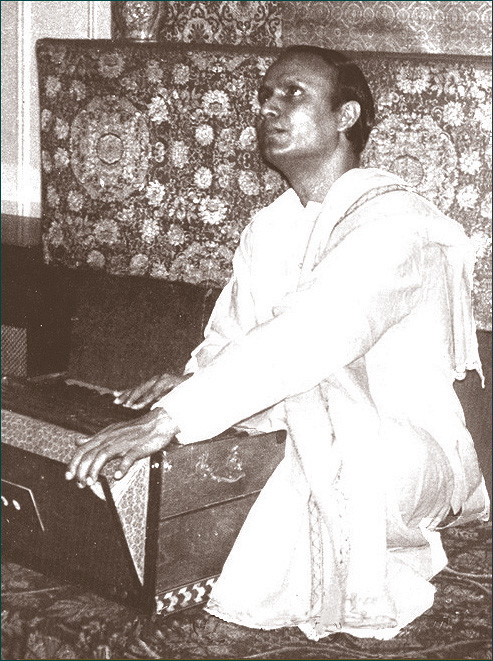
The informal function began with a silent meditation led by Sri Chinmoy, followed by him playing the esraj.

sri-chinmoy


sri-chinmoy
Sri Chinmoy with Robert Muller and other guests. Photos: Shraddha Howard


Secretary-General Dag Hammarskjöld was enthusiastic about the creation of a meditation room at the United Nations. When it opened in 1957, he wrote:
We all have within us a center of stillness surrounded by silence.
This house, dedicated to work and debate in the service of peace, should have one room dedicated to silence in the outward sense and stillness in the inner sense...
Dag Hammarskjöld   UN.org

On 17 September 1976, [see note below] the members of "Sri Chinmoy: The Peace Meditation at the United Nations" gathered for a few minutes of silence in the Meditation Room of the United Nations. Afterwards Sri Chinmoy spoke about the experience.

This is the first time that all the members of the Meditation Group have gone to the Meditation Room and meditated together. This is a significant occasion for us. But something infinitely more important, this is our soulful tribute to the immortal memory of the UN Pilot, Dag Hammarskjöld. We went to the Meditation Room to observe the anniversary of his death. According to human wisdom, death is a halt, where all movements cease for good. But according to divine wisdom, death is a step we take while walking along Eternity's road.

Continue reading: Sri Chinmoy, The Seeker's Mind, Agni Press, New York, 1978