Video by Utpal Marshall
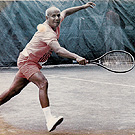
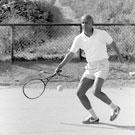
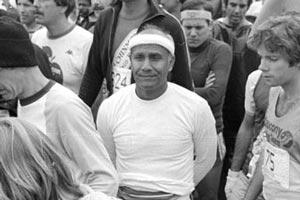
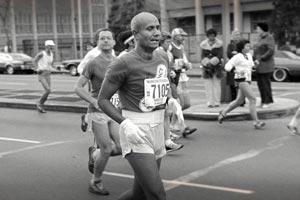
On March 3rd 1979, Sri Chinmoy completed his first marathon in Chico California in a time of 4:31:34. Each year since then, his students in New York and around the world have honoured him by running the 26-mile distance.

Video by Utpal Marshall
On March 3rd 1979, Sri Chinmoy completed his first marathon in Chico California in a time of 4:31:34. Each year since then, his students in New York and around the world have honoured him by running the 26-mile distance.
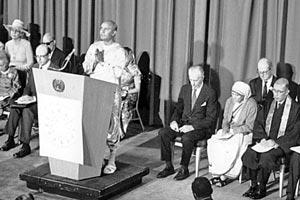
Sri Chinmoy delivers the third in a series of four lectures, entitled ‘Commentary on the Bhagavad Gita’, in Vanderbilt Hall at New York University in New York, NY, USA.
Sri Chinmoy delivers a lecture, entitled ‘Give, Receive and Become’, at the University of New Brunswick in Fredericton, NB, Canada.
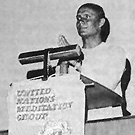
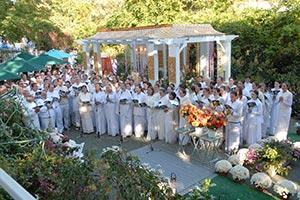
Sri Chinmoy and the Meditation Group he leads at the United Nations hold a special function in honour of UNICEF staff members, at the UN in New York. Members of the Meditation Group perform Sri Chinmoy’s song ‘UNICEF’ for the first time.
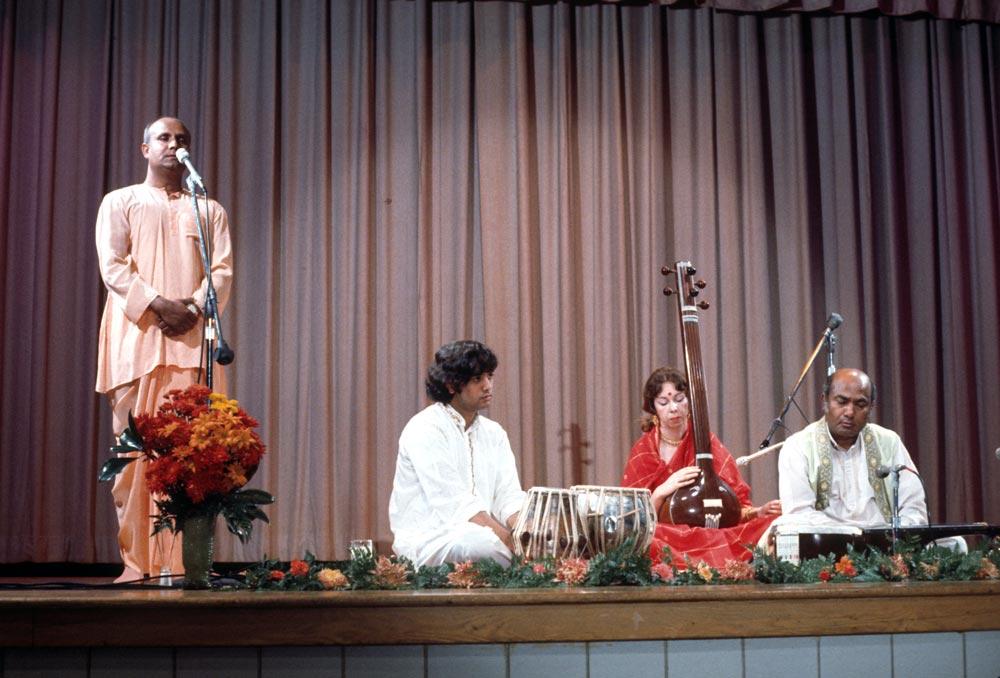
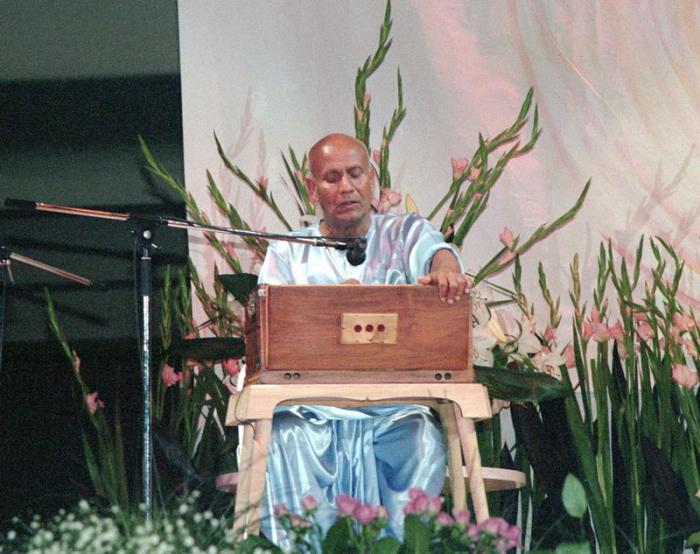
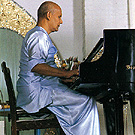
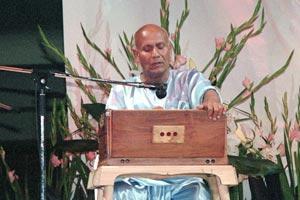
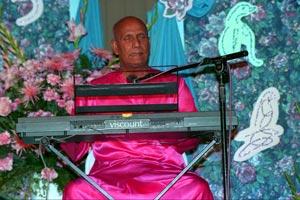
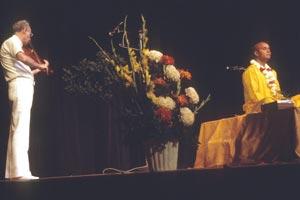
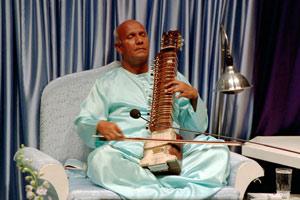
Sri Chinmoy plays the esraj and delivers a lecture, entitled ‘Progress’, at Hunter College in New York, NY, USA.
Sri Chinmoy delivers a lecture, entitled ‘Peace’, in Honolulu, Hawaii, USA.
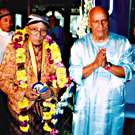
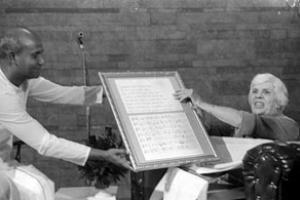
Sri Chinmoy receives a plaque inscribed ‘To the Great Son of India’ together with the Twentieth Century Global Man Award from the Federation of Indian Associations, in New York, NY, USA.
Sri Chinmoy holds a special function in honour of Vladimir Petrovsky, United Nations Under-Secretary-General for Political Affairs, at Public School 86 in Jamaica, NY, USA.
Sri Chinmoy offers the U Thant Peace Award to Vladimir Petrovsky, Under-Secretary-General, Director-General of the United Nations Office in Geneva, at the residence of Mr. Petrovsky, in Geneva, Switzerland.
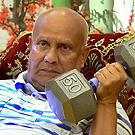
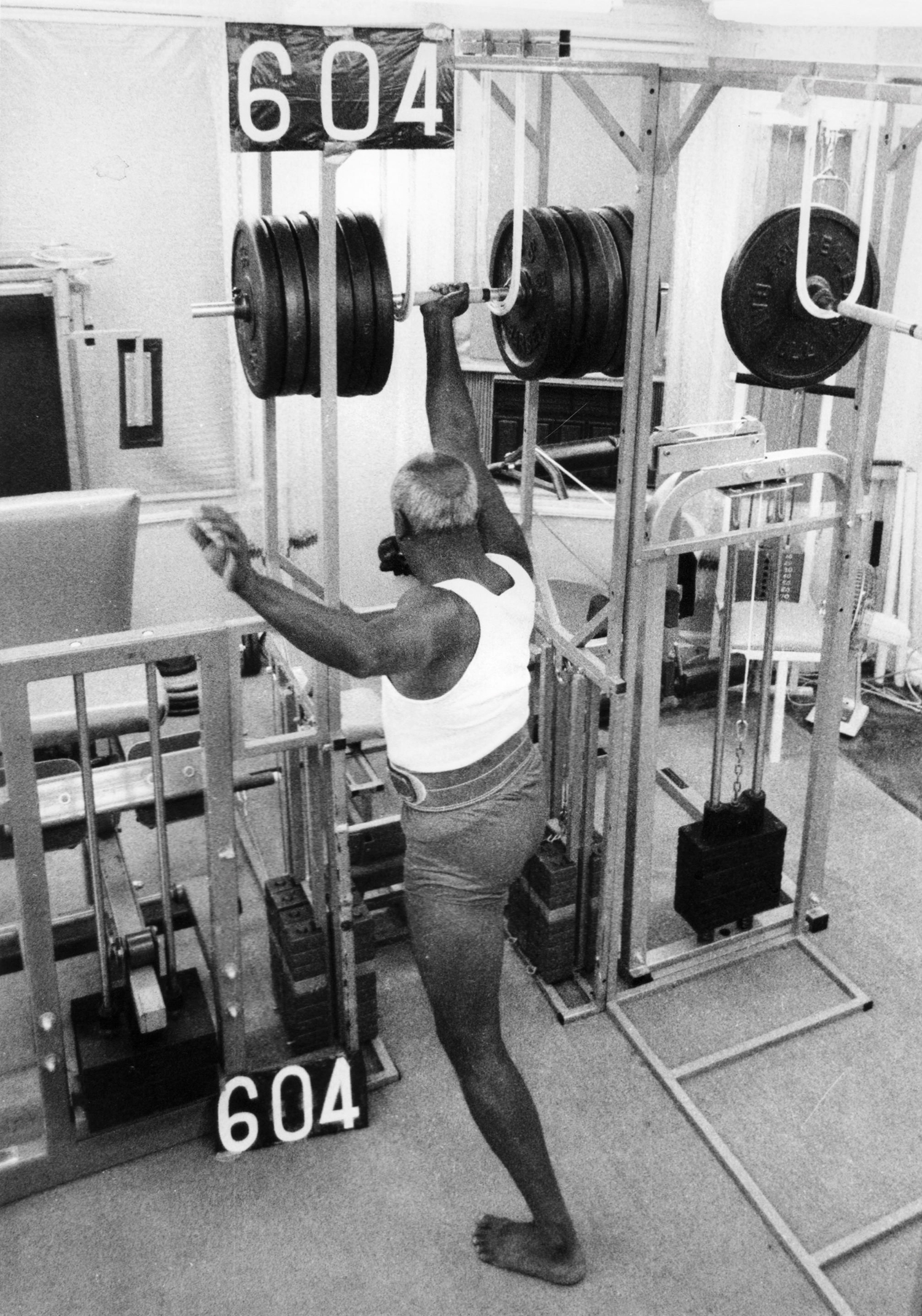
Sri Chinmoy lifts 160 lbs. with both arms simultaneously — a total weight of 320 lbs. — at his home gym in Jamaica, New York, NY, USA.
Venezuela is declared a Sri Chinmoy Peace-Blossom-Nation.
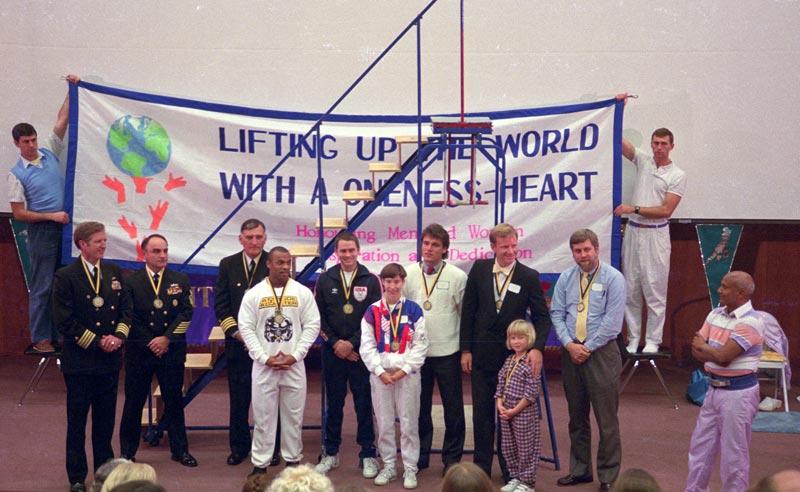
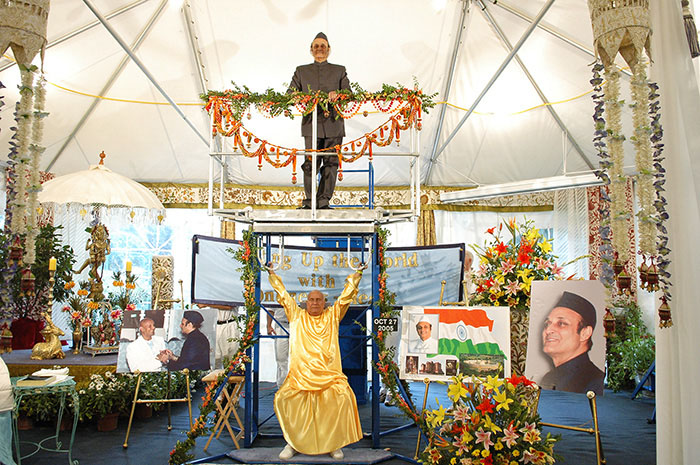
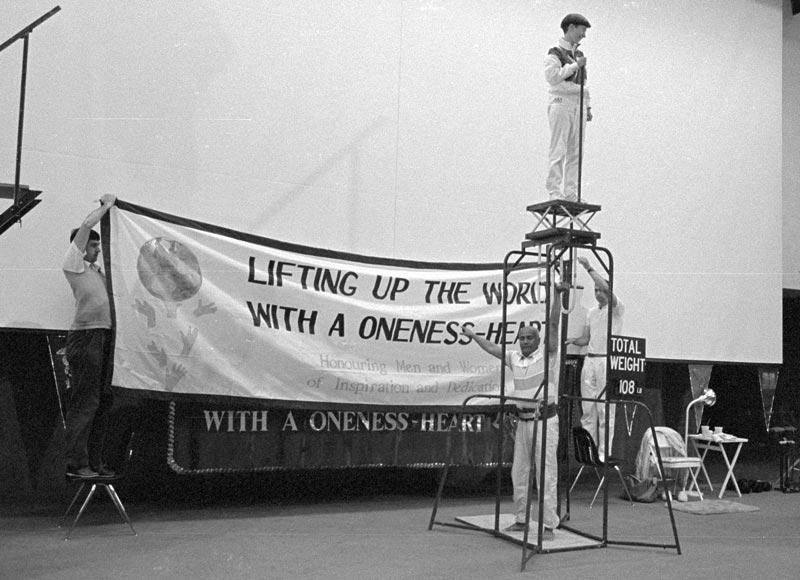
Sri Chinmoy lifts 13 people in Jamaica, NY, USA.
UNITED NATIONS — The Director of the United Nations Meditation Group, Sri Chinmoy, held a special meditation March 17 for staff members working at UNICEF.
Members of the Meditation Group sang a song about UNICEF the Master had composed for the occasion.
Sri Chinmoy with United Nations guards.
Published in Anahata Nada, March 1, 1977, Vol. 4, No. 2
UNICEF, UNICEF,
O mother and child,
O sweetness-sea,
O beauty-flower and duty-tree!
You are your glowing eyes of light,
You are your loving oneness-height,
You are your soaring fulfilment-dream,
A true triumph of the Lord Supreme.
Published in Chandelier, Part 1
Note: Sri Chinmoy composes this song, on or just before March 17, 1977, for a special function held in honour of UNICEF staff members at the United Nations in New York, where it is performed for the first time.
– Sri Chinmoy |
Sri Chinmoy offers this prayer at 5:45 a.m. before lifting 160 lbs. with both arms simultaneously for the second time. (Total: 320 lbs.).
Published in My Morning Soul-Body Prayers, part 3
The second in a series of four lectures by Sti Chinmoy
at Vanderbilt Hall, New York University, New York
In the second and third chapters of the Gita, Sri Krishna blessed Arjuna with a few glimpses of Yogic light. In chapter four, he blesses Arjuna with a flood of spiritual light. He widely and openly reveals the secrets of Yoga. Hard is it for Arjuna to believe that Sri Krishna taught Vivasvan (the Sun-God) this eternal Yoga. Vivasvan offered it to his son Manu, and Manu imparted it to his son Iksvaku; from him it was handed down to the royal Rishis. Long before Sri Krishna’s birth, Vivasvan saw the light of day. Naturally Sri Krishna’s declaration would throw Arjuna into the sea of confusion.
The eternal mystery of reincarnation is now being revealed. Says Sri Krishna: “Arjuna, you and I have passed through countless births. I know them all; your memory fails you. Although I am birthless and deathless and the Supreme Lord of all beings, I manifest Myself in the physical universe through My own Maya, keeping My Prakriti (Nature) under control.”
Maya means ‘illusion’. It also means the unreality of ephemeral things. The unreality is personified as a female, who is also called Maya. The words dharma and maya are the constant and spontaneous expression of the Indian soul. According to Shankara, the Vedantin of the Himalayan peak, there is only one Absolute Reality, the Brahman, without a second. Advaita or Monism, deriving from Vedanta, is his momentous philosophy. There is only the Brahman. Nothing outside the Brahman exists. The world as it stands before our mental eye is a cosmic illusion, a deceptive prison. It is only when true knowledge dawns on us that we will be in a position to free ourselves from the meshes of ignorance and from the snares of birth and death.
A thing that is, is real. A thing that appears is unreal. An eternal Life is real. Ignorance and death are unreal. Maya is a kind of power filled with mystery. We know that electricity is a power, but we do not actually know what electricity is. The same truth is applicable to Maya. God uses His Maya-Power in order to enter into the field of manifestation. It is the process of the becoming of the One into many and again the return of the many into the original One.
Prakriti means ‘Nature’. It is the material cause as well as the original cause of every thing in the manifested creation. Purusha is the silent Face. Prakriti is the activating Smile.Purusha is the pure, witnessing consciousness, while Prakriti is the evolving and transforming consciousness. In and through Prakriti is the fulfilment of the Cosmic Play.
Arjuna knew Sri Krishna as his dear cousin; he later knew him as his bosom friend; later still he knew him as his beloved Guru or spiritual Teacher. Here, in this chapter, he comes to know Sri Krishna as the Supreme Lord of the world. Sri Krishna says,
Whenever unrighteousness is in the ascendant
And righteousness is in the decline,
I body myself forth.
To protect and preserve the virtuous
And put an end to the evil-doers,
To establish dharma,
I manifest Myself from age to age.
From these soul-stirring utterances of Sri Krishna, we immediately come to learn that He is both the Ultimate Knowledge and the Power Supreme. Confidently and smilingly, he is charging Arjuna with a high-voltage spiritual current from his great Power-House.
Sambhavami yuge yuge
I body Myself forth from age to age.
Sri Krishna now declares himself an Avatar. An Avatar is the direct descendant of God. In the world of manifestation, He embodies the Infinite.
In India, there was a spiritual Master who declared himself to be an Avatar. Unfortunately, he became an object of merciless ridicule, both in the West and in the East. As he could not put up a brave fight against this biting sarcasm, he finally had to change his unsuccessful policy. His proud statement went one step further: “Not only I, but everybody is an Avatar.” Since everybody is an Avatar, who is to criticise whom? Lo, the self-styled Avatar is now heaving a sigh of relief.
It may sound ridiculous, but it is a fact that in India practically every disciple claims his Guru to be an Avatar, a direct descendant of God. A flood-tide of enthusiasm sweeps over them when they speak about their Guru. The spiritual giant Swami Vivekananda could not help saying that in East Bengal, India, the Avatars grow like mushrooms. On the other hand, to pronounce that there has been and can be only one Avatar, the Son of God, is equally ridiculous.
Each time an Avatar comes, he plays a different role in the march of evolution, according to the necessity of the age. In essence, one Avatar is not different from another. A genuine Avatar, Sri Ramakrishna, has revealed the Truth: “He who was Rama, he who was Krishna is now in the form of Ramakrishna.”
There are two eternal opposites: good and evil. According to Sri Krishna, when wickedness reaches the maximum height, God has to don the human cloak in the form of an Avatar. Sri Krishna’s advent had to deal with the darkest evil force, Kamsa. Similarly Herod, the peerless tyrant, needed the advent of Jesus Christ. Christmas, the birth of Christ, demanded the extinction of the life of ignorance. Janmastami, the birth of Sri Krishna, is celebrated throughout the length and breadth of India, with a view to leaving the sea of ignorance and entering into the ocean of Knowledge.
The easiest and most effective way to conceive of the idea of a personal God is to come into contact with an Avatar and remain under his guidance. To have an Avatar as one’s Guru is to find a safe harbour for one’s life boat. In this connection, we can cite Swami Vivekananda’s bold statement: “No man can see God but through these human manifestations. Talk as you may, try as you may, you cannot think of God but as a man.”
According to many, as the Buddha is the most perfect man, even so is Lord Krishna the greatest Avatar the world has ever seen.
There are also Amsavataras (partial Avatars). But Sri Krishna is a Purnavatara (complete Avatar) in whom and through whom the Supreme is manifested fully, unreservedly and integrally. When human aspiration ascends, the divine Compassion descends in the cloak of an Avatar.
“As men approach me, so do I accept them.” There can be no greater solace than this to the bleeding heart of humanity. If we accept Sri Krishna with faith, he illumines our doubting mind. If we accept Sri Krishna with love, he purifies our tormenting vital. If we accept Sri Krishna with devotion, he transforms the ignorance-night of our life into the Knowledge-Sun of His eternal Life.
Sri Krishna now wants our mind to be riveted on caste. He says that it was he who created the fourfold order of the caste system according to the aptitudes and deeds of each caste. There are people who give all importance to birth and heredity and deliberately ignore those who are abundantly blessed with capacities and accomplishments. The result is that society has to suffer the ruthless buffets of stark confusion. True, birth and heredity have their own importance. But this so-called importance cannot offer us even an iota of light and truth. It is by virtue of action, serene and noble, that we grow into the Highest and manifest the Deepest here on earth.
From verse 16 to verse 22, we see Sri Krishna throwing light on action, inaction and wrong action. Action — that is to say, true action — is not just to move our legs and heads. Action is self-giving. Action is to abandon attachment. Action is to bring the senses under control. Wrong action is to dance with desire. Wrong action is to disobey one’s inner being. Wrong action is to swerve from the path of Truth, esoteric and exoteric.
In common belief, inaction is tantamount to inertia, sloth and so forth. But true inaction is to throw oneself into ceaseless activities while keeping the conscious mind in a state of sublime tranquillity or trance.
Faith and Doubt close this chapter. Faith is not a mere emotional feeling to stick to one’s belief. It is a living inner breath to discover, realise and live in the Truth. Faith is the exercise taken by a seeker of his own will to force himself to stay in the all-seeing and all-fulfilling Will of God. The Yajur Veda tells us that consecration blossoms in self-dedication, Grace blossoms in consecration, faith blossoms in Grace, and Truth blossoms in faith. What else is faith? To quote Charles Hanson Towne,
I need not shout my faith. Thrice eloquent
Are quiet trees and the green listening sod;
Hushed are the stars, whose power is never spent;
The hills are mute: yet how they speak of God!
Doubt is naked stupidity. Doubt is absolute futility. Doubt is outer conflagration. Doubt is inner destruction.
“Samsayatma vinasyati — The possessor of doubt perishes.” He is lost, totally lost. To him the path of the Spirit is denied. Also denied is the secret of life’s illumination.
Says Sri Krishna: “For the doubting man, neither is this world of ours, nor is the world beyond, no, nor even happiness.” The New Testament presents us with the same truth: “The man of doubtful mind enjoys neither this world nor the other, nor final beatitude.”
In Nyaya (logic), one of the six systems of Indian Philosophy, we notice that doubt is nothing but a conflicting judgement regarding the character of an object. Doubt comes into existence from the very fact of its recognition of properties common to many objects, or of properties not at all common to any objects. Doubt is that very thing which is wanting in the regularity of perception. Also doubt, being non-existent, exists only with non-perception.
Doubt is an all-devouring tiger. Faith is a roaring lion that inspires an aspirant to grow into the all-illumining and all-fulfilling Supreme.
Poor, blind doubt, being quite oblivious of the truth that faith is the most forceful and most convincing affirmation of life, wants to give a violent jolt to man’s lifeboat.
The poet’s haunting words of truth stir our hearts to their very depths:
Better a day of faith
Than a thousand years of doubt!
Better one mortal hour with Thee
Than an endless life without.
Published in The Oneness of the Eastern Heart and the Western Mind, part 2
A lecture by Sri Chinmoy
at the University of New Brunswick
Fredericton, New Brunswick, Canada
All of us here are seekers. According to me, a seeker is a spiritual farmer who cultivates his inner soil. So we are all spiritual farmers. We cultivate our inner soil and, in the near future, we shall collect the bumper crop of realisation. Today we are in the process of aspiration. Tomorrow our aspiration will blossom into realisation.
Give, receive and become. Let us give what we have: love. Let us receive what others give: love. Let us together become what God eternally is: Oneness, transcendental Oneness and universal Oneness.
Real giving is self-offering. Real receiving is self-expansion. Real becoming is God-perfection.
There are many ways to give, receive and become, but usually we adopt one of two principal ways: the way of the mind and the way of the heart. When we give with the mind, we give love plus uncertainty. When we receive with the mind, we receive love plus doubt. When we give with the heart, we give love plus concern. When we receive with the heart, we receive love plus fulfilment. When we become with the mind, we become an uncertain illumination. When we become with the heart, we become fulfilled perfection.
When the mind gives something, it thinks that it is being most generous and helpful, and it tries to inject this feeling into the one who receives. When the heart gives something, it feels extremely fortunate that it is privileged to become a soulful server, and it offers its humble gratitude to the one who receives.
Right now we feel that our human mind is the supreme member of our inner family. But unfortunately, this member ponders and forever thinks in an effort to know the solution to life's teeming problems. But thinking, doubting and pondering will not lead us to any permanent solutions. It is only the illumination of the heart which offers a final solution and ultimately becomes the solution itself.
Again, we have other members in our family: the vital and the physical. When the vital wants to give something, it tries to draw all attention to itself like a magnet. When the physical wants to offer something, it delays and delays, and the hour of offering never strikes at all. But if we wait, we shall stay in the world of doubt. Fear, anxiety and worry will all join together the moment we want to give our love to our dear ones, and then these undivine qualities will enter into our dear ones along with our love.
God gives us His Compassion-sea; we give Him our gratitude-drop. His gift is unconditional and perpetual; our gift is conditional, and it has a secret motive. We feel consciously or unconsciously that if we offer a drop of gratitude to God, then eventually we shall be able to win His Heart. At our journey's start, we are sincere to some extent. We enter into the spiritual life with the aspiration for self-offering, God-receiving and God-becoming. But while we are running along the road, deception assails us and we consciously try to deceive even God the Almighty. Our ignorance within tells us that we shall be able to dethrone God, that we shall be able to win God's Power with our tears and excruciating pangs. And once we achieve this Power, we shall be able to lord it over others.
It very often happens that a seeker launches into the spiritual life and comes to a spiritual community because he is disgusted with the outer world. The spiritual leader of the community knows that he has two types of disciples. One type practises the spiritual life most devotedly and sincerely and is constantly learning. The other type is constantly preaching and offering sermons. The leader tells the new seeker, "It is up to you to become either a teacher or a student." The seeker immediately says, "I would like to be a teacher, and not a student." It has happened countless times that when the earthly life disappoints us and fails us we want to enter into the spiritual life. But before we make any progress, we start deceiving others and soon begin to deceive ourselves. We deceive our own aspiring existence. But if we start giving to our inner life what we have and what we are — our outer ignorance and our inner aspiration — then God, out of His infinite Bounty, will come to the fore and give us what He has and is: a flood of Compassion, a flood of Light and Delight.
When a child offers his mother a penny that he has found on the street, the mother receives that penny with greatest joy and offers him a dollar in return. The child has spontaneously given the mother all his tiny wealth, and the mother joyfully gives the child wealth far beyond his imagination. In the case of an aspirant, his surrender is like a drop of nectar to God. But when this drop offers itself soulfully to the mighty ocean, the ocean inundates the drop with its own vastness, and the drop receives all the inner wealth of the mighty ocean.
There are two types of seekers. One type will give and immediately expect ten times more in return. The other type will just give, and then wait for God's choice Hour to strike. Even if God's Hour does not strike, this kind of seeker will not mind in the least. There is an anecdote about this that I would like to tell you.
Once God's messenger entered into the world-arena and saw an aspirant singing and dancing in the street in praise of the Lord. He was a half-lunatic, but in his own way he was praising the Lord. The messenger also saw a serious seeker seated at the foot of a banyan tree practising spirituality in a most austere fashion.
Now, when the God-messenger approached the singing lunatic, immediately the lunatic asked, "Please tell me when I shall realise God."
"Right now I do not know," replied the messenger. "Let me go back and ask the Lord and, on my return, I shall let you know.
Then the messenger approached the seeker who was practising austerities. This particular seeker asked the same thing: "Please tell me when I am going to realise God."
The messenger said, "I do not know right now. But I am going back to the Lord, and I shall ask Him. When I come back, I will let you know."
A few months later the messenger came back to the same place, where the one seeker was singing and praising the Lord and the other was in deep, contemplative meditation.
As soon as the singer saw the messenger, he was overjoyed. He said, "Now, please tell me my fate."
The messenger replied, "Yonder is a tamarind tree. Look how many leaves are on that tree! It will take you as many incarnations to realise God as there are leaves on that tree."
Immediately the singer was overjoyed. He said, "Then definitely I shall realise God. It is only a matter of time before I realise God."
Then the messenger went to the seeker who was practising penance and told him that it would take him only three more incarnations to realise God.
The seeker immediately felt intensely disappointed. "Three more incarnations?" he cried. "I have been practising spirituality so sincerely, so devotedly, and yet I have to take three more incarnations? Then there is no use in even trying. I shall give up this austere life. If God is so unkind then I don't need Him, and He does not deserve me." With that, the seeker gave up his spiritual life altogether.
One seeker was ready to wait millions of years in order to realise God. That is called waiting for God's choice Hour. The other seeker could not wait even for three incarnations; it seemed too long for him. But the real seeker offers himself and does not expect anything in return.
In the spiritual life we have to feel the necessity of surrender. Our self-giving is nothing but surrender to the Inner Pilot, the eternal Source within. This surrender is not demanded or exploited. On the contrary, only surrender consciously and cheerfully offered blossoms into Infinity in our aspiring consciousness.
If our attitude is to wait and decide whether to give or not, then we shall never see the face of satisfaction. But if we do not wait, if we feel that God's Hour has already struck, then we shall give to God what we have and what we are. At that time our spiritual progress will immediately be enhanced.
When a seeker fails to give, he ceases to be. The moment his giving comes to an end, he becomes non-existent. Existence is the radiation of our self-offering. Non-existence is the destruction which results from our self-withdrawal.
Let us offer God our solemn promise to fulfil Him unconditionally in His own Way. And let us receive God's solemn Promise that He will make each of us a conscious representative of Himself on earth, so that He can manifest Himself in and through us.
When, as a seeker, I give, I become a chosen instrument. When, as a divine lover, I love, I become an immortal instrument. When, as a devoted server, I serve, I become a perfect instrument.
When I become a chosen instrument, I embody God the One, the sole Reality, the transcendental Truth. When I become an immortal instrument, I reveal God the Many, the divine Multiplicity in Unity. And when I become a perfect instrument, I manifest God the Whole, the Golden All.
Published in My Maple Tree
A lecture by Sri Chinmoy
at Hunter College of the City University of New York, in New York City
God’s universal Push awakens us. God’s transcendental Pull liberates us.
We worship God because we think that He is far, very far. We love God because we feel that He is near, very near.
Sincerity we need; purity we need. With our sincerity we strengthen our aspiration-heart. With our purity we enlighten our dedication-life.
In our life of aspiration, in our life of dedication, we wish to make fast, faster and fastest progress. How do we achieve this goal? We achieve it on the strength of our faithfulness, cheerfulness and soulfulness. Faithfulness we need in our physical consciousness. Cheerfulness we need in our vital consciousness. Soulfulness we need in our psychic consciousness.
We all wish to make progress, continuous and constant. How is it that we do not make satisfactory progress? We do not make satisfactory progress precisely because we live in the world of complaints. We complain and, because we complain, we do not make any progress. Because we do not love God, we complain, and because we complain, we do not love God. And because we think of the world too much, we make no progress.
There are two lives: the aspiration-life and the desire-life. We started our journey with the desire-life. Then we gave up the desire-life and entered into the aspiration-life. At God’s choice Hour, we shall enter into the realisation-life, where satisfaction will be ours within and without.
AUM – Vol. 5, No. 5,6, 27 May-June 27 1978
A lecture by Sri Chinmoy
in Honolulu, Hawaii
What is peace? Is it a magic word? Is it something that will always remain a far cry? Is it a reality that will always be beyond our grasp? Is peace something that will never be permanently in the inmost recesses of our heart? Is it some heavenly treasured thing, a blessingful gift from above, which we do not have here on earth?
What is peace? Peace is a reality which is at once self-revealing and self-fulfilling. When can we have peace of mind? We can have peace of mind only when we surrender our ignorance-night to the Wisdom-Light and Compassion-Height of our Beloved Supreme.
We can say that we are very clever. We offer our Beloved Supreme our ignorance-night and, in exchange, we invoke His Compassion-Light and His Satisfaction-Delight. We give our ignorance-night and, in return, out of His infinite Bounty, He gives us His infinite Light, Peace, Wisdom and Compassion. But again, we see that quite often our Beloved Supreme surrenders to our ignorance-night. We are like a child asking for something unhealthy. Because of the child’s constant insistence, the parents at times give in to him. But when the child realises that it is something harmful, then he stops asking and the parents stop giving. Again, our ultimate, absolute Father knows that it is He who is experiencing this unhealthy thing in and through us.
If we do not breathe in, we cannot live. Similarly, without peace we do not and cannot live like true human beings. We cry for peace — peace within, peace without. So how is it that we do not get peace, which is so important in our life? We do not get peace because of our hunger for possession. We want to possess the world, but as we increase our material possessions, we come to realise that we are still veritable beggars. No matter what we acquire, when we look around we see that there is someone else who has more material wealth. Each time we increase something in our life, we look around and see that somebody else has that very thing in greater measure, and we lose our peace of mind. We become a victim to worry, anxiety and depression; we become frustrated, and frustration is always followed by destruction.
As soon as we come to realise that possession is not the answer, that possession will not give us peace of mind, we go to the other extreme. The other extreme is renunciation. We try to renounce. But when we try to renounce, we come to know how stupid we are. What are we going to renounce? Is there anything on earth which we can claim as our own, very own? Our body does not listen to us, our vital does not listen to us, our mind does not listen to us. Instead, they try to control us.
We want our body to be active, but our body wants to wallow in the pleasures of lethargy. We want our vital to be dynamic, but instead of being dynamic, our vital becomes aggressive and tries to destroy others. We want our mind to be inundated with faith. Instead, our mind always doubts and suspects. It is inundated with doubt at every moment. It not only doubts others, but it also doubts its own capacities, its own achievements, its own realities, its own realisations. This moment our mind will say that you are a very good person, the next moment the same mind will say that you are very bad. And then the following moment the mind will wonder, “Am I right in doubting that person?” First we say he is nice, then we say he is bad. Then we start doubting our mind’s own capacities. And once we start doubting the reality and the authenticity of our mind, destruction starts. When we doubt someone else, we don’t really lose something very significant. But when we start doubting ourselves, then our reality-life comes to an end.
We consider something to be our possession only when we have the last word, only if whatever we say goes. But even the members of our own reality-existence — our body, vital and mind — don’t listen to us and are not within our control, so how can we say they are ours? Even though they are unruly, we want to keep them permanently. Alas, death comes and snatches them away. If they are our own possessions, then how can they be taken away without our permission? If we can’t control our own body, our own vital or our own mind, then how do we dare to say that these are ours?
We can renounce only the things that we possess. The things that we cannot keep permanently, we cannot claim as our own possessions. So what right do we have to renounce them? Renunciation is ridiculous when we do not have a thing to renounce. If we dive deep within, we see that we are veritable beggars. How can a beggar renounce anything?
So possession brings frustration, and renunciation is fruitless. What then can give us peace of mind? Only acceptance — acceptance of God’s Will can give us true peace of mind. By accepting God’s Will as our own, very own, we can get peace. Then only is our life normal. In God’s Eye there is no such thing as possession and renunciation. In God’s Eye there is only one thing: acceptance. In our heart, in our life, there is only one truth, one prayer, which is the ultimate prayer that the Saviour Christ has taught us: “Let Thy Will be done.” Millions and billions and trillions of prayers have been written from time immemorial, but no prayer can equal this one: “Let Thy Will be done.” When we accept God’s Will as our own, at every moment peace looms large in our life of wisdom, in our life of aspiration, in our life of dedication.
How do we know if something is God’s Will or is not God’s Will? We can easily know. When we do something that is God’s Will, we feel a kind of inner joy or satisfaction before we even do it. And while doing or completing the thing, we also get joy. Then comes the paramount question whether we can be equally happy if our action is fruitful or fruitless. In the ordinary life we are happy only when success dawns. When we see victory at the end of our journey, only then are we happy and delighted. But if we can have the same kind of happiness, joy and satisfaction whether we succeed or fail, and if we can cheerfully offer the result of our actions at the Feet of our Beloved Supreme, then only can we know that what we have done is God’s Will. Otherwise, when there is success we feel that what we did was God’s Will, and when there is failure we say that what we did was the will of a hostile force. Or when we succeed we say it is because of our will, and when we fail we say it is because God does not care for us.
We can blame our Lord at our sweet will. We can misunderstand our Lord at our sweet will. When we fail, we can blame God and when we succeed, we can try to get the glory for ourselves. But if we are sincere seekers, and if we want real abiding happiness, then we shall do the things that we feel are good and right, but the results we shall offer to the Supreme. Success and failure are two experiences. These two experiences we have to unify, and whichever experience we get at the end of our journey, at the end of our performance, we have to offer with tremendous joy. If we can place the result at the Feet of our Beloved Supreme soulfully, cheerfully, unreservedly and unconditionally, then without doubt we will have true peace of mind. At that time peace of mind will come and knock at our heart’s door, our life’s door. We will not have to wait for peace of mind; it will be waiting for us.
We have to surrender our earth-bound will to the Heaven-free Will of our Beloved Supreme. We have to cheerfully, soulfully, devotedly, unreservedly and unconditionally surrender our limited human reality to the Universal or Transcendental Reality. This surrender is not the surrender of a slave to its master. This surrender is the wisdom-light that recognises a difference between our highest height and our lowest depth. Right now, even as seekers, we are often embodying the lowest depth of consciousness, whereas the highest height of consciousness is represented by our Beloved Supreme. Both the highest and the lowest belong to us. What happens when we surrender is that we offer our lowest part to our highest part, for the Supreme is none other than our own highest Self. When we surrender our lowest self, which we now represent or embody, to our high, higher, highest Self, we get peace of mind and inundate our entire being with joy, light and delight.
We are like the tiny drop, and the Supreme is our Source, the ocean. When the drop enters into the ocean, it loses its little individuality and personality and becomes the ocean itself. But as a matter of fact, it does not lose anything at all; it only increases its existence-light unimaginably. If the drop maintains its own reality and personality, it will always be assailed by fear, doubt and all the negative and destructive qualities. But when it enters into the Source, which is all Light and Delight, at that time it acquires all the divine qualities and capacities of the Source.
Published in AUM – Vol. 6, No. 6, June 1980