Video by Utpal Marshall
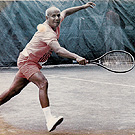
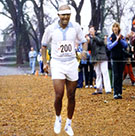
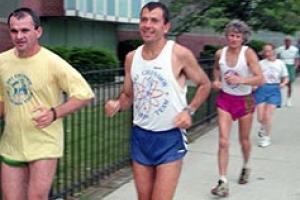
On March 3rd 1979, Sri Chinmoy completed his first marathon in Chico California in a time of 4:31:34. Each year since then, his students in New York and around the world have honoured him by running the 26-mile distance.

Video by Utpal Marshall
On March 3rd 1979, Sri Chinmoy completed his first marathon in Chico California in a time of 4:31:34. Each year since then, his students in New York and around the world have honoured him by running the 26-mile distance.
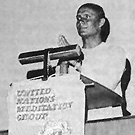
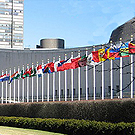
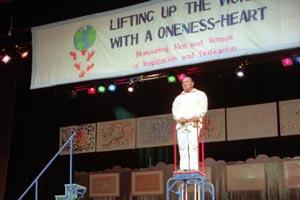
Sri Chinmoy delivers a lecture entitled, ‘Why Do I Have To Become Spiritual?’, as part of the Dag Hammarskjold Lecture Series, in the Dag Hammarskjold Auditorium at the United Nations in New York.
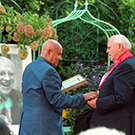
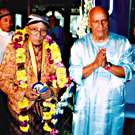
Sri Chinmoy is honoured by Donald Irwin, Mayor of Norwalk, in Norwalk, CT, USA.
Sri Chinmoy cooks a 22-course meal for 465 of his students to honour the third anniversary of Annam Brahma restaurant in Jamaica, NY, USA. He begins cooking at 1 a.m. and finishes nearly 14 hours later. Orders come in from his meditation centres as far away as Europe and Australia, and 265 of the dinners are then sent by air express to destinations around the world.
Sri Chinmoy inaugurates a new mediation centre in the New York area — the Silver Group.
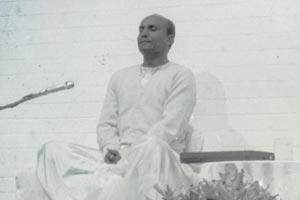
Sri Chinmoy opens a Santana concert with a silent meditation for world peace at Madison Square Garden in New York, NY, USA. 19,000 people join with him in mediation.
Sri Chinmoy gives a talk entitled, ‘Hope’, in Honolulu, Hawaii, USA. Following the talk, Sri Chinmoy answers questions from the audience.
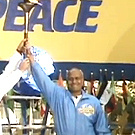
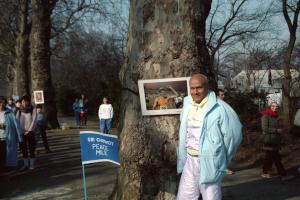
The first Sri Chinmoy Peace Mile — a permanently marked running course along the river Thames — is inaugurated by the Mayor of Wandsworth in Battersea Park in London, UK. Also attending the ceremony are, Members of Parliament, British running champions and dignitaries representing the Greater London Council, the United Nations Association and the Church. The programme includes several races, ending with a peace walk around the course, led by Sri Chinmoy. The ‘Sri Chinmoy Peace Mile’ song, which Sri Chinmoy composed earlier the day, is sung at the ceremony.
Sri Chinmoy receives the World Citizen Humanitarian Award from the World Peace University in Eugene, OR, USA. Dr. F. Richard Schneider, the Chancellor of the private educational institute, which has campuses in Oregon, Chile and Bangladesh, presents the award.
Sri Chinmoy meets with Prof. Dr. Anita B. Pfaff, daughter of Netaji Subhas Chandra Bose, and Prof. Dr. Martin Pfaff, Member of the Bundestag, at their home in Augsburg, Germany.
Moldova is declared a Sri Chinmoy Peace-Blossom-Nation.
JAMAICA, N.Y. — Sri Chinmoy cooked a 22-course meal March 15 to honour the third anniversary of Annam Brahma restaurant.
He began cooking at one o'clock in the morning and finished nearly 14 hours later.
Dinners were sent air express to disciples around the world, who ordered them from as far away as Europe and Australia. Some 265 meals were sent to distant Centres, and about 200 were consumed that day in the restaurant.
Sri Chinmoy embarked on the project as a fund-raising effort for the restaurant, which Nishtha took over three years ago.
Cooking a 22-course meal.
Published in Anahata Nada, April 1, 1977 Vol. 4, No. 3
Song by Sri Chinmoy
Sri Chinmoy Peace Mile, Sri Chinmoy,
Runners and God together enjoy
The vision-sun of self-transcendence-delight,
A fulness-earth-home of ecstasy’s oneness-height.
Published in Peace-Blossom Songs
Published in My Aspiration-Heart’s Country-Life-Salutations
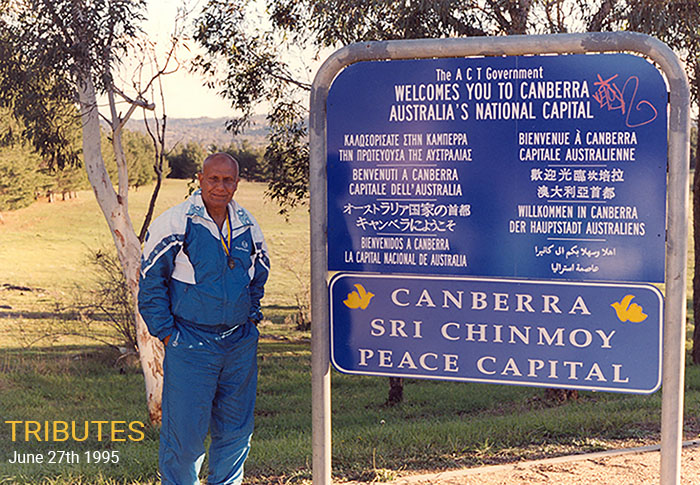
The first Sri Chinmoy Peace Mile is inaugurated by the Mayor of Wandsworth at Battersea Park in London, UK. The programme includes several races, ending with a peace walk around the course. Sri Chinmoy also composes a song for the occasion.
by Sri Chinmoy
At the inauguration of the Sri Chinmoy Peace Mile in London, the weather was mild and excellent. It was very unusual for England. Believe it or not, the sun actually came out! Everybody was so happy that we were blessed by the presence of the sun.
All around the one-mile loop there were beautiful blue flags, quite small, and large pictures of important runners. They started with Robert de Castella’s picture, then some English runners, and ended with Sebastian Coe’s picture — as if he were finishing first.
There were also twelve stone plaques on the course with the inscription “Sri Chinmoy Peace Mile”. There was also a big plaque that told our ideals and philosophy in a nutshell.
Thirty metres away from the starting line there were four golden statues of Lord Buddha in a peace pagoda. Right near the start was the River Thames, which runs along about 800 metres of the course. It was all very beautiful!
I always speak about enthusiasm. This time the British have shown enthusiasm from beginning to end. How cheerfully they worked together! In terms of happiness, enthusiasm, warmth and oneness, this race far surpassed all the races we have ever held, including those in New York. I always say, “Become, and then go beyond.” So they have become one with all the good qualities that New York offers in its races, and they have gone far beyond.
The big shots who came were so nice! How kindly and respectfully they talked to me. I was so deeply moved.
The Mayor and the Commissioner of the Park were at the opening ceremony of the London Peace Mile. There were also a Nobel laureate and a Minister on the stage. For the opening they asked me to release peace doves. I said that I would like the Mayor to release them.
The Mayor said he would do so only on one condition: I had to be on the stage beside him. So we stood together, and he released the doves.
So many runners came to the inauguration of our Peace Mile in London. Many were former Olympians — some from 1948, some from 1956. There was also a British Olympian who had stood fourth in the 10,000-metre race in the Los Angeles Olympics in 1984. Now he is training for the next Olympics.
I had a very long talk with him. I said, “You will get another chance in Korea.”
He replied, “This time, if I do not get a medal, I will give up.” He had seen a video of me lifting 200 pounds and he was very impressed. He said he used to lift 40 pounds, but it was too much for him.
I said, “You do not need to do it.”
There was also a runner from Iran who holds eight Asian records. He was very humble and very nice. He was appreciating me like anything, and I also was appreciating him. He feels I have special blessings from Allah. He also gives all credit to Allah for his running success.
Then, an ex-Olympian from the 1948 Olympics came over to introduce himself to me. He said, “I am a friend of Dhrubha Hein’s father.” This world of ours is so small! Here I was in London and I met a friend of Dhrubha’s father.
The BBC came and interviewed me for a long time at the inauguration ceremony. Then they wanted me to run with the children. So I ran with the children.
From the beginning to the end my place was fixed: last. When I started, I had barely covered 100 metres when the children were at 400 metres. They were so fast!
One lady was wheeling her child in a perambulator. She was ahead of me. Then something happened at around 300 metres, and she fell down. I felt miserable!
Afterwards, the father of the girl who had stood first in the competition begged me to be in a photograph with his daughter. She had defeated me badly, so he was very proud of her. The father was the photographer, and he took a very nice picture.
The Mayor came up to me because he wanted to have a picture taken with me in front of one particular statue of the Buddha, which he liked very much.
Unfortunately, I did not care for that statue. So after we had taken the picture that he wanted, I asked him to stand in front of another statue for another picture. According to me, this second statue was infinitely better.
At that time his photographer was missing. We had two photographers of our own, but he wanted to have his own photographer. So we had to wait.
The Mayor was shouting: “Where has he gone! Where has he gone!” Finally, his photographer came and took the picture.
Published in Run and Become, Become and Run, part 18
Sri Chinmoy meets with Prof. Dr. Anita B. Pfaff, daughter of Netaji Subhas Chandra Bose, and Prof. Dr. Martin Pfaff, Member of the Bundestag, at their home in Augsburg, Germany.
by Sri Chinmoy
while in residence at the Sri Aurobindo Ashram in Pondicherry, India
"Chinmoy, my mosquito net is torn in various places. Will you take it to Albert so he can mend it?"
I took it to Albert-da immediately. Albert himself fixed it, though he had many workers under him. Such was his love for Nolini-da.
On my return, Nolini-da said to me: "One thing is done. Now something more: the laces of my shoes are all torn. Can you get me some new ones?"
I went to Harpagon and got a pair of laces from Panu-da. When I came back Nolini-da lovingly said: "Your running speed and working speed are two great rivals." In silence, I offered him my inmost gratitude.
Published A Service-Flame and a Service-Sun
A lecture by Sri Chinmoy
as part of the Dag Hammarskjold Lecture Series, in the Dag Hammarskjold Auditorium at the United Nations.
Why do I have to become spiritual? I have to become spiritual precisely because I wish to see something, do something and become something. There are many people on earth who do not feel the necessity of this, and I do not find fault with them. But my inner being tells me that I have to see something, do something and become something.
What I wish to see is perfection in my life and in the life of each and every individual. What I wish to do is to love mankind unreservedly and divinely. What I wish to become is a conscious and chosen instrument of God.
Two lives: a life of aspiration and a life of desire. I have been in the life of desire. In that life I did not have even an iota of Peace and Bliss. Therefore, I entered consciously and soulfully into a new life, the life of aspiration. In my desire-life, my existence was tossing in a shoreless sea, and it found its reality in a goalless shore. In order to swim in the sea of Reality, in order to reach the Golden Shore of the Beyond, I entered into the life of aspiration.
AUM
It is a mistake to think that a spiritual person is impractical. On the contrary, a spiritual person is really practical. An ordinary, unaspiring person thinks of God as being in Heaven, millions and billions and trillions of miles higher than his own existence. His God is not around him, not in front of him, but in an unknown or unknowable Heaven.
But a spiritual person has a different idea of God. He says, “If God exists, then He has to be inside my heart, all around me, right in front of me.” So a seeker is practical. He does not accept the theory that God is in a distant and unattainable Heaven, that God is aloof and uninterested in his life. He says, “Only if my God is right here on earth, will I be able to fulfil my aspiration and my need.”
Once he realises that God is right in front of him, he immediately feels that God is everywhere, both in Heaven and on earth. When he thinks of God in Heaven, he immediately feels that God is the dream-fulfilling Reality. And when he thinks of God on earth, he feels that God is the reality-illumining Dream — Divinity’s conscious and ever-transcending Dream which illumines reality.
In the ordinary life, there are many needs. But in the spiritual life we come to realise that there is only one need, and that is a love for God. There is also something that is not needed, and that is self-proclamation. When I love God, I feel that I am touching the very root of God-Tree. And if I touch the root, then the dynamic flowing energy in the root will take me to all the branches, leaves and flowers. But when I proclaim myself, I just limit and bind myself; I am not able to taste, to enjoy myself as a universal Reality. My self-proclamation immediately separates me from the Whole, which I once upon a time was, which I want to become and which I eventually will be.
A spiritual person is not only practical but also normal and natural. Everything in his life is orderly. He goes from one to two to three, and not the other way around. For a normal person, first things come first. And what is the first thing? It is God, because God is the Creator, God is the Source. Every day dawns with a new life, a new hope, a new sense of Immortality. Now, when the morning dawns, the seeker does first things first. First he prays to God, then he thinks of mankind, and finally he thinks of himself.
When he prays or meditates on God, the seeker uses the divine instrument called surrender. “Let Thy Will be done,” he says. And when he thinks of mankind, he uses the instrument called love. He uses his love-power, his love-instrument to become inseparably one with humanity. Then, when he thinks of himself, he uses his discipline-power, his self-control. If he uses his power of self-control, then at every moment a new dream can be dreamt by the divine within him, the seeker within him. A higher call from above takes him to his reality, which is ever-transcending.
As an individual, I have to know that my physical body is not my only reality. I also have a soul, a heart, a mind and a vital. I have to care for my soul first, because this is the eldest member of my family. The soul is constantly dreaming in and through me, and the dream of the soul is the harbinger of my reality’s perfection. So I have to think of the soul or meditate on the soul first.
Next I think of my heart. My heart needs love; it needs to offer love and it needs to receive love. First it gives love, then it receives love and finally it becomes love itself. After giving and receiving love, my heart will feel its inseparable oneness with everything and everyone.
Then I have to think of my mind. If I just think of my mind, that does not solve any problem at all. I have to meditate on the mind with the idea of expanding and illumining it. I think not of the mind that binds me or limits me or separates me; I think of the mind that will gladly listen to the heart and to the soul, the mind that can feel the universal oneness.
Then I have to think of my vital. When I think of my vital, I have to think of dynamic energy. If there is no dynamic energy, I cannot produce or achieve anything. Life is a river that flows constantly and continuously. Vital energy is the current that carries us to the sea, the sea of illumination and perfection.
When we think of the physical, immediately we think of the mind, because we feel that the mind is the most developed member of our family. This is true before we accept the spiritual life. But after we have accepted the spiritual life, we feel that the heart is an older brother superior to the mind. And when we become really spiritual, we can boldly say that we do not need the mind at all; what we need is the heart and soul to guide us through life. Granted, the mind may have everything that the heart has. If we want a diamond, we can find a diamond in the mind-room, and we can find the same diamond in the heart-room. But the moment we enter into the mind-room, we see that that room is full of rubbish, junk and undivine things. The diamond is covered, and it will take us days, months and years to uncover it. But when we enter into the heart-room, we see that there is nothing else but the diamond. The moment we open the door, the diamond is right there before us.
A spiritual person is a man of wisdom. Just by seeing the diamond, he will not be fully satisfied; he will want to grow into the diamond itself. This spiritual diamond is perfect Perfection. The spiritual person enters into the heart-room, sees the diamond, touches the diamond, meditates on the diamond and grows into the diamond. When he grows into the diamond, that means he has become the perfect instrument of God. Then his real satisfaction dawns. A seeker’s satisfaction dawns only when he becomes a perfect instrument of the Supreme. At that time, he becomes one with earth-consciousness and one with Heaven-consciousness.
AUM
A spiritual person wants to realise unity in diversity, harmony in diversity. In the ordinary life, two human beings constantly contradict each other. And even in the spiritual life, two divine qualities in different seekers — if they are not properly guarded or guided — will not become complementary. Let us say one seeker has sincerity and the other seeker has humility. Both these qualities are of paramount importance. But the person who has sincerity feels he is not being admired the way his friend is being admired. He feels that the person who has humility is getting more appreciation from others. So the person with sincerity is not happy. Now, the person who is humble feels that his humility is not giving him total satisfaction either. He feels that the person who is sincere is getting more appreciation and admiration. When we are beginners in the spiritual life, even our divine qualities do not satisfy us.
But when we go deep within, our divine qualities will not oppose one another. On the contrary, each divine quality will complement every other divine quality. When sincerity enters into humility and offers its wealth, immediately humility sees that the only one who is really humble is God. It is God’s Humility that makes Him what He is. And when humility enters into sincerity, sincerity feels its own reality.
After I become spiritual, what is expected of me? I have to empty myself before God and I have to empty myself before mankind. When I empty myself before God, I shall empty my teeming ignorance, the ignorance of millennia. And when I empty myself before mankind, I shall empty my love. Love I have to empty before humanity; ignorance I have to empty before God.
The life of a spiritual seeker is not the life of a stagnant pool. His is the life of a fresh spring, a spring of ever-flowing Consciousness-Light. When the seeker feels that his life is ever-flowing Consciousness-Light, he feels that Heaven — which is dream — is being manifested on earth, and that earth — which is cry — is being transformed into the ceaseless Smile of the Supreme.
Published in The Tears of Nation-Hearts
A talk by Sri Chinmoy
in Honolulu, Hawaii
Hope is at once both simple and profound. It is hope that binds Heaven and earth. Hope is the bridge between Heaven and earth. It is hope that makes us feel, at the beginning of our spiritual journey, that we are of God and that we are for God.
God wants to manifest Himself in and through us. We hope to realise God so that we can liberate ourselves from the meshes of ignorance. God hopes to make us His perfect instruments. We hope to please God eventually in God’s own Way.
You will say that because of life, there is hope. You are right. But I wish to add something. Because there is hope, we live eternally — in the inner world, in the outer world, or in both worlds. You will say that hope sees illumining light in teeming darkness. You are perfectly right. But I wish to add something. Hope is itself the light that illumines darkness.
I love hope. I may not love God, but in the inmost recesses of my being, in the inmost recesses of my heart, I feel that God loves me. Whether I love God or not, God loves me: This is my fervent hope. I may not care for God, but I do feel in all sincerity that God cares for me. Whether I care for God or not, God cares for me: This is my fervent hope.
There is human hope and divine hope. Human hope is desire-bound; divine hope is aspiration-free. Desire-bound and earth-bound are one and identical. Aspiration-free and Heaven-free are one and the same. Human hope inspires us and energises us. Hope divine awakens in us not only infinite possibilities but also immortal realities.
Human hope inspires our outer journey. Hope divine aspires in and through our inner journey. Our outer journey takes us to name and fame, but name and fame will eventually lead to utter frustration. But in the divine world, in the aspiration-world, at the end of our inner journey’s close we see, we feel and we grow into illumination.
When we aspire, we come to realise that hope is a hand, beautiful and powerful, beckoning us for our psychic transformation. When we aspire, we see and feel that hope is the perfect beginning of our God-realisation. When we do not aspire, hope appears before us in a different way. We feel that perhaps it is all mental hallucination; perhaps it is all deception.
Each individual here on earth, whether he is aspiring or not, cannot escape from hope. But hope itself is not an escape. Hope unites us with a higher reality which illumines and fulfils us.
The world is a body. An ordinary human being is not satisfied with the body-consciousness that he has and that he is. He wants to see the body of the future. He wants to see the body-consciousness of the future. If he can see the possibilities, potentialities, realities and inevitabilities of the future, then only will he be happy. But a sincere seeker is not interested in seeing the distant or remote future. He feels that this world is an eternal
Now. By virtue of his convincing inner hope, he wants to see, feel and grow into the eternal Now.
Perhaps some of you know that I serve the United Nations. We have a group at the United Nations which meets twice a week to pray and meditate for peace. What we call the United Nations was once upon a time known as the League of Nations. The League of Nations was the vision of Woodrow Wilson. Woodrow Wilson was a man of supreme vision. He wanted to unite all the nations. Each nation is composed of human beings and divine souls. By unifying the souls of all the nations, he envisioned that world peace would come into existence.
At the United Nations there are representatives from every corner of the world. They have come with sincere hope that a day will dawn when all the world’s calamities and misunderstandings will come to an end, and mankind will be united as one family. Is this not a hope? It is. But inside this hope, possibility looms large. And inside this possibility, what is looming large is inevitability.
The world is still millions of miles away from world peace. But just because we do not see the reality all at once, that is no reason to become discouraged. Before the day dawns, it is dark. When we look at the darkness that is all around and identify with the darkness, it is almost impossible for us to have faith in light. But at the end of the tunnel there is light. At the end of the darkness there is light. This light that we talk about is not a mental hallucination or deception. This light is our psychic light, our soul’s light deep within us, and it is all the time trying desperately to come to the fore. It is more than eager to come to the fore to liberate us, illumine us and perfect us. It is like a child and the mother. The mother is always trying inwardly and outwardly to make the child perfect. Similarly, our inner light is trying to free our outer existence from ignorance-night.
So, at the United Nations, representatives from many, many parts of the world are gathered together. They have come there for world-unity, but world-unity seems to be a far cry. Yet they still have the inner hope that some day there will be world-unity. Right now the countries of the world misunderstand each other, and some of them are undivine, to say the least. But deep within them there is an inner urge. Each nation has an inner urge to have peace, to have light, to have oneness. Each nation hopes to someday have peace, light and oneness. Peace, light and oneness will definitely come into the world arena precisely because each nation is inundated with hope. This hope of today will be transformed into the abiding satisfaction of tomorrow only when we believe in hope, grow into hope, and breathe in at every moment the fragrance and the beauty of hope.
Published in AUM – Vol. 6, No. 5, May 1980
following the talk
Question: What is the difference between aspiration and desire?
Sri Chinmoy: When we desire, we try to increase our capacities in order to challenge others, in order to defeat others, in order to lord it over others, and in order to make the world feel that we are a few inches — if not a few miles — ahead of it. Desire wants to say, like Julius Caesar: “Veni, vidi, vici — I came, I saw, I conquered.” I came into your domain, I saw you and I conquered you.
Aspiration is not like that. When we aspire, we cry not only for our own perfection but also for others’ perfection. Aspiration will say, “What I have, I wish to share with you. If I have a good thought, I wish to share it with you. Again, if you have a good thought, I wish you to share it with me. Let us share our capacities and our realities with each other.” Aspiration plays the role of oneness, which is nothing other than perfection itself. Oneness is perfection; perfection is oneness.
Desire enjoys the sense of separativity: “You stay where you are, I will stay where I am, and I will try to show you that I am infinitely more powerful than you, infinitely superior to you. In every aspect of life I will show you that I far surpass you.” This is the message of desire. But aspiration will say, “If I have anything good, I will share it with you. If I have beauty, I will give it to you. If I have power, I will give it to you, because I am always eager to sing the song of oneness.”
Aspiration is always trying to establish its oneness with each and every individual, and to see only the good, divine, supreme qualities that each individual has and is. If aspiration discovers that I have an unlit quality or capacity, it will try to illumine it. It will never give it to you. My difficulties and imperfections, aspiration will not hide. It will try to illumine them, but it will never offer them to you. When I am aspiring, I will pray to God, my Heavenly Father, to inundate me with light so that I can illumine my imperfections, limitations and undivine qualities.
Desire, on the other hand, secretly or openly will try to throw into you only bad qualities. If I have any wrong thoughts or wrong ideas, if I have anything that is undivine and destructive, openly I can’t give these things to you. But secretly my desire will try to inject them into you so that you will also bear the burden and suffer, so that you will carry the heaviest possible load and not be able to surpass me in any way.
Desire binds us; aspiration liberates us. Desire wants to lord it over others. Aspiration always wants to be one with others. Each time desire achieves its goal, another goal looms ahead; so desire is never satisfied. First it wants one house, then two houses, then three houses, and at the end of the road, frustration looms large. But when we aspire, even if we get just an iota of light, we are satisfied, for we know that eventually we will be inundated with the infinite ocean of Light. Right now we are wanting in receptivity. Once we get more receptivity and our inner vessel becomes large, larger, largest, at that time we shall definitely see and grow into infinite Peace, Light and Bliss. These are not mere words or ideas; these are realities that will one day be at our disposal.
Question: How can we be more attached to pleasing God?
Sri Chinmoy: Instead of saying ‘attached’, let us say devoted. When something is good, we are devoted to it; when something is undivine, we are attached to it. Because we love our country, we devote our lives to the improvement of our country. If anything is good, we will devote our lives to that thing. Our soul is devoted to God-manifestation. When we start praying and meditating, we try to satisfy God. That means we are devoted to a high cause, the supreme Cause.
When we remain in the ordinary world, the unaspiring world, the desire-world, we try to please and satisfy only ourselves. But when we are in the aspiration-world, we try to please God. God is the root, and if we can please the root, then the trunk, branches, leaves, flowers and fruits will also be pleased. So let us devote ourselves to the root, to God. If we can please God on the strength of our heart’s inner cry, then we will see and feel inside us God’s Love, Concern, Light and Peace — all that God has and is.
How can we have this inner cry? We can have this inner cry in the same way that we can have the outer cry. When the child cries for food, no matter where the mother is, she will come running. The child may be on the first floor and the mother may be on the fourth floor, but the mother will come running because the child is sincerely crying to be fed. Similarly, if we cry sincerely for divine Nectar, for light and delight, then God is bound to give it to us.
When the child cries, he has the unconscious hope that the mother will come and bring him food. But in the case of seekers, we are conscious. So when we cry for peace, light and bliss, immediately we get an answer. But our cry has to be sincere. When we cry inwardly, we have to feel a sincere need for God. When we have that inner need, then God, out of His infinite Bounty, will come and grant us the things that we need.
If we have a sincere, genuine inner cry, then all our problems will be solved. But if we do not have that sincere inner cry, then no matter how many years we live on earth, we will not find satisfaction, because true satisfaction means the perfection of our nature, the perfection of our life.
Question: I’m trying to have faith in all that you are saying. But if it is true, why don’t I feel these things inside me? Why don’t I feel light and peace inside?
Sri Chinmoy: If something is true, you will feel it within the very depths of your heart. That is true. But sometimes it may take a little time. You sow a seed. After a few months it germinates. In a year it grows into a sapling, and eventually it grows into a huge banyan tree. Similarly, when you begin to take an interest in the spiritual life, you have sown the seed. You may not see the results immediately. It takes time.
You will feel, but first you have to have faith. Inside you there are many organs: heart, lungs and so on. You believe this because doctors and others say so. Although you cannot see these things, you know that they are there. Similarly, within your inner body, let us say, there are many things which you may not feel, but which I am aware of, because I have prayed and meditated more than you have. In the spiritual life you have to pray and meditate soulfully, and have faith in what you have heard from spiritual seekers and Masters. Eventually, if you apply yourself to the inner discipline, you will see that they were right. Again, there are many things which you may know better than I do. In these matters I have to have faith in you. Then eventually, if I seriously study these things, I will see for myself that what you say is true.
In the inner world if you do not see something right now, you cannot say that it does not exist. I am not saying that you are doubting or arguing; far from it. But I wish you to cultivate more faith in what I say and in what other Masters have said about the inner world. You have to start with faith — sincere, genuine, sublime faith. This faith is not going to betray you. You read spiritual books, scriptures. Each book embodies light. While reading, you may not feel light inside the book. But you do not discard the book. No, you have faith in the messages that the book contains. You meditate on the words and ideas that the book embodies, and eventually you do get light. Inside the ink, inside the paper, inside the book there was a hidden reality. You believed in that hidden reality while you were reading, and in the course of time you got illumination. But you had to read the book to get the essence, the quintessence, of the book.
Similarly, you have to pray and meditate before you will feel your own divinity. If you cannot feel your inner divinity right now, don’t be sad or upset. It takes time. Pray and meditate sincerely, and through your faith your real divinity will one day loom large. Once you enter into the spiritual life, if you do not have higher experiences or realisations, do not give up. If you do not feel inside the very depth of your heart something divine, illumining, fulfilling and perfect, no harm. It takes time to acquire a free access to the inner world, but once you have it, you will see that it is flooded with light and delight.
Published in AUM – Vol. 6, No. 5, May 1980