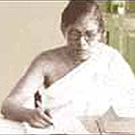
T.V. Kapali Sastry

Preface


Sri Kapali Sastry (1886-1953) was a highly respected Vedic scholar and Sanskrit authority. Even after he became Sri Aurobindo’s disciple and entered the Ashram, he continued to write many commentaries and definitive works. The young Chinmoy had the immense good fortune to study under him in the Ashram school and the following anecdotes capture his love and respect for this great soul.

– Vidagdha


1.


Chinmoy’s full-length play The Descent of the Blue, which was published serially in the Mother India from 1958 to 1962, contains the following scene depicting the momentous day in Kapali Sastry’s life when he was accepted by Sri Aurobindo as his disciple.


Act XI, Scene 3
 

(1923. Pondicherry. Sri Aurobindo’s residence.)

(Enter T.V. Kapali Sastri, an eminent Sanskrit scholar of South India.)
 

KAPALI: (Bowing his head to Sri Aurobindo) Sir, six years back when I first came to you I asked you about India’s possibilities and you gave me an inspiring answer, ‘not possibility but certainty.’ This time you are giving me another inspiring thing – your golden complexion. It is no longer deep-brown as before. In you, Yoga incarnate carries now its true complexion.

Now I have come, my mind made up once for all, to throw myself at your feet and upon your Grace for ever. Pray how should I proceed in the first step of your Yoga?

SRI AUROBINDO: My Yoga aims at transformation of the whole being, not excluding the physical.

KAPALI: How and where to begin?

SRI AUROBINDO: One has to bring the Divine Consciousness right down into the very cells.

KAPALI: Too difficult even to think of. But I cannot try the too-hard so soon. I repeat I throw myself at your feet and upon your Grace, now and for ever. Do with me as you please.

(Sri Aurobindo gives a gracious smile and a nodding assent. With a parting pranam Kapali leaves the Master’s presence, profoundly happy.)


2.

 
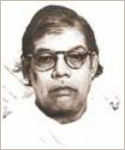
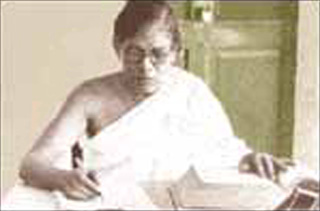
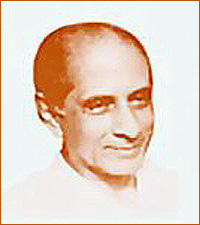
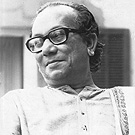
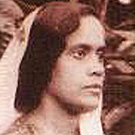
An early photograph of Kapali Sastry.

Prabhakar was my first Sanskrit teacher. Then I got a promotion to South India’s great Sanskrit scholar Kapali Sastry. He was an authority, specially on the Rig Veda. Sri Aurobindo said such nice things about him.

This story happened in 1945. I had written some prayers in English. They came from the very depths of my heart. I was a seeker and I shall always remain an eternal seeker, so these prayers came from the seeker in me.

I liked this particular teacher very much. He was extremely kind to me and full of affection for me. I went to his house and showed him these prayers. They numbered about twenty. He liked them immensely. Then he said to me, “Who has written them?”

          I said, “I wrote them.”

          He asked, “Is it true?”

          I replied, “Yes.”

          He said, “Always we have to know who writes.”

          I said again, “I wrote them.”

Then he said, “Chinmoy, you are just a young fellow. If somebody had told me that Mother had written these prayers, my faith in the Mother would have increased so much! I would have immediately touched her feet and offered her all my love, adoration and devotion because they are so beautiful, so soulful. But you are just a little kid, so I cannot do that. I know who you are. Instead of touching your feet, I can only bless you.”

He patted me on the shoulder and congratulated me because I wrote those prayers. I still have them in my Indian notebooks.

What a wonderful teacher! He was absolutely right. Always we have to know who has written the words or who has said the words. If a thief says, “Do not steal, do not tell lies,” are you going to listen to him? The very next moment he himself will go and steal and tell lies and everything. But if a saint says, “Do not steal,” then there is a force behind it. The force carries through the words. The same thing can be said by different people but you have to know the source.


3.

This next story happened a few months later. In those days, in December, we used to have an annual cultural function at the Ashram. My Sanskrit teacher, Kapali Sastry, had translated Sri Aurobindo’s poem “Who” into Sanskrit. In English, the poem begins,

          In the blue of the sky, in the green of the forest,

          Whose is the Hand that has painted the glow?

I like this poem so much. Hundreds and hundreds of times I used to recite it – sometimes softly, sometimes forcefully.

Anyway, my teacher was teaching the class to recite the Sanskrit words in the South Indian style. Unfortunately, on that occasion I became the worst student because I did not like his way at all. He wanted me to join the group but I was not getting any joy, so I was not learning his way. I was making mistakes, perhaps deliberately, God alone knows.

This teacher had such affection for me, but I was not doing it the way it should be done. So he asked me to recite it for him in my own way. The way I recite poems, Bengali and Sanskrit, is pure Tagore style. He said, “It is useless.” Then he kicked me out of the group. Since I could not learn his way, he threw me out.

Mother used to watch the final rehearsal of each group. If she approved the performance, then only you could be in the programme. So my teacher took about twenty students to recite the poem in front of the Mother. Many Ashramites were also there listening and I was among the audience. I was in a very good consciousness, not at all jealous!

Mother listened to their recitation, but she did not like it at all. Still, she graciously gave him another chance. She said to this greatest scholar, “Next week you come back to me with your group. They need improvement.”

Then my poor teacher came up to me and said, “Chinmoy, I have failed. Now you do it in your own way. Since the Mother did not approve of my way, let us try yours.”

In the back of his mind, he never thought, even for a second, that Mother would be pleased with my style. So I said to him, “If you are not pleased with my way, why are you accepting it? If you yourself do not like it, it is useless for me to teach others.”

He said, “I am a little bit sad and embarrassed. But I really want you to try. Perhaps Mother will make a selection. She heard mine this week and she will hear yours next week. The best thing is to try your way.”

So I became the teacher and everybody learnt it in my way. My way was very simple. Sometimes there was a musical touch in it. He also made a few suggestions to improve it.

We went the following week to recite the poem in front of the Mother. O God, she liked it very much. Her comment was, “Very good!”

I was not in the group. I was seated in the front row. Then Mother had to ask me whether I recited or not. She asked me what I was doing in the audience. So I also joined the group and, in a week or two, at the cultural programme, we recited it exactly my way.

My poor teacher! He showed such magnanimity of heart. Not only was he the ocean of wisdom but he had such a large heart. He was sincerely happy that Mother like my version. This story shows his nobility.


4.

Next to Kapali Sastry, we were like drops. He was the ocean of knowledge. He wrote a book in English that was all about the Mother. It was called Flame of White Light. He asked me to translate it into Bengali. In the Ashram, these great sadhaks did not request; they just compelled. The order came, “Do it for me.” The order came to me through M.P. Pandit, who was a very great literary figure in the Ashram. Sri Aurobindo was M.P. Pandit’s Guru but Kapali Sastry was his mentor.

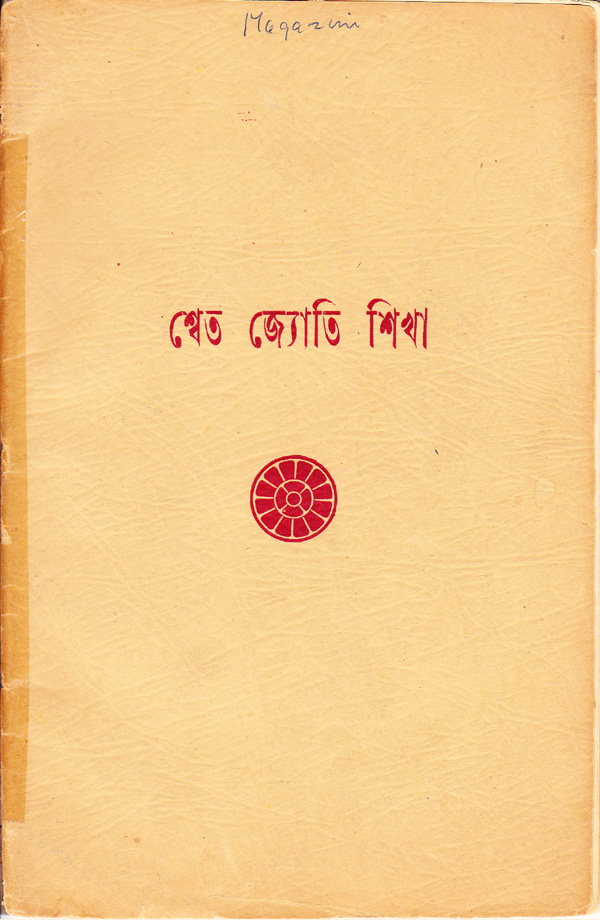
So I translated the book into Bengali. The title was “Sada jyoti shikha”.
 

The booklet was printed at the Ashram. The original cover and the pages of Bengali text follow:1
 

Previous    

Next

5.

In February 1986, I was visiting my family at the Sri Aurobindo Ashram. One day I was near Sri Aurobindo’s Samadhi. All of a sudden, so many reminiscences of my Sanskrit teacher started flowing in my mind-river. I could not believe it. Later I learnt that it was his centenary year.


– End –


Note:
1 Colour plates have been omitted due to copyright restrictions.

Sahana Devi

Stories by Chinmoy


Foreword

Sri Chinmoy requested this compilation of stories about Sahana Devi in 2006 and he reviewed it several times, making additions and corrections. From the time that he joined the Sri Aurobindo Ashram in 1944, as a young orphan of only twelve, Sahana Devi expressed tremendous motherly concern and love for him. He remained eternally grateful to her.

– Vidagdha Bennett (Compiler)


Table of Contents


Preface by Sri Chinmoy

I shall tell you a few stories about a singer of the supreme heights. Her name was Sahana Devi. She lived at the Sri Aurobindo Ashram as a most ardent disciple of Sri Aurobindo and the Mother for more than sixty years before she passed away in 1990. During my Ashram days, I basked in the sunshine of her affection.


1. How Sahana Devi Joined the Ashram

Sahana-di was a student at Rabindranath Tagore’s Santiniketan. She was extremely fortunate because she was so closely connected with Tagore. She sang for him many, many times and he was deeply enamoured of her soul-stirring voice. She also composed many songs.  

Dilip Kumar Roy was responsible for bringing Sahana Devi to the Sri Aurobindo Ashram. Dilip-da had a golden voice and also he had mesmerising charm. When Sahana Devi saw and heard Dilip-da’s supremely gifted talents, she became a great admirer of him.


Dilip Kumar Roy

Sahana-di was a singer of the highest order. She had a most glorious singing voice.1 Dilip-da taught her one particular Bengali song. After Sahana-di sang that song, Dilip-da said he would not sing it any more because she sang it far, far better than he did.2 Look at Dilip-da’s sincerity!  

When Dilip-da joined the Sri Aurobindo Ashram, he inspired Sahana-di to do the same. By that time, she too had developed tremendous love and devotion for Sri Aurobindo. Dilip-da and Sahana-di both arrived at the Ashram on November 22nd, 1928.  

Tagore was very upset when Sahana-di left Santiniketan. When she came to the Ashram, he sent an unforgettable message: “Had I been an Emperor, like the Moghul Emperors, I would have sent my army to bring you back from the Ashram.”  

Sahana-di had such a great personality. She was very highly educated and extremely talented. In appearance, she had a long face and she was very tall, majestic. She had a certain way of walking that commanded respect. When she walked, you could feel there was something inside her. She carried tremendous dignity, dignity, dignity.  

People were not afraid of her, but she commanded such admiration and respect. To go near her was really something. It was easier to go near Dilip-da. In Sahana-di, we always felt kindness and seriousness at the same time.  


2. Sahana Devi’s Version of Tagore’s Musical Tastes

Sahana Devi was a supreme authority on Tagore, specially Tagore’s devotional songs. She wrote in one of her articles that Tagore did not care for tabla or measured Western beat. She said that he wanted only a spontaneous flow.  

Then, in a subsequent issue of the same magazine, another authority on Tagore’s music – Shanti Ghosh – said that Tagore really enjoyed tabla and also Western beat. Whom to believe? Both of them studied under Tagore and now there are two different versions. Sahana Devi was older than Shanti Ghosh by a few years, so perhaps her version is more reliable.  

I have the same problem. When the beat is measured, usually I do not like it. For the fast songs, I do like it but for the slow ones, these one-eighth or one-quarter notes do not appeal to me.  

Tagore had ten or twelve students whom he personally invited to study directly under him. They were selected from the several hundred students who attended Santiniketan. Among these selected students, his nephew Dinendranath3 was the closest. As soon as a tune came to Tagore, he used to sing it for his nephew and his nephew would give the proper notation. When his nephew died, Tagore said that his right hand had gone. Other students began taking notation for him, but the process became very slow. Tagore always used to say that the reason was that his nephew was in his consciousness, whereas, the others were not.  


3. The Niece of Deshabandhu Chitta Ranjan Das

Sahana Devi came of a very illustrious family. Her maternal uncle was known as ‘Deshabandhu’ – ‘The Friend of the Nation’. That was his title. His actual name was Chitta Ranjan Das. He was the barrister who defended Sri Aurobindo when Sri Aurobindo was interned in Alipore Jail on a charge of sedition.4 Lord Krishna himself came to Sri Aurobindo in the Alipore Jail and told him, “Give all responsibility to Chitta Ranjan. You do not need to give your advice. He is the one whom I have chosen to release you from the jail.”  

Day in and day out, C.R. Das worked so hard. Then, while summing up his case before the court, C.R. Das gave such an historic message. He said, “Long after he [Sri Aurobindo] is dead and gone, his words will be echoed and re-echoed not only in India but across distant seas and lands …” That was the day Sri Aurobindo was released.  


Chitta Ranjan Das


C.R. Das became a very great political figure. He was extremely close to Mahatma Gandhi, ‘the Father of the Nation’. They had mutual admiration and appreciation for each other.  

For many years, C.R. Das used to come and visit Sri Aurobindo in Pondicherry. Sri Aurobindo told him, “Politics and spirituality do not go together. Give up politics if you want to realise God.”  

C.R. Das could not give up politics. He continued to work for his country until death snatched him away in 1925.  The Master-Seer of the age, from his silence-hushed Ashram, said,  

Chitta Ranjan’s death is a supreme loss. Consummately endowed with political intelligence, constructive imagination, magnetism, a driving force combining a strong will and uncommon plasticity of mind for vision and tact of the hour, he was the one man after Tilak who could have led India to Swaraj.

Tagore’s glorious tribute to the mighty departed soul runs:   

With thee came down
            The immortal breath.
This thou booned us
            With thy body’s death.   

Mahatma Gandhi said:   

Time cannot efface the memory of a man so great and good as Deshabandhu.   


4. Sahana-di Sings for Sri Aurobindo

The Mother and Sri Aurobindo lavished their affection and love on Sahana-di. She was such a superlative singer; her voice was unimaginably haunting. In the beginning, Sri Aurobindo gave Dilip-da, Sahana-di and one or two more permission to sing for him once a week. Then, gradually, it became once a fortnight, then once a month. Perhaps I was not even born at that time.  

Sahana-di was among those who used to receive letters from Sri Aurobindo almost on a daily basis from 1930 to 1938. She received hundreds and hundreds of letters from him. Sri Aurobindo had very special blessings, very special concern and very special affection for her. In her immortal book, entitled At the Feet of the Mother and Sri Aurobindo, Sahana-di published many, many letters that she received from Sri Aurobindo and the Mother.  


Sahana-di and the Mother


5. Sahana-di’s Experience while I was Singing

The Pondicherry sun is very, very powerful. Many days we had scorching heat. The following incident happened in 1946 or 1947 on one of those days. I was just a young boy of fourteen or fifteen. Between midday and one o’clock – absolutely the hottest time of the day – I was inspired to walk along the shore of the Bay of Bengal. Then, what is more, I was inspired to sing some songs. Deliberately, from beginning to end, I was singing them all wrong! I was singing in Bengali at the top of my voice and I was using all unbearable melodies. In this way, I was getting much more joy than when I sang those songs correctly!  

The Bay of Bengal was only one hundred metres away from my house. I walked there for at least five or six hundred metres. I was not wearing sandals even. Sometimes I was singing, sometimes I was whistling. I was absolutely carefree. This kind of carefree life is something we can never recapture, never! After walking there, I came back home. When I came near my house, I could not continue to sing in such an uncivilised way, so I stopped my singing. I became a silent Brahman.  

In three or four hours’ time, Sahana Devi came to my sisters’ house with a poem. Her house was very close to the Bay of Bengal – only two and a half blocks away. She told my sisters that from her balcony, she had seen me walking and singing. I was acting like a madcap, but she had seen inside me the living presence of God. She did not see me as a human being at that time; she saw a living God inside me. She herself was such a great singer, but she did not care about my deplorable singing.  

She was so deeply inspired by this experience that she wrote about twelve lines to say, “I vividly saw God, not a human being.” At that time, I was not yet well acquainted with her, but I knew who she was. That was her first comment.  

Even now, I cannot believe how badly I was singing, deliberately, on that day. I was getting tremendous joy by singing the wrong tune. But Sahana-di went beyond my singing. What a beautiful poem she wrote! Afterwards she came to know that I happen to be a good singer.  

Afterwards, she reminded me of that incident many, many times. In 1989, when I visited my family at the Ashram, she was 92 years old. Even then, she had to remind me of that incident.


6. The Cousin of Atulprasad Sen

Recently, I have come to learn that Sahana-di was the cousin of Atulprasad Sen, the great composer.5 6 I have borrowed the melody of his song “Balo balo balo sabe” for my song “Chalo chalo chalo chalo”. Here, in the West, if you borrow the melody of another composer, then you will be placed in jail. But, in India, if you mention that you have borrowed a melody from someone, then you are exonerated and the composer is so proud that you have taken his melody. Our “Chalo chalo” I have freely taken from “Balo balo”. Like that, I have taken seven or eight supreme tunes from different musicians – Kaji Najrul Islam, Dilip Kumar Roy and others.


7. A Serious Misunderstanding with Sahana-di

Sahana-di became one of my Ashram ‘mothers’. My own physical mother left me when I was eleven and a half, so when I came to the Ashram, there were five elderly women who lavished their affection on me unreservedly and unconditionally. They all claimed to be my mothers and they showered me with boundless love and affection. My main mother was Mridu-di.7 Then came Sahana-di. In so many ways, she poured her boundless affection, concern and fondness upon me.  

Alas, somehow a serious misunderstanding arose at one time between Sahana-di and me. She had a devoted student, but later on, this lady became Sahana-di’s rival. The rival’s daughter was in Sahana-di’s music class. One day, this girl was angry with Sahana-di for some reason. She stood up in class and said, “Even Chinmoy-da says that your voice is not what it used to be. You have lost your singing capacity.”  

All on a sudden, out of the blue, that girl had to ruin everything for me. It was only rivalry because this girl’s mother, who was also a singer, was jealous of Sahana-di. Although we were brought up together at the Sri Aurobindo Ashram, I never had the occasion to speak to that girl, even for a fleeting second. She was two years my junior and she was in a completely different class from me. But I happened to be a very good singer, so she thought if she uttered her criticism in my name it would have more effect.  

I was a great admirer of Sahana-di’s singing voice. What is more, Sahana-di was so kind, so affectionate and so indulgent to me. How could I speak ill of her? It was unthinkable for me to criticise my Ashram mother. It was all an utter lie. But that is how fate goes.  

Sahana-di believed the story and she became so mad. Life is always like that. When people speak ill of us, we always believe it. But when they flatter us, we are reluctant to accept their praise; we feel there must be some motive behind it. I told Sahana-di that the report was absolutely false, but she did not believe me. She was so furious that she would not even talk to me, nor would she include me in any musical activities. Before, I was one of the first to be invited.  


8. I am Forbidden to Participate

My unfortunate experience with Sahana-di happened in 1947. Her punishment came a few months later. Our greatest Ashram singer, Dilip Kumar Roy, had composed an excellent song in Sanskrit on India’s freedom. The name of the song was “Avirbhuta bharata janani” (Mother India is fully awakened). In this song, he is worshipping the soul of India as the Mother Goddess.  

Dilip-da wanted at least two hundred Ashramites to perform the song at a special function that would be held at the football playground. Pondicherry’s Governor would be there. Sahana Devi and Dilip-da were extremely close friends and Sahana Devi was his assistant. In order to make up the number, Sahana Devi invited singers of all different standards to join – including my own brother Mantu, who cannot hold a note! Give him any song and it is off the track. When my brother Mantu used to sing, my sister Lily used to disappear because he ruined everything. When they were singing in a group, my sister would become so embarrassed, she used to run away.  

Anyway, I was not allowed to be among those two hundred singers. Can you imagine? Sahana-di said, “If Chinmoy sings that song, I am not going to sing.”  

Who was I in comparison with Sahana-di? So Dilip-da’s reply was, “Oh, who needs Chinmoy!” I received a message via one of Dilip-da’s friends that I must not join the group; I was discarded.  

The singers used to practise at Dilip-da’s house. It was only forty metres away from the house where I lived, on the same street. Two hundred people could not be accommodated in his house, so some of them had to stand outside on the pavement.  

While they were practising, I used to enjoy singing the song. Who could remain silent? I could hear it very well, even from my room. I learnt it very, very nicely, but I was not allowed to participate in the final performance. That was my punishment.  

Some people told me that I should just go up and sing on that day without an invitation. They said it would not matter because so many people were taking part. But I did not dare. I did not want to make Sahana Devi even more furious. So I stayed in the audience.  

I suffered so much because one girl told a lie. I incurred Sahana-di’s anger and also Dilip-da became really angry with me. It took many long years for Sahana-di to forgive me.  


9. Sahana-di Forgives Me

This incident happened in 1952, when I was twenty-one years old. One day, Sahana Devi caught me on the street and gave me a notebook. In it, she had written a poem in Bengali of ten or twelve lines. It was very short. My mothers did not believe in ‘request’. Their heart-dictionaries housed only ‘demand’ and ‘command’. She did not beg or request me – she ordered me to translate it into English. She said she would forgive me on one condition: if she was satisfied with my translation. This poem was all about Sri Aurobindo. The title was “Aurobindo Pranam”. Sahana-di’s notebook also contained a long poem by her in Bengali. It ran to two hundred lines.  

I immediately translated the short poem and then I was inspired to translate the long poem as well. I thought, “I have so many things to do, but at least I should do this for Sahana-di. Whether it is to her satisfaction or not, I should do it.”  

Master! To Thee I Bow
By Sahana Devi
 

Thy Feet of immortal lustre are all my world,
My life, a worship of Thy Form divine,
My haven, the fulness of Thy desire unfurled,
Extinction of earth’s will in Thee is mine.  

Devoutness of my heart Thy Bounty’s rays,
The splendour of Thy Compass is my might,
The ken of Thine is my liberation’s ways,
Blessings of Thee on me Thy Acceptance-light.  

My realm, Thy world unveiled of supernal Play,
Mine is the whole of Thy eternal swing,
My loneliness is the fire-touch of Thy ray,
And that alone the door unclosed to Thee, King!  

The Form of my form is Thy Apocalypse,
The Fountain of my thoughts is Thy Will’s Sun,
Existence Thine my song’s citadel-deeps,
My bow the withdrawal of “I”, and union.

                                   (Translated by Chinmoy)  

Fortunately, Sahana-di liked my translations very much. When she read them, she once more became all love, all affection, all kindness, all compassion towards me. And I received from her the same scoldings! She was all-eager to forgive me, so she said she liked the translations very much and she was so happy, so happy. She arranged for both the long one and the short one to be printed in the Mother India.8

Many years later, during one of my visits to the Ashram, she said to me, “Now I want you to keep this. You will value it because it is your own handwriting.” My notebook that I gave her with my translations, she gave back to me. My original handwriting was quite beautiful. Nowadays, it is unreadable! I still preserve that notebook.  


10. My Table Tennis Adventures

I am beginning with the story of how my pride was smashed when I was a young man. Sahana Devi used to beg me to play tennis. Because I was doing well in athletics, I did not listen to her advice. I thought that if I practised tennis on the hard court, I would ruin my legs for sprinting. I was also very poor and I could not afford to buy the necessary shoes and racquet. At the Ashram, I played tennis only twice.  

One year, for some reason, I decided to participate in the tennis tournament. Since I had no experience, they put me against K. Rajangam. This was the gentleman who gave the money to buy the main building of the Ashram. He was quite young when he joined the Ashram and he came of a very rich family, so he offered Sri Aurobindo and the Mother a very large amount of money and the main building was purchased.  

About ten years ago when I was visiting the Ashram, I was nearing the Ashram Dining Hall. Somebody from behind called, “Chinmoy!” I turned around only to see him. He grabbed my hands and immediately put them on his head for my blessings.  

This happened right in the street. I said, “What are you doing? What are you doing?”  

He said, “I know who you are.” 


Rajan-da outside the main entrance of the Sri Aurobindo Ashram


Coming back to my tennis story, Rajan-da was then on the wrong side of 50. He was either 55 or 58. I was about 22 years old. I had such pride because I was the fastest sprinter, the best athlete. I said to Rajan-da, “I will easily defeat you!” Then the game commenced and I discovered that my racquet had a big ‘hole’! He was such a skilful player and he was enjoying the game immensely. Poor me, I was running this side and that side, but I could not return the ball. Needless to say, he defeated me very nicely. He crushed my ego.  

The second time I played was the following day. I went and practised against the wall with the hope that in the near future I could again challenge Rajan-da. Alas, it did not help. I failed to make any progress. Sahana-di begged me and begged me to persevere. She even said she would give me a tennis racquet.  

I said, “No, no, no.”  I did not follow her suggestion. But now, you see, her vision was better than mine. If I had listened to her and started playing tennis at age eighteen, today I would be able to play really well. These were my two experiences of playing tennis in the Ashram.  

Then Sahana-di said, “At least play table tennis.”  I agreed to try table tennis.  

Sahana-di was so happy. She immediately gave me three wooden table tennis bats. I began to learn the game and I became a very good player.  

One of the main pillars of the Ashram – A.B. Purani – used to enjoy playing table tennis very much. Unfortunately, he was quite stout and also at that time he was around sixty years old. Therefore, nobody wanted to play on the same doubles team as him. I happened to be a great admirer of his. I used to call him ‘Lion’, and he used to call me ‘Baby Lion’. He was very, very fond of me. So I said that I was ready to play doubles with him.  

Alas, we never won. Why? Because people are not kind. Our opponents used to direct all their tricky shots to him. He was the weak point in our team. How much area could I cover? But I did not mind at all because I was able to give Purani-ji so much joy, so much joy.  


A.B. Purani


I wish to add something more about Purani-ji. He was a very great scholar and writer. His Evening Talks with Sri Aurobindo offer us so many insights into Sri Aurobindo’s views on a wide range of subjects.  

In 1955, Purani-ji went to England to gather information about Sri Aurobindo’s early life there for his monumental biography entitled The Life of Sri Aurobindo. In his book, he has reproduced a photograph of the room Sri Aurobindo occupied as a student at King’s College, Cambridge University.  

On June 27th, 2003 – nearly half a century later – I went to Cambridge to honour various professors with our “Lifting Up the World with a Oneness-Heart Award”. One of my students made arrangements with the Provost tor me to go and see Sri Aurobindo’s room after our ceremony was over.  

There are actually two rooms where Sri Aurobindo lived from 1890-1892. The smaller of the two rooms was used as a study by Sri Aurobindo and some other students. The rooms are now occupied by an elderly gentleman, Dr. John Avery, who is retired. Formerly, he was a lecturer in Persian studies. He showed me everything with such love and respect. He made repeated requests for me to sit down, but how could I dare to sit down in the room where my Master had studied? I was trembling with delight inside that room. My eyes were flooded with tears and my heart was swimming in the sea of delight. My heart was literally throbbing. Out of reverence, I remained standing and meditated.  

Afterwards, Dr. Avery thanked me for paying a visit to his room. I replied, “It is I who should be grateful to you. I am a humble disciple of Sri Aurobindo.”  

I will cherish this most precious memory of my visit to Sri Aurobindo’s room until the end of my days. Fortunately, we were able to take many, many photographs, so perhaps I have been able to add something to Purani-ji’s immortal book.  


11. Nolini-da Immortalises Sahana-di

On January 30th, 1962, I said to Nolini-da, “It seems you have immortalised Sahana-di in your writings.”  

Nolini-da replied, “Chinmoy, I do not write anything false. She deserves my sincere appreciation.”


Sahana-di, Nolini-da and Nolini-da’s son Robi-da – March 1969.
Photo by Chinmoy


12. Kings and Queens of Imagination

Kalipada-da, Rose-di and Satinath-da were working in Amrita-da’s room. Around eleven o’clock in the morning, Amrita-da said to me: “Chinmoy, yesterday I read your article on Raja Rammohun. You are all Bengalis here; I am the only non-Bengali. I must say that all you Bengalis are rajas and ranis [kings and queens] of imagination.”  

Rose-di said, “Amrita-da, what you say is perfectly true. But, unfortunately, we have all lost our kingdoms, so we are crownless kings and queens.”  

At this point, Sahana-di entered the room. Amrita-da said, “Don’t worry. Sahana can easily solve the problem for you. She can afford not only to buy you crowns but also to crown you.”  

Sahana-di said, “What? What? What kind of arrow, Amrita, are you hurling at me?”  

“We are not aiming arrows at you. We are just admiring your supernatural capacities and qualities,” he said.


13. I Set Music to Sahana-di’s Song

Sahana-di wrote many, many beautiful songs. I learnt quite a few when I was in India. One song of hers was my favourite. After I came to America, I set music to this particular composition in my own way.


Agni mayi agni jwalo kayai tuli sara
Rakte mama bahao taba bani rasha dhara
Tarar mato urdha shikha dhari utuk sab dhulika
Mukta karo bhangi amar mritikar kara

                                                                                    – Sahana Devi


On one of my visits to Pondicherry, I wanted to sing that song for her. Sahana-di was head of the tailoring department in the Ashram. The Mother gave her that job. My cousin Nirmala-di also used to work there. There were about ten workers altogether. So one day I went there. The workers were so thrilled that I had come to visit their department. And Sahana-di herself was so happy and surprised to see me.  

She asked, “What brings you here?”  

I replied, “I have come here to sing a song. One of your songs I have set to music. I know your melody well; I learnt it when I was fourteen or fifteen years old. I fully appreciate your melody, but in America, I was inspired to set a different melody to your song. I want you to hear my version.”  

She said, “I know you are a daredevil. Now, what do you need from me? You have not come with your harmonium?”  

“From America, I will carry my harmonium?” I answered.  

Then she said, “Ja! Go inside. There are three harmoniums. Choose whichever one you want. Bring it out and sing.”  

I said, “I do not need your harmonium. I can sing better without a harmonium.”  

I was told that Sahana-di was very fussy about her instruments. Usually, she did not lend them to anyone. But on that occasion, she begged me to use one of her harmoniums. So I played on her harmonium and sang the song. Although my tune was totally different from hers, she was very deeply moved.  

That kind of affectionate command or demand we exchanged – the ‘son’ and the ‘mother’. At that time I was forty-two.9


14. The Last Meeting

Every time I went to India to visit my family, I used to visit Sahana Devi. The last two or three times, she came to our house in a rickshaw to see me. I would have gone to see her, but she did not trust me to come on my own, so she came to see me. She said, “You have become such a great person, it is I who should visit you.”  

The last time I saw her, she said to me, “Kindly give me some money, Chinmoy. I have written a novel and I need money to print it.”  

I said, “Fine. How much money do you need?”  

She told me how much money she needed. Then immediately I gave her much more than what she needed. This was a kind of mother-and-son business.  

Then she asked me if she should send me an autographed copy. I said, “Yes, you can give me. But, forgive me, I am not going to read your novel.”  

She knew I am of that type. In my entire life, I have read only three novels: Anandamath by Bankim Chandra Chatterjee,10 Srikanto by Sarat Chandra Chatterjee11 and War and Peace by Tolstoy.  

So Sahana-di did not send me her autographed copy. She passed away on April 6th, 1990 at the age of 93.  


15. The Grandson of Deshabandhu

The grandson of Deshabandhu Chitta Ranjan Das became India’s Ambassador to the United States in 1992. His name is Siddhartha Shankar Ray. His mother, Aparna Devi, was the eldest daughter of Deshabandhu. Formerly, Siddhartha Shankar Ray was the Chief Minister of West Bengal.  

He was, to some extent, anti Sri Aurobindo because he did not understand why Sri Aurobindo left politics and opened up the Ashram. And yet, here in America, he and his wife, Maya Devi, poured their affection into me in so many ways. They were so kind to me.  

On August 8th, 1993, we honoured them both with a special programme at a local school, PS 86. During the programme, we played a recording of Sahana-di singing and Ambassador Ray was very deeply moved.12

This is what Ambassador Ray said on that occasion:  

Sri Chinmoy, sisters and brothers, I want everyone to know how deeply grateful I am for the exalting spiritual experience that you have provided me tonight. There was tremendous spiritual serenity, but it was coupled with a great deal of mundane gladness. Not only have you, my sisters and brothers, and, of course, Sri Chinmoy, uplifted me towards great spiritual heights, but suddenly listening to my own aunt singing after so many years was something I did not ever expect, certainly not in the United States.   

Sahana Devi was my mother’s first cousin, the daughter of the sister of Deshabandhu Chitta Ranjan Das. The last time I saw her I was perhaps eight or ten years old. She renounced the world and went to Pondicherry to join Sri Aurobindo. Sri Aurobindo, of course, she knew, not only because my grandfather defended him, but also because of my grandfather’s spiritual affinity with him, but more than that, because of my grandmother’s love for Sri Aurobindo’s philosophy and his thinking. Our family and Sri Aurobindo’s family were very near, very close. As a result of which, when Sahana Devi wanted to renounce the world and seek spiritual attainment, the Sri Aurobindo Ashram was probably the only place she could really have gone, the only place that she had really heard about.   

But to suddenly hear her voice today, on the 8th of August 1993, has completely taken away the soil from under my feet, and I do not really know what I am saying. Her singing voice was exactly the same as my mother’s voice and suddenly, when I heard her voice coming through the speakers, I thought it was my mother’s voice. My mother passed away in 1973, after a very long illness. She suffered from cancer. And after twenty years to suddenly hear the same voice was mentally, as well as spiritually, shall I say shattering. I felt that I was living in a different world altogether.   

And I am grateful to Sri Chinmoy for having done this for me. I would not say that it is for me. It is because I am the grandson of Deshabandhu. Otherwise, there have been many ambassadors, many ministers.  


Conclusion

Sahana Devi was a very, very great soul. Sri Aurobindo used to have many great souls among his disciples. She was undoubtedly one of those.  

Life is a flower of the soul that unfolds its petals
When touched by the Light of the Divine.

                                                    – Sahana Devi     


– End –


Endnotes:
1 An old recording of Sahana Devi singing may be found at the following: Hummaa.
2 This is confirmed by Anurag Banerjee who writes: “Once, at the University Institute Hall, Sahana Devi had sung Dwijendralal’s ‘How can we worship Thee in an image /When all the world’s Thine image Divine?’ which Dilip Kumar had taught her. After her performance Dilip Kumar got up and announced to the audience: “I’ll never sing this song again!” – except from The Mother’s Lasso.
3 Refer: Visva-Bharati.
4 Refer: Sri Aurobindo Society.
5 Refer: Munshiganj District.
6 A very rare recording of Atulprasad Sen singing his own composition may be found at: Hummaa.
7 Mridu Bhashini Devi. For stories about her, refer Mridu-di: My First and Foremost Mother of Affection [Agni Press, New York, 1998].
8 Mother India (journal)
9 1973 or 1974.
10 Bankim Chandra Chattopadhyay
11 Sri Chinmoy was fond of telling an amusing story about Sarat Chandra Chatterjee: “He had a dog, uglier than the ugliest, named Bulu. Bulu’s barking was not enough. He used to bite Sarat Chandra’s guests also. Sarat Chandra was such a great writer. He had many, many admirers. Now when Bulu died, many literary figures came to see him and pay their respects. When Bulu was buried, they all shed tears. Then some of them even went to the length of writing poems and short stories about Bulu to please Sarat Chandra.” Sri Chinmoy added: “If you like someone, then you will try to like the things that he likes.”
12 In 1996, Ambassador Ray offered the introduction to Sri Chinmoy’s Peace Concert in Washington, D.C. in which he said, “Sri Chinmoy is an embodiment of Rabindranath Tagore’s concept of the universal man.” On another occasion, Ambassador Ray said to Sri Chinmoy, “We are ambassadors. We deal in politics, but you are India’s real cultural ambassador. Our contributions do not last. Your contribution is the real contribution which will last in America and the West.”

Narottam Dass Mehra

The following article by Chinmoy was published in the “Mother India” magazine in August 1963. It is his heartfelt tribute to a revered friend and fellow Ashramite. Narottam Dass Mehra was some twenty-four years older than Chinmoy, but he saw something unique in the young man and he and his entire family became extremely close to Chinmoy. After Narottam’s passing, his son Baburam offered Chinmoy the money for his ticket to the West and for this unconditional gesture of faith in him, Sri Chinmoy was grateful to the end of his days.

– Vidagdha


          IN MEMORIAM: NAROTTAM DASS MEHRA


                       “Mother Divine !”—
                       Only this word on his lips a-shine—
                       Her Grace alone his vision’s Light—
                       Her Victory’s Sun his soul’s pure might.
 

  Narottam (meaning “the best of men”) proved all true to his name.

  Impelled from within he came to Pondicherry from his Calcutta home and had the darshan of Sri Aurobindo and the Mother on August 15, 1950, for the first time. That was the golden moment of his life—a new birth of his soul.

  Narottam’s old ideal of a successful life merely culminating in a flourishing business changed its entire motive and colour under the direct guidance of the Mother. Then and there his soul, his psychic being, came to the fore and took charge of his career. The Love that ruled all his moments now became his shield against the shafts and arrows aimed at him. The shocks of the world came upon him, but unbowed he stood, unscathed he emerged.

  His connections with the world were replaced by one all-comprehensive Connection with the Source of that Love, the Mother Divine.

  His offerings to the Mother knew no reserve, no expectation of return, none of recognition. The Love effaced every dividing line of his personality. His was a single whole of self-dedication. This was the simple picture of the fire-pure change of Narottam.

  On July 24, a few hours after his demise, the Mother disclosed that his psychic being had clasped her and would not leave. She said also that it was luminous and his next incarnation would be remarkable.

  On July 27 an inmate of the Ashram wrote to the Mother his vision regarding Narottam’s departure. A part of his vision was that Narottam might have lived for twenty years more had he lived an ordinary life outside the Ashram, free from the stress of the spiritual seeking, but that by throwing himself at the Feet of the Mother he had achieved through her Grace the spiritual progress of twenty coming births. The Mother made a correction, saying, “He would have passed away three years ago had he lived outside.”

  The disciple is extremely grateful to the Mother that She has made known what would otherwise have remained unknown.

  Much more grateful is the whole family that they had their dearest one with them for three long years more because of his Ashram life here.

  Six years before he breathed his last, Mamaji (as Narottam was familiarly called) spoke to me of one of his dreams in which he found himself among a group of people sitting by a burning pyre. Happy and cheerful within, he asked who the dead was. “It is Narottam, who was my life’s support,” said one, heaving a deep sigh. “He was goodness itself for everybody,” said another shedding his tears. “He was a hero of the Divine Mother and died fighting her battle, a hero’s death,” said the third with a broad smile. Deeply moved by this last answer, Mamaji drew close to the man and warmly blessed him.

  The end of his dream came true at 10.7 a.m. on the 24th July, 1963, shortly after he had entered his fifty-sixth year.
 

CHINMOY


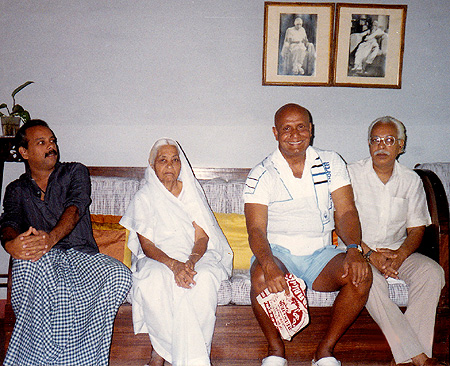
This photograph, taken in Pondicherry on 18 January 1989, shows Baburam's brother, Baburam's mother, Sri Chinmoy and Baburam Mehra.


Notes:

Sri Chinmoy told many stories over the years about this particular family. Here is a small selection:

1. “Baburam is several years younger than me. He was begging me to go to his place. Finally, one day I went with him. As soon as his father saw my eyes, something happened inside him. After that, his father never called me Chinmoy – it was always Yogiraj (king of the yogis).”

2. “When Baburam’s father was very sick in hospital, I went with Baburam to see him. Two doctors came out of the room, smoking. Baburam asked them, “How is he doing?” “Quite well,” they said. I go there and I see the soul is leaving the body. I folded my hands and offered my pranam to Baburam’s father. Then I said to Baburam, “Go and bring the doctors. Your father has left the body.” The doctors did not believe him, but they came. Then they used our Indian system to see if he was alive. If someone is dead and you shake the big toe, the whole body will shake. If they are still alive, the body will not shake. That is our Indian theory. Anyway, they did this and they saw that Baburam’s father was no more. They were so shocked. Not even two minutes before they were saying that he was fine.”

3. “Baburam’s father had a new suit. It was Nehru type. So when Baburam’s mother heard that I was coming to America, she gave it to me. She said her husband would have been so happy for me to have it. On rare occasions I used it in America. When one big shot came to the Indian Consulate, my sectional boss, C.G.K. Menon, asked me to give it to him to wear to the function. Every day at 4:30 I used to stand in front of this particular boss and say, ‘I am now going to the post office.’ One day he said to me, ‘Why are you wasting your time here?’ Then he was so happy when I left the Consulate to do my spiritual work.”

K.D. Sethna (Amal Kiran)

Stories by Chinmoy


Foreword

K.D. Sethna is one of the earliest disciples of Sri Aurobindo. He joined the Sri Aurobindo Ashram in 1927 at the age of twenty-three and his Master gave him the beautiful name “Amal Kiran” (purest ray serene). K.D. Sethna was blessed to enjoy an extensive correspondence with Sri Aurobindo on many literary subjects, in particular Sri Aurobindo’s epic poem “Savitri”.

K.D. Sethna is a renowned scholar, poet, cultural critic and philosopher, as well as the author of more than forty books. In addition, he is the founding editor of Mother India, a monthly cultural and literary magazine.

K.D. Sethna is one of those who recognised Chinmoy’s budding poetic gifts and he became one of Chinmoy’s mentors. For many years, Chinmoy assisted him in preparing each issue of “Mother India” for publication.

The major essay in this compilation of stories was written by Chinmoy in 1962, on the occasion of K.D. Sethna’s 59th birthday. It is re-typed exactly from Chinmoy’s own typewriting. Chinmoy was 31 years old when he penned this tribute.

In later years, when Sri Chinmoy would return to the Ashram to visit his family, he would meet with K.D. Sethna. As of this writing, the venerable centenarian is still alive. He celebrated his 100th birthday in 2004.

– Vidagdha Bennett
Compiler


Table of Contents


1. K.D. Sethna Embraces Me

[Sri Chinmoy told this story on January 18th, 1995, after he had just returned from a visit to Pondicherry.]

When I was meditating at Sri Aurobindo’s Samadhi, I saw one of my old mentors. He is now 90 years old. Many, many years ago, I was meditating at the Samadhi, at exactly the same place, when someone started calling my name: “Chinmoy, Chinmoy.” As soon as this man heard my name, he stood up with the help of a cane.  

He said to me, “By the way, are you Chinmoy?”  

I replied, “I am Chinmoy.”  

Then immediately, he dropped his cane and embraced me. He said, “Romen told me that it is your third poem in English, ‘The Absolute’.”  

I said, “Yes, it is my third poem.”  

“Third poem! Third poem!” and he embraced me again, saying, “Are you telling the truth? You are a genius!”  

I said, “Yes, I am telling you the truth. It is my third poem in English.”  

This man later became one of my mentors. I worked very, very hard for him for years and years.  He lived in Bombay. When I saw him at Sri Aurobindo’s Samadhi this time, I immediately bowed to him and expressed my love and gratitude.


2. K.D. Sethna and the Mother

[The following is Scene 6 from Chinmoy’s full-length drama about Sri Aurobindo entitled The Descent of the Blue, which was published between 1958 and 1962 in the Mother India.]

(January, 1928. The old Library room in the Ashram. An interview with the Mother. Having turned his back upon his old life, K.D. Sethna, afterwards renamed Amal Kiran by Sri Aurobindo, sits smartly dressed in European style, facing the Mother across a table.)

SETHNA: Mother, I have seen the world thoroughly. No more of it. I am sick of intellectual pursuits as well. Now I want nothing except God.

MOTHER: You have seen the world thoroughly? How old are you?

SETHNA: Twenty-three.

MOTHER: Only twenty-three and…

SETHNA: Yes, Mother. Can I stay here for good?

MOTHER: (Compassionately) Don’t decide in a hurry. Stay here now and see how it suits you. Then… (The Mother rises.)

SETHNA: Wait a moment, Mother. Let me make my pranam to you. You know, we Indians make a pranam to our Guru.

(The Mother smiles. She does not mention that at least a hundred times each day the Ashramites make pranams to her.

Sethna prostrates before her. She blesses him. Later she relates to Sri Aurobindo how a young Parsi “taught” her the Indian way with one’s Guru! Sri Aurobindo enjoys the joke.)

(Some weeks later. Sea-side, Pondicherry. Sethna, meditating alone in the morning, on the pier. He was worrying in his mind about not having an opening in the heart or any extraordinary spiritual experience. He had been told that he might think of a book in the heart, opening. The mention of a book had put him out a little, for he was sick of the mental pursuits associated with books. In the course of his meditation now, he felt as if the sea were swaying right through his heart in a rhythm of wide delight.)

(Some time after 21st February 1928, when Sethna has his first Darshan of Sri Aurobindo and the Mother. Sethna and the Mother.)

SETHNA: May I ask if Sri Aurobindo has said anything about me?

MOTHER: “He has a good face.” That’s what Sri Aurobindo has said.

(The remark strikes home. Sethna is all surprise. He at once remembers that he himself had fixedly scanned Sri Aurobindo’s own face at the Darshan moments and found it “good"!

15th August 1928. Sethna had his second Darshan, and offers to Sri Aurobindo a poem of his. He comes downstairs into Purani’s room and sits still, head bent in dejection. He seemed to have lost the inner consciousness that had abided with him for a long time, almost starting from that moment at the sea-side. He had somehow faced Sri Aurobindo now with the outer mind again.)

PURANI: What’s the matter?

SETHNA: I don’t know.

(Suddenly he feels as if a huge solid mass were pressing from above into his head, causing giddiness, bringing strange tears into the eyes and making the heart beat wildly with joy.

In the afternoon he comes to the Mother to receive a Blessing-garland from her. The Mother takes him into her interview-room.)

MOTHER: Do you know what Sri Aurobindo has said this time? There is great change in you, he has said, and he is very pleased.

(Sethna falls at the Mother’s feet and takes her Blessing.)


3. Birthday Tribute to Amal Kiran

November 25, 1962. To-day Amal Kiran enters his 59th birthday. My hand trembles, my mind oscillates, my heart hesitates to pay him my homage.

Amal Kiran (the purest ray serene) is the name given by the Divine Master to one of his dearest sons, K.D. Sethna – a name sweet to the ear and full of finest suggestions to the mind. In the forefront of the intellectual world, a versatile mind rich in world-literature and philosophy, mathematics and metaphysics, science and art, history and classics, he is all humility and humour, full of good will and friendliness to young and old alike. Apart from these admirable personal qualities the rationalist frame of his cultural self like most rationalists is never impervious to his Guru’s kindling the divine Fire in the natural faculty of his poetic genius – all these outstanding features mark our the devotee in the rationalist. A happy blend of the two, does he not seem to be a prototype of the Future?  

Since 1927 the disciple began to bask in the sunshine of his Master’s affection and love. Also it was in that year that ‘rich rumours of his masterpiece’, Savitri reached K.D. Sethna’s ear. One of the ever-memorable days in his life is October 25, 1936. From that day on for months, Sri Aurobindo used to send passages from Savitri to Amal to type out.  

Neither are we to miss the train of humour which the Master once presented to the disciple: “I have been kept too occupied with other things to make much headway with the poem – except that I have spoilt your beautiful copy of the “Worlds” under the oestrus of the restless urge for more and more perfection; but we are here for world-improvement, so I hope that is excusable.”  

That the last chapter of Amal Kiran’s book The Poetic Genius of Sri Aurobindo serves as an Introduction to Savitri is a fact that can never be denied even by his mightiest opponents. His critical appreciation of the poem throws abundant light on those aspiring readers whose boats would like to ply between the Ever-luminous Day and the All-devouring Night. Now it is not our task to greet him with cheers on the strength of Sri Aurobindo’s comment on his Introduction to Savitri: “It seems to me very fine both in style and substance, but as it is in high eulogy of my own writings, you must not expect me to say more.”  

Sri Aurobindo’s Savitri has a different story to relate. In one of his letters to Amal Kiran he discloses this truth: “Savitri is a work by itself, unlike all the others. I made some eight or ten recasts of it originally under the old insufficient inspiration. Afterwards I am altogether rewriting it, concentrating on the first Book and working on it over and over again with the hope that every line may be of a perfect perfection…”  

No doubt, there are many, if not all, who either fail or dare not swim in the effulgent sea of Savitri. But on that ground to rail at Savitri or to try to blight the unbounded beauty that is Savitri is nothing but naked stupidity. If the poet’s satisfaction has to depend solely on the reader’s satisfaction, then the poor poet must accept the role of a slave before the readers. Now, how surprisingly yet easily the creator of Savitri acquits himself is a truth, never-to-be-forgotten:

“…if I had to write for the general reader I could not have written Savitri at all. It is in fact for myself that I have written it and for those who can lend themselves to the subject-matter, images, technique of mystic poetry.”

Savitri is an unprecedented adventure both in inspiration and revelation in the realm of poetry. Hence to appreciate it one needs must have a new mentality, wide open to the light of Truth. It is a pity that a good number of people are of the opinion that philosophy and poetry cannot peacefully live together. But Sri Aurobindo’s view is otherwise. He boldly asserts that philosophy has its rightful place in poetry. He throws considerable light on the matter in one of his letters to Amal Kiran: “All depends on how it is done, whether it is a dry or a living philosophy, an arid intellectual statement or the expression not only of the living truth of thought but of something of its beauty, its light or its power.”

A word about repetition. The world is not lacking in such critics who think repetition is a clear indication of weakness, never to be connived at. Sri Aurobindo says, it need not be always so. “I may cite as an example the constant repetition of the word Ritam, truth, sometimes eight or nine times in a short poem of nine or ten stanzas and often in the same line. This does not weaken the poem, it gives it a singular power and beauty. The repetition of the same key ideas, key images and symbols, key words or phrases, key epithets, sometimes key lines or half lines is a constant feature. They give an atmosphere, a significant structure, a sort of psychological frame, an architecture.”  

I believe, that even a critic of the superlative degree will not deny the fact that Savitri abounds in mysticism. In mystic poetry like Savitri repetition is not at all objectionable, but needful, nay, essential. Again from one of his letters to Amal Kiran we come to learn something about repetition which is equally formidable. “Of course, where the repetition amounts to a mistake, I would have no hesitation in making a change; for a mistake must always be acknowledged and corrected.”  

Those who are all admiration for Savitri and are cut to the quick when wiseacres fail to be at one with them, will do well by listening to the advice given to Amal Kiran by Sri Aurobindo:         

“You must not expect appreciation or understanding from the general public or even from many at the first touch; there must be a new extension of consciousness and aesthesis to appreciate a new kind of mystic poetry.”

Strangely enough, the critic in Amal himself has played his role. But why? Let us leave him to give the reply:

“The nature of these criticisms must not be misunderstood. Just as the merits of “Savitri” were appreciated to the utmost – and this meant whole-hearted appreciation of more than ninety-nine per cent of it – whatever seemed a shortcoming no matter how slight and negligible in the midst of the abundant excellence was pointedly remarked upon so that Sri Aurobindo might not overlook anything in his work towards what he called “perfect perfection” before the poem came under the scrutiny of non-Aurobindonian critics at the time of publication. The commentator was anxious that there should be no spots on “Savitri’s” sun. The purpose was also to get important issues cleared up in relation to the sort of poetry Sri Aurobindo was writing and some of his disciples aspired to write. Knowing the spirit and aim of the criticisms, Sri Aurobindo welcomed them, even asked for them. On many occasions – and these provide most of the matter collected here – he vigorously defended himself, but on several he willingly agreed to introduce small changes. Once he is reported to have smiled and said: “Is he satisfied now?” Unfortunately the opportunity to discuss every part of the poem did not arise and we have, therefore, only a limited number of psychological and technical elucidations by him of his art.”

Now let us focus our attention on some of Amal Kiran’s multifarious writings which are at once deeply penetrating and supremely significant: According to his Master, Nationalism is a creed. The disciple says, “Nationalism, to be the truest, must be not only a movement against a foreign rule but also an expression of a nation’s authentic temperament.”  

Truth is truth. Although at times it is difficult to admit it. It is a sad misfortune of this age that its writers are exquisitely sensible to temporary praise and blame. They write with the fear of Reviews before their eyes. But with a stoic heart how wonderfully yet faultlessly Amal Kiran tells the world about the supremacy of Bankim’s Bande Mataram over Tagore’s Jana Gana Mana:

“The revelatory vision and the mantric vibration distinguishing Bande Mataram throw Jana Gana Mana entirely into the shade. And it is no wonder that not Tagore’s but Bankim’s song has been the motive-force of the whole struggle for India’s freedom. Until it burned and quivered in the hearts of our patriots and rose like a prayer and incantation on their lips, the country was striving with an obscure sense of its own greatness: there was a vagueness, a lukewarmness, a fear: we were overawed by the material prowess and pomp of our foreign rulers and our efforts to find our true selves were spoiled by either an unthinking imitation of the West or else a defensive anti-Western conservatism. We had not yet struck upon the master-key to the problem of national existence. Then, out of a book that had been neglected when it had first appeared, the music of Bande Mataram rang into the ambiguously agitated air of the nation’s reawakening consciousness… Bande Mataram stimulated and supported the people of India, instilling into them a hope and a strength beyond the human. It is the one cry that has made modern Indian history; not political speeches, but this magical strain breaking through Bankim Chandra from the inmost recesses of resurgent India’s heart and interfused by Sri Aurobindo with India’s mind and life as the true national anthem, brought us, in 1947, on the fifteenth of August (which was also the seventy-fifth birthday of Sri Aurobindo) our political liberation. To put such a saviour-song on any other footing than that of national anthem is to be disloyal to the Power that has given us a new birth.”  

Ahimsa is a word, sweet to the Indian ear. But at times it is apt to lead us astray. When the so-called Ahimsa is practised against the Will of God, it is nothing short of a crime unpardonable. It is next to impossible to refute his arguments as regards the deplorable weakness of Ahimsa:

“If Ahimsa signifies repugnance from shedding all blood except one’s own even when one is confronted with Hitler’s panzers or, to take a smaller yet vicious example, the marauding tribesmen who, with Pakistan’s connivance, broke into Kashmir, then Ahimsa is just an unconscious collaboration with anti-civilisation forces and, far from being a merit, a pernicious mistake.”

Further his firm conviction about the relation between Gandhi-ji and Swaraj can never be denied by any man of sound understanding:

“With Gandhi, Swaraj was never the be-all and end-all. No doubt, he wanted India to be politically independent, but never unconditionally, never by any kind of means. Either certain conditions must be observed by us, certain means adopted, or else no Swaraj was to be desired and worked for. There was in Gandhi’s vision an ideal which seemed to him larger than India’s political freedom – and that ideal was what he strove after and sought to represent. If Swaraj could be under that ideal, if it could attune itself to this “greater glory”, then alone was it worth having!”  

Now let us switch over to a subject quite different. It is about the significance of the English Language in India. We can learn from Amal Kiran the undeniable wonderful benefit that we derive from the English Language:

“We shall be underestimating the significance of the English language in India if we think that it is only a valuable means of promoting our political, economic and technological interests in the democratic world. English is, above all, an immense cultural asset. And it is such an asset not simply because it renders available to us magnificent countries of the mind, but also because it renders to us the most magnificent expression of our own soul.”

Neither are we to forget his challenging words against the foreign critics who think it is an absurdity on the face of it for an Indian to write poetry in English:

“The Indian, with the Himalaya of the Spirit in his national history and consciousness, can alone carry English poetry to a summit of spiritual fulfilment.”  

Now about two world-figures. Both of them are of Indian origin – Rabindranath and Sri Aurobindo. We are wonder-struck how he manages to describe their stupendous gift to humanity in a few words:

“The one is a skilful thinker at the same time he is an intuitive poet and the other a profound philosopher plus an illumined Yogi and an inspired bard.”  

Elsewhere his most significant utterance about Sri Aurobindo runs in this wise:

“How shall we crown Sri Aurobindo? Is he greater a Yogi than as a philosopher? Does the literary critic in him out-top the sociological thinker? Does he shine brighter as a politician or as a poet? It is difficult to decide. Everywhere Mount Everest seems to face Mount Everest.”  

His appreciation of another world-figure, Jawaharlal Nehru, is worth remembering:

“Jawaharlal Nehru is pre-eminently the mind-principle in its aspects of lucidity and refinement and idealism.”  

Also it is no hard task for him to pass his fearless opinion on some of the illustrious figures of the West as he has studied them thoroughly and understood them perfectly. Tolstoy, Emerson, Ruskin and Morris – these four illustrious figures are the prides of the West. Even those who have not studied them and will never do so, I am sure, if they just pay attention to the Indian critic, will be considerably benefited.

“Tolstoy was religious to the marrow and looked for the fountainhead of all conduct in duty to God. Emerson was a mixture of pantheist and transcendentalist: he held that the truest springs of action lay in the divine infinity hidden behind phenomena. Besides, he was a pugnacious individualist vis-à-vis average social conventions and the rating of common human collectiveness as paramount. Ruskin also was surcharged with a conviction of the Infinite and the Eternal – art to him was most valuable when through natural objects it had suggestions of them, open or subtle. Morris followed Karl Marx in his general socialist opinions, yet he too had a living sense of realities beyond the human and the earthly, as had the mediaeval master craftsmen whom he admired.”  

A superb critic is not the sole praise of Amal Kiran. Also he has something remarkable to present to the lovers of science. In this field too his intense originality is evident. His views are remarkable for their living expression of scientific realities.

“Einstein is a genius who has affected the whole realm of physics and not merely the sphere of ultra-scale phenomena. Even in the sphere of the ultra-microscopic his wonderful mind has shone. It is a commonplace of scientific knowledge today that light which was supposed for several centuries to be purely a wave-motion is now found to consist also of bullet-like particles called photons. Very few realise that nobody except Einstein gave conclusive proof of Plank’s brilliant hypothesis that light was composed of quanta, separate packets of energy: what is more, Einstein proved these energy-packets to be possessing mass and inertia like any material object. Even if he had no relativity theory to his credit, this research and several other subsequent discussions of atomic phenomena would rank him among the top scientists of our country.”

 
NEWTON
“To find absolute motion, the real as opposed to the apparent, we must have as a first condition, according to Newton, a perfectly immobile frame or standard of reference present in all places, an absolute space. But he realised that there was no means of directly observing motion in absolute space. He wrote: “It is indeed a matter of great difficulty to discover, and effectually to distinguish, the true motion of particular bodies from the apparent; because the parts of that immovable space, in which these motions are performed, do by no means come under the observation of our senses.” To give empty and absolute space the logicality it lacked from the view-point of sense-observation Newton introduced into science the religious concept of God’s omnipresence in a literal sense. The diary of his friend and student, David Gregory, leaves no doubt that the unmoving uniform universal presence of God in the physical cosmos was the essence of his absolute space in reference to which the absolute motion would occur. Of course the knowledge of absolute motion can be only with God whose being is its basis, but, as its postulation was for Newton a necessity of reason, both God’s being and consciousness were an integral part of Newtonian physics!”

Now it is high time for us to pin our attention on his poetic genius, which he and we as well rightly believe, to be his second delight, first being the climbing cry for the ultimate Reality, for the manifestation of the Divine on earth. Let us begin with his criticism of some of the world’s immortal poets – Shakespeare, Wordsworth, Shelley and Keats.  He says, “In Shakespeare at all times we have a quiver of the Life Force, a passion of the entrails, as it were, an impact on the sensational being, a most vivid vibrant word. In Wordsworth and Shelley and Keats we have a calmer fineness, the more conceptive intensity starting from the brain proper in imaginative action.”

Amal Kiran’s poems have a free access to occult realities and supernal truths. It will be no hyperbole to hold that his poems are the result of his significant vision. The music in the following lines is enchanting:

  “Infinity is a love
       That never runs,
   Present in every place
       With the Silver ones!”


We all know what is Heaven and what is earth. The poet of The Adventure of the Apocalypse tells us about their real relation. Also he tells us what change our mind has to undergo before we discover Eternity alive:

       “Earth’s roof is heaven’s floor –
               The dome of mind
        Must bear a trampling terror
               Before we find
        Through a sudden gap the mystic
               Eternity alive!”  


Words, words, words. To be sure, we shall receive nothing short of a boon from God if we just follow the example of the poet in his usage of words:

  “Let me not utter five things in five words,
   But by one word of densest diamond
   Pack five things to a shining secrecy
   That gathers a deep truth missed by them all;
   Or else with five words capture one sole thing,
   Pluck it from fires that light up earth’s abysm –
   Fires that were veiled by being locked together,
   But now a fourfold seizure from without
   Of splendours and terrors ruling time and space
   And then a sudden self-sight, a fifth flame
   That knows by a sheer eternity within!…”  


Many have written and many will write about Sri Aurobindo. But I dare say that none will come near the poet of The Secret Splendour while describing Sri Aurobindo so luminously and vividly. Here his pen produces something exquisite in the truest sense of the term:

           “All heaven’s secrecy lit to one face
        Crowning with calm the body’s blinded cry –
        A soul of upright splendour like the noon!  

            But only shadowless love can breathe this pure
        Sun-blossom fragrant with eternity –
        Eagles of rapture lifting, flickerless,
        A golden trance wide-winged on golden air.”


We are familiar with his Talks on Poetry that are coming out serially in Mother India. Dilip Kumar Roy is perhaps at the top of the admirers of Talks on Poetry. “Your Talks on Poetry,” says Roy, “are so amazingly beautiful! How deeply you have drunk at the nectar-spring of the Muses!” What a surprise he springs on us, especially on the lovers of poetry, still more so on the admirers of Blake! He has been singled out to complete a book of 240 typed sheets on the 24 lines that go to make Blake’s Tyger. In this connection we are extremely happy to learn that Kathleen Raine, the greatest authority on Blake in England, has gone through the first draft. She has simply been carried away by the splendour-waves of criticism of Tyger by an Indian poet. Both the authorities on Blake carried on a correspondence for nearly two years.  

A word about Amal Kiran the Editor of Mother India. We can safely say that in him the man of action and the man of imagination are not brought tête-à-tête under their old relation of hostility, rather they have become friends, true and faithful. As he is a grand dreamer of dreams, even so he is a spiritual realist. Mother India shows how dynamic his energy is! It is said that Plato once remarked that his Academy consisted of two parts, one being the body of his students, the other the brain of Aristotle. I need not hum and haw in uttering that Mother India consists of two parts – the pleasure of its countless readers and the Brain of Amal Kiran.

K.D. Sethna was born under the auspices of a lucky star. Nevertheless, he lives a life devoid of all luxuries. He is a staunch friend who can be safely relied upon. None would or even could imagine to get an empty assurance from him. In his daily life, in his public dealings, he is a man in the highest degree amiable and he represents a characteristic simplicity which wins for him the esteem and regard of all. All these are borne out by personal experience. If his life is pure, his aims are lofty. If his learning is varied and profound, his achievements are vast and magnificent.

I am sure, it will be quite apposite to say a few words about his better-half, Sehra. No doubt, it is but few who are blessed with partners in life, who share in full measure their lofty ideas and ideals, sad failures and happy triumphs. Smt. Sehra and Sri Amal Kiran are a rare couple. We all wonder at the spiritual urge, prophetic vision of this frail but agile woman. I venture to say with emphasis that she has been swimming at each hush-gap in the Sea of the Mother’s Light and Delight.

Public honours came to him thick and fast. To name only a few:

It is alleged that the Government of India wanted to know from the Sri Aurobindo Ashram Authorities if they could recommend anybody who could be expected to discharge ably the duties of the Consul General of Pondicherry. Both Sri Aurobindo and the Mother chose Amal Kiran, but he expressed his unwillingness to accept the job lest he should, quite unaware, be going little by little away from the direct contact of the objects of his highest adoration.  

Dr. Spiegelberg, the Founder and president of the Asiatic Society, at California, having considered Mr. Sethna as an authority on the Philosophy and Yoga of Sri Aurobindo and Indian philosophies offered him the post of a lecturer in the Stanford University. But Mr. Sethna suggested the name of Sri Haridas Chaudhuri to Sri Aurobindo and on his approval wrote to Dr. Speigelberg about it and he (Mr. Spiegelberg) was only too glad to accept Mr. Chaudhuri and said, “My Guru’s word is a law to me.” This again shows how Sri Aurobindo’s Amal Kiran spurned earthly name and fame, preferring the close proximity of Sri Aurobindo and the Mother.  

One more proposal came from the Israel University for a series of lectures on Sri Aurobindo’s Philosophy and the Indian philosophies. Amal Kiran related this news to the Mother who remarked: “So you are going?” His immediate reply was: “Am I such a fool, Mother?” The Mother smiled sweetly and there ended the matter. Here again for the third time the disciple echoed his Master’s teaching: “All is too little that the world can give.”


4. I Keep my Promise

[Sri Chinmoy related the next three stories on March 1st, 1986, after he had returned from a visit to Pondicherry.]

I saw K.D. Sethna meditating at Sri Aurobindo’s Samadhi, so I went near him and took two pictures of him. Then I approached him. He said to me, “Chinmoy, at first I could not recognise you. I said to myself, ‘Who can dare to take my picture without my permission?’ Then immediately my thoughts changed and I said, ‘I am so insignificant. Who will bother to take my picture?’”  

I came still closer and said to him, “Do you recognise me now?”


He said, “Of course. You are my mind-begotten son.”  

He is the editor of the monthly magazine Mother India. Formerly, I was his unofficial assistant. Many times, I had to do everything when he was away in Bombay. If I know a little bit about literature, then I owe it considerably to him. He has helped me in my literary life considerably.  

Then he invited me to come to his place. I accepted. He said, “Are you telling me the truth?”  

I assured him, “Definitely I am coming.”  

“But I can’t trust you,” he said. “In those days, when you were young, if you said something, I would have believed you immediately. Never would you fail me. But now, you have become a big shot. I do not think you will come.”  

I said, “I will come. I will come tomorrow exactly at 3:30.”  

At 3:30 the next day, I was there to keep my promise.   


5. Testing my Strength

During our meeting at his place, we discussed many things. At one point, he said to me, “Let me examine your strength.”   

So he grabbed my hand and started squeezing it quite powerfully. I smiled, pretending it was not hurting. Finally, he exhausted all his strength; it was over.   

Then he said to me, “Now you have to squeeze my hand.”   

He happens to be 82 or 83 years old. He is lame; he needs a cane. I did not have the heart to squeeze his hand. I thought, if I use my strength, perhaps I will damage his hand. If something untoward happens, he will tell the whole world I am the culprit.   

Perhaps I did not have the strength also. Anyway, my inner strength compelled my outer strength to remain silent. My hand became like what you call marshmallow.   

He said, “How can it be? You are so weak. How can you lift so much weight?”   

I said, “It is all because Grace descends from Above.”


6. A Discussion about Perfection

He was my mentor and now he says that I have become his mind-begotten son. Hundreds and thousands of times we used to discuss literature, politics, spirituality and so many things.   

Now he had to say to me, “Why are you doing so many things? You can’t be satisfied with one thing? You don’t believe in perfection? Why do you have to be involved in so many things, so many aspects? It is not good. Only select one and stick to it.”   

I said to him, “Everybody has an inner Guide. You also have one. My inner Pilot wants me to be a Jack-of-all-trades and a master of none.”   

He said, “Nobody’s inner Pilot will ask him to do that.”   

I replied, “In my case, perhaps, there is an exception.”   

Then I said to him, “You have seen me at the Ashram. Now perhaps you are not noticing considerable change in me, whether good or bad, for the better or for the worse. I use the term ‘Supreme’. You have to forgive me. For you, it is ‘Mother and Sri Aurobindo’. It is the same thing, but I use the term ‘Supreme’. My Lord Supreme has made a factory out of me, a spiritual factory or a philosophical factory or a poetical factory, as well as other kinds of factory. Every day, He is producing items in very large measure. How can I say to Him, ‘Look for perfection. Only one or two things You should do in and through me.’ In my case, He wants me to produce. I have done thousands of paintings, composed so many songs. He has told me that He will take care of my perfection as long as I take care of His Inspiration that he gives me.”   

Then I told Amal Kiran the metaphor that I always tell my students about the supermarket: “My paintings, my thousands of poems and songs, and all that – you select one that you like. Somebody else will select something else, and a third person may select something totally different. I am like a shop. There are quite a few things inside this shop. So everybody has to be satisfied according to his need.”   

Perhaps my philosophy did not strike a note with him. He said, “No, you have to believe in perfection.”   

Then I said, “I do believe in perfection, but if Somebody says that He will take care of my perfection as long as I take care of His Inspiration that He gives me, then what can I do?”   

So we could not see eye-to-eye with each other but, anyway, our friendship remains strong. In the end, he said, “All right, you have Somebody to guide you and I have Somebody to guide me.”   

“Absolutely true,” I said. “It is the same Guide, only I am following the Supreme and you are following Mother and Sri Aurobindo. They are the same. We have to abide by their Dictates. In my case, He asks me to produce on a very large scale and I do it.”   

Then he asked me, “How many books have you written?”   

I answered, “Very shortly, 700 will go to my credit.”   

He exclaimed, “Seven hundred! Long before you, I was born. Fifteen books only I have printed, and twenty-five are still to come out. That makes forty. I aim at perfection. That is why I have written only forty books.”   

With utmost sincerity, I said, “I am very proud of you. You aim at perfection. My perfection is a little bit different from yours. Plus, God has blessed me with printers and printing presses. As soon as I complete a book, it can be printed. Here you may take six years to get a small pamphlet out. By God’s Grace, we have a big press and I have the opportunity to print my books immediately. My students are so kind to me. They do everything faster than the fastest.”  

He was very nice to me. While parting, he said, “Again I am reminding you of your perfection.”   

I said, “You remind me but Somebody else has been kind enough to take care of it.”
 

K.D. Sethna (seated at rear) meditating at Sri Aurobindo’s Samadhi, January 17th, 1989. Photo by Chinmoy


7. Letter from K.D. Sethna

On July 2nd, 1999, Sri Chinmoy received a deeply moving, handwritten letter from K.D. Sethna, who was then aged 94. The letter was written from the Nursing Home, where K.D. Sethna was being cared for and where Sri Chinmoy had visited him on a number of occasions:


[Following is a transcript of the letter:]

Nursing Home

July 2, 99

Chinmoy, cherished brother of old time
and all time,

   I deeply appreciate your letter,
full of your sweet self. I have
been here for quite a while and I don’t
know when I shall be out of it – if
ever. I am feeling quite at home and
everybody is very considerate. My
friends of the outer world visit me and I
appreciate their love – especially of my
dearest friend Minna.
   Somehow my most tenacious habit
– reading – has loosened its grip.
Does that mean I have loosened my
grip on life? Perhaps. For now
I seem to live very largely and the
limits of earthly years have fallen
from me – without my quite
knowing what infinitude has
become native to my heart.
    I shall end now what could
very well be endless.
    My script has not been very

[Refer side margin]
elegant. I am writing from a somewhat awkward position.
It bids me stop here – but our inner communication
can be endless. With love as always, Amal Kiran.
I deeply appreciate your gift.


8. Conclusion

How did K.D. Sethna come to the Ashram for the first time? It is a story at once amusing and enlightening. He bought a pair of shoes. The shoes came wrapped in newspaper. In that newspaper, he happened to see an article about Sri Aurobindo.    

His mind was so brilliant. For twenty years, Sri Aurobindo did not show his Savitri to anybody and then he showed it to Amal Kiran, his poet-disciple. Amal Kiran had the rare good fortune to discuss with his Master matters of high poetry through a series of illumining correspondence. He asked Sri Aurobindo detailed questions about various aspects of the poem and Sri Aurobindo revised many parts.

I learnt so much from Amal Kiran and he was extremely kind and compassionate towards me. He printed so many of my poems and articles in the Mother India. He even printed my play about Sri Aurobindo, The Descent of the Blue, serially. And he published many, many articles by Nolini-da that I had translated from Nolini-da’s original Bengali into English. But I can never forget that very first meeting, when he stood up and asked me, “You wrote that poem?” Then he threw away his cane and embraced me.

K.D. Sethna at the Nursing Home, June 1999. Photo by Chinmoy

Chinmoy’s Mentor: Dr. Sisirkumar Ghose

Foreword

In September 1997, Sri Chinmoy requested me to compile his reminiscences about Dr. Sisirkumar Ghose, who was one of his main mentors during his formative years. Sri Chinmoy gave this collection of stories the title:

My Santiniketan Sisir-da:
My Mentor of a Fully Blossomed
Lotus-Heart

I was greatly helped in finding background information about Sisirkumar Ghose by his great-niece, Mahatapa Palit,1 who had become Sri Chinmoy’s student several years earlier. She was able to provide a detailed biography and many rare photographs of this eminent scholar. I also have a personal connection with Sisir Ghose, which adds another thread to this unique tapestry.

These stories were told by Sri Chinmoy over many years. He read the entire collection aloud to Arun Ghose, Mahatapa’s uncle and the nephew of Sisir-da, during Arun’s visit to New York on September 27th, 1997. At that time, Sri Chinmoy made many additions and improvements to the manuscript. The stories are all presented in his first-person speaking voice, as they were originally recorded.

– Vidagdha Bennett

Table of Contents


My Santiniketan Sisir-da:
My Mentor of a Fully Blossomed
Lotus-Heart


Dedication by Sri Chinmoy

Sisir Ghose lived most of the time in Santiniketan, West Bengal, where he was a Professor of English, an authority on the writings of Rabindranath Tagore and a world-renowned scholar of mysticism. But, from time to time, he used to come and stay at the Sri Aurobindo Ashram.

My beloved Sisir-da was unswervingly kind to me. He was unreservedly affectionate to me. He was unconditionally indulgent to me. He was undoubtedly an Himalayan mentor in my formative years at the Sri Aurobindo Ashram. He showed me how an ocean of knowledge-light can at once lovingly and unassumingly play with a very tiny and shallow pond. My heart’s gratitude-flames I am most soulfully offering to his heart’s compassion-sun. I bow in all humility to a most precious diamond of Tagore’s Santiniketan.
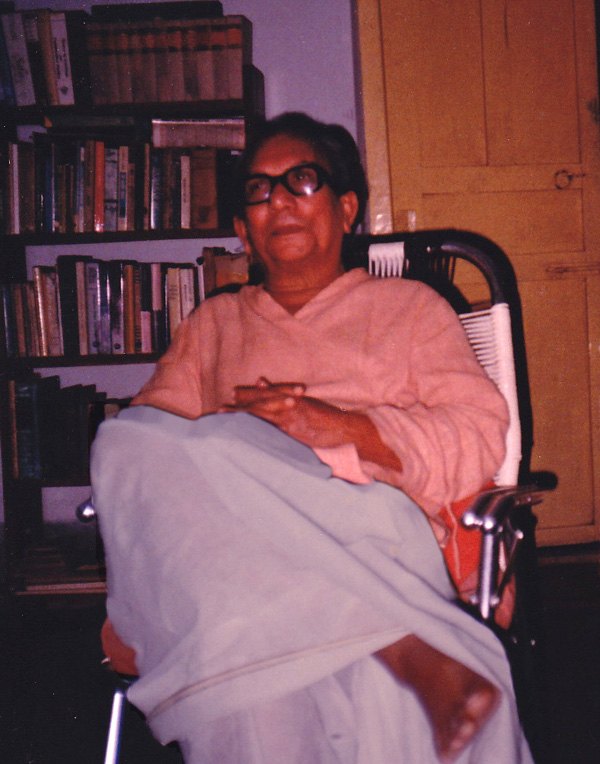
 

Dr. Sisirkumar Ghose2


1. Sisir-da’s Unalloyed affection

In so many ways, Dr. Sisirkumar Ghose – my Sisir-da – blessed me with his unalloyed affection and fondness during my youth. I shall never forget the way he would suddenly appear and grab my shoulder and compel me to walk with him here and there.

When my friends of my own age saw that I was going somewhere, they would often come running to walk with me. I had one friend, by name of Prahllad, who would even drop his bicycle in the street so that he could walk with me.

But Sisir-da was considerably older than I was and so he treated me like a little brother. He used to call out, “Hey, Chinmoy!” Then he would place his hand affectionately and powerfully on my shoulder in front of everyone and turn me around so that I could accompany him. I had to make an about-turn! He never asked me where I was going; he would just grab me and pilot me in his usual way. Then we would walk and walk.

One incident stands out in my memory. Evening had fallen. He grabbed me by the shoulder and compelled me to walk at least two miles with him along the shore of the Bay of Bengal. He was talking and talking of literary things the whole way. Now and then, he would quote from Sri Aurobindo’s “Savitri”. I was a silent listener and devoted admirer. By the time we came back, it was eleven-thirty or so. He had to drink a cup of tea. Now, where would he get tea at that hour? My cousin Nirmala was very nice. We went to her place around midnight and she made tea for him. In those days, I did not drink tea.

I learnt so many things from Sisir-da during our walks together. Truly, his was the wisdom-ocean.


2. My Sisir-da

Half a century has elapsed since those days. Strangely enough, I have only recently come to learn that Sisir-da was born in 1919. That means he was my senior by only twelve years. To me, the difference in our ages seemed more like twenty years. He was so mature that he looked much older than his actual age. Perhaps his long years of reading and studying contributed to this impression.

He once told me that he had a very special friend who would stay by his side the entire night through. He asked me to guess who this friend could be. I was bewildered. Sisir-da, with twinkling eyes, said: “You fool! You do not know who my special friend is? It is my English dictionary!”

Sisir-da had wavy hair and his eyes were very, very beautiful. His voice was sweet, high and melodious, like Tagore’s voice. As a West Bengali, he had excellent Bengali pronunciation. I deeply admired his Bengali pronunciation and tried to emulate it wherever possible, for I myself, being born in Chittagong, feel that my Bengali pronunciation is quite inferior to that of people from West Bengal, specially scholars like Sisir-da.


3. Sisir-da’s Eldest Brother

Sisir-da had four brothers, but he used to speak to me most often about his eldest brother, Santosh, whom he adored. He would say, “I am nothing in comparison to him. He was much more brilliant than I am. How I wish you could have seen my eldest brother!” And tears would shine in Sisir-da’s eyes.

Whenever I praised Sisir-da’s literary writings or his Bengali handwriting, which was extremely elegant and beautiful, he would say the same thing, “Ah, but my eldest brother’s literary compositions and handwriting were far, far better.”

This eldest brother had been a professor of English at Patna University where Sisir-da took his B.A. and M.A., but he died at a young age. Sisir-da used to support this brother’s wife and children. How he cherished the memory of his eldest brother!


4. Sisir Ghose’s Two Homes

Sisir Ghose was a brilliant scholar. Many of his lectures were printed serially in The Statesman. He lived most of the time in Santiniketan, West Bengal, where he was a reader/lecturer/professor at Rabindranath Tagore’s Vishwabharati University. But from time to time, he used to come and stay at the Sri Aurobindo Ashram.

For literature and culture, Tagore was his Guru; and for spirituality and yoga, Sri Aurobindo was his Guru.


5. Affection Compels Surrender

Once an Ashramite named Damodar, who had studied at Santiniketan for some time, asked Sisir-da to elucidate certain aspects of Sri Aurobindo’s “Savitri”. Sisir-da asked me to be present when he answered the questions. By then, I had read Sri Aurobindo’s epic seer-vision poem eight or ten times, but since I did not go beyond the barrier of high school, I am further than the furthest from being a scholar. From my earliest childhood, however, I have been a poet and each time I read “Savitri”, I absorbed and learnt so many difficult English words that are not to be found in most of the dictionaries. As to the subject itself, I knew that Sri Aurobindo had taken an episode from the Mahabharata as his theme but, to be perfectly sincere, I could not understand the poem well, no matter how many times I read it. So I told Sisir-da that I was not the right person to hear his discourse.

He said, “Chinmoy, ‘Savitri’ is not a matter of understanding. It is a matter of loving and admiring. You have read the poem so many times. That proves you genuinely love it. So, in what way are you inferior to one who has merely studied the poem on a mental level?”

Then he compelled me to go with him and listen to his most eloquent discourse. It lasted for forty-five minutes and I gained so many new and deep insights into the meaning of “Savitri”. This is the nature of affection. When somebody makes affectionate demands of you, you have no choice but to surrender, unconditionally surrender.

Sometimes, I would see him when I was on my way to the dining hall. I would be so hungry, absolutely dying to go and eat, but that was the time he was inspired to explain to me some portion of “Savitri”. He would tell me, “I know you have not understood it.” Then he would make me sit in one corner and he would read me the passage and explain everything to me.


6. Visitors from Santiniketan

In 1958, some years after Tagore’s passing, twenty Santiniketan students came to the Sri Aurobindo Ashram to take part in our athletics competition. In some items, we Ashramites defeated the Santiniketan students and, in some, they defeated us. I participated in the decathlon. That was the day I destroyed my right elbow throwing the javelin. In the 100-metre race, I defeated the Santiniketan students, but I lost to my German coach, Saumitra,3 badly.

The group of students from Santiniketan stayed at the Ashram guest house for two nights. They were of my age and so I mixed with them a little. I came to know that Sisir Ghose was the English Professor of the fellow who ran with me in the 100 metres.

Later, when I informed Sisir-da, he said, “He is a very bad student, but he is very good in athletics. I tried so hard to give him a good mark for English, but I could not.”


7. Sisir-da creates a Problem for Me

In 1957 or 1958, out of sheer joy and love, Sisir-da gave me a small picture of the Mother, Rabindranath Tagore, Paul Richard and W.W. Pearson standing together. He said, “Chinmoy, take it. This is something sacred.”

The picture was taken in 1917, long before I was born, in front of the huge statue of the Lord Buddha at Kamakura in Japan. The picture was so special because four very significant human beings, four world famous figures, were standing side by side.

I was so delighted and excited to receive the picture and I lost no time in showing it to my boss, Nolini Kanta Gupta, who was the main secretary of the Sri Aurobindo Ashram. I thought he would share my happiness. To my astonishment, Nolini-da became furious. “Who gave you that picture?” he demanded.

I did not want him to be mad at my Sisir-da, so I said, “ I have forgotten.”

“How could you forget this kind of thing?” said Nolini-da. “You only received the picture yesterday.”

Then he confiscated the picture from me. In one fell swoop, I lost the picture and I was blessed with a severe scolding.

When next I saw Sisir-da, I said to him, “You have done me a big favour! That picture landed me in such serious difficulties with Nolini-da.”

He said, “I had no idea it would create problems for you. I thought you would be so happy.”
 

A Buddhist priest, W.W. Pearson, Rabindranath Tagore, Mirra Richard (The Mother) and Paul Richard before the Lord Buddha in Kamakura, Japan, 1917.

The Cosmic Game of our Lord Beloved Supreme is such that the story does not end there. Although I had seen the picture only fleetingly, that particular statue of the Lord Buddha remained fixed in my mind. It was beyond my imagination that I would one day go to Japan and meditate at that sacred place. But that is exactly what happened. Since my first visit to Japan in 1969, I have made my pilgrimage to Kamakura seven times to pray and meditate before the Lord Buddha. To me, this statue embodies his His consciousness more than any other that I have seen.

In December 1996, the Head Priest of the Kotoku-In Buddhist Temple in Kamakura, who has become a very close friend of mine, most compassionately allowed me to offer a Peace Concert at the feet of the Lord Buddha. I was so deeply moved and honoured to do so, and I shall always remain grateful to him for this singular opportunity to express my love and devotion.
 

Sri Chinmoy meditating in front of the Kamakura Buddha many years later.


8. A Most Precious Gift

At the end of 1960, Sisir-da went to America and gave quite a few talks at Missouri University and various other places on philosophy, literature and so forth. When he was in New York, he stayed in Greenwich Village. There he bought a statue of the Lord Buddha as a present for me. When he came back to the Ashram in 1962, he gave me the statue and told me where he had bought it.

I asked, “Is it a village?”

I simply had no idea that in only two years I would come and live in Greenwich Village. I always say that in Greenwich Village there is no night; it is all day. There is so much light in the street.
 

Sisir-da in America, October 1962.


9. Sisir-da’s Most Significant Prediction

It was arranged that Sisir-da would give a talk at the Ashram about his trip to America. Four or five hundred people came to hear him at the playground. It was around nine o’clock in the evening. I was sitting in the audience, about twenty metres away from him, in the fourth or fifth row. He was reading out his memoirs.

All on of a sudden, out of the blue, he pointed to me and said, “I can clearly see that in a few years this fellow, our Chinmoy, will go to America and create a commotion!”4

Everybody in the audience burst into laughter because they thought it was all an hilarious joke. I did not know any Americans at this time but, in only two years, Sisir-da’s prediction came true. He was the first one to make the prediction that I would come to America. How did he have that vision in 1962? God alone knows. I was not even thinking of America. My mind was flying quite often to the Himalayas to resume the life I led in my previous incarnation.


10. Two Great Rival-Friends

Sisir Ghose and K.D. Sethna,5 the editor of Mother India, were two great friends and rivals. At the same time, both of them were my mentors. For years and years, they would not speak together face-to-face. But each one saw that I was mixing with the other one. So Sisir-da used to ask me, “How is Amal-da?”6 And K.D. Sethna used to ask me, “How is your Sisir-da?”

I was in between these two great literary figures. Quite a few times, Sisir-da would give me his writings to take to K.D. Sethna to print in Mother India. But if Sethna corrected one line, then finished! Sisir-da would not allow Sethna to print it. So both of them were on their high horses.

One day I decided to arrange a meeting between them. I sent an invitation to each one. I knew they would not refuse because they liked me so much. So, after many years, they agreed to see each other. I arranged for them to meet at Sethna’s place. I brought Sisir-da there in the late afternoon. And then both of them started talking and talking and talking, far above my head. I was so happy to see them together.

At one point, they started talking about me. Sisir-da said, “If we had twisted you just a little, given you a little help, you could have become a great scholar. You could have taken your Masters Degree.”


11. A Difference of Approach

While I was listening to Sisir-da and K.D. Sethna exchanging their views on a wide variety of subjects, I noticed one difference between them: I saw that K.D. Sethna’s approach was broad and vast. His sweeping mind was able to encompass everything in a general way. His reasoning was irrefutable and his intuition was penetrating.

By contrast, Sisir-da’s approach was much more specific. He knew so much about Western poets and philosophers that he was able to focus on minute details. On this occasion, however, he showed tremendous respect for K.D. Sethna’s literary knowledge and wisdom. Not only was K.D. Sethna his senior, but K.D. Sethna had the rare good fortune to discuss matters of high poetry with Sri Aurobindo through a series of illumining correspondence. That is why Sisir-da showed his humility in a most genuine way.


12. “For Me, He is a Professor!”

One day I was assisting K.D. Sethna with the forthcoming edition of Mother India. I said to him, “They say that Dr. Sisir Ghose is an excellent professor.”

K.D. Sethna said, “What is this? Why are you calling him ‘professor’? He is not a professor! He is only a Ph.D.”

I said, “He is so vast and great. For me, he is a professor.”

Then K.D. Sethna became furious. “From now on, you have to say that he is a reader. Readers are inferior to professors. You fool! Why do you have to open your big mouth to me!”

What do I know about the difference between a professor and a reader? This is the British system. For me, everyone who teaches at a university is a professor. But on this occasion, I became brave. I said, “Dr. Sisir Ghose will always be a professor to me. When I made the arrangements for you two to see each other after so many years – approximately fifteen years – both of you started showing off and I clearly saw that in some areas he knows much more than you do. That is why I call him professor.”

Then Amal Kiran’s compassion-forgiveness-aspect came to the fore and he gave me a very broad smile.

I made the first and last arrangement for these two literary giants to see each other again.
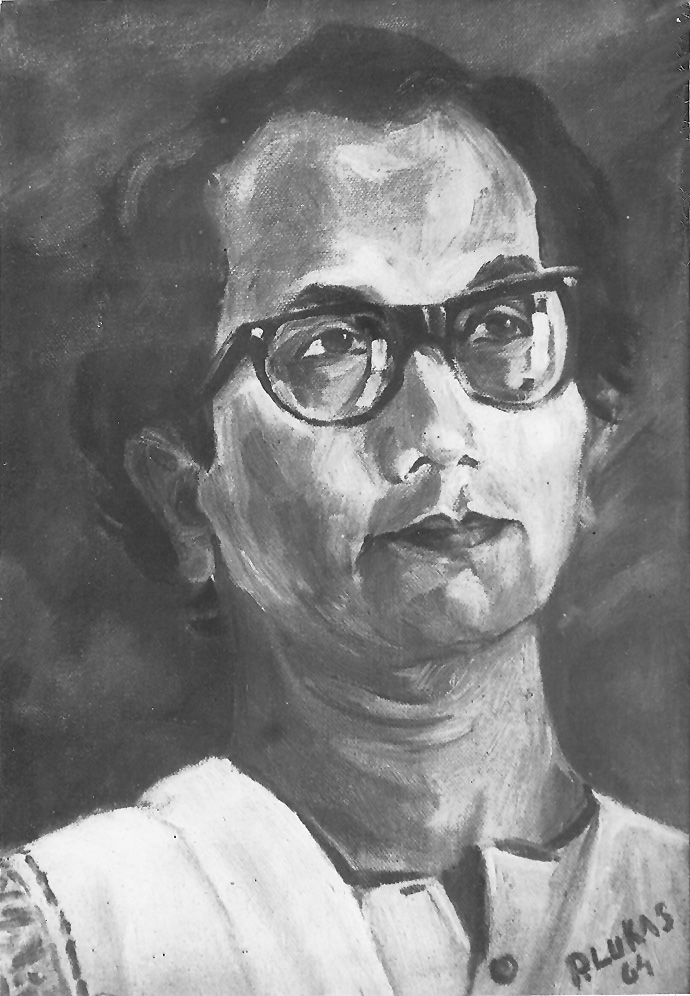
 

This portrait of Sisir-da was painted by P. Lukas in 1964.


13. Tagore’s Right-hand Man

Sisir Ghose and others used to have such admiration for Amiya Chakravarty,7 who was Rabindranath Tagore’s right-hand man. Tagore used to take him everywhere with him to be his literary secretary.

Once Amiya Chakravarty came to the Ashram and I was so happy to see him. Then, when I was working at the Indian Consulate in New York, one day he came in for a new passport. He was at that time a Visiting Professor at New Paltz. I was so happy and thrilled to see him. I said to him, “I saw you when you came to the Sri Aurobindo Ashram.”

“Oh, you come from the Ashram?” he enquired.

“Yes, I saw you at Purani’s place. I was so happy.”

That was my meeting with Amiya Chakravarty.


14. How could Chinmoy be so Rotten?

Whenever I go to the Ashram to see my sister and my brothers, I always go to pray and meditate before Sri Aurobindo’s Samadhi. This incident happened on one of my visits many, many years ago.

Sisir-da saw me going to the Samadhi and so he was waiting for me at a nearby place. He was observing me and wondering whether I was still the same person, his Chinmoy. After meditating, I bowed down to Sri Aurobindo and then I walked away. I was in another world and so I did not see my dearest Sisir-da waiting for me. I passed close by him without smiling at him or looking at him.

Then, for ten years or even more, he could not forgive me. He was so insulted that I had treated him in this way.

In spite of that, in 1982 he was the one to examine a Ph.D. thesis on my poetry written by one of my Australian students – and to pass it. Look at his nobility! When I think of my Sisir-da’s magnanimous heart, I swim in the sea of my gratitude-tears.


15. Sisir-da Reveals his Identity

Usually the examiners for Ph.D. remain anonymous, but I wanted to know who had done my student8 this great favour and so I asked Vidagdha to try to find out. She made an official request to the University of Melbourne and they wrote to Sisir Ghose seeking his permission to reveal his name and address. He readily agreed. This whole process took quite a few weeks. When Vidagdha finally received the information, she had no idea that I would recognise the name. She simply put the details in a letter and mailed it to me in New York.

O my God, ten days later, on the same day that her letter would appear, I went to a bookstore here in Jamaica, Queens. It was on Jamaica Avenue. It used to be near the train station, but it is no longer there. The manager was my friend.

Anyway, at the bookstore I happened to see a book by my beloved mentor Sisir Ghose. It was called Mystics as a Force for Change. I bought the book and returned home. I was about to eagerly devour the book when the mailman came. He delivered Vidagdha’s letter. I opened it and there I saw for the first time that my Sisir-da had been her examiner. My entire being was flooded with gratitude and a deep sense of amazement. From Australia, they had to go all the way to Tagore’s Santiniketan to find an examiner for her thesis – and whom should they find but my Sisir-da! Where is Australia and where is India? What a small world we live in!


16. Sisir-da’s Secret

In 1982, Sisir-da came to our home in Pondicherry and he was sitting eating Indian sweets with my brother, Chitta. Chitta was bragging that someone from Australia has earned a Ph.D. on my English poems.

Sisir-da simply said, “Oh, I see” and he kept eating sweets and smiling at my brother.

Then, later that year, when it became known that Sisir-da was the one who had examined Vidagdha’s thesis, my brother said to him, “Still you just smiled and said nothing! You kept it all top secret.”

They were joking about that incident.


17. Sisir-da’s Bravery

How brave my Sisir-da was! He knew that by passing Vidagdha’s thesis on my poetry, he would fall victim to severe criticism from many quarters – and still he went ahead and passed it. He stood for me. Vidagdha’s thesis had the merit, plus his love for me was so strong that nothing could sway him from his chosen course of action.

When it became known that it was he who had passed the thesis, some of my critics said to him, “Chinmoy is an idiot! What kind of English poetry can he possibly write?” They did not appreciate his decision at all.

Sisir-da’s only comment was, “I knew Chinmoy perhaps better than you did.”

These critics had forgotten that month after month, year after year, I was asked by Nolini-da himself to translate his Bengali writings into English. I also rendered Sri Aurobindo’s story “Swapna” (Dream) into iambic pentametre blank verse and his story “Kshamar Adarsha” (The Ideal of Forgiveness) into 200 lines of Bengali verses. This Bengali poem was read to him by his literary assistant, Nirodbaran, who said that Sri Aurobindo’s comment was: “It is a fine piece of poetry. He has capacity. Tell him to continue.”

I was still in my early teens when I received this blessingful encouragement from Sri Aurobindo. I shall forever and forever treasure his words in the inmost recesses of my heart. Perhaps it was because of this that Sisir-da told his critics, “I knew him perhaps better than you did.”


18. My Offering of Gratitude to my Sisir-da

As soon as I came to learn that it was my Sisir-da who had examined Vidagdha’s thesis, I wrote a letter to her all about him. She immediately sent the original letter to him at Santiniketan. Instead of writing to him directly, I wanted him to hear my praise of him in a sweet roundabout way.

23 November 1982

  My Beloved Sisir-da was unswervingly kind to me. He was unreservedly affectionate to me. He was unconditionally indulgent to me. He was undoubtedly an Himalayan mentor in my formative years at the Sri Aurobindo Ashram. He showed me how an ocean of knowledge-light can at once lovingly and unassumingly play with a very tiny and shallow pond. My heart’s gratitude-flames I am most soulfully offering to his heart’s Compassion-Sun.

  Just yesterday, I went to a bookstore that has countless books. To my earthly excitement and my heavenly astonishment, the first book that my eyes caught was my Sisir-da’s unique “Mystics as a Force for Change.” Needless to say, I immediately bought the book. On my return home, while my greedy mind was devouring his Nectar-Light, my ready heart was swimming fast, very fast, in a sea of soulful tears. His descending fondness for me and my ascending admiration for him shall forever remain two self-transcending rivals.

  On the same afternoon, the mailman arrived as usual with a large quantity of letters. When I opened up your letter and discovered that one of your examiners was Dr. Sisir Kumar Ghose of Santiniketan, my immediate offering of gratitude to this supremely noble soul can only be felt and never, never be described. My world and his world are flooded with sweet memories.

  P.S. If I have spoken one single truth in this incarnation, then here is this truth: My Sisir-da’s Bengali handwriting and English handwriting have reached the unsurpassable heights. At the Ashram, I envied his handwriting and I shall always envy his handwriting. Who knows, perhaps in an unguarded moment he himself fell victim to envy when I was the fastest champion-sprinter in the Ashram. How I wish it could all be true! My aspiring oneness-heart categorically tells me that my Sisir-da’s life was of a totally different mould. Therefore, envy was, is and shall always remain a perfect stranger to him. Finally, I bow in all humility to a most precious diamond of Tagore’s Santiniketan.

  P.P.S. In his remarks on your thesis, he said that my “Ten Thousand Flower-Flames” would perhaps never be seen. At that time, I had completed only three or four hundred poems. Now I have completed five thousand. So the Indian bullock cart slowly and steadily, if not unerringly, is proceeding toward its destination.

Chinmoy
 

[Sri Chinmoy then added two hand-drawn birds. Under the larger one, he wrote Dr. S.K. Ghose in English and Bengali, and under the much smaller bird, he signed his own name. Because the birds have been scanned in from a photocopy of the original letter, they are very faint.]


19. Sisir-da and I become Reconciled

In December 1989, I travelled with my students to Egypt for our Christmas trip. From there, I flew to India for one week to visit my family. Sisir-da was in the Ashram at the time. He was staying in the main Ashram guest house, Golconde. So I went to see him there.

According to our Indian tradition, I said, “I have come.” Then I bent down and touched his feet. Sisir-da was, by that time, almost completely blind and so he could not see me at all. But from my voice, he recognised me.

He said, “You pagla! [madcap] Why are you touching my feet?” Then he went on, “All right, I have forgiven you.” He grabbed me most powerfully, the way he used to do, and made me stand up.

He said, “I was sulking for so many years, but today I have forgiven you.”

I asked, “Why? What have I done?”

Then he told me the whole story about how he saw me at the Samadhi so many years ago and I did not greet him or acknowledge him in any way.

I said, “Do you think gratitude is not born in my heart? Had I recognised you, I would definitely have acknowledged you. But I did not see you at all. I am not the only culprit. It is equally your fault. When I was young, you used to grab me by the shoulder and shower your affection on me. Have you removed your affection from me? Why then did you not compel me to stop, the way you used to do? Did you not see that I was in another world? Perhaps you were also in a very high consciousness. Otherwise, why did you not bring me down?”

Sisir-da replied, “No, you have become such a big shot. That is why you passed me by! But anyway, I forgive you, I forgive you.”


Then he asked me to sit by his side and he began showing me such affection, such affection. He was calling me, “O Guru of the world.” Then he reminded me that he was the first one to predict that I would come to America and create a commotion. It is absolutely true. When he had that vision, I had no plan, no sponsor, nothing.

At one point, I said to him, “Yes, you tell me that I am a big shot. How is it then that you did not send me a copy of your book on mysticism? You know that I love mysticism.”

Sisir-da’s immediate reply was: “If I had given you the book, you would not have touched it. I know you more than you do. Now you are showing off that you have read it. Just because you took the trouble of buying it, you have read it. Otherwise, you would not have touched it.”

We talked and talked for a long time. Our happy experiences and sad experiences blended together in our sweetest reminiscences. That was the last time I saw my Sisir-da. He passed away on April 16th, 1991.
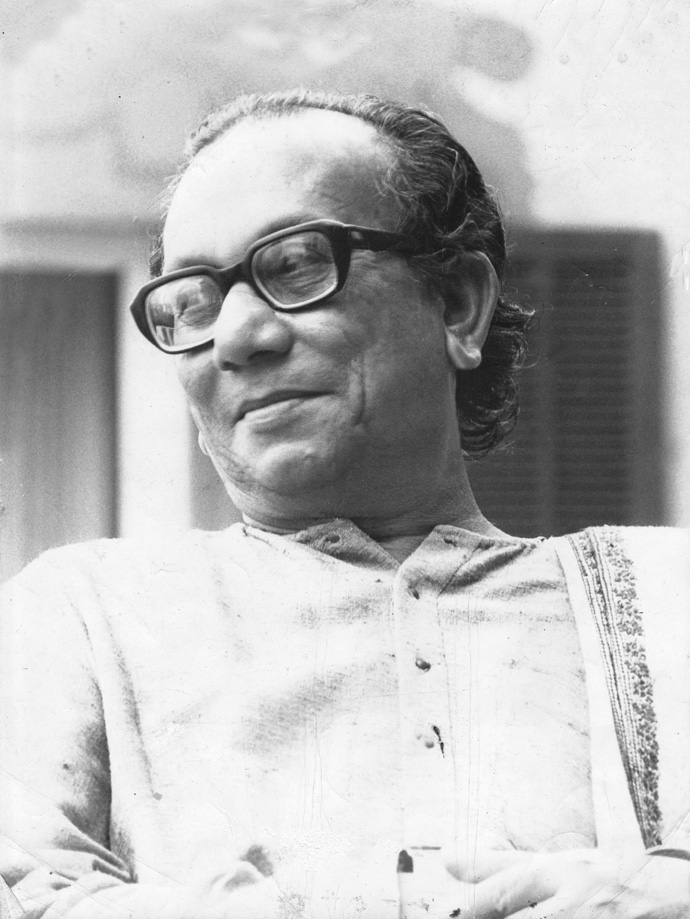
 

A rare portrait of Sisir-da


20. Tagore’s Niece

When I paid my last respects to Sisir-da, he introduced me to Tagore’s niece, Parul Tagore. He called her Didi. I saw her for about ten or fifteen minutes. She is the one who devotedly took care of Sisir-da in the evening of his life when his vision began to fail. She would read to him and so forth. This elderly lady has a heart of tremendous affection and compassion.


21. Sisir-da’s House

Towards the end of his life, Sisir-da wanted to build a house at the Ashram and live there permanently. But there were some unfortunate problems with the builders and he was not at all satisfied with the result. It was a very sad experience for him. He gave the house to the Ashram and he stayed in the Ashram guest house. That was where I saw him for the last time.


22. An Ashram Boy

What kind of affection Sisir-da had for an Ashram boy! He saw something in me right from the beginning. And he himself was a well-respected scholar at Santiniketan and elsewhere.

Like Nolini-da, Champaklalji and K.D. Sethna, he approached me. Otherwise, how could a young boy dare to approach him? I had virtually no formal education; I did not even complete high school. On my own, how will I dare to ask these Ashram luminaries for anything?

After I had written my third poem in English, K.D. Sethna saw me at the main Ashram building. He came and embraced me. Then I became his messenger boy. I had to go to his place every day and carry the proofs of Mother India to the press. I did this work lovingly, devotedly and gratefully.

Then Champaklalji, who was Sri Aurobindo’s main assistant, commissioned me to do various errands for him. Next, Rajen-da, head of the Bengali section of the Ashram Library – whose unalloyed affection I treasure in the inmost recesses of my heart – insisted that I come and work at the Library because Mother had said I should do some mental work. At that time, I was washing dishes in the dining hall and I was so happy. My friends would come and throw their dishes in the tub in such a way that I would be completely soaked. But after Rajen-da received Mother’s message, I had to leave that job and go to work in the Library.

It was at the Library that Nolini-da found me and asked me to go and work for him. I translated Nolini-da’s writings from Bengali to English, and served him in various capacities most lovingly and devotedly.

Then one more job I received: Amrita-da, the Ashram General Manager, commanded me to sign checks for the Mother. Right under Mother’s signature, I had to write down in a neat hand “Mother M. Alfassa”. Then only the bank would accept the checks. Ironically, now that the Mother is no longer in the physical, the bank accepts without question checks that are made out simply to “The Mother”.

So, one by one, all the important figures employed me with affectionate commands and demands. I was so happy and proud to serve them and specially to be at Nolini-da’s beck and call.


23. Sisir-da’s Inner Direction

To my infinite joy, Sisir-da’s great-niece – Mahatapa – has now joined our path. I am absolutely certain that Sisir-da’s soul has brought her to me. He was her maternal grandfather’s youngest brother. In Bengali, we say “chotodadu”.

The last time Mahatapa and her parents saw Sisir-da, he said to them, “I have lost my eyesight, but it has given me a new vision.”


24. A Family Tradition

In front of hundreds of Ashramites, Sisir-da predicted my arrival in America two years prior to the actual date. Like her most illustrious great-uncle, Mahatapa predicted that I would visit Miami (where she was studying) three weeks prior to the day when I actually made my announcement. This kind of prediction-capacity is in their family tradition. Like great-uncle, like great-niece!


Sri Chinmoy’s Reminiscences

[On September 27th, 1997, Mahatapa brought her uncle, Arun Ghose, a retired Commodore in the Indian Navy, to meet Sri Chinmoy. This visit evoked so many sweet memories of Sisir-da for Sri Chinmoy and Sisir-da’s direct relatives. Sri Chinmoy celebrated the occasion by reading aloud his reminiscences of Sisir-da and by composing a special song in Bengali dedicated to him.]
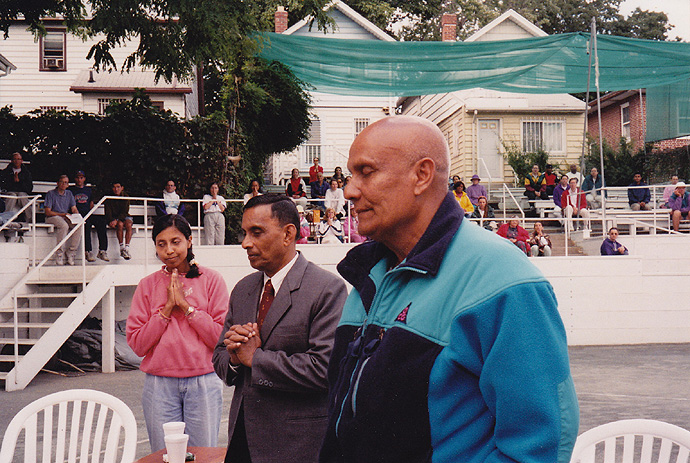
Here Sri Chinmoy is standing with retired Commodore Arun Ghose and Mahatapa.

Sri Chinmoy reads his reminiscences of Dr. Sisirkumar Ghose


Sisirkumar Ghose

Bengali words by Sri Chinmoy:

Sisir-da, Sisir-da, Sisir-da
Sneha dhanya kripa dhanya ami tomar Chinmoy
Kusum hiyai tomar atmar ami gahi bijoy
Kabi gurur sebak bihag shantiniketaner dipak
Gyaner guner asim pathar Sisirkumar Ghose
Karun ankhi madhur hriday oishi paritosh


English translation by Mahatapa Palit:

Sisir-da, Sisir-da, Sisir-da!
I am your affection-blessed, compassion-blessed,
Your very own Chinmoy.
With a flower-heart I sing
Your soul’s victory-joy.
You are the avian servitor
Of the Master-Poet Rabindranath.
Of Shantiniketan,
You are the shining lamp.
Knowledge-talent’s boundless ocean –
Sisir Kumar Ghose!
You are the compassion-eye and
Sweetness-heart of Divine Satisfaction.


– End –


Appendix One

DR. SISIRKUMAR GHOSE
Biographical Sketch

Born:

  • May 1st, 1919

Education:

  • B.A. (English Honours, Patna University, 1938)
  • M.A. (English, Patna University, 1940)
  • Chancellor’s Gold Medal for standing first in both B.A. and M.A.
  • Ph.D. (English, Calcutta, 1950)
     

Teaching Experience:

  • 42 years in total.
  • Visiting Associate Professor in the USA (1961-62)
  • Visiting Professor in Bulgaria (1972)
  • Visiting Professor in Japan (1973)
  • Rockefeller Scholar in Residence at Bellagio, Italy (1981)
  • Professor of English, Vishwabharati, Santiniketan, West Bengal (1969-1984)
     

Academic Contributions:

  • Contributed article on mysticism to the Encyclopaedia Britannica (1974).  Reprinted for ten years.
  • President, All India English teachers Conference (1973)
  • National Fellow (1974-76)
  • National Lecturer (1982-83)
  • Member, Board of Editors, Studies in Mystical Literature.
     

Selected Publications:

  • The Later Poems of Tagore, 1961
  • Aldous Huxley: A Cynical Salvationist, 1962.
  • Faith of a Poet: Selections from Tagore, 1964.
  • Metaesthetics and Other Essays, 1966.
  • Mystics and Society, 1968.
  • The Poetry of Sri Aurobindo, 1969.
  • The Shaping Imagination, 1973.
  • Modern and Otherwise, 1974.
  • Man and Society, 1977.
  • Tagore, Sri Aurobindo and Iqbal, 1979.
  • Sri Aurobindo: Poet and Social Thinker, 1979.
  • Mystics as a Force for Change, 1981. [Foreword by Aldous Huxley]
  • Lost Dimension, 1982.
  • Rabindranath Tagore, 1986.
  • Mysticism: Views and Reviews, 1987.
     

Selected Abridgements:

Sri Aurobindo:

  • The Life Divine
  • The Synthesis of Yoga
  • Essays on the Gita
  • The Ideal of Human Unity
  • The Future Poetry

Rabindranath Tagore:

  • The Religion of Man


Appendix Two

Excerpts from Sisir-da’s Letters To Vidagdha Bennett9

“Chinmoy is a dear, old Friend, utterly generous in spite of the heights he has climbed. I am writing to him separately. So many memories! I am glad you did not mind my negative remarks on the thesis. I certainly enjoyed reading it and hope to see it in print one of these days. If and when you come to India, we shall meet. In the meantime – telepathy!”

December 15th, 1982

“I finished working on a small book on Tagore. Excuse the name-dropping, the book was released on May 9 (Tagore’s 125th birthday) in Delhi by the Prime Minister.”10

June 16th, 1986

“[Sri Chinmoy’s] muscular feat is as remarkable as his meditative. I am sure people are impressed. There is a breakthrough in the relation between the spirit and the body under way. The weightlifting is the tip of the iceberg.”

November 13th, 1986

“These days I move out every now and then, even if the eyes are not exactly normal. Tomorrow I go to a seminar in Delhi. Seminar on ‘Tradition: Its Continuity’ … I have a small paper on Tagore. Going against the popular, public image, I emphasize the Outsider (maybe because I am one). Spring days are ahead. Bloom, for ever bloom.”

February 21st, 1987


Endnotes:
1 Dr. Sisirkumar Ghose was Mahatapa’s mother’s father’s brother.
2 Sri Chinmoy chose this photograph as the one that reminded him most powerfully of the Sisir-da that he knew.
3 Werner Haubrich – ‘Saumitra’ (meaning ‘friend’) – a coach from Germany, came to the Ashram to give training in athletics and swimming. He stayed for some months and then returned to Germany.
4 In some versions of the story, Sri Chinmoy says, “… and he will make a big noise!”
5 Refer: K. D. Sethna
6 Amal Kiran is the beautiful spiritual name given to K.D. Sethna by Sri Aurobindo. It means ‘purity’.
7 Refer: Amiya Chakravarty
8 Vidagdha Bennett.
9 I corresponded with Sisir-da regularly from 1982 until a year or so before his passing, when he became blind.
10 Prime Minister Rajiv Gandhi released the monograph.


Copyright © 2009, Vidagdha Bennett. All rights reserved.

Chinmoy’s First Bengali Teacher: Prabhakar Mukherji

Compiled by Vidagdha Bennett

The following incidents were narrated by Sri Chinmoy at different times.

 
Sri Chinmoy took this photo of his first Bengali teacher, Prabhakar Mukherji, in the summer of 1972,
when he returned to Pondicherry for a short visit.


1. My first Bengali teacher was my greatest admirer. His name was Prabhakar. He taught me Bengali and Sanskrit. I was not even six months in his class when he wrote an article about me! It was 26 pages long. This happened in 1944, the year I joined the Ashram. I was just a little kid and he had to write an article about me, saying what he saw in me and so on. Can you imagine!

Then he invited all the students to come to his place and listen to him reading the article. He offered them some milk and fruit and so forth, so they went. Such was his love for me.

2. I have always been a great admirer of Shivaji. At the Sri Aurobindo Ashram where I grew up, our teachers used to give us marks out of four. If you got four out of four, it was excellent; if you got three, it was very good; two was good; one was fair and zero was ‘tolerable’.

One time my Bengali teacher asked us all to write an essay on Shivaji. We had to write it in the classroom, not as homework. I was at that time around thirteen or fourteen years old. The teacher was so pleased with my essay that he gave me eight out of four! The principal came to know of it and he said to this particular teacher, “Are you crazy? How can you give eight out of four?” Then they had a serious altercation.

By giving me eight out of four for my essay on Shivaji, my Bengali teacher – who was so fond of me – got into trouble with the principal!1

3. Whenever I finished some poems, I used to literally run to my Bengali teacher, no matter how busy he happened to be. I was so anxious to get a little word of appreciation from him. I would come with three or four poems and he used to appreciate them with utmost sincerity. So many things he used to see and feel in my poems. Never, never did he discourage me.

There are many poets who give up because they are unbearably criticised. They are cursed because of undivine criticism. But my Bengali teacher was always so kind to me.

4. My Bengali teacher was so fond of me. One funny incident I remember. He liked to smoke, but he did not smoke in front of us. He used to smoke at home late at night. Once I was passing by his house. It was ten o’clock at night. I saw him outside in the street smoking. As soon as he saw me, he did not extinguish his cigarette, he just put it inside his pocket! Then he started talking rubbish, pretending that nothing was wrong. He was positive that I did not know about the cigarette.

I had begged him so many times to stop smoking. So when I caught him, I said to myself, “Let your pocket burn!”

We chatted for a few minutes and then, as I was leaving, I said to my poor teacher, “By the way, I know the condition of your pocket!”

5. In 1955, when I published my first book of poetry in the Ashram, I asked him to write the Introduction. The book is called Flame-Waves and it came out on my 24th birthday. This is what he wrote:

INTRODUCTION

To introduce a poet to the public is sometimes almost as tempting as to be oneself a bard; especially when the author is a close relation of the introducer and when the former is more gifted than the latter.

Just eleven years ago, one day as I was busy with my students in the Bengali class in our Ashram School, a boy of thirteen was brought to me. I found myself looking for the first time into Chinmoy’s intelligent but innocent and simple face. In a couple of years he joined my Sanskrit class, after having been initiated into that language by his eldest brother Hriday Ranjan, who is a devoted student of the Rig Veda and a lover of poetry.

Within a few days, Chinmoy brought me some Bengali poems of his, not in a spirit of display but for correction. I took his manuscript and without his knowledge showed it to the Secretary of our Ashram, Nolini Kanta Gupta, who is a celebrated savant and a front-rank writer. It was returned with the comment, “The boy has merit; encourage him, he will produce even better poetry in the future.” The present book has also been seen in manuscript.

In 1946, the poet rendered Sri Aurobindo’s story ‘Kshamar Adarsha’ (Ideal of Forgiveness) into Bengali verses – no less than two hundred lines. Poet Nirod Baran took it to our Master who remarked: “It is a fine piece of poetry. He has capacity. Tell him to continue.” The poem was published in a journal in March 1948, with an appreciative Editorial note.

Somewhere in 1950, while one evening I was all alone, absorbed, in my room, Chinmoy suddenly knocked at my silence, and soon a heap of typed sheets was before my eyes. They were all ‘Prayers’ in English, composed in prose but with a fragrance of genuine poetry.

Since 1953, he has been contributing now and again to ‘Mother India’. I thank its Editor K.D. Sethna, a prominent poet of modern India in English as well as an erudite exponent of Sri Aurobindo-Literature, for his encouragement and advice to the young poet in various ways.

Romen, the author of ‘The Golden Apocalypse’, also deserves my thanks for giving Chinmoy a push on the path of English poetry.

Lastly, a word of thanks to Chinmoy himself for choosing me to write this Introduction. He is too unassuming to ask for appreciation, but when some one suggested my name, he exclaimed, “Oh! I got inspiration from him in my younger days, that continues even now. And who else will appreciate me so affectionately?”

Though perhaps out of place here, yet it is interesting to note that Chinmoy got the Blessings of our Mother and Sri Aurobindo as early as 1933, when he came here for the first time as a child of a little above twelve months! May he continue to receive their Grace!

‘Flame-Waves’ is the maiden work of the author, dedicated to our Mother Divine as a humble offering on his own birthday, on the 27th of August, 1955. The title, of course, indicates the Aspiration in the inner being of the poet, at once flowing and fiery, wide-spreading and upward-leaping.

Prabhakar Mukherji

Sri Aurobindo International University Centre,
Pondicherry,
27-8-1955


6. Chinmoy’s brother Chitta was extremely proud of his younger brother’s literary endowments and especially grateful to Prabhakar Mukherji for encouraging him. In his notebooks, Chitta writes:

“Right from his childhood, Madal had a tremendous desire to write books and print books. I am so grateful to God that He has fulfilled my youngest brother’s desire. In 1955, when Madal’s first book in English,“Flame-Waves”, was published, his Bengali teacher, Prabhakar Mukherjee, who was all affection and love for Chinmoy because he was by far the best student in his Bengali class, in his introduction wrote:

‘In 1946 the poet [Chinmoy] rendered Sri Aurobindo’s Bengali story, Kshamar Adarsha, ‘The Ideal of Forgiveness’, into Bengali verse – no less than 200 lines. The poet Nirodbaran took it to our Master, who remarked: “It is a fine piece of poetry. He has capacity. Tell him to continue.” ’ [That was Sri Aurobindo’s remark.]

The poem was published in a journal, Partha Sarathi, in March 1948 with an appreciative editorial note. He had written this poem when he was 14 years old. At such a tender age, he showed his great talent. No wonder he has become a celebrated poet! We noticed all along in Chinmoy the influence of Tagore, Vivekananda and Sri Aurobindo. When Chinmoy was in his teens, we saw in Chinmoy – Tagore, the manifold capacity; Vivekananda, the indomitable hero; and Sri Aurobindo, the founder of Integral Yoga.” 2

– End –


Endnotes:
1 Sri Chinmoy, Shivaji, Agni Press,1997.
2 Sri Chinmoy, My Brother Chitta, Agni Press,1998.

An Ashram Jewel: Mulshankar

Stories by Chinmoy

Compiled by Vidagdha Bennett


1.  One day I was going to the volleyball court. On the way, I met one of Sri Aurobindo’s main assistants. This gentleman used to massage Sri Aurobindo. His name was Mulshankar and I liked him very much. He was just going home after being upstairs in Sri Aurobindo’s room. He was so excited to see me.

“Chinmoy, Chinmoy,” he said, “Katha1 is now listening to your poem! Nirod is reading it to him and he is listening.”

This incident took place in 1946, when I was fourteen years old. I had rendered Sri Aurobindo’s story “Kshamar Adarsha” (The Ideal of Forgiveness) into Bengali verses. Believe it or not, the poem ran to 200 lines! Many years later, I translated it into English iambic pentametre also.

It is the famous story from the Puranas where the sage Vashishtha forgives Vishwamitra, even though Vishwamitra has killed his one hundred sons. Sri Aurobindo wrote only two stories, this one and another called “Swapna”.

2.  In 1947, while Sri Aurobindo was still alive, we had to defend the Ashram from goondas (hooligans). I was a member of the group of guards. It was a very bad year. Some Tamilians were displeased with us and so they threatened us. They were trying at random to kill some of the Ashramites.

On the day that India was liberated from England – August 15th, which was also Sri Aurobindo’s birthday – Mulshankar was assassinated. It happened in the street, only fifty metres away from the main entrance to the Ashram.

Mulshankar had been with Sri Aurobindo in Sri Aurobindo’s room and he was going home to take a shower and come back again to Sri Aurobindo. It was around 7:30 in the evening. Then some hooligans attacked him and stabbed him in his left side.

I was there when the Mother’s driver, Pavitra, came and put him in the car to take him to the hospital. His wound was bleeding so profusely. He died either on the way to the hospital or shortly afterwards.

It was a terrible blow. He was so close to Sri Aurobindo. He was only going home for a few minutes to take a shower and then go back. Look at this hostile force!

And I happened to be there, in exactly the same spot, not even two minutes before the assassination. Those hooligans perhaps were already at the end of the street when I passed by. It was a special celebration day. That is why I was walking in the evening. Some people had seen me there in the street, so when Mulshankar was stabbed, a rumour passed very quickly that it was me!

My aunt heard the rumour that I had been killed and she started crying and crying. Even afterwards, when she had seen me with her own eyes, she was still crying.

The people who attacked Mulshankar did not know who he was. They only knew that he was an Ashramite. When the police came, instead of arresting the Tamil hooligans, they began arresting some of the Ashramites! The police were so stupid!

For about a month, we had serious problems with these hooligans. People were afraid of going from one place to another.

Three or four days after Mulshankar had been stabbed, my eldest brother, Hriday, was attacked. He was two miles away from the Ashram in the late afternoon and five or six hooligans caught him. My brother was an expert on the Vedas and he started reciting the Vedas very loudly. The hooligans got frightened and went away; otherwise, he would definitely have been killed.

Like my brother, many were attacked, but luckily, nobody else was killed.

3.  Mulshankar was only 34 or 35 years old when he was killed. He was one of the real jewels of the Ashram. Simplicity, sincerity, purity – any divine quality you want to mention – could be found in him. He was a jewel in every respect. His was a great loss to the Ashram.2


– End –


Endnotes:
1 ‘Katha’ means ‘Chief’ in Bengali. In the early days, this was how many of the Ashramites referred to Sri Aurobindo.
2 In Nirodbaran’s book, Twelve Years with Sri Aurobindo [Sri Aurobindo Ashram, Pondicherry, 1973], he provides some more background about this tragic incident:
“[Mulshankar] was the brother of Esculape, alias Dayashankar, at one time in charge of the Ashram Dispensary. He also worked as an assistant in the Dispensary after Esculape’s retirement and came to serve Sri Aurobindo as a medical aid. He was no masseur and in fact knew nothing about it, but he picked it up from some casual lessons and was gifted with the natural lightness and suppleness of finger movements … What could be more heart-rending than that he lost his life at the hands of an assassin during the riot of 1947? When the news was brought to Sri Aurobindo that he had been fatally stabbed, the room was filled with gloom and horror. Sri Aurobindo listened quietly and his face bore a grave and serious expression that we had not seen before.” (Pages 212-213)

Pondicherry


.
 

An Ashram Jewel: Mulshankar
Stories by Chinmoy

Compiled by Vidagdha Bennett

One day I was going to the volleyball court. On the way, I met one of Sri Aurobindo’s main assistants. This gentleman used to massage Sri Aurobindo. His name was Mulshankar and I liked him very much. He was just going home after being upstairs in Sri Aurobindo’s room. He was so excited to see me. Read more…
 

.
 

Chinmoy’s First Bengali Teacher: Prabhakar Mukherji
Stories by Chinmoy

Compiled by Vidagdha Bennett

My first Bengali teacher was my greatest admirer. His name was Prabhakar. He taught me Bengali and Sanskrit. I was not even six months in his class when he wrote an article about me! It was 26 pages long. This happened in 1944, the year I joined the Ashram. Read more…
 

.
 

Chinmoy’s Mentor: Dr. Sisirkumar Ghose
Stories by Chinmoy

Compiled by Vidagdha Bennett

These stories were told by Sri Chinmoy over many years. He read the entire collection aloud to Arun Ghose, Mahatapa’s uncle and the nephew of Sisir-da, during Arun’s visit to New York on September 27th, 1997. At that time, Sri Chinmoy made many additions and improvements to the manuscript. The stories are all presented in his first-person speaking voice, as they were originally recorded. Read more…
 

.
 

K.D. Sethna (Amal Kiran)
Stories by Chinmoy

Compiled by Vidagdha Bennett

K.D. Sethna is a renowned scholar, poet, cultural critic and philosopher, as well as the author of more than forty books. In addition, he is the founding editor of Mother India, a monthly cultural and literary magazine. K.D. Sethna is one of those who recognised Chinmoy’s budding poetic gifts and he became one of Chinmoy’s mentors. Read more...
 

.
 

Sahana Devi
Stories by Chinmoy

Compiled by Vidagdha Bennett

I shall tell you a few stories about a singer of the supreme heights. Her name was Sahana Devi. She lived at the Sri Aurobindo Ashram as a most ardent disciple of Sri Aurobindo and the Mother for more than sixty years before she passed away in 1990. During my Ashram days, I basked in the sunshine of her affection. Read more...
 

.
 

T.V. Kapali Sastry
Stories by Chinmoy

Compiled by Vidagdha Bennett

Sri Kapali Sastry (1886-1953) was a highly respected Vedic scholar and Sanskrit authority. Even after he became Sri Aurobindo’s disciple and entered the Ashram, he continued to write many commentaries and definitive works. The young Chinmoy had the immense good fortune to study under him in the Ashram school and the following anecdotes capture his love and respect for this great soul.

Read more…
 

.

Of Turtles and Other Delicacies

by Vidagdha Bennett


In Sri Chinmoy’s teachings, a vegetarian lifestyle plays a most significant role in the life of a spiritual seeker. He believed that a vegetarian diet can greatly enhance the seeker’s purity and inner aspiration, and help that individual to make faster progress. He explained:  

When we eat meat, fish and so forth, the aggressive, animal consciousness enters into us. Our nerves become agitated; we unconsciously become restless and aggressive. The mild qualities of vegetables, on the other hand, help us to establish in our inner life as well as in our outer life, the qualities of sweetness, softness, simplicity and purity.

Earth’s Cry Meets Heaven’s Smile, Part 1

Again, he insisted that merely becoming a vegetarian was no guarantee of spiritual progress:

Just by becoming a vegetarian one will not realise God. It is impossible! Many people have followed strict vegetarian diets, but there are not very many people on earth who have realised God. In India, all widows of respectable families are supposed to be vegetarians. But if you count all Indian widows, you will not find many God-realised souls among them. Unless these women pray and meditate most sincerely and devotedly, they will make very little spiritual progress.


If you stop eating fish and meat you will not realise God overnight. Far from it! You must not expect such great results from so small an effort. But your aspiration will be increased. Your mild qualities, soft qualities, aspiring qualities will come to the fore sooner. Everything depends on how fast you want to make progress. If you feel that each second counts, if you feel that there is no end to your goal, then the best thing is to achieve the things that are ahead of you as soon as possible.

The Body: Humanity’s Fortress


In essence, he was a liberal vegetarian, encouraging eggs and dairy products. His only requirement was that his disciples do not consume meat, fish or fowl. He also advised his disciples to embark on this dietary path gradually, rather than renounce all meat overnight and perhaps cause the physical body to revolt as a result. In this and in many other respects, he was an eminently practical spiritual Guide.


The curious thing is, although Sri Chinmoy himself abstained from eating meat from the time he joined the Sri Aurobindo Ashram in 1944 until he passed away in 2007 at age 76, he did not actually dislike the taste of meat. In fact, he was brought up on it for the first twelve years of his life and he was wont to recall those days with some fondness. Since he knew I came from a strong meat background (my father was a tallow merchant and exporter of livestock), I was sometimes on the receiving end of these whimsical asides.


The following very interesting revelations were recorded over a dinner he attended with a number of disciples at a restaurant in Japan on January 9th, 1997. In this relaxed atmosphere, Sri Chinmoy mused:  


When I lived in Chittagong, was there any day that I did not eat fish? Without fish and without rice, Bengalis do not exist. No Bengali can live without fish and rice. Since I started eating proper food from the age of two or three, every day I ate fish and meat three or four days a week. All kinds of fish we had, but one particular fish had salt in it. We used to call it ‘chilka’ or something like that. It was very tasty.


As far as meat goes, we had duck, turtle, goat, lamb and pigeon. Meat was more limited, that is why we only had four or five kinds, but we had at least twelve or fifteen varieties of fish. Fish was unlimited; meat limited.


Chicken and beef we could not eat. We only went up to goat. Lamb, of course, both the religions ate. Lamb meat was so good. Lamb meat is so mild, but it is so warm, hot. It is very energetic. I used to like lamb more than goat.


Again, turtle is very good. You have to be very, very clever when you catch a turtle, otherwise, the turtle will take away your fingers. If the turtle can catch your finger—finished! Some people lose their fingers to turtles. Always when you catch a turtle from the pond, you have to turn it over. Then it is helpless; it cannot do anything. That is also how you cut the meat. But if it is kept in the normal way, it will bite you; it will take away your fingers. While the turtle is going away, you have to remain behind it and then quickly turn it with your arms. You can do it on land or in the water.


In Chittagong, there is a pond where the turtles are four hundred or five hundred years old. Those turtles were once upon a time human beings. But one Muslim spiritual Master was so angry with his favourite disciples that he turned them into turtles. About twenty turtles are there. He got furious with them. And then, after turning them into turtles, he changed their names. Before, they had human names and then he started calling them Bajali, Majali and all kinds of names like that. These turtles are so huge! If you look at their eyes, immediately you will feel that they were human beings. There are some monkeys, if you look at them you can see that they are going to take human incarnation in the near future, but these turtles were formerly human beings. Alas, the Muslim spiritual Master was so disappointed and disgusted that he cursed them.

(Unpublished)

 
Sacred turtle in the pond at the shrine of Hazrat Bayazid Bastami near Chittagong.

The sacred turtles to which Sri Chinmoy refers are to be found at the dargah (shrine) of Hazrat Bayazid Bastami, a Persian Sufi Saint who is believed to have visited Chittagong in the ninth century. His shrine is located on the remote Nasirabad Hill, about five miles from Chittagong. In front of the shrine is a dighi (water tank), which is home to a number of huge, freshwater turtles. They happen to be black, soft-shelled, three-clawed turtles (Aspideretes nigricans)—a rare and critically endangered species. These turtles are highly unusual in appearance, having a relatively long neck and a snout elongated into a proboscis. And, in this protected environment, floating lazily by the edge of the pond, handfed tidbits by pilgrims and tourists on a daily basis, they have grown to an enormous size. If, as legend has it, they are doomed to spend many hundreds of years there for having incurred the wrath of the Saint, the gentle Chittagonians have certainly made their lives as comfortable as possible. Like many other cultures around the world, they believe the turtle is a holy creature, symbolising longevity. The Saint clearly intended his disciples to dwell on their faults at great length!

And yet, in another story about the Bastami, Sri Chinmoy talks of the Saint’s compassion and indicates that he fully intended to give his recalcitrant disciples a reprieve at some future date:


The shrine of Persian Sufi Saint Hazrat Bayazid Bastami near Chittagong.


In India there was once a Muslim mendicant who had a certain amount of occult power. His name was Bajit Bastami. In Chittagong there is a special place where many Muslims worship him. Even the Hindus have tremendous love for him.


In a pond near his tomb there are fifteen or twenty very large turtles that were actually human beings once upon a time. Bajit Bastami got angry at these people because they were unkind to him, so he turned them into turtles. He gave them all names: Rajali, Majali, Pulali and so on. He said that when the time came, he would turn them into human beings once again—not ordinary human beings, but great human beings. Because they were going through such severe punishment, he said that some time in the future his compassion would help them become great human beings.

Illumination-Experiences on Indian Soil, Part 2


Returning to the subject of Sri Chinmoy’s childhood meat-eating days, he made mention of that period in his life in 1986 when he went to visit a British friend by the name of Jim Smith, who was at one time the Registrar of Records for the British Amateur Weight Lifters’ Association:  

[Jim Smith] lives about an hour and a half from London on a farm. There he has a flock of sheep and some cows. One of the rams was very bad-tempered, so he had to grab it by the horns . . . He also has six or seven ducks, which he wanted to show me. I said, “Oh, this reminds me of my Chittagong days. Every week there I used to eat duck and duck eggs.”


He couldn’t believe it. He never eats duck, but he eats chicken and chicken eggs, which I never ate. He said he also eats fish. I said, “I used to eat fish every day. And until the age of eleven or twelve, I used to eat turtle and duck.”

My Weightlifting Tears and Smiles, Part 2

Another rare insight is the following from 1992:  

Before I accepted the spiritual life, I used to eat fish and meat to my heart’s content. The Western world eats mainly chicken and beef, but we ate duck, goat, lamb, turtle and pigeon.


My sisters used to cook. A Brahmin servant and one ordinary servant also cooked. God alone knows what my mother cooked! Her cooking was sitting in the temple for hours and hours praying and meditating. I don’t think she ever cooked.


Normally, we would all eat together, but on Saturdays and Sundays, when my father was home from town, my mother wouldn’t eat with me or my brothers because of her respect for my father. She would eat all by herself or with my sisters while the father and sons were eating together.

My Father Shashi Kumar Ghosh

In many ways, this protein-rich diet proved to be an excellent foundation for the young boy and was perhaps integral to his later athletic prowess, for once he joined the Sri Aurobindo Ashram no meat, fish or fowl were allowed to be consumed and his diet became markedly deficient in protein as a result.

Curiously, as an addendum to this section on Madal’s diet, he also underwent a most unusual ritual of eating a live fish. This was in accordance with an old Bengali village superstition. Even though he was only three years old at the time of this ordeal, the memory of that day remained with him vividly:  

When I was three years old, my horoscope was drawn up for the second time by the village astrologer. There he predicted that as an infant I would die in water. Everybody in the family was so shocked and upset. My cousin Pushpita, who is almost the same age as my brother Chitta, was the one to do something about it. That same day she took me to our nearest pond.


In Chittagong villages, we have a superstition that if you eat a live fish you will be able to learn to swim very easily. So, first of all, she gave me a tiny fish to swallow. I put it in my mouth and, with great difficulty, I managed to swallow it. I suffered a lot, but I really wanted to learn to swim, so I gladly obeyed her.


Then my cousin put me on her back and she began swimming around in the pond. I was holding onto her and moving my legs. In a few minutes I learnt how to do frog kick. After we had practiced for some time, we came out of the water. My cousin lifted me onto her shoulder and carried me home to my mother. She was so happy and delighted with my progress.


My poor mother had been very frightened by my horoscope prediction, but my cousin was able to convince her that I would not die if I was thrown into the water because I knew how to swim. In spite of my cousin’s sincere attempt to cancel my fate, my horoscope prediction was almost infallible.1

My Brother Chitta

Many children put things in their mouths as a matter of course, but the experience of swallowing a live, cold and presumably wriggling fish was clearly one that could not be forgotten, even across the span of many decades. As the writer M.M. Kaye observes about one of her central characters, “Like most children the world over, he was resigned to the curious behaviour of grown-ups and accepted it as part of the scheme of things.”

One final point to make is that Sri Chinmoy did not cast judgement on those spiritual figures of the past who chose to eat meat and fish. Nor did he call into question their lofty experiences and sublime realisations. In this connection, he used to make special mention of Lord Buddha, the Christ, Sri Aurobindo and Swami Vivekananda—who were all, at various stages of their lives, non-vegetarians.

Once, when one overzealous disciple asked Sri Chinmoy—“When a person knows that he is on the path of God, won’t meat automatically become repulsive to him from within?”—Sri Chinmoy answered, pointedly:

You are judging others from your own point of view. Swami Vivekananda and other spiritual persons ate meat even to the last day of their lives. We cannot say that Swami Vivekananda was inferior to us spiritually or in any other way. There are some spiritual figures who do continue to eat meat and fish both before and after their realisation. You had the experience of finding meat repulsive when you went deep within and reached a certain stage, but this is not an inevitable experience.

The Body: Humanity’s Fortress

I am reminded of a personal experience in this regard. When a group of us were visiting Kagoshima, Japan, with Sri Chinmoy in January 1997, I happened to experience severe tooth pain. Late one night, unable to sleep, I went down into the small hotel lobby to sit. Quite unexpectedly, around 3:30 am, the elevator doors opened and Sri Chinmoy stepped out for his early morning walk. He was surprised to see me and when he discovered the reason for my lonely lobby vigil, he tut-tutted sympathetically before disappearing into the darkened streets outside. Some thirty minutes later, he returned, carrying a plastic bag, which he handed to me in silence. After he had entered the elevator, I looked inside and discovered a container of hot soup. Turning it round, I noticed the English label and read with a smile: “Hearty Beef Broth.”

On another much earlier occasion, also in Japan, Sri Chinmoy and a number of us were guests at a formal Japanese lunch. We all sat on the floor on tatami mats and were served bento boxes full of unfamiliar, exotic-looking food. Most of us had no idea what we were consuming. We were all tentatively plying our chopsticks when one of Sri Chinmoy’s Japanese students came running up to him and announced, in a flustered voice, “Guru, don’t eat the pink things. They are fish cakes!”

It is no exaggeration to say that we all looked up aghast. Most of us had already eaten our ‘pink things’ with the delicate, scalloped edges. What now? Then came Sri Chinmoy’s calm and measured voice, “Eat it, eat it. Just take it as cake.”

I am sure it is as much a mistake to take the exception for the rule as it is the reverse. Sri Chinmoy was definitely not in favour of his disciples eating meat or fish, yet we can see that he was willing to adjust this principal under special circumstances. It only goes to show that the outer actions of a spiritual Master are often beyond our understanding.

On January 20th, 2003, in Cairns, Australia, Sri Chinmoy elaborated on this theme:  

Who can understand a spiritual Master’s ways? With the ordinary human mind, we can never, never know the Master’s ways. They are inscrutable.


Sri Ramakrishna would tell one person, “Go and eat meat. Nothing will happen.” To another person, he would say, “All restlessness will enter you if you eat meat. You must never eat meat!”


If the first person would eat meat, his consciousness would not be disturbed in the slightest. If the second person would eat meat, the restlessness of the animals would enter into him instantly and take him into the abysmal abyss of his consciousness.


After he realised God, Swami Vivekananda used to eat meat and fish. His fellow brothers and other critics used to say, “O my God, he is eating meat! He has definitely fallen.”


Swami Vivekananda would answer, “When I was poverty-stricken, you did not give me even one cent! Such kind-hearted people you were! Now I am in a position to eat meat and you are criticising me mercilessly. Is eating meat taking away my spirituality? Am I descending? You are such well-wishers! Where was your sympathy when I was without any money for weeks on end?”


Sri Aurobindo is another one. He used to eat a whole chicken regularly for a year, even when he was in his high, higher, highest consciousness. Nothing affected him. Then, while he was writing his magnum opus ‘The Life Divine’, his servant used to come to him with a very large Burmese cigar. He would smoke to get inspiration. This is all written in official books on Sri Aurobindo’s life.


Sri Ramakrishna, a great Master of the highest heights, quite often used to smoke a hookah before he entered into his highest meditation. In most cases, when people smoke, they cannot raise their consciousness even an iota. Even if someone smokes next to someone who does not smoke, it is all finished for the non-smoker. That unfortunate person will not be able to go higher at all!


In Lord Buddha’s case, a man gave him poisonous meat and then the Buddha died. As he lay dying, when someone asked him about the man who had poisoned him, Lord Buddha said, “Forgive him! Forgive him! He has not done this intentionally.”


In our spiritual life, we all have to know how much capacity we have.

(Unpublished)

On February 19th, 2004, at his house in New York, he returned to the same theme, emphatically:  

It is very, very difficult to understand spiritual figures. Never try to understand them. Your self-doubts will only destroy you. Never, never try to understand any spiritual Master. They are far, far beyond our understanding. We make the most deplorable mistake when we want to understand them. Never try to understand them. If you want to understand, you will only cause serious problems for yourself.


Then, with reference to God, he concluded:

I never try to understand Him. He loves me far beyond my imagination.

(Unpublished)


– End –


Copyright © 2009, Vidagdha Bennett. All rights reserved under Creative Commons license.


Endnote:
1 Sri Chinmoy is referring to the fact that when he was five years old, he was returning from town with his brother Chitta when they were caught in a wild storm and the ferry in which they were travelling sprang a leak. Soon it began to sink. Alas, assistance was not forthcoming. At that very moment, Sri Chinmoy writes, “a boat sprang up, empty, from the depths of the waters . . . In no time the boatman caught hold of me and threw me into the empty boat.” (Awakening) Thus, the young child and all the other passengers were saved by help from above and Madal’s horoscope prediction was not fulfilled.

The Most Bitter Medicine

by Vidagdha Bennett

In his childhood, Sri Chinmoy had an encounter with one of the largest and most powerful of cats – a Royal Bengal Tiger. He also had an encounter with one of the tiniest members of the animal kingdom – a mosquito. Which one is the more deadly? In Sri Chinmoy’s case, by God’s infinite Grace, he was not harmed by the tiger, but he did suffer greatly from the mosquito. He contracted malaria and endured a number of virulent attacks of malarial fever during his youth in Shakpura. Many years later, Sri Chinmoy told his students:

Here in America you have not suffered from malaria and I hope nobody ever suffers from that disease. In India, how I suffered from malaria! Once, my brother and I were attacked on the same day. You cannot imagine how painful it is. All the subtle nerves and gross nerves start dancing. Such pain! You simply shout and scream. Previously perhaps you did not know any acrobatics or special exercises, but as soon as you get malaria, you become an expert. All our best acrobats you can challenge with your exercises. Pain compels you to do it. At any other time, if you had asked me to do that kind of exercise, I would have said, ‘Impossible!’ But when I had malaria, I was in such pain that I could do all kinds of acrobatics. Ten Divine Secrets

He once told his disciple-doctor, Dr. Meghabhuti Roth, that he had so much pain during these attacks that he was “dancing all over the room, day and night.”

Malaria is an acute infectious disease that has dominated mankind’s history for thousands of years. In ancient India, it was called “the king of diseases”. Alexander the Great is thought to have caught malaria during his march through India. He was only thirty-three years old when he died from it in 323 BC, at the height of his power. Dante died of malaria in Italy in 1321; Lord Byron contracted it in Greece and died in 1824. Christopher Columbus and Napoleon Bonaparte also suffered from the disease. Eight US presidents have had malaria, including John F. Kennedy, who caught it during the Second World War.

In rural Bangladesh, the problem has always been endemic. Malaria is transmitted by the female Anopheles mosquito. The main larval habitats of this vector are usually marshlands, known in Bengali as beels. The larvæ also breed in tanks, permanent and temporary ponds, rice fields, pools and ditches. They favour cool, uncontaminated water with light shading and vegetation. In the Chittagong region, which has an annual monsoonal rainfall of 80-100 inches, where the delta is criss-crossed by waterways and channels, and the main crop is rice, conditions could not be more ideal for breeding. Moreover, on the Ghosh family property, there were a number of permanent freshwater ponds.

Since the mosquito feeds at dusk or during the night, the most basic preventative measure for malaria in the first half of the 20th century was the use of mosquito nets around each cot. Despite this precaution, however, the youngest members of the Ghosh family were bitten.

When someone is bitten by an infected female Anopheles mosquito, protozoan parasites enter the blood stream, multiplying within the red blood cells. This leads to fever of up to 104ºF; accompanied by chills, joint pain, nerve pain, profuse sweating, nausea and convulsions.

Malaria is one of the most common infectious diseases in the world. It is estimated that there are 515 million cases each year, causing from one to three million deaths. In his book Animal Kingdom, in which he offers the spiritual significance of many animals, Sri Chinmoy equates the mosquito with torture and charges his words with the weight of personal experience:

Mosquito, my mosquito,
You torture humanity’s breath
With your tiny body, your outer frame.
Human valour, human pride, human fame
Are at your mercy’s reign.
You prove that size is not important:
What is important is capacity’s life.
How secretly you carry
Death-King’s secret knife!

Children are most vulnerable to malaria, particularly the form of the disease known as cerebral malaria. Sri Chinmoy’s description of unbearable pain throughout the body, prompting him to perform acrobatics, correlates with the classic symptoms of cerebral malaria. In this form of the disease, there is a clogging of cerebral micro-circulation by the parasitised blood cells. This clogging causes extreme neurological pain, leading to febrile convulsions.

No vaccination has been approved against malaria and there is no ultimate cure for the disease. Once an individual has been infected, attacks can occur cyclically for many years, but the virulence of an attack can be greatly lessened by regular doses of quinine. When talking of his own experiences, Sri Chinmoy never failed to mention quinine. It seemed that the memory of its taste lingered for decades afterwards:

The only medicine for malaria is called quinine. It is extremely, extremely bitter. No other medicine is as bitter as quinine. But quinine is the saviour. If we do not accept the medicine, then how are we going to get rid of our fever? Ten Divine Secrets

Although quinine has been used in Europe to treat malaria since 1631, its use only became large-scale after 1850. It was the drug of choice until the 1940’s when chemical substitutes were developed. Quinine is extracted from the bark of the cinchona tree which originates in Peru. It was subsequently cultivated in large quantities by the Dutch in Java. During World War II, with the Japanese occupation of Indonesia in March 1942, the world’s major supply of quinine was cut off and the treatment of allied troops who were stationed in malarious zones, such as North Africa, India and Burma, was seriously compromised. In May 1943, General Macarthur issued the statement: “This will be a long war if, for every division I have facing the enemy, I must count on a second division in hospital with malaria and a third division convalescing from this debilitating disease.”

For ordinary Indians in British-controlled India, the situation was even more dire. Over 680,000 deaths from malaria were recorded in 1943 and over 763,220 in 1944. Supplies of quinine were inadequate to non-existent. In the light of these disturbing statistics, we can perhaps date Sri Chinmoy’s malarial infection as pre-1942, that is, aged ten or under, since he received prompt and effective medical attention and was prescribed quinine tablets. Had he contracted the disease between 1942 and 1945, his chances of survival would have been significantly reduced.

Quinine can be administered in various forms, but it seems that Sri Chinmoy was given quinine sulphate orally, which accounts for his memory of the bitter taste. Many patients cannot tolerate the extreme bitterness of these tablets and vomit after ingesting them. Since the tablets have to be administered every eight hours until the fever abates, it was truly an ordeal to stomach the correct dose, especially in the case of young children.

The pain of the disease and the unpleasantness of the treatment together provided Sri Chinmoy with a potent metaphor to convey the necessity of embarking on a difficult and potentially unpleasant course of action in order to cure oneself of spiritual ailments. He refers, for example, to the fact that discipline may be extremely bitter and painful, but it is the only antidote for ignorance – which, in its own way, is also life-threatening. He writes:

Right now, ignorance lords it over us. Ignorance is our master, but we do not want this master any more. We need somebody stronger than our present master who can overthrow him. We want knowledge to be our master. Knowledge comes in the form of discipline, which is like quinine. If we accept this discipline, then only can we conquer ignorance. So we have to allow discipline to be our new master, our new guide, our new saviour. Let us give the highest post to discipline. Right now, when we think of discipline, we feel that it is nothing short of punishment, which we are facing all the time. Instead, we have to feel that discipline is our help, our guide, our inspiration, our aspiration, even our realisation. Ten Divine Secrets

He emphasises that in the spiritual life, as in the outer life, medicine is not always sweet, but adds, “If you do not take the medicine, the disease will not be cured.”

Sri Chinmoy moved to New York in 1964 at the age of thirty-two. When he was in his seventies, he suffered greatly from fevers. I once asked him if these recurrent fevers might not be a residue from the malarial fever of his childhood. He reflected for a moment and then answered that he did not think so. He thought that by that time, after living in America for so many years, the malaria was no longer in his system. But I believe the question remains whether the intensity of his early bouts of malarial fever did not ultimately cause some undiagnosed neurological damage which contributed to the suffering he experienced during the last few years of his life.

– End –


Copyright © 2009, Vidagdha Bennett. All rights reserved under Creative Commons license.