The Animal Companions of Sri Chinmoy’s Childhood

by Vidagdha Bennett


In his later years, we saw what lengths Sri Chinmoy went to in order to express his fondness for various members of the animal kingdom – whom he referred to as his younger brothers and sisters. He lifted white horses in Mongolia, elephants in Thailand, lambs and cows in New Zealand and even an aquarium of tiny fish in New York. With immense affection and tenderness, he raised these “creatures great and small” into the air. Prior to that, in the 1980’s, he had transformed his modest home in New York into a veritable menagerie, filling it with dogs, parrots, macaws, chinchillas, monkeys and rabbits. It comes as no surprise, then, to find that even as a child in Shakpura, Sri Chinmoy (Madal) had a number of assorted pets.

Monkeys

Madal’s favourite pets were two monkeys: Jadu and Madhu. Sri Chinmoy often told us about the antics of this pair and the so-called “village wisdom” that allowed him to escape their mischievous and unkind assaults:

I was very fond of monkeys. There was a chain hanging down from a pole and at the top was a small round house where they lived. The monkeys’ lives were spent climbing up and down the chain and screaming. Then from their own bodies they removed bugs. Every second they used to discover something on their skin. We could not see anything, but a monkey sees everything on its own body. The monkeys used to bite. When a monkey starts running toward you, you have to lie down and stop breathing. If you act as if you are dead, then it will never, never bite. So many times I did that when I was about six years old. Little children of one or two years and elderly people they never bite, but young boys and girls they bite. A few times I was caught. I have at least ten or twelve marks. I used to go near a monkey with such fondness and joy, but then I forgot that the chain was so long. Sometimes, before I brought food for the monkey, it used to bite me. We had a servant who was fourteen or fifteen years old. There was not a single day when he was not bitten by one particular monkey.


When monkeys are tame, they show affection. My mother was not bitten even once. They felt kindness in my mother. My sister once or twice was bitten. The monkey bite hurts a lot. It bleeds immediately and profusely. How many times my right or left thigh or my elbow was bitten! Their teeth are very small but they grind. My brother Mantu never gave them any bananas or anything else to eat. He did not like monkeys, he did not like dogs, he did not like cats. He was against every kind of animal. Monkeys do something that is really worth seeing. They climb up a tree and from the very topmost branch they jump into a pond. Then they swim across.
The Jewel of Humility

Elsewhere, Sri Chinmoy mentions that when he saw Madhu or Jadu running fast towards him, he would immediately fall down on his back and stop breathing:

Then they would examine me closely. Meanwhile, I would pretend that I was dead. They were satisfied and they would not bite me. That is how I escaped most of the time, but I still have very, very big marks from those occasions when they caught me by surprise.
Sri Chinmoy Answers, Part 14

His technique was not always successful, however. He lamented,

Unfortunately, it worked only if I fell down when [Madhu] was forty or fifty metres away. If he was released just ten metres away from me, then no matter what I did, he would bite me very nicely!
Amusement I Enjoy Enlightenment I Study, Part 5

As he related these episodes, Sri Chinmoy would often point out some of the scars he bore from the bites of his ‘beloved’ pets. Jadu is a term of endearment, meaning ‘darling’, while Madhu means ‘honey’ – not appropriate names, perhaps, for primates who kept the entire household at a respectful distance! It is yet another indication of Madal’s great courage and will-power that he was able to remain motionless, without flinching, for several minutes and allow the monkeys to examine him. We should also note that monkey bites, nowadays, are treated as potentially serious, since monkey saliva can be laden with infectious organisms and viruses.

It is unclear what species of primate Jadu and Madhu belonged to. They may have been rhesus macaques, which are common to Bangladesh and are known to actively enjoy swimming. This species typically becomes aggressive on maturity. Alternatively, they may have been some kind of leaf monkey or capped langur, also native to Bangladesh. Monkey bites from species with long canines, such as the rhesus macaques, are usually a deep, razor-like slice, whereas Sri Chinmoy describes Jadu and Madhu as having small teeth that grind. This would indicate a species that has more molar teeth and not such prominent incisors.

Dogs

Madal had two dogs: Bagha (‘tiger’) and Tegh (‘sword’). It seems that domestic dogs in rural areas were not generally kept indoors, but were free to roam over the family property and even beyond. “In those days,” writes Sri Chinmoy, “we had two or three large gardens and several houses.” He goes on to describe his dogs:

Bagha looked like a tiger. He was very big and very, very kind. He used to guard the whole Ghosh family – five or six houses. Bagha was big, spirited and very powerful. If you dropped something, if you made any sound, then you were finished; he used to bark for five minutes. When we were studying for our examinations, we never studied silently. To convince the physical mind that we were studying, we used to recite aloud. At that time, when anything went wrong, the dog used to bark. That was Bagha.


When we left Shakpura for good, Bagha would not stay behind. He entered into the Karnaphuli River and followed us. Our boat was sailing and he was swimming to catch up. Finally, we put him in the boat with us. We stayed for two or three days at our maternal uncle’s place and Bagha was so happy. Then we had to go to Pondicherry and we could not take him with us. Our relatives were so kind to this dog, but in one week Bagha died. That was Bagha’s sacrifice for our family.


We had another dog named Tegh. Our house was in Shakpura and my aunt’s place was in Dhalghat. Tegh used to carry messages from one house to the other. My sister used to write down a message. Then the servant would go with Tegh for a half mile or so. Immediately Tegh knew what he should do. The servant would come back and Tegh would go all the way to my aunt’s place, three miles away, and deliver the message. Then, from my aunt’s place he was so eager to come back. Twice he did that.


If an animal is evolved and very close to its master, then that animal can do something very, very special to prevent a serious calamity from taking place either in the family or among the very dear ones. That kind of supreme sacrifice an animal can make.
Sri Chinmoy Answers, Part 27

Other Pets

One of his earliest pets was a small animal, possibly a palm squirrel. Madal came into possession of this little creature via a distant cousin who had been interned by the British for his revolutionary activities. In one of his stories, Sri Chinmoy describes how his cousin smuggled the little creature out of jail. At the time of writing the story, Sri Chinmoy used an autobiographical mode, but he later substituted fictional names for the main characters in the published version. I have restored the original dictated version in the text below:

In the jail, the prisoners kept a very small, cute animal as a pet. It was forbidden to take anything out of the jail, whether it was a bird, a squirrel or any other animal. But on the day that he was due to be released, my cousin thought of me and wanted to bring me a gift. So he decided to smuggle this little animal from the jail as a gift for me.


Normally, this cousin never wore a hat or cap. But on the day he was coming out of jail, he put on a very dignified suit and a tie and wore a hat. Under the hat he was hiding the little animal. Because he was wearing such gorgeous clothing, nobody suspected him and he was able to fool the guards.


When my cousin gave me the cute animal, I was thrilled. I was four or five years old at that time and I liked my present very, very much.
Compassion-Affection versus Deception-Destruction

Sri Chinmoy also mentions various other pets:

I had a white hare. I had also many, many birds. I had a kite and others. The Jewel of Humility

There are several different kites seen in the skies of Bangladesh and India, including the magnificent Brahminy kite with its chestnut plumage and white head and breast:

Brahminy kite

Brahminy kite

Known in Bengali as shonkho chil, this raptor feeds on fish. Of these, it seems there was no lack in Madal’s household.

Aside from these birds and animals, it seems that Madal had a special relationship with the larger animals on the property. After he lifted a cow on 27 November 1986, Sri Chinmoy recalled: “In Chittagong, we had a cow named Nandini that was almost the same size as the one I lifted today. We had another cow named Surabhi. Surabhi was quite thin and Nandini was quite heavy.” My Weightlifting Tears and Smiles, Part 2

Both Surabhi and Nandini are names of cows in Hindu mythology. Surabhi is the divine cow of plenty which emerged when the cosmic gods and the demons churned the ocean of milk. She is also known as Kamadhenu. Nandini is her daughter. Both of them are believed to have the miraculous power of being able to grant any wish.


Leaving the pets behind

It is heartbreaking, indeed, to imagine that Madal was compelled by the untimely deaths of his parents to leave this pastoral haven. On the one hand, he longed to go to the Sri Aurobindo Ashram, especially since his elder brother Chitta and his sister Lily were already there and he missed them immensely. Of all his brothers and sisters, he was closest to these two. On the other hand, for a young boy who was struggling to cope with the tragic loss of his adored parents, this additional wrench from the innocent creatures that he loved must have been extraordinarily difficult.

We can identify with Madal’s anguish at leaving Bagha to fend for himself on the now deserted family estate and then his sudden joy and concern as the faithful dog jumped into the river and swam desperately behind the ferry. How powerful the animal must have been to have caught the vessel! One can picture the commotion it created as it was hauled on board, exhausted, dripping and yet ecstatic to be reunited with the family. Thus the final farewell of the boy and his dog was postponed for three more days. Eventually, however, the day of departure day dawned and Hriday had to take Madal and Mantu to the railway station. Once more Madal had to part from his dog. This time there was to be no reprieve for Bagha.

The closeness of the connection between Madal and Bagha is indicated by the fact that Bagha did not survive this parting. He stopped eating altogether. The powerful dog which had swum after the ferry – and caught it – lived for only a week more and then gave up his body. Meanwhile, Madal had arrived at the Sri Aurobindo Ashram and, at the tender age of twelve, plunged into the life of spirituality. It was a life where the male and female members of his family lived in separate quarters and where pets were not permitted. Those childhood village days of boundless freedom were past and his life of strict discipline and inner awakening had begun. He did not acquire another dog for almost forty years.


– End –


Caveat: This is an overview of Sri Chinmoy’s childhood pets as mentioned in his writings. It is by no means conclusive and I am sure that in the course of time other writers will be able to add to it from their own personal reminiscences of Sri Chinmoy’s enthralling conversations about his childhood. I recall, for instance, Sri Chinmoy talking about a mynah bird he used to own which was a marvellous mimic. Sometimes, the birds and other pets with which he filled his house in New York called forth certain childhood memories. Sri Chinmoy even acquired two monkeys and named them Jadu and Madhu, while he gave the name Bagha to a guard dog belonging to one of his attendants. And he inundated his dogs Sona, Kanu, Chela and Gopee with love and affection.


Copyright © 2009, Vidagdha Bennett. All rights reserved under Creative Commons license.


Sri Chinmoy’s Childhood Ambition

It is a peculiar fact of human nature that the sweet and innocent ambitions of our childhood linger in our later years. Thus it is possible to find at the core of every great statesman or inventor or writer a desire to become something quite simple and ordinary. The greatest human being I have ever known is Sri Chinmoy. He was a spiritual guide, first and foremost, but within this calling he encompassed the roles of poet, artist, composer, musician and athlete. Given his vast accomplishments in each field, it is uniquely touching to discover that as a child his only longing was to work on trains.

In September 1992, one of many occasions when he mentioned this early ambition, he said, “I had a desire in my childhood to work on a train. My father was the chief inspector of the Assam-Bengal Railway Line. I thought, ‘Oh, if I can blow the whistle or wave the lamp, I will have the whole world!’ That was my desire.” 1

Almost two decades earlier, in 1974, he had written, “I used to want to become a ticket checker on a train. When I was a child and the ticket checker came by on the train and asked for the tickets, I was so fascinated by his movements and his gestures that I wanted to become just like him.” 2

At other times over the years, he spoke of wanting to follow in the footsteps of his father and be the conductor or driver of the train, always adding at the end of his reverie, “God did not see fit to fulfil this innocent desire of mine. Instead, God has given me a far more difficult job.” 3

Although Sri Chinmoy went on to become a source of boundless inspiration to spiritual aspirants the world over, he cherished his love of trains to the end. As he said in 1991, “trains are in the life-blood of our family.” 4

Madal’s Epic Train Journeys

Intercity express trains, local trains and subways are a way of life for millions of Indian commuters nowadays. However, train rides were a much-treasured rarity for the young Chinmoy (known then as Madal), largely because of the unique topography of East Bengal.

Madal’s occasional sorties from his village home in Shakpura to Chittagong town, where his father and elder brother worked, were made by ferry. Chittagong is the southernmost port of the Ganges-Brahmaputra Delta – the world’s largest delta – stretching 354 km (220 miles) from West Bengal to East Bengal. Chittagong derives its name from Arab traders who called it ‘Shetgang’ (‘shet’ meaning delta and ‘gang’ meaning river). Chittagong district is, in fact, comprised of hundreds of small islands connected by a labyrinthine series of waterways. In and around his village of Shakpura, and also as far as his mother’s village of Kelishahar 9.6 km (6 miles) away, Madal moved about by foot or bullock cart.

And yet, despite his limited access to trains, by the time he was twelve years old, Madal had covered more than 22,500 km (14,000 miles) by rail. How did this striking paradox come about?

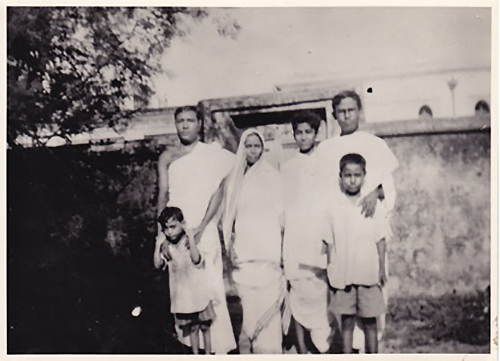
I believe it is possible to say, without exaggeration, that it was due to one momentous event in the Ghosh family: towards the end of 1932, Madal’s eldest brother, Hriday, left Chittagong and went to Pondicherry, South India, to join the Sri Aurobindo Ashram. He was at that time twenty-one or twenty-two years old and had just completed his B.A. at Chittagong College. His youngest brother, Madal, was just one year and three months old.

Hriday’s sudden decision to leave precipitated a family crisis. Two long weeks passed before the family discovered where he had gone. The second eldest brother, Chitta, later recorded in his notebook: “[Hriday] was a most brilliant student. My father was furious. He would not even look at our brother before he departed. Then my mother took an oath that she would fast unto death if my father did not bring her to the Ashram. It took two days for my mother to soften my father’s heart. At the end of two days, he surrendered to my mother. He brought my mother and my whole family to the Ashram.” 5

Somehow, Shashi Kumar Ghosh obtained extended leave from his job as chief inspector of the Assam-Bengal Railway and, in early 1933, the family set off en masse in Hriday’s footsteps to try to persuade him to return home. Although they were unsuccessful in this enterprise, they did become reconciled to his chosen path.

And so began what would become a regular pattern over the next eight years of trips to Pondicherry to visit Hriday. After that initial trip in early 1933, they undertook round trips in 1936, 1939 and 1941. Each round trip was of epic dimensions – 4,915 km (3,054 miles), the equivalent of the distance from Mumbai to Moscow. This distance included 315.6 km (196 miles) by steamer and ferry. And, from a close examination of the timetables listed in the Indian Bradshaw #803, October 1932, we can estimate that the journey took at least five days each way. The trip of 1936 took even longer and included approximately 500 additional kilometres (310 miles) because the family made a number of side trips to sacred places along the way.

These family processions between Chittagong and Pondicherry culminated in one final one-way trip in July 1944, after the passing of Madal’s mother and father. Hriday had taken permission to return to Chittagong for his mother’s last days. After her death, he wound up the family affairs and took the remaining members of the family with him to live at the Ashram.

Madal’s train experiences

In a book dedicated to his father and published in 1992 My Father Shashi Kumar Ghosh, Sri Chinmoy offers some charming insights into his experiences as a young boy travelling immense distances by rail:

“Because my father had been a train inspector, we could travel free all over India. Eleven human beings my father could take free: two servants, one cook and eight members of the family. I used to enjoy riding on the train so much. The trains were long, with many seats inside. In those days, they were not so crowded. Now they are very crowded; there is no room. Indian trains were like bullock carts – twenty to thirty miles per hour. My only ambition was to become a ticket collector or inspector like my father. He started out as an ordinary officer of the Assam-Bengal Railway. Then he became head inspector of the whole line. But God did not fulfil my desire. Whenever we went on the train, everybody in the family used to fall asleep during the trip, but I could not wait to see the next station. There people used to carry things on their heads, and they had a peculiar way of shouting, ‘Tea! Betel nut! Ancient Indian cigarettes! Real cigarettes!’ and other things. My mother, brothers and sisters all used to sleep, but there was no sleep for me!” 6

Timetable of Trains from Chittagong to Pondicherry

Just how the family negotiated these long trips to and from Pondicherry is fascinating. It is also a tribute to Shashi Kumar Ghosh’s expertise and familiarity with the intricate workings of the Indian railway system, which is the largest in the world. I am greatly indebted to R. Sivaramakrishnan of Pondicherry, who is a member of the Indian Railways Fan Club Association (IRFCA), for giving me a glimpse into this era of Indian train travel and for so kindly providing me with the following information.


STAGE ONE: Shakpura to Chittagong


Transit time: 1½ hours Mode of transport: river ferry Distance: 13 km (8 miles)


Making Ticket Reservations in Chittagong Shashi Kumar Ghosh would have had to make reservations for the train journey around a week in advance in order for the issuing station to get telegraphic confirmation of the onward reservations from the changing stations. Tickets were booked and issued manually, with the booking clerk taking up to ten minutes to issue a set of tickets, and considerably longer if more than one train was involved. The large size of the Ghosh party would have complicated the booking process even further, even though they were travelling free of charge.

Because of Shashi Kumar Ghosh’s high-ranking position with the railway, we may presume that the family members were entitled to travel first class, while the two servants most probably travelled third class. The first class fare up to Calcutta, inclusive of the steamer, was 51-1-6 (51 rupees, 1 anna, 6 paise). The third class fare was 6-15-6 in October 1932.


A typical M class steam locomotive in use in the 1930's and 40's.
Photo credit: Shaw Webspace


There was one daily train from Chittagong towards Sealdah Station in Calcutta. It was called the Chittagong Mail and it ran on a metre gauge track up to Chandpur.


Chittagong Railway Station
Photo credit: Jay Davidson


STAGE TWO: Chittagong to Calcutta (23 hours)


2100 hours Depart Chittagong #3 Chittagong Mail
MG – ABR (Metre Gauge/Assam Bengal Railway)
0153 hours Arrive Laksam Junction Mileage total: 81 (130 km)
O223 hours Depart Laksam Junction  
0350 hours Arrive Chandpur Mileage total: 113 (182 km)


At Chandpur, in the small hours of the morning, the passengers would disembark with their luggage and board a steamer for the picturesque 95-mile (153 km) trip north-west along the Ganges (known as the Meghna and Padma in different sections of its course) to Goalundo Ghat. There they would board the broad gauge counterpart of the Mail which would take them to Sealdah.


0430 hours Depart by steamer  
1400 hours Arrive Goalundo Ghat Mileage total: 208 (335 km)


A steamer approaches the Goalundo Ghat
Photo credit: Great Mirror


1440 hours Depart Goalundo Ghat #6 Chittagong Mail
BG – EBR (Broad Gauge/East Bengal Railway)
2000 hours Arrive Calcutta (Sealdah) Mileage total: 363 (584 km)


Metre gauge (MG) referred to rails that were 1,000 mm (3 ft 3⅜ in) apart, while broad gauge tracks (BG) were 1,676 mm (5 ft 6 in) apart.

Overnight in Calcutta

By this stage, the family would have covered 584 km (363 miles) over a period of a day and a half (not including time spent in Chittagong), travelling by small ferry, large steamer and two different types of steam locomotive. If the Chittagong Mail was running on time, they would have pulled into Sealdah Station, Calcutta, at eight o’clock in the evening. The daily Mail Train to Madras would have left from Howrah Station, across the Hooghly River and on the other side of the city, just an hour earlier. So the family would have had to spend one night and almost a full day in Calcutta before catching the next day’s Madras Mail. Mr. Sivaramakrishnan suggests that the family may have crossed to Howrah Station for the night. Howrah had spacious waiting rooms for the upper classes as well as retiring rooms, and a waiting hall for class III passengers with baths. He adds, “Most passengers preferred to stay in them for 12 to 24 hours for a connecting train, rather than going out of the station to find a lodge.” 7 Since Howrah Bridge was not finished until 1943, passengers crossed between the two termini – Sealdah on the east bank and Howrah on the west bank – by means of a bridge of boats.
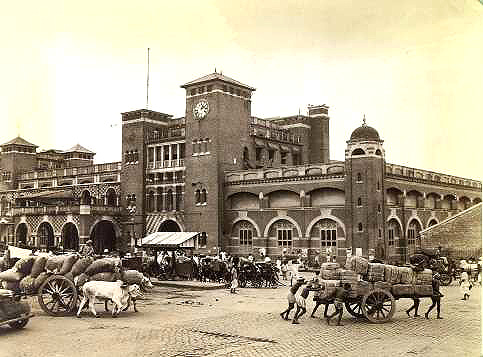


Howrah Station, Calcutta circa 1928
Photo credit: Mrinal, Indian Railway Fan Club Association


The passenger concourse at Howrah Station, 1943
Photo credit: Mrinal, Indian Railway Fan Club Association


STAGE THREE: Calcutta to Madras (37 hours 10 minutes)


1900 hours Depart Howrah # 4 Madras Mail
BG – BNR (Broad Gauge/Bengal Nagpur Railway)
1415 hours Arrive Waltair (now Visakhapatnam) Mileage total: 547 (880 km)
1435 hours Depart Waltair #2 Calcutta Mail
BG – M&SM Rly (Broad Gauge/Madras & Southern Mahratta Railway)
2310 hours Arrive Bezwada Mileage total: 764 (1229 km)
2330 hours Depart Bezwada  
O810 hours Arrive Madras Central Mileage total: 1032 (1660 km)


Transfer in Madras

Arriving in Madras in 1933, a totally unfamiliar city, after almost four days of travelling, with young children in tow, a wife who was frail from fasting, and the added problems of luggage to deal with and food to procure, it is quite possible that Shashi Kumar Ghosh and his party failed to make the next available connection to Pondicherry, which was the #7 Dhanushkodi Express at 1115 hours. Moreover, they would have had to transfer to Madras Egmore Station, almost a mile from Madras Central, which would have involved hiring several rickshaws to convey the whole party. One assumes that the family transferred to Egmore Station, installed themselves in the spacious waiting room, confirmed their onward tickets, purchased some food and rested. Depending on the time of year they were travelling, they may have encountered scorching temperatures in the 40's, and extremely high humidity.


The fanciful exterior of Egmore Railway Station, Madras
Photo credit: K. Pichumani/The Hindu


STAGE FOUR: Madras to Pondicherry (6 hrs 25 mins or 7 hrs 40 mins) Mr. Sivaramakrishnan presents two possible timetables here. Assuming they made the transfer from Madras Central to Madras Egmore on time, the connection would have been as follows:


1115 hours Depart Madras Egmore #7 Dhanushkodi Express
MG – SIR (Metre Gauge/South Indian Railway)
1540 hours Arrive Villupuram Junction Mileage total: 99 (159 km)
1600 hours Depart Villupuram Jn. #247 Passenger train
1740 hours Arrive Pondicherry Mileage total: 123 (198 km)


Alternatively, perhaps not wishing to arrive in the evening, they would have waited in Madras for the day and caught the following evening train:


2130 hours Depart Madras Egmore #9 Trivandrum Fast Passenger
0150 hours Arrive Villupuram Junction  
0345 hours Depart Villupuram Jn. #241 Passenger Train
0510 hours Arrive Pondicherry  


The stately Pondicherry Railway Station
Photo credit: blob59 on flickr.com
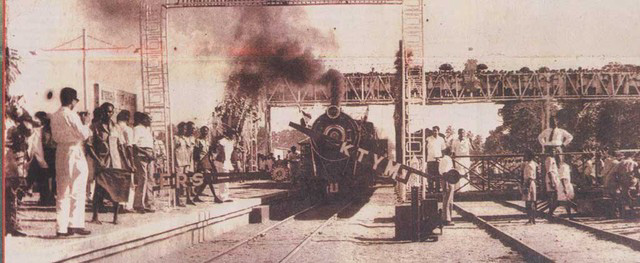


A metre gauge steam locomotive pulling into a station in Cochin. Although this is not the exact train that was used on the South Indian Railway, it does convey something of the atmosphere and experience of the platform, the station attendants holding coloured flags with which they gave semaphore signals, the waiting passengers, and the massive blasts of steam upon arrival. Photo credit: Indian Railway Fan Club Association, Krishnan Nair Studio, Ernakulam and Mr. Gopalkrishnan


Those who are interested, advises Mr. Sivaramakrishnan, can also trace the journey visually by turning to Volume 26 of The Imperial Gazetteer of India, Atlas 1931 edition, Railways and Inland Navigation, pages 25 and 26. These excellent maps can be found at the following links: Imperial Gazetteer of India, v. 26, Atlas 1931 edition, Railways & Inland Navigation, p. 25. and Railways & Inland Navigation, p. 26.

The trip of 1936

In 1936, when Shashi Kumar Ghosh made his second trip to the Sri Aurobindo Ashram with his wife and children to visit his eldest son, Hriday, and to seek the blessings of Sri Aurobindo and the Mother, he decided to visit many temples and holy places along the way. These places of pilgrimage had been sanctified by spiritual Masters, such as Sri Chaitanya, Sri Ramakrishna and Swami Vivekananda. Others were consecrated to Lord Shiva and other Hindu Gods. Madal would only have been five years old at the time, too young perhaps to take in the details of the trip, but his next older brother, Mantu, who was eight, retained vivid memories of this journey. From Mantu’s recollections, published in his book My Heart-Songs, we can reconstruct the general route their annual pilgrimage took that year:


“In 1936 our mother, father, Chitta-da, Chinmoy and our sisters and I travelled to Navadwip, the birthplace of Sri Chaitanya. There we saw a statue of the golden Gauranga. I still remember the kirtans that were sung there. Men were wearing women’s clothes and singing kirtans. They were singing devotional love songs.

From there we came to Dakshineswar, the sanctified abode of Sri Ramakrishna. After visiting the temples, we continued on to Belur Math which had been established by Swami Vivekananda. Afterwards, we went to see the zoo, the museum and the Victoria Memorial in Calcutta.

Leaving Calcutta, we journeyed to Burdaman to visit our uncle. He was a great Vaishnava devotee. There, too, we heard kirtans. Inside the village, we sought out our uncle at his Guru’s Ashram. It was in the midst of a beautiful garden. Sri Chaitanya also came to Burdaman during his wanderings. There he met with Keshab Bharati, a renowned scholar. We also visited the home of Madhai, the ruffian who became Sri Chaitanya’s devotee. Here there is a special bathing ghat.

From Burdaman we travelled to Orissa and visited the world famous temple of Jagannatha at Puri. We received prasad from the temple.

Continuing southwards, we visited many temples on our way. Some of the temples, we even visited at night. In front of the statues, countless little, little lamps were burning. We could not see the deities properly and there were hundreds of bats moving around overhead. In front of one temple there were two large pillars. We heard that they were golden palm trees.

Next we went to Prahllad Puri. There we saw mountains and the ocean where Lord Vishnu killed Hiranya Kashipu, Prahllad’s father. We have seen everything. From there we went to Pakshi-Tirtha, the place of bird pilgrimage. Thousands of birds make their home there. We came a long way. We saw a Brahmin on top of a mountain. He was eating. Two white birds came and took food from his hands and then left.

Then we went to visit the sacred Venkateswara temple. The temple is situated on Tirupati Hill. It is one of the most famous temples in South India. It is in Andhra State. Nowadays the bus can come right up to the temple. Formerly, it was not so easy. One had to come up to the temple by covering a very long distance. People used palanquins because of the high elevation.

There were many monkeys in the vicinity of the temple. Our father was eating a mango. One monkey took away his mango and gave our father a slap. Chinmoy, Chitta-da and I did not go inside the temple. Our mother had to come down and see Chinmoy.

From here we came to the Sri Aurobindo Ashram for Sri Aurobindo’s and the Divine Mother’s Blessings.” 8Manoranjan (Mantu) Ghosh

This journey involved many detours, side trips and stops along the eastern coastline, adding hundreds of kilometres to the journey. A number of these sacred places of pilgrimage, such as Navadwip, were not directly accessible by train. In other places, it would have been more practical to take a ferry. A river ferry from Navadwip, for example, going south on the Hooghly (Ganges) River would have been the ideal way to stop at Dakshineswar and then at Belur Math on the opposite bank. The distance from Navadwip to Calcutta is 94 km (58.4 miles).

After a day or two seeing various sights in Calcutta, it seems the family may have boarded a train on the Eastern Railway Line for the 100 km trip to Burdaman (also known as Burdwan or Bardhaman) to the north/west of Calcutta. Some of the other places mentioned, such as Prahllad Puri, were particularly remote, while the visit to Venkateswara Temple on Tirupati Hill involved considerable physical effort – climbing 14 km up more than 4,000 steps – an endeavour that seemed to have proved too much for the youngest son, as Mantu notes, significantly, “Our mother had to come down and see Chinmoy.” 9

Indelible Train Experiences

Although these epic train journeys all took place between 1933 and 1944, the exhilarating experiences of those endless days – running from side to side in the carriage to view the passing scenery, observing golden fields utterly different from the rich green rice paddies of his native East Bengal, anticipating the ever-changing Coromandel coastline, alighting at little stations to buy snacks, listening to the sound of the majestic wheels churning, watching the chaotic activity on the platforms as people surged on and off the train, falling asleep to the gentle rhythmic swaying of the carriage – all these experiences passing through the consciousness of the young boy were, indeed, indelible.

On one occasion, the young Chinmoy observed a most curious incident. He writes, “I was watching at the train station when it happened. I saw a sadhu, a thin fellow, an old man of sixty years. He was insulted because a policeman had thrown his stick out of the train. The sadhu had come out of the train and was standing on the platform, very, very furious, and staring at the engineers. There were two engineers; one was the main engineer and the other was his assistant. The sadhu entered into the brain of the chief engineer and made him incapable of operating the train.” 10

By and large, however, we can see that Sri Chinmoy internalised his early train experiences. His mature writings focus on inner realities rather than autobiographical details. And yet a constant train motif can be traced in his writings, most especially in his poems. He uses the image of the train not only to make abstract spiritual concepts relevant to our day and age, but to impart a dramatic urgency to his message:

“A restless mind
Is nothing but
A runaway train
That courts destruction.” 11
“If your dedication is not nourished
By faith every day,
Doubt may at any moment
Derail your dedication-train.” 12

In other poems, he hints at the charm of the train journey itself:

“Singing a song soulfully
Is exactly the same
As enjoying a ride on an express train:

Panoramic views on either side.” 13
“Fastest runs to the Goal Supreme
My Lord’s Love-Train.
Singing and dancing, therein my breath –
No bondage-chain.” 14

The following poem seems to encapsulate the symbolic meaning of his train experiences:

“An express train
Of consecutive great ideas
Has brought me to my Himalayan goal:
The sleepless service of humanity.” 15

And, in the light of Sri Chinmoy’s recent passing, his explanation of the passage of death in terms of a train ride is especially poignant:

“We are all like passengers on a single train. The destination has come for one particular passenger. He has to get off at this stop, but we still have to go on and cover more distance.” 16

An Innocent Childhood desire fulfilled at last

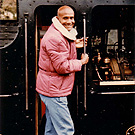
As an Australian, I feel a special connection to Sri Chinmoy’s love of trains because it was here in our country that he was able to fulfil at last his childhood desire to drive a train. This event took place at the famous “Puffing Billy” heritage railway in Victoria on September 13th, 1984 – when Sri Chinmoy was 53 years old. Recounting his experience afterwards, Sri Chinmoy made the following unforgettable statements:

“Since my childhood ended, in my entire incarnation I have had only two or three happy moments. Of course, when I achieved God-realisation was one. And the day I rode with the engineer of the steam train in Australia was another. When I was young, it was my greatest desire to be the driver of a train. God did not see fit to fulfil this innocent desire of mine, but now my Australian children have fulfilled it!
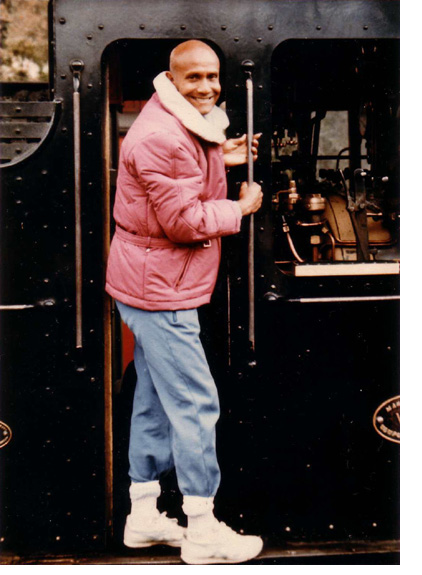
 

Sri Chinmoy on “Puffing Billy” in the Dandenong Range, Victoria, September 13th, 1984. Photo credit: Sri Chinmoy Centre

“The engineer was so kind, so nice; he received so much. Every two minutes he was putting coal in the furnace, and talking, talking, talking, all about his experiences with this train and other trains. He has been in India, and he talked about the Darjeeling train, which is much more peculiar and dangerous than this one. This train is mainly for children and for tourists, and quite a few of the workers on it work for free. His real job is running a nursery, and driving the train is a labour of love. If everyone took a salary, they would not be able to keep the train running.

“Every year there is a race – the train versus runners. The runners start and finish at the same place as the train. But they run on the road, while the train goes on its track. The route is very hilly and very scenic… The driver told me, ‘We get joy by losing to the runners. Otherwise, could anybody defeat us?’ The train can safely go about 22 miles per hour. If it goes much faster, it will go off the rails.

“At one point the engineer asked me to sit on his seat, but it was so narrow! My thigh was larger than the seat. The sound the train made gave me such joy. And the whistle was so loud! He would pull the handle just half an inch, and such a loud noise it made!

“So my Australia has given me tremendous joy by fulfilling an innocent childhood desire of mine.” 17


– End –


Copyright © 2009, Vidagdha Bennett. All rights reserved under Creative Commons license.


Endnotes:
1 Excerpt from Sri Chinmoy Answers, Part 19.
2 Excerpt from God’s New Philosophy.
3 Excerpt from The World-Experience-Tree-Climber, Part 4.
4 Excerpt from To The Streaming Tears Of My Mother's Heart And To The Brimming Smiles Of My Mother's Soul.
6 Excerpt from My Father Shashi Kumar Ghosh.
8 Excerpt from My Heart-Songs.
10 Excerpt from The Astral Journey.
11 Poem no. 21,296 from Seventy-Seven Thousand Service-Trees, Part 22.
12 Poem no. 14,457 from Twenty-Seven Thousand Aspiration-Plants, Part 145.
13 Poem no. 5,776 from Ten Thousand Flower-Flames, Part 58.
14 Poem no. 7 from My Silence-Heart Blossoms, Part 1.
15 Poem no. 6,813 from Ten Thousand Flower-Flames, Part 69.
16 Excerpt from Death and Reincarnation.
17 Excerpt from The World-Experience-Tree-Climber, Part 3.

 

Encounter with a Royal Bengal Tiger

December 13th, 2008

The Royal Bengal Tiger (Panthera tigris tigris), known in Bengali as bagha or shardul, is the largest member of the cat family on the face of the earth. A male specimen averages 9 feet 5 inches from head to tail and weighs approximately 480-600 pounds. The female measures around 8 feet and weighs in the region of 300 pounds. Its canine teeth can be up to 5 inches long and its claws are razor sharp. It is said that a Royal Bengal tiger can kill an elephant or carry a fully grown cow over a ten foot fence. In its natural habitat, it stands indisputably at the top of the ecosystem – and it is the national animal of both Bangladesh and India.

Imagine then that you are just ten years old, alone in the forest, your eyes eagerly scanning the foliage above your head for the rust-coloured drupes of jujubes that you crave. You climb up one of the jujube trees and eat some of the sweet, crunchy fruit. Then you clamber down the tree, keen to embark on more adventures. Suddenly, something draws your attention to the long grass in front of you. As your eyes adjust to the shadows, you see them coalesce into black stripes on orange fur, a massive head with two gleaming eyes is turned towards you – and you realise that you have come face-to-face with an enormous Bengal tiger in the wild. The forest around you is utterly silent. There is no adult within a two-mile radius, no means of help, no weapon to hand, no building to hide inside. It is just you and the tiger; a young boy at eye-level with one of nature’s most ferocious creatures. Your life can be measured in seconds.

This is the exact scenario that unfolded sometime between 1941 and 1942, when spiritual luminary Sri Chinmoy (known as Madal) was ten years old. It took place in the low mountains to the east of Chittagong, an area which in those days was still densely forested and where tigers and other wild animals ranged freely.

Over the years, Sri Chinmoy narrated this heart-stopping story a number of times. Sometimes, in his retelling, he substituted the word ‘lion’ for ‘tiger’ and this has created inevitably some confusion, especially since the Asian lion was not known to still inhabit that area. I once had the opportunity to ask him personally which animal it was that he encountered on that fateful day and he answered, emphatically, “Tiger! Tiger!” I imagine that, in the drama of the moment, he did not take account of the precise physical characteristics of the big cat that was poised not ten feet from where he stood. From the descriptions of those few who have survived to tell such a tale, it has been observed that in life-or-death circumstances, one isolated detail often becomes the focal point of concentration and the thing that is remembered long afterwards. It can be something as inconsequential as the way the leaves rustled, the shape of a cloud or a certain fragrance. In Madal’s case, it was the eyes of the tiger. Beyond these, it appears, he saw little else. In later life, he continued to interchange ‘lion’ and ‘tiger’; he never referred to its size, whether it was standing or crouching, upwind or downwind of him, if it was male or female. But he always described the look in its eyes.

For up to five minutes, Madal and the tiger gazed at each other, neither one making a move. The tiger made no motion to leap at him, nor did Madal run away or scream. Something quite extraordinary had intervened to transform his emotions from those of fear to those of calmness: he saw his mother’s eyes reflected in the eyes of the tiger and she was inundating him with love and affection. Here is the entire episode in Sri Chinmoy’s own words:

“When I was ten years old, I went to visit my maternal uncle who lived in the country. There was a chain of mountains nearby, about two and a half miles away. I was extremely fond of roaming in these mountains.

One afternoon about two o’clock, all my friends were in school, so I decided to go for a walk alone on one of the mountains. I had been to this mountain many times accompanied by my friends and relatives. But we had only wandered through the fringes of the mountain, which were more accessible. This time, being alone, I got more joy from my adventure! I roamed further and further until I was in the thick of the dense forest which covered the mountain. Formerly, when I had gone with my friends and relatives, they had wandered only through the outskirts of the forest, as these were more accessible.

I was very fond of a certain kind of fruit called jujube. There were many jujube trees in the forest, so I climbed one of them and ate to my heart’s content. When I climbed down, there, facing me, only ten feet away, was a tiger!

We stood there, face-to-face, and the tiger, far from showing a ferocious look, was all mildness. Furthermore, reflected in the tiger’s eyes, I saw the face of my own mother although my mother was in our home village, Shakpura, six miles away.

This went on for several minutes. Seeing my mother in the eyes of the tiger, I felt no fear and raised no cry. I was calm and serene. The more I looked into the tiger’s eyes, the greater was the affectionate feeling I received from the tiger.

Very slowly, after about five minutes, I started to move away, turning my back to the tiger and walking slowly and cautiously. After covering a reasonable distance, perhaps a quarter of a mile, I turned back to see if the tiger was following me. There was no sign of the animal. Then I took to my heels and ran for dear life.

I covered a mile in a short time, crying and shouting for help: “Save me! Save me! I saw a tiger!” When I finally came to my aunt’s house, I was trembling and screaming. My aunt felt as though I had died and had come back to life by some miracle. Some of the villagers showed sympathy, some scolded, others mocked. My aunt was holding me as if I had really been killed by the tiger!

Although it had been decided that I would be staying at my uncle’s home for a few days, quite unexpectedly my mother arrived that day. In the afternoon she had been having a siesta, and had dreamed that I was attacked and killed by a tiger. She came with her servant to her brother’s home, practically insane with grief, assuming that her son had died.

I was practically bathed in the sea of tears shed by my mother and aunt in their joy at seeing me alive and safe.” 1

Clearly, the tiger’s decision not to attack cannot be ascribed to the fertile imagination of a young boy. Although a tiger attack may well be the most fearsome thing the human imagination could ever conjure up, imagination alone cannot quell the destructive power of a living animal.

And yet, it is difficult to explain how Madal’s intense inner experience could have such an immediate and decisive effect on the physical plane. Several explanations suggest themselves. One is that in his moment of utmost need, when there was no other recourse for help, Madal was able to invoke his mother’s calm and serene presence to such a degree that the tiger was subdued. A second explanation suggests itself when we learn that at the precise moment Madal was having this experience, his mother dreamt that he had been attacked and killed. Because of their close inner connection, it is highly likely that her soul became aware of the danger he was in and exerted itself to protect him by entering into the soul of the tiger. A third explanation is that the young boy was protected by God Himself who entered into the tiger and rendered it incapable of attack. It is possible that God manifested Himself through the eyes of the tiger as Madal’s mother so that Madal would not be afraid.

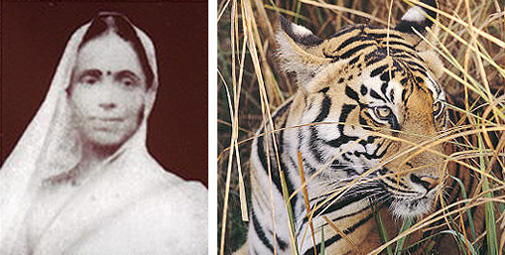
The eyes of Sri Chinmoy’s mother, Yogamaya, and the eyes of a Bengal tiger are juxtaposed below:
 

Photo credits: Sri Chinmoy Centre/Ullas Karanth, WCS-India

Again, a sceptic might say that tigers are shy and secretive animals which tend, by nature, to avoid human contact. Alternatively, the animal may have already feasted or perhaps it preferred some other kind of prey. Atanu Raha, chief conservator of forests in West Bengal, stated in 2003: “Human beings are not a natural diet for tigers. A tiger turns into a man-eater only under extraordinary situations, like when it grows too infirm or disabled to hunt or when there is a scarcity of its natural prey.” Nonetheless, the tiger is responsible for more human deaths than any other predator – and most of these killings are cases where the victim accidentally surprised a tiger.

While not claiming to be an expert on the habits of tigers, I believe that the encounter between Madal and the tiger may have been one of those extraordinary situations to which Atanu Raha refers, and in more ways than one. From the tiger’s point of view, it was clearly extraordinary to have been presented with such an easy and defenceless prey, one moreover which had intruded into its territory. From Madal’s point of view, it was extraordinary that his life was spared. Beyond the extraordinary lies the mystical and it is within the bounds of mystical experience that this incident falls.

“A real mystic,” explains Sri Chinmoy, “is he who wants to see the divine mystery in everything, in nature and in human beings. He wants to go to the essence, to the Source, faster than any human being dares to imagine.”

In this case, in the fraction of an instant, Madal was able to see the divine mystery inside the tiger, to penetrate its essence, as it were, with the result that the whole scene has a transcendent quality.

Sri Chinmoy carried this experience with the tiger with him throughout his life in a number of ways. He was once asked which was his favourite poem in English and he stated that it was “The Tyger” by William Blake, and he described this poem as “humanity’s invaluable treasure.” The immortal opening stanzas of the poem are:

“Tyger! Tyger! burning bright
In the forests of the night,
What immortal hand or eye
Could frame thy fearful symmetry?

In what distant deeps or skies
Burnt the fire of thine eyes?
On what wings dare he aspire?
What the hand dare seize the fire?”

(From Songs of Experience, 1794)

Sri Chinmoy offered his own illumining interpretation of this poem in his talk on William Blake given at the United Nations in New York in 1976:

“Here we see that ignorance-energy, which threatens to devour the entire world, finally discovers its transformation-salvation in the realisation of the absolute One. This absolute One embodies both ignorance-energy and knowledge-energy and, at the same time, far transcends them both.” 2

Interestingly, both Blake and Sri Chinmoy focus on the eyes of the tiger. One might be tempted to think that Blake’s tiger was purely the creation of his poetic genius, an apt metaphor for the fiery deeps of hell. But historical evidence points to the fact that he may have seen an actual living tiger in the Tower of London. In those days, the Tower housed the royal menagerie – gifts for the Royal Family that were brought back by ship from far-flung countries. There was an elephant, as well as several leopards, lions and tigers, to name but a few species. Ferocious beasts were much sought after, especially since it was the prerogative of the Royal Family to own them. Within the Tower, they were kept in small cages. Sometime in the middle of the 18th century, this exhibition was opened to the public and so we might have found young William Blake having his own encounter with a tiger at far closer quarters than modern zoos allow for. The experience seems to have etched itself on his active mind and there is, in his poem, genuine awe at the splendour and beauty of the animal mingled with fear and a kind of nameless dread of its deadly power.

In a book entitled Animal Kingdom, in which he offers the spiritual significance of many animals, Sri Chinmoy equates the tiger with the quality of cruelty. He writes:

“Tiger, my tiger,
When are you going to end
Your dark cruelty-life?
How long shall wait at your door
Your divinity-friend?
Don’t delay! Don’t delay!
Inside the vital of your delay
Looms large your world-failure-day.”
3

In his poems, he invariably aligns the tiger with destructive qualities, such as ignorance, doubt and desire:

“The mind is a tiger,
An ignorance-tiger.
The heart is a fire,
A wisdom-fire,
To conquer the breath
Of the ignorance-tiger.”
4
“The ferocious ignorance-tiger
Is all around us.
This tiger may not be about to leave us
Right now,
But eventually it has to leave us
For good.”
5
“Self-doubt
Can be compared to
A ferocious, man-devouring
Tiger.”
6

Above all, he uses this powerful image to urge the spiritual seeker not to underestimate the power of the forces of ignorance, but to face those forces fearlessly and conquer them. He inspires us to cultivate within ourselves the same remarkable courage that he showed as a boy of ten and the same implicit faith in the ultimate victory of goodness, peace and divinity:

“Each time
You have a chance,
Hurl your wisdom-lance
At ignorance-tiger.”
7
“A man of belief
Compels the impossibility-tiger
To sit at his feet.”
8


– End –


Copyright © 2008, Vidagdha Bennett. All rights reserved under Creative Commons license.


Endnotes:
1 Excerpt from To the Streaming Tears of My Mother’s Heart and to the Brimming Smiles of My Mother’s Soul.
2 Excerpt from Reality-Dream.
3 Excerpt from Animal Kingdom.
4 Poem no. 17,815 from Twenty-Seven Thousand Aspiration-Plants, Part 179.
5 Poem no. 6,410 from Ten Thousand Flower-Flames, Part 65.
6 Poem no. 5,311 from Twenty-Seven Thousand Aspiration-Plants, Part 54.
7 Poem no. 34 from My Fifty Gratitude-Summers.
8 Poem no. 16,767 from Twenty-Seven Thousand Aspiration-Plants, Part 168.


Those wishing to know more about the Royal Bengal Tiger may like to view: Climate Trackers: Bengal Tiger


A Life Once Spared

January 16th, 2009

Indians of all castes and from all walks of life traditionally worship numerous cosmic gods and goddesses – Brahma, Vishnu, Shiva, Durga, Saraswati, Lakshmi, Kali, Parvati, Ganesh, Kartikeya and many more. To the Western mind, this pantheon of divine manifestations can be mystifying, whereas, for an Indian, they belong to a time-honoured way of life that is perfectly natural. Throughout the year, special festivals are dedicated to certain gods and goddesses, and on a daily basis many traditional religious rituals are observed.

Bengal has long been regarded as the epicentre of devotion to the goddess Kali and spiritual Masters who hail from this part of India – including Sri Ramakrishna, Sri Aurobindo and Swami Vivekananda – all expressed profound devotion to her. Sri Chinmoy, a true Bengali, belongs to this tradition. Kali was worshipped with great ceremony in his family and, as he grew older, although he no longer observed a ritual-based form of worship, he maintained his deep love for her. She was his most favourite of all the goddesses. He explains:

Kali is one of the four aspects of the Supreme Mother. She is the Mother of power, the Mother of compassion and the Mother of speed. She wants her devotees to run the fastest … One has to be extremely pure, sincere and heroic in order to be her chosen instrument. She is not for the weak; she is only for the strong. She cares only for the strong who are ready to fight against ignorance… In India, each family has a presiding deity. Mother Kali happens to be my family’s deity, so she has special blessings for my entire family.
(Great Masters and the Cosmic Gods)

For Bengali families, the most important religious event of the year is Kali Puja, which falls in October or November, depending on the lunar calendar. This sacred occasion is observed with elaborate decorations and ceremonies, which extend over a number of days and nights. Special bamboo pandals (temples) are erected, Brahmin priests travel from household to household to perform the rituals, temples and houses are brightly illuminated by strings of lights, women wear red-bordered saris, men don white dhotis and kurtas, and the constant sound of conches, bells and drums all add to the festivity.

During Sri Chinmoy’s childhood, it used to be a common custom, especially among well-to-do landowners such as his father, to offer a special goat sacrifice to Mother Kali during Kali Puja. In Bengal, this sacrifice is called patha bali. For Shashi Kumar Ghosh, it symbolised his protection of the entire family.

In 1938, when Sri Chinmoy was seven years old, something unexpected took place during this sacrifice which very nearly resulted in a tragedy of horrific proportions. In his autobiographical writings, he describes the scene as it unfolded at the family temple:

Once, our family was performing the Kali Puja, the festival of Mother Kali. At the time, I was about seven years old. Many sacrifices were offered. The most important was the sacrifice of a live goat. Someone would hold the legs of the animal tightly, while the goat’s head was placed at the end of the scaffold. For the sacrifice to be successful, the Brahmin priest had to perform it with one stroke of his sharp scimitar. If the priest failed on the first stroke, it was said that the devil’s doings would befall the family that was performing the festival.

After the sacrifice of the goat, it was customary that fruits also be sacrificed to Mother Kali. In this case also, to make the sacrifice successful, the priest had to cut these fruits in half with only one stroke of the scimitar. Then he would fling the fruit out to the spectators and the lucky ones would catch it.

When the time came for the sugar cane sacrifice, it was placed on the scaffold that earlier had held the goat and the fruits. The top portion of the sugar cane has a few leaves and is not edible, but the main body of the sugar cane plant is most delicious. I noticed that some of my friends, who had been standing near the top portion of the sugar cane, had quietly moved around the back of the audience to the other side, so that they could stand near the other end of the altar. They knew that the body of the sugar cane would be flung in that direction.

The priest had grasped the scimitar in both hands and swung it above his head, even extending his hands behind his head in order to get better leverage to perform the job successfully. Just as the priest was beginning to swing, I jumped over the scaffold. In the nick of time, he halted his swing.

A wave of panic swept those who were watching. I had escaped from a great calamity by just a hair’s breadth. Had the priest not been able to stop his swing, I would have been in the other world. Fortunately, the divine in the priest had immediately endowed him with the needful life-saving skill.

My father, approaching me in a calm and quiet manner, embraced me with both arms. There was not a trace of worry or anxiety in his face – only tranquil joy streaming forth.

My father then took the priest aside and said, ‘You have saved my son’s life. Whatever reward you want I shall immediately give you – money, property or anything else I have. I shall give it to you here and now.’

The priest, still trembling from the experience, said to my father: ‘Reward! What reward? I have saved my mentor’s dearest son! What greater joy can there be on earth than to save my deeply esteemed mentor’s youngest son!’ My Brother Chitta

In his eagerness to catch one of the stalks of sugar cane as the priest flung them to the young boys, Madal had no concept of the danger he courted by jumping over the scaffold. He was intently focussed only on reaching the other side and oblivious to all else. We recall that Madal’s maternal uncle used to make a pun on the family surname and call him kharaghosh (rabbit) because he was always darting about here and there. Madal was adept at jumping, climbing and running and this may have given him the foolhardy confidence to jump over the scaffold at the precise moment the priest was preparing to strike.

Meanwhile, the priest, on his part, was focussed on raising his scimitar over his head in preparation for his swing. At some point, he must have noticed the movement of the little boy. Human reaction time is usually between .2 and .25 of a second. However, it is highly unlikely that this window of time alone would have been sufficient to arrest the action of the sharp blade, particularly once the downward motion had begun, a motion which some have described as being faster than the eye can see.

A world-class 100-metre runner can cover two and a half metres in .25 seconds. A weapon thrown by an expert travels 10 metres in .25 seconds. An object, after freefalling 100 metres, travels 11.25 metres in the same timeframe. How much faster then would a powerful slice with a scimitar be! Clearly, under the circumstances, even an extremely fast reaction time would not have saved the boy from a terrible fate.

Moreover the reaction time of the priest – that is, the elapsed time between his observance of Madal and his subsequent halting of his swing – would have been affected by the events of the day. He would arguably have been tired from his previous exertions. By the time he was asked to cut the sugar cane, his reaction time may have slowed considerably. Again, since he addresses Shashi Kumar Ghosh as his mentor, it seems that he had been the family priest for some time, which indicates that he may not have been a young man. In this context, the fact that he was able to stop the momentum of the blade, to fight against the pull of gravity, was a feat of monumental proportions.

Both Shashi Kumar Ghosh and the priest immediately recognised that some divine force had intervened to save the little boy. Since the sacrifice was dedicated to Mother Kali, and presumably took place in front of the sanctum sanctorum where her image was installed, I believe we can say that Mother Kali acted through the priest to save Madal’s life. Fortunately, one of the main qualities of Mother Kali is that of speed. Sri Chinmoy says,

When the Grace of Mother Kali or any aspect of the Divine Mother enters into us, miracles can take place in the twinkling of an eye. Whatever You Want, God Gives

Her direct intervention transformed this potential tragedy into a cause for profound wonder and awe. One can even see traces of her divine touch reflected on the face of Shashi Kumar Ghosh. Sri Chinmoy speaks of the ‘tranquil joy streaming forth’ from his father, who instantly recognised the miracle for what it was. Like a king of olden times, he was fully prepared to bestow his entire kingdom on the priest who had saved his son’s life. The priest, on his part, was still trembling from the incident some minutes after it happened. He seems both physically and spiritually shaken.

Sri Chinmoy retained this scene in his memory with great vividness for several reasons: it was yet another of his narrow escapes from death; it was one of the very few occasions when his beloved and adored father embraced him and, after leaving Bengal, he never again in his life celebrated Kali Puja in this way.

From the age of twelve, when Madal became a resident at the Sri Aurobindo Ashram, religious rituals as such disappeared from his life. Although at one time Sri Aurobindo had identified with Kali so closely that he even signed some of his letters with her name, in his Ashram he cultivated a universal form of spirituality that was not embedded in tradition. It was based solely on silent meditation and inner awakening. Swami Vivekananda expounded a similar philosophy when he gave lectures in the West. Only in rare, private poems or letters did he make mention of Mother Kali or even of his own spiritual Master, Sri Ramakrishna.

We find a similar dichotomy in Sri Chinmoy’s life. He maintained his intense personal devotion to Mother Kali to the end of his days. Wherever he went, he carried a small picture of her in his pocket. He bowed before her image whenever he left his house and before he did his daily weightlifting. He composed a number of devotional songs in praise of her in his mother tongue Bengali, only seldom translating them into English. His writings and teachings, however, focus on the universal aspects of prayer and meditation. They are, one may say, oriented to seekers of the West.

One must inevitably ask why someone who has achieved the highest type of realisation – such as Sri Aurobindo or Sri Chinmoy – would feel the need to offer devotion to a cosmic god or goddess. It is, perhaps, something that we shall never fully understand. As seekers on the path, we are secure in the object of our devotion. It is the spiritual guide whom we have chosen to lead us to the Goal. But for the one who has reached the Goal, perhaps there is still something in his nature which yearns for the sweetness of devotion. In the same way that a master cellist still practises the musical scales every day, Sri Chinmoy still prayed to the Supreme, still sang devotional songs, still repeated the Name of the Supreme hundreds of times – and still offered Mother Kali all the intensity of his devotion.

Even before he passed behind the curtain of Eternity, he sought her permission and her blessings. In the small hours of the morning on October 11th, 2007, he stood with folded hands facing his cherished image of Mother Kali and uttered the simple Bengali word ‘Mago’ (Mother), the very first word that all Bengali children learn. Then he bowed his head. This time Mother Kali did not have to act swiftly to save her child from certain death. Instead she welcomed him with open arms.


– End –

Copyright © 2009, Vidagdha Bennett. All rights reserved under Creative Commons license.


A Life Nearly Snuffed Out

Sri Chinmoy graced this earth for seventy-six years, but his life nearly ended after barely three years when he contracted such a severe case of smallpox that the doctors gave up hope for his survival. Had their prognosis been correct, the world would have lost one of its most revered spiritual leaders at the very dawn of his life. The story of how the infant Madal survived against all odds is a testament to the miraculous power of prayer – in this case, the ceaseless prayers and unwavering faith of his mother, Yogamaya.

From time immemorial, smallpox has been one of mankind’s greatest killers. Lord Macaulay, in his History of England (1914), described it as “the most terrible of all ministers of death.” During the 20th century alone, it is estimated that smallpox was responsible for 300-500 million deaths.

In 1958, at the height of the Cold War, the Soviets requested a global campaign to eliminate smallpox. Their proposal met with universal support and, by the end of 1979, the World Health Organisation was finally able to certify the eradication of smallpox ‘in the wild’. In May the following year, the World Health Assembly declared: “The World and all its peoples have won freedom from smallpox, which was a devastating disease sweeping in epidemic form through many countries since earliest times, leaving death, blindness and disfigurement in its wake, and which only a decade ago was rampant in Africa, Asia, and South America.” To date, smallpox remains the only human infectious disease to have been completely eradicated.

In 1934 or ’35, when Madal succumbed to the disease, India was the stronghold of smallpox in Asia. Bengal, in particular, was subject to such frequent epidemics that the disease was known as Bashanta, meaning ‘spring’, because that was the season during which these disastrous epidemics regularly occurred.

As early as 1880, the British rulers of India had passed a Vaccination Act requiring children to be vaccinated against smallpox within six months of birth, but it seems that the Act did not apply to all jurisdictions and it was not enforced, especially in rural areas. Vaccination teams went from village to village, but they were inadequate to the enormous task and their work was impaired by administrative apathy, as well as suspicion and mistrust on the part of the Indians. As a result, it seems that the small village of East Shakpura where the Ghosh family lived was somehow overlooked between the years spanning Madal’s birth in 1931 and his contraction of the disease.

In spite of his protected village upbringing, somehow the young Madal must have been exposed to someone who carried the disease. Since no other member of the family suffered from smallpox, it seems most likely that the carrier was someone outside the family circle, possibly a housemaid, cook or gardener who stopped to play with the little child. The near-tragedy that ensued is related in Sri Chinmoy’s own words:

“When I was three or four years old, I had the worst possible case of smallpox. The smallpox attacked my eyes, ears and nose – everything. The doctor said it was a matter of weeks: I would die or I would go blind or become deaf. The case was so serious. My mother said, ‘With God’s Blessings and my prayers, I will not allow my youngest son to die or to become blind or deaf.’


The doctors said, ‘We do not want your son to die, but he is going to die. Our medicine will not work.’

My mother accepted the challenge. She used to wash my face with coconut water. Her prayer and coconut water saved me. I am not dead; I am not blind or deaf. I may have the marks on my face, but my case would have been infinitely worse if the smallpox had not left me. I was cured only because of my mother’s prayer to God and her concern and affection for me. She saved my life.” 1

I imagine that most contemporary readers, like myself, have only a vague idea of the effects and ravages of smallpox. We know, for example, that such notables as Mozart, Beethoven, Elizabeth I of England, George Washington and Abraham Lincoln were afflicted with the disease and survived it, though all of them bore visible pockmark scars as a result. In 1801 President Thomas Jefferson had introduced mandatory smallpox vaccinations for American Indians. This followed the breakthrough discovery by Edward Jenner in 1796 that those who were inoculated with cowpox virus developed immunity to smallpox. In spite of the development of vaccines, however, this devastating scourge lingered in both Western and Eastern countries.

There are two virus variants of smallpox: Variola major and Variola minor. Variola major, the more deadly of the two, was more prevalent in Asia, while Variola minor occurred predominantly in Europe. It is evident from Sri Chinmoy’s description that he contracted Variola major. The overall mortality rate of this variant was around 30-35%. 

Smallpox is transmitted from one human being to another by inhaling virus-laden droplets released into the air by coughing or sneezing. Children are particularly susceptible to the contagion. The incubation period is about 12 days. After that time, the victim develops an acute fever that can soar over 104ºF (40ºC). This is frequently accompanied by severe headaches, muscle pains, chills and vomiting. By days 12-15, the first visible lesions appear on the mouth, tongue, palate and throat. These lesions rapidly enlarge and rupture. Within another 24-48 hours, a burning rash appears on the skin, typically on the forehead, and then spreads to the whole face, extremities and torso. By the second day of the rash, the skin lesions erupt in sharply raised and hard pustules. The distribution of the pustules is densest on the face.

Treatment is supportive only and consists primarily of wound care and infection control. The well-defined aspects of Variola major are high fever, deep rashes and oozing pustules.

In Madal’s case, as his symptoms worsened, it seems that the doctors who had been called in to treat him gave up all hope of his survival. Even the family priest abandoned hope. Sri Chinmoy writes:

“At one point during my illness, my smallpox was getting worse day by day. Not only the doctor but also the family priest felt that I would not survive. One night the priest dreamt that I had died. He ran to our house immediately, in the dead of night, and knocked at our door. My mother, quite alarmed, opened the door. The priest rushed toward me while I was fast asleep inside the mosquito net. My suffering had been most pitiful until then, but I awoke suddenly, screaming a healthy cry. Upon hearing me, the priest started striking his chest with his fists, in joy or dismay or both, and tearing his hair out at the roots. ‘O God,’ he cried, ‘You have deceived me. But my heart is overwhelmed with joy and gratitude at Your deception.’

My mother wanted to know why the priest had come at this late hour, so the priest, still trembling, told her all about the dream he had had. My mother replied, ‘Venerable sir, my prayer is infinitely stronger than a child’s smallpox.’ ” 2

And so, against all odds, Madal lived. The effect of the coconut water perhaps minimised the infection and cooled his skin, but clearly it did not cure him.


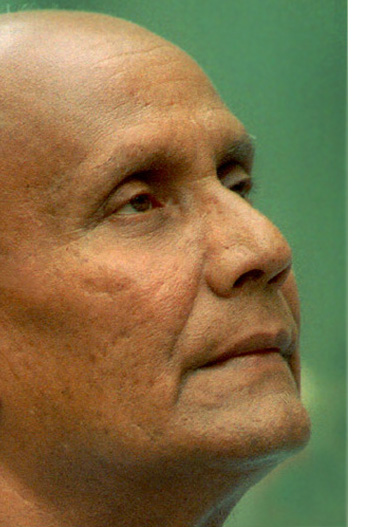
A close-up of Sri Chinmoy showing
smallpox scars still in evidence after sixty years. Photo courtesy: Pavitrata Taylor

One can only marvel at the power of his mother’s prayers which drew him back from the grasp of death. She pitted her faith against this great scourge and won. Nor did her son suffer from after-effects such as blindness, deafness or disfigurement following his long recovery. Only in a certain light, if one looked closely at Sri Chinmoy’s golden countenance, could one faintly discern the dark purplish scars that indicated where the eruptions had been.

In an interview conducted on December 15th, 2008, a longtime student of Sri Chinmoy offered some valuable insights into Sri Chinmoy’s smallpox condition:

“When the British were in Burma, which was at that time a British possession, they came into East Bengal, which we now call Bangladesh. They came there to reinforce their control of Burma. Sri Chinmoy’s mother told him that when he was an infant, he was so beautiful that the British soldiers were always carrying him around. I once said to him, ‘Did your family know they were British soldiers?’ He answered, ‘Yes, but since they were the conquerors my parents could not say: Do not pick up my child.’ The soldiers liked him very much, but when he was three years old, he contracted smallpox which left ugly lesions on his face. With smallpox there are scabs and, when the scabs heal, they drop off or the child scratches them and then it leaves a scar. So Sri Chinmoy said that he never was as beautiful after the smallpox as he was before. Smallpox was such a rampant disease in those days that many, many people got it. Even though Sri Chinmoy’s father was quite wealthy, it did not prevent his own child from getting a disease that was very widespread.”

In the poetry of his later years, Sri Chinmoy did not specifically invoke the sights and sounds of his beloved Bengal, nor did he convey highly personal experiences. He subsumed them into his vision of mankind’s spiritual progress. But his childhood impressions did not vanish altogether from his memory. Thus we find him yoking the negative aspects of the human mind with words such as ‘disease’, ‘fever’, ‘contagious’, ‘infectious’, ‘chronic’ and ‘incurable’ – words that we might employ in everyday use, but which attain a profound significance in view of the fact that he very nearly lost his life to smallpox.

“You are not the only one
Who suffers from
The infectious doubt-disease.
Doubt-disease has covered
The length and breadth
Of the world.” 3
“Ungratefulness
Is the incurable disease
Of millennia.” 4
“Despair-fever
Is, indeed,
A fatal disease.” 5
“Temptation is the world’s
Oldest disease.
Aspiration is at once
The world’s most ancient
And most modern medicine.” 6

There are even references to the potential blindness and disfigurement that might have resulted from his bout with smallpox:

“The mind’s doubt-disease
Disfigures
The entire being.” 7

“Desire-fever tortures
The human mind.
With brutal force it renders
The heart-eye blind.” 8

Finally, there is this prescient poem in which the poet appears to refer to the span of his life in the third person:

“From Heaven
He came into the world
With an unconscious headache.
From earth
He will return to Heaven
With a conscious fever.” 9

In view of the fact that during his final days on earth Sri Chinmoy was subject to an unremitting fever, this last line seems to contain both an actual and a metaphorical truth. Inwardly, he willingly took upon himself the imperfections of humanity in order to illumine and transform them. Outwardly, this supreme act of love caused him to suffer from a fever that no amount of medical assistance could reduce. One thing we know for certain: the scorching fevers that marked both the dawn of Sri Chinmoy’s life and its close were both subject to the Will of God.

– End –
 

Copyright © 2009, Vidagdha Bennett. All rights reserved under Creative Commons license.


Endnotes:
1 Excerpt from To the Streaming Tears of My Mother’s Heart and to the Brimming Smiles of My Mother’s Soul.
2 Excerpt from To the Streaming Tears of My Mother’s Heart and to the Brimming Smiles of My Mother’s Soul.
3 Poem no. 3,030 from Twenty-Seven Thousand Aspiration-Plants, Part 31.
4 Poem no. 13,183 from Twenty-Seven Thousand Aspiration-Plants, Part 132.
5 Poem no. 10,829 from Seventy-Seven Thousand Service-Trees, Part 11.
6 Poem no. 2,769 from Twenty-Seven Thousand Aspiration-Plants, Part 28.
7 Poem no. 10,819 from Seventy-Seven Thousand Service-Trees, Part 11.
8 Poem no. 46 from Silence Speaks, Part 9.
9 Poem no. 1 from The Silence-Song.


A Childhood Pastime of a Great Spiritual Master

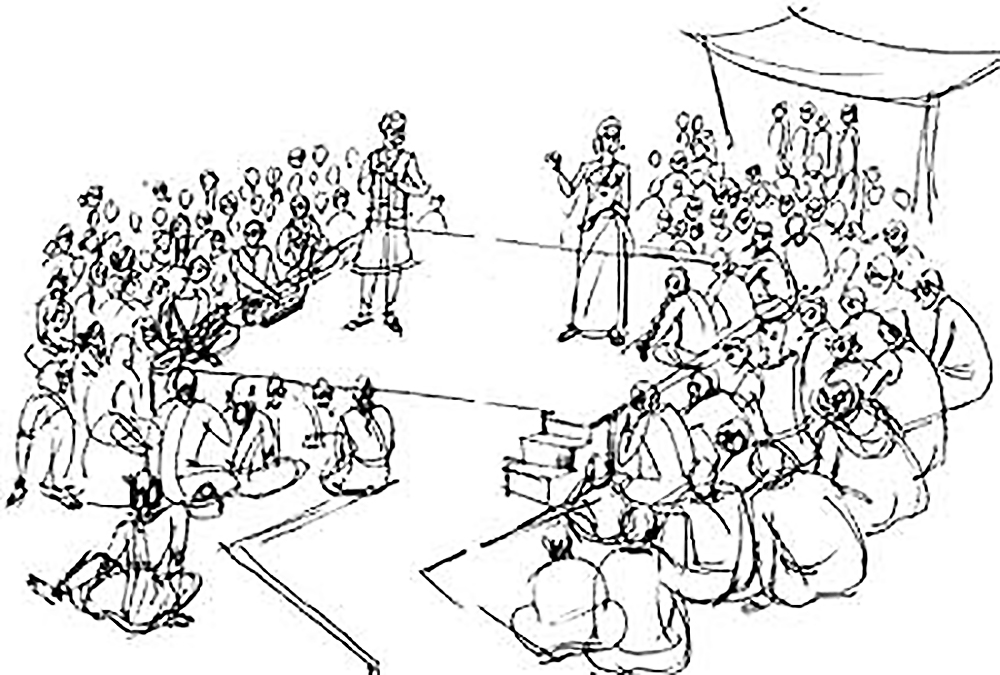
It is November 12th, 2008 and I find myself in Perth, sitting in the Federal Court of Australia, watching a lawyer, who happens to be my brother, argue a landmark case involving intellectual property rights. As the drama unfolds, with both sides trading arguments and counter-arguments, my thoughts turn to a young boy of nine or ten years’ old, who used to sit in the public gallery of the High Court of Chittagong almost half a century ago. In my mind, I see him peering over the railings at a trial taking place in the main courtroom below, listening intently to the speeches made by the lawyers of both sides and examining the faces of the miscreants with keen interest. The boy’s name is Madal. In later years, he would become internationally revered and beloved as Sri Chinmoy – dreamer of peace, poet, musician, artist, athlete and spiritual guide.

In the evening of his life, on those sublime occasions when he was wont to reminisce about his childhood, Sri Chinmoy used to tell us the story of these visits to the High Court on Fairy Hill in Chittagong. By way of explanation, he said that he “liked to watch the lawyers and jailbirds”. Usually one of the family servants, such as the cook, would be delegated to escort him and together they would sit in on various trials and enjoy the proceedings immensely.

I freely admit this is one aspect of Sri Chinmoy that has always mystified me. What attracted a mischievous village boy, someone so full of energy and vitality that family members bestowed on him the nickname ‘Madal’ (meaning ‘kettledrum’), to sit for hours on end absorbed in the crimes and foibles of strangers? Having successfully absconded from his tutor’s dominion, set free for the day to roam in the town, what drew him time and again to return to the High Court?

I realise now that my limited comprehension was based on a very narrow idea of what a saintly person should or should not do. I overlooked the fact that the broad canvas of humanity, that great mass of struggling and imperfect individuals, is his chosen field of manifestation. Moreover, I did not take into account the most central tenet of all, the lines in the Bhagavad Gita uttered by Lord Krishna that convey the very essence of a true messenger of God:

When righteousness declines and unrighteousness prevails, Myself I embody and manifest.

Where else then should a young spiritual Master go to imbibe the prevailing values of his time but a court of law, that arena where truth and falsehood wage their eternal struggle, where the innocent are sometimes sentenced to jail and the guilty on occasion walk free, where human justice and divine justice are balanced on the scales of karma, where flawed individuals may rise to nobility and the great may be exposed as flawed?

I believe that Madal’s visits to the High Court of Chittagong were intrinsic to the awakening and expansion of his consciousness. They represented his first steps outside the family circle, they introduced him to the general conditions of life in East Bengal and, finally, they enabled him to identify with the sufferings and joys of a host of men and women. In sum, I believe that his experiences as a silent observer in the High Court served as an important foundation for his spiritual work in later years.


Madal’s Family Circle

Let us try to recreate something of Madal’s daily life in 1940, the year he turned nine. His family home was located in East Shakpura, a tiny village approximately 13 km east of Chittagong town and connected to it by waterways and the broad Karnaphuli River. Having retired from his position as Chief Inspector of the Assam-Bengal Railway, his father, Shashi Kumar Ghosh, had founded a bank in Chittagong named Griha Lakshmi (the House of Lakshmi). Each Monday morning, Shashi Kumar and Madal’s elder brother Chitta would leave the village home and travel to town by ferry. They would stay there during the week, sleeping in quarters above the bank, and return home on Friday evening.

This arrangement left Madal and his next older brother Mantu alone with the ladies of the house – their mother and two of their sisters – for days on end. A private tutor would come to give lessons to Madal and Mantu, but the two young boys also had a great deal of free time to play games, frolic with their pet dogs and monkeys, climb trees, pluck mangoes, visit the ponds on their father’s estate and chat to the workers. It was, in many ways, an idyllic life. Theirs was a prosperous family; their father was the enormously respected head of the village council, and there was an abundance of cousins, aunts and uncles who seemed to be in semi-residence at the sprawling Ghosh family dwelling.

Yet Madal pined to accompany his father to town and, by various subterfuges, often succeeded in following his father as he walked to the little pier at the beginning of a new week. On many occasions, seeing his youngest child so determined to emulate him, Shashi Kumar would surrender and allow Madal to board the ferry with them. Madal was his seventh child, born when he was forty-nine years old and his wife, Yogamaya, was thirty-seven. His other children were spiritually inclined, quiet and restrained, but this one was different. Madal was lively and full of irrepressible energy. By the time he was eight or nine, he could barely be contained and although he was the darling of the family, one imagines that it might have been with something akin to a sigh of relief that his mother and sisters saw him leave for a trip to town.

Arriving in Chittagong, Shashi Kumar and Chitta would set about their work, leaving Madal in the strict care of one of the bank’s workers. He was not allowed to go out into the streets alone, but he won permission to accompany the bank messenger on the back of his bicycle when he went out on errands. If Madal had succeeded in abstracting a few paisas from his father’s coat pocket, he would beg the messenger to make a stop at the stall of a sweet vendor and he would purchase a small bag of sweets to distribute to various officials in the bank.

Apart from riding on the back of the messenger’s bicycle, an activity all the more thrilling because he was forbidden to have a bicycle of his own, Madal’s favourite pursuit was to go to the High Court.


The Symbolism of the High Court

Unlike other cities in Bangladesh, the topography of Chittagong is full of contours. The Chittagong High Court is a monstrous and imposing two-storied red-brick edifice constructed by the British on Fairy Hill (“parir pahar”). For many years, it was the largest single building in India atop a hill. Until recently, it dominated the landscape and could be seen from afar by people approaching Chittagong via the Karnaphuli River or by road. To Madal, as he arrived by ferryboat from the village with his father, it would have been the first thing he saw each time he went to town.

East Bengal at that time was part of India and India was ruled by the British. The strong imperial presence in Chittagong had lasted almost two hundred years. In fact, the British had built their own part of the city adjacent to the old, existing city and, as in the rest of India, they had given it a separate identity. They strewed their section with massive buildings which were somehow believed to enshrine their values. Such buildings, writes Simon Winchester in the foreword to his insightful book Stones of Empire: Buildings of the Raj (2005), written in collaboration with Jan Morris, were “an assurance hewn in red sandstone that constitutional rule and democracy would long flourish.”


Chittagong High Court


In Chittagong, the British purchased a 25-acre property comprising a hill and surrounding valleys from a Zamindar by the name of Akil Chandra Sen. On the crest of the hill, they built their High Court, which was also used as the seat of administration. The building covers a staggering 250,000 square feet and has literally hundreds of rooms. It also commands panoramic 360-degree views of Chittagong, including the port area, large portions of the Karnaphuli River down to its mouth, the Deang and Banskhali Ranges to the South and the Hill Tracts to the east. On the lower slopes of the hill, the British constructed other important buildings relating to the “civilised governance” of the colony.

What was the rationale behind such an excessive display of grandiosity? Christopher Alexander in his book A Pattern Language (1977) supplies a partial explanation when he observes, in a more general context:

The instinct to climb to a high place, from where you can look down and survey your world, seems to be a fundamental human instinct.

Yet surely there is more to it than this, otherwise the British would have been content with a modest building more appropriate to the needs of this far-flung colonial outpost. The imperious architecture of the British Raj is more damningly interpreted by Simon Winchester and Jan Morris who write:

…the High Courts of India were very conscious of their own importance, and into them the architects tried to build the loftiest meanings of empire… they were also the largest buildings in their neighbourhoods, towering above the rest like legal maxims… The High Courts did not often express a quality of mercy, but generally made the malefactor feel as alarmed as the judge was all-confident. (p. 111)

Yet it was through the doors of one such High Court that a small boy dared to pass, accompanied by a humble cook.


Inside the High Court

Walking up Fairy Hill, approaching the huge façade and then entering through the imposing front portal – acts requiring no small amount of courage – Madal truly found himself in a “House of Wonders”. It was beyond anything that he had ever experienced in his village. The High Court literally thronged with a life of its own. Vaulted corridors and wide staircases led to court after court and the white marble floor echoed with the myriad footsteps of justices and judges in their flowing robes, lawyers, pleaders, litigants and criminals.

As he ventured down the long, cool galleries, past alcoves where clusters of lawyers conferred in hushed voices or family members tried to offer solace to each other, beneath portraits and sculptures installed by feringhi from another culture, his ears would have caught snatches of English and perhaps the language of traders in this port city – Arabic, Burmese, Dutch and Portuguese, as well as Indian dialects that differed greatly from his own Chittagonian dialect. One can imagine the fascination that this exerted on the young boy, especially one whose father wore Western clothes to work and could converse in English.


Courtroom Dramas

What kinds of cases were referred to the High Court? It seems that the village councils (‘panchayat’) – of which Madal’s father was the chief judge in their area – dealt with local matters, such as the determination of property boundaries, theft of cattle or produce, broken contracts, dowry payments and such. The High Court had jurisdiction in company matters, matrimonial issues, bribery, major litigation, bankruptcy and so forth. One can only imagine the tales that were spun before the court and absorbed by a wide-eyed boy sitting in the public gallery, a little boy who, undoubtedly, was wise far beyond his years.


Historical Perspective

It is also worth noting that Chittagong was not at that time the “sleeping beauty emerging from mists and water” that Chinese traveller Huen Tsang eulogised in the 7th century AD. Anti-British feelings were reverberating throughout the sub-continent and, for a time, Chittagong was in the forefront of the movement to expel the British. On April 18th, 1930, sixty-five revolutionaries, men and women, led by the great patriot-hero Surya Sen, had simultaneously raided the armoury, police station and telegraph office in Chittagong. They then proclaimed an independent national government.

This offensive caught the British by surprise and shocked them to the core. Many of the revolutionaries escaped to the surrounding hill areas. Manini Chatterjee, in her book Do and Die: The Chittagong Uprising: 1930-34 (1999) reports that the official backlash was heavy and by 1931, the year of Madal’s birth, Chittagong had come under virtual martial law. The administration had special powers to arrest, detain and punish anyone it thought was connected with the revolutionaries. This touched on Madal’s own family as one of his relatives was jailed for revolutionary activities. In addition, the leader of the revolutionary movement, Mastar-da Surya Sen, was connected with the family. Sri Chinmoy clarifies:

Surya Sen happened to be a distant relative of my mother’s younger sister’s relatives. A few times he came to my mother’s sister’s place to hide… The British Government was always in search of Surya Sen.

Over the next three years, the revolutionaries in hiding waged a guerrilla war against the entrenched colonial power. Eventually, in spite of the best efforts of East Bengalis to protect them, those who were still alive were captured, interned in Chittagong Jail and then tried in the Chittagong High Court. Some were sentenced to years of imprisonment, more serious offenders were deported to the Andaman Islands, while their adored leader, Surya Sen (who was not arrested until 1933) was hanged in 1934, evoking a surge of public sympathy and giving new impetus to the anti-imperialist struggle. It is not an understatement to say that the events in Chittagong shook the foundations of the British Empire. In 1934, the city was described by the Intelligence Department as “the mainland of Bengal revolutionary activities.”

The uneasy situation vis-à-vis the British was compounded by the outbreak of the Second World War which led to a massive military build-up in Chittagong as the British transformed the port city into a key military base. There was an influx of allied forces from Britain, Australia and America. Soldiers were massed on parade and they flooded the streets. Sri Chinmoy recalled that sometimes these soldiers would affectionately pick him up and carry him on their shoulders.

Ultimately, the War was to bring much hardship and suffering to the people of Chittagong. Because of its strategic importance to the British and its proximity to the war front in Burma, the city was vulnerable to invasion. It became a target of Japanese attacks, there were frequent air raids and, after the fall of Burma in early 1942, refugees flooded the city. Sri Chinmoy later wrote of those times in his book My Brother Chitta (1998):

My father passed away in 1942 during the Second World War. In the last year of his life, the Japanese began to bombard East Bengal and a huge hole, like a swimming pool, opened up in front of our bank in Chittagong. Many times, when we heard the planes coming, we had to go inside the air-raid shelters.


The Great Famine

The Chittagong region is extraordinarily fertile, with three crops of rice per year. In 1940, only 7.4% of the population lived in urban areas. The principal primary industries were the cultivation of rice, jute, fruits and vegetables. The very name “Shakpura” means “place of vegetables”. During the War, farmers of the region were forced to sell the bulk of their rice to the British at a very cheap price and it was used to feed the armed forces, both those stationed in India and those fighting abroad. As the War progressed, the British took emergency measures to requisition and stockpile rice for the soldiers. Moreover, they destroyed more than 60,000 small boats which, in the delta, were essential to the grain distribution system. The British rationalised this action by saying that it was to prevent the invasion of the Japanese, but in reality it was to break the backbone of the revolutionary movement.

These actions precipitated the Great Famine of 1943 – paradoxically, a season of bumper crops – in which five million people in the Chittagong area died from starvation. The Great Famine is known in Bangladesh as “panchasher manvanter” – the famine of ’50 – because it occurred in the year 1350 of the Bengali calendar. Fortunately, Sri Chinmoy’s elder brother Chitta had foreseen this eventuality. Sri Chinmoy writes:

My brother Chitta was concerned that if the War continued, it would be difficult to find enough rice and other food for the entire family. So he sent one of our servants to the town to buy about forty huge bags of rice. He bought enough not only for our family but also to sell to the poor people at a very cheap price. The servant brought them back to our village by boat and others came to help him unload them. I tried to lift one bag, but I could not even budge it. My brother also bought other kinds of food. He kept everything in a temporary shop, and every night one servant stood guard in front of it.

It is still widely believed in Chittagong that the food crisis was engineered by the British Government in order to compel Bengalis to flock to the army recruiting centres. Thus the British would acquire much-needed manpower and the independence movement would be substantially reduced, if not crushed.

The Ghosh family, however, took another route. After their mother passed away in 1943, they applied to join the Sri Aurobindo Ashram in Pondicherry, South India. Madal’s eldest brother, Hriday, who had been a resident there since 1933, came back to Chittagong and made all the necessary arrangements. A very small number of young children, whose lives were endangered by the War, such as Madal, were given permission by the Divine Mother to join the Ashram. Hriday wound up the family affairs, gathered Madal, Mantu and various other members of the family and set out on the long journey to Pondicherry, gradually leaving the war zone behind. From Chittagong, they travelled more than 2,300 km (1,430 miles) by train, arriving at the Ashram in July 1944. As a postscript, one notes that on March 25th that same year Japanese aircraft, consisting of five medium bombers and thirty fighter planes, attacked Chittagong.


A Pastime Illumined

In many ways, Sri Chinmoy’s early experiences in the Chittagong High Court were a fast track to his understanding of the human condition. And it meant that several decades later, when he moved to New York and came into contact with all the extremes of Western lifestyle, nothing would ever surprise him about human behaviour, there was nothing new for him under the sun. He had seen and heard most things.

Effectively, this means that it is not entirely accurate to assume that Madal was a naïve village boy who had somehow been sheltered from the harsh realities of the world. By the time he was twelve and his eldest brother took him to South India, he had endured the bombing of his homeland, its occupation by armed forces, the destruction of his father’s bank and, outweighing all else, the illness and untimely deaths of both his parents. He had spent most of his time in the company of adults, and he had the unique perspective of someone who had observed a wide range of human behaviour during trials at the High Court.

Looking back now at the man he would become, I believe it is possible to see his experiences at the Chittagong High Court reflected in many aspects of Sri Chinmoy’s life: he always saw truth in its many facets; he accepted the flaws of humanity; he sympathised with all parties; he urged people never to judge others; and he himself did not judge. As he wrote in one short poem:

Love is something
That never cared to learn
How to judge anybody.

We return in the end to the image of a young boy who liked to go and sit for hours in the High Court. It is something that I have never understood – until today.


– End –

Related: My Brother Chitta at Sri Chinmoy Library
 

Copyright © 2008, Vidagdha Bennett. All rights reserved under Creative Commons license.


Chittagong


.
 

A Childhood Pastime of A Great Spiritual Master

by Vidagdha Bennett

It is November 12th, 2008 and … my thoughts turn to a young boy of nine or ten years’ old, who used to sit in the public gallery of the High Court of Chittagong almost half a century ago. In my mind, I see him peering over the railings at a trial taking place in the main courtroom below, listening intently to the speeches made by the lawyers of both sides and examining the faces of the miscreants with keen interest. The boy’s name is Madal. In later years, he would become internationally revered and beloved as Sri Chinmoy – dreamer of peace, poet, musician, artist, athlete and spiritual guide. Read more…
 

.
 

A Life Nearly Snuffed Out

by Vidagdha Bennett

Sri Chinmoy graced this earth for seventy-six years, but his life nearly ended after barely three years when he contracted such a severe case of smallpox that the doctors gave up hope for his survival. Had their prognosis been correct, the world would have lost one of its most revered spiritual leaders at the very dawn of his life. The story of how the infant Madal survived against all odds is a testament to the miraculous power of prayer – in this case, the ceaseless prayers and unwavering faith of his mother, Yogamaya. Read more…
 

.
 

A Life Once Spared

by Vidagdha Bennett

Indians of all castes and from all walks of life traditionally worship numerous cosmic gods and goddesses – Brahma, Vishnu, Shiva, Durga, Saraswati, Lakshmi, Kali, Parvati, Ganesh, Kartikeya and many more. To the Western mind, this pantheon of divine manifestations can be mystifying, whereas, for an Indian, they belong to a time-honoured way of life that is perfectly natural. Read more…
 

.
 

Encounter with a Royal Bengal Tiger

by Vidagdha Bennett

The Royal Bengal Tiger (Panthera tigris tigris), known in Bengali as bagha or shardul, is the largest member of the cat family on the face of the earth. A male specimen averages 9 feet 5 inches from head to tail and weighs approximately 480-600 pounds. The female measures around 8 feet and weighs in the region of 300 pounds. Its canine teeth can be up to 5 inches long and its claws are razor sharp. It is said that a Royal Bengal tiger can kill an elephant or carry a fully grown cow over a ten foot fence. In its natural habitat, it stands indisputably at the top of the ecosystem – and it is the national animal of both Bangladesh and India. Read more...
 

.
 

Of Turtles and Other Delicacies

by Vidagdha Bennett

In Sri Chinmoy’s teachings, a vegetarian lifestyle plays a most significant role in the life of a spiritual seeker. He believed that a vegetarian diet can greatly enhance the seeker’s purity and inner aspiration, and help that individual to make faster progress.… Again, he insisted that merely becoming a vegetarian was no guarantee of spiritual progress. Read more...
 

.
 

Sri Chinmoy’s Childhood Ambition

by Vidagdha Bennett

It is a peculiar fact of human nature that the sweet and innocent ambitions of our childhood linger in our later years. Thus it is possible to find at the core of every great statesman or inventor or writer a desire to become something quite simple and ordinary. The greatest human being I have ever known is Sri Chinmoy. He was a spiritual guide, first and foremost, but within this calling he encompassed the roles of poet, artist, composer, musician and athlete. Given his vast accomplishments in each field, it is uniquely touching to discover that as a child his only longing was to work on trains.

Read more…
 

.
 

The Animal Companions of Sri Chinmoy's Childhood

by Vidagdha Bennett

In his later years, we saw what lengths Sri Chinmoy went to in order to express his fondness for various members of the animal kingdom – whom he referred to as his younger brothers and sisters. He lifted white horses in Mongolia, elephants in Thailand, lambs and cows in New Zealand and even an aquarium of tiny fish in New York. With immense affection and tenderness, he raised these “creatures great and small” into the air. … It comes as no surprise, then, to find that even as a child in Shakpura, Sri Chinmoy (Madal) had a number of assorted pets. Read more…
 

.
 

The Most Bitter Medicine

by Vidagdha Bennett

In his childhood, Sri Chinmoy had an encounter with one of the largest and most powerful of cats – a Royal Bengal Tiger. He also had an encounter with one of the tiniest members of the animal kingdom – a mosquito. Which one is the more deadly? In Sri Chinmoy’s case, by God’s infinite Grace, he was not harmed by the tiger, but he did suffer greatly from the mosquito. He contracted malaria and endured a number of virulent attacks of malarial fever during his youth in Shakpura. Read more…
 

.

Appendix


Hriday wrote the following 17 commentaries on daily aphorisms that appeared in his youngest brother Chinmoy’s book Meditations: Food for the Soul, published in 1970. His commentaries were initially published in a small, undated pamphlet and are reproduced here in their entirety. Seen side by side, the aphorisms and the commentaries reveal how sympathetic the two brothers were in their wisdom and vision, even their mode of expression. Hriday’s commentaries flow as a natural extension of the original poetic aphorisms and cast light on the philosophical depths they embody.


July 1

God does not want to enslave man by a miracle. He wants to guide man with an embrace.

Man in essence is God, as he has been made in His Image and is an exact prototype of Him. God wants that man should be in becoming also as perfect as He. Man has a mind and a vital, which are at present limited, half enlightened and insignificant, and a soul, a direct portion of God, supporting them. God is both omnipotent and All-Love. By His Omnipotence He can stupefy and dazzle the mind and vital with some miracle. But man’s soul will not respond to the action of Power, though his mind and vital will yawn at the wonder. The soul will respond only to the magic wand of love. So, instead of forcing and coercing with His Omnipotence, God, Who is All-Love, makes man feel His intense Love and captivates the soul of man with His loving embrace. His Love and Self-giving make man feel that he belongs exclusively to Him. Being enamoured of His Love, he wishes to be His one lover, and he becomes God, not only in essence but also in manifestation.


July 2

I am my Beloved’s. Lo, His spontaneous Love flows towards me. My Beloved is mine. Lo, my spontaneous cry carries me towards Him.

I and my Beloved, Soul and God, are not two different entities. They are in essence and in all reality One and the same. The seeming separation is only for Play – as One and only One cannot play. As long as the Soul remains in Ignorance of this Supreme Truth, she thinks herself separate from her Beloved – and she feels suffocated in the world. But when she sees herself as only God’s, she feels the spontaneous Love of her Beloved flowing to her, and her spontaneous cry also for the complete union draws her to one raison d’être of her existence, her Sole Lover, her God.


July 5

A student of mine came to me and said that he had committed a vital sin. He also prayed to God to forgive him. But he is not sure whether God has forgiven him or not. I assured him that God has forgiven him, for he no longer continues to do the wrong thing.

God Who is our Father, Mother, Beloved all combined – nay, even our higher Self from Whom we are born as His exact Image – is not an astute and impartial Judge sitting on His imperial Throne on the Olympic Height, judging scrupulously the merits or demerits of our actions and rewarding or punishing as His inexorable Law dictates or demands. He is the All-Merciful Self, with Infinite Patience and Forgiveness for His children. For, if not He, who will make them as perfect as He? Out of His Omnipotence, He has given us a little freedom. If, due to that little freedom, we commit something wrong and then repent, it is His loving, paternal care that will absolve us and give us strength and guidance to shake off the dust from our soul and make us pure and immaculate. If not He, who will do that, He being our own Higher Self?


July 6

Do not be afraid of evil. But be always cheerful in doing good. Evil will soon leave you, for evil is extremely jealous of good.

Two contradictory things cannot co-exist. As two jealous persons fight each other bitterly and at the end only one survives, good and evil also – like light and darkness – can never exist side by side. The best and easiest way to weed out thorny plants from a garden: one has only to plant a few thornless good plants and tend them with care. The good plants will naturally grow and occupy the space of the thorny evil plants. Instead of doing a tedious Herculean task of weeding out the thorny plants, we can allow the thornless plants to kill the thorny ones. It is not only the easiest but also an infallible process of good riddance.


July 23

When God’s Will is not my will, everybody can dare to be my master.

God is not only omnipotent but also the Source of all strength to all, irrespective of low or great, weak or strong, good or bad. He knows best: whom to give, how much to give and when to give. When I surrender to Him and identify my will with His, I become Invincible. But when my will is not His Will – everybody can dare it. So it depends on God’s Will or sanction or toleration as to how long I shall remain victorious. Whenever He decides my defeat, He can bring it through anybody. The fate of one-time dictators of the world illustrates this fact.


July 27

Man desires the Infinite. He will one day possess the Infinite.

“I and my Father are the same.” So says the Christ. In fact, as God has made man in His Image and out of His seed, man and his Creator are one in essence. Only God knows and feels it, while man is yet to know and feel. What is latent in him, his Infinity, will develop in the course of time through his incessant aspiration and by the Grace of God – and then he will see that he has always been the Infinite.


July 29

Love humanity and then do whatever you want to do with humanity. Love Divinity and then do whatever Divinity wants you to do.

The Soul of a true lover of humanity is greater than humanity. If I sincerely love humanity, God will make me His instrument and He will consciously guide me to love it as best I can. He will not allow me to commit blunders. It may seem as if I am doing what I like with humanity, the fact is, it is He – God – Who will get the thing done by me. But if I loved Divinity, as it is omniscient, omnipotent and all-blissful Self of all, I should surrender to God and do consciously what He wants me to do.


July 30

When we serve humanity, God loves us. When we love God, both humanity and God serve us. God serves us with His soulful Concern. Humanity serves us with its dedicated feeling of oneness.

God is at once Transcendent and Immanent – Supracosmic and Cosmic – above and in humanity. So, when we love and serve humanity, God loves us and helps us to serve humanity, because in serving humanity we only fulfil His Will: of helping Him in His cosmic play. But when we love God, both humanity and God serve us. Humanity as a whole, a portion of God, is serving God. We are an inalienable part of humanity. So when we love God, in her feeling of dedication, she feels unity of her dedication with ours – and serves us. And God takes all our cares and with soulful Concern serves us, as He is our only Beloved.


August 1

My sleeping body I offer to my God’s Compassion. My dreaming body I offer to my God’s Love. My crying body I offer to my God’s Concern.

When man is in complete Ignorance, he needs God’s Compassion to be awakened. So, he must offer his inert nature to God so that he can awaken in it a little consciousness to feel God’s Love. Then he starts dreaming, hoping, aspiring and gradual unfolding. This state man has to offer to God’s Love – more impersonal than personal – that he thinks and feels can fulfil his dream. Last comes his crying, intense aspiration for something positive, which only God’s ever-conscious, all-fulfilling, all-including Concern can grant. He needs and feels also God’s all-accomplishing Concern always for and around him.


August 3

Action is bondage when I love my life alone. Action is freedom when I love the life of the world.

When I feel myself separate from the world, I am attached to my ego. Whatever I do then centres round my ego and makes me bound to the fruit of action. When I feel myself an inalienable portion of the world, my life becomes a part of the world and I become a Cosmic Being. In that consciousness, I am no longer a limited ego in Ignorance, but a Cosmic Manifestation of the Supreme in His World-Play. I become identified with Him and whatever is done in and through me is in complete freedom: not for the pleasure and benefit of the limited ego, but for the gradual unfoldment of the Supreme’s Plan, in and through me, for the World-Spirit.


August 6

Surrender to God’s Will is the highest realisation of our hidden power.

We are at present beset with so many forces that demand our constant care and attention for their fulfilment: Desires of all kinds – moral, immoral, neutral – have made our lives spiritually miserable. And yet, we have no time to think that we are so; it requires enormous efforts to feel – not merely believe – constantly and tangibly, that God is the omnipotent, omniscient and all-merciful Self of all. When we can realise that, we feel the utter unworthiness of our ego, however great it may look to others, and try to surrender to Him and to His Will for our best benefit. It does come only when the ego feels its utter helplessness after a million rude shocks. This surrender to God’s Will is the highest realisation of the Soul, the hidden divine power in man.


August 7

Do not try to approach God with your thinking mind. It may only stimulate your intellectual ideas, activities and beliefs. Try to approach God with your crying heart. It will awaken your soulful, spiritual consciousness.

God is above and beyond mind. He is a Reality that cannot be proved or disproved by arguments or counter-arguments. He is to be felt and then to be realised and lived. In our life we find feeling, especially feeling by identification, is more powerful than thinking by mind. Though the presence of God can be felt everywhere, it is most felt in the heart, where the Soul stays. If we approach God with our thinking mind, He will escape our grasp, as He is always unintelligible. But if we approach God with our heart, where our Soul stays, our Soul, being a portion of the Supreme, will feel identification with the Supreme. And then God will awaken in us His own Spiritual Consciousness. He can escape the reasoning of the thinking mind, but He cannot escape love and surrender of the heart, because God with His eternal portion – Soul – stays in the heart.


August 9

Love quickens activity. Devotion radiates humility. Surrender multiplies proficiency.

The motive behind all our actions is either love or fear in some form or other. The love of a mother for her child and vice versa, the love of a husband for his wife and vice versa, the love of a country or an object urges us to sacrifice our everything to please our object of love, be it material or abstract, a living being or an idea. Fear compels us for activity – but only so much as is unavoidable. Whereas love prompts us for spontaneous Self-giving, fear for a person or a thing can extract only the minimum from our unwilling nature. Devotion to a person or a good cause makes us humble, as we find our object of adoration cannot be pleased with our vanity. He or that is above our moral capacity to be pleased with. When humility follows our inborn natural capacity, surrender to a person or the Supreme gives us required guidance and strength to make us proficient and completely successful.


August 14

Responsibility is no anxiety. Responsibility is the possibility of opportunity culminating in inevitable fulfilment.

In fact, we all have an inexhaustible power-house in our nature which can fulfil all our demands. Only the demand is to be made. To meet this demand – real or imaginary – nature puts forth required attention and energy. What we cannot do easily – for example, keeping late hours at night – we can easily do if we are asked to keep vigil over a patient relative. In this way, the sense of responsibility awakens in us a greater effort, to regularise, harness and channelise our energy in a particular way. And if it is free from anxiety, as it should be, this responsibility makes us what we should be in a particular time and place and with relation to others. If there is no sense of responsibility, people would stop working and everything will be in disorder. Responsibility makes us unselfish, wide and obedient. It always ends in inevitable fulfilment of the cherished object.


August 16

Imagination is no self-deception. Imagination is the road that leads man to the life of practicality wherein lies man’s true fulfilment.

There is nothing unreal. What is materially not true is true in some other plane. For example, ideas. They are true in planes of ideas. In the physical plane, they are to be translated in action before their form and force are felt and seen. So, Imagination of those high Ideas and Ideals is not self-deception. Only they are to be given concrete shape in action. Unless one has Imagination, one cannot have any definite Idea of the thing to be done. So, it is the road that not only gives the vision of the Idea, but also urges the dreamer to get his dream fulfilled in life and therein lies his true fulfilment.


August 22

Sacrifice is the common meeting ground for man and God. Man’s sacrifice is his ignorance. God’s sacrifice is His Compassion.

We all can give what we give to whom we love. And it is a two-way traffic, giving and taking, so that in the end our difference diminishes and we become equal. Man has, at present, only his Ignorance and Incapacity. He can give only this to his God – his Creator and One Lover. Nobody wants from us what we do not have and cannot give. Everybody is satisfied with what we can give. God also is satisfied if we give Him what we have – our Ignorance and Incapacity. He in His Turn will give us what He has – His Compassion in the form of Truth, Wisdom, Bliss, Consciousness. This sacrifice is not immolation of a lamb at the altar of a cruel deity. It is the loving offering of the Supreme of His own Self to His dear children. And, as His Source is inexhaustible, it never diminishes. Only this freely giving makes man a true partner of His Divine Kingdom.


August 23

Meditation is the language of spirituality. Spirituality is the language of unity. Unity is the language of divinity.

Meditation is the one and only means of gaining spirituality. Spirituality can never be gained by reading, writing and discussing books of spirituality. It cannot be given also by any other means than meditation. It is to be communicated through the Soul – from the Soul to the Soul. If we gain sufficient spirituality, we find unity – real unity – underlying all forms, as all forms are only His. This unity is the substance of Divinity. Divinity expresses itself through spirituality.


Yogamaya attends a Jatra Performance

It requires a great exercise of imagination for most of us to conceive of village life in East Bengal in the 1930’s. Ours is an age that typically craves entertainment and diversions. This need is sumptuously fed by a plethora of options: television, dvds, the internet, books, magazines, theatre, restaurants, newspapers and so forth. Imagine, then, if all these diverse forms of recreation were eliminated, with the exception of a small number of sacred texts and the prospect of an occasional visit by a travelling theatre company. That is the world in which Sri Chinmoy grew up and our appreciation of it may help us to better understand an incident that occurred in connection with his mother Yogamaya and his elder brother Chitta…

•••

Evening descends in Shakpura, a tiny village on the riverine system of Chittagong. In the Ghosh household, the kerosene lamps are lit and small pools of light reflect the family circle. The elders of the family might be deep in discussion, the younger ones playing chess1 or some other game. Perhaps someone is reading the Mahabharata and narrating various episodes. Another might be sewing some clothes or mending fishing nets. Thus the rhythm of life goes on – with a kind of pristine simplicity that has remained unchanged for generations.

News has reached the family by word of mouth that a Jatra troupe will be passing through the area and performing in a nearby village. Jatra is the folk theatre of Bengal and is particularly popular in rural areas. Usually these dramas portray much-loved episodes from the life of Bengal’s saint, Sri Chaitanya, or they illustrate the pastimes of Lord Krishna.

The impending arrival of the Jatra troupe is a matter of much excitement and conjecture. The monsoon season has passed and the long, hot nights are ideal for social gatherings. On the appointed night, villagers from near and far gather at the designated place – either a temple courtyard or an open field. A bell is rung to signal that the performance will start in two to three hours – typically, some time after midnight. The pace is unhurried and no one minds the extended wait. It is a chance to see distant relatives and exchange news.

The performance itself will last for up to four hours. Already the courtyard is thronging with people. We can imagine the Ghosh family arriving from Shakpura, by ox cart or on foot. Chitta has brought his mother Yogamaya and several of his sisters and brothers.

At the centre of the courtyard, a wooden stage or asar has been temporarily constructed for the performance. This platform is approximately three feet above the ground and sixteen feet square. It is open on all sides. As the starting time draws near, several musicians and singers take their seats on two ramps on opposite sides of the platform. The ramps are six inches lower than the platform itself. The musicians set up their instruments: harmonium, tabla, dholak, flute, pakhawaj, betala and so on. The audience is seated casually on the ground all around them.


Image credit: The late Sri Balwant Gargi, Yakshanga Cultural Magazine


The only furniture on the stage is a wooden bench. This will serve, by turns, as a throne, a log, a bed and the steps of a bathing ghat. A wooden gangway, bordered by bamboo strips and ropes, extends from one side of the stage to a curtained dressing area some sixty feet away. Via this gangway, the actors will make their appearance and also exit. Oil-fed torches, hung on poles, illuminate the asar and add to the atmosphere.

The performance Yogamaya has come to see is about the life of Sri Chaitanya. It will be presented in the dialect of the region and, according to custom, the characters will be portrayed by an all-male cast. The role of Shachi, Sri Chaitanya’s mother, will be taken by a seasoned actor wearing a sari and heavy make-up. This is a story that has many rich dramatic elements, including the antics of two hooligans, Madhai and Jagai. There are also courtly scenes requiring elaborate costumes, which provide a stark contrast to the ochre robes of Sri Chaitanya and his followers. Additionally, the saint’s ecstatic dancing creates wonderful dramatic opportunities. And there is the commanding presence of the narrator, the Vivek, who comments on the action and provides the voice of conscience.

The figures are all larger than life, their actions exaggerated and their voices, minus microphones or amplifiers, charged with melodrama. Nonetheless, the Jatra plays serve as a powerful medium to communicate religious and spiritual values.

The dramatic core of Chaitanya Jatra, the scene that evokes the most pathos, is undoubtedly the scene where Sri Chaitanya decides to leave his dear ones and go in search of his beloved Lord Krishna. He blesses his close disciples for the last time and then takes farewell of his mother. He touches her feet and slowly withdraws along the gangway into the darkness beyond, while his mother weeps inconsolably. She calls after him, using his childhood name, “Nimai! Nimai!” But the echo comes back, “Nai! Nai! Nai!” meaning ‘not here’ or ‘nothing’ in Bengali.

Here is the scene as Sri Chinmoy dramatises it in his 1973 full-length play Lord Gauranga: Love Incarnate:


(Chaitanya is alone.)

CHAITANYA: Krishna, where are you? Where are you? I can no longer bear your absence. I want only a glimpse of your smile, O my beloved Krishna, O my All. Show yourself to me. If not, to death this body of mine I shall give.

(Enter Sribas, Gadadhar and some of Chaitanya’s other close disciples, who sit near the Master’s feet.)

CHAITANYA: I am glad to see you all. I wish to tell you something quite important. I shall leave you soon. With an unparalleled devotion you all have served me. I offer to each of you my heart’s ceaseless gratitude. But I must go. I must go and find my beloved Krishna. Once I find him, I shall be back.

SRIBAS: Lord, your cruel announcement falls on us like a thunderbolt. Perhaps others can survive being separated from you, but I shall never survive it.

GADADHAR: I have lost all faith in God. Our Lord wants to see Krishna, and for that he is leaving us all. He is forsaking even his old mother. God’s ways are not mysterious at all. They are just cruel, unbearably and unpardonably cruel.

CHAITANYA Gadadhar, for God’s sake, aim not your venomous arrow at my heart. My Lord Krishna is all Love, all Compassion, all Perfection. Indeed, my greatest difficulty lies in leaving my old mother. I must overcome the problem. With Krishna my life is my heart’s delight. Without Krishna my life is the torture of hell. Meaningless and fruitless is my life without him. I need only Krishna.

(Enter Shachi, Chaitanya’s mother.)

SHACHI: Nimai, I have just come to learn that you are leaving me. My son, that can never be done. Impossible! Your elder brother took to sannyasa. He renounced the world. I shall not allow you to follow in his footsteps. Time and again you promised me that you would not desert me like your brother. Tell me frankly, are you determined to leave me, my son? Don’t you know that I cannot bear your absence even for a fleeting second?

CHAITANYA: O Mother of my heart and soul, Krishna is calling me. Mother, please, please allow me to go. I want to go to a sacred place. I feel that then I shall be able to meet my Krishna. Mother, without your full permission I shall not go. But if you allow me to go and find my Krishna, I promise you, Mother, I shall be back.

SHACHI (blessing Chaitanya): My heart’s pride, my life’s only joy, you have my sanction. You go in search of your beloved Krishna. After you have found him, come back without fail. I shall be counting the moments until your safe return. (With folded hands and closed eyes she prays!) O Lord Krishna, show yourself to my Nimai. You are his All. And he is my All.

(Chaitanya touches his mother’s feet and goes away. Shachi opens her eyes.)

SHACHI: Nimai, Nimai!

ECHO: Nai, nai ...


Jatra has always relied heavily on musical dialogue and, in 1982, in true Jatra tradition, Sri Chinmoy composed an exquisite bhajan song to capture this moment of parting.2

Shachimata dake Nimai Nimai
Pratidhani kahe nai nai nai.

He translated the Bengali words to his song as follows:

The mother of Sri Chaitanya
Is crying for her son, Nimai.
The echo answers,
“He is not here! He is not here! He is not here!”

This heart-wrenching scene would most certainly have had a profound effect on the audience, even though they knew the story well. Perhaps their very anticipation of this parting, as well as of other much-loved episodes in Sri Chaitanya’s life, would have heightened their emotional response. Moreover, it was not uncommon for Bengali families to have at least one male member renounce the world and become a monk. In the case of the Ghosh family, Yogamaya’s eldest son had joined the Sri Aurobindo Ashram in South India, while her husband’s elder brother was a monk in Nadia, West Bengal.

In later years, Sri Chinmoy described his mother’s intense reaction to this scene on numerous occasions. The following very moving version is from the evening of July 10th, 1998, when Sri Chinmoy was recounting some family stories:


This anecdote is about our village theatre. We call it Jatra. My brother Chitta took my mother to watch a play about Sri Chaitanya. When he took renunciation, his mother was crying and crying like anything. So my mother also cried like anything.

My brother asked her, “Why are you crying? We are your children. Nobody will take renunciation. You will have grandchildren. We are all going to get married. Do not cry, do not cry.”


My mother said, “Fool! Fool! I am crying – why? Will God listen to my prayer? I want all my children to remain unmarried, to take sannyasin life, like Sri Chaitanya.”

Being identified with Sri Chaitanya, she was crying for her children to be spiritual, to renounce the world. And here my brother thought she was crying because she thought if her children also do the same then she will have to cry the same way as Sri Chaitanya’s mother.

(Unpublished)


In another version of the story, Sri Chinmoy wrote that his mother “became racked with sobs” during this scene. What is exceptional is that she had identified herself not with Shachi, but with Sri Chaitanya; not with the human, but with the divine.

Curiously, Chitta completely misread his mother’s reaction. He assumed that, like any mother and especially one with seven children of her own, she longed for an ever-burgeoning family replete with grandchildren. But, as Sri Chinmoy often reflected, his mother’s inner cry was unique. She wanted nothing short of God-realisation for each of her children. It is a sacrifice very few mothers have been able to make.

It is not known in what year this episode took place, but it was clearly a turning point in the lives of the Ghosh siblings. In many ways, they took it as their mother’s sanction for each of them to follow their spiritual inclinations and renounce the world.

Yogamaya was, indeed, a most remarkable aspirant. Had her hopes and expectations for her children been more mundane, then their lives might have followed a different course altogether and the world would not have reaped the benefit of their immense spiritual depths.

Yogamaya and her four sons at the Sri Aurobindo Ashram in Pondicherry, 1941.

Left to right back row: Hriday (who was already a permanent resident of the Ashram), Yogamaya, Mantu, Chitta.
Left to right front row: The little brother of Hriday’s best friend in the Ashram and on the far right is Chinmoy.
This was Mantu’s and Chinmoy’s last visit to the Ashram before they became permanent. On the day this photograph was taken, Chinmoy had a very high fever.


– End –


Endnotes:
1 In unpublished reminiscences, Mantu describes how he and his younger brother Madal would sit on a cot together playing chess while their mother mended the fishing nets. Interestingly, the game of chess originated in India.
2 Sri Chinmoy wrote many spiritual plays and also a vast number of stories, which he encouraged his students to perform. These performances were frequently staged outdoors, under the stars, with simple costumes and props. In effect, he carried Bengali Jatra theatre to contemporary New York.


Copyright © 2009, Vidagdha Bennett. All rights reserved under Creative Commons license.


Yogamaya


.
 

Yogamaya attends a Jatra Performance

by Dr. Vidagdha Bennett

It requires a great exercise of imagination for most of us to conceive of village life in East Bengal in the 1930’s. Ours is an age that typically craves entertainment and diversions. This need is sumptuously fed by a plethora of options: television, dvds, the internet, books, magazines, theatre, restaurants, newspapers and so forth. Imagine, then, if all these diverse forms of recreation were eliminated, with the exception of a small number of sacred texts and the prospect of an occasional visit by a travelling theatre company. That is the world in which Sri Chinmoy grew up and our appreciation of it may help us to better understand an incident that occurred in connection with his mother Yogamaya and his elder brother Chitta… Read more…
 

.