
4th July - reflections on the Fourth of July and Sri Chinmoy's writings on America.






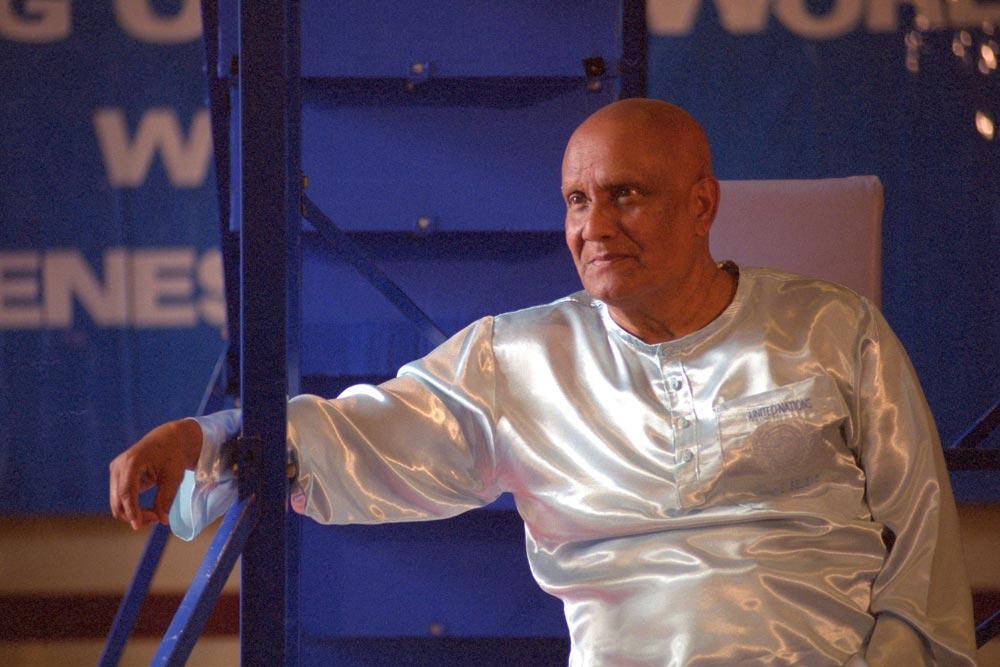
4th July - reflections on the Fourth of July and Sri Chinmoy's writings on America.
List of concerts
around the world

Articles exploring the world of Sri Chinmoy’s Art
Sri Chinmoy and
inspiring world figures
Stories about Sri Chinmoy’s
weightlifting feats
Videos, photos and stories about Sri Chinmoy’s favourite game
Sri Chinmoy’s paternal
and maternal ancestry
Sri Chinmoy’s meditations at the UN in New York

Essays on Sri Chinmoy’s
early life in India
Insights into Sri Chinmoy’s daily life in New York
From the pen of the Master

Sri Chinmoy’s formative years in India

Archive of photographs of
Sri Chinmoy playing games

Extensive records of all
Sri Chinmoy’s races
Collections from our
photographic archives
Articles from writers
around the world

Sri Chinmoy interviewed
live on CNN International

Sri Chinmoy held his first 7-hour public meditation, All Angels’ Church, Manhattan
Sri Chinmoy delivers a lecture, entitled ‘The Secret of Joy’, at the University of Uppsala, in Uppsala, Sweden.
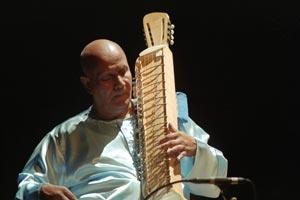
Sri Chinmoy offers a concert at the Lincoln Center in New York, NY, USA.
Sri Chinmoy gives one spiritual talk, part of 100 lectures in 20 days.
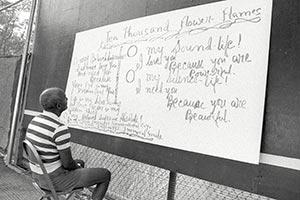
I am a born prayer, 8:15 a.m., Jamaica High School Track, Jamaica, NY, USA
This talk (no. 23) is later published in Everest-Aspiration, Part 1
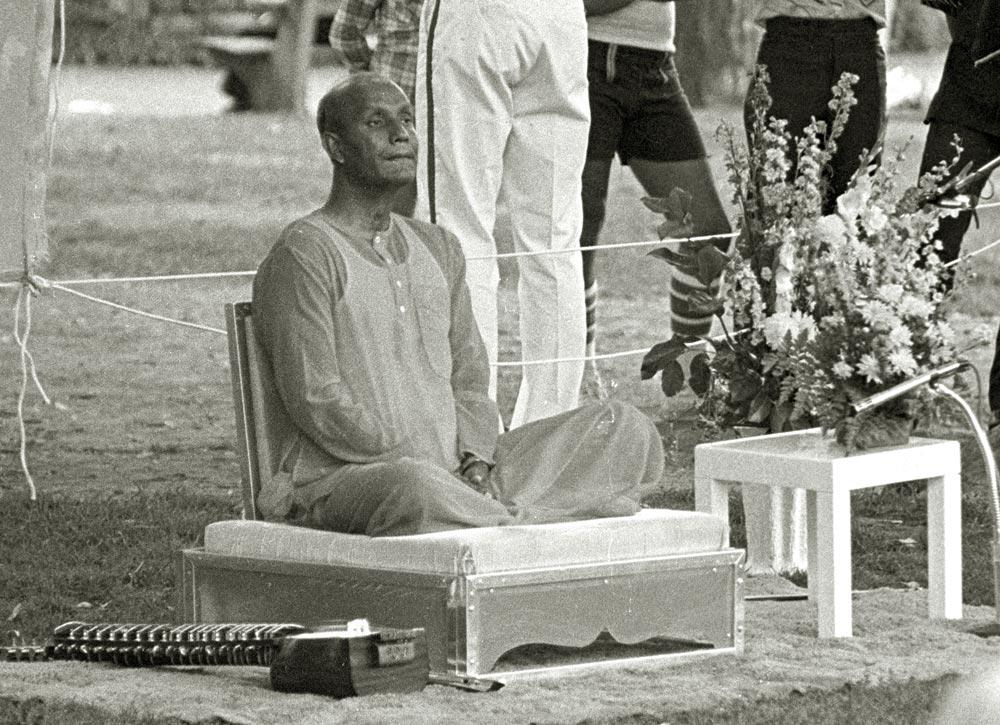
At 1:30 p.m., Sri Chinmoy offers an open-air concert at Fort Tryon Park, located near the famous medieval art museum "The Cloisters" in Upper Manhattan.
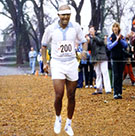
Sri Chinmoy delivers a lecture, entitled ‘Receptivity’, at Harvard University in Cambridge, MA, USA. He also completes a 7-mile solo run in 54 min. 53 sec., as part of his ‘Fifty Oneness-State-Songs’ series, in Boston, MA, USA.
Sri Chinmoy begins his epic poetry series Twenty-Seven Thousand Aspiration-Plants in Jamaica, NY, USA.
Sri Chinmoy completes 7,000 poems in one year, in Jamaica, NY, USA.
Sri Chinmoy offers a Peace Concert (119) at Aspiration-Ground in Jamaica, NY, USA.

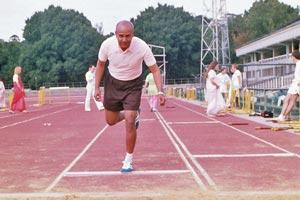
Sri Chinmoy competes in the 100-metre race (15.29 sec.), 600-gm javelin (27.26m), 1-kg discus (23.70m) and 4-kg shot put (8.65m) at Sri Chinmoy Masters Games, held at Victory Field in Forest Park, New York, NY, USA.
Sri Chinmoy gives a talk, entitled ‘No Expectation’, at his home in Jamaica, Queens, NY, USA.
An article about Sri Chinmoy’s weightlifting is published in the ‘Sport Around the World’ section of DELO, one of the main daily newspapers in Slovenia.
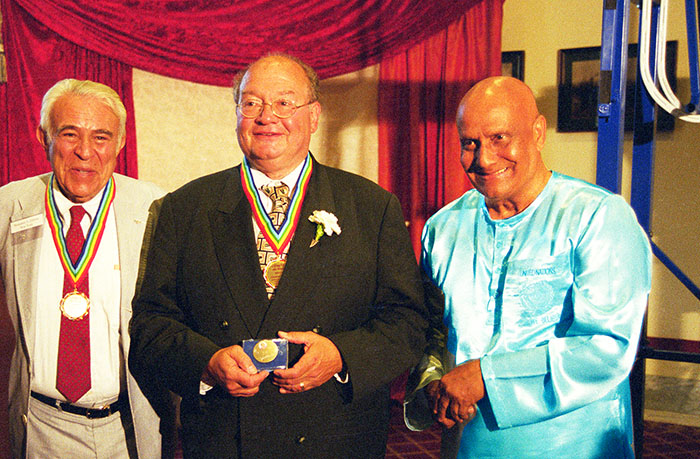
Sri Chinmoy lifts five members of the US Congress: Neil Abercrombie, Congressman from Hawaii; Gary Ackerman, Congressman from New York; Sanford Bishop, Congressman from Georgia; Benjamin A. Gilman, Congressman from New York; Ed Towns, Congressman from New York, at the Rayburn Office Building, US House of Representatives in Washington, DC, USA.
An exhibition of Sri Chinmoy’s Jharna-Kala artworks opens at the Great Buddha Temple, Daibutsu, Kōtoku-in, in Kamakura, Japan.

Sri Chinmoy, age 15, paints this 4⅜x7⅛-inch watercolour on brown paper at the Sri Aurobindo Ashram in Pondicherry, India.

This article about Sri Chinmoy’s weightlifting is printed in the Sport around the World section of DELO, one of the main daily newspapers in Slovenia. (Number of printed copies: 87,700)
At the age 69 years he lifted 272 kg
New York — At the age 69, Sri Chinmoy set an astonishing record for his age: he bench pressed 272 kg by simultaneously pressed up two gigantic 136 kg weights.
Interestingly, Sri Chinmoy improved his achievement each day by lifting weights of at least 22.5 kg heavier than the previous day for three successive days.
But this record is not the only one he has set in the last months. Previously he set records including the standing double-arm dumbbell lift (590 kg), seated double-arm dumbbell lift (200 kg), standing calf raise (907 kg) and seated calf raise (544 kg).
Published in DELO, 10 July 2000
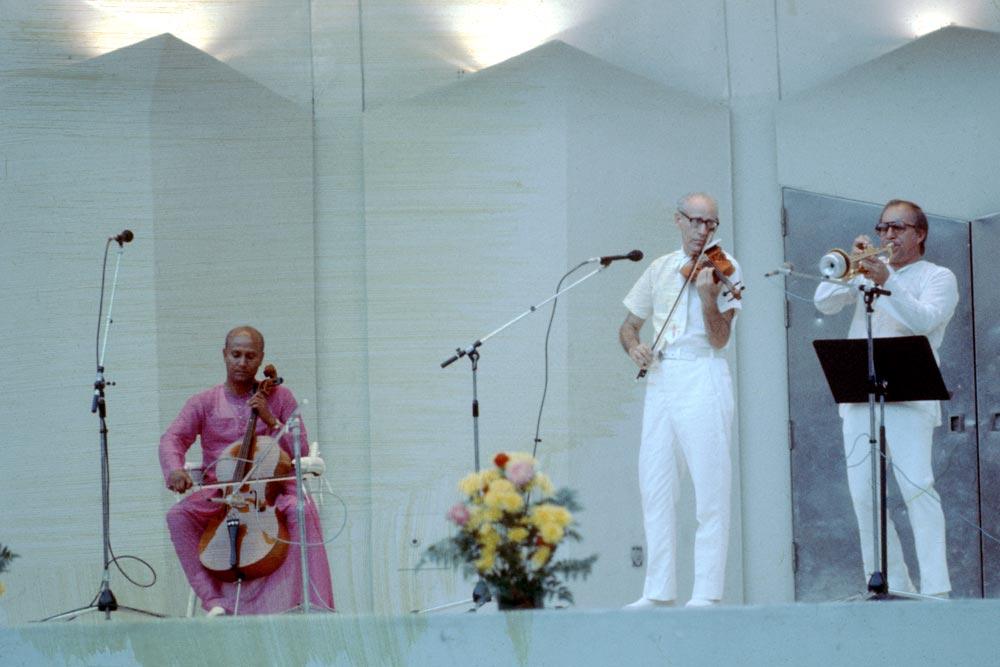
Sri Chinmoy offers a concert at the Lincoln Center in New York, NY, USA.

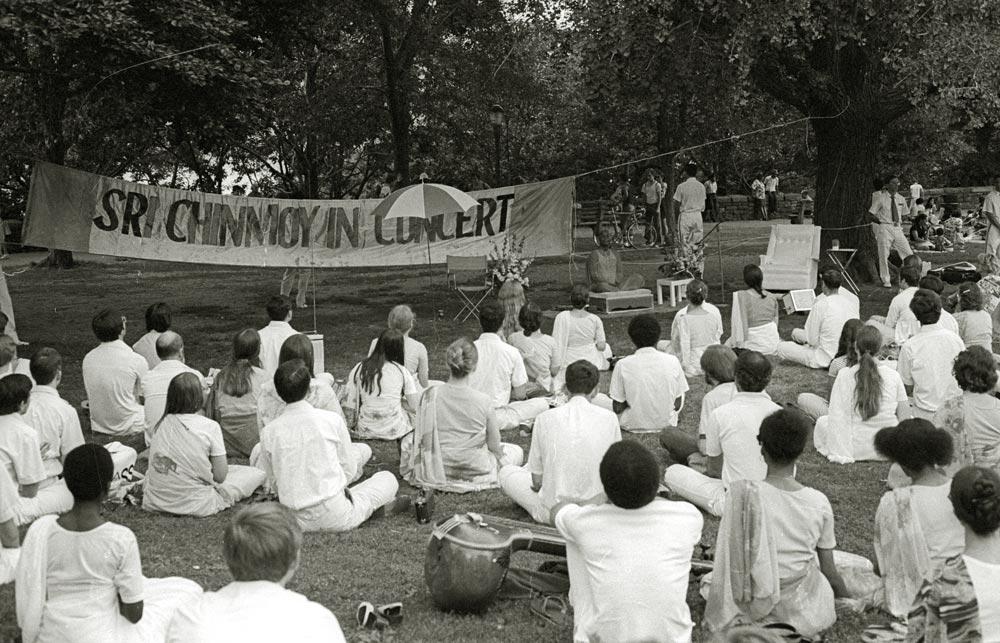
At 1:30 p.m., Sri Chinmoy offers an open-air concert at Fort Tryon Park, located near the famous medieval art museum "The Cloisters" in Upper Manhattan.
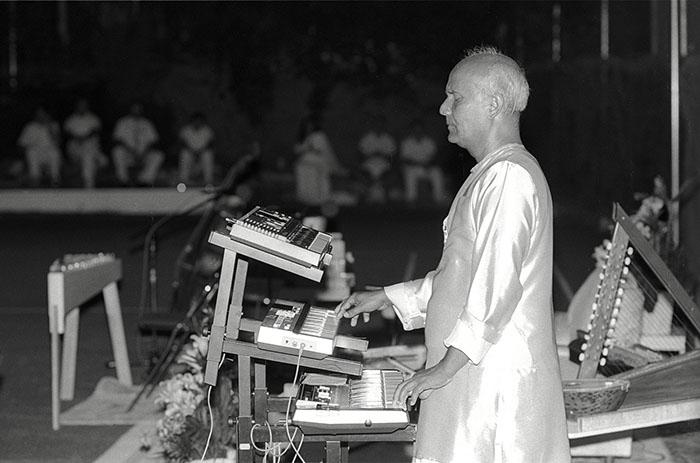
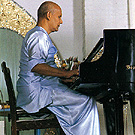
Sri Chinmoy plays a synthesizer during a Peace Concert at Aspiration-Ground in Jamaica, New York.

Sri Chinmoy, javelin in hand, competing at the Sri Chinmoy Masters Games held at Victory Field, Forest Park, Queens, New York.

Sri Chinmoy crosses the 100-metre-race finish line in a time of 15.29 seconds at the Sri Chinmoy Masters Games held at Victory Field in Forest Park, New York. Coming in behind him is Rupantar LaRusso, a race director for the Sri Chinmoy Marathon Team.
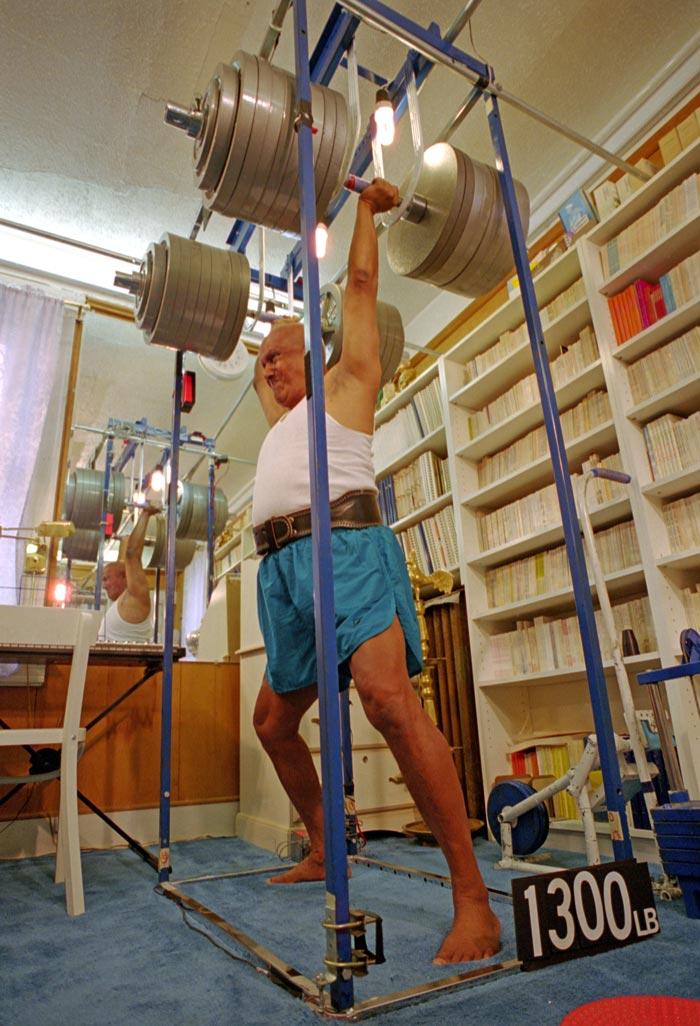
Sri Chinmoy lifts 1,300lb in his private home, Jamaica, New York.

Sri Chinmoy simultaneously lifts Democrat Hon. Gary L. Ackerman (centre) and his Republican colleague Hon. Benjamin A. Gilman (left) — both Members of the U.S. House of Representatives from New York — on a two-platform lifting apparatus, one of us with each arm, in the Rayburn Gold Room on Capitol Hill, Washington DC.
If I had not experienced it, I could not imagine this to be possible. — Hon. Gary L. Ackerman
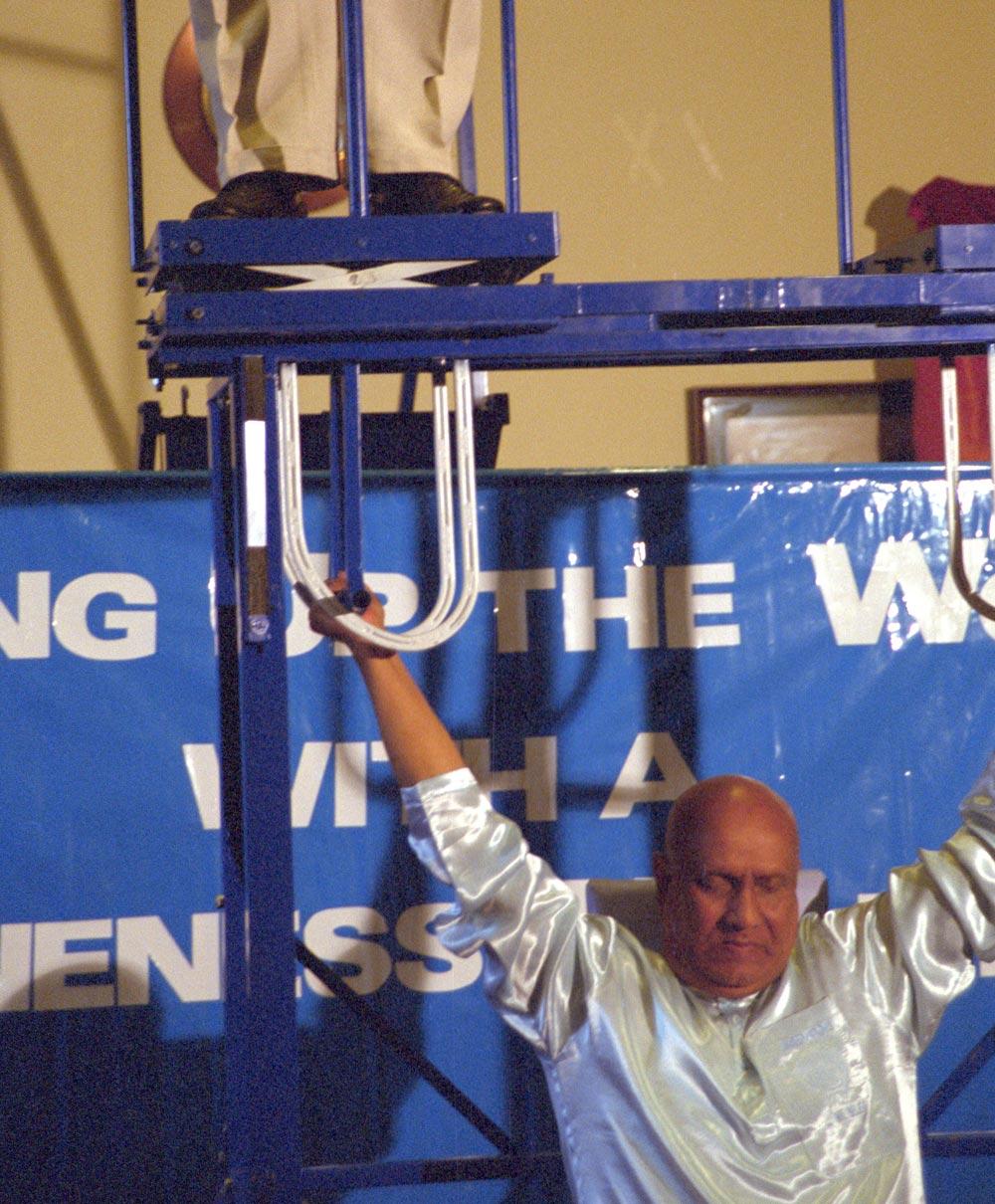
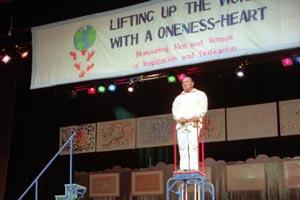
Sri Chinmoy lifts a participant during the Lifting Up The World With a Oneness-Heart programme.
A lecture by Sri CHinmoy
in Room 10 of the University of Uppsala, Uppsala, Sweden
Dear seekers, dear sisters and brothers, today I shall talk on the secret of joy. There is nobody on earth who does not want joy. There is nobody on earth who does not need joy. But there are only very, very few people who know the secret of joy.
The secret of joy is not to be found in the life of desires; the secret of joy is in the life of aspiration. The life of desire blinds us and binds us. The life of aspiration illumines us and liberates us. The life of desire makes us feel that we are all beggars. The life of aspiration makes us feel that we are all God’s divine children. The life of desire is the life of pleasure. A life of pleasure can never be a life of joy, because pleasure is followed by frustration and frustration is followed by destruction. But joy is followed by deeper joy, deeper joy is followed by deepest joy and deepest joy is followed by infinite Joy.
In the spiritual life, we can have joy only when we surrender ourselves to God’s Will. Two thousand years ago the Saviour Christ taught us the supreme message: “Let Thy Will be done.” There can be no higher message, no deeper secret, than this. If we want to have infinite Joy, then here is the secret. As long as I am in the finite my joy is bound to be finite. I can have unlimited joy only when I enter into the Infinite. How much joy can a drop of water contain? But when this drop enters into the mighty ocean and becomes inseparably one with the mighty ocean, the joy it can contain becomes infinite.
We get joy from self-conquest. To conquer ourselves we have to discipline our life. From a disciplined life we get self-mastery. From self-mastery we get the message of self-discovery. Self-discovery and God-realisation are one and the same. When we realise God, our inner consciousness is flooded with Light and Delight. At that time we have infinite Joy, infinite Peace and infinite Light.
There are various ways to get joy, but the easiest and most effective way is through love. When the mother loves her child, how happy the child is! But the mother remains on earth for seventy or eighty years and then she dies. Her son, who has now become a grown-up man, does not get any more joy from his mother because she is no longer on earth. He has received love, which is joy, from his mother for thirty or forty years. This joy we call the joy of the finite. But when we love God, the Inner Pilot, who is eternal, then our joy will be permanent and eternal. I am not saying here that we should not give importance to a mother’s love. We can enter into infinite Joy without throwing aside finite joy.
In our life of joy service is as important as love. If we serve God in mankind, we can become happy. If we serve those who need our help, then we can become happy. Each time we serve, we expand our consciousness, and real joy grows in the expansion of our consciousness. Service means going from one to many, from many to the Infinite. First I eat and serve myself. Then I feed my near and dear ones. And then I try to feed the whole of humanity. As I serve more and more seekers, as I increase my service, I also increase my joy.
Something which is quite important in our spiritual life is freedom. Freedom from what? Freedom from falsehood, darkness and ignorance. Every day God gives us freedom. It is we who have to use this freedom. With our freedom we need not pray to human beings to give us things. We can easily pray only to our Lord Supreme, who is our Liberator. We can love only God, who is our Beloved Supreme. But in order to pray to God, meditate on God and love God, we need inspiration. This inspiration we may get from a flower, from a flame, from the sky, from the mountains, from the sea, from the moon, from the stars, from the sun. Or we can get this inspiration from a God-realised man. We may look at a flower for inspiration or we may look at the flame of a candle, but we have to know that the flower has not realised God, the flame has not realised God. If we meditate on the picture of a Master, we get a kind of inspiration which is much more powerful than the inspiration that we get from a flower or a candle flame. If we meditate on a picture of the Christ, Sri Krishna, the Buddha or other spiritual Masters in whom we have faith, then naturally we shall get infinitely more inspiration than if we meditate on a flower or a candle flame.
Here on earth we are caught by the animal in us, by the human in us and by the Divine in us. When we are caught by the animal in us, we fight vehemently to free ourselves. What are the animals inside us? Doubt, jealousy and aggression. When we are caught by the human in us, it compels us to be satisfied only with a small, insignificant thing. It forces us to remain inside a tiny cave. It tells us that we cannot realise the Infinite. The Divine in us catches us most lovingly. The Supreme holds His divine child most lovingly and tells him that He is dreaming in and through him. He wants His child to grow up and one day become as great as He is.
In our daily practical life there is a way for us to get joy. If we lead a simple life and go to our goal on a direct path, if we walk along a sunlit path, then we can have joy. A simple life is the life of happiness. A direct path is the path of joy. A sunlit path is the path of constant joy.
We do not get joy because the world is full of chaos. Who has created this chaos? You and I. It is we who have to be blamed. When our body only sleeps and snores, we create chaos. When our vital strikes others, we create chaos. When our mind doubts others, we create chaos. But if we use our body to serve God in man, if we use our vital to inspire others, if we use our mind to illumine others, then we are bound to get joy.
We have made many, many promises to God. Every day we promise God that we shall do this for Him, we shall do that for Him, but we never, never do what we promise. God has made only one promise to us and that promise is that He will give us His Joy. His Joy He wants to give us in infinite measure, but when He wants to give it to us, we do not receive it. God is like the sun, an inner sun; He is all Light. If we keep our windows and doors shut, then the sunlight cannot come in. Similarly, if we keep our heart’s door shut, then God’s Joy cannot come in. But if we keep our heart’s door open, then we get light and illumination from God the inner Sun.
We have three special rooms: the room of the soul, the room of the heart and the room of the mind. There are two more rooms: the room of the vital and the room of the body, but most of the time we keep the doors to these two rooms closed. When we live in the soul’s room, we see that there is nowhere for death to stay. When there is nowhere for death, naturally we will be extremely happy. When we live in the heart-room, we see that at times there is a seat for death. Naturally, we cannot be as happy as when we are in the soul’s room. This moment, when our heart identifies with Light divine, naturally there can be no death; but the next moment, when our heart identifies with the ignorance of the world, at that time all is depression, frustration, destruction and death. In the room of the mind, not only is there a seat for death, but death is welcome to sit on any seat he wants to. Death comes in and sits either on its own seat or on any other seat it wants to occupy. So there can be no joy at all in the room of the mind. If we are in the mind-room, we have to pray to enter into the heart-room. If we are in the heart-room, let us pray and meditate to enter into the soul’s room. It is only in the soul’s room that we will find infinite Joy, infinite Satisfaction and infinite Perfection.
Published in My Rose Petals, part 4
by Sri Chinmoy
8:15 a.m.
Jamaica High School Track,
Jamaica, New York
I am a born prayer. I am extremely grateful to my Beloved Supreme, for He has given me the prayer-capacity to become one with the Christ consciousness.
I am a born concentration. I am extremely grateful to my Beloved Supreme, for He has given me the concentration-capacity to become one with the Brahma consciousness.
I am a born meditation. I am extremely grateful to my Beloved Supreme, for He has given me the meditation-capacity to become one with the Vishnu consciousness.
I am a born contemplation. I am extremely grateful to my Beloved Supreme, for He has given me the contemplation-capacity to become one with the Shiva consciousness.
I am a born aspiration. I am extremely grateful to my Beloved Supreme, for He has given me the aspiration-capacity to become one with the Ramakrishna consciousness.
I am a born dedication. I am extremely grateful to my Beloved Supreme, for He has given me the dedication-capacity to become one with the Buddha consciousness.
I am a born realisation. I am extremely grateful to my Beloved Supreme, for He has given me the realisation-capacity to become one with the Chinmoy consciousness.
I am a born manifestation. I am extremely grateful to my Beloved Supreme, for He has given me the manifestation-capacity to become one with the Shankara and Vivekananda consciousness.
I am a born perfection. I am extremely grateful to my Beloved Supreme, for He has given me the perfection-capacity to become one with the Krishna consciousness.
I am a born satisfaction. I am extremely grateful to my Beloved Supreme, for He has given me the satisfaction-capacity to become one with Him, with His Consciousness that is already manifested and with His Consciousness that is yet to be manifested.
Published in Everest-Aspiration, part 1
A lecture by Sri Chinmoy
at Harvard University, Cambridge, Massachusetts
Receptivity is emptiness. What we call emptiness today, that very thing we can aptly call fulness tomorrow. Let us try to lead once more a life of simplicity, humility, sincerity, purity, gratitude and surrender. Some of us may think and feel that they are already blessed with these divine qualities. To them, my simple request is this: They should try to discover the capacities of these divine qualities. Simplicity increases receptivity in our physical body. Humility increases receptivity in our vital. Sincerity increases receptivity in our mind. Purity increases receptivity in our heart. Gratitude increases receptivity in our aspiration-life. Surrender increases receptivity in our dedication-life.
The way we live either increases or decreases our power of receptivity. There are two ways of living: wrong living and right living. There are two kinds of human beings on earth: the ignorance-lover and the God-lover. The ignorance-lover wrongly depends on wrong living. The God-lover rightly depends on right living.
Receptivity is available in two worlds: the desire-world and the aspiration-world. In the desire-world, receptivity is found in the thick jungle of attachment. In the aspiration-world, receptivity is found in the beautiful garden of devotedness.
Receptivity succeeds and receptivity proceeds. When we invoke God the divine Light, our receptivity succeeds in the battlefield of life. When we invoke God the supreme Delight, our receptivity proceeds along Eternity's all-fulfilling and all-satisfying Road.
Measureless and fathomless receptivity we can have if we are not afraid of the unknown and if we are ready to love the Unknowable.
Here we are at Harvard. Harvard embodies unparalleled capacities, and one unparalleled, sky-vast capacity is its sea-deep receptivity. Again, receptivity comes from God's Compassion-Eye, and God's Compassion-Eye comes from God's Oneness-Heart. This Oneness-Heart each seeker can have, provided he claims God's Oneness-Heart as his own, very own. Once a seeker can claim God's Oneness-Heart as his very own, his will be the measureless and fathomless receptivity. And inside his fathomless receptivity, at every moment what will loom large is God's own Transcendental Vision.
Published in Truth’s Fountain-Melody

Sri Chinmoy begins his epic poetry series Twenty-Seven Thousand Aspiration-Plants in Jamaica, NY, USA.
Twenty-seven thousand
Aspiration-plants:
Indeed, the distance is too long.
But my Beloved Lord Supreme
Says to me,
“My child, the distance is too short.
In top secrecy I am telling you:
I shall walk with you
All the way.”
Published in Twenty-Seven Thousand Aspiration-Plants, part 1
A talk by Sei Chinmoy
at his home in Jamaica, Queens, New York
We are born with expectation. If I cry, my mother will come and give me milk. If I cry, my father will take me to the town. But Lord Krishna said, “You have the right to action, but not to the fruits thereof.”
Yes, we take it as our right to do something; but we have no right to expect the fruits of our action. In our case, we expect the action and the result to go together. If we touch a drum, we expect that there will be a sound. But why should there be a sound? We are expecting the sound while we are touching the drum. But while touching the drum we must not think of the sound. Our job is only to strike the drum. The sound we have to keep separate from the striking.
The trouble is that most of the time, as soon as we do something, we want the results. But we should say, “If the result comes and it is good, then it will please me. But if it does not come, I must not be disturbed.” But we do not always do that. At every second, we have expectation.
As soon as we come out of the house, our expectation is that there will be a soothing breeze. The cool morning breeze will be blowing: that is what we expect. If we come out of the house and, instead of a cool breeze, we find that a very hot wind is blowing, then we are doomed to disappointment. But if we say, “I will come out, no matter what kind of weather it is, because I feel from within it is good to go out,” then we shall not be disappointed.
Unfortunately, we do not say that. Before we perform an action, we try to get the result. We have to come to the point where we can say, “I will act, but I will not care for the results.” That is when we make progress. Otherwise, even before doing something, we are expecting the results. Even before we touch the drum, we expect the sound to come.
Where does unconditional surrender come into the picture? While crying for God, do we say, “God, I am crying for You. If it is Your Will, come. But if it is not Your Will, do not come. I want to please You in Your own Way”? How many people every day repeat, “I want to please You, God, in Your own Way”? More than ten times if we say it, we become sick of hearing our own voice! Then we change our prayer: “I will please You only when I feel like it, and I do not mind even if You do not please me, as long as we can please each other once in a blue moon.”
Now let me tell a story about unconditional surrender.
Today I was looking at some old family pictures. When I saw a picture of my cousin, Nirmala-di, I immediately started shedding tears. She was so close to our family. She died while plucking flowers. She was standing on the roof of her house at the Ashram. To one side was a protection-flower tree. The Mother gave that particular flower the name “Protection.” My cousin was plucking those flowers and somehow she fell on her head on the street below. She died then and there. My sister Lily was passing by. She heard the sound, but she did not see what had happened. She was just walking along the street, and she went home. In five minutes she received the message that this had happened, and she came running.
This was the cousin who was responsible for my getting the job for Nolini-da. She said I must work there, I must. She was the one who said I must give Nolini-da a gift. My gift was one of his prose articles which I had turned into poetry, English blank verse.
But the most important thing happened when I came to the Ashram at the age of one year and three months. How kind was Nirmala-di! She was so fond of my mother. For one month, whenever my mother wanted to spend time in the main Ashram building or go to see the Divine Mother on the balcony or elsewhere, this cousin made the sacrifice of looking after me. And how I used to cry, cry, cry and scream for my mother! The sound would cover quite a few blocks! To my own sisters, this cousin of mine said, “You people go. I will take care of him.” Even though she herself had only been in the Ashram for two months when I was brought there — she came at the same time as my brother Hriday — she made this sacrifice. She wanted my mother to spend as much time as possible in the main building and to see the Divine Mother. This was my cousin. She was so fond of us. At every second she would scold us. She was older than my sisters. If you are older, you have every right to scold the younger ones.
Coming back to the point, what did Nirmala-di expect from her service? She could have said to my mother, “You brought your child here. He is your responsibility. Why are you not asking one of your daughters or one of your sons to take care of him? You have four or five other children who can easily take care of him. Let them do it.” But she did not do that. Instead she said, “I have been here for two months. You will be going away in a month, so let me make this sacrifice.” It was all because of her love for my mother. This kind of unconditional surrender she made.
How many of you have tried — sincerely tried — to see everything in my own way? Will it be my fate not to have one single disciple like that? In some cases, year after year disciples have not tried to please me because they have blocked their inner door and outer door completely. I cannot open their outer door, and I cannot open their inner door. I do not exist inside them. I am outside, outside, outside. I am neither in their mind, nor in their heart; I am not in their existence.
Nobody can dare to tell me, “I do everything in your own way.” Again, nobody will be able to say, “I always try to do everything in your own way.” Someone may try to do everything in my own way for one week or for one month, but then that person becomes tired. He simply says, “I tried so hard to please Guru for one month. Now he should please me at least for one day or two days or three days.” This kind of surrender is only a joke. It creates suffering for me.
A disciple may try to please me for two days, and then he expects me to please him for ten days — not even the other way round. And people sometimes say, “Since Guru has the capacity, since he is stronger than I am spiritually, he should please me more in my own way.” But this is not the correct philosophy. The disciples should say, “Since Guru has more capacity, let me become one with him. Then I will have his capacity.” That attitude people should adopt.
For a few weeks or a few months, you try to please me. Then you bring expectation forward. When your expectation is not fulfilled, you say, “Oh, our philosophy is not to expect,” and once more you start trying. But you do not forget to use your expectation once again. You say, “Who knows, next time Guru may fulfil my expectation.”
From today you can start trying to serve without expectation. Better late than never! We always make promises in our lives, like my brother Mantu. Every morning he makes a resolution not to read any newspaper. Then one of his friends will come and say, “Mantu Babu, Mantu Babu, have you read about such-and-such? Do you know?”
“What? What?” says Mantu.
Then his friend will say, “I do not want to tell you. I do not want to take away your joy. There is something most significant in the newspaper. Go, go immediately and read it for yourself!”
Mantu’s resolution lasts perhaps for another twenty minutes. Then he goes as fast as possible to the library to read the article.
In your case, you can make a resolution right from today to sincerely try to see everything and do everything in my own way. Just repeat, “Cheerful obedience, cheerful obedience, cheerful obedience.” Then you can say, “No expectation, no expectation, no expectation!” and also, “Fastest progress, fastest progress, fastest progress!” If you can repeat those words like japa, if they are engraved on the tablet of your heart, then definitely you will be able to make the fastest progress.
Published in Live in the Eternal Now