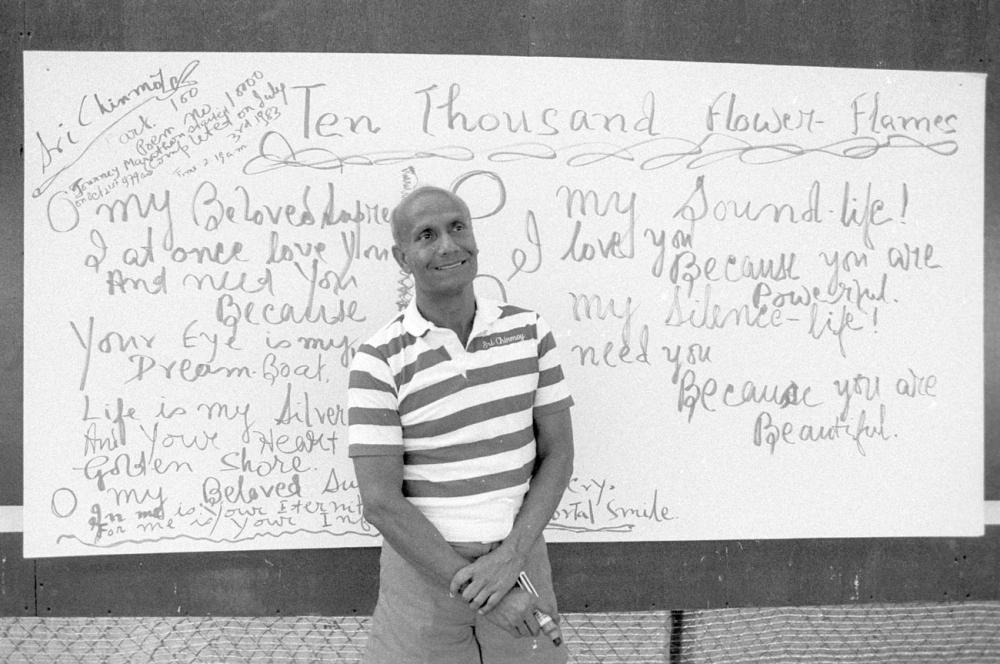
Between October 22nd, 1979 and July 3rd, 1983, Sri Chinmoy composed 10,000 Flower-Flames, a poetry series published in 100 different volumes.
Photo: Bhashwar Hart
To mark the completion of the poetry series, the poet, Sri Chinmoy held a celebration at Aspiration-Ground, New York on 3rd July 1983.
Video footage by Niriha
Sri Chinmoy reading poems from this poetry series
Poems from Ten Thousand Flower-Flames
A recording of Sri Chinmoy reading a selection of poems from part 1 of his Ten Thousand Flower-Flames series, interspersed with musical performances on various instruments.
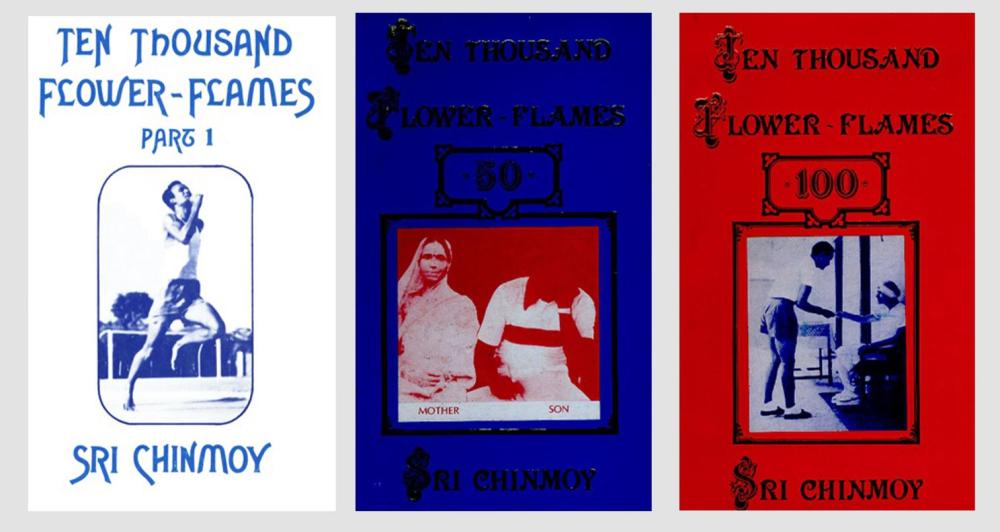
A distinctive feature of the book covers for Ten Thousand Flower-Flames was the cover photo from the life of Sri Chinmoy. This shows part 1, part 50 and part 100.
"On Sunday, July 3rd, 1983, Sri Chinmoy completed the final poem – poem number 10,000 – of his monumental series entitled Ten Thousand Flower-Flames. It is not often that we are given the opportunity to celebrate a poetic “event”... - View the read-only PDF…
Sri Chinmoy reads a selection of poems from part 1 of his Ten Thousand Flower-Flames series, interspersed with musical performances on various instruments. The 10,000 poems in this series were written from 1978 to 1983.
A story from Sri Chinmoy’s 1976 trip to Australia, 9 March 1976.
In 1956 Melbourne hosted the Olympic Games. As it is for all Olympic cities, this was an opportunity to build new sporting facilities, expand and update its infrastructure such as public transport and generally brush everything up with a sparkling new coat of paint. It was Australia’s first truly grand moment on the modern world stage!
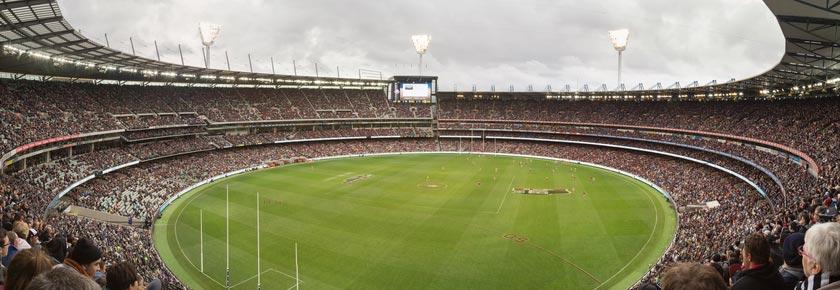
Modern view of MCG (2015) Stock photo, licensed.
Just by coincidence Melbourne is also the home of Australia’s most famous sporting stadium, the MCG (Melbourne Cricket Ground) or just the ‘G as it is affectionately known by all Melburnians. It is a massive, Coliseum-like structure that holds 100,000 spectators and its grandstands rise upwards to form a huge amphitheatre. So it was a natural decision for Olympic officials to choose the ‘G to stage the Opening and Closing Ceremonies, as well as the track and field competition.
The playing area of the ‘G is huge and the officials found they could easily measure out a temporary athletics track, jumps pits and throwing areas within its boundaries. In those days synthetic track hadn’t been invented and the lanes were all marked out on the grass.
And so, for one long week at the end of November 1956, the world competed for Olympic athletics glory at the ‘G and Australia suddenly seemed to come of age. Then at the end of the Games the stadium reverted to its former role of hosting games of cricket in the summer and AFL games (a unique brand of football we call ‘Aussie Rules’) during the winter months. Other than the lasting tribute of a bronze plaque on a grandstand wall and now fading memories, you would never have known that, in the bright summer of 1956, the Olympics came to the MCG.
Now we fast-forward 20 years later to March 1976. Guru has just arrived from Canberra during His first visit to Australia and we were all jumping out of our skin in anticipation at the airport! Although we had just spent the past few days with Guru in Sydney, this was something really special, hosting Guru in our own home town.
We drove Guru to his hotel, and thinking that He might want time to rest or settle in, had planned to make arrangements for the talks Guru would be giving. Guru, however, had His own inscrutable ‘plans’. Shortly after checking in, He reappeared.
“Melbourne has staged the Olympic Games?” “Yes Guru!” we all replied in wondrous chorus. “Then please take me where the athletics were staged.”
Since I had a very keen interest in athletics, everyone turned to me excitedly with that “let’s go, let’s not keep Guru waiting” kind of look. To say that I was thrown into a sea of confusion is an understatement. Guru said He wanted to see where the athletics were staged but I knew intuitively that He would not appreciate the MCG in spite of its majesty, now that it was just an empty sports stadium with no evidence of anything remotely looking like a track. Oh God, what was I to do!
Luckily the ‘G was only about 2 kilometres away so we all jumped into our cars and travelled in excited convoy across town. We arrived and I immediately encountered the first challenge: the stadium was all locked up; how would we get Guru inside?
I had an inspiration to seek out one of the groundsmen and after persuading him that we had with us a visiting Indian gentleman who had waited all his life to see the home of Australian cricket, his heart softened. “No worries mate, just go through that gate and you’ll get inside. But don’t step on the grass, it’s hallowed ground, you know!” I allowed myself an inner chuckle, thinking, “If only you knew who you were letting inside!”
We all walked down the ramp to the grass. Guru looked around and then uttered the words I had been dreading: “Where is the track!” I felt my knees buckling and my stomach turning somersaults. “Guru, they only had the track during the Olympics; they removed it once the Games finished.”
I knew Guru wasn’t convinced. “Guru, I can show you the warm-up stadium just across the road where the athletes prepared for their races. It’s got a track.”
Guru responded with what I felt was some annoyance but on the positive side I knew this other stadium at least had a track, even if it wasn’t the actual stadium where the athletes competed during the Games. So we all jumped back into the cars and drove in convoy to Olympic Park.
Now every Australian who loves track and field has heard of Olympic Park in Melbourne. It is where John Landy ran a sub-4 minute mile; where he ran back to pick up a stumbling Ron Clarke and still won the race. So many moments in Australian athletics history have been recorded in the very earth it stands upon.
We were able to walk straight into the ground and immediately Guru turned and showered us with a radiant smile as He spied the track. I’m already thinking to myself, “Thank God,” but Guru jolted me out of my false nirvana with a request for some equipment.
Immediately I sped off to look for another groundsman and fortunately, on explaining the situation, he very kindly brought out some hurdles. OK, it wasn’t a javelin or a discus but Guru seemed happy enough. At least we had hurdles . . . that’s what I was telling myself anyway.
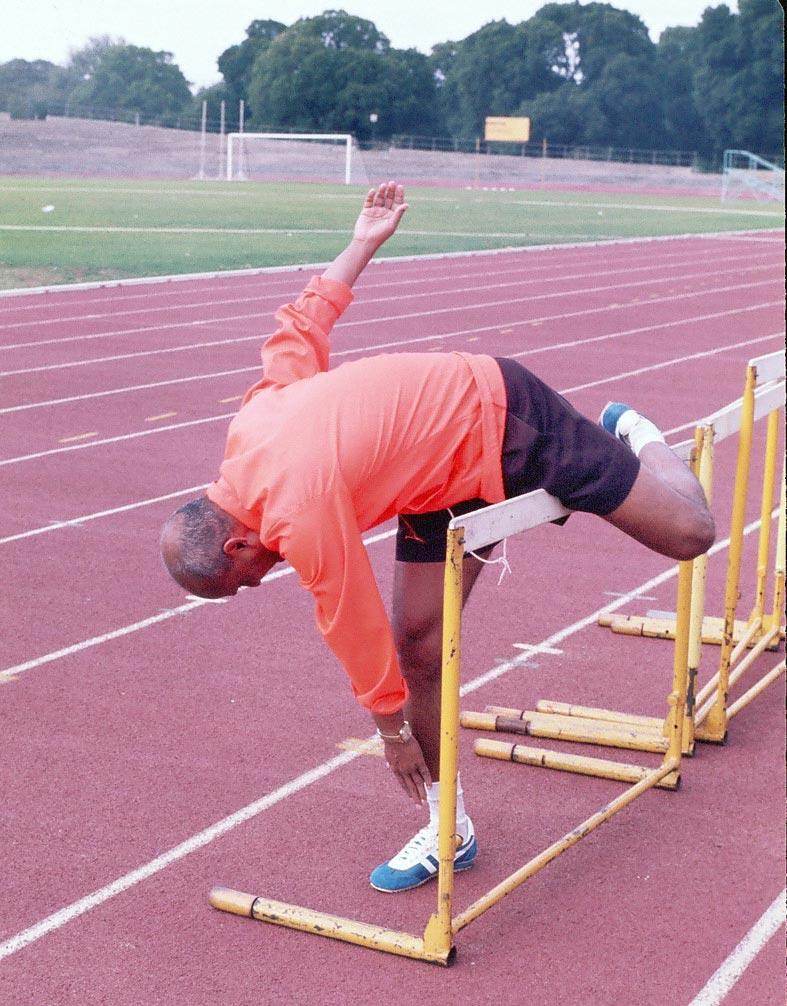
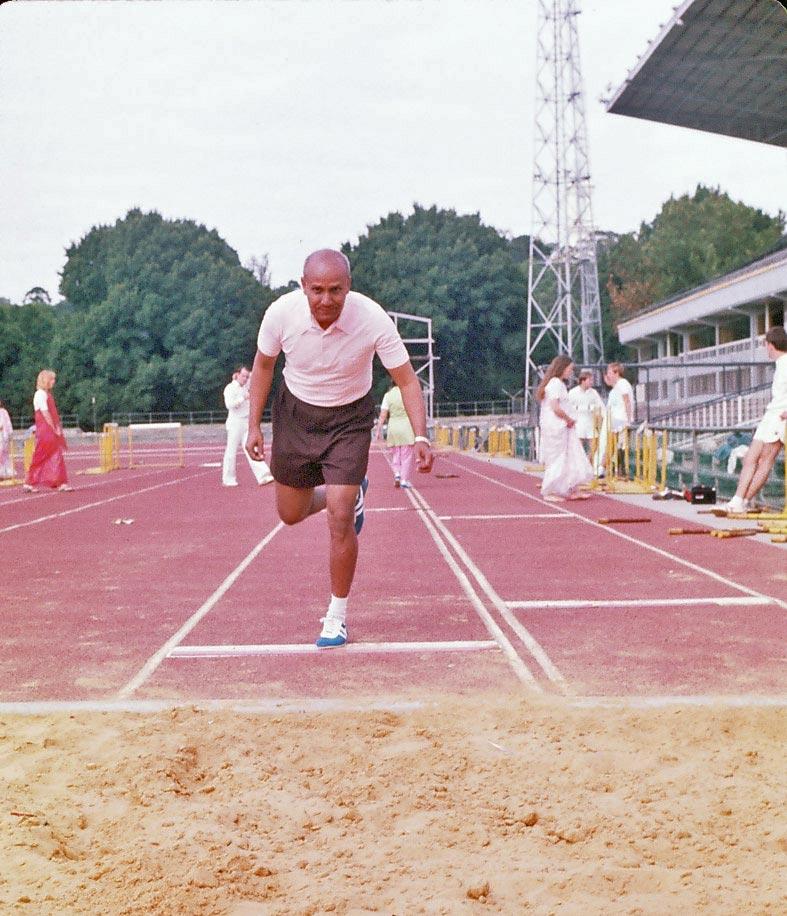
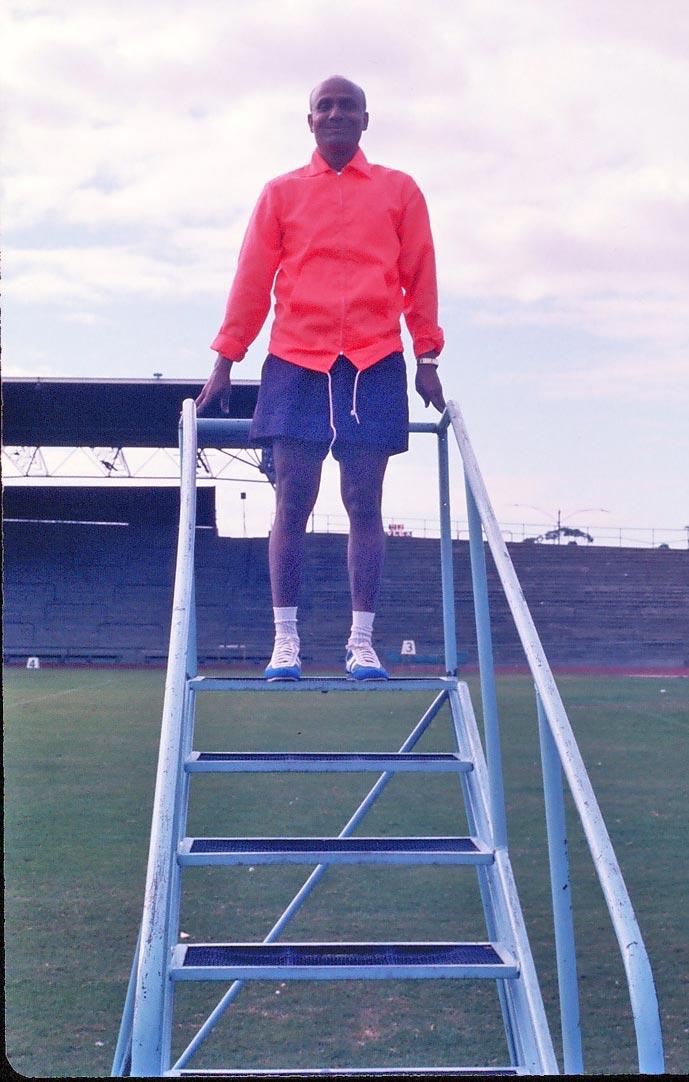
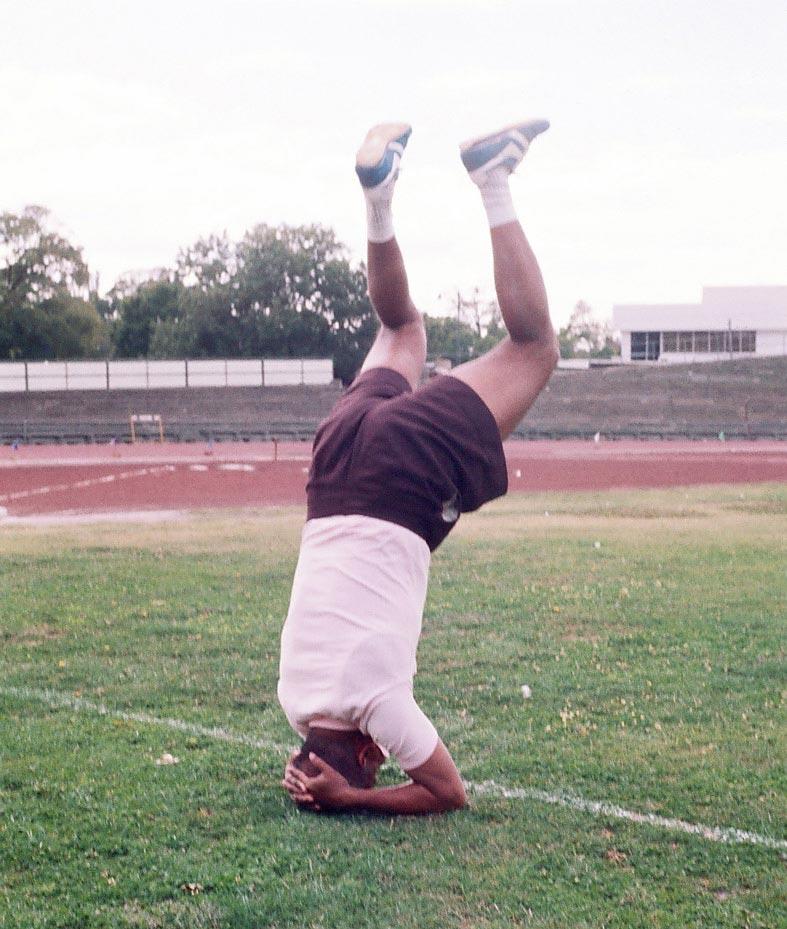
Guru started doing some warm-ups and stretches using the hurdles. He was really enjoying Himself standing on His head, doing poses at the long jump pit and He even gave a short talk on the significance of the Olympic Games. Then Guru had us all line up and run down the 100 metres straight in a line across the track.
Finally the stress of the moment gave way to pure joy, seeing Guru the supreme athlete happy and completely in His element. Afterwards Guru gave us all a sweet from His hand. It was the first time Prashanta and I received something in this way from Guru.
Footnote: Guru visited Olympic Park on another two occasions: in 1987 when He opened the World Masters Athletics Games with a meditation and special song He had written for the occasion, and in 1995 at the staging of a Sri Chinmoy Masters Games.
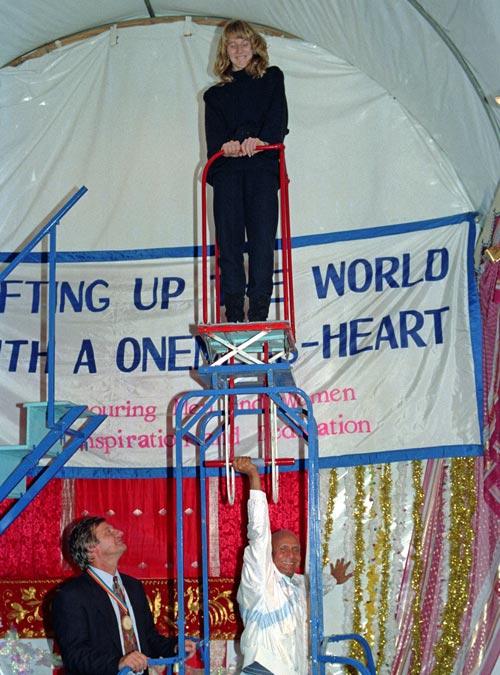
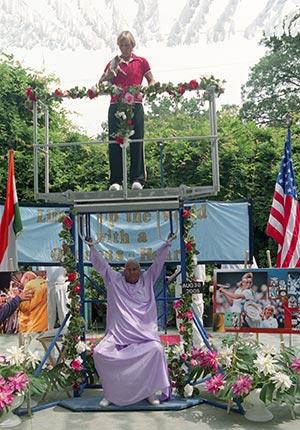
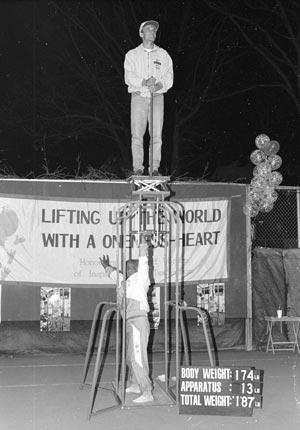
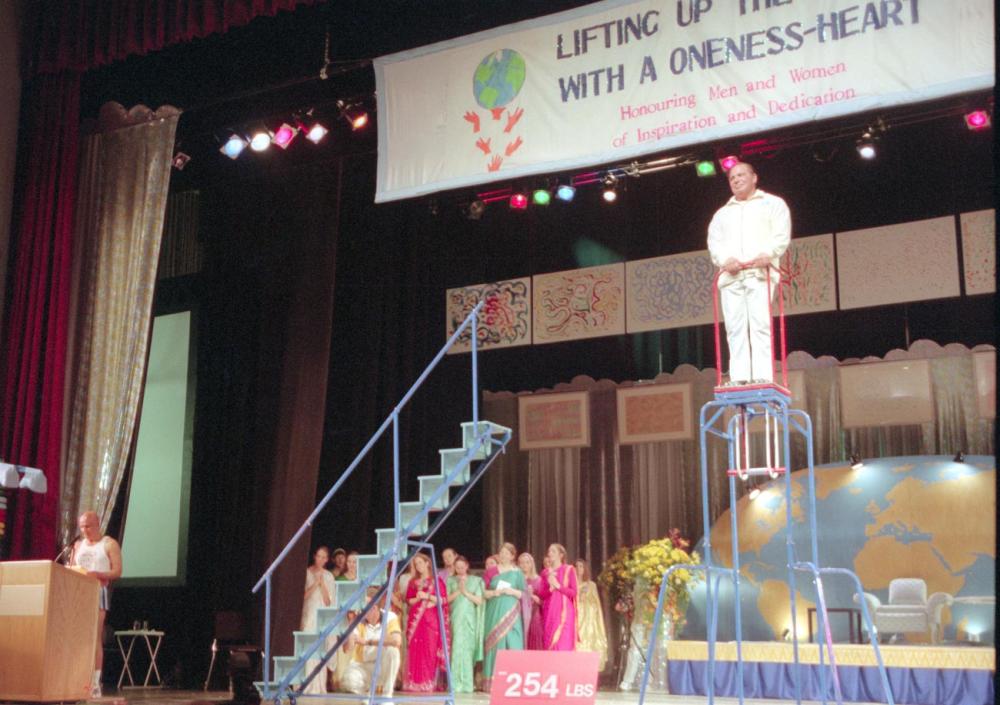
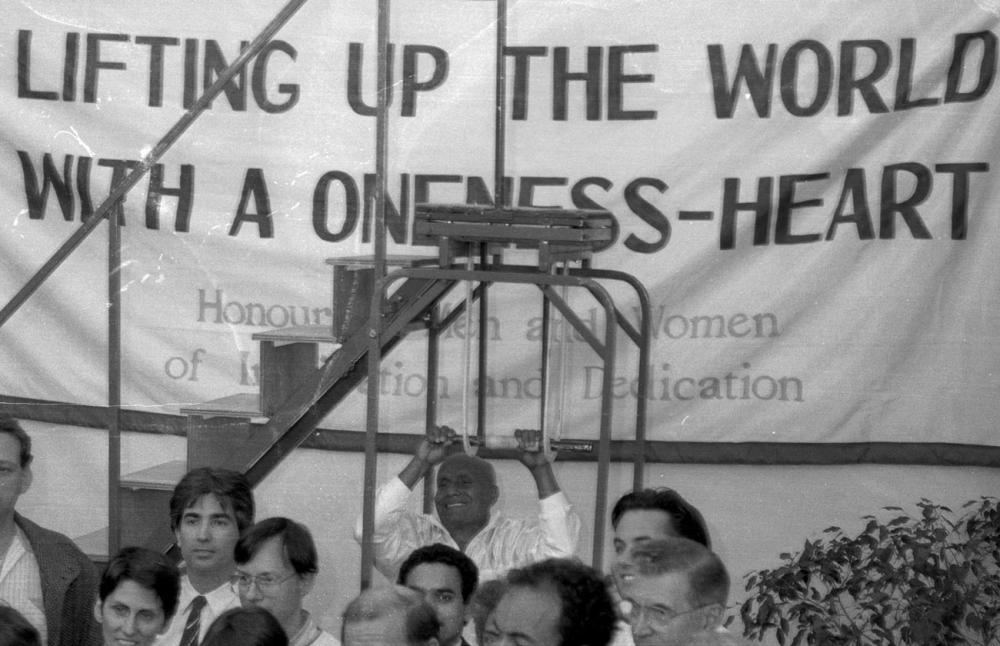
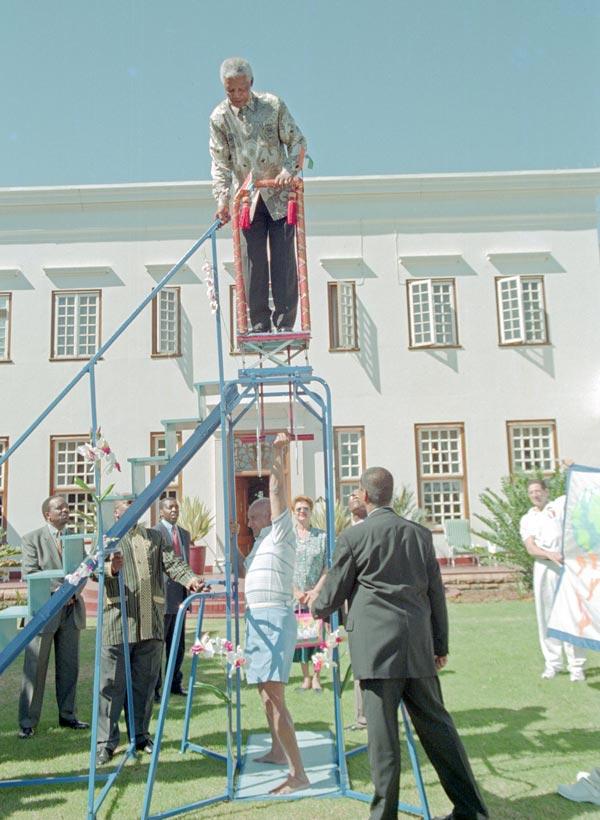
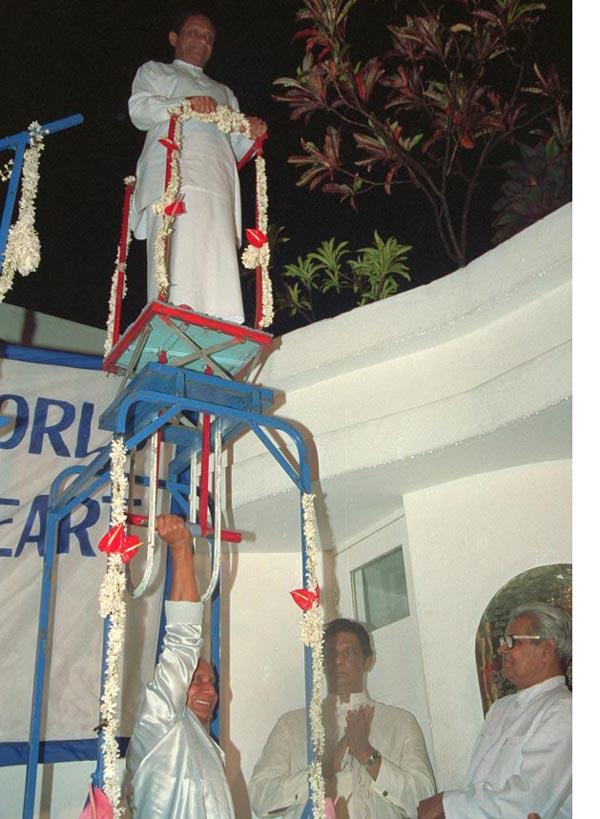
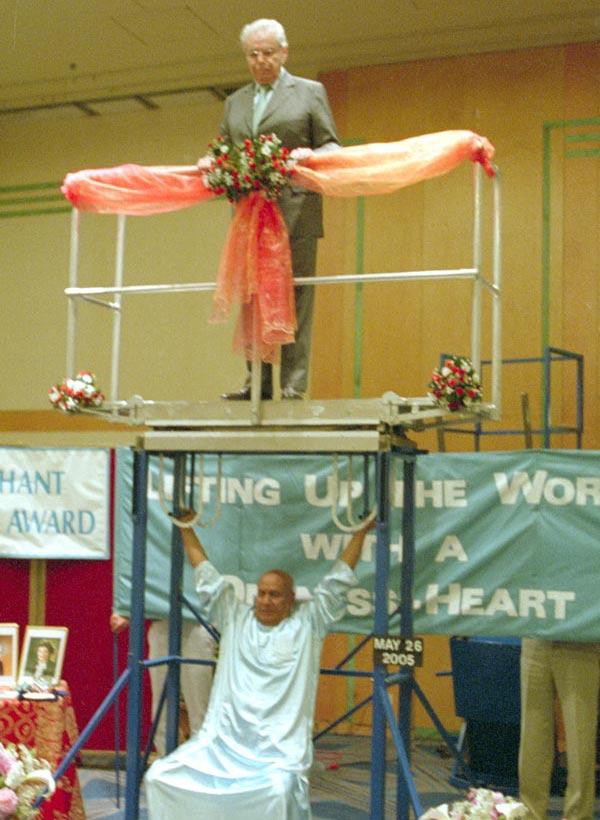
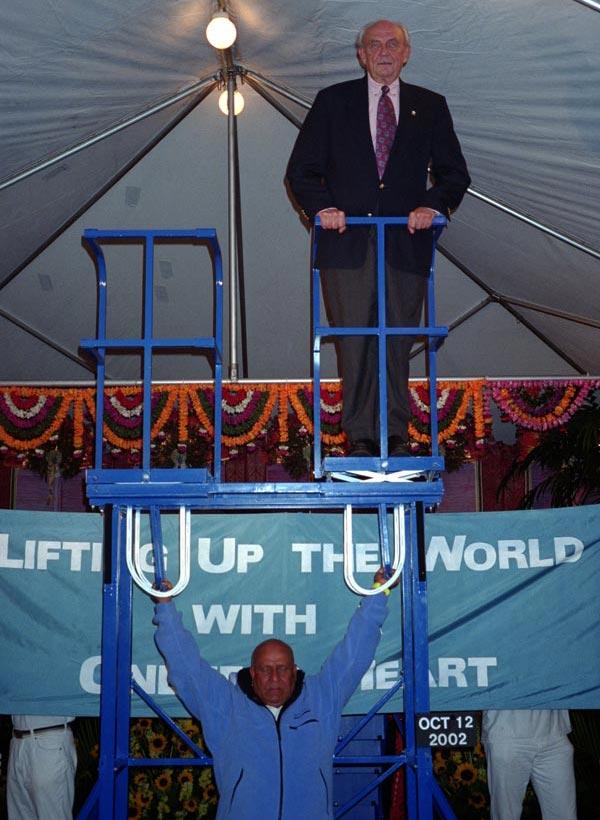
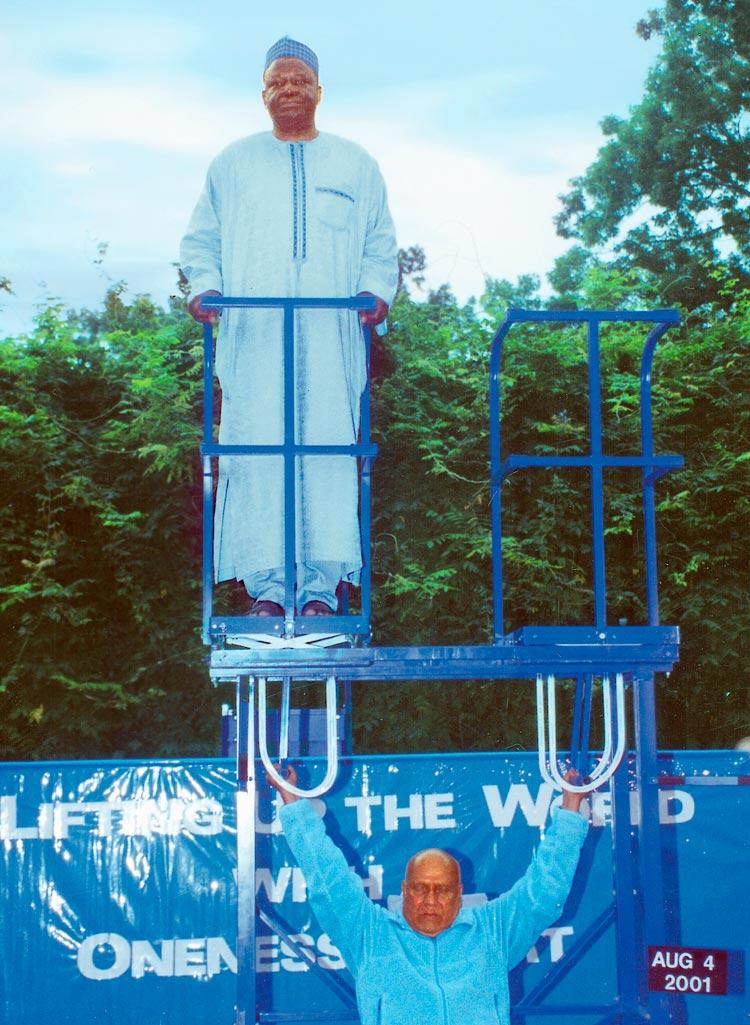
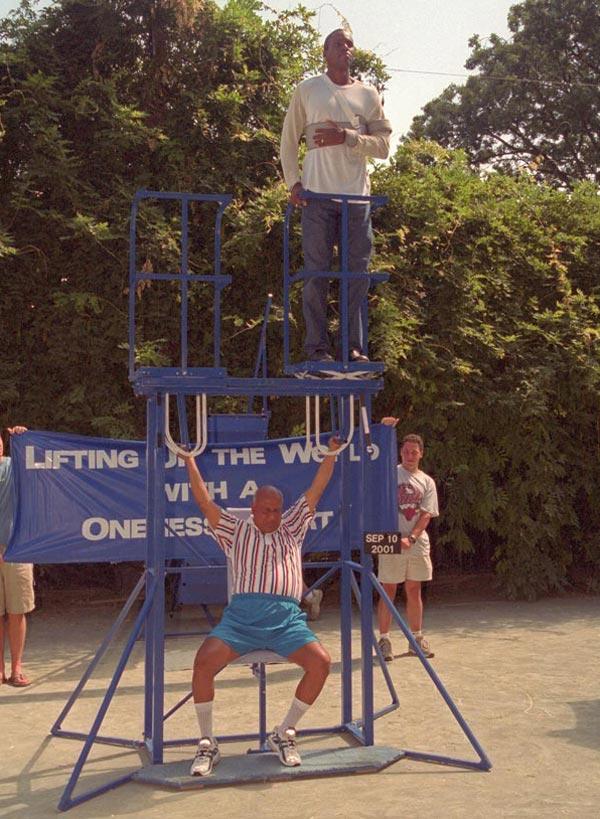
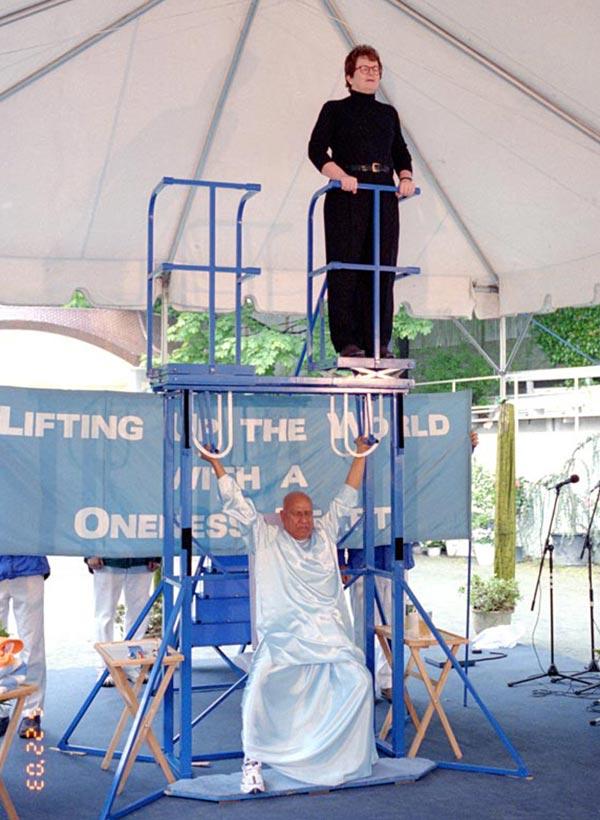
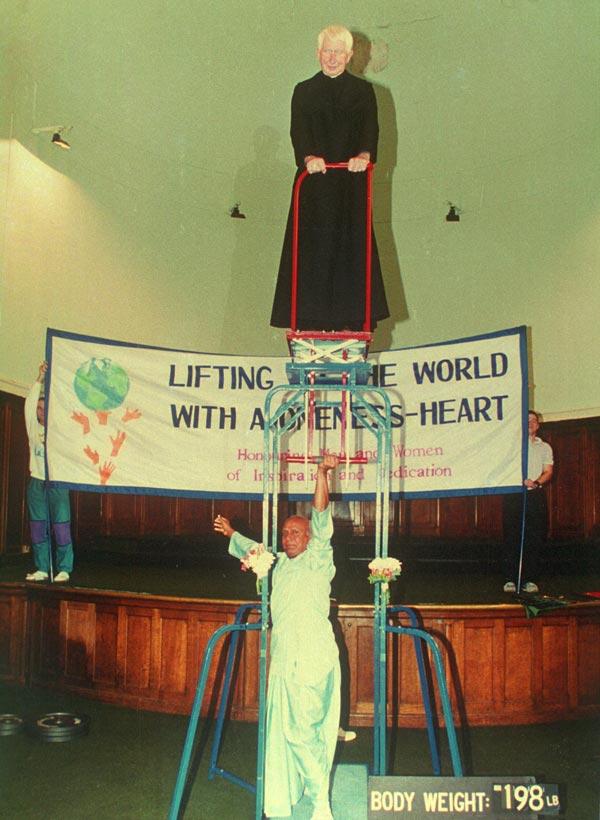
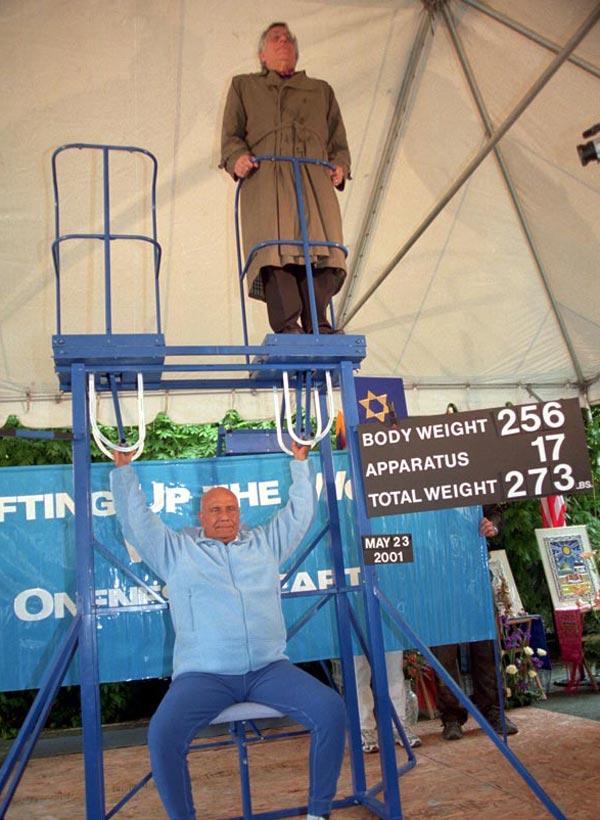
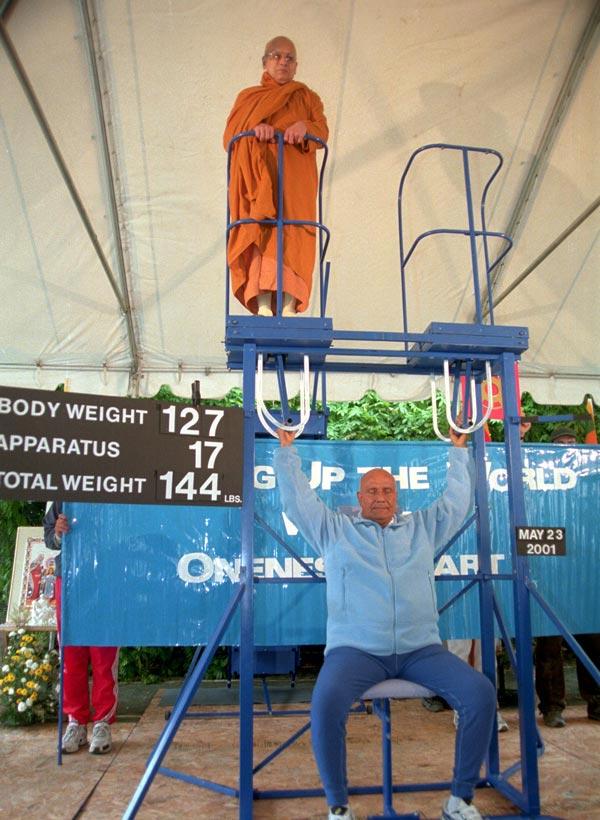
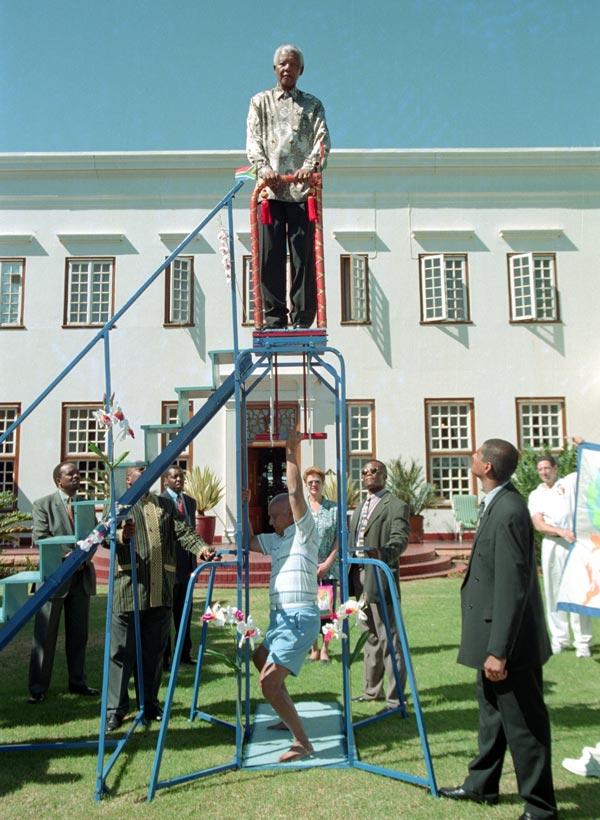
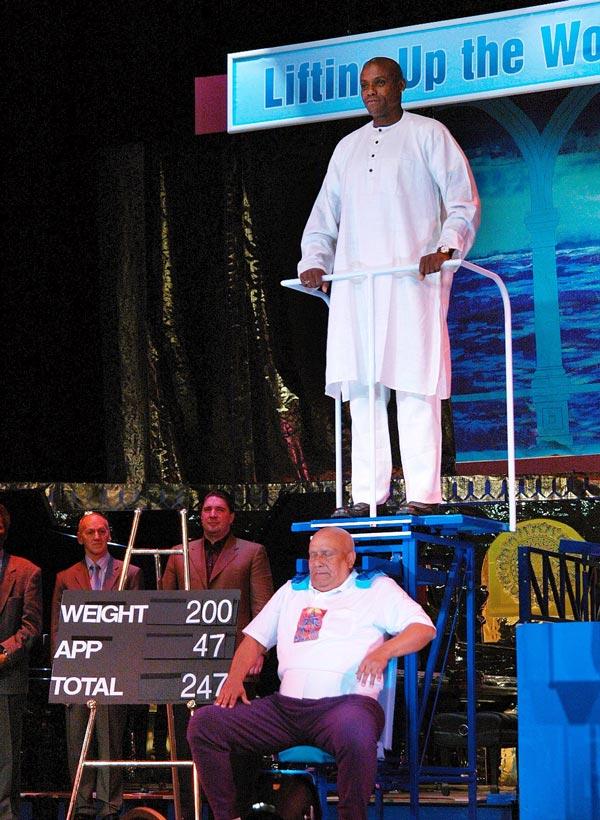
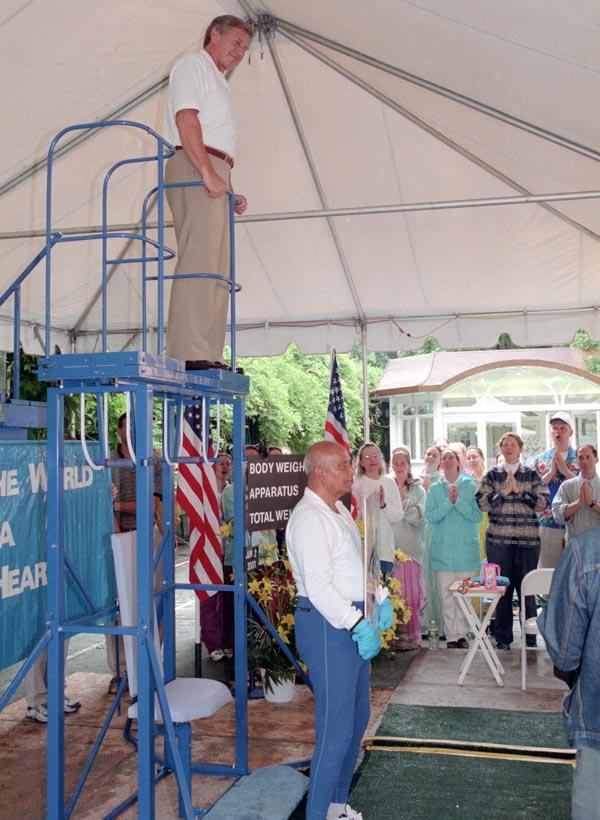
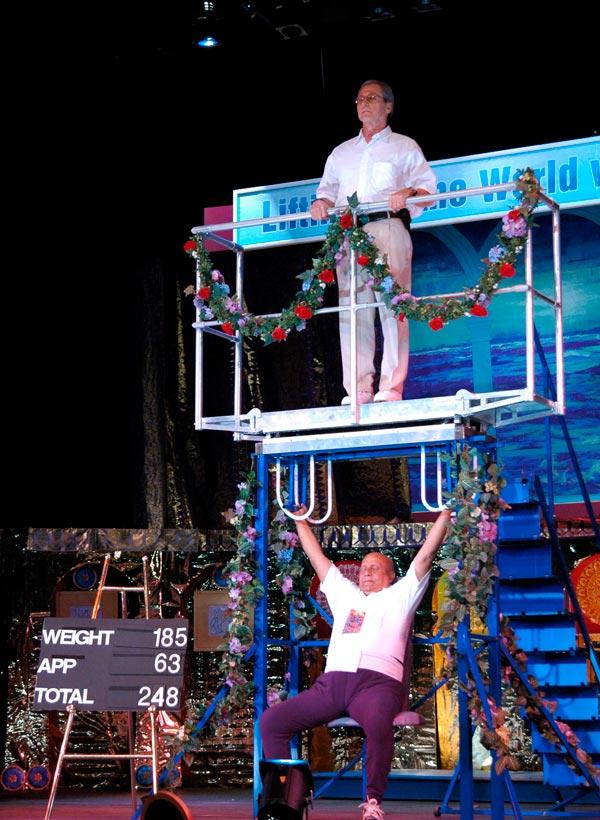
The "Lifting Up the World with a Oneness-Heart" program is a unique award that was offered by Sri Chinmoy to recognise individuals from all walks of life who had inspired and uplifted humanity. Sri Chinmoy lifted the recipients overhead either with one arm or both arms, using a specially constructed platform in a symbolic gesture of oneness with their uplifting achievements.
Bill Pearl. Five times winner "Mr Universe". Photo: Pulak
The programme began on 26th June 1988. The first person to be lifted was Mahamsarat Bill Pearl, a former Mr Universe and "World's Best-Built Man of the Century". Explaining his motivation for this programme, Sri Chinmoy said:
"I am trying to reach people in various walks of life who have inspired others — in sports, in literature, in science and in politics. Since they have inspired many people, I am trying with my limited capacity to encourage and inspire them. When someone does something great, he is cheered by his colleagues. They congratulate him. Here also I am trying to congratulate them with my prayerful meditation and inner oneness with them. I just lift them up to show my deepest appreciation of their achievements." (1)
Sri Chinmoy's initial goal was to lift 700 individuals. He achieved this on 3 November 1988, just a few months after beginning. Five days before the celebration of this first milestone, Sri Chinmoy remarked:
My immediate goal is to lift 700 individuals who have inspired mankind in all kinds of ways, in all walks of life. But my ultimate goal is to love God the Creator and serve God the creation sleeplessly and unconditionally until I breathe my last. (2)
7 Nov 1988, celebration of first 700 people to be lifted. Photo Dhanu
Over the next 29 years, Sri Chinmoy would lift 8,300 people in this way. It included heads of state, senior diplomats, sportsmen and cultural figures, but also ordinary people who had made a contribution to making the world a better place.
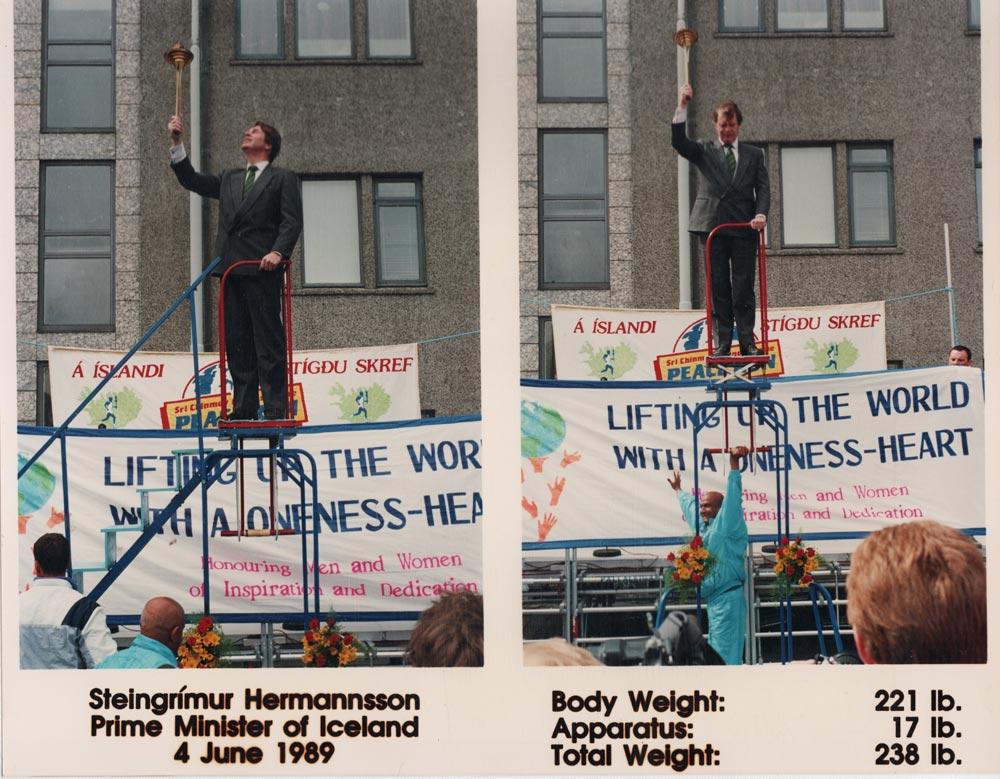
PM Steingrímur Hermannsson of Iceland holds aloft the Peace Torch whilst being lifted.
A seated one-armed lift is one of the hardest weightliftin,g challenges as the arm needs to do most of the lifting. The feats of Sri Chinmoy lifting people heavier than his own bodyweight, are impressive in their own right. Sri Chinmoy was always keen to emphasise that the essence of "Lifting Up The World With a Oneness-Heart" was the feeling of oneness.
As you can see, I am not a bodybuilder; I am not a weightlifter. I do not have the muscle mass of a bodybuilder; I do not have the strength of a weightlifter. But I am a truth-seeker and a God-lover. I pray and meditate so that I can establish my oneness with each and every human being in the whole world. My lifting is all done on the strength of my heart's oneness with the world. I do this in the spirit of my soulful and devoted service to humanity.
Sri Chinmoy also offered this most significant revelation of the significance of his Lifting Up the World programme on 28 July 2005.
Sri Chinmoy: I lift people to offer my gratitude, gratitude to the Lord Supreme. So many children, so many world leaders, so many I lift.
Whom do I lift? The living Presence of God I lift. Not the name, not the form, but the real Divinity inside – that I lift with my aspiration. The living Presence of God.
Heads of State
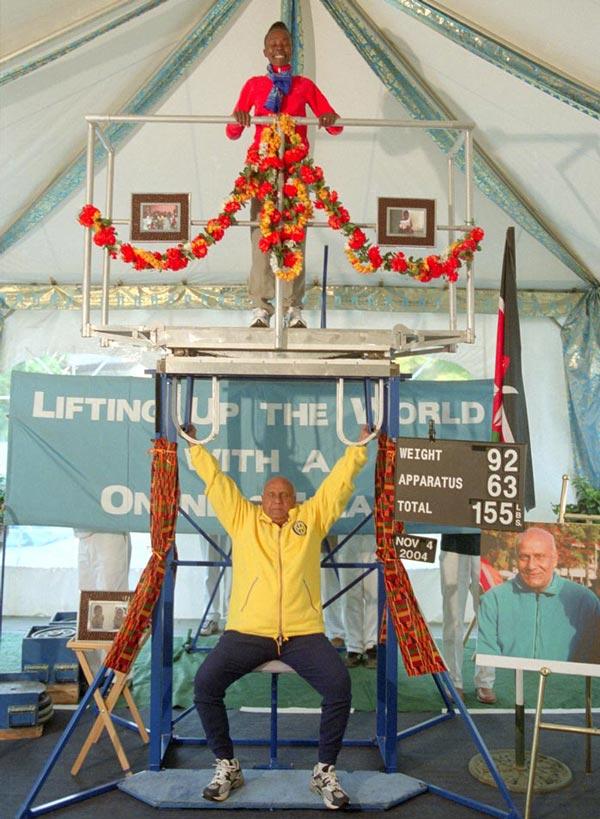
From left to right. President Nelson Mandela (South Africa, 9 March 1999) President Ranasinghe Premadasa (Sri Lanka, 4 January 1990) President Jorge E. Illueca of Panama - 21 July 1989
United Nations
From left to right. Javier Pérez de Cuéllar, 5th Secretary General of the United Nations, 26 May 2005 Vladimir Petrovsky, Former Director-General of the United Nations in Geneva, 12 October 2002 Professor Ibrahim A. Gambari, Under-Secretary-General of the United Nations, 4 March 2002
Sport
From left to right. Sudhahota Carl Lewis, Olympic champion - 10 September 2001. Billie Jean King, tennis champion - 22 May 2003. Tegla Laroupe, Marathon champion - 4 November 2004
Cultural/Music
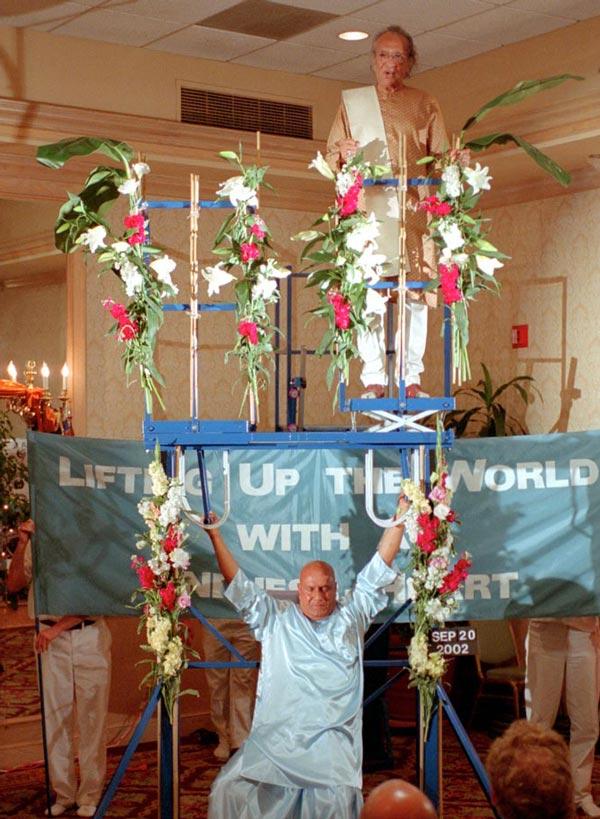
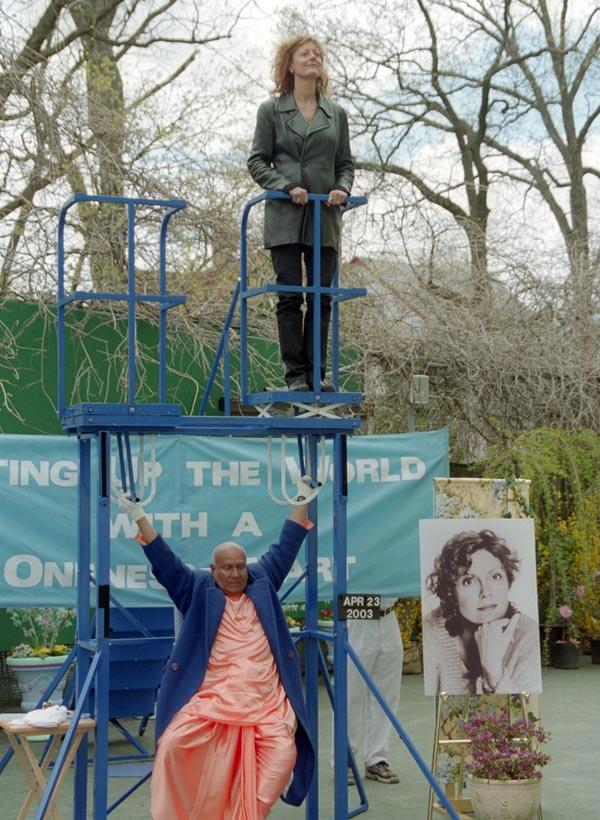
From left to right. Ravi Shankar, 20 September 2002 Susan Sarandon, 23 April 2003 Roberta Flack, 29 October 1988
Religious/spiritual figures
From left to right. Cardinal Basil Hume, 19 October 1990 Rabbi Marc Gellman, 23 May 2001 Buddhist monk, 23 May 2001
Kind Words for Lifting Up The World With a Oneness-Heart
"I am very happy you are here. I feel deeply honoured to be a part of your worldwide organisation and to take part in this wonderful programme. I am happy this moment has come. Your powerful group carries an equally powerful message for the world."
PRESIDENT NELSON MANDELA South Africa, March 9th, 1999 (The 2,000th person to be lifted by Sri Chinmoy)
"You spread the ideas of non-violence, tolerance and harmony among people. All of us are inhabitants of the same planet. We are members of one family. And you spread the idea of one family all over the world."
VLADIMIR PETROVSKY Former Director-General of the United Nations in Geneva, October 12th, 2002 (The 5,000th person to be lifted by Sri Chinmoy)
"To be lifted once in a lifetime, I think, is good enough for most. To be lifted twice is an honour I cannot forget. I am overwhelmed. I want to thank Sri Chinmoy for this tremendous honour. By honouring me, you are honouring more than just me. You are honouring the town from which I come in Nigeria, the country from which I come, the continent from which I come, and the United Nations, where I work. Sri Chinmoy is a wonderful human being whom I am proud and privileged to know. There is no higher calling, no higher pursuit than peace. This is what Sri Chinmoy symbolises."
PROFESSOR IBRAHIM A. GAMBARI Under-Secretary-General of the United Nations, Special Adviser to the Secretary-General on Africa, March 4th, 2002
"Who can imagine what Sri Chinmoy does! He does it through his spiritual strength, his power, putting his faith in God and understanding that anything can be achieved. I think it is a message that is strong to everyone about where to direct their attention or meditation and that they can achieve anything they set out to do."
SUDHAHOTA CARL LEWIS 9-time Olympic Gold Medallist in track and field, November 17th, 1999
"Sri Chinmoy has no one to look at and say that such things are impossible. The only thing he can do is to feel what is inside him. For Sri Chinmoy there are no limits to the human body. To get beyond that is a wonderful feeling, because no one else has ever done what he is doing. But just because no one else has done it does not mean that it is impossible. Sri Chinmoy is the proof. Sri Chinmoy is exposing the wonderful mystery of what we are. He is exposing capabilities that humans have never tapped before. He has placed aside all barriers. To overcome the difficulties and go beyond limitations is the sign of someone very great. No one has been where Sri Chinmoy is now. Sri Chinmoy is a pathfinder for humanity."
AL OERTER 4-time Olympic Gold Medallist in the discus, February 18th, 2000 (lifted with his wife Cathy)
"First Swami Vivekananda came to give India's spiritual wealth to the West. Then came Paramahansa Yogananda. Now Sri Chinmoy has come."
MAESTRO RAVI SHANKAR Legendary Sitar Player, September 23rd, 2002
"Sri Chinmoy was in San Diego recently, so Christine and I went to see him. This was the first time Christine had met the Guru, and he lifted us together along with dozens of athletes in attendance. I was amazed at how his shoulders had grown and upper back had become wider from the overhead lifting. At 71 years of age, Sri Chinmoy continues to work out and lift more weight. I spoke a few words to the gathering before we left and got a standing ovation as I recited a stanza from a song I wrote about him years ago...Feeling very inspired afterwards, I was in high spirits all day."
FRANK ZANE 3-time Mr. Olympia, 3-time Mr. Universe, Mr. America, September 24th, 2002 (lifted with his wife Christine). Comments reprinted from the Autumn 2002 issue of his magazine Building the Body
"When Sri Chinmoy lifts, the feeling that you have starts from inside. It's a wonderful thing. It's as if you feel yourself being lifted by someone from inside first...Sri Chinmoy is trying to give people a chance to actually see the spirit. The way he does the lifts is with God's Power and Strength and Support."
ADDWITIYA ROBERTA FLACK 6-time Grammy Award-winning vocalist, July 29th, 2001
Helen Hunt on David Letterman
Stories about Lifting up the World With a Oneness-Heart
Father’s Day in America falls on the third Sunday in June, and each year Sri Chinmoy’s disciples, friends and well-wishers around the globe celebrate this day. Take a look at this special day throughout the years. Here also, is a selection of Father’s Day songs, composed by Sri Chinmoy.
Sri Chinmoy came into this world between 5:13 and 5:30, an hour before sunset, on Thursday, August 27th, 1931. According to the Indian calendar, it was the month of bhadra, towards the end of the monsoon season.
Throughout his lifetime, the child that was born on that day to Shashi Kumar Ghosh and his wife Yogamaya was known by many different names and appellations. This is a humble attempt to reveal the significance of some of these names.
The names by which a spiritual Master is known are extremely sacred. For a devotee, they are almost too sacred to utter. In Sri Chinmoy’s case, some names are widely known around the globe, while others are not. Again, there are others which perhaps shall never be known. For most of us, however, our love and devotion for this God-Soul are encapsulated in one simple word – ‘Guru’ – and we were privileged to address him by this beautiful title hundreds upon hundreds of times.
Ganapati
Statue of Lord Ganesh, the giver of realisation
When Yogamaya gave birth to her seventh child at the family home in East Shakpura, it seems that no formal male or female name had been chosen in advance of the baby’s arrival. It was the Indian custom in those days to pray for the divine inspiration to name the child only after its birth, when the baby’s gender was established and its inner and outer propensities had begun to emerge. In the meantime, the child was given a temporary name.
The child was born during Ganesh chaturthi, the time of year during which Lord Ganesh is believed to have descended to earth. (Lord Ganesh, also known as Ganapati, is worshipped for a ten-day period which varies each year according to the lunar calendar.) Thus it seemed auspicious to give the child the name Ganapati. This name proved particularly apt. Physically he bore a resemblance to the beloved elephant god because of the size of his head and stomach. Predictions about Ganapati’s future made by the wise grandmothers on both sides of the family linked him with other aspects of this cosmic god. As Sri Chinmoy’s elder brother Chitta explained:
“When [Madal] was an infant, his head and abdomen were comparatively larger than the rest of his body. His horoscope name is Ganapati, so our grandmother used to say that he was definitely going to be another Ganapati – Siddhi Data – the giver of realisation and also the scribe who noted down the Mahabharata from the sage Vyasa in one sitting. Ganapati also has a big head and stomach. Our grandmother said that Madal was going to be a great writer like Ganapati. Many, many years ago she prophesied this. She was right.” (excerpt from “Chitta’s Notebook” in My Brother Chitta)
Sri Chinmoy revealed that his second grandmother endorsed this view that the child would be a writer:
“Another grandmother prophesied that Ganapati would be a clerk. For a village woman to have a grandson who is a clerk is a real achievement. What she actually meant was that Ganapati was destined to deal with paper. She was right! In his later life, Ganapati went on to write many, many books. Instead of becoming a clerk, Ganapati became a poet and author. This is how her prophecy came true.” (Compassion-Affection versus Deception-Destruction)
It is not known how long the family employed the horoscope name Ganapati for the little child. It seems that it was soon replaced by his affectionate nickname. In later years, however, Sri Chinmoy did restore the name ‘Ganapati’ as a pseudonym in some of his autobiographical stories. And it gives one pause to reflect when we recall that in February 2007, at the age of seventy-six and less than eight months before he passed behind the curtain of Eternity, he spent three entire days among the elephants of Thailand. The connection with Lord Ganesh, the giver of realisation and the remover of obstacles, was present at the dawn of his life and at its close.
Madal
One of Ganapati’s grandmothers unwittingly played a key role in the choice of his next name: Madal. When it became evident that the child would be born during the month of bhadra (the month of turbulent weather), she reminded the family of the Bengali village belief that those who are born during this month cause untold destruction. The truth of her dire prediction was lent credibility by a dramatic event that occurred on the day of the child’s birth. Sri Chinmoy used to take great delight in retelling this significant story:
“The day I was born, our house in the town was burnt to ashes. Therefore, my grandmother said to the family members that this rascal would destroy the whole family.
My mother said, ‘No, my child is going to bring tremendous name and fame to our family.’
A week later my grandmother composed a couplet in Bengali that said: ‘The bhadra-born people turn everything topsy-turvy.’ The name of August is bhadra in Bengali, but in the Chittagong dialect we say bhada. The words to the poem were:
Ek bhada jar Ut put tar
My mother also composed a couplet in Bengali saying that he who is born in this month, bhadra, is definitely going to beat the golden kettledrum. The golden kettledrum is being played in the Heavens by the Cosmic Gods. The poem was as follows:
In other versions of the same story, Sri Chinmoy seems to indicate that this warning about his destructive tendencies was an oft-repeated refrain from that particular grandmother.
And so it happened that the image of the kettledrum came to be synonymous with the boisterous child and he acquired the nickname ‘Madal’ permanently. It appears to have been used within the family circle to the exclusion of all subsequent names as a token of their infinite affection and love.
The ‘destruction’ portion of the grandmother’s prediction bears further examination. When speaking of spiritual matters, Sri Chinmoy used to emphasise that what Indians traditionally call the Destroyer aspect of God is, in fact, the Transformer aspect. In the process of evolution, imperfection is transformed into perfection, ignorance is transformed into wisdom and darkness is transformed into light. The great Sanskrit mantra from the Upanishads is:
Asato ma sad gamaya Tamaso ma jyotir gamaya Mrityor ma amritam gamaya
[Lead me from the unreal to the Real. Lead me from darkness to Light. Lead me from death to Immortality.]
This is the prayer of each and every seeker. In one sense, negative qualities must be destroyed before divine qualities can enter, but Sri Chinmoy always preferred to say that darkness, ignorance and untruth must be transformed from within. In his opinion, ignorance is nothing other than limited light in the process of becoming unlimited light.
So the mysterious conflagration that engulfed the family house and happened to coincide with Madal’s earthly arrival may be interpreted in a spiritual sense as proof of the immense transformative power that he brought with him.
In reference to his own family, although Madal did not bring about its destruction, his passing did signify the end of the Ghosh line. Of the seven children born to Shashi Kumar and Yogamaya, not one married and had children. All of them entered the spiritual life. A maternal aunt and several cousins followed suit. One by one, they all passed away within the hallowed precincts of the Sri Aurobindo Ashram, with the result that what was once a huge, extended family is survived today only by a handful of distant relatives with whom Sri Chinmoy maintained no contact. In this respect, Madal’s appearance did signify the end of this illustrious and pious family.
The name ‘Madal’, with all its attendant sweetness and affection, remained the province of close family members for as long as they lived and, indeed, long after he came to be known as ‘Chinmoy’ and eventually ‘Sri Chinmoy’. This is exemplified by a letter Sri Chinmoy composed to his long-departed father at the time of his father’s centenary celebrations and which appears as the preface to his 500th book:
April 14th, 1982
My dear Father,
On the occasion of your most auspicious centenary, I am offering you my five hundredth rose, “I Am Ready” from my crying and smiling heart-garden. May you remain in heavenly Peace, Light and Delight until I come and join you.
Yours in the Eternal Father Supreme, Madal
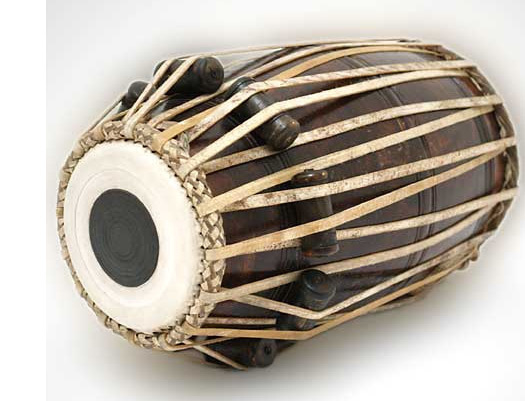
Photo of a madal-kettledrum
On another occasion, towards the close of his sister Lily’s life, Sri Chinmoy made an emergency trip to Pondicherry, South India, to visit her at the Nursing Home. When he entered the room, he was accompanied by his brother Mantu. He greeted his sister, but she was barely in this world and was not conscious of his presence. Then Mantu said to her, “Maduliar has come.” Immediately, Lily opened her eyes and greeted her beloved youngest brother with utmost joy. Sri Chinmoy told us that the name ‘Maduliar’ was a very sweet adaptation of ‘Madal’ that was only used by one or two very intimate family members.
The musical instrument from which he derived the name ‘Madal’ is actually a two-headed hand drum. It is, on average, two feet in length and has a cylindrical shape with a slight bulge in the middle. The drum is held horizontally, suspended by a neck strap, and is played with both hands. It was originally made from a hollow tree trunk, but most madals nowadays are made of wood or clay. These kettledrums are popular folk instruments because they are compact and easy to carry.
Madal himself liked his name because of its ancient links with the great Moghul Emperor Akbar, whom he admired enormously:
“Ganapati used to admire Akbar, the greatest of the Mughal emperors. Of all the Mughal emperors, Akbar the Great was the one who wanted most sincerely to unite Hindus, Muslims and Christians into one religion. He tried extremely, extremely hard to bring about his lofty goal. For him, there was only one religion, which was love of God. Ganapati was happy that, according to historians, the emperor Akbar was an expert in playing the madal-kettledrum. Akbar had many singers and musicians of the highest order in his court. He also had many, many musical instruments at his disposal, but he liked the kettledrum the most.” (Compassion-Affection versus Deception-Destruction)
In later years, Sri Chinmoy ensured the perpetuity of his childhood nickname by bestowing the name Madal Bal (‘the sound of the kettledrum’) on the Divine Enterprises begun by his students in Switzerland. He also named the twice-yearly circus put on by his students Madal Circus to represent the innocent delight of this favourite entertainment.
In a number of songs that he composed using the word madal, Sri Chinmoy liked to rhyme it with badal (thunderbolt) or pagol (wild). Together, they comprise a portrait of his childhood days in the village – noisy, wild and carefree. This atmosphere is best captured by his exquisite song “Sumadhur Sure”, composed on his 47th birthday in 1978, in which he uses all three words:
Sumadhur sure antara pure Dake more prema bithika Madal badal akashe pagol Hasi ananda gitika
“Inside the very depth of my heart In a sweet and soulful tune The love-avenue calls me. Kettledrum and thunderbolt are enjoying A divinely wild game in my sky And are offering me fountain-songs Of smile and delight.” (song no. 7 – Bela Chale Jai)
Any discussion of the name ‘Madal’ must return at last to his mother Yogamaya’s most profound prediction: “He is destined to be played on by the Gods and Goddesses in the skies.” Everything that Sri Chinmoy accomplished during his earthly sojourn was at the behest of the Divine. He used to advise his students to adopt the same code of life, invoking the words of Sri Krishna to his dearest friend and disciple Arjuna in the Bhagavad Gita: “Nimitta matram bhava savyasachin.”(“Become a mere instrument.”) When one contemplates all that Sri Chinmoy achieved during his lifetime, in so many diverse fields, it is clear that he surrendered himself unconditionally to become an instrument – a golden kettledrum – so that not only the cosmic gods and goddesses but the Supreme Himself could play in and through him at their sweet Will.
Chinmoy
The necessity for Madal to have a proper given name did not arise until 1936, when he was five years old. At this time, the inspiration for the name came directly from Madal’s second oldest brother, Chitta. This is how it came about, recorded in Chitta’s own words:
“In 1936, when we visited the Sri Aurobindo Ashram, the Ashram Secretary, Nolini Kanta Gupta, wanted to know Madal’s real name, because Madal is a nickname. I was a little bit puzzled. What suitable name could we give to our youngest brother? Our eldest brother’s name is Hriday Ranjan. My name is Chitta Ranjan. My younger brother’s name is Manoranjan. Then Prana Ranjan was coming to my mind to give as Madal’s real name, but it was not satisfying my heart. All on a sudden, I got an inner message. A divine voice echoed and re-echoed in my heart: ‘Chinmoy, Chinmoy!’ My human mind never thought that this name would one day be accepted, loved and adored by countless truth-seekers and God-lovers.” (This and the following excerpts from Chitta’s notebooks are reproduced in My Brother Chitta)
Chitta gives the divine meaning of this name and shows how in Bengali the addition of the suffix -moy changes the pronunciation from Chitmoy to Chinmoy. Chitta also expresses his gratitude to God for the inner vision that gave him the capacity to see the Divine in his little brother:
“Chit plus moy = ‘Chinmoy’. Chit is consciousness; moy is full: full of consciousness, consciousness all-pervading.
God, out of His infinite Compassion, gave me the insight to see our youngest brother the way he is supposed to be seen. I was so fortunate that I knew who he was. I loved him dearly. He, too, reciprocated. We love each other deeply, soulfully, unreservedly and, perhaps, unconditionally, too.”
It is significant that Chitta’s own name is derived from the same Sanskrit root – Chit, meaning consciousness – and this link between the two brothers in name is yet another manifestation of their deep inner connection. Again, ‘Chinmoy’ as a proper name was not altogether unknown to Chitta. At the Sri Aurobindo Ashram in the 1930’s there was a female devotee of the Mother named ‘Chinmoyee’. But, ultimately, it seems that the inspiration to name his youngest brother ‘Chinmoy’ came directly from an inner, divine prompting.
It is intriguing that the responsibility for giving a formal name to the child devolved upon Chitta rather than upon the parents. It seems that, to some extent, Chitta had already assumed the role of father figure to Madal – a role that would become permanent after the passing of Shashi Kumar Ghosh in 1942. It is not known whether there was any formal naming ceremony at this time, but it does seem that it coincided with Hriday’s decision to cast his youngest brother’s astrological chart according to the ancient system created by the sage Bhrigu.
When Hriday took the remaining members of the family to the Sri Aurobindo Ashram in July 1944, Madal officially became Chinmoy to everyone outside the close family circle. Chinmoy’s first opportunity to have the blessings of Sri Aurobindo came a few weeks later, on August 15th, the Darshan Day that commemorated Sri Aurobindo's birthday. At this time, he stood in the long queue with other much older Ashramites to pass by Sri Aurobindo and the Mother for a few fleeting seconds. Chitta describes how the Mother broke her customary silence in order to draw the Master’s attention to the young boy:
“In 1944, during the Darshan time, the Mother herself introduced Chinmoy to Sri Aurobindo, saying, ‘Hriday’s youngest brother, Chinmoy….’ Usually the Mother never did this kind of thing. Although some of us came long before Chinmoy and joined the Ashram, Mother used to refer to us as Chinmoy’s brothers and sisters. Always Mother used to introduce me as ‘Chinmoy’s brother’. We have been in the Ashram now for at least forty years. Even now, when they talk about us, many members in the Ashram say, ‘Chinmoy’s brothers and sister’. Such affection, such love he enjoyed both from the Mother and the members of the Ashram.”
It is interesting to note that although the Mother gave spiritual names to Sri Chinmoy’s sisters, she did not do the same for Hriday, Chitta, Mantu or Chinmoy. From 1944, when he became a permanent member of the Ashram, until 1964, when he left for America, Chinmoy retained the same name. One might even say that he grew into the meaning of his name as his realisation deepened. In his poem “An Orphan Boy”, written on May 24th, 1998, he says:
“There was an orphan boy. His name was Madal Chinmoy. He hailed from a wee village, Shakpura. He became his family’s ananda fuara.
***
“Madal, kettledrum of the cosmic Gods, Became Chinmoy, Consciousness-full. God’s Compassion-Eye made him A Teacher of His inner School.” (Unpublished)
On December 2nd, 1977 a schoolchild disarmingly asked Sri Chinmoy, “Do you like your name?” His reply was:
“Yes, I do like my name. There are various reasons why I like my name, but the main reason is that inside my name I see continuously an expansion of my own consciousness. Now, you may want to know what consciousness is. Consciousness is a very, very long bridge that connects earth’s helplessness with Heaven’s fulness.” (Jharna-Kala Art Quarterly, Vol 1, No 3)
His perception of the role of consciousness as the bridge between this earthly realm and the Divine can easily be read as a statement about his own role as a spiritual Guide:
“Consciousness is the connecting link between earth and Heaven. Consciousness connects the cry of the finite with the Smile of the Infinite. Consciousness is the connecting link between earth’s aspiring reality and Heaven’s smiling Reality. It is the bridge between the reality that is growing and the Reality that eternally is.” (The Significance of a Smile)
According to ancient Indian philosophy, the highest state of realisation is the triple consciousness – Satchidananda, which translates as ‘Existence-Consciousness-Bliss’. At the core of this word is the same Sanskrit root chit. The exalted state of Satchidananda is the goal of all spiritual aspirants and, by name and by destiny, the young Chinmoy came to be fully identified with it. He writes:
“There are seven higher worlds and seven lower worlds. An aspiring human being enters into one of the seven higher worlds and makes progress in the inner life. Like a bird, his aspiring consciousness flies from one world to another, until finally he finds himself in the seventh world, Satchidananda, the world of Existence, Consciousness and Bliss. There he becomes consciously and inseparably one with the Supreme Pilot.” (The Vedas: Immortality’s First Call)
When discussing how this youth eventually came to be known around the globe by a single name, it must be remembered that at the Sri Aurobindo Ashram first names were entirely self-sufficient. In the small, eclectic spiritual community that was established at Pondicherry, there was no longer any need for surnames, and we know that nicknames were not encouraged. Elders had the suffixes –da or –ji (male) or –di (female) attached to their first name as a mark of respect, but since Chinmoy was junior to most of the Ashramites when he arrived, this did not apply to him until many years after he had departed for the West. During his two decades at the Ashram, he was, quite simply, ‘Chinmoy’ – secretary to Nolini-da (the General Secretary of the Ashram), champion athlete, budding poet and fellow Ashramite.
There were some close friends and admirers, however, who recognised their Chinmoy’s spiritual attainments. Sri Chinmoy often referred to the very first time he returned to his normal consciousness after being in samadhi (trance). This experience took place during his school years. Since he did not complete high school, his age must have been somewhere between twelve and sixteen:
“My favourite Indian joke is what happened the first day I came down from the highest type of samadhi. I forgot my name. I was trying to think of my name, but I could not remember it. Then it came to my mind that one of my school notebooks had my name on it. I looked at the cover of the notebook and found my name. When I came down from that consciousness the second and third time, I had to ask my friends what my name was. My friends were my greatest admirers. They knew my realisation, so they did not cut jokes with me.” (Smile of the Beyond)
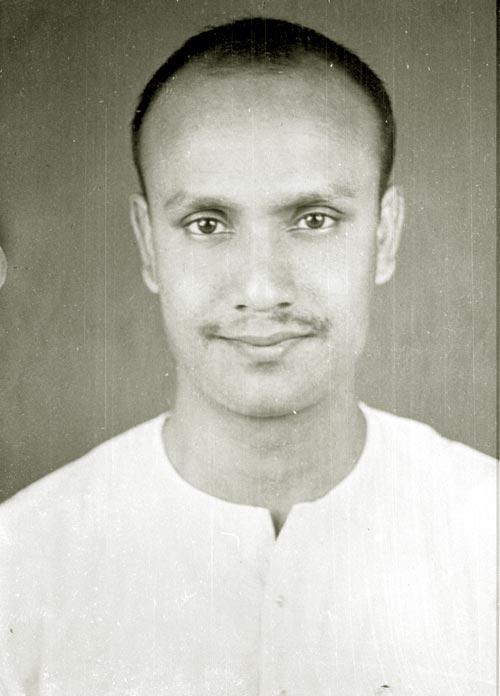
Sri Chinmoy passport photo 1964.
In the Ashram, however, he remained always a humble disciple of Sri Aurobindo and the Mother and he was reluctant to put himself forward in any way. He happily embraced the lowly jobs of washing the dishes of the other Ashramites at mealtimes and running errands for the seniormost pillars of the Ashram. And, even in the West, long after he had become known as ‘Sri Chinmoy’, he always signed his letters back to older Ashramites in India as ‘Chinmoy’. He once wrote a letter to the esteemed scholar of mysticism, Dr. Sisirkumar Ghose, who had been one of his mentors during his Ashram years, and inadvertently signed it ‘Sri Chinmoy’. He immediately took his pen and, with a flurry of lines and swirls, transformed the ‘Sri’ into a beautiful bird to disguise his mistake. He was also most insistent that his autobiographical stories about his Ashram years appeared with this single name.
Sri Chinmoy rarely wove autobiographical elements into his thousands of poems and songs. However, his own interpretation of the spiritual and mystical significance of his name does appear at a few selected places. In one especially poignant couplet, he questions:
“Chinmoy, Chinmoy, Chinmoy, Chinmoy. Am I God-Eternity’s self-amorous boy?”
In his Bengali songs, Sri Chinmoy sometimes uses his name as the happily rhyming antithesis of mrinmoy (ignorance), as in the following creation dated August 27th, 1974, his 43rd birthday:
Ami kalo mrinmoy Ei mor parichoy Ami taba barabhoy Ei mor parichoy Ami habo chinmoy Ei mor parichoy
“I am dark ignorance-clay; This is my earth-reality. I am Your Compassion-flood; This is my Heaven-reality. I shall be consciousness universal and transcendental; This is my Absolute Reality Supreme.” (song no. 54 Supreme, I Sing Only For You)
Bengali proper names, unlike most Western or Christian names, often double as regular nouns and occur quite naturally in speech. In rare instances, Sri Chinmoy uses this ambiguity between the noun ‘chinmoy’ and the proper name ‘Chinmoy’ to invest his Bengali lyrics with subtle nuances. In the following song, composed in the autumn of 1977, he conveys the image of a boat of consciousness gently rocking. At the same time, he suggests his own spiritual path, which he often referred to as the Golden Boat:
Ananda bhola nirvana dola Tunga ala chinmoy bela
“Self-enraptured in the swing of nirvana, The boat of consciousness infinite Is spreading pinnacle-light.” (song no 27 My Indian Sunrise)
One comparatively recent Bengali and English song is uniquely autobiographical. In it, Sri Chinmoy celebrates the derivation, the meaning – and perhaps the fulfilment – of both his nickname and his formal name:
Shuno shuno bishwa basi Madal amar upanam Chit + moy Chinmoy Ta je amar dharadham
“Hearken, hearken, O world citizens, Madal is my nickname. Madal is a God-kettledrum. Madals are played by the cosmic Gods. Chinmoy, boundless consciousness of the Universal Home.” (January 22nd, 2001 – song no. 296 Sanjher Tara, Part 3)
Finally, there is this classic English song, composed on June 1st, 1996, in which Sri Chinmoy reviews the three names of his childhood in terms of some infinitely larger historical and spiritual perspective:
“Young in heart, young in mind, Ganapati, Madal, Chinmoy. Old and gold in oneness-soul, A God-memory-toy.” (Sri Chinmoy’s Rainbow-Dreams)
Kumar
As we learnt earlier, Chitta had resolved to put ‘Ranjan’ as Sri Chinmoy’s middle name in line with the other brothers of the family – Hriday Ranjan, Chitta Ranjan and Manoranjan (Mantu). It is not clear where this middle name, meaning ‘delight’, originated. On his mother’s side of the family, the customary middle name was ‘Charan’.
However, once Chitta received the inspiration to give Madal the proper name ‘Chinmoy’, it seems that he decided to break with tradition and give him the patronym ‘Kumar’ after Shashi Kumar Ghosh. The young Chinmoy said that he felt so honoured and proud to receive his father’s middle name.
‘Kumar’ means ‘unmarried youth’ in Bengali and has the additional meaning of ‘prince’. Historically, the son of a king, the heir apparent, is addressed as ‘Rajkumar’. Another very interesting insight into the name comes from Indian mythology where ‘Kumar’ is one of the names of the cosmic god Kartikeya [also known as Skanda]. Kumar was the younger brother of Ganesh. He grew into a skilful and powerful warrior and eventually became the commander-in-chief of the cosmic gods. The name ‘Kumar’ refers to the fact that he never married.
Ghosh/Ghose
Ghosh is a surname found predominantly in Bengal. Some Ghosh families, as in the case of Sri Chinmoy, originated from East Bengal, present-day Bangladesh. From this surname, one learns that the family is Hindu and also of Kshatriya [warrior] caste.
Shashi Kumar Ghosh favoured this transliteration into English of the Bengali name. Thus his son’s name upon entering the Sri Aurobindo Ashram was formally Chinmoy Kumar Ghosh. However, in order to align himself more completely with his spiritual Master, Sri Aurobindo, Chinmoy changed the spelling of his surname to Ghose.
Sri Aurobindo was born Aravinda Acroyd Ghose. (In 1906, he adopted the more Bengalicised spelling ‘Aurobindo’) At some stage during the twenty years that Chinmoy was a permanent member of the Ashram, he began to adopt ‘Ghose’. Though it is, perhaps, self-evident, it is worth mentioning that the Bengali characters remain unchanged either way. In due course, I believe Chinmoy’s brother Chitta and sister Lily followed his lead, while the other members of the family are thought to have retained the spelling ‘Ghosh’.
Ghose is derived from the Sanskrit word ghoṣa. It has two meanings. On the one hand, it means “sound, reverberation, din, shout, battle-cry.” In this context, it can also refer to the roar of water or the cry of an animal. On the other hand, ghoṣa is an occupational name, meaning ‘cowherd’.
The most eloquent interpretation of the meaning of ‘Ghose’ was undoubtedly given by Lakhan L. Mehrotra on September 27th, 1978. Mr. Mehrotra was formerly Sri Chinmoy’s boss at the Indian Consulate in New York. He later became Consul General of India in California and then went on to a most distinguished career as India’s High Commissioner/Ambassador to a number of countries. Upon meeting with Sri Chinmoy again, after a gap of some eleven years, he rose at one of Sri Chinmoy’s concerts held at San Francisco State University and addressed the audience as follows:
“I have known Sri Chinmoy as Chinmoy Ghose now for several years, and ‘Ghose’ means resonance. Sri Chinmoy the resonant will always reverberate in our hearts with his eternal message. He brings to you a spiritual tradition which sprang up and flourished in the mountain-vastness of the Himalayas several thousands of years ago and which has been carried across the seven seas by Everest-streams and rivers. Sri Chinmoy is part and parcel of that eternal Stream. Sri Chinmoy belongs to that stream of thought and sentiment which has shown us the Light for ages. He recited a verse from the Upanishads a little while ago: Asato ma sad gamaya, ‘Lead me from the unreal to the Real’; Tamaso ma jyotir gamaya, ‘Lead me from darkness to Light’; Mrityor ma amritam gamaya, ‘Lead me from death to Immortality.’ May I say that while we mortals pray for that Immortality, Sri Chinmoy is part of that Immortality. I consider those blessed who sit in his presence and who seek his presence, and I know that even after I and you and everyone is gone, his voice and his message will be with us, for that is the Message Supreme to which I bow.” (The Vision-Sky of California)
While it may seem curious to some that Mr. Mehrotra should have focussed his comments on ‘Ghose’ rather than ‘Chinmoy’, it can be explained by the fact that when Sri Chinmoy worked at the Indian Consulate from 1964-67, it was the custom of colleagues to address each other in the British Public School tradition only by their last name. Thus, he was called simply ‘Ghose’. It must have marked a great change for the young man of thirty-two, who had hitherto been known only as ‘Chinmoy’.
Another famous spiritual luminary who shared this surname is Paramahansa Yogananda who was born Mukunda Lal Ghosh. Dr. Sabyasachi Ghosh Dastidar, Chair of the Politics, Economics and Law Department at the State University of New York at Old Westbury, informs me, “Ghosh is one of the very old Bengali traditional names, and all the Ghoshes are ‘related’, meaning in Hindu culture they have the same gotra or blood line.”
C.K.G.
C.K.G. – the initials of Chinmoy Kumar Ghose – is the pen-name used by Sri Chinmoy when signing his artworks. He first introduced this pen-name on November 19th, 1974 when he completed his first painting, a rose, and he used it exclusively in connection with his art. Although he did manage to sign and date many thousands of his paintings, it would have been physically impossible for him perhaps to sign his entire output of more than 16 million bird drawings and 150,000 paintings.
Sri
‘Sri’ is an honorific title for a male, usually a person of distinction. It denotes respect and esteem, particularly when used for a holy man. It can also be spelt Shri, Sree or Shree. It is widely used in the Hindu, Buddhist, Jain and Sikh cultures.
In Sanskrit, ‘Sri’ means ‘prosperity’. Originally, it referred to the goddess Mahalakshmi, the goddess of prosperity and beauty, but nowadays it is used primarily as a masculine name prefix, while ‘Srimati’ and ‘Sushri’ are used for women. Thus, in the case of a holy man, for example, it literally means “one who is endowed with inner wealth.”
In some instances, ‘Sri’ can be equated with the English ‘Mr’, or possibly the old-fashioned ‘Venerable Sir’. When used as a title for a holy man, it translates as ‘Revered Teacher’ and indicates that he has realised the Highest. When used as an epithet for one of the cosmic gods or goddesses, it can be translated as ‘Lord’.
In Sri Chinmoy’s case, he was given this respectful title after he began offering talks in the West. We can perhaps date it then from as early as 1965. All his books published in the West, beginning with “Meditations: Food for the Soul” published in 1970, bear the name Sri Chinmoy and that is also how he signed his letters.
In the case of Sri Aurobindo, I am informed by his biographer Peter Heehs that “he signed Aurobindo Ghose until 1926, when he began to sign Sri Aurobindo (Ghose). Sri Aurobindo became standard by the end of the 1920’s.” Sri Ramakrishna and Sri Chaitanya are also referred to by this honorific.
Other epithets have been used for spiritual Masters. Sri Ramakrishna was also called ‘Paramahansa’ (Great Swan, that is, the swan of realisation), as was Paramahansa Yogananda; Ramana Maharshi means ‘Great Seer’ (Maha + rishi); while Mahatma Gandhi, the great social reformer, means ‘Great Soul’ (Maha + atma).
In the case of Sri Chinmoy, however, he became known around the world and will forever be known simply by these two words, inextricably linked. As he wrote in one brief song on March 26th, 1997:
“C.K.G. the Artist. Madal the Drummer. Chinmoy the Poet. Sri Chinmoy the Dreamer.” (Jharna-Kala Songbook)
Guru
This shortest, most endearing, almost anonymous and yet beloved name is how Sri Chinmoy was known to his near and dear ones in the West. His disciples always addressed him simply as ‘Guru’. His closest friends called him ‘Guru’. Nothing more was needed.
Nowadays this sacred word is applied liberally in the media – there are fitness gurus, media gurus, financial gurus and so forth. But for those whom Sri Chinmoy touched, inspired and guided, the word shall forever retain its original meaning: a Guru is the master, the spiritual preceptor, who illumines the age-old ignorance of the seeker. A true Guru is one who has attained God-realisation, also known as enlightenment.
Sri Chinmoy explains:
“Guru is a Sanskrit word. It means ‘he who illumines others’. The Guru brings light. Light itself is the real Guru. In my case, I always say that I am a server. I am a child of God and you are also a child of God. We are members of the same family. The one who came first into the family perhaps knows more than the ones who came after him. In terms of spirituality, I know a little more than my students. Being the elder brother, I know more about our Heavenly Father, God. I teach them how to pray and meditate so that they can also have a free access to our Heavenly Father, their Inner Pilot.” (Sri Chinmoy Answers, Part 29)
Time and again, Sri Chinmoy returned to this theme: that the only real Guru is God. He drew a clear distinction between the human Guru and the God whom he represents on earth:
“Everybody has the same Guru, the only Guru, the Lord Supreme. But when one is a beginner, one cannot or may not know where the real Guru, the eternal Guru, is, just because he does not have a free access to Him. At this point, if somebody helps the seeker enter into his own world of Divinity and Reality, then the seeker learns or discovers his own Divinity. This is the role of the spiritual Master, the human Guru. But the real Guru is inside the inmost recesses of each aspiring heart.” (Self-Discovery and World-Mastery)
Significantly, another word for God in Sanskrit is ‘Adiguru’ – that is, the original or first Guru. The following highly personal poem declares the same theme in language of utmost love and devotion:
The necessity of having a human Guru is a matter for each individual to decide according to his own inner voice. Sri Chinmoy believed that if one wants to achieve the highest goal –self-realisation – then the assistance of a human Guru is indispensable:
“To achieve realisation oneself and alone is like crossing the ocean in a raft. But to achieve realisation through the Grace of a Guru is like crossing the ocean in a swift and strong boat, which ferries you safely across the sea of ignorance to the Golden Shore.” (Eternity’s Breath)
In several of his brief, aphoristic poems, he expresses the role of a Guru as a humble intermediary between earth and Heaven:
Swami Vivekananda went much further and declared, “No man can see God but through these human manifestations.”
To be linguistically precise, ‘Guru’ is made up of two Sanskrit roots: ‘Gu’ meaning ‘darkness’ and ‘ru’ meaning ‘removal’. Thus, the Guru is the dispeller or remover of darkness. The allegorical meaning is “one who transforms darkness into light.” The word may also have a connection with the root ‘gur’ meaning ‘to raise or lift up’. In this context, the Guru is one who lifts up darkness or ignorance, something that Sri Chinmoy did both inwardly through his meditation and outwardly through his weightlifting. Strangely enough, the link with weightiness does not end there. When used as an adjective, ‘guru’ actually means ‘weighty; heavy’. So the Guru, correspondingly, is someone who is heavy with knowledge or wisdom.
I am informed by Tanima Bossart, who joined Sri Chinmoy’s Path in February 1968 and whose mother joined the previous year, that Sri Chinmoy was called ‘Guru’ by his disciples even in those early days. Tanima’s mother, she said, “found out about Sri Chinmoy from the publicist on her off-Broadway show, who said to her, ‘I have a Guru’, and that’s how it started for her.” I also have vivid memories of Sri Chinmoy telling us that an Irish newspaper had called him by this title in December 1970 when he visited Dublin to offer lectures. This was the first time that he had been referred to as a Guru in the media.
In Sri Chinmoy’s letters to his students and close friends, he would sign either ‘Guru’, ‘Guru Chinmoy’ or ‘Guru Sri Chinmoy’. In conversations on the telephone, he would often announce himself by saying, “This is your Guru speaking.”
In essence, the word ‘Guru’ can have no meaning without the corresponding word ‘disciple’. A Guru has no separate existence by himself, for a Guru’s very existence depends on the existence of his disciples or spiritual children with whom he can share the fruits of his realisation. Hence, every time we addressed Sri Chinmoy as ‘Guru’, we were invariably reminded of our own role as seekers after wisdom.
The Unknown, Unknowable and Forever Lost Names
Many years ago, Sri Chinmoy was asked if he had any other names which were not known to his students. His reply was:
“I had so many names in the Ashram. My dearest friend, who saw something in me long before anybody else, used to call me Chinny. Someone else used to call me Chinnymoyda. ‘Chinny’ means sugar and ‘moyda’ means flour. When I was very young, some people used to call me a name that meant ‘Japanese doll’ because they felt I was cute. Then some people, especially girls, gave me a name meaning ‘fire’ because my eyes were always red, wide open and very fiery; they felt there was no compassion in my eyes. Others called me Jogisamrat, Jogibar or Jogiraj. Everybody can give names. When my disciples are pleased with me, they give me one name; when they are displeased with me, another name they give me. Every day they may give me a different name, and I am ready to accept all of these names. So these are the names that I had. I also have many, many inner names, but those are not for the disciples to know. Some special souls have given me names and also some of my disciples have given me names, but that information is restricted.” (Sri Chinmoy Answers, Part 8)
Of the names mentioned here, ‘Jogi’ is the Bengali equivalent of Yogi. Thus the three names mentioned mean respectively ‘Emperor of Yogis’, ‘Most excellent among Yogis’ and ‘King of Yogis’. Another admirer used to call him ‘Chinmoy Saraswati’, referring to the efflorescence of wisdom and creativity, attributes of the goddess Saraswati, which he perceived inside the young man.
In Sri Chinmoy’s Own Words
In a small number of poems and songs, Sri Chinmoy reflects on the arc of his life, from simple Indian village boy to world-renowned spiritual Master. In some, he invites us to share his joy at this divine play. In others, we detect a detachment, almost a withdrawal of self, from things temporal. Some writings are infused with a sense of defeat and disillusionment, others with the calmness and relief of someone who has victoriously fulfilled his earthly role.
At times, these extremes are enigmatically juxtaposed so that history, perhaps, can choose between them. The following two English songs, composed on the same day – August 2nd, 1990 – reflect this pendulum swing between negative and positive self-reflection, or perhaps between a human and a divine assessment:
“Madal the child, Sleeplessly wild. Chinmoy the teenager, An uncertain wager. Sri Chinmoy the man, A sad failure-plan. Guru Chinmoy, Guru Chinmoy, God and man’s broken toy.”
“Madal the child, All cute and wild. Chinmoy the teenager, An earth-climbing wager. Sri Chinmoy the man, God’s own Rainbow-Plan. Guru Chinmoy, Guru Chinmoy, God and man’s fondness-toy.” (Song-Flowers, Part 8)
A further example typifies Sri Chinmoy’s tendency to withdraw from any specific name and become completely identified with a divine quality:
This quality may vary. In the following poem, he wishes to become the embodiment of gratitude at the end of his journey’s close:
“My Lord Supreme, My Beloved Supreme, Your Vision tells me That my name is Madal, The God-dreamer. Your Compassion tells me That my name is Chinmoy, The God-seeker. Your Illumination tells me That my name is Sri Chinmoy, The God-lover. Your Perfection tells me That my name is Guru, The God-server. And Your Satisfaction tells me That my name is Gratitude, The God-knower.” (My Lord, I Pray to You, 1994)
A spiritual Master assumes a name and a form for the purpose of taking a human incarnation, but he is constantly aware that his true inner reality is both nameless and formless:
“At last I know my name. My name is God’s eternal Game. At last I know my name.” (My Flute)
In Sri Chinmoy’s pinnacle-poem, The Absolute, written in India in 1958, the poet’s identity disappears entirely into the Supreme. Here is the first stanza of this immortal poem:
“No mind, no form, I only exist; Now ceased all will and thought; The final end of Nature’s dance, I am It whom I have sought.” (My Flute)
Ganapati, Madal, Chinmoy Kumar Ghose, Sri Chinmoy, Guru – all merged in the end into the pure, sublime Consciousness from which this God-Soul came.
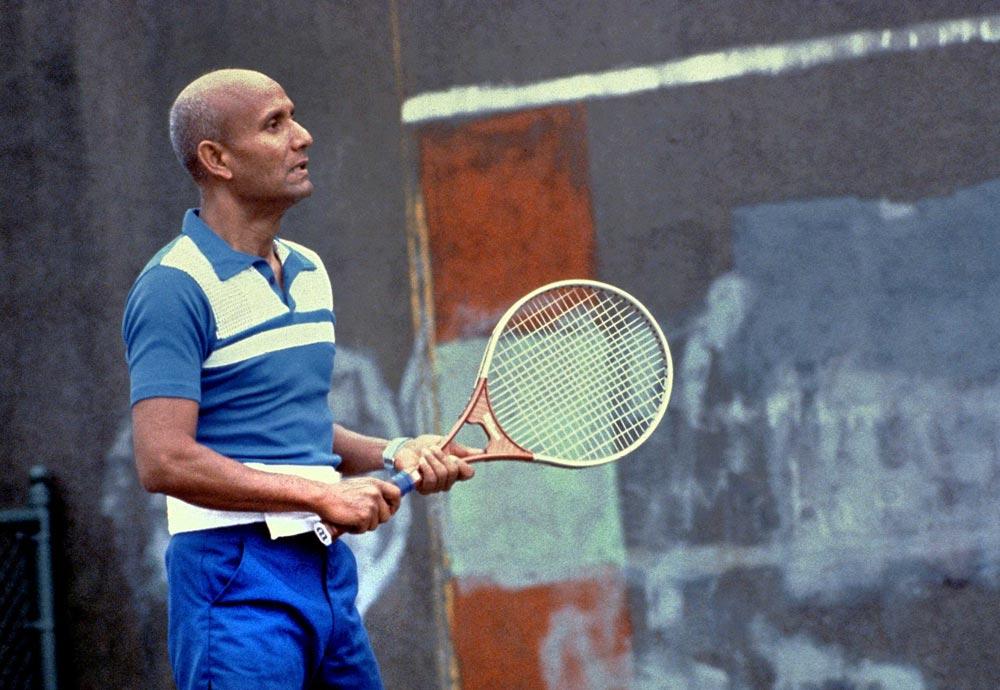
Around 13 June 1977, Sri Chinmoy played tennis for the first time in the West. It was a game that Sri Chinmoy took to heart and played an important role in his life.
Sri Chinmoy began playing tennis on or around 13 June 1977, at the age of 45. Despite a late start, he displayed a great eagerness to develop and improve, often playing a variety of opponents for many hours.
Photo: Kedar Misani
The spiritual message of tennis
The spiritual message of tennis: Love, serve And finally surrender To the Supreme in the winner. The loser who cheerfully surrenders To the Supreme in the winner Becomes himself a real winner In the inner world.
Footage of Sri Chinmoy playing tennis from the late 1980s to 2005. Includes meeting with Ilie Nastase and awarding of "Lifting Up the World With a Oneness-Heart". Footage courtesy Mridanga Spencer.
Tennis Stars
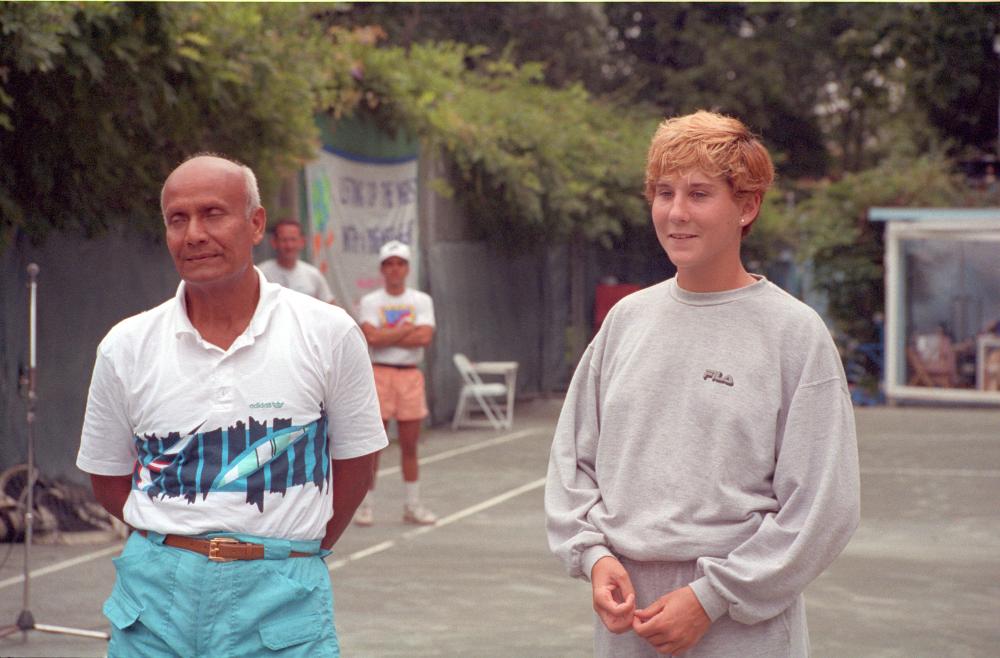
Over the years Sri Chinmoy invited many top tennis players, such as Billie Jean King, Steffi Graf, Monica Seles, Mats Wilander, Ilie Năstase, Martina Navratilova and Ramesh Krishnan to his own tennis court at Aspiration-Ground, New York.
Sri Chinmoy with Monica Seles. Photo: Maral
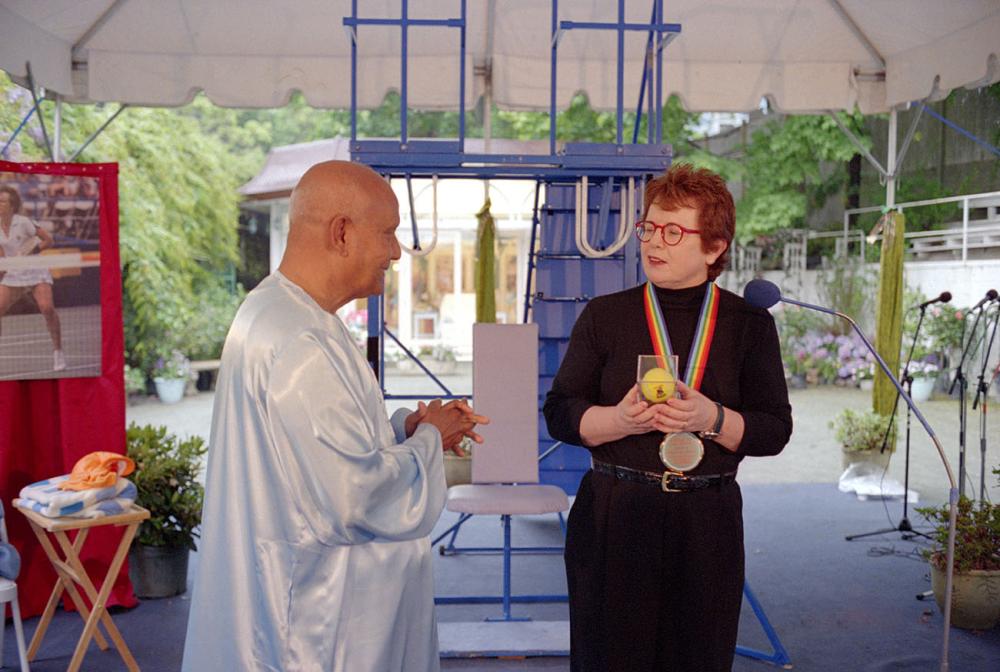
Photo: Dhanu. Sri Chinmoy, Billie Jean King. 22 May 2003
Lifting Up The World With a Oneness-Heart
Sri Chinmoy would often honour tennis players as part of his "Lifting Up the World with a Oneness Heart" programme.
From left to right. Steffi Graf (11 Nov 1989), Martina Navratilova (30 August 2005), Mats Wilander (17 March 1990)
Sri Chinmoy Tennis Classics
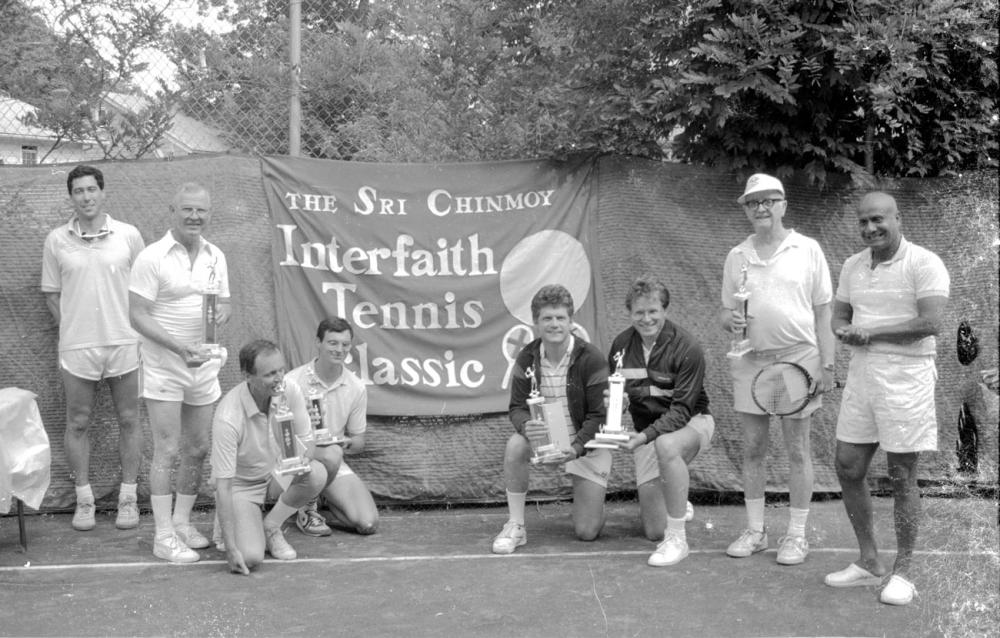
Photo Pulak. 8 June 1989
Sri Chinmoy and his students also organised tennis competitions, known as Sri Chinmoy Tennis Classics. This included a tennis competition for the UN, and in the above example, an interfaith tennis classic.
Question: Guru, when we put on Sri Chinmoy Tennis Classics in our cities, how can we make it an experience that will be beneficial to the inner life and not just another tennis tournament?
Sri Chinmoy: First of all, we should not give the players prize money. Then, whoever is the organiser could give a five-minute talk. He could say that in order to do anything successfully in life, you always need friends. It is like a tug-of-war: if you have more people on your side, then you are bound to win. It is the same in tennis. You already have talent as a friend. You also have parents, dear ones and so on. One more friend that you can have is a good thought. A good thought can be your best friend. If you have good thoughts and good will towards your opponent, then these realities will enter into him and you will also receive good thoughts and good will from him. (Continue reading at Sri Chinmoy Library)
Watching Sri Chinmoy play tennis
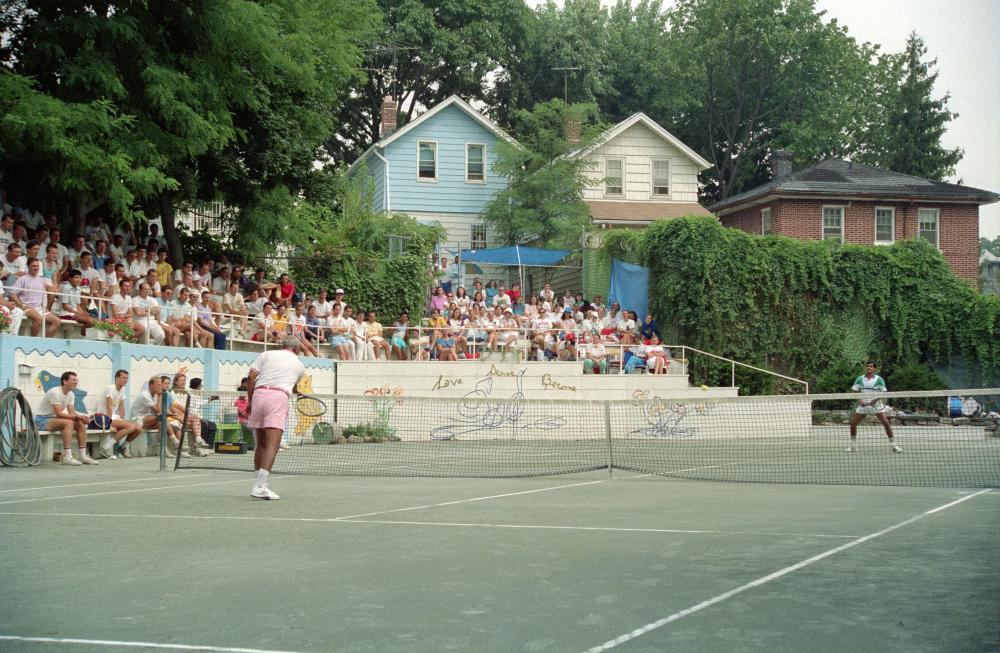
Photo: Pulak. Sri Chinmoy playing India tennis star Ramesh Krishnan at Aspiration-Ground, 1988
From 1978 to the early 2000s, Sri Chinmoy spent many hours playing tennis at Aspiration-Ground. Sri Chinmoy said, it could be an excellent opportunity for his students to be in a meditative consciousness whilst he was playing tennis.
You can learn so much from tennis. Whenever I play, please watch very soulfully.
When I strike the ball, see how the ball surrenders and goes wherever I want it to. Each time I strike the ball, please identify yourself with the ball, and feel that you are surrendering to the will of the Supreme in me. Inwardly you can say the word “surrender”. And no matter in which direction I hit the ball, unconditionally it goes there. So feel that you are making your surrender unconditional.
Then when I am serving, please feel that you are serving the Supreme in your Guru. Whenever I serve, please feel that you are serving the Supreme in me with utmost love and devotion.
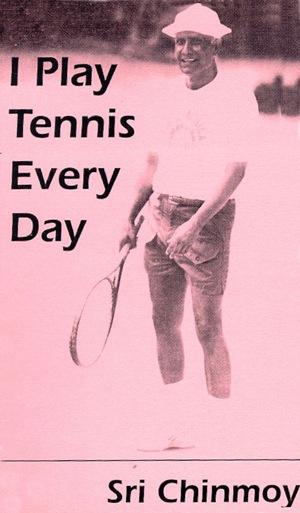
If you can do these two things, you will get tremendous joy and make tremendous progress when you are watching me play tennis. (I Play Tennis Every Day, Sri Chinmoy Library)
Mahiyan - Playing tennis with Sri Chinmoy
(Video footage Sri Chinmoy - Kedar. Interview: Tejvan)
Mahiyan Savage was a former professional tennis player who became a disciple of Sri Chinmoy in the early 1970s. Mahiyan played many hours of tennis with Sri Chinmoy.
Stories of playing tennis with Sri Chinmoy
Audio file
Databir, Bipin and Rupantar talk about playing tennis with Guru. In particular, they explain Sri Chinmoy's preferred method of scoring, which led to quick games with minimal interruptions.
Watching Sri Chinmoy play tennis on a summer’s morning in New York, it is hard to believe that a little over four years ago the game was unfamiliar to him. Today, approaching fifty years of age, he moves about the court with the natural ease of one who has attained a sure and certain mastery of what must be one of the most demanding and skilled of sports. Sri Chinmoy’s strokes are smooth, even and powerful; his timing excellent; his rhythm relaxed. It is at once clear that a lifetime of dedication to sport lies behind the beauty and grace of his style. Read more...
Three years have elapsed since the first part of this article appeared. If one were to graph Sri Chinmoy’s progress in tennis during this time, it would show a steady escalation, which was particularly intensified during the warmer months from April to September. Read more...
Photos of Lifting up the World with a Oneness-Heart. Steffi Graf, Adarini Inkel; Mats Wilander, Dhanu; Martina Navratilova, Pulak
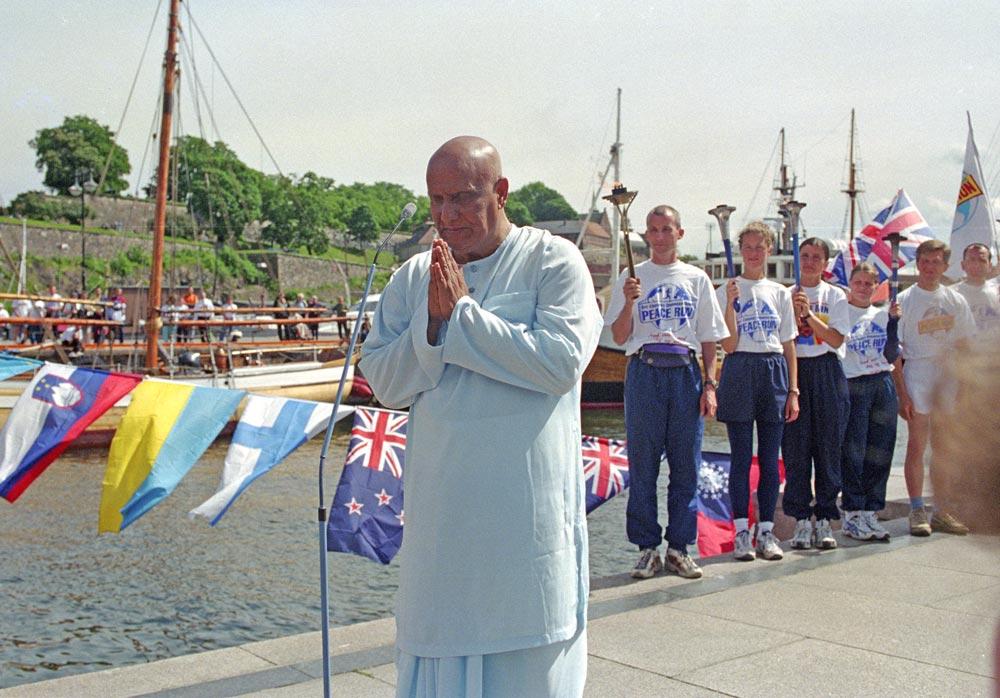
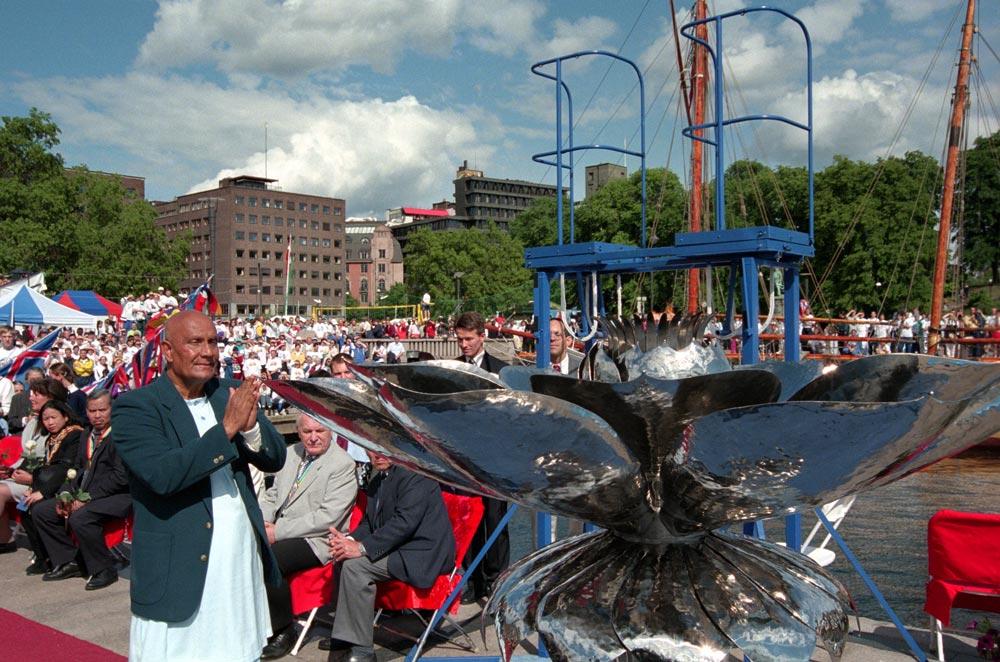
On 9 June 2001, Sri Chinmoy inaugurated the Eternal Peace Flame at the Pier of Honour, in Oslo, Norway. The flame was symbolically lit using the Peace Run Torch. Sri Chinmoy was joined by Svenn Kristiansen, Oslo's Deputy Mayor and several other dignitaries in attendance. There was also a large crowd of well-wishers who offered their own prayers and meditations for this symbol of peace.
Photo: Pulak, 9 June 2001
Sri Chinmoy inaugurates the Eternal Peace Flame at the Pier of Honour in the Port of Oslo, Norway.
The Eternal Peace-Flame, Mankind’s oneness-game. Here in Norway’s Oslo The smiles of the world glow.
Runners from the Sri Chinmoy Oneness-Home Peace Run were in Oslo for the occasion.
Photo: Maral
The inauguration of the Peace Flame was part of a week-long activity dedicated to peace in Oslo. It included a concert, art exhibition, lecture and running events.
Video
Video by Kedar Misani
The statue's permanent home
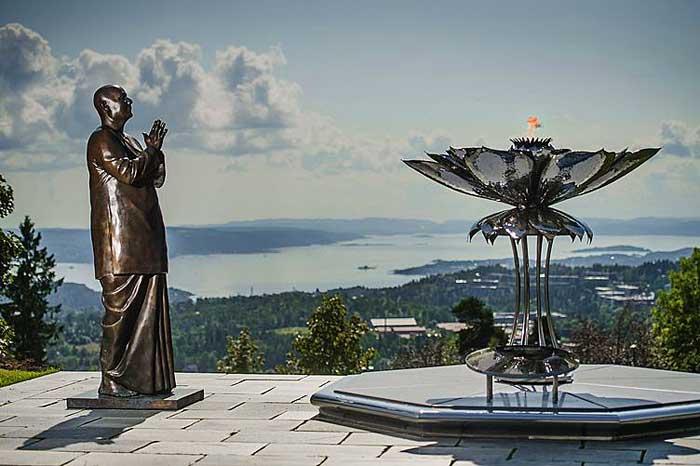
Photo: Kedar Misani
After its temporary position, the Eternal Peace Flame now has a permanent place in the beautiful surroundings of Holmenkollen — overlooking the city. Next to the flame, there is now also a statue of Sri Chinmoy - a powerful work of art to represent the peace-loving life and spirit of Sri Chinmoy, the founder of the Oneness-Home Peace Run.







 ‘Sri’ is an honorific title for a male, usually a person of distinction. It denotes respect and esteem, particularly when used for a holy man. It can also be spelt Shri, Sree or Shree. It is widely used in the Hindu, Buddhist, Jain and Sikh cultures.