
June 15

The Cry and the Smile

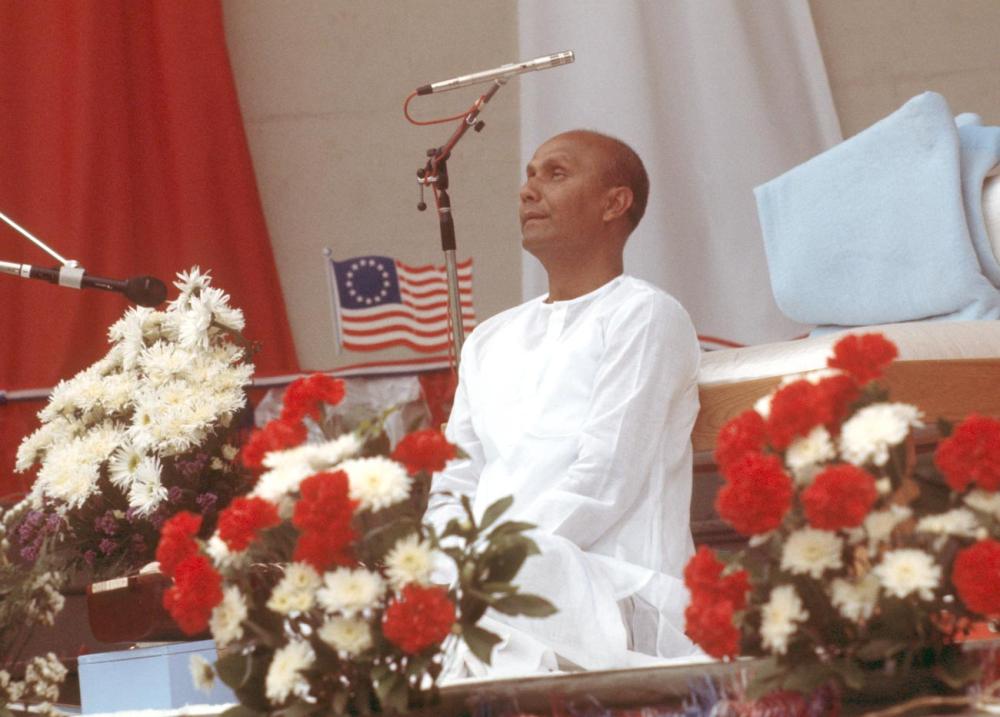
A talk by Sri Chinmoy
at the American Church in Paris, France


I wish to give a short talk on the cry and the smile: the outer cry and the inner cry, the outer smile and the inner smile.

The outer cry is for name and fame. The inner cry is for Truth and Light.

When we walk along the road of name and fame, there comes a time when frustration makes friends with us. This frustration-friend takes us to destruction and there our journey ends.

When we walk along the road of Truth and Light, perfection becomes our friend and perfection leads us to satisfaction. But there our journey does not end; on the contrary, there a new and unprecedented journey starts. For this satisfaction is nothing but the ever-transcending Reality. Each time we are satisfied, a new reality inspires us to transcend ourselves.

The outer cry lives in the outer world. The outer cry is to possess the world, to bring it under our dominion, under our jurisdiction for us to use in our own way. We want to possess the world precisely because the outer world is not within us. Anything that is not within us, we feel is not ours.

The inner cry lives in the world of aspiration. Aspiration ultimately grants us realisation. Realisation means oneness with the Infinite. As individual seekers, we become inseparably one with the Infinite when we realise our transcendental Self. Inside our transcendental Reality we see the entire world with its cries and smiles.

The outer smile is the smile of the face. Quite often the outer smile consoles us, although it is not always encouraging and illumining. We notice at times that there is a motive behind the outer smile. The outer smile at times wants to be reciprocated; we smile and we want the world to smile back at us.

The inner smile is the smile of the heart. This smile inspires the seeker and elevates his consciousness. When the inner smile manifests itself through the outer smile, it reminds the seeker of his promise to the Absolute Supreme. His promise is to realise God, reveal God and manifest God here on earth. When the outer smile manifests itself through the inner smile, it is assurance that the outer life offers to the inner life. The outer life says to the inner life, “I am sorry I have stayed away from you for so long. But from now on, I shall become inseparably one with you. I shall help you in every possible way. Not only that, I shall please you and fulfil you in your own way. I shall fulfil you in your own way because I know that your way and God’s Way are absolutely one.”

Human life itself is a cry right from dawn to sunset. The moment a child is born, he offers a cry to Mother Earth. Again, when he is about to pass behind the curtain of Eternity, he offers a cry to Mother Earth. From the outer point of view, the child cries because the world is a stranger. The world is a stranger to the new-born babe; therefore he cries. And the same person, when he is ready to die, is afraid of the other world. Therefore, he offers a cry. This is a human, outer explanation of the reality that we see.

But there is also an inner explanation, an esoteric explanation of the cry. When the soul enters into the world of manifestation with a human body, it offers its gratitude to Mother Earth through its cry. The soul enters into the world-arena and it offers gratitude to Mother Earth for accepting it. And the same soul, at the end of its journey, again offers gratitude to Mother Earth through the physical cry, for the physical body was granted the opportunity by Mother Earth to realise, reveal and manifest Truth and Light on earth.

The human child cries for the mother’s milk. But this human child, on the strength of his aspiration, becomes a divine child. When he becomes a divine child, he prays to the Universal Mother, to the Absolute Supreme, to grant him Nectar, Delight, Immortality. In his human existence, he cries for the milk which nourishes the human existence. In his divine existence, he cries for something divine and immortal.

The human cry and the divine smile at times go together. The human cry in the physical world and the divine smile in the vital world at times go together. When a dear one dies, we cry. When we cry, the soul that is close to us smiles in the vital world. In the vital world, the souls that are attached to us, that still have kept a close connection with the world, get tremendous joy when we cry for them, and their joy they express with a smile. But if these souls are in the inner worlds that are far beyond the vital world, in the intuitive world or in the soul’s world, they only watch the progress of the individuals on earth. If they see that their dear ones who are on earth have manifested everything that they were supposed to manifest before leaving the body, then they are happy. If not, then they feel sad and miserable for their dear ones.

The souls that remain in the soul’s world always abide by the Will of the Supreme. Sometimes the Will of the Supreme tolerates certain things, sometimes it approves and sometimes it is totally committed to certain things taking place on earth. When the soul mixes with the vital, especially the lower vital, it loses its pristine divinity for the time being and it does not always abide by the Will of the Supreme. But it never loses its inmost divinity, which is eternally immortal. The souls that lose a bit of their universal Reality, a bit of their divinity, become one with ignorance and become a miserable cry. Again, the souls that do not mix with the lower vital and remain always above the vital world, here and elsewhere, remain always in perfect peace and bliss. These souls constantly offer smiles both to Heaven and to earth. Again, it is not only ordinary human beings who cry and smile, but also the spiritual Masters of the highest magnitude who offer their cries and smiles to mankind.

Here in the West, the Saviour is Christ. The Christ cried for humanity’s salvation from sin. And sin is nothing but limited consciousness, which unfortunately we claim to be ours. Again, out of his infinite Bounty, the Christ gave us the most luminous Smile when He said, “Let Thy will be done.” When the human in the Christ became one with our cry, he said, “Father, what have I done? Why hast Thou forsaken me?” Again, when the Christ became one with his own divinity, his own transcendental Reality, he offered to the world at large his highest wisdom, his smile: “I and my Father are one.”

In the East, we recall the Buddha’s human cry for a little bird before he got his enlightenment. To save the life of a bird his heart literally bled; and he did save the bird. Again, in his later years, the Lord Buddha cried for the enlightenment of humanity. He got his illumination and his heart cried to offer it to the world at large. He told humanity two most sublime things. First he said, “This world is transitory. Here, if you expect abiding satisfaction, then you are bound to be disappointed.” The second message he offered to the world at large was this: “Discover the Light within. Be the Light unto yourself.”

The Christ taught us to free ourselves from sin consciousness. The Buddha taught us to free ourselves from ignorance and bondage-consciousness. The Christ, out of his infinite Compassion, taught us the message of salvation; and the Buddha, out of his infinite Compassion, taught us the message of liberation. When we achieve salvation, anything within us that is inferior to the highest Reality becomes one with the highest Reality. When we achieve liberation, anything within us that is limited, anything within us that limits or binds us, becomes totally liberated, illumined, perfected and fulfilled.

Aspiration is an inner cry; again, aspiration is an inner smile. When we aspire to reach the highest Height, it is an inner cry that we embody. When we climb down to serve God in each human being, we are embodying an inner smile. Each human life is composed of a cry and a smile. The cry strengthens, the smile expedites. Therefore both the cry and the smile are of paramount importance.

God’s Vision is the inner Cry to manifest His infinite Divinity. God’s Reality is the inner Smile that grows and glows in humanity’s aspiring consciousness. As long as man and God exist, man will cry to God for fulfilment in his own human way and God will cry for fulfilment in and through man in His divine Way. Man will cry to God to give him the capacity to bind the world; God will cry for man to liberate himself and to liberate others. If someone is a desiring person, there will come a time when he becomes an aspiring person. At that time he says to God, “O Lord Supreme, I shall be pleased only when I please You in Your own Way.” God and the seeker smile simultaneously. The earth consciousness accepts the divine Consciousness and the divine Consciousness accepts the earth consciousness for Reality’s transcendental Satisfaction.


Published in My Rose Petals, part 6


Sri Chinmoy Answers

Seekers’ questions
at the American Church in Paris, France


Question: How can a sincere seeker distinguish a true teacher from an untrue teacher?

Sri Chinmoy: A sincere Master will always say that he and the seeker have to work together. The Master says he will not be able to grant the seeker realisation overnight. If the Master says he will grant the seeker realisation if the seeker gives him millions of dollars, then that Master is false. The true teacher says to the seeker, “You show me your aspiration and I shall show you God’s Compassion. I shall unite both God’s Compassion and your aspiration. When they come together, then you become perfect.” The real Master will always tell the seeker that there is something called God’s Hour. It is then that God grants the seeker realisation. There is an hour for preparation and an hour for realisation. When we sow a seed, it takes time to germinate; then gradually it becomes a sapling and finally a tree. Until it becomes a tree, until it offers fruit, it is in the process of preparation. But when the tree bears fruit, it completes its journey. It is no longer preparation; it is realisation.

Question: I feel that there is a reality which is expressed through different religions, but I have read in the Upanishads that one must be able to transcend this reality. However, I find it very difficult.

Sri Chinmoy: You have to pray and meditate. Each religion has a way of expressing the Truth. Reality is One. But it expresses itself through each religion according to the receptivity of that particular religion. When you realise the Highest, then naturally you go through all the religions at once and, at the same time, you reach the Highest.

Question: There are many different spiritual paths to reach the one Reality. What is the difference between these paths and do they all go to the same point?

Sri Chinmoy: If the paths are real, then they lead to the same destination. It is like a school. A school has hundreds of students. Suppose ten or twenty students walk along one road to come to the school. Again, there are a few students who will walk along another road to come to the same school. So there are many roads, but the school remains the same.

But you have to know that some students are more advanced than others. Some will go to kindergarten and some will go to college or university. Again, the kindergarten student will one day graduate and go to elementary school, high school and college and eventually he will get his Master’s degree or Ph.D. So today’s goal may not be tomorrow’s goal. In the beginning, the seeker aims at a particular goal. Then he wants to achieve a higher goal, grow into a higher goal. So collectively, all individuals are coming to the same goal according to their receptivity and capacity. If one’s capacity right now is the high school capacity, then he is coming to the high school. If his capacity is for college, then he is going to college. And no matter what level he goes to, there are many of his standard who will come to the same school. Many will come to the high school; many will come to the college. But the goal for the seekers of one height will be one particular thing, and for the seekers of another standard there will be another goal.

Question: Who determines the capacities and standards?

Sri Chinmoy: The capacity is aspiration; the capacity comes from the inner cry. If you really do need God, if you desperately need God, then your standard is very high. If God comes first, Truth comes first, Light comes first in your life, then automatically the inner cry increases.

Question: Is there a way to increase the inner cry?

Sri Chinmoy: Certainly. Suppose there are four or five good swimmers. If you want to become a good swimmer, then you will mix with the swimmers. If somebody knows how to swim better than you do, then you will mix with that particular swimmer in order to learn how to swim better. Similarly, if you want to accelerate your spiritual progress, you have to mix with those in whom you have some confidence, some trust that they will be able to guide you and accelerate your progress.

Question: How does one come to know which is one’s dharma?

Sri Chinmoy: If one really wants to know, one can. If one wants to learn, one goes to school. If one wants sing, one goes to a musician, a singer. If one wants to know anything, then one goes to someone who already knows. If someone wants to know what his dharma is, then he has to go to someone who knows everybody’s dharma.

Question: What exactly is realisation?

Sri Chinmoy: Realisation is self-discovery and God-discovery. When one realises God, or the highest Truth, one becomes inseparably one with humanity’s cry and Divinity’s Smile. When he identifies himself with humanity, he cries for humanity because humanity is hungry; and when he identifies himself with Divinity, then he becomes happy because he has got the opportunity to feed humanity. Oneness with Heaven, oneness with earth — conscious, complete, inseparable and eternal oneness — is called realisation.

Question: What role does conscious will play in the spiritual life?

Sri Chinmoy: Conscious will is of paramount importance in the spiritual life. Unconsciously we do many things, good and bad. But when we do them consciously, with conscious will, then we get the effect immediately.

If we use our conscious will, then we shall get up early in the morning, take a shower and pray to God. But if it is unconscious will, we shall keep in the back of our mind the thought that we have to pray, and that is all. Meanwhile, we shall remain lying down. While sleeping, we may repeat God’s Name once or twice, and then we shall feel that we have prayed or meditated. But we are lethargic, idle; we will not leave the bed. For one second we shall meditate and for ten minutes we shall sleep. This is called unconscious will.

Conscious will is like an express train. It just starts and then it goes to the destination as fast as possible. Unconscious will stops at many stations before it reaches the destination. Each time it reaches a station, it takes a rest there and relaxes its capacity. Then it has to regain its capacity to go to the next station. This way it takes a very, very long time. People who pray and meditate unconsciously will take thousands and millions of years to realise God.

Conscious will values time. It knows the necessity of time. Conscious will teaches us that time is very precious. If we do not realise God today, then how are we going to reveal and manifest God tomorrow? Therefore we have to realise Him as soon as possible. Again, realisation has no end, revelation has no end, manifestation has no end. So we feel that it is the supreme necessity to realise at least some height and then reveal and manifest that height.


Published in My Rose Petals, part 6


Sail My Heartbeat Sail

Sri Chinmoy commenced this series of rhyming poems on Sunday, 14 June 1998 in New York. The first volume is completed in three days.


14 Heart-smile

Whom I seek
Is within me.
I pine His
Heart-Smile to be.

15. Halt

Not my mind-cherishing life,
But my heart-blossoming breath
I need, I love, I treasure
To halt the pride of death.

16. Emptiness

Empty of heaviness-darkness
My mind, my heart today;
Behold, my soul-ecstasy
And I together play!

17. My paintings

My paintings
Tell me what they are.
Their message
I share near and far.

18. My poetry

My poetry
Tells me about its Heaven-Source.
Its sorrows
And joys — my journey's course.

19. My music

My music
Tells me where to dive
And fly
To clasp ecstasy's drive.

20. My sports-life

My sports-life
Shows me the pride of speed;
Excellence,
Transcendence-together lead.

21. My tennis

My tennis
Tells me how to serve and love
And claim
To be my Lord's choicest dove.

22. My prayer

My prayer
Tells me Whom to beg only,
Deep within,
Wide without, sempiternally.

23. My meditation

My meditation
Is compelled by God to be His Voice,
And only Him
To fulfil all-where His express Choice.

24. My aspiration

My aspiration
Tells me I can reach God's Eye,
And also God's Feet
In prayer-tears I can tie.

25. My dedication

My dedication,
My God-manifestation-bloom
To reserve a seat
In God's hallowed Heart-Room.

26. My dear, sweet Lord

My dear Lord,
How can I live
Without Your Life's Compassion-Eye?
My sweet Lord,
How can I breathe
Without Your Heart's Forgiveness-Sky?


Published in Sail My Heartbeat Sail, part 1


Here and Now

Prayers by Sri Chinmoy
at the Peace Concert in the US Capitol Office Building, Washington, DC


21.

HERE and NOW
I must realise
That my unconditional surrender
To God's Will
Is the most indispensable part
Of my pleasing God.

22.

HERE and NOW
I must realise
That my God-disobedience
Is my
Immediate and immeasurable
Aspiration-heart-failure.

23.

HERE and NOW
My breath must learn
How to breathe
The breath of the world.

24.

HERE and NOW
My heart shall learn
How to love
The heart of the world.

25.

HERE and NOW
My life must learn
How to become
The life of the world.

26.

My God-aspiration-thrill,
My God-dedication-thrill
And
My God-manifestation-thrill
Are ever new and never old.
This is what I have come to learn
HERE and NOW.

27.

HERE and NOW
My solemn promise
To myself:
No more desire-slavery.

28.

HERE and NOW
I shall live my life
Between my desire-banishment
And my God-attachment.

29.

Not what I want
But what I must do
For God-satisfaction
Is the wisdom-light
Of HERE and NOW.

30.

We are deeply in love
With the beauty
Of God the creation.
We must be deeply in love
With the duty
Of God the Creator as well —
Right from today,
HERE and NOW.

31.

HERE and NOW
I have decided to offer
Only one prayer:
My Lord, do make me the lover,
Server and devourer
Of the golden dust of Your Feet.

32.

HERE and NOW
The miracle of miracles:
A cute smile of my eyes
Has brought God down
From the Ultimate Beyond.

33.

I never knew that my heart's
Fleeting tears
Had such tremendous power.
HERE and NOW I clearly see
They have brought down
God Himself
With His everlasting Smiles.

34.

I love God.
God loves me.
This is not a new realisation,
But HERE and NOW
I unmistakably see
That we two have
No separate existence.

35.

As I love God,
Even so, He needs me.
As God loves me,
Even so, I need Him.
But HERE and NOW
I see a slight difference:
His Love and Need
Are unconditional.
So far, mine are not!


Published in Here and Now


June 15

Interview with United Press International

Excerpts from the interview with Sri Chinmoy
the United Nations in New York


UPI: You said once that honesty and frankness are the birthright of the West, humility and devotion are the birthright of the East, and the combination of these four powers should be the ideal of a human being. What do you mean by this?

Sri Chinmoy: When these qualities, the good qualities of the East and the good qualities of the West, are all combined, a human being can be perfect. Right now the good qualities that the East has are not enough. Similarly, the good qualities that the West has are not enough. But when we can amalgamate, when we can have the qualities of both worlds, then an individual can become perfect. Right now the West wants to proceed with only honesty and frankness, but this is insufficient. Humility is also required. The East has humility, but honesty is also required if it wants to become perfect.

UPI: What is it that you do at your meditation sessions?

Sri Chinmoy: We pray and meditate, plus I give short talks and answer questions. The inner world embodies peace, light and bliss. The outer world, unfortunately, does not embody these qualities right now, whereas the inner world has them in boundless measure. So we try to establish a free access to the inner world by virtue of our inner cry and our soulful meditation. We call this our aspiration.

UPI: So you don't sit down and talk about the boundaries in the Middle East; you talk about other things?

Sri Chinmoy: Yes. I am quite ignorant of politics as such. My forte is spirituality. There are two approaches to every problem. One is the inner approach; the other is the outer approach. Those who come to meditate want to try to walk along the inner road. But ultimately both the roads can lead to the same destination.

UPI: What is the inner road?

Sri Chinmoy: The inner road is the road of sincere dedication to the highest Cause. In the outer world one can aim at a particular goal without having sincere dedication to the goal. But the inner road represents the attitude of the seeker. The seeker tries in every way to lead a more illumining and more fulfilling life, to find and follow the way that is right from the highest point of view.

UPI: Do you envision the day when your goals will be achieved?

Sri Chinmoy: In the outer world it is a very, very slow process. In the process of time, definitely we will reach the destined Goal. No sincere cry will meet with frustration, disappointment or failure. If we have a sincere cry, the day is bound to dawn when our sincere cry will meet with satisfaction, supreme satisfaction, which is illumination within and without.

UPI: But you don't ever see the day when your work will be done, do you?

Sri Chinmoy: No, my work is not like that. It is a slow and steady process. We have to sow the seed, which has to germinate, then become a sapling and gradually become a huge banyan tree. We are now in the process of consciously becoming that which we always were in the inner world. But this process of growth is an ever-transcending process. We can grow eternally. We need never stop.

UPI: Where are you now? Have you dropped the seed? Do we have a seedling?

Sri Chinmoy: This is a most inspiring, encouraging question. I have been asked thousands and thousands of questions all over the world, but this last question of yours so far nobody has asked me, not even my disciples. We have sown the seed. Now we have a tiny plant. This tiny plant will grow and become a strong tree. If storms of doubt and hurricanes of jealousy and other undivine things enter, then naturally the progress can be very slow. But if there is implicit faith and devoted oneness, then naturally the plant will very soon grow into a tree. Now we are in the plant stage; we have sown the seed, and it is no longer a seedling. It has germinated properly. Previously it was only a seedling, but now it has become a tiny but healthy plant. So there is every hope that it will weather all the buffets and blows of human doubts and weaknesses and grow into a huge tree.

UPI: Thank you very much.


Published in The Inner Role of the United Nations


June 15

Photos by Kedar Misani


Sri Chinmoy running in the 10 km Sri Chinmoy Race in Belvoir Park, Zurich. At the invitation of Sri Chinmoy, the great Czech runner Emil Zatopek officiates at the prize-giving ceremony.


Sri Chinmoy Lauf

The following day was our main race, the Sri Chinmoy Run. The disciples had found a very beautiful course around a lake with two or three small loops and one big loop. Zatopek was supposed to start the race. He was so enthusiastic, as if he were running himself. He called out, "Where is the gun?" He was screaming, "No gun? No gun?" We said, "We don't use a gun." Then his wife said, "You don't need a gun." When his wife said that, Zatopek said, "All right, I will clap."

The race was to start on a small bridge. There were a little over two hundred people on the bridge. They were standing under a big banner saying "Sri Chinmoy Lauf." "Lauf" means race. Zatopek was standing on one side. He started the race by saying something in German, ending with a final clap. When he clapped, everybody clapped, and the race started.

All the London disciples — even elderly women — were running. Our very good runners were also there. Among the disciples, Sundar came in first and then Janaka. But they were defeated by local Swiss boys. I was not feeling well and was running last, behind everybody. When I ran along the small loops, Zatopek was so excited. He was clapping like anything. His wife stood up also and was clapping and clapping, although I was running behind everybody.

Some of the girls who are useless runners kept taking short cuts at the places where the monitors were directing them around the loops. I told them later that they were all rogues. If they were supposed to run around someone who was standing in one place, instead they cut across. They saved fifty or seventy metres on four occasions. I was so disgusted. On one loop, at least two hundred metres they didn't run. They took a short cut. What were they doing? Just because they were third class runners, they felt nobody would pay any attention.

When it was over, Zatopek gave the prizes. I was so embarrassed. The first, second and third prize trophies were of the same size, with the same figure. Only it was mentioned on the trophy, "first" or "second" or "third." I said, "How can it be?"

Phillip announced the winner's name and handed the trophy to Zatopek, who handed it to the person. To each person who came up for a trophy, Zatopek had something encouraging to say. He was very, very nice. There were also health food prizes — honey and other things — for the winners. Zatopek was so happy to see that we had health food for the winners. After he gave each person his trophy, he pointed to the health food so happily and said, "Take this. You select."

I thanked both Zatopek and his wife, and Zatopek spoke, appreciating us. Then he came up to me and grabbed my hand and said, "Our Guru, this is the best." That was his comment. The race and the atmosphere — everything — pleased him, so he said, "Our Guru, this is the best."

The Mayor of Zurich, who comes from Canada, sent his assistant to honour me. He came with a proclamation and he spoke so highly of me for about seven or eight minutes. All of a sudden, his wife, who was very tall — much taller than her husband — came and gave me a huge bouquet. She was smiling at me. The husband said, "She wants to offer you this bouquet." So I took it and I thanked her.


Published in Salutations, numbers 1-4


June 14


A 14-HOUR FATHER’S DAY MEDITATION


Jamaica, N.Y. – Sri Chinmoy and about a hundred of his disciples celebrated Father's Day last month with a 14-hour meditation.

For the final seven hours, the Master gave darshan, blessing each one of his disciples individually.

The disciples filed one by one into a small room where Sri Chinmoy waited, closing the door behind them.

Earlier, he had asked each of them to write on a piece of paper seven spiritual accomplishments or achievements. As each disciple entered the room, the Guru read the list in silence, and then blessed the seeker.

Some of the blessings lasted for a couple of minutes, and often the disciples would come out of the chamber deeply moved, sometimes in tears.

The meditation was originally meant to last only 13 hours, but the extra hour was needed to complete the darshan.

The day was broken up into two four-hour sessions, one three-hour session, and a final two-hour session which stretched into three hours. Between the sessions were rest breaks.

The disciples were asked to eat very little, or fast, in order to meditate better. But at two sessions the Master handed out prasad, or blessed food. Once it was an orange and a nectarine, and once it was an ice cream sandwich and an apple.

The evening ended with a 13-course meal.

Only those who had been disciples for at least four years were invited to participate in the meditation, and some came all the way from Canada and Florida for the single-day session.

The previous day Sri Chinmoy held a seven-hour meditation for his other disciples who had been with him for less than four years.


Published in Anahata Nada, Vol. II, No. 6, July 1, 1975


Father’s Day Meditation

Norwalk Meditation for Sri Chinmoy


A special Father’s Day Meditation was held Saturday, June 14 in the garden of the Norwalk Sri Chinmoy Centre, 80 Perry avenue. The program consisted of *seven hours of silent meditation led by Sri Chinmoy, director of the United Nations Meditation Group. Present were 200 people, mostly members of the Norwalk Sri Chinmoy Centre. Also attending were members of Sri Chinmoy Centres of Chicago, San Francisco, Miami and Canada who came specifically for this event.

The meditation began at 6 A.M. and ended at 5 P.M. with several intervening breaks. After the meditation a 13-course vegetarian meal topped the festivities.

Several members of the Norwalk group also attended a similar meditation at the Sri Chinmoy Centre in Queens, N.Y. held the next day, which lasted for 14 hours.

Sri Chinmoy conducts regular meditations at the Norwalk centre every Saturday at 1 P.M.

Editor's note:*14 hours in total


Originally published in The Norwalk Hour, Wednesday, 18 June 1975

Reprinted in AUM – Vol. 2, No. 6, 27 June 1975


ARLO GUTHRIE VISITS GURU LAND


JAMAICA, NY — Singer Arlo Guthrie came to Annam Brahma restaurant on June 14 to meet and meditate with Sri Chinmoy.

“I am a great, sincere, genuine admirer of your father,” the Master told him. “He was a supremely genuine seeker and also an unparalleled self-giver through his heart-illumining and life-fulfilling songs.”

During the course of the meeting, the disciple singers sang Woody Guthrie’s “This Land is Your Land” and Sri Chinmoy’s adaptation, “This Heart is Your Heart,” using words their teacher had put to Guthrie’s music.


Published in Anahata Nada, Volume 20, April–July 1991


June 14

Photo by Maral Siegel


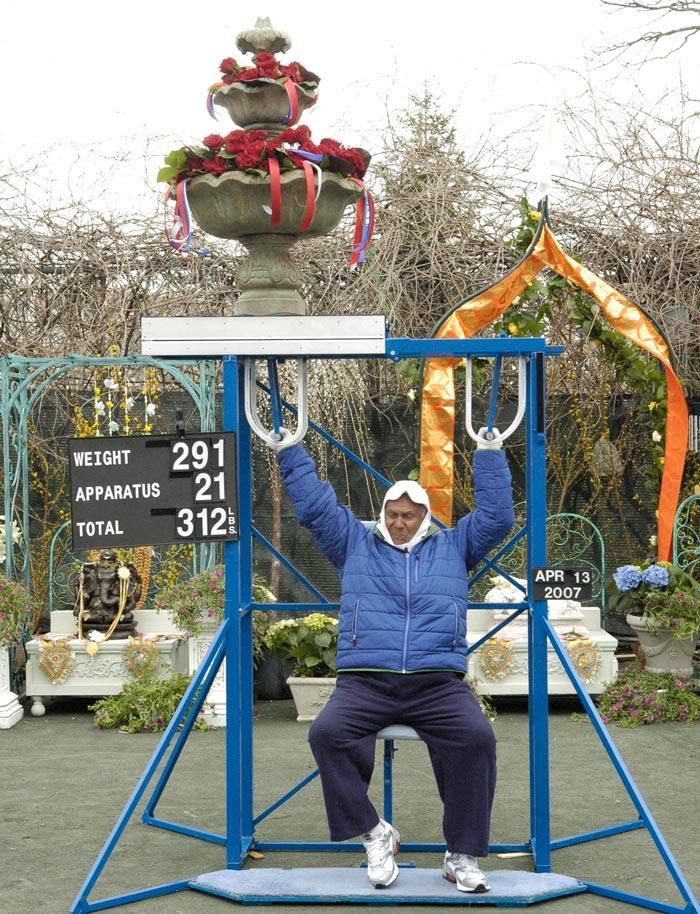
After lifting Mahasamrat Bill Pearl and his wife Bhavatarini Judy Pearl during his visit to San Diego, California, Sri Chinmoy presents them with a signed original Soul-Bird drawing.


June 14

sri-chinmoy
Photo: Bhashwar

 Sri Chinmoy plays tennis on his first anniversary of starting to play tennis.


Sri Chinmoy meets with Olympic running legend Emil Zatopek and his wife Dana at the Westathletic-Cup, a multinational track-and-field event held near Zurich, Switzerland.


June 14


Sri Chinmoy meets with Olympic running legend Emil Zatopek at Zurich Airport, Switzerland.


Photo by Maral Siegel


Sri Chinmoy presents the U Thant Peace Award to Mahasamrat Bill Pearl, 5-time Mr. Universe and ‘World’s Best-Built Man of the Century’, in San Diego, California, USA. Bhavatarini Judy Pearl is there to offer her congratulations to her husband.


Photo: Pulak

Singer Arlo Guthrie came to Annam Brahma restaurant on June 14 to meet and meditate with Sri Chinmoy.

June 14

Transcendental Height and Aspiration-Light

A lecture by Sri Chinmoy
in the Examination Hall Trinity College Dublin, Ireland


Dearest brothers and sisters, I have special love and admiration for your country, Ireland. I have been cherishing and treasuring love for this country since I was twelve, when I read a book written about the spiritual Master, Swami Vivekananda. In his biography I read something most striking. A young woman from your country was so deeply inspired by the Swami's spiritual light that she went to India and offered her entire existence to Swami Vivekananda, her spiritual Master. Her name was Miss Margaret Noble, but her Master offered her a new name, a spiritual name, her soul's name: Nivedita. Nivedita means self-offering, total self-offering. She offered her whole existence to India. India's spiritual children will forever remain indebted to her love and sacrifice. India's freedom-boat will forever be indebted to her significant efforts to free Mother India from ignorance. Nivedita embodied dedicated self-offering.

When I was twenty-three years old, for the first time I read her book about her Master, Swami Vivekananda. The great spiritual Master, Sri Aurobindo, once remarked that this book of Nivedita's was written with the breath of her heart. From this book I learned how a disciple can become inseparably one with the Master on the strength of implicit love, devotion and surrender to the Master's will.

There are two types of people on earth: spiritual people and unspiritual people. Spiritual people are often accused by those who are not spiritual of being abnormal. They supposedly want to live in the clouds and eat the moonlight. They have no sense of reality. They are just fooling themselves. This is the accusation that is often thrown at them. Spiritual people, in return, say that they are absolutely normal, whereas the unaspiring people are abnormal.

An unaspiring person accuses a spiritual person of not paying attention to the outer life. But a real spiritual person is bound to pay full attention to the outer life. If he is not sincerely spiritual in the truest sense, then in the name of spirituality he will ignore and revile the outer world. But the outer world is the manifestation of God. If someone wants to realise the highest Truth, how can he ignore God's outer manifestation? A really spiritual person will not ignore the outer world. On the contrary, he will accept the world. He will accept the challenge of the world. Then he will conquer the ignorance of the world and he will offer his Wisdom-Light to the world at large.

Unaspiring people often say that a spiritual person is afraid of the world. He is a coward. He does not brave the world, but runs away and hides like a thief, while the ordinary, unaspiring person shoulders the responsibilities of the entire world. But I wish to say that if a genuine spiritual person does not involve himself in the activities of the world, it is because he is preparing himself to shoulder the responsibilities of the world. He knows very well that it is God alone who can give him infinite Light, infinite Bliss, infinite Peace and infinite Power to change the face of the world. Just by mixing with the multitudes, he will not be able to help the world. But by serving the Inner Pilot, by fulfilling the Inner Pilot, he can one day be of real service to mankind.

Among the spiritual people there are some who are accused of too much spirituality, and there are some who are accused of too little. The latter are like students who go to school for a while, but do not want to complete their studies. They want to stop at grammar school or high school. These seekers are satisfied with an iota of Peace, Light and Bliss. They don't feel that they need infinite Peace, Light and Bliss. But at times frustration looms large in their lives, and they expect infinite Peace, Light and Bliss overnight. God feels that it is absurd on His part to give them infinite Peace, Light and Bliss. They are still children. We do not give a child thousands of dollars. We give him just a penny. That is more than enough for him. Even if this child begs his father to give him a thousand dollars, the father knows that he will not be able to appreciate it or utilise so large a sum properly or wisely.

In the spiritual life, when his aspiration does not immediately satisfy the craving mind of the budding, beginning aspirant, this person very often leaves the spiritual path. He thinks he is wasting his time. He says, "I have tried. I have prayed to God to give me Peace, Light and Bliss, but He has not fulfilled my prayer. I tried so hard, but He has not listened." But his conception of what kind of aspiration he has offered to the Supreme is not the Conception-Light of God. He is a child in the spiritual world. If he meditates fifteen minutes a day, he feels that he has played his role and that it is now God's bounden duty to satisfy him, to fulfil his desires. But when one becomes a sincere seeker, one feels that it is God's duty to bless him with Peace, Light and Bliss only in God's own time.

At our sweet will, we cannot demand Peace, Light and Bliss from above. Who wins the spiritual race? He who has patience. He who has inner courage. He who has the mounting inner cry, which we call aspiration. Each individual has only two things. When he is not in the inner life or in the life of the spirit, when he is in the body, in the vital and in the mind, at that time he has desire. But when he accepts the inner life, when he lives in the heart and the soul, he has aspiration. Desire has to possess one thing today, two things tomorrow and three things the day after tomorrow. Desire is like that. But aspiration does not go from one to two to three. Aspiration just tries to immerse us in the Sea of Peace, Light and Bliss. It does not try to possess the drops of this sea one by one.

From the ordinary point of view, desire is the most important. From the spiritual point of view, aspiration is the most important. If we desire something strongly, naturally we will get it sooner or later. In the world of desire, if we try very hard to get something or to achieve something, in the course of time we will succeed. And in the world of aspiration, if we desperately cry for Peace, Light and Bliss in infinite measure, we are also destined to achieve our goal in the course of time.

Now what do we need along with our aspiration? We need inner confidence. Right now hesitation looms large in our life. We want to do something, but hesitation does not allow us to do it. Doubt constantly plagues our mind. Hesitation kills our inspiration. It is impossible for us to achieve our purpose. But when we have aspiration, we automatically develop confidence in our life, inner confidence.

Now what is confidence? Confidence is the harbinger of success. With confidence we can accomplish everything sooner or later. Success is a very complicated thing. It is very difficult to achieve. When we think of success, we think of something pleasing and comforting to us. But this is success on the physical plane. On the spiritual plane, success is something that energises us and liberates us from the body-consciousness.

When we achieve success in the ordinary life, we feel that it is not sufficient. Today we achieve success in a particular sphere. Immediately we are subjected to more desires. We achieved success, but success does not satisfy us; success does not please us. We cry for success, but when this success dawns we want to achieve something else.

In the spiritual life, success is a different matter. Success is an inner progress. Progress is success in the process of evolution. We have evolved from the mineral life through the plant life to the animal life, and from the animal life to the human life. Now we are longing for the divine life. We are always in the process of evolution, and success is nothing other than our progress. When we make progress, what do we actually do? We manifest our inner Divinity, our inner Reality, our inner Immortality. When we manifest our Divinity and Reality, we feel that this Divinity and Reality, and God, are one and the same. The manifestation of our inner Divinity is the manifestation of God Himself, and what we call our manifestation is actually God's own manifestation.

When we go deep within, we see that God Himself has chosen us as His instruments in order to manifest Himself in and through us. But when He manifests Himself in and through us we have to play our part, because the Creator and the creation always go together. The player and the instrument always go together. If there is no instrument, the player is useless; and, again, if there is no player, the instrument cannot do anything. Both are equally important in this case. When God manifests Himself in and through us, He gives us equal credit. When manifestation takes place, man and God smile together. The divine man and the Lord Supreme smile together. That is the sign of perfect manifestation.

We talk about aspiration. We talk about concentration, meditation and contemplation. Now why do we need them? We need them because we want to go back to our Eternal Home. Earth is our temporary home. Here we stay for fifty, sixty or seventy years. But we have an Eternal Home where we live forever, and that Eternal Home is deep inside our heart.

Right now we have four homes: Earth, Heaven, Death and God. Earth is our home. But from Earth what do we get? Frustration, only frustration. We work for the world. The world does not care. We work for our near and dear ones. They show no sign of gratitude. They do not fully acknowledge the fact that we are trying to help and serve them. So what happens then is that we look up. The song of aspiration dawns in our life. We want to see our Heavenly home, but we have no idea where Heaven is. We feel that Heaven is in the sky. Spiritual Masters, however, say that Heaven is deep inside our pure heart. We are not in a position to enter into the inmost depths of our heart, so Heaven right now is sheer imagination for us.

Our third home we reach at the end of our earthly journey, and that home is Death. When we enter into this home, we take rest from the battlefield of life. But our vast, eternal Home is God. When we think of God the Home, what happens to us? Consciously or unconsciously, we expect Love, Peace, Bliss, Infinity, Eternity, Immortality. These are the things God the Home is bound to grant us. Whatever we see in God the Home, whatever we expect from God the Home, we will get. If we need Peace, He will flood our being with infinite Peace. If we expect Light, He will surcharge our inner being with divine Light. Anything that we need or expect devotedly, soulfully and unconditionally, God is bound to give us. Why? Because He is all Love.

It is God who has taught us the secret of expectation. It is He who has taken the form of expectation in us, and it is He who meets with our expectation from above. When we expect aspiration from God, He becomes aspiration. It is through aspiration that He enters into His own perfection. Spiritual seekers know that God is the eternal Player. He is playing constantly with His aspiration and His realisation. His highest Transcendental Height and His purest Aspiration-Light go eternally together. His Life-Boat plies between the shores of Aspiration-Light and Transcendental Height.


Published in My Rose Petals, part 2


Fear and Courage

A lecture by Sri Chinmoy
at the University of Geneva; Geneva, Switzerland


We are afraid of God. God’s infinite Vastness frightens us. God’s Transcendental Height frightens us. God’s immeasurable Depth frightens us.

God is both Truth and Light. God the Truth tries to lead us to the perfect Truth. But, unfortunately, we feel that God the Truth is always examining us. We feel that since we are a mountain of falsehood, since we are making mistakes at every moment, God the Truth will punish us. But God is all Compassion. He does not punish us. On the contrary, He tries to illumine our mistakes and make us perfect. In the process of evolution, He tells us that falsehood is nothing but lesser Truth. We have to transcend falsehood and then enter into Truth. And for that, we need a constant inner cry, which we call aspiration.

Just as we are afraid of God the Truth, so also are we afraid of God the Light. We feel that God the Light will expose us, since we have done many undivine things. If someone commits a theft, he wants to hide. He is afraid of light. He feels that if he is in light, he will be exposed. But God the Light is totally different. Here the Light does not expose us; it illumines us. The Light tells us that darkness also has a little light, that night, too, has a little bit of light. God, being all Light, is all-pervading. Therefore, He is bound to be in darkness as well as in Light. Of course, when He is in darkness, He will have only a very small amount of Light, whereas, in an aspiring human being, He will manifest boundless Light. Again, even if there is just a little light, this light will grow into boundless Light. It is like the seed that grows into a banyan tree.

Fear and courage. Fear has capacity in a negative way. It rejects oneness. It wants to remain always individual and separate. Fear is like the tiny drop that does not want to merge into the vast ocean. It wants to maintain its individuality and personality. The finite is afraid of the Infinite and, at the same time, it does not want to confess its fear. But the vast ocean knows that its individuality and personality are composed of countless drops of water. The Infinite knows that it has become Infinite precisely because it houses the finite in infinite measure.

On the physical plane, there are two types of fear: fear of the imaginary and fear of the real. Imaginary fear is far worse than real fear because we are afraid of something that we can only imagine. We are afraid of death because we feel that death will take away all our earth’s wants, all our earth’s love, all our earth’s oneness. Here we achieve, here we accomplish; but we have no idea what is going to happen to us in the other world. We have no idea if we shall go to Heaven or to hell. Here on earth at least we know that we have our dear ones and relatives to look after us. But we do not know whether we shall meet with our dear ones in the other world or whether there will be anyone to look after us. In fact, we do not even know if there is another world. Therefore, the very thought, the very idea, the very conception of death frightens us.

Like imaginary fear, we can have imaginary courage. The worst possible imaginary courage is the courage of an atheist. He is infinitely more insignificant than an atom and yet he challenges and denies God’s Existence. God is Infinite. God is Eternal. God is Immortal. Yet the atheist challenges God’s Existence; he denies God’s Existence or speaks ill of God.

There are some human beings who do not pray and do not meditate, yet they feel that they have boundless peace to offer to the world at large. This is their imaginary courage. Or there are some human beings who feel that they can have the world drop down at their feet at the twinkling of an eye. Like Julius Caesar, they feel that they will be able to say, “I came, I saw, I conquered.” This is all imaginary courage, for they are still afraid of something or other. They are afraid of a tiny, imaginary thought. A tiny thought will enter into them. Then for quite a few years this wicked thought can command them most mercilessly. Yet these human beings say that the whole world can be placed at their feet if they want it.

Fear of the known, fear of the unknown and fear of the unknowable. We have done many things undivine; therefore, we are afraid of the consequences. We know that as we sow, so we shall reap. The law of karma nobody can deny. If we have done something wrong, then we have to pay the penalty. Here what we fear is quite known. But there is also the unknown fear. If we do something wrong today, then we feel that in the near future we are going to suffer for it. We have no idea if the punishment will be severe or not. But we do know that we will be punished. The very thought of the punishment tortures us. Although the real punishment we shall get later on, right now the unknown fear, the fear of the unknown, tortures us.

Fear of the unknowable is fear of what is going to happen in our life or after our death — fear, for example, that there may be a catastrophe and this world of ours will not last. This unknowable can be positive or negative. Infinite Light is an unknowable Reality and it can frighten us. Infinite night, darkness, is also an unknowable reality that can frighten us. The infinite Light is a positive force; the infinite night is a negative force,

We speak of the Universal Consciousness; we speak of the Transcendental Consciousness. We achieve both the Universal Consciousness and the Transcendental Consciousness on the strength of our inner courage. Inner courage is nothing but constant self-giving. Here we are all seekers. Before we became seekers, we stayed with our desire-friends, but now our friend is aspiration. God granted courage to our body before we were spiritual, before we aspired. He thought that with this courage we would be fully alert. He gave courage to our vital. He thought that with this courage our vital would be dynamic. He gave courage to our mind. He felt that with this courage our mind would be completely clear. He gave courage to our heart. He thought that with this courage our heart would be totally pure. Then we became seekers. Now God has given our heart the power of oneness. He has given our mind the power of wideness. He has given our vital the power of compassion. He has given our body the power of sacrifice.

Then He tells us, “Children, do not be afraid of the known, do not be afraid of the unknown, do not be afraid of the unknowable. Have courage in the known. And then, after a while, you will have courage in the unknown. And have courage that even the unknowable will one day become not only knowable but completely known.

“Your parents, your grandparents, your ancestors, prayed to Me. Therefore, they received Light from Me. Their light has entered into you and you have become spiritual. And now, if you pray and meditate, you will also get Light from Me. Your light will far surpass that of your parents, grandparents and ancestors. There is no competition, but in the process of evolution I am manifesting Myself in and through human beings more and more. There shall come a time when I, the Unknowable, will appear before you with My infinite Peace, Light and Bliss, and these will all become known to you. At that time, you shall have courage within, courage without. When you dive deep within with your inner courage, you play with God the Creator. And when you bring your outer courage to the fore, you play with God the Creation. This is how you participate in My Cosmic Game.”


Published in The Oneness of the Eastern Heart and the Western Mind, part 1


Sail My Heartbeat Sail

Sri Chinmoy commences this series of rhyming poems on Sunday, 14 June 1998 in New York. The first volume is completed in three days.


1. Sail

Sail my heartbeat sail, sail
To clasp our Lord's Nectar-Mail.

2. Choice hour

How can I not love
The beauty of a flower!
How can I not rise
At my sweet Lord's choice Hour!

3. Rainbow-dream

To devour the Dust-Gold-Feet
Of my Lord Supreme
Every morn my heart becomes
A rainbow-dream.

4. Perfection-dream

To be a chosen child
Of my Lord Supreme,
My crying-smiling heart's
Perfection-dream.

5. God-climbing fire

Once more I shall become
My heart's God-climbing fire.
My eyes shall see nowhere
The face and body of mire.

6. Impurity-insecurity

Sleeplessly I keep my mind
Free from impurity-ties.
Breathlessly I keep my heart
Empty of insecurity-cries

7. The right to choose

Oh, what I have and what I am,
Am I ready to lose?
If so, my Lord Supreme tells me:
Him I have the right to choose.

8. My dream

Mine is a birthless
And deathless dream:
To breathe the Heart
Of my Lord Supreme.

9. Mind-tears versus heart-smiles

My newness-mind-tears
Keep me glowing.
My fulness-heart-smiles
Keep me sailing.

10. My gratitude-heart

The fragrance
Of my God-gratitude-heart
Has smashed
My mind's ego-pride-dart.

11. Ecstasy's endless road

I see no more my earth-bound mind's
Despair-gloom-cave.
Ecstasy's endless road my life
Is ready to pave.

12. Negativity-mind

A ruthless
Negativity-mind
In every
Corner of my heart I find.

13. Silence

From the Silence Unknowable
To the Sound knowable I came
To play and sing and dance
With a tiny, fragile frame,
And build a rainbow-bridge
Between Heaven and earth
For my sweet Supreme to travel
And flood all-where His Birth.


Published in Sail My Heartbeat Sail, part 1


June 14

Photo by Bhashwar Hart


Sri Chinmoy holds a 14-hour outdoor meditation at the Connecticut Centre in Norwalk, Connecticut, for his disciples who had been with him for at least four years.