Articles

A complete categorised list of contents can be found in the side menu at the top right of the page. Here are some of the most popular articles.


.
 

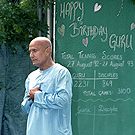
AUGUST 27th — Sri Chinmoy’s Birthday

Sri Chinmoy was born on August 27th 1931 and each year his birthday is celebrated by his disciples, friends and well-wishers around the world. Take a look at this special day throughout the years. Read more...


.

WEIGHTLIFTING ANNIVERSARY

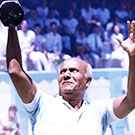
Sri Chinmoy began his weightlifting adventure on 26 June 1985, with a lift of just 40 pounds. Over the next year and a half, his progress astounded the weightlifting world. Here, we honour his weightlifting anniversary with a visual celebration of his landmark achievements. Read more...


.

FATHER’S DAY

Sri Chinmoy is the Spiritual Father to thousands of people worldwide. In America, Father’s Day falls on the third Sunday in June, and each year his disciples, friends and well-wishers celebrate this day. Take a look at this special day throughout the years. Read more...


.

Cycling Days (1977-1980)

Story by Savita Shivaji and Anjali Das

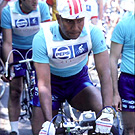
Many are familiar with his stellar athletic achievements, including his short- and long-distance running, and his contributions to the international running community through races staged by his marathon team. Some may know of his prowess as a tennis player. Others may have heard of his legendary weightlifting … Less known is Sri Chinmoy’s venture into long-distance bicycle riding. Read more...


.

APRIL 13TH

Sri Chinmoy arrived in New York on April 13th 1964. He made his home there for the next 43 years, yet his oneness-heart came to encompass the entire world. Each year, on this day, his disciples, friends and well-wishers around the globe celebrate his life of dedicated service to the West. Take a look at this special day throughout the years. Read more...


.

NEW YEAR’S MESSAGES

On the eve of the New Year, a new consciousness dawns on earth. God once again inspires each human being, each creature, with new hope, new light, new peace and new joy.” Sri Chinmoy

During his lifetime, Sri Chinmoy’s annual New Year’s Message became a tradition. Usually offered in conjunction with a public meditation or concert in the month of December, Sri Chinmoy would recite a special message for the coming New Year.

Here, for the first time, is the entire collection of New Year's Messages from 1966 to 2007, together with Sri Chinmoy’s own comments, photographs from the public meditations, and songs composed. Read more...


.
 

A Childhood Pastime of A Great Spiritual Master

by Vidagdha Bennett

It is November 12th, 2008 and … my thoughts turn to a young boy of nine or ten years’ old, who used to sit in the public gallery of the High Court of Chittagong almost half a century ago. In my mind, I see him peering over the railings at a trial taking place in the main courtroom below, listening intently to the speeches made by the lawyers of both sides and examining the faces of the miscreants with keen interest. The boy’s name is Madal. In later years, he would become internationally revered and beloved as Sri Chinmoy – dreamer of peace, poet, musician, artist, athlete and spiritual guide. Read more…

.


The Strange Birds of Ottawa

by Chidananda Burke

It’s like a giant aviary. Hundreds of thousands of birds have found a temporary home here – hovering by the windowsills, clinging to the walls, nesting in the archways and vestibules. Everywhere there’s movement – birds sweeping through the air in huge parabolas … tumbling from the ceiling like giant waterfalls … exploding through the halls like shards of light. What was once an empty four-storey heritage building in downtown Ottawa has been converted into one of the most astonishing art galleries ever built. Read more…

.


Aspiration-Ground, Now and Then

by Animesh Harrington

It is late afternoon in New York – high summer – and the humidity of the day is just beginning to break. I am grateful to find a cool and restful sanctuary from the city heat and the uncomfortable rhythm of the streets. The voice of the poet has drawn me here to “the green and the dense groves.” There is a gentle whisper in the breeze beckoning me. “Smiles call me, tears call me. A faint melody calls me,” as I move inexorably towards an oasis of the soul. Read more…

.


Sri Chinmoy’s First Visit to Australia

On February 28, 1976, Sri Chinmoy departed New York on an epic 10,000-mile journey across the globe. And after a series of gruelling flights across two continents and the vast Pacific Ocean, he finally arrived in Perth, late in the evening on the first day of March, eager to begin his tour of Australia.

During his ten-day stay, Sri Chinmoy visited the major cities of Sydney, Canberra, Melbourne and Adelaide where he gave talks at universities, met with prominent Australians and recorded music for two LP albums. It was in Australia where he played the esraj on television for the first time and learned to play the Western flute. Read a day-by-day account of this historic tour…

.


Two Immortal Songs — Ami Jabo and Phire Chalo

At his first recitals in America and later at his Peace Concerts around the world, Sri Chinmoy would sing the plaintive, traditional Bengali song Phire Chalo. He would have heard it countless times in India and it was a melody he loved. In 1932, this song became famous throughout the entire sub-continent when it was sung by the blind singer K. C. Dey in the film ‘Chandidasa’.

Fifty years later, in 1982, Sri Chinmoy based his song Ami Jabo upon the original melody of Phire Chalo, and by adding his own poetic lyrics, gave it a new life. Both songs are India’s immortal gifts to the world. Read more, view videos and listen to the songs…

.


Sri Chinmoy’s Miracle Lift

On January 30, 1987, Sri Chinmoy lifted a weight of 7,063¾ pounds using only his right arm. It was an achievement that challenged the limits of human possibility and it shook the world of weightlifting.

Sri Chinmoy was not a professional weightlifter, and he was certainly not built for the task. At 5 feet 8 inches high and weighing only 162½ pounds, he was far from the imposing muscle-bound figure one would expect. And given his age of 55 years, he was a most unlikely person to be attempting to lift such massive weights. He was, however, a great spiritual master, a man of adamantine will who had absolute reliance upon God’s Grace. Read more…

.


CHRISTMAS: The Play of Universal Emotion

by Sri Chinmoy

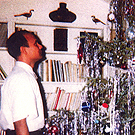
Each year in the West, Sri Chinmoy observed the birth of Christ. His first Christmas in New York, in 1964, was celebrated at the home of his two American sponsors, Sam Spanier and Eric Hughes. (click photo). The following is an excerpt from ‘CHRISTMAS: The Play of Universal Emotion’ published in AUM Magazine in 1965.

“This is the day that unites near and far. This is the day that awakens the best in us, within and without. This is the Day of Eternal Bliss, from which the Past, Present and Future derive much significance of Existence.

Christmas reveals to us a limitless ocean of Universal Joy. The waves of the suffering world dare not declare their existence.” Read more...

.


A Soulful Tribute to NELSON MANDELA (1918-2013)

Nelson Mandela — Father of the South African Nation — passed away on December 5th, at the age of 95, at his home in Johannesburg. Not only was he a towering inspiration to the people of South Africa, he was universally admired for his courageous struggle against apartheid; his unbreakable will in the face of 27 years of imprisonment; and his compassion and forgiveness of his oppressors.

His legacy to the world at large is beautifully described by his close spiritual friend and fellow peace-lover Sri Chinmoy in the following poems and reflections:

“President Mandela’s very name
Builds a hope-cathedral
In the heart of despair-flooded humanity.”

View slideshow...

.


The Meaning of Discipleship Today Original Audio Recording

by Sri Chinmoy

On June 1st, 1979, at the request of the Dean of the Pacific School of Religion at Berkeley in California, Sri Chinmoy delivered one of his most historic lectures.

He opens his main address with the question: “Who is a disciple?” And immediately answers: “A disciple is a seeker, a truth-seeker.... A disciple is a lover; he is a Heaven-lover.... A disciple is a server; he is an earth-server.... A disciple is a fulfiller; he is a God-fulfiller.”

Sri Chinmoy highlights the differences between “yesterday’s disciple, today’s disciple and tomorrow’s disciple” and explains the importance of the Master-disciple relationship.

Listen to the original recording along with transcription.

.


Scholarly Studies

about Sri Chinmoy

The opportunity to venture into uncharted waters has always been a profound source of inspiration for seekers after knowledge. The creative works of Sri Chinmoy have presented just such a challenge, particularly in the last century when he was newly arrived in the West from India.... That this writer was also a musician, a mystic and a philosopher merely compounded the difficulties. But, somehow, barriers dissolved. Traditional universities acceded to topics that had never been attempted before ... and pioneering studies [were] undertaken at universities in Australia, the USA, Iceland and New Zealand. The fact that these dissertations and theses came to fruition is a testament to the enduring power of Sri Chinmoy’s words and music – and to the courage of a handful of scholars scattered around the globe. Read more…

.


Bengali songs

The lyrical quality of the Bengali language lends itself perfectly to poetic expression. Its cadence and rhythm give it a natural musicality. Even so, it takes the touch of divine inspiration to transform these elements into immortal songs. 

Sri Chinmoy had the rare gift of being able to create Bengali lyrics and simultaneously imbue them with haunting and exquisite melodies. From his earliest childhood until the final days of his life, he immersed himself in the world of song. Read more...

.


THE EXISTENCE OF GOD – Original Audio Recording

by Sri Chinmoy

On April 22nd, 1974, Sri Chinmoy delivered three university talks in three different US states. In this, the final lecture of the day, at the North Idaho Junior College in Idaho, Sri Chinmoy answers one of humanity’s age-old questions: Does God exist?

“Here we are all seekers. Some of us may not be as sincere as others. Some of us may be curiosity-mongers. Some of us, at times, become doubters. Some of us, at times, become atheists. Yet we are all seekers. Just because we are seekers, at God’s Choice Hour, one day we shall realise God.”

Listen to the original recording along with transcription.

.


Early Years

.


Stories about Sri Chinmoy's family. Read more…


.


Stories from Sri Chinmoy's life in Chittagong. Read more…


.


Stories from Sri Chinmoy's life in Pondicherry. Read more…


.

Sri Chinmoy and the Language of Prayer

Dr. Vidagdha Bennett

Perhaps the greatest impulse to pray comes from our perception of the degree of separation between our human heart and God. When God is far from us, we yearn for His Presence. When we feel close to Him, we praise Him. We pray to God in the belief that our prayers will be heard, that they will bridge the chasm between the finite and the Infinite and link us to that immense Other. And, in rare moments of mystic oneness, we feel that prayer can embody something of the radiance and beauty of the Divine itself.

The many degrees of separation between the supplicant and God are frequently intimated through the speaker’s choice of pronouns. This is especially so in the English language where the profound influence of Tyndale’s New Testament (1526) followed by the Authorised King James’ Version of the Bible (1611) led to a preference for ‘I-Thou’ prayers and invocations.1 By the close of the 19th century, however, ‘thou’ had been replaced by ‘you’ in almost every instance, except a religious context. And, in recent times, even that has changed, rendering ‘thou’ virtually archaic – although many still rue its loss and believe that prayers which have been sanctified by hundreds of years of utterance seem to lose an intangible part of their sacredness when they are modernised. In the case of The Lord’s Prayer, to take a significant example, there are legions of Christians who treasure the elegance and majestic quality of the older translation:

“Our Father, which art in Heaven,

Hallowed be Thy Name.

Thy Kingdom come,

Thy Will be done, in earth as it is in Heaven…”

Here is a splendid God, a God great and mighty, a God who, even as ‘Father’, inspires such awe as to banish all thoughts of intimacy – truly a God to revere and worship. When these immortal words of the Christ are expressed without the honorific terms, many believe that the prayer itself becomes considerably weakened:

“Our Father in Heaven,
Hallowed be your Name,
Your Kingdom come,
Your will be done, on earth as in Heaven…”

There are even some who would infer that the humility and devotion of the supplicant are called into question by the use of ‘you’ and ‘your’. They believe that the use of the common pronoun denotes a conversation between equals, and that supplicants reciting the prayer will be less inclined to look upon God with awe.

Whether the original Aramaic words of the Christ contained this distinction is debatable. And, to the extent that “Traducta estraditor es” (“Every translator is a traitor”), it is manifest that many such ecclesiastical interpretations may be unique to the English version. But, inasmuch as it has helped us to refine our language of prayer, discussion about the appropriateness of the familiar pronoun ‘you’ for God has been extremely valuable.

Which way, then, lies the future of prayer? Will it be formal or familiar? Will the use of ‘Thou’, ‘Thy’ and ‘Thine’ be preserved from extinction or will they be allowed to depart gracefully in favour of everyday spoken English?

I believe that one of the answers to this question lies outside the Christian religion in the hundreds of prayers in English expressed by Indian poet and spiritual figure Sri Chinmoy (1931-2007).

In Sri Chinmoy’s prayers, both the familiar and the formal pronouns for God coexist, although the more formal usage predominates in his early writings. His choice of the older “I-Thou” format does not appear to arise from any conscious attempt on the part of the poet to evoke biblical overtones, a view reinforced by the fact that he was neither educated in the West nor was he nurtured in the Christian tradition. I believe that Sri Chinmoy’s use of ‘Thee’ and ‘Thou’ can rather be traced to the somewhat unusual literary environment in which he studied the English language.

Sri Chinmoy spent his formative years in South India under the guidance of the spiritual luminary Sri Aurobindo, whose poem “Savitri” is arguably one of the finest epics ever written. Educated at Cambridge University in the late 19th century, Sri Aurobindo displayed in his poetry many of the stylised features of the Victorian era, but he consciously tried to forge a new language of the spirit, or what he referred to as “a direct and sovereign descent and pouring of some absolute sight and word of the spirit into the moulds of human language.”2

Sri Aurobindo’s lofty language and incantatory style is exemplified by the following prayer in sonnet form written on October 25th, 1939:

BECAUSE THOU ART

Because Thou art All-beauty and All-bliss,
My soul blind and enamoured yearns for Thee;
It bears Thy mystic touch in all that is
And thrills with the burden of that ecstasy.

Behind all eyes I meet Thy secret gaze
  And in each voice I hear Thy magic tune:
Thy sweetness haunts my heart through Nature’s ways;
  Nowhere it beats now from Thy snare immune.

It loves Thy body in all living things;
Thy joy is there in every leaf and stone:
The moments bring Thee on their fiery wings;
Sight’s endless artistry is Thou alone.

Time voyages with Thee upon its prow, –
And all the future’s passionate hope is Thou.

The poet has infused older forms of poetic speech with his own luminous vision to give his prayer a purity and intensity that is quite new.

We can see that Sri Chinmoy’s exquisite hymn of praise for God, published in his book “My Flute” in 1972,3 comes from this same tradition:

HOPE

Thou art my Lord, my golden dream,
  Thou art my life in death.
O bless me with Thy Hope Supreme,
  Lord of the Eternal Breath!

Agelong the vision of Thy Sun
  For darkness have I sought.
I know the evils I should shun
  And quickly bring to nought.

The earth is deaf and blind, my Lord;
  Its true goal it denies.
It hears no voice, no heavenly word
  From those who seek the skies.

O yet I feel Thy kingly Grace
  With my feeble mortality.
I shall win at last the Noonward Race,
  Plunge in the Nectar-Sea.

Because he seeks to convey the feebleness of man and the overwhelming sovereignty of God, the poet has turned naturally to the language of ‘Thou’ and ‘Thy’. These words convey something of that immense gulf between the human and the Divine, and have the effect of diminishing any ego that might otherwise be brought forward in the course of the seeker’s personal petition. In an illumining comment in this connection, Sri Chinmoy writes:

“Ego has to be transcended. Man uses the terms ‘I’ and ‘mine’ because he feels that these things constantly feed him. But the real God-lover wants to be fed by God’s Grace and God’s Compassion. A true seeker of God, a true lover of God, will use the terms ‘Thou’ and ‘Thine’.”4

And, in a further comment on the Christ’s immortal prayer, “Let Thy Will be done”, Sri Chinmoy says:

“This is the greatest prayer that we can offer to God. In the sincere depths of this prayer is the extinction or transformation of the ego.”5

If the absence of human ego and the presence of God are interdependent, as he indicates, then the seeker’s choice of pronouns may be seen to play a crucial role in preparing him inwardly to be in a condition of prayer that is most receptive to the Divine.

The following prayer, which is pivotal to Sri Chinmoy’s philosophy, is based on this belief:

 INVOCATION

 Supreme, Supreme, Supreme, Supreme!
 I bow to Thee, I bow.
 My life, Thy golden plough.
 My journey’s Goal Thy soulful Dream
 Supreme, Supreme, Supreme, Supreme!
 I bow to Thee, I bow.

 Supreme, I am Thy glowing Grace.
 My world, Thy Feet of Light;
 My breath, Thy Vision’s kite.
 Thou art one Truth, one Life, one Face.
 Supreme, Supreme, Supreme, Supreme!
 I bow to Thee, I bow.

This prayer represents the ultimate self-offering of the individual human soul to the Divine. The seeker bows before God again and again in utter humility. Upon closer reading, one realises that the seeker gives no indication that he feels unworthy, small or inadequate. On the contrary, he is singularly aware of the great responsibility vested in him by God to manifest the tremendous dreams and visions that God wishes to fulfil in and through him, dreams of such significance and beauty that he is almost overwhelmed by them. He sees himself as radiant with a light that is not his own.

‘Supreme’ – the Name that Sri Chinmoy has chosen to express his concept of God – is sufficiently new to Western ears to suggest both the transcendent and the personal aspects of the Divine. It corresponds to the ancient ‘Purusha’ of Indian scriptures. In his “Commentary on the Bhagavad Gita”, Sri Chinmoy writes:

Purusha is the pure, witnessing consciousness … Purusha is actionless. No action is possible in Purusha, for Purusha transcends both time and space. Yet without Purusha, there can be no universe, no manifestation.”6

Discussing the concept of the Purusha in the Rig Veda, Indian scholar Hiranmay Banerjee writes:

“Here, the whole creation is identified with a colossal person, whose dimensions are big enough to explain for the entire universe and yet leave a residual portion to suggest, presumably, its all-pervading character.”7

Similarly, the ‘Supreme’ in Sri Chinmoy’s writings represents an immanent principle, and yet it is one which can respond to the seeker’s prayers, one which not only reciprocates love but whose love sustains the universe.

The bond between man and the Supreme that is reflected in “Invocation” is in sharp contradistinction to the following prayer which issues from the experience of God’s absence:

A LITTLE

A little joy have I of ceaseless joy,
A little day of timeless day.
Yet knows no bound this empty show of mine;
 I march along a goalless way.

O Love! A desert within me ever pines.
 Do turn it into a song of dawn.
 I know not in what hour of evil night
 Thou art, my Lord, from me withdrawn.

Life now must reach Thy Breath of Bliss supreme,
Make Thee the one and only Guide.
Thou art the Bridge between my death and birth;
O let my longings in Thee abide.

Here it seems that the poet has chosen to employ the honorific pronoun as a way of actualising God’s withdrawal – “I know not in what hour of evil night/Thou art, my Lord, from me withdrawn.” In this context, the use of the old affirmation ‘Thou art’ emphasises the remoteness of God. The personal God has receded into the Impersonal, day has been overtaken by night, light by darkness. The pilgrim continues marching but fails to find the bridge that will lead him away from the realm of night towards a new dawn.

It may also be relevant to mention in this context that ‘Thou’ is a singular pronoun and, therefore, the God who is invoked is also a singular entity, whereas ‘You’ lacks that singular-plural distinction and can sometimes, as a result, seem more abstract, ambiguous. In the Hindu tradition from which Sri Chinmoy hails, a tradition in which the plurality of God is central, the use of ‘Thou’ underscores the oneness of the Divine – all the various manifestations of God coalesce in this singular pronoun.

In the following poem, the supplicant has come to terms not only with the grandeur and impersonal nature of God but with his own place within that vastness. Because of this attitude of acceptance and surrender, the poem is transformed into a celebration of God’s immanence:

MASTER

O Lord of Nature, sovereign Sun of all!
  Who, if not Thou, will speak of Thee?
  Thy Smile of Grace through Eternity
Frees all aspiring souls from night’s dumb call.

Reality Unique! Thou art the ring
  Of the lowest chasm and spanless height.
  In Thee they feel their haven bright;
In Thee all beings move and wave and wing.

To see Thy all-transcending mystic Form
  No vision have we of golden gaze;
  Thou art the noon of all our days,
The veerless Pilot in our death’s stark storm.

There is a great parity in the images between “A Little” and “Master”. In the former, God is both the bridge and the Guide; here He is the ring and the Pilot. Where previously He was the One who transformed night into a song of dawn, here He is the “sovereign Sun of all” and “the noon of all our days”. Instead of invoking God’s “Breath of Bliss”, the poet now summons His “Smile of Grace”.

The poem has a superb ease of delivery. In a line of singular beauty, Sri Chinmoy allows his vision to be swept along by a judicious use of conjunctions and alliterative effects: “In Thee all beings move and wave and wing.” Sri Chinmoy’s God is not a pantheistic God, but it is true to say that, like his kinsman Tagore, Sri Chinmoy sees Nature as infused with “the suggestion of an Uttermost Beyond.”8

Sri Chinmoy tends to use initial capital letters to dignify his mode of address even further and to add typographical emphasis. Not only ‘Thee’, ‘Thy’ and ‘Thou’ are accentuated in this way, but also the names for God and His divine qualities, for example “Thy Breath of Bliss supreme”. While initially disturbing to the eye perhaps, these majuscules do provide clarity of interpretation as well as signalling an intensity of tone which we might otherwise have to intuit. And it is perhaps evidence of the flexibility of the English language that the rules of capitalisation are arbitrary enough to permit extreme variations from one writer to another.

Again, this preference for capitalisation, though permissible in English, provides a challenge for translators, especially those working with languages where there is no distinction between capital and lowercase letters, or with ideogrammatic languages where there are no letters at all. Again, in the German language, all nouns are capitalised and so the mixed case effect of Sri Chinmoy’s lines of poetry cannot be effectively reproduced. A further point of interest is that in the poet’s mother-tongue, Bengali, capital letters are non-existent, as indeed are all punctuation marks except the vertical end of line bar. Perhaps, as he made the transition to English, the poet discovered that he needed to indicate some difference between the common applications of any given word and its application to God.

The prayers by Sri Chinmoy that I have so far considered are classed among his earliest creations in the English language and date from the period 1955-1972. Along with his use of the “I-Thou” format, we can see that the poet was also concerned with expressing his prayers within a highly formal rhyming and metrical structure. He meets the delicate tension between the demands of poetry and the demands of prayer by fulfilling both. There will always be critics to question whether poetry can still be called thus when it is so overtly prayer, but I believe that we find in Sri Chinmoy’s work a creative, honest and sustained attempt to render his prayer in the most heightened poetic language possible.

Not all Sri Chinmoy’s poems of this era are addressed directly to God, yet all reveal something of the inner spiritual condition of the poet. Consequently, it becomes difficult to isolate his prayers from his entire oeuvre. Poems evoking the “dark night of the soul” evolve into poems of prayer, and poems of prayer evolve into poems of illumination, wisdom and realisation. It is a pattern that is repeated constantly through Sri Chinmoy’s works and with endless variations. In the poem “Another Day”, for example, the poet begins with the sorrowful line:

Another day, another day,
My Lord Supreme is far away.

A few pages on in the same volume, in a poem entitled “Our Meeting Place”, we find that from the depths of despair comes the cry of the heart for God’s response, His “silence-embrace”. This is the poem in its entirety:

O Lord, my Master-Love, how far are we?
How far from ecstasy’s silence-embrace?
Heavy is my heart with sleepless sighs and pangs;
I know my bleeding core, our meeting place.

Then, in “Revelation”, we find that this condition of utter desolation has been transformed into one of ecstatic oneness with God:

No more my heart shall sob or grieve.
My days and nights dissolve in God’s own Light.
Above the toil of life my soul
Is a bird of fire winging the Infinite.

And if there is an overlapping of the boundaries between prayer and poetry, there is yet another capacity of the poet which is still to be considered and that is his role as a singer. In fact, Sri Chinmoy’s expression of his gift for singing and musical composition predates his earliest poems in English, since his songs are written in Bengali. Moreover, the poet’s activities as a composer of songs continued to run concurrently with his composition of English poems until his final days.

Sri Chinmoy’s devotional songs are short and lyrical in nature. Like his early English poems, they correspond to strict metrical and rhyming patterns, particularly in the genre immortalised by Rabindranath Tagore. What is especially interesting in this context is that the poet often translated his songs into English and printed them as poems in their own right. In English, however, he freed the poems from the conventions of rhyme and rhythm and explored a spontaneous lyrical form. In many ways, they became poetic recreations of the original. One such example is the following classic:

O MY LORD OF BEAUTY

You are beautiful, more beautiful, most beautiful,  
Beauty unparalleled in the garden of Eden.  
Day and night may Thy image abide  
In the very depth of my heart.  
Without You my eyes have no vision,  
Everything is an illusion, everything is barren.  
All around me, within and without,  
The melody of tenebrous pangs I hear.  
My world is filled with excruciating pangs.  
O Lord, O my beautiful Lord,  
O my Lord of beauty, in this lifetime  
Even for a fleeting second,  
May I be blessed with the boon  
To see Thy Face. 

The ten-line Bengali original, while incomprehensible to most of us, is nonetheless revealing in a number of ways. Here it is in transliteration from the Bengali characters:

Sundara hate sundara tumi
Nandana bana majhe
Nishidin jena antare mor
Tomari murati raje
Tumi chhara mor nayan andhar
Sakali mithya sakali asar
Chaudike mor bishwa bhubane
Bedanar sur baje
Pabo kigo dekha nimesher tare
Ei jibaner majhe

To begin with, the rhyming scheme is a carefully structured abcbddabcb form (or aabbaa if the lines are written without end breaks). I am sure that Bengali literary experts could also cast light on the metrical scheme of the song. Having observed Sri Chinmoy composing many such songs, I know that he strived diligently to adhere to strict inner principles of composition. A final point to make, from my admittedly limited knowledge of the language, is his use of the word ‘tumi’ (meaning ‘you’) to refer to God. The honorific form of the second person pronoun does exist in Bengali – ‘apni’ – and is in current use for elders and all those in a formal relationship. Clearly, Sri Chinmoy has consciously eschewed this choice in favour of the more familiar ‘tumi’. As a direct result, perhaps, God is addressed in translation as ‘You’, while in the possessive form the poet uses ‘Thy’. The intermingling of these two modes lends dignity to the poet’s rapture.

Most of Sri Chinmoy’s translations from the Bengali favour the use of ‘You’ for God, with capitalisation of the initial letter providing a kind of mid-way elevation without necessitating the use of ‘Thou’. Around this pronoun many images of God accrete and it is in these images that the richness of Sri Chinmoy’s experience of God is best appreciated. It is here also that we find his most significant departures from Western modes of prayer. The following poem-prayer, to take one example, began as a Bengali song:

O MY BOATMAN

O my Boat, O my Boatman,
O message of Transcendental Delight,
Carry me. My heart is thirsty and hungry,
And it is fast asleep at the same time.
Carry my heart to the other shore.
The dance of death I see all around.
The thunder of destruction indomitable I hear.
O my Inner Pilot, You are mine,
You are the Ocean of Compassion infinite.
In You I lose myself,
My all in You I lose.

For purposes of reference, here is the Bengali original:

Ore mor kheya ore mor neye
Ore ananda bani
Niye jao mor trishita khudhita
Supta chitta khani
Mrittyu nritya heri charidhar
Dhwangsa ashani hane durbar
Ogo kandari tumi je amar
Chira asimer kripa parabar
Tomar majhare harabo amare
Jani aji ami jani

The rhyming scheme appears to be aabb and then two very short lines containing internal rhymes follow. If we were to write out the poem according to the rhyming scheme, it would appear:

Ore mor kheya ore mor neye ore ananda bani
Niye jao mor trishita khudhita supta chitta khani
Mrittyu nritya heri charidhar
Dhwangsa ashani hane durbar
Ogo kandari tumi je amar
Chira asimer kripa parabar
Tomar majhare
Harabo amare
Jani aji
Ami jani

Gradually, as the seeker merges himself in the silence of that “Ocean of Compassion”, the lines become shorter and shorter until he finally loses himself completely in the last two lines, like a drop being absorbed into the sea. I am sure that many such subtle intricacies in the poet’s lyrical form will be revealed by Bengali scholars. In addition, there is a natural propensity for rhyme in the Bengali language which uniquely favours poets and which Sri Chinmoy employs with his most distinctive style.

In “O My Boatman”, God is represented in a number of ways – as Boat, Boatman, message, Pilot and Ocean – and yet these aspects of God are not at all contradictory. Rather we can feel a steady enlargement and deepening of the poet’s vision of God, a gathering momentum that carries him towards his urgent and heart-rending cry, “Carry me.” He recognises that if God should come in response to his appeal, then God will be manifest in everything: He will be the Boat, the Boatman, the ocean that is crossed and the shore on the other side. God’s immanence will be undeniable.

The entire landscape of the poem, while not specific to any geographical location, is suffused with the poet’s personal experience of the waterways of East Bengal where he was born, and the little ferryboats that plied to and fro. In another prayer from the same volume, he begins,

O love me more and love me long.
My boat is sinking, my hope is strong.

Rabindranath Tagore, writing from a similar perspective but without the same sense of dramatic urgency, gives us a finely nuanced portrait of his mysterious boatman in “Gitanjali”:

74.

The day is no more, the shadow is upon the
earth. It is time that I go to the stream to fill
my pitcher.

The evening air is eager with the sad music of
the water. Ah, it calls me out into the dusk. In
the lonely lane there is no passer-by, the wind
is up, the ripples are rampant in the river.

I know not if I shall come back home. I know
not whom I shall come to meet. There at the
fording in the little boat the unknown man plays
upon his lute.

Tagore’s boatman plays upon a lute. Sri Chinmoy also inclines towards the depiction of God as a musician entrancing mankind with His rapturous music. In the following poem, this divine Musician is both male and female, moon and sun:

I SING, I SMILE

I sing because You sing.
I smile because You smile.
Because You play on the flute
I have become Your flute.
You play in the depths of my heart.
You are mine, I am Yours:
In one Form
You are my Mother and Father eternal,
And Consciousness-moon, Consciousness-sun,
All-pervading.

The allegorical frame of reference in this poem is specifically Indian. The poet is invoking the great spiritual figure Sri Krishna, who was perceived as an incarnation of God. In his youth, Sri Krishna charmed his devotees in Brindaban by playing the flute. We find a striking parallel in the opening poem of Tagore’s “Gitanjali”:

1.

Thou hast made me endless, such is
thy pleasure. This frail vessel thou
emptiest again and again, and
fillest it ever with fresh life.

This little flute of a reed thou
hast carried over hills and dales,
and hast breathed through it
melodies eternally new.

At the immortal touch of thy
hands my little heart loses its
limits in joy and gives birth to
utterance ineffable.

Thy infinite gifts come to me only
on these very small hands of mine.
Ages pass, and still thou pourest,
And still there is room to fill.

Both poets seek to convey the experience of becoming an instrument which God animates with His Breath and through which He creates innumerable melodies.

Another signature of Sri Chinmoy’s spiritual heritage is in those prayers, particularly the translations from Bengali songs, which refer to one of the manifestations of God by name or by traditional epithet. The following exquisite invocation of Sri Krishna as “King of the cowherds” is embodied in a refrain that runs through the lyric and then fades away at the end, like a wistful echo:

IN THE FOREST OF MY INNER LIGHT

O King of the cowherds,
Just once before me appear.
My life is a false dream,
My death is a false dream.
Do take them away.

O King of the cowherds,
Just once before me appear.
In the forest of my inner light,
In the silent depths of my heart,
I hear the soul-stirring music of your Flute.

I see your divine cow,
Grazing in the lap of Infinity’s Silence.
O King of the cowherds,
Just once before me appear.

In the following poem, it is Shiva, one of the Indian trinity of Brahma-Vishnu-Shiva (the Creator, the Preserver and the Transformer), who is called upon time and again to reveal and manifest his vast powers in and through the poet:

ARISE! AWAKE!

Arise, awake, O friend of my dream.
Arise, awake, O breath of my life.
Arise, awake, O light of my eyes.
O seer-poet in me,
Do manifest yourself in me and through me.

Arise, awake, O vast heart within me.
Arise, awake, O consciousness of mine,
Which is always transcending the universe
And its own life of the Beyond.

Arise, awake, O form of my meditation
  transcendental.
Arise, awake, O bound liberator in humanity.
Arise, awake, O my heart’s Liberator, Shiva,
And free mankind from its ignorance-sleep.

The specifically Hindu references here do not, however, impede our understanding of the text or our appreciation of the glorious language in which Shiva is invoked. Each time the phrase “Arise, awake” resounds, it is as if a bell has been struck. The original Bengali song reads as follows in transliteration:

Jago amar swapan sathi
Jago amar praner pran
Jago amar chokher jyoti
Rishi kabi murtiman
Jago jago jago

Jago amar bishal hiya
Byapta jaha bishwamoy
Jago amar sei chetana
Bishwatite shesh ja noy
Jago jago jago

Jago amar dhyani swarup
Jago amar badha jib
Sarba jiber tandra tuti
Jago amar mukta Shib
Jago jago jago

Once more we see the flawless rhyming scheme, the condensed Bengali sentence structure, and the tendency of the poet to rely on single, powerful Bengali words to convey a depth of meaning for which there is no equivalent corresponding word in English. Hence, the necessity felt by the poet not merely to translate into English the word in question but also to suggest something of the entire area of experience that the word embodies. Let us take the second last line for example – “Jago amar mukta Shib”. Quite literally, the line means “Awake, my liberator Shiva.” But clearly Sri Chinmoy feels that this does not sufficiently convey Shiva’s role with respect to humanity at large and so he has rendered it in the wonderfully poetic and elegant lines: “Arise, awake, O my heart’s Liberator, Shiva,/And free mankind from its ignorance-sleep.” In essence, by defining Shiva’s role, the poet has translated not just his line of poetry but a vast area of spiritual experience and understanding to which his Western readers might not otherwise have access.

For the most part, however, Sri Chinmoy’s imagery for the Divine is not dependent on any particular spiritual tradition nor does it fit into any established pattern of prayer, at least in the Western sense. In the following poem, for example, he portrays the feminine aspect of God without using the name Kali or Durga or any of the other Indian goddesses. Equally, his poem could be taken as referring to Mary, the Mother of Christ. This is a prayer in which the supplicant experiences a state of grace after intense suffering:

THE MESSAGE OF SURRENDER

Today You have given me
The message of surrender.
I have offered to You
My very flower-heart.
In the dark night with tears,
In the unknown prison-cell of illusion,
In the house of the finite,
No longer shall I abide.
I know You are mine.
I have known this, Mother,
O Queen of the Eternal.

And the Bengali original reads:

Tumi amai diyechho aj samarpaner bani
Ami tomai sanpechhi mor kusum hriday khani
Andhar rate ashru sathe
Moher karar ajanate
Simar gehe thakbona ar jani ami jani
Tumi amar jenechhi ma chirantaner rani

Everything in the poem revolves around that single-syllable word ‘Ma’, ‘Mother’. It is the first word uttered by every child; and it represents the highest realisation of the saints and sages.

Thus we can see that Sri Chinmoy’s concept of God comprehends not only His immensity but also His nearness, in the form of Mother, Father or Beloved. One very moving example of the latter category is the following translation by the poet from his original Bengali song:

I shall listen to Your command, I shall.
In Your sky I shall fly, I shall fly.
Eternally You are mine, my very own.
You are my heart’s wealth.
For You at night in tears I shall cry.
For You at dawn with light I shall smile.
For You, for You, Beloved, only for You.

A reading of the poems in “My Flute” reveals a continual shift in perspective, so that we behold God always in a new light. He is a Bird or an Ocean or a Flautist or a Boatman and so on. There are even occasions when the poet himself presupposes God’s answers to mankind’s prayerful questions and, far from being presumptuous, this conversation between the human and the Divine seems in perfect harmony coming from someone who is both a seer and a poet:

WHERE IS THE TRUTH?

O Lord, where is the Truth?
  “Where your Beloved is.”
Who is my Beloved, Who?
  “In Whom your life is peace.”

And that brings us to one of the most fundamental aspects of Sri Chinmoy’s prayers. The prayers are born of genuine personal experience, certainly, but they also articulate universal experiences. In many ways, they address the Divine on behalf of suffering and struggling humanity; they speak for the human heart. It is for this reason that they will never be dated. Sri Chinmoy has identified with mankind’s timeless spiritual longings. He has pleaded with God, begged Him for a response, wept for Him, communed with Him, praised Him, loved Him and thanked Him. Every possible kind of dialogue with God he has known from personal experience. That is why his prayers bear the stamp of authenticity.

But the greatest value of these prayers is that we seem to travel with them into the presence of the Divine. They enact for the reader what Sri Aurobindo has so beautifully described in “Savitri”:9

A prayer, a master act, a king idea
Can link man’s strength to a transcendent Force.

For, in the end, as someone has so aptly observed, God is not a grammarian. He answers our stuttering prayers, our mumbled prayers, even our unspoken prayers. So if we are to discuss the language of prayer, we must begin with silence, for that is where prayer is born and where it ultimately ends. Indeed, there is every possibility that, as Australian poet Nathan Shepherdson suggests, “the prayer is broken by the praying.”10 Given this landscape of wordless silence that informs prayer, it may be appropriate to end with one last prayer by Sri Chinmoy, a prayer in which the seeker aspires to learn the language of silence:

ONLY ONE HOPE

Break asunder all my hopes.
Only keep one hope,
And that hope is to learn
The language of Your inner Silence
In my utter unconditional surrender.
In Your clear and free sky
I shall be calm and perfect.
The bird of my heart is dancing today
In the festival of supernal Light.


– End –

References

1 Although the second person singular pronoun ‘thou’ is now synonymous with utmost reverence and solemnity, it was once a naturally occurring element of speech and indicated familiarity and intimacy. In fact, it was the pronoun ‘you’ which was considered to be the more formal mode of address. This usage of ‘thou’ is still preserved in several regional dialects in the United Kingdom. Over time, the meanings of the two words alternated. ‘You’ became increasingly common, while ‘thou’ was reserved for honorific use.

2 The Future Poetry, Part 2, Chapter VII

3 All the prayers and lyrics by Sri Chinmoy referred to in this article are selected from My Flute [Agni Press, NY: 1972, reprinted 1975]. The Bengali transliterations may be found at Sri Chinmoy Songs.

4 From a talk entitled “Ego”, given on January 26th, 1969 and published in Two Devouring Brothers: Doubt and Ego, Agni Press, NY: 1974

5 ibid

6 The Three Branches of India’s Life-Tree: Commentaries on the Vedas, the Upanishads and the Bhagavad Gita, Aum Publications, NY: 1996, pp. 169 and 220.

7 How Thou Singest, My Master! A Study of Tagore’s Poetry, Orient Longmans, Calcutta: 1961, pp. 47-48.

8 Rabindranath Tagore, The Religion of Man, Macmillan, NY: 1931, p. 92.

9 Book One: The Book of Beginnings; Canto II: The Issue.

10 Review of Best Australian Poetry 2004, The Age


Copyright © 2010, Vidagdha Bennett. All rights reserved under Creative Commons license.

 

Literature

As we have a human world, where we get all earthly things, even so there is a world of inspiration. If we go deep within, we can enter into that world and find that the poems are already written.There is a world of poetry, a world of prose, a world for all literature that exists.  –  Sri Chinmoy

Sri Chinmoy Poetry Series

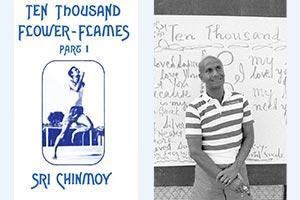
Ten Thousand Flower Flames

One of Sri Chinmoy's most significant poetry series. A collection of 10,000 poems published in 100 different volumes. Sri Chinmoy began the series on October 22nd, 1979 and completed it on July 3rd, 1983. Later many poems were set to music. Sri Chinmoy also chose his favourite 207 Flower Flames, published in a separate volume.


Image
eb-300

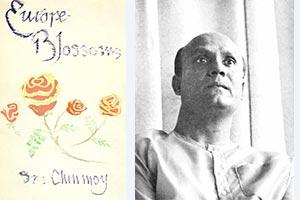
Europe-Blossoms

Europe-Blossoms are a series of 1,000 poems that Sri Chinmoy wrote during a trip to Europe in the summer of 1974. Sri Chinmoy began writing the poetry series on a Pan Am Flight from New York to London on 21 June 1974 and were completed on July 13, 1974. The book was published by Aum Press, Puerto Rico in August of 1974.


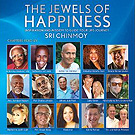
The Jewels of Happiness Audio Edition

Words by Sri Chinmoy. Narrated by Archbishop Desmond Tutu and others.

Ever since he led the Peace Meditations at the UN, the power of Sri Chinmoy’s initiatives have been praised by world leaders and influenced thousands of individuals. Here, his insightful words, elegant prose, and shrewd aphorisms form a wonderful tapestry of inspiration for people from all walks of life. Read more…
 

.


Commentaries on Sri Chinmoy's Literature


The Ever-Transcending Quest - A Literary Analysis of the Poetry of Sri Chinmoy Introduction

by Mrinali Christine Clarke

The idea of a poetic voice expressing or evoking pure consciousness is, of course, a paradoxical problem, for it raises the conundrum – how can one express in mere words an experience of such a subjective metaphysical nature, or, in other words, how does one ‘express the inexpressible’? The daunting nature of such a task has, however, never discouraged the artist or writer from attempting it. Read more…
 

.
 

Poetry’s Universality and Humanity’s Divinity:
A Reciprocal Soul-Discovery Journey (English version)

by Hridananda Andrés Ramón

An Approach to the Concepts of Truth, Beauty, and Delight in Sri Chinmoy’s Poetic Work. Submitted to the Faculty of English, University of Iceland, 2005. Includes Spanish version. Read more…
 

.
 

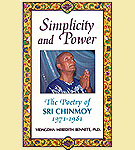
Simplicity and Power

by Dr. Vidagdha Bennett

Every age calls forth its poet, someone who is able to express its deepest ideals and aspirations. The critic who first engages in the appraisal of this newly emergent poet is faced with vastly different responsibilities from the critic who deals with writers of an established excellence. Beyond his direct response to this promising new body of literature lies the task of creating a climate of empathy in which the poems may be received by future readers and commentators. Read more...
 

.
 

Sri Chinmoy and the Language of Prayer

by Dr. Vidagdha Bennett

Perhaps the greatest impulse to pray comes from our perception of the degree of separation between our human heart and God. When God is far from us, we yearn for His Presence. When we feel close to Him, we praise Him. We pray to God in the belief that our prayers will be heard, that they will bridge the chasm between the finite and the Infinite and link us to that immense Other. And, in rare moments of mystic oneness, we feel that prayer can embody something of the radiance and beauty of the Divine itself. Read more...
 

.
 

Sri Chinmoy’s “Ten Thousand Flower-Flames”
A Commentary

by Dr. Vidagdha Bennett

On Sunday, July 3rd, 1983, Sri Chinmoy completed the final poem – poem number 10,000 – of his monumental series entitled Ten Thousand Flower-Flames. It is not often that we are given the opportunity to celebrate a poetic “event”. Both as readers and critics, we are seldom in touch with the immediacy of creation and though a poem should become immortal in after-ages, something of that original impact, akin to a new discovery, is lost with the lengthening passage of time. Read more...
 

.
 

Thus Spoke our Master

Dr. Kazem Abhary interview on SBS Radio

The Australian SBS Radio, Persian Programme, interviewed Dr. Kazem Abhary about his book, a translation of 500 of Sri Chinmoy’s aphorisms into Persian, titled Pire Maa Farmood, meaning ‘Thus Spoke our Master’ on 20th March 2011. The following questions were asked by the SBS host… Read more...
 

.

Family

.
 

The Family Tree – tracing Sri Chinmoy's ancestry.

Direct family lineage view…

Maternal relatives view…

Paternal relatives view…


.


Stories about Sri Chinmoy's mother Yogamaya. Read more…


.


Stories about Sri Chinmoy's brother Hriday. Read more…


.

August 1975

To:
Pir Vilayat Khan
Head of the Sufi Order in the West


1975

August

          From: Pir Vilayat Khan, Head of the Sufi Order in the West

Correspondence

Introduction

When it came to correspondence, Sri Chinmoy seemed to belong to another era. He placed great value on written communication with his friends and acquaintances, rarely missing a birthday or important occasion in their lives, and he derived immense joy from their letters to him in return. Usually he dictated his letters to an assistant. Then he would embellish the typewritten originals with his handwriting and birds and even spelling corrections. Sometimes he revised the draft a number of times before he was satisfied with it. On rare occasions, he would write letters using longhand, but of these, sadly, few copies were made. He dictated his letters to a number of his students, including Chidananda, Agraha, Nishtha, Nilima, Nemi, Sanjay and Vidagdha, and so it is difficult to make any accurate estimation of their volume. I believe it would run to several hundred letters per year. Most of these letters are on the letterhead of ‘Sri Chinmoy: The Peace Meditation at the United Nations’. In my case, and also in the case of Nishtha, Sri Chinmoy encouraged us to use old-fashioned Canon or Brother portable ribbon typewriters and specified that we should not spend more than $100 to purchase them. We only relinquished these in 2007 when replacement ribbons were no longer available. This section presents a brief and necessarily incomplete selection of Sri Chinmoy’s letters over the years.

— Vidagdha


Sri Chinmoy’s First One Million Soul-Birds

Statistical References

1. Largest Drawing: 66 yards x 18 inches
This was a roll of tracing paper purchased by the artist in Suva. On it, he drew 1,181 birds.

2. Most Birds on One Page: 96,588
This work was completed on December 11th, 1993, over a period of three days (20 hours in total). The sheet size measures 32” x 26”.

3. Implements Used:
Ball-point pens in various colours, felt tip marker pens, acrylic paint, single colour crayons, rainbow crayons, battery-operated pen, gold and silver metallic pens.

4. Materials Used:
Acid-free art paper, note-paper, canvas, foam core, graph paper, tracing paper, white satin fabric, white cotton fabric, Indian hand-made marbled paper, Japanese rice paper, oak tag, postcards, envelopes, computer-generated grids, calendars, lined paper and sheet music.

5. Countries where Sri Chinmoy drew Soul-Birds:
Malta (the beginning of the project), Sicily, Tenerife, USA, Thailand, Viet Nam, Philippines, Japan, Canada, Austria, Slovakia, Czech Republic, Western Samoa and Fiji (the completion of one million).

6. Cities in the USA where Sri Chinmoy drew Soul-Birds:
New York, Washington DC, Houston, Seattle, San Francisco, Los Angeles, San Diego and Honolulu. 

7. Galleries of Sri Chinmoy’s Soul-Birds:

January 10th, 1992 — Riu Bonanza Hotel, Puerto La Cruz, Tenerife

May 5th-14th, 1992 — 52 Vanderbilt Avenue, Manhattan, NY (dedicated to Raisa Maximovna Gorbacheva)

May 31st, 1992 — Aspiration-Ground Meditation Park, Queens, NY

October 1992 — Commonwealth Institute, Edinburgh, Scotland

October 1992 — Cambridge Central Library, Cambridge, England

November 1992 — The Old Fire Station, Oxford Town Centre, Oxford, England

November 1992 — The Epace Miro, UNESCO, Paris, France

January 8th-20th, 1993 — Rizal Memorial Library and Museum, Cebu City, Philippines

January 18th, 1993 — The University of Southern Philippines

April 13th-May 31st, 1993 — John F. Kennedy International Airport, New York

June-July, 1993 — Palais des Rois de Majorque, Perpignan, France

June-July, 1993 — Shinjuku Citizens Gallery, Tokyo, Japan

June-July, 1993 — ‘La Favourite’, Tokyo, Japan

June-July, 1993 — Peace Osaka Hall, Osaka, Japan

August 1st-31st, 1993 — 66 Crosby St, Soho, New York

October 12th-15th, 1993 — Miyazaki, Japan

November 2nd-December 11th, 1993 —18 York St, Ottawa, Canada (Gallery dedicated to Raisa Maximovna Gorbacheva)

December 17th, 1993 — Outrigger East Hotel, Honolulu, Hawaii

December 31st, 1993 — Tokatoka Hotel, Nadi, Fiji

January 7th, 1994 — Travelodge, Suva, Fiji


8. Special Titles of Series:

 
1 – 7,000
 
Seven Thousand Blue-Gold Birds
7,001 – 20,000
 
Thirteen Thousand God’s Dream-Souls
20,001 – 30,000
 
Ten Thousand Flaming-Winging Song-Birds
30,001 – 43,000
 
Eternity's Thirteen Thousand Aspiration-Cries
43,001 – 55,000
 
Infinity’s Twelve Thousand Dedication-Smiles
55,001 – 62,000
 
Immortality's Seven Thousand Sunrise-Birds
62,001 – 70,000
 
Eight Thousand Dream-Boat-Birds
70,001 – 80,000
 
Ten Thousand Freedom-Bird-Flights
80,001 – 90,000
 
Ten Thousand Self-Giving Heart-Birds
90,001 – 100,000
 
Ten Thousand World-Transformation-Dreams

After the completion of 62,000 birds, Sri Chinmoy said that the name “Dream-Freedom Peace-Birds” would apply to all his birds from that time on.

8. Special Dates:

Date   Event
December 29th, 1991   Sri Chinmoy begins drawing birds in Malta
January 7th, 1992   Completes 7,000 Blue-Gold Birds
May 30th, 1992   Completes 13,000 God's Dream-Souls (total of 20,000 birds)
January 29th, 1993   Completes 10,000 Flaming-Winging Song-Birds (total of 30,000 birds)
April 23rd, 1993   Sri Chinmoy opens exhibit at JFK Airport, New York
April 25th, 1993   Completes Eternity’s 13,000 Aspiration-Cries (total of 43,000 birds)
June 23rd, 1993   Completes Infinity’s 12,000 Dedication-Smiles (total of 55,000 birds)
July 2nd, 1993   Completes Immortality’s 7,000 Sunrise-Birds (total of 62,000 birds)
July 18th, 1993   Completes 8,000 Dream-Boat-Birds (total of 70,000 birds)
August 2nd, 1993   Sri Chinmoy opens exhibition in Soho, New York
September 25th, 1993   Completes 100,000 birds
October 19th, 1993   Declares his goal to be one million birds
November 13th, 1993   Completes 200,000 birds
November 17th, 1993   Attends exhibition of 100,000 birds in Ottawa
November 26th, 1993   Completes 300,000 birds
December 3rd, 1993   Completes 400,000 birds
December 11th, 1993   Completes drawing with 96,588 birds taking his total over 500,000
December 22nd, 1993   Completes 700,000 birds
December 23rd, 1993   Drawing for his pet dog Kanu
December 28th, 1993   Completes 800,000 birds
January 1st, 1994   Drawings for his father, mother and brothers and sisters
January 5th, 1994   Completes one million birds


10. Profile of a Half a Million Drawings in 25 Days
(December 12th, 1993 – January 5th, 1994):

Date   Daily Count   Grand Total
December 12   4,971   582,722
December 13   11,147   593,869
December 14   11,949   605,818
December 15   10,246   616,064
December 16   8,995   625,059
December 17   4,915   629,974
December 18   11,381   641,355
December 19   12,229   653,584
December 20   21,220   674,804
December 21   12,133   686,937
December 22   15,245   702,182
December 23   7,959   710,141
December 24   17,896   728,037
December 25   20,226   748,263
December 26   21,466   769,729
December 27   20,025   789,754
December 28   10,938   800,692
December 29/30 (dateline)   10,205   810,897
December 31   15,706   826,603
January 1   18,001   856,314
January 2   5,592   861,906
January 3   16,410   878,316
January 4   15,691   894,007
January 5   107,912   1,001,919


Selected Messages

One million birds – how wonderful! How wonderful is Sri Chinmoy’s achievement! By God’s Blessing we can do everything, and Sri Chinmoy has achieved this by God’s Blessing. (Jan. 1994)

— Mother Teresa
Nobel Peace Laureate
Founder, Missionaries of Charity


I congratulate you on this wonderful achievement, which transports us men, who would be winged, to the birds, which we have tried to emulate. (Jan. 1994)

— Rt. Hon. Lord Yehudi Menuhin
Renowned violinist


Your million birds will be an inspiration to everyone to continue to work for our common goal of peace – peace in our lives and communities, and peace on earth.

— Dr. Linus Pauling
Nobel Laureate in Peace and in Chemistry
Founder, Linus Pauling Institute of Science and Medicine


I am delighted to offer my warmest congratulations to Sri Chinmoy on the occasion of his completion of one million bird drawings. These soul-birds, symbols of freedom, joy and love, will undoubtedly inspire countless individuals and remain as a lasting tribute to peace and harmony.

— Rt. Hon. Jean Chrétien
Prime Minister of Canada


Warmest congratulations on drawing one million Birds of Peace. May such a mammoth and magnificent achievement be an inspiration to all of us working for peace worldwide.

— Rt. Hon. Jim Bolger
Prime Minister of New Zealand


It strikes me as highly appropriate that Sri Chinmoy, who has done so much in the cause of peace, should have chosen to create these birds. Birds are expressive not only of freedom and grace but also of the harmony and beauty that accompany peace. If each of Sri Chinmoy’s creations inspires one – ten – a hundred – people to a greater commitment to peace, their impact will have been enormous! (Feb. 1994)

— H.E. Elliot L. Richardson
Co-Chairman, United Nations Association (USA), National Council
Former United States Ambassador-at-Large


Sri Chinmoy has drawn marvellous birds, thousands of birds, thousands of hope-messengers. Thank you. (Feb. 1994)

— Madame Catherine Lalumière<
Secretary-General of the European Council


As Governor of the State of Nebraska, a Sri Chinmoy Peace State, I am very pleased to offer you sincere congratulations upon drawing your millionth bird of peace. Your dedicated service to mankind as an ambassador of peace is deeply appreciated. Efforts like yours help call attention to the ‘oneness’ which we as a state, a nation and a world must strive to achieve.

— Hon. E. Benjamin Nelson
Governor of the State of Nebraska


Your uninhibited self-expression through art speaks louder than words in communicating your strong belief in the freedom found in international peace


I offer my warm congratulations to Sri Chinmoy on this august accomplishment. Sri Chinmoy’s soul-bird drawings are eloquent and inspiring. The symbolic birds remind us of mankind’s great potential to achieve both inner and outer peace, (Jan. 1994)

H.E. Maurice Strong
CEO, Ontario Hydro
Former Secretary-General of the UN
Conference on Environment and Development


In the drawing of one million images by Sri Chinmoy, it is revealed to us the power of genius has burst its spiritual and cultural bounds to find further expression in the dream-freedom of these peace-birds. (Feb. 1994)

— H.E. Angier Biddle Duke
President, Council of American Ambassadors
Former U.S. Ambassador to Spain, Morocco and Denmark


Sri Chinmoy’s project is an eloquent testimony to the enlightened belief that visual art can powerfully affect our sympathies and understanding. I have nothing but respect for his endeavours. (Feb. 1994)

— Ivan Gaskell
Curator of Paintings,
Harvard University Art Museums


I vividly remember the beautiful exhibition titled ‘My 70,000 Soul-Bird-Flights’ which you displayed in Soho last summer. It released powerful and positive messages to all who viewed it. May your humanitarian deeds continue to inspire world peace and global harmony wherever you and your soul-birds travel. (Jan. 1994)

Renee Phillips
Publisher and Editor-in-Chief,
Manhattan Arts International Magazine


The soul, like a dove of peace, longs for the divine. This flight of those who thirst for peace and for God is made tangible with all its high spiritual quality by these improvised and pure strokes, by these solar and beautiful images of Sri Chinmoy … Let us join with Sri Chinmoy for the great flight! (Jan. 1994)

—Professor Gabriel Mandel
Professor of Art History
Renowned Italian writer and painter


Congratulations on your 1,000,000 bird drawings. Their beauty inspires us all. To finish 1,000,000 birds in the outer world transmits a powerful message for all of us to keep our hearts open to the great and peaceful inner world.

— Sudhahota Carl Lewis
World’s Fastest Human Being
Nine-time Olympic gold medallist


The dove is a symbol of peace, and a bird signifies life and loving. Sri Chinmoy has taken a simple thing and turned it into a monumental achievement to inspire us, which no one else in the world could do.

— Mahasamrat Bill Pearl
Five-time Mr. Universe
Best Built Man of the Century


The Transformative Art of Sri Chinmoy

This article is adapted from Dr. Tilak’s book Understanding Karma In Light of Paul Ricoeur’s Philosophical Anthropology and Hermeneutics, North Charleston, SC, BookSurge, 2007, with the kind permission of the author.


Introduction

Of all the Indian mystics and spiritual teachers who have travelled our world guiding those in quest of self-realization, Sri Chinmoy is unique because of his skilful use of the medium of poetry and visual art to communicate his teachings to the target audience in small groups spread across the five continents. Born in Chittagong, India in 1931, while still a child, Sri Chinmoy had a deeply mystical experience and at the age of twelve he entered an ‘ashram’ where he spent the next twenty years in intense prayer and meditation; perfecting his inner vision and realizing that rare state of awareness with God that various traditions call Enlightenment or God-realization. Driven by an inner voice or urge to offer his realizations to aspiring humanity, he moved to New York in 1964. “It was the Voice of my Inner Pilot, who commanded me. I had no choice in the matter” (see Sri Chinmoy 1977: 52).

After he had settled in New York, Sri Chinmoy turned his attention to the United Nations and its activities. From its inception, the United Nations had recognized the value of meditation as a force for world peace. Trygve Lie, the first Secretary-General, accordingly had a meditation room built in the Secretariat building. Dag Hammarskjöld, his successor, was mystically oriented and re-designed the room, as it exists today. U Thant, who followed Dag Hammarskjöld, was equally mystical in his outlook and brought deeply Buddhist spiritual and humanistic perspectives to the working of the United Nations. Over the decades, an ongoing series of programs and symposia have been designed to provide a forum for ambassadors, officials, and staff to share and reinforce their spiritual vision of and for the United Nations. In 1971, Sri Chinmoy was invited to serve as a leader of the meditation group, which is formally known as ‘Sri Chinmoy: Meditation at the United Nations’. It is an association of United Nations delegates, staff, NGO representatives, and accredited correspondents. Over the years, Sri Chinmoy authored over 1,500 books of poetry, plays, stories, aphorisms, and essays. A renowned artist, he was also recipient of ‘‘Contribution to the Arts’’ award given by the New York School of Visual Arts in 1976.

In an interview given to Bishop Kennedy and Sister Patricia Fox in Adelaide, Australia on March 12, 1976 while on a tour there, Sri Chinmoy explained the raison-d’être of his life and mission thus: “Discover yourself through yogic meditation.” It would appear that Sri Chinmoy perfected the art of meditation, which ultimately led him to self-perfection and ‘God-realization’ without any external help. Subsequently, he taught the art of meditation to anyone who cared to learn. To his Australian interviewers, Sri Chinmoy explained that he preferred the life of activity, dynamism, and self-giving (i.e. Karmayoga) to remaining closeted in the Himalayas (Sri Chinmoy Centre 1977: 54-56, 63). In a seminar he conducted in Ottawa, Canada in 1993, which I had attended, Sri Chinmoy explained his philosophy of life thus: “I have come into the world to be of service. I don’t teach in the outer sense of the term. I enter into my own highest meditation.” He then lapsed into what may be called a deep state of meditation for a few seconds to provide a practical demonstration of his meditative techniques. Returning to verbal explanation and commentary, he continued, “I keep my heart’s door open and then anybody can enter and together we go to our God.” Those interested were invited to maintain an inner connection with him; and he promised to provide inner and outer guidance that would take them to the ‘source’ of life.

The interaction with the master in Ottawa in 1993 clearly brought out for me Sri Chinmoy’s hermeneutical stance: To interpret is to bring out what is concealed in a given manifestation, to make evident what in the manifestation is not evident from the milieu in which the interpreter’s audience lives. Like the legendary Hermes, Sri Chinmoy acted like a ‘go-between’ to his interlocutors, transmuting what is beyond human understanding into a form that human intelligence could grasp. His poetry recitals and talks seemed to bring out what Palmer calls the three directions of meaning implicit in the verb hermeneuein and the noun hermeneia in a hermeneutical act: (i) oral recitation or expressing aloud in words; (ii) a reasoned explanation; and (iii) a translation from another language (see Palmer 1969: 13-14). To learn something on one’s own is like a fagot without fire; but when the preceptor (guru) imparts knowledge, his/her power and grace come with it, igniting the fagot.


The Athlete Karmayogin

Sri Chinmoy and his unique method of teaching were brought to my attention in the early seventies when students in my yoga class at Laval University in Quebec City, Canada, began to mention his name and ask questions about his spirituality and why he was becoming so famous. After some preliminary research it became clear to me that there was indeed something different in Sri Chinmoy’s re-interpretation of the traditional Karmayoga that put him apart from any number of spiritual teachers from India who roam around the world today. He probably was unique in stressing the old Greek adage of ‘healthy mind in a healthy body.’ By incorporating physical culture and sports (such as the biennial Peace Run or the running of marathons organized the year round all over the world) in his overall spiritual project, Sri Chinmoy aimed at an active and creative attitude towards an integrative life of meaning and purpose. In many ways it was modelled on the institute of gymnasium with its lectures and discussions as well as physical exercises, which was the most popular institution in ancient Greece.

Every two years, hundreds of disciples and others interested are encouraged to join together in a round-the-globe relay run under the aegis of ‘Sri Chinmoy Oneness-Home Peace Run’ with the aim of promoting world peace. The ‘Sri Chinmoy Marathon Team,’ an international running organization, which believes that sports can be a powerful instrument for promoting world peace, organizes the Peace Run. Each year the team puts on more than five hundred events worldwide, including triathlon championships in a number of countries. It is an Olympic-style relay by men, women, and children representing more than seventy nations. Carl Lewis, the 9-time Olympic gold medallist, was one of the dozens of well-known athletes and celebrities who have participated in it. Each participant runs a few metres holding aloft a flaming peace torch then hands it over to the next runner along the route. The route stretches more than fifty-one thousand miles: almost twice the earth’s circumference. In keeping with the tenets of Karmayoga, the Peace Run is designed to be practical. By touching directly thousands who line the route, it expects to bring hope, inspiration, and friendship. More importantly, it seeks changes in attitude: in the runners, in those who cheer them on along the way, and in community or political leaders who see in the run the groundswell for peace.


Sri Chinmoy at the National Art Gallery, Ottawa

It was almost two decades later, in November 1993 that I had the privilege of meeting Sri Chinmoy in person when I attended the inauguration ceremony of the exhibition of 100,000 miniature drawings of soul birds done by him at the National Art Gallery in Ottawa, Canada. It appears that about two years prior to that opening, Sri Chinmoy was guided by his ‘Inner Pilot’ to express and share his transcendent experience with others by illustrating it in the form of the soul birds. The project took concrete shape on December 29, 1991, while he was on tour of Malta. The one million mark was to be reached three years later, on January 5, 1994 in Fiji. In the next two years, his painting activity reached a crescendo. Incredibly, the five million mark was reached on July 19, 1996 in New York.

Back at the National Art Gallery in Ottawa, Canada in 1993, I remember being deeply moved by the transformative power of his miniature drawings. As I sauntered from one salon to another taking in the minuscule and tiny drawings that were scattered and displayed everywhere like butterflies, I suddenly became aware that my ‘worm’s-eye view’ of the mundane reality that was essentially conditioned by space and time was first challenged and then transformed into the ‘bird’s-eye view’ urging me for a dialogue on supreme and transcendent reality beyond space and time. It was, as if, myriad soul birds were soaring in the sky within. I then realized how Sri Chinmoy the artist and poet, was also a modern incarnation of the Vedic kavi shaman who possessed the power to make things clear and to purify the universe by his power of the possible and of imagination (māyā). As the Ŗgveda puts it, he was like a priest, poet, seer, and free magician all rolled into one (Ŗg 3:38.1-4; 1:164.18).


Performing artist and actor as hermeneutist

After visiting the art gallery, we assembled in the theatre for an ‘audience’ with Sri Chinmoy, the artist and the actor, who staged a commanding performance for us. It was preceded by a short presentation by Karen Kain, the famous Canadian ballet dancer, who had received initiation from the master. On the stage Sri Chinmoy loomed majestic, alternatively reciting poetry and furiously drawing on a 4’x 4’ white canvas paper tiny soul birds in dark ink with a few deft strokes of a pen in rapid succession. One could feel something of the ancient Vedic sacrificial ritual (yajña) in operation there. Sri Chinmoy’s public painting and recitation ritual evoked the core element of the Vedic and Indic spirituality expressed at once as a ritual, a spectacle, and a performance. It could only be described as pre-discursive, supra-textual, and even visceral inviting engagement of one’s entire person. True, the audience heard him verbally and propositionally, but one could also sense, see, even smell the ‘extension and sending across’ of the uniquely spiritual tradition. It was as if his ritual acted out aesthetically and dramatically that which spirituality represents. The work of art perhaps is the ultimate example of the human capacity to express will through matter. A painting or a sonata, for instance, is a purpose or idea in sensuous form through which the immaterial human function or will become incarnate transcending the periphery of the actor’s physical and human realm and body; in such a way that all may share the product of art that originated in the artist’s will and desire.

A work of art, from the perspective of hermeneutics, is not a mere ‘thing,’ it is social cement, a connecting link or even fusion between this mind and that mind. The fact of Sri Chinmoy being up on stage in a highly charged ecstatic state in the pantomime of drawing the soul birds facilitated this fusion. It is as if he had invited the audience to join him in a transformative experience in which the meaning of inner development was not pre-determined, but grew out spontaneously by participation in the event. Here, the motif and experience of the bird as messenger reached a threshold point. It carried the living sense of being in a meaningful and longed-for union, of which the bird was emblem, signpost, messenger, and medium. This suggests that the purpose of art is transformational rather than mere visual display. As long as the inner experience is true, then the art, too, is true. In this ‘staged’ encounter, one is witness to poetics as a hermeneutical technique of explanation and interpretation, which culminates in appropriation, i.e. a creative shaping and retaining of received knowledge and experience as one’s own. It is not, however, a passive receptivity but a product of dynamic engagement. The reciprocal interplay between Sri Chinmoy and the disciple can be seen as a re-fusion, powering dynamism of its own.


Bird: metaphor and messenger of the soul

In cultures of Asia the bird motif has been traditionally connected to spontaneous, even involuntary, kinaesthetic imaging and knowing based on a natural closeness between the bird imagery and the Spirit. The conjunction of the bird and the Spirit is identified in the bird ‘totem,’ which is simultaneously expressed in the real bird, the artist, and in something approaching a Platonic idea of the bird’s essential nature and gift (see Cunningham 1991). In Indian spirituality, the swan (hamsa) motif points to the transcendent reality (brahman) as an aspect of the soul. It is therefore not surprising that where the creative spirit was, the bird motif would be found close at hand. Alternatively, this phenomenon could be understood in terms of Karl Jung’s theory of synchronicity. Whenever an important interior, revelatory expansion occurs within the human psyche, it is externalised simultaneously in the form of a work of art or literature centred on a root symbolism such as the bird. Others then are able to participate and relate in the interior development of the visionary through the shared symbolisms. The artist, in turn, crystallizes this new pattern of relationship by the use of a new metaphor, affirmed in the depths of his/her being. In Sri Chinmoy’s drawings and poetry, birds symbolized the evolving spirit like the stork who, according to an age-old legend, brings the newborn child from the sky. Like Chinese martial arts and poetry, Sri Chinmoy’s transformative art made use of the bird imagery as a model for proper posture and attitude that are thought to transcend mere imitation leading to merger with ultimate reality (brahman).

Sri Chinmoy’s sketches of soul birds seemed similar in technique and symbolism to works of the Daoist Fifth Moon artists of China that, too, are usually drawn with a few broad strokes of brush using black ink and leaving ample blank and empty space on the white paper. According to the principle of clairvoyanticism of Daoist theory of art based on the Dao De Jing (particularly chapters 25, 41, 42), this technique is used to realize the presence of the infinite (Dao or brahman) seen from the standpoint of the finite. Jacques Maritain, the French philosopher of art, explains this technique with reference to the first of the six canons of art traditionally attributed to Hsieh-ho who maintained that the artist catches the unique spiritual resonance in ‘Things,’ inspired as he is by his communion with the spirit of the cosmos. Through his contemplative effort, the artist brings out from ‘Things’ the encaged soul and the inner principle of dynamic harmony; their ‘spirit.’ Like an invisible ghost, it comes down to them from the spirit of the universe and gives them their typical form of life and movement (Maritain 1965: 14).


Sri Chinmoy, the Vedic artist and poet

In the Vedic tradition kavi was at once seer, poet, artist, shaman, and yogin. As performer and transformer of consciousness, the Vedic kavi cannot be separated from his/her object creations and intention. The function of intention is comparable to the Latin intendere ‘to stretch’ or to ‘extend’ and reveals the metaphorical origins of the notion of intentionality as a kind of ‘stretching’ of the mind in order to ‘see’ into the future. The drive to go beyond sense to reference (to use Paul Ricoeur’s expression) lies not within the structure but in the subject’s intentionality and ultimately in the very being of the subject. The kavi’s art and poetry is not a mere paid diversion or distraction as is often the case with modern artists who live in the bohemian world of gallery, theatre, and concert hall. True art cannot be appreciated apart from the artist who created it. To that extent artist and his/her art must always remain on the cutting edge of ever-transforming consciousness. For this reason traditionally, the Vedic kavi’s art was present and was revealed in and through the actual performance alone.

It seems that Sri Chinmoy’s art, too, could not be separated from his performance, or more appropriately, from the performing ritual that he staged for us in Ottawa. The secret of ‘all great art and religion,’ according to Gregory Bateson, is ‘how to tell the difference between a sacrament and a metaphor...It’s something that one cannot tell’ (see Greentree 1991). The birds that figure in Sri Chinmoy’s drawings are more than metaphors; they are the consciousness of brahman. Those who meditate on them realize the feeling and state of brahman, which can be induced in the mind that has been deliberately sensitised and prepared to receive it. This phenomenon may be analogous to Abraham Maslow’s ‘peak experience’. Sri Chinmoy was a kavi in the traditional sense of that term because through the medium of art he was able to induce the state of brahmanin himself and in those who were receptive to, participated, and shared in his performing art ritual. This presupposes recognition and conviction (after Ricoeur) that imagistic insights are as fundamental a form of cognition as presumably is verbal, abstract, and propositional thought. Painting and sculpture are texts (like art) constructed in a visual mode that can be thought of as ‘artifactual’ means for evoking intended feelings and sensations of transcendence. The juxtaposition of artefact with feeling can become a powerful means for creating meaning in the world as well as extracting meaning from it. In a pamphlet entitled 5 Million Birds and published by his centre (n.d.), Sri Chinmoy described the genesis of his art in these words:

Everything is in seed form in the inner world first, and then only can it become manifested in the outer world. The embodiment of thought-reality, which is manifested here in the form of art or in any other form, first existed in the inner world. Never see anything with your mind’s eye. See everything with your heart’s eye. Then you will see that everything is beautiful. Art is meant for man’s understanding. It is meant for man’s blending with the inner life’s inner ecstasy (Sri Chinmoy Centre 1977).

Sri Chinmoy claimed that the act of painting came to him spontaneously. He saw a streak of light, which he followed. When painting, he did not have in mind a set number or figure. All he did was to render himself as a perfect instrument of the Supreme by surrendering to His Will. “The human artist in me says: ‘what is finished is finished. What is complete is complete.’ The divine artist in me says: ‘Nothing can be permanently finished, nothing can be completely complete. For in the inner world today’s destination and today’s perfection are the starting points to embark on a new journey and to see the face of a new dawn’.” (Sri Chinmoy Centre 1977).

The context of Sri Chinmoy’s art is conducive to a symbolic mode of interpretation, which forces us to interpret his miniature ‘soul birds’ connotatively as signifiers of transcendent meaning. Here, Ricoeur’s view of painting (based on a theory of Francois Dragonet) would be useful. Ricoeur held that painting (and in a similar fashion, writing) is not an attempt to duplicate reality but to augment the real by the strategy of contracting and miniaturizing it. But in the very abbreviation of time-space dimension, it enlarges our vision of reality, explains Sri Chinmoy’s preoccupation with the miniature in his paintings of birds.

Painting for the Dutch masters was neither the reproduction nor the production of the universe, but its metamorphosis. The eikon opens up a reality that is more real than the ordinary real (cited in van Den Hengel 1982: 36).

Like the writer, the painter in Sri Chinmoy worked with an ‘optic alphabet’ with which he wrote ‘a new text of reality.’ His more than one million bird miniatures visually depict and represent unity in multiplicity. Incredible though it may sound, each drawn bird is different, however infinitesimally. In the pamphlet of the Sri Chinmoy Centre referred to above, the message of his ‘art’ is stated to be ‘Self-transcendence which is the life, heart, breath, and soul of my Art.’

As soon as we think of one million birds, it is all multiplicity. But as soon as we think of the bird-consciousness, it is one. The bird-consciousness represents the consciousness of our soul’s inner freedom.

Sri Chinmoy’s style is at once lyrical and abstract with relatively fewer substantives in his poems. But whenever present, they act as archetypal symbols: bird, boat, or flame for instance. The evocative power of his poetry is packed with verbs of action, which impel the reader (and the listener) to make a qualitative leap of consciousness. Alan Spence, who has published collections of poetry and short stories and was Writer-in-Residence at the University of Glasgow, Scotland, narrates an incident when Scottish poet Tom McGrath was reading aloud to a friend a poem by Sri Chinmoy called ‘The Absolute.’

Their initial reaction was that the poem was ‘old-fashioned’ in rhythm and diction and that peculiarly Indian sensibilities could not be captured in English. As the recitation went on, however, it became clear that:

[We] were listening to a voice speaking from the absolute pinnacle of human experience, and speaking directly from it…Not only had we heard a great poem, but we both felt we had been in the presence of a consciousness the nature of which filled us with the deepest humility and reverence (See introduction of Alan Spence in Sri Chinmoy 1982: 8-10).

This power in Sri Chinmoy’s poetry lay in the fact that though composed in English, his poems were crafted in the traditional Indian medium of mantra and sūtraMantra refers to formulaic arrangements of letters designed to generate a specific sequence of sound vibrations that produce an intended effect on the body, mind, and the consciousness of the person chanting. Sūtra refers to aphorisms that are densely packed with words of multiple meanings. Every time a poem is read aloud and/or heard, therefore, refigured surplus meaning leaps out as it were, evoking a shift in the consciousness that McGrath and his friend had talked of.


Discussion

Sri Chinmoy’s deployment of a poetic and recitative mode (in place of standard prose exegesis) to evoke and elucidate the Absolute appeared deliberate. His hermeneutical act thereby avoided, what Nikky Kaur Singh, a Sikh scholar based in the US, coyly brands a prosaic exegesis that precariously hangs on to ‘the side of a passage, underneath a line, on the bottom of a page, in a footnote, a passive act’ (1992: 264). Sri Chinmoy’s visual art and poetry, therefore, has an enduring potential to become a fountain of creativity, which can contribute greatly to spiritual aesthetics opening up in the process an entirely new road and vista in transformative art. Since it is not confined to a rational system of thought, but operates like the traditional Vedic or Daoist aesthetics, it allows a direct, intuitive experience which contains within it certain basic, profound, and subtle meanings essential to the attainment of brahmanhsiuang-hun is recognized as a prerequisite to the beauty of poetry and art).

What was it that was so appealing in the persona of Sri Chinmoy in addition to his transformative art and poetry? During the performance that I attended, he abruptly lapsed into meditation apparently completely losing individual awareness. He metamorphosed himself, as it were, into a receptive public medium for divine self-expression. Consequently, the audience felt a kind of three-way mystical union with him through the medium of his artworks. Instructors from his Centre in Montreal who I used to invite to speak to my students shed additional light. What appealed to those who for various reasons were dissatisfied with their actual condition and the more traditional forms of religion, was Sri Chinmoy’s charisma, his teachings on peace and spiritual truth that appeared greater than science. Sri Chinmoy employed a variety of ways to engage spiritual truth and communicate it to anyone who cared to learn. The most direct way was to communicate directly from heart to heart in a ritual/performative setting as he did for us in Ottawa. The written and spoken word for the general public was yet another way.

It would seem that Sri Chinmoy’s disciples who belonged to different faiths understood his message differently. To his expatriate Hindu disciples, Sri Chinmoy’s teachings came across as more discursive and reflective oriented by the tradition of the initiation by the guru (dikşā). One is reminded of Max Weber’s well-known notion of exemplary charisma; the guru’s exemplary presence enables disciples to discover their own true identity. To put it more generally, the mechanism of transaction, so important in Indian spirituality, moves the disciple to give his/her utmost respect to the guru while at the same time surrendering his/her old constricted sense of self. In exchange, he/she receives the guru’s love and an enlarged sense of who he/she really is.

Others welcomed an opportunity to establish a personal link and relationship with Sri Chinmoy either directly or indirectly, finding solace in the universality of his message and its claim to transcend the particularities of any one religion or culture.

Sri Chinmoy passed away in 2007. And though he is no longer physically among us, one tangible way to still access his unique charisma and teachings can be anchored in the sixteen million soul-bird miniatures that he has drawn. The life and the spirit of these miniatures did not end with the physical end of the master. The encounters of thousands of his followers and others with the soul-birds miniatures will continue to enter into and animate the spirit and message of Sri Chinmoy.

— End —

References

Cunningham, Keith. 1991. The cry of the heron: animal as medium and as messenger. Quest, vol 4 no.2 (Summer 1991): 72-80.

Greentree, Victor. 1991. The artist as shaman. Quest, vol 4 no.1 (Spring 1991): 48-54.

Kaur Singh, Nikky-Gurinder. 1992. Poetics as a Hermeneutic Technique in Sikhism. In Texts in Context: Traditional Hermeneutics in South Asia edited by Jeffrey R. Timm, 245-270, Albany, N. Y.: State University of New York Press.

Maritain, Jacques. 1965. Creative Intuition in Art and Poetry, New York: The World Publishing.

Palmer, Richard. 1969. Hermeneutics; interpretation theory in Schleiermacher, Dilthey, Heidegger, and Gadamer. Enanston, Ill.: Northwestern University Press.

Sri Chinmoy. 1973. Commentary on the Bhagavad Gita: The Song of the Transcendental Soul. New York: Rudolf Steiner Publications.

Sri Chinmoy. 1976. My Heart’s Salutation To Australia Pt II, New York: Sri Chinmoy.

Sri Chinmoy Centre. 1977. Sri Chinmoy. New York.

Sri Chinmoy. 1982. Between Nothingness and Eternity: a selection of poems with an introduction by Alan Spence. Jamaica, N.Y.: Aum Publications.

van Den Hengel. 1982. The Home of Meaning. The Hermeneutics of the Subject of Paul Ricoeur, Washington D.C.: University Press of America.


Note on the Author:

Shrinivas Tilak is an independent researcher based in Montreal, Canada. Born in 1939 in India, he immigrated to Canada in 1965 where he did B.A. (Asian studies) and M.A. (history and philosophy of religion, Concordia University, Montreal), and Ph.D. (history of religions, McGill University, Montreal). His doctoral dissertation was on the meanings of old age and aging from the perspective of ayurveda. His research interests include Ayurveda, Indology, and Hermeneutics. Dr. Tilak’s major publications are: The Myth of Sarvodaya: A study in Vinoba’s concept (New Delhi: Breakthrough Communications 1984); Religion and Aging in the Indian Tradition (Albany, N. Y. State University of New York Press, 1989), and Understanding karma in light of Paul Ricoeur’s philosophical anthropology and hermeneutics (North Charleston, SC: BookSurge, 2007).