Travels abroad


Sri Chinmoy’s First Visit to Australia

On February 28, 1976, Sri Chinmoy departed New York on an epic 10,000-mile journey across the globe. And after a series of gruelling flights across two continents and the vast Pacific Ocean, he finally arrived in Perth late in the evening on the first day of March, eager to begin his tour of Australia.

During his ten-day stay, Sri Chinmoy visited the major cities of Sydney, Canberra, Melbourne and Adelaide where he gave talks at universities, met with prominent Australians and recorded music for two LP albums. It was in Australia where he played the esraj on television for the first time and learned to play the Western flute. Read more...


.
 

Sri Chinmoy in Japan:
December 1985 – January 1986

by Animesh Harrington

In villages and in cities, on the coastal waters and inland mountains, life goes on – the irrepressible life of a country that has emerged from the great centuries past to meet a future of even greater promise. Inspired by tradition and powered by timeless energy, a thousand worlds of hearts and minds and faces, a million ways of the soul that is Japan, move as one. Read more...
 

.
 

Bali, Bali, Bali
January – February 1991

by Animesh Harrington

It is sunset. Far mountain peaks catch the last rays of light; a wash of colour spreads out across the evening sky; waves of calm, lap the motionless shoreline; and the rush of daily life dissolves in an ocean of irresistible peace. Read more...

 
.
 

Travelling the Inner Road – A Tour through the Heart of Germany

by Animesh Harrington

A group of one hundred or so runners are gathered in a park by the Berlin Wall. In the moments that precede the race, the eye moves uneasily across the landscape in which we are about to run. It is the western side, just metres from the stark divide of barbwire and underground mines. On the park wall are painted crosses commemorating those who have unsuccessfully attempted the crossing from East to West. No one escapes these days. Within calling distance, the East German guards look down curiously from their towers at the sight of colour and animation below them. Read more…
 

.
 

A Journey to the South Seas
Sri Chinmoy’s visit to Samoa and Fiji, 1993-94

by Animesh Harrington

It is a world away from the bleak grey skyline of winter discontent; the rush and scuttle of grid-locked streets; the squeeze and scatter of subway transits; and the crowded isolation of tired foot-worn pavements where biting waves of ice-cold Atlantic air drive inhabitants of New York City either indoors for months, or in search of warmer climes. This is Samoa. Read more...
 

.

Scholarly Studies

The opportunity to venture into uncharted waters has always been a profound source of inspiration for seekers after knowledge. The creative works of Sri Chinmoy have presented just such a challenge, particularly in the last century when he was newly arrived in the West from India. Scholars who themselves had only recently been introduced to his writings and philosophy sought to place them in context. The challenge did not lie solely in the unfamiliarity of the material, but also in gaining authority to undertake such a pursuit. It was out of the norm to request permission at a conservative house of learning to study a contemporary Bengali writer who chose to express himself in the English language. That this writer was also a musician, a mystic and a philosopher merely compounded the difficulties. But, somehow, barriers dissolved. Traditional universities acceded to topics that had never been attempted before, supervisors were found and examiners ultimately located. The results are listed below — pioneering studies undertaken at universities in Australia, the USA, Iceland and New Zealand. The fact that these dissertations and theses came to fruition is a testament to the enduring power of Sri Chinmoy’s words and music – and to the courage of a handful of scholars scattered around the globe.


Bennett, Vidagdha Meredith. “Simplicity and Power: The Poetry of Sri Chinmoy 1971-1981.” Ph.D. thesis, University of Melbourne, 1981.


Fishman, Aparajita Adam. “A Truth Must Be Lived.” B.A. (Hons) diss., Harvard College, Harvard University, 1984.


Clarke, Mrinali Christine. “The Ever-Transcending Quest: A Literary Analysis of the Poetry of Sri Chinmoy.” B.A. (Hons) diss., Monash University, 1989.


Siegrist, Saudamini Gigi. “The Writing of Devotion.Ph.D. thesis, New York University, 1999. [This extract includes the Introduction and the chapter relating to Sri Chinmoy.] 


Ramón, Hridananda Andrés. “The Art of Running: Spirituality, Aesthetics and Sports in Sri Chinmoy’s Literature.” M.A. diss., University of Iceland, 2003.


Ramón, Hridananda Andrés. “Poetry’s Universality and Humanity’s Divinity: A Reciprocal Soul-Discovery Journey – An Approach to the Concepts of Truth, Beauty, and Delight in Sri Chinmoy’s Poetic Work.” M.A. diss., University of Iceland, 2003.


Ramón, Hridananda Andrés. “Reflections on Musical Composition.” B.A. diss., University of Iceland, 2008. (chapter six focuses on Sri Chinmoy’s music)


McGuire, Thomas. “Become Another God: Oneness, Love and the Philosophy of Sri Chinmoy.” M.A. diss., The University of Auckland, 2012.


Leósson, Suren Torfi. “Poetry-Heart and Prose-Mind: The Style of Sri Chinmoy’s University Lectures.” B.A. Essay, University of Iceland, School of Humanities, Department of English, 2017.


Pedersen, Kusumita Priscilla. “World-Story and Soul-Story: Narrative in the English Poetry of Sri Chinmoy.” Presented at the Mid-Atlantic Regional Meeting of the American Academy of Religion, Panel on Religion and Literature, March 1985.


Rare Recordings


Sri Chinmoy delivered over 500 lectures at universities and cultural institutions around the world during his more than forty years in the West – most of them in his first two decades, between 1965 and 1985. He also offered thousands of informal talks and answered countless spiritual questions.

With this collection of rare recordings, there is now the opportunity to directly experience the charm and power of Sri Chinmoy’s original spoken words.


THE THIRD EYE – Original Video Recording

by Sri Chinmoy

In 1976, Scottish playwright, poet and musician Nityananda Tom McGrath invited Sri Chinmoy to give a talk at the Third Eye Centre in Glasgow. Fittingly, Sri Chinmoy chose to speak about the third eye (one of the most important chakras in the subtle body). In his talk, Sri Chinmoy reveals the capacities of the third eye as well as offering cautionary advice to seekers who want to make the fastest progress in their life of aspiration.

“When the third eye is opened in accordance with God’s Will, no matter what the seeker did in the past, no matter what is going to happen today or tomorrow, no matter what will take place in the distant future, the seeker will not be affected, for God’s Will will illumine him, perfect him, liberate him and immortalise him.” — Sri Chinmoy View the original video recording along with transcription…
 

.
 

THE MEANING OF DISCIPLESHIP TODAY – Original Audio Recording

by Sri Chinmoy

On June 1st, 1979, at the request of the Dean of the Pacific School of Religion at Berkeley in California, Sri Chinmoy delivered one of his most historic lectures.

He opens his main address with the question: “Who is a disciple?” And immediately answers: “A disciple is a seeker, a truth-seeker.... A disciple is a lover; he is a Heaven-lover.... A disciple is a server; he is an earth-server.... A disciple is a fulfiller; he is a God-fulfiller.”

Sri Chinmoy highlights the differences between “yesterday’s disciple, today’s disciple and tomorrow’s disciple” and explains the importance of the Master-disciple relationship. Listen to the original recording along with transcription...
 

.
 

THE EXISTENCE OF GOD – Original Audio Recording

by Sri Chinmoy

On April 22nd, 1974, Sri Chinmoy delivered three university talks in three different US states. In this, the final lecture of the day, at the North Idaho Junior College in Idaho, Sri Chinmoy answers one of humanity’s age-old questions: Does God exist?

“Here we are all seekers. Some of us may not be as sincere as others. Some of us may be curiosity-mongers. Some of us, at times, become doubters. Some of us, at times, become atheists. Yet we are all seekers. Just because we are seekers, at God’s Choice Hour, one day we shall realise God.” Listen to the original recording along with transcription...
 

.
 

EAST AND WEST – Original Audio Recording

by Sri Chinmoy

In February 1965, Sri Chinmoy was interviewed on a New York City radio station, during which he read a short message. This is the earliest known recording of Sri Chinmoy, made just ten months after his arrival in the West, at the age of 33.

Here, Sri Chinmoy shares his spiritual optimism for the union of East and West: “Across all physical and conventional barriers between East and West, high above national standards, above even individual standards, will fly the supreme banner of Divine Oneness.” These prophetic words were published six months later as an essay in the first issue of AUM Magazine in August 1965. Listen to the original recording along with transcription...
 

.
 

OUR PATH – Original Audio Recording

by Sri Chinmoy

“Our path is basically the path of the heart and not that of the mind. This does not mean that I am criticising the path of the mind. Far from it. We feel, that the path of the heart leads us faster towards our goal.”

These are the immortal words of Sri Chinmoy as he spoke to members of his newly formed London Centre on November 21, 1970. It is unquestionably one of Sri Chinmoy’s most important talks. The power and conviction of Sri Chinmoy’s voice in this original recording is as accessible and inspiring today as it was all those decades ago. Listen to the original recording along with transcription....
 

.

Music

It is through music that the universal feeling of oneness can be achieved in the twinkling of an eye … music has the opportunity, the capacity, to claim the universe as its very own.Sri Chinmoy


.

Sri Chinmoy’s Peace Concerts

During his lifetime, Sri Chinmoy gained worldwide recognition as a prolific composer and a consummate musician. In 1984, he offered the first of what he called ‘Peace Concerts’ to an audience of 8,500 people in Cologne, Germany. For the next twenty or more years, he travelled the globe sharing the message of peace through his music. Here is a list of Sri Chinmoy’s first 600 Peace Concerts, together with photographs; links to talks, poems and dedications; and additional information. Read more...


.
 

The Flute of Light — A Tribute to Sri Chinmoy’s Western Flute

by Dr. Vidagdha Bennett

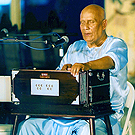
In 1976, Sri Chinmoy made two momentous musical discoveries: the esraj and the flute. The esraj he came across in February, in a book of Indian instruments. When he obtained one shortly afterwards, the haunting effect of this bowed instrument delighted his musical ear, and the esraj subsequently accompanied him on a visit to Australia at the end of February. It was to be here, in Australia, that Sri Chinmoy would become acquainted with the classical Western flute. Read more...


.
 

Analysis of Sri Chinmoy’s Music

by Shambhu Neil Vineberg

Sri Chinmoy sits on the floor in his meditation room playing the harmonium. Around him are strewn a few of his old notebooks from the Ashram from which he chooses the poems to set to music. He is lost in the very private, personal world of musical creativity. Diligently trying out numerous musical phrases to a particular line of poetry, he plays his harmonium quickly, until he decides that he has captured the essence of the words he is working with. Read more...


.
 

A Summit-Height Musical Experience at Interlaken

by Dr. Vidagdha Bennett

The clock had not yet struck six. Suddenly, in a mountain village in Switzerland, a gong was struck. Through the darkened sky, across the emerald green waters of Lakes Thun and Brienz, and high into the unseen peaks beyond, the sound travelled. The concert of concerts had begun. Read more...


.
 

Cascading Organ Delight: Sri Chinmoy’s performance on the Grand Organ at the Sydney Opera House

by Prachar Stegemann

Part 1 — the events leading up to ‘Sri Chinmoy’s historic organ performance.
Part 2 — a personal account of the performance itself, from an ‘unusual’ perspective.
Part 3 — an interview Sri Chinmoy gave immediately following the performance.
Part 4 — tributes to Sri Chinmoy's performance, which was recorded live and subsequently released on CD as Heart-Power Victory. Read more...


.
 

History of Sri Chinmoy’s Musical Manifestation from 1943-1975

by Shambhu Neil Vineberg

At the Indian Cultural Centre in New York on March 20, 1966, the Master performed ten devotional songs that included both ancient and modern music, sung in both Sanskrit and Bengali. The Sanskrit chants were ancient mantras set to music by Sri Chinmoy after he entered the country: ‘Agne naya supatha raye asman’, ‘Asato ma’, ‘Tvamadi deva purusha purana’. Included among the ten songs which Sri Chinmoy sang at the concert were the following three, composed when he was only twelve years old: ‘Tamasa rate’, ‘Sundara hate’ and ‘Jago’. Read more


.
 

The Birth of a New Creation

by Prachar Stegemann

“I dare any sensitive man or woman to remain unmoved by this music.” — Conductor Isaac Karabtchevsky had just heard Sri Chinmoy playing the pipe-organ. Sri Chinmoy is better known as a meditation teacher, poet, composer, painter, athlete, weightlifter, for his worldwide Peace Concerts … He recently took up keyboards, with stunning results. Read more...


.
 

Reflections on Musical Composition

by Hridananda Andrés Ramón

A dissertation on musical composition from a technical, aesthetical and spiritual point of view; it begins by analysing the approach of Western composers such as Stravinsky, Boulez and Harvey, and it expands into the Eastern spiritual/yogic approach as expounded by Sri Aurobindo and Sri Chinmoy. Submitted to the Department of Music, Iceland Academy of the Arts, 2008. Read more...


.

Songs

Sri Chinmoy composed more than 23,000 songs in Bengali, English, Sanskrit and French during his lifetime. This section highlights some of his most beloved compositions.


Bengali songs

by Sri Chinmoy

The lyrical quality of the Bengali language lends itself perfectly to poetic expression. Its cadence and rhythm give it a natural musicality. Even so, it takes the touch of divine inspiration to transform these elements into immortal songs.

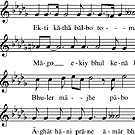
Sri Chinmoy had the rare gift of being able to create Bengali lyrics and simultaneously imbue them with haunting and exquisite melodies. From his earliest childhood until the final days of his life, he immersed himself in the world of song. Read more...


.

English songs coming soon...

A Tribute


Maestro Ravi Shankar and Sri Chinmoy

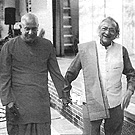
The greatest Indian sitar player of his time Ravi Shankar passed away on December 11, 2012. He was born in 1920 in Varanasi, India, to Bengali parents and went on to achieve worldwide acclaim as a virtuoso musician. Through his music he opened the door to Indian culture and spirituality in the West. He first met Sri Chinmoy in 1973 in New York and the two spent hours together conversing in their native Bengali language. They had a profound respect for one another and, in 2002, as a mark of deep friendship, Ravi Shankar and his daughter Anoushka offered a private concert for Sri Chinmoy and his students. These historic meetings are documented in an article by Vidagdha Bennett entitled ‘Pilgrims of Eternity’. Read more…
 

.
 

Ravi Shankar

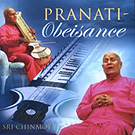
Sri Chinmoy’s soulful song ‘Pranati Janai Ravi Shankar’ honouring his dear friend was released on CD entitled Pranati–Obeisance and can be heard on Radio Sri Chinmoy.


Ravi Shankar, to you I offer my soulful obeisance.
You are the Lion-Sitarist.
In the world of hallowed music-pilgrimage,
    Immortal you are in every heart.
From high Heaven the Cosmic Gods descend and garland you.
At every moment they illumine your life-road.
Two sleepless friends you have:
Heaven’s Fragrance, Heaven’s Glory.
    Rapt in dance at the Feet of the Absolute Lord Supreme
    Is your outer frame.

— Sri Chinmoy (August 16, 2002)

Translated by Sri Chinmoy from his original Bengali verse.

.
 

Sri Chinmoy and Ravi Shankar

by Ashok Parulekar

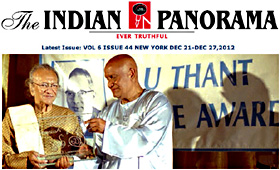
They are two great musicians who gave India’s divine gift of soulful music to the whole world. Ravi Shankar was the greatest Sitar player in the world who passed away recently. Spiritual master Sri Chinmoy composed 21000 soulful songs and performed in 700 Peace Concerts around the world based on his own meditative compositions and using a number of musical instruments. Sri Chinmoy left his body in October, 2007. Both will be eternally alive through their music and inspire humanity through generations. at The Indian Panorama
 

.

Meetings


Ravi Shankar (1920-2012)

The greatest Indian sitar player of his time Ravi Shankar passed away on December 11, 2012. He was born in 1920 in Varanasi, India, to Bengali parents and went on to achieve worldwide acclaim as a virtuoso musician. Through his music he opened the door to Indian culture and spirituality in the West. He first met Sri Chinmoy in 1973 in New York and the two spent hours together conversing in their native Bengali language. They had a profound respect for one another and, in 2002, as a mark of deep friendship, Ravi Shankar and his daughter Anoushka offered a private concert for Sri Chinmoy and his students. Read more…
 

.
 

Jesse Owens and Sri Chinmoy – Two Champions of Peace

by Animesh Harrington

There is a certain indefinable feeling about visiting an Olympic stadium. Home to an entire era of sporting glories, it holds within its walls the essence of the athletic aspirations of its time, that words alone can never express. The stands are now empty, the track is bare, there are no flags waving or cheers to be heard, yet the Olympic feeling lives on, in treasured memories of inspired deeds; in powerful images of men and women who ran like gods, who sacrificed all and won, taking humanity a little closer to the skies. Read more…
 

.
 

Sri Chinmoy Visits the Governor of Puerto Rico

by Agni (Mr. José Luis Casanova)

When you pay a visit to the Governor, what do you go to see? A politician, an executive officer. Now, when you visit Governor Ferré of Puerto Rico, in addition to the executive and the politician you will find the artist, the philosopher, the engineer and the philanthropist. Fluent in three languages – Spanish, French and English – he has a very profound culture and a deep-felt interest in human needs and endeavours – not only the outer needs for food and shelter, clothing and diversion, but also the profound and most compelling needs of the human soul for peace, love, contentment and beauty. Read more...
 

.
 

The King of Surakarta and Sri Chinmoy Reunite

by Dr. Agraha Levine

Throughout the ages, great spiritual Masters have come to earth to offer humanity an opening to the Supreme’s secret and sacred Works. But even for the greatest of spiritual teachers, rare it is that their inner divine workings are made clear for all to see, to experience and to claim as their very own. Such a most extraordinary event took place in early December of 2003 when Sri Chinmoy travelled to the heart of the beautiful verdant island of Java – to Solo, capital of the ancient Mataram Kingdom. Read more...
 

.
 

Two God-Lovers: Don Pablo Casals and Sri Chinmoy

by Agni (Mr. José Luis Casanova)

The early autumn evening was warm and all nature was standing still. The Casals’ house, sitting on top of a hill, has a bird’s-eye view of the city. As soon as Sri Chinmoy and a small group of his students arrived, they were shown in by Mrs Martita Casals. Decoration, although sober, was done with extremely good taste and warmth. The cello was sitting in the centre of the room all by itself, like the king that it is. Read more...
 

.

Links

Related Websites


Contributing Authors


Translators


Contributing Photographers


Website development
Vasudeva Server
Website hosting


About

This site aspires to serve as a venue wherein readers from all backgrounds may offer their reflections on the life and works of Sri Chinmoy.

sri-chinmoy

Sri Chinmoy believed that spirituality should be an integral part of everyday life. Within the context of his own life, he showed that the inner silence born of deep meditation can give meaning to everything we do. He was a poet, a dramatist, a storyteller, an artist, a musician, a composer, a singer, an athlete, a dreamer of peace — in sum, an extraordinary individual whose inspiration overflowed into numerous creative endeavours. He was also a spiritual master, guiding seekers in the quest for self-discovery.

In everything Sri Chinmoy did, he expressed the essence of the human spirit and our dreams and hopes for a brighter future for all mankind.

We invite you to consult our expanding menu for biographical details about Sri Chinmoy, as well as articles offering insights into various aspects of his life.

Image
animesh-sri-chinmoy
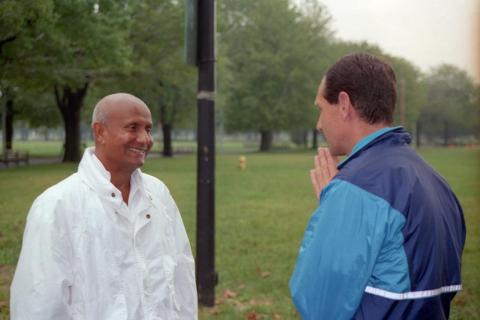
Sri Chinmoy with Animesh Harrington (1989. Photo Adarini)

About founder of site - Animesh Harrington

(Contact Form)


Related Websites


Contributing Authors


Translators


Contributing Photographers


Website development
Vasudeva Server
Website hosting


Unless otherwise stated, all content on this site is subject to copyright.
Copyright © 2023 Sri Chinmoy Reflections. All rights reserved.

Creative Commons License

This work is licensed under a
Creative Commons Attribution-NonCommercial-NoDerivs 3.0 Unported License.