“My Mother, No More!”


Preface

These are Sri Chinmoy’s original reminiscences of his mother’s passing, penned at the Sri Aurobindo Ashram in India when he was in his teenage years. They are written in the highly formal and now slightly antiquated style that was favoured by Sri Aurobindo and the glittering literati of the Ashram, among whom we can number Nolini Kanta Gupta, Dilip Kumar Roy, K.D. Sethna, Nishikanto, Nirodbaran, M.P. Pandit and others.

The reminiscences were originally typed by the author and the manuscript shows editorial marks in blue ink made by K. D. Sethna, the editor of “Mother India”. The present version, however, endeavours to preserve the original version as far as possible – for beneath the stumbling and imitative attempts of a youth to express himself in an unfamiliar tongue, we are given glimpses of an immensity of grief that can never be fully expressed or assuaged.

– Vidagdha


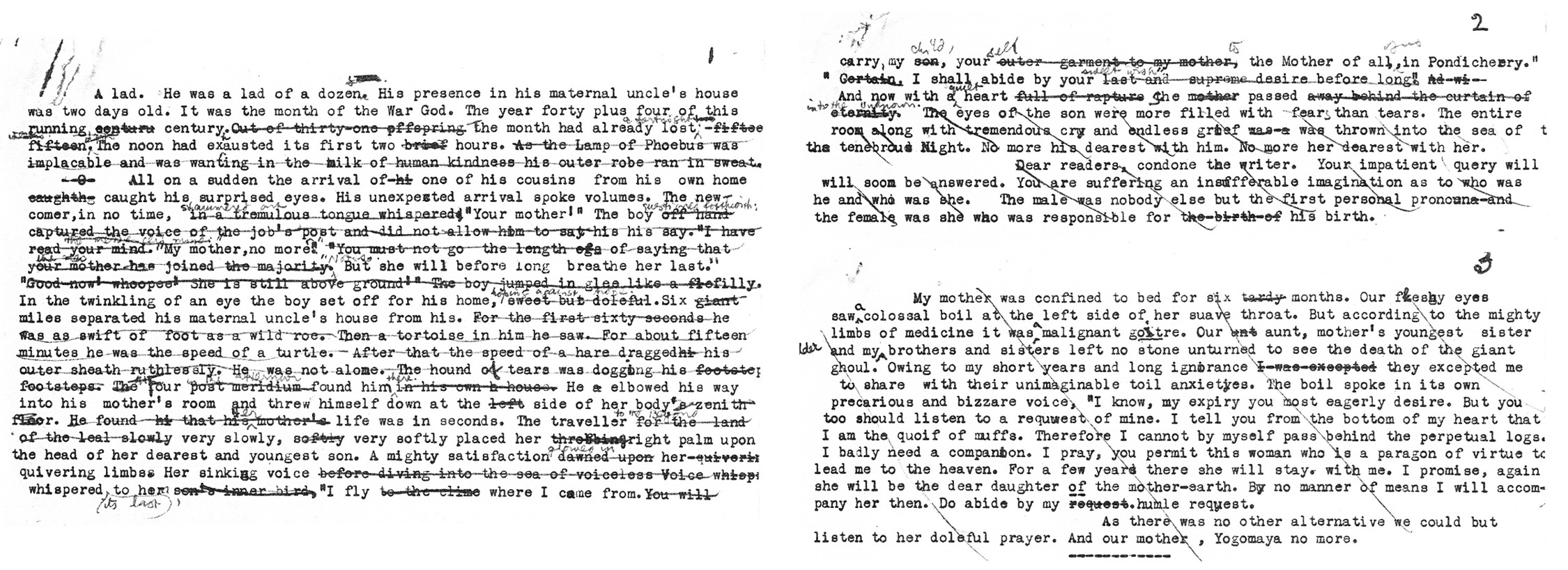
A copy of the original manuscript typed by the author.


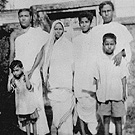
A lad. He was a lad of a dozen. His presence in his maternal uncle’s house was two days old. It was the month of the War God. The year forty plus four of this running century. Out of thirty-one offspring the month had already lost fifteen. The noon had exhausted its first two brief hours. As the Lamp of Phoebus was implacable and was wanting in the milk of human kindness his outer robe ran in sweat. All on a sudden the arrival of one of his cousins from his own home caught his surprised eyes. His unexpected arrival spoke volumes. The newcomer, in no time, in a tremulous tongue whispered, “Your mother!” The boy off hand captured the voice of the job’s post and did not allow him to say his say. “I have read your mind. My mother, no more.”

“You must not go to the length of saying that your mother has joined the majority. But she will before long breathe her last.”

“She is still above the ground!” The boy jumped in glee like a filly. In the twinkling of an eye the boy set off for his home, sweet but doleful. Six giant miles separated his maternal uncle’s house from his. For the first sixty seconds he was as swift of foot as a wild roe. Then a tortoise in him he saw. For about fifteen minutes he was the speed of a turtle. After that the speed of a hare dragged his outer sheath ruthlessly. He was not alone. The hound of tears was dogging his footsteps.

The four post meridiem found him in his own house. He elbowed his way into his mother’s room and threw himself down at the left side of her body’s zenith floor. He found that his mother’s life was in seconds. The traveller for the land of the leal slowly very slowly, softly very softly placed her throbbing right palm upon the head of her dearest and youngest son. A mighty satisfaction dawned upon her quivering limbs. Her sinking voice before diving into the sea of the voiceless Voice whispered to her son’s inner bird, “I fly to the clime where I came from. You will carry, my son, your outer garment to my mother, the Mother of all, in Pondicherry.”

“Certainly. I shall abide by your last wish and supreme desire before long.”

And now with a heart full of rapture the mother passed away behind the curtain of eternity. The eyes of the son were more filled with fears than tears. The entire room, along with tremendous cry and endless grief, was thrown into the sea of the tenebrous Night. No more his dearest with him. No more her dearest with her.

Dear readers, condone the writer. Your impatient query will soon be answered. You are suffering an insufferable imagination as to who was he and who was she. The male was nobody else but the first person pronoun and the female was she who was responsible for his birth.

***

My mother was confined to bed for six tardy months. Our fleshy eyes saw a colossal boil on the left side of her suave throat. But according to the mighty limbs of medicine it was a malignant goitre. Our aunt, mother’s youngest sister, and my brothers and sisters left no stone unturned to see the death of the giant ghoul. Owing to my short years and long ignorance they excepted me to share with their unimaginable toil anxieties. The boil spoke in its own precarious and bizarre voice, “I know, my expiry you most eagerly desire. But you too should listen to a request of mine. I tell you from the bottom of my heart that I am the quoif of muffs. Therefore I cannot by myself pass behind the perpetual logs. I badly need a companion. I pray you, permit this woman who is a paragon of virtue to lead me to the heaven. For a few years there she will stay with me. I promise, again she will be the dear daughter of the mother-earth. By no manner of means I will accompany her then. Do abide by my humble request.”

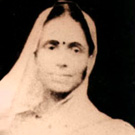
As there was no other alternative we could but listen to her doleful prayer. And our mother, Yogomaya, no more.
 

– End –


Editor’s Notes
1. “He was a lad of a dozen” is a reference to the boy’s age, since he was twelve years old at the time.
2. Madal was staying in the village of Kelishahar, East Bengal, the home of his maternal relatives, when this story took place. He then ran to his own home in the village of East Shakpura.
3. “It was the month of the War God.” This refers to March, named after Mars, the Roman god of war. It is evident that the writer is using the European calendar here. Hence, we may fix the date at March 16th, 1944. Yogamaya’s passing occurred shortly after four o’clock in the afternoon.
4. “The Lamp of Phoebus” is the sun. In Greek mythology, Apollo is called Phoebus, the sun-god.
5. “Joined the majority” – a euphemistic expression meaning “has died”.
6. “Roe” is a Eurasian species of small deer.
7. “The four post meridiem” means “four hours after midday”.
8. “Body’s zenith floor” may refer to the body being at its lowest point (nearing death).
9. “The land of the leal” – a Scottish expression meaning the abode of the blessed after death; paradise; heaven.
10. “The Mother of all, in Pondicherry” – meaning the Divine Mother of the Sri Aurobindo Ashram, Mme. Mira Alfassa.
11. Goitre is an enlargement of the thyroid gland, which can lead to a pronounced swelling in the neck.
12. The expression “quoif of muffs” most likely means “cap of fools”.
13. The Perpetual Log, invented towards the end of the 18th century, was used to determine the speed of a ship. The device consisted of a wooden board (the log) towed by a line attached to a clock-work system onboard. It provided a constant (perpetual) update of a ship’s movement through the water. Vessels that plied the Indian coastline during the author’s youth, would have most certainly still employed this navigational aid. “To pass behind the perpetual logs” may mean to be set adrift, beyond the rope tethered to the ship and hence, a euphemism for “death”.
14. Yogomaya, alternatively spelt Yogamaya.
Prose


“My Mother, No More!”

by Sri Chinmoy

These are Sri Chinmoy’s original reminiscences of his mother’s passing, penned at the Sri Aurobindo Ashram in India when he was in his teenage years. They are written in the highly formal and now slightly antiquated style that was favoured by Sri Aurobindo and the glittering literati of the Ashram, among whom we can number Nolini Kanta Gupta, Dilip Kumar Roy, K.D. Sethna, Nishikanto, Nirodbaran, M.P. Pandit and others. Read more…


.

A New Epic

On 24 January 1998, 1.30 am, in Cancún, Mexico, Sri Chinmoy completed his poetic series Twenty-Seven Thousand Aspiration-Plants. The very same day, he received an inner Command to undertake a new project (Seventy-Seven Thousand Service-Trees). In these reflections, Sri Chinmoy describes the birth of this vast epic.    


During this trip to Mexico, in spite of my physical illness and so many inner and outer problems, we have accomplished two most significant things. We have completed our Twenty-Seven Thousand Aspiration-Plants1 and two million bird drawings. From the literary and artistic point of view, this trip will be our most significant offering to the Absolute Supreme. To complete Twenty-Seven Thousand Aspiration-Plants is something in our aspiration-life that is greater than the greatest and better than the best.

In the small hours of this morning, my soul was in my Transcendental Consciousness and my heart was in my Universal Consciousness.

My Supreme stood in front of me and said to me, “No retirement, no retirement, no retirement for you, my child.”

I said to my Supreme, “What more do you want from me, what more?”

He said to me, “Seventy-seven thousand.”

Immediately I said to Him, “Is it Your Wish, is it Your Request, is it Your Will or is it Your Absolute Command?”

He said, “It is My Absolute Command.”

Then I said to Him, “I do not think I am going to live on earth that long.”

He said to me, “My child, I command you to start. I command you to start. You know and I know how long you are going to be on earth, but I want you to start. This is My Absolute Command.”

“My Supreme, my Supreme, I shall obey Your Command, I shall.”

My problem now is only to start. By that time, how many new disciples will come and join our boat, and how many will disappear out of our boat? Only the Supreme knows how many will come and how many will go and how many will reach Heaven.

But before I complete it, I will reach Heaven. Then all my disciples can write, the way Shakespeare’s writings were continued by his contemporaries. You are my contemporaries, so all can write, just like Sri Chinmoy, and from Heaven I shall approve of it gladly and proudly!2


Editor's notes:

1 This is Sri Chinmoy’s 27,000th poem in the series:

          My Twenty-Seven Thousand Aspiration-Plants,
          My Lord Beloved Supreme has given me
          To give you the Sun-Smile-Blossoms of His Heart.

          My Twenty-Seven Thousand Aspiration-Plants,
          You have given humanity a sleepless God-thirst
                And a breathless God-hunger.

AP-27,000

2 Sri Chinmoy gave the name Seventy-Seven Thousand Service-Trees to this new project. Out of 77,000 poems, he completed a total of 50,000 from 23rd January 1998 to 11th October 2007, the day of his earth-departure.


An Orphan Boy – Commentary


Sri Chinmoy gave the following talk on 20 June 1998 at Public School 117 in Queens, New York.


What do we learn from this poem-song? That I am swimming in the sea of sorrows and tears. Each spiritual Master sings in the same vein. There is no spiritual Master who has not suffered ruthlessly at the hands of humanity, so I cannot be an exception. Once you make unconditional surrender to God’s Will and enter into God’s Manifestation-Game, or Lila, then you cannot come out of it. He suffers, you suffer, we all suffer. There is not a single person, whether he is realised or unrealised, who does not suffer.

Many, many, many times I have said to the Supreme, “To realise You is an Herculean task.” It takes countless incarnations to realise God. God-realisation is not like drinking water. You cannot get it for the asking. No, we do not get it for a price. It demands many, many incarnations, inner preparations, outer preparations and the mounting flame of aspiration. But always there is hope. God’s own Hope is keeping His Universe alive. If He loses Hope, then the Game is over.

A spiritual Master comes into the world to expedite the evolution of mankind. In order to do this, he needs constant co-operation from humanity. Here I am with you. Ours is a very small world. But again, I have the whole world. When a spiritual Master comes, he gets a few hundred or a few thousand disciples. But in the inner world, he has to work for the entire humanity. Outwardly, he has to take care of a few hundred or a few thousand, but his inner commitment to God is such that he has to work for the whole world.

When you pray most sincerely and meditate very well, you must realise that your prayers and meditations are entering into the soul and heart of the universe. There you are helping those who are crying for light, love and bliss from God.

On our path, the outer manifestation is very beautiful and powerful. We are manifesting here, there and everywhere. But the inner manifestation is oneness, oneness with God’s Will. At every moment, we have to offer God our love, devotion and surrender. At every moment we have to offer Him our loving, cheerful and self-giving obedience. If we neglect to offer these things to God, what can poor God do? He needs us for His Manifestation; we need Him for our realisation. If I am not a good instrument, then He chooses you. And if you are not a good instrument, He chooses somebody else. In exactly the same way, if I am a good instrument of His, then as many years as He wants me to continue His Mission, I must.

From this particular song-poem, you can see that right from the beginning of my life, I have been swimming in the sea of sorrows. I came of a very insignificant village, smaller than the smallest. Shakpura is even smaller than Briarwood. Then I had to lose my dearest ones, my father and mother. Everything was God’s Plan. Had I not lost them, God knows what would have been my fate. You people are lucky. Some of you have brought your children to the path. Again, some of you saw something in me. That is why you left your parents. You felt that I would be able to play the role of your parents. I have tried my best. You have also tried your best.

In my case, my eldest brother brought me and my brothers and sisters to the path. Our mother’s heart and soul were all for the spiritual life, but her mind was playing its own game; that is what the mind always does. Her mind was thinking that her children must get higher education, that kind of thing. That is why God in the form of a spiritual Master took my parents away, so that the whole family could enter into the spiritual life.

You can say it is a question of speed. I am the youngest in the family. When I think of my eldest brother, he far, far surpassed me in terms of the amount of time he spent in prayer and meditation. Long before I came to the Ashram, he began praying and meditating most intensely. Again, all my brothers were under spiritual Masters of the highest order in their previous incarnations. Some were Jesus Christ’s disciples, some were Sri Ramakrishna’s, one was Sri Chaitanya’s and some were Sri Ramachandra’s direct, direct disciples.

One day, when you realise God – which you should, you must and you will – you will be able to tell the whole world that you were once my direct disciples. You will also be able to claim that you were with me; you were then my contemporaries.

Either in the near future or in the distant future or in one of your future incarnations, you will realise God. I will be at that time in Heaven. God is very, very kind to me. Definitely this is my last incarnation. From Heaven I will be able to see you, help you and fulfil my vision in and through you.

My last and only request to you is this: always think that spirituality is a one-way street, not a two-way street. You may go slowly at times if you are tired, but do not turn around, do not turn back. Please remember it is a one-way street. Many seekers have forgotten, or they deliberately forget, and they make it into a two-way street. If you become indulgent to your own unaspiring life, there is only collision, collision and nothing else. I have had millions of sufferings and inner failures, with regard to the disciples. But He who has created me, He who has created you, will not suffer failures eternally. If that were the case, then God would not have created this world, never.

This poem of mine is flooded with sorrows and I do hope that one day you are the ones who will transform my sorrows into an ocean of delight. You have come into the world to manifest the Supreme, but this manifestation can take place only on the strength of your oneness with the Will of the Supreme. You have to go beyond and beyond and beyond all the barriers – physical, vital, mental, psychic and earthly – all, all, all. You have to conquer all the forces that are standing in your way. All our enemies are inside us, not outside us. They come in the form of doubt, suspicion, disobedience, fear, jealousy and insecurity. These inner enemies are obstructions on the way.

I have not given up and I beg of you all not to give up. Let us continue. Let me continue having faith in you all, and I expect the same from you – mutual faith. I shall give you what the Supreme in me wants me to give you. You will also give me what the Supreme in you wants you to give me. He wants me to give you my compassion, my love, my affection, my divine sweetness, fondness and constant concern to make you happy. At the same time, He expects you to give me your constant readiness, willingness and eagerness in the form of love, devotion, surrender and cheerful obedience at every moment.

What I am supposed to give, I shall definitely, definitely, definitely give, as I am giving. What you are supposed to give, some of you give and then withdraw. For one day you give and then, for months and months, you take rest, enter into vacation.

But I do hope we can have a good family. To have a sweet family, the father has to give what he is supposed to and the children have to give what they are supposed to. Let us turn this family into a very sweet, very illumining, very fulfilling and very satisfying family.

Now I can forget about the sadness of the poem. Excruciating pangs let us forget, completely forget. Let us only grow into sweetness, peace, light and bliss.


— End —


An Orphan Boy

24 May 1998

There was an orphan boy.
His name was Madal Chinmoy.
He hailed from a wee village, Shakpura.
He became his Family’s ananda fuara.

He lost his Father at the age of eleven.
The following year, his Mother
        Was summoned by Heaven.

At the age of twelve, he came to Pondicherry
To be a passenger of his Master’s Ferry.
Sports he liked and became a mountain-champion,
But neglected not his dream of God-union.

One night his Guru Supreme
Entered into his sweetness-dream,
Said:
        “Get up to meditate. Get up to meditate.
         In years to come you will have to navigate
         The birthless and deathless mankind’s sorrows
         To the Golden Shore of Tomorrows.
         Give due importance to your body, vital,
                 Mind, heart and soul
         To help the world reach its destined Goal.”

Madal, kettledrum of the cosmic Gods,
        Became Chinmoy Consciousness-full.
God’s Compassion-Eye made him
        A teacher of His inner School.
His student-life he took as his life’s bondage-night.
Therefore, his heart pined for Freedom-Light.

Now that he is a teacher of the inner School,
He realises that he is an unspeakable fool.
Humanity’s transformation-fate
Is a completely closed iron gate.
He breathlessly cries to God,
        “Save me, my Lord, save!”

“For you, no rest. Sunlit Path you needs must pave.
For you, no rest, no rest, not even a fleeting rest
Because in you I have found My Heart’s Satisfaction-Nest.”

“O Lord, I am crying, bleeding and dying.”

“Who prevents you from smiling and flying?”

The whole world came to him.
        He desperately wanted to hide.
His Absolute Lord commanded him
        All-where with Him to ride.


Editor’s notes

1. “Ananda Fuara” means “fountain of delight” in Bengali.
2. Madal came to Pondicherry to become a permanent resident of Sri Aurobindo’s Ashram.
3. Sri Chinmoy originally dictated this poem to Nishtha Baum.


Poetry


.
 

An Orphan Boy

by Sri Chinmoy

There was an orphan boy.
His name was Madal Chinmoy.
He hailed from a wee village, Shakpura.
He became his Family’s ananda fuara.

Read more…


.


A New Epic

by Sri Chinmoy

On 23 January 1998, in Cancún, Mexico, Sri Chinmoy completed his poetic series Twenty-Seven Thousand Aspiration-Plants. The very next morning, he received an inner Command to undertake a new project. In these reflections, Sri Chinmoy describes the birth of this vast epic. Read more…


.

Autobiographical


.
 

An Orphan Boy

by Sri Chinmoy

There was an orphan boy.
His name was Madal Chinmoy.
He hailed from a wee village, Shakpura.
He became his Family’s ananda fuara.

Read more…


.


A New Epic

by Sri Chinmoy

On 23 January 1998, in Cancún, Mexico, Sri Chinmoy completed his poetic series Twenty-Seven Thousand Aspiration-Plants. The very next morning, he received an inner Command to undertake a new project. In these reflections, Sri Chinmoy describes the birth of this vast epic. Read more…


.
 

“My Mother, No More!”

by Sri Chinmoy

These are Sri Chinmoy’s original reminiscences of his mother’s passing, penned at the Sri Aurobindo Ashram in India when he was in his teenage years. They are written in the highly formal and now slightly antiquated style that was favoured by Sri Aurobindo and the glittering literati of the Ashram, among whom we can number Nolini Kanta Gupta, Dilip Kumar Roy, K.D. Sethna, Nishikanto, Nirodbaran, M.P. Pandit and others. Read more…


.
 

A Dream

by Sri Chinmoy

In the morning, I had a dream about my running. There were two runners: the human runner and the divine runner, my human runner and my divine runner. I was at once the human runner and the divine runner. These two runners had a race, a 100-metre dash. Read more…


.

My First-Time Experiences

by Sri Chinmoy

Most of the stories in this section were told by Sri Chinmoy on 2 December 1991. He was very fond of narrating stories from his early days in the West and he had the unique gift of being able to re-enact each circumstance so that it was vividly impressed on our imagination. Frequently, his wonderful delivery and timing would cause the entire audience to burst into laughter. Read more…


.
 

Chittagong Stories

by Sri Chinmoy

This is a miscellany of stories told by Sri Chinmoy over the years about his childhood in Chittagong. When he used to reminisce about his Indian life, he would pluck anecdotes from here and there, not necessarily in any chronological order.... A kind of magic would descend as wave after wave of sweet memories flooded his being. Here are just a few of those well-loved stories. Read more


.
 

Collected Stories

by Sri Chinmoy

A collection of personal stories told by Sri Chinmoy to his students. They were recorded at various locations around the world.

Read more…


.
 

Man Proposes, God Disposes

by Sri Chinmoy

Man proposes, God disposes. This famous proverb can easily be applied to my family, specially when it comes to the subject of university degrees. Ours are such funny, funny stories. It all began with my eldest brother, Hriday. He was a great philosopher. Read more…


.

Poem: 1946

Transliteration and Translation

by Rintu Chakravarthy (Singapore)


Transliteration

Amitraakhkhar

Shadya ashphuto mama jibaatma jedin
Prothom robir aalo kare nirikhkhon
Shei sriti smarite aaj ei aayojon.
Ajad amar shib shaanto shamaahito
Srishtir aadim kaale chilo je bhaashwar
Aapnaar rupe rashe aapni mohito,
Shei deb naaraayan kon abhipraaye
Paathalo daadaare mor ei dharanite.
Naahi jaani sheidin nandan-kaanane
Bishaader kaalo chaaya podechilo kina
Dharanir shyam andhe prashphut golaap
Bidhaataar pujaa laagi godilo je jon
Shei srashtaa projaapati ekoi abhipraaye
Daadaare godeche jaani emon sundar.
Anujer bhakti maakhaa saral pranati
Jaagaabe jaahaar mone pulak nischito,
She barenyo atithir aagamoni dine
Joyullaash hoibena panchajanya bine
Kotha Krishna kotha tabo shakha Dhananjoy
Daadaare aamaare karo akkhoy-abyoy.

Translation

The day my fresh unblossomed soul-flower
Observed the first rays of the Sun –
Today’s arrangements are in remembrance of that memory.
Ageless, immortal, auspicious, peaceful, engrossed in meditation
One who was illumined since the beginning of creation:
Who remains enchanted in His own self-beauty
That Lord Narayana in a certain contemplation
Sent my elder brother1 into this world.
Not sure if on that day in Paradise
The dark shadows of melancholy were cast or not
The blossoming roses in the lap of the dark cloud-hued Earth
Those who harvested for the worship of the Creator
That Creator Prajapati in similar contemplation
Created my elder brother, I know, such beautiful.
The devotion-imbued simple obeisance of the younger brother
Will definitely awaken delight in the heart of
That honourable guest’s auspicious day of arrival
When the celebration will be sans the sounds of the Panchajanya conch.
Where are you Krishna, where is your dear friend Dhananjoy?2
Do make my elder brother and me endless and changeless.

Notes:

This is a facsimile of a poem written by Sri Chinmoy on 17 February 1946, when he was fourteen years old.

1 We are grateful to Rintu for offering a translation for this very lofty tribute by Sri Chinmoy to his elder brother. The question of which elder brother is being referred to is perhaps partially solved by the pet name the poet uses to refer to him. “Dada”, meaning elder brother, is what the young boy called his eldest brother Hriday; whereas he called Chitta “Madhyamda”, meaning middle brother, and Mantu was “Tunuda”, little elder brother.

2 At several points in the Bhagavad Gita, Lord Krishna addresses Arjuna as Dhananjaya. The epithet means, “the one who conquers wealth.”


Copyright © Sri Chinmoy. All rights reserved


Light in the United Nations

Sri Chinmoy conducting the regular Tuesday noon-hour meditation at the United Nations.


For one visiting the city of New York, it would be very easy to overlook a steel and stone building on the bank of the East River around mid-town Manhattan. Its architecture is not imposing by any means. Its grounds are not extensive and its physical size is not domineering. But inside it dwells the hope of all humanity, for it is the house of the United Nations. Within its granite walls, a swarm of human beings work frantically day and night to bring understanding among the peoples of the earth.

In incessant turmoil the nations of the world struggle for peace, knowing perfectly well that peace is the only hope for survival in the atomic age. Unfortunately, peace cannot be built from outside materials like a house or a bridge. Peace is not something that can be synthesised out of good intentions and mental bickering. The nation is an extension of the human personality, an overgrown ego that is moved by forces of nature, too subtle and profound to be understood, much less controlled, by the unillumined mind. On the mental level, my nation is supreme and the fellow on the other side of the table feels also that his nation is supreme. So the unceasing stream of ideas, pressures, counter pressures, measures and counter measures. The world comes to a brink of disaster and then men retreat in horror after a glimpse of the abyss. Man wants to live after all. But how much advantage can one nation obtain from the others without actually falling into oblivion? A new term has been coined, ‘brinkmanship’, that is to say, how near to the mouth of the abyss the leaders of a particular nation dare to go. They study each other’s moves, applying pressure here and there, probing in every conceivable way the other fellow’s will and capacity.

At the north entrance to the building there is a Foucault’s pendulum. No doubt it was placed there as a scientific exhibit. But the pendulum is marking time, silently, inexorably. If one looks at it intently after attending one of the meetings of disputing nations, one cannot help but think that the silent pendulum, in its inexorable swing, is warning us that time is ticking out, and the hour is late for mankind to leave the mental discourse aside and seek the way to understanding and true peace.

The question now is: How can peace be obtained? Surprisingly enough, the answer is very simple. Peace is not outside us; it is within the very depths of our hearts. In infinite peace the soul abides and it is more than willing to give us that peace if we just open ourselves to its life-giving splendour. Yet this very easy solution seems unattainable to a person living completely in his mind, submerged in an ocean of thought and convinced that a solution has to be found there, in the mental realm, or else there is no solution; there is no escape from the chain of events pushing him constantly. What is needed is a completely new approach, ‘novus ordo’; a new trail that can lead us out of the maze we are in.

Now the second question: Who will be able to lead modern man’s thought through this new departure, this new order of things? Who will be the trailblazer on this new frontier?

Poet, thinker, philosopher and spiritual teacher, Sri Chinmoy Kumar Ghose has come to us from his native Bengal, India. It is not by chance he has been chosen to lead the meditation group at the United Nations. His spiritual insight, loving care and profound understanding of the human soul, mind and heart endow him with the capacity to be the leader on this new road. His spiritual power lovingly elevates the consciousness of all who listen to him to a plane where not only peace, but also joy, light and power can be attained. There a true unification of human knowledge, concern, love and sympathy take place.

All the nations of the world are aspiring towards universal peace; but it is a person of the spiritual stature of Sri Chinmoy who is able to bring it down for the suffering and aspiring humanity. How, you may ask, is Sri Chinmoy able to help humanity in this new dimension? It is because he has already established his conscious oneness with God. That is why he can serve Divinity in humanity. That is why he can open a new road to human understanding and lasting peace on earth.

After all, what man wants is happiness. When, through the leadership of a true spiritual guide, we discover the inexhaustible treasure of peace, joy and power within ourselves, true happiness abides in us and with happiness comes understanding. The bell for inner victory has rung. Just to hear these words from the mouth of a spiritual Master brings down waves of hope and aspiration to the citizens of the world. Inner victory. True understanding. Lack of fear. The dedication of all human resources to combat the real enemies of man: ignorance, fear, frustration, want. It all seems so vast and lofty that our human mind wavers in unbelief. Yet it is no dream. It is true the hour has struck, the bell has rung for the liberating of all mankind, for the new world of peace and co-operation.

What is meditation? Meditation is communion with the inner being. Meditation is food for the soul. In our outer everyday lives we are living on the periphery, on the surface of our personality. To meditate is to go to the roots for nourishment and knowledge. When we live on the surface, accepting the world and mankind as the senses and reasoning mind see them, we are confused and cannot understand other human beings, their motivations and the myriad forces that move them around. When we dive deep into our being, we understand the fundamental unity of all mankind, under God. To meditate is to understand, to love is to accept.

When we climb a mountain we can go up as high as our knowledge and strength allow us to go. In the same fashion, when we meditate, if left to or own resources, we can go as deep or as high as our actual state of development allows us. It is a different matter altogether when we are led in our meditation by a competent guide, a realised soul. Then we will be able to penetrate into the inmost recesses of our being and to ascend to ineffable heights of peace, light, bliss and power.  From there we come back to the state of everyday affairs, strengthened and illumined by the inner light.

Sri Chinmoy’s philosophy is: Accept life, embrace life, love mankind and with the infinite light of consciousness transform the world into the perfect expression of God.

Now let us hear the significant message of Sri Chinmoy expressed in some of his meditations, especially inspired on the United Nations.

Inaugural Message, April 14, 1970

Today’s United Nations was yesterday’s perfecting Vision.
Tomorrow’s United Nations is today’s fulfilling Realisation.
Unity is not oneness. A bud is not a flower.
Unity is the temple. Oneness is the shrine.
The absence of unity is imminent confusion.
The absence of oneness is the ultimate destruction.
The presence of unity is the immediate end of human imperfection and limitation.
The presence of oneness is the glorious beginning of man’s perfect Perfection.

– End –

Editor’s Notes:

1. The author, Agni (Mr. José Luis Casanova), was one of Sri Chinmoy’s earliest disciples in the West. He was a founding member of the Sri Chinmoy Centre (Aum Centre as it was then known) in San Juan, Puerto Rico.

2. The article was first published as a small booklet around 1970.

Sri Chinmoy’s Work at the United Nations:

Printed in the journal
CrossCurrents 
September 2010


Many may think of the United Nations mainly as the secular arena of political strife, but the World Organization has a spiritual dimension which, although it is often not visible to the general public, is intrinsic to its purposes. This essay describes the work of the philosopher, poet, humanitarian, and peace-server Sri Chinmoy (1931-2007) at the United Nations, a work that was devoted to bringing to the fore, fostering and articulating this spiritual dimension. Sri Chinmoy saw the United Nations not merely as a political institution but as “the Heart-Home of the World-Body” and the focal point of an emerging “world-oneness.” Read more at Wiley Online Library