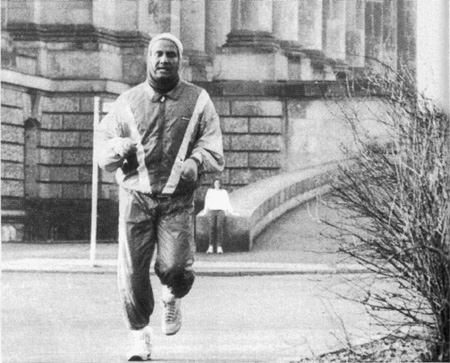
A group of one hundred or so runners are gathered in a park by the Berlin Wall. In the moments that precede the race, the eye moves uneasily across the landscape in which we are about to run. It is the western side, just metres from the stark divide of barbwire and underground mines. On the park wall are painted crosses commemorating those who have unsuccessfully attempted the crossing from East to West. No one escapes these days. Within calling distance, the East German guards look down curiously from their towers at the sight of colour and animation below them. The distance of the race is announced (it is 2 miles); a minute’s silence and the race begins. The course is a one-mile loop. The first half mile follows the wall around the park and then the course turns back past the bullet-scarred Reichstag, Hitler’s infamous headquarters.
Once the race begins, all thought is lost in a concentrated effort to stay in touch with the leading pack. The first mile goes by in under 5 minutes and the leaders still look fresh. The air is cold, the skies grey, and the trees that line the empty pathways are devoid of greenery. Yet, like an artist's brush drawing an inspired line across a bleak winter canvas, a trail of multi-coloured tracksuits adds a touch of life and hope to an otherwise grim and forbidding scene, as it weaves its way through the park.
Sri Chinmoy running a 2-mile race near the Berlin Wall – 24 March 1985
The guards watch intently as each runner heads for the finish line. The sounds of the timer's calls are muffled with the echoing coughs of breathless runners. Suddenly one runner attracts the attention of the crowd of finishers who have gathered. The runner sprints to the line and walks away casually. Moments later he offers the group some apples as prasad (blessed food) and a silent meditation.
Almost as quickly as they had arrived the group departs; the East German guards still absorbed in the early morning activities. For a time, East and West shared something in common – something intangible – that politics cannot touch.
This race was the beginning of a 7-day Sri Chinmoy race series, which started in Berlin and ended in Augsburg. The early morning races were a springboard for each day, yet in a sense they represented only a fragment in a mosaic of activity that characterised Sri Chinmoy’s German tour. Some of the posters merely read ‘Friedenskonzert 85’ and in most cases it seemed to be sufficient. Many people in Germany had either heard or read about Sri Chinmoy's Peace Concert in Cologne in 1984 where 8,800 people packed the city's ‘Sporthalle’. This year Sri Chinmoy came to offer 13 concerts in 10 days throughout the German-speaking world.
The concerts were 2-5 hours in length and on occasions, two would be held in a single day. A total of almost 30,000 people came to hear the master-musician-composer. The concert tour, which started in West Berlin (a tiny island of western occupation in East Germany), moved down the German mainland, through Switzerland, and onto Austria. The ethereal sound of Sri Chinmoy's flute still resonates in the silver light of the German dawn. A new inner road has been trodden. And along the way, the German people responded with the warm, glowing smiles of their peaceful hearts.
In villages and in cities, on the coastal waters and inland mountains, life goes on – the irrepressible life of a country that has emerged from the great centuries past to meet a future of even greater promise.
Inspired by tradition and powered by timeless energy, a thousand worlds of hearts and minds and faces, a million ways of the soul that is Japan, move as one. This island unto itself, this culture so secret and sacred, has sustained generations with its will to endure.
In the juxtaposition of ancient and modern, spiritual and material, this land of vast contrasts retains its delicate balance. It comes as no surprise to find the bustling international airport of Narita surrounded by fields that have been tilled in the same manner for countless generations. In the cities, high-rise buildings and centuries-old temples share the skyline. The horizon, everywhere, is an eclectic mixture of imagery.
The Japanese world is elaborate with ritual yet, in essence, the people maintain their lives with simple reverence. From the grand Buddhist and Shinto temples that dominate the country with their austere architecture to the humble neighbourhood shrines on village street corners, decorated by flowers and offerings of fruit, the evidence of Japan’s faith abounds. It is, after all, the living spiritual consciousness of the people that sustains Japan.
The words of Sri Chinmoy's song uniquely capture the heart and soul of this special land.
Japan, Japan, Japan!
A soulful flower-garden.
Clearly you see,
Quickly you do.
Silence-ecstasy
Your property true.
Japan, Japan, Japan!
High Heaven's hallowed plan.
* * *
The skies over Narita are clouded as North-West Airlines flight No.17 touches down on its fourteen-hour flight from New York. Before Sri Chinmoy passes through the customs doors there is already evidence of an unprecedented tour. Box after box of heavy weights, exercise machines and musical instruments are being loaded onto the buses. The steady stream of students, 100 or more, many with conspicuous extra items of luggage, greet the cold Japanese morning.
There is anticipation in the air, as though the soul of Japan has been longing for this moment. Japan, with its innate receptivity, is readily awaiting the message of a modern spiritual master, as it did the light and wisdom of the great Lord Buddha more than twelve centuries ago.
Finally, Sri Chinmoy makes his way out of the terminal and onto one of the buses. The journey has begun.
From here the group will travel to Tokyo, for a one-week stay, then by bullet train to the coastal town of Beppu, famous for its hot springs, then high into the mountains of Fukuyama, and finally on to Kyoto, the ancient capital of Japan. However, the itinerary can never describe the way in which Sri Chinmoy moves, the spiritual adventures he reveals or his joyful way of surprise.
Through this schedule of travelling and tarrying, packing and unpacking, sightseeing and quietly being, Sri Chinmoy weaves a silver thread of delight as concerts, weightlifting, functions, marathons and shopping flow on and on.
* * *
Amid the swarming afternoon rush of a crowded Tokyo subway, with its vast migration of office workers and shopkeepers, who move with relentless precision through the maze of ticket gates and tunnels, Sri Chinmoy walks calmly towards the station platform. With a detached anonymity, he moves steadily through the sea of human activity. He acknowledges little of the outer parade; surrendering nothing to the cadence of the crowd: his pace and time are his own; his focus is inner poise.
With him, Sri Chinmoy carries a small bag; it swings gently on his arm as he carefully negotiates a set of stairs leading down to the platform. He turns to the side to lower one foot at a time onto each step, sparing the strain on his back.
Once on the platform, Sri Chinmoy and his students board the train. The carriage is completely full. Sri Chinmoy presses himself against the glass of the carriage door, protected by only a few students from the crush of passengers.
The variant sounds of the subway merge into a monotonous hum as the train moves on towards the next station. Gradually another sound, coming from one corner of the train, becomes increasingly audible. The pure notes ride easily over the carriage conversation. Sri Chinmoy, with his head bent towards the ground and his back to the crowd, stands by himself playing his tote-a-tune.
In a little over one hour, Sri Chinmoy will be on stage in Kamakura. His cello, esraj, harmonium and other instruments will stand proudly by him. He will be dressed in a beautiful dhoti. The setting will look like a celestial garden. He will look like a divine king as he meditates and the heart of the audience will melt as he plays.
***
Meditating in front of the Great Buddha, the Daibutsu,
at Kamakura. Photo: Animesh
Kamakura, a little over fifty kilometres from Tokyo, has long been a place of pilgrimage. For it is here that the most famous and best-loved monument to the Buddha resides. Built entirely of bronze, weighing 270,000 pounds, with a height of over forty feet, it has survived both earthquake and tidal wave and stands today as it has for centuries, complete in contemplative repose.
The nobility and purity of Japan’s spiritual heritage is enshrined in the sanctified dimensions of the Great Buddha, the Daibutsu. After seven hundred years, the benign presence of the holy image, unsheltered from the elements, towering majestically above the temple gardens, still blesses the ground of Kamakura.
Today Sri Chinmoy has come to honour the Buddha – a living master of the present will honour the living spirit of a great master of the past.
Sri Chinmoy makes his way quietly through the tourist traffic of the temple gardens. At the front of the statue, Sri Chinmoy folds his hands and raises his head towards the inclined face of Lord Buddha. For some minutes he remains there, motionless, immersed in the silence of meditation. Then, gently he turns to meditate in front of those surrounding him. His face reflects a radiant ecstasy.
It was here, three years ago, on these very steps, that Sri Chinmoy first taught his students his song proclaiming Buddha's victory. As Sri Chinmoy takes a seat in a portable folding chair and gazes high into the eyes of the Buddha, the singers among his students form a line behind him. Suddenly the air begins to resonate with the stirring call of this immortal song. Sri Chinmoy’s eyes span the infinite skies; the Buddha is enveloped in timeless trance and the singing continues:
Jaya jaya jaya
He niranjana maha nirvan
Joy hok taba joy
He Siddhartha…
* * *
The streets of Beppu are clear. The cold air lies low to the ground. Streetlights contrast a hazy glow against the dark sculptured slopes of the mountains surrounding the town. In the pre-dawn calm, sounds never heard by day ripple faintly over the sleeping city. Each movement, sight and murmur, is part of this early morning tapestry.
At 4:00 a.m. a group of boys prepare themselves to leave the kaikan (Japanese hall) where they are staying. They brace themselves against the December cold and jog 1½ miles towards the Hinago Hotel in the city centre. At 4:30 a.m. Sri Chinmoy meditates with his students before leaving the hotel for his early morning run. This morning thirty or forty people have gathered. They sit on the carpet and chairs in the hotel lobby.
Sri Chinmoy begins to speak slowly as he gives the morning meditation; the power of his voice reinforces the silence. Then, for fifteen minutes, he meditates; each second a reflection of the enchanting spiritual world of the beyond. At the end, he bows to those around him and, rising from his chair, walks off towards the hotel exit, out into the cold morning air. The silence remains as the group gradually disperses. They will meet in a few hours’ time for a two-mile race.
* * *
Alongside the shore of Beppu Bay, a flat one-mile running course has been marked out. By 6:50 a.m. the marshals and timers are in place and at 7:00 a.m. the runners are called to the starting line. As the runners pause for one minute of meditation before the event, a distant clock tower begins to chime out its morning call, the famous Japanese song – Sakura.
Sri Chinmoy is extremely fond of this song. At functions, he will quite often sing or play it. The traditional melody is so hauntingly beautiful. And the lyrics that describe the heavenly fragrance of the cherry blossoms seem to capture the very soul of Japan. It is hard to believe that someone other than a Japanese person could have composed the words. But in 1894, a German named Rudolf Dittrich wrote the lyrics for Sakura in Japanese, German and English.
The race starts. Even though it is just a few days since the marathon in Tokyo, the pace from the outset is fast and it takes the winner, ironically he too is German, only 10 minutes 13 seconds to complete the two-mile course.
Later in the day at a function, Sri Chinmoy plays with a tape recorder he has bought in town. On it, he has recorded ‘Sakura’. He delights in telling the story of how the lyrics were composed by a German. Then Sri Chinmoy calls up Kailash, head of the German Centres, and presents him with the recorder. Kailash takes his seat again and Sri Chinmoy goes on with something else.
A minute or so passes and then, as if he had been waiting to see how long it took Kailash to find out how to operate it, Sri Chinmoy looks over to him with a smile and jokingly explains how it works.
***
Sri Chinmoy returns from a mid-morning walk through the busy shopping section in the town of Beppu to the quietude of the foyer of the Hinago Hotel. Some students have gathered there as he tries out a new massage chair. He sits with eyes closed as the machine gently massages his back. Sri Chinmoy is obviously pleased with it and starts to bargain with the shopkeeper who has delivered it. Finally, the price is settled and Sri Chinmoy once more relaxes back into the chair.
Agraha has brought Sri Chinmoy a flashlight. There are two lights on the frame that move independently and cast a bright, intense beam. Again, Sri Chinmoy smiles and starts to talk to the others who are standing by. “We should have a 100-lb. weight on stage tonight,” he says. Sri Chinmoy is feeling mischievous. He suggests that the seekers who come to the concert in the evening could come up afterwards and try to lift 100 lbs. “It can be called a Strength Concert. Peace is strength,” he says.
Of course, it does not happen that way. The concert is purely musical. Sri Chinmoy arrives at the concert wearing an immaculate blue kurta and dhoti. He is the epitome of gentility and peace. The audience could never guess that this great spiritual master is, for his weight (154 lbs.), one of the strongest people alive. His recent single-arm lift of 155 lbs. has astounded the greatest weightlifters of our time and attests to the inexhaustible power of the soul.
* * *
Sri Chinmoy’s love for shopping is unbounded. Each day he will spend hours in stores, mostly browsing and occasionally buying prasad or a small gift for someone. His Indian nature can hardly resist the temptation to bargain with the shopkeepers. The Japanese shopkeepers, although not accustomed to the bargaining process, usually find some way to offer him a discount. Through shopping, Sri Chinmoy finds new ways to meet the people of Japan and in an unassuming way, the people he encounters respond.
The delicacy of Japanese design, the exquisiteness of its presentation, reflect a quality of elegant simplicity that lies at the depth of the Japanese heart.
Endless stories of Sri Chinmoy’s shopping adventures abound and he delights in telling them. What other spiritual master has ever written a book entitled I Love Shopping?
* * *
Waiting for the bullet train at Beppu station. Photo: Animesh
In unexpected places, the unexpected seems almost to be expected.
On the bullet train from Beppu to Fukuyama Sri Chinmoy is seated by himself, absorbed in composing songs, while his students, who have spread out through the various carriages, occupy themselves reading, listening to music or gazing out the windows at the passing landscape of Japanese life.
As if to bring into focus this diversity of activity, Sri Chinmoy begins to hand out prasad. The aisle through carriage no.14 is instantly flooded by the slow-moving procession of students making their way towards Sri Chinmoy.
Sri Chinmoy smiles as he offers each person a small Japanese sweet. Within a few minutes, the aisle is again free, as his students quietly resume their seats. Sri Chinmoy goes on composing his songs as the bullet train speeds on towards Fukuyama.
What must the Japanese passengers think; or perhaps they were too polite to notice?
* * *
Nearly every day Sri Chinmoy buys or is given a musical instrument; the Japanese stores being almost inexhaustible in their range. The collection he has gathered over the past weeks includes instruments from both East and West. Some of the most unusual forms of musical combinations now sit side by side. Simple whistles and horns together with the instruments Sri Chinmoy has brought from New York for his concert performances constitute a grand symphonic display.
One of Sri Chinmoy's favourites is a 50 cent multi-coloured whistle only six inches in length, which can be broken apart and re-assembled. It is packed in a beautiful pale blue cloth case that, in turn, can be packed into a larger cloth case with other small instruments. Sri Chinmoy takes great delight in the packing of this precious favourite, smiling as he gently places it in the soft material covering and slowly closing the zippered case.
Each instrument, it seems, has its own home and those without homes are soon given one; like the group of toy instruments Sri Chinmoy found in Beppu. A toy piano, a battery organ, a xylophone, a Japanese drum, a dragonhead-shaped castanet, tuned bells and others formed an unusual group.
The instruments were closely arranged in order of height so that each one could easily be played and a wooden box was constructed by Unmilan to house the display. Sri Chinmoy now often tinkles with this small orchestra during the spare moments of a function.
Another cute item Sri Chinmoy is fond of playing with is an alarm clock in the shape of a toy trumpet. Occasionally he will turn on the alarm, the sound of the trumpet calling the attention of his students. The sound has now come to signal something special – the start of a meditation or a singing performance.
On a small table by his chair lies an assortment of wooden flutes. Neatly scattered about the floor beside him are percussion instruments – a small drum set, cymbal and temple bells. Some Japanese instruments like the samisen, koku and biwa sit nearby.
From time to time, larger instruments like the cello are brought in for Sri Chinmoy to play. Each day many hours are spent in practice. And just as he finds homes for his instruments, his instruments are homes for his melodies.
Sri Chinmoy’s musical expression is limitless. With the touch of each instrument, he brings forth new worlds of sound – sublime melodies from the heavens above.
* * *
It is New Year’s Eve and the Japanese students who have arranged much of Sri Chinmoy's tour offer a small concert of singing – an intriguing mixture of traditional Japanese songs and Sri Chinmoy’s compositions.
The serious mood of the singing and meditation gives way to light-hearted humour as Sri Chinmoy asks the Japanese students to tell some Japanese jokes. The jokes are translated back and forth, sometimes losing their intended meaning, but no-one minds. Far beyond the jokes themselves, there is an infectious joy that is bursting to be expressed.
Sri Chinmoy knows how to have fun.
* * *
Walking in the grounds of Miroku No Sato, Fukuyama.
Photo: Animesh
Barely after dawn, as the silent heights of Japan’s hilltops witness the first rays of light for the New Year, a group of runners stands before Sri Chinmoy as he talks of the year ahead and the remarkable possibilities it holds. His presence is irresistible, as are his words. “Think of your good qualities,” he requests. “This year has tremendous possibilities.”
Most of the runners are expecting a two or three-mile run, which has become the standard over the past few weeks of daily races. Today, however, is different; Sri Chinmoy announces that the boys should run 13 miles and the girls 7 miles.
Sri Chinmoy himself is determined to cover the distance of 7 miles; his knee injury still prevents him from running. Sri Chinmoy completes the course walking in 2:01:50. Later he smiles as he recalls his time. The pace is 17 minutes 24 seconds per mile – far, far outside his best running time.
The weather has become colder and after the race, the day’s activities are confined to the warmer surrounds of the meeting hall. Different singing groups practise songs. At times, the rooms and hallways are a confluence of sound ringing with an ethereal resonance broken only by the silence of meditation.
* * *
The talk and clamour in the meeting hall quickly stills. All movement has ceased as a quiet meditative mood permeates the atmosphere. Twenty songs, Sri Chinmoy begins to sing, all in Bengali. He gazes intently at his hand-written manuscript. He carries the tune perfectly as his voice glides over the notes.
Each note is like a bend in a stream, lending form to an unbroken flow of music. The quarter notes and all the varying portions that inhabit the realm between tones add an infinite expressiveness to the lyric. The sound of Sri Chinmoy’s voice carries the listeners far beyond the mind as he responds solely to the call of his beloved Inspirer.
Quite unexpectedly, he stops to correct a line. He repeats part of the tune a few times and then continues to weave through the delicate pattern of the melody.
“I have done my job,” he exclaims. “Now you people have to learn them.”
Seven different groups have been given songs over the past week and singers can be seen day and night carrying manuscripts and practising the subtle nuances of the songs.
Every now and then, Sri Chinmoy will call different groups to rehearse in front of him. He listens for the soulful qualities of the songs to emerge. The subtle variations, sometimes only discernible to his ear, are corrected with meticulous care. When the songs are sung correctly and soulfully they ‘melt your heart’, he says.
Whenever Sri Chinmoy hears a mistake, he smiles and stops the singers. Over and over they will sing the line. He will sometimes motion with his hand, describing in the air the flow of notes. At other times he will say, “Here I do something tricky,” then proceed to sing the notes. He will use phrases like ‘thin not flat’, not referring so much to the pitch of the note but rather to its actual ‘shape’.
Sri Chinmoy finds a way to communicate the essence of his songs where Western musical notation merely approximates a description, often missing the delicate interplay of the partial notes that dip and slide.
Suddenly Sri Chinmoy smiles. Magic has been created – the singers have got it. Today Heaven and earth are satisfied.
* * *
His back is perfectly straight as he sits. His right arm is raised in the air. His hand is open and poised to clench the 50-lb. training weight being gently lowered onto his palm. His face is expressionless save the sheer concentration. His eyes are open, yet his gaze is focused neither on the distant walls of the room nor on the crowd of onlookers who watch with breathless expectation. One, two … five times he lowers and raises the weight.
From the bending of his elbow to the full arm extension, his countenance does not alter. The weight is carefully lifted from his right hand and transferred to his left. Again he repeats the exercise, back and forth. After each set of five he relaxes only momentarily.
Finally, he has done enough. His head dips towards his knees as he puffs out his exhaustion with one long breath. There is a slight smile in his gesture. He throws back his head and, looking high above the heads of his students, broadens his grin. There is a challenging look on his face and everyone begins to share the humour of the moment. “How many girls can lift fifty pounds with one hand?” he asks. “Only once you have to do it.” There are no takers.
The same challenge is issued to the boys. A half a dozen or so, out of the hundred people present, come forward. Some succeed, others don't. (Later Sri Chinmoy gives 200 yen to all the boys who lifted the weight.)
The next test is one of Sri Chinmoy’s favourites. “Who can do 100 push-ups without stopping?” Vidura springs forward. His face is flushed and his arms are straining after rhythmically pumping out one per second, but he does reach 100. He has obviously been training. Others try but all fall short of the magic mark.
It is now Sri Chinmoy’s turn. He has already done 700 earlier in the morning and, together with the weight training he has just finished, this extra attempt of 300 push-ups constitutes an exhausting workout. Sri Chinmoy positions himself carefully for the attempt. He does them in sets of 100 as his students count each push aloud, and time the breaks between sets.
Because of his painful back problems, he does not completely straighten his body in this position. His head is a little lower to the ground and his legs are slightly parted. “A lot of people think that the way Sri Chinmoy is doing it is easier. But it is not. It actually places tremendous strain on the shoulders and the legs,” explains Vidura.
As Sri Chinmoy retires back to his chair after the final 300th push-up there seems to be an air of anticipation about him. He stretches out his legs and gestures to Nirvik to massage his feet. Perhaps he is already contemplating new goals? (A little over one week later Sri Chinmoy would astound the world by completing 2,230 push-ups in less than one hour.)
* * *
It is a steep climb up the narrow steps leading to the Buddhist temple in the grounds of Miruko No Sato in Fukuyama. The temple is a modern building but the wide walkways, the rock garden and the grand dimensions of the interior halls are an unaltered expression of the ageless architecture of Japan.
From the meditation hall, the sound of singing drifts softly across the gardens and out into the forest surrounds; the clear cold air amplifies the awakening of the fragile morning. The words of the song are in Pali, the Indo-Aryan language spoken in Northern India, 500 B.C., which formed the greater part of Buddhist literature. The voice is unmistakably that of Sri Chinmoy.
I go to the Buddha for refuge
I go to the Dharma for refuge
I go to the Order for refuge
Over and over Sri Chinmoy continues to chant. For fifteen minutes he remains seated before the great altar, his eyes fixed on the statue of the Buddha – a black cast image embraced in a chandelier of bright gold brass bells.
Suddenly Sri Chinmoy’s singing changes to a higher key and the invocation becomes a breathless song of adoration. For a further five minutes, he continues. After the singing, he remains for a while as the light of the morning gradually begins to fill the room.
As Sri Chinmoy moves from the hall out onto the landing and along the wooden walkway, he is singing sweetly to himself. He carries with him his song-offering to the Buddha. In the meditation hall, his consciousness-breath remains.
Who knows who will next be blessed in the silence of this remote temple, far from the world and its cares?
* * *
In the high mountains above Fukuyama the mist and rain shroud the world below.
Many thousands have come into contact with Sri Chinmoy over the years. Those seeking spiritual wisdom and inner peace are drawn to him wherever he goes. Here at the Buddhist retreat of Miruko No Sato, where Sri Chinmoy and his students have come for a one-week stay, a group of Japanese seekers have made their own pilgrimage. Some have already made an acquaintance with Sri Chinmoy at his concerts in different cities; others, who will see him for the first time tonight, have patiently been awaiting his arrival. This evening is special in their lives and for all present.
Sri Chinmoy meditates on each new seeker. His gaze is far beyond the physical. The air is charged with a power that is difficult to comprehend. Each person is blessed; they receive something only they and Sri Chinmoy know.
Downstairs in another meeting room, one hundred or so of Sri Chinmoy’s students have been waiting. Sri Chinmoy walks to the front of the room and takes his chair. He meditates briefly and gestures to the singers to start. Softly, his song ‘Never Say No’ is sung in Japanese. A mood of tranquillity permeates the room. The Japanese students, including those accepted only moments earlier, walk slowly by Sri Chinmoy as he meditates. His eyes alight on each person as they pass. The singing continues, gently drifting, as it seems, beyond the mountains of Fukuyama. Sri Chinmoy, too, seems distant as his face expresses a concern for the world at large.
* * *
At first sight, the shallow pool that stretches the length of the memorial seems empty. A thin layer of ice has formed on the surface. It mirrors the clouded sky in stark reminiscence. The piercing chill of the air holds no comfort for the casual visitor, yet the old men and women who come to pray here are indifferent to time and season.
Sri Chinmoy stands and meditates in front of the memorial. The eternal flame silently guides the mind upward, away from the harsh realities that the body of Hiroshima has suffered. Hiroshima, an international shrine; the focus of the world’s prayer for peace seems to be crying constantly while God’s Compassion rains like a fine morning mist on all who come to worship.
We walk from the memorial to the concert hall where Sri Chinmoy will play. There is not a breath lost or a word spoken as the silence merges gently with the music of the Heavens.
* * *
2,230 push-ups in less than one hour.
Photo: Animesh
At a function in a Kyoto kaikan, Sri Chinmoy relaxes in his chair as he listens to various singing groups. Yesterday had been a most significant and, at the same time, physically demanding day. Already this morning’s newspapers were carrying reports of Sri Chinmoy’s astounding feat of self-transcendence – 2,230 push-ups in less than one hour (59 minutes and 34 seconds to be precise).
Throughout the push-up attempt, Sri Chinmoy had requested that everyone remain in a prayerful, soulful consciousness. The audience sang Sri Chinmoy’s songs as he performed set after set (usually 100 push-ups per set). Agraha timed the breaks as Unmilan, Bipin and Rupantar took turns in counting.
The speed at which Sri Chinmoy moved seemed to defy the mind. At times the whole action of bending, dipping and straightening became a blur of motion. Between each set, Sri Chinmoy walked back and forth on stage. Deep in concentration, he would drop his arms loosely by his side, easing the strain in his burning muscles.
Even as the final minutes of the hour ticked away, Sri Chinmoy continued his breathless pace. At 2,230, he stopped and sat back in complete exhaustion. Then, standing before the audience of his students, Sri Chinmoy bowed in gratitude to the Supreme.
Later, Agraha reads out a letter from Jim Smith (Record-keeper, British Amateur Weightlifting Association). The letter not only officially recognises Sri Chinmoy’s unique weightlifting achievements, but also Jim Smith personally adds his unbounded praise for Sri Chinmoy’s ideals.
Afterwards, Sri Chinmoy starts to chat with his students.
“If anyone does something really great for the world,” he says, “it takes at least two hundred years for that person to be recognised… When it is a matter of the spiritual power that I have, it is like the sea, whereas my physical strength is like a drop. But people appreciate the drop. I have been serving the world for 22 years through talks and meditations, but I am more famous for lifting these inert weights… On the other hand, if people can appreciate the drop they may ask the question: Where does the drop come from? From the sea!”
* * *
As the days of Sri Chinmoy’s Japan tour come to a close, the outer significance of the journey becomes apparent. Each day more and more newspaper articles are collected. The total number of reports on Sri Chinmoy’s concerts, his push-ups, his weightlifting; the Peace Swims in Hiroshima and Nagasaki by Adhiratha, Sunil and Shraddha; Ashrita's pogo-stick world record at Mt Fuji; and the Sri Chinmoy Marathons in Tokyo and Kyoto have now reached 37. National and local television also covered many of the events.
The outer events have their own evidence, but who will know the inner miracles that have taken place? The Japanese people have responded to Sri Chinmoy’s call and he has touched the heart and soul of Japan in a very special way.
On the last days of the tour, Sri Chinmoy is busy seeing students and admirers. Some will not see him again for a long time and Sri Chinmoy constantly offers them his love and concern.
As Sri Chinmoy stands at the departure gate of Osaka airport, his smile means more than any words that can be spoken. There are no goodbyes as such, only the unspoken invitation to meet again soon, but still, Japan and all those who stay behind are a little sadder for his leaving.
It is sunset. Far mountain peaks catch the last rays of light; a wash of colour spreads out across the evening sky; waves of calm, lap the motionless shoreline; and the rush of daily life dissolves in an ocean of irresistible peace.
Nature is offering its final blessing for the day as the ephemeral glow of twilight gently lifts the heart to prayer.
It could be any one of a thousand summer evenings that have graced this special island for centuries. But for me, this tranquil close of day marks the final farewell to our stay in Bali.
Like old friends, memories of the past five weeks have gathered, eager to share these fleeting moments. Some images parade past with the bold clash of a gamelan orchestra; others, delicate and serene, leave their faint impressions like a whispering stream of flute music.
January-February 1991
“It is as if Sri Chinmoy is playing with a miniature solar system. Each shotput, once it takes flight, looks like some heavenly body suspended in infinite space.”
It is just before 6 a.m. when Sri Chinmoy arrives at the beach entrance of the Kartika Plaza Hotel. A team of assistants, ‘the shot-put boys’, have already set up Sri Chinmoy’s practice area. It is of a makeshift design, drawn out on hardened sand. There is no throwing circle, no stop board, just a simple line marking the place from which Sri Chinmoy will throw. In front of this point, each metre, between 6 and 12 metres, has also been marked with a line and a small flag. To the side of the throwing area, shot puts of varying weights have been arrayed.
The official weight of an Olympic shot put is 16 lbs. The shot puts Sri Chinmoy will be throwing today are: 6, 8, 12, 16, 22, 27, 31, 35, 40 and 50 lbs.
Sri Chinmoy, retaining as always a meditative consciousness, does not talk as he takes the first shot put in his hands. With a tremendous thrust, he launches the weight into the air. There is absolute silence until the shot put hits the sand.
He walks up to the farthest mark and turns around. Outwardly he gives little attention to where the shot put has landed. Sri Chinmoy, it seems, is spanning some other inner world as he slowly walks back to his seat.
He takes a drink from his table and rises again for the next attempt. Like this, he will practice for two or more hours. It is as if Sri Chinmoy is playing with a miniature solar system. Each shot put, once it takes flight, looks like some heavenly body suspended in infinite space. One could easily imagine that the moon and the planets had come to earth for a time, just to rest for a moment in Sri Chinmoy’s hands.
***
The heat and humidity in Bali can be devastating, especially for Westerners. Just running a few miles in the early morning takes its toll. Yet most mornings, after an exhausting workout throwing shot put, Sri Chinmoy plays tennis.
This morning, at the courts of the Hotel Sanur Beach, Mahiyan takes up his usual position, ready to face Sri Chinmoy's relentless play of volleys and drop shots. It is not unusual to see Mahiyan looking pale, and dripping wet from perspiration.
Today though, Mahiyan is close to exhaustion. The scene is reminiscent of a time in Sri Lanka, when Sri Chinmoy himself was so severely affected by the heat that he suffered extreme dehydration and life-threatening cramps. However, the match is nearing its end and the game plays on as Mahiyan staggers across the court in chase of the ball.
Finally, Sri Chinmoy unleashes the winning point. Mahiyan almost falls from the court and sits, slumped and motionless, in the shade by the wall. The vision of Mahiyan, his hand loosely clutching a water bottle, eyes cast toward the heavens, the involuntary gasp of his breathing, his mind uncluttered by thought, is a scene from an epic battle in the Mahabharata. He looks like an ancient martyr, crumpled, worn and helpless, who has given his all for a great cause.
Sri Chinmoy takes two cups from his table and walks towards Mahiyan. He leans down and offers Mahiyan his drinks. A gleam of gratitude comes to Mahiyan’s eyes. Sri Chinmoy says nothing as he turns and walks away. Mahiyan rests back against the wall, melting in the afterglow of Sri Chinmoy’s smile.
***
The Bali International Yacht Club, while not exactly Newport, is about as international as you could get in the far, far East of the Indonesian archipelago. Nevertheless, it is true to its tradition – it is home to noble seafaring souls from around the world.
The local variety of yachts look to be almost shipwrecked as they sit tilted against the horizon in the shallow inlet. Our chartered sailing ship, the ‘Matahari’, is luckily anchored in deeper waters of the bay and we are ferried out to it in a small motorboat.
As we set sail, it is as though we are continuing an eternal boat journey. It could be the Nile, the Hudson or the Elbe: Sri Chinmoy sits by the side composing songs, the skyline moves slowly by, the rush and spray of water dissolving earthbound time.
The captain, who has already become a friend, will in the course of the next few weeks dedicate his boat to world peace with a plaque inscribed: ‘Sri Chinmoy Peace Boat’.
***
The shot put boys dressed as clowns, jump and smile, dance and sing their way through Sri Chinmoy’s most recent composition:
The audience is a troupe of circus performers who had entertained us the night before. Now, in this unusual reversal of roles, Sri Chinmoy is honouring the ‘Oriental Circus’ in a very special way.
There is something of the atmosphere of a children's birthday party here at the Bali Gardens Hotel today, which is understandable as most of the circus performers are in fact children, orphaned children.
During the past twenty years, the kind heart of the circus manager, Tony, has become home for many children who have lost their parents. He takes loving care of them and they have become part of his travelling circus family.
Outside in a small amphitheatre, Sri Chinmoy’s weightlifting platform has been set up. One by one the circus performers come up on stage to be lifted. Occasionally Sri Chinmoy lifts two or three of the younger children at once, much to the amazement of their circus friends.
After the lifting, Sri Chinmoy, who also lost his parents at an early age, gives a touching talk to the children: “You may not understand now what I am going to say, but when you are older Tony will tell you...”
Sri Chinmoy’s heart says it all and the children respond with spontaneous joy. As their final tribute to Sri Chinmoy, the younger children (the youngest is only four years old) give a display of acrobatics with all the talent and professionalism of veteran circus performers.
***
On several occasions, Sri Chinmoy appreciated the “simplicity, sincerity and purity” of the people and the land of Bali. Their religious tradition has imbued them with something unique. The Balinese have a natural friendliness, openness and spontaneous happiness, which affects everyone they come in contact with.
The General Manager of the Kartika Plaza Hotel is one such person. Living and working each day with the open-hearted Balinese people, as he has, has given him an immediate receptivity to Sri Chinmoy’s message.
On arrival at the Kartika Plaza Hotel, Sri Chinmoy was accorded a welcoming honour reserved only for royalty. The departure ceremony could easily have been intended to honour a god.
Assembled in front of the hotel’s main entrance is a 30-piece gamelan orchestra. Dressed in traditional uniform of yellow, red and gold they sit and kneel with complete repose. They have been playing now for 20 minutes or more. The soft murmur of gongs, bells and drums conveys an anticipation of the magic about to unfold.
The music, with precise intonation and control, rises to a deafening crescendo of pitch and flailing rhythms. Then from the height of thunderous intensity, the sound drops like gentle evening rain from the edge of a cloud as a quiet temple-like atmosphere once more resumes the play.
The dancers who have been patiently waiting by the fountain at the side move out in front of the orchestra and the performance begins. Sri Chinmoy has arrived.
The General Manager is looking on with justifiable pride. (The dancers and musicians are all part of the hotel staff.)
Sri Chinmoy is escorted slowly down the steps to where the procession has formed. He is flanked by honour guards on all sides and is engulfed in a ribbon of colour and sound as he is walked in stately grandeur down through the decorative gateways and gardens to his waiting car. As Sri Chinmoy bows to his hosts in gratitude, he is showered with flower petals. The musicians have stopped, yet the peal of gamelan bells still echoes in the air, as if the gods themselves have continued to play.
***
Mr. Astawa, Assistant Manager of the Kartika Plaza Hotel, had a significant dream about Sri Chinmoy even before Sri Chinmoy had arrived in Bali.
He dreamt he was in a most luminous room with disciples and there he saw Sri Chinmoy smiling at him.
Today Mr. Astawa has been invited to meet with Sri Chinmoy. The singers have just finished learning a special song about Mr. Astawa, which Sri Chinmoy spontaneously composed for the occasion. Mr. Astawa arrives and is ushered to the front where Sri Chinmoy is seated.
As the singers start to sing, the dream and the reality come face to face. Mr. Astawa is completely overwhelmed by a flood of his heart’s joy and gratitude. With his head bowed in humility and hands folded in prayer he asks if he can become Sri Chinmoy's disciple.
Sri Chinmoy smiles. The dream continues…
***
At the airport, Sri Chinmoy’s Balinese disciples have been waiting to offer their last goodbye to their spiritual Master. Also here, are the General Manager of the Kartika and his wife. Amidst the swirl of activity, they stand, smiling and chatting with us, bowing to Sri Chinmoy and completely taken by the occasion.
Meanwhile, at the Kartika Plaza Hotel, there is a lasting tribute to Sri Chinmoy carved in stone, which was dedicated by the General Manager. He has named the gateway by the beach, ‘Sri Chinmoy Peace Gateway’.
***
Our Christmas trip has come to a close. Still, the achievements will forever be remembered:
Sri Chinmoy composed 400 songs, wrote 3,200 poems, lifted 53 people (8,018 lbs.) in less than 1½ hours, received an award naming him ‘Ambassador of Peace’, as well as an honorary Doctor of Philosophy degree from Dwijendra University. There were Peace Boats, Peace Gateways, Peace Gardens, Peace Concerts … and Peace Dreams.
It is a world away from the bleak grey skyline of winter discontent; the rush and scuttle of grid-locked streets; the squeeze and scatter of subway transits; and the crowded isolation of tired, foot-worn pavements where biting waves of ice-cold Atlantic air drive inhabitants of New York City either indoors for months, or in search of warmer climes.
This is Samoa.
Here the air is humming with heat; heavy with humidity. The rainforest glistens with tropic intensity and the sky is clear, wide and high. Lush greens and brilliant blues fill the senses with South Pacific peace and nature’s warmth envelopes northern visitors like a comforting blanket.
Sri Chinmoy and a few hundred of his students have arrived and everyone is grateful to be here. For a Bengali like Sri Chinmoy, the weather in Samoa is reminiscent of his childhood days. He certainly seems at home.
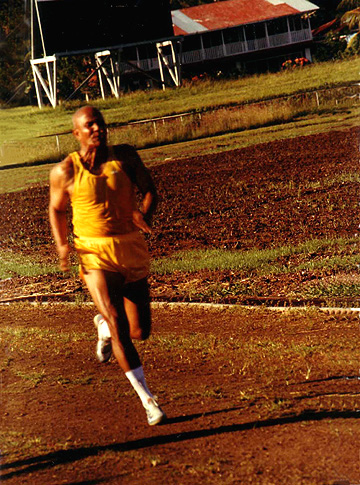
Wearing his gold World Masters Games uniform, Sri Chinmoy sprints around the track at Apia Park – December 28, 1993. Photo: Animesh
At age 62, Sri Chinmoy is looking trim and athletic. Ten years of weightlifting, from 1983 to 1992, saw him bulk up to cope with his strenuous training regime. But with a respite from heavy lifting and his chronic knee injury gradually improving, he has been able to concentrate once more on his favourite sport of running. This past October he was able to compete in the 10th World Veterans Games in Miyazaki, Japan. His body is taking on the shape of a seasoned athlete.
Sri Chinmoy now weighs less than 145 pounds – a goal he has been cherishing for some time. Although this is somewhat heavier than his Ashram weight of 131 pounds, he is overjoyed with the achievement. And to celebrate the occasion, he wants to give his students a special present, so he asks his long-time British disciple Ongkar Smith to organise a 145-item prasad (blessed food).
In Samoa, a confluence of forces seems destined to enable Sri Chinmoy to improve his sprint times. Determination and opportunity are happy partners here – Sri Chinmoy’s steadfast commitment and a warm, relaxed environment in which to train will soon produce results. Within a day or so, some of the boys have already fashioned a makeshift 100-metre track in a vacant field not far out of town for Sri Chinmoy to practise on.
Sri Chinmoy once lamented that as you get older, the spring in your legs is no longer there. His body now does not respond as it did when he was the 100-metre champion of the Sri Aurobindo Ashram, some thirty or more years ago. These days, the speed of his youth is beyond his reach. But undeterred by the constraints of passing decades, Sri Chinmoy is still eager to find new ways of increasing the length of his stride, and he will practise every day with utmost dedication.
Yet running is only one of the many activities that occupy Sri Chinmoy’s ‘holiday’ schedule. For many years, Sri Chinmoy has performed ‘Peace Concerts’ wherever he goes, and Samoa’s capital of Apia will be no exception. After meeting with the Head of State of Samoa, King Malietoa Tanumafili II, Sri Chinmoy holds a Peace Concert in his honour. It is an opportunity for Sri Chinmoy to play and sing some of his favourite songs and most importantly to offer his gratitude to the Samoan people.
The grounds of the Kitano Tusitala Hotel where Sri Chinmoy is staying provide an ideal outdoor setting in which to hold regular functions. A series of tents and portable chairs are set out on the grass in the open air. In the morning, afternoon and evening, Sri Chinmoy and his students gather here to meditate, to sing and tell stories. Typically, the evening functions are punctuated by heavy downpours of tropical rain. But it never lasts for long and cheerful laughter soon returns everyone to their seats as the joyful mood of the function continues to flow on into a star-blessed night.
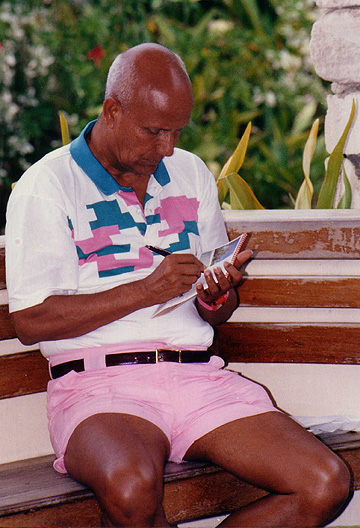
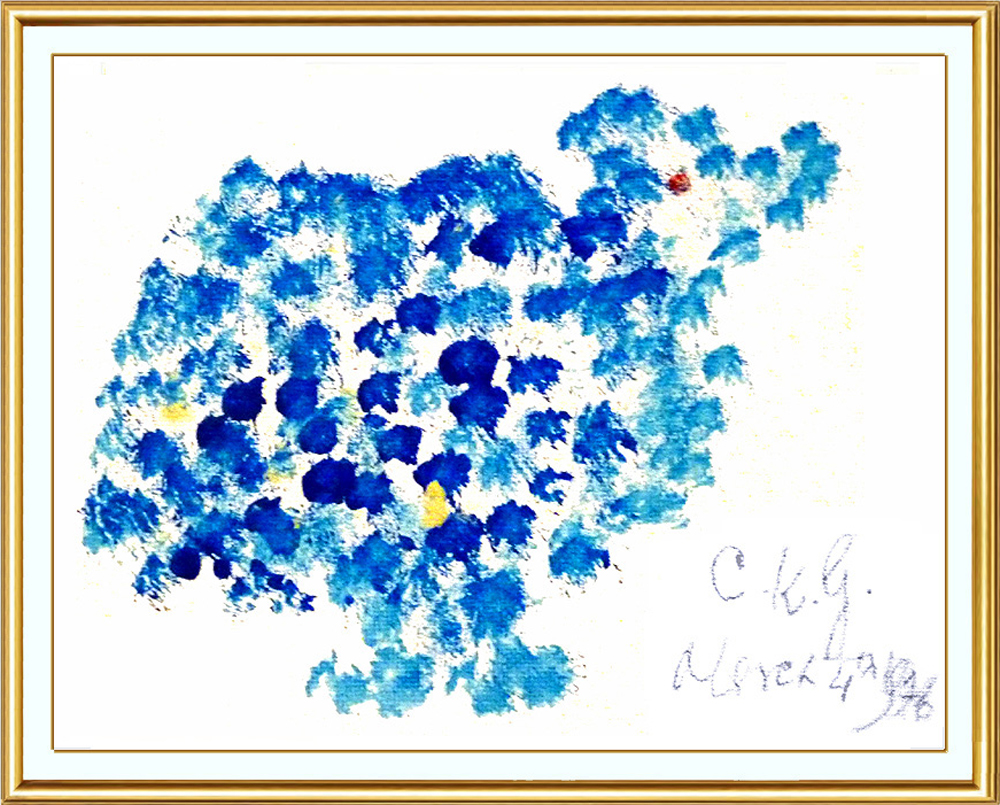
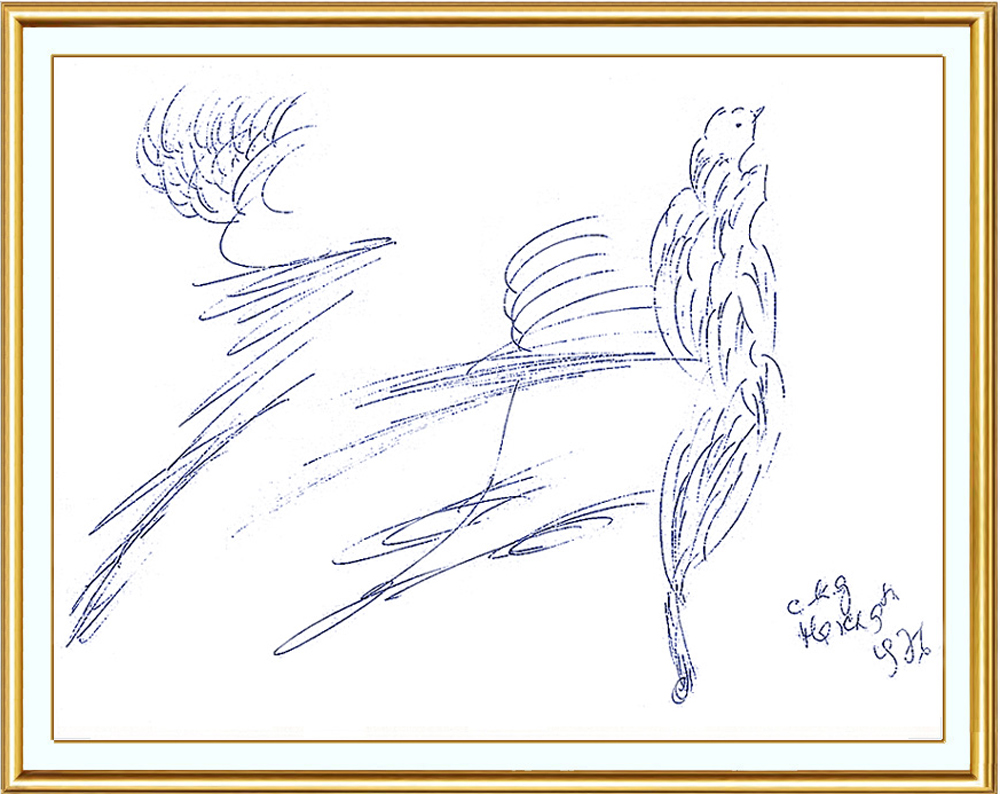
Wherever Sri Chinmoy happens to be, he can always be seen with pen and paper. The tiny abstract bird drawings known as ‘Dream-Freedom Peace-Birds’, which he started in Malta two years ago, seem to roll from his hand at an ever-astonishing rate. Every spare minute is consumed with creating. And it’s not as if Sri Chinmoy works for ten minutes or half an hour between more important matters. No, it is almost as if he has access to the space between the racing seconds of normal life, where he is able to draw into existence something of form from a formless welkin of creativity. To watch Sri Chinmoy while he is drawing is akin to witnessing the primordial moment when time itself was first created.
The numbers speak for themselves: Sri Chinmoy has just passed the 700,000 mark – 724,000 to be exact – which averages out at more than 1,000 birds per day since the project began.
Tonight there is a special banquet in honour of the 700,000 birds. The Jharna-Kala1 girls have cooked a delicious Indian meal. And because it rains each night here, this evening all the chairs are lined up along the covered walkways. There is a line of chairs on each side, stretching for almost 100 metres, with just enough room to walk down the middle for serving. The odd tourist walks through, a little bemused I’m sure, as we sit happily chatting and eating.
After the banquet, we move over to a large tent to view Sri Chinmoy’s latest creation. He asks us to walk by “prayerfully.” The magnificent illustration on display before us is unique. This drawing marks a radical shift in Sri Chinmoy’s artistic development; it is quite unlike anything he has previously done.
Initially, this new artwork looks similar to one of his early pastel drawings, but on closer inspection it can be seen to be entirely composed of very tiny birds – each one, vivid, brilliant and precise. All have their own individuality and a special luminosity, which is surprising because from a distance the collective form is totally different. The brightly coloured tiny birds combine to produce a larger picture, a new optical image – more muted in tone – much like how the eye synthesises the individual dots in the pointillist paintings of Seurat and Monet to produce perfectly composed scenes.
This drawing contains over 13,000 birds. Sri Chinmoy explains that the large overall picture looks like Kanu (his favourite dog who died just one year ago) when he sat in a particular way. The drawing was dedicated to Kanu and Sri Chinmoy’s mother (who looks after him in the inner world).
This evening, we celebrate Sri Chinmoy’s new weight achievement with the 145-item prasad. Sri Chinmoy said the items could be “smaller than an atom,” hence there are all manner of things, ranging in size from a grain of pepper to a tomato, all contained in a large surprise pack. He was so proud to have lost weight that he also hands out a photo of himself on the scales as proof!
Speculation is rife as to when Sri Chinmoy might complete 1,000,000 birds, but he is giving no hints. However, he said when he is finished they will be displayed in a gallery in Canada. “I’m begging each and every one of you to come to Canada at least once in your life to see these birds,” he declares. Then he adds, “and this means disciples from abroad ... You won’t have to meditate or do anything. There will be two million wings to lift you up.”
The function continues with people telling stories of their adventures while here in Samoa. One place of interest to visitors has been the house of the famous Scottish writer Robert Louis Stevenson,2 author of such classics as Treasure Island, Kidnapped, and The Strange Case of Dr. Jekyll and Mr. Hyde. The author spent the last 5 years of his life in Samoa. His home, located in the much cooler altitude of Vailima, just 4 km from Apia, is a beautifully preserved example of colonial architecture. Here many of his books and letters have been preserved. The Samoan people had such high regard for their Tusitala (Teller of Tales) that when he died, they carried his body on their shoulders to the summit of nearby Mount Vaea, where they buried him, overlooking the sea.
Sri Chinmoy, a prolific author himself, would no doubt have been pleased to hear of the honour accorded to a fellow writer. Nevertheless, he takes the opportunity to keep drawing. Behind the scenes, Jharna-Kala girls have been busily counting birds in the ever-increasing number of drawings that have been accumulating. Towards the end of the evening, Sri Chinmoy announces that today was his biggest day yet – 21,466. (The previous highest total was 21,232.) Currently, the total number of bird drawings is 769,000. The artist-athlete is steadily closing in on 800,000.
A boat trip is being organised for tomorrow. It will take people to another island for a dedication of the body of water between the two islands as a ‘Sri Chinmoy Peace Strait’. There will be a big ceremony there with the chief of the island.
Sri Chinmoy does not go on the boat trip; he spends the morning drawing. It seems every bit of his energy is now going into the ‘birds’. Sri Chinmoy wants to finish the million as soon as possible.
The afternoon brings Sri Chinmoy to his running track and the boys who had worked on the track are invited to run 100-metre time trials. Most people are on the boat trip, so there are only about 30 disciples here. Sri Chinmoy stays at the track for a long time, having all sorts of races. Finally, he gives out a huge sugary pastry for prasad.
Tonight there is a huge treat in store – we are all off to the circus.
The sun is setting as we arrive at a most unusual venue. There are a few stalls set up outside a miniature big-top-style tent, which only seats about 200 people. The humidity is near 100% as we pack ourselves tightly into the crowded seats surrounding the tiny arena. This is the first all-Samoan circus and most of the performers have never seen a real circus before. They range in age from three to forty plus, and the rustic simplicity of their skills, as well as some well-honed professional acts, has us all charmed. It is after all called ‘The Magic Circus of Samoa’.
The enthusiasm of the ringmaster, Tup’ai Bruno Loyale, makes it all happen. As the circus is about to start, he introduces Sri Chinmoy as a ‘Man of Peace’. All evening he is overwhelmingly open-hearted and beaming a smile from ear to ear. Needless to say, it is an infectiously happy event. Sri Chinmoy takes in all the action, even while he is still busily drawing.
Some of the Samoan circus performers have traditional tattoos on their bodies. The more tattoos a man has, the higher his standing in Samoan society. To undergo the entire process is extremely painful and takes up to sixteen years. Usually, only a chief will have his body completely covered in tattoos.
Ringmaster Tup’ai Bruno Loyale wearing the garland just presented to him by Sri Chinmoy. Photo: Prashphutita Greco
After the circus, Sri Chinmoy greets the ringmaster who proudly displays his traditional Samoan tattoos.
At the end of the night’s performances, the ringmaster himself is introduced. He enters the central arena, minus his flamboyant showman’s coat and tails, dressed instead in simple Samoan attire. It is a surprise to everyone to see that he too is adorned with the traditional tattoos. He is of German origin, speaks with an American accent, but he is every bit a Samoan. After the show, Sri Chinmoy is eager to meet him again to offer his gratitude for the evening’s truly magical experience.
Inspired by the idea that participating in sport is not just for the young, but for the young at heart, Sri Chinmoy has been sponsoring athletic events for the over 50s since 1985. At 7 a.m. this morning, a group of intrepid elderly athletes gather in Apia Park for the Sri Chinmoy Masters Games. The Minister of Youth, Sports & Cultural Affairs Tuiloma Pule Lameko is here as is Chief Matai Viao Ala’Illima and his wife, a noted American author, all ready to compete.
Sri Chinmoy too, is ready to run. He is wearing his uniform, gold shorts and singlet, from the World Masters Games in Miyazaki. The warm climate here seems to draw out the best from Sri Chinmoy’s muscles. And even though the track is less than ideal, with its uneven surface partly covered in slippery moss, Sri Chinmoy’s time for 100 metres is clocked at 15.1 sec. and 33.4 sec. for 200 metres. At the end of the morning’s activities, the invited guests participate in a Celebrity 100-metre walk. Minister Lameko crosses the line first and Sri Chinmoy ties with Chief Matai Viao Ala’illima.
At the awards ceremony, the Minister leads the Samoans in a traditional Samoan song.
Tonight is Sri Chinmoy’s second Peace Concert in Apia and he dedicates the concert to Mikhail Gorbachev, saying that he is, “the greatest peace-dreamer, the greatest peace-seeker and the greatest peace-lover here on earth.” The Minister of Sports has become a great supporter of Sri Chinmoy’s peace initiatives and he is in attendance tonight.
The year is drawing to a close, and so is our stay in Samoa. So much has happened here that remains unrecorded. Only the highlights now seem recognisable; like islands, on an ocean of consciousness, they jut out above the waterline of experience. But even the smallest, most fleeting moments can often change the complexion of a day, lift the heart to unexpected joy or soothe the soul. Samoa has done that for us. The Samoans we have met and the Samoan nation as a whole, I’m sure, have benefited from so graciously accepting the presence of a great spiritual master. Tofa soifua Samoa!
***
It is New Year’s Eve in Nadi,3 Fiji, the first day of our ten-day stay here. At the entrance to the function room is a small sign which says that Sri Chinmoy has requested that we enter in silence, with folded hands, and to be in a prayerful consciousness.
Only a few people are here at present. They are walking slowly around the room. Stretched along both side walls are two 4 ft. x 30 ft. rolls of paper covered in texta-coloured birds. There are 7 or 8 large bird shapes on each sheet. Surrounding and within each major bird image, are many other smaller birds – flying, diving, floating and sweeping across the canvas. A personal insight strikes me: the very existence of these birds is due to Sri Chinmoy’s Light and at the same time their very existence is to spread Sri Chinmoy’s Light.
When Sri Chinmoy arrives, we take our seats and listen intently as he talks about the year ahead from a spiritual perspective. He extemporaneously recites this prayer:
My Beloved Supreme, the New Year begins.
Do tell me
How I can please You most
In the New Year.
“My child, you will be able
To please Me most
If you just give Me two things
Once and for all:
Your mind’s ceaseless deception-night
And your heart’s sleepless aspiration-light.” December 31, 1993
Sri Chinmoy is still drawing and the official bird count now stands at 826,603. He expresses a wish to complete 1,000,000 birds before the end of the Christmas trip.
The first day of the New Year marks the commencement of outdoor morning meditations, followed by bhajans.4 Sri Chinmoy arrives around 5:15 a.m., meditates for a short time and recites a special prayer:
My Absolute Lord Supreme,
May my mind today and every day
Think of You only.
May my heart today and every day
Love You only.
May my life today and every day
Serve You only.
May I today and every day
Place my success-joy and my progress-peace
At Your Compassion-Feet. January 1, 1994
It is the night before we leave Nadi and Sri Chinmoy shows us something very special which he had been working on that day. Done on approximately A3 size paper, they are intricate drawings of birds composed of thousands of very tiny birds.
The three ballpoint pen sketches represent the members of his immediate family. One is of his mother – the number of small birds alone in this drawing of Jogā Bishwās (Yogāmayā, as she was known) is 3,127. Another depicts his father, Shashi Kumar, and the third drawing depicts all seven brothers and sisters.
Next morning at the 5 a.m. meditation, Sri Chinmoy recites this prayer:
This morning
My Lord Beloved Supreme
Is telling me
That before I dare to claim
His Immortal Love, Immortal Joy
And Immortal Pride
As my own, very own,
My own faith-heart-garden-blossoms
Must infinitely increase
Their beauty and fragrance
Inside His Compassion-flooded Heart. January 2, 1994
The early part of the day is spent in packing all the bird drawings, equipment and personal luggage onto buses that will take us from Nadi to Fiji’s capital, Suva, on the other side of the main island.
Here in Suva this morning, Sri Chinmoy is ‘relaxing’ by the hotel pool and still drawing birds at an incredible rate. Last night he said he had finished 860,000.
During the day, Sri Chinmoy watches some of the boys playing volleyball. He instructs them with great enthusiasm, calling the vital shots and scoring the matches. Then for a bit of fun, he has them playing games, such as keeping the ball up in the air for as long as possible. Volleyball is one of Sri Chinmoy’s favourite sports. He used to play it in his youth and captained the men’s team at the Sri Aurobindo Ashram in India before he came to the West.
Sri Chinmoy likes it here in Fiji. The large Indian population gives the island a very different feeling. The streets are filled with sari shops and all types of Indian food vendors. There are stores full of brassware, spiritual books and religious items – brightly coloured pictures of Indian gods and goddesses are ubiquitous. Sri Chinmoy can often be seen out and about, popping into the many fascinating stores around the city.
At the evening function, Sri Chinmoy announces that the tally is now 878,316 birds. He comments that the first 100,000 birds took him more than a year and 10 or 11 months to complete, whereas the subsequent number has been done in the few months since then. Like any task he undertakes, his progress seems to invariably follow an exponential path.
Fiji’s National Stadium in Suva is an all-purpose venue with its own 400-metre synthetic track. In a few days, the Sri Chinmoy Masters Games will be staged here, so Sri Chinmoy can be seen early each morning, rain or shine, practising his sprints.
January 5, 1994, proves to be an historic day, filled with anticipation and drama. The next eventful 24 hours begins with a prophetic message by Sri Chinmoy at 5:15 a.m.:
Supreme, my Supreme, my Lord Supreme,
My Absolute Supreme, my Beloved Supreme,
Today once more,
Out of Your boundless Bounty,
You are making me
A choice instrument of Yours.
You are completing one million bird-creations
Through my aspiration-heart
And dedication-life.
My Lord, my Lord, my Lord,
Do make my heart
Worthy of Your infinite Compassion
And my life Your immortal Victory.
My Lord, my Lord, my Lord,
Your birds are smiling
In Infinity’s Sky.
Your birds are singing
In Eternity’s Peace, Peace, Peace. January 5, 1994
Many of us are presently seated in the hotel lobby awaiting Sri Chinmoy’s arrival. It could be minutes or hours to the one million. Sri Chinmoy walks downstairs. He is carrying with him, folders and papers. He is totally immersed in his own world of creation. He gazes sideways at us for a moment, but you can tell that he does not see us – his eyes are focused on a more immediate goal.
The room is filled with palpable expectation. Sri Chinmoy walks outside, takes a seat under the large shaded canopy, and calls for some of the girl counters – presumably to check the latest count. Suddenly he rushes back through the door and heads upstairs. On the way, he calls for his attendant, Savyasachi Brown. Now, back down the stairs – Sri Chinmoy first, followed by Savyasachi carrying 5 or 6 rolls of paper. The intensity is building as Sri Chinmoy returns to his seat outside. Savyasachi is now counting each page as Sri Chinmoy completes the drawings.
Tonight there is a Peace Concert at the Suva Civic Centre dedicated to President Gorbachev. It is all of one hour long – very short by Sri Chinmoy’s standards. He is soon dashing back to the hotel. The counters inform him that he still has 39,000 to go. At his hotel room, Sri Chinmoy keeps drawing, through the late evening and on past midnight, into the silent hours of the next day.
It is easy to think, with his goal so tantalisingly close and after a long day and night packed with activity, that the early hours of the morning might tempt Sri Chinmoy to take the shortest route to his goal by quickly drawing the smallest possible birds. But again, Sri Chinmoy confounds the devious mind. Instead, he begins to create something totally new – large, intricate and beautiful designs on fabric, saris and postcards.
At 4:31 a.m., January 6, 1994, local time, he finally completes the one million birds. But Sri Chinmoy still counts this as belonging to January 5, since, in Moscow, it is still January 5 – Raisa Gorbacheva’s birthday. Sri Chinmoy was determined to finish by her birthday as the entire collection is dedicated to her. The final count is 1,001,919.
Many more events will take place over the forthcoming days, but one highlight will forever remain unsurpassed – the one million bird drawings and the Herculean effort of their creator.
The Sri Chinmoy Masters Games is held at the National Stadium, where Sri Chinmoy runs 100 metres in 14.82 sec., his fastest time so far during this Christmas trip; the Sri Chinmoy Oneness-Home Peace Run visits a hospital, an orphanage, a school, and carries the flaming torch around the oval at a Rugby match; and at the National Stadium, Ashrita Furman sets an official world record for dribbling a basketball – 83 miles in 24 hours – to honour his Guru’s achievement.
Finally, today Sri Chinmoy and his students are leaving Fiji. Some will travel with him onto Raratonga and Tahiti before returning to New York. Others will fly out to destinations in Europe, Australia and New Zealand. Yet it won’t be long before they all meet again. One million Dream-Freedom Peace-Birds are also taking flight. They too will flock together soon, in what will be a spectacular display of light and colour in the heart of Ottawa,5 Canada, the city Sri Chinmoy has chosen to exhibit this most wondrous collection of heaven-born creations.
References:
Author’s original diary notes from Samoa and Fiji, 1993-94
Notes by Prashphutita Greco: Sri Chinmoy in Western Samoa and Fiji (1993/4)
Anahata Nada, Volume 23, Mid-December 1993–March 1994 News Clippings from Samoa-Fiji 1993-94 Statistical References: Sri Chinmoy’s first one million Soul-Bird drawings
Endnotes: 1Jharna-Kala is Bengali for Fountain-Art, the name Sri Chinmoy gave to his body of artwork. For many years Sri Chinmoy’s paintings and drawings have been catalogued, preserved and exhibited by a dedicated group of girls. 2 Sri Chinmoy’s stay in Samoa coincided with the eve of the centenary year of Robert Louis Stevenson’s death (1894). 3 In Fijian, the letter ‘d’ is pronounced as ‘nd’, thus ‘Nadi’ is pronounced ‘Nandi’. 4 Traditional-style devotional songs, composed by Sri Chinmoy. 5 On March 23, 1994, an exhibition of Sri Chinmoy’s first 1,000,000 Dream-Freedom Peace-Birds opened in a gallery in Ottawa, Canada. The choice of Ottawa to host the drawings is significant because it was here Sri Chinmoy produced his first artwork in the West, on November 19, 1974.
In 1974, two years before Sri Chinmoy visited Australia, he composed his soulful tribute to the island-continent, entitled ‘My Salutation to the Soul of Australia’. During February 1976, the month preceding his arrival in Australia, Sri Chinmoy was consciously preparing for his visit. He would have been diligently working on the ten lectures he was to deliver in five major capital cities; on February 19, in a radio interview on WRNW in New York, Sri Chinmoy explained the reason for his upcoming visit; and on February 20, whilst on a bus trip to Canada, Sri Chinmoy composed the song ‘O My Australia’. It is also interesting to note that on February 17, Sri Chinmoy first began playing the esraj – the instrument he chose to play publicly for the first time in Australia. Here is a day-by-day account of this historic tour:
“As soon as the plane landed at the airport in Perth, the soul of Australia and I began our inner colloquy.… ‘In India, every day we hear about cricket between Australia and India…. I will play a game where nobody will win or lose…. Here there is no competition; there is no rivalry. It is all oneness. It is our oneness-game. I have come here to devotedly offer my light to you.’” — Sri Chinmoy (Dec. 2, 1991)Read more...
Sri Chinmoy arrives in Perth, the capital of the state of Western Australia, late in the evening after a marathon series of connecting flights from New York. His journey includes a short stopover in San Francisco, then on to Honolulu and across the Pacific Ocean to Sydney, eventually arriving in Perth 2½ hours behind schedule.
MARCH 2ND
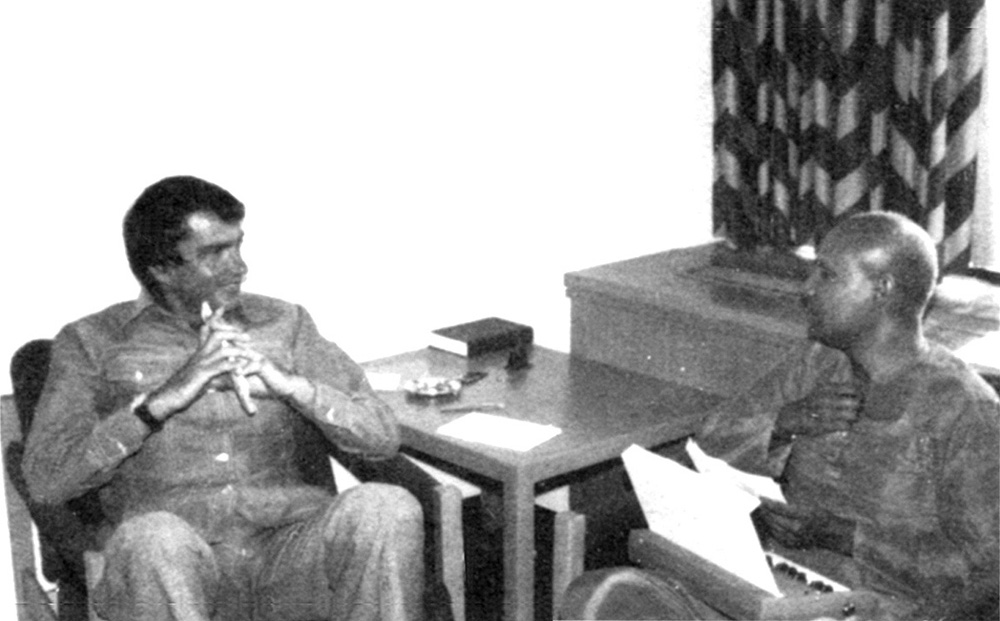
Ian Cairns: “How do you continue to meditate? Do you just do it by yourself or do you have some school...?”
Sri Chinmoy: “Some surfers come to you because you are an authority on that subject. They know that if they come to you, they will be able to learn everything in a very convincing manner. Again, there have been a few experienced and talented human beings, like Tagore and others, who didn’t go to school. But we can’t say that they are not men of wisdom. No, they are. But these are exceptions.”
Sri Chinmoy meets with Aboriginal poet Jack Davis in Perth.
“Visiting guru Sri Chinmoy ... says people can be pure, perfect, peaceful, divine and right by talking to God. This, he says, can be done by praying, meditating and believing in the link between us and God.” — Daily News
Sri Chinmoy is interviewed at ‘Flame-Waves’ restaurant in Perth by a reporter from the Daily News and the article appears in the final edition of the newspaper the same day.
Prior to his first lecture in Australia, Sri Chinmoy offers his most soulful gratitude to the Dean of Perth: “This morning I had the golden opportunity to be blessed by his august presence. His heart's magnanimity has touched the very depths of my heart. With all the sincerity at my command I pray to the Christ-consciousness to grant Mother Earth a few more sincere seekers and sincere lovers of mankind like the Dean of Perth, so that our planet earth can have a better peace, a more fulfilling heart and a more satisfying reality.”
Sri Chinmoy meets with the Anglican Dean of Perth, the Rev John Cornish, at St George’s Cathedral in Perth. Their meeting is covered by The West Australian and an article appears in the newspaper the next day.
“My dear Australian sisters and brothers, you are all welcome in my house. My house is my heart, my heart of aspiration and my heart of dedication. My heart of aspiration shall love the divine in you and my heart of dedication shall love the Supreme in you.” — Sri Chinmoy
Sri Chinmoy delivers his first lecture in Australia, entitled ‘Aspiration’, that evening at St George’s Cathedral in Perth. It draws over 500 people and after seating space ran out, many seekers sat cross-legged on the floor.
MARCH 3RD
“I think a person such as yourself, who is so humble in himself, giving light to people in so-called prominent positions, probably reminds them to be more humble and more dedicated to the thing they’re serving rather than themselves.” — The Right Hon. Ernest Lee-Steere, Lord Mayor of Perth
Sri Chinmoy meets with the Lord Mayor of Perth, the Right Hon. Earnest Lee-Steere, who arranged a small reception at his chambers in Perth.
“There are very few flowers in God's creation that please God to the greatest extent. The rose is one of those, along with the lotus. Rose and lotus: these are the two mystical flowers. These are the two flowers in God’s Heart-Garden that please Him most. The fragrance and beauty of this rose will come from Perth, Australia and go directly to the Heart of God the Creator and God the creation.” — Sri Chinmoy
“Dear seekers, dear sisters and brothers, I am also a seeker like you. We all are in one Boat. Our Goal is one: the Golden Shore of the Beyond. Here we are all members of the same divine family … seekers of the Eternal Truth walking along Eternity’s Shore.” — Sri Chinmoy
Sri Chinmoy holds a lunchtime meditation at the Seekers’ Centre in Perth. He gives a short talk and answers questions from the audience. Sri Chinmoy commented on the sincere and receptive group of seekers who were assembled there.
“Philosophy and spirituality belong to the domain of knowledge, whereas Yoga belongs to the domain of wisdom. I am extremely happy to learn that the motto of this august university is ‘Seek Wisdom.’ ” — Sri Chinmoy
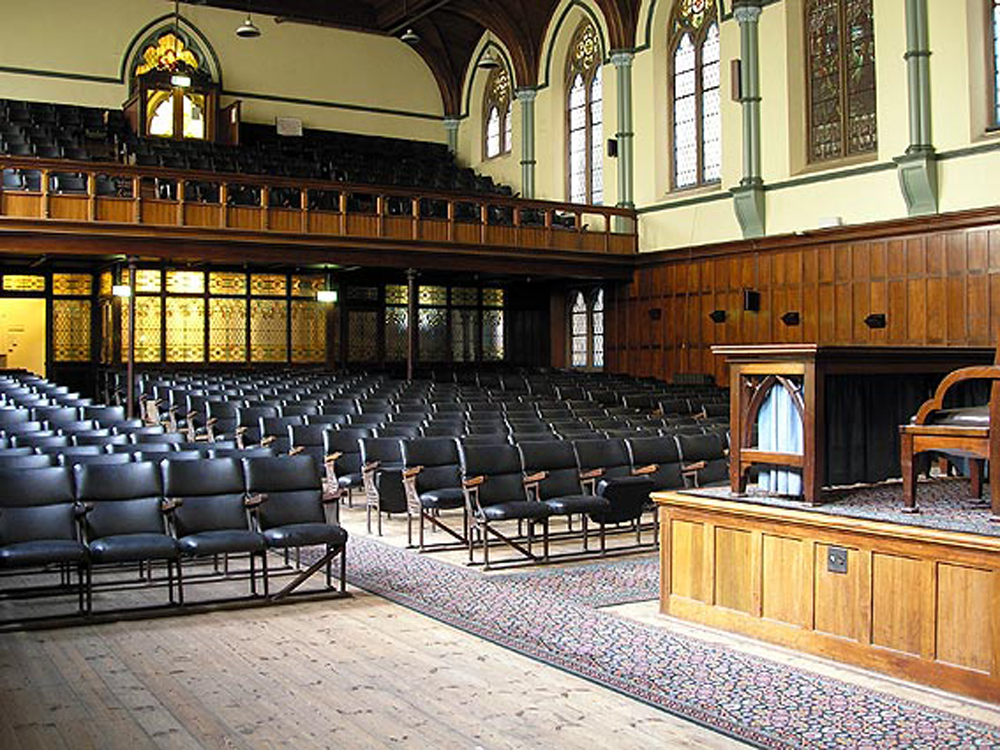
Sri Chinmoy delivers a lecture, entitled ‘Philosophy, Spirituality and Yoga’, in Winthrop Hall at the University of Western Australia in Perth, where he also plays the esraj for the first time in concert. The event attracts around 700 people, the largest audience in Australia.
MARCH 4TH
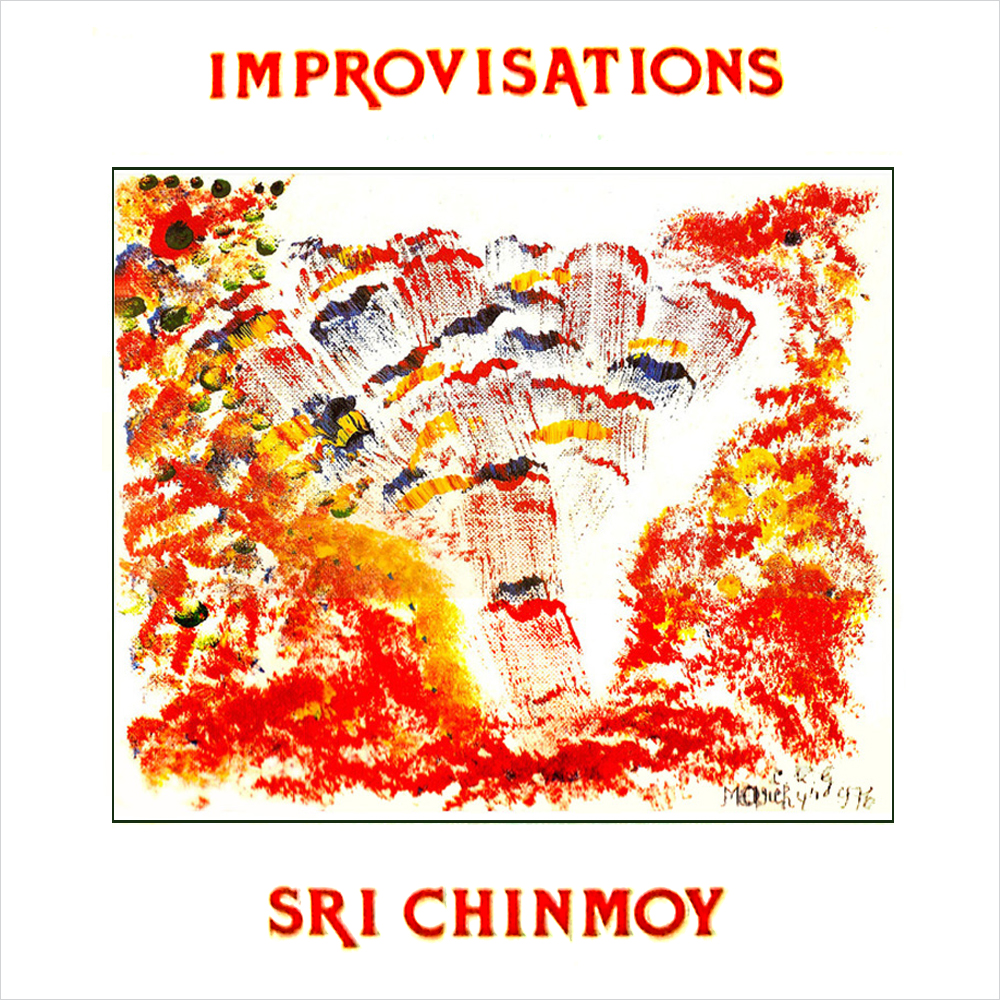
Sri Chinmoy spontaneously plays his first extemporaneous keyboard improvisation at Flame-Waves restaurant in Perth. It later becomes Side A of the LP album, ‘Improvisations’.
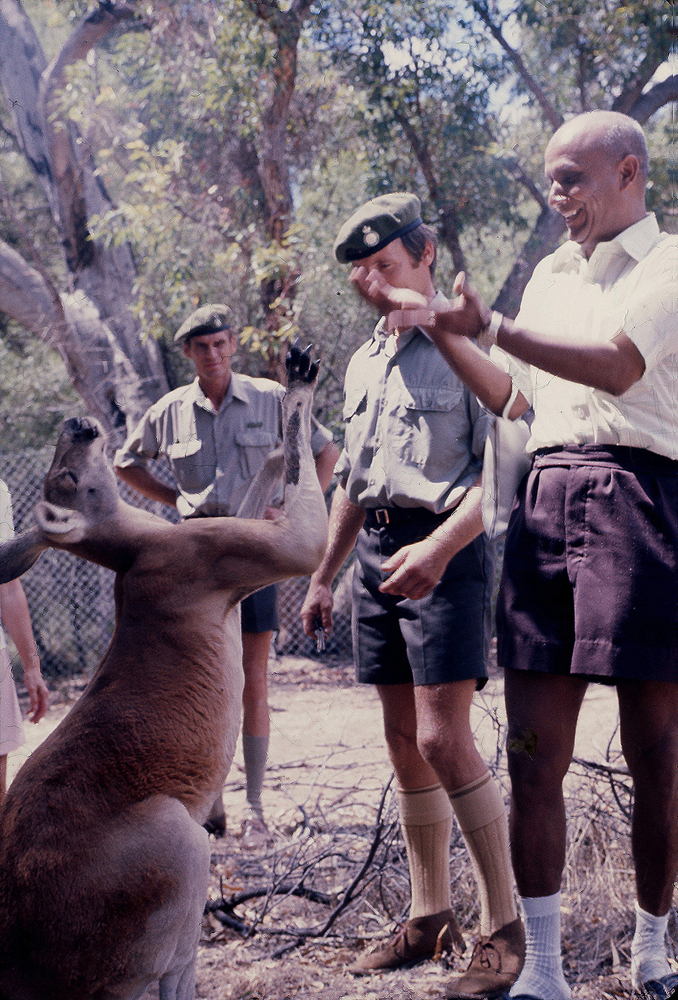
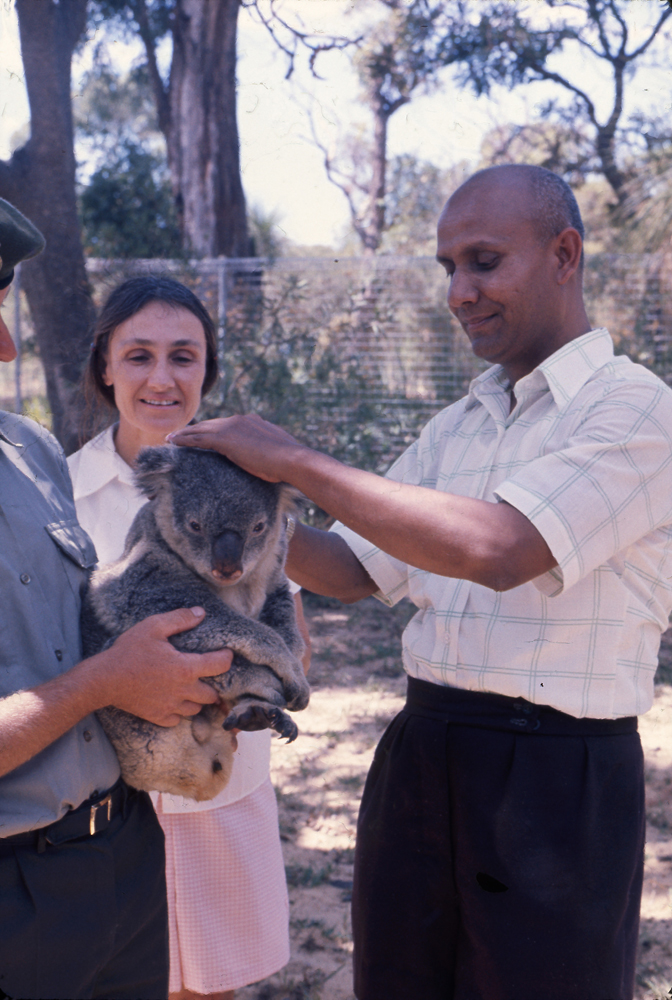
Sri Chinmoy visits Yanchep National Park, north of Perth. There, Sri Chinmoy sees Australian marsupials for the first time. He delights in seeing the kangaroos and blesses one of the oldest koalas in the park, 17-year-old ‘Nobby’.
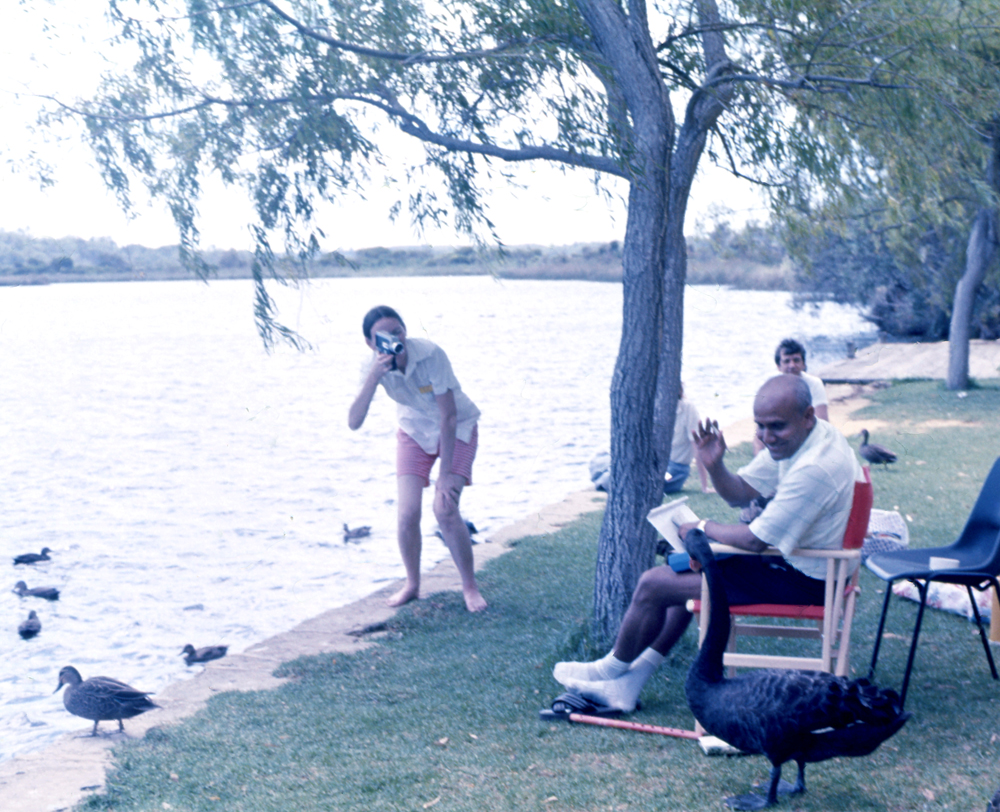
As Sri Chinmoy composed his music, with ducks and black swans walking around him, he jokingly commented: “Oi, I have become Saint Francis! These are my friends – take a picture.” — Sri Chinmoy
Sri Chinmoy writes Bengali songs while seated beside the beautiful spring-fed lake, Loch McNess, at Yanchep National Park. When he arrives at the grassy slope beside the lake, he comments, “This is the sort of place I need in New York.”
Sri Chinmoy departs Perth at 11 p.m. for a plane trip across the Australian continent to Sydney, capital of the state of New South Wales, on the east coast.
MARCH 5TH
Sri Chinmoy arrives in Sydney at Kingsford Smith Airport in the early morning.
Sri Chinmoy holds a mid-day, public meditation at the University of Sydney.
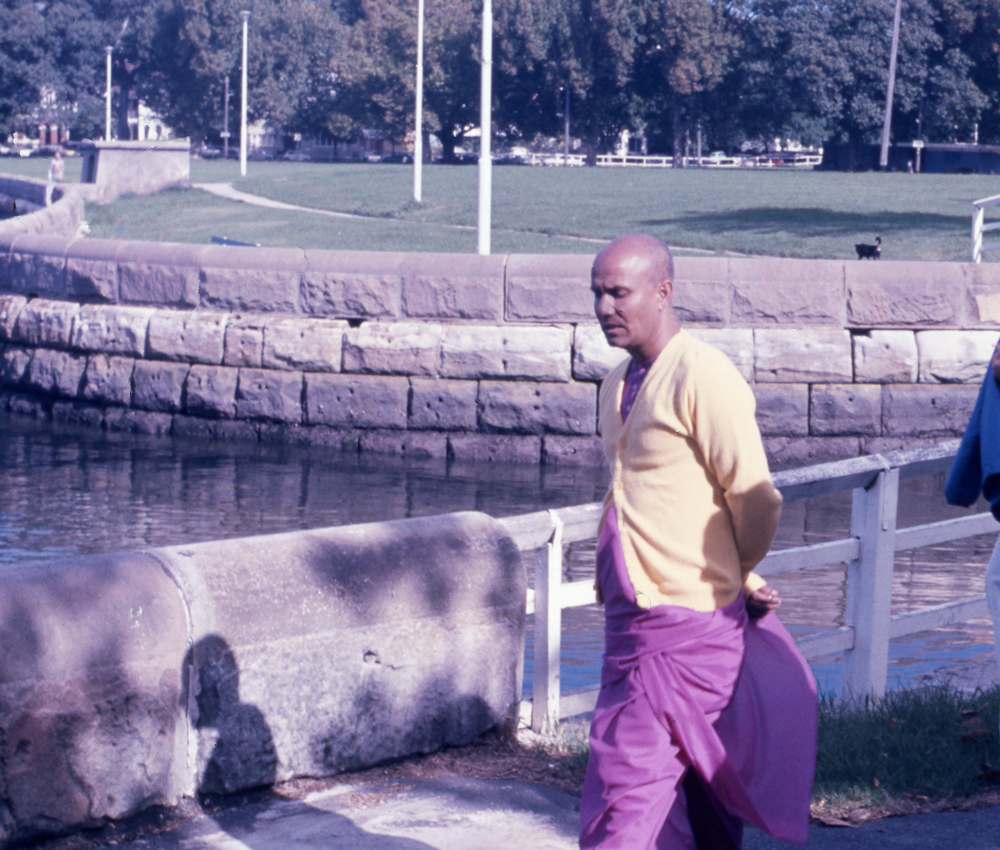
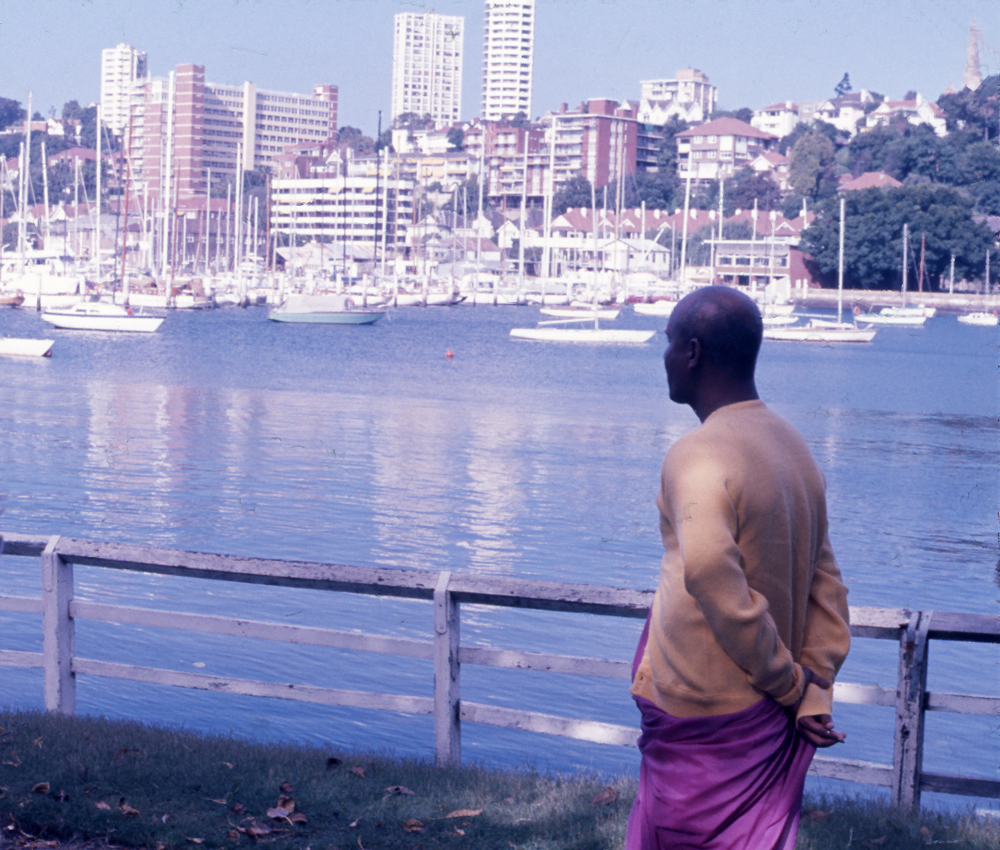
Sri Chinmoy meets with his students at the hotel where he is staying and walks down to the park by the waters of Sydney Harbour.
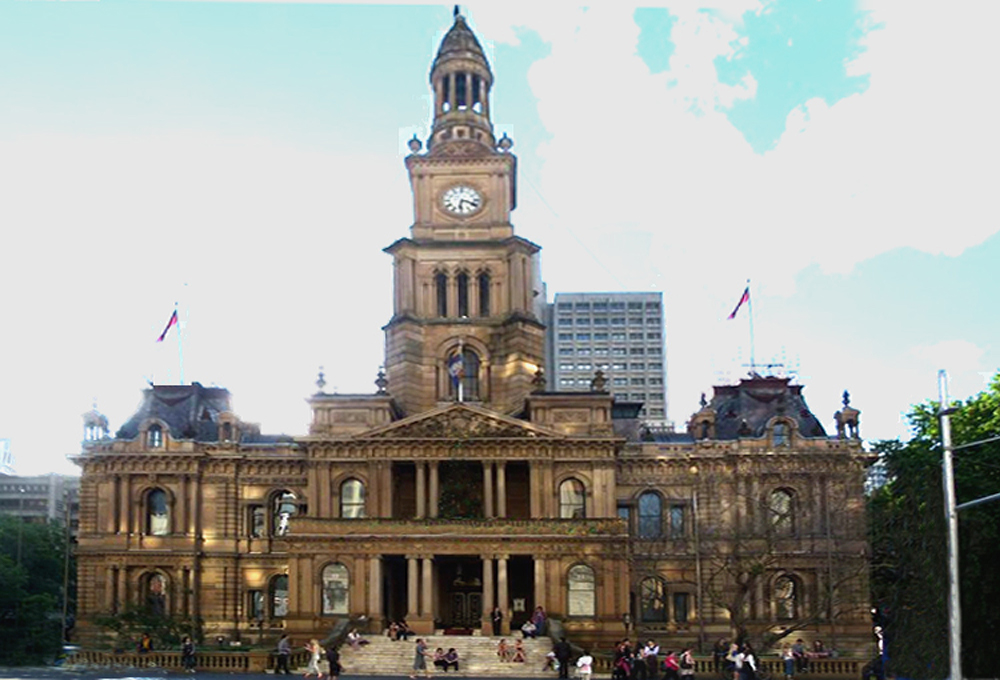
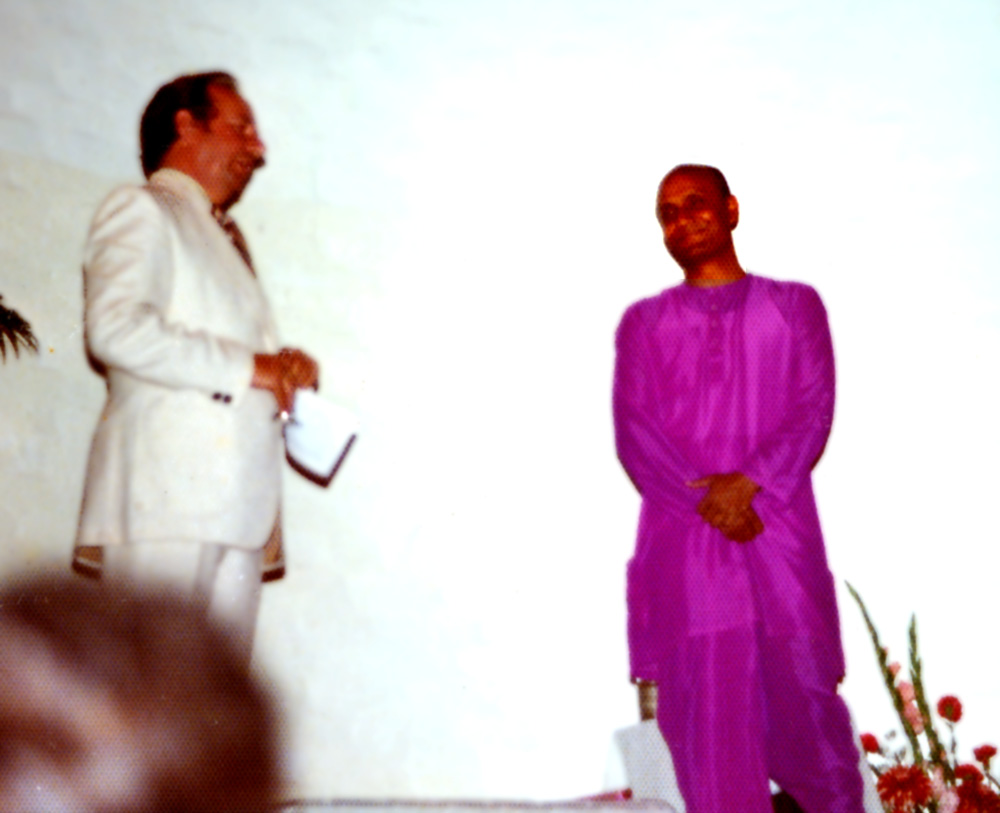
Sri Chinmoy delivers a lecture, entitled ‘Aspiration and Realisation’, at the Town Hall in Sydney. Some 400-500 people attend the meeting at which all his Australian disciples sang the ‘Invocation’ together for the first time.
MARCH 6TH
Sri Chinmoy visits Taronga Zoo, Australia’s oldest zoo, on the northern side of Sydney Harbour.
“Right now fear, doubt, anxiety, tension and disharmony are reigning supreme. But there shall come a time when this world of ours will be flooded with peace. Who is going to bring about that radical change? It will be you: you and your sisters and brothers, who are an extension of your reality-existence. It will be you and your oneness-heart, which is spread throughout the length and breadth of the world.” — Sri Chinmoy
Sri Chinmoy meets with Reverend Ted Noffs, who introduces him to the audience before his historic evening lecture, entitled ‘Peace’, at the Wayside Chapel in the heart of the Kings Cross area in Sydney.
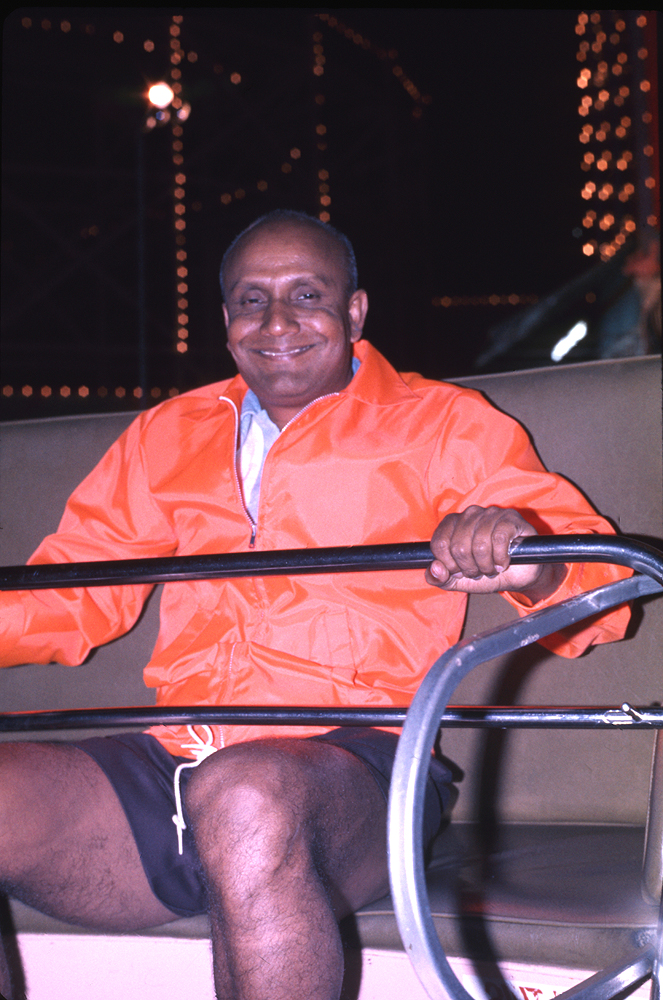
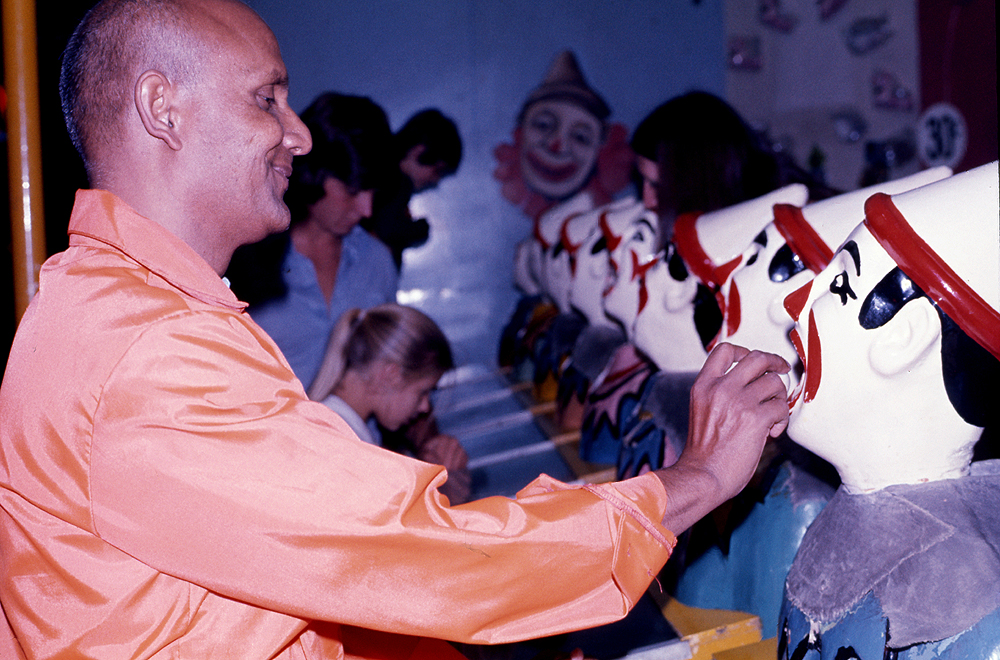
Sri Chinmoy and his students visit Luna Park, a 1930s-style funfair and amusement park, at Milsons Point in Sydney. There, he enthusiastically participates on the rides and visits the sideshows.
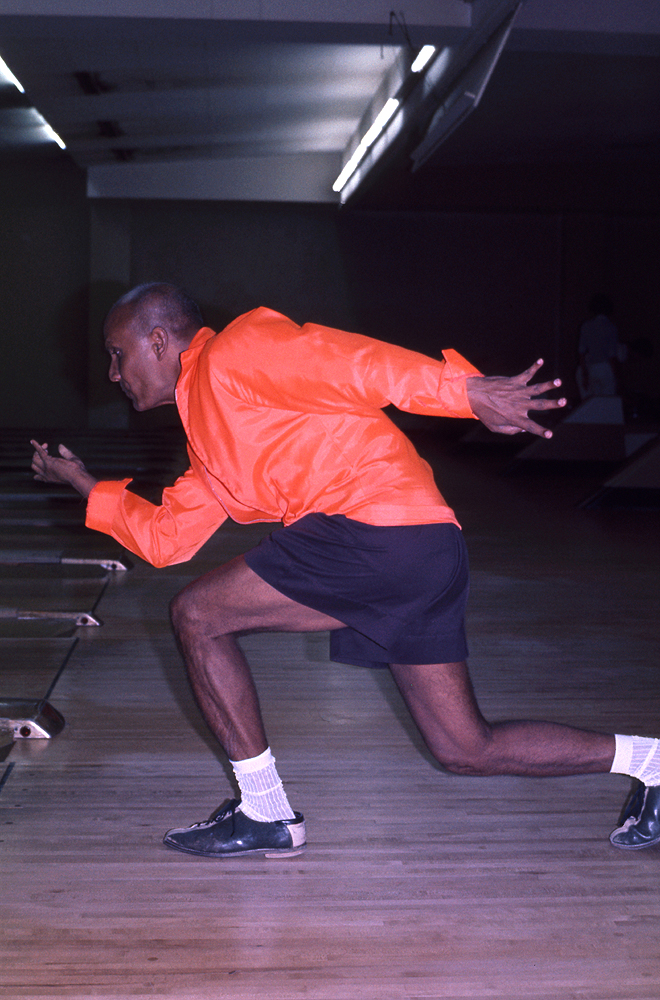
Sri Chinmoy and his students go ten-pin bowling at Rushcutters Bay Bowl in Sydney.
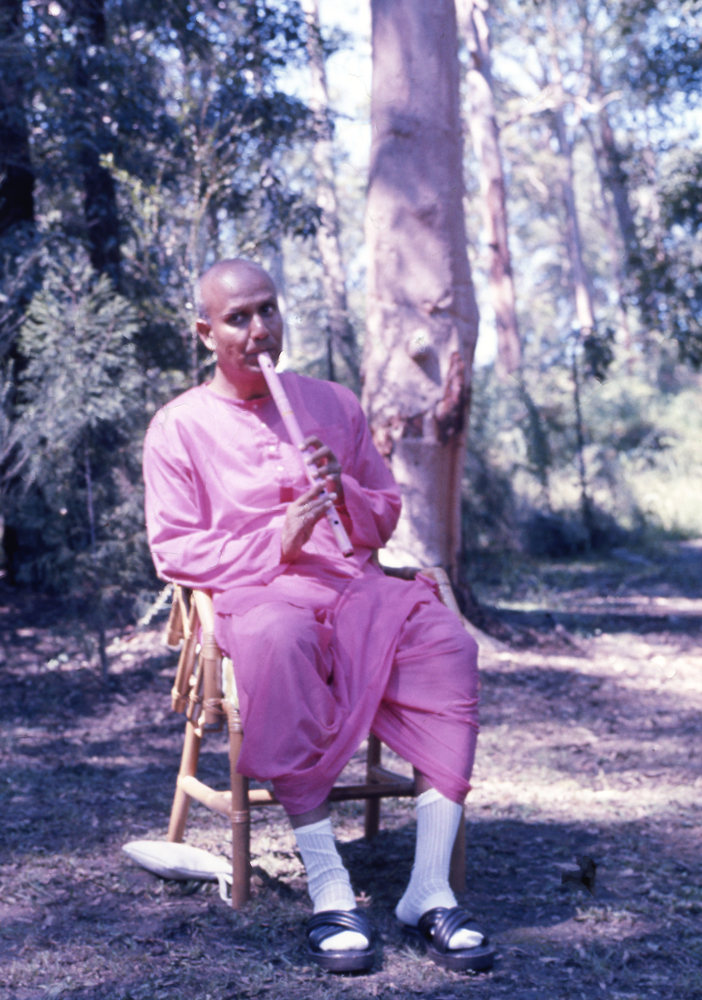
Sri Chinmoy visits the home of the Australian film and TV actor-singer Barry Crocker and his wife Dene in Sydney’s forested northern suburbs for a picnic with his students.
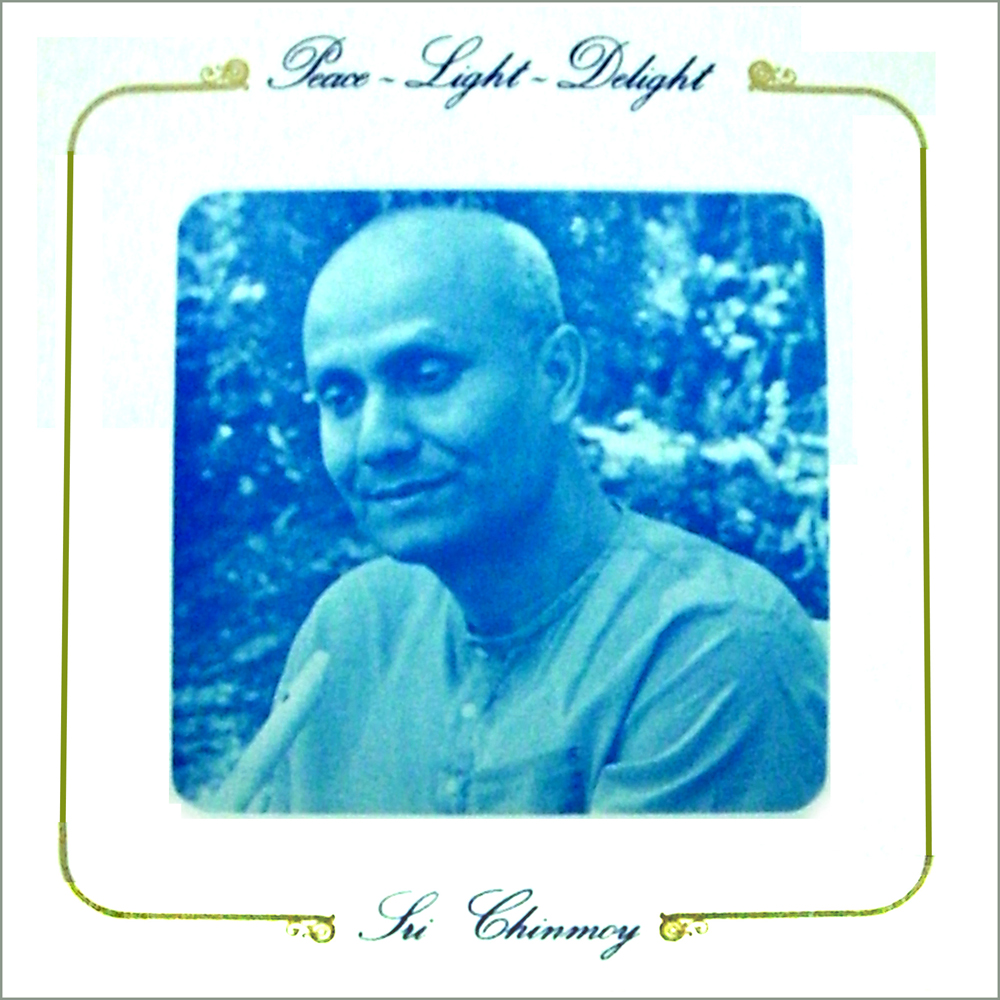
Sri Chinmoy makes the first recording of his esraj music at Tin Pan Alley Music studios in Sydney. He was the first person to record an album there. The vinyl LP record, which also contains vocal tracks, is subsequently released as ‘Peace-Light-Delight’.
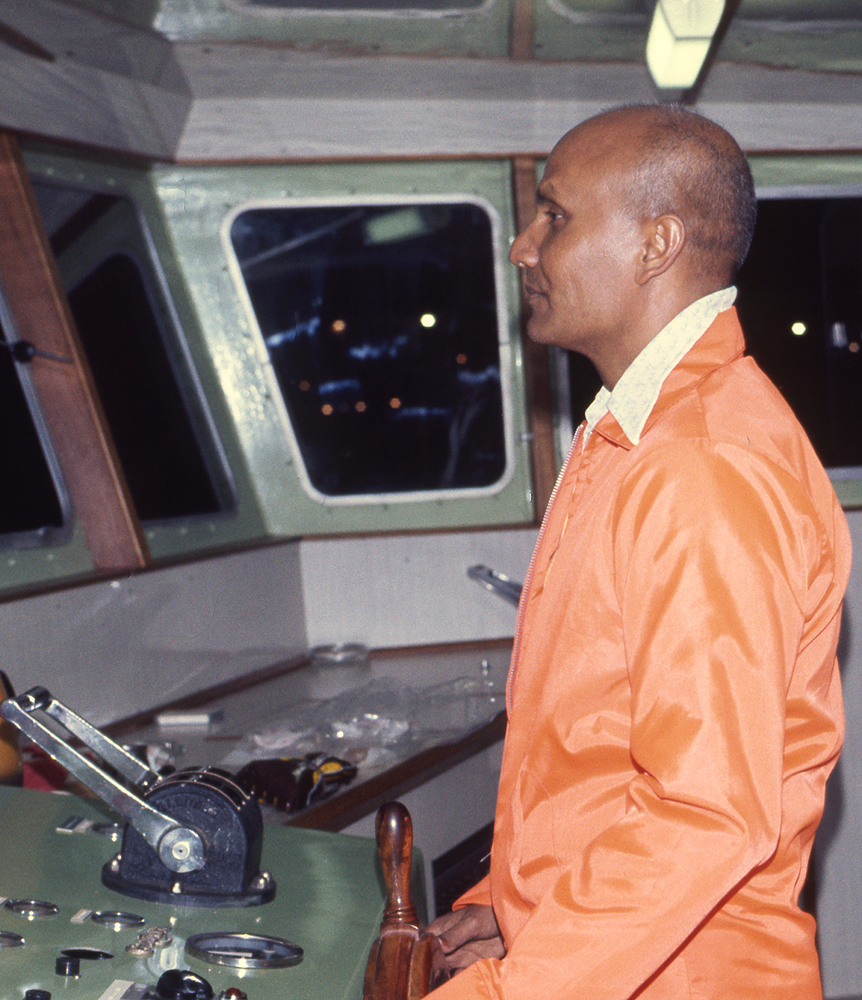
Sri Chinmoy takes an evening boat cruise on Sydney Harbour aboard the Captain Cook ferry and gives a talk on the ‘Golden Boat’, which is recorded by ABC Radio. The captain allows Sri Chinmoy to steer the ferry for a time.
MARCH 8TH
“When a seeker makes considerable progress in his spiritual life, he comes to realise this eternal Now. He establishes a free access to this sole Reality, the eternal Now.” — Sri Chinmoy
Sri Chinmoy takes an early morning car journey to the nation’s capital Canberra to hold a meditation and deliver a lecture, entitled ‘The Eternal Seeker’, at the Australian National University.
MARCH 9TH
“In each seeker, there is a promise to God, a promise to the inner Reality, to the Highest Reality, that he will become a perfect, unconditional instrument of God to play the inimitable role God has created for him.” — Sri Chinmoy
Sri Chinmoy takes an early morning flight to Melbourne, the capital of the state of Victoria, before delivering a lunchtime lecture, entitled ‘The Reality Within’, in the Open Stage Theatre at the State College of Melbourne.
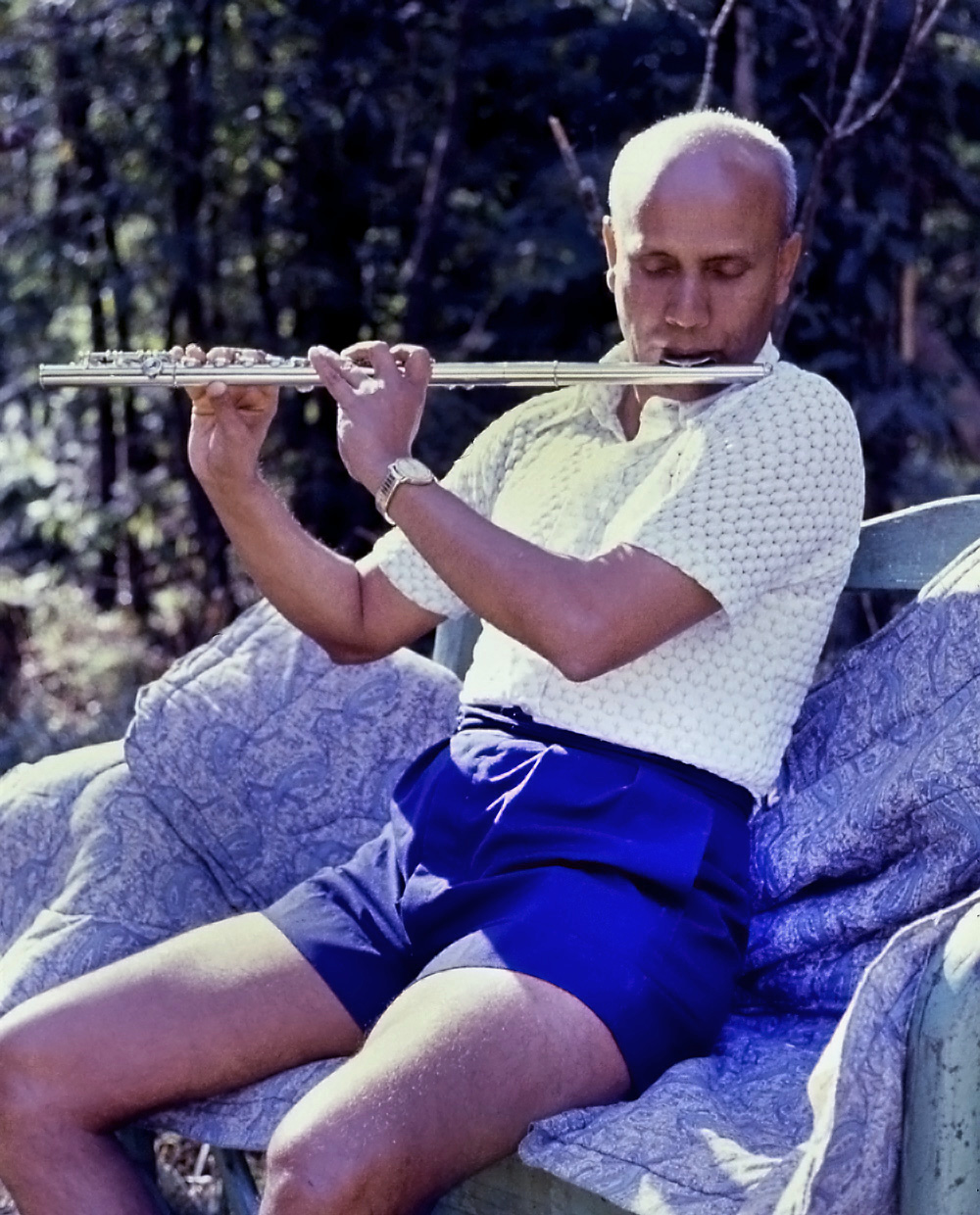
Sri Chinmoy and his students take a coach ride to Healesville Sanctuary on the outskirts of Melbourne. It is on this journey that Sri Chinmoy first learns to play the Western flute. Read article…
“The seeker starts with simplicity and goes along the road of sincerity, purity and divinity. Inside divinity, at every moment he realises a Goal, a Goal that is constantly transcending its own Infinity, Eternity and Immortality.” — Sri Chinmoy
Excerpt from a letter in 1999: “I have extremely fond memories of my meeting with Sri Chinmoy in 1976. In the intervening 23 years his work for peace has shown how one person can have such a positive and profound effect on so many people’s lives.” — Ron Clarke
Sri Chinmoy meets with Ron Clarke, Australia’s great Olympic middle-distance runner and former holder of 17 world records. Sri Chinmoy also composes a song dedicated to him.
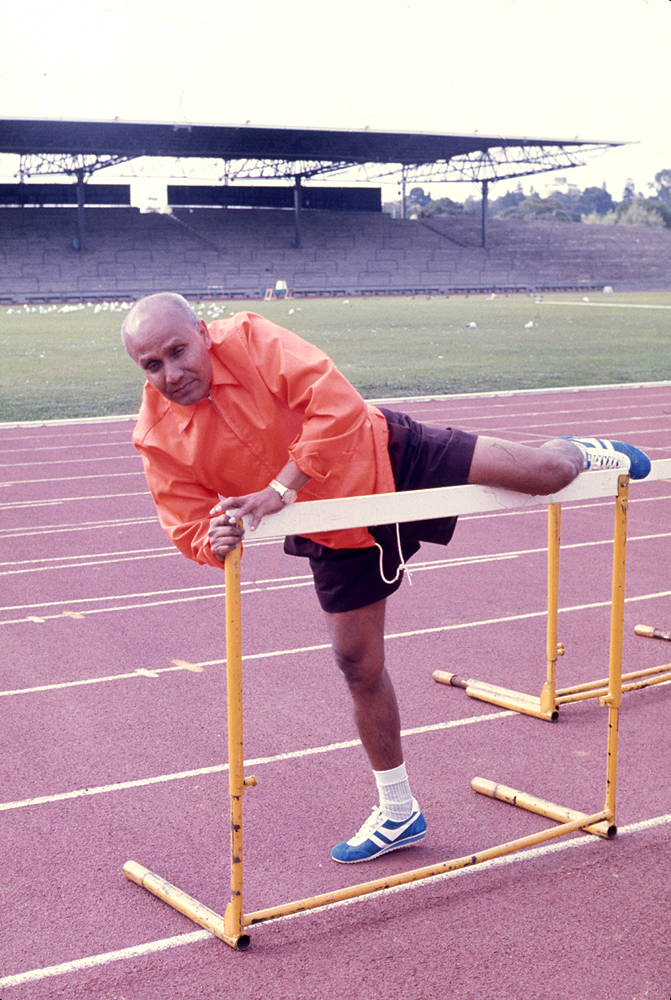
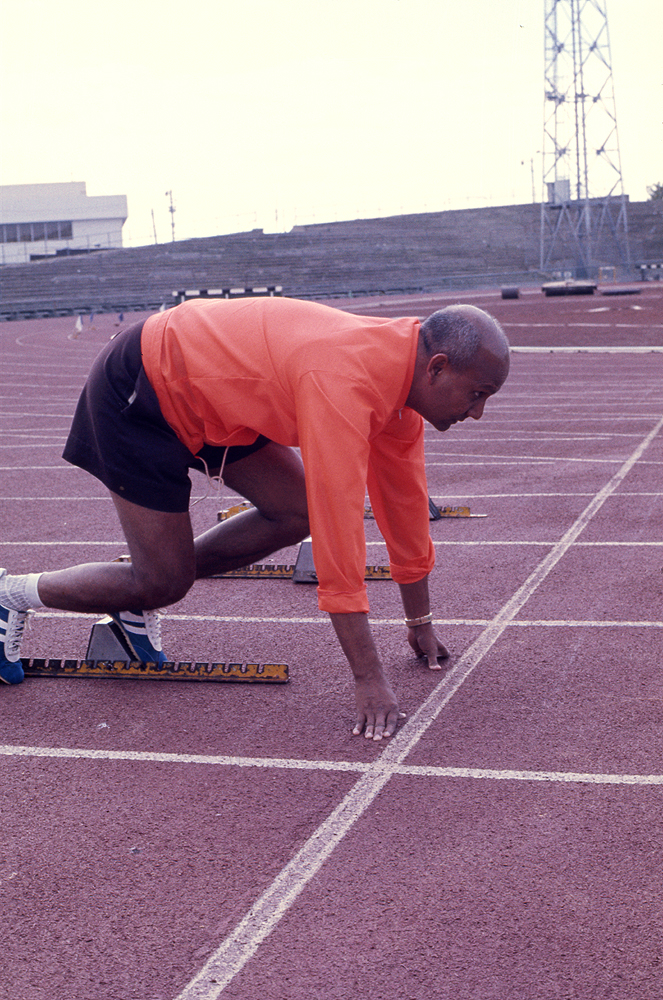
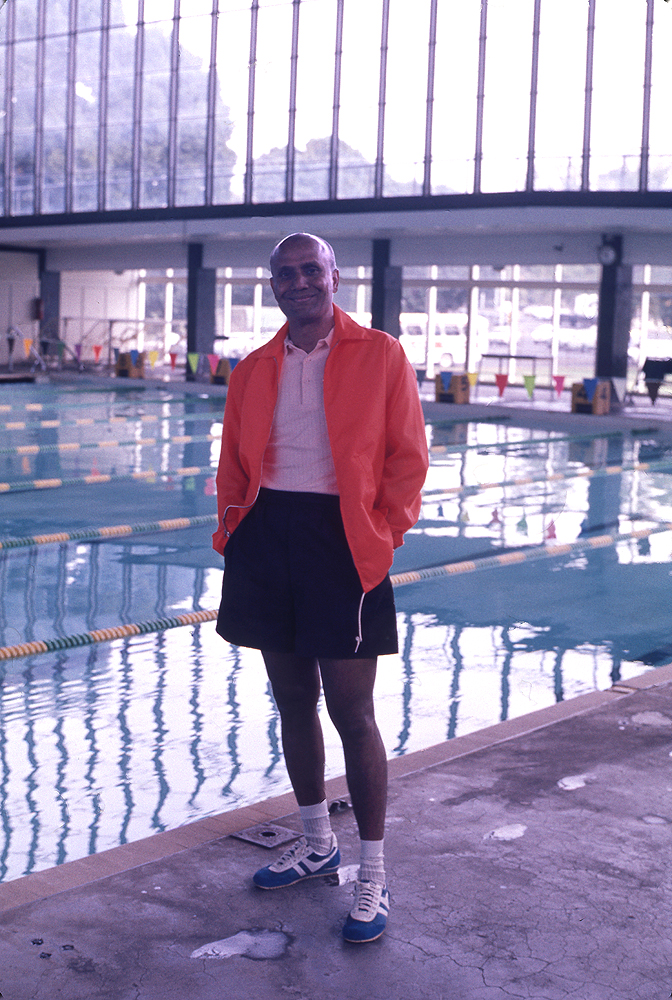
On his last morning in Melbourne, Sri Chinmoy and his students visit Olympic Park, which was the venue for the Olympic Games in 1956. Here Sri Chinmoy runs a few laps, jumps hurdles and uses the broad jump pit. He also visits the Beaurepaire Centre swimming pool adjacent to the stadium.
“There is no happiness in mere seeing. There is no happiness in mere feeling. There is no happiness in mere achieving. Happiness can be found only in our conscious surrender to God’s Will.” — Sri Chinmoy
Sri Chinmoy holds a public meditation and delivers a lunchtime lecture, entitled ‘Happiness’, in the Robert Blackwood Memorial Hall at Monash University in Melbourne.
Sri Chinmoy departs Melbourne in the early afternoon by plane bound for Adelaide, the capital of the state of South Australia and the final city on his Australian tour. He arrives at Adelaide airport at 4:30 p.m.
“Spirituality is simplicity, sincerity, purity and humility. A simple life helps the seeker grow. A sincere life helps the seeker fly and dive. A pure life helps the seeker become one with God’s Vision and God’s transcendental Reality. A humble life helps the seeker embrace the length and breadth of the entire world.” — Sri Chinmoy
Sri Chinmoy holds an evening meditation and delivers a lecture, entitled ‘Spirituality’, at Brougham Place Congregational Church in North Adelaide. Later, he visits the newly established Adelaide Centre.
MARCH 12TH
A morning press conference is held at Sri Chinmoy’s hotel in Adelaide, where he sings ‘O My Australia’ and plays his esraj. Later that evening, it goes to air on the Channel 7 news — the first time his esraj playing had been broadcast on television anywhere in the world.
“What you are offering is very simple. They aren’t things to learn, intellectual things. It is an attitude of the heart.” — Bishop Phillip Kennedy, Catholic Bishop of Adelaide
“Tomorrow when I leave Australia, I shall leave behind my soulful gratitude, my ever-growing gratitude, for here I have been given ample opportunity to be of devoted service to the sincere and genuine seekers. Nothing gives me more joy, delight and sense of satisfaction than to be of service to sincere seekers.” — Sri Chinmoy
Sri Chinmoy delivers an evening lecture, entitled ‘Possession and Satisfaction’, in the Napier Lecture Theatre at the University of Adelaide. The lecture hall is full to capacity.
“Geography taught me that Australia is vast, a very vast continent. On my arrival I most sincerely felt that Australia is not only vast, but also one; not only one, but also illumining; not only illumining, but also fulfilling. Vastness, kindness, magnanimity, a sense of responsibility: all these things I have felt right from the beginning in the soul of Australia.” — Sri Chinmoy
Sri Chinmoy concludes his first Australian tour, flying out of Adelaide in the early morning to Perth on the west coast for a connecting flight to Madras in India. From there, he goes on to Pondicherry for a short stay with his family before returning to New York.
On February 28, 1976, Sri Chinmoy departed New York on an epic 10,000-mile journey across the globe. And after a series of gruelling flights across two continents and the vast Pacific Ocean, he finally arrived in Perth, late in the evening on the first day of March, eager to begin his tour of Australia.
During his ten-day stay, Sri Chinmoy visited the major cities of Sydney, Canberra, Melbourne and Adelaide where he gave talks at universities, met with prominent Australians and recorded music for two LP albums. It was in Australia where he played the esraj on television for the first time and learned to play the Western flute. Read a day-by-day account of this historic tour…