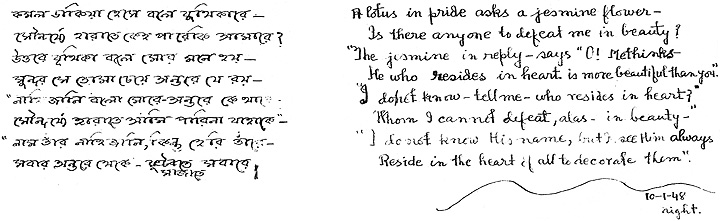
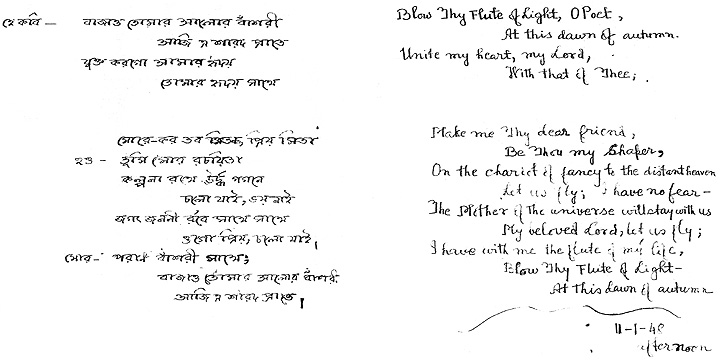
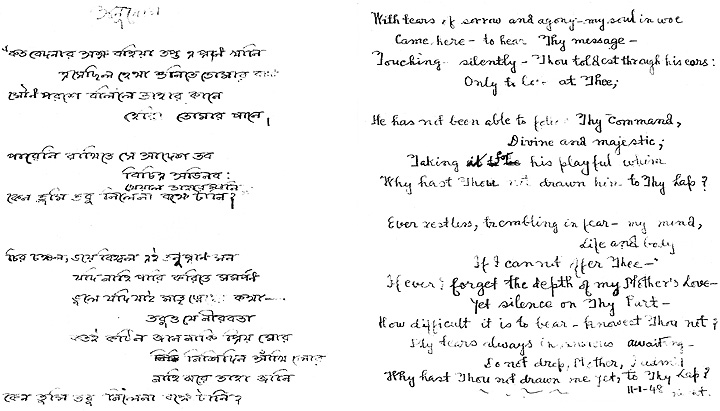
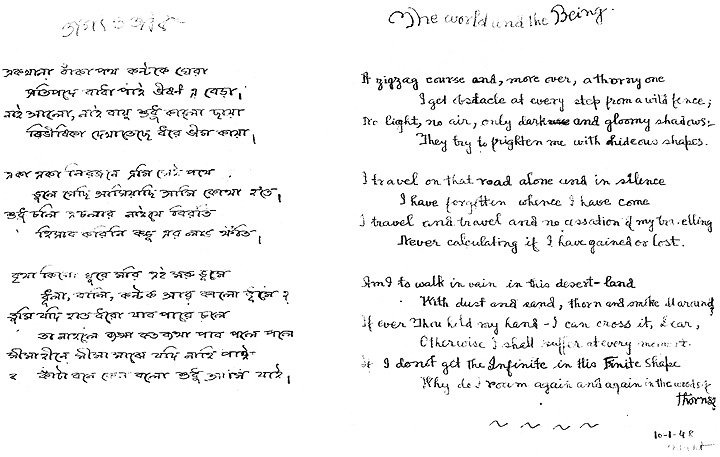
Notebook: 1948

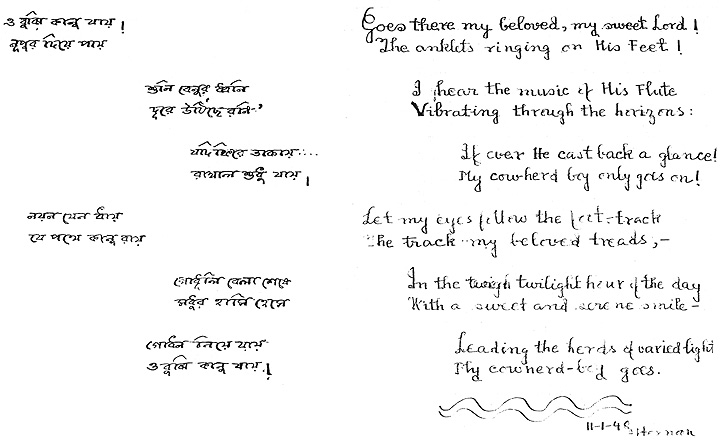
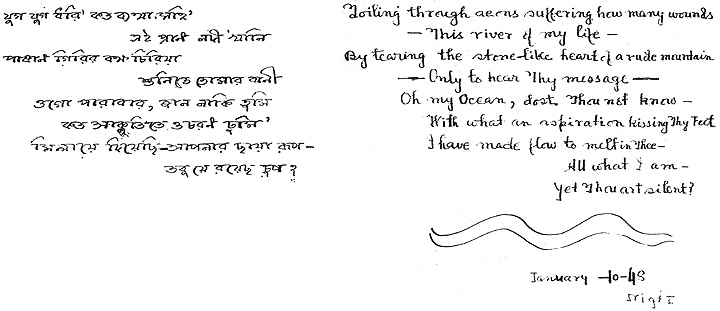
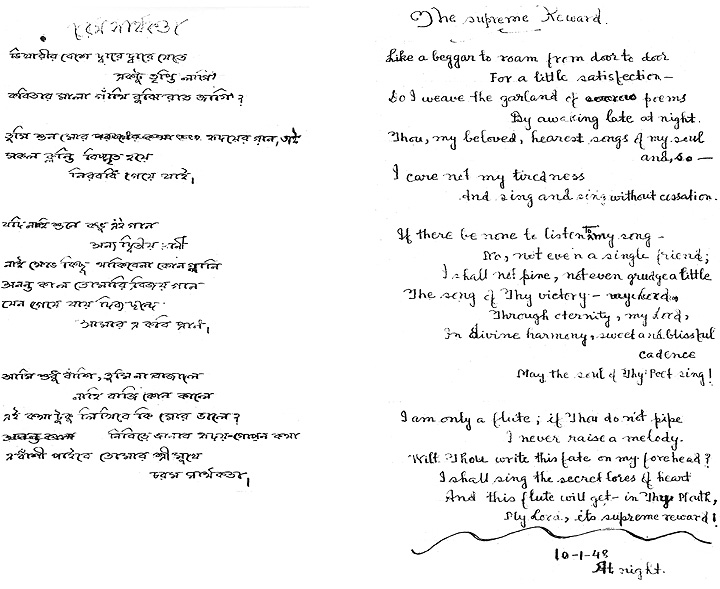
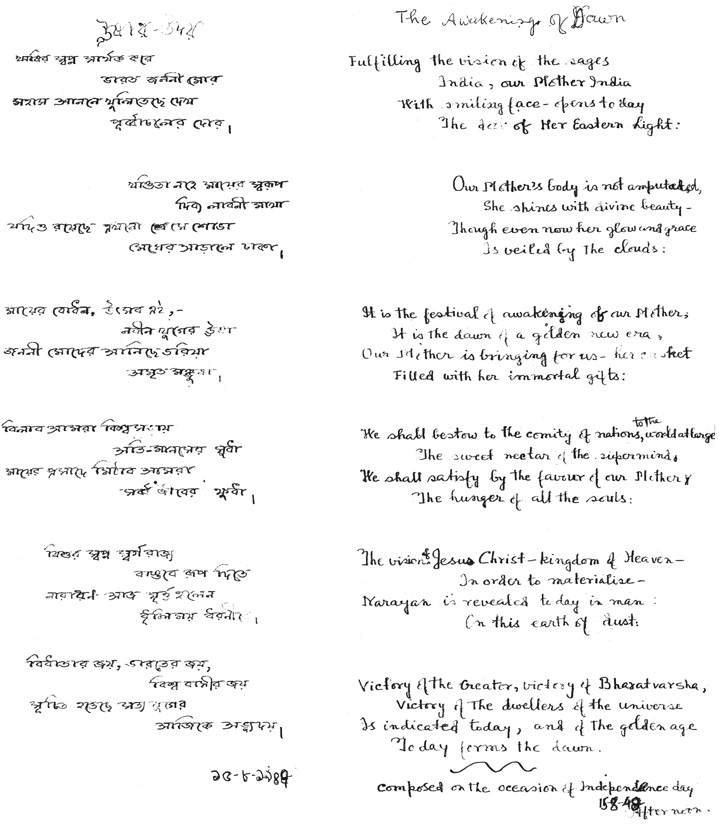
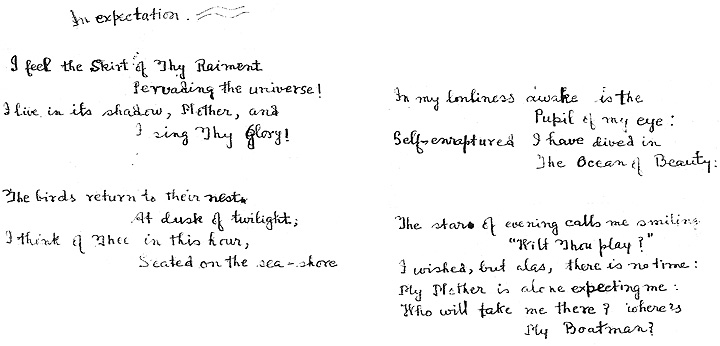
The following eleven poems are photocopied from Sri Chinmoy’s Notebook of 10 and 11 January 1948, with the addition of one poem from 15 August 1948. These poems were all written when he was sixteen years old. Sri Chinmoy’s original Bengali handwriting is hereby reproduced, as well as his own English translations and, in some instances, we have included in the editorial notes his mature, revised versions of the same poems. Where the poet set music to these poems in later years, we have endeavoured to provide the link. All Bengali words, transliterations and translations are by the Poet, unless otherwise indicated.

– Vidagdha

Table of Contents


1.  Goes There My Beloved


Goes there my beloved, my sweet Lord!
The anklets ringing on His Feet!

          I hear the music of His Flute
          Vibrating through the horizons:

                    If ever He cast back a glance!
                    My cowherd boy only goes on!

Let my eyes follow the foot-track
The track my beloved treads, –

          In the twilight hour of the day
          With a sweet and serene smile –

                    Leading the herds of varied light
                    My cowherd boy goes.

11-1-48
Afternoon


Notes:

1. Sri Chinmoy revised this poem and set music to the Bengali words on 17 December 1972.

2. Revised Bengali words and translation:

O bujhi Kanu jai
Nupur diye pai
Shuni charan dhwani
Dure uthichhe rani
Jadi phire takai
Rakhal shudhu jai
O bujhi Kanu jai
Nayan jena dhai
Je pathe Kanu rai
Godhuli bela sheshe
Madhur hasi hese
Godhan niye jai
   There goes my Beloved, my sweet Lord,
   The anklets ringing on His Feet.
   I hear the music of His Flute
   Vibrating through the horizons.
   If ever my cowherd boy
   Should cast a glance behind Him,
   Still He only goes forward.
   Let my eyes follow the track
   My Beloved treads.
   In the twilight hour of the day,
   With a sweet and serene smile,
   Leading the herds of varied light,
   My cowherd boy goes.

3. Sri Chinmoy recorded this song on October 15, 1999. It was released on the CD "One Thousand Lotus Petals" Part 2 [(c) 2000].


AudioPlayer requires Adobe Flash Player
or maybe incompatible with your browser.
Click to play the audio file.

Listen to Sri Chinmoy singing.


2. If Ever I Go


If ever I go to read my poems to anybody
In return I get only laughter – my poems are worthless
Yet I write and write; caring for none.
In simple and easy tune I go on always singing:

Poems are for one’s own self, and never for others:
Through poems the poet returns unawaringly to his heart.

11-1-48
At night


Notes:

1. Sri Chinmoy set this poem to music on 26 November 2005, more than 53 years later.

2. Transliteration:

Kabita amar dekhabar tare taro kache jadi jai
Pratidane shudhu pai apaman kono je mulya nai
Tabu likhe jai apanar mane karo prane nahi chahi
Sahaj surete bahu giti mor niyata chalechi gahi


3. Toiling Through Aeons


Toiling through aeons suffering how many wounds
           – This river of my life –
By tearing the stone-like heart of a rude mountain
           – Only to hear Thy message –
           Oh my Ocean, dost Thou not know –
              With what an aspiration kissing Thy Feet
               I have made flow to melt in Thee –
                                            All what I am –
                                            Yet Thou art silent? 

January -10-48
Night


4. The Supreme Reward


Like a beggar to roam from door to door
                For a little satisfaction –
Do I weave the garland of poems
                By awakening late at night.
Thou, my beloved, hearest songs of my soul and, so –
I care not my tiredness
       And sing and sing without cessation. 

If there be none to listen to my song –
                No, not even a single friend;
        I shall not pine, not even grudge a little
The song of Thy victory –
                Through eternity, my Lord,
        In divine harmony, sweet and blissful cadence
                 May the soul of Thy Poet sing!

I am only a flute; if Thou do not pipe
                 I never raise a melody.
Wilt Thou write this fate on my forehead?
        I shall sing the secret lores of heart
        And this flute will get – in Thy Mouth,
                  My Lord, its supreme reward!

10-1-48
At night


5. Pilgrims


Travellers we are, – liberation is not our aim:
          To conquer the whole universe is our endeavour.
                   By love we shall conquer the world
                   And then return to our Motherland –
When all will sing our glory – all around –
           We shall celebrate the victory of our Lord.

If there be anything more lowly than grass – it is our head
           Living pictures of humility we are the young heroes:
                   Being strong with the strength of God –
                   We shall overcome all dangers.
None inferior, all are equal, knowing this truth in heart
           The poor and the rich, the foolish and the wise –
                              We shall greet all.

11-1-48
Afternoon


6. The Awakening of Dawn


Fulfilling the vision of the sages
         India, our Mother India
With smiling face – opens today
         The door of Her Eastern Light:

Our Mother’s body is not amputated,
         She shines with divine beauty –
Though even now her glow and grace
          Is veiled by the clouds:

It is the festival of awakening of our Mother;
          It is the dawn of a golden new era;
Our Mother is bringing for us – her casket
          Filled with her immortal gifts:

We shall bestow to the comity of nations, to the world at large
          The sweet nectar of the supermind.
We shall satisfy by the favour of our Mother
          The hunger of all the souls:

The vision of Jesus Christ – kingdom of Heaven –
          In order to materialise –
Narayan is revealed today in man
          On this earth of dust.

Victory of the Creator, victory of Bharatvarsha,
          Victory of the dwellers of the universe
Is indicated today, and of the golden age
          Today forms the dawn.

Composed on the occasion of Independence Day
15-8-48
Afternoon


Notes:

1. Sri Chinmoy set tune to this song on 13 July 1997, in preparation for the 50th anniversary of India’s Independence.

2. Transliteration:

Rishir swapna sarthak kare
Bharat Janani mor
Sahas anane khuliteche dekho
Purbachaler dor

Khandita nahe mayer swarup
Dibya labani makha
Jadiyo rayeche ekhano se shobha
Megher arale dhaka

Mayer bodhan utpab ei
Nabin juger usha
Janani moder aniche bhariya
Amrita manjusha

Bilabo amara bishwaw sabhai
Ati manaser sudha
Mayer prasade mithabo amara
Sarba jiber khudha

Jishur swapna swarga rajya
Bastabe rup dite
Narayan aj murta halen
Dhulimoy dharanite

Bidhatar joy Bharater joy
Bishwabasir joy
Suchita hateche satya juger
Ajike abhyudoy


7. A Lotus in Pride


A lotus in pride asks a jesmine flower –
            Is there anyone to defeat me in beauty?
The jesmine in reply – says “O! Methinks –
            He who resides in heart is more beautiful than you.”
“I do not know – tell me – who resides in heart?
            Whom I cannot defeat, alas – in beauty –”
“I do not know His name, but I see Him always
            Reside in the heart of all to decorate them.” 

10-1-48
Night


Notes:

1. ‘Jesmine’ – a variation of ‘jasmine’ or ‘yasmin’ (Persian). 

2. The following transliteration of this poem was undertaken by Mahatapa Palit:

Kamal dakiya heshe bole juthikare
Soundorjyo harate keho pareki amare?
Uttore juthika bole mor mone hoy
Sundor se tomar cheye antare je roy
“Nahi jani bolo more antare ke thake
Soundorje harate ami parina jahake”
“Nam tar nahi jani, kintu heri tare
Sobar antare theke – sajate sobare.”


8. Blow Thy Flute of Light


Blow Thy Flute of Light, O Poet,
                     At this dawn of autumn.
Unite my heart, my Lord,
                     With that of Thee;

Make me Thy dear friend,
                      Be Thou my Shaper,
On the chariot of fancy to the distant heaven
                      Let us fly; I have no fear –
The Mother of the universe will stay with us
                      My beloved Lord, let us fly;
I have with me the flute of my life,
                       Blow Thy Flute of Light –
                               At this dawn of autumn.

11-1-48
afternoon


9. With Tears of Sorrow


With tears of sorrow and agony – my soul in woe
            Came here – to hear Thy message –
Touching – silently – Thou toldest through his ears:
             Only to look at Thee;

He has not been able to follow Thy Command,
                    Divine and majestic;
             Taking it for his playful whim
Why hast Thou not drawn him to Thy Lap?

Ever restless, trembling in fear – my mind,
                    Life and body
              If I cannot offer Thee –
If ever I forget the depth of my Mother’s Love –
              Yet silence on Thy Part –

How difficult it is to bear – knowest Thou not?
              My tears always in anxious awaiting –
                     Do not drop, Mother, I admit
Why hast Thou not drawn me yet, to Thy Lap?

11-1-48
night


10. The World and The Being


A zigzag course and, more over, a thorny one
           I get obstacle at every step from a wild fence;
No light, no air, only dark and gloomy shadows –
           They try to frighten me with hideous shapes.

I travel on that road alone and in silence
            I have forgotten whence I have come
I travel and travel and no cessation of my travelling
            Never calculating if I have gained or lost.

Am I to walk in vain in this desert-land
            With dust and sand, thorn and smoke all around?
If ever Thou hold my hand – I can cross it, Dear,
            Otherwise I shall suffer at every moment.
If I do not get the Infinite in this Finite Shape
            Why do I roam again and again in the woods of thorns?

10-1-48
night


Notes:

1.  Sri Chinmoy revised this poem and set it to music on 27 August 1974 – his 43rd birthday.

2.  The revised Bengali words and translation read as follows:

Shudhu chali e chalar
Nai je birati

Hisab karini kabhu
Er labh khati
Britha kigo ghure mari
Ei marubhume
Dhula bali kantaka
Ar kalo dhume I just walk on;
My walking never ends.
I have never calculated
The loss and gain of my journey.
Alas, am I to go on
Eternally in vain
In this earth-desert
Full of dust and sand, thorns and smoke?


11. In Expectation


I feel the Skirt of Thy Raiment
                  Pervading the universe!
I live in its shadow, Mother, and
                  I sing Thy Glory!

The birds return to their nest
                  At dusk of twilight;
I think of Thee in this hour,
                  Seated on the sea-shore.

In my loneliness awake is the
                  Pupil of my eye:
Self-enraptured I have dived in
                  The Ocean of Beauty:

The star of evening calls me smiling,
                  “Wilt Thou play?”
I wished, but alas, there is no time:
My Mother is alone expecting me:
Who will take me there? where’s
                   My Boatman?


Note:

1. The Bengali words for this poem are missing from the photocopy of the Notebook. The English words do not appear to correspond with any of Sri Chinmoy’s currently published songs or their translations.

Collected Stories

Table of Contents


Sri Chinmoy narrated the following story in Cairns, Australia, on 20 January 2003.


1. Disciples of Another Master

Five disciples of a Master once came to me in New York. Let us call him Guru Sukha. This Guru had a very, very good soul and he had many disciples.

One by one, these five disciples each had dreams of their Master during their sleep. He told them, “Please go to Sri Chinmoy, please go to Sri Chinmoy.” He also said very nice things about me to then in their dreams.

One of Guru Sukha’s disciples would come to me. Then, in two months’ time, another one would come. Then another and another. All of them had the same story: “Master keeps coming to me in my dreams and begging me to become your disciple.”

Alas, none of these disciples stayed on my path. They thought that I was too high for them.

One of these disciples was a hairdresser. She used to speak so highly of me to all her customers. She would have tears of devotion in her eyes as she spoke about me. Her customers would be so moved that they would often give the lady small tips for her Master, and she would gladly take their donations. After some time, she left the path.

Four or five years later, quite unexpectedly, this lady came to my house. I was on my porch. She came with a very large bag containing coins, and also one and five-dollar bills. She offered me this bag.

I asked her, “What happened?”

“I am not ready to be your disciple,” she answered, “but I cry and cry when I talk about you to my customers. I think of you all the time. When I talk to my customers and tell them about you, they are so moved. They give me money for you, so I brought you the money they wanted to give you.”

I said, “Why do you not come back to our path?”

“Oh, no, your path is too high for me. I cannot,” answered the lady.

Guru Sukha was a very good and genuine Master. Some Masters want their disciples to stay with them, even when the disciples want to be with another Master. Again, Masters like Guru Sukha send their own disciples to other Masters when they feel a certain Master can help their disciples to continue to make progress. This has happened many, many times. Truth to tell, there are many ways to arrive at the Goal.


2. Giving Joy to the Master

Sri Aurobindo wrote a story in Bengali called Kshamar Adarsha, “The Ideal of Forgiveness”. There he described how the Vedic sage Vashishtha forgave King Vishwamitra, even though Vishwamitra had killed one hundred of his disciples.

When I was thirteen years old, I rendered this story into two hundred lines of rhyming Bengali verse. Timidly and devotedly, I submitted this poem to the Mother of the Sri Aurobindo Ashram. Out of her infinite compassion for me, the Mother gave it to Sri Aurobindo. In a few days’ time, at four-thirty in the afternoon, I was on my way to the volleyball ground. One of Sri Aurobindo’s dearest attendants, Mulshankar, stopped me and said, “Chinmoy, Nirod is reading out to Sri Aurobindo your long poem and Sri Aurobindo is smiling.”

When I heard this, I was in the seventh heaven of delight! A few hours later, Nirod-da sent for me and returned the poem. He told me that Sri Aurobindo had remarked, “It is a fine piece of poetry. He has capacity. Tell him to continue.”

Last August I was inspired to set this poem to music and today Kailash’s group has sung this song most soulfully and most powerfully. Once upon a time, a thirteen-year-old boy pleased his Master. He is now seventy-one years old, and his disciples have pleased him very, very much. In all sincerity, from my own inner vision, I am telling you that the joy my disciples have given me today with their singing is infinitely more than the joy I gave Sri Aurobindo with my poem. Their singing of the song was most excellent!

Just before Kailash’s group began, I was cycling in our meeting room. Only Priyadarshan was inside. Right from the beginning, who was I seeing? I was seeing Sri Aurobindo in the room. Then I also saw the Mother and Nolini-da. They were watching and watching from the corner on the far side of this room. They were very happy.

Only when I started walking, they became so sad. They were deeply, deeply sad at the pain I was experiencing in my legs. That sadness I cannot express in words.


3. Hriday’s Respect for his Teacher

My eldest brother, Hriday, went to high school, college and university. He studied the Vedas, the Upanishads and many more of our sacred scriptures. Hriday was a most brilliant student and scholar.

It so happened that my brother’s primary school teacher was also my primary school teacher, even after a gap of so many years. This teacher’s name was Shivashankar. He was strictness incarnate. If a student did not do his lessons or if he misbehaved in any way, Shivashankar had a long cane – an absolutely sesquipedalian cane – with which he would strike the naughty pupil. Not only that, but the student would have to kneel down and pull his ears. He would have to keep that terrible pose as long as our teacher wanted. The student’s knees, back and everything would be hurting very much. That kind of strict teacher Shivashankar was!

After twelve years of being at the Sri Aurobindo Ashram, my brother returned home for a year. He went to see Shivashankar and pay his respects. When he saw Shivashankar, my brother fell flat at the feet of his first teacher.

The old man said to my brother, “What are you doing? You are now such a great man! You are a spiritual seeker and you have been in the Sri Aurobindo Ashram. How can you do this?”

Hriday answered, “No, no! You were the one who first opened my eyes to knowledge. You are the one in my life who deserves this.”

Right in front of us, with utmost sincerity, Hriday prostrated himself and took blessings from Shivashankar. The old man was shedding tears and tears of joy.

This kind of respect some wonderful older teachers receive from their former students.


4. “Steal My Heart”

Many, many years ago, when I was in Jamaica, West Indies, I went to a church and gave a talk on spirituality. There were about eight hundred people in the audience. They were very impressed with my talk. Then they asked me many, many questions on prayer, meditation and various aspects of the spiritual life. Somehow I managed to satisfy them.

The minister of the church was a lady. She became a disciple and stayed in our Jamaica centre for many years.

At the end of the programme, one of my Jamaican disciples said, “We are all extremely grateful to Sri Chinmoy for offering us his talk and for answering so many questions today. We hope his answers have been of service to you in your own spiritual quest.”

Then the disciple explained that our spiritual path includes people from all faiths and greatly encourages seekers in whatever religion they belong to. The disciple asked if anyone in the audience would like to follow our path and become my disciple. Can you imagine! All eight hundred members of the audience wanted to become my disciples.

They stood in a long queue. Since I knew that our path was not meant for everyone in the church, I said, “Each person may kindly pass by me slowly, in a meditative consciousness. I shall meditate on each person.”

After meditating briefly on each person, I saw that seventy or eighty were definitely meant to be my disciples. One by one, each of those whom I accepted in our Centre came and stood on one side. To the rest of the people, I offered my soul’s loving goodwill. I knew that they would do better on another spiritual path.

Afterwards, all the new disciples came to our leader’s house. I had given her the name Durga. I agreed to see each person separately.

One very thin policeman came into the room and sat in front of me. I cut a joke with him. I said, “I am so happy you have come. If I happen to steal something, then you will be the first person to arrest me?”

He answered, “No. I have come here for you to steal my heart.”

I was deeply touched. That policeman was so nice.

Right after the policeman, his wife entered the room. Alas, she had quite a few things to say to me against her husband! She wanted me to solve all her family problems.


5. Never Give Up!

There was one disciple in Jamaica to whom I gave a spiritual name, which in Bengali, means ‘beautiful’. Her soul was most beautiful. Her husband had problems with his eyes, so he was not allowed to drive at all.

One day, shei came to me and said, “Guru! Guru! Please help me. I have been learning how to drive, since my husband can see almost nothing. Now I have to take a driving test to get my driver’s licence. I am so nervous! Please help me.”

I told her, “I shall definitely pray for you to do well.”

The following day, she came to see me with a very dejected face. She said, “Guru, I did horribly on my test. I was so nervous that I wanted to finish the test as quickly as possible. As a result, I did not even slow down at the first few cross streets to see if a car was coming. I just went through. After only two minutes, the examiner failed me.”

“I am so sorry for you,” I said. “Kindly offer this experience to the Supreme and move forward. Just practise for one or two days more and then try again, good girl.”

She took the driver’s test for the second time. Once again, she came to me with a very sad face. “I am such a bad driver, Guru! I failed again. This time I made a right turn instead of a left turn, and I was going the wrong way down a one-way street. Needless to say, the examiner failed me immediately. I do not know if I will ever pass.”

With utmost love and concern, I consoled her and said, “Please do not worry. Try again. You will definitely succeed.”

Like this, she tried and failed six times. Still the authorities were allowing her to take the test again and again because she had to drive her husband. I felt miserable for her. I told her, “This time I am very serious. I am concentrating on you most powerfully. You please try once more to pass the examination.”

She went for her test for the seventh time and this time she passed. I was so happy for her.

In my own case, I failed twice my driving test. The first time, the examiner stopped the test at the first road! When I took the test the third time, my examiner was so kind. He was encouraging me in every way throughout the test. At the end, he said, “I have never seen a driver as careful and as good as you are!”

I always say, “Never give up! Never give up!”

Chittagong Stories

Part One


This is a miscellany of stories told by Sri Chinmoy over the years about his childhood in Chittagong. When he used to reminisce about his Indian life, he would pluck anecdotes from here and there, not necessarily in any chronological order. Sometimes he would follow a theme, or relate events connected with a certain relative. Oftentimes, in answer to a question from one of his students, he would invoke an episode from his youth, and then the whole atmosphere of his Indian village life would permeate him. A kind of magic would descend as wave after wave of sweet memories flooded his being. Here are just a few of those well-loved stories. It is perhaps worth noting that while these stories are often in the present tense, they were mostly told during the 1990’s.

– Vidagdha


Table of Contents
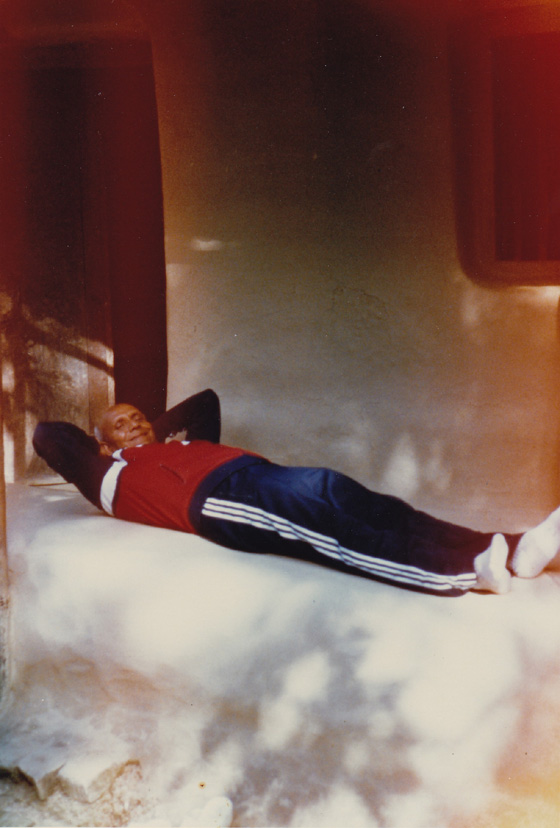


1986: Sri Chinmoy returns to Shakpura after more than forty years.
Here he is lying down on the front step of his childhood home.


1. Our Birthplace

We Indians, specially Bengalis, are always proud of our birthplace, whether we think of our province, town or even village. Strangely enough, as a villager, you are even more proud of where you were born than you would be if you were born in a large town or city.

Always when I think of Shakpura, I feel so lucky that I was born in a village, not in a town. Then, when I think of Chittagong, I feel so lucky that I was born in Chittagong and not somewhere else in East Bengal. Then, when I think of East Bengal, I feel so lucky that I was born there and not in West Bengal or somewhere else.

We always feel that our village is by far the best; our town is by far the best; our city is by far the best; our province is by far the best; our country is by far the best. That is our national feeling. By widening and widening our vision, we can go from nationalism to internationalism. But if I do not have real and genuine love for my village, Shakpura, then I can never develop love for Chittagong, and if I cannot develop love for Chittagong, I can never have love for Bengal. If I do not love Bengal, I will never have love for India and if I do not have true love for India, I will never be able to love America or any other part of the world, let alone the whole world.

It is because we love our mother right from the dawn of our life that we can love others. From the physical mother, we expand and increase our love so that eventually we feel utmost love for the Universal Mother.


2. Village Life

I was born in an Indian village. A village is all simplicity, innocence, sincerity and purity. Whenever and wherever I see these divine qualities, I am deeply moved and I am immediately transported to the highest Heaven.


3. My Cousins

When I think of the affection of my cousins, I simply cannot imagine that they are not my real brothers and sisters. We were brought up together. They are absolutely like my real brothers and sisters.

My cousin Pushpita and her mother, my aunt, both live in the Sri Aurobindo Ashram. They are so close to our family. Once my sister Lily had a difference of opinion with my cousin about something and for fifteen years they would not talk to each other. Here we are like brothers and sisters and two members of the family are not on speaking terms! It was so painful for the rest of the family. Everybody else continued to mix as before, but blindly I took my sister’s side. Who knows who was right and who was wrong? For me, whatever side my sister was on was the only side for me.

So this sad state went on, went on. Finally, a few years ago, when my sister Lily fell seriously ill, my cousin and her mother came to see her in the Nursing Home. They said, “No, we are not going to go away. The past is dust. This is the time for us to be with you.” Then my sister Lily had to surrender and they became extremely close once more.

My aunt is 99½ years old. Next year, in March, she will reach 100. She will be the first person in our family to reach 100. A few years ago, I told her that I wanted her to live to 100 and she has done it. I am so proud of my aunt. She is my mother’s younger sister. Alas, my mother did not even live to be fifty years old. She passed away when she was 49.


4. My Prayers to Saraswati

In our family, my father worshipped Kali and my mother worshipped Durga. We did not care so much for Saraswati. Once a year, we observed Saraswati Puja, but otherwise it was all Kali and Durga.

Again, in order to pass your school examinations, you have to worship Saraswati because she is the goddess of knowledge, wisdom and perfection. If she is pleased with you, then she will grant you the capacity to learn things by rote very quickly. So when I was a young boy, I used to repeat millions of times, like a parrot, the Sanskrit slokas to invoke Saraswati. Mine was absolutely Bengali pronunciation. How fast I used to say the words, like a train! Only the sound I used to hear and with my devotional spirit I invoked Saraswati, but the words I did not pronounce correctly at all.

But Saraswati was pleased with my prayer and she blessed me with retentive faculties. In the school, I always used to stand first. When I was fourteen years old, I was meditating in the main building of the Sri Aurobindo Ashram and she appeared right before my eyes. She was playing on her celestial vina. I had never heard this instrument before, either in Chittagong or in Pondicherry. Then she broke the whole instrument into millions of pieces and she poured them into me. She said, “I am giving you my knowledge.”

Now look at this! When I worshipped Saraswati as a young boy, how fast I said her name. If a teacher wanted to give marks for my performance, he would not have given me even zero out of one hundred. It is absurdity. I am the worst possible student that I have ever seen! But divine compassion is unconditional. Because I did it in my childhood, she came to me when I was a youth. Does she care for my pronunciation? No, it is only the devotional attitude that she cares for. Unconditionally she poured and poured her knowledge, wisdom and intellectual aspect into me. That is why I have been able to write so many books. It is all because of the blessings that I received from Saraswati in 1945 or 1946.


5. Brihaspati’s Day

I was born on a Thursday. This is the day of Brihaspati, the Guru of the Cosmic Gods. In Bengali, we call it Brihaspatibar. For some time, I used to observe a day of silence on that day. If I needed something from the disciples, I would write it down on a piece of paper. Again, how I suffered for one full year because of that day. Every Thursday, without fail, I used to have miseries because I would receive bad news on that day.

When I was doing my long-distance training, I decided to run 27 miles every Thursday because I was born on the 27th. Then my promise descended to 13 miles, then 7 miles. Now I do not do anything special on that day.

When we visited one large Buddhist temple in Rangoon,1 they had shrines for the Lord Buddha at different places according to which day of the week you were born on. So I stood and meditated at the Thursday shrine.


6. It is in our Life-Blood

From the age of five, I began hearing stories about Sri Ramakrishna and Swami Vivekananda. Is there any Bengali whose blood is not made of Sri Ramakrishna and Swami Vivekananda? We cannot breathe without Thakur and Naren.

This much I can say: if anyone claims to be a Bengali, then he has Sri Ramakrishna and Swami Vivekananda as the source of his life-blood.


7. Astral Journeys

When I was only nine or ten years old, my father told me a story about astral journeys. I knew that my father never told lies, but when I heard this story, I thought that perhaps my father was only joking. I could not believe that it really happened.

My father told me that once a judge happened to be trying a case in court. All on a sudden, a Buddhist monk came into the courtroom while the court was in session. He walked right up to the judge and said, “Meditate, meditate.”

The judge was puzzled. Then the Buddhist monk said, “You do not know why? Then I shall tell you. You know that your wife is now in London. This is a most significant moment. Take down the time. Now calculate the time difference between here and London. At this moment, your wife is giving birth to a most beautiful child.”

To the judge’s wide surprise, eight hours later he received a telegram from London. The telegram came with the happiest news that a child had been born. And the time of birth corresponded exactly with the appearance of the Buddhist monk.

Six months later, the Buddhist monk again went to the court. This time he said to the judge, “Your wife has now returned to India. I would like to see her.” The judge was extremely pleased with the monk, so he took him to see his wife. Upon seeing the monk, the wife exclaimed, “Oh, I have seen this man before. He came to me at the hospital in London.”

That was my father’s story. Then he explained to me that it was the subtle physical of the Buddhist monk that had gone to the hospital in London, while the monk himself remained in India. Unfortunately, I did not believe this story at all. I thought that perhaps the monk had somehow gotten the telegram from somewhere else. I gave my father all kinds of silly arguments.

Many years later, I came to know from my own personal experience that this kind of astral journey is quite possible for spiritual Masters and aspirants of a very high order.


8. Our Messenger-Dog

When I was a young boy, we had a dog. I was so fond of this dog. He used to take letters from our house to our cousin’s house about five and a half miles away. We would write down the message, give it to him, and he would take it to our cousin’s home. Quite often our mother used to write letters to her sister, and sometimes she sent them like this. Our dog acted just like a human being, like a real messenger.


9. An Insane Fellow

Many years ago in our village our barber's brother all on a sudden became insane. He was such a nice man and a good friend to everyone. God knows why it happened. Then he used to create all kinds of problems wherever he went. He used to strike people.

The members of his family – his wife and children – used to tie weights around the feet of this poor fellow so that he could not walk properly and also they hung two bells around his neck. The villagers would hear the bells ringing and then they would know that the insane man was coming and they would disappear.


10. Our Family House

In 1986, I returned to Shakpura for the first time in over forty years. Our original four or five houses disappeared during a cyclone after we had gone to the Ashram. They were blown away. Afterwards, our relatives tried, according to their financial capacity, to rebuild the main house where I was born, but it is not the same. In size and proportion, it is totally different. They have kept the same main structure, but the roof is now very low. There used to be a second floor with a corrugated tin roof, but now there is no upstairs. Also the doorways were much higher, otherwise my brother Mantu would not have been able to pass through the door. Unfortunately, now it looks poverty-stricken.

Upstairs my three sisters and my cousin used to live. Chitta, Mantu and I used to sleep on the ground floor. On the left side of the house was our temple. It is no longer there. Now there is only a haystack. There was also a guesthouse on the kitchen side, but it, too, has disappeared, along with the servants’ quarters and other houses.

Right in front of the house were many mango trees, at least twenty. Now there is not even one. My relatives said they had to use them to get money. It is like a barren desert. In the back of the house there were ponds. The largest one has been reduced in size so that the gardens can be utilised as paddy fields. In this pond, I learnt to swim. I used to sit on the stone slab that was the front doorstep and Brahmins used to come and chant for protection and invoke the presence of Lord Krishna.
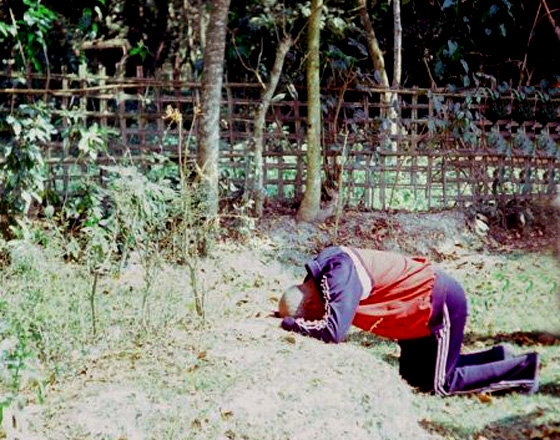
 

Sri Chinmoy visits his parents' resting place (1986)


The ashes of my parents are buried near the house. According to our Hindu tradition, at the time of cremation, the eldest son has to put fire inside the mouth of the parents. This is the most painful experience. Then the ashes are gathered and buried.

This house still belongs to my family, my brothers and sisters and I. The relatives that are now living there are my distant cousins. They are not my first or second cousins, but third or fourth. They are taking care of the property. They know everything about me and they were begging me to give them permission to make it a place of pilgrimage. But my mother’s soul in Heaven was dead against it, so I cannot stand against my mother. My sister and brothers begged me to send money to our relatives for this purpose. I was quite happy to do so, but unless my mother changes her mind, I cannot do anything. I wanted to have a memorial for my parents, but my mother has her own reasons for not wanting it.

For me, it was a very sad experience to see our family house once again. Outwardly, it has been so badly neglected that I could not recognise aanything. It was like seeing a haunted housed. Again, when my sweetest childhood reminiscences came forward, I was happy.


11. Our Family Temple

Our family did not hold regular meditation or worship services inside our temple, but on special occasions, such as Durga Puja, we would have them. My mother used to spend hours and hours praying in the temple. I had to go twice – early in the morning before going to school and again in the evening. My morning meditation was short and my evening meditation was even shorter. I only repeated as fast as possible a few times Krishna’s name or Kali’s name. That was my meditation.


12. Our Chittagong Dialect

In my childhood, I never dreamt that anyone could compose songs in our Chittagong dialect. It was unheard of. This dialect, unfortunately, is not written down. We never wrote it and in school they did not teach it. We had to read and write in pure Bengali. Recently, I came to learn that two books have been published in our dialect. How I would like to have copies of those books!

Bengali is very soft and sweet, whereas our Chittagong dialect is uneven. The whole thing in the Chittagong dialect is to speak very fast. My sister Lily can speak so fast, but since I came to America, I have slowed down considerably. In my childhood, I spoke much, much faster. I have forgotten so many words.

If you want to write the Chittagong dialect down, you have to use the real Bengali characters and then add some diphthongs here and there. Now, because Bangladesh is a separate country, they have started singing in this dialect. They are trying to show their independence from the Calcutta Bengalis.

I have also started composing in the Chittagong dialect. In 1986, I made my first attempt. Now I have written quite a few songs about Chittagong, Dacca and Bangladesh.2 One day I hope that we can sing them for the staff members of the Bangladesh Mission to the United Nations.

Tagore is the only composer who has two national songs to his credit. His song “Jana Gana Mana” is the Indian national anthem and “Amar Sonar Bangla” is the anthem for Bangladesh. Both are written in pure Bengali.


13. My History Teacher

My history teacher in Chittagong was a Muslim. He was such a good and kind man. At one o’clock every afternoon – recess time – he and a few Muslim students used to go to the mosque to pray. We Hindu boys used to play football, only fifty or sixty metres away from the mosque.

When Muslims pray, they say, “Allahu Akbar” (‘Allah the Almighty’). They bend and chant and pull their ears. Then they slap their face a few times. I saw my history teacher pray like this many, many times.

There were some mischievous boys in our school who used to imitate him by doing exactly the same thing. They used to slap their faces very nicely and then bend and pull their ears. At other times, these same boys used to scream very loudly to disturb the prayers of the Muslims. Then my history teacher used to come out and scold them. Sometimes he used to beat them also. I felt so sorry for my history teacher because the Hindu boys were so disrespectful.

Many years later, when I visited Marrakesh in Morocco, at six o’clock in the morning I heard the Muslim call to prayers. You could hear it all over the city. At that time, I remembered my poor history teacher and his unfortunate experiences.


14. My Pet Monkeys

I wish to tell you something amusing but authentic. As a child, I was very fond of monkeys. That is why I still have the monkey consciousness in me! I had two or three monkeys at a time. My most favourite monkey used to bite me like anything. I used to give it bananas and other kinds of food that I liked to eat. Right after eating the banana, he used to bite me. You have no idea, how many marks I have even now from monkey bites.

One day my mother said to me, “Monkeys do not bite little babies, because they are so innocent and helpless. But when children become a little older, like you, then you become immediate victims to monkeys. But there is one thing you can try to save yourself: you can fall down and pretend that you are dead.”

It seems that monkeys do not bite dead people. My monkeys had a long chain around their necks. As soon as I came within their reach, I used to fall on the ground and hold my breath. This I have done forty or fifty times. Then the monkey would feel me to see if I am really dead, but he would not bite me. Usually I escaped, but two or three times I was caught because the distance between us was not very great when I fell down.

Of course, the moment I used to open my eyes and get up, the monkey would bite me anyway! I did not have the heart to strike the monkey, but my cousins used to strike them so hard and then the monkeys would leave them alone.

There is a philosophical lesson to be learnt from this. Let us say that in this case to be dead means to be deep in ignorance-sea, which is full of impurity. At that time, the lower vital forces do not bother you because they know you are at their beck and call. But the moment your soul awakens you and makes you aspire for purity, these lower vital forces say, “Where are you going?” At that time, they challenge you. If you want to live a spiritual life, then you must fight against ignorance and establish purity. But if you want to surrender to ignorance, you will just lie down. Then incarnation will follow incarnation and you will not make any progress at all.


15. My First Visit Back to Chittagong

I went back to Chittagong after more than forty years to see my birthplace. I wanted to see where I was once upon a time when I was still a tiny grain of sand. I just wanted to appreciate the finite in me, which was absolutely insignificant. Whoever thought that a little Indian village boy would come to the West and write so many books and songs and so on?

I know that I cannot utilise the past realities in my life in order to make progress, so in one sense my visit was useless. But curiosity took me there. On the one hand, it was useless, but, on the other hand, you can say that there is always a source from whence we grow. A vast expanse of light begins with just a tiny flame. Again, the source of that tiny flame is infinite Light. In the process of involution, infinite Light is descending, descending, descending.

So I wanted to go back to see my source. And still, when I think of my little village – East Shakpura – it gives me a kind of inner thrill.


16. A Significant Occurrence

On the day I was born, our home in the town burned down, without rhyme or reason. It was not our village home. Fortunately, nobody was in the house at that time. You can say that all the sins of my past incarnations were burnt to ashes! Again, fire signifies aspiration. So perhaps my soul came down with intense aspiration to be of service to mankind with the dawn of a new hope.


17. My Father and Mother

My mother comes from the village of Kelishahar, which is five and a half miles from Shakpura, where my father’s family lived. As you know, in India it is the custom to have arranged marriages. When my mother was a young girl, there were only arranged marriages. Sometimes the family members would go and look for someone suitable, and sometimes the Brahmin priest would go.

Again, it is also traditional to choose a bride who is much younger than her husband. My father was twelve years older than my mother.

Even though theirs was an arranged marriage, my father and my mother had an extremely close connection based on their previous incarnations. After my father passed away, it did not take even a year for my mother to follow him to the other world.


18. A Budding Poet

Right from infancy, I started composing poems, even when I could not read or write. I used to dictate them to my brother Chitta and he used to write them down for me. I dictated them in my own language – it is Bengali, but in the Chittagong dialect. Even when I was three or four years old, rhymes used to come. But, unfortunately, quite often there were no such words. The words that I was using spontaneously were missing from the dictionary!


19. Lakshmi Puja

In October 1990, at our tennis court in Queens, we observed Lakshmi Puja. The disciples lit hundreds of little candles, the way they do in India, and they placed Lakshmi’s footprints at various places.

Lakshmi is worshipped practically all over India in various ways. Each town, city and province worships her in its own way. Mother Lakshmi is for everybody, good or bad. She is the Mother of indulgence.

While I was growing up, our family and neighbours in Shakpura observed Mother Lakshmi’s Puja in a special way. On this one day of the year, you can steal things from your neighbours. The gardens are full of flowers and fruits, plus there are various other things in the courtyards of the houses. So you can enter and steal whatever you like. Even if you are caught red-handed by the owner, you just smile and go away. Expensive things that are kept inside the house are not available, but anything that is left outside you have the opportunity to take away as your own.

So we would go to other people’s houses and steal mangoes and other things, and they would come to our house and steal things. It was all great fun.


20. The Bhrigu System and My Fate

In my case, Bhrigu says that at the age of twelve I will go to my Satguru and from that time onwards astrology will not apply to my life because my Guru would be responsible. Whatever was destined to happen would not happen because my Guru would change my fate.

In India, we have another system of astrology. There it says that Lord Krishna’s planets, the Buddha’s planets, Sri Aurobindo’s planets and my planets are all in the same alignment.

My brother Chitta laughed when he read this because he knew it was all true long before I was born.


21. My Meat Eating Days

Before I went to the Sri Aurobindo Ashram, I ate fish every day and meat twice a week. Usually, we would have duck meat. Perhaps once a month we would have lamb. On rare occasions, we would have turtle, which I liked very much. But fish I had every day. We had so many ponds on our property and they were filled with clean water and fish.


22. Our Family Cows

In our family, we had two special cows. They were huge. One was called Surabhi. She was white and very, very mild. The other was Nandini. This one was brown and not too mild! These were the names of Krishna’s two cows, so we took the same. Both of these cows we had for a long time.


23. Life Under the British

When the British soldiers came and took over East Bengal, quite a few of our relatives were killed. Others left. And some stayed behind. The British soldiers were supposed to threaten us and frighten us, so that we would not rebel against the British government. But some of the soldiers, instead of scaring us, used to come and eat with my relatives and carry me on their shoulders.


24. Lacking in Faith

Every day Mantu and I were supposed to go into our temple and pray before going to school and every day we used to forget. Then my mother would worry that we did not have any faith. On important occasions, she would come and see how Mantu and I were doing, but otherwise she would ask my sisters how we were.

My mother spent so much time in the temple. When we fell sick, she would not come near us. She would only go to the temple and pray and pray. She had no faith in the doctor. Her faith was all in her prayers. At that time, my sisters would look after us.


25. Indian Mothers

The affection that I received from my immediate family and from my relatives is beyond your imagination. Indian affection is so different from American affection. Indian mothers will not kiss or embrace their children. They will only bless them. When Indian mothers are happy, they always bless their children.

Again, in our Indian households, mothers do not have to do the same kind of work as American mothers do. Although American families are far wealthier by comparison, you do not have servants like we do in India. There machine work is not so developed. We did not have a washing machine or hot water, but we used to have a washing man who came to our house every day. We also had a man to cook and two other servants to clean. These servants used to do everything. I was so close to them. They were like members of the family.

When we took the train to the Sri Aurobindo Ashram, my father would take eleven people – eight family members, two servants and one cook.

Now, in Indian society, people do not have to remain servants if they do not want. They can study and get a degree the same as any other caste. But in those days, it was unheard of.


26. My Only Ambition

It used to take four days to go from Chittagong to Pondicherry by train. First, the train would go to Calcutta and then it would travel southwards at thirty miles per hour. I used to enjoy the train ride so much. My only ambition was to become an inspector, like my father. He started out as an inspector. Then he became head inspector of the whole line from Bengal to Assam.

When we travelled to Pondicherry, everybody else in the family used to fall asleep, but there was no sleep for me. I would wait eagerly for the next station. With my eyes and ears, I absorbed the scenes that passed by. In those days, the trains were not very crowded, so I could move from side to side. I did not want to miss anything. Nowadays, the trains are overcrowded.

At the stations, people used to keep their wares on their head. And some of them had a peculiar way of shouting ‘chai’ and other things. Sometimes, I slipped out of the train to buy sweetmeats and other tasty foods.


27. My Favourite Places

There are quite a few places in India whose very name gives me tremendous joy and a tremendous inner thrill. Kanyakumari is one of those. Kanyakumari is where Vivekananda entered into the water and Sri Ramakrishna was telling him inwardly to come to America. No matter how many times during the day I hear ‘Kanyakumari’, the name gives me the same inner thrill.

Another place that gives me immense joy is Cherrapunjee in Assam. It rains throughout the year in Assam.3 When I was a little boy studying in Chittagong, the very name ‘Cherrapunjee’ used to give me such joy.

Another name that used to give me special joy when I was a little boy is ‘Pondicherry’. Even without the Ashram, the very word ‘Pondicherry’ was like Heaven for me.

There are quite a few rivers in India. When it is a matter of sacred feeling, nothing compares with the Ganges. But, strangely enough, I get more joy when I hear the name of the Jamuna River, even though it is so small. Perhaps it is because of its special connection with Lord Krishna.

When we travelled by train along the route from Calcutta to Madras, we passed over the Godavari River. O God, such a sacred feeling I used to get whenever the train passed over that river!

Then comes our Taj Mahal. I have been there three times. When you look at the Taj Mahal with the mind, the mind immediately gets lost because of the beauty and power of the place. How many pilgrims and other people have been there to see the Taj Mahal! It shows an emperor’s love for his wife. Because of Shah Jahan’s love for his wife, Mumtaz, he built something immortal.

But of all the places in India, what gives me utmost joy is the name ‘Chittagong’ and specially ‘Shakpura’. On the one hand, I am a cosmopolitan. I am a spiritual man; I am meant for the whole world. But still, when I hear the name ‘Shakpura’ or ‘Chittagong’, immediately my heart derives the sweetest joy. Vastness we appreciate, admire and adore. But inside littleness, we can develop sweetness, fondness and intimacy. For me, that sweetness can be found inside the mere mention of my childhood village home.


Endnotes:
1 Sri Chinmoy is referring to the Shwedagon Pagoda.
2 Here are three songs composed by Sri Chinmoy in the Chittagong dialect:
Chatga Ar Chatga Manat Pare Toar Katha
Ranga Mati... Bhitare Tui Baire Tui
Ma Toar Pachhuiyere Kataananda Pailam
3 Cherrapunjee is known as the wettest place on earth.

Stories


Chittagong Stories

by Sri Chinmoy

This is a miscellany of stories told by Sri Chinmoy over the years about his childhood in Chittagong. When he used to reminisce about his Indian life, he would pluck anecdotes from here and there, not necessarily in any chronological order.... A kind of magic would descend as wave after wave of sweet memories flooded his being. Here are just a few of those well-loved stories. Read more


.
 

Collected Stories

by Sri Chinmoy

A collection of personal stories told by Sri Chinmoy to his students. They were recorded at various locations around the world.

Read more…


.

Man Proposes, God Disposes


Sri Chinmoy offered this talk at his home in New York on 29 March 1999.


Man proposes, God disposes. This famous proverb can easily be applied to my family, specially when it comes to the subject of university degrees. Ours are such funny, funny stories.

It all began with my eldest brother, Hriday. He was a great philosopher. By the age of sixteen or seventeen, he had studied all the European philosophers. For a Chittagong village boy, that was really something. Then, by the age of twenty, he had studied in tremendous depth the Vedas, the Upanishads and the Bhagavad Gita. He was preparing for his BA at Chittagong University. The other students used to call him ‘scholar’, and his professor used to call him ‘professor’ or ‘great scholar’. After receiving his BA, Hriday was planning to go on and study for higher degrees.

But, in the meantime, something happened. Six months before he sat for his final examination to get his BA, he had to hear Sri Aurobindo’s name. Then everything was finished for him. The name ‘Sri Aurobindo’ was enough for my brother. After hearing it, he only wanted to go and lead a spiritual life. He lost all inclination to study. He gave up his studies completely.

I had the same experience. When I was four or five years old, I heard the name ‘Sri Aurobindo’ and something happened. I felt such joy, sweetness and love inside. At that time, I did not hear anything about the Mother. Even Sri Aurobindo’s picture I did not see. I only heard the words ‘Sri Aurobindo’. That was enough. Inside my heart, something happened. Afterwards, when I was seven, I saw a huge picture of the Mother and Sri Aurobindo. But, in the beginning, the name ‘Sri Aurobindo’ was enough.

Anyway, when Hriday gave up his studies, it was such a blow for my father. Somehow my brother managed to sit for the examination. Then he did not wait for the examination result. Without telling my parents, he took the train to Pondicherry to be with Sri Aurobindo.

My father was so furious. He said he would never look at Hriday’s face again. How could his eldest son do this? My mother immediately wanted to go to Pondicherry and bring him back. She said to my father, “I have to go and bring him back. Otherwise, I will not eat.”

My father said, “Do whatever you like. I am not going to take you to Pondicherry.”

So my mother was prepared to fast unto death! For one whole day she did not eat.

Then halfway through the second day, my father’s heart melted. He said, “This fasting has to stop. You must eat. I will take you to Pondicherry to bring him home.”

My father wrote to the Ashram and received permission for everybody to go for a short visit. Because of my father’s job as chief inspector on the Assam-Bengal Railway Line, we were able to travel all the way to Pondicherry free of charge. So this is the story of how we all came to the Ashram for the very first time. I was only one year and three months’ old.

When we arrived, as soon as my mother saw my brother Hriday, she cried and cried and cried. She cried so much that finally he agreed to return home with us. He said, “All right. I do not need the spiritual life right now. When the time comes, I will come back.”

Then my physical mother had to take permission from the Divine Mother for Hriday to leave. She went to see the Ashram Mother. The Ashram Mother did not speak Bengali, and my mother did not speak proper Bengali. She only spoke in our Chittagong dialect. So my sisters were there to translate her request into proper Bengali, and Nolini-da, the General Secretary of the Ashram, translated everything into English for the Mother.

My mother was crying and crying. She had been planning to say to the Divine Mother that she would be so grateful if the Divine Mother would allow Hriday to go back home. Instead of that, my mother said to the Ashram Mother, “I am so grateful that you have taken full responsibility for my eldest son. Please promise me that you will take care of all my children. They have come here with me. Will you take care of them? Now I am leaving behind my eldest one. Let him stay with you, and these little ones will go back with me. I want them to get higher education. Once they get higher education, will you promise to take them back?”

The Divine Mother immediately said, “Yes, I shall allow you. This one can remain here and the rest you will keep for a few years. Let them have higher education. I promise I will keep them after that.”

Look what happened! My mother had gone there only to take her son back. Instead of that, she begged the Divine Mother to take care of the rest of her children when they grew up.

When my mother and sisters came back to the house where we were staying, my mother said, “Look what I did! I went to take my eldest son back home. Instead of that, I have offered all my children to the Mother.”

Everybody laughed and laughed. And again, everybody was so deeply moved. Even my father was deeply moved that his wife was so devoted to the Mother. So this is how Hriday remained in the Ashram and we all went back to Chittagong with my mother and father. Even though Hriday had given up his studies, my parents were still hopeful that the rest of us would go on and receive degrees.

The next one to disappoint them was my middle brother, Chitta. When Hriday left, Chitta was doing his intermediate studies. You call them matriculation. After finishing his intermediate studies, Chitta was supposed to study for his BA. Then one day he announced that he would not study any more because he also wanted to come to the Ashram. My father had to beg him to stay. My father said to him, “If you do not want to study, at least work for me in our bank. When the time comes, you can definitely join your brother in the Ashram.” So Chitta went to work for my father in the town.

Next came my sister Ahana. Ahana was a very, very brilliant student. She passed her matriculation and was in her first year of college life. By that time, my father had passed away and my mother was suffering from goitre. Nowadays they can easily cure goitre. Here in America they do not take it seriously even. But for two years my mother suffered so much from goitre and then she died. She died not even six months after my father.

When my father passed away, Hriday took leave from the Ashram to come home and take care of the family while my mother was dying. He had made a promise to my mother that at the time of her passing he would return from the Ashram. He took the Ashram Mother’s permission, saying, “Mother, I made this promise to go to see my physical mother.” The Sri Aurobindo Ashram Mother said, “You go.” So Hriday came back to be with us.

That was the time when Chitta said to my mother, “Now I wish to take his place in the Ashram. You do not need two of us here.” Then Chitta went to Pondicherry.

The day my mother died, I was at my maternal uncle’s house. The message was delivered and I came running home, even though it was quite a few miles away. When I entered into my mother’s room, her life could be numbered in seconds. I stood beside her and she took my hand. Then I knew what she was going to do. She put my hand in the hand of my eldest brother, Hriday. In her own way, she was asking him to take full responsibility for me. My eldest brother immediately said, “Yes, I will take responsibility for Madal.”

Then my mother gave me a smile, her last smile, and in a few seconds she passed away.

All this was happening in our home in Chittagong, but on the same day something very significant happened at the Ashram. Sri Aurobindo had two or three secretaries. The main one, Nirodbaran, came from Chittagong. He had been a medical doctor. On that day, he said to Sri Aurobindo, “Hriday’s mother is suffering so much. Can you not do something to cure her?”

Nirodbaran knew that Sri Aurobindo had such affection for my brother. Even if Hriday had a headache, Sri Aurobindo used to make enquiries. Sometimes Sri Aurobindo used to make fun of Hriday and call him “our philosopher-disciple” because Hriday used to ask so many questions about the Vedas and the Upanishads. Sri Aurobindo used to enjoy his questions because there were very few people who were so deeply interested in the Vedas and the Upanishads. Hundreds of letters my brother received from Sri Aurobindo in his own handwriting.

Anyway, Sri Aurobindo all along had a very compassionate feeling for our family. When Nirodbaran brought up the subject of my mother’s suffering, Sri Aurobindo immediately said, “You want me to cure her? What can I do? Her time has come. It is God’s Will for her children to come here.”

It did not take even two hours. Sri Aurobindo said this in Pondicherry around noontime. In two hours’ time, the telegram came from Chittagong. Hriday had sent Chitta the message. As soon as he saw it, Chitta said, “I do not have to open it. I know what it is.” Before he received the telegram, Nirod-da had told him that Sri Aurobindo has said, “Her time has come.”

My mother’s only wish had been that everybody would get degrees. This is how all mothers feel. But Sri Aurobindo did not want us to delay any longer. Degrees were not meant for us.

So our whole family’s studies ended with my mother’s passing. My sister Ahana gave up her studies at the college. Mantu had only three months remaining before matriculation. He would have easily passed. I was only twelve years old. We all disappeared from Chittagong and came to Pondicherry.

The Divine Mother kept her promise and took our whole family. Not only our whole family, but our relatives also wanted to come with us. They had never cared for the spiritual life, but because they were so attached to us they came. The Mother gave permission and they came. We had decided that we would remain permanently, but my maternal uncle and aunt came with us in the hope that eventually they would be able to take us back to Chittagong. They were not successful and, after some time, they returned.

In the Sri Aurobindo Ashram, there was a school where Mantu and I studied. Our whole family were excellent students, but when it came to Mantu, he became a bad student. He studied for one year and then he gave up because the Ashram did not give any degrees. I became a very bad student only in mathematics. In mathematics, I was unbearably bad. I continued to study at that school for quite a few years.

The Divine Mother wanted me to get a degree. I also wanted to get a degree in French from a place outside the Ashram. It was called Calve College. My maternal uncle was so excited that I wanted to get a degree. At that time, I was fully ready for class 10, which was matriculation. But they said that I had to take an examination and be in class 9 first. So I went to that college for the examination. Just before the examination, the inspector of schools for the entire Pondicherry, who happened to be a Frenchman, was there and he said that more than forty-five students were not allowed in a classroom. So they would not accept me in that class. They said, “Now you have to go to class 8.” I was so shocked.

My French teacher from the Ashram had accompanied me on that day. His name was Benjamin. He was so kind to us, but we used to make fun of him and call him, “Bon jamun.” He took me to class 8. When we arrived, the teachers told us that the inspector was coming and two or three students would have to leave secretly. I said, “I am going.” So this is how I descended and descended – before the examination had even begun! They were putting me back far below my standard.

The funniest thing is that many, many years later I gave a talk in France. There is a French organisation where important people come and give talks. I saw that just one day before me, that same inspector had given a talk at that place.

Anyway, that was the end of my degree. I was so sad and disgusted that I returned home with Benjamin. I did not stay to see if I would get a ‘promotion’ from class 8. That night the Mother asked for me. I used to go to her three times a day minimum, sometimes four times. So I went to her and I started wonderfully crying. I told the Mother, “I do not want to study.”

She said to me, “Why did you have to take Benjamin? Why did you not take Pavitra, the director of our school?” Pavitra was the Mother’s secretary. He was a Frenchman and he was very highly respected. Before joining the Ashram, he had been an engineer and a chemist. Then the Mother said, “Tomorrow you will go with Pavitra. He will speak to them and they will definitely allow you.”

By that time, I was so mad and upset that I said to the Mother, “I am not going to sit for their examination. I am giving up.”

The Mother asked me, “Then what do you want to do?”

I said, “Only I want to learn English. I do not want to learn any other subject any more – only English.”

For the Mother to hear that I wanted to learn English and give up French – what an insult! She only gave importance to French in the Ashram. At the Ashram school, for five days a week you study French; English two days; Bengali, my mother tongue, only once a week. Even then, by the time I was fifteen years old, I had become almost an authority on Bengali literature. Our Ashram library was there and it had hundreds and hundreds of Bengali books. I used to go and study privately.

At the Ashram school, sometimes we had to study history and geography in French, and even mathematics in French! O God, how difficult mathematics was! Of all the subjects, mathematics was my hostile enemy!

So that was how my formal education ended. I have to confess that many times afterwards, I felt sorry. Then I started writing in English and some scholars and professors started appreciating my articles, my English poems and so forth, so I was consoled. My suffering ended a few years later. But the suffering of my sisters and brothers did not end. My eldest sister, Arpita, cried and cried when I gave up the Ashram school. Then she was so delighted and excited to hear that I would be going to Calve College. But her happiness did not last. Now, when I go to Pondicherry and pass by that College, I get such a nostalgic feeling. The whole building is in very poor condition, but when I look at it, I think, “That is where I was supposed to get a degree.”

Many years later, when the Ashram school started giving degrees and diplomas, my sisters literally begged me to go back to school. I said, “I left school so many years ago.”

So all the time, man makes proposals. In our case, it was degree, degree, degree. Then God comes and says, “No, no, no!” God tempts us and then, when we move in that direction, it is all finished. It is like my little dog Chela. When he is on the leash, we allow him to go forward to some extent and then we pull him back. It was not destined in our family that we get degrees. My mother’s prayer could not be fulfilled. We studied and studied, but degrees all went away. At least my brother Hriday got one degree, but he could have gone much further.

I am so grateful to my eldest brother. If he had not joined the Ashram, God knows what would have been my fate. It would have been totally different. I would have gone to Chittagong University, got a degree, this and that. But the Divine Mother allowed our whole family to come to the Ashram. In those days, they did not make anybody permanent until one or two years had passed. Then they would see what kind of people you were. Our family came in March 1944. In three weeks’ time, the Mother said, “The whole family is permanent.”

I am telling you this because some of you wanted to get degrees, but I did not want you to get higher degrees. Your Guru wanted degrees, but God said no. Then God gave me inner degrees. Now so many professors at universities value me. Why? Because they see something spiritual inside me. When it comes to my lifting, there are bodybuilders with enormous muscles. But if they lift these heavy weights, who will pay attention? It is because the world sees that I am of a different type that it appreciates what I have done. It sees that I am a spiritual man who is all for peace. I do not need any other degree.

Informal talks


Man Proposes, God Disposes

by Sri Chinmoy

Man proposes, God disposes. This famous proverb can easily be applied to my family, specially when it comes to the subject of university degrees. Ours are such funny, funny stories. It all began with my eldest brother, Hriday. He was a great philosopher.
Read more…


.

AUM magazine

AUM magazine was a monthly journal devoted exclusively to the spiritual writings of Sri Chinmoy. It was first published on August 27, 1965, and continued to be printed until 1981.

The following extracts from AUM have been referenced in various articles and yearly timelines throughout the Sri Chinmoy Reflections website:


1965

Vol 1. No. 1       August 27, 1965.

                         AUM

                         EAST and WEST

                         OCCULTISM and SPIRITUALITY

                         CREATION and EVOLUTION

                         LOVE: Sacrifice

                         PHILOSOPHY

                         REALISATION

                         IMMORTALITY


Vol I. No. 3       October 27, 1965.

                         EAST and WEST (Part 2)


Vol 1. No. 5       December 27, 1965.

                         CHRISTMAS: The Play of Universal Emotion


                         A NEW YEAR’S MESSAGE


1966

Vol 1. No. 8       March 27, 1966.

                         RECITAL OF INDIAN DEVOTIONAL SONGS


1971

Vol VII. No. 1     August 27, 1971.

                         OUR PATH


1976

Vol 3. No. 2       February 27, 1976.

                         INTERVIEW FOR THE TED BONNET SHOW


Vol 3. No. 12     December 27, 1976.

                         NEW YEAR’S MESSAGE FOR 1977


Anahata Nada

Anahata Nada was the longest-running newsletter of the Sri Chinmoy Centre. It was first published on January 1, 1974, and chronicled Sri Chinmoy’s life and activities for over three decades until 2007. From its inception to its final issue, it was edited by Chidananda.

The following extracts from Anahata Nada have been referenced in various articles and yearly timelines throughout the Sri Chinmoy Reflections website:


1974

Vol 1. No.  1    January 1, 1974.
                      Two Thousand Per Year

                      New Year’s Meditation: Invitation to Peace

Vol 1. No.  2    January 27, 1974.
                      Puerto Rico Honours Sri Chinmoy

                      11 Lectures In 11 States – January

                      Radio Broadcasts across the U.S.

Vol 1. No.  3    February 28, 1974.
                      Decathlon Poet: 200 Poems in 22 Hours

Vol 1. No.  4    March 27, 1974.
                      Canadian Lecture Tour

Vol 1. No.  5    April 27, 1974.
                      Tenth Anniversary Celebration

                      The Chef Supreme

Vol 1. No.  6    May 27, 1974.
                      Literary Triumph: 360 Poems In A Day

                      A Spiritual Master's Gratitude

                      Sri Chinmoy Day

                      Salute from Bristol

Vol 1. No.  7    June 27, 1974.
                      European Tour

Vol 1. No.  8    July 27, 1974.
                      India and Iceland: Two Spiritual Brothers

                      Irish President meets Indian Master

                      Ten-Day Birthday Festival

                      UNICEF Calendar

Vol 1. No.  9    August, 1974.
                      Sri Chinmoy Birthday Festival

                      A Guru’s Birthday Party

                      Olympic-style “Sports Day”

Vol 1. No. 11    November 1, 1974.
                      Jet-Age Guru

                      Eastern Light in the Northern Sky

Vol 1. No. 12    December 1, 1974.
                      Herculean Publishing Venture

                      Farewell to a Spiritual Brother

                      A Yogi’s Art Exhibit

                      A Tree Grows in Ottawa


1975

Vol 2. No.  1    January 1, 1975.
                      Indian Guru holds Art Exhibit

                      Two Hundred Flowers for 200 Books

                      Musical Salutations to Canada and America

                      Celebrating New Year’s Eve with 100 Bengali Songs

Vol 2. No.  2    February 1, 1975.
                      U.N. Under-Secretary-General greets Sri Chinmoy

                      Yogi Wins Mentor Poetry Award

                      Completes 4,000 Paintings in Six Weeks

Vol 2. No. 8    October 1, 1975.
                      Sri Chinmoy Completes 100,000 Paintings ... In Ten And A Half Months

                      Transcending Sleep

Vol 2. No. 10    December 1, 1975.
                      Governor of Puerto Rico Feted by Indian Yogi


1976

Vol 3. No.  1    February 1, 1976.
                      Meditation at Christ Church

Vol 3. No.  3    April 1, 1976.
                      Australian Lecture Tour Completed

                      A Warm Welcome by Australian Dignitaries

                      … And Conversations with Australian Folk Heroes

                      Guru Visits Religious Leaders


1977

Vol 4. No.  7    August 1, 1977.
                      Guru Gives 27 (Plus One) Concerts In July

                      100 Talks In 20 Days

Vol 4. No.  8    September 1, 1977.
                      Poems That Rhyme Done 630 Time(s)


1979

Vol 5. Nos. 9-10-11    Aug.-Nov., 1979.
                      Guru Leads Largest Team in New York Marathon


1983

Vol. 9, Nos. 9-12, Vol. 10, No 1    September 1982-January 1983.
                      Meditation held with President of India


1985

Vol 13.            April-July, 1985.
                      Master Meets Maestro


1989

Vol 18.            August-November, 1989.
                      Celebrity One-mile Relay


1990

Vol 19.            April-July, 1990.
                      Guru’s Mandela Song Broadcast Nationwide

                      Peace Leader meets with Nelson Mandela at the U.N.


1996

Vol 25.            Mid-December 1995-March 1996.
                      Victoria Falls becomes “Sri Chinmoy Peace Falls”

                      Zulu King welcomes Sri Chinmoy


2002

Vol 33.            August – Mid-November 2002.
                      Ravi Shankar gets U Thant Peace Award

                      Ravi Shankar offers Special Concert at Aspiration-Ground


2005

Vol 39.            August – Early November 2005.
                      Cambodian Leader gets U Thant Award

                      Dr. Chinmoy Receives Honorary Degree


Life Experiences


A Dream

by Sri Chinmoy

In the morning, I had a dream about my running. There were two runners: the human runner and the divine runner, my human runner and my divine runner. I was at once the human runner and the divine runner. These two runners had a race, a 100-metre dash. Read more…


.

My First-Time Experiences

by Sri Chinmoy

Most of the stories in this section were told by Sri Chinmoy on 2 December 1991. He was very fond of narrating stories from his early days in the West and he had the unique gift of being able to re-enact each circumstance so that it was vividly impressed on our imagination. Frequently, his wonderful delivery and timing would cause the entire audience to burst into laughter. Read more…


.