February 20

Imagination, Inspiration, Aspiration and Realisation

A lecture by Sri Chinmoy
at Sir George Williams University, Montreal, Canada


Imagination is the creation’s invisible beginning. Inspiration is the creation’s visible beginning. Aspiration is the creation’s illumining beginning. Realisation is the creation’s fulfilling beginning.

The poet imagines. The singer inspires. The seeker aspires. The lover realises. This poet is the seer-poet who envisions the realities of the world beyond. This singer is the divine singer who has a free access to the world of celestial music. He is in tune with the music that elevates the consciousness of humanity. This seeker is he who has freed himself from the desire-world, from the meshes of ignorance. He wants only the truth and nothing else. This lover is a God-lover. Here on earth and there in Heaven he loves only God. Each creation of God’s he takes as the living manifestation of God. In each creation he sees and feels God’s Silence-Vision and God’s Sound-Reality.

Imagination says to inspiration, “I have discovered something great: God is great.”

Inspiration says, “I fully agree with you. Your discovery and my discovery are the same. And what you say, I am sure, is on the strength of your own personal experience, for I have had the same experience: God is great.”

At this point, aspiration says to imagination and inspiration, “Friends, you two are right. I wish to add only one thing: God acts ceaselessly and compassionately.”

Then realisation comes into the picture and says, “Friends, you three are perfectly right. Only allow me to add something more: God gives us everything unreservedly and unconditionally, but we receive according to our receptivity.”

Imagination is not mental hallucination. Inspiration is not self-deception. Aspiration is not earth-negation. Realisation is not Heaven-glorification.

Imagination is not mental hallucination: it is the reality that grows and glows in our physical mind at God’s choice Hour. Imagination has a world of its own. From there, the reality descends into our physical mind, our earth-bound mind.

Inspiration is not self-deception. Inside inspiration abides and looms large the reality of one’s existence. Inspiration carries us to the farthest Beyond, to the highest Heights, to the universal Depths. It has the capacity to embody the transcendental Height and also to measure the universal Depth.

Aspiration is not earth-negation; aspiration is earth-acceptance. Earth is God’s creation. If we accept God as our very own, we cannot separate earth from His existence. A true seeker is he who sees God not only in the highest plane of consciousness but also in the lowest unlit plane of consciousness. He is everywhere in a greater or lesser degree. But the seeker enters into the lowest in order to bring down the reality-light of the highest so that he can transform the lowest into the highest. Earth the seeker accepts as a reality, and in this reality, through this reality, God-Vision manifests itself.

Realisation is not Heaven-glorification. Some people think that if one realises God, he will all the time talk about Heaven-realities, for he alone knows what is happening in Heaven. Since he is an authority on Heaven, he will try to glorify the realities that exist in Heaven. But on the contrary, a realised soul is he who feels that it is his bounden duty to spend most of his time starving with humanity’s hunger, crying with humanity’s pangs and smiling with humanity’s joy. To serve God in humanity, to bring to the fore the divine light that humanity embodies, is his soul’s primary task. Here on earth he has to fulfil God’s Dream. For him, not Heaven but earth is the Reality supreme.

Imagination knows no obstruction. Inspiration knows no hesitation. Aspiration knows no test. Realisation knows no rest.

Imagination knows no obstruction. It runs, it flies, it dives. There is nothing here on earth that can remain as a distant impossibility to imagination. Imagination has a free access to all of God’s Reality.

Inspiration knows no hesitation. Once the divine in us is inspired, there is no delay, no hesitation whatsoever. It runs the fastest towards the destination.

Aspiration knows no test. Some people are of the opinion that God examines our aspiration, but this is absurd. God knows what we have and what we are. He never examines us. It is we who examine ourselves, for we are not sure of our capacity, of our reality or of our achievement. Also, we examine ourselves because we want to prove to God and to humanity our worth, our value, and whether or not we are fit to stand against the teeming ignorance-night.

Realisation knows no rest. It would be a deplorable mistake to come to the conclusion that once we have achieved realisation then for us it is the journey’s close. No, realisation is preparatory to revelation, and revelation is preparatory to manifestation. Manifestation is preparatory to perfection and perfection is the song of eternal transcendence. Perfection is not and cannot be a finished product. Perfection is continuously in the process of transcending its own height. Again, today’s realisation has to be the beginning of tomorrow’s new aspiration. As a matter of fact, inside realisation, revelation, manifestation and perfection there is always aspiration.

Imagination, inspiration, aspiration and realisation are all divine qualities, but aspiration preponderates. It has the strongest capacity to lift everything that it sees around or within, to lift it up to the ever-transcending Beyond. This is what our aspiration can do and always does.

The divine child in us is imagination. His very being is surcharged with imagination. The divine deer in us is inspiration. The deer symbolises speed, which inspiration has in abundant measure. The divine bird inside us is aspiration. This bird flies and flies to the farthest Beyond. It embodies the inner flaming cry that has to reach the Highest, the Absolute, the farthest Beyond.

Imagination, inspiration and aspiration eventually grant us realisation. Realisation is the perfection of our inner nature and the conscious support of God’s cosmic Will. At every moment a realised soul offers conscious and constant oneness with the Will of the Absolute Supreme. Inside himself he sees a swan. This swan symbolises realisation. It is the swan of wisdom-light, the swan of victory-height and the swan of nectar-delight.

Usually imagination is in the mind, inspiration is in the dynamic vital, aspiration is in the crying, loving heart and realisation is in the entire being. When we have imagination, we feel that we can do everything. It is only a matter of time. At God’s choice Hour we shall be able to accomplish everything that we want to accomplish. When we have inspiration, we feel that everything can be done, for that is what our adamantine will wants to do for us. When we have aspiration, we feel that God is going to do everything for us, for we are helpless, we are hopeless, we are useless, yet we are still His loving children. Therefore, out of His infinite Bounty He will do everything for us. Finally, when we have realisation, we clearly see in unmistakable terms that God has already done everything for us. There is nothing that we have had to accomplish; everything has been done for us by God Himself. Now we only have to share in His infinite Wisdom-Light.


Published in AUM – Vol. 3, No. 2, February 27, 1976


Indian Stories

by Sri Chinmoy


The emperor’s watermelon

There was a great Muslim emperor who was very kind. He used to fulfil the desires of his subjects unconditionally. One day, while the emperor was walking along the street, he saw a mendicant singing a song. The song went thus: “Even if Allah does not give us anything, no harm; for our Emperor will give us everything.”

The mendicant did not know that it was the emperor who was walking by, since the emperor was wearing ordinary clothes. The emperor said to him, “You come to my palace tomorrow.”

“Palace?” asked the mendicant.

“Yes,” replied the emperor. “I am the Emperor. You come to my palace.”

The mendicant was moved and, at the same time, a little frightened, but he came to the palace the following day. The emperor said, “Yesterday you were singing a song. I am pleased with you. I am giving you this watermelon as a gift from me.”

Outwardly the man thanked him, but inwardly he said to himself, “I thought that he would make me very rich. Now he is only giving me a watermelon. All right, let me accept this gift, since he is giving it to me.”

On the way back to his house, somebody asked the mendicant if he was going to sell the watermelon. The mendicant thought, “The best thing is to get rid of this watermelon. Who wants to carry such a heavy thing anyway?”

So he sold it for a very nominal price. With that money he bought some cookies and ate them. O God. A few days later he was walking along the street and whom did he see? The emperor. The emperor said, “So, are you happy now?”

The mendicant confessed, “No, I am not. You were so kind to me and you invited me to come to your palace. But you gave me just a watermelon, instead of giving me something valuable. I feel that I have missed my chance.”

The emperor said, “You are such a fool! You should have examined the watermelon. Inside I had put a few gold coins. I had cut out a piece and put it back, adding four gold coins.”

On hearing this, the man started striking his forehead. “Now the man I sold the watermelon to — I am sure he has got these gold coins. I do not even know who the man was.”

The emperor said, “You deserve this fate. When I saw you the first time, you were flattering me to such an extent. It is impossible for me to be more kind-hearted to humanity than Allah Himself. Out of His Compassion, Allah has given me a little wealth and a little kindness. Yet you have to flatter me to such an extent, saying that I am more compassionate than God! Is it possible? Because of your unthinkable flattery, you deserve this punishment. How can a human being have more Compassion than Allah Himself? Be sincere. Then only will you be given everything. If you promise to me that you will be sincere, then I will give you a little money. I will give you ten gold coins, but from now on, be sincere. The world doesn’t need flattery. It needs sincerity. If you sincerely pray to God, God will give you everything.”

You have far surpassed me

One day a little boy went to a great man and he bowed down to him with folded hands. The great man asked, “My boy, what is your name?”

When the boy told him, the great man immediately became annoyed. “My name? How do you dare to have my name?”

“I don’t know,” replied the boy. “My parents gave it to me.”

“Your parents?” said the man. “How did they dare to give you my name?”

“I do not know,” answered the little boy, “but my grandfather says one day I will become as great as you are. That’s why they gave me this name.”

The great man became furious. “How dare you say this to me? How dare your grandfather tell you this!”

The little boy said, “I do not know. Only my parents and grandfather have told me that I will be as great as you. That’s why they have sent me to you.”

“Have you come for my compassion and protection, or have you come to bless me?” the man asked.

“I have not come to bless you,” said the boy. “I am touching your feet. I have need for your blessings.” 

“What kind of blessings do you want? Little candies, cookies or a few rupees? What is in the back of your mind?”

The boy said, “No, I have not come to get anything, only to be blessed by you. If you could only touch my head and say that you are blessing me.”

“Why do I have to touch your head with my hand? You can touch my feet with your head.”

So the little boy touched the great man’s feet with his head. The man had remained seated in a chair during the conversation, but at that moment he stood up and lifted the child on his shoulder and said, “My boy, you have far surpassed me. You don’t have to surpass me in the future; you have surpassed me already with your patience. I have become great, but I have not conquered anger and pride. You have conquered both anger and pride at such a young age. You deserve this name more than I do, so I am giving you a little money as my blessing.”

The man gave the little boy 500 rupees, and the young boy returned home to his family.

Gandhi’s ashram

After he left Africa and returned to India, Mahatma Gandhi opened up an ashram at the request of his close friends. The immediate members of his family and a few friends went to live in the ashram. There they led a very simple, pious life and they prayed and meditated.

The ashram was supported by rich merchants who used to come on many occasions. So the ashram was doing well, and everybody was happy that such a good ashram existed.

One day, Gandhi received a letter from a schoolteacher. “I will be so glad and grateful if you allow me to stay at your ashram with my wife and child. I will do anything you want me to do.” At the end of the letter the teacher wrote, “Only one thing I hesitate to tell you, but I must be sincere with you. I am an untouchable.”

When Gandhi read this, he buried his head in his hands. “O God, I love the untouchables, for they are God’s children. But now my family will be furious. How can I allow this man at the ashram? On the other hand, how can I refuse him? He has written such a soulful letter. My heart breaks.”

Gandhi spoke to the members of his family about the matter. They were so nice. “If you want to have this man here, definitely invite him to join us,” they said.

Still Gandhi hesitated. “The merchants who support the ashram are very fanatic. They belong to society, and they will worry about what society will think of them.” Then Gandhi said, “No, I will allow this teacher to work and live here at the ashram.”

The untouchable came to the ashram. As soon as the merchants heard about this, they stopped giving money to Gandhi. They said, “You are ruining society. You come from a good family, a good caste. How can you do this kind of thing? We will not give you money in support of such an unthinkable thing.”

Gandhi told them, “All right, do not give us money. But if somebody sincerely and soulfully wants to serve this ashram, I will allow him. Untouchables are God’s children also.”

Soon Gandhi ran into financial difficulty. One day, while walking along the street, he saw a merchant with a carriage. The merchant approached him and said, “I am a rich merchant who used to help support your ashram. Since you let an untouchable into your ashram, I have been unable to help you, because I am afraid of what my friends might say. My heart is one with you, but I have to live in society. You are above society, so you can welcome an untouchable into your community. But I want to give you money secretly. Please promise me that you will not tell anyone about this.”

Gandhi promised him, “I won’t tell a soul about this.” 

The merchant said, “Then tomorrow come here and I will give you a very large amount of money.”

Gandhi believed the merchant and the following day he returned to the same place. The merchant did come and he gave him a very large amount of money. Gandhi did not even know the man’s name, since many merchants had helped his ashram, and he did not know all of them personally. Gandhi asked him his name, but the merchant wouldn’t tell him. “Please,” the merchant said, “I can’t give you my name. Yours is a noble cause and I fully agree with you. But I have to live in society, so this must remain a secret. You are doing the right thing; therefore, I am supporting your cause. But it is not necessary for you to know my name.”

On that day, Gandhi’s fate changed.

You have proved to be my real wife

Gandhi was returning to India from South Africa. Many friends and many lawyers came to his farewell party to say goodbye to him and his family. The family received very expensive gifts and Gandhi’s wife and sons were especially delighted.

Gandhi was always renouncing things, so he said, “Why are they giving me these things? They only bind me, and I want to be free. I really want to give away most of these things; I want to give away anything that I don’t need.”

The wife and sons said, “We do need some things. Please do not give away everything.”

Then Gandhi saw that someone had given some very expensive and beautiful jewellery to his wife. “I can’t keep this,” he told her.

“This jewellery was given to me,” she said, “not to you.”

But Gandhi said, “It is because of me that they know you. Otherwise, they would not have given you this.”

The wife said, “Why did I come into your life? There are so many people on earth, but it is I who was chosen to be your wife. This kind of argument will never end. I won’t give up this jewellery.” 

The children took the side of their father. “Because of Father you got the jewellery. Now you have to give it up.”

The wife became furious. “I won’t give it away.”

But Gandhi said, “Tomorrow I will take this expensive jewellery and sell it, and put the money in the bank. The money will be only for those who love their country and serve their country. They will take money from that bank and spend it to liberate their country, but not for anything else.”

The children again took their father’s side. “It is an excellent idea, Father! Let us do it!”

The wife said, “You fools! You are siding with your father, but I need this jewellery for you, for your wives. Your father gives away everything. What are you going to have for your own families?”

The children laughed and laughed. “We don’t have to think of that right now. It is too early.”

Finally Gandhi’s wife said, “All right, I don’t need it either. Since your father has renounced everything, I do not need this either.”

Gandhi said, “At last you have proved to be my real wife.”

Your compassionate words have solved my problems

There was a king who was very good, kind and just. Everybody admired him and loved him. One day, as the king was about to get up from his throne after having finished his day’s routine work, an old lady came up to him. “I have something to tell you, O King,” she said.

The king said, “Please, I am tired. Tomorrow please come and speak to me.”

But the old lady said, “No, you have to hear what I want to say today.”

“I am tired,” the king said again, “but all right, tell me.”

“If you don’t listen to me today, if you don’t give me fifteen minutes’ time without any interruptions, I will pray to God to give us another King. I thought you were very kind-hearted, but since you are proving yourself otherwise, I will pray to God to replace you.”

Everybody laughed and laughed, but the king said, “Don’t laugh at her. I am going to listen to her. It is not because I am afraid of her scolding or curse. God, out of His infinite Compassion, has made me King. Tomorrow He can easily replace me, not because of her request, but if in any way I am not being divine. He will do what He wants to do with me. If I am really compassionate, I can spend fifteen minutes listening to her, no matter how tired and exhausted I am. It is not because I may lose my throne, but because this is the compassionate thing to do. How many unimportant things I have done today! Who knows, this poor woman probably has serious problems. That’s why she has come to me. When I have problems, I know how I suffer. So let me listen and see if I can be of some help to her.”

The old lady said, “O King, your compassionate words have taken away all my worries and anxieties. You are really great. You are greater than any other king in God’s creation. Your compassionate words in silence have solved all my problems.”

You too can be free

One day a young boy of twelve was playing all by himself under a tree. Suddenly he saw a policeman waving a revolver and chasing a young man. Since the young man was running very fast and the policeman could not keep up, he asked the boy, “Can you help me? If you run with me, I will definitely appreciate you and also I will give you some money.” The policeman was a little bit older than the young man who was running away.

The boy asked, “Why are you chasing him?”

The policeman replied, “Because I was asked by higher authorities to arrest him.”

“For what?” the boy asked.

“Because this young man belongs to a club that wants to overthrow the British rule.”

“But are you not an Indian?” asked the young boy.

“Yes,” answered the policeman, “I am an Indian.”

“Then why are you doing this? Are you not ashamed of your conduct? A young man wants to free his country. I am only twelve years old, but I know how good it is to be free.”

The policeman said, “A little boy has to teach me about freedom? I can shoot you, kill you.”

“Let me see you shoot me,” said the boy.

The policeman said, “I am very pleased with you. But I have to support my family, my children. Do you think I like my job? I have to arrest him so I will get a good reward. Then my children will be able to lead a comfortable life. Forget about comfort; even to give them basic, ordinary lessons I need this money. Otherwise, I also don’t like the British Government. I hate it, I hate it.”

“If you really don’t like the British, if you really want to work somewhere else, you don’t have to work under the British Government directly,” said the boy.

The policeman said, “Who will take care of me? Who will take care of my family?”

“God,” said the boy.

The policeman started laughing. “Oh, your philosophy! God will take care of everybody.” And the policeman mocked at him.

At this point the boy’s father appeared. The father had been looking for his son, who had gone out alone to play. “Come home, my boy,” he said, “it is time to eat.”

“Father,” said the boy, “the policeman was laughing at me because I said God will take care of him. He does not want to work for the British Government, but because of his wife and children he has to take this job. Now I am telling him that if he gives up this job, God will take care of him. He was chasing a young man who is trying to free his country and he asked me to help him arrest this man.”

The father said, “God spoke through you. I am ready to give this man a job in my office if he is really sincere.” 

The policeman said, “Definitely I will work there.”

The gentleman said, “I have so many things to do at my office. I will promise to you a higher salary. I want to prove to you that my son was right when he said, ‘God takes care of us if we really want to do the right thing’. To liberate us from the British Government is absolutely the right thing. Not to help them in any way is the right thing. God spoke through my son’s mouth and now God is speaking again through my action. You come and work with me.”

The king’s choice

There was a time in India when kings used to honour poets. Once, many poets came to the palace for a poetry contest. The king was to select the best poet. Finally he selected two poets who had written extremely good poems: one young man and one old man.

The king said, “Now the time has come for me to make the final decision between these two. In both cases, the poems are so good that it is difficult for me to say which one is the better of the two.” The king said to the young man, “Please read your poem again.”

The young man read out his most soulful and spiritual poem. The aspiration of the poem moved everyone deeply. The king said, “I am so pleased,” and he gave the young man his own necklace. The young poet was so moved, and everybody gave him thunderous applause.

As soon as the old man came up to read his poem, some people giggled, others laughed; everything went on. The king said, “Stop, stop! I am also an old man, almost this poet’s age. Do not make fun of him because of his age.”

The old man read out his poem. It was about the passing of Dasharatha, the father of Ramachandra, in the absence of his son. The king cried, “Oh, it is a most pathetic story. This is also most beautiful. I am giving you my golden ring. Even now I won’t be able to make the choice. The young man’s poem is more spiritual and full of dedication, and your poem is about the passing of Sri Ramachandra’s father.”

Most of the people in the court said the young man’s poem was nicer than the other poet’s, but the king said, “You are prejudiced because all of you are young. One day all of you will become old. I may not appear old, but I am almost the same age as this poet. I wish to tell you, do not mock at old age. Your time also will come. Always be nice and kind to people. You see that I am having real difficulty in making the choice. For me, both are equal. Both are supremely great. Even though I am unable to make the choice, I am so happy that I am able to appreciate their merits. They deserve all my appreciation and admiration, in addition to the humble little gifts I have given them.”

My Motherland comes first

There was a great political leader named Vallabh Bhai Patel. He was one of the right-hand men of Gandhi and everybody admired him. He had tremendous will and was known as the iron man of India. He encouraged and inspired millions of people to fight against the British rule.

Once he was giving a talk about the freedom of India. He spoke of how India could have freedom and liberate itself from the British. In the middle of the talk a mailman came to Vallabh Bhai Patel and gave him a telegram. He opened it only to learn of the quite unexpected death of his wife. But Vallabh Bhai Patel didn’t say a word to anyone. He continued lecturing for an hour or so. Then he answered everyone’s questions with utmost calm and quiet.

Afterwards, tears were flowing from his eyes. Everybody came up to him, asking, “What happened? What is the matter?”

He showed them the telegram.

“How could you answer questions so calmly and quietly, and how could you finish such an inspiring lecture?”

The great political leader replied, “Duty comes first. My Motherland comes first. My wife was dear to me, but my Motherland is infinitely dearer. Therefore, I have done my duty to my Motherland first. This is infinitely more important than to think of one’s wife. I have done my first and foremost duty. Now I am performing my next duty: I am crying for my wife.”

The wise villager

There was a very old villager whom everybody appreciated and admired. She had tremendous wisdom, and many people, even from other villages, used to come to her for advice. She was quite poor, but she was very reluctant to take money from people.

One day it was raining very heavily. About ten guests were at her house. She felt that if her guests, plus her own children and grandchildren, stayed inside her one room, they would all suffocate. So she asked her relatives to remain outside the house. “I beg of you to go outside in the rain,” she said.

They listened to her and went outside, where they got totally drenched.

Then she saw that her one-room house was not big enough even for the guests. She asked them, “Would you kindly remain standing while I give you food.”

After she served her guests she said, “I have to be one with everyone. I am one with you because you are my guests. Guests are like gods. I have to honour, worship and adore you. The members of my family, I asked to remain outside. Now I am going outside to feed them. I have to be one with everybody. This is how God wants me to live on earth — to be one with everybody. You deserve one treatment and they deserve another treatment. Their suffering is my suffering. Again, I don’t want you to go outside in the rain because you will suffer. It is I who should serve my family in this way.”

Everybody was deeply moved by the old woman’s words, and they appreciated and admired her great wisdom.

The prince’s illumination

There was a prince who was very handsome. He was extremely proud of his beauty. Everybody appreciated his beauty, and he himself used to admire his own beauty. One day, when he was walking along the street, he saw a religious mendicant carrying a skull. The prince said, “What are you doing? Such an ugly thing you are carrying!”

The mendicant said, “Ugly? In my life, I have never seen anything so beautiful as this skull. Therefore, I am carrying it and I keep it with me twenty-four hours a day.”

“That is beautiful?” mocked the prince. “It is so ugly!”

“No,” said the mendicant, “it is beautiful. Only I want to know whose skull it is — whether it was a king’s or prince’s. I am trying to find out, but if I don’t get the answer, no harm.”

The prince asked, “You can’t see any beauty in me?”

“You are beautiful?” laughed the mendicant. “You are nothing in comparison to my skull.”

“Are you telling me the truth?” the prince said. “I am the prince.”

“If you want to know the truth,” said the religious man, “I am telling you the truth. But if you want to hear flattery, I will say that you are more beautiful than my skull.”

“Are you saying that everybody is flattering me?” asked the prince.

“That I don’t know,” said the mendicant, “but I want to say that my skull is infinitely more beautiful than any part of your body.”

The prince was still bewildered. “How?”

The mendicant explained, “Beauty we see with our inner heart. You may see beauty in something, and I may see beauty in something else. It is our own inner development that determines what we consider beautiful. I can clearly see from my yogic practice, from my spiritual experience, that this skull belonged to a person who practised spirituality. To me, whoever practises spirituality is beautiful. You do not practise spirituality, so you are ugly according to my inner understanding. Whoever practises spirituality is beautiful and whoever does not practise spirituality is ugly.”

The prince was at once humiliated and illumined.

God will take care of us

There was a very spiritual man who was also extremely interested in reading. He used to read voraciously. He had a wife and two sons. Since he did not work at a regular job, it was difficult for him to meet with the expenses of his family. He had only a small plot of land, which his sons used to plough and grow rice on. This was their main source of income.

The spiritual seeker used to buy books like anything. His wife was dead against it. She would say to him, “You buy books, and we can’t even eat properly.”

On one particular day he bought a book for twenty rupees. His wife was furious. “Now we won’t be able to eat for two days!”

Her husband said, “No, God will take care of us. Since he has given us mouths, he will bring us food also.”

His wife was very skeptical. “This is your spirituality! You read and you talk.”

On the following day the seeker received a registered letter. He opened it to find that somebody had sent him forty rupees. The letter said, “Here are forty rupees. Last night I had a dream. I don’t know who you are, but in my dream a most luminous person came and told me to send you forty rupees. The luminous being gave me your name and address and said that you were close to him. Since you are very spiritual, he wanted me to send you this money right away. I am sending it registered, in case my dream was not true.”

The seeker accepted the letter and his son said, “See, my father is right.”

“Your father is right?” said the wife. “It is my worries which made everything all right.”

The husband said, “At least there should be something to keep everything all right. It may be your worries, or my prayers, or God’s Compassion for us, or my children’s luck. But as for me, I feel I know who is responsible and who alone will always be responsible, and that is my Beloved Lord.”

The unconditional gift

Once a spiritual Master was enjoying his morning walk. It was a very, very cold winter day. One of his disciples came running up to him and gave him an expensive, beautiful shawl. Then he went back inside and left the Master. The Master was walking in a meditative mood when he saw a poor old man near him. The old man was also in a meditative mood, so the Master asked him, “Can I interrupt you?”

The spiritual man said, “Yes, certainly, you can. You are a spiritual Master. You have every right to speak to me. How I wish to become as great as you are.”

“Yes, I am a spiritual Master,” he replied, “but I have a little more money-power than you do. How I wish you would take this shawl from me.”

“I need only God,” the old man said.

“Yes,” said the Master, “but God is speaking through me. If you have this shawl, you will be able to meditate better.”

“Is it so?” asked the man.

“Yes,” the Master said, “if you don’t suffer from cold so much, you will be able to meditate better. I have finished my meditation and I am going home. Please take this shawl.”

The poor man finally accepted the shawl and thanked the spiritual Master. He continued praying and meditating.

When the Master returned home, the disciple asked, “Where is the shawl? Such an expensive, beautiful shawl I gave to you!”

The Master said, “Make up your mind. Did you give it to me to carry for you or to have as my own?”

The disciple said, “I gave it to you to have as your own.”

“Then, if you give me something as a gift,” said the Master, “how do you dare to ask me for it?”

“I am not asking for it for myself,” said the disciple, “but for you, so the next time you go out you will be able to use it.”

“Did you give me this to please me or to please yourself? If it was to please yourself, I have the money. I am sending someone to get a more expensive, beautiful shawl and I will give it to you. But if you did it just to please me, for my sake, then keep silent.”

The disciple got the point. “ I gave it to please you, Master.”

The Master blessed the disciple. “Whenever you give something to the Master, you can’t ask the Master to use it in your own way. He will always use it in his own way. That is the right way.”

Gandhi’s tie

Gandhi was once working as a lawyer in South Africa. He wanted to be economical, since everything was very expensive there. Since the washermen used to charge very high amounts, Gandhi thought of washing his clothes himself. He read a few books about how to wash clothes properly, how to iron and so forth.

One day, while he was washing his clothes, he used too much starch on a particular tie. Then he did not press it properly. That day, when he went to court, his friends noticed something funny about his tie and began laughing.

“What is wrong with you?” they asked. “Why is starch falling from your tie?”

Gandhi said, “You are making fun of me. I am giving you joy. It is not an easy task to give people joy. Right now I am learning to wash clothes. I badly want to save money and washermen are charging very high prices. Soon I will become an expert, but now I am giving you joy, so I am very happy. It is a difficult thing to give others joy, but I am doing it. Therefore, I am proud of myself.”

Gandhi’s self-sufficiency

One day Gandhi went to an English barber to have his hair cut. But the barber said to him, “You black man, I won’t cut your hair! Go away.”

Gandhi was unhappy, but he was, as always, forgiving. So he said, “He is right. If he cuts my hair, who knows what will happen. We are all the time fighting against the British. They feel we are inferior people. Perhaps his boss will fire him if he cuts my hair. After all, our barbers will not cut the hair of someone of a low caste. According to the British, we are inferior. That’s why the British barber is not cutting my hair. What can I do? I shall not go to another barber for more insults.”

So Gandhi cut his own hair. He stood in front of a mirror and started with the front. The front came out well, but the back was not so good.

The next day, when Gandhi came to court, everybody laughed and laughed. “Why didn’t you go to a barber?” they asked.

“One barber has already insulted me,” Gandhi said. “He is absolutely right. Why should he cut my hair? All right, make fun of me. One day I will learn to cut hair and wash things also. I want to be self-sufficient. When I am self-sufficient, I will be really happy. I am sure you are happy now because you are making fun of me and I am happy that I can give you joy. But a day will come when you will be proud of me. I will learn how to cut hair by myself. I want to be self-sufficient in all ways. Today my incapacity is making you happy. Some day my capacity will make you happy.


Published in Great Indian Meals: Divinely Delicious and Supremely Nourishing, part 9


February 19

Interview for the Ted Bonnet Show

The following interview was broadcast on radio station WRNW in Briarcliff Manor, NY, on 19 February 1976, at 2:00 p.m.


Question: What approach to God do the follower’s of your religion take?

Sri Chinmoy: First of all I would like to make it very clear that ours is not a religion. Ours is a path, a path that leads to God-realisation. In order to reach this destination some people pray, while others meditate. In our case we do both, but the emphasis is on meditation. There is a definite difference between prayer and meditation. When we pray, we talk and God listens. When we meditate, God talks and we listen.

Question: What benefit do you derive from meditation?

Sri Chinmoy: First and foremost, when we meditate we get peace of mind. The world has everything except peace of mind. Then, the world has become very complex. We want to simplify our lives so that we can run towards our goal without countless distractions. When we meditate, we simplify our earthly life so that we can run faster towards our goal. When we meditate, we see the reality in everything. Right now there are many things on earth which do not seem real to us. But when we meditate, we see the essence, the reality-seed, in everything.

When we meditate properly, we come to realise that God is not only in Heaven hut He is also on earth. In the West there is a belief that the Father is in Heaven and the son is on earth. But when we meditate properly, we feel that wherever the son is the Father also has to be. If the son is on earth, the Father is also on earth. In His entire creation, the Compassion-Light of the Supreme reigns. Meditation makes us feel that there is no place where God does not exist. And it is through meditation that we bring to the fore the living presence of God in all our multifarious activities.

Question: How can a person learn to meditate?

Sri Chinmoy: If someone wants to learn how to meditate, either he has to go to a spiritual teacher or he has to study some spiritual books. If the seeker does not care for a spiritual Master, then he has to study some spiritual books. The difficulty here is that each individual seeker has a specific way to meditate. A book will give general instructions with regard to meditation, but if the seeker has no teacher, he has to select from the books the things that will suit him. If the seeker accepts a Master, the Master will give him at the very beginning the inner guidance that will help him learn how to meditate properly. This is the advantage of having a Master.

Question: If someone does not want to study spiritual books and does not want to go to a spiritual Master, then what should he do?

Sri Chinmoy: In this case he should try to make his mind absolutely calm and quiet when he wants to meditate. Then, if he sees that there are some good thoughts arising in his mind, he should let these good thoughts play in his mind. If he has thoughts of love, joy, peace, and bliss, then he can let these thoughts grow and play in his mind or in his heart. But if he has thoughts of fear, doubt, jealousy, insecurity and other negative forces, then he should try to destroy them immediately. He has to feel that his mind is his door. He has quite a few friends and quite a few enemies who are trying to come in, but he will allow only his friends to enter the door, not his enemies. His friends are love, joy, peace, bliss and so forth. This is the simplest form of meditation.

Question: Will it be easier to meditate if one knows how to concentrate first?

Sri Chinmoy: If one wants to start with concentration, then usually it will be easier for him to meditate. There are three spiritual terms that go together: concentration, meditation and contemplation. Concentration paves the way for meditation. If one knows how to concentrate, then it will be easier for him to meditate. And if one knows how to meditate, then it will be possible for him to contemplate. Concentration is the practice of focusing our attention on a particular subject or object to the complete exclusion of anything else. Our entire mind will be concentrated only. on that particular subject. Nothing else in God’s creation should be allowed to enter into our mind. We will focus all our attention on one particular object.

When our power of concentration becomes strong and vigilant, we can try to meditate. In order to meditate we make our mind calm, quiet and tranquil. We try not to have any thoughts at all. Then, when we are successful in our meditation, we can try to contemplate. Contemplation is the third stage and it is both the most important and the most difficult. The seeker becomes one with his Beloved Supreme on the strength of his proper contemplation. He feels that he and his Lord Supreme exist as one; there is nothing separating the two. They become one and inseparable.

To come back to your question, if one knows how to concentrate, then it will be easier for him to learn how to meditate, although one can learn meditation without practising concentration first. The best thing is to start with concentration. It is like walking up a ladder. The first rung is concentration, the second is meditation and the third and ultimate is contemplation. I would advise the beginner to start with concentration. But if a beginner finds it too difficult even to concentrate, then he should start with japa. Japa means repeating a syllable or a word or a few words over and over again. He can start with ‘peace,’ ‘joy,’ ‘love,’ ‘God’ or any divine word that gives him satisfaction. This will help him considerably if he cannot concentrate right at the very beginning.

Question: Do we really need a spiritual teacher?

Sri Chinmoy: Whatever you want to learn, you will be able to learn faster and better with a teacher. Suppose somebody wants to learn how to sing. Naturally, he will go to a singing teacher. After he has studied under the teacher’s guidance for some time, there comes a time when the student has learned everything. Then he no longer needs the help of a teacher. We need a teacher for everything: singing, dancing, swimming. Meditation also needs to be learned properly, and he who is wise will go to an authority on this subject in order to learn it.

People come to me because they feel that I am familiar with this subject and I can offer them some light, some peace of mind, some inner and outer guidance and assurance. As I said before, books are available in the market about how to concentrate and meditate, but most people need direct guidance if they really want to learn well. People go to school just because they feel the necessity of a teacher to give them direct knowledge and guidance. In the inner life also, if one wants to make fast progress, then one goes to a spiritual Master. I am not the only one; there are a few others on earth. But if one likes my method of teaching or my course of study, then he will come to me. If one likes somebody else’s method, naturally he will go to that other Master. Eventually, my students and the students of other Masters will arrive at the same Goal. All the true spiritual paths lead to the same Goal. The destination is one, although we are walking along many roads.

Question: How many disciples do you have?

Sri Chinmoy: Right now about a thousand students all over the world. These are my actual disciples — those who have outwardly and inwardly accepted me as their spiritual Master. But I also have followers. Followers are those who read my writings and try to get some inspiration and wisdom from my writings. The difference between the followers and the disciples is that the disciples try to follow certain spiritual disciplines regularly. They pray, they concentrate or meditate, they try to follow my advice as sincerely as possible. The followers are not as strict as the disciples. They are also trying to make progress, but in their own way. So altogether I have about a thousand disciples in about fifty Centres all over the world.

Question: I was told you will be going to Australia next month. Why are you going there?

Sri Chinmoy: I have been invited by the disciples in four Centres of mine there to hold meditations and give spiritual talks. I shall be there for two weeks giving talks at various places. For the last four years my disciples in Sydney, Melbourne, Perth and Adelaide have been inviting me to hold meditations, give talks and offer my dedicated service to the Australians. So now I am going at last.

Question: Do you give spiritual talks often?

Sri Chinmoy: Yes, very regularly. For the past three weeks I have been speaking at George Washington University in Washington, D.C. I gave a series of seven talks there. Two days ago I gave a talk in Cape Cod. Twice a week I go to the United Nations and also I have centres in Connecticut, New Jersey, Manhattan and Queens. I am occupied every day.

Interviewer: Sri Chinmoy, thank you very much for being on the air with us today.

Sri Chinmoy: I offer you my heart’s sincere appreciation and gratitude for having given me the opportunity to serve your listeners.


Published in AUM – Vol. 3, No. 2, February 27, 1976


An article about Sri Chinmoy’s Peace Concert appears in the Slovakian newspaper ‘Trhak’.


February 19

O My Puerto Rico

Lyrics:

O My Puerto Rico!
Your soul is beauty’s flow,
Your heart is duty’s glow.
O my Puerto Rico!
Your simple life of Truth
Is God’s Perfection-Ruth.
To you I bow, to you I bow,
In our Lord’s Eternity-Now.
To you I bow, to you I bow,
O my Puerto Rico!

Sri Chinmoy dedicates the song to Rafael Hernandez Colon — Governor of Puerto Rico on 21 February 1975


Published in My Aspiration-Heart’s Country-Life-Salutations


Sri Chinmoy celebrates his eighteenth Esraj Anniversary and his fifth Piano Anniversary at the Wednesday evening meditation at Public School 86 in Jamaica, New York. His performance on the Bösendorfer piano lasts 23 minutes and 13 seconds.


A God-Lover’s Aspiration-Harvest


Lyrics:

Peace is a God-lover’s Aspiration-harvest.


Published in O My Peace-Nest-Heart


Sri Chinmoy offers a Peace Concert and celebrates his 23rd Esraj Anniversary at Public School 86 in Jamaica, New York.


Sri Chinmoy celebrates his 13th Piano Anniversary by giving an 18-minute perfornance at Public School 177 in Jamaica, Queens, New York. The recording is later released as a CD, entitled ‘Omnipotence-Poise’.


February 19


Sri Chinmoy lifts two 650-lb. dumbbells (1,300 lbs. in total) simultaneously, using both arms, in Jamaica, Queens, New York.


Weightlifting prayers

My Supreme, my Supreme, my Supreme!
Today it will be a symbolic lift.
My Supreme, my Supreme, my Supreme!
Today I am embarking on
A very, very, very long journey.
While I am taking each step forward,
I am going to offer You
My heart’s gratitude-tears.
I do hope that one day,
Out of Your infinite Bounty,
You will take me to my destination.
My Supreme, my Supreme, my Supreme!

Sri Chinmoy offers this prayer at 8:37 a.m. before lifting 650 lbs. with each arm simultaneously six times (Total: 1,300 lbs.) New record.


Published in My Morning Soul-Body Prayers, part 12


My Supreme, my Supreme, my Supreme!
Indeed, a mystic journey
In the weightlifting world.
My Supreme, my Supreme, my Supreme!

Sri Chinmoy offers this prayer at 8:56 a.m. after successfully lifting 1,300 lbs.


Published in My Morning Soul-Body Prayers, part 12


My Symbolic Lifting

by Sri Chinmoy

After lifting 1,000 pounds with both arms I got the inspiration to go directly to 1,300 pounds. Today was my first attempt at lifting 1,300 pounds with both arms simultaneously — 650 in each arm. Before lifting, I announced, “Today will be my symbolic lifting. God alone knows how many years and months it will take me to actually lift the weight.”

For the first lift, I gave myself zero. But when I did the second lift, my third eye was telling me that my left arm went up a little. My human eyes were telling me that it is all foolishness.

Then, when it came to the third lift, definitely the push was coming. For the fourth lift, I turned on the camera and the result was very good. The fifth lift happened to be the best. I then did it two more times. The fourth, fifth, sixth and seventh lifts are all noticeable and visible. Today, on the very first day, it has gone practically as high as 1,000 pounds. So you can see, impossibility is not to be found in our aspiration-dedication-journey.

I did not take any stretching exercises or use any other machines beforehand. I said, “Since I depend entirely on the Supreme, why do I have to take stretching exercises?” Only I took a shower. This is how stupidity entered.

For me, it is nothing short of a miracle and again, there is no such thing as a miracle at the Feet of our Beloved Supreme. This is called Grace. From 900 to 1,000 pounds, it took four days. Then today I lifted 1,300 pounds on the very first day. On the 13th of April I will do it so that even the blind can see!

I never, never imagined that with this 300-pound increment I would be able to succeed on the very first day. So it is one hundred per cent due to the Grace of the Supreme. That is why after the lift I said, “Indeed, a mystic journey in the weightlifting world.”


Published in A Mystic Journey in the Weightlifting World, part 4


Something Historical has Taken Place

by Sri Chinmoy

It seems that something historical has taken place today. Only future generations will appreciate it. This morning, at 8:37, I embarked on this journey and at 8:56 I completed it. I said it would be a very, very, very long journey, but when the Compassion-flood descends from Above everything can take place in the twinkling of an eye. I never, never, never imagined that today I would be able to lift 1,300 pounds. That is why I used the term ‘mystic’. How can one increase by 300 pounds?

There is no such thing as impossibility when you entirely depend on the Will of God. But if you feel that you are the doer, then impossibility looms large.


Published in A Mystic Journey in the Weightlifting World, part 4


February 18

Sunday News


In the February 18, 1973, Leisure section of the Sunday News, this announcement about the WNEW-FM meditations appears in the column ‘Radio Round­ up’:

“Each morning at sunrise, the Dave Herman Show on WNEW­ FM presents a two-minute medi­tation by Sri Chinmoy, a yogi who conducts bi-weekly medita­tion services for United Nations delegates.

Background music is played by two members of the Mahavishnu Orchestra — John McLaughlin and his wife, Eve.”


February 18

Photo by Sarama Minoli


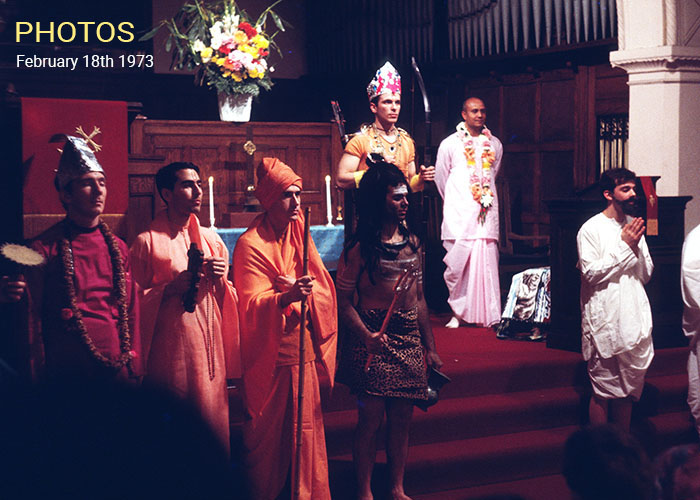
Three of Sri Chinmoy’s spiritual plays are performed by members of the New York, Connecticut and New Jer­sey Sri Chinmoy Cen­tres at the Vic­toria Congregational Church in Jamaica, Queens, New York.

At the very end of the evening’s programme, the audience vote for the best costume. The winner is Savyasachi Brown (top row, left of Sri Chinmoy) dressed as Arjuna.


February 18

Flame Waves from the Upanishad-Sea, part I

by Sri Chinmoy
at Rutgers University, New Brunswick, New Jersey


I

Transliteration:

"Aum bhur bhuvah svah
Tat savitur varenyam
Bhargo devasya dhimahi
Dhiyo yo nah pracodayat."

Translation:

We meditate on the transcendental glory of the Deity Supreme, who is inside the heart of the earth, inside the life of the sky, and inside the soul of the heaven. May He stimulate and illumine our minds.

Comment:

Illumination needed; here is the answer. Transcendental illumination transforms the animal in us, liberates the human in us, and manifests the Divine in us.

II

Transliteration:

"Purnam adah, purnam idam, purnat purnam udacyate.
Purnasya purnam adaya purnam evavasisyate."

Translation:

Infinity is that.
Infinity is this.
From Infinity, Infinity has come into existence.
From Infinity, when Infinity is taken away, Infinity remains.

Comment:

Infinity is the concealed Breath of the Pilot Supreme.
Infinity is the revealed Life of the Supreme’s Boat.
Infinity is the fulfilled Body of the Goal Supreme.

III

Transliteration:

"Asato ma sad gamaya
Tamaso ma jyotir gamaya
Mrtyor ma amrtam gamaya."

Translation:

Lead me from the unreal to the Real.
Lead me from darkness to Light.
Lead me from death to Immortality.

Comment:

The unreal in us desires the pleasure-life of the finite. The Real in us aspires for the God-Life of the Infinite.

Darkness is the discoverer of the doubting and frustrated mind. Light is the discoverer of the aspiring and dedicated heart.

Death — where is the cat? Miaowing nowhere. Immortality — where is the lion? Roaring all-where.

IV

Transliteration

Anor aniyam mahato mahiyan 
Atmasya jantor nihito guhayam.

Translation

Smaller than the smallest life, larger than the infinite Vast,
The soul breathes in the secret heart of man.

Comment

The soul is God’s eternal child and man’s great-grandfather.
As God’s eternal child the soul unceasingly plays.
As man’s eternal grandfather the soul perpetually enjoys rest.

V

Transliteration

"Vedaham etam purusam mahantam
Aditya-varnam tamasah parastat."

Translation

I have known this Great Being, effulgent as the sun beyond the boundaries of tenebrous gloom.

Comment

Before our realisation this Great Being quenched our heart’s thirst.
After our realisation we feed the soul’s hunger of this Great Being.

VI

Transliteration

Satyam eva jayate.

Translation

Truth alone triumphs.

Comment

Truth is God’s Crown offered to God by God Himself.
Truth realised, God is forever caught.

VII

Transliteration

"Devebhyah kam avrnita mrtyum
Prajayai kam amrtam navrnita."

Translation

For the sake of the gods, he (Brihaspati) chose death.
He chose not Immortality for the sake of man.

Comment

Brihaspati houses the flowing life of the gods and treasures the glowing love of man.

VIII

Transliteration

"Uru nastanve tan
Uru ksayaya naskrdhi
Uru no yandhi jivase"

Translation

For our body give us freedom.
For our dwelling give us freedom.
For our life give us freedom.

Comment

God’s Compassion is the freedom of our body. God’s Concern is the freedom of our dwelling. God’s Love is the freedom of our life.

IX

Transliteration

"Agnir jyotir jyotir Agnir
Indro jyotir jyotir Indrah
Surye jyotir jyotih Suryah."

Translation

Agni is Light and the Light is Agni.
Indra is Light and the Light is Indra.
Surya is Light and the Light is Surya.

Comment

Light is Love revealed.
Light is Life manifested.
Light is God fulfilled.

X

Transliteration

Anandadd hy eva khalv imani bhutani jayante Anandena jatani jivantiAnandam prayantyabhisam visanti

Translation

From Delight we came into existence.
In Delight we grow.
At the end of our journey’s close, into Delight we retire.

Comment

God has written an open letter to His human children. His letter runs: “My sweetest children, you are the only delight of My universal Existence.”

XI

Transliteration

"Hiranmayena patrena satyasyapihitam mukham;
Tat tvam, pusan, apavrnu, satya-dharmaya drstaye."

Translation

The Face of Truth is covered with a brilliant golden orb. Remove it, O Sun, so that I who am devoted to the Truth may behold the Truth.

Comment

The Face of Truth awakens us.
The Eye of Truth feeds us.
The Heart of Truth builds us.

XII

Transliteration

"Saha nau avatu, saha nau bhunaktu
Saha viryam karavavahai."

Translation

May He protect us together.
May He own us together.
May He make unto us vigour and virility.

Comment

God, Guru, and disciple:
God is Compassion and Protection;
Guru is Concern;
The disciple is dedication.
When these three work together, perfect Perfection shines, and it will shine through eternity.

XIII

Transliteration

"Yenaham namrta syam
Kim aham tena kuryam"

Translation

What shall I do with the things that cannot make me immortal?

Comment

God is eternally proud of man because he embodies God’s Immortality.

XIV

Transliteration

Madhuman me parayanam Madhumat punarayanam.

Translation

Sweet be my departure from home.
Sweet be my return.

Comment

My sweet departure from my eternal home has made me feel how brave I am. 
My sweet return to my eternal home shall make me feel how fortunate I am.


Published in The Upanishads: The Crown of India's Soul


Love Human, Love Divine, Love Supreme

A lecture by Sri Chinmoy
at the State University of New York, at Purchase


Dear seekers, dear sisters and brothers, I wish to give a short talk on love. Love is most significant in our human life, in our earthly existence. Love is life, life is love.

Love human, love divine and love supreme. Human love wants to possess and be possessed by the world. Divine love wants to establish its inseparable oneness with the world and then it wants to divinely enjoy this oneness. Supreme Love transforms human love into divine love and blesses divine love with boundless joy and divine pride.

Fear and doubt quite often torture human love. Cheerfulness and confidence increase and support divine love. Perfection and satisfaction fulfil Supreme Love. This perfection is continuous progress and continuous self-transcendence. This satisfaction is something that each individual needs in his eternal journey towards the ever-transcending Reality-Height.

Human love is nothing but incapacity. If we dive deep within human love, then we see clearly that it is weak and impotent. Divine love is capacity. Slowly and steadily it wins the race. There comes a time when human love becomes transformed into divine love. When divine love wins the race, it is not filled with pride. It shares its success cheerfully and soulfully with the transformed human love. Supreme Love, out of its infinite bounty, grants divine love the boon of transforming humanity and, at the same time, living in the boundless immortal Consciousness. Supreme Love is the endless Reality which always transcends and the immortal Vision which always illumines the earth-consciousness and Heaven-consciousness.

Human love craves for a satisfactory result. Then, when it does not get a satisfactory result, it is doomed to disappointment. It sinks into a chasm where it finds something quite unknown, a stranger: despair. Despair soon is devoured by frustration and this frustration eventually devours human love itself.

Divine love makes a soulful attempt at reaching the goal. It does not pray for or long for the result as such. Its aim is to make a soulful attempt and then it leaves everything in the blessingful care of the Supreme Pilot. It says to the Inner Pilot, “It is up to You to give me success or failure, which is only an experience. I wish to please You, O Supreme, in Your own Way.” This is divine love.

Supreme Love unconditionally gives and gives. What does it give? Compassion in infinite measure, Love in infinite measure, Peace in infinite measure. It depends on the individual to receive its boundless Compassion, Light, Peace and Bliss according to his soul’s receptivity. According to his life’s progress, the individual receives these immortal treasures from above.

Human love says to the world, “I love you; therefore I have the supreme authority to strike you and punish you if and when necessity demands.” Divine love says to the world, “I love you; therefore I feel that it is my bounden duty to perfect you so that you can become a perfect instrument of the Supreme Pilot.” Supreme Love says to the world, “I love you; therefore I feel at every moment a constant necessity in My cosmic Vision and in My cosmic Reality to claim you as My own, very own. I also wish for you, too, to claim Me as your own, very own, at every moment here on earth and there in Heaven.”

Slowly, steadily and gradually human love decreases; and finally it dies. Slowly, steadily and unerringly divine love increases in the aspiring humanity; and then it flies. Compassionately, ceaselessly and unconditionally Supreme Love always remains the boundless sky. From there it guides and illumines the aspiring humanity and illumining divinity.

A doubtful mind, a suspicious mind, an insecure mind is quite often visible in human love. A soulful heart, a climbing heart, a glowing heart is always visible in divine love. A fruitful life, within and without, is eternally visible in Supreme Love.

Imagination reigns supreme in human love. With imagination human love starts its journey and at its journey’s end again it sees imagination. It sees the soul, the body, the vital, the mind, even the goal itself as imagination.

Conviction paramount, conviction illumining, conviction fulfilling always reigns supreme in divine love. This conviction is the soul’s Reality-Light that illumines the entire world. It is this conviction that divine love offers to the seekers of the absolute Truth. This conviction is the treasure-reality which, at the beginning, belongs to the Ultimate Source and which the Ultimate Source offers to the soul to share with aspiring mankind.

Compassion eternal reigns supreme in Supreme Love. This Compassion is the Supreme’s highest Power, deepest Peace and brightest Light. He offers His infinite and immortal Reality to us unconditionally and we receive it according to our inner capacity and our outer receptivity.

Love of the limited self, the very limited self, is another name for human love. Love of the entire world is another name for divine love. A cheerful, beckoning Hand the Supreme offers to divine love for earth’s illumination, salvation and perfection. Love of the limited, unaspiring, desiring, binding and blinding human in us and the unlimited, eternally aspiring, self-giving divine in us is another name for Supreme Love.

In the process of evolution, each individual starts with animal love, love that destroys. Gradually this animal love makes progress. It receives an iota of light and changes its consciousness. Then it goes into human love, which is the song of possession, the song of doubt and insecurity. Eventually this doubtful existence is transformed into faithful existence; this life of insecurity becomes a life of security and confidence. For human love grows into divine love, which feels its identification and oneness with God’s entire creation. Divine love is finally transformed or given the golden opportunity to grow into Supreme Love, which is Infinity’s Perfection and Eternity’s Satisfaction. This is how each individual walks along Eternity’s road to reach the ever-transcending and ever-fulfilling Goal.


Published in Sri Chinmoy Speaks, part 4


February 18

Photo by Bhashwar Hart


A bronze bust of U Thant is presented to Sri Chinmoy by UN Under-Secretary-General Robert Muller and sculptor Domenico Mazzone.


Presentation of Bust of U Thant


Sri Chinmoy’s recent book U Thant: Divinity’s Smile and Humanity’s Cry has pleased and inspired many admirers of the late Secretary-General. Deputy Under-Secretary-General Mr. Robert Müller was so moved by the book and by the many other ways in which Sri Chinmoy has honoured the memory of U Thant that he commissioned sculptor Domenico Mazzone to make a bust of U Thant for Sri Chinmoy. On 18 February Mr. Müller and Mr. Mazzone present the sculpture to Sri Chinmoy in a ceremony in the United Nations’ Dag Hammarskjold Auditorium. Following is a transcription of the presentation.


Mr. Robert Müller: Dear Sri Chinmoy, as a small token of my deep appreciation for all you have done for the memory of our beloved U Thant, I have commissioned sculptor Domenico Mazzone, another great friend of U Thant, to make for you a bust of the late Secretary-General. It is my pleasure to offer it to you in memory of him.

Sri Chinmoy: Dear Mr. Müller, esteemed brother, I am accepting this with my heart’s infinite gratitude. My heart will always treasure this soulful and blessingful gift of yours. This contains the living presence of our beloved U Thant. Each member of the United Nations Meditation Group will treasure this living presence which I have just received from you both. The memory of this blessingful gift will be written and will always remain written on the tablet of our gratitude-hearts. On behalf of all the members of the United Nations Meditation Group, to you I offer our ever-growing gratitude.

You have received in abundant measure aspiration in the inner world and inspiration in the outer world from our beloved U Thant. Today you are blessing us with that inspiration and aspiration. We shall try our best to be more devoted to the cause of the United Nations and to be more worthy instruments of the soul of the United Nations.

You have the same vision as our Secretary-General had. Your oneness-vision with him, with his soul, will be a beacon of light pointing the way to our journey’s ever-transcending goal. U Thant was an extraordinary leader of the world. He was not only a pilot of the United Nations-Boat but also a supremely able pilot of the World-Boat. His was a colossal moral strength. His was an indomitable inner courage which sought to change the face of the world and transform human ignorance into divine wisdom-light.

Now I am holding not a mere bust, but a blessingful personality that guided and still guides humanity’s destiny. U Thant’s illumining soul, his soul of illumination, will always remain within us, and his life of dedication will always remain for us. We are sailing in his boat of dedication, which is bound to reach the Golden Shore, the Shore that has boundless Peace, boundless Light, boundless Harmony and boundless Satisfaction.

Again, to you I offer my heart of infinite gratitude, and this I offer not only on my behalf but on behalf of all the members of our Meditation Group. This we shall cherish as an invaluable treasure in our heart of aspiration and dedication.

(Sri Chinmoy presented Mr. Mazzone with a copy of his book, U Thant: Divinity’s Smile and Humanity’s Cry.) As a token of our deepest appreciation and admiration to the master sculptor in you, I wish to offer you this book.

Mr. Mazzone: Thank you, thank you very much. I am deeply touched by your words. I feel like crying inside, so beautiful is this ceremony. What you said of U Thant is so true: he is the real light of the world. I have met many celebrities, but U Thant is really unique, so unique that I cannot find the right words. All I can say is that in my view he was very, very close to God. Thank you very much. Thank you from the bottom of my heart.


Published in AUM – Vol. 4, No. 2, 27 February 1977


Sri Chinmoy lifts Russian musician Purushottama Boris Grebenshikov in Langkawi, Malaysia.


February 18

Message to Sudhahota Carl Lewis

from Sri Chinmoy


Sri Chinmoy sends this message at a time the champion athlete was experiencing some difficulties in his indoor competitions.


Dearest Sudhahota, I wish to offer you a soulful and a blessingful message. The soulful message is coming from my heart and the blessingful message is coming from my soul. Of late you have been experiencing sad realities in your sprinting career. My heart of sympathy and my heart of oneness are experiencing the same sadness that your own heart is experiencing. To us, so-called failure is nothing but an experience. Just because we are seekers, we say that either God has given us this experience for our own inner improvement, or that for some unknown reason God is tolerating this experience, which the hostile forces have maliciously given us. In any event, whether our Beloved Supreme approves of this experience or whether He just tolerates it, we abide by His all-loving Decision which, for us, is nothing but His all-encompassing Compassion.

For me to give you suggestions or advice is like a tiny flame giving advice to the sun. But a tiny flame is also a solid and concrete portion of God. In this world, when the tiny flame has established its inseparable oneness with the mighty sun, at that time the tiny flame is quite anxious to offer its capacity to the sun. So, from an absolutely practical point of view I would like to say a few things.

For the past few weeks, in the 50 metres and 60 metres you have been coming in second. For us, the thought of your being second in this event is far beyond our imagination. But to me the 50-metre and 60-metre races are of no importance at all. When the world speaks of sprinting or the fastest sprinter, it speaks of the 100 metres. When we talk about Jesse Owens being the fastest runner, we never think of 50 yards or 50 metres or 60 metres; we think only of 100 metres. Go to any obscure country and ask who is the fastest. Immediately they will say the name of the person who is first in 100 metres. In this respect, your name has covered the length and breadth of the world. The whole world knows you as the best, the superlative sprinter.

When I came to America and heard about 40, 50 and 60-metre races, it amused me more than it inspired me. If people want to value only the shortest distance, then there will have to be a 10-metre or a 2-metre race. Or some silly people will say that whoever comes out of the starting blocks first is the fastest sprinter. But if this person has to run 70 or 80 or 100 metres, perhaps he will be nowhere. Some runners are still behind even up to the 90-metre mark. But when it is 100 metres, they defeat their rivals.

The General Secretary of the Sri Aurobindo Ashram, Nolini Kanta Gupta, who passed away recently, was my boss when I lived there. His middle son was the fastest in 40 metres. But luckily for me, there were no 40-metre races, and in the 100 metres I always defeated him. He would be as much as 4 or 5 metres behind me. Then, after a few years, he gave up his running career and I continued with the 100 metres.

So please feel that 100 metres is the real race — not 60 metres or 10 metres or 2 metres! Please concentrate only on your 100 metres. Let the world mock you. As you have something to do, the world also has something to do. Let the world say whatever it wants to say or feel whatever it wants to feel. If you have already decided not to do any more short distances before the Olympics, then do not surrender your adamantine will to public criticism. People may try to instigate you to run more short distances, but if you have already decided not to run anymore, do not surrender to their unforgivable instigation.

If you want to continue and say, “I shall accept the challenge! I want to prove that I can do it,” then that is another matter. But the only thing is, the Olympics are fast approaching, and I personally feel that the time has come for you to concentrate on the 100 and 200 metres and on the long jump. Who knows, perhaps God is giving the runners who are right now defeating you in shorter distances just a few drops of Nectar, whereas He has decided to give you a very large quantity at a later time. Or perhaps He is giving them some crumbs and plans to give you a big loaf. Anyway, you please make your decision. If you feel it is inadvisable to run the shorter distances, then do not listen to the critics.

In case you are tempted to do 50 or 60 metres, I wish to offer you some advice on a very practical level. Of course, being a spiritual man, everything I say comes from a spiritual plane. When running 50 or 60 metres in competition, before the starter fires the gun please try to feel that you have to run 10 metres less than the other competitors. If the race is 50 metres, then convince yourself that you are running 40 metres. If it is 60 metres, make yourself feel that you are going to do 50. If you feel that they have to run 10 metres farther to reach the goal, then naturally you will feel that you will win. When you feel that your task is easier than their task, you will get an extra surge of joy — we use the spiritual term ‘delight' — that will help you succeed. You will have a very strong, cheerful, inner frame of mind and be able to run much faster. Then, by God’s Grace you will be able to always do a miracle on the track.

But even though you make yourself feel that you are running a shorter distance than your rivals, you will not come to an absolute halt after you have covered that distance. In the 100 metres, for example, everybody advises the runners to maintain their speed even after they have passed through the tape. That is absolutely the right thing to do. Similarly, if you convince yourself that you are running only 50 metres whereas your rivals are running 60 metres, after 50 metres you cannot let your speed drop. You have to continue your speed right to the end.

Also, while you are running, try to feel that you are being chased rather than being pulled by something or someone. That way you will go faster. If somebody is chasing you, your speed will be faster than if somebody in front of you is pulling you toward him with a rope. If you feel that a magnet is pulling you to the finish line, you will run fast; but you will run faster if you feel that somebody is chasing you and you are running for your life. Imagine that a ferocious tiger is right behind you and at any moment is going to devour you. You know how fast a tiger can run! So you will run for your most precious life, and you will run the fastest. If the image of a tiger is not pleasing to your mind or heart, then think that your house has caught fire and you are running to the nearest telephone booth to call the fire department. When you see that your most valuable house is being burned to ashes, definitely you will run the fastest.

If you cannot think of a tiger or a fire, then try to feel that you are one or two metres ahead of everyone else right from the beginning. Before the race has started even, when you are taking the set position at the starting blocks, please try to feel that the other five or six runners are behind you. Then, when you start, feel that they are not running with you but are chasing you because you are trying to eat something most delicious and they want to deprive you of it. If you can feel that your rivals are behind you, chasing you, then you will be able to run much faster than if you see that the others are all on a line with you. So if you can feel that your competitors are a little behind and chasing you, and that you are running for your life, this will give you more inner intensity and outer determination. All this that I am saying also applies to the 100 metres.

About your long jump, people are enjoying a kind of malicious pleasure and accusing you of taking drugs, which is totally false, absolutely false! Unthinkable criticism has always been the order of the day, and there are always people who will say things that have no foundation. On the one hand, you have accepted the challenge and are doing absolutely the right thing. On the other hand, if you have to prove yourself to others in this way, then you are just surrendering to their whims. Today you have accepted this challenge.

Tomorrow they may say something else very painful about your running and jumping, and again you will have to prove that they are wrong. Instead of proving to them that they are wrong, just think of your promise to the world at large that you will do something incredible. Only dream of those incredible things and do not surrender to the stupid criticism of humanity. In the future, if they bring up the same stupid subject, please do not listen to them!

A great spiritual figure, a spiritual giant named Vivekananda, came to America around 1893. He used to say, “The elephant is going to the marketplace and the dogs are barking.” You have to feel that you are the strongest elephant and that the dogs are barking at you. You don’t have to pay any attention to these human beings whose criticism is as useless as the barking of dogs to an elephant. (Joking) If they start barking, then ask your dearest brother Narada — instead of beating his drums — to take his stick and beat the heads of those foul critics.

In the Indian caste system, some people are called untouchables. When I read in the paper that some people are calling you untouchable, I say, “They are using the wrong word. They are saying ‘untouchable’, but what they mean is ‘unreachable’.” You are unreachable in the long jump. I understand 35 or 36 times consecutively you have been first. If this is not the supreme glory, the Himalayan height, then what else is? Even if you never break Beamon’s record — which I am sure you will do, without fail, in this lifetime — you are still a champion. For nobody has ever been able to jump more than 28 feet as many times as you have.

Now I am giving you some suggestions on the practical plane for the Olympics. When you start the long jump, please try to run for the full length; do not shorten your distance. It is absolutely important to have your proper distance. When you are about to start, of course you will pray and meditate the way you have been doing. But at the same time, try to feel that you are hearing people repeating your name: Carl Lewis. Like a thunderous noise, most powerfully, feel that you are hearing your name repeated.

Another thing: when you are about to start, try to feel that you are representing not only America but all of earth. Feel that a competition is going on between earth and Heaven. Since you took birth on earth, you are representing earth and demonstrating earth’s capacity to the cosmic gods and goddesses. Try to feel that the whole earth is behind you and that you are getting blessings, love, concern, determination and oneness from the entire earth. Do not think of the people you are competing against or the person who is second. You have to convince your entire being that the whole Olympic stadium is for you. The members of the audience are eagerly supporting you and helping you in every possible way with their inner will and determination.

You have to feel that there is not a single human being who is against you, because you are not representing any particular country or race, but the entire earth.

So, while running, feel that the whole earth in a thunderous voice is repeating your name: “Carl Lewis, Carl Lewis, Carl Lewis.” Then, when you are about to approach the board in the long jump, feel that the whole earth — all of humanity — is standing up. You do not have to see whether you have covered 9,10 or 11 metres. Only feel that millions of human beings are standing up to honour you because you have broken Beamon’s record and brought supreme glory to earth. This is what I advise you to do when you do the long jump.

As for your training, again I wish to tell you that every second of your life is of paramount importance now when the Olympics are fast approaching. So do what inspires you most inwardly, and do not surrender to the foul criticism of the outer world. The entire world knows what 100 metres is. So please pay all attention to the 100; the 50 and 60-metre events are of no importance.

The world cares for speed, so we have to prove that we are absolutely the fastest. How I wish all human beings would run faster than the fastest, with unimaginable speed, towards Eternity’s ever-transcending Goal. Once we reach the highest transcendental Height with our fastest speed and consciously begin serving our Supreme Pilot at every moment, at that time we can and we shall create an absolutely new creation. At that time there will be only one reality, one song: the song of self-transcendence. There will be no boxing ring where might is right. There will be no destruction. In order to prove our supremacy, we will only have to transcend ourselves the way the Absolute Supreme is transcending Himself. The supreme secret or goal will be to transcend our own capacities. We will not try to defeat others. We will try only to constantly transcend ourselves. In this way we will get supreme satisfaction and offer supreme satisfaction to the inner world and to the outer world.

This is what our Beloved Absolute Supreme expects from His creation, and He will be fully satisfied only when that type of reality manifests itself on earth. It may take thousands or millions of years, but He will not be fully satisfied until He has created that type of creation. Let us pray and meditate to become consciously part and parcel of His new creation. Let us try to become one, inseparably one, with His Will and, when the God-Hour arrives, to become the choice instruments in His tomorrow’s creation.

So, dearest Sudhahota, you are a runner, sprinter and jumper and I am a talker. Along with my marathon advice, I am offering you my soul’s transcendental blessings and my oneness-heart of sympathy. I am also offering you my oneness-heart of divine pride for what you have already done for mankind and for what you will be doing for the success and progress of humanity in its outer running. There shall come a time when humanity will see, through you and other world-class runners, that the inner running and the outer running must go together to create a new world that will be full of divine glory and divine satisfaction.


Published in Carl Lewis: The Champion Inner Runner


Sri Chinmoy lifts a seven-month-old baby elephant weighing 701 lbs. using a standing calf-raise machine with shoulder platform, at Elephant Special Tours, in Mae Sopok, Chiang Mai Province, Thailand. The total weight of the lift, including apparatus, is 785 lbs.