February 27

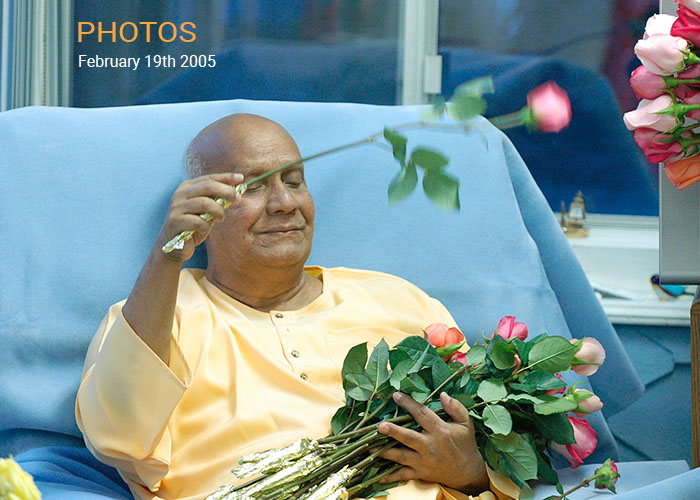
Sri Chinmoy meditates with Addwitiya Roberta Flack at Public School 86 in Jamaica, Queens, New York.
Sri Chinmoy meditates with Addwitiya Roberta Flack at Public School 86 in Jamaica, Queens, New York.
A lecture by Sri Chinmoy
in Kendall Cram Room at Tulane University, New Orleans, Louisiana
Dear seekers, I wish to give a talk on compassion. When we use our mind to understand the meaning of compassion, very often we are misled and we mislead others. But when we use our heart, we understand the meaning immediately, and we make others understand as well.
Compassion is God's immense and intense Concern for mankind. When we show compassion to others at the time of their need, compassion is sweet. When we receives compassion from others while we are in dire need, compassion is sweeter. And when we come to realise that it is God's Compassion that is enabling us to fulfil our promise both to Heaven and to earth, Compassion is sweetest. Our promise to Heaven is to reveal our divine qualities here on earth. Our promise to earth is to manifest all our divine capacities so that Mother Earth can utilise them for her own purposes.
We are all seekers here, and we feel that if we can receive God's most illumining Compassion, then our spiritual journey will be expedited. But how are we going to receive this Compassion from Above? We can easily do it if we can feel that we are like a child, a little divine child. When a human child cries, no matter where the mother is, she comes to comfort him, for by pleasing the child she gets satisfaction. Similarly, when we soulfully cry for God's Compassion, God immediately descends with His Compassion-power.
A child cries helplessly because he feels that without his mother's help and guidance he cannot do anything. But the spiritual child does not cry with a sense of helplessness. He feels that there is a Source, and that Source is omniscient, omnipotent and omnipresent. When we become soulful in our cry, we establish a free access to the Source. So the seeker in us, the divine child in us, cries soulfully and not helplessly.
In our ordinary day-to-day life, in our multifarious activities, we speak of Grace, divine Grace. From the spiritual point of view, there is a subtle difference between Grace and Compassion. Let us imagine a vast expanse of water all around — this is Grace. But when there is a heavy downpour, a shower, this is called Compassion. Compassion is Grace, but in a very intensified, one-pointed form. Grace is something general, which is for everyone whether he aspires or does not aspire. But divine Compassion, real Compassion, enters into our aspiring consciousness, our aspiring life, only when we feel the inner urge to fly into the Beyond.
Compassion wants to operate in us at every moment, but quite often, because of our ignorance, we resist Compassion consciously or unconsciously, even after we have begun to cry for it. In the ordinary life, if somebody wants to give us something out of his infinite kindness, and we don't take it, then the person immediately withdraws his gift, as if to say that we do not deserve it. But in the case of God, it is not like that. God never withdraws His Compassion from us. On the contrary, He tries to offer more of His divine, unconditional Compassion.
Compassion is a power, an illumining power. But when we are extremely stubborn and reject Compassion totally and mercilessly, God at times relies on His Patience-power. He knows that Eternity is at His disposal and that one day in the process of evolution we shall be able to receive His Compassion. Today if we do not achieve and receive His Compassion devotedly or gratefully, He does not mind. Tomorrow He will give us another opportunity, and in either the near or the distant future, we are bound to accept His Compassion-power, for this alone can transform our nature. So God does not withdraw; He only uses another type of Power, which we call patience.
Before we enter into the spiritual life, Compassion is something abstract. But when we enter into the spiritual life, and live a divine life, Compassion becomes concrete. At every moment we feel God's Compassion in us in either a subtle or a solid, palpable form. At every moment we can see it, feel it and grow into it.
AUM
The state motto of Louisiana is "Union, justice, confidence". These terms are extremely spiritual. Union. Union occurs between the finite and the Infinite. Right now we are in the physical, so we are all living finite, individual, separate existences. But when the finite enters into the Infinite in order to realise the highest Absolute, or when the Infinite enters into the finite to manifest its own Divinity, then this union immediately establishes one reality, one fulfilling reality. In the union of the finite and the Infinite we realise the highest plane of consciousness and, at the same time, we manifest Divinity on earth.
Now, what actually is being united when the Infinite and the finite join? It is God's Compassion and man's surrender. God's greatest gift to mankind is His Compassion-power, and man's greatest gift to God is his surrender-power. When man surrenders to God soulfully and unconditionally, when he surrenders to God's Will cheerfully, at that time God's Capacity, God's Reality, God's Infinitude become his. Compassion is the magnet in God, and surrender is the magnet in the seeker. When God uses His Compassion, it is like a magnet from above pulling us up to the Highest. And when we use our surrender, this magnet immediately pulls God down into our living breath. So when our magnet and God's magnet come together, the Hour of God dawns for us in our life of aspiration and self-dedication.
Justice. In the ordinary human life, justice says, "As you sow, so you reap." This is justice: tit for tat. If somebody has done something wrong, we feel we have every right to threaten him, frighten him, warn him, punish him. But this kind of justice is on the lowest rung of the human ladder. When we step up to a higher rung, justice becomes a kind of forgiveness. If we can forgive someone who has done something wrong, if we have the capacity, then we feel that forgiveness itself is justice. When we enter into the highest level of consciousness, at that time there is no question of either punishment or forgiveness. It is only a matter of illumination. The highest Self encompasses and embodies all of Reality. So if one part of its existence is unillumined, it does not punish or forgive. It tries to illumine that part of its own existence. When we watch the world from the highest plane of consciousness, we feel that the ignorant, obscure, impure, imperfect world needs illumination. Here justice is the feeling of oneness. Divine Justice is the transformation of our own unlit existence. Divine Justice is self-illumination.
In the ordinary life, we feel that equality is justice. But in the divine world, if somebody has the capacity to receive more Peace, more Light, more Bliss from Above, then he should be given more. Equal opportunity should be given, but if you have more capacity or receptivity than I have, then you should progress according to your own speed and not slow down to my speed. If you wait for me, then God's Hour will have to wait for you, and you will not reach the Goal at God's choice Hour. This kind of equality is not an act of illumination. If your time has come, you go. God has given me the same opportunity, but you have developed more capacity. That is why you have received more light and you can run faster towards your Goal. When God gives me the capacity at His choice Hour, at that time I also will reach the Goal. This is called divine Justice. God is constantly giving us all the same opportunity, but our individual capacity is not the same.
Confidence. Confidence is a most important quality in both our human life and our divine life. In the human life, usually our confidence is based on our ego, our unruly vital. The unruly vital makes us feel that we can do everything, that there is nothing on earth we cannot do. Nevertheless, it is true that in our human life, if we do not have confidence, we cannot do anything. But in the divine life when we have confidence, it is a different matter. This confidence comes from an inner awareness of our Source. We feel, "I am God's son, I am part and parcel of God. Since He has infinite Peace, Light and Bliss, since He has infinite capacity, I also have the same within me. Right now I am not aware of it, but a day will come when I will not only be aware of it but will actually be able to manifest it." This is called divine confidence.
Now, some people have confidence only in God and not in themselves. This is a deplorable mistake. They should have confidence in themselves, but they should feel that this confidence is coming directly from God. They have to feel that their faith in their own personal effort is their confidence in a capacity which has come directly from God. God has given us this confidence and God is the one who is experiencing this confidence in and through us. This confidence is nothing other than the confidence God has in Himself.
God always has confidence in us, but very often we lose confidence in ourselves. When we have been defeated once or twice in the battlefield of life, we lose all our confidence. But God never loses His confidence in us because He knows that He is the root and we are the branches. Since the root is firm and solid, how can the branches fail? God knows His capacity, His potentiality, His Plenitude and Infinitude; therefore He has all confidence, not only in Himself but also in us, for He feels that we are His direct manifestation. Without us He cannot manifest what He has and what He is; and without Him we cannot realise what we have and what we are. We are part and parcel of God's Divinity, His integral Reality; therefore He always has boundless confidence in our capacity.
Published in Fifty Freedom-Boats to one Golden Shore, part 3
A talk by Sri Chinmoy at Saint Paul’s Chapel, Columbia University, New York
My Lord Supreme, You accept from me my hungry desires as though these things are tremendously valuable.
My Lord Supreme, You accept from me my teeming worries and anxieties as though these things are extremely beautiful.
My Lord Supreme, You accept from me my poisonous doubts as though these things are remarkably meaningful.
My Lord Supreme, You accept from me my untiring insecurity and my unending impurity as though these things are going to adorn Your Heart.
My Lord Supreme, You accept from me my ocean-vast ingratitude as though it is something that is going to richly satisfy You.
My Lord Supreme, when You give me Your Peace, Your Love, Your Joy, Your Compassion and Your divine Blessings in boundless measure, I get joy, true. But Your Joy, while giving, far surpasses my joy, in spite of the fact that I am the receiver and You are the Giver.
My Lord Supreme, when I give You my undivine qualities unreservedly, You get much more joy and satisfaction in receiving than I get in giving.
My Lord Supreme, You are always great. You are always good. Will there ever be a time when I shall be able to defeat You in anything?
“My child, you have already defeated Me.”
I have defeated You? Impossible, my Lord, impossible! How can I ever defeat You? Tell me, how?
“My child, I need you infinitely more than you need Me. My need for you far surpasses your need for Me. Does this not prove that you have defeated Me badly? Now let Me explain to you this secret and sacred philosophy of Mine. You do not know who you are, but I know who you are. You think that you are ignorance incarnate, but I see you as an experience of Mine. I see you as My own evolving Life. I see you as My own Dream-manifesting Reality.
“It is not you; it is I. It is not yours; it is Mine. It is I who am always in the process of unveiling and becoming, and becoming and unveiling. Thus it is I who sing in and through you My Eternity’s Song: Oneness. It is I who dance in and through you My Infinity’s Dance: Perfection. It is I who cry and smile, and smile and cry, in and through you My Immortality’s Silence-Sound: Satisfaction.”
Published in The Oneness of the Eastern Heart and the Western Mind, part 3
Listen to Sri Chinmoy reciting this talk...
Sri Chinmoy recounts stories to his students in New York after his two-week visit to his homeland, the first time in 42 years
On the airplane from Bombay, a lady carried a dog onto the plane in an ordinary handbag. From time to time she would open the bag, and the dog would jump up. Then she would talk to the dog for a few seconds before closing the bag. The lady was calling the dog Tina, which is our Upasana’s former name. So many people saw the dog on the plane! Can you imagine? I am sure it is not permitted to carry a dog in that way.
While waiting at Customs, I happened to be behind this lady. She was very smart, very pushy and very restless. Just because I was behind her, I was able to make headway in the line. Otherwise, I would have had a much longer wait.
When I first arrived in India, a bald-headed man came up to me near the Air India office in our hotel and said, “Sri Chinmoy? Sri Chinmoy?”
I said, “Yes.”
He said, “I can’t believe it!” His eyes were swimming with tears. So soulfully he was shedding tears and embracing me. His soul knew who I am. He created a real scene in the hotel. So many people were watching!
He told me that he used to come to our meetings three years ago and then he stopped. He knows Adhiratha and he was telling me how Adhiratha stands next to my chair when he is guarding on stage on Wednesday nights. He also knows Sumantra and Ayoddhri.
He said he had come to India to visit some spiritual places, so I gave him the names of a few places to see. He said that he wants to start coming to our meetings in New York when he returns. He is a construction worker from Long island.
In another case, a boy named Brad had been my disciple for a few years in California, but then he had left the path. Brad was going to India to search for a Guru. He and another seeker were going to visit a few spiritual places. I don’t think the other seeker was looking for a Guru.
I happened to be on the same plane that they were on, so Brad found his Guru again in me. In his case, he touched the soil of India only to go back to America.
Published in The World-Experience-Tree-Climber, part 5
by Sri Chinmoy
while in residence at the Sri Aurobindo Ashram in Pondicherry, India
"Chinmoy, how is it that I don't see you nowadays on the sports field?"
"Nowadays I only play volleyball and practise running just to keep my body fit, since I shall not compete anymore in athletics."
"You have done more than your share of competition. Nobody expects you to compete anymore. Only try to keep your body fit. This is essential."
Published in A Service-Flame and a Service-Sun

Sri Chinmoy walking at the second Sri Chinmoy ‘Rainbow Marathon’. The first of the Rainbow Marathons — scheduled on the 27th of each month in Flushing Meadow Park, Queens, New York — was held in January.

Sri Chinmoy walking by the lake at Oakland Park in Queens, New York.

Sri Chinmoy plays the Western flute during an interview on WCBS-TV’s ‘The Way To Go’ in New York.
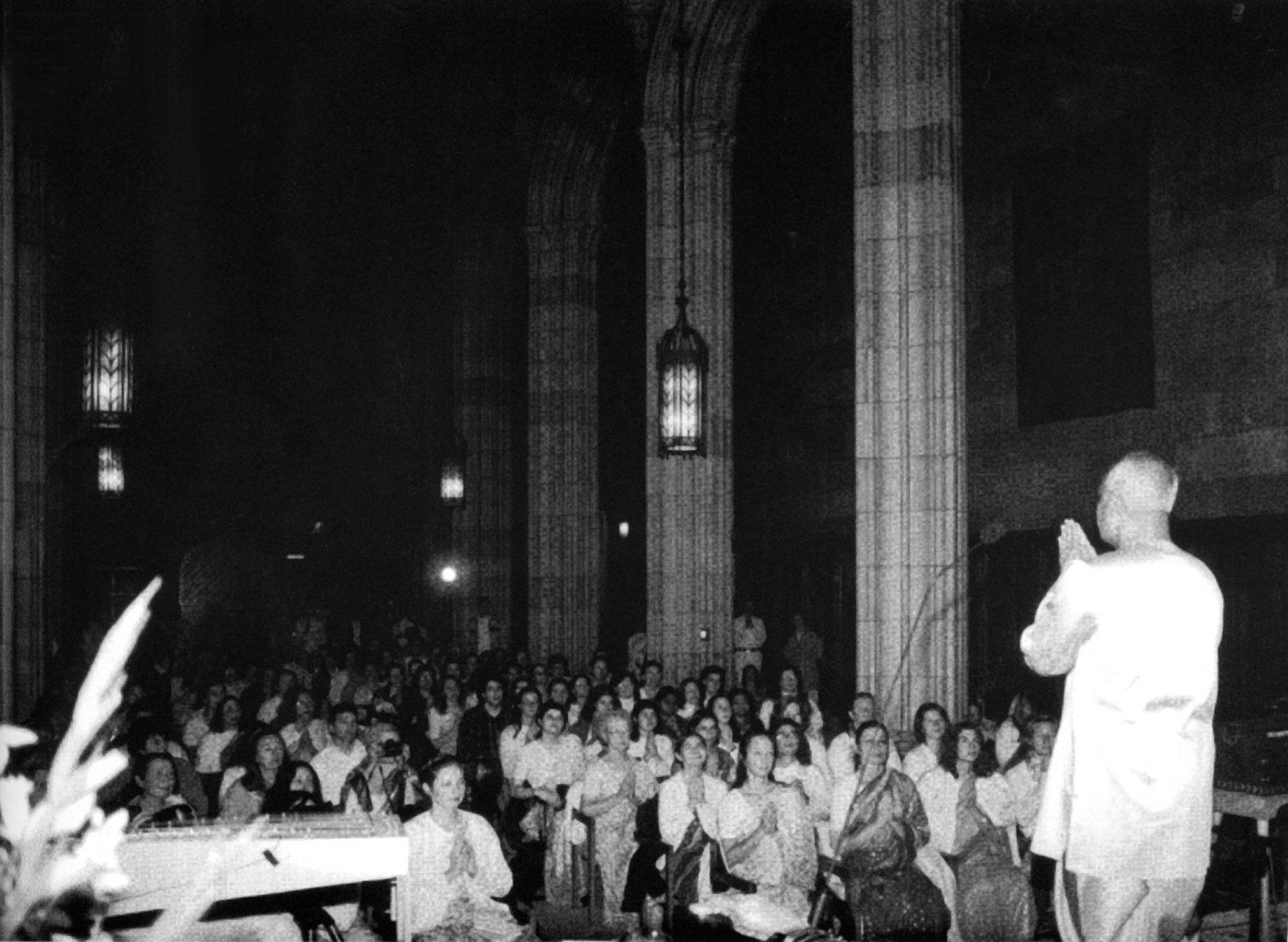
Sri Chinmoy offers a Peace Concert and an organ performance at Yale University in New Haven, Connecticut.
A running story by Sri Chinmoy
During the 20-mile race in Central Park today, one old man was looking at me and telling another old man, “He is the director of the Sri Chinmoy Marathon Team!” Then two ladies — not disciples — started calling me, “Guru, Guru!”
The first two miles Prabhir was ahead of Sarama, although she was running and he was walking. She had her jacket around her waist. People were dying and she was carrying extra weight! Then she went ahead of Prabhir.
Published in Run and Become, Become and Run, part 15

Sri Chinmoy lifts Don Ritchie, ultra-distance runner, the world-record holder for 100 miles and 100 km, in the garden tent at Annam Brahma restaurant in Jamaica, Queens, New York.


Sri Chinmoy meets with the Japanese composer and concert pianist Masanobu Ikemiya at Annam Brahma Restaurant in Jamaica, Queens, New York.
Question: When you play different instruments, are you expressing different qualities?
Sri Chinmoy: Each instrument has its own unique soul. Again, each time we play an instrument, the soul of that particular instrument expresses a different quality. Again, while we are playing an instrument or singing, every minute or two and sometimes every second, our own soul can bring to the fore a different quality. The soul can change its garments very rapidly. This moment it wears one garment; the next moment it wears a different one. But it is not actually a garment; it is the soul’s fragrance that is changing.
This moment, while you are playing, your soul-flower is offering a soulful or prayerful fragrance. Then something happens in your consciousness, and the soul-flower offers a different fragrance. It is not that the music or melody are changing, no! Your own consciousness is changing, so your soul is expressing or manifesting another quality. The soul has countless qualities, and which one it expresses at any moment depends on the consciousness of the performer.
Question: Do you feel this when you play?
Sri Chinmoy: In my case, I try to become the embodiment of what my soul wants to express. I may play all wrong notes, but my soul does not care. My soul does not care for my perfection. It cares only for my prayerfulness and soulfulness. It cares only for how much mental purity I have and for how much psychic oneness I have established with my inner life. The soul does not care for technique at all; only it sees how much I am in tune with it in the inner world.
Question: As a pianist, sometimes I am so caught up with technique that I lose the soul or forget what I am trying to say.
Sri Chinmoy: If you can meditate for three or four minutes before you play, your mind will be inundated with light. Then your mind will be clear and confusion will not dare to enter into it. At that time, you do not have to think of the technique; it will come automatically. Everything comes from light — even technique. The light will pull the technique.
If the owner or manager of a restaurant asks one of his workers to do something, immediately the worker will try to please him. Similarly, when you embody light, the light within you will command the technique to perform for you, and you will go far beyond the domain of technique. Now you are thinking about technique; you are begging it to serve you. But at that time, technique will be dying to serve you and please you because you are the boss.
Spending a minute or two in silence is like putting money in your pocket. If you have money in your pocket, in the supermarket you can buy anything you want. When you meditate for two or three minutes, you accumulate inner wealth — peace, light and bliss. Then, as soon as you stand in front of the audience — before you play even — spontaneously you are sharing this wealth with them. So before you even start to perform, you have already pleased your audience. Then, even if you play wrong notes, they will be sympathetic towards you.
It is like a mother and her child. The child makes a million mistakes when he plays an instrument, but the mother thinks, “Oh, it is so excellent!” The mother’s love for the child makes her feel that whatever the child does is perfect. So if you distribute your inner wealth before you play, the audience is not going to judge you because it is already satisfied. You can play anything you want and the audience will be pleased.
When I play for my students, they do not care how many mistakes I make. Why? Because before I play, I meditate with them and we establish our oneness with one another. So right from the beginning there is mutual satisfaction. At that time, they are so inwardly happy and satisfied that no matter how bad my outer performance is, their mind and heart are happy. And when you are happy and filled with inner delight, you do not see any mistakes. When you are in a very high state of consciousness, nothing affects you; everything is joy.
It is like a host trying to please his guests as soon as they come in. If the host stands at the door and gives them a flower or a smile and talks to them, then half the battle is won. No matter what else he does, everything is perfect because he has already conquered the hearts of his guests. But if the guests are pouring in and the host is somewhere else, they will say, “Look at this! He is so callous and irresponsible!”
Question: All of us before going on stage are so nervous, but we don’t show it.
Sri Chinmoy: Everybody has nervousness, but by virtue of prayer and meditation you can conquer nervousness — to a great extent or completely. In addition to prayer and meditation, there is also something you can do on the practical level. Instead of seeing a thousand people in the audience, imagine that there is only one person, one listener. Then feel that this one person is not even a musician. He is not somebody who will find fault with you; he is just an ordinary person. Since you are an infinitely better musician than he is, why do you have to worry? Or feel that he is your greatest admirer and you are playing for him out of sheer compassion. You should do this not in an aggressive way but in a sympathetic way. So from a thousand people in the audience, bring the number down to one person, and feel that that person is your most sincere admirer.
Question: I have trouble organising my life. It takes so much time to pay bills and do the everyday things in life that there is not enough time for music. There is so much junk in my life; it is just like my mind. I would like to have a much more simple life, but to live in this world I need to do so many things.
Sri Chinmoy: You have to have silence, not sound. Sound can be silenced by silence itself. When you meditate, there is tremendous silence. On the surface there are huge waves, but the waves are only a very small part of the ocean. At the bottom of the ocean there is deep silence.
You are talking about paying bills and so many other things that you have to do. You have to think of these things as monkeys that are biting you; they are not biting your body but your mind. If you pick up a big solid stick, the monkeys become frightened and stop biting you. In this case, the stick is your inner silence. When you keep your mind absolutely quiet, you will know what is most important. You are a musician and not a secretary or a politician. If you do not answer certain letters, your world will not collapse. But if you do not pay attention to your music first and foremost, then you will be the real loser. Again, you have to be practical and pay your bills. But the money for this comes from your music. So always you have to go to the source. Music is the source of your inner life and also the source of your outer life.
If you pay utmost attention to your music, from your music-world you will get tremendous joy. Then, if you are happy, you will pick up a particular letter that came three months ago or six months ago and answer it. But if you are unhappy, you are not going to touch anything. So first you have to derive joy from your music. Then, once your mind is inundated with joy, everything else will come easily. But if you do not do first things first, which in your case is music, then everything will go wrong.
I have one particular song that is the source of all my musical pieces; it is called The Invocation. I sing The Invocation every day, as well as play it and listen to it on tape. Before that I meditate. All my disciples early in the morning also sing that song in front of their shrines. Then their outer world and inner world become in tune with the universal harmony. For me and my students, the highest type of music is meditation. Life without meditation is out of tune with the inner harmony.
Question: How do you have the same amount of inspiration every day?
Sri Chinmoy: In my case, I am dealing with the Source, which is inexhaustible. Every day I am entering into my heart-garden, where there are so many beautiful and fragrant flowers. If every day we enter into our heart-garden by virtue of our prayer and meditation, we will constantly get a fresh supply of inner beauty and inner purity. If we cannot enter into the inmost recesses of our heart, if we just enter into the mind-jungle, we will only occasionally find flowers. To have flowers all the time, we have to enter into the heart. The heart is all freshness and newness because of its oneness with the universal spirit. Every day it offers us a newly blossoming dawn.
Question: Some days I feel so down and other times I am up high.
Sri Chinmoy: One day we climb up the life-tree and another day we climb down. We have to be wise. When we climb up to the top of the tree, we have to feel that we are plucking the fruits. Then, when we are coming down, instead of feeling miserable, we have to feel that we are distributing the fruits that we collected. There is a joy in achieving and there is a joy in giving. So when we are up, we are achieving; when we are down, we are giving. But if we do not take that attitude, then when we are down we feel miserable because we have nothing to do. No, we do have something to do — we have to share our wealth with the rest of humanity!
Question: Is giving as important as achieving?
Sri Chinmoy: If the father gives the child a piece of candy and the child gives the father a sweet smile, that smile will conquer the father’s heart. For the child, his smile is all he has. So when he smiles at the father, he is giving the father all his wealth.
When we follow the spiritual life, we come to realise that we never give anything to a third party; the giver and the receiver are the same person. God is in everybody. This moment God is playing the role of the giver inside me, and the next moment He is playing the role of the receiver inside you. Then it is reversed. It is like taking from the left hand and giving to the right hand. Again, God the giver cannot be happy unless God the receiver takes what is offered. When the father gives something to the child, if the child does not take it, the father will feel sad. But when the child takes and is happy, the father is also happy. So it is reciprocal happiness, in which the giver and the taker are of equal importance.
If you are playing a masterpiece and the audience is not receptive, then you are very sad. Only if the audience is very, very attentive and receiving joy from your playing will you also get tremendous joy. So the joy has to be mutual. Everything in life we have to share. What you have, you have to share with me. What I have, I have to share with you. Otherwise, there is no happiness.
Question: So sharing gives joy to everybody, and I am the one who has to start activating this?
Sri Chinmoy: Somebody has to start. In a relay race there will be four people. But one has to start. If everybody starts at the same time, everybody will collide and it will be chaos. One completes the circle around the track and then the next one starts. The whole world is going around like this. But one has to start with his self-giving heart.
Question: So many people in this country do not care for music or poetry or dance anymore. They do not see value in it. Do you think it will change?
Sri Chinmoy: It is only a matter of time. The eagerness and self-giving of the musicians, poets and artists will eventually conquer the public’s restlessness or unwillingness. If the performer has readiness, willingness and eagerness, then he is bound to win over the heart of the audience. Right now the audience is like a naughty child, but if the mother is extremely kind-hearted and has infinite patience, eventually the mother is going to win. The mother’s compassionate tears or her smile will eventually conquer the heart of the child.
Question: That is how we have to deal with our own mind, too!
Sri Chinmoy: Exactly! In everything we do, we need patience. In the beginning, when a child tries to stand up, he falls down again and again. After falling down a number of times, he could say, “No, I am not going to try to get up anymore.” But he has a tremendous inner urge to walk. He sees his father, mother and elder brother all walking and he, too, wants to go forward. The patience that a child exercises unconsciously, a grown-up has to exercise consciously.
For a child patience is natural because he is all the time in the heart. But because adults live in the mind, they have to try so hard to get back those heart-qualities. When we are in the mind, everything becomes crooked and distorted. So we have to bring the unruly mind under the control of the heart.
Published in Sri Chinmoy Answers, part 10
by Sri Chinmoy
We have a new disciple who plays the cello with the Puerto Rico Symphony. She also has about 50 students and teaches five or six hours daily. One by one her students come and play in front of her. When her good students come, she gives them five minutes. When the bad students come, after a minute she says, “Oh, you are playing very well. I am pleased with you.” Then she sends them away immediately.
I wanted to practise the cello while I was in Puerto Rico, but this new disciple did not want to let me play on her cello. But after she refused, then for the whole day she felt totally miserable. So on her own she brought me her cello the next day. She said her cello cost $5,000. It was good, but mine is better. She herself was supposed to play that day, so she borrowed a cello from somebody else.
When I tried her cello she flattered me, saying that my intonation was good. That is why she allowed me to use it.
The day I was supposed to return the cello, I told her to come at twelve o’clock and take it back. She came exactly at twelve. I had brought her a trophy, and she said, “Can I not also have a plaque to put on this trophy that says you gave it to me?”
After I returned the cello, she told Alo that she felt some higher power was guiding her hand when she played it. When she played she felt that it sounded as if Pablo Casals were playing. So she was very happy that she had let me use it.
Published in The World-Experience-Tree-Climber, part 3
by Sri Chinmoy
I have been on airplanes many, many times, but only two or three times have I watched the movie. On a flight from Florida to New York, I was sitting in my seat drawing when they announced that it was time for the movie.
They were going to show George Burns in Oh God. I hadn’t liked the movie when we showed it at the Centre, but I said, “To kill time, let me see it.”
So I paid two dollars for the earphones and turned the switch to channel 9. With my right hand I was holding the earphones to my ear, and with my left hand I was trying to draw. Of course, I couldn’t draw very well with my left hand, since I am right-handed.
The stewardess saw me and said, “Why are you not using the headphones?”
So she showed me how to put the headphones on my head. Then she asked, “Where do you come from? India?”
I said, “Yes.”
She said, “Oh, that’s why!”
I said, “I have been here in the States for 20 years.” I didn’t have the heart to tell her how many times I have been on airplanes. But if you don’t use things, you don’t know the proper way.
Published in The World-Experience-Tree-Climber, part 4
by Sri Chinmoy
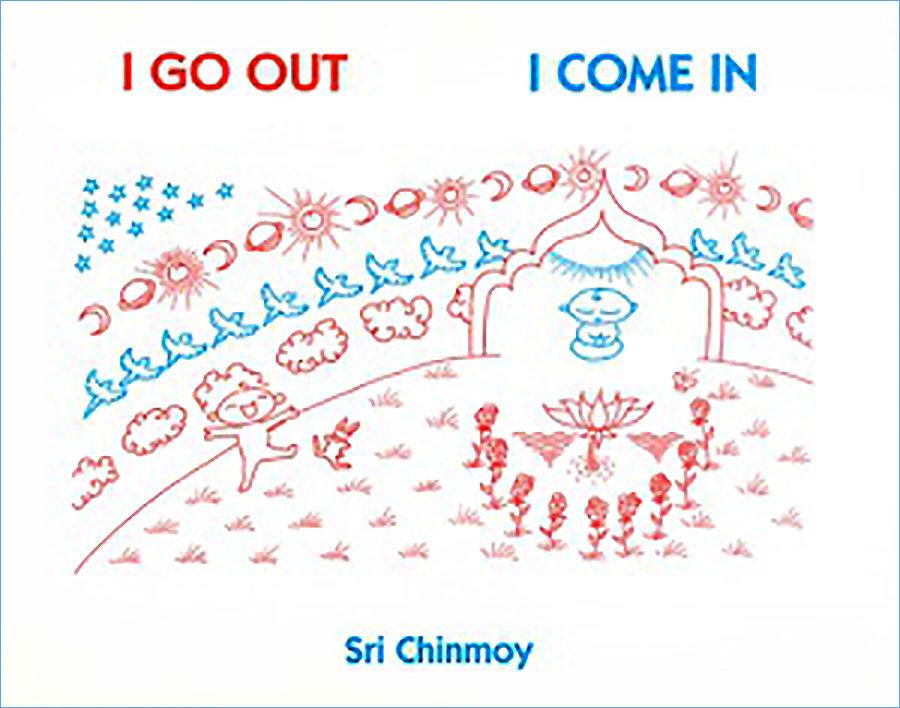
Sri Chinmoy’s book I Go Out, I Come In is published. The first printing contains 33 poems. The second printing contains 92 poems.
When I go out,
I am nowhere.
When I come in,
I am all-where.
I go out
To school my mind.
I come in
To school my heart.
I go out
To buy what I leave behind
Foolishly.
I come in
To reclaim what I am
Eternally.
I go out
To feed my curiosity-mind
And curiosity-eyes.
I come in
To feed my divinity-soul
And purity-heart.
Out I go
To foolishly invent.
In I come
To wisely discover.
I go out
To measure Nature's divinity.
I come in
To treasure Divinity's nature.
When I go out,
Mine is a sound-bound journey.
When I come in,
Mine is a silence-bound destination.
When I go out,
I assume a new name:
Joy-expectation.
When I come in,
I resume my old name:
Peace-foundation.
When I go out,
I try to find God.
When I come in,
God tells me,
"Bind Me, My child,
Once more."
When I go out,
I need what I find.
When I come in,
I find what I need.
When I go out,
I spend money.
When I come in,
I drink honey.
I go out
To watch my mind's exploration.
I come in
To sing my heart's invocation.
Proudly I go out,
Only to say what I can.
Peacefully I come in,
Only to feel what I am.
The carpenter's human son asks me
To go out.
God's divine son asks me
To come in.
Be a brave mind
When you go out.
Be a pure heart
When you come in.
When I go out,
I dine with the known.
When I come in,
I pine for the Unknown.
I go out
To see the Face of God.
I come in
To become the Heart of God.
When I go out,
I see the flow.
When I come in,
I become the glow.
When I go out,
God tells me:
“My child, enjoy yourself.”
When I come in,
God tells me:
“My child, enjoy Me.”
When I go out,
I become a mad elephant.
When I come in,
I become a glad deer.
When I go out,
I start my mind-engine.
When I come in,
I sail my heart-boat.
To see God the Power,
I go out.
To feel God the Peace,
I come in.
Columbus went out
And discovered the New World:
America.
I came in
And discovered my old world:
My Source, my God.
I go out
To get what I want.
I come in
To feel what I need.
When I go out,
I surprise others
And others surprise me.
When I come in,
God and I surprise each other.
I go out
To hear what the world
Has to say.
I come in
Only to see that God is waiting
To hear from me.
I go out
And decrease my money-power.
I come in
And increase my heart-power.
I go out
To see the vastness of the world.
I come in
To see the Infinity of the universe.
I go out
To see the power of greatness.
I come in
To feel the love of goodness.
I go out
To buy the world.
I come in
To love the world.
I go out hurriedly
To learn.
I come in wisely
To unlearn.
I go out to say:
“God, where are You?”
I come in to say:
“God, take me!”
When I go out,
My mind provokes.
When I come in,
My heart invokes.
Published in I Go Out, I Come In, part 1