Sketches in Time

In the recesses of my desk, there is a piece of paper I have kept for almost thirty-five years. It is a portion of a disposable serviette, the kind that usually has a life expectancy measured in minutes. However, this particular item has been imbued with a certain touch of immortality. Despite the relentless march of time and many moves on my part between continents, countries, states and cities, it has remained with me.

The year it came into my hands was 1976.

In the summer of that year, Sri Chinmoy visited Europe to offer a series of free talks on various aspects of the spiritual life. First stop in his busy itinerary was the northern English city of York, famous for its grand gothic cathedral — the largest in Northern Europe — York Minster. The venue for Sri Chinmoy’s lecture, however, was the much smaller Friends Meeting House in Friargate.
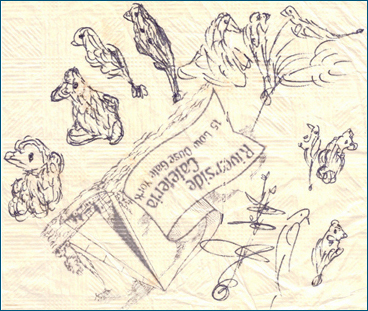
On the morning of his talk, Sri Chinmoy visited a nearby café — Riverside Cafeteria. And while waiting for his food to arrive, he began doodling on a serviette.

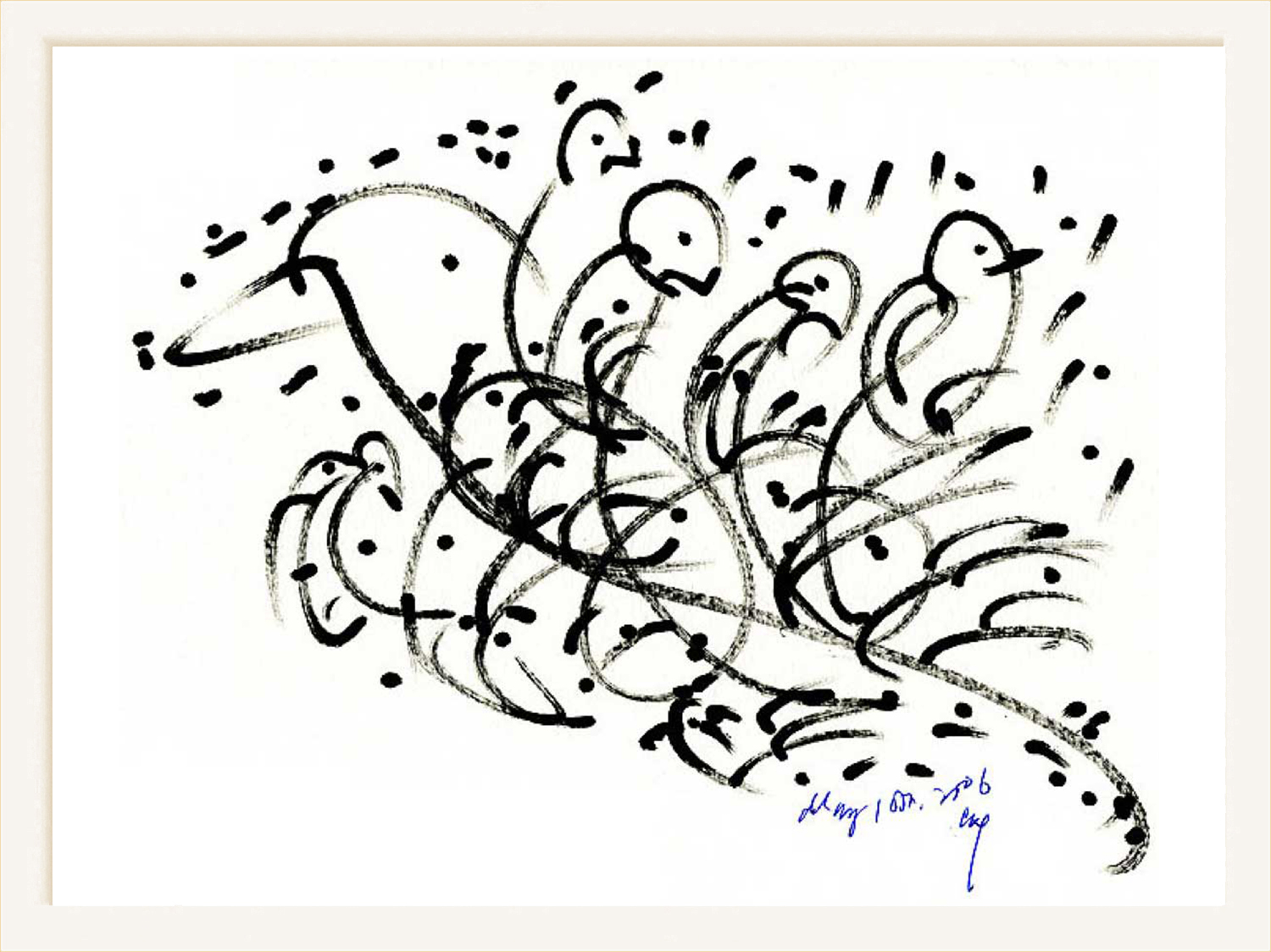
What he drew were clusters of birds and other tiny beings. Some were on branches, some in free flight; some stared with apprehension, others were confident in their cheerful play; some were feathered, as if insulated from the harsh realities of the world; and some were composed of the clean, swift strokes of a master draughtsman revealing with a few unfaltering lines, the essence of the soul in motion.

This was not the first time Sri Chinmoy had drawn these types of images. He would often do a quick sketch of a bird when signing his name or writing a message. They were not considered part of his formal artwork. Perhaps it was for this reason that he walked away from the table at the end of the meal leaving the serviette behind. Fortunately, Sushumna Mary Plumbly, leader of Sri Chinmoy’s London meditation centre at the time, picked it up, carefully folded it and put it away for safekeeping.

A few days later at her home in London, she revealed the treasured memento of Sri Chinmoy’s visit. The excitement welled in her eyes as she opened the folds of the precious artwork and displayed it in its entirety upon the table. Interestingly, the ink did not cross the fold marks, enabling it to be carefully torn into four equal portions without destroying the artwork. She kept one portion and presented three of us who were there on that occasion with a quarter. And so it was that the one became four — like the four points of a compass.

Holding my portion of the serviette in my hands now, it feels as light as a feather. The tissue itself has hardly any substance to it — time has dried and weathered its body and it now seems only to be held together by the lines of art upon its surface. It is so delicate, in fact, that I can almost imagine the tiny birds taking wing, transporting this vignette of physical reality back to a celestial abode. To me, this tiny tableau of birds on a 6x6-inch square of tissue holds impressions of the past as well as a vision of the future; it is a point in time and space where memory and destiny are able to spread out across the vast canvas of time.

Vivid memories of that day in York seem to be woven into the very texture of this small fragment of art: the modern sights and sounds of an ancient city; the age-long vision and meditative silence of a contemporary spiritual master.

In the late afternoon, we drove to Leeds and from there we began our journey back to London. I remember stopping at an Indian restaurant for dinner and then driving down the M1. It was a balmy summer’s evening and Sri Chinmoy was in a relaxed mood. He started to sing one song after another — ‘Ore Mor Kheya’, ‘Ekbar Shudhu Balo’ ...

The songs were in Bengali, a language so beautifully suited to the appointment of melody that translation is barely needed to appreciate the depth of feeling the songs convey. However, one song from that journey, ‘Hiya Pakhi’, vividly illustrates how much he identifies with the image of the bird as a symbol of spiritual freedom. Here is his own English translation:

O bird of my heart,

Fly on, fly on.

Look not behind.

Whatever the world gives

Is meaningless, useless

And utterly false.

Surely no one could have predicted that simple sketches like the ones Sri Chinmoy drew in York, would one day be transformed into an entirely new art form, one that would amaze and enchant art-lovers around the globe. In 1991, Sri Chinmoy began in earnest, drawing birds at a phenomenal rate. He never missed an opportunity to bring into creation the tiny soul-birds he loved so much and, in the decades that followed, he would draw more than 16 million of them. They have been exhibited in prestigious galleries the world over and have been accorded acclaim by all who view them.

Sri Chinmoy’s soulful bird drawings have proven their ability to transcend time and place. The inspiration they carry will continue to expand far into the future. I, therefore, place this delicate page of sketches back into the book of history, evidence that even in those early days the pen of the artist was never still; it was always ready to capture the beauty of inspiration, wherever he happened to be, using whatever resources he had to hand.


— End —


Copyright © 2009, Animesh Harrington. All rights reserved under Creative Commons license.
 

A Magnificent Obsession

To devote oneself to a single thing in life, one noble undertaking, with every fibre of one’s being, to exhibit an intensity of purpose that excludes all other themes and subjects – how many human beings can maintain that commitment? Perhaps the very definition of a genius is someone who is so obsessed by a single pursuit that it consumes him. Then it becomes a magnificent obsession and he is compelled to follow it to its glorious conclusion.

Inspiration visits many creative artists in its diverse hues and colours, but there are certain individuals in whom inspiration repeatedly comes in the same form. Choice of theme and subject is no longer theirs to make. They are compelled to explore and celebrate the same theme over and over.

Among painters, we can trace this kind of magnificent obsession in the works of Vincent Van Gogh who revealed, “The cypresses are always in my thoughts.”

Similarly, Claude Monet echoes, “These landscapes of water and reflections have become an obsession.”

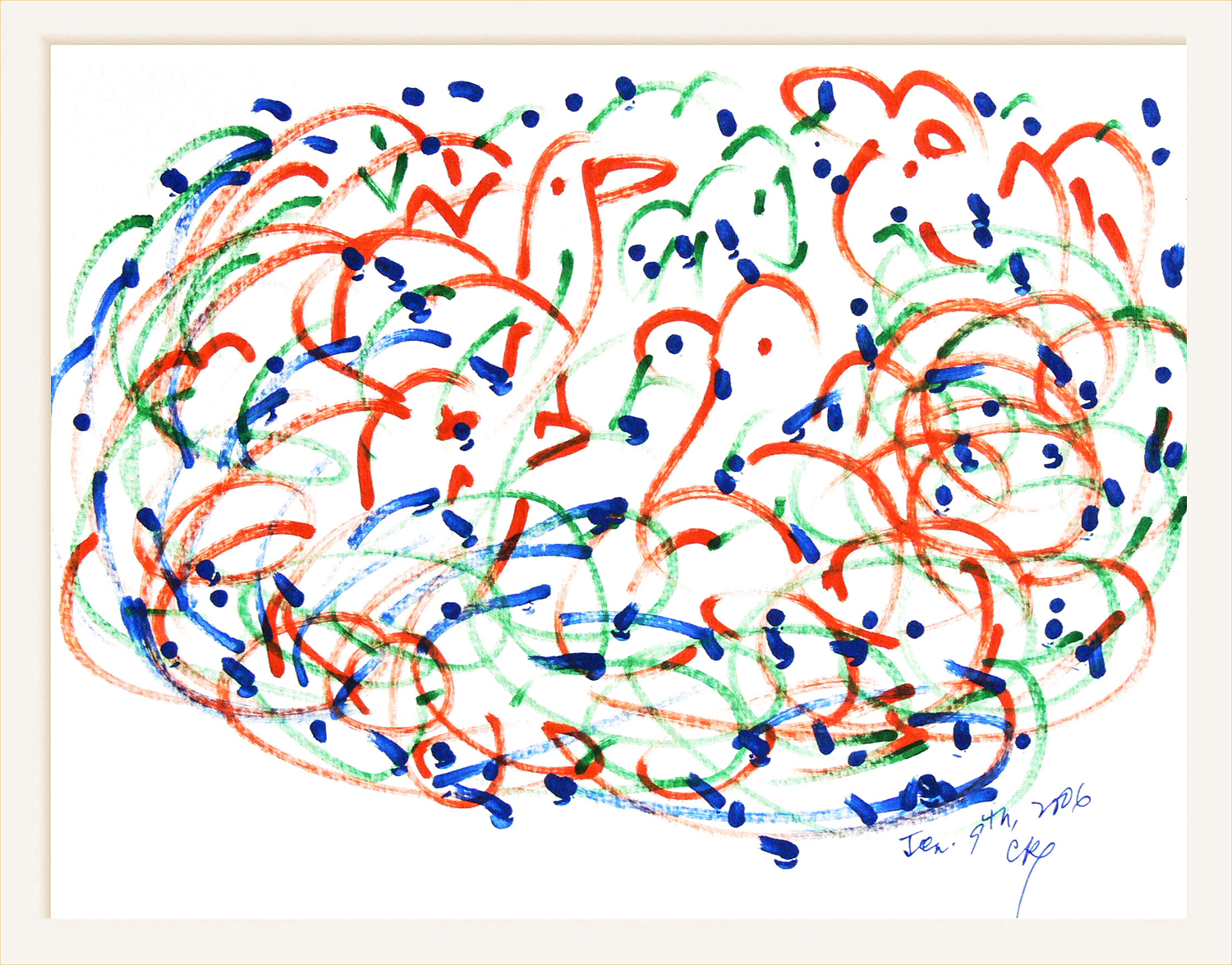
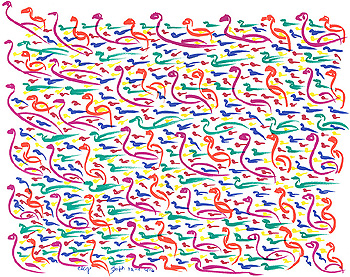
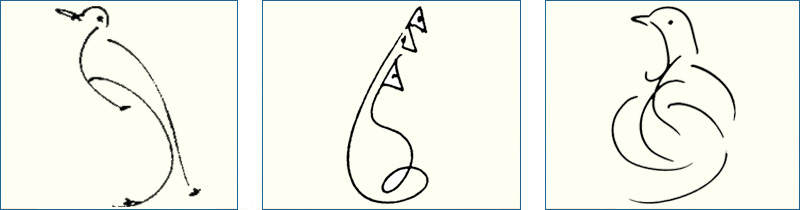
And in this century we have the towering presence of Sri Chinmoy with his bird drawings numbering more than fifteen million. Sri Chinmoy’s obsession with birds began quietly. In December 1991, he was on vacation in Malta with some of his students. One day he took up a small, square pad of telephone jotting paper and rapidly drew a single bird on every page using a ballpoint pen. Each bird was composed of barely two or three sweeping lines and the dot of an eye. His principal concern was not to accurately render the anatomy and outer characteristics of the birds, but to convey their essence. There were hints of species, certainly – the long neck of a swan, the rounded softness of a sparrow, the raised crest of a cockatoo, the extended beak of a kingfisher. There were birds in flight, birds that craned forwards, or peered elusively from behind the curve of a wing. But there was something very different about these birds. It was as if they were the outer notations of a mysterious inner language.

As Sri Chinmoy’s signature style developed, he began to create landscapes composed entirely of birds. Over the years, he has drawn thousands of birds on a daily basis, using felt tip markers, crayons, coloured ballpoint pens and acrylic paint pens. But the form of the birds themselves has remained essentially the same. Sri Chinmoy draws his birds at great speed and with flawless execution. The slow deliberations of a halting line, the time spent erasing a mark once it has been made on the page, the concept of filling in a blank space with painstaking cross-hatching or shading – all this is foreign to him.


To a Western artist, perhaps, Sri Chinmoy’s technique would be an anathema, but not to a master Chinese calligrapher, for example. Such artists are venerated because they meditate for hours before committing their brush to paper. Once they start to paint a character, they complete it in a single, uninterrupted motion.

Sri Chinmoy uses the same kind of meditative approach. When one interviewer asked him, “Do you have a bird in mind when you draw?” he replied,

“I have nothing in mind. I try to keep my mind as empty, vacant and tranquil as possible. The outer mind is like the surface of the sea. On the surface, the sea is full of waves and surges; it is all restlessness. But when we dive deep below, the same sea is all calmness and quiet. It is there that we find the source of creativity.”

Because these birds are not the products of the mind, there is an intriguing simplicity about them, a graphic purity in their appearance. True, they seem to lie flat on the surface of the page. There is no depth of perspective in their portrayal and yet they are not static. There is an almost musical rhythm in their positioning, in the interplay of lines and space. The great philosopher Lao Tzu once wrote:

“Thirty spokes converge towards the hub, but it is the space between them that forms the essence of the wheel… This is the rule. The material harbours usefulness, and the immaterial imparts the true essence.”

Sri Chinmoy engenders the essence of each bird as much through the spaces between the lines as he does through his ever-shifting combination of curved, wavy, elongated, angular and flicking lines.

Moreover, the dynamic movement by which they are created is somehow transferred to the birds. They are like energy fields, pulsing with life. Nor are the birds tethered to the page by details of scenery. They exist alone in a white space, free from embellishments of any kind. This isolation makes them seem more truly notations, or seismographs, of an inner meaning. Sri Chinmoy has blurred the distinctions between art, ideographic writing and calligraphy with his ethereal creations.

Like many a creative artist before him, this gift appears to be self-born rather than the product of artistic training and accepted shibboleths. He reflects that he studied a little art in school around 1944, but never had any real instruction. He adds, “Everything I do is entirely the result of God’s Grace. I get all my inspiration from God.”

Again, it is becoming increasingly manifest that while this artist pays no heed to fashion, his style of drawing may itself become fashionable. Recent exhibits of his works in Paris, London and Vienna have garnered considerable acclaim. But the primary interest in his work is undoubtedly focussed on the fact that he has reduced the symbolic landscape to one element – the bird.

Sri Chinmoy has frequently been asked to explain the symbolism of his birds. He replies:

“I am a man of prayer and meditation. For me, birds have a very special significance on a spiritual level. They fly in the sky, and the sky is all freedom. So when the birds fly in the sky, they remind me of the soul’s infinite freedom. The soul has come from Heaven. When we think of birds, we are also reminded of our Source, and this gives us enormous joy. I feel that if people come here to view these birds, their inner hunger to fly in the sky of infinite freedom will be fed.

In another interview, he made a direct connection between this inner freedom and peace: “Each bird reminds me of freedom, and I feel that freedom lies in peace and nowhere else.” Hence, the beautiful name by which Sri Chinmoy’s bird drawings are known: “Dream-Freedom-Peace-Birds.”

Perhaps one of the most moving comments about Sri Chinmoy’s bird drawings was offered by the late maestro Yehudi Menuhin. In a letter to the artist in 1994, on the completion of Sri Chinmoy’s first million bird drawings, Yehudi Menuhin wrote:

“It is good to know that you, who have such a great following, can bequeath the world so many drawings and sketches. We have become so addicted to the camera that we have forgotten how the ancient travellers entered their impressions on a notebook, both graphically and verbally. I congratulate you on this wonderful achievement, which transports us men, who would be winged, to the birds, which we have tried to emulate.”

– End –


Copyright © 2009, Vidagdha Bennett. All rights reserved under Creative Commons license.
 

February 9


Photo by Sarama Minoli


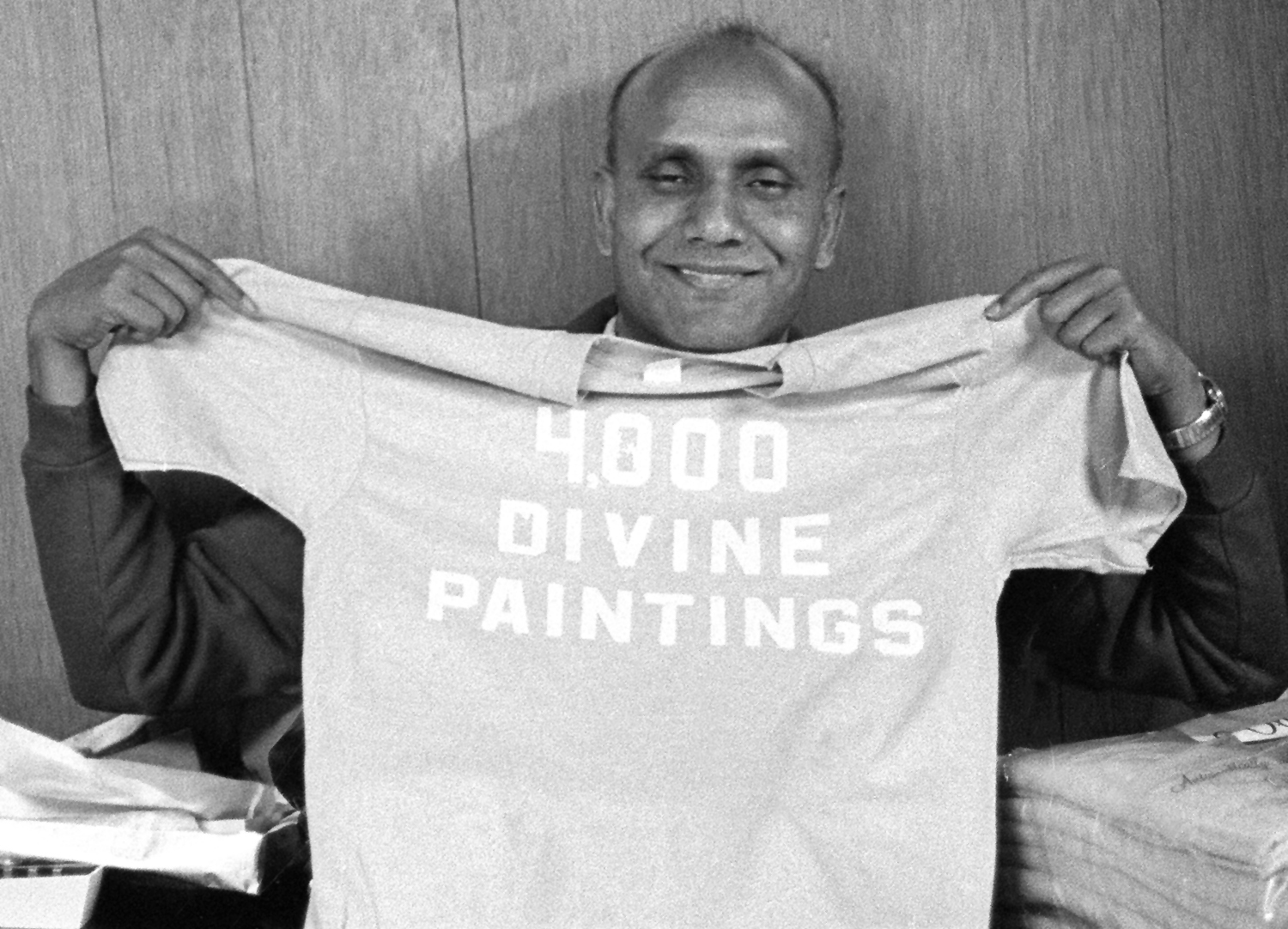
Sri Chinmoy celebrates his most recent artistic achievement of completing 4,000 Jharna-Kala paintings, at a function with his students held at the Bayside Church in New York.


March 8

Photo by Bhashwar Hart


The first Jharna-Kala Parade is held on Madison Ave in New York.


Jharna-Kala Parade in New York City

Braving freezing winds and near 0˚C temperatures, a Jharna-Kala parade is held in New York City to celebrate and honour Sri Chinmoy’s completion of 10,000 paintings in 100 days.

One lane of Madison Avenue is blocked off to make way for balloon-decked police cars, horses, drill teams, flags, banners, clowns, flower-covered floats with large reproductions of paintings, and even a unicyclist. Along the way, spectators are offered balloons and flowers and lots of goodwill.

At 2:00 p.m., the parade proceeds up Madison Avenue from 59th Street and turns towards Central Park at 72nd for a free concert by Mahavishnu John McLaughlin and Devadip Carlos Santana. Over two thousand enthusiastic listeners attend, many of whom had thronged around the float on which the musicians had played throughout the parade.

At Central Park, Sri Chinmoy walks on stage to meditate with Mahavishnu and Devadip and bless them.


January 8

Photo by Prashphitita Greco


An exhibition of Sri Chinmoy's artworks in Suva, Fiji, including the large drawing displayed, which contained the 1,000,000th Soul-Bird.


February 8

Artwork no. 14815


Sri Chinmoy presents His Majesty King Sinoehoen Pakoeboewono XII of Surakarta, with a special Soul-Bird drawing in Nusa Dua, Bali, Indonesia.


March 7


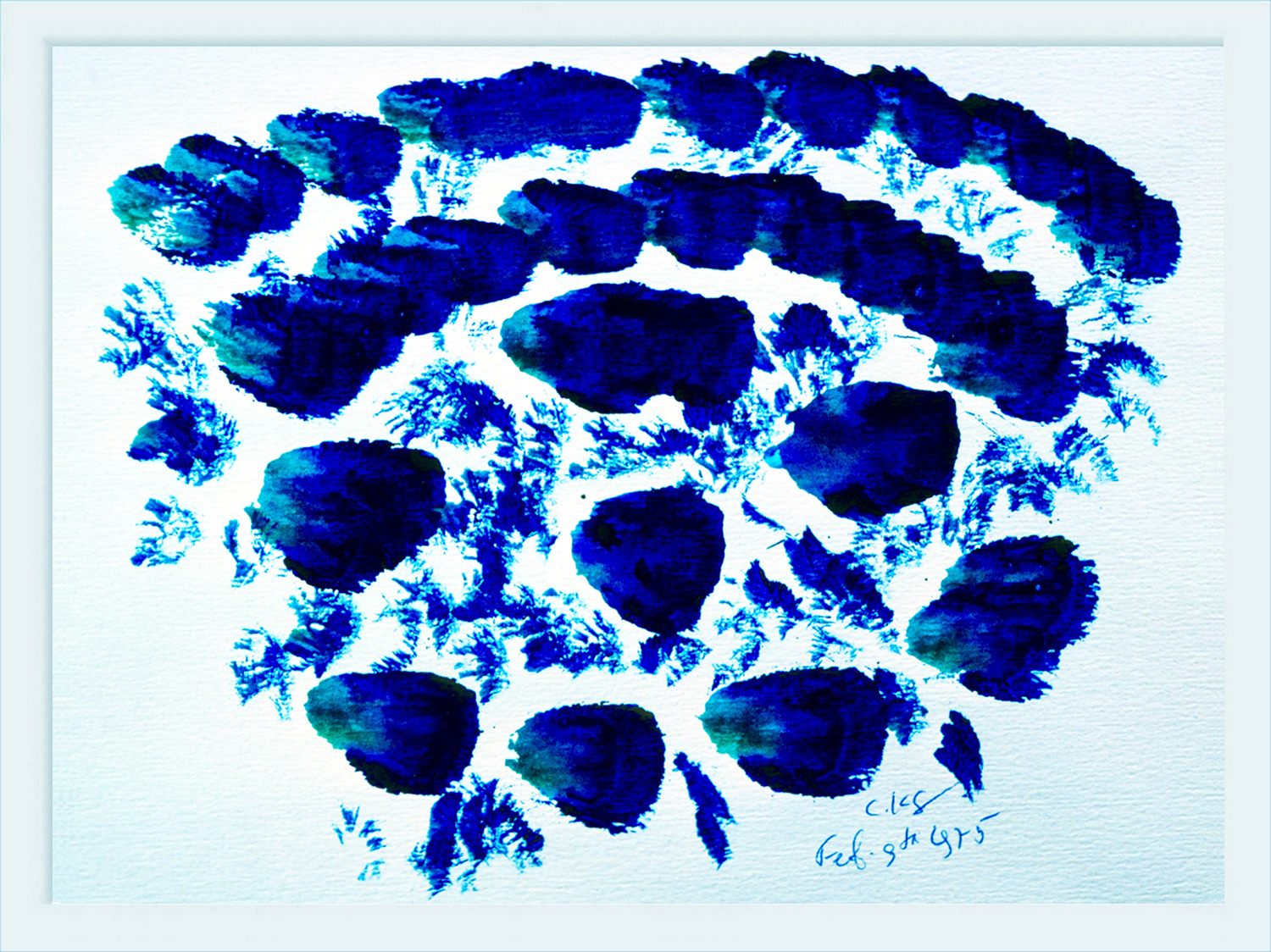
During his visit to Sydney in New South Wales, Sri Chinmoy created seven Jharna-Kala sketches in chalk.


Description

  • Medium: Chalk
  • Material: Sketch paper
  • Dimensions: 34.5 cm x 25 cm

Provenance

  • Date: March 7, 1976
  • Origin: Sydney, NSW, Australia
  • Collection: Sri Chinmoy Centre (Sydney)

Note

Sri Chinmoy commented at the time that the drawing above represented the Soul of Australia.


January 7

Photo by Prashphutita Greco


Sri Chinmoy during a boat trip off Suva in Fiji takes a few moments out to catch up on the news — the newspaper he is reading features an article about his historic artistic achievement of completing one million Soul-Bird drawings.