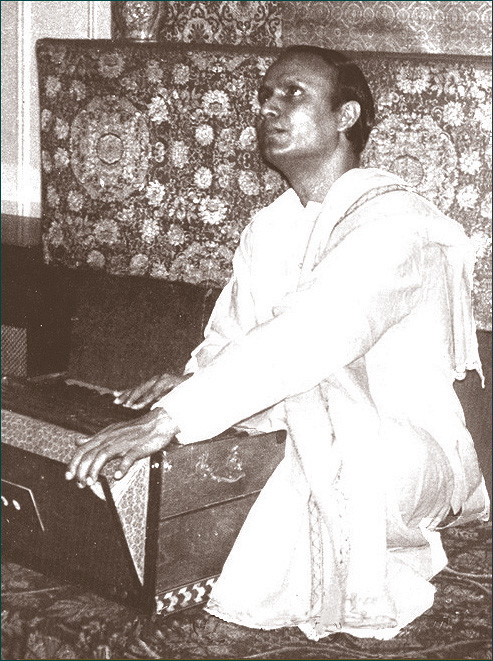
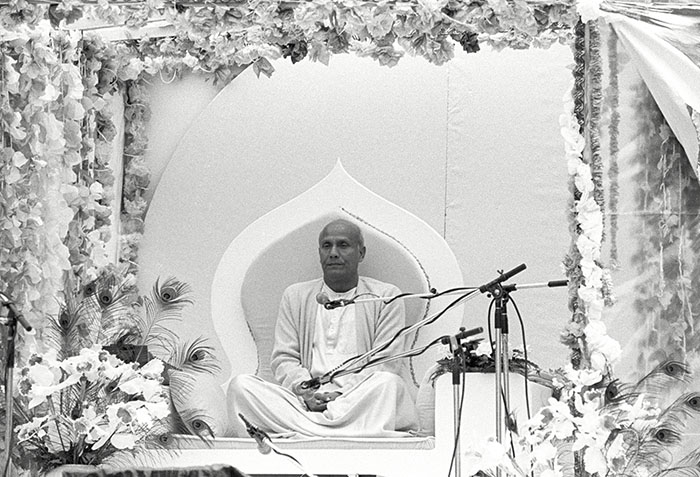
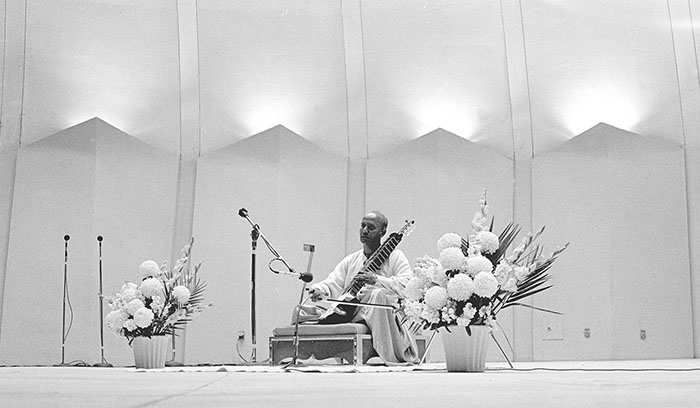
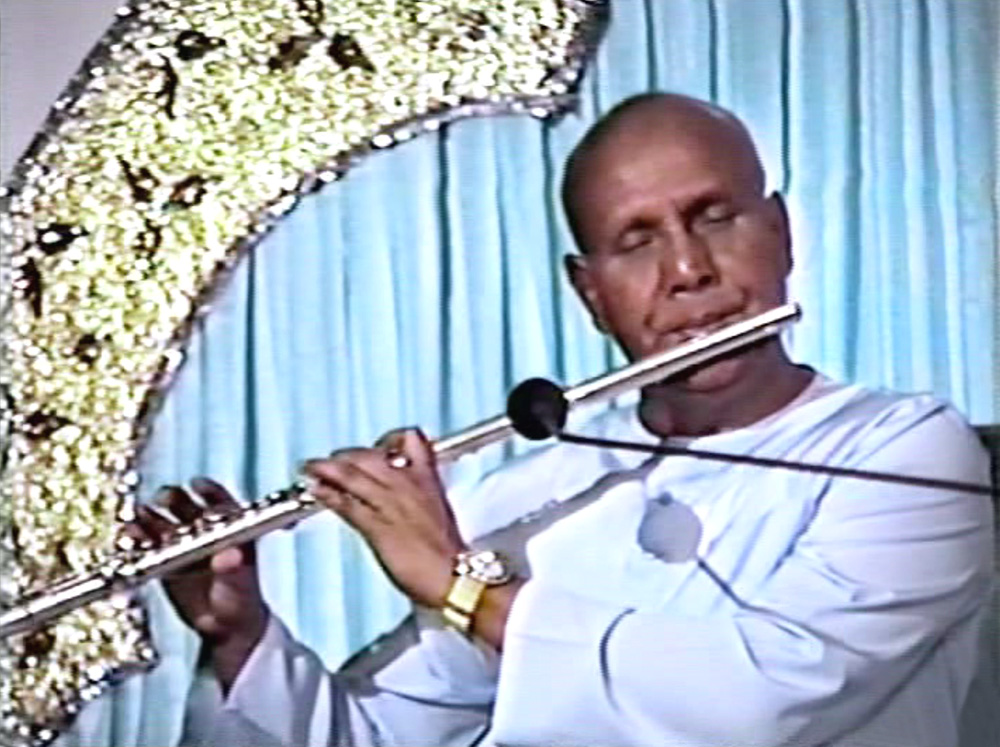
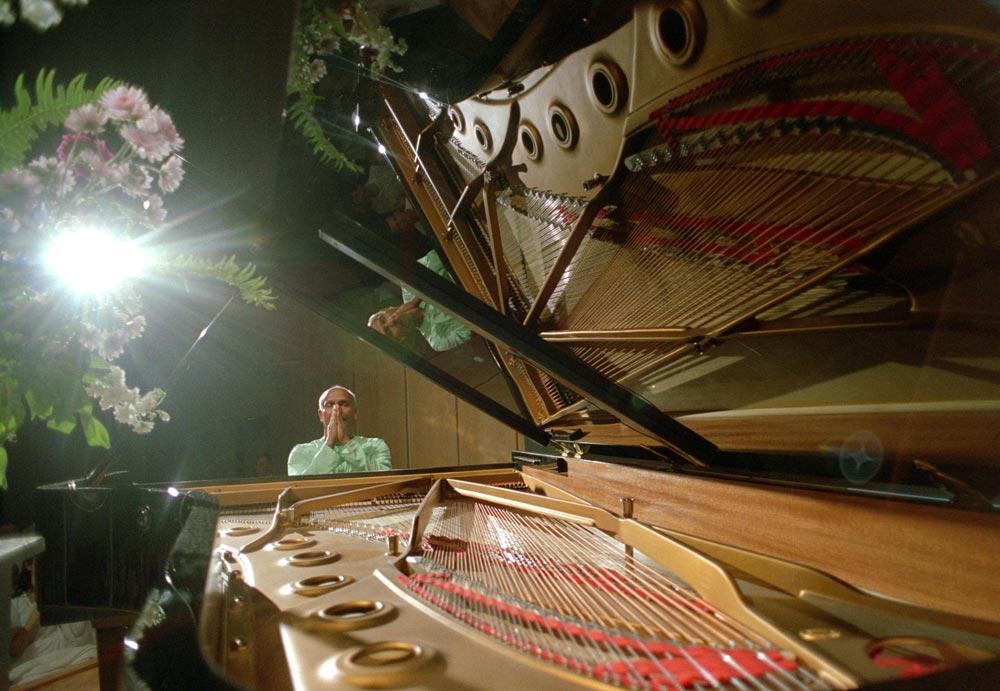
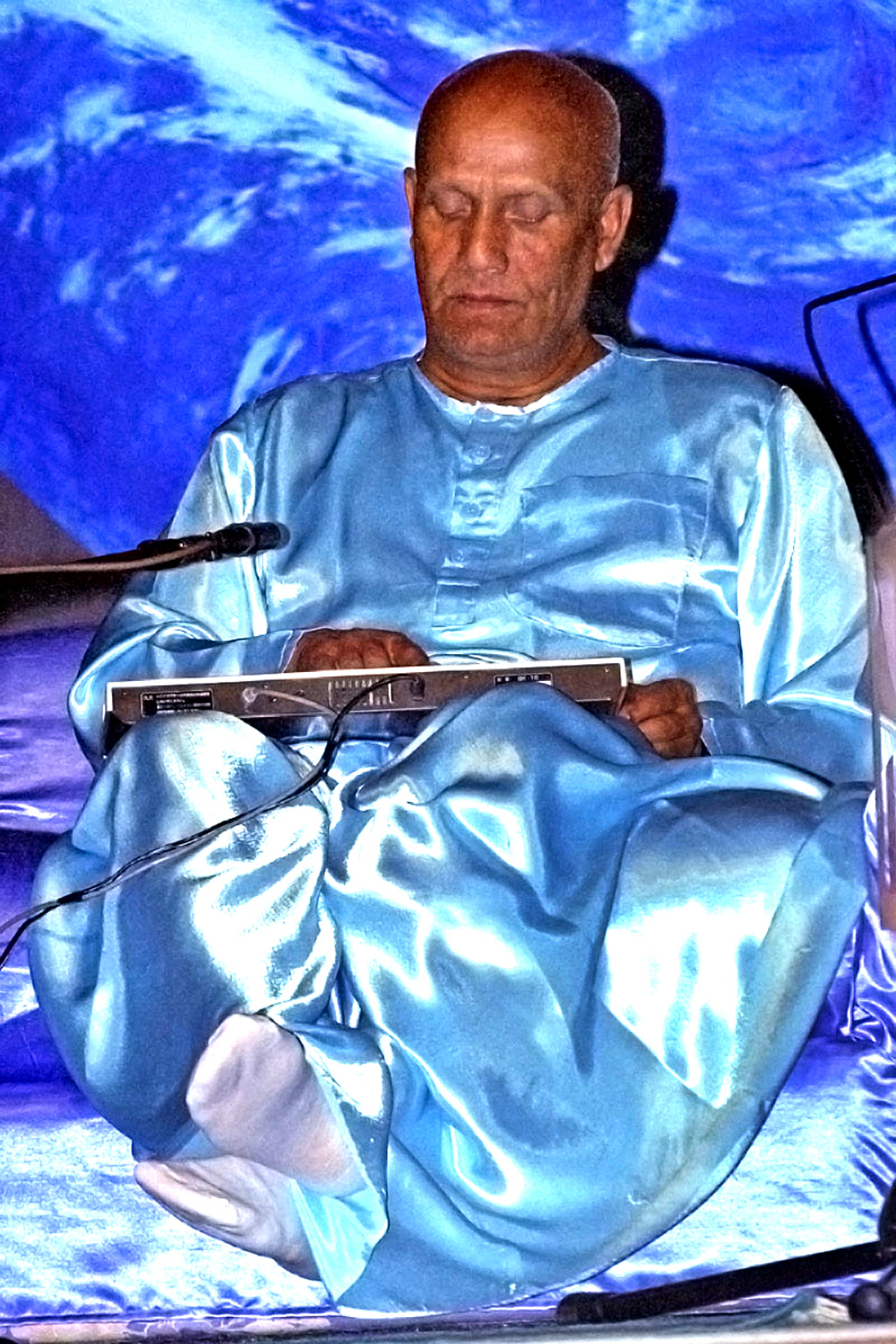
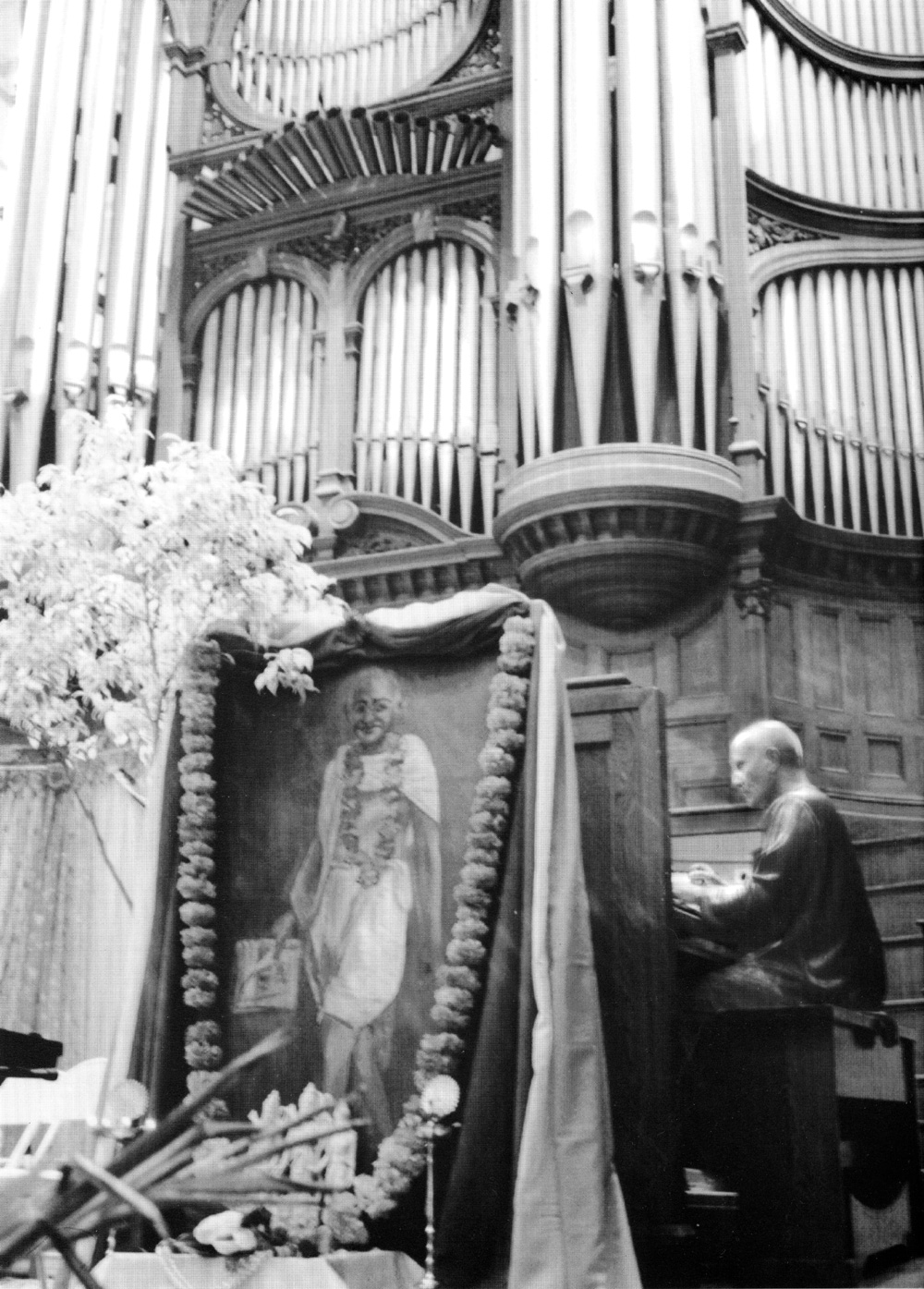
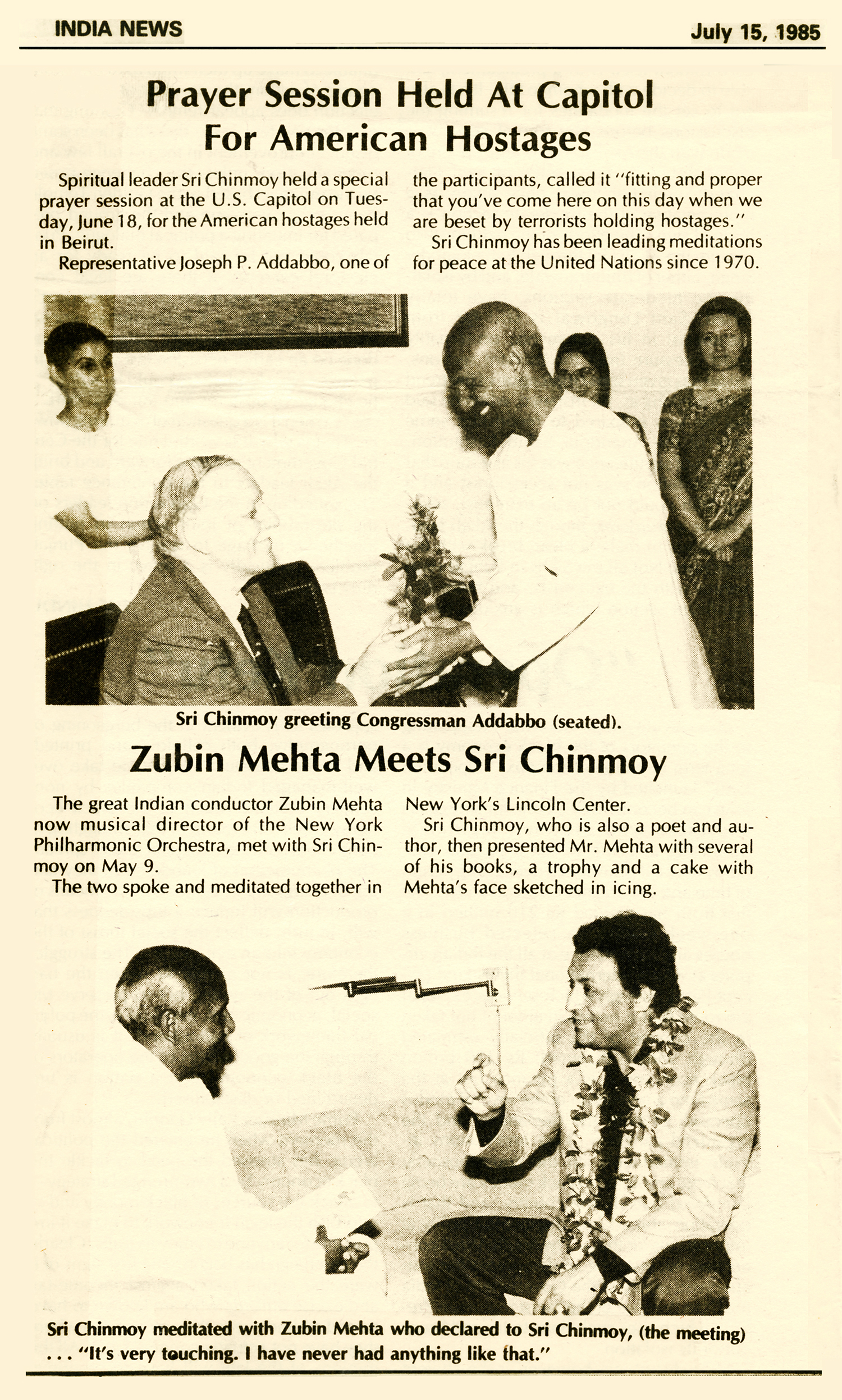
In 1976, Sri Chinmoy made two momentous musical discoveries: the esraj and the flute. The esraj he came across in February, in a book of Indian instruments. When he obtained one shortly afterwards, the haunting effect of this bowed instrument delighted his musical ear, and the esraj subsequently accompanied him on a visit to Australia at the end of February.
It was to be here, in Australia, that Sri Chinmoy would become acquainted with the classical Western flute. Previously, he had played considerably on the simple Indian reed flute. Although this instrument has a tremendous purity of tone, he found it lacking in the agility needed to convey subtle nuances and shades of expression. Now, one of Sri Chinmoy’s disciples, a young girl of nineteen years, introduced him to the modern transverse flute. The grace of the instrument and its clear, limpid sound appealed deeply to Sri Chinmoy and, on March 10th, he requested the opportunity to play it.
The occasion was a bus trip to Healesville Animal Sanctuary just outside Melbourne. As the bus rolled through the foothills of the Dandenong Range, Sri Chinmoy’s first lesson began. His young disciple carefully explained the art of embouchure and fingering and, in less than two hours, when the bus had reached its destination, Sri Chinmoy had mastered the basic scale. Alighting from the bus, he delighted everyone by walking through the various bird and animal compounds playing the flute to entranced kangaroos, cockatoos and all who would listen.
He was the student and his disciple was the teacher. It was an unusual reversal of roles. But how long can such a one disguise his true nature? How long to hide with utmost humility in the role of a novice musician? The great musical wealth housed inside his breast could scarcely be contained.
A Master Musician
What can be said of Sri Chinmoy’s progress on the flute? Technically, the advances that he made over the next few months were extremely rapid and significant. His flute became his constant companion. Whether reclining on his couch, travelling in the car or even walking along some solitary corridor, the silver tip of the upraised flute could be seen, with gentle fingers dancing over its surface, scattering notes of radiant beauty.
It seemed that long in advance of fully mastering the flute technique Sri Chinmoy could hear the ethereal tunes he would ultimately produce. He sought a note of pristine purity, a peace-breathing, soul-stirring note. This led him to experiment with the entire flute range – from bass and alto flutes through to C soprano and piccolo. He played flutes that were silver, gold and platinum-plated, inexpensive student models and hand-made masterpieces. His most frequent choice was a Haines C soprano flute in the Boehm style, with closed holes. Its clear, limpid tone was capable of every conceivable nuance.
As Sri Chinmoy continued to practise more and more, he found that technique, as such, no longer stood in the way of translating his inner songs into musical form. Deploying all the acoustic properties of the flute, he was able to play with infinite variation and expressiveness. The notes that he created were clean, crisp and finely articulated; he had a thorough appreciation of phrasing; he was especially adept at producing incomparable sequences of notes – slurs, trills, unusual intervals and turns. He was able to make single, detached notes last endlessly by virtue of his excellent respiratory control.
In November 1979, Sri Chinmoy added a new and surprising effect. The flute was made electric and connected to an echo chamber. This had the result of amplifying and prolonging each individual note so that the listener gained the impression of a continuous overlay of sound. In effect, Sri Chinmoy had added the mountain summit or the farthest horizon to his playing. It was the note heard from afar, floating across the valleys with bird-like clarity, borne on the wind to pierce our hearts.
The Silver Sound
The pure, melodic line that constitutes the essence of Sri Chinmoy’s music sets it apart from the Western system of harmonics. The evolution of Western music is based on the belief that consonance of sound is most pleasing to the ear. This has led to the rich orchestral effects of Western classical music. Sri Chinmoy, however, inclines towards the delicate structure of Eastern classical music, with its emphasis on simplicity and clarity. He has ever preferred the distinct melodic thread of the single instrument, uttering its song alone and unqualified. The sound issues from the silence gradually; it does not break or disturb it. And it returns to this silence-source at the close of the song – like a small wave spinning out the length of the shore and then sinking back into the ocean depths.
Explaining his views, Sri Chinmoy writes:
“I personally feel that there are many, many songs which will be better if you do not embellish them with harmony. If you carry just the melody, they will be really haunting. Then the pristine purity of the song will remain. Our haunting Indian melodies go right to the very depth of the heart and soul.”
When Sri Chinmoy plays upon the flute or the esraj, unaccompanied by other instruments, the musical instrument becomes his own voice, full of luminosity and power. This music is of a kind that cannot be poured into tight and traditional forms. It recognises no boundaries, save those accents of feeling which the flautist seeks to render. It presupposes only the awakened heart of the aspiring seeker, whose ear is the deputy of his innermost being.
What is it that makes hearing Sri Chinmoy play his flute such an extraordinary experience? One might be seated in a large meditation hall, rapt in silence, when from the stairwell a trill of wondrous notes, like some invisible perfume, touches the delicate fibres of the soul. Helpless before such magic, the soul inhales them deeply and melts in them. A glissando, a sudden cascade of notes, and the air is subsumed once more by silence.
Immersed in the Divine
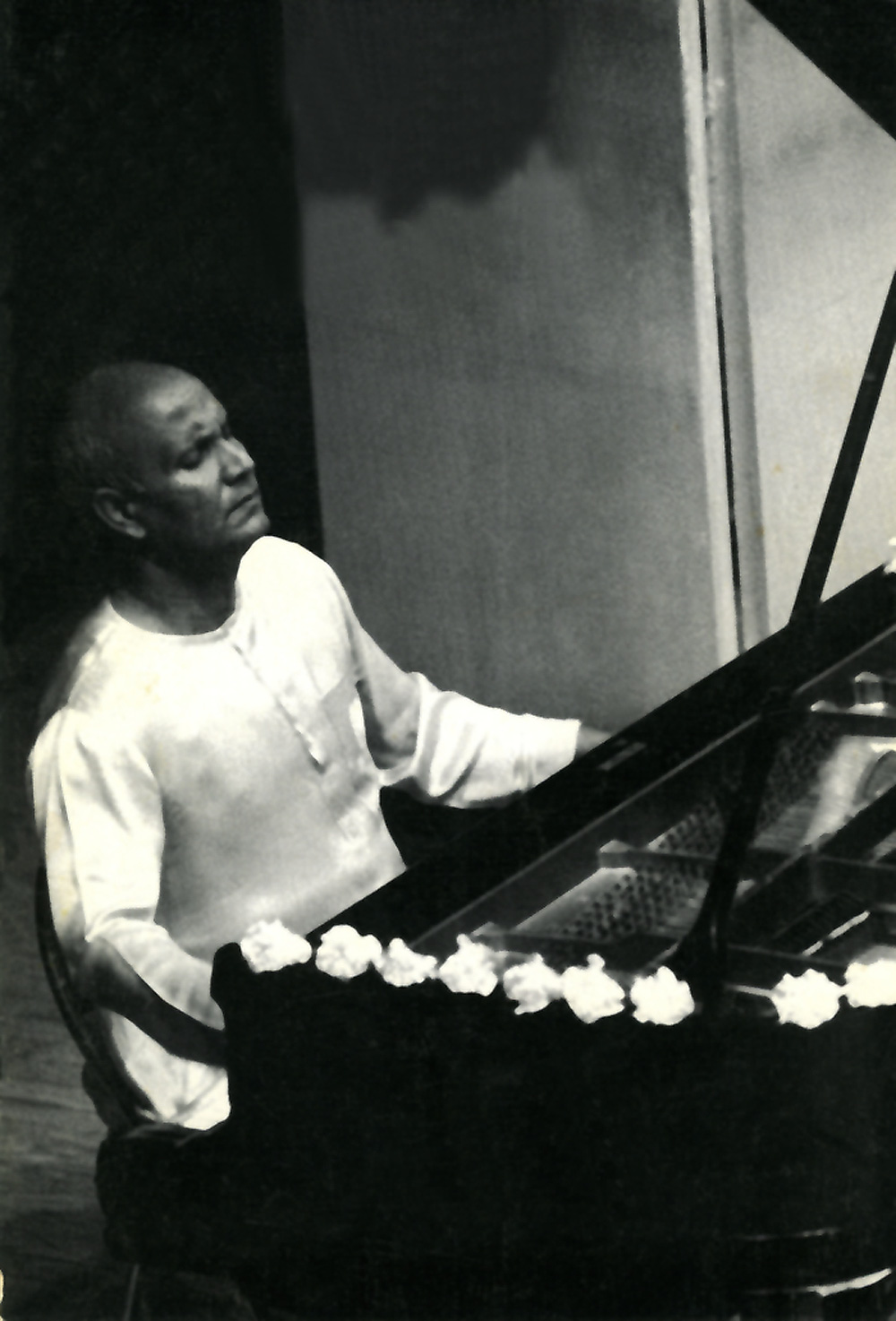
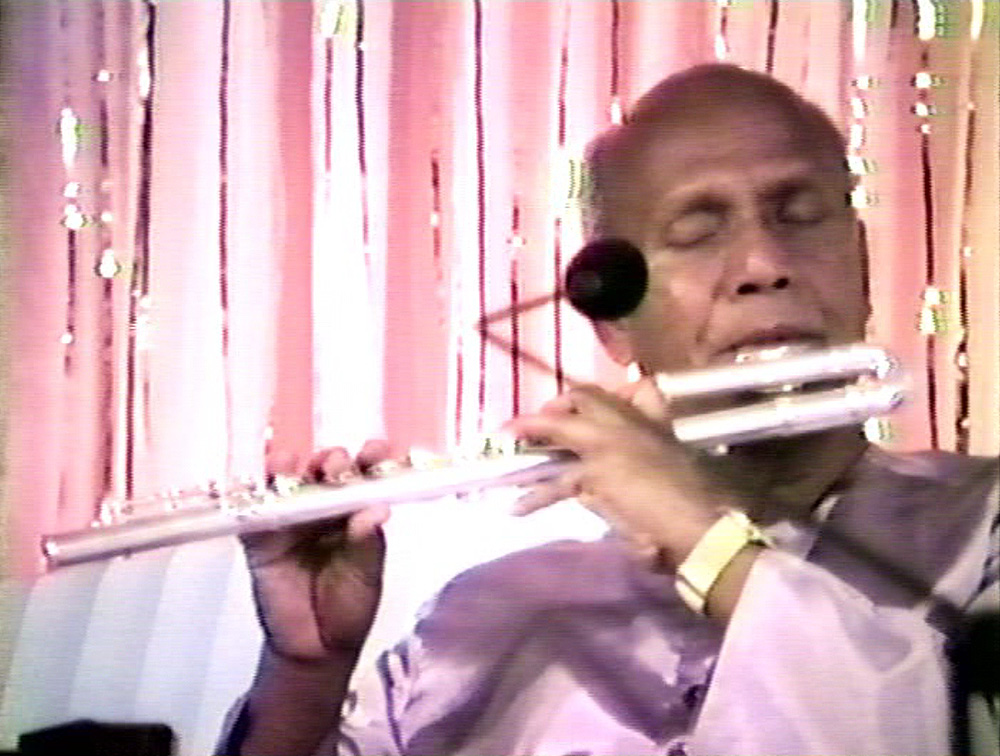
Sri Chinmoy relaxes in his chair, his eyes closed in sublime peace, his plaintive flute shedding soft, low notes. There is something in the quality of his playing and in the outline of his figure in repose which strikes an ancient chord.
The image of the divine flautist is one of the most beautiful flowers of Eastern mysticism. Sri Krishna played upon his flute in the forest of Brindaban. Hearing his call, the cowgirls living at the edge of the forest would leave their homes to join him in his divine play.
The experience of seeing and hearing Sri Chinmoy play the flute summons similar associations. Gone are the leafy forest trails and lotus-filled ponds, gone the peacocks and placid, white cows, yet the same serene smile dances across his countenance and his flute music evokes the same inner thrill. In Sri Chinmoy, we discover anew someone who seeks to awaken aspiring humanity and lead it into the presence of the Divine. He frames songs of human transformation to release mankind from the slumber of inconscience.
In poem after poem, Sri Chinmoy pays homage to Lord Krishna through his portrayal of a mysterious and evanescent flute-player. None can ignore the peremptory summons of his flute:
There goes my Beloved, my sweet Lord, The anklets ringing on His Feet. I hear the music of His Flute Vibrating through the horizons. If ever my cowherd boy should cast a glance Behind Him, still He only goes forward. Let my eyes follow the track my Beloved treads. In the twilight hour of the day, with a sweet And serene smile, Leading the herds of varied light, My cowherd boy goes.
Lord Krishna, the eternal youth, draws his devotee through the siren-like music of his flute. Listening to Sri Chinmoy’s flute, it is possible to feel the same unfathomable call of the Divine. It may be that in each and every age the hearts of seekers will be captivated by a gentle flautist who, taking up his instrument, diffuses a spontaneous flow of notes such as none has ever heard before, nor will hear again.
Sri Chinmoy in Concert
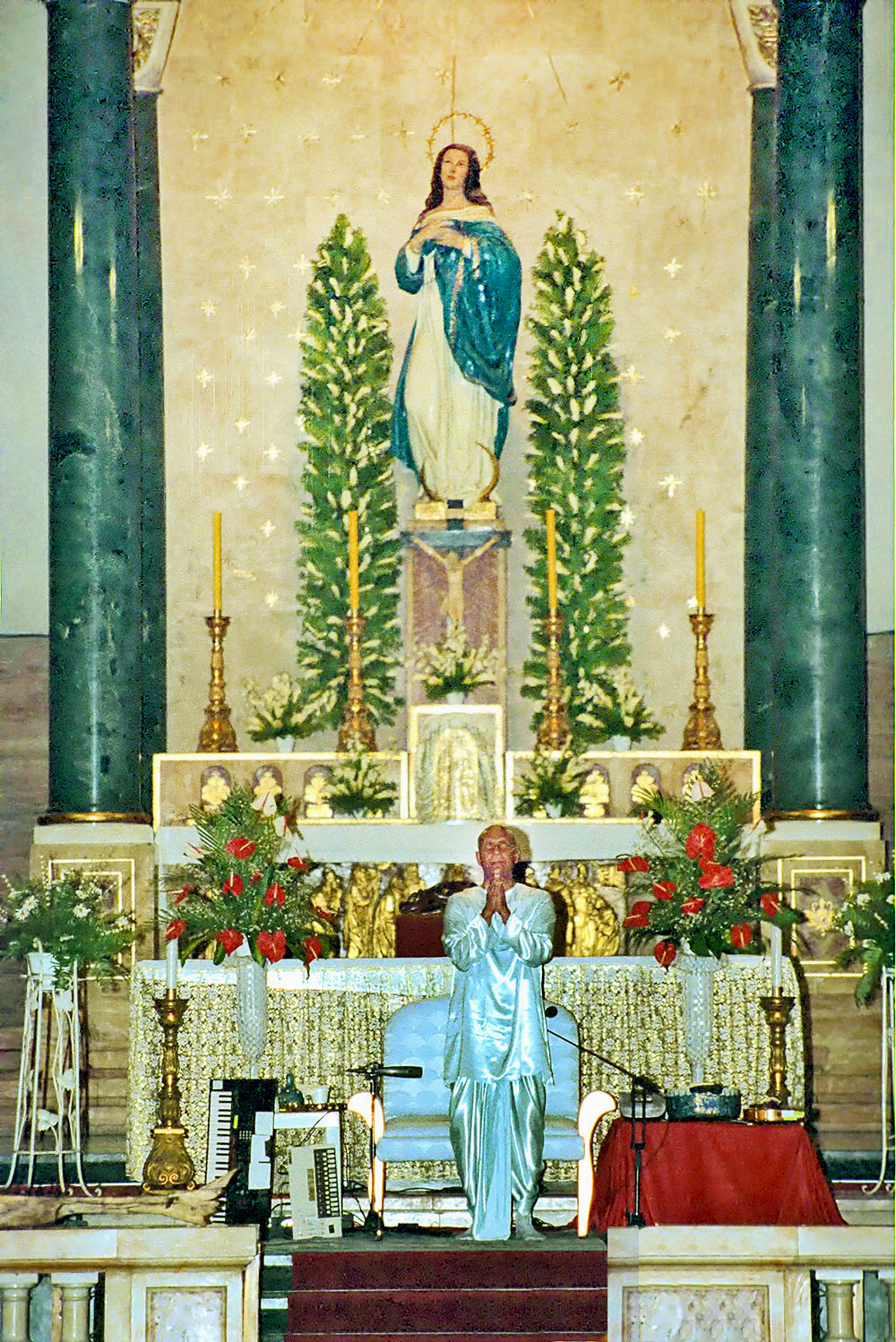
April 7th, 1982. Sri Chinmoy has come to Carnegie Hall, showplace of the world’s premier musicians, to make his unique offering – a free musical concert in which he will perform on esraj, flute and harmonium.
The vast stage discloses the familiar, meditative figure of the master. He is seated in an upright chair. Slowly he bends down and picks up the flute by his side, feeling the shape he knows so well. He lifts the silver mouthpiece to his lips and releases the first long, fluttering note. As all the air begins to vibrate with his musical creation, we seem to discover some long-forgotten concord, some melody whose absence has made our hearts heavy with the ache of centuries.
Some audience members, finding themselves swept away by the magic of the music, impute to it heavenly scenes and vistas. In a 1980 review in the Washington Post, Richard Harrington was moved to write:
“Sri Chinmoy performed a lovely, very modern flute essay, pretty enough to make a deer lay its head on the musician’s lap.” [June 7th, 1980]
The pastoral arcadia to which this critic was transported vividly reminds us of Stendhal’s statement: “The only reality in music is the state of mind it induces in the listener.”
On June 4th, 1982, Sri Chinmoy performed before an audience of 2,400 at the Louise M. Davies Symphony Hall in San Francisco. After the concert, one admirer wrote:
“Sri Chinmoy’s concert was Heaven! Thank you for a beautiful experience. His presence of love itself was worth the trip to the city. Then, as he became the perfect instrument through which the music of the universe could express itself, I was absolutely transformed.”
The experience of Sri Chinmoy’s flute music is subtle but unforgettable. We, who are present at its blossoming, have but a partial glimpse of its immense and ultimate role. Already seekers far and wide are conscious of the presence of a higher, nobler and purer inspiration in the world. And perhaps, like the deer that the Washington Post critic envisioned, we may eventually follow this flute trail to the Lap of the Supreme.
– End –
Editor's note: The author originally wrote this article in 1982.
"I dare any sensitive man or woman to remain unmoved by this music." – Conductor lsaac Karabtchevsky had just heard Sri Chinmoy playing the pipe-organ.
Sri Chinmoy is better known as a meditation teacher, poet, composer, painter, athlete, weightlifter, for his worldwide Peace Concerts, and as Director of Sri Chinmoy: The Peace Meditation at the United Nations.
He recently took up keyboards, with stunning results.
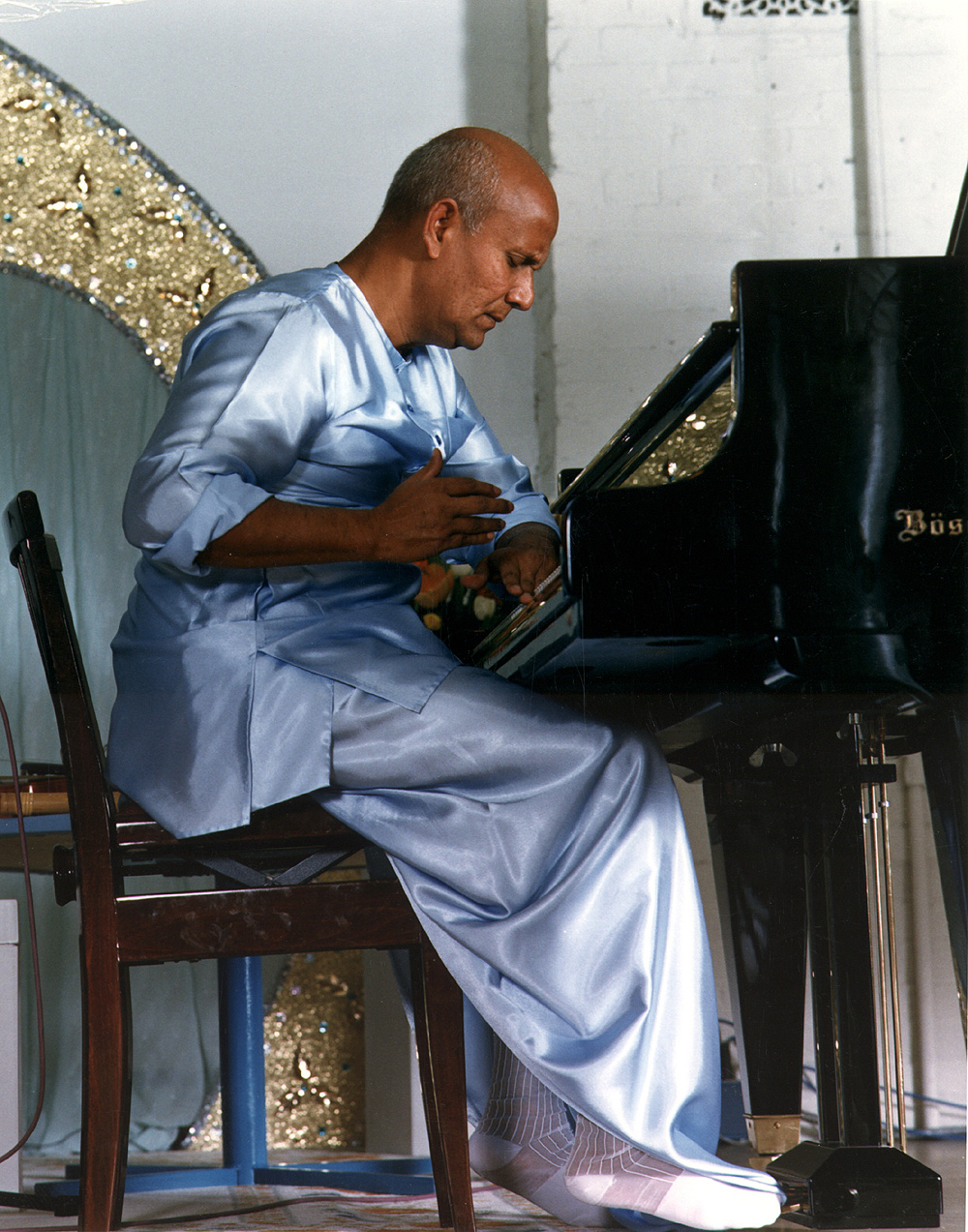
On the 18th of February 19871, Sri Chinmoy first sat at a piano and spontaneously improvised for 2½ minutes. Of course he has had no formal training; he does not read music.
Four days afterwards at a concert in New York, he first played in public, a 13-minute improvisation that he later gave the title, ‘The Battle of Kurukshetra’ (the epic battle fought in the ‘Mahabharata’ between the Pandavas, representing the forces of good, and the Kauravas, the embodiment of darkness and ignorance).
On hearing recordings of his debut performance, numerous classical, jazz and contemporary musicians expressed awe at Sri Chinmoy's astonishing technical capacity; at his radical and uncanny rhythmic control and explosive dynamic power; but above all, at the compelling force of a relentless tidal-wave of inspiration.
Concert pianist Milton Kaye declared: "Sri Chinmoy has the stuff that music is made out of. Artists would kill for what Sri Chinmoy has!"
And what is that stuff? Leading New Age musician and composer Steven Halpern provides a clue:
"Music is a carrier for consciousness. Sri Chinmoy infuses his music with power and elevation. So everything that Sri Chinmoy plays becomes all the more effective because of his consciousness."
"Consciousness," writes Sri Chinmoy, "is the spark of life which connects each one of us with the Universal Life. It is the thread that puts us in tune with the universe… It is the link between God and man, between Heaven and earth. God is an infinite Consciousness. There is no human being who does not have within him this infinite Consciousness…"
A spiritual master such as Sri Chinmoy has established an inseparable oneness with this infinite Consciousness.
Most of the time, however, our own consciousness is very much on a finite level, a level largely determined by the inherent limitations of the mind. To enter into the infinite Consciousness requires first the transcendence of the limited, reasoning mind. To achieve this, one particularly effective vehicle is music.
Just as consciousness exists on many different levels, even so, different music will express and manifest these various levels, and be received and assimilated accordingly. Sri Chinmoy's music, performed spontaneously by one with no training, yet so overwhelming in its energy and directness, is clearly coming from a supramental stratum of consciousness, from somewhere quite beyond our normal human framework of perception.
Legendary percussionist Milford Graves exclaims:
"It is 'out of earth' music. It is cosmic music, beyond this galaxy. Sri Chinmoy's sense of harmony and rhythm is fantastic. You can hear all aspects of life. Nothing is planned. Sri Chinmoy's approach is the highest approach. You have to have the wisdom of the innermost Truth to play like this. Sri Chinmoy is doing what other musicians would like to but can't because they are so moulded. His music is the ultimate!"
Pianist Scott Cossu has sensed that Sri Chinmoy is leading the way for other musicians:
"Sri Chinmoy's piano music is crossing that border between the human element and the spiritual element. It's the connecting force. It's extremely challenging to speak the musical language Sri Chinmoy is speaking. It's a language of connection with God. This is so powerful that my words pale next to his music."
Composer Kalatit Baker sees this music as spiritual revelation: "Franz Liszt described the piano as 'the 88-note orchestra.' Now under the hands of Sri Chinmoy the piano has become 'the 88-note window of the Beyond.' Like water in a channel from a great ocean, notes cascade, race and flow with unlimited power, beauty and life energy. They are perfect in their revelation of experience beyond earth-experience and beyond the life we know."
When performing, Sri Chinmoy enters into a very high meditation, surrendering the limited consciousness of the mind to a higher force within. "I am not the doer," he says. "I don't bring it forth, it comes. It comes to the fore from within. Only I try to be a faithful instrument in all my activities. I have written considerably, I have spoken considerably, I have sung considerably and also I have composed considerably. Each of these activities I try to do as a devoted instrument of my Inner Pilot… My Inner Pilot executes His Will in and through me according to my power of receptivity."
The Inner Pilot can be seen as the dynamic, creative aspect of the Universal Consciousness. The artist serves here as a mirror wherein we glimpse the nature and workings of a common, higher state of Being, our true Self.
For most artists, inspiration is a fortuitous blessing, or the sporadic spoils of a desperate pursuit. For Sri Chinmoy: "Inspiration is like a flight of birds. When birds fly overhead, why should they land where you are? Why should they come to you? Since I am a spiritual Master, I can say, 'Stop here,' and they will stop."
While most artists labour for some time in the process of creation, for Sri Chinmoy creation itself is spontaneous. He has said that writing poetry is for him like drinking water. In his musical performance, Sri Chinmoy spans inspiration and articulation, vision and reality in one instant. There is no process involved in this music, no interpretation. It is the sheer joyous self-revelation of a state of absolute Being, of pure boundless consciousness.
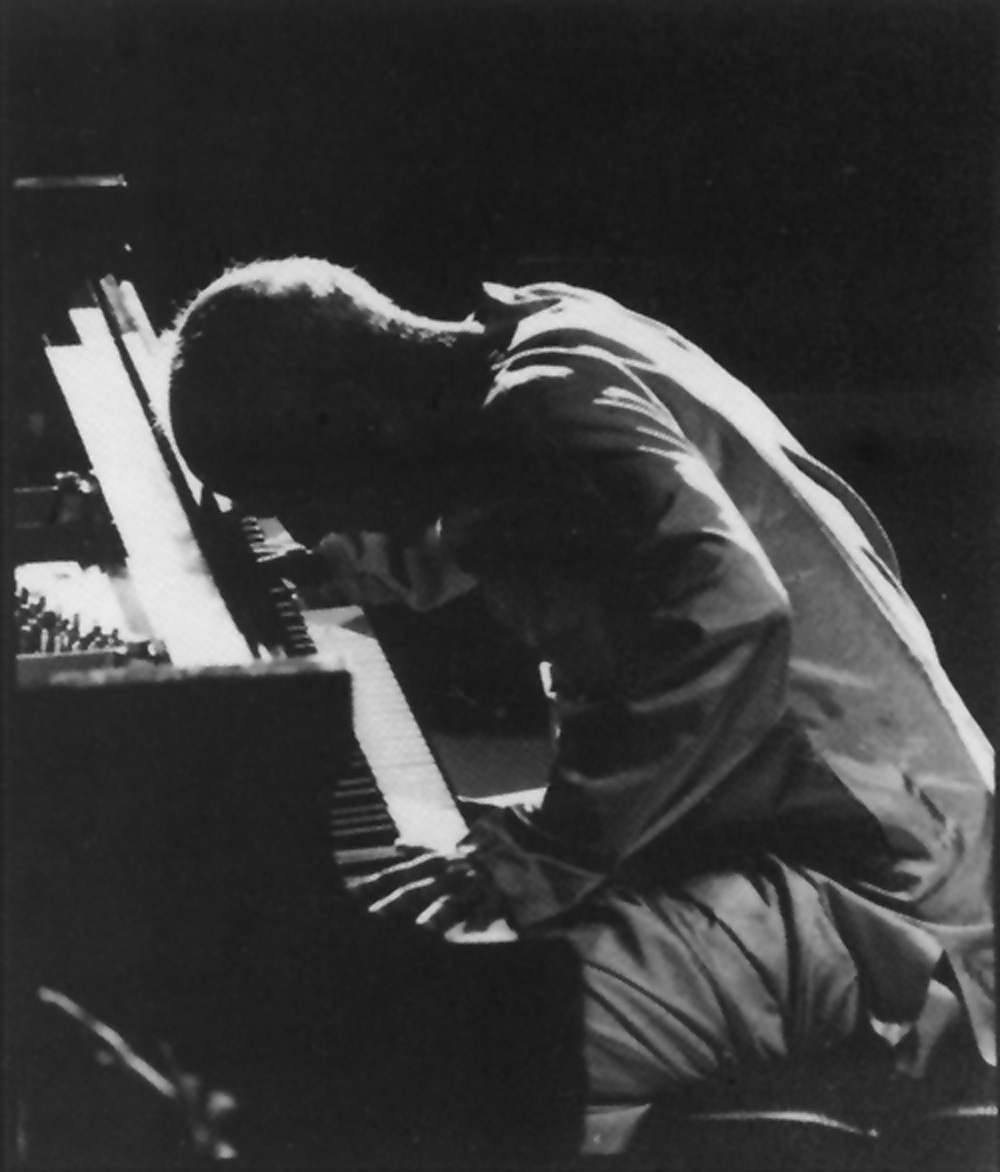
The physical exertion and sheer stamina involved in Sri Chinmoy's performances is overwhelming. The speed and power of many passages make the most striking keyboard masterpieces seem timid by comparison.
Where did Sri Chinmoy acquire the monumental technique required to execute such daunting passages?
In his case, technique is not something separate from inspiration – the end and the means flow together as one spontaneous achievement. For as the spiritual pervades the physical, so too, to be completely one with the spiritual is to have total command of the physical. Utterly surrendered to the dictates of his Inner Pilot, Sri Chinmoy's physical body becomes a dynamo of pure energy, a lightning-rod to ground the clear light of Cosmic Vision…
When asked what he feels when playing music, Sri Chinmoy replied:
"It is not a matter of seeing or feeling. I only enjoy myself. At times I don't see or feel anything; only I become the music itself. I become Delight, Delight itself."
Sri Chinmoy calls his paintings "Jharna-Kala", Bengali for "Fountain Art", which gives a hint at the nature of the wellspring of his inspiration. When he paints, he says, "I become an instrument and just follow a streak of light. I see a streak of light and then I follow it."
The resulting paintings, often executed in a matter of seconds, hundreds at a time, seem almost to vibrate with living energy, witnesses to the vivid intensity and immediacy of the inner realms from whence they have sprung with such urgent inspiration.
This sense of urgency, of absolute commitment to an overwhelmingly powerful inner force or "Inner Pilot" also characterises Sri Chinmoy's keyboard improvisations. It is as though there is no intermediary, as though the listener is thrown directly into the ocean of light and power. Beyond the mind, where objectivity and separativity no longer exist, this music acts as a courier of inner Truth – a Truth to which we concord not in the mind but in our inmost being through a kind of inner thrill, the thrill of the finite embracing the Infinite…
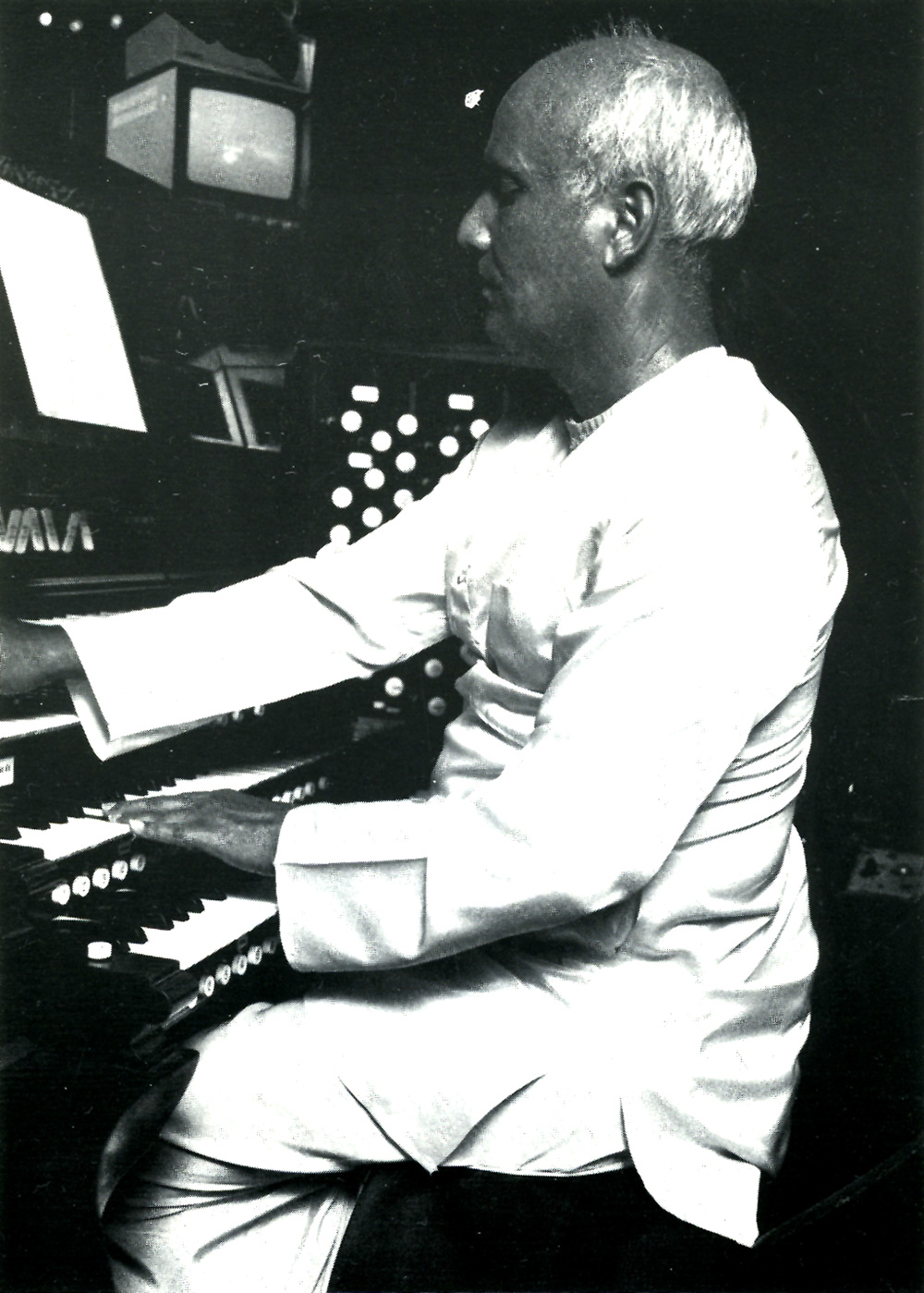
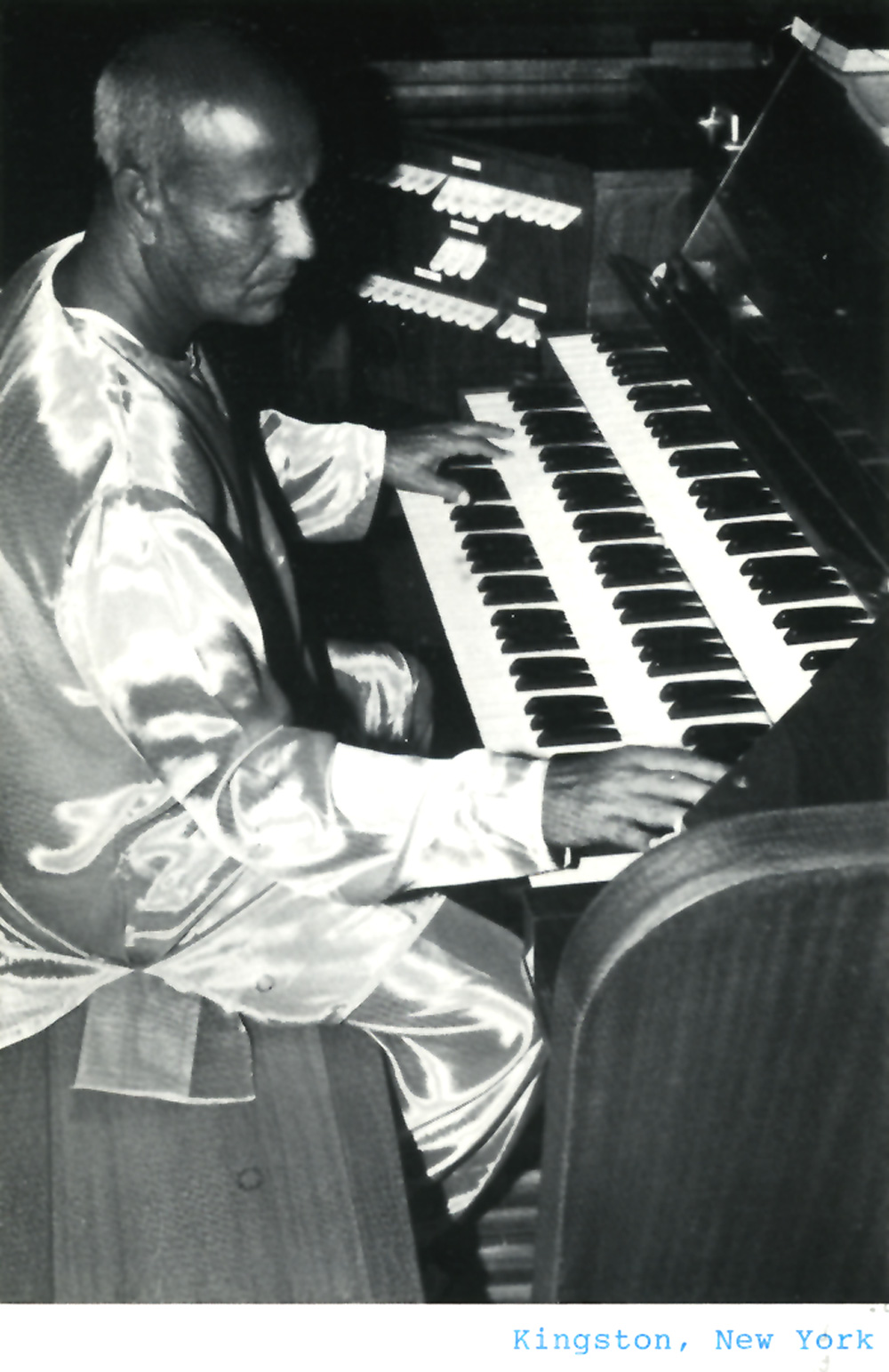
Performances on piano and synthesizer became a regular feature of the Master's concerts from early 1987. Then on the 26th of May, during a visit to Switzerland, Sri Chinmoy visited a church in Zurich and played on a new instrument, the pipe-organ. The 38-minute performance, entitled "The Summit-Song of Self-Transcendence", was to signal new, unprecedented heights in the Master's music- manifestation. It seemed he had found the ultimate vehicle for the musical expression of his teeming vision of universal omnipotence and omnipresence, the instrument, which he was already saying, made the grand piano seem like a child's toy!
Three days later Sri Chinmoy gave his first public performance on the pipe-organ, as part of a concert at London's Royal Albert Hall. Jenny Robb, composer and instructor at the Guildhall School of Music, described her reaction:
"I was completely agog… The organ playing was powerful, staggeringly powerful. It was a riveting, deeply moving experience!"
John Luxton, Head of the Keyboard Department at the Canberra School of Music, concurred:
"It's amazing, really amazing! This music is on another level. It made me feel that there are no boundaries; that I was tapping into a consciousness of the Infinite. Immensely powerful music! This is what music should be all about!"
It seems that not only had Sri Chinmoy found the ultimate instrument but, reciprocally, the pipe-organ had found its consummate player. The traditional role of the pipe-organ in churches has been to uplift the congregation – to turn the mind to contemplation of the power and grandeur of the Almighty, as the soul thrilled to the pipes' mysterious and mighty resonance. Now, in Sri Chinmoy's hands, the pipe-organ is itself thrilling to an intimate and direct revelation of mystical experience.
Following a remarkable performance on the famous organ in New York's Cathedral of St. John the Divine, Martin Smith, organist and Dean of the Manhattan School of Music, observed:
"Sri Chinmoy is creating absolutely pure music! He is creating absolutely perfect compositions, and they just pour out of him… He has amazing virtuosity with the organ. His digital agility on the keys is fantastic!
"Sri Chinmoy's spiritual depth of expression is so clear. His music speaks so clearly from within, from the deepest part of him. From the first note, it completely gathers your whole energy, your whole attention and holds it there.
"Sri Chinmoy's music is meditation in its purest form. This music changes you in the way that deep meditation changes you. It changes your life. You're not the same person that you were before. You can't be the same person. You are expanded."
This is the very purpose of music, according to Sri Chinmoy:
"Music means Self-expansion and oneness. The Self expands through music. The Self that expands is not the individual self but the unlimited Self."
Indeed, the ultimate significance of Sri Chinmoy's music lies in this capacity to transform our consciousness. As legendary jazz trumpeter, Don Cherry, has pointed out:
"To experience Sri Chinmoy's music would free a lot of people."
By revealing inner worlds far beyond the mind's domain, where time and space cease to exist, where there is only the constant play of pure power, light and ecstasy, our expanded consciousness is awakened, liberated from age-old limitations.
John Balka, Director of the Office of Sacred Music at St. Mary's Cathedral, San Francisco, has observed:
"Sri Chinmoy has understood that the essence of music has the power to move the soul in ways that words alone cannot. Combining his highly developed spirituality and his well-honed physique into one brilliant and expressive energy, the Guru projects the considerably unique power of music through performance that is perfect in its freedom from reservation and constriction.
"This is how he teaches with music; that is how he moves thousands at a time, through the superconscious, into that perfectly serene light of God's Peace… This is art of the highest order."
With music that is saturated in the highest consciousness, Sri Chinmoy is creating a revolutionary genre of music.
By investing his music with the ultimate task, the task of spiritual transformation, Sri Chinmoy is manifesting nothing less that a new, vibrant and compelling spiritual Teaching.
The music-world will never be the same again…
– End –
Endnote: 1 For Sri Chinmoy, February 18, 1987, marked the beginning of his piano career. He had, however, played piano on previous occasions. The earliest recorded instance is a public performance at a Christmas classical concert in Puerto Rico in 1974, when he played one of his own compositions. View Photograph
This article was first published in 1987 in a booklet entitled, 'The Peace Concert with Sri Chinmoy'.
After receiving an inner command from the Supreme in October, 1963, Sri Chinmoy Kumar Ghose made plans to begin a spiritual mission in the West. In order to enter the United States, Sri Chinmoy required a sponsor and he was truly fortunate to receive an offer from a close friend and admirer, Sam Spanier, who was an American. Upon entrance to the United States on April 13, 1964, Sri Chinmoy was employed by the Indian Consulate and worked in the passport-visa section for over two years. During these years, the Master began to plan the first steps toward the manifestation of the divine Light which the Supreme had been manifesting through him since his earliest realization. In 1965, Sri Chinmoy went on the air over New York radio station WBAI to announce his plans for the start of a school which would offer meditation and Indian philosophy to those sincere aspiring seekers who wished to learn the inner Truths about earthly and divine Life. On August 27, AUM Magazine, a monthly publication of Sri Chinmoy’s writings and philosophy, was inaugurated. AUM has continued to publish the lectures, poetry and music written by the Master.
Sri Chinmoy began offering lectures on the spiritual life to local church groups and community organizations such as the Lions Club, and inaugurated his musical manifestation with a performance held by the Asia Society at the Guggenheim Museum in New York City. At the Indian Cultural Centre in New York on March 20, 1966, the Master performed ten devotional songs that included both ancient and modern music, sung in both Sanskrit and Bengali. The Sanskrit chants were ancient mantras set to music by Sri Chinmoy after he entered the country: “Agne naya supatha raye asman,” “Asato ma,” “Tvamadi deva purusha purana.” Included among the ten songs which Sri Chinmoy sang at the concert were the following three, composed when he was only twelve years old: “Tamasa rate,” “Sundara hate,” and “Jago.”1 Sri Chinmoy also sang the following songs by other composers of devotional songs: (The first two songs are often sung by the Master during meditations and family gatherings) “Phire chalo” (traditional), “He paratha” (Kaji Najrul Islam), “E ghora rajani” (Chandidas), “Nivid ghana andhare” (Tagore). (It may be noted that Sri Chinmoy has the entire collection of Tagore’s poetry and songs at his home in Jamaica, New York.) The Master closed the concert that night with “Bande Mataram,” the original national anthem of India. He has since set his own music to Bankim Chandra Chatterjee’s text, and this song is today often sung by disciples. Dulal (Sol Montlack) was one of the earliest disciples of Sri Chinmoy, accepted by the Master on August 20, 1966. Dulal does not recall hearing Sri Chinmoy sing at the earliest meetings, held in the Master’s Brooklyn apartment. “The first time I heard Guru sing was when he bought a harmonium, when he moved to Manhattan (December 1966).”
Dulal, a musician in his own right, was soon recognized by the Master and was offered a great honor: “At one time in the very beginning Guru said that I would be the only disciple that he would allow to set music to his poetry. At that time I felt he was giving me the power to do it.” Since then, Dulal has set music to many of the Master’s poems, messages for the New Year, and selected mantras. The first songs which Sri Chinmoy sang at his weekly meditation meetings of the newly established Aum Centre (as it was known in the earlier days) were four chants from the Upanishads: “Asato ma,”(mentioned earlier), “Aum Purnamadah,” “Anor aniyan” and “Vedaham etam.” (Numerous cassette recordings exist which contain the actual meetings of the Aum Centre from 1966 on. It is from these tapes and interviews with disciples that this information has been obtained.) On August 27, 1967 (on his thirty-sixth birthday), Sri Chinmoy presented the disciples with the “Invocation to the Supreme” (since translated into many other languages). Sri Chinmoy sees this song as the most important for his disciples to sing because it embodies the essence of his illumining philosophy:
Supreme, Supreme, Supreme, Supreme!
I bow to Thee, I bow.
My life Thy golden Plough;
My journey’s Goal Thy soulful Dream.
Supreme, Supreme, Supreme, Supreme!
I bow to Thee, I bow.
Supreme, I am Thy glowing Grace.
My world Thy Feet of Light.
My breath Thy Vision’s Kite.
Thou art one Truth, one Life, one Face.
Supreme, Supreme, Supreme, Supreme!
I bow to Thee, I bow.
The Master has often spoken to his disciples about the power of the “Invocation”:
I feel it will be necessary for each seeker to learn this song. The “Invocation” will bring his psychic being to the fore and he will feel the living presence of the Supreme during his singing. This song not only will help him in his life of aspiration, but also in his life of realization.
Each note and each line is significant and powerful. Each word is a world of inner revelation – natural, spontaneous and soul-stirring. I wish everyone to commit this song to memory and it is my sincere request that you all fold your hands whenever this song is sung.
This is our most devoted dedication to the Supreme.
(August 27, 1967)
Another time he explained:
I wish all of you to sing the Invocation every day. Feel that it is part of your meditation. More than that, feel that it is the most soulful meditation. Try to imagine the words right in front of you with your mental vision and sing it most soulfully. If you can sing the Invocation soulfully, it will be like meditating powerfully for four hours … If you can feel that you are really ‘God’s glowing Grace,’ all of your problems will go away.
During the twenty years Sri Chinmoy spent in prayer and meditation at a south Indian ashram, he was a prolific poet and filled up hundreds of small notebooks with Bengali and English poems. When the Master mailed his poetry collection to New York (1969), over twenty volumes were lost in the mail. It is from the remaining books that Sri Chinmoy selects his favorite poems to set to music.
In 1969, Sri Chinmoy set music to his English poems and he lovingly offered each song to a disciple: “A Sea of Peace” (the Master’s first English poem composed circa 1949) was offered to Nilima; “I am a Fool,” to Gita; “Sweet is my Lord,” to Lavanya; “I am a Thief,” to Sarama; “I am an Idiot,” to Madhuri; “Father, I Am,” to Dulal. In addition, “I Sit Alone” was offered to Tanima; “At Last I Know,” to Nemi; “What Can I Do,” to Nirupama; “My Ego,” to Aditya. Each disciple was responsible for learning his or her respective song, and the Master often called upon the singers to offer their songs at the weekly Centre meetings. During this period Sri Chinmoy began assigning disciples to various singing groups.
Sri Chinmoy’s original Bengali notation for “Nil pakhi ure akashe.” The music is written above the poetic text. The English translation appears below.
The blue bird is flying in the blue sky.
Alas, here below I am dying in utter
frustration.
The bird of my heart is crying
most soulfully.
It is binding all around –
Time, space and man,
With its infinite freedom-light.
According to one singer:
He’d make up groups of singers which he thought were harmonious; sometimes it would be by age (such as the children’s group) and often the boys and girls formed separate groups.
Throughout the early days, Sri Chinmoy composed songs specifically for certain individuals and singing groups. He personally taught all the songs, since very little music was being transcribed by disciples. During these joyous learning sessions the Master would sing the song to be taught a few times, say the words a few times and spell the words for the disciples to write down. The only problem, which many disciples spoke of, was the speed at which the Master operated. Because of this, many found this process to be quite difficult. According to Lavanya, who has a superb voice:
When he sings, he’ll sing the first line ten times. Then he’ll go to the next line and sing it two or three times. Then he’ll go back to the first line and sing it twice again. Then he’ll go on to the next line and sing it twice, then back to the first line again. He’ll do the rest of the song like that, repeating the first line all the time. He says that if we learn the first line thoroughly, it will be easy for us to learn the rest of the song, because of the continuous flow that he, keeps in his songs. But for us it is funny and also frustrating, because each line takes us the same amount of time to learn. So at the end he’ll say, “so, you people have learned it?” and we’ll all look at each other and laugh, because all we really know is the first line.
(As a boy at the ashram, Sri Chinmoy had the unique ability to learn a song after hearing it only once or twice.)
Sri Chinmoy set music to the immortal motto of the AUM Centre in 1969.2 The “Motto” is most memorable on account of its beautiful flowing melody which sings of divine faith in man’s potential to realize the Highest in himself.
Man is Infinity’s Heart.
Man is Eternity’s Breath.
Man is Immortality’s Life.
In 1970, certain disciples besides Dulal were given permission to set music to the Master’s poetry. Some of the most beautiful songs by disciples were composed during this period by Mahavishnu.
The texts of the songs were often selected from My Flute and were sung by Mahavishnu and Mahalakshmi as well as by a selected group of disciple-singers called the Mahavishnu Choir. Since its formation, the choir has performed on radio, TV and in various concert hall appearances.
In April 1971, Sri Chinmoy composed the thirty-nine English songs of A Seeker’s Universe. Madhuri beautifully describes them in her biography of the Master:
(The songs) relate the eternal odyssey of the soul from the initial search, initial inspiration, the inevitable obstacles and discouragements, the anguished cries of the lost and bewildered soul, which terminate in the triumphant union with its Source. (p. 77, Vol. II, The Life of Sri Chinmoy)
In November 1971, Sri Chinmoy decided to form an all-women singing group to perform his Bengali songs (which, at the time, numbered around ten). Tanima, who was the first disciple to ever sing one of the Master’s Bengali songs (“Bidai bela,” the “Farewell Song,” in 1969), was made the leader of the group. A concert was scheduled for January 1972, and Sri Chinmoy decided that the singers would learn fifty Bengali songs for their first performance. Sri Chinmoy immediately set to work composing another forty songs and a rehearsal schedule was set up.
The Bengali Singers met on Saturday and Sunday mornings at the old Divine Robe Supreme. (Before the Sri Chinmoy Centre Church was purchased, the disciples often had meetings in the large, empty back room of the clothing store.) The Master came to the rehearsals quite often to sing new songs which he had just composed and to hear how the singers were getting along learning his other songs.3 For each of those involved in the Himalayan task of learning fifty songs of a foreign language in only six short weeks, a great amount of time was taken up in practicing and memorizing. Tanima relates:
We started learning the songs at the end of November and the concert was in January. So we had about six weeks to learn fifty songs. Most of the girls were not musicians at all and it was an incredible feat for them to do this.
I can remember at the time I was working at a bank, and I was also running the Sri Chinmoy Lighthouse (printing press) in the evening. At the bank I was an international teller and I used to have these little cards with the song words on them, and I sang songs behind my booth whenever there wasn’t a customer there.
The Bengali singers often asked the Master why texts of the Bengali songs so often dealt with depression. Sri Chinmoy explained that while walking along the street, he used to see many people full of depression. Whomever he saw he used to feel that person’s consciousness, and immediately it would be recorded in his heart, the Master said. He would offer the suffering soul light, but he would also remember the suffering and express it in his songs. The following is an excerpt from a talk Sri Chinmoy gave to the singers on this topic:
In the period between 1952 and 1954, my poems were all from identification. It’s not that I spoke to people about their suffering, but in passing I got a vibration from a particular person.
When the singers sing the songs, you should identify with the poems using your compassion-power and try to become one with the feeling in the songs. You people are all meditating and you have some light. While you are singing, at the same time you are identifying with and throwing light into the suffering soul. There are many people who will some day sing these songs and feel that their life is being expressed.
The first performance of the Bengali Singers was held on January 13, 1972 at the Victoria Church in Jamaica, Queens. All the local disciples were invited and the Master wanted this concert to be very special. In a special ceremony a few days prior to the concert he offered each singer a beautiful pale blue sari to wear for the performance and on the evening of the performance, he personally arranged the singers in rows. During the last set of songs, Sri Chinmoy asked the singers to sit in their rows and Tanima stood behind them. Tanima relates:
I had my eyes closed and we were singing “Hari jadi” (the third song from the end) when all of a sudden I felt Guru’s hands on my head blessing me. I had no idea that he was going to bless me. He went on to bless each singer as we sang the last couple of songs. We had all put so much into learning the songs and the goal was in sight. We had made it through this incredible six weeks – who would have thought we could do it?
After the concert Sri Chinmoy proudly offered his soulful blessing to the singers and presented each with a beautiful trophy. At a later date, he said the following to Tanima, who had begun teaching his music to different Centres as well:
I am so proud of you. You are the music teacher and you are teaching in many places. I am extremely grateful to you, for the singer in me you have brought forth everywhere. The whole of Bengal and Mother India will be truly proud of you and grateful to you. You will be teaching hundreds of songs. Fifty you have already taught and right now fifty more songs will be learned by this singing group.
This is an historic achievement. No Guru is fortunate enough to have disciples who will sing one hundred of his songs in a foreign tongue. For that I am grateful to the singers, and especially to you, because it is you who are teaching them and it is you who will be teaching them. The musician in me will find the real meaning and significance of these songs through the selfless joy and love of all the singers.
Sri Chinmoy immediately set to work composing fifty more melodies to selected Bengali poems. This time the Bengali singers were given much more time to rehearse and perfect the songs. The performance was held on December 17, 1972 in the Sri Chinmoy Centre Church, Bayside, Queens. For this concert, the women were much more confident and the performance was finished in less than two hours. The Master awarded each singer with a charming bell, a beautiful vase complete with flowers, a trophy and a small piece of candy.
Soon after the start of 1973, Sri Chinmoy tested all of the singers and he chose ten to form a second group of Bengali Singers (the “good group”). This did not signal a disbanding of the original group of Bengali Singers. In fact, Sri Chinmoy has increased the membership of the original group since 1973 and this larger group often offers a few songs during the Master’s public meditations. He soon composed forty-two more melodies to selected Bengali poems for the “good group” and their performance was planned for August 1973, but because of a lack of time on the night of their performance, the songs were not heard in their entirety until July 5, 1975 in the magnificent halls of the Jharna-Kala Gallery (which featured over 7,000 of Sri Chinmoy’s paintings and drawings.)4
In April 1972, Sri Chinmoy formed two all-men singing groups: Lotus Groves and The Singers of Eternity’s Patience-Pride. For the Lotus Groves he chose the finest singers and Mahavishnu was chosen as the leader. (Because of Mahavishnu’s busy schedule, Kanan eventually assumed the leadership position.) The Master composed twenty Bengali songs for the Lotus Groves and although he taught the singers the first two songs, Tanima was chosen as the teacher for the group.
The formation of the Singers of Eternity’s Patience-Pride was completely spontaneous. As related by Tarun:
Several of us were eating dinner in the basement of the Church and somebody suggested that the bad singers form a singing group. The idea had been around for a while before this particular night, but for some reason, that night Guru agreed. So he asked someone for a hat and he put the names of eleven bad singers in the hat and he picked one piece of paper, saying that the person whose name was on the piece of paper would be the leader of the group. Of course, I got picked!
Sri Chinmoy wrote eleven new Bengali songs for the singers and he assured [should be assumed] personal responsibility for teaching them the songs. According to Tarun:
Guru said he would teach us the songs and he tested us on scales and he wouldn’t accept our wrong notes. The funniest part of the rehearsals was when Guru gave us the words to the songs. He usually pronounced the words and letters so fast that we never got them right the first time around. We’d always say, “Guru slow down!”
On February 18, 1973, the Lotus Groves and The Singers of Eternity’s Patience-Pride performed their songs in the Victoria Church. Since the Master wanted to make the concert enjoyable for all the disciples, he had previously arranged for a contest to be held at the end of the concert. The Eternity’s Patience-Pride singers dressed up as different Hindu cosmic gods and famous avatars (Krishna, Christ, Vishnu). Each “avatar” or “god’’ stood up in font of the audience, which voted for the singer who had caught the essence of that spiritual figure in his choice of costume and in his consciousness. Tarun won the contest, dressed as Ramakrishna.
Most of the Singers of Eternity’s Patience-Pride had never sung any of Sri Chinmoy’s songs, because their sense of pitch was so bad; thus, the singing group provided a great opportunity for the young men to experience the power of the Master’s music. Tarun relates:
I feel it was a divine opportunity to sing Guru’s songs. When you sing soulfully, it really helps your aspiration and spiritual progress. So I think one of the points of the group was to give the poor singers an opportunity to feel the divinity in Guru’s music.
In June, 1973, Sri Chinmoy traveled to India to visit his family and spent a large part of the summer there. Before he left, he asked Tanima to make him a tape of the Lotus Groves, Bengali Singers, various disciples performing his music and two classical pieces by Bach. (Solos by Lavanya, Tanima and Anjali; Bach pieces played by Dulal, Chandika, Tanima and Prabhat; Songs with music by Sri Chinmoy and words by Bhumananda, Nolini Kanta Gupta’s son; “Bande Mataram,” music by Sri Chinmoy, words by Bankim Chandra Chatterjee.) Tanima recorded the songs and later received a beautiful letter of appreciation from Sri Chinmoy:
Yesterday about a hundred and fifty people came to hear your songs and music. They were moved far beyond their imagination. Apart from the musical voice and talent of your students, they deeply appreciated your Bengali pronunciation, accent and so forth. So, you can well imagine my joy and pride in you all.
During the summer of 1973, Sri Chinmoy composed music to various English poems from The Dance of Life. These were offered to the European disciples during the Master’s European lecture tour, and then to Puerto Rican, Canadian and San Francisco disciples. The performance of these songs took place in August 1973 during the Master’s birthday celebration.
In 1974, Sri Chinmoy accelerated his musical manifestation and he set music to 100 Bengali poems, which were performed by his disciples during the August birthday celebration. Although the Master recorded 100 songs on cassettes which were distributed to the singers, only 85 songs were located and were subsequently transcribed. Apparently, some disciples either lost their tapes or recorded over them.
Sri Chinmoy composed another hundred Bengali songs for the disciples to perform on New Year’s Eve. Since the tapes of these songs were distributed to the disciples only a few days prior to the performance, Sri Chinmoy remained on stage throughout the performance and each group joined him in singing its particular song.
In 1975, Sri Chinmoy was in the midst of his monumental painting effort (called Jharna-Kala, or “Fountain-Art,” which produced over 120,000 works in its first year) and he began composing music in an improvised style very similar to the way was painting. The Master started his Jharna-Kala in November 1974, and at that time spent several minutes laboring over each of his paintings and drawings much in the same way as he sometimes worked over a musical phrase while composing one of the early Bengali songs. Gradually he began to flow with a steady stream of inspiration and he was soon turning out works of art in only a minute or less. The inspired lines and swirls characteristic of the Master’s colorful art began to manifest themselves at an unbelievable rate (culminating in a world record of 16,031 in 24 hours). During this period, Sri Chinmoy composed one hundred more Bengali songs for his disciples to sing in the August celebration, but this time he composed them spontaneously. He would sit down in his meditation room at home or in the Sri Chinmoy Centre Church, with the tape recorder running and ashram notebooks close at hand, and begin singing the improvised songs a few at a time. The cassettes containing the songs were given to the individual singing group leaders. The songs were later transcribed for publication. The Master also composed fifty Bengali songs, which were left unsung and untranscribed during the celebration. This group of songs were transcribed in November.
In 1975 Sri Chinmoy composed some of his most important songs as far as the world body of nations is concerned. For the American Bicentennial, the Master offered “O My America,” a loving tribute to the soul of America:
America, America, America,
Great you are, good you are,
Brave you are, kind you are.
O my America, America,
Your Heaven-freedom
is Earth’s Aspiration-Choice.
With you, in you is God-Hour’s
Victory-Voice.
This song embodies the spiritual qualities of the soul of America. For the beautiful soul of Puerto Rico, Sri Chinmoy offered “O My Puerto Rico” which he dedicated to Governor Hernández Colón of Puerto Rico:
O My Puerto Rico,
Your soul is beauty’s flow,
Your heart is duty’s glow.
O My Puerto Rico,
Your simple life of truth
Is God’s perfection-Ruth.
To you I bow
In our Lord’s Eternity-Now.
To you I bow,
O My Puerto Rico.
For the soul of Canada, the Master offered “O my Canada”:
O my Canada You are very vast.
Can you not be very high too?
Try, you can. O my Canada,
Why do you always follow?
Can you not lead from now on?
Try, you can. O my Canada,
You think that the world does not admire you.
Can you not demand the world’s admiration?
Try, you can, you certainly can.
Sri Chinmoy has been conducting meditations for staff and delegates at the United Nations since 1970. As one who is truly devoted to the cause of world brotherhood, the Master has been performing divine service for all humanity by meditating for world peace within the walls of the U.N. In the words of Governor Hernández Colón of Puerto Rico:
I know of [Sri Chinmoy’s] great work in the United Nations and his efforts in helping the United Nations gain the spiritual direction that it needs to cope with the problems of the world today. It is indeed a very hard task, but if there is any one person with devotion and deep spirituality who can carry this task to fruition, it is Sri Chinmoy. May this body realize the highest mission which he has for all mankind.
In August 1975, Sri Chinmoy composed “O United Nations,” which speaks of the divine potential of that great world assembly:
O United Nations, O U.N.,
You are the world-body,
Crying for the world-soul.
And you are the earth-life,
Longing for oneness-goal.
In the heart of your glowing dream,
Big brothers and brothers small
Shall smile, sing and dance –
O Vision-Perfection in all.
During the month of August 1975 Sri Chinmoy decided that he would perform on twenty-seven different musical instruments for his birthday (August 27). He played songs, scales and improvised passages on Indian instruments such as the sarod, jal tarang and sitar; on our own Western violin, cello and piano; and on an assortment of other instruments, drums and even on a toy horn. Sri Chinmoy explained that the performer of the concert would actually be the ‘divine child’ within him. The soul is this divine child, which in the lives of many people, has been covered over by dullness and hesitancy. The seekers who have accepted the Master’s path have heard the divine child in them singing the song of the Supreme. The Master in his wisdom sees that showing what his own soul-child can do helps to bring out the divine childlike qualities in his disciples. These qualities, such as purity, spontaneity and delight, are of supreme importance in Sri Chinmoy’s path.
Of the twenty-seven instruments the Master studied for that concert, he has continued to practice the flute, violin and cello. (More recently, he has taken up the esraj, an Indian stringed instrument similar to the sitar.) He is truly becoming a great spiritual musician. His music demonstrates an unusual capacity for sweetness and inspiration, but this is not based entirely on technical proficiency. The listener will immediately realize the Master need not be a great musician from the technical standpoint, for through his utter simplicity and innocence the great spiritual wisdom and vision of the divine soul comes forward.
Thus, watching Sri Chinmoy play an instrument is an experience like no other. He plays soulfully, so sweetly, drifting higher and higher into the world of the Beyond, and it seems that his only link with the mundane world as we know it is the instrument on which he is playing.
One may consider Sri Chinmoy’s music as the music of the Supreme. It is none other than God who is the Supreme Musician and Sri Chinmoy who is the instrument. Thus, when Sri Chinmoy plays, what is communicated is enjoyment, satisfaction and delight – God-Enjoyment, God-Satisfaction and God-Delight.
A most astonishing feat of musical composition occurred on the evening of November 22, 1975, at Thomas Edison High School in Jamaica, N.Y. Sri Chinmoy invited all of his disciples to join him in silent meditation as he spontaneously composed the music to two hundred Bengali poems. In a remarkable display of yogic powers of concentration the Master composed all two hundred songs within four hours. He started off singing each group of songs by chanting the Vedic mantra “Aum,” which resounded through the halls of the auditorium, and it seemed as if the listeners were being carried off on a divine journey into the world of the Supreme by one who has free and total access to it. A visiting disciple commented, “It was as if we were hearing the voice of God Himself.”
It seemed that 1975 was going to end with the two hundred songs as the final offering, but on December 20, Sri Chinmoy surprised his disciples by spontaneously setting ninety-nine poems from Transcendence-Perfection to music. (The 843 poems in this collection were written in a twenty-four-hour period from midnight to midnight on November 1, 1975.) Before he began singing, Sri Chinmoy commented:
If the songs come out well, then I shall give full credit to all of you and if they do not come out well, I shall gladly take the full blame. If you truly inspire me, I do not know how I can fail you. So, do inspire me so that I can sing well.
The fact that I have talked too much today is an understatement. I have talked and talked since the small hours of the morning. My voice has already started revolting, but I am more rebellious than my unwilling voice. So let us see who will win the race.
This set of songs was the most recent compositional effort by Sri Chinmoy for 1975.5
– End –
This article first appeared in the author’s book “Sri Chinmoy: The Silence-Sound: An Overview of Sri Chinmoy’s Musical Manifestation (1944-75)”, Aum Publications, New York, 1977.
Author's & Editor's Endnotes: 1 These three were composed for Sri Chinmoy’s play on Sri Ramakrishna and Vivekananda. They each embody different moods of Swami Vivekananda. “Tamase rate” tells of his period of darkness. “Sundara hate” tells of the feelings of Sri Ramakrishna’s disciples as they were meditating on their Master. In “Jago” Vivekananda is bringing his awakened soul, the friend of his dream, to the fore. 2 On April 13, 1970, to honor Sri Chinmoy, and to make the AUM Centres more definable, the name of each Centre was changed to Sri Chinmoy Centre. 3 Many early Bengali Singers rehearsals have been recorded on tapes filed in the Sri Chinmoy Centre Library. 4 Only forty melodies from this group have been published in The Garden of Love-Light, Vol. III. 5 There have been numerous songs omitted from this historical glance, but most of the songs which Sri Chinmoy composed during this period can be found at Sri Chinmoy Songs.
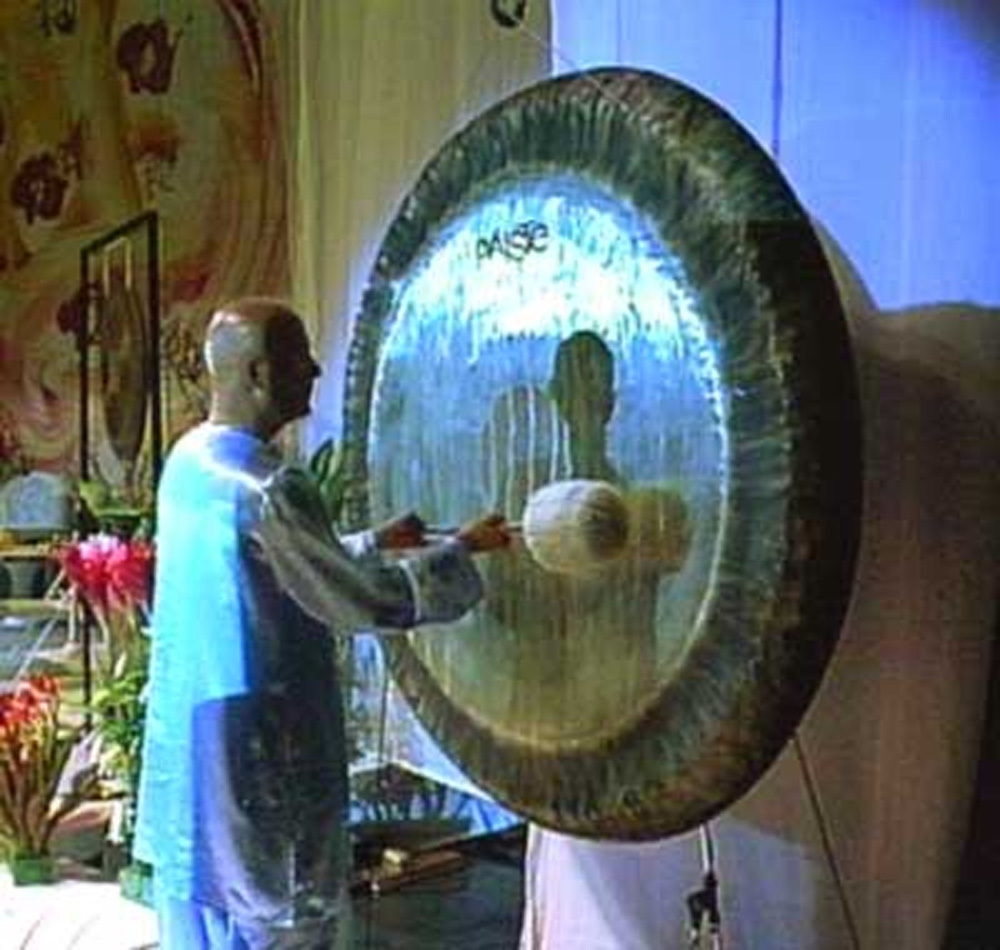
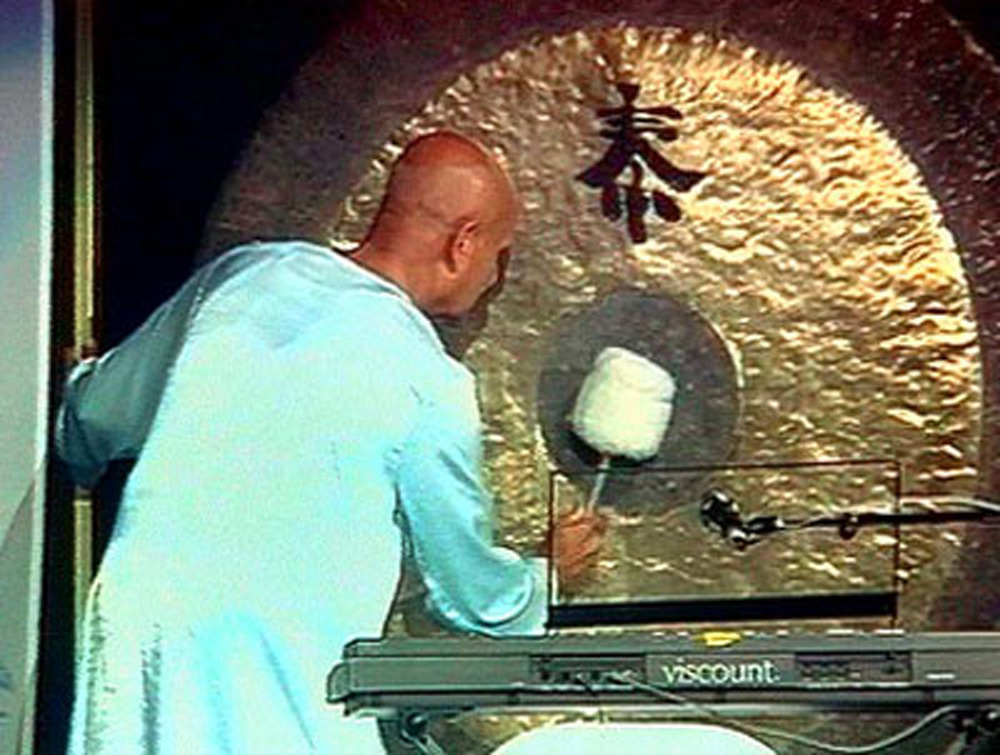
The clock had not yet struck six. Suddenly, in a mountain village in Switzerland, a gong was struck. Through the darkened sky, across the emerald green waters of Lakes Thun and Brienz, and high into the unseen peaks beyond, the sound travelled. The concert of concerts had begun.
On a vast stage in the heart of Interlaken, a musician took his seat, surrounded by a forest of instruments. This was Sri Chinmoy. He had chosen the Swiss Alps to fulfill a soaring dream: to play 170 musical instruments in the course of a single, sustained performance. How long it would take, he did not know. Like a voyager of old setting his compass for faraway lands, he gathered the necessities of his journey about him and boldly prepared to put forth.
The audience, comprising seven hundred of Sri Chinmoy’s students from various countries, waited with bated breath. Which of the fascinating instruments arrayed on the stage would Sri Chinmoy select? What kind of thrilling notes would he produce? What images would he call forth in the minds of his listeners?
From a revolving table at his side, Sri Chinmoy picked up a large, white conch shell. Formed by a mollusc on the ocean bed, the conch has been used by mankind for centuries. In India, it is considered to be a most sacred and auspicious instrument to blow at the beginning of any holy festival. The conch shell, or sankha, is one of the main attributes of Lord Vishnu. The spiralling in the conch is held to be symbolic of infinite space, which constantly expands in a clockwise direction. Thousands of years ago, in the time of the Mahabharata, Lord Krishna blew his conch ("Panchajanya") to signify the start of the epic battle of Kurukshetra. Sri Chinmoy evoked all these images and more as he blew his conch three times with tremendous power and confidence.
The third instrument he chose was a small, blue ceramic ocarina in the shape of a dove. In stark contrast to the gong and the conch, the gentle, cooing notes of this instrument wound their way subtly around the large hall. In the pre-dawn mountain hush, the peaceful notes of the dove seemed to announce the awakening of the day. We were reminded that for aeons man has turned to Mother Nature for musical inspiration. We strive to imitate thunder, rain, the rustling of leaves and the lapping of waves, the calls of birds and the cries of animals. These sounds touch a deep chord in us. They are at once a source of inner harmony and immense solace.
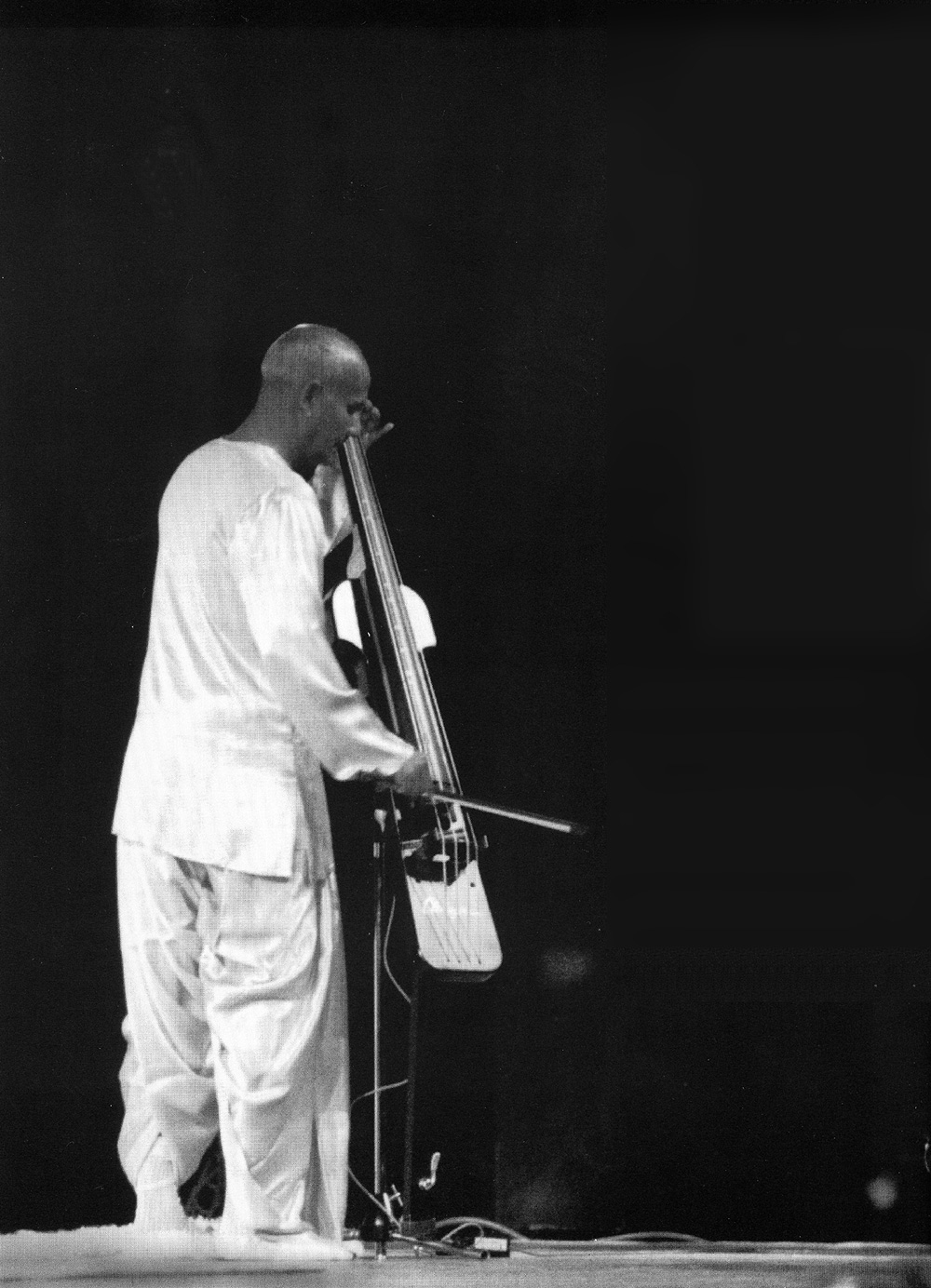
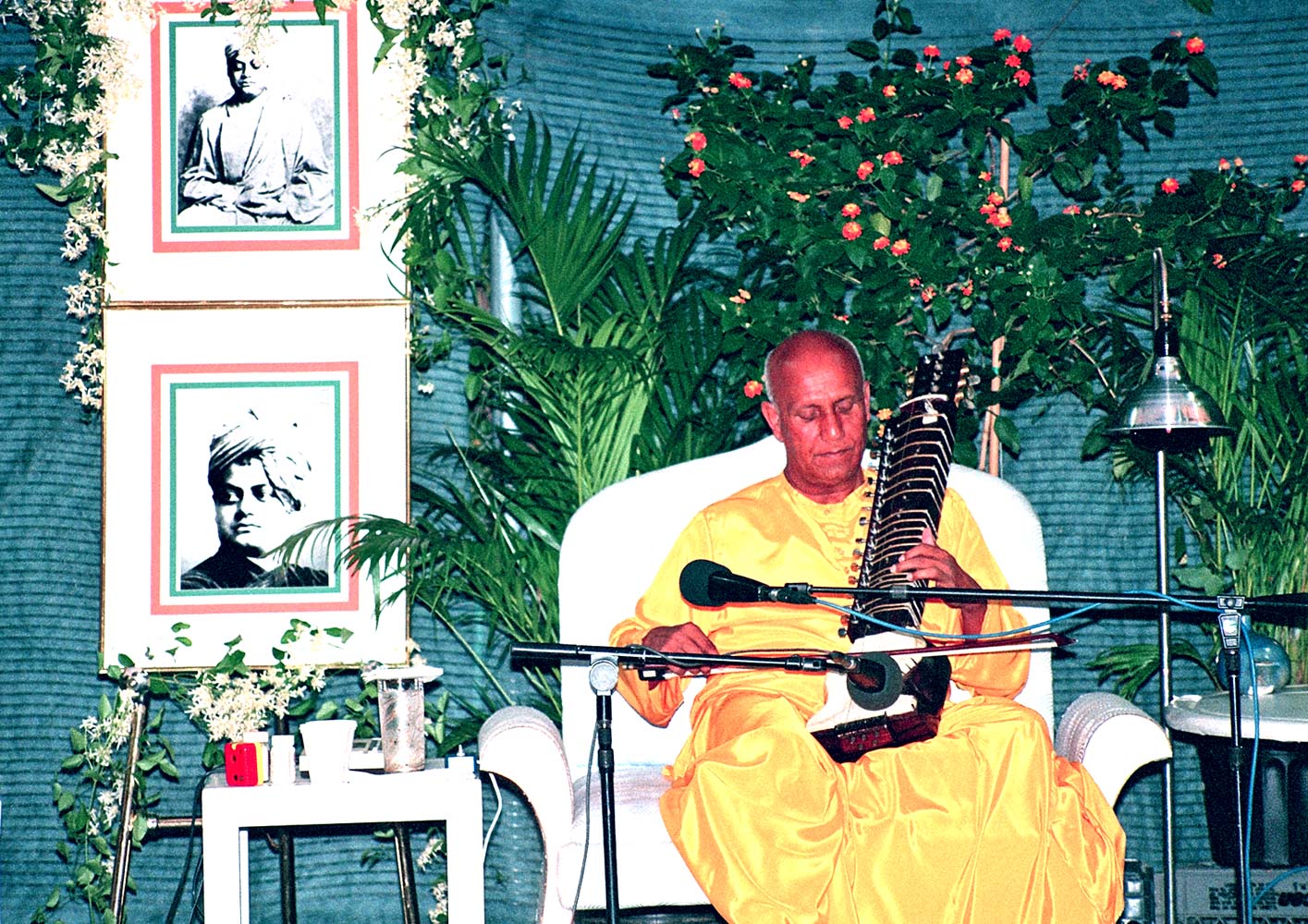
Sri Chinmoy’s fourth selection was an elegant, long-necked, bowed instrument from Bengal. This was Sri Chinmoy’s cherished esraj, an instrument which he first began playing seriously in 1976. Although he was to play several kinds of esraj during the course of the programme, this particular one, made by two German students, is his favourite. Sri Chinmoy performed a long piece, comprising a seamless blend of his own compositions and improvisation. Under the sure sweeps of his bow, numerous sympathetic strings began to vibrate, creating a heavenly sound.
And so Sri Chinmoy established his pattern for the next seven and a half hours. It would be a spontaneous movement from one instrument to the next, a juxtaposition of loud and soft, blown, struck, plucked, bowed, strummed, picked and shaken. He was to explore every technique of producing music that mankind has conceived throughout the ages.
From the esraj, Sri Chinmoy proceeded to a Western flute in "C", an instrument that he first began playing in Melbourne, Australia, also in 1976. He then reached for one of his newest instruments: a beautiful lute with crescent moon openings in the large, oval face. It was a ruan which he had bought in China during his visit there over the Christmas/New Year period of 2004/2005. As Sri Chinmoy tenderly plucked this instrument, my gaze was captured by the vista from the large windows of the conference hall. Now visible in the lightening dawn, a steep, green slope just beyond gave hint of the Alpine peaks that enfold Interlaken. Tendrils of mist were creeping downwards, obscuring the uppermost reaches and bringing with them a light spray of rain. As Sri Chinmoy continued to play the ruan, distilling its sublime essence, we might have been high in the Yellow Mountains in China, imbibing the fragrance and mystic atmosphere of that ancient culture.
Sri Chinmoy next moved to a series of instruments that included a Swedish brass glockenspiel, a Moroccan plucked instrument, a balaika from Russia, a native American triple flute and a snake charmer from India. His musical spirit was encircling the world. As he coaxed from each instrument its unique "voice", he seemed to summon the consciousness of each country into the auditorium. A rare and exotic sequence of notes on the snake charmer gave rise to images of a bustling Indian village, a darbouka drum from Egypt evoked life along the Nile, a Celtic lap harp called forth exquisite pastoral scenes.
At certain moments, Sri Chinmoy appeared to become so absorbed in a particular instrument that one wondered if he would remain in that world, lost in an ecstasy of self-forgetfulness and unmindful of the scores of instruments that yet awaited him. Eventually, with perhaps the faintest tinge of reluctance, he would lay the instrument aside and proceed to the next.
Sri Chinmoy appeared to follow no fixed order when choosing what instrument to play. He would walk the length of the stage and seat himself at a Chinese cello or stand behind a table on which were arrayed a set of djembe drums from Africa, kuin brass temple bowls from China and cow bells from India. When he had played all the instruments on stage, he would announce an intermission while his helpers carefully removed the instruments and brought forward a whole host of new ones.
There were three such intermissions — at 7:24, 9:30 and 11:34. They lasted 30 minutes, 45 minutes and 63 minutes respectively. Sri Chinmoy had originally thought of dividing his performance into seven sets. In a similar marathon performance, held on November 25th, 1995, Sri Chinmoy played 150 instruments.
This concert started at 9:05 a.m. and continued until 11:20 p.m. —representing a total elapsed time of 14 hours and 15 minutes. On that occasion, he divided his performance into six sets with a brief intermission between each one.
Some audience members had forecast that his Swiss performance could last as long as 17 hours, but Sri Chinmoy swept all such predictions aside when he completed his first 47 instruments in just 90 minutes. Playing with tremendous intensity, he concentrated his creative energy into just one or two minutes per instrument.
Although most of the instruments had been transported in crates and cases from New York, there lacked about thirty to make up the number. In addition, Sri Chinmoy had requested that up to 200 instruments be available on the day so that he could reject some if necessary, or extend his performance, according to his inspiration. These extra instruments were devotedly offered for the occasion by one of his students who owns music stores in Zurich and Salzburg. It was he who brought the large Chao gong which Sri Chinmoy struck to announce the commencement of the concert. He also supplied a number of most unusual instruments – among them, frosted crystal singing bowls, a 300-string rotating, conical barrel harp, a Japanese daiko drum with a diameter of twelve feet and a Vietnamese skull phones set that looked like a gigantic, upturned insect. Sri Chinmoy remained undaunted by even the most unfamiliar and unusual musical challenges, extracting unique rhythms and sounds that left his listeners wonderstruck.
Some instruments brought forward a childlike aspect of the 74-year-old musician, most notably a wooden grandfather frog drum with a horned back over which Sri Chinmoy rolled a small log. A carved whistle in the shape of an elephant, a wooden ocarina shaped like an owl that produced hooting noises and a brightly painted conga drum also provided light and enchanting moments. Other instruments embodied a loftiness of their own, particularly Sri Chinmoy’s standard concert instruments — the esraj, cello, harmonium, Western flute and synthesizer.
In this age of specialisation, Sri Chinmoy revealed his tremendous versatility. Western society holds to the unspoken promise that to become an expert in anything, one must study that subject exclusively. An athlete excels in one sport, a doctor in one part of the body or one disease, a scholar in one field of learning. The advent of someone like Leonardo da Vinci, who explored so many different fields and achieved miracles of perfection in each, is so rare as to be considered a phenomenon.
This trend towards an ever-narrowing scope runs counter to the great forces of the universe, to the very foundation of our life on earth. Energy expands and flows; rivers run towards the ocean; a tree bears many fruits; nature has provided countless species of animals, birds and plants. Why then should we be content to do only one thing well? Surely, as we become more in tune with the universal consciousness, we too should undergo an expansion, a kind of overflowing of inner wealth. This is what Sri Chinmoy manifests, not only in his musical performances, but also in his musical and literary compositions, his artworks, athletics and numerous other activities. For him, enthusiasm for the new and diversity of creative expression are synonymous with an ever-blossoming consciousness.
Thus it was that on this day Sri Chinmoy himself became the composer, the conductor and the orchestra at his world music concert in the Alps. Only a true musicologist could hope to identify all the instruments that he played and, even then, such an expert would, in all likelihood, be baffled by the many instruments designed and crafted for Sri Chinmoy by his students. Variants of traditional instruments with sympathetic strings added, customised mouthpieces, frets removed or new sounds added electronically made up a large proportion of the instrument total.
Again, such an expert might also be nonplussed by sounds and sequences that the Western mind cannot process in a recognised or formulaic way. Sri Chinmoy’s unorthodox fingering, his style of bowing, the use of his fists and the side of his hands on the keyboard, his love of improvisation in itself and his preference for the Indian scale and sequence of notes, force us to unlearn our established concepts of the ‘correct’ way to play music and yield to a wholly different experience.
And no matter what instrument Sri Chinmoy held in his hands, he maintained his silent, meditative consciousness. Palpable delight infused his performance, but it was held within his heart’s vast sea of poise.
This delight in music itself, the very breath of music, was perhaps the most compelling aspect of Sri Chinmoy’s performance. It made one dive deep within to find an answer to the fundamental questions: "What is music? What is that urge, inherent in man, to create waves of melody? Why do we feel ourselves to be complete when we are listening to a beautiful piece of music?"
Sri Chinmoy has written that "music is our soul’s home." He further adds, "When Light divinely manifests itself in the form of music, it is the music of the soul." If music is a pure expression of Light, which is God, then listening to such music can only bring us closer to God. Our individual natures are absorbed into God’s own Nature.
After his performance on 150 musical instruments in 1995, Sri Chinmoy wrote in one poem,
God the Supreme Musician
Came down
And left His Golden Footprints
For us to follow.
This was the experience that Sri Chinmoy opened for us in Interlaken. For seven and a half hours, we were literally bathed in the many-splendoured Light of the Divine. Instruments came and went, earthly time came and went, we scarcely knew how, for the music seemed to have wrapped our souls in itself.
Finally, Sri Chinmoy sat at his synthesizer, which we knew to be his final instrument. It has been combined with a Kurtzweil sound module to create clusters of unique percussive sounds. Sri Chinmoy concluded with magnificent organ-like chords which soared with a grandeur and majesty beyond description towards a thrilling finish. The concert was over. The time was 1:37 p.m.
Sri Chinmoy rested for a few minutes and offered his boundless gratitude to his helpers and to the audience. Then he was requested to play one last instrument: the huge Japanese daiko drum that remained on stage. He at once stood up and approached the drum, using a large, muffled striker to produce deep, rumbling thunderclaps.
Even as the gong had been a symbolic start to the concert, so, too, this victory-drum was a deeply symbolic ending. Between the gong and the drum, so much had happened, inwardly and outwardly. A tiny mountain village in the Swiss Alps had encompassed the entire world and reached to the farthest Heavens beyond. Seven hundred ardent music-lovers had attained the summit-heights.
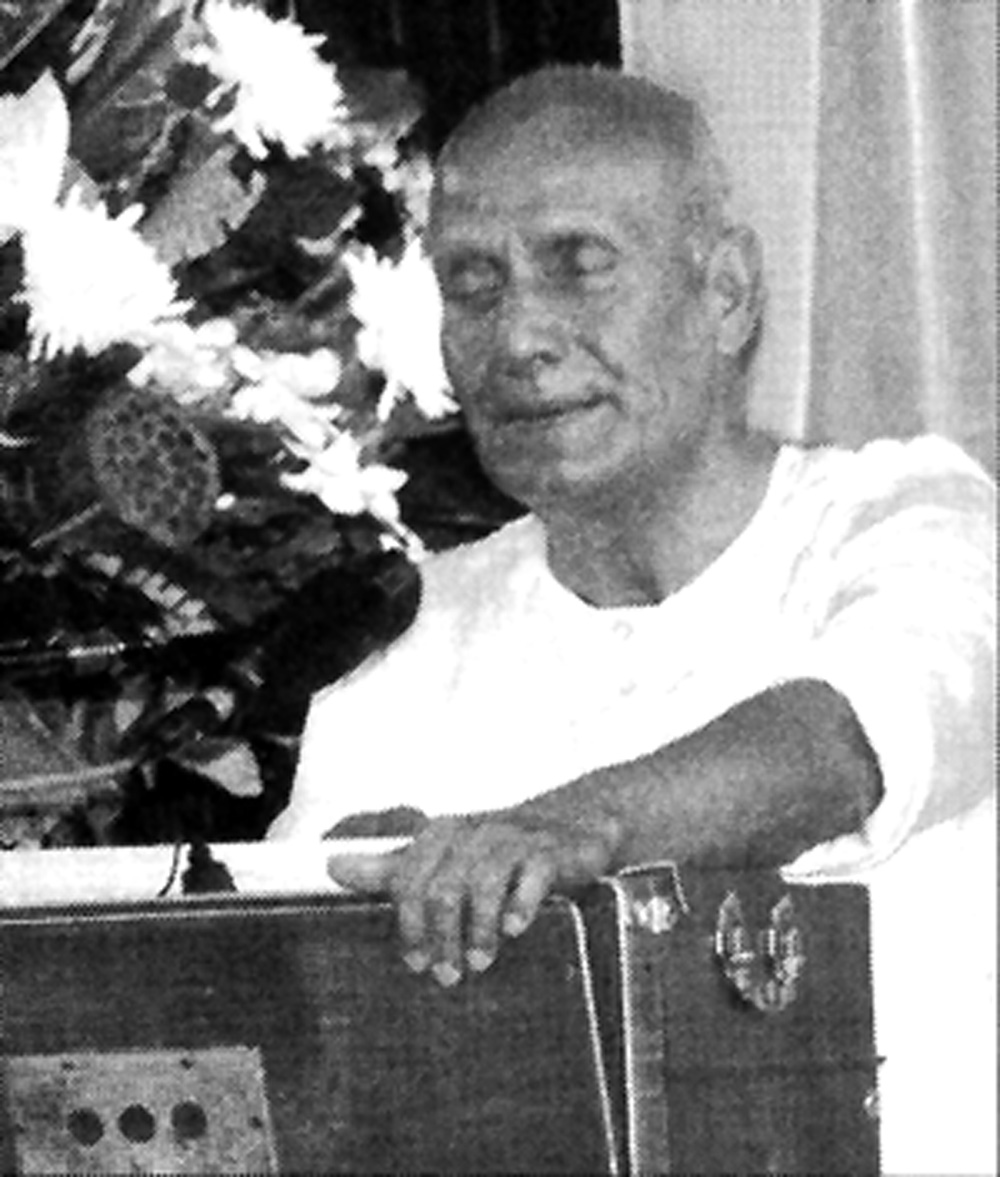
Sri Chinmoy sits on the floor in his meditation room playing the harmonium. Around him are strewn a few of his old notebooks from the Ashram from which he chooses the poems to set to music. He is lost in the very private, personal world of musical creativity. Diligently trying out numerous musical phrases to a particular line of poetry, he plays his harmonium quickly, until he decides that he has captured the essence of the words he is working with. He notates the musical passage in his native Bengali notation and immediately starts to work on the next line of poetry. He composes with complete freedom and spontaneity, his main concern being that the music perfectly embodies the consciousness of the Bengali poetry. Gradually the songs emerge, joined together by unexpected intervals and beautiful glissandos which glide by so gently and gracefully that one is immediately lifted to that higher plane of consciousness where the outer sound is transformed into inner bliss, and the listener becomes surcharged with the ever-increasing flow of divine nectar which floods the Master’s entire existence.
The music of Sri Chinmoy embodies a variety of characteristics which apply to his entire repertoire of vocal music. The most predominant aspect of the Master’s style is constant motion. It is rare that one note will receive enough durational emphasis to result in its implication as a tonal center (although combinations of notes often imply tonal centers around Db and Gb). Whether the song is diatonic or whether accidentals are introduced, whether the song is strongly rhythmic or sweetly flowing, whether there are unusual intervals or the simplest stepwise phrases, there is always a sense of moving from one place to another. Both rhythmically and melodically, Sri Chinmoy’s songs draw their life from a constant sense of motion. This primary characteristic includes all the other aspects of the Master’s music.
The most important quality of this motion is that it is, by and large, ascendant motion. Ascending scale-wise movement dominates the repertoire. Sri Chinmoy usually starts a song on Db, Gb, F or Ab and immediately ascends to a higher note. A study of the starting notes in the 99 songs from the collection Supreme, Teach Me How to Surrender songbook shows that 24 songs begin on the note Db. In 21 of those 24 cases, the note following Db is the next higher whole step: Eb. The three songs which did not contain this scale-wise motion did leap to a higher note: twice to Gb, and once to Bb. It may be wise to note that the ascending melody, a natural characteristic of Sri Chinmoy’s style, is the natural embodiment of spiritual aspiration and the inner cry for a higher and more fulfilling existence. It symbolizes the untiring effort on the part of the spiritual seeker to continually transcend himself.
Sri Chinmoy’s songs are generally linear in form. They rarely employ what could be called a conscious use of compositional technique. One always gets a sense of freedom in the Master’s music, and never rigidity. It is interesting to notice, therefore, the very precise form the Bengali poetry adheres to. The great majority of the poems are metrically consistent and rhyme in couplets. For example, the rhyme scheme of “Tomar Adesh” is AA, BB, CC, A’:
Tomar adesh shunbo ami shunbo
Tomar nabhe urbo ami urbho
Tumi amar chira apan
Tumi amar hiya ratan
Ashru sathe kandbo rate
Alor sathe hashbo prate
Tomar lagi kandbo ami hashbo
The syllables per line of this poem are neatly arranged as 10, 10, 8, 8, 8, 8, 10. This poem was written in 1968-1969, but it is representative of hundreds that Sri Chinmoy wrote prior to 1964, the year he left India for the United States.
Tomar Adesh Shunbo Ami Shunbo
Score:
Translation by Sri Chinmoy:
I shall listen to Your Command, I shall.
In Your Sky I shall fly, I shall fly.
Eternally You are mine, my very own.
You are my heart’s wealth.
For You at night, in tears I shall cry.
For You at dawn, with light I shall smile.
For You, for You, Beloved, only for You.
Looking at the music, we find that the two lines set to the first two lines of the poem are identical. The symmetrical structure AA, BB of the text follows through perfectly with a melodic AA, BB pattern in the song. The tendency toward symmetry already established carries into the last part of the song. In the third line, Sri Chinmoy starts the musical phrase in the same way as the preceding two phrases, but after two notes he continues with the figure until the pause C#’, and then he completes the phrase with a complementary phrase identical in rhythm to the one which precedes it. “Tomar Adesh” is, therefore, an example of how the form of the text suggests the form the melody will take. This is not a common practise of the Master, but yet certain examples, usually on a smaller scale than this example, do exist.
Most often it is the sense, or consciousness, of the poem that determines how the melody will turn out. The words carry the message for the ears to hear, and the music breathes life into the words for the soul to feel. “Tomar Hasi Bhalobasi” is a good example of Sri Chinmoy’s representation of the spiritual qualities of the text in music.
Tomar Hasi Bhalobasi
Score:
Translation by Sri Chinmoy:
Supreme,
Your Smile I love.
Your Torture I love.
Your Feet I love.
Your Eyes I love.
Your Soul I love.
Your Body I love.
Everything that is You I love.
Every moment I love You.
O Lord Supreme, O Lord Supreme,
I love You, I love You.
You are the Flute of my existence.
For the line “Tomar charan bhalobasi” (“Your Feet I love”), Sri Chinmoy has begun his phrase on the low C#, representing the humble bow of the seeker when face-to-face with the Supreme. In addition, the C# signals the locrian mode which, because of its harmonic instability, may represent humility in the presence of God. The phrase “Pratikhane bhalobasi” (“At every moment I love You”) begins on a low D and leaps an octave to d’ for the line “Prabhu tomai bhalobasi” (“O Lord Supreme, I love You”), which introduces the climax of the song. The low register of the phrases containing references to the body and the feet is entirely called for in this instance, since the body is the lowest part of the seeker’s existence, and the last part to be illumined, and since the humble person traditionally approaches a holy man in India by touching his feet.
Although one rarely finds evidence of melodic development in Sri Chinmoy’s songs, there is a constant tendency to develop the various rhythmic motifs of any given song. In “Ogo Sundara”, for example, Sri Chinmoy begins the song on a c’ and he establishes the motif ‘A’ which repeats three times.
Ogo Sundara Ogo Ananda Ogo Mor
Score:
Translation by Sri Chinmoy:
O my beautiful One, O my Lord of Delight,
O Lord of my life-breath,
In the finite and the Infinite I have met
Your Universal Consciousness.
I shall play on the flute of transformation-light
In the forest of my heart.
Smiling and dancing I shall lose myself
In the wealth of Lord Krishna.
This repetition of an established motif is common throughout the Master’s songs. One may pause for a moment to reflect on Sri Chinmoy’s illumining philosophy, which speaks of the soul as being the ‘divine child’ within, which has unfortunately been covered over in the process of our growth and, therefore, cries to be heard. The utter simplicity of the motif and its subsequent repetition elicits a response from our own divine ‘child-soul’, just as a child singing some favourite rhyme over and over can touch our hearts in a simple yet profound way.
In the following phrase, Sri Chinmoy stays with the c’, creating motif ‘B’, where he repeats the rhythmic pattern using substitute pitches. Motif ‘C’ is created, which consists of and , borrowed from the first motif. He repeats the pattern (‘hriday bane’), but this time he substitutes segments from motif ‘B’ before ending the phrase as an extended form of motif ‘A’.
Here one finds a natural compositional form and structure in Sri Chinmoy’s music. The various rhythmic motifs unite the song as an organic whole in the way they emerge out of and elaborate on each other.
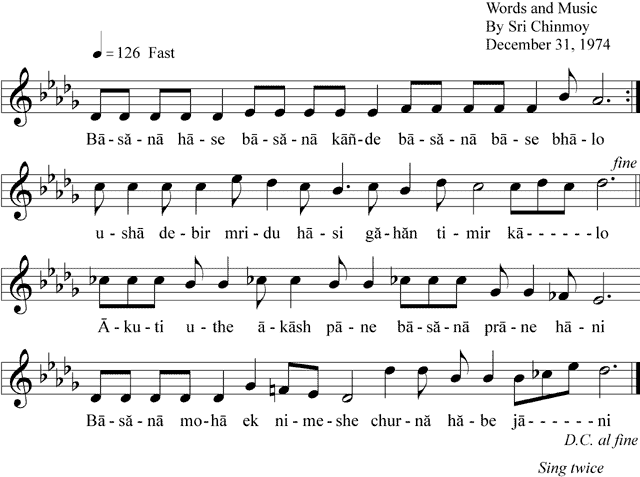
Often the Master establishes a set meter, such as in “Basana Hase”, where the motif is repeated is repeated three times and could easily be manipulated to serve as a cadence, but the phrase is disrupted at the cadence in such a way that the metrical balance of the phrase is upset. The metre is established in 3/4 and the cadence upsets the flow. In the second phrases, the motif is quite different – – and it is repeated six times, but the figure at the cadence disrupts the flow:
Basana Hase Basana Kande Basana
Score:
Translation by Sri Chinmoy:
My desire smiles and my desire cries.
My desire loves the sweet smile
Of the goddess dawn
And the darkness
Of dark night.
I know not how and why
My aspiration-flame is climbing up
To reach the skies.
I know in a twinkling
My desire-world
Will come to its final end.
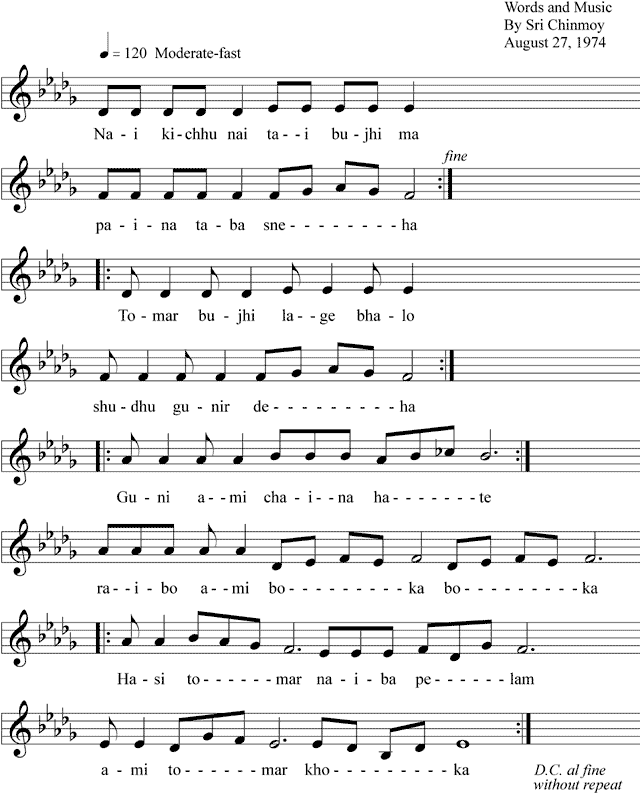
There are many rhythmic similarities between “Basana Hase” and “Nai Kicchu Nai”:
Mother, do You not love me
Just because I have nothing to offer You?
Do You love only those
Who are blessed with striking capacities?
Mother, I do not want to be a man of virtues or capacity;
I want to remain a fool.
Although You bless me not with Your smile divine,
I claim myself Your fondest child.
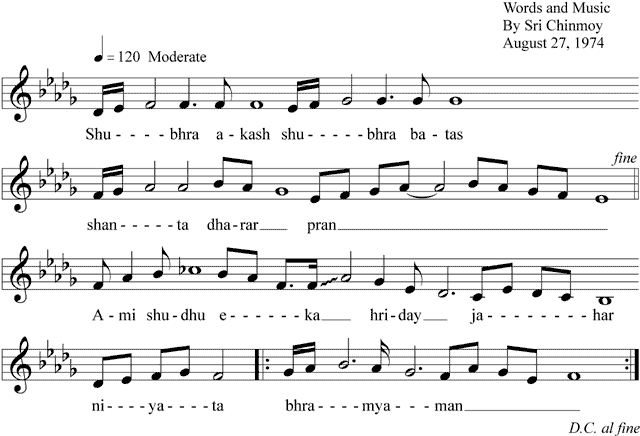
In “Nai Kicchu Nai”, one can easily follow the simple scale-wise passage. Likewise in “Shubhra Akash”, the same pitches used in “Nai Kicchu Nai” appear, but in a different rhythmic pattern:
Shubhra Akash Shubhra Batas Shanta
Score:
Translation by Sri Chinmoy:
A clear, bright sky and clear, bright air
And a tranquil earth heart I feel within me.
Alone I am roaming in the cosmos wide
With my eternity’s partner heart.
In both of these songs, the common cadential figure appears. This figure is used by Sri Chinmoy at the ends of many musical phrases and as a common thematic device. Variations may occur, which include the common figure .
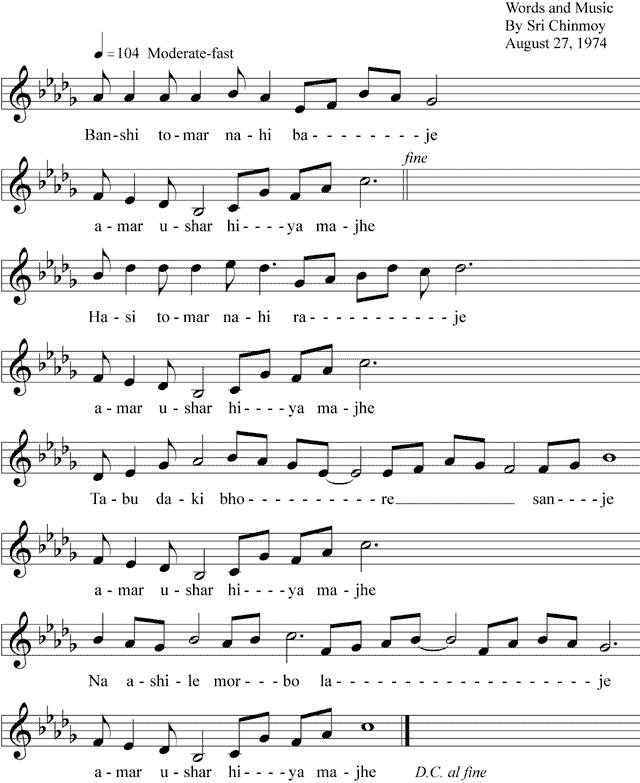
In “Banshi Tomar Lahi Baje”, the figure is repeated three times, followed by the figure . In fact, the entire song consists almost primarily of these two rhythmic figures.
Banshi Tomar Nahi Baje Amar Ushar Hiya
Score:
Translation by Sri Chinmoy:
I hear not Your flute
In my barren heart.
I see not Your Smile
In my barren heart.
Yet I invoke You morning and evening
In my barren heart.
If You do not respond,
I shall die in utter shame
In my barren heart.
The question may arise: what causes certain rhythmic patterns to be so often expounded when myriads of other possibilities avail themselves? Sri Chinmoy explains that he uses these “because I get a kind of unusual thrill”.2 Another answer to this question concerns the Bengali language. The syntax of the Bengali words combined with the Master’s natural styles of pronunciation and interpretation result in the common figures and . For the two-syllable words ‘banshi’, ‘tomar’, ‘nahi’ the Master emphasizes the first syllable (i.e. ) and he continues throughout the song with this type of emphasis.
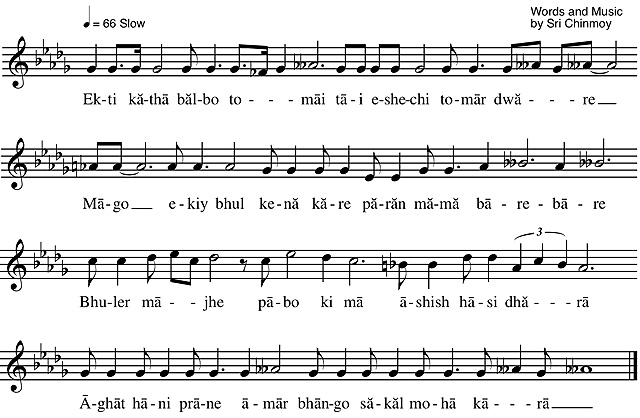
Sri Chinmoy usually adheres to the given key signature in any particular song for the majority of the pitches within that song. When he uses accidentals, it is most often to shift the tonality of a moving line to provide contrast to the other diatonically moving phrases.3 “Ekti Katha Balbo” is an interesting exception to this generalization. Here the Master uses accidentals to create the half-steps which follow the repeated note ‘G’. The effect is almost one of staticity. This makes the first two lines and the last line of “Ekti Katha” quite different from the flowing motion we are used to hearing in the other songs.
Ekti Katha Balbo Tomai
Score:
Translation by Sri Chinmoy:
I shall tell You one thing,
Therefore, I have come to Your door.
Mother, why does my mind commit
The same mistake time and again?
Mother, will I get the flow of Your Blessing-Smile
In my teeming errors?
Striking my heart, do break asunder
The prison-cell of all my attachments.
Even though this is a departure from the expected, we can see the reason for “Ekti Katha’s” use of accidentals and staticity by going to the Bengali text:
Ekti katha balbo tomai
Tai eshechi tomar dware
Mago ekiy bhul kena kare
Paran mama barebare
Bhuler majhe pabo ki ma
Ashish hasi dhara
Aghat hani prane amar
Bhango sakal moha kara
The first four Bengali lines are translated by the first three lines of English. The poetry speaks with some despair about how time and again (‘barebare’) the speaker in the poem commits the same errors. This inhibits the seeker’s progress and, therefore, there is a lack of motion both in the seeker’s life and in the music. The next two lines of Bengali correspond to the fourth line of English. The seeker implores the Divine Mother for the ‘flow’ of Her Blessing. Accordingly, the music frees itself from the tortured intervals of the half-step created by the accidentals, and begins moving diatonically. ‘Dhara’, or ‘flow’, is a melisma that rises and falls back to the original c#, thus embodying in a subtle but effective way the sense of the word.
The last phrase of the song immediately reverts back to the style of the beginning. ‘Aghat hani’, or ‘strike’, is expressed by the accented repeats on ‘G’. ‘Kara’, or ‘prison-cell’, again picks up the repeated half-step. The seeker is still caught in this ‘prison-cell’ and the music clearly implies the aborted wish to move freely.
“Ekti Katha Balbo” is, therefore, an excellent example of how Sri Chinmoy will depart from his usual diatonic motion if the consciousness of the poem calls for it.
The last musical consideration in this brief survey of Sri Chinmoy’s music4 is the use of the repeat. Many of the songs have one or more phrases repeated, almost all have a ‘D.C.’ marking, which means the songs invariably end with the first line or two of the beginning. Sri Chinmoy elaborates on the repeat:
“When I sing my songs, why do I very often repeat the same line twice? When I sing each line twice, it has a mantric effect. When we sing a line only once, someone’s heart may be receptive but the other members of his family may not be receptive. Or the seeker’s vital may be receptive, but his mind is roaming. Each time a different part of the being may be receptive. When I repeat, it gives those members that were not listening the first time another opportunity to pay attention. By repeating, I give the opportunity to the mind or vital or body-consciousness to also listen to my music.”
On the subject of singing and learning the Master’s songs, Tanima Bossart5 relates: “Sri Chinmoy has made it clear to me that in teaching his songs to the Centres, the songs have to be standardized and not left open to individual interpretation or changes, even if there are times when he himself sings them differently. There are a few cases when, after singing a song over the years, he has incorporated a change and requested us to do the same. “Ekbar Shudhu Balo” is one example. “Ore Mor Kheya” is another.”
It should be noted that Sri Chinmoy stresses the importance of singing his songs in the key in which they are transcribed. He has composed a song in a certain key in order to bring out the quality of the text. Since the notes each have their own special vibration and spiritual quality, one should adhere to this rule.
It is important to remember, finally, that Sri Chinmoy’s songs are first and foremost an offering to the world, an offering of himself and of the infinite peace, light and bliss that he embodies. This, too, is why there are so many songs, and why the Master is determined to write so many more: his offering is unconditional and, therefore, endless. Sri Chinmoy has realized that one of his divine purposes in life is to offer an abundance of beauty and inspiration to the world in the form of his soulful, illumining music.
– End –
This analysis first appeared in the author’s book “Sri Chinmoy: The Silence-Sound: An Overview of Sri Chinmoy’s Musical Manifestation (1944-75)”, Aum Publications, New York, 1977.
Author's & Editor's Endnotes: 1 Sri Chinmoy composed this song and the two that follow on the occasion of his 42nd birthday. 2 This and subsequent comments made during a taped conversation with the author. 3 Often the #4 and b7 degrees are added to the major scale, resulting in a nine-tone scale. The #4 degree is usually introduced within the third phrase as a bridge to the dominant tonality. The b7 degree brings the implied tonality back to the tonic. 4 Previous chapters of Shambhu’s book discuss the development of Indian music from the early Vedic chants to the devotional songs of the modern age. He shows how various aspects of Sri Chinmoy’s music fit into this historical stream and relate to contemporary Indian spiritual music. In doing this, he discusses Sri Chinmoy’s use of accents, melismas, ascendant melodic motion, repetition of established motifs and cadential figures. 5 Tanima Bossart is one of the original transcribers of Sri Chinmoy’s music. We are indebted to her and to Archee for their assistance with the musical notation for several songs in this article.
The genesis of Sri Chinmoy’s Peace Concerts can be traced back to one auspicious day in June 1965, when he was asked by the Indian Consulate, at the behest of the Asia Society, to set tune to three ancient Bengali poems and sing them at a recital to be held at the Guggenheim Museum in New York.
With barely a week’s notice, the young Chinmoy was desperate to find a harmonium. As it happened, Sher Singh, the security guard at India House, was more than happy to sell him one. In true Indian manner, Chinmoy bargained with the seller, eventually procuring it for just $6. The kind heart of Sher Singh won out. Chinmoy’s first offer of $25 was refused and when they both agreed upon $7, Mr. Singh returned $1 to Chinmoy’s hand.
“That week I practised those three songs on Sher Singh’s harmonium at least forty times. Before the actual performance, during my lunch hour, I had to go to the Asia Society and sing before the Society’s leaders. They were very satisfied.”1
His career as a concert musician had begun.
The earliest known photograph of Sri Chinmoy in concert, playing his first harmonium — the one he bought from Sher Singh. The picture was taken at Sri Chinmoy's second recital for the Asia Society, held at the Indian Cultural Centre in New York on March 20, 1966.
At his lectures in the late ’60s and early ’70s, Sri Chinmoy would often play the harmonium and sing a few traditional spiritual songs, as well as some of his own original compositions from an ever-increasing repertoire.
In the summer of 1975, Sri Chinmoy began practising a variety of Eastern and Western instruments, culminating in a twenty-seven instrument concert on his birthday, August 27.
Although the variety of instruments Sri Chinmoy has played since then can be numbered in the hundreds, there are two instruments that have become synonymous with Sri Chinmoy’s musical performances over the years – the Indian esraj and the Western flute.
He first began playing the esraj in New York on February 17, 1976. And in early March that same year, during a lecture tour of Australia, Sri Chinmoy learnt to play the Western flute.
During his lifetime, Sri Chinmoy gained worldwide recognition as a prolific composer and a consummate musician. In 1984, he offered the first of what he called ‘Peace Concerts’ to an audience of 8,500 people in Cologne, Germany. For the next twenty or more years, he travelled the globe sharing the message of peace through his music. His largest concert was held in the year 2000, when 19,000 people gathered to hear him at the Molson Centre in Montreal, Canada.
When asked how his concerts bring peace to the world, he answered with characteristic humility: “In my case, I feel that when I play soulful music and when I sing my spiritual songs, I can offer whatever peace I have to humanity. So this is my way of offering.”2
In total, Sri Chinmoy offered almost 800 Peace Concerts, performing in capacity-filled venues, sharing inspiration with audiences around the world.
Video of Sri Chinmoy Peace Concerts. Photo by Dhanu from Montreal Concert, Canada, 1991.
“When I offer peace concerts,” he said, “thousands of people pray with me and meditate with me. I play different musical instruments and sing for about two hours. The peace-lovers who come to listen inspire me, and I inspire them. Everything is based on inspiration.”3
The following is a list of Sri Chinmoy’s first 600 Peace Concerts.4 Gradually more concerts will be added, together with additional information, photographs and links to talks, poems and dedications.
• Sri Chinmoy dedicates the concert to President Ronald Reagan, in honour of the President’s birthday. Earlier the same day, Sri Chinmoy had joined the President as a guest at the National Prayer Breakfast.
65.
HARVARD UNIVERSITY Cambridge, Massachusetts, USA March 7, 1986
CAIRO SHERATON HOTEL Cairo, Egypt December 20, 1989
Special guest India’s Ambassador to Egypt Alan Nazareth addresses the audience. Also in attendance is Fred Lebow, Founder and President of the New York Road Runners Club.
212.
MONTAZAH SHERATON HOTEL Alexandria, Egypt December 23, 1989
213.
SUCHARITA HALL (Presidential Residence) Colombo, Sri Lanka January 4, 1990
•Dedication to Sri Lankan President Ranasinghe Premadasa.
• Special guests include President Premadasa, several Ministers and other government officials. Following the concert, Sri Chinmoy lifts the President and presents him with the ‘Lifting Up the World with a Oneness-Heart’ Award.
214.
214 RATNAPURA TOWN HALL Ratnapura, Sri Lanka January 5, 1990
• Special guests include Sri Lanka’s Chief Minister Arthur Ranasinghe (representing President Premadasa), the Mayor of the City of Ratnapura and several district officials. After the concert, a special cultural programme of music and dance is held in Sri Chinmoy’s honour.
215.
ELPHINSTONE THEATRE Colombo, Sri Lanka January 8, 1990
• The concert is held under the patronage of Prime Minister Dingiri Banda Wijetunga, who also attends, along with Chief Minister Ranasinghe, Presidential Advisor Weerakoon, and the Mayor of Colombo M. Hussain Mohamed. Sri Chinmoy also lifts the Mayor.
216.
ARMONIA HOTEL Vouliagmeni, Greece January 18, 1990
217.
PUBLIC SCHOOL 86 Jamaica, New York, USA February 6, 1990
Peace-Meditation-Blossoms
218.
PUBLIC SCHOOL 86 Jamaica, New York, USA February 10, 1990
Peace-Meditation-Blossoms
219.
MEISTERSINGERHALLE Nürnberg, Germany February 18, 1990
Oneness-Happiness-Song
220.
KONGRESSZENTRUM Hannover, Germany February 20, 1990
Oneness-Happiness-Song
221.
STAATSBIBLIOTHEK West Berlin, West Germany February 21, 1990 (afternoon)
Oneness-Happiness-Song
• Audience of 200
222.
ICC KONGRESSZENTRUM West Berlin, West Germany February 21, 1990 (evening)
Oneness-Happiness-Song
• Audience of 4,200
223.
OPERNHAUS LEIPZIG Leipzig, East Germany February 22, 1990
Oneness-Happiness-Song
224.
KONGRESSHALLE am Alexanderplatz East Berlin, East Germany February 23, 1990
Oneness-Happiness-Song
• Sri Chinmoy offers a special message to the oneness-soul of Germany.
225.
BUCHMAN HALL New York, NY, USA February 27, 1990
Peace-Meditation-Blossoms
226.
ST. PETER’S LUTHERAN CHURCH New York, NY, USA March 3, 1990
Peace-Meditation-Blossoms
227.
COMMUNITY UNITED METHODIST CHURCH Jackson Heights, New York, USA March 13, 1990
Peace-Meditation-Blossoms
228.
DAG HAMMARSKJÖLD AUDITORIUM United Nations, New York April 3, 1990
Peace-Meditation-Blossoms
229.
HUNTER COLLEGE New York, NY, USA April 14, 1990
Peace-Meditation-Blossoms
230.
COMMUNITY CHURCH New York, NY, USA April 21, 1990
Peace-Meditation-Blossoms
231.
VETERANS MEMORIAL HALL Snug Harbor Cultural Center Snug Harbor, New York, USA May 15, 1990
Peace-Meditation-Blossoms
232.
ASPIRATION-GROUND Jamaica, New York, USA July 1, 1990
Peace-Meditation-Blossoms
233.
BÖSENDORFER CENTER New York, NY, USA July 28, 1990
Peace-Meditation-Blossoms
234.
ASPIRATION-GROUND Jamaica, New York, USA August 16, 1990
Peace-Meditation-Blossoms
235.
TOWN HALL New York, NY, USA August 28, 1990
Peace-Meditation-Blossoms
236.
EMPIRE STATE PLAZA CONVENTION CENTER Albany, New York, USA September 5, 1990
Oneness-Happiness-Song
237.
PERFORMING ARTS CENTER Providence, Rhode Island, USA September 6, 1990
Oneness-Happiness-Song
238.
THE OPERA HOUSE Boston, Massachusetts, USA September 7, 1990
Oneness-Happiness-Song
239.
THE PALACE THEATRE New Haven, Connecticut, USA September 8, 1990
Oneness-Happiness-Song
240.
CONSTITUTION HALL Washington, DC, USA September 10, 1990
Oneness-Happiness-Song
241.
JOSEPH MEYERHOFF SYMPHONY HALL Baltimore, Maryland, USA September 11, 1990
242.
MONMOUTH ARTS CENTER Red Bank, New Jersey, USA September 12, 1990
Oneness-Happiness-Song
243.
PUBLIC SCHOOL 86 Jamaica, New York, USA September 19, 1990
244.
PUBLIC SCHOOL 86 Jamaica, New York, USA September 26, 1990
245.
PUBLIC SCHOOL 86 Jamaica, New York, USA October 3, 1990
246.
ASPIRATION-GROUND Jamaica, New York, USA October 7, 1990
247.
PUBLIC SCHOOL 86 Jamaica, New York, USA October 10, 1990
248.
KONCERTHUSET Stockholm, Sweden October 14, 1990
249.
KONCERTHUSET Stockholm, Sweden October 15, 1990
250.
ROYAL ALBERT HALL London, England, UK October 19, 1990
ST. ALOYSIUS COLLEGE Birkirkara, Malta December 21, 1991
• Sri Chinmoy dedicates the concert to President Mikhail Gorbachev (2)
• Audience of 500
289.
PRESIDENTIAL PALACE Valletta, Malta December 23, 1991
• Special guest Censu Tabone, President of Malta. The concert, in honour of the President, is held in St. George’s and St. Michael’s Hall of the Palace of the Grandmasters where the knights of Malta used to meet.
290.
SHERATON HOTEL Catania, Sicily, Italy January 2, 1992
• Sri Chinmoy dedicates the concert to President Mikhail Gorbachev (3)
• Audience of 600
291.
HOTEL RlU BONANZA Puerto de la Cruz, Tenerife, Canary Islands January 12, 1992
PUBLIC SCHOOL 86 Jamaica, New York, USA February 1, 1992
294.
PUBLIC SCHOOL 86 Jamaica, New York, USA February 8, 1992
295.
PUBLIC SCHOOL 86 Jamaica, New York, USA February 15, 1992
296.
PUBLIC SCHOOL 86 Jamaica, New York, USA February 22, 1992
Si Chinmoy celebrates his esraj anniversary and sings 20 ‘peace songs’.
297.
PUBLIC SCHOOL 86 Jamaica, New York, USA February 29, 1992
Sri Chinmoy dedicates the concert to U Thant, former Secretary-General of the United Nations, on the twentieth anniversary of his first meeting with him.
COLLEGE OF STATEN ISLAND Staten Island, New York, USA November 12, 2000
•
603.
THE COOPER UNION East Village, New York City, New York, USA November 18, 2000
•
604.
THAI AYUTTHAYA BUSINESS ADMINISTRATION COLLEGE Ayutthaya, Thailand December 1, 2000
•
605.
TRADERS HOTEL Yangon, Myanmar December 7, 2000
•
606.
TRADERS HOTEL Yangon, Myanmar December 17, 2000
• Early evening concert for special guests: Secretary-1, Lt. Gen. Khin Nyunt and Dr. Daw Khin Win Shwe, wife of S-1; Minister of Foreign Affairs U Win Aung; Minister of Home Affairs Tin Hlaing; and Minister of Hotels and Tourism Major-General Saw Lwin.
607.
TRADERS HOTEL Yangon, Myanmar December 17, 2000
• Evening concert
608.
NATIONAL THEATRE Mandalay, Myanmar December 24, 2000
• Concert dedicated to Secretary-1, Lt. Gen. Khin Nyunt. With special guests Maj. Gen. Ye Myint, Commander of Mandalay Region; and the Mayor of Mandalay, Soe Thi Ha.
609.
MYANMAR LACQUERWARE INSTITUTE Bagan, Myanmar January 1, 2001
•
610.
MYANMAR LACQUERWARE INSTITUTE Bagan, Myanmar January 1, 2001
• Concert dedicated to Secretary-1, Lt. Gen. Khin Nyunt.
611.
UDAYANA UNIVERSITY Bukit Jimbaran Campus Nusa Dua, Bali, Indonesia January 17, 2001
•
612.
TAMAN BUDAYA ART CENTRE Denpasar, Bali, Indonesia January 20, 2001
•
613.
PUBLIC SCHOOL 86 Jamaica, New York, USA March 27, 2001
•
614.
PUBLIC SCHOOL 86 Jamaica, New York, USA April 6, 2001
•
615.
QUEENS COLLEGE AUDITORIUM Flushing, New York, USA April 13, 2001
• Sri Chinmoy performs on 30 instruments
616.
PUBLIC SCHOOL 86 Jamaica,, New York, USA April 27, 2001
•
617.
PARLIAMENT HILL Old Railway Committee Room Ottawa, Ontario, Canada May 7, 2001
• Includes a ‘Lifting Up the World with a Oneness-Heart’ programme and a Peace meditation at Canadian Parliament
618.
UNITED NATIONS DAG HAMMARSKJÖLD AUDITORIUM New York May 14, 2001
• Celebrating the 31st anniversary of Sri Chinmoy: the Peace Meditation at the United Nations
Endnotes:
1 Sri Chinmoy, My Consulate Years, Agni Press, Jamaica, NY, 1996, p. 35. 2 Sri Chinmoy, Sri Chinmoy Answers, Part 30, Agni Press, Jamaica, NY, 2001. 3 Sri Chinmoy, Sri Chinmoy Answers, Part 23, Agni Press, Jamaica, NY, 2000. 4 Originally published in 500 Compassion-Blessing-Blossoms with new additional information and amendments supplied by concert organisers.
Sri Chinmoy holds a meditation in the Jharna-Kala Gallery at 220 Mercer Street in Greenwich Village, New York. (The gallery was open for public viewing of Sri Chinmoy’s artworks from July 7th to August 29th 1975.)
Sri Chinmoy completes 3,000,000 Soul-Bird drawings in Jamaica, New York.
Prayer Session Held At Capitol For American Hostages
Spiritual leader Sri Chinmoy held a special prayer session at the U.S. Capitol on Tuesday, June 18, for the American hostages held in Beirut.
Representative Joseph P. Addabbo, one of the participants, called it “fitting and proper that you’ve come here on this day when we are beset by terrorists holding hostages.”
Sri Chinmoy has been leading meditations for peace at the United Nations since 1970.
Caption:
Sri Chinmoy greeting Congressman Addabbo (seated).
Zubin Mehta Meets Sri Chinmoy
The great Indian conductor Zubin Mehta, now musical director of the New York Philharmonic Orchestra, met with Sri Chinmoy on May 9.
The two spoke and meditated together in New York’s Lincoln Center.
Sri Chinmoy, who is also a poet and author, then presented Mr. Mehta with several of his books, a trophy and a cake with Mehta’s face sketched in icing.
Caption:
Sri Chinmoy meditated with Zubin Mehta who declared to Sri Chinmoy, (the meeting) ... “It’s very touching. I have never had anything like that.”

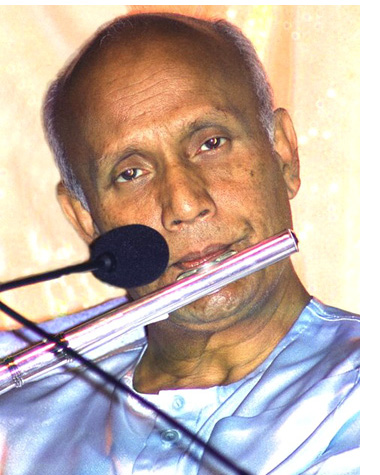
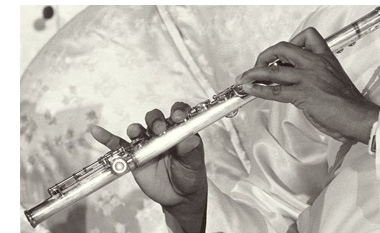
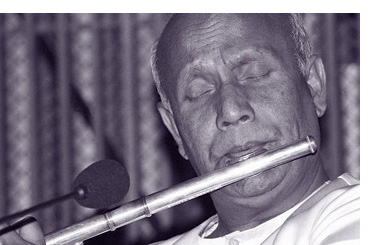
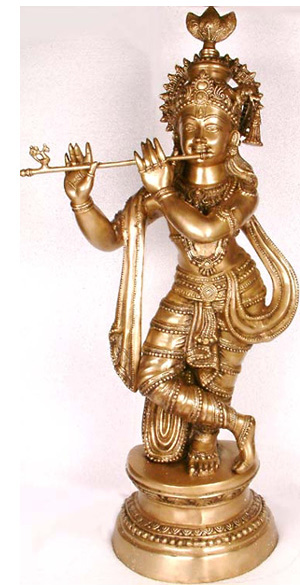
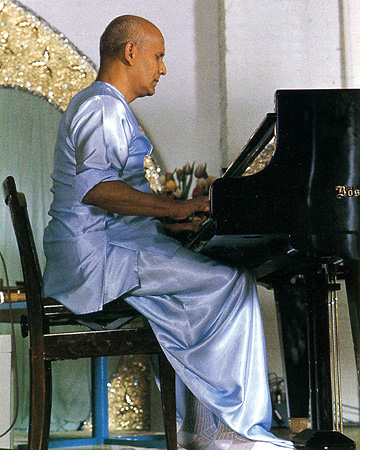


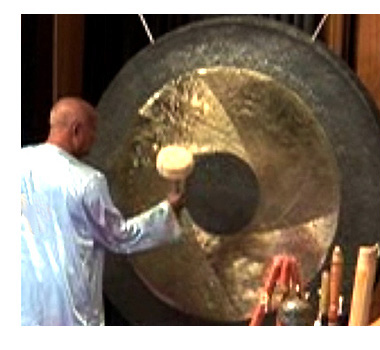


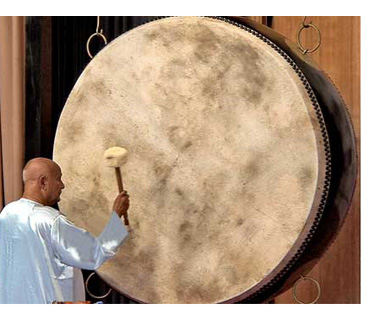 Finally, Sri Chinmoy sat at his synthesizer, which we knew to be his final instrument. It has been combined with a Kurtzweil sound module to create clusters of unique percussive sounds. Sri Chinmoy concluded with magnificent organ-like chords which soared with a grandeur and majesty beyond description towards a thrilling finish. The concert was over. The time was 1:37 p.m.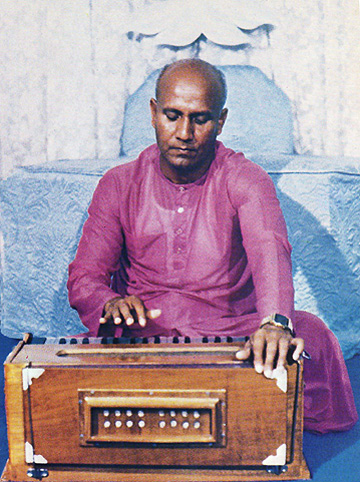
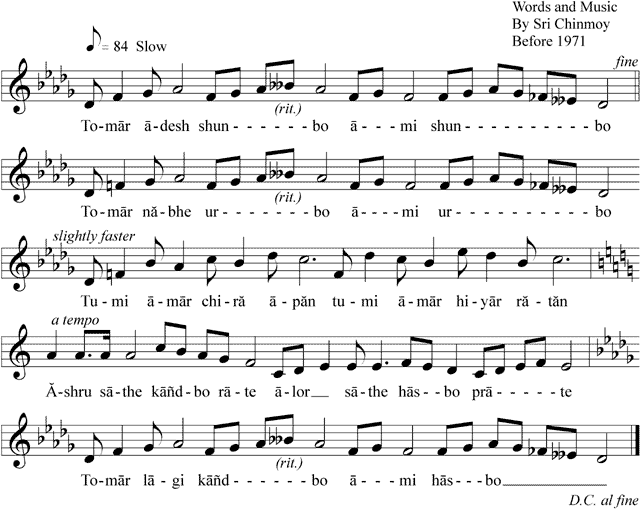
 until the pause C#’, and then he completes the phrase with a complementary phrase identical in rhythm to the one which precedes it. “Tomar Adesh” is, therefore, an example of how the form of the text suggests the form the melody will take. This is not a common practise of the Master, but yet certain examples, usually on a smaller scale than this example, do exist.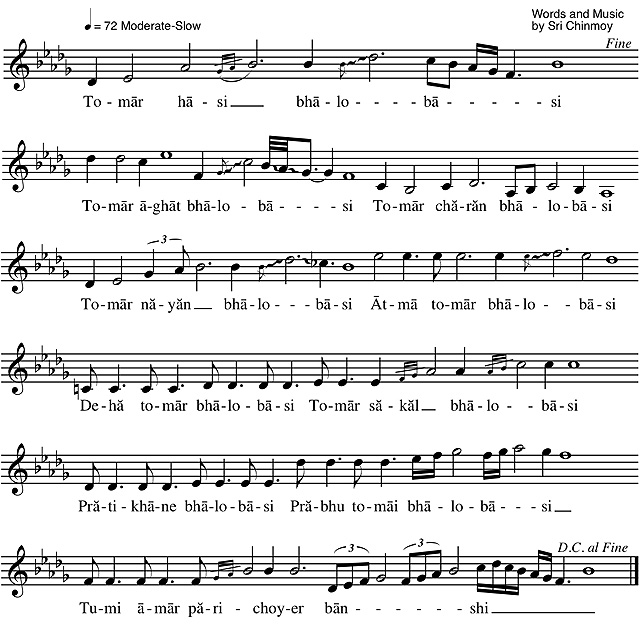

 using substitute pitches. Motif ‘C’ is created, which consists of
  and
and  , borrowed from the first motif. He repeats the pattern
  upsets the flow. In the second phrases, the motif is quite different –
  at the cadence disrupts the flow: