Every age calls forth its poet, someone who is able to express its deepest ideals and aspirations. The critic who first engages in the appraisal of this newly emergent poet is faced with vastly different responsibilities from the critic who deals with writers of an established excellence. Beyond his direct response to this promising new body of literature lies the task of creating a climate of empathy in which the poems may be received by future readers and commentators. The critic cannot fall prey to hesitation at this early stage. He must make a bold case for his choice, one that may move others to turn to the poetry and which may also serve as a point of departure for further critical studies. And, gradually, with the passage of time and the accumulation of diverse viewpoints, a perception of the intrinsic worth of the poet may begin to mature in the public consciousness.
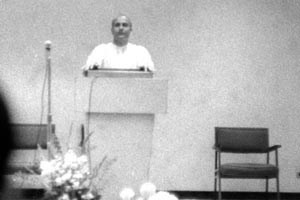
Sri Chinmoy’s fourth class in the Spring series on Yoga at his home, 4826 New Utrecht Avenue, Brooklyn, New> York
Who is fit for Yoga? You are fit for Yoga. He is fit for Yoga. I am fit for Yoga. All human beings without exception are fit for Yoga.
The spiritual fitness can be determined by our feeling of oneness, our desire for oneness. The tiniest drop has a right to feel the boundless ocean as its very own. Such is the case with the individual soul and the Universal Soul.
Where is God and where am I? God is on the third floor and I am on the first floor. I come up to the second floor. He comes down to the second floor. We meet. We both meet together. I do not forget to wash His feet with my tears of delight. Neither does He forget to place me in His heart of infinite Compassion.
Now what is Yoga? Yoga is self-conquest. Self-conquest is God-realisation. And he who practices Yoga does two things by one stroke: he simplifies his whole life and he gets a free access to the Divine.
In the field of Yoga we can never pretend. Our aspiration must ring true. Our whole life must ring true. Nothing is impossible for an ardent aspirant. A higher Power guides his steps. God's adamantine Will is his safest protection. No matter how long or how many times he blunders, he has every right to come back to his own spiritual home. His aspiration is a climbing flame. It has no smoke, it needs no fuel. It is the breath of his inner life. It leads him to the shores of the Golden Beyond. The aspirant, with the wings of his aspiration, soars into the Transcendental.
God is infinite and God is everywhere. To a genuine aspirant, this is more than a mere belief. It is the Reality without a second.
Now let us focus our attention on the spiritual life. It is a mistaken idea that the spiritual life is a life of austerity and a bed of thorns. No, never. We came from the Blissful. To the Blissful we shall return with the spontaneous joy of life. It seems difficult because we cater to our ego. It looks unnatural because we cherish our doubts.
The realisation of God is the goal of our life. It is also our noblest heritage. God is at once our Father and our Mother. As Father He observes, as Mother He creates. We shall never give up demanding of our Mother as a child does of his mother, so that we can win over our Mother's Love and Grace. How long can a mother go on unheeding her child's cry? Let us not forget that if there is anybody on earth on whom all human beings have a full claim, it is the Mother aspect of the Divine. She is the only strength of our dependence. She is also the only strength of our independence. As Her heart is the home of infinitude, so also is it eternally open to each individual.
We should now become acquainted with the eight significant strides that lead a seeker to his destination. The strides are Yama(self-control and moral abstinences), Niyama (strict observance of conduct and character), Asana (various body postures to help us enter into a higher consciousness), Pranayama (systematic breathing to hold a rein on the mind), Dharana (the fixation of our consciousness on God, joined by all parts of the body), Dhyana (meditation, the untiring express train speeding towards the Goal), and Samadhi (trance, the end of Nature's dance, the absolute fixation of our individual consciousness on the Transcendental Supreme).
Yoga is our union with Truth. There are three unfolding stages of this union. In the first stage, man has to feel that God needs him as much as he needs God. In the second stage, man has to feel that without him God does not exist even for a second. In the third and ultimate stage, man has to realise that he and God are not only eternally One, but Equal, all-pervading and all-fulfilling.
Sri Chinmoy worked for a 24-hour period — from midnight to midnight the previous day — writing 360 poems. Meanwhile, his press team began the task of publishing The Goal is Won early on the same day. They too take just 24 hours to complete their goal, finishing on the morning of April 29th.
June 1st, 1979
Pacific School of Religion
Berkeley, California, USA
Transcription from the original live recording.
0:02 Dear friends, dear brothers and sisters, dear distinguished professors and deans, here we are all seekers. We are sailing in the same boat, the boat that carries us to the Golden Shore of the Beyond. Nothing gives me a greater sense of satisfaction than to be of dedicated service to the seekers, for I am also a seeker, an eternal seeker, a seeker of the infinite Truth and Light.
1:26 As you know, I am advised by my esteemed friend, Dean Foster, to speak on the meaning of discipleship today. This is a most significant subject and, therefore, I offer him my gratitude-heart.
2:02 Now, who is a disciple? A disciple is a seeker, a truth-seeker. Who is a disciple? A disciple is a lover; he is a Heaven-lover. Who is a disciple? A disciple is a server; he is an earth-server. Who is a disciple? A disciple is a fulfiller; he is a God-fulfiller.
2:41 The meaning of discipleship today: now if we want to know the meaning of discipleship, we have to focus our concentrated attention on the role of a disciple. The role of a disciple is quite simple, of course, if we follow the path of the heart and not that of the mind. The role of the seeker is to give what he has and what he is. What he has is an inner cry. This cry is birthless and deathless. He offers this birthless and deathless inner cry to his Pilot Supreme for His infinite Light, eternal Peace and immortal Bliss. What he is? He is a devoted and soulful instrument. He wants to help mankind see the beauty of the Infinite in the very heart of the finite. He wants to unite earth’s helpless cry, helpless cry, and Heaven’s endless Smile. He takes it as his bounden duty to serve both Mother Earth and Father Heaven. Undoubtedly, he is a chosen instrument of the Absolute Pilot Supreme. Here to manifest the eternal Truth is his constant cry, constant hunger.
5:25 Yesterday’s disciple, today’s disciple and tomorrow’s disciple: yesterday’s disciple was simple and humble. Simplicity was his outer life, humility was his inner life. Simplicity and humility inundated his entire being. Today’s disciple is complicated and argumentative. Complication and argumentation reign supreme in his life, day in and day out. Tomorrow’s disciple will be the fastest spiritual runner. His code of life will be to run and become, and become and run. He will run in order to succeed; he will become in order to proceed. At times, he will run and reach the Goal; at times, the Goal will come to him. When he reaches the Goal, he will be blessed with the transcendental Pride of the Absolute Supreme. And when the Goal reaches him, he will immediately sit at the Feet of the Absolute Supreme with his heart’s soulful gratitude-sea.
7:40 In the days of yore, the disciple was advised and encouraged by the Master to renounce the world. Renunciation was taught right from the beginning when the seeker or the disciple came to the Master. The Vedic seers of the hoary past, and also the Upanishadic seers, offered a supreme message to the world at large: “Enjoy through renunciation — Tena tyaktena bhunjitha.”
8:40 Everybody wants to enjoy, for satisfaction is of paramount need. Now, they came to realise that satisfaction can be achieved only through renunciation, there is no other way. This world of ours gives us things that do not last; their life-breath is very short. Sooner than the soonest, everything dies. So, they taught their disciples not to run after material objects. Everything here is an illusion. Nothing can last and nothing will last permanently. What is the use of running after things that will not last for good? So, the students were taught the message of renunciation.
10:01 Then there came a time when the message needed some transformation. The twentieth century and a few centuries before, the sages, the seers, the spiritual Masters have come to realise that acceptance of life is of paramount importance, not rejection.
10:33 If we renounce the world, if we renounce the body, vital, mind and heart, then what are we going to do for our Beloved Supreme? We say we love God. We say we want to please Him. If we want to please Him, if we want to fulfil Him, how can we reject or renounce the world? This world of ours, as it is, must be accepted. First we accept, then we transform. Needless to say, this world is far, far from perfection. But unless and until we accept the world, we touch the earth-arena, we touch the sufferings, the pains, the imperfections of the world at large, how are we going to change the face and fate of the world? Therefore, we must needs accept the world.
11:46 Our mind is full of doubts, worries and anxieties and so forth. Our mind has to be transformed. Our vital quite often is destructive. We have to have a new vital, which is dynamic. With a dynamic vital we will be able to run the fastest, dive the deepest and fly the highest. Our body is lethargic; our body enjoys ignorance-sleep. It has been sleeping for millions of years, yet it wants to enjoy this ignorance-sleep. Now, the seeker in us tells our body to wake up. Again, the Upanishadic seers taught us how to inspire the body with inner dynamism by repeating the soulful and powerful words of incantation.
13:08 Uttisthata jagrata – Arise, awake! Prapya varan nibodhata – Until the Goal is reached, do not stop!
13:32 The inner Goal can be achieved only by the powerful souls. Not for the weakling, the Goal that satisfies our inner world and outer world; the Goal that quenches our Eternity’s thirst.
14:06 Today’s disciple cannot satisfy us. Yesterday’s disciple could not satisfy us. Tomorrow’s disciple also perhaps will not satisfy us. Why?
14:26 Yesterday’s disciple said to the Master, “Master, give me the capacity. If you bless me with capacity, I shall please you.” Now, the seeker, the disciple, did not want to go further. He did not tell the Master that he would be more than willing to please the Master in his own way.
14:54 Today’s disciple says to the Master, “Master, I am giving you a golden chance. Do please me first in my own way. I give you my word of honour, tomorrow I shall please you in your own way. But you have to please me first; and I have already given you a golden, supreme chance.”
15:22 Tomorrow’s disciple perhaps will say to the Master, “Master, let us please each other. You give me something significant and I shall give you something significant. I shall give you my life’s sleepless service. You give me your soul’s Himalayan realisation.” Here also, the disciple has managed to forget the message of unconditional reality. All conditional — Master has to give something to the disciple, then only the disciple will give the Master something else.
16:17 Therefore, yesterday’s disciple could not fulfil the supreme task; today’s disciple cannot; and tomorrow’s also failed. But, in the distant future — it may take millions of years — there shall come a time when the seeker-disciple will be ready to please the Master in his own way. The seeker-disciple will be able to identify himself with the supreme prayer-message of the Saviour Supreme Christ: “Father, let Thy Will be done.”
17:19 Here the message of surrender comes to the fore. Unfortunately, the present-day world is scared to death when it hears the word ‘surrender’. Now, in the spiritual life, the surrender that we speak of is not the surrender of the African slave of the past to their masters. It is the recognition of the Infinite by the finite. A tiny drop recognises its inner identity with the vast ocean. And it enters into the ocean and becomes the vast, infinite ocean itself.
18:24 Here, in the spiritual life, nobody is compelled to surrender. But everybody has an inner urge to grow into the Infinite. As the tiny drop grows into the Infinite, even so, the finite consciousness of ours can eventually grow into Infinity.
18:56 Surrender and freedom are always at daggers drawn. But if we dive deep within, we feel there is no difference between the two terms, between the two concepts, between the two so-called realities. They are the obverse and the reverse of the same coin. Before we accepted the spiritual life, we enjoyed freedom in a special way. We fulfilled, or wanted to fulfil, our earth-bound desires. We felt, perhaps, we had the capacity and potentiality to be another Napoleon or Alexander the Great or Julius Caesar to voice forth, “I came, I saw and I conquered.” This is at least the positive way of looking at the reality. Otherwise, if it is the negative way, then we would have cherished and admired deep in the inmost recesses of our heart the destructive message of Hitler and Stalin.
20:38 Now, we entered into the spiritual life, the desire-bound life we gave up. We enjoyed freedom, whether it is freedom or not, we enjoyed something in a limited way, and the after-effect of it was total frustration. Therefore, we needed a kind of escape. Or, we can say illumination dawned on us. Therefore, we entered into spiritual life.
21:12 Here, unfortunately, we feel that we are surrendering to somebody else. We have no freedom of ours. But I wish to say, freedom is always there. You have only changed the course of the game. Previously you wanted to fulfil yourself by fulfilling the desire-life. Now you want to fulfil yourself, please yourself, by fulfilling the aspiration-life.
21:54 Here, nobody compels, or can compel, a seeker-disciple to follow a spiritual path or to listen to the advice of a Master. He comes to the Master on the strength of his inner urge. Then he sees himself as an exact prototype of his Master’s divine consciousness. He knew perfectly well that once upon a time he enjoyed freedom in his own way. Now, also, he is exercising his freedom in a different way. When we lead, we enjoy freedom. Again, when we consciously, soulfully, deliberately and unconditionally follow, we enjoy another kind of freedom.
23:01 So here, his inner awareness, inner development, inner sense of truth compel him to follow a higher life, a more illumining life, a more fulfilling life. Therefore, the question of surrender does not arise at all — only, a new kind of freedom he enjoys. He is enjoying a new kind of freedom. He follows his own higher reality. He knows that the Master knows a little more than he does, so therefore he is following the Master. It is a new freedom. He does not have to kiss the dust of his Master’s feet. He knows, he and his Master are inseparably one and here on his own, to fulfil his own divine longing, he is staying with the Master. And he knows perfectly well, there is only one Master and that Master is the Absolute Supreme. And the Master who is in the physical form is only a representative of his real Guru, the real Master.
24:58 In the spiritual life: God for God’s sake. Right from the beginning, if this message a seeker can embody, can reveal and manifest at every moment in his life, then only he can be a perfect choice and supreme instrument of the Beloved Supreme. There shall come a time when our Mother Earth will be inundated with the seeker-disciples who will carry the banner of unconditional surrender, which is nothing other than conscious and constant, inseparable and unconditional divine oneness with one’s Master.
– End –
Endnotes: 1 Sri Chinmoy translates the Sanskrit phrase Nayam atma bala hinena labhya as “The soul cannot be won by the weakling.”
April 22nd, 19741
North Idaho Junior College, Idaho, USA.
Transcription from the original live recording.
0:05 Dear seekers, dear brothers and sisters, I wish to give a very short talk and then I shall welcome spiritual questions.
0:34 Here we are all seekers. Some of us may not be as sincere as others. Some of us may be curiosity-mongers. Some of us, at times, become doubters. Some of us, at times, become atheists. Yet we are all seekers. Just because we are seekers, at God’s Choice Hour, one day we shall realise God.
1:38 The motto of the state of Idaho is ‘Exist Forever’. Now, we know that the body does not exist forever. It exists only for sixty, seventy or eighty years, then the body plays its role; the role of the body is over. Something in us, within us, exists forever, and that is the soul. Just because we are seekers, we do believe in the existence of the soul. Now, how is it, the soul exists and not the body?
2:35 The soul exists forever precisely because the soul is the direct representative of God on earth. The soul has, right from the beginning, the message of Divinity, Eternity, Infinity, Immortality. The soul embodies Infinity, Eternity and Immortality, whereas the body of ours fails to embody these three divine qualities. The soul exists because... the soul exists forever because the soul is aware of its source, the ultimate source, God – the Eternal, the eternal Supreme Pilot.
3:51 Now, here our question is: does God exist?
3:59 The atheist in me will immediately say, “No, God does not exist. God does not exist; he cannot exist. And, therefore, I do not need Him.”
4:14 Now, the desiring man in me wants to answer this question, “Does God exist?” The desiring man in me in no time says, “Yes, God exists. I can see it, I can see Him, I can feel Him. How? When? When my desires are fulfilled, at that time, I imagine God according to my sweet fancy. But the moment my desires are not fulfilled, I immediately negate the existence of God. There is no God, no God. Now, the existence of God depends on the fulfilment of my desire. This is what the desiring man in me has taught me. If my desire is fulfilled, God exists. If my desire is not fulfilled, God does not exist at all. Or, I say God may exist for others, not for me. If we see... if I see that others’ desires are fulfilled, then God exists for them and not for me.
6:16 Now, the aspiring man in me has something to say with regard to God’s existence. The aspiring man says, in me, “God exists, even though I cannot prove it to the world at large. But I see it, I see, I feel His Presence. A day will come when I will be able to bring Him to the fore and show Him to the world at large – God exists.” Something within me tells me that God exists. When I become the aspiring man, something within me tells me God exists. And this aspiration, aspiring man, he feels the existence of God when there is an inner urge in him, there is an inner cry in him.
7:20 Now, as a human being, this moment I can be an atheist; next moment I can be an agnostic; again, I can be a desiring man; an aspiring man, I can be. Again, a dreamer; I can dream. I can dream all the time. Now, when I dream of God, I feel that God exists, but He is far, very, very far. I see a yawning gulf between my dream-boat and my reality-shore.
8:12 I can become a lover. When I become a lover of God, I see God is nearer than my eyes and dearer than my heart. And I can become a server. Why do I have to become a server of God? Why do I have to serve God?
8:42 I serve God, because I feel that I get the utmost joy in serving God. There are many things I have done, many things I have said, many things I have offered, but nothing has given me immense joy. Only my service to God has given me abundant joy. Therefore, the server in me feels that God’s existence is for His Happiness.
9:31 Now, as a seeker, I have three friends: concentration, meditation and contemplation. I ask my friends, “Friends, have you seen God?” They immediately say, “Yes, we have seen God. We have not only seen God, but we can make you see God.” Then I ask them how? My concentration-friend, my meditation-friend and contemplation-friend tell me that they work together, one after the other, in a successive manner, Like stepping on three rungs of a ladder – first, second, third. Or, just to take three steps – one, two, three.
10:36 My concentration-friend tells me, “Just take any object or subject, and concentrate on it. Don’t allow any thought to enter into your mind. No thought, good or bad, divine or undivine, don’t allow. Make your mind absolutely thoughtless. No wave of thought must enter into the mind.” And I listen to my concentration friend and I do abide by his dictates.
11:21 Then my meditation-friend offers me his advice. My meditation-friend asks me to empty my heart. He says, “Your heart is full of fear, impurity, insecurity and ignorance. Just empty it, empty it.” So I empty my heart, and immediately I feel tremendous joy, and the Eternal Guest, God, comes in and He sits on His Throne.
12:15 My contemplation-friend now tells me, “Have you ever played hide-and-seek?” So I said “Yes, I have played.” So here also, as soon as you try to contemplate, try to feel that you are playing a game of hide-and-seek from the beginning. You and your friend, you and your intimate friend. Now, this moment you hide and He seeks after you, and next moment you hide and He will do the same, so you play hide and seek.
13:02 Now, how long can you play hide-and-seek? For fifteen minutes, half an hour, an hour, then it is all over. Then you become real friends; then you become real lovers. Or, for some time you become the lover and your friend becomes the Beloved and vice versa. So when we contemplate, the seeker and God become lover and Beloved, or two Supreme Lovers, or two Supreme Beloveds.
13:43 Now, I ask my friends, “From whom you have learned?” Who taught them the existence of God? Who showed them the existence of God? They tell me that their parents have shown them the Face of God, the existence of God. Their parents have taught them all about God.
14:17 I ask them who their parents are? They said, their parents are aspiration and will-power. Aspiration is the mother; will-power is the father. Now, aspiration is our conscious oneness, identification and oneness, with the ultimate Reality. This knowledge or wisdom we acquire when we become the aspiring heart. God sees that our will-power is our soul’s light. When we become one with the soul, when we become the soul, we see that it is the soul’s light that can show us God. As heart’s identification with the supreme Reality can show us God’s existence, even so, our soul’s light, which is our will-power, can show us God’s existence on earth.
15:49 Now, in the spiritual life, aspiration and will-power go together, like mother and father. We need both mother and father.
16:06 Now what is aspiration? What does aspiration do? Aspiration is our inner cry for the Highest. And what does aspiration do? Aspiration helps us in minimising and in diminishing our desires. Once our desires are diminished, we feel peace within and without. We feel joy, delight. We feel that our source is delight, and we are in delight, and into delight we shall retire.
17:14 Thousands of years ago, the Vedic seers of the hoary past sang this message:
17:20 From Delight we came into existence.
In Delight we grow.
At the end of our journey’s close, into Delight we retire.
17:34 Now, will-power. Will-power is something that expedites our journey. We know that there is a destination, there is starting point. Now, if we take help of the Indian bullock cart to reach our destination, it will take us years and years to reach our destination. But if we take help of the modern supersonic jet plane, it is a matter of a few hours. Now, with our will-power, adamantine will-power, we accelerate our progress.
18:26 Now, while we are proceeding along the path, concentration comes and energises us. Like a divine bullet, it makes us feel that we can run the fastest. And meditation comes and tells us that we have to dive the deepest. If we dive very deep, then there our Goal abides. Contemplation says you don’t have to go anywhere. You don’t have to go deep within. You don’t have run, just stay where we are. Only give to God what you have. What you have is inner cry, and what you are is ignorance. Give and become. It is in your self-giving that you become God.
19:35 Now, in the spiritual life, a seeker feels that he can exist without everything. There comes a time in a seeker’s life when he feels that he can exist without water, without food, without even air, but he cannot exist without God. At that time, God the Reality just comes and stands before him.
20:18 God exists. This existence of God depends on our faith in Him, faith in ourselves. Faith is the precursor; faith is the harbinger of a new dawn. Now, in the beginning, we find it very difficult to have faith in ourselves, whereas we find it easier to have faith in God. We don’t know who God is. But when it is a matter of God, we feel it is better to have faith in God since many people tell many things about God. But for us to have faith in ourselves is extremely difficult. But I wish to say, if you have faith only in God and not in ourselves then God-realisation will remain a far cry. Our faith in ourselves does not mean arrogance, pride and haughtiness, far from it. Our faith in ourselves means a vessel we have within us. We call it receptivity. If we do not have the power of receptivity, we will not be able to hold God’s Potentiality, His Capacity, His Divinity, His Immortality. So our faith is the vessel within us. It is our receptivity. And God’s Power, God’s Capacity, can only operate in and through us only when we have become receptivity itself.
22:06 Now, how do we increase our receptivity? If we want God’s Peace, Light and Bliss in infinite measure to enter into us and operate, how do we increase our receptivity? We increase our receptivity through conscious and constant offering of our gratitude, soulful gratitude, to the Inner Pilot. We feel that the power of receptivity that we have, it is He who has given us. We feel that the aspiration that we have has come directly from God.
22:58 In our family we have father, mother, brothers, sisters. How is it that I as an individual am praying, meditating, while others, the others, the rest of the family, is not praying? Just because God has awakened me from my slumbering life, I am now in a position to pray and meditate. So receptivity grows, increases, only when our gratitude flows.
23:43 God exists. His existence can be proved only when our receptivity is complete. Otherwise, if we cannot receive Him, if we cannot welcome Him, no matter how many times He comes in front of us, we will not be able to claim Him as our very own. Unless and until we can claim Him as our very own, we will not be able to prove God’s existence.
24:22 Now, we find it very difficult to imagine the vast as our very own. We are in the finite; we are for the finite. We feel it’s simply impossible for us to imagine the vast as our very own. This is the physical mind in us that makes us feel so. The mind in us always wants to experiment with the truth, or achieve the truth, by cutting the truth into pieces, in infinitesimal measure.
25:10 But the heart does not do that. The heart does not break the truth into pieces. The heart wants to see the truth in its entire totality. It wants to feel the truth, possess the truth, claim the truth as its very own in its entirety. How does the heart do this? The heart is very wise. Heart goes to its elder brother, the most illumined brother, the soul. The heart frequently enters into the room of the soul and when it comes back to its own abode, it comes with boundless light.
26:03 The heart, our heart, aspiring heart, is inundated with light and in the light when we accept someone, we accept him in his entire existence. For the mind to accept God or any reality as a whole is impossible. The mind limits; the mind binds. The heart expands; the heart liberates. But this is the physical mind I am talking about. There is illumined mind; there is intuitive mind. This mind right now is not in our possession. But when the physical in us, which we call physical mind, enters into the heart and the heart takes the mind into the soul, the mind becomes liberated; as the heart is liberated from the light of the soul, as the soul is liberated from the Consciousness-Light of the Supreme.
27:31 We are all seekers. For us God does exist. It is a matter of hours. He who has started running the race, has left the starting point, naturally will reach sooner than others. But spirituality is not a competitive game. There is no competition involved there. If at all we have to compete, then let us compete with our fear, doubt, anxiety, worries, and other negative forces. Let us defeat them. That means, let us transform them. If we can transform our fear into courage, doubt into faith, insecurity into security, impurity into purity, imperfection into perfection, then that is our success.
28:34 Again, in the spiritual life we don’t give importance to success; we give all importance to progress. Success lasts for a few minutes, a few hours, or for a day or two. But we cannot build our foundation on success because we are not sure that every day, or every hour, we are going to be successful. Today we are successful, tomorrow we may have to accept failure. But progress is something that we have all the time been making – progress. Right from the mineral kingdom we enter into the plant kingdom, from plant to the animal, from the animal to the human. Now we are trying to enter into the divine kingdom. So here is our constant progress. So when we think of ourselves as a song of progress and not as a song of success, then we realise God. God-realisation does not remain a far cry.
29:58 Here we are seekers. If we aim constantly at our progress – what we were yesterday, and what we are today, what we are going to be tomorrow. If this is our aim, if this is our goal, then God’s existence, God-realisation, are within our easy reach.
30:26 AUM
– End –
Endnotes: 1 On this day, Sri Chinmoy offered three university talks in three different states – Oregon, Washington and Idaho.
Listen to the live recording.
Duration: 1½ minutes
February 1965
Interview on WBAI Radio, New York City
Transcription from the original live recording.
0:00 Now that I am here in the West, I would like to speak a few words about East and West.
0:06 East and West may be taken as the two eyes of the same human body. The present human divisions and distinctions – racial, cultural and linguistic – now barriers to unity, are destined to blot themselves out of the human consciousness when it is flooded with a new Light and Force.
0:27 This is the inevitable consequence of a new Light that is dawning all over the world. Diversities will be there, and they will be enhanced in fullest measure, but they will not sway the general consciousness. Rather, they will be happy and harmonious complements to a unique whole – a true human family in every sense of the term, and in a yet unknown sense.
0:56 This is a most hopeful streak of light amidst the surrounding obscurities. This is a moment, not merely of joining hands, but of joining minds, hearts and souls. Across all physical and conventional barriers between East and West, high above national standards, above even individual standards, will fly the supreme banner of Divine Oneness.
– End –
Note: This is the earliest known recording of Sri Chinmoy, made just ten months after his arrival in the West, at the age of 33.
Reference: Sri Chinmoy originally read this message during an interview with Mr. Edwin Ross on WBAI Radio in New York City. Excerpts from their conversation were later published inI Wanted To Be A Seeker Of The Infiniteby Sri Chinmoy, (Agni Press, New York, 2012).
Published versions:
‘East and West’ by Sri Chinmoy was first published in AUM Magazine, Vol. 1, Nos. 1 & 3, AUM Press, Puerto Rico, August 27 & October 27, 1965). It was subsequently reprinted in Sri Chinmoy’s book, Yoga and the Spiritual Life: The Journey of India’s Soul (Agni Press, New York, 1971). The expanded version that appears in this book was either written before Sri Chinmoy’s interview on WBAI Radio, and he selected only a portion of it to read during the broadcast, or he later appended the shorter version for publication.
Listen to the live recording.
Duration: 29 min. 15 sec.
November 21, 1970 – London Transcription from the original live recording.
0:00 I wish to say a few words about our path.
0:10 Our path is basically the path of the heart and not that of the mind. This does not mean that I am criticising the path of the mind. Far from it. We feel, that the path of the heart leads us faster towards our goal.
0:53 Now, each individual is sincere or has to be sincere. And at the same time each individual can be wise, too. Sincerity is one thing; stupidity is something else. Again, sincerity is one thing. Along with sincerity if we have wisdom, then we can fulfil our task sooner than otherwise. So, when we follow the path of the heart, we feel only one thing that is constantly required, and that is love. If there is love, there is fulfilment. If there is fulfilment, then God is bound to be there. God is there, where there is fulfilment. He will never be satisfied with something incomplete, unfulfilled, unrealised, unmanifest.
2:32 He wants from us realisation, revelation, manifestation and perfect perfection. These are the things that each individual seeker has to perform or acquire in his lifetime. And if it is not possible to acquire all these things – realisation, revelation, manifestation and perfection – in one short span, if he cannot acquire all these things, then he has to take many more incarnations. But God will never allow anybody to remain unrealised and unfulfilled. Today it is time for you to realise God, tomorrow it will be the time for somebody else to realise God, the day after will be the time for me to realise God.
3:34 There is an hour, which we call ‘God’s Chosen Hour’. At God’s Chosen Hour, when it is chosen for you, you will realise God, when it is for you; you will realise, when it is for you; you will realise – it is bound to.1 But now, the chosen hour, we can hasten the chosen hour with our aspiration. Yes, we can go here – this is the goal. Now, I can go walking, here I can come. I can come on cycle. I can come here, cycling. I come by car, I can. Again if I take the plane, I can come. Now, I have to know if I take the plane I will come faster, infinitely faster than if I just started walking. So in the spiritual life also it is like that. Some things will help us to reach our goal faster than other things. And that is what, as I said, love – as the jet plane will take you faster to your destination, so also love is going to lead you faster to your destination. This love is inside the heart, not inside the mind. Inside the mind there is very limited [love], in a very limited measure. Inside the heart it is in abundant, in infinite, measure.
5:28 Now why it is inside the heart and not it is inside my mind, or inside my hand, inside my fist? No. Inside the heart is the soul. Soul is not here; soul is not here. Soul is not inside my shoulder. It is not inside my knee, inside my elbow. It is inside my heart, here. Soul permeates. So, whole consciousness, the consciousness of the soul, permeates my entire body. But the actual location of the soul is here, inside the heart. So, soul has everything – Peace, Light, Bliss – in infinite measure. Now from the soul we get these divine qualities inside the heart. Now from the heart, again we can bring them to the mind. From here, we bring it to the heart, and then we can bring upward to the mind. So my path is the path of the heart; and inside the heart, I see, it is all love. The heart, means our spiritual heart, is flooded with divine love.
6:43 Now, whenever we think of God, we think of God as something vast, something divine, something boundless, something most powerful. God the Omniscient, God the Omnipotent, God the Omnipresent – this is our feeling of God, conception of God. But when we go deep within we see that the conception of God that we have – God the Omniscient, God the Omnipotent, God the Omnipresent – do not entirely satisfy us. God is omnipotent, so what? Somebody is richer than I, so what? Somebody is more capable of doing something more than I, so what? He has his own capacity; I have my own capacity. My capacity is, true, infinitely less than his. His capacity far surpasses mine. So, I stay with my capacity and he goes on with his own capacity. But what happens is that God has another quality, which is called love – God the Love. That quality is like a magnet. It pulls us. Mother has that love, the child runs towards the mother. The child has that love, mother runs towards this child. This magnetic pull is in the love. So God pulls us with His Love and we pull God with our magnetic love, magnetic love, together. He pulls us with His Love and we pull Him with our love.
8:55 Now, so when we think of God, the seeker, the seeker thinks he needs God just because he needs fulfilment. He needs the feeling of inseparable oneness. And love gives that feeling of oneness. Not power, not any other thing, not any other quality of God. But it is the quality of love that gives us the feeling of oneness with God. Now inside love, other qualities grow – Peace, Light, Bliss, Power. So love is the strongest force here, because inside love everything can grow.
9:51 God’s Peace can grow, God’s Joy can grow, God’s Delight can grow, God’s other divine qualities [can grow]. So, our path we feel is easier, more effective, in this sense. Here, we don't have to read millions of books to know where the Truth is. Here, we don't have to exercise our mind day in and day out to know what Truth looks like. No! Truth is inside us. It is crying to come to the fore. But unfortunately, we have kept the door closed and we are not allowing the Truth to come out. Now, how can we try, how can we bring the Truth out of the prison cell that we have created?
11:03 Again, I have to say, it is through love. Love for whom? Love for God. And who is God? It is the highest illumined part in us. God is not something else. God is not somebody else. He is within us. When you think of God, if you can feel that our feet and head – let us say – feet, still in ignorance, it is under clay, and head is up above, in the skies. So here, if I have to go up, I have to know that my highest part is head, and my lowest part is now the feet. But if I know the highest and the lowest are mine and this lowest has to be transformed into the highest one day, or the lowest has to enter into the highest so that it becomes totally merged with the highest.
12:19 So, in our path, we see the identification is absolutely necessary. The highest has to feel its oneness, total oneness, with the lowest. The lowest has to feel its oneness with the highest. Now, highest always feels its oneness. It is the lowest that finds it difficult, out of fear, doubt, jealousy and so forth. The one who has the light, the possessor of light, is not afraid of entering into darkness, because he knows as soon as he enters into darkness, he will be able to illumine the darkness. Now in this room there is no light, and I come with a torch, flashlight. Immediately I know that I am the possessor, I am carrying a flashlight, the room will be illumined.
13:23 So, in the spiritual life also, when we have light, we are not afraid of darkness. But what happens is that darkness is afraid of light. Darkness feels, “Oh, I will be exposed. I have done many things wrong. I’ve told lies, I have cheated someone, I have misbehaved. Then, light will come and I'll be caught like a thief. I'll be caught red-handed.” Then, darkness wants to hide. Now what can the light do? Light is coming not to expose. Light is coming to illumine, and transform darkness into light. This room was unlit, obscure for a long time. Then light wants to enter to transform the very face of darkness. But darkness is afraid of light. So this is what is happening in the modern world. In spite of the fact that man needs light, men are afraid of light.
14:31 Now again, where is this light? In the mind? Never! It is in the soul. The little light that we always see in the mind can never, can never, guide us to our goal, destined goal. The destined goal is very far and we need light. What kind of light the mind has? A candlelight. When the storm of doubt comes – whooh2 – it is blown. Then, again, we are in the same darkness. In darkness we are groping. Now look at the power of the candlelight – when there is wind, immediately the candle is blown. Now again, we are the beggar, we are the blind, we cannot walk. Who, what has caused this? How is it that the candle is extinguished? By doubt, by our own fear, by our own anxiety, by our own jealousy and imperfection. Now, here the mind has this candlelight. How long can you stay? But here we have got ceaseless light. So, because it is part and parcel of the highest, and it has the direct contact with the Self, with this Ultimate, with the Absolute. So here it is a continuous flow of light. It does not end.
16:19 The ocean of light, you can use it all you like. You won’t feel that you are running short of it. But here, if you use the light – gone, like the candlelight, in a matter of a few seconds, not a few minutes – gone. Now again, we say we have very scanty light here, very limited light. But is it true that we shall always have limited light there? No. Since head is also, mind is also, God’s creation, it has to get abundant light. Otherwise in the mind we shall remain practically animal. Doubting people, suspecting people, hating people – this is what we shall do with the mind. God will not tolerate this; God will not allow us. So, God wants us to bring the light from the heart, from the soul, and transform the mind that doubts, that is scared to death, that hates people or that wants to lord it over others.
17:40 Again, I wish to come back to our path – it is the path of the heart, the path of love. When we love someone, we really want to give all that we have and all that we are. God loves us, that’s why He is ready to give us at every moment His infinite Peace, infinite Light, infinite Bliss and infinite Power. But, unfortunately, we don’t love Him the way He loves us. So when He wants to give us something – His infinite Peace, Light and Bliss – either we suspect Him or we suspect ourselves. We suspect ourselves: “How can...? I never prayed to Him. I never thought of Him. I did so many things wrong. Why should He come to me?” In this way, we try to justify ourselves. “I have done millions of things wrong, and why should God come to me?” We suspect, and then when He is standing right in front of us, [we say] no! It is like a false coin. Coin is true, but it seems it is a false coin. So this is a false god – we start doubting.
18:58 Now, in the spiritual life, when we meditate, the first thing we do is conquer doubt. If I doubt myself, who is the loser? I will be the loser. If I doubt you, who will be the loser? I will be the loser. God has all divine qualities in boundless measure. If I doubt God, God is not going to lose anything. He will go back with His own divine infinite qualities. He will stay with His qualities, if I don’t want to take from Him. If I feel that it is a wrong god, false god, fake god. Like this, is the thing. Then, we don’t get anything from Him, we don’t.
19:50 Then if I doubt myself, at the same time, that I am not fit for spirituality – as we read out the article ‘Who is fit for Yoga?’3 – I am not fit for spirituality. I am not meant for God, I am not meant for God-realisation, if I start doubting myself. Again, it is I who am not getting what God wants to give me. But, if I have real love for God. Like a child, he has pure love for his mother. He runs towards his mother in spite of the fact that his whole body is full of mud, clay and sand. He knows that as soon as he gets to his mother, his mother will throw off this rubbish, sand and all that. His mother will embrace him, kiss him and so forth. He knows that his mother is going to do that. And he knows that it is his mother only who can clean him – not him[self]. He knows how to mix in the clay and all these kind of things, he will do. He will soil his own body. But here he knows he is not in a position or he does not have the capacity to clean himself properly. So he runs towards his mother, crying. And, the mother with all her affection, mother will purify him.
21:09 So in the spiritual life also, when we have that same kind of love for God, we go towards God with everything – with our bondage, imperfection, limitations – what we have right now. If you have love – a child has love, that’s why he goes with all his imperfection, with his ugly body. So if you also have that same kind of love for God, you will run towards God with that same kind of imperfection. No fear, because you will know that it is God who has the capacity to perfect your nature, to perfect your life, to perfect everything that is undivine right now in you.
21:50 So, our path is the path of love, path of heart, path of perfection. And then, one thing, I wish to say, our path is the path of total acceptance. We have to accept the world. Now we have to know, if we enter into the Himalayan cave or sit on the mountain top, or dive into the blue vast ocean and cry for peace there, then we are not going to do anything for earth.
22:33 It is like this – I will eat food and let my brothers remain unfed; let them starve. That is not good. If I’m a real human being, if I have got my meal, I have to see if my brothers are also eating or not, whether they are starving or not. If they’re starving, then I will not eat. I have to feed them. When we are eating together, then only we will get real satisfaction.
23:07 So in the spiritual life, real Spiritual Masters ... they feel that, if they are eating, they’ll eat in front of humanity and share with humanity. Now again, it depends on the hunger of humanity. If my brothers are not totally hungry, naturally they will eat very little, or next to nothing. So if humanity, as a whole, does not want to eat as much as it should, then what can this Spiritual Master do? But, if there is somebody sincerely hungry, then the Spiritual Master has the meal, so you eat. I have got it. Let us share.
24:00 So my path is the path of acceptance, here we have to accept the earth as it is. But we have to know one thing, that this is not the end. Earth is far, far away from perfection, far from perfection. Unless we have accepted the earth, how are we going to perfect it? Unless we touch anything, how are we going to transform it? If somebody has pain, he needs massage. Then naturally, I have to touch his head and massage his head. Then only his pain will go.
25:00 Here earth is defective at a particular place. And that defective part, if I don’t touch, how am I going to transform it? Anything that is defective has to be made perfect. Now, if I don’t touch the thing, how am I going to perfect it? If you see that I have something wrong in me, by staying there you cannot change my nature. You have to enter into me and then only you can transform me, change me.
25:37 If we really love mankind, then we have to be with mankind. And for that, again, what we need is love. If we do not have love, we will never stay with mankind more than a fleeting second. But if we have love for mankind, then we shall say, “As long as this earth-consciousness is not realised, I will try to stay on earth to be of help, even for one individual.” If love is there, constant sacrifice can be made. And then we come to realise, where is sacrifice? As I said before, if it is my highest, or if it is my lowest part. Right now one part of mine is not conscious of the highest and the highest is trying to make the other part conscious.
26:50 So if humanity is right now not crying for Peace, Light and Bliss – Happiness – then we have not to give up our enthusiasm, or our inspiration, our service. No! We shall continue slowly, steadily. We shall mix with thousands of people. Out of a thousand, if one person cries for Light, or if one person is pinched with hunger, let us try to feed that one. And others, when they are hungry tomorrow, I will feed them tomorrow.
27:35 So we are not going to give up our hope. Only what we have to do is to exercise our patience when patience is required, we have to offer our service, when service is required. We have to offer everything as the time demands us.
28:02 To come back to my path, my path is the path of love. And within the path of love only we can have the feeling of inseparable oneness. And wherever you see oneness, you have joy. In unity, is our prosperity and reality. But in diversity we do not get [joy] according to our satisfaction. When we are one, we stand. When we are many, we just pull one another down, pull down, break down, like that.
28:52 So love is oneness, inseparable oneness. God is ours on the strength of love, you can say. And, God also claims us on the strength of His Love.
– End –
Endnotes: 1 Indicating various individuals, or groups of individuals, in the room with each “you”. 2 Sri Chinmoy makes a blowing noise. 3 The original talk, ‘Who Is Fit For Yoga?’, was given by Sri Chinmoy on April 29, 1966, at his home in Brooklyn, New York. It was first published in AUM Magazine (Vol. II No. 2, September 27, 1966), and later published in Yoga And The Spiritual Life: The Journey of India’s Soul by Sri Chinmoy, Agni Press, New York, 1971.
Published versions:
‘Our Path’ by Sri Chinmoy, first printed in AUM, The Message of Sri Chinmoy, (Vol. VII, No. 1, August 27, 1971), AUM Press, Puerto Rico, August 27, 1971. It was revised and reprinted in The Master And The Disciple, Agni Press, New York, 1985. The talk was also published in various brochures in London and New York during the 1970s. In an interview on January 22, 1974, on WRVR’s ‘Connections’ in Connecticut, Sri Chinmoy was asked to clarify what he meant by “the path of the heart”.
“I love the moon, not because it circles the earth but because the soft light of the moon can completely moisten our hearts and Souls.”
At the end of the night, I saw beyond the high walls the moon against a dark blue sky. A bright moon! The silver moonlight washed the sky, but it did not come rolling onto my bed. The roads and buildings of New York are full of light. I could not have imagined in Bengal that the glow of the neon bulbs could so ungraciously drown the light of the moon. I have on many occasions lay immersed in the moonlight of autumn nights. I love the moon, not because it circles the earth but because the soft light of the moon can completely moisten our hearts and Souls. This morning I had asked the moon in New York for a Light that would completely fill every part of my being. But the high rise buildings did not let this wish of mine come true. New York has given so much — so much wealth and glory, such flow of dynamism — but it has taken away my moonlight. This is my sadness. More than anything this is what makes me sad here.
In this country I have received so much, but I have not received the joy that creates a yearning in the heart, melting everything. Perhaps I shall never receive it. Amidst all the glitter and the sparkle the lack of heart is so notable. Wealth can buy us many things, but it cannot buy us happiness. Yet once in a while we have an experience that awakens our senses. Quietly, in silence, we see it at work and we are completely moved by it. The experience gives us a reason to live again, and fills us with a desire to love the world. It is such an experience that I had a few days ago. I had heard about this Centre quite a few times after coming to New York. I had even received an invitation to visit it. However, the opportunity had not arisen. I kept thinking I would go, but somehow it did not happen. So the other day I asked dear Fahim how I could visit the Centre. Fahim Rezanur is loved in his community. One of his special qualities is that he does not say no to anything. There are some people who try to make everyone happy. He is one of them. And so I hear that he presides over at least twenty organizations. I am not like that. And for that too I have to suffer. I do not believe that God has sent me to earth to fulfill all responsibilities. And so why should I take all these chores upon myself? But more on this later.
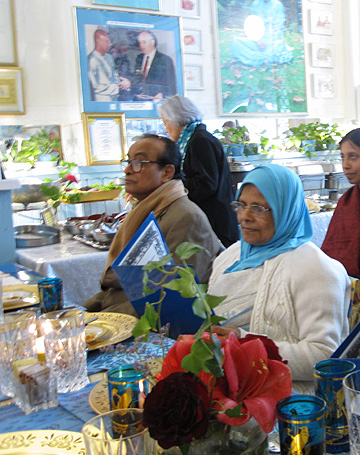
Mr. Momtazuddin Ahmed and his wife Mrs. Quamrunnessa Momtaz attend a function at Annam Brahma Restaurant.
The invitation soon came along. A gentleman, an engineer by profession, drove me there. Fahim had already arrived. He took me to a vegetarian restaurant. I listened to songs, both the words and music of which were composed by Sri Chinmoy. None of those who sang were from Bangladesh. They were all Westerners. But the songs expressed a love for Bangladesh. The beauty and glory of Bangladesh came through in every composition. It was beautiful to hear the songs before the meal. And what was even more impressive was the singers. They sang with such feeling — completely immersed in the music, within and without. Almost all the songs had God’s Compassion, Glory and Love as their theme. We hear such an expression in the songs of the Bauls and in Rabindra Sangeet. The lyrics expressed the limitless strength and sweetness of the incomparable One who abides in the entire universe. At the end of the musical presentation was lunch – all vegetarian, embellished with delicious chutney. Four of us had been invited. Besides us in the other tables were other guests. The Centre seekers served the food. I heard that they were well-educated and held responsible jobs. They volunteered at the restaurant and delighted in serving the guests, not seeking any compensation. It was a labor of love. I learned that there were other enterprises that functioned in a similar manner, under the direction of the Sri Chinmoy Centre.
“They sang with such feeling – completely immersed in the music, within and without.”
Guests view the sheet music during the performance of Bengali songs.
Sri Chinmoy is from Chittagong, Bangladesh and was born in the Boalkhali precinct. It is the same place where poet Ramesh Sheel was born. It is also where that the sun-child of Bangladesh, Surya Sen, was born. Sri Chinmoy’s family was rooted in the teachings of Sri Aurobindo. When Sri Chinmoy lost his parents at a very early age he went to live in the Sri Aurobindo Ashram, a thousand miles in the south, in Pondicherry. He lived there for many years. The seeds of idealism and spirituality that were sown in Chinmoy’s life and mind in these early years grew to become the great tree that we now know as Sri Chinmoy. Initiated and filled with this idealism, Sri Chinmoy eventually came to America. In Jamaica, New York, he built his Ashram. Practicing meditation and tapasya he grew even stronger. Sri Chinmoy offers many types of spiritual disciplines to discover one’s true nature and manifest God’s Glory within oneself. He composed songs and set them to music. He drew and painted. He regularly exercised and by doing so brought forth the strength that lies hidden within each of us. With his strength he could control a mad elephant and stop moving cars.
Sri Chinmoy had a deep love for religion. By birth he was a Hindu. But his true religion was love for humanity. In his Centre there is no division based on religion. Each person has their own religion. This consciousness has created in the Sri Chinmoy Centre a true love for all religions. I truly appreciated the tolerance of all faiths and beliefs expressed by those who were serving. To create a life-consciousness that is without animosity and division is not easy. It is only when one walks the road of a higher consciousness that the petty differences of the mundane life diminish. Not many can reach the deep state of meditation that this requires. Meditation is difficult and takes time. To truly manifest the full Glory of God-nature is not easy. One of Sri Chinmoy’s mantras was that it is necessary to have belief in oneself along with belief in God. This in itself is such a difficult task that one who achieves this state of belief has won half the battle.
Sri Chinmoy longed for Samadhi. Therefore, his disciples have laid him in eternal sleep of the Mahasamadhi. They feel that his Consciousness is ever-present. Death is only a change of location. An eternally awakened Sadhak’s Consciousness is after all immortal. He is now in a state of his deepest meditation, one with God.
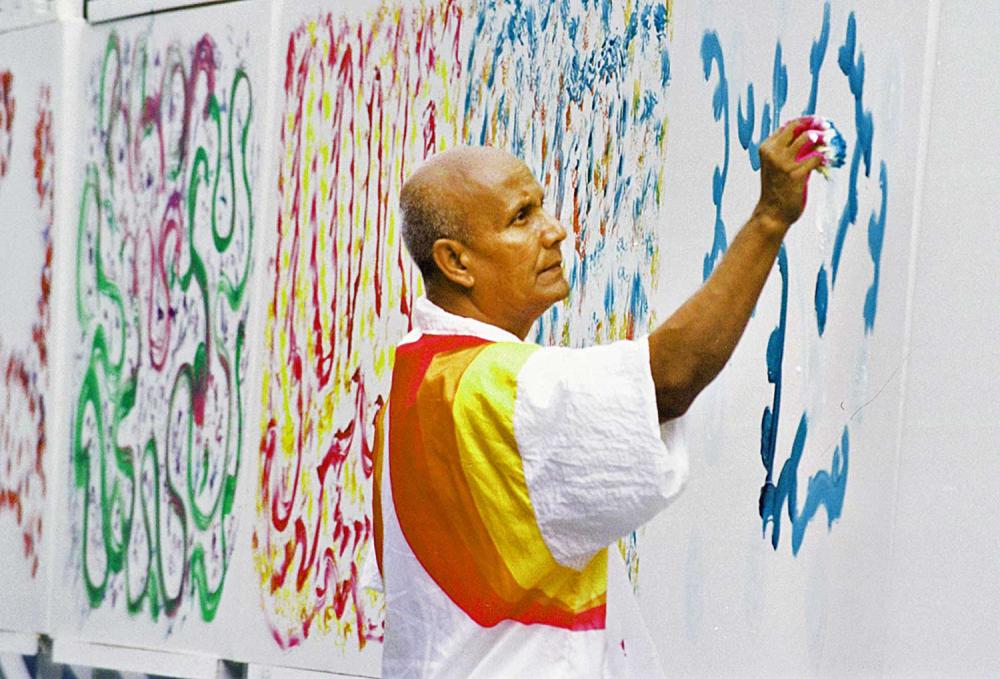
Sri Chinmoy did not speak about miracles. He believed in the strength of the mind and body. If our bodies are not able, if our breathing is not normal or is laboured, then how can we meditate? Therefore, even in his advanced years, Sri Chinmoy followed a regular regimen of physical exercise. He expressed in all his heartfelt activities, a God-consciousness. It is He (God) that he drew in the abstract play of colors and lines. The movement in his art shimmers like a fountain. It is not easy to fathom the abstract quality of this movement.
Sri Chinmoy was skilled in playing many musical instruments. He walked in the world of varied melodies. But not with haste. The beauty of his melodies rise like a still-moving river. In songs, in melody, in art, in physical prowess, in the trance of his meditation – in all these, Sri Chinmoy manifested the myriad aspects of God. Sri Chinmoy said “My religion is Love. Those who love God are my brothers and sisters – and this is the way I express my God-Love.” For the short time that I was at the Sri Chinmoy Centre, not even for a moment did I feel that this extraordinary Sadhak was not beside me. In every facet of this event I felt his love. A world of division, jealousy, greed and individual assertion rules today. There is none who says to another – “Give me some of your sorrow and take some of my joy. Come let us together build a world full of love.” Sri Chinmoy said “Be happy. Be happy. Be happy. If you are not happy you will not make inner progress.”
Winter is not over yet. Every once in a while New York gets blanketed in white by a fresh flood of snow. And then roars in the wintry wind followed by bitter cold. I want to take all the warmth of the world at this time and wrap it around myself. We need warmth to live. In my Bengal now the winter and the shroud of mist is giving way to the south winds. Spring is coming. In green Bengal spring is coming! The solitary wind will blow everything and the leaves will leave their shelter in the trees and fall to the ground. The leafless trees will stand like renunciate Bauls. And then a fresh invitation to life will arrive. Fresh leaves, fresh beauty. Once again a new tide of life will flow through the trees. How beautiful is nature then! Hidden in the leaves, the nightingale will sing its song of love. Once again new life will awaken in all its simplicity. It is this beautiful Bengal that I have left behind soaring through the skies to a land thousands of miles away, across the Atlantic. Here the leaves fall even before the winter begins. The trees are bereft of their green garland. All the leaves have fallen down. The dry branches like orphans stand scattered here and there. Looking at the state of these trees I am filled with sadness. O silent trees, how long will you stand so helplessly in this heartless, indifferent world? In my life the time to create new dreams seems to be over. A leafless tree am I. Who will give me shelter in this affectionless world? Sri Chinmoy has said that if you want to make your life bright, then you have to expand your heart. So may it be. I will stand on the empty road with my Veena of love. If ever I see a traveler, I shall welcome him with the melody of love. All my songs will be songs of love, songs of friendship. Sri Chinmoy, with his unparalleled capacity to dive into the depths of meditation, has untiringly practiced the sadhana of God’s Compassion and Love. I am only a simple person. With all my heart and soul in this world of mortals, I shall beg for the alms of love. This alone will make my life meaningful and sweet. Let the world be awakened by proclaiming the victory of love. Sri Chinmoy received the closeness and affection of so many great souls. Even if I receive the love of ordinary men my life will be glorified.
– End –
The original article in Bengali (Bangla) was published in Ajkal,
a Bengali newsweekly from New York, on February 5, 2010.
It is late afternoon in New York – high summer – and the humidity of the day is just beginning to break. I am grateful to find a cool and restful sanctuary from the city heat and the uncomfortable rhythm of the streets.
The voice of the poet has drawn me here to “the green and the dense groves.”1 There is a gentle whisper in the breeze beckoning me. “Smiles call me, tears call me. A faint melody calls me,”2 as I move inexorably towards an oasis of the soul.
The discordant thud of traffic gradually diminishes and the sound of singing grows louder as I walk along a driveway entrance. Inside, beyond the high fence covered in wisteria, an international music group practises. There is an unhurried serenity here and the atmosphere brings peace to both heart and mind.
As I pass through the gate, a silent inner feeling of reverence begins to envelop me and I find myself walking upon holy ground – the very ground upon which a great spiritual master once trod.
Over the past week or so, people from across the globe have been gathering here to honour what would have been Sri Chinmoy’s 78th birthday on August 27. The days and nights have been given over to meditations, plays, poetry and music. Indeed, the area inside resembles a small amphitheatre – a perfect venue for these types of activities – a flat open lower level bordered by a high wall decorated along the perimeter with flowers and lush greenery, stairs leading to an elevated walkway and a series of tiered bleachers built into a surrounding natural hill, all shaded by high, leafy trees.
The white bleachers, upon which I now take my seat, though they have been renewed and considerably expanded over the years, were originally constructed as part of a tennis court back in the early ’80s. But this piece of parkland in suburban New York City was always more than a sports facility. It was given the name Aspiration-Ground by Sri Chinmoy many years ago and he always intended it to be a place for spiritual progress.
My eyes scan the dark green rim of the treetop canopy that crowds the heights above me. The sharp edge of a leafy silhouette clips out a clear patch of vibrant blue from the sky. It is cool here among the maples and elms and my thoughts are calm and expansive. I could easily linger in the heavens where thoughts evaporate into the formless beyond, but I remind myself there is so much that Aspiration-Ground has to offer.
As my eyes descend through the tight interlocking pattern of leaf-laden boughs, I am reminded how many memories they must hold; how much these silent sentinels have witnessed over the years. They are the guardians of a very special epoch in spiritual history.
I think back over the countless times I have sat on these benches – in early morning and late at night; in sunshine and in rain; in frigid cold and searing heat; through mid-summer and the depths of winter; on through the ’80s and the ’90s, just to be with Sri Chinmoy as he meditated, played tennis, gave concerts and lifted all manner of things, from inert metal weights to people from all walks of life.
My thoughts are carried gently on the soothing fragrant currents that pervade the atmosphere of Aspiration-Ground. They are not bound by the present; they seem to easily glide across three decades of history all in a magnificent moment. And I begin to paint a scene with colours and sounds from the past, as I am absorbed in beguiling reminiscences of summers long gone. The tall wire driveway fence, which is now covered in flowering vine, in my mind is almost transparent. The large suspended video projector screen is replaced by a simple blackboard upon which tennis scores, aphorisms and daily highlights are written in chalk. Peel back the decorations and extra seating from the lower level, and a full-size tennis court is revealed. The soft surface is raked and watered, the white-tape lines are brushed, and the court awaits Sri Chinmoy’s first footprint of the day.
There is no doubt Sri Chinmoy loved this special place. He would play tennis here at every opportunity, no matter what the weather. At the far end of the court, where a beautiful memorial temple now stands, a small blue-painted wooden hut served as Sri Chinmoy’s home away from home. It was the type of structure you might find in an Indian village – simple yet completely functional – two large wire doors at the front, which even when closed still gave a view of the entire tennis court; artificial grass floor covering; a chair and a lamp; a heater in winter, a fan in summer; and a small table for drinks between matches. To each side, and sometimes inside this tiny outdoor room, lay exercise machines of every variety that Sri Chinmoy would regularly use. For him, the body was a temple and he stressed over and over again, in word and in action, how important it was to keep the body fit and healthy to allow the soul the opportunity to express its divine qualities. It was nothing for him to play 50 matches straight, and then go on to lift weights or workout on machines custom-built to strengthen different muscle groups.
Especially when the weather was fine, Sri Chinmoy would spend all day at the court. The magic of those days cannot be overestimated. They were days of continuous joyful spontaneity that flowed on and on. We felt like a caravan of pilgrims travelling across time, never knowing what divine surprise lay around the next corner.
Seated in his little blue gazebo, Sri Chinmoy would quite often compose songs extemporaneously on a small tote-a-tune and have different singing groups learn them on the spot – often correcting the singers as they struggled to negotiate the ‘tricky’ weave of a particular melodic phrase. Our western musical notation, with its seven basic notes, could translate nothing of the subtlety which Sri Chinmoy so effortlessly employed in his songs. The lilting slides between notes are lost if one refers only to the sheet music. For Sri Chinmoy, the subtlety of the melody was everything – it was the conveyer of consciousness, an expression of soulfulness. And so, Sri Chinmoy taught in that same centuries-old oral tradition that has enabled the integrity of songs that lie far outside the regime of western scales to be preserved.
Over and over, the singers would sing. And when the singers had finally got it, everyone smiled. This would inevitably lead on to a grand performance in the afternoon or later that evening. But these were the days when we had Sri Chinmoy, master composer and singer – the exemplar – to show us how it was done.
Whenever Sri Chinmoy arrived at Aspiration-Ground there was always a hush that overcame the crowd. He would invariably be in a meditative mood as he walked through the gate at the far end of the court. His presence always evoked a feeling of reverence. On seeing him, one could not help but feel drawn to prayer in an effort to find a corresponding part of oneself that could approach the natural serenity which he possessed. Before and after every activity Sri Chinmoy would meditate – every action for him was an act of devotion. Quite often he would sit and chat to us, answering questions, relating anecdotes – serious and amusing. Yet all the while, as he was seemingly occupied by the outer circumstance of talk and laughter, there remained a feeling that he was engulfed by an infinitely more sublime experience.
Gazing down to where that little blue hut once stood, it seems to me now that at any moment Sri Chinmoy could appear. And as he so often did, he would walk by in a high meditation. His eyes would barely be open, yet he would be completely conscious of every step. He would negotiate a 90-degree turn with precision, never for a moment losing his inner poise. For 20 minutes or so he would walk back and forth along the entire length of the court, a wave of peace emanating from him with every prayerful footstep he took.
Meditation was the focal point of life at the court. Yet despite its peaceful ambience, the court was always a hive of activity; a constant, steady movement behind the scenes, ensuring everything ran smoothly. As leader of a worldwide organisation, there were always things that required Sri Chinmoy’s attention. Messages would constantly be relayed back and forth. Sometimes they required nothing more than a nod or the wave of his hand; at other times they could occupy him for lengthy periods. Nonetheless, time never seemed to be Sri Chinmoy’s enemy. Somehow it too seemed willing to surrender to a higher power. Sri Chinmoy’s uncanny knack for timing was not only evident in his tennis playing but in every aspect of his life. “Life is a divine game,”3 he once wrote, and he played it perfectly.
Over the years, many thousands of people have visited Aspiration-Ground. It was the culture of the heart that Sri Chinmoy created here, which drew people from all walks of life. Among those who came, were tennis players like Monica Seles and Ilie Nastase; athletes like Carl Lewis and Bill Pearl; and singers like Roberta Flack and Sheena Easton.
All who came in contact with Sri Chinmoy were touched by a special grace. These were halcyon days; days when a great spiritual master trod upon this very ground; days we thought would never end. They will never be repeated. “Alas, the Boat of Time sails on,”4 still the poet sings.
The sky calls me,
The wind calls me,
The moon and the stars call me.
The green and the dense groves call me,
The dance of the fountain calls me,
Smiles call me, tears call me.
A faint melody calls me.
The morn, noon and eve call me.
Everyone is searching for a playmate,
Everyone is calling me, “Come, come!”
One voice, one sound, all around.
Alas, the Boat of Time sails on.5
Time has moved on. Yet while the outer appearance of Aspiration-Ground has changed, the essential inner qualities with which Sri Chinmoy imbued this sacred place have remained.
The tall trees draw me once more into their confidence. There is a refreshing afternoon breeze moving through the high branches and the rustling leaves seem to be whispering. It is tempting to believe that all the treasured experiences over the years, all those stories of endless delight, and the myriad secrets of the inner worlds have been recorded here...
Today, gazing into the silent heights of the treetop canopy, the sights and sounds of the court, where Sri Chinmoy spent his days, are still very much alive.
– End –
Endnotes: 1, 2, 4 & 5 Sri Chinmoy, My Flute, ‘The Boat of Time Sails On’, P.48., Agni Press, 1972. 3 Sri Chinmoy, Ten Thousand Flower-Flames, Poem no. 9272, Part 93, Agni Press, 1983.
The sole function of Art is to discover beauty within and without. And Art is in itself a self-expression of the different levels of Consciousness. – Sri Chinmoy
.
Jharna Kala Anniversary
Videos, photos and examples of Sri Chinmoy's art from the beginning on 19th November 1974. 50th Anniversary
Sri Chinmoy created hundreds of thousands of paintings and drawings during his lifetime. Many of his original artworks are in private collections or curated by Sri Chinmoy Centres around the world. This new section is a humble attempt to give some of these beautiful artworks a wider audience. Submissions for inclusion are most welcome. View more…
.
The Transformative Art of Sri Chinmoy
by Dr. Shrinivas Tilak
Of all the Indian mystics and spiritual teachers who have travelled our world guiding those in quest of self-realization, Sri Chinmoy is unique because of his skilful use of the medium of poetry and visual art to communicate his teachings to the target audience in small groups spread across the five continents. Submissions for inclusion are most welcome. View more…
.
A Magnificent Obsession
by Dr. Vidagdha Bennett
To devote oneself to a single thing in life, one noble undertaking, with every fibre of one’s being, to exhibit an intensity of purpose that excludes all other themes and subjects – how many human beings can maintain that commitment? Perhaps the very definition of a genius is someone who is so obsessed by a single pursuit that it consumes him. Then it becomes a magnificent obsession and he is compelled to follow it to its glorious conclusion. Read more…
.
Experiences Of The Ottawa Gallery
by Chidananda Burke
It had started out as an ordinary, multi-use building in one of Ottawa's better shopping districts. … Upstairs was a Mexican restaurant, where businessmen gathered for lunch over margueritas and enchiladas. … Then one day the disciples came in with their brooms and hammers, with their buckets of plaster and paint. Added wiring was put in, bringing light to the darkened hallways. The half-dead building was infused with fresh energy and new aspiration. Read more…
.
The Strange Birds of Ottawa
by Chidananda Burke
It’s like a giant aviary. Hundreds of thousands of birds have found a temporary home here – hovering by the windowsills, clinging to the walls, nesting in the archways and vestibules. Everywhere there’s movement – birds sweeping through the air in huge parabolas … tumbling from the ceiling like giant waterfalls … exploding through the halls like shards of light. What was once an empty four-storey heritage building in downtown Ottawa has been converted into one of the most astonishing art galleries ever built. Read more…
.
Sketches in Time – Sri Chinmoy’s bird drawings from 1976
by Animesh Harrington
In the recesses of my desk, there is a piece of paper I have kept for almost thirty-five years. It is a portion of a disposable serviette, the kind which usually has a life expectancy measured in minutes. However, this particular item has been imbued with a certain touch of immortality. Despite the relentless march of time and many moves on my part between continents, countries, states and cities, it has remained with me. Read more…
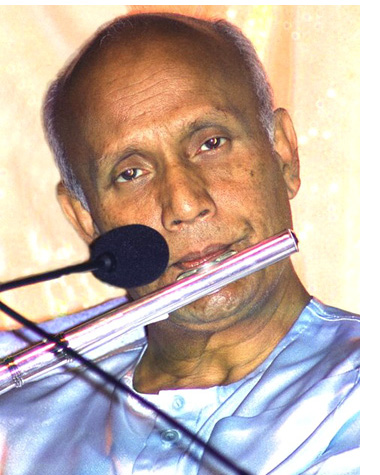
In 1976, Sri Chinmoy made two momentous musical discoveries: the esraj and the flute. The esraj he came across in February, in a book of Indian instruments. When he obtained one shortly afterwards, the haunting effect of this bowed instrument delighted his musical ear, and the esraj subsequently accompanied him on a visit to Australia at the end of February.
It was to be here, in Australia, that Sri Chinmoy would become acquainted with the classical Western flute. Previously, he had played considerably on the simple Indian reed flute. Although this instrument has a tremendous purity of tone, he found it lacking in the agility needed to convey subtle nuances and shades of expression. Now, one of Sri Chinmoy’s disciples, a young girl of nineteen years, introduced him to the modern transverse flute. The grace of the instrument and its clear, limpid sound appealed deeply to Sri Chinmoy and, on March 10th, he requested the opportunity to play it.
The occasion was a bus trip to Healesville Animal Sanctuary just outside Melbourne. As the bus rolled through the foothills of the Dandenong Range, Sri Chinmoy’s first lesson began. His young disciple carefully explained the art of embouchure and fingering and, in less than two hours, when the bus had reached its destination, Sri Chinmoy had mastered the basic scale. Alighting from the bus, he delighted everyone by walking through the various bird and animal compounds playing the flute to entranced kangaroos, cockatoos and all who would listen.
He was the student and his disciple was the teacher. It was an unusual reversal of roles. But how long can such a one disguise his true nature? How long to hide with utmost humility in the role of a novice musician? The great musical wealth housed inside his breast could scarcely be contained.
A Master Musician
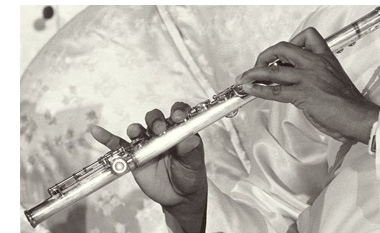
What can be said of Sri Chinmoy’s progress on the flute? Technically, the advances that he made over the next few months were extremely rapid and significant. His flute became his constant companion. Whether reclining on his couch, travelling in the car or even walking along some solitary corridor, the silver tip of the upraised flute could be seen, with gentle fingers dancing over its surface, scattering notes of radiant beauty.
It seemed that long in advance of fully mastering the flute technique Sri Chinmoy could hear the ethereal tunes he would ultimately produce. He sought a note of pristine purity, a peace-breathing, soul-stirring note. This led him to experiment with the entire flute range – from bass and alto flutes through to C soprano and piccolo. He played flutes that were silver, gold and platinum-plated, inexpensive student models and hand-made masterpieces. His most frequent choice was a Haines C soprano flute in the Boehm style, with closed holes. Its clear, limpid tone was capable of every conceivable nuance.
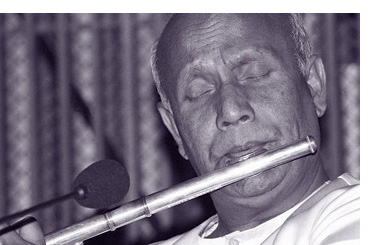
As Sri Chinmoy continued to practise more and more, he found that technique, as such, no longer stood in the way of translating his inner songs into musical form. Deploying all the acoustic properties of the flute, he was able to play with infinite variation and expressiveness. The notes that he created were clean, crisp and finely articulated; he had a thorough appreciation of phrasing; he was especially adept at producing incomparable sequences of notes – slurs, trills, unusual intervals and turns. He was able to make single, detached notes last endlessly by virtue of his excellent respiratory control.
In November 1979, Sri Chinmoy added a new and surprising effect. The flute was made electric and connected to an echo chamber. This had the result of amplifying and prolonging each individual note so that the listener gained the impression of a continuous overlay of sound. In effect, Sri Chinmoy had added the mountain summit or the farthest horizon to his playing. It was the note heard from afar, floating across the valleys with bird-like clarity, borne on the wind to pierce our hearts.
The Silver Sound
The pure, melodic line that constitutes the essence of Sri Chinmoy’s music sets it apart from the Western system of harmonics. The evolution of Western music is based on the belief that consonance of sound is most pleasing to the ear. This has led to the rich orchestral effects of Western classical music. Sri Chinmoy, however, inclines towards the delicate structure of Eastern classical music, with its emphasis on simplicity and clarity. He has ever preferred the distinct melodic thread of the single instrument, uttering its song alone and unqualified. The sound issues from the silence gradually; it does not break or disturb it. And it returns to this silence-source at the close of the song – like a small wave spinning out the length of the shore and then sinking back into the ocean depths.
Explaining his views, Sri Chinmoy writes:
“I personally feel that there are many, many songs which will be better if you do not embellish them with harmony. If you carry just the melody, they will be really haunting. Then the pristine purity of the song will remain. Our haunting Indian melodies go right to the very depth of the heart and soul.”
When Sri Chinmoy plays upon the flute or the esraj, unaccompanied by other instruments, the musical instrument becomes his own voice, full of luminosity and power. This music is of a kind that cannot be poured into tight and traditional forms. It recognises no boundaries, save those accents of feeling which the flautist seeks to render. It presupposes only the awakened heart of the aspiring seeker, whose ear is the deputy of his innermost being.
What is it that makes hearing Sri Chinmoy play his flute such an extraordinary experience? One might be seated in a large meditation hall, rapt in silence, when from the stairwell a trill of wondrous notes, like some invisible perfume, touches the delicate fibres of the soul. Helpless before such magic, the soul inhales them deeply and melts in them. A glissando, a sudden cascade of notes, and the air is subsumed once more by silence.
Immersed in the Divine
Sri Chinmoy relaxes in his chair, his eyes closed in sublime peace, his plaintive flute shedding soft, low notes. There is something in the quality of his playing and in the outline of his figure in repose which strikes an ancient chord.
The image of the divine flautist is one of the most beautiful flowers of Eastern mysticism. Sri Krishna played upon his flute in the forest of Brindaban. Hearing his call, the cowgirls living at the edge of the forest would leave their homes to join him in his divine play.
The experience of seeing and hearing Sri Chinmoy play the flute summons similar associations. Gone are the leafy forest trails and lotus-filled ponds, gone the peacocks and placid, white cows, yet the same serene smile dances across his countenance and his flute music evokes the same inner thrill. In Sri Chinmoy, we discover anew someone who seeks to awaken aspiring humanity and lead it into the presence of the Divine. He frames songs of human transformation to release mankind from the slumber of inconscience.
In poem after poem, Sri Chinmoy pays homage to Lord Krishna through his portrayal of a mysterious and evanescent flute-player. None can ignore the peremptory summons of his flute:
There goes my Beloved, my sweet Lord, The anklets ringing on His Feet. I hear the music of His Flute Vibrating through the horizons. If ever my cowherd boy should cast a glance Behind Him, still He only goes forward. Let my eyes follow the track my Beloved treads. In the twilight hour of the day, with a sweet And serene smile, Leading the herds of varied light, My cowherd boy goes.
Lord Krishna, the eternal youth, draws his devotee through the siren-like music of his flute. Listening to Sri Chinmoy’s flute, it is possible to feel the same unfathomable call of the Divine. It may be that in each and every age the hearts of seekers will be captivated by a gentle flautist who, taking up his instrument, diffuses a spontaneous flow of notes such as none has ever heard before, nor will hear again.
Sri Chinmoy in Concert
April 7th, 1982. Sri Chinmoy has come to Carnegie Hall, showplace of the world’s premier musicians, to make his unique offering – a free musical concert in which he will perform on esraj, flute and harmonium.
The vast stage discloses the familiar, meditative figure of the master. He is seated in an upright chair. Slowly he bends down and picks up the flute by his side, feeling the shape he knows so well. He lifts the silver mouthpiece to his lips and releases the first long, fluttering note. As all the air begins to vibrate with his musical creation, we seem to discover some long-forgotten concord, some melody whose absence has made our hearts heavy with the ache of centuries.
Some audience members, finding themselves swept away by the magic of the music, impute to it heavenly scenes and vistas. In a 1980 review in the Washington Post, Richard Harrington was moved to write:
“Sri Chinmoy performed a lovely, very modern flute essay, pretty enough to make a deer lay its head on the musician’s lap.” [June 7th, 1980]
The pastoral arcadia to which this critic was transported vividly reminds us of Stendhal’s statement: “The only reality in music is the state of mind it induces in the listener.”
On June 4th, 1982, Sri Chinmoy performed before an audience of 2,400 at the Louise M. Davies Symphony Hall in San Francisco. After the concert, one admirer wrote:
“Sri Chinmoy’s concert was Heaven! Thank you for a beautiful experience. His presence of love itself was worth the trip to the city. Then, as he became the perfect instrument through which the music of the universe could express itself, I was absolutely transformed.”
The experience of Sri Chinmoy’s flute music is subtle but unforgettable. We, who are present at its blossoming, have but a partial glimpse of its immense and ultimate role. Already seekers far and wide are conscious of the presence of a higher, nobler and purer inspiration in the world. And perhaps, like the deer that the Washington Post critic envisioned, we may eventually follow this flute trail to the Lap of the Supreme.
– End –
Editor's note: The author originally wrote this article in 1982.