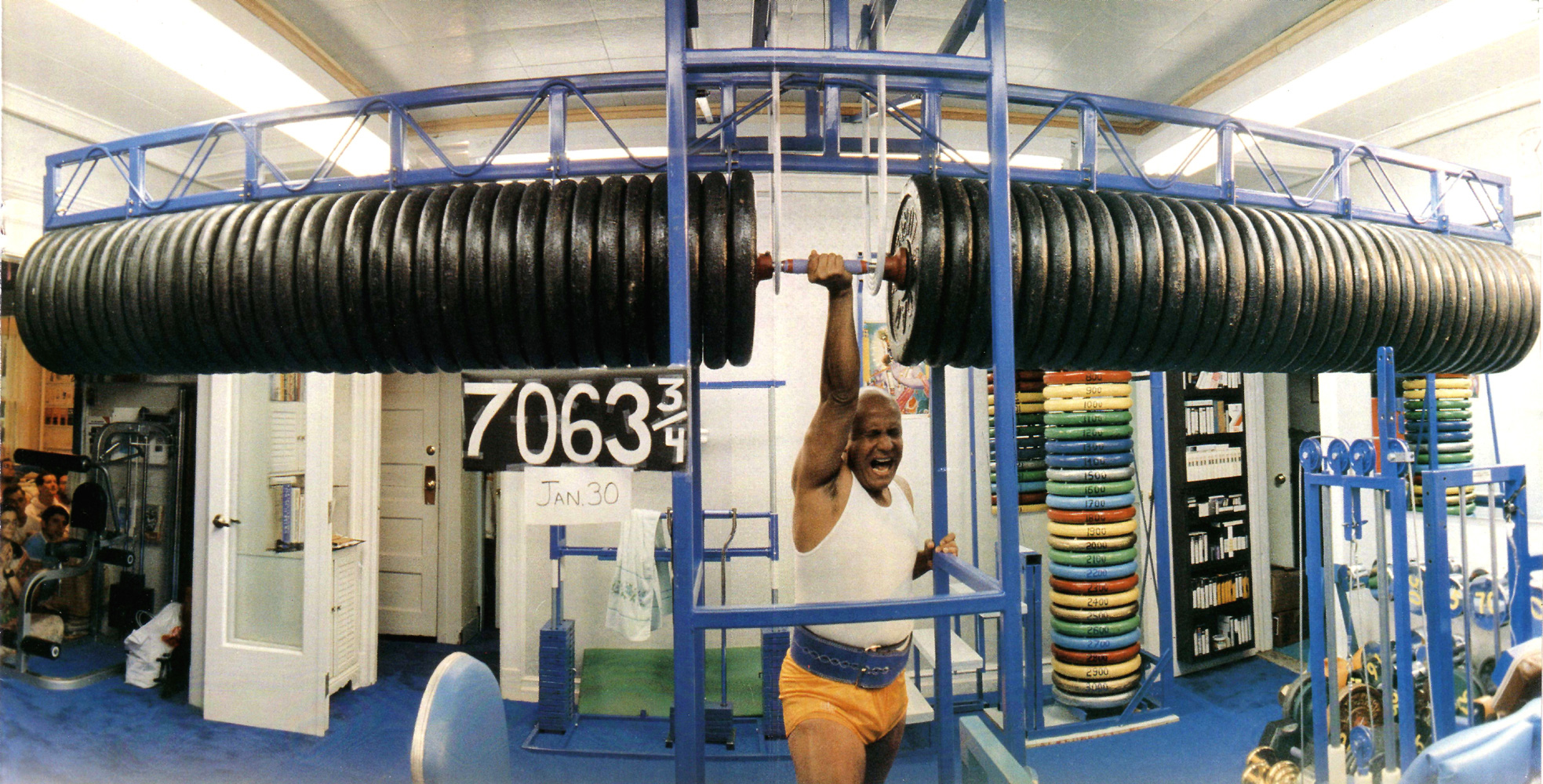
On January 30, 1987, Sri Chinmoy lifted a weight of 7,063¾ pounds using only his right arm. It was an achievement that challenged the limits of human possibility and it shook the world of weightlifting.
Sri Chinmoy was not a professional weightlifter, and he was certainly not built for the task. At 5 feet 8 inches high and weighing only 162½ pounds, he was far from the imposing muscle-bound figure one would expect. And given his age of 55 years, he was a most unlikely person to be attempting to lift such massive weights. He was, however, a great spiritual master, a man of adamantine will who had absolute reliance upon God’s Grace.
“If I ask my mind whether I can lift 7,000 pounds, immediately it will say, ‘Impossible!’ ... But when I am in the heart, with the heart and for the heart, there is no such thing as impossibility because of the heart’s oneness.” — Sri ChinmoyExcerpt from a 1993 press conference ...
(Excerpt from a 1993 press conference.) Read more...
Sri Chinmoy’s lift of 7,063¾ pounds was not an easily won victory. Over a 19-month period, from June 26, 1985, when he first began serious weightlifting, Sri Chinmoy trained daily, performing multiple sessions of intensive strength-building exercises, enabling him to progressively lift heavier and heavier weights.
As each goal was reached, his determination increased. One lift, in particular, illustrates Sri Chinmoy’s never-give-up philosophy — it took him 214 attempts before he finally succeeded in lifting a 303¼-pound dumbbell.
Sri Chinmoy’s progress was nothing short of exponential. It was 17 gruelling months before he finally lifted more than 1,000 pounds. Then 2½ weeks later on November 27, 1986, he broke the 2,000-pound barrier, and on January 20, 1987, a lift of over 3,000 pounds was achieved.
Sri Chinmoy was the first spiritual master in history to directly challenge the inertia and inconscience of the material world through the discipline of weightlifting. His miracle lift of 7,063¾ pounds was, and will forever remain, a triumph of the spirit over matter.
For years they had stood at the entrance to the temple, two thousand-pound stone lions, eyes blank, like sentinels of heaven. Passing between them, one could almost feel their power. With their massive physical presence and forceful inner presence, they seemed to straddle two worlds – half-alive and half not-alive.
Then one day in 2004 they appeared at a great indoor arena, the auditorium of York College in Queens, where Sri Chinmoy planned his November 13th weightlifting demonstration. That day, the auditorium would become the scene of heroic contests and deeds, where the denseness of matter would confront the openness of spirit.
By all accounts it promised to be an unforgettable event. On one side, lay thousands of pounds of metal weight. On the other, stood the lone figure of the man hoping to tame them. The metal plates were cold, dark, stubborn in their unwillingness to budge. The man was determined, implacable in his will to move them.
Using the muscles in his arms, his shoulders and his legs, 73-year-old Sri Chinmoy planned to lift 20 tons that evening. It was his 19th weightlifting anniversary, and he wanted to commemorate the occasion by breaking all previous records.
Over the course of the night, he raised off the ground everything from automobiles to books to metal weights – using various kinds of lifts.
Many Olympic gold medalists and other world-class athletes came to watch the performance…and be part of it. They filed onto the stage in a great procession, and one by one this weightlifting maestro also raised them into the air.
The whole evening was a vivid demonstration of the philosophy of spirit he has been expressing through his writings, paintings, music and lectures over the past forty years. It’s a philosophy that strives to bring forward the inner life, awaken the divinity buried inside each object and person.
It’s a philosophy that finds its most dramatic symbol in the physical act of lifting. When he lifts, Sri Chinmoy says he does not try to conquer the weights; rather, using the power of concentration and meditation, he strives to lighten them, to transform their dense, heavy physicality into the lightness of spirituality.
Nothing captured the essence of the evening so strikingly, and profoundly, as his lift of the two lions. Though made of stone, they exuded a presence, an aliveness, so they seemed to exist halfway between matter and spirit. One could say they represented matter on the edge of spirit, stone inconscience on the borderline of consciousness.
In lifting them with his calf-raise machine, Sri Chinmoy was striving to cross that line, not just to bring light into darkness but to perform a far greater alchemy – transforming inert matter into the substance of life. The muscular effort he exerted, though absolutely real in its own realm, was also a metaphor for the infinitely more difficult spiritual struggle.
For a moment he stood by the lifting apparatus, his body hunched under the padded bars. Then suddenly he straightened, pushing against the bar with his shoulders – calves straining as he sought to raise the two half-ton lions into the air. At first nothing happened. The lions did not budge; he might as well have been trying to lift a building off the sidewalk.
But he continued pushing, pushing, until all sense of time vanished, all points of reference disappeared, and nothing in the universe seemed to exist except that enormous mountain of weight and the terrible, implacable urge to raise it.
The tension became almost palpable, as though the resistance of the stone lions and the strain of trying to raise them were both reaching the breaking point. Something had to give – either the straining muscles and the spirit they cloaked, or those eyeless creatures of stone, yearning for life, for consciousness.
Then, miraculously, the lions started to tremble. The master weightlifter was not exerting more effort; he had long ago reached his maximum. But inwardly he had crossed some line, broken through some barrier so that, somehow, his physical body had merged with the force within.
Now it was not muscle straining against stone, but spirit reaching out to spirit, prepared to go on indefinitely for hours, for days, for centuries, if need be, until the stone itself disintegrated to dust.
And, finally, when matter could no longer bear the relentless pressure, when the physical universe could no longer tolerate this implacable tension, the weight suddenly gave and the lions began to rise off their supports. From inconscience he had brought forward the essence of life, from matter he had invoked spirit.
There were other lifts that night, but none seemed as memorable as those two stone-faced lions, which he raised across the threshold of consciousness in an event that will forever shine forth as one of the crowning moments of mankind’s spiritual history.
At his home in New York, Sri Chinmoy raised and supported two 500-pound dumbbells simultaneously from an overhead rack.
As we enter the Third Millennium1, Sri Chinmoy continues to challenge the age barrier. In his 69th year he is lifting prodigious weights and follows a strenuous training schedule on a daily basis. His recent lifts are phenomenal for a man of his age and have impressed such sports luminaries as Bill Pearl, five-time Mr. Universe; Al Oerter, Olympic gold medallist in the discus; and super Olympian Carl Lewis. There is no stopping this world-renowned advocate of peace who has combined the highest physical and spiritual aspects of humanity to a degree unknown since the ancient Greeks. Regardless of age or circumstances, he lives out his philosophy of self-transcendence to inspire humanity to have a new vision of itself.
On Wednesday, February 16th this year [2000] at his home in New York, Sri Chinmoy raised and supported two 500-pound dumbbells simultaneously from an overhead rack. It was the triumphant culmination of a series of lifts, which began in 1998 with a lift of 100 pounds, 50 in each arm, on September 29th. The poundage increased steadily and in November ’98 he lifted his own body weight (at the time) of 145 pounds simultaneously in each arm. Throughout 1999 the lifts increased in magnitude and several were performed in public and were broadcast on television worldwide.
Sri Chinmoy’s age alone makes the succession of lifts leading up to the 1,000-pound lift of February 16th an incredible achievement. He weighs a mere 170½ pounds, so he lifted six times his own bodyweight. When did you last meet someone who could lift their own bodyweight? Few athletes can do this, regardless of age, and most would not attempt it. Only those involved in the weightlifting and powerlifting worlds can truly appreciate these lifts. They know the finely tuned balance and co-ordination required to lift two dumbbells of this magnitude simultaneously. Immense preparation is required before an attempt is made to lift such weight, which imposes such great strain upon the human frame. Sri Chinmoy does not have the usual powerlifter’s physique. His training involves workouts for almost every muscle in the body — as each is integral to the total co-ordination required. Few men of Sri Chinmoy’s age would undertake the gruelling schedule of daily exercises involved in preparation for lifting let alone attempt such lifts.
For Sri Chinmoy it is a dedicated way of life. Most of his lifts are done in the early hours of the morning as his days are full of many activities and commitments. His home in New York contains a fascinating collection of exercise machines specially made for his needs by his assistant Unmilan Howard, an Australian metalworker who shares Sri Chinmoy’s vision of a peaceful world in which individuals can realise their true potential and serve humanity effectively. Each day Sri Chinmoy offers his soulful prayers to the divine source of all earthly achievement and in meditation he draws on the inner resources which make his feats possible.
“I rely upon the inner power that I bring forward on the strength of my prayer-life and meditation-life.” — Sri Chinmoy
His way has always been to set himself goals which he works towards with a relentless determination. Those who assist Sri Chinmoy never cease to be amazed at his tenacity and by his resilience in the face of failure. He simply refuses to give up and increases the intensity of his training. He also has a remarkable recovery rate. Lifting dead weight against the force of gravity imposes enormous strain and weightlifters need time to recover between lifts and strenuous workouts. They also cannot sustain the level of concentration required for extended periods and need quality rest. Sri Chinmoy’s years of meditation enable him to concentrate almost indefinitely and he is able to relax fully and regain strength quickly. On numerous occasions after a public display of lifting he has gone on to perform concerts with no outward sign of strain or exhaustion.
Sri Chinmoy as he ages does not become a prisoner of time — he uses time, every minute and every hour as a God-given opportunity to manifest the divine potential within. Like the true Olympians of Ancient Greece he challenges the very limits of mortality with grace and humility. Al Oeter’s comment on Sri Chinmoy’s 1,000-pound lift was:
“For Sri Chinmoy there are no limits to the human body... He is exposing the wonderful limits of what we are... He is exposing capabilities that humans have never tapped before. Sri Chinmoy is the first, the pioneer, and he is leading the way for others to break barriers in all different fields in their own lives.”
Many times, in various aspects of life, Sri Chinmoy has shown that with prayer and meditation there are no limits to what can be accomplished. His weightlifting is also an expression of his work for world peace.
“If someone is really strong inwardly, he is always at peace. When you have confidence and strength within you, you do not quarrel or fight with others. It is insecurity that leads to conflict. When we are strong inwardly we feel oneness with the world. It is out of the feeling of oneness that solid peace comes. Oneness, based on inner security, is the only foundation for world peace.” — Sri Chinmoy
Those who witness Sri Chinmoy’s lifts are aware of another dimension at work. Before each lift he focuses his entire concentration inwardly, the concentration then goes through touch to the dumbbells. The tremendous strain on his body is apparent, and there is always a point when an upward movement seems impossible, as wrists, arms, shoulders, back and legs take the weight. In a successful lift this is followed by a movement of sheer grace, when the dumbbells move simultaneously away from the metal frame holding them and are held clear. There is a resounding crash as the dumbbells are released and the ground vibrates. Bill Pearl thought it was humanly impossible for the body’s joints to even budge this kind of weight until he saw it for himself. Now he is at hand to support Sri Chinmoy on the occasions he lifts in public — intuitively knowing the moments of greatest strain and giving encouragement. His comment:
“Sri Chinmoy is unique. He is working from the spiritual not the physical. He is not merely lifting a dumbbell, he is trying to lift the attitude of the world. This man is of Godly strength, he is of absolute Godly strength.”
The Olympic spirit of old finds true expression in Sri Chinmoy. He affirms as did the athletes of the Hellenic world, that the human spirit, for all the dark forces that surround it, is in essence heroic. In the moments of victory the ordinary, shadowy consciousness is transformed in a divine brightness. The poet’s task was to catch and keep the fleeting divine moment — to reveal to men what was really important in their lives. Now we have the camera to record such moments for posterity, there are some immortal photographs of Sri Chinmoy.
Attempting to lift weights of this magnitude can be seen as entering a battlefield, with one’s own physical strength pitted against gravity. The weightlifter and the dense mass of weight stand in opposition to each other. In Sri Chinmoy’s case everything he does is done in a soulful way. Instead of opposing the weight, in his supreme effort and deep meditation he accepts and encompasses the dead weight. We witness the oneness of the human spirit with earthbound matter and it is to this unconditional oneness that the inconscient weight yields. Sri Chinmoy has often said that it is not the power to conquer others, but the power to become one with others that is the ultimate power on Earth.
– End –
Note: 1 This article was originally published in India Link International • 16th March 2000/15th May 2000
On June 26th 1985, at the age of 53, Sri Chinmoy raised a 40 lb. dumbbell overhead, and so began an extraordinary weightlifting career. Just 19 months later, on January 30th 1987, Sri Chinmoy’s determined efforts culminated in a lift of 7,063¾ lbs.
For more than two decades Sri Chinmoy continued to inspire the weightlifting community with his relentless training regime and astonishing progress. His historic achievements will forever remain a testament to the unlimited potential that lies within us all.
Sri Chinmoy's Weightlifting Adventure – August 1983 to March 1986
by Unmilan Howard
Who knows when this story began … and who knows when it will end? Like all adventures Sri Chinmoy embarks upon, the open invitation is always there for us to join him on his journey to the limits of human transcendence and beyond. This is a chronicle of a small part of one such continuing adventure – into the realm of Sri Chinmoy’s weightlifting achievements. Read more...
.
A Man of God-Strength
by Bhavani Torpy
On Wednesday, February 16th this year [2000] at his home in New York, Sri Chinmoy raised and supported two 500-pound dumbbells simultaneously from an overhead rack. It was the triumphant culmination of a series of lifts, which began in 1998 with a lift of 100 pounds, 50 in each arm, on September 29th.… Throughout 1999 the lifts increased in magnitude and several were performed in public and were broadcast on television worldwide. Read more...
.
A Tale of Two Lions
by Chidananda Burke
For years they had stood at the entrance to the temple, two thousand-pound stone lions, eyes blank, like sentinels of heaven. Passing between them, one could almost feel their power. With their massive physical presence and forceful inner presence, they seemed to straddle two worlds – half-alive and half not-alive. Then one day in 2004 they appeared at a great indoor arena, the auditorium of York College in Queens… Read articles...
.
Worlds Where Matter and Spirit Meet
by Animesh Harrington
We are apt to believe that any revolution in science must necessarily come from the frontiers of research, that the world of every day experience is solidly confirmed as functioning within well-defined physical parameters. It seems ironic that the scene of this new challenge comes not from the laboratories at MIT, the space observatories of NASA or the linear accelerator at CERN, but the suburbs of New York City where, day after day, many have witnessed an occurrence that may be regarded as violating the laws of natural science. Read articles...
.
Sri Chinmoy’s Miracle Lift
On January 30, 1987, Sri Chinmoy lifted a weight of 7,063¾ pounds using only his right-arm. It was an achievement that challenged the limits of human possibility and it shook the world of weightlifting.
Sri Chinmoy was not a professional weightlifter, and he was certainly not built for the task. At 5 feet 8 inches high and weighing only 162½ pounds, he was far from the imposing muscle-bound figure one would expect. And given his age of 55 years, he was a most unlikely person to be attempting to lift such massive weights. He was, however, a great spiritual master, a man of adamantine will who had absolute reliance upon God’s Grace. Read articles...
Three years have elapsed since the first part of this article appeared. If one were to graph Sri Chinmoy’s progress in tennis during this time, it would show a steady escalation, which was particularly intensified during the warmer months from April to September.
As conditions at the Jamaica High School handball area deteriorated, Sri Chinmoy expressed a wish to have a permanent tennis court of his own. He was able to purchase a narrow and oddly shaped plot of unused land in the neighbourhood and his students constructed a clay court on the site. It was a snug fit, to say the least. A doubles court is normally 36’ x 78’ with a 12’ perimeter on each side and a 21’ perimeter behind the two baselines to create extra playing area. Sri Chinmoy’s court had less than half these perimeters. At his home end, a small blue hut was built where he could rest between sets. To one side was a high, solid wall that supported bleachers for spectator seating. On the other side was a wire fence with windproof netting. The far end had its own set of unusual obstacles – a set of steps, a low wall and a gate which seemed to be in constant use. The court was finished on June 9th, 1981 – just in time for Sri Chinmoy’s fourth tennis anniversary.
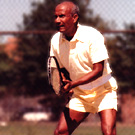
Sri Chinmoy serving from his home end. This was before his blue hut had been built in the area where his chair and drinks can be seen. Photo by Vidagdha, circa June 1981
Sri Chinmoy serving from his home end. The photo clearly shows the proximity to the players of the stone wall. Photo by Vidagdha
Sri Chinmoy returning a shot from Ashrita to his forehand side. The narrow perimeter on this side is clearly evident. In time, wisteria has grown to cover most of the fence. Photo by Vidagdha
Over the years, this modest tennis court has become a place of pilgrimage for seekers. It is used by Sri Chinmoy and his disciples for meditations, singing, dramatic performances and many other spiritual activities. Within its precincts, conversation is at a minimum. One becomes filled with the holiness and sanctity of the place. And yet, it began as a humble tennis court.
During the warmer months, Sri Chinmoy developed a routine whereby he would arrive at the court between 7:15 and 7:30 a.m., often after an early morning run, perform a set of ten or twelve weightlifting exercises, and then work through a range of practice shots on the court. Only then would he commence serious play. Mostly, his partners were local disciples. Each one would play two games with him and then another player would take over. Very few were able to take any points from him.
In 1981, however, Sri Chinmoy’s game received new impetus when he discovered a worthy rival in the person of one of his Californian disciples. Mahiyan (John Savage) was a former circuit player. He had played in the French Open and he was the practice partner of Pat Du Pré,1 at that time ranked 12th in the world. Initially, when Sri Chinmoy played Mahiyan, he was outclassed by the sheer brilliance of Mahiyan’s game, particularly his consistent and relentless ground strokes. Enjoying this new challenge, Sri Chinmoy set aside his habitual routine of playing only two games with any one partner at a time. His matches with Mahiyan grew into lengthy battles of attrition that did not cease until both sides were ready to drop with fatigue. And Sri Chinmoy thrived on such encounters, awaiting them with eager anticipation. His matches with Mahiyan acted like a catalyst, suddenly compelling him to reach a much higher standard of play.
As the months went by, he gradually developed answers for Mahiyan’s best shots and was able to play offensively, not solely defensively. He drove Mahiyan from corner to corner, until the younger man was dripping with perspiration. A major breakthrough came when he was able to return Mahiyan’s big serves on a regular basis. Although forced to play them from a point 2-3 metres behind the baseline, Sri Chinmoy’s return of service became a potent weapon.
His improved game was put to the test on April 16th, 1982 when famous tennis coach Alex Mayer,2 a former world’s number 7, paid him a visit. As the two players began to rally, Mayer automatically slipped into his role of coach and adviser, feeding the balls to Sri Chinmoy at varying angles and depths. After thirty minutes, Sri Chinmoy invited Mayer to play a match and so began a game that was quite unlike any other, a game full of gentlemanly consideration and of master shots that held the spectators spellbound with admiration. Both players dug deep into their reserve of shots, displaying utmost finesse and skill. “I thought this life was going to be easy. Nobody promised us an easy life,” joked Mayer between sets.
The final scores after one hour of play stood in Mayer’s favour: 6-2, 6-1, 6-1. However, he refused to accept the result as it appeared on paper, for it was his unshakable conviction that Sri Chinmoy had allowed him to win. “You are so great, you make other people great,” he told his host, putting his arm around Sri Chinmoy’s shoulders.
During the months of May, June and July 1982, Sri Chinmoy consolidated his game even further. At the same time, he plunged deeply into running. The choice between the two sports was often difficult, as they were no longer proving mutually beneficial. Early in July, he commented, “Tennis and running don’t go together. If I don’t play, then I will really make improvement in my running. But tennis gives me joy. Running does not give me that kind of joy.”
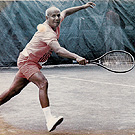
Sri Chinmoy playing at an outside venue.
Sri Chinmoy’s love of tennis was exemplified on July 4th. For some weeks, he had been ill, but on this Independence Day weekend he ventured upstate to open an old-time country music festival. Afterwards, he gathered with his students at a nearby clay court. He entrenched himself at one end just after midday, under a scorching sun. His opponents rotated in two’s and four’s. Sri Chinmoy’s mood was quiet and he interrupted the flow of games at regular intervals to conduct special on-court meditations. His students would clamber down from the grassy slopes where they had been watching the games and sit on the court to meditate with their teacher.
By late afternoon, the players’ footprints, like so many tiny bird tracks, trailed across the entire surface of the court. Sri Chinmoy called a final meditation at 5:30 p.m. The energy that he had poured into the game throughout the afternoon was now turned inwards.
Back in New York, he began to prepare for the arrival of Mahiyan from California and Anugata (Bach) from Chicago in August. During this time, Databir (Watters) worked closely with him, peppering his shots to Sri Chinmoy’s weaker areas.
Although Sri Chinmoy was suffering considerably from back pain – the result of a fall on the ice some years earlier – he settled into a routine of two hours’ practice each morning and each afternoon. These hot, summer days were distinguished by some classic matches. On July 14th, to cite a typical day, Sri Chinmoy arrived at the court for his second session at 5:00 p.m. His opponents were to be Databir and Ashrita (Furman) in tandem. Enjoying himself in an informal way, Sri Chinmoy sent balls rocketing to all corners of the court. Soon the two boys were covered with clay streaks. Like baseball players sliding in to base, they skidded to the net and then a swift return would cause them to jerk sideways or backwards. Sri Chinmoy gave no indication of easing the pressure. At one point, after nearly two hours of play, Databir fell to his knees and prayed out loud that Sri Chinmoy’s ball would not clear the net. His antics drew much laughter. Later, while chasing a ball, he ran headlong into the side wall and stayed flattened against it, desperately tired. After the match was over, the two boys as well as the umpire and ball boys all gathered round Sri Chinmoy and, like comrades, they discussed the different strokes of the top professional players.
The following day at 6:00 p.m. the same pattern was repeated, this time with the addition of a few more players. Sri Chinmoy arrived directly from a long run. Before playing, he put on two supportive belts for his back. In addition, he conceded two points in advance to each doubles pair. It seemed as though they had every advantage over him.
As Sri Chinmoy began his first game, his eyes sparkled with the joy of this innocent combat. Like Arjuna stringing his famous bow Gandhiva, he sent shots whizzing across the net. He darted in to meet short returns with his famous half skip and, when he missed a shot, he pivoted on one foot – a signature move like a dance step.
At 7:30 p.m. people began arriving for meditation. Instead, they found themselves witness to a remarkable display of energy and skill. In the final moments of play, Sri Chinmoy employed his whole repertoire of dipping and angled shots, spins and lobs, to defeat the opposing team. The scores stood at 50-35 games in his favour. Smiling, he said: “Almost nearing 100 games – so one can become tired!” He sat in his chair for the first time in over three hours and his students sat before him in rows on the court. He placed one finger over his lips as he meditated, like the spiritual masters of yore who, speaking in sign language, conveyed to their disciples the message of silence. The soft night lapped at the edges of our paradise and we knew that this precious moment belonged to eternity.
Towards the middle of July, Sri Chinmoy began to intersperse his tennis with poetry. On July 17th, he inaugurated the first in a series of chalk poems, which he wrote on the green scoreboard that was fixed to the wire fence. He asked his students to consider the tennis ground as their illumination-ground.
On July 27th, after concert tours to Rhode Island, North and South Carolina, Sri Chinmoy admitted that he was suffering from very poor health. In particular, he was troubled by constant fevers. However, he still continued to practise. On August 10th, his mighty nemesis Mahiyan arrived in New York and this gave him boundless joy. He immediately invited Mahiyan to play and so began an intense match that was to last over two hours. It was the kind of game Sri Chinmoy relished, with interminable rallies filled with long drives and crisp volleys. Each player employed his full artillery of shots.
Every day Sri Chinmoy took up his tennis appointment with Mahiyan. To the delight of all, he frequently spiced their arduous games with humorous comments. On one occasion, he exclaimed, “Now we are ready for Wimbledon!” At other times, he would warn Mahiyan in advance of a winning shot by calling out ‘bullet’ or ‘ace’ or ‘now you are gone!’ His praise of Mahiyan’s good shots was unstinting. Mahiyan’s grace on the court, his footwork, body positioning and flawless execution of shots compelled Sri Chinmoy’s admiration. His is the classic style of play, whereas Sri Chinmoy has adopted a more unconventional approach utilising greater wrist movement. This results in flicking shots that are extremely difficult to anticipate.
Playing set after set, Sri Chinmoy and Mahiyan established a momentum which both were reluctant to break, even if it meant playing to the point of exhaustion. One day, after a lengthy match which extended into dusk, Sri Chinmoy sank into his chair, while Mahiyan slumped to the ground on his side of the court.
“Oi, Mahiyan, how do you feel?” Sri Chinmoy asked, weakly.
“Terrible, Guru!” replied Mahiyan with feeling.
No one who watched their encounters in the last half of August 1982 will ever forget the thrill that came from seeing Sri Chinmoy perform at such a peak. We were transfixed with awe that he could maintain such a pace. One day, after first playing in the morning, the two combatants met again in the early evening, barely recovered from their previous rigours. These evening games were especially prolonged, frequently extending to more than thirty exchanges before the point was decided. Finally, Sri Chinmoy won the second set 7-5 and, in a spontaneous gesture of joy, he threw his racquet high into the air. It was something we had never seen him do before.
On some days, he requested Mahiyan and Anugata to face him as a pair. It was a fearsome combination, for Anugata had developed a professional service that was virtually unreturnable. It averaged between 95 and 110 mph and had tremendous kick spin, forcing Sri Chinmoy to play a high backhand return. On August 20th, these two players defeated Sri Chinmoy 6-2. Yet, by the very next day, he had analysed his weaknesses and was no longer vulnerable to the same degree. The result was that he defeated them 6-4. On August 23rd, a host of doubles teams lined up against Sri Chinmoy. The final score in his favour was 20-1.
Sri Chinmoy was in sparkling form at this time, responding to the pressure of game after game with superlative ground shots, delivered with pinpoint accuracy. He aimed his returns at his opponents’ feet, used cunning passing shots and lightning half volleys. In some matches, he delighted in edging up to 3-0 so that he could gamble on an attacking shot to take the match. At other times, he derived joy from fighting uphill in his game scores against overwhelming odds. His astute perception of the flaws in his opponents’ games and his unwavering concentration helped him to withstand the terrific pace and onslaught of a doubles team.
It was noticeable during these gruelling matches that he conserved energy in various ways. Unlike most players, who continually adjust their position with a succession of tiny sidesteps, his feet were planted firmly on the ground. He relied rather on his innate sprinting ability and a curious, utterly personal, skip – like an Indian classical dance step – which brought him to the correct position.
Sri Chinmoy is extremely light for a tennis player. At 5’ 7½” he is just ½” taller than the great Ken Rosewall and yet he averages 133 pounds, while Rosewall’s competitive weight was 140. Despite his slight build, Sri Chinmoy is able to inject remarkable strength into his shots. He is also adept at delicate, feathery shots and at overhead lobs which send his opponents scampering towards the baseline, flailing futilely with their racquets. He has brought his unique imagination to the game of tennis with surprising results.
The last days of August 1982 continued the tournament atmosphere that had been established. On August 24th, he lost to Mahiyan 4-6 and defeated Anugata 6-3. The following evening, he played 26 games, winning 15. Finally, on August 26th, the day before his 51st birthday, he played over three hours of intensive tennis with Mahiyan and Anugata. The results stood evenly deadlocked: 23-23. The standard of tennis in these matches was unquestionably brilliant. Sri Chinmoy had refined the half volley into a versatile weapon rather than an emergency tactic. Perhaps his reliance on this shot developed as a foil for Mahiyan’s towering presence at the net. Knowing Sri Chinmoy’s fondness for angled passing shots, Mahiyan often rammed his approach shots down the middle to land at Sri Chinmoy’s feet. Then Sri Chinmoy would use the half volley lob to scoop the ball up and send it over Mahiyan’s head or dribble it just over the net.
His next intensive bout of tennis came in late December 1982, when he visited Japan. Many of his matches were centred at a local court in Kyoto. Although the surface was uneven, it was extremely soft and Sri Chinmoy found that this eased the pressure on a very painful right achilles tendon injury that had developed through sprinting. The weather was brisk but clear and he soon began to find his form. The irregular bounce forced him to change his style of game and come to the net with an attacking volley. Under these conditions, his volley and overhead shot quickly improved. At this time, he was playing with a Weed racquet strung at 58-60 pounds with a nylon string.
On December 27th, Sri Chinmoy challenged Mahiyan to game after game. When the two players could barely see each other in the enveloping darkness, Mahiyan called out across the court, “Are you still there, Guru?”
“Yes, yes, I am here,” came the reply and they went on to finish their game. The final scores, in Sri Chinmoy’s favour, were: 6-4 7-5 3-6 5-7 1-6.
Sri Chinmoy arrived in Okinawa on December 28th. During his visit to the island, he played tennis on a basketball court, which his students had marked out. As usual, he blended the strict discipline of meditation with the game. Every fifteen minutes or so, he would cease playing and offer a brief meditation. Thus the court became the focal point of each day. At times, the game of tennis was forgotten altogether and the routine became a metaphor for the inner life of contemplation and the outer life of dynamic action.
Sri Chinmoy’s next spate of tennis was in April 1983, when his students gathered to celebrate his 19 years in the West. After the winter months of limited physical activity, Sri Chinmoy’s back was giving him trouble. Consequently, he concentrated on weights and flexibility exercises to regain his condition. On April 7th, he played Mahiyan for the first time since Japan and defeated him 5-0. Sri Chinmoy was so thrilled with this unexpected win that he offered all his students a special five-item prasad that evening and presented Mahiyan with a trophy and a huge cake, saying, “I get such joy when I play Mahiyan. He makes me forget my pain.”
On April 13th, the anniversary of his arrival in the West, Sri Chinmoy ran and walked 19 miles. By April 21st, the inclement weather had cleared slightly and he was able to return to the tennis court. In the late afternoon, he played Mahiyan, winning 6-4. The next day, they played again. This time Sri Chinmoy lost 4-7, and so Mahiyan offered him a trophy and a cake for losing. Sri Chinmoy said: “I am accepting this with infinite love from my heart and infinite gratitude from my soul. You come to New York and you give me such joy and I become a player. When you leave I touch rock bottom. No inspiration, no aspiration to play tennis.”
Sri Chinmoy then went on to talk about his game, making some interesting revelations: “Service I can’t do because of my back. Each time I serve hard, I become so tired that it is like playing two games.” Then, as an afterthought, he added: “My backhand needs topspin and my forehand ground strokes need to be more offensive.”
On April 23rd, Sri Chinmoy had a truly classic encounter with Mahiyan. The final score, in his favour, was: 6-4 6-3 10-8. This was Mahiyan’s departure day and Sri Chinmoy farewelled him with flowers and a special song. Finally, he placed a laurel wreath on Mahiyan’s head.
Over the next few days, Sri Chinmoy continued to play upwards of four hours a day. On April 29th, he played against various doubles pairs, winning 43-1. Then he took on four women players at once, defeating them 8-0. That same afternoon, he once again scored an impressive victory against the men’s doubles teams, winning 55-5. This brought his score for the day to 98-6. Just after 8:00 p.m., he called a meditation on the court itself. Afterwards, he moved to a particular place on his right-hand side and made a mark on the green clay. He asked the tennis court workers to keep the mark. Later he explained that during the meditation, he had a vision of a fountain of light shooting up from the ground at that point. The fountain was many-coloured and very beautiful to behold. From that time on, that particular place was preserved as sacred. A circle was drawn around it and it was covered at night. People took care never to tread inside the area, which was about one foot in diameter.
On May 1st, 1983 Sri Chinmoy ran ten miles of the Long Island Marathon. Around this time, he also began to introduce sprint training into his regimen. In every field, he was expanding, seeking to improve and reaffirming his commitment. The combination of tennis, running and weight work had made him inordinately strong. He once asked that his racquet be strung over 80 pounds, like Björn Borg, a former world’s number 1 from Sweden.3 Mahiyan, back in New York for Sri Chinmoy’s tennis anniversary on June 13th, said: “It will break your wrist, Guru.” “Do it,” was the answer.
Sri Chinmoy’s tennis anniversary had the atmosphere of a festival. During the day, he played with each of his students for three minutes and, in the evening, he played against Mahiyan. During one rally, there was a jaw-dropping 167 exchanges of the ball. In another game, Sri Chinmoy astonished everyone by resurrecting his soccer prowess and returning the ball with his head! Indeed, it seemed that to return the ball every time, against all odds, gave him far more satisfaction than actually winning. For what did it signify to make a point, except that the fun should end and have to start all over again? But how many people could play like this? Most players, as they become physically tired, grow mentally tired also. They begin to falter in their concentration and become less patient during rallies. Then, in order to reduce the amount of physical effort involved, they start to take risks. Mahiyan was unique in being able to maintain his standard for long periods of time and not suffer such lapses of concentration.
During the next few months, Sri Chinmoy gave up distance running entirely in order to devote himself to sprinting. The World Masters Games were scheduled for the end of September in Puerto Rico and he aimed to compete in several events. The effects of this sprint training on his tennis game were immediately apparent. He began to rush the net, a tactic he had rarely employed in the past, and he was able to cover the entire court with explosive speed.
From August 3rd to September 9th, he competed in fifty sprints and short distance races. On August 11th, to take a sample day, he ran a 50-meter race in 8 seconds, followed by a 60-meter race in 9.3 seconds. He then went on to score a 6-4 6-3 victory over Mahiyan at the court. Later the same day, during a heavy downpour, he defeated various other players 6-3 and was himself defeated by Mahiyan 9-11. Frequently, the speed at which he chased balls across the court would pitch him into the fence at the side boundary, but he was able to recover and be back on court in time to save a return.
On August 13th, Sri Chinmoy was due to play in the first round of the United Nations Tennis Tournament. It was four years since he had last played there. Now he was no longer a novice, but a seasoned player. From 8:00–8:20 a.m. Mahiyan gave him solid hitting practice. Later that morning, at the tournament, Sri Chinmoy lost by a very narrow margin to the top player in the tournament. The scores were 7-6 7-5 against him.
Upon returning to his own court at 11:30 a.m., Sri Chinmoy played a leisurely game with the Nepalese ambassador and his sons, defeating them in straight sets. He then suggested that Mahiyan come forward for an exhibition game. Suddenly, Sri Chinmoy’s whole approach was transformed. He pounced on low balls, hit others on the run and blasted his baseline shots. He won the match 6-1.
At 6:21 p.m. that same day, Sri Chinmoy took some instruction from Mahiyan on the serve and practised by serving 51 times. After that, he played various doubles pairs, winning 14-10. By this time, he had grown very tired and his right hand was numb from holding the racquet. Still, he challenged Mahiyan alone and won 6-3. It was the close of a long day.
On August 14th, Sri Chinmoy focused largely on sprinting. He recorded a time of 17.7 seconds for 100 meters, and then ran five 200-meter time trials, with a best time on the day of 38.7 seconds. At 8:20 a.m. he came to the tennis court and played two sets with Mahiyan. It was superlative tennis. Every point became a gripping duel. For a long time, Mahiyan was able to keep Sri Chinmoy on the baseline by smashing successive overheads. Sri Chinmoy was enjoying being on the receiving end of these thundering shots and testing his own ability to return them. In spite of the unrelenting barrage, he managed to outfox Mahiyan with his lobs and passing shots, winning the first set 6-4. Before moving on to the second set, he joked with Mahiyan: “You have meditated for such a long time. You will defeat me – you will see!” During this second set, the points see-sawed between the two players: Mahiyan’s long reach made him invincible at the net, while the absence of tactical errors on Sri Chinmoy’s part kept the pressure on Mahiyan. In the end, Sri Chinmoy won 6-2.
In the late afternoon, Sri Chinmoy practised his serve 100 times. He then defeated Mahiyan 6-4. Following this game, Sri Chinmoy did something most unusual. He invited Mahiyan to be his doubles partner against Malati and Pratap. This may well have been the first time that Sri Chinmoy had played tennis with a doubles partner. Although Mahiyan did have doubles experience, he was far too stunned by Sri Chinmoy’s invitation to play his natural game and he seemed to remain paralysed near the net. As a result, they lost many points in the opening games, but recovered to win 3-2. Afterwards, Sri Chinmoy played Malati and Pratap alone, defeating them 6-1. On this day, he had played a grand total of 40 games, of which he had won 27.
On August 15th, Sri Chinmoy recorded 16.9 seconds in a 100-meter race. Transferring to the tennis court, he defeated Mahiyan 6-4. In the afternoon, he again practised his service, this time serving 50 balls from each side of the court. His first game of the afternoon was against Databir and Mahiyan. He lost 4-6, but went on too defeat the next doubles pair 6-1. Sri Chinmoy had a knack of not telegraphing his intentions to his opponents, so that they could seldom anticipate his shots. And a moment of indecision was generally all he needed to liquidate an opponent.
By the next day, Sri Chinmoy was in peak form. It took him just 35 minutes to beat Mahiyan 6-4, and 21 minutes to beat a doubles team that included Anugata. Of all the players he faced, Anugata’s serve gave him the most joy. On one occasion, he said, “Anugata’s serve sends me to heaven!” Definitely, his medium stature affected the power of his own serve. Both Mahiyan and Anugata stand well over six feet tall.
During the afternoon of August 17th, Sri Chinmoy played 40 games in succession against various doubles teams before a gallery of 450 spectators, conceding only 9 games to his opponents. The following day, he played 30 games, winning 20. On August 19th, he played 26 games, winning 17. Once ignited, his appetite for tennis was boundless. It seemed that he would prefer to stay all day and night at the court, if it were possible. On August 20th, he defeated his students 25-11 and, on August 21st, he played a grand total of 78 games, winning 55. In spite of the score in his favour, these were closely fought matches, studded with long rallies and superb shots from both sides. It was point and counter-point and the emotions of the spectators fluctuated accordingly.
On August 23rd, Sri Chinmoy defeated his students 44-12. This was the last round of tennis for a number of days as other commitments took its place. Moreover, Sri Chinmoy had been turning his attention more and more to sprinting, working through various drills on the narrow driveway outside the court. He practised with and without spikes. He also began to wear a special mouthguard which had been custom-designed by his dentist. He believed this would significantly increase the speed of his legs and arms. Sri Chinmoy even tried wearing the mouthguard for a number of tennis games and found that his strength and flexibility were greatly improved. It was one of Sri Chinmoy’s traits that he was always keen to try new techniques or training methods which would give him an edge.
Towards the end of August, Sri Chinmoy attended the US Open to watch one of his favourite players: John McEnroe. This gave him fresh inspiration in his own tennis. The very next day, he won his matches against his students 19-1. However, because of his strict diet, he complained of not having any life-energy. Shortly afterwards, he sprained his leg doing a 400-meter sprint and was forced to spend considerable time working out on exercise equipment while his leg healed.
September 2nd was Mahiyan’s last day in New York. Sri Chinmoy did some sprint training in the morning, covering 100 meters comfortably in 16.7 seconds and 400 meters in 86.75 seconds. He then played many consecutive games with Mahiyan, farewelling him with splendid shot-making.
Following Mahiyan’s departure, Sri Chinmoy continued to play for many hours each day, often extending far into the evening. During one memorable encounter with Anugata and Databir on September 6th, Sri Chinmoy cunningly manoeuvred both players into the same box, then cried “Flee!” Finding themselves huddled together, they could only watch helplessly as Sri Chinmoy hit a hard topspin forehand into the opposite corner.
Sri Chinmoy keeps his eyes on the ball as he reaches for a backhand shot.
In the throes of a hard-fought point.
The joy of the game.
About reading the play during a game, he commented: “Even before they serve, I have made up my mind where I shall return it. Whether I shall do a lob or forehand or backhand, I know – unless it is an ace or impossible position. But usually I know already, so I don’t have to waste time deciding.”
One of the shots that delighted Sri Chinmoy most, especially at night, was a sky-high lob. Often his lobs would soar beyond the circle of electric night into the blackness of the night. This understandably caused many mental problems for the player on the other side of the net, trying to time a smash when he could scarcely even see the ball.
On September 8th, Sri Chinmoy played barefoot. His aim was to toughen up his feet so that he might one day run barefoot, as he used to do when he was a youth in India. Between games he sprinted in short spurts across the court or jumped up and down on his toes. He played without shoes again the next day, this time less gingerly, and won 11-5.
Within a few days, this multi-talented champion had put his tennis to one side as he intensified his preparations for the World Masters Games in Puerto Rico.
Endnotes: 1 For more information on Pat Du Pré see: Wikipedia 2 For a photo of Mayer in action in 1973, visit: Stanford Photo 3 For more information on Borg see: Wikipedia
Watching Sri Chinmoy play tennis on a summer’s morning in New York, it is hard to believe that a little over four years ago the game was unfamiliar to him. Today, approaching fifty years of age, he moves about the court with the natural ease of one who has attained a sure and certain mastery of what must be one of the most demanding and skilled of sports. Sri Chinmoy’s strokes are smooth, even and powerful; his timing excellent; his rhythm relaxed. It is at once clear that a lifetime of dedication to sport lies behind the beauty and grace of his style.
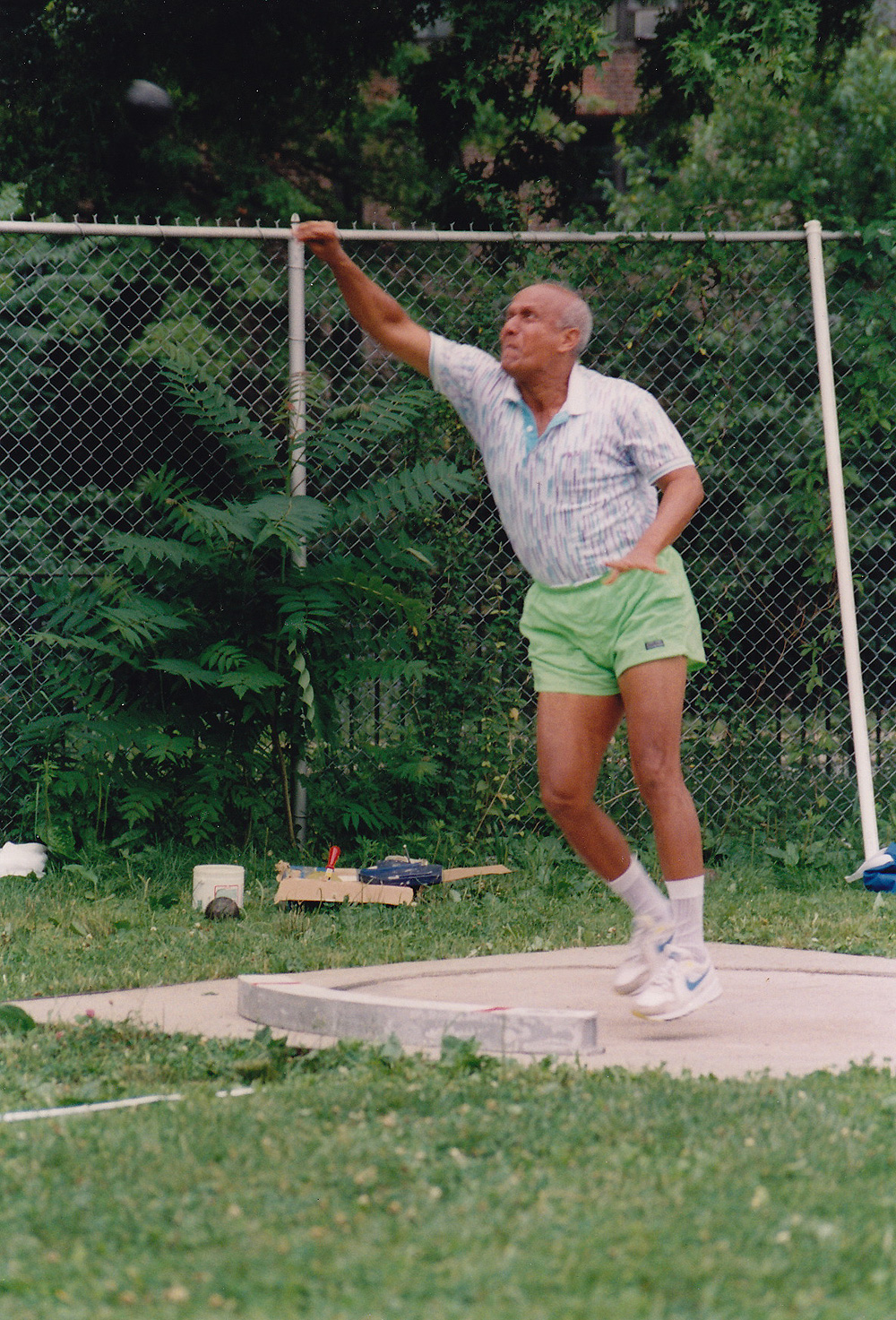
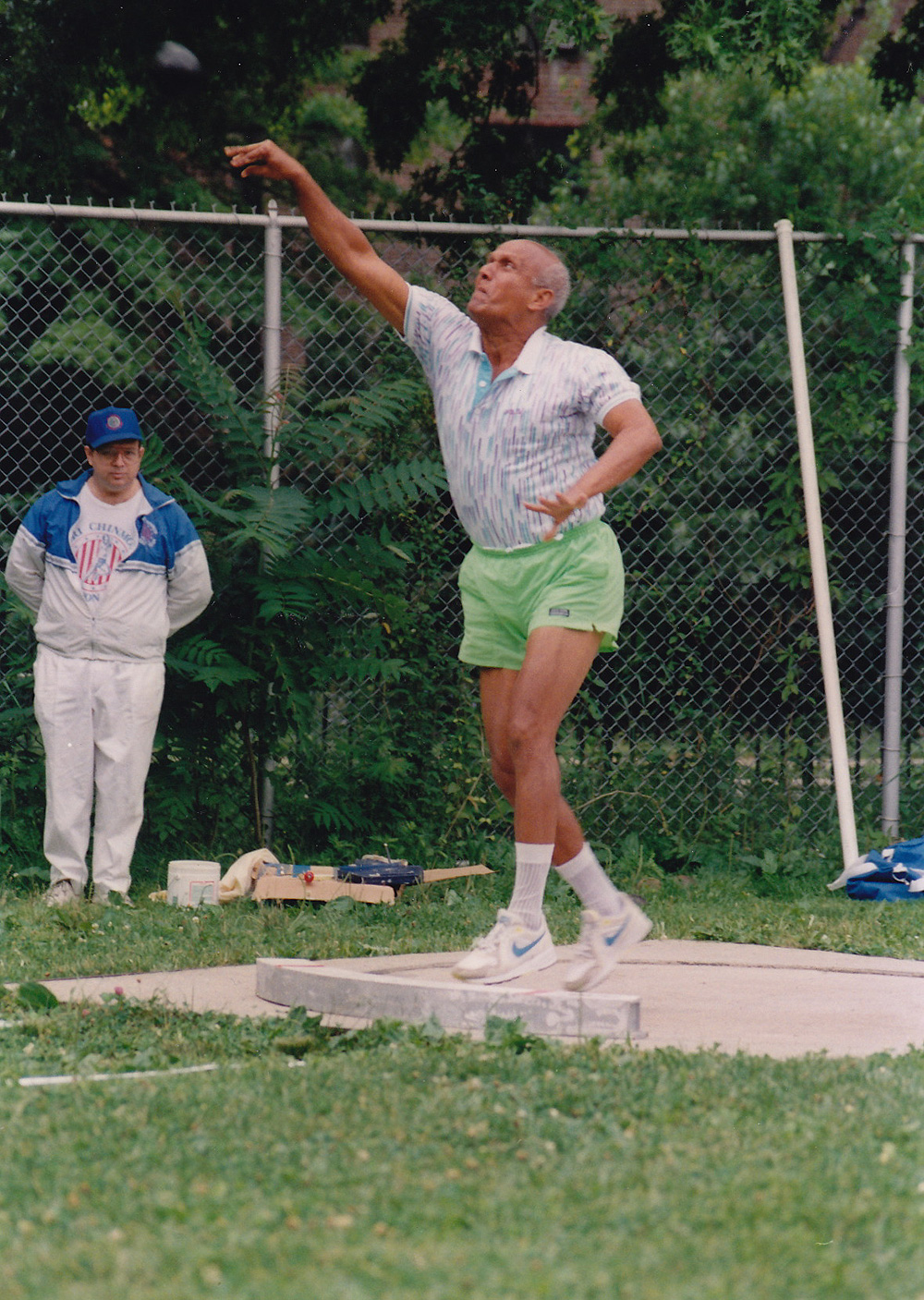
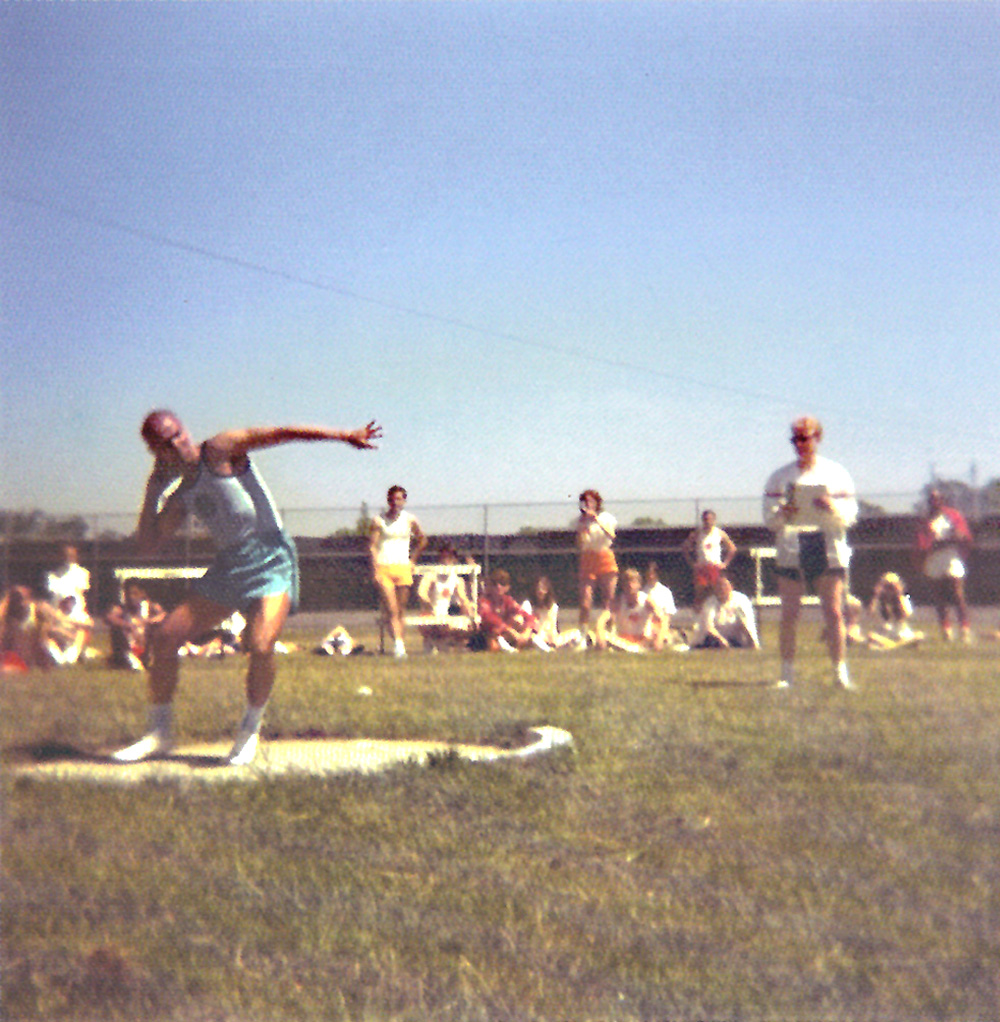
In his early teens, Sri Chinmoy devoted many hours each day to becoming a champion sprinter. Extending his interests to the shot put, discus and javelin, he gained tremendous strength in his upper body as well as the ability to let his body flow into a throw in a single and continuous movement. In addition to these and other athletic events, football (soccer) played a major part in Sri Chinmoy’s formative years, the deft footwork and agility required providing a perfect complement to his innate speed.
So it was that at the age of forty-five years, when Sri Chinmoy first displayed an interest in tennis, it was not as an untutored sportsman that he approached the game but as an athlete of considerable talent in many areas, a man who had the speed to meet its challenge, who had the determination to master it, the will-power to endure and a unique spirit of sportsmanship which, in time, would signal a new approach to tennis itself.
Most tennis players, especially those who go on to become great, take up the game in childhood. Years of training and discipline go towards shaping and perfecting the classic tennis strokes of service, forehand, backhand, volley, smash and so on. It is generally held that if one learns as a child, the body is light and supple, the mind free from preconceived ideas of style and form. In later years, this early discipline ripens into a winning combination of skill and intuitive feeling for the sport.
In the case of Sri Chinmoy, who first began playing on June 13th, 1977 – at an age when other players might consider reducing their level of competitive sport – age, as such, did not prove a hindrance to learning the game, for his muscular body still retained its tremendous litheness and strength. More than any physical advantage, however, Sri Chinmoy brought to his new endeavour a wealth of concentrative power and the heart of a child. He came to it without having to unlearn old and binding habits, and with what can only be described as a boundless receptivity to all facets of the game. Coupled with this was his willingness to spend far more than the hours necessary to perfect his game. Openness, dedication, concentration and natural ability – these factors supplied the groundwork of Sri Chinmoy’s tennis.
Sri Chinmoy adopts the ready stance. Photo by Dhananjaya
Having taken up the game in June, Sri Chinmoy pursued his newfound interest wholeheartedly and, throughout the month of July, he played every day at least once on a concrete court. His partners at that time were several of his disciples who were already excellent players. They gave no lessons or theoretic instruction to Sri Chinmoy, however, for it soon became evident that his chosen method of learning was by actual on-court experience. By playing, he discovered how to play, and by playing better and better opponents, he gradually raised his own standard. Observing and absorbing the best qualities of his partners’ games, he grasped the fundamentals of the strokes and was able to perceive more clearly his particular strengths and weaknesses.
Sri Chinmoy then began to augment his learning process in various ways. On September 6th, 1977, and on several days following, he attended the U.S. Open Tennis Championships in Forest Hills. He also commenced practising with a ball machine that directed balls to him at different heights and speeds. He used exercise equipment to increase the size and strength of his right wrist, forearm and bicep. Some of this equipment was purchased; other pieces were designed at his suggestion so that he could avail himself of time spent travelling in a car or seated for long periods.
Because of the difficulty he experienced in hiring a tennis court during the hours that suited him, Sri Chinmoy learnt many of his skills off the court – on the street outside his home and in a low-roofed building, which he called “Progress-Promise”. When he had the opportunity to apply these skills in an on-court situation, Sri Chinmoy would spend hours at a time working through a range of shots, acquiring subtlety in his use of the racquet and developing a feel for spin.
The graceful form that characterises Sri Chinmoy’s game. Photo by Dhananjaya
On September 17th, 1977, he won his first round at the United Nations Tennis Tournament, which took place at the Sterling Tennis Courts in Queens. Although he lost his match the next day, in the second round of the tournament, his progress demonstrated that in just three short months he had become highly proficient at the game.
Over the next few months, Sri Chinmoy continued to practise daily, cultivating the body movements and strength necessary for a sound game. At the end of October, he attended the Colgate-Borinquen Tennis Classic in Puerto Rico. At this stage, he considered his main weaknesses to be his serve (which lacked the full wind-up that is essential for power) and his backhand (which was not of equal strength with his forehand). By concentrating on these two strokes in particular, he was able to formulate a potent serve and an effective, one-handed backhand.
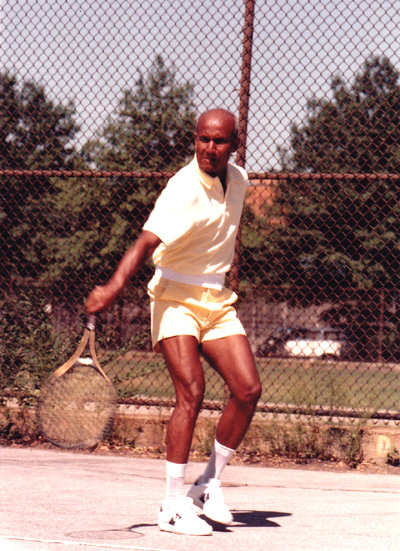
Sri Chinmoy demonstrates his improved backhand. Photo by Dhananjaya
At this time, Sri Chinmoy also began to experiment with different kinds of equipment, such as shoes and racquets. He played with racquets that were strung as low as 25–30 pounds, and others that went up to 115 pounds and required holes to be drilled in order to fit a special nylon cord. Finally, he settled for a 72-pound racquet tension. Further modifications to the racquet itself included a one-inch extension to the grip. This was, in fact, prior to the time when such extended racquets became available commercially. He also tried various grip sizes and, after ranging up to five inches, now prefers a 4¼ to a 4⅜ inch grip in which the bracket is shaved down slightly so that it is actually somewhat smaller. On the whole, Sri Chinmoy selects large-face racquets and his most recent favourites have been the Prince Pro2 and the Wilson Cobra.
Sri Chinmoy’s tennis training intensified in December 1977 and January 1978 while he was on a three-week trip to Bermuda with many of his students. There he played countless games daily, as well as more formal matches with several professionals on the island and the president of the Bermuda Tennis Association. Later during the month of January, while on a trip to Puerto Rico, Sri Chinmoy played with tennis pro Jaime Gonzalez. On his return to New York, he took some private coaching from Ronnie Rebhuhn, head pro of the Great Neck Tennis Club on Long Island.
In his regular matches, Sri Chinmoy favours the Simplified Scoring System adopted by the World Team Tennis Organisation in 1974. Under this system, individual games are won by the first player to score 4 points. This eliminates the entire process of deuce and advantage which many people hold to be an archaic constraint on the game. Certainly, the simplified scoring system brings about a faster revolution of games. There are fewer chances for a player to recover from a losing position and long, drawn-out matches are replaced by clear and decisive victories.
For Sri Chinmoy, the sheer joy of tennis is never marred by a rigid adherence to the rules and regulations. Often, in order to prolong a fine rally, he will accept a ball that is obviously going to land beyond the baseline. Again, instead of putting a ball away with a passing shot to win a point, he may place it in a more accessible position for his opponent, thus keeping it in play a little longer. His whole game is permeated by a spiritual consciousness that is not attached to winning or losing. To opponents and onlookers alike, it is evident that Sri Chinmoy’s profound love of the game itself gives him a unique detachment from the results of his efforts. This spiritual poise, which is the hallmark of all his undertakings in the realms of athletics and the arts, imparts to his game a rare quality of repose. Losing crucial points does not disturb this inner balance, for he approaches each game with a sense of a new beginning, a new opportunity. Players are surprised to find him complimenting their good shots at critical moments or expressing an obvious delight in an especially swift exchange.
Sri Chinmoy’s love of tennis has also inspired him to stage a number of marathon tennis performances. In June 1978, for example, to celebrate the first anniversary of his taking up the game, he played 453 straight games against 89 disciple players, both male and female. The marathon series began shortly before 6:00 a.m. on June 13th and moved indoors at dusk. It finally came to an end at 11:10 p.m., approximately 17 hours later. The following year, for his second anniversary, Sri Chinmoy played 100 different opponents over three days, winning every game.
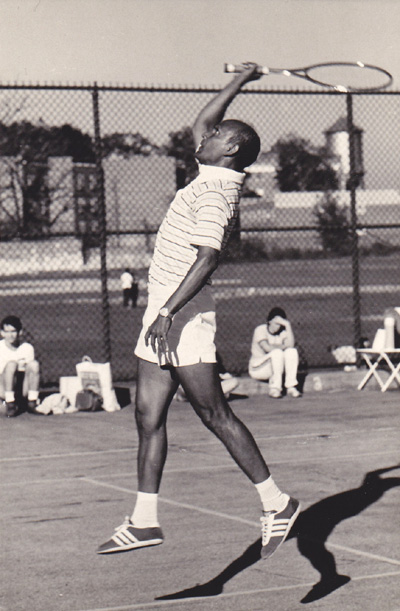
Sri Chinmoy leaps high to execute an overhead smash. Photo by Dhananjaya
This kind of event is nothing other than a celebration – a celebration not only of tennis, but also of ‘play’ in its purest form. The players delight in the game and they share their delight with those who are observing it. Ball boys, umpires, scorers, spectators – all are caught up in the thrill of moment-to-moment shots.
Because tennis invites participation in this way, it differs greatly from running, a sport which Sri Chinmoy began to practise seriously once more towards the end of 1978. Though previously a sprinter, he now tackled the longer distances, up to as far as 47 miles. Here, too, the emphasis was on stamina and endurance, the same qualities that he needed for his endless hours on the court. Running and tennis were to prove mutually beneficial, at least in the beginning. Running increased his on-court speed, while tennis gave him a proportionate abdominal and upper body strength that many distance runners lack.
Sri Chinmoy’s tennis game was clearly on the ‘upswing’! Discussions, such as the one held with Jack Kramer3 in California on September 30th, 1978, also helped to clarify certain points about the game. Their conversation probed the finer details of serve, spin, slice and net play:
Sri Chinmoy: Will you please advise me about the serve? Is it absolutely necessary to use the American twist?
Jack Kramer:Only if you want to have complete safety and keep people back by hitting deep. A serve is only as good as its depth and accuracy…
Sri Chinmoy:What about underspin and overspin?
Jack Kramer: Underspin is great for balls that are very short, because you can’t hit them hard and keep them in. It is also good for balls that come hard and deep. If a ball comes hard and deep and you don’t have time to hit a backhand drive, you can use your slice. It’s your defence.
In June 1979, Sri Chinmoy had another illumining meeting with a tennis legend. This time it was with Pancho Segura.4 The meeting took place in California and Segura advised him to work on his backhand.
On November 18th, 1979 in Queens, Sri Chinmoy played 102 single-set games, of which he won 82 and on November 22nd he played 140 games, winning an outstanding 106. This was only the beginning of an extraordinary series of weeks filled with tennis. During a three-week vacation in Hawaii, on the hot and unshaded courts of the University of Hawaii, he played a grand total of 1,398 singles games, in which he chalked up 1,023 victories.
Hard is it to fathom such a feat: that one man alone could play for so long against players who rotated and were, therefore, much fresher; that he could maintain his enthusiasm, energy and consistency. Truth to tell, it was his opponents who left the court looking ragged and spent, while Sri Chinmoy pressed on to yet another game.
In some respects, it may be said that Sri Chinmoy has tailored his game to meet the demands of such tournaments, where endurance is a major factor and the ages of most of his opponents are much less than his own. He replaces excessive running with excellent strategy, striking the ball at different angles, chopping it or causing it to sail high over his opponent’s head for a baseline lob. This kind of tactical game is only possible for someone who can accurately place the ball. Hence, it is not surprising that Sri Chinmoy believes placement is the single greatest determining factor. His view supports that of Australian tennis great Ken Rosewall,5 who has written:
“In tennis, it is not important simply to hit a fast ball, or to hit it a long way. This is a game where the most important thing is placement of the ball.”
When Sri Chinmoy is on the attack, his game is characterised by placement rather than by power, for power alone, he feels, is not sufficient to win points. Unlike many modern players, he is not content to play a waiting game of indefinite rallying until his opponent commits a fault; nor does he play a slam-bang game of baseline shots. What he prefers is a game of strategy – of disguised shots, drives with underspin and slice, lightning half volleys and shots like the lob, which can be transformed from a defensive manoeuvre into an offensive one by an experienced player.
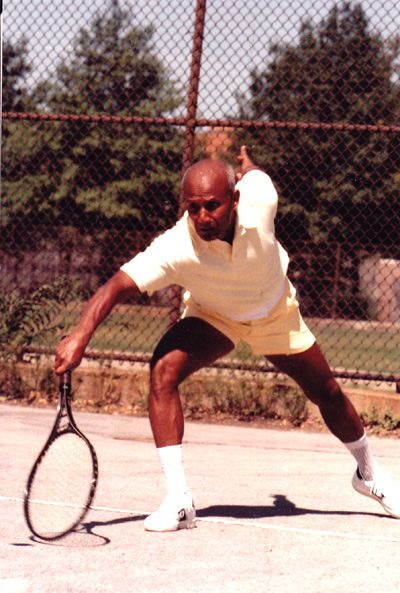
At full stretch for a half volley. Photo by Dhananjaya
Troubled with persistent pain in his lower back, Sri Chinmoy cannot always hit the ball parallel to the ground. He counteracts this disadvantage by placing his racquet firmly down for low balls and catching them immediately after the bounce on the half volley. Like American Tom Okker,6 he has made this one of his best shots, swift and penetrating. Rosewall, who was also a master of the half volley, writes of this shot:
“The half volley is a real fighting shot and should be perfected.”
Sri Chinmoy’s ability to anticipate the play makes it extremely difficult to get shots past him, particularly when he is at the net. Seldom is he caught off balance or forced to cramp his stroke. His footwork is noiseless and sure. We do not find him sacrificing control or rhythmical co-ordination for speed, or losing points through an over-eagerness to crush the ball. He has learnt to take full advantage of his extensive repertoire of shots and to play with both skill and insight.
“The half volley is a real fighting shot.” – Ken Rosewall Photo by Dhananjaya
In 1980 Sri Chinmoy’s game gained new impetus when he was able to bring his weight down to 127 pounds. With his 5’7½” stature, his appearance on the court was now that of a much younger man. In both his running and tennis, this weight loss led to a significant increase in speed.
On April 19th, for four consecutive hours, Sri Chinmoy played four professionals at Randall’s Island, New York, winning 48 out of the 101 games played. Over the next few months, Sri Chinmoy Tennis Tournaments were held in Chicago, New York and Puerto Rico. These arose out of his direct encouragement of aspiring young players.
Observing his third tennis anniversary at the end of June 1980, Sri Chinmoy played 325 games with 77 different players. Of these, he won 284 games (over 87%). At the close of the year, in Tobago, he played a total of 266 games on seven different days, losing only 50. In each instance he played alone against a doubles team. His standard had now progressed to a different level.
It is August 1981. Each morning, after competing in a series of track and road races conducted in honour of his forthcoming 50th birthday, Sri Chinmoy arrives for tennis practice. His court is a makeshift area laid out on the handball court of Jamaica High School. The concrete surface is uneven, it is bounded on one side by a solid wall and it is open to wind. Yet it is here, in these modest conditions, that a superb tennis player has been nourished and this inauspicious ‘centre court’ has been the scene of some of the most enthralling tennis imaginable.
He has taken on player after player with unflagging energy and zeal and, over the space of four years, he has come to surpass all of them. Beyond the limelight of the pro circuit, Sri Chinmoy has been exploring the beauty and delight of the game in its purest form. Now, perhaps, the time is ripe for a new step forward. Of late, he has begun conceding three points in advance to his opponents and then attempting to struggle back and win the 4-point game against all odds. He has continued to challenge the best doubles teams single-handedly, playing with alleys on one side of the court and not on the other. This has forced him to cultivate even greater accuracy with regard to the placement of shots. In a single day’s play in July 1981, Sri Chinmoy won 23 out of 24 games played in this fashion, easily accommodating himself to the additional demands of this two-pronged attack. Recently, as many as four players have taken the net against him simultaneously and still he has maintained his winning edge. On Saturday, August 15th, for example, eight games were played with this unique formation and the final score stood at eight wins for Sri Chinmoy and zero for the opposing team. Even given that they may have toned down their regular game in order to give their spiritual teacher a sporting chance, it is still a remarkable achievement.
These recent innovations attempt to reproduce the uncertain and unpredictable nature of a real tournament situation. In spite of being placed under the handicap of squaring off against four players at once, Sri Chinmoy has proved his mettle. As in all his other activities, he has pushed tennis to the very limits. It is his relentless quest for perfection that compels him to keep transcending his own capacities. And tennis has provided him with the perfect metaphor for surrender to the divine. The tiny ball has no will of its own; it simply obeys the player unconditionally. As he writes in one song:7
I play tennis every day
To join my Lord’s Vision-Play.
I am the surrender-ball:
All joy in a body small.
Tennis, tennis, tennis game,
My heart’s perfection-flame.
Four fleeting years have seen Sri Chinmoy advance from a novice to a player of rare excellence. The next few years may hold even more startling improvements. Whatever the outcome of these future matches, Sri Chinmoy’s tennis will always be treasured by seekers because it reveals the calm repose, the spirit of play and the quenchless thirst for perfection of a lover of spirituality.
Endnotes: 1 This article was written in August 1981 when Sri Chinmoy was still a relative newcomer to the sport. 2 The history of the tennis racquet: About.com: Tennis 3 For more background on Jack Kramer see: Hall of Famers 4 For more background on Pancho Segura see: Wikipedia 5 For more background on Ken Rosewall see: Wikipedia 6 For more background on Tom Okker see: Wikipedia 7 The musical notation for this song is at: Sri Chinmoy Songs
Watching Sri Chinmoy play tennis on a summer’s morning in New York, it is hard to believe that a little over four years ago the game was unfamiliar to him. Today, approaching fifty years of age, he moves about the court with the natural ease of one who has attained a sure and certain mastery of what must be one of the most demanding and skilled of sports. Sri Chinmoy’s strokes are smooth, even and powerful; his timing excellent; his rhythm relaxed. It is at once clear that a lifetime of dedication to sport lies behind the beauty and grace of his style. Read more...
.
Sri Chinmoy’s Peerless Tennis Achievement, Part Two
by Vidagdha Bennett
May, 1984
Three years have elapsed since the first part of this article appeared. If one were to graph Sri Chinmoy’s progress in tennis during this time, it would show a steady escalation, which was particularly intensified during the warmer months from April to September. Read more...
One group of runners that not only competes in races but also organises them for other runners of all standards is the Sri Chinmoy Marathon Team. Though Sri Chinmoy races are known widely throughout Australia as some of the best organised and friendliest runs around, not much is generally known of the man who is the inspiration behind these events. Read more...
Introduction
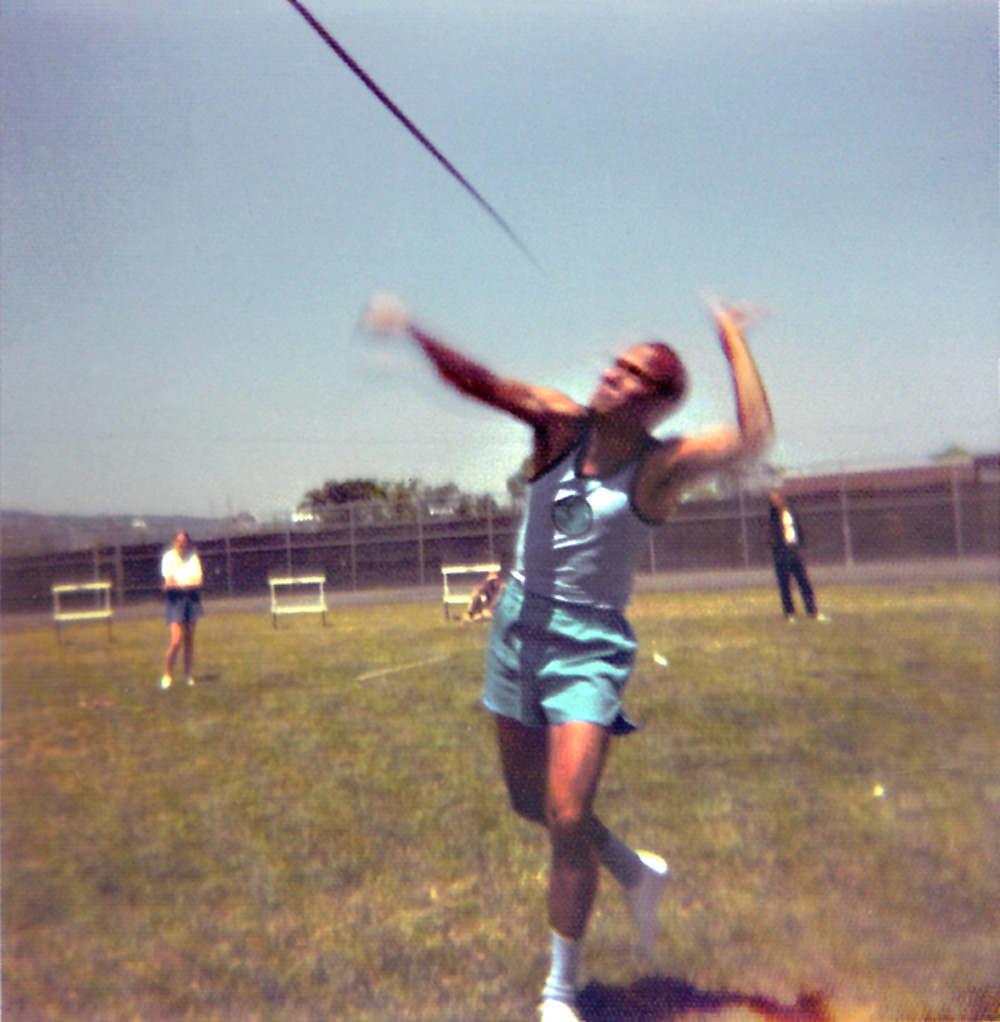
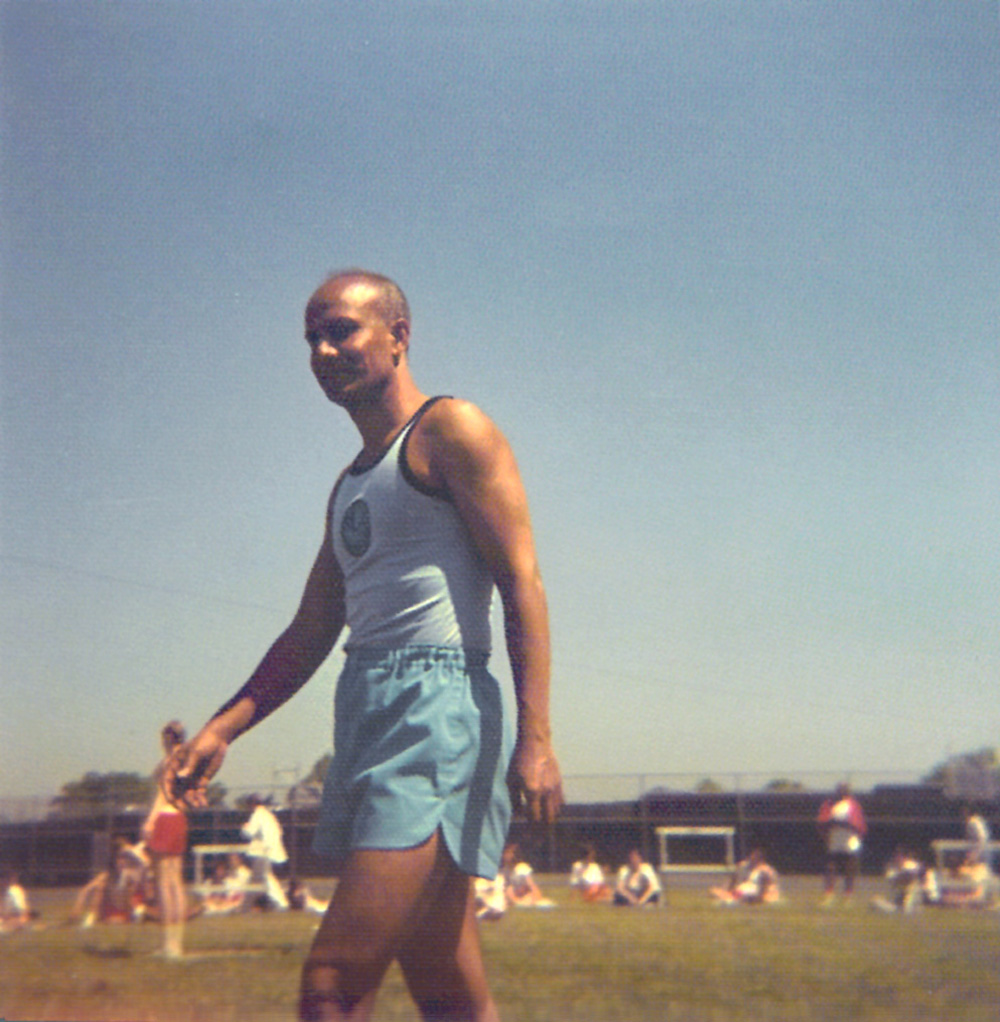
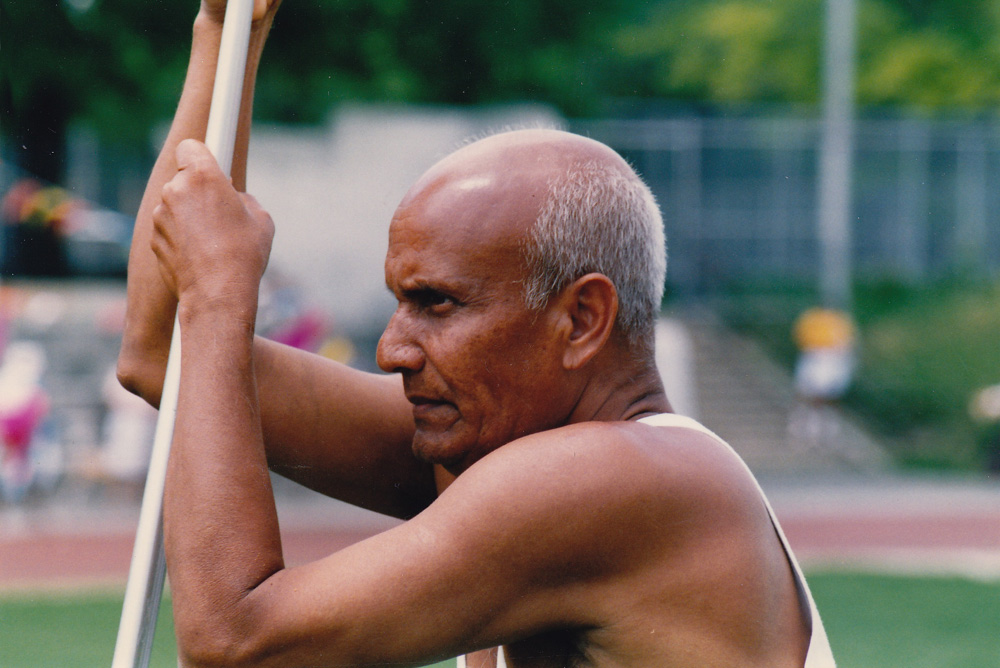
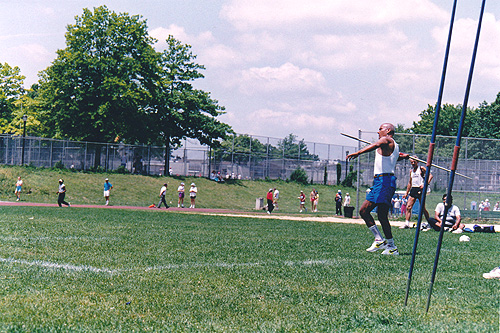
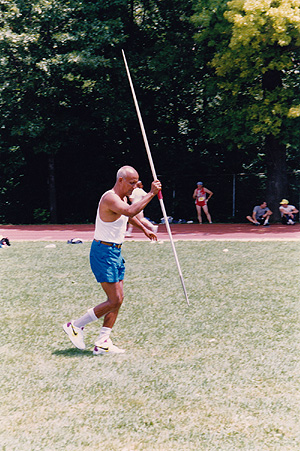
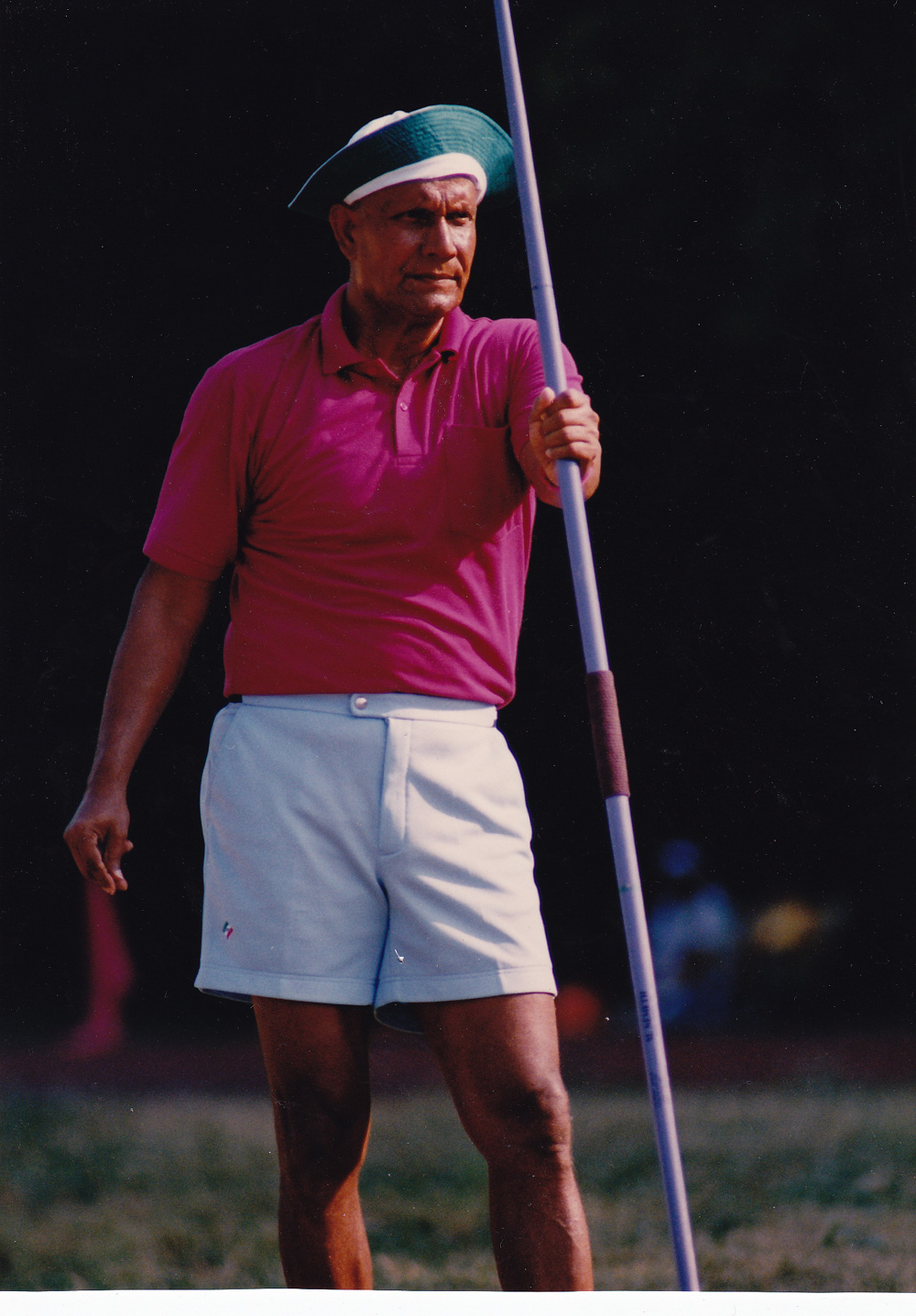
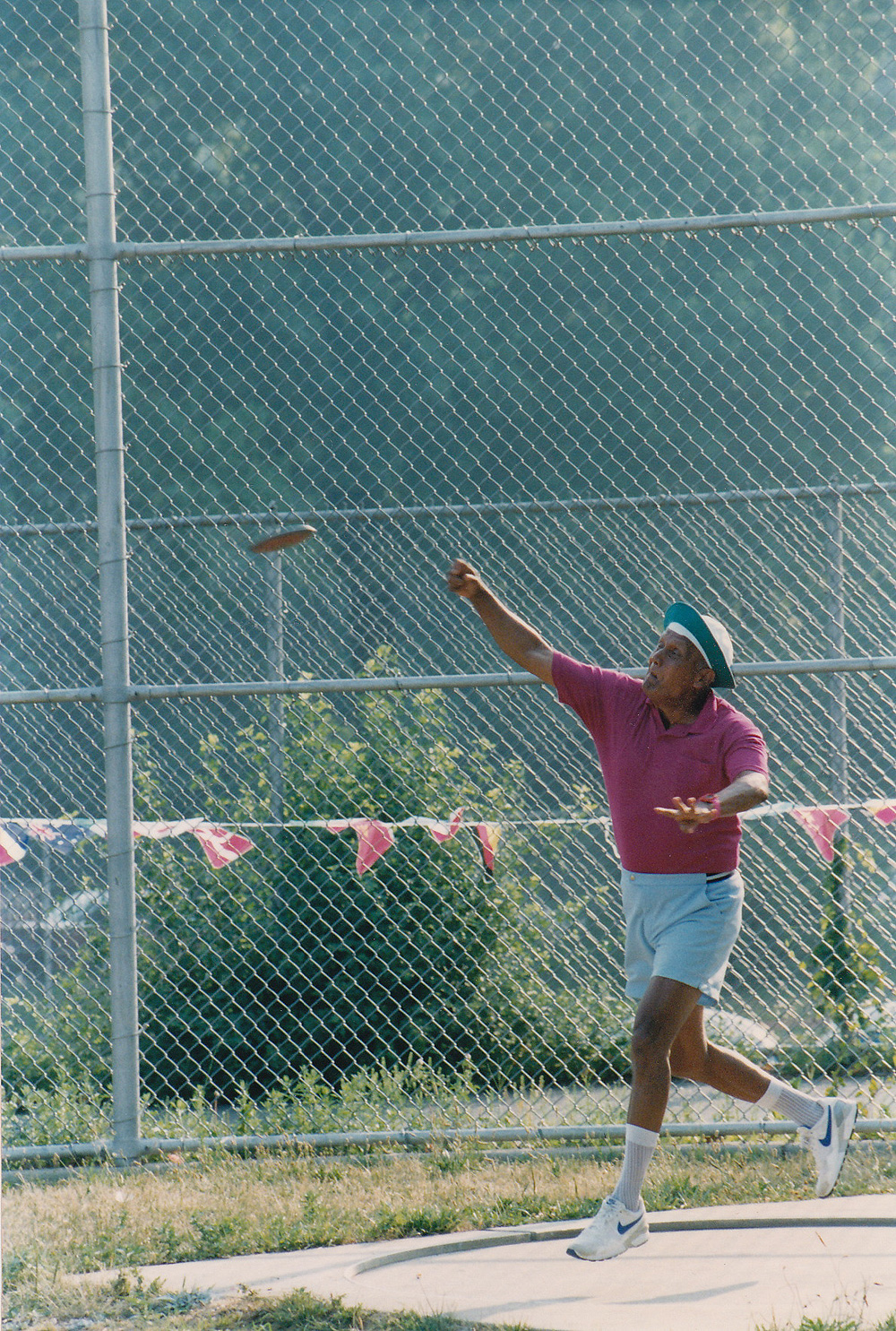
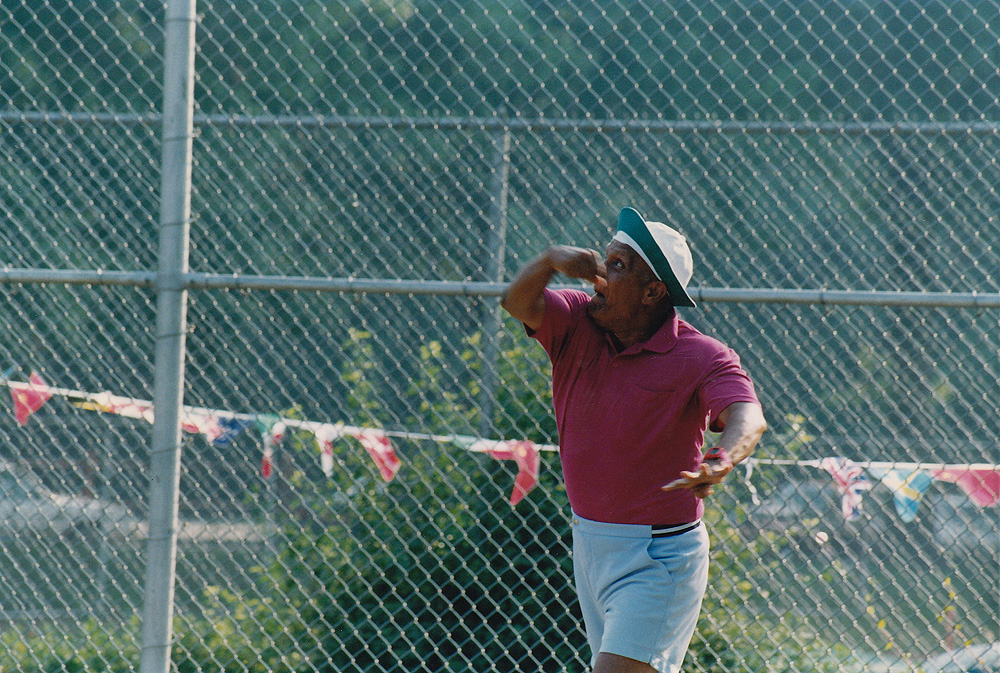
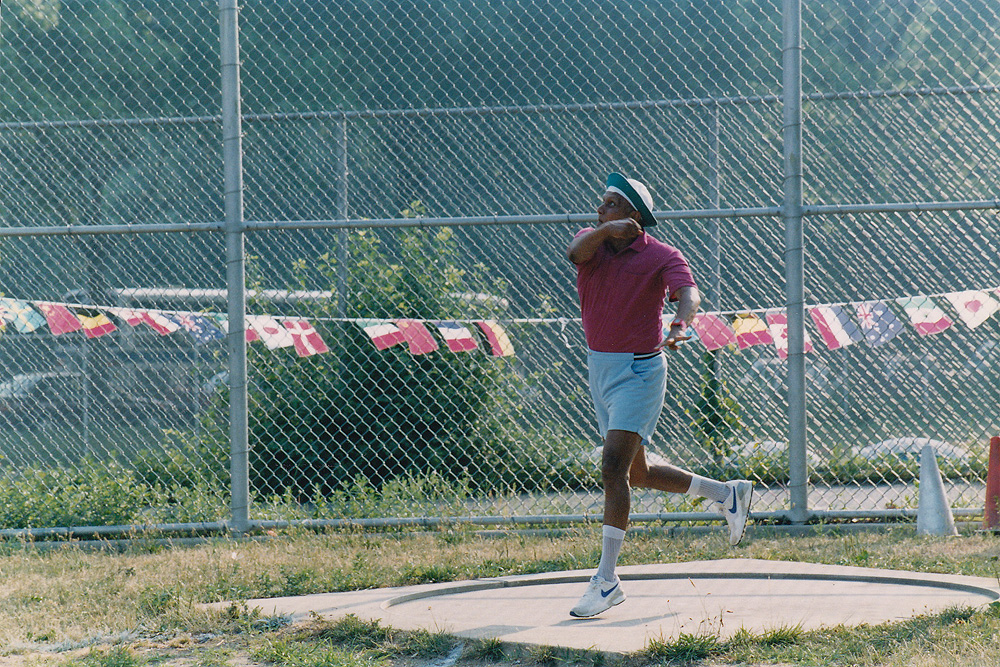
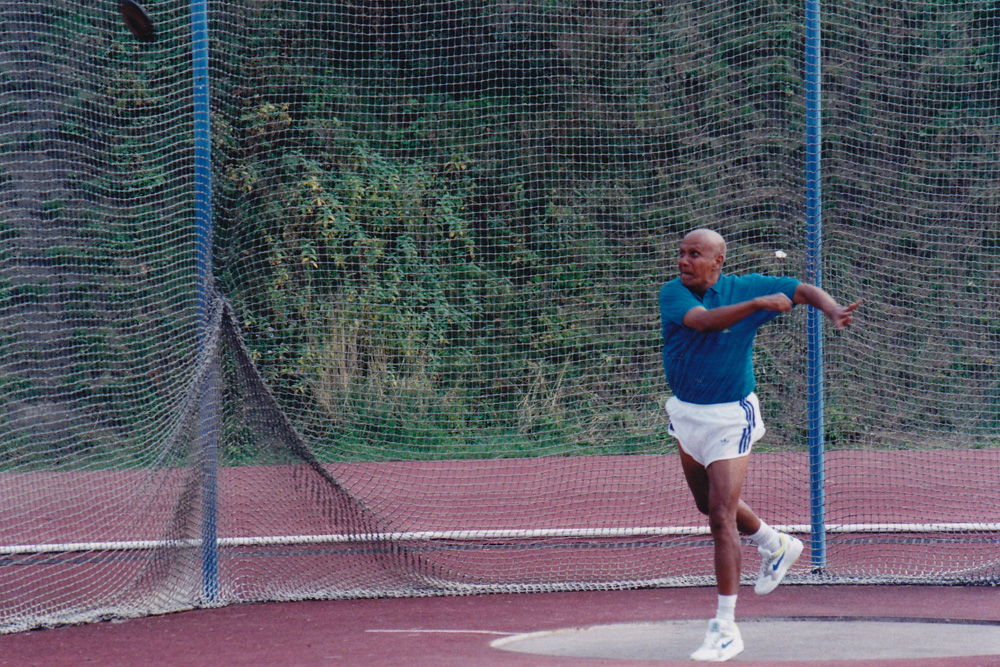
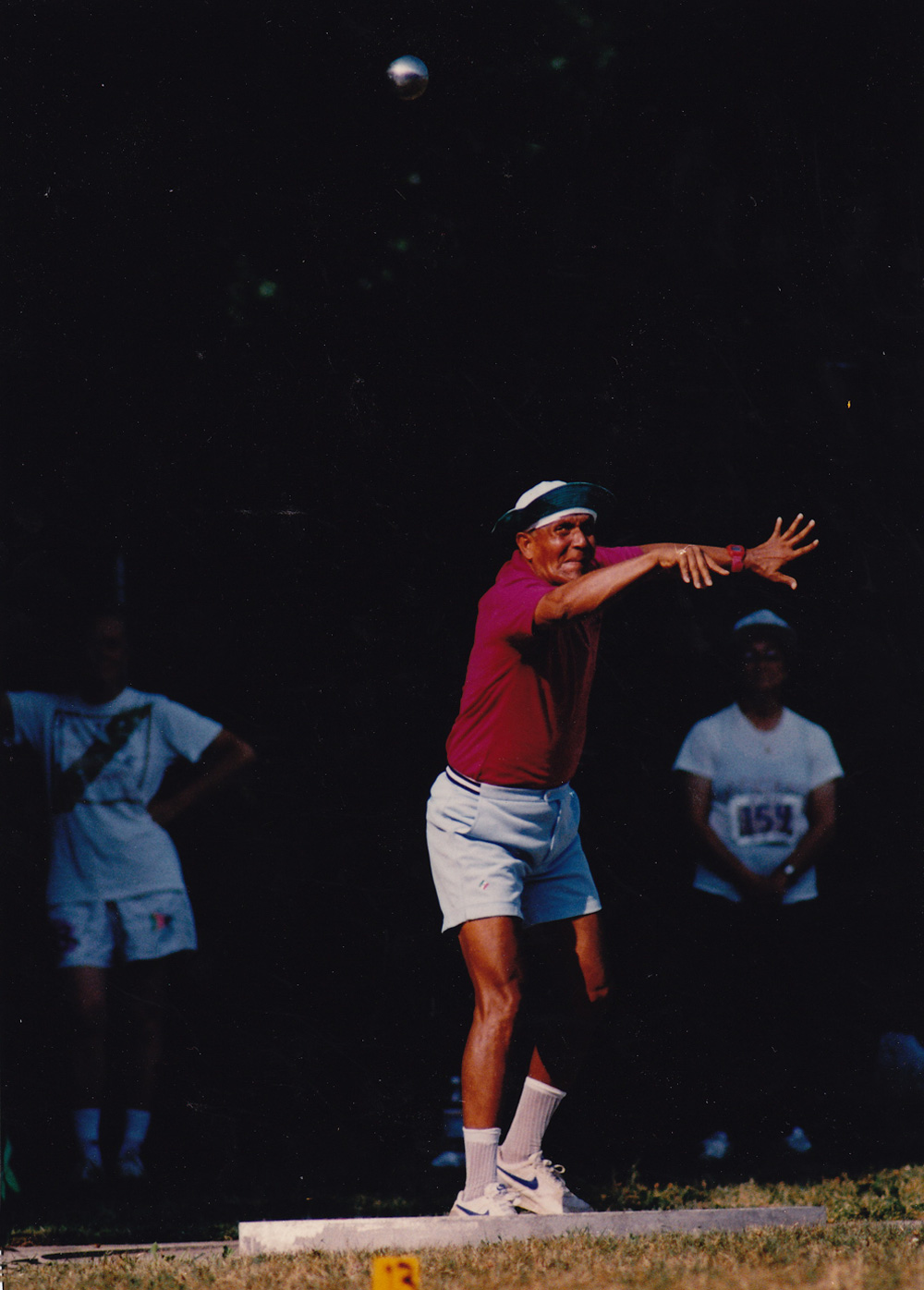
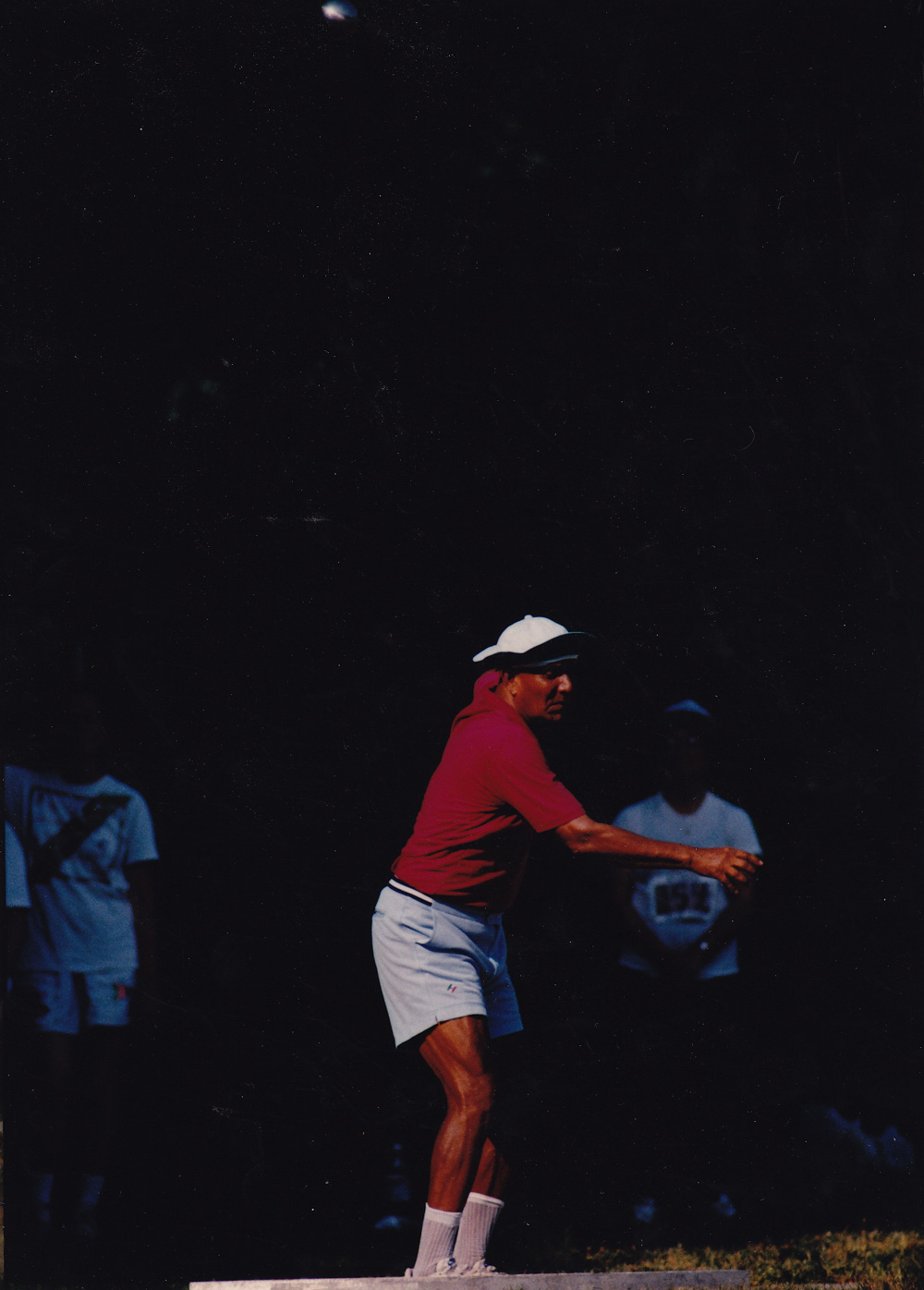
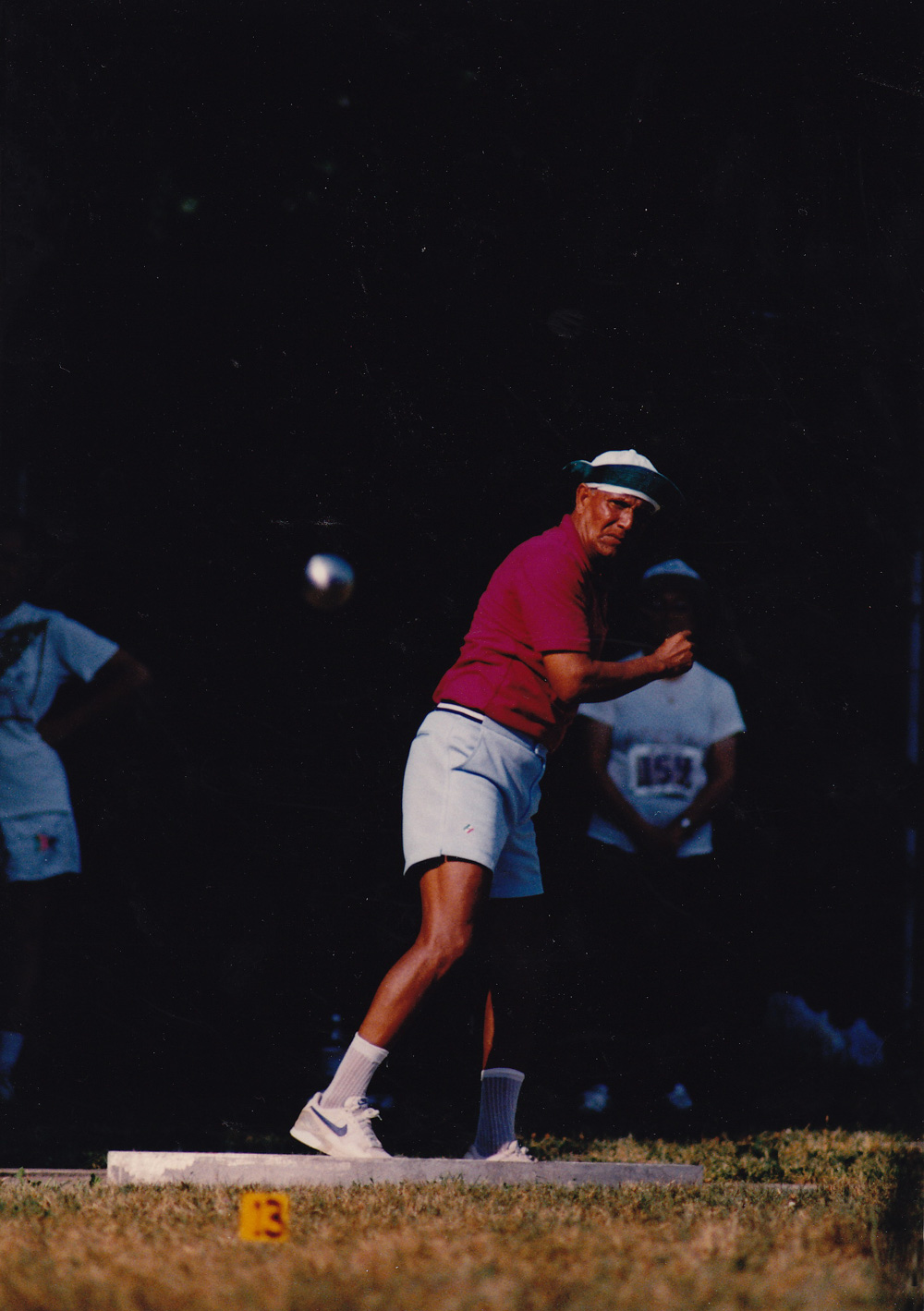
These records are a work in progress. A number of results from Sri Chinmoy’s early years in America have, unfortunately, been lost over time. Again, other events in which Sri Chinmoy participated may come to light. This table contains a mixture of official races and key training sessions. Since Sri Chinmoy placed more emphasis on personal progress than on competition, he regarded both marks as equally important. His training sessions are also valuable indicators of the dedication he brought to his beloved track and field events. In later years, when the condition of his knees would no longer permit him to sprint or jump, he still participated wherever possible in the throwing events. These records are from the notebooks and records of Bipin, Ketan, Savita, Chetana and Vidagdha.
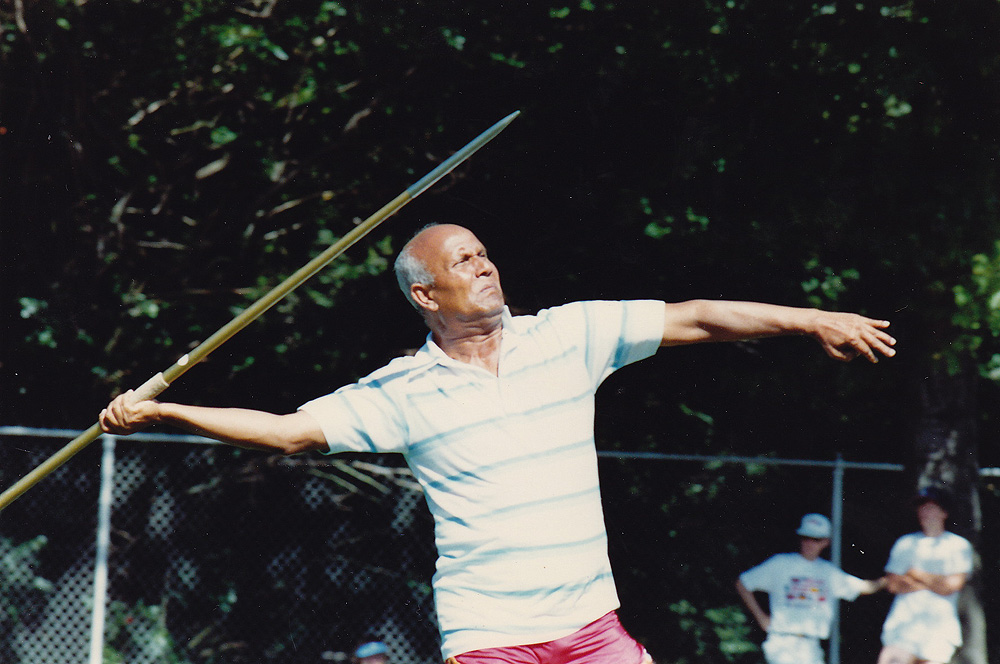
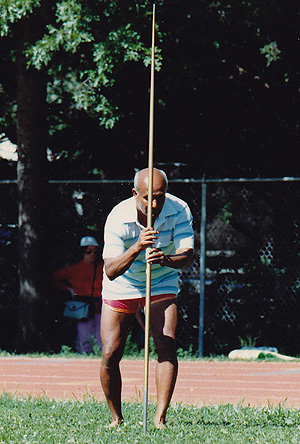
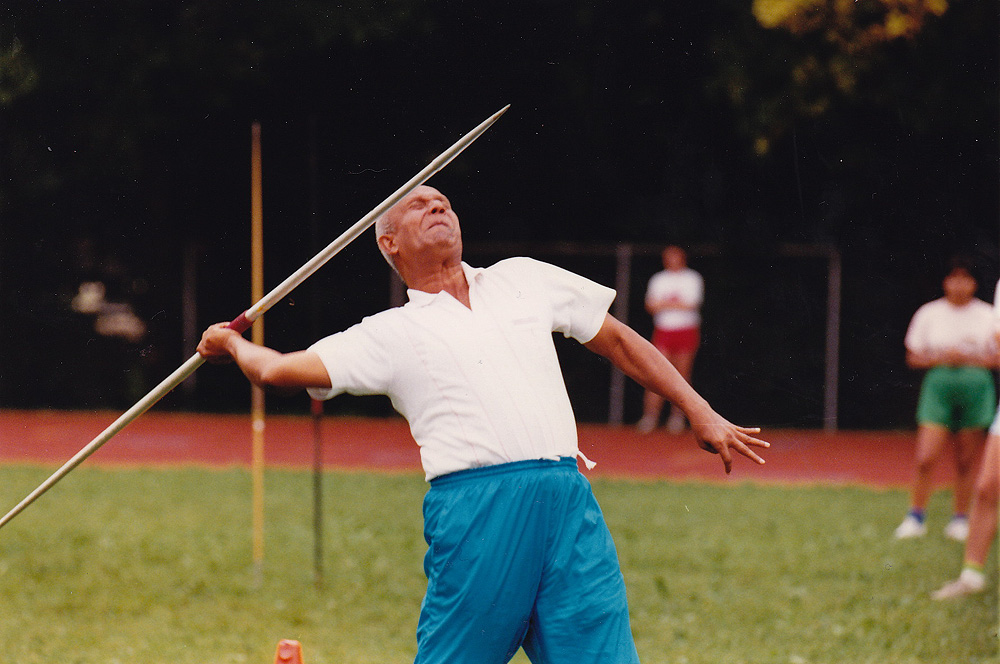
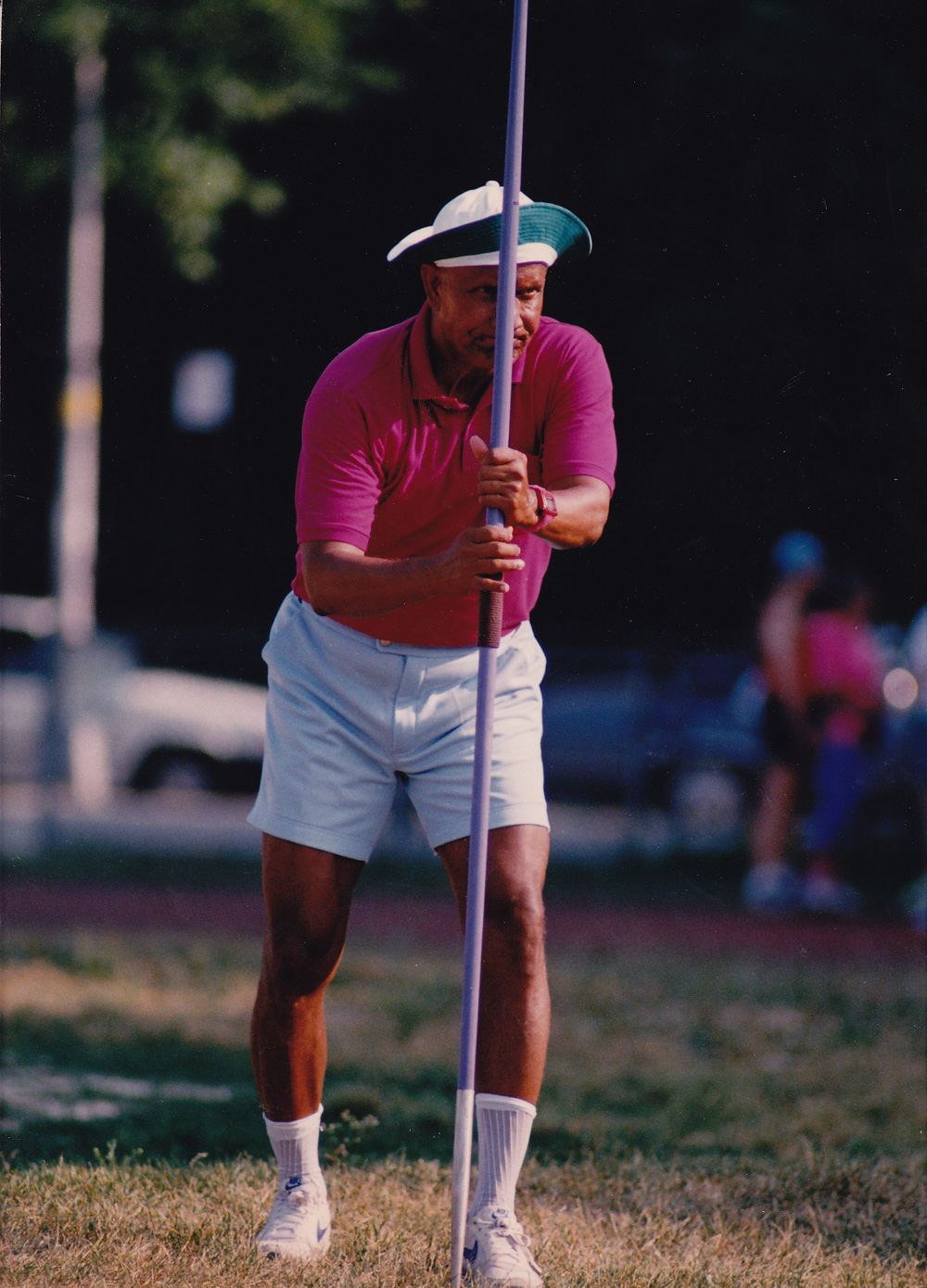
In both 1990 and 1991, Sri Chinmoy used a 600 gm aluminum Dick Held Javelin and a 600 gm Viking Sandvik; he defeated Trishakash and Nirvik in the Men’s Over 55 event
11
24.08m
22 Oct 1990
Victory Field, Long Island, NY
12
27.16m
31 May 1991
Queensboro Community College, Long Island, NY
13
26.62m
14 Jul 1991
Sri Chinmoy Masters Games
14
27.55m
8 Aug 1991
Victory Field, Long Island, NY
Best of 60+1 throws done as a birthday offering on his 60th birthday
In both 1990 and 1991, Sri Chinmoy used a 600 gm aluminium Dick Held Javelin and a 600 gm Viking Sandvik. He defeated Trishakash and Nirvik in the Men’s Over 55 event.
15. 11 July 1992
Sri Chinmoy Masters Games
Victory Field, Long Island, NY
Distance: 26.74m
17. 10 July 1993
Sri Chinmoy Masters Games
Victory Field, Long Island, NY
Distance: 27.26m
102˚F heat
20. 8 October 1995
Sri Chinmoy Cup
Slavia Praha Sports Stadium,
Prague, Czech Republic
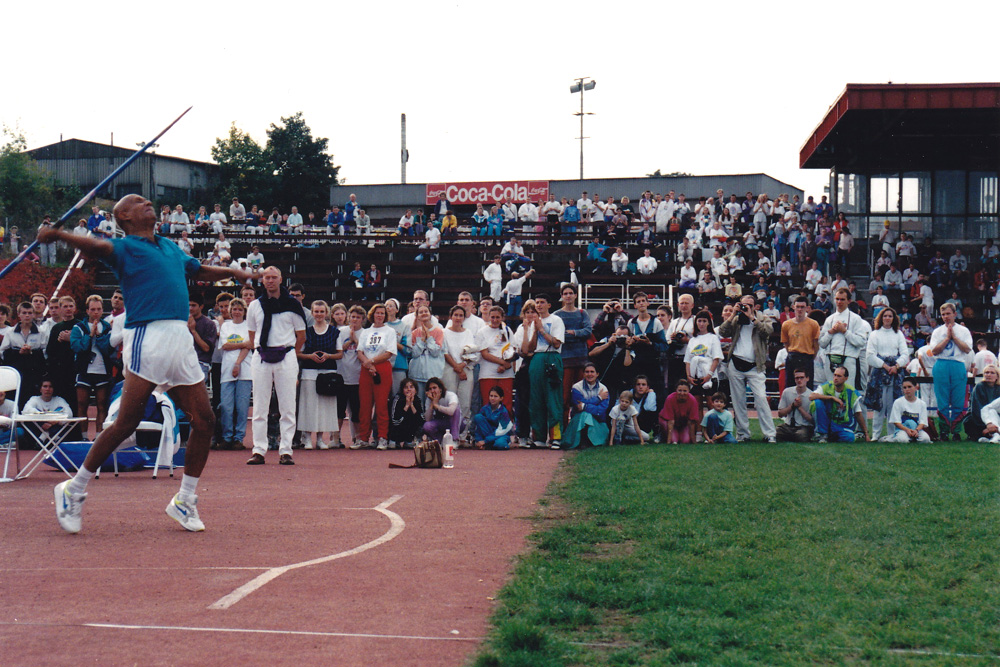
Distance: 23.58m
1-KG DISCUS
1. 21 August 1974
Sports Day
New Paltz, NY
Distance: not recorded
7. 10 July 1993
Sri Chinmoy Masters Games
Victory Field, Long Island, NY
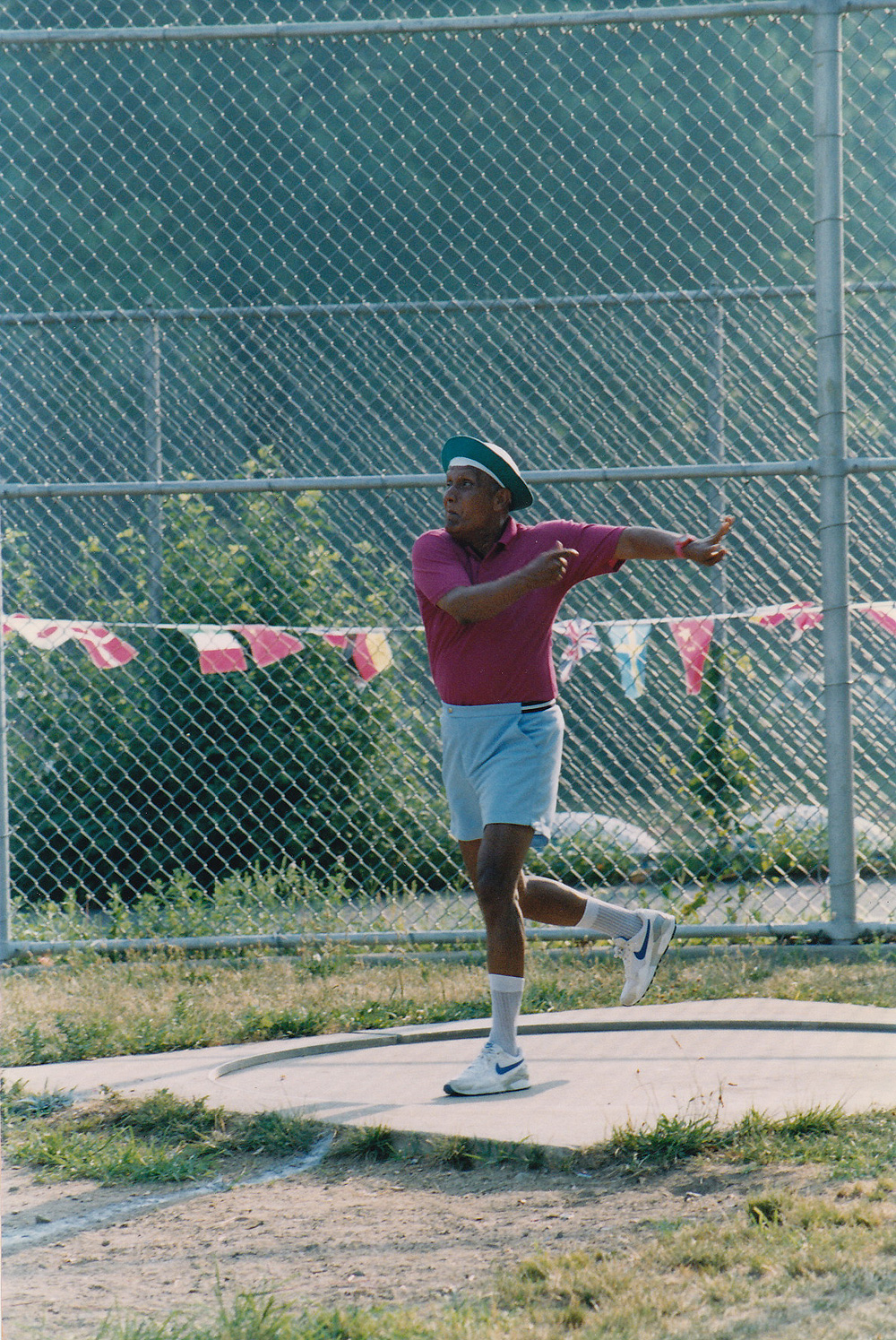
Distance: 23.70m
10. 8 October 1995
Sri Chinmoy Cup
Slavia Praha Sports Stadium,
Prague, Czech Republic
Distance: 21.04m
Best of 6 throws
6-LB SHOT PUT
1. 25 August 1989
Sports Day
Victory Field, Long Island, NY
Distance: 12.07m
4-KG SHOT PUT
1. 10 July 1993
Sri Chinmoy Masters Games
Victory Field, Long Island, NY
Distance: 8.65m
4. 8 October 1995
Sri Chinmoy Cup
Slavia Praha Sports Stadium,
Prague, Czech Republic
Distance: 8.38m
Best of 6 throws
6. 4 October 1997
Sri Chinmoy Masters Games
Victory Field, Long Island, NY
Distance: 8.19m
Best of 5 throws
5-KG SHOT PUT
1. 11 July 1992
Distance: 7.94m
Best of 6 throws
This was Sri Chinmoy’s first time throwing this metric weight.
12-LB SHOT PUT
1. 21 August 1981
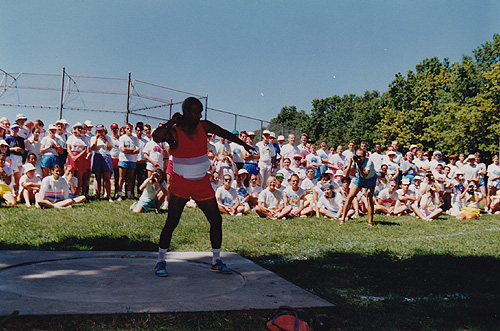
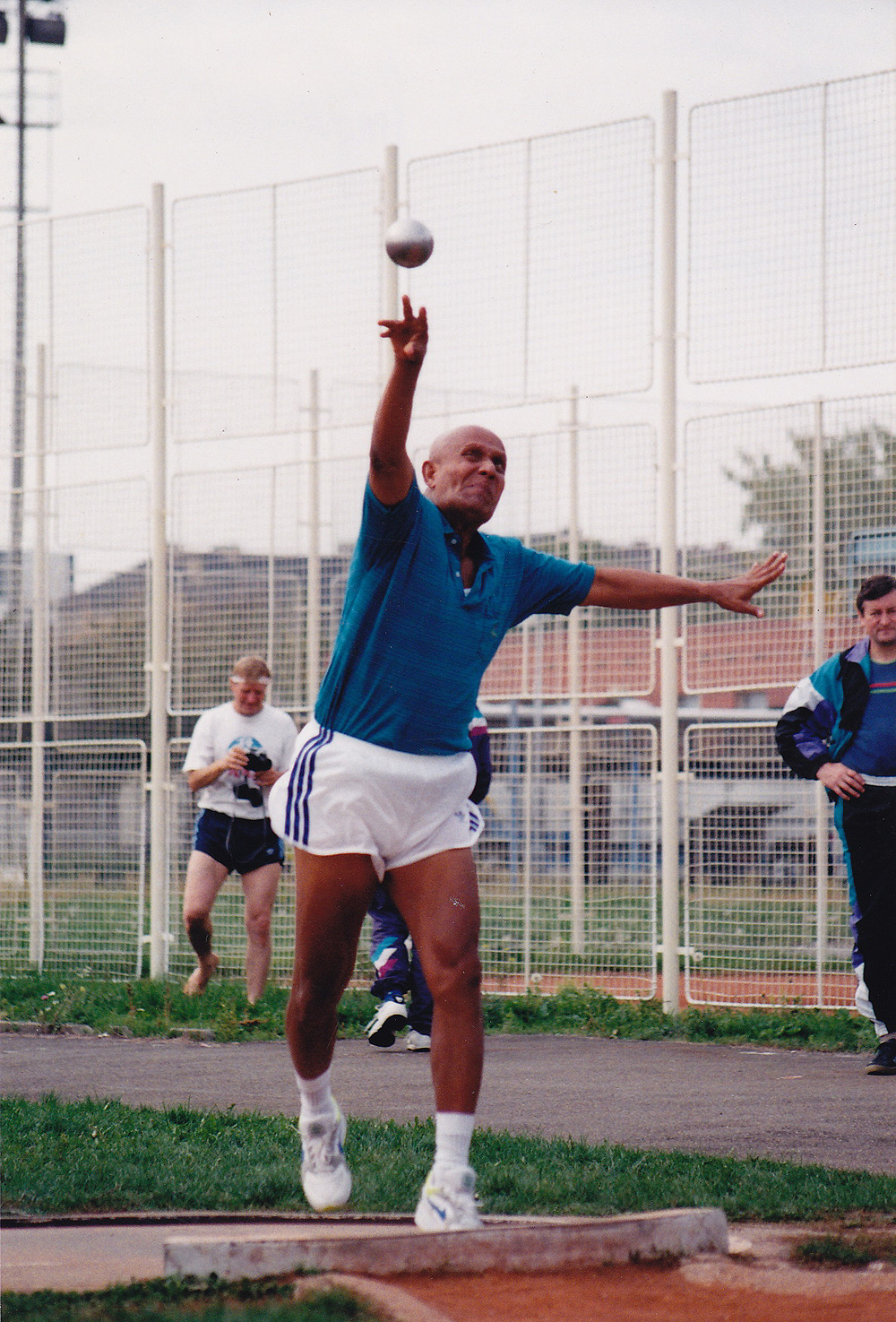
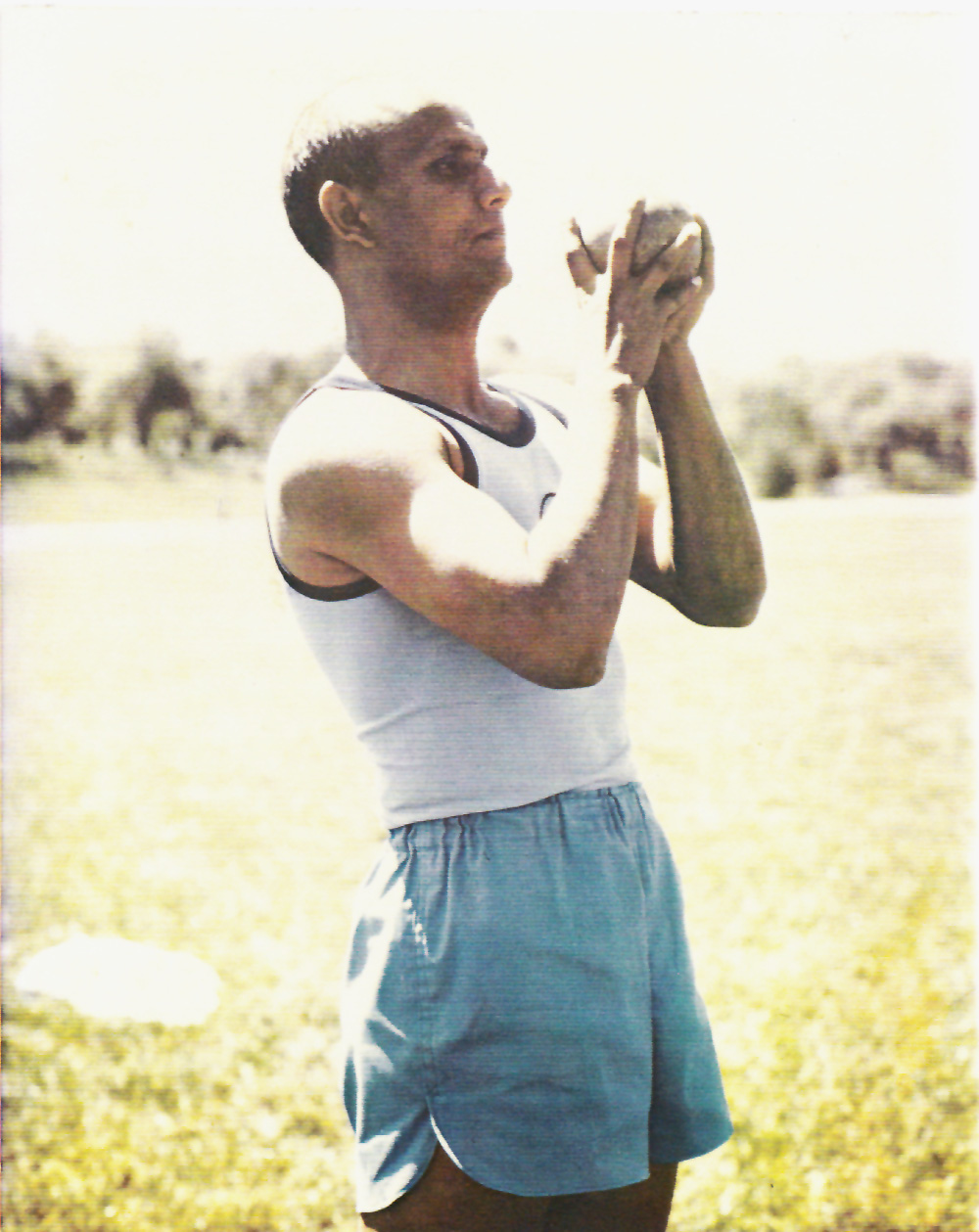
Sports Day in New Paltz, upstate New York. Sri Chinmoy is wearing a ‘Salutation to America’ t-shirt, commemorating the 1,300-mile. non-stop running relay through all 13 original states of America, that took place from October 7-14 of the previous year.
6-KG SHOT PUT
1. 14 July 1990
Sri Chinmoy Masters Games
Distance: 7.74m
16-LB SHOT PUT
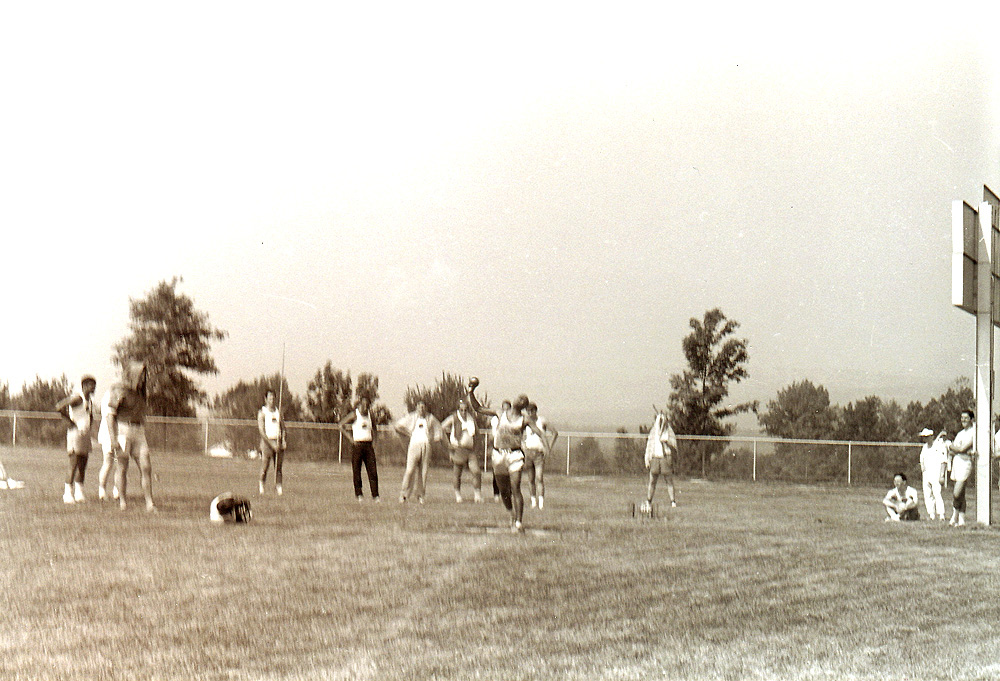
1. 1972
Sports Day
Distance: not known
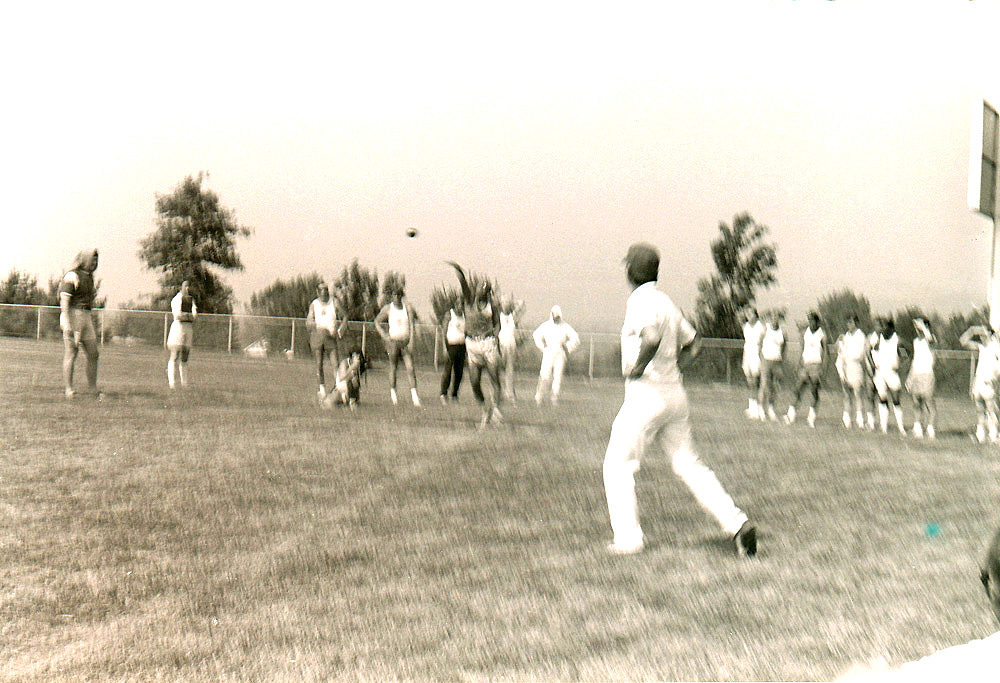
2. 1973
Sports Day
Photo by Abakash
Distance: not known
Sri Chinmoy used a brass 16 lb. shot put.
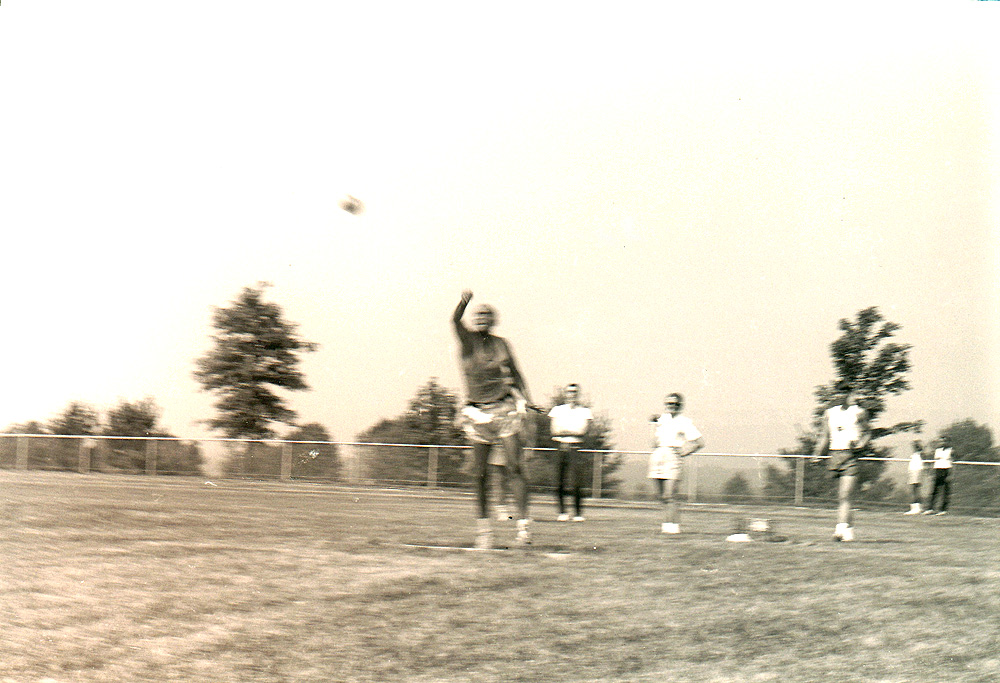
3. 21 August 1974
Sports Day
New Paltz, NY
Distance: not known
If you have photos to contribute to this section, kindlycontact the editor.
Time: 12:00:00
Pace: 24:50
Distance: 29 miles
12-Hour Walk
Jamaica High School Track and around school block
6. 1-16 May 1985
Sri Chinmoy 1,000 Mile Race
Flushing Meadow Park
Queens, New York, NY
Race no.10
Distance: 208 miles
Place: 10th overall
Day 4: May 4, 1985
Photo by Bhashwar Hart
Sri Chinmoy was an official entrant in the 1,000-mile race, which was conducted on a one-mile asphalt course at Flushing Meadow Park. And New York Road Runners Club President Fred Lebow, a frequent visitor to the race, was there at the finish to hand out the awards.
If you have photos to contribute to this section, kindlycontact the editor.