Early athletics

Chinmoy1: Star Athlete of the Sri Aurobindo Ashram

Compiled by Vidagdha


Classic Photographs2


1. The Races: Sprints, relays,
middle distance, hurdles
  2. The Jumps: High jump, pole vault   3. The Throws: Shot put


  4. Awards: Decathlon champion   5. The Captains  


1. The Sprints


Chinmoy in the starting position. His bare feet and the pitted road surface were typical of many of his races.


100 metres: Chinmoy’s classic sprinting form. He won this event for 16 consecutive years. Here he is running on the Ashram’s cinder track that was opened by the Mother on July 1st, 1951.


Chinmoy crossing the finishing line in first place in the 100-metre sprint.3 (July/August, 1959)


Chinmoy [far right] at the start of a 400-metre event. On the far left is his German coach Saumitra [Werner Haubrich4]. (July/August 1958)


Chinmoy [second from left] prepares to run the anchor leg in a 4x100-metre relay. Although starting considerably behind the rest of the field, he was able to win the race for his team. (July/August 1957)


The start of a senior men's sprint in 1958. Chinmoy, aged nineteen, is second from the right; Manoj Das Gupta is on the far right.


Sri Aurobindo Ashram

The start of a middle distance race. Chinmoy (second from the inside lane) is in prime position for a fast start.


Chinmoy [far right] during a close 100-metre hurdles race (July/August 1959). On the far left is Manoj Das Gupta, presently the Managing Trustee of the Sri Aurobindo Ashram.


2.  The Jumps


High Jump: Chinmoy is using the older style Western roll.5 The landing pit consists merely of sand, unlike the thick mattresses in use today. (July/August 1958)


Chinmoy soars over the bar in the pole vault the 1952 Sports Day completion. (23rd July, 5 p.m.)


Pole vault: Chinmoy leaps well clear of the bar. He is using a bamboo pole and bare feet.6 Note the absence of any cushioning to break the fall. (August/September 1960)


3. The Throws


Shot Put: Chinmoy’s tremendous leg and arm-power are revealed in his ready stance. The figure of the Mother in the background has been enlarged and superimposed on the photograph. She would attend all the Sports Days with great enthusiasm and present the awards to the champions on the day.


Shot Put: This dramatic photograph from 1952 captures the exact moment when Chinmoy releases the shot. The Mother is seated in the background.7


4. The Awards


Chinmoy receives his decathlon award from the Mother, September 5th, 1959. This photograph reveals the Mother’s exquisite smile for the Ashram’s star athlete. The decathlon event was first introduced in the Ashram during the 1956 athletics season.


This is the original of the previous photo and has much clearer definition. At a certain point in the 1970’s, the background was blocked out by taping white photographic paper over it.


Chinmoy poses with his athletic awards on Sports Day.


Chinmoy poses with several Champion’s Cups.8


5  J.S.A.S.A. Captains Sri Aurobindo Ashram 1961


Sri Aurobindo Ashram – 1961

This group photograph from 1961 includes the captains of all the different sports and divisions within the Department of Physical Education of the Sri Aurobindo Ashram, more commonly known as J.S.A.S.A. – ‘Jeunesse Sportive de l’Ashram de Sri Aurobindo’. Chinmoy, aged 29, is in the top row, fourth from the right. He was the captain of the men’s football and volleyball teams. In the centre, in white, is Pranab Bhattacharya, who founded the Department at the express wish of the Mother in 1945 and, at the time of this writing 64 years later, is still directing it.


Endnotes:
1 Throughout this text, Sri Chinmoy is referred to as ‘Chinmoy’, the name by which he was known during his Ashram days.

2 These are the only photographs that have emerged to date. More may yet be uncovered that show Chinmoy’s other major events: javelin, discus, hammer, long jump and hop, skip and jump.
3 In 1974, Chinmoy’s classic sprinting profile from this photograph was reproduced on the cover of his book The Goal is Won.
4 “As a result of a request to the Federal German Republic at Bonn, they have sent us a highly qualified Physical Educator to give our members a three months course. The instructor, Mr. Werner Haubrich is from the Sporthochschule of Koln and holds a diploma of the institute in Physical Education. He is not only an able theoretician, but is at the same time a fine sportsman particularly in Athletics and Swimming. In sprinting and hurdling his records are very impressive being 10.9 seconds for 100 metres, 22.2 seconds for 200 metres, 50.2 seconds for 400 metres and 25.3 seconds for 200 metres hurdles. He has already completed his course of swimming lessons for the instructors class and he is now holding classes in athletics.” – Sri Aurobindo Ashram Bulletin of Physical Education, Nov. 1958.
5 The Fosbury Flop was not introduced until 1968.
6 One year, during competition, Chinmoy’s bamboo pole snapped as he took off, causing him to fall heavily.
7 Seated to the right of the Mother is Udar, who acted as timekeeper and umpire for the events. A former aeronautical engineer, he also manufactured much of the equipment at his Harpagon workshop.
8 Sri Chinmoy told us that he put on spikes especially for this photograph, but they did not fit properly and so he did not wear them during competition. From the slight alterations in his appearance, it seems that these awards photographs may have been taken in different years. He maintained a bodyweight of 131 pounds (59.42 kilos) throughout his competition years.


The Ashram Years

Preface

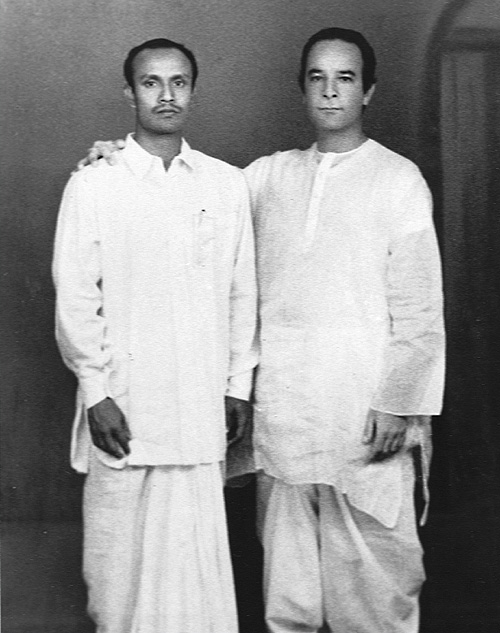
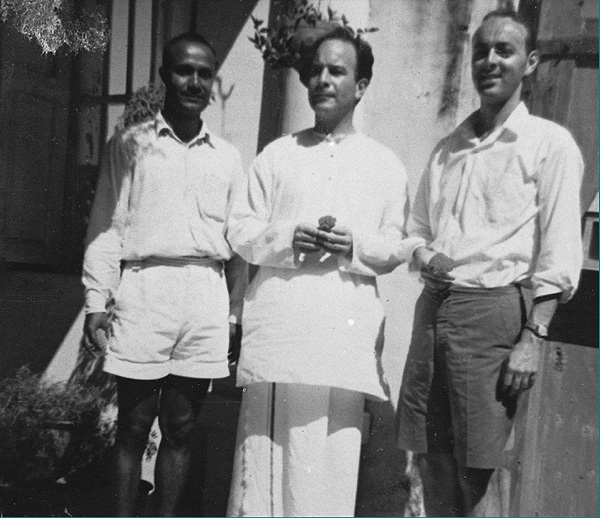
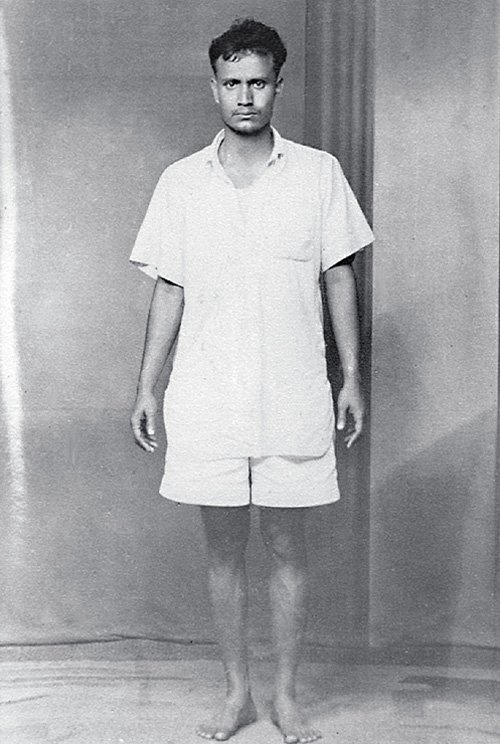
In this rare collection of photographs from the years 1944-1964, we see the young Chinmoy blossom spiritually. An extraordinary luminosity is reflected in his eyes and, as the time of his eventual departure from the Ashram draws near, he seems to brim with vast inner gifts waiting to be manifested.

The provenance of most of these photos is not known, unfortunately. They have been gathered from various private collections of Sri Chinmoy’s students and, with the exception of a handful, there is no indication of the year in which they were taken.

– Vidagdha

Table of Contents


1. Earliest Photo


Sri Chinmoy referred to this as the “sugar cane photo”. In the original (still to be located), he is standing with three friends in front of a field of sugar cane. This photograph was taken during his teenage years.


2. Relaxed


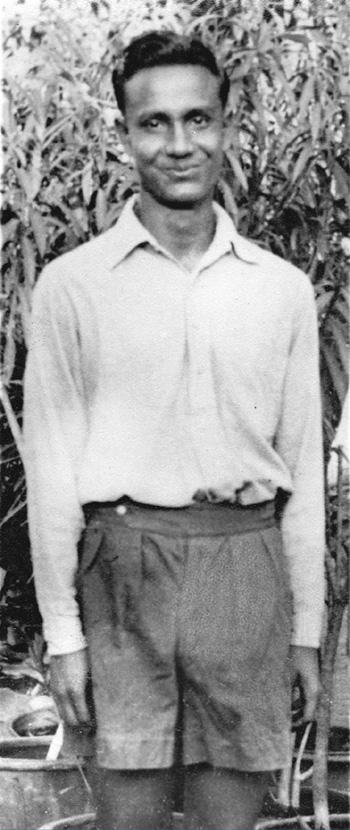
This photograph shows Chinmoy in a relaxed mood.


3. Among Friends


In this formal portrait, Chinmoy (second from left) is seated with three other Ashramites. His closest friend, Jyotish, is on the far right, but regrettably we cannot identify the other Ashramites in the picture.


Here Chinmoy is standing behind his friends Nabin (left) and Jyotish (right).


Sri Aurobindo Ashram – 1958

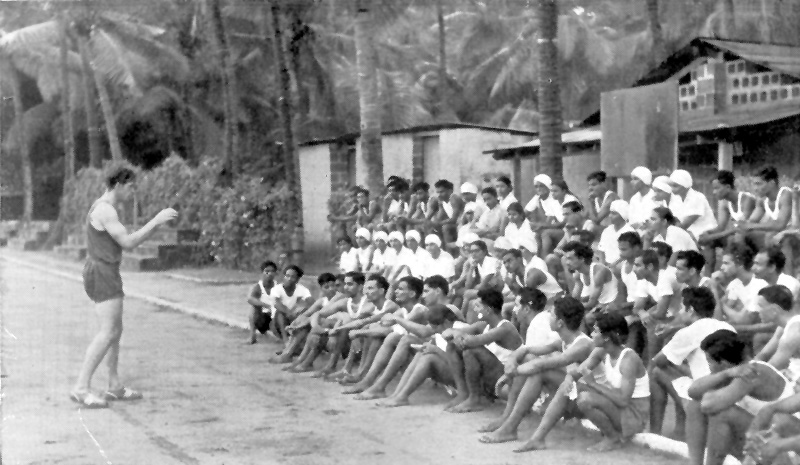
This photograph, reproduced from an Ashram magazine, was taken in 1958 when Werner Haubrich (known in the Ashram as Saumitra) came from Germany to coach the younger Ashramites in athletics. Chinmoy is seated in the middle row on the extreme right. The original caption for this photograph reads: “Mr. Haubrich explaining the fundamentals of running.”

Chinmoy and Sam Spanier, 1963. While on a visit to the Sri Aurobindo Ashram, Sammie happened to meet Chinmoy and he was deeply impressed by the young man’s spiritual wisdom. Sammie invited Chinmoy to come to America and he offered to become one of Chinmoy’s sponsors.


This photograph, also from 1963, shows Chinmoy with Sam Spanier and Eric Hughes, two of his American friends from the Ashram. He stayed with them in Greenwich Village when he first arrived in New York and later visited them regularly at ‘Matagiri’ in Woodstock. He maintained his friendship with them throughout his life.


4. Inner Experiences


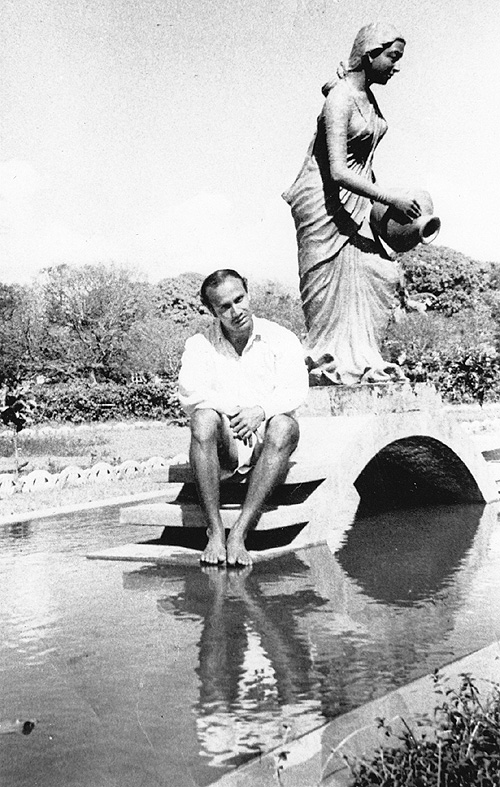
At this ornamental pool located in Bharati Park, Pondicherry, Chinmoy had many significant inner experiences. [From the private collection of Gariyasi Bruner]


5. With Nolini Kanta Gupta


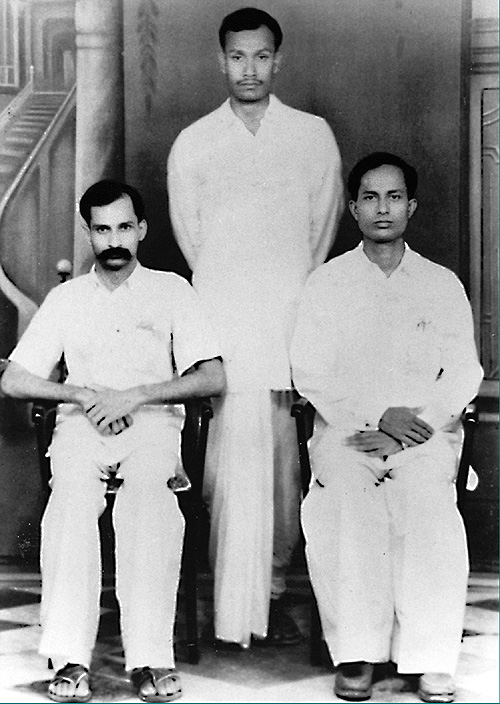
This historic photograph shows Nolini Kanta Gupta (the General Secretary of the Ashram) and K. Amrita (the General Manager of the Ashram) sitting side by side. Behind them are their secretaries: Chinmoy, the main assistant to Nolini-da, and Kalipada, the main assistant to Amrita-da. The photograph was taken on Chinmoy’s 31st birthday – August 27th, 1962 – at his fervent request.


The story behind the photograph is recounted by Chinmoy in his Ashram diary:

Early in the morning I went to Nolini-da and made my most devoted pranam to him. He was very pleased. At noon I went to Amrita-da and told him that I would like to have a group picture with him and Nolini-da.

Amrita-da said: “With Nolini? Has he agreed?”

“Yes, he has agreed. Only now I need you.”

“Is Nolini ready?”

“He is,” I said.

“If Nolini is ready, I am already ready. Come along. Let us make you immortal or let you make us immortal on your birthday.”

Indeed, it was a classic picture. Nolini-da and Amrita-da were sitting in chairs. I was standing behind Nolini-da and Kalipada-da was standing behind Amrita-da.1

Missing photograph: On January 13th, 1963 – Nolini-da’s birthday – another photograph was taken in which Chinmoy and Nolini-da are shown together. Unfortunately, it has not yet been located. This is Chinmoy’s account of that occasion:

The photographer Vidya Brata came in to take pictures. He took two pictures of Nolini-da and then Nolini-da said: “Now I wish to have a picture with Amrita. Chinmoy, go and call him.”

I called Amrita-da, who immediately came. When Amrita-da and Nolini-da stood side-by-side, Indu-di (Nolini-da’s wife), standing at the door of Bula-da, said: “Look, look! Ram and Laksman being photographed together!”

Amrita-da immediately said: “True, we are Rama and Laksmana, but Laksmana has to deserve Rama.”

Indu-di said: “You do deserve Ram.”

Nolini-da gave a broad smile. Amrita-da immediately left for his Tamil class.

Indu-di had a strong desire to have her picture taken with Nolini-da. I pleaded with Nolini-da to let himself be photographed with Indu-di and he agreed. I then went into Amrita-da’s room to work. Indu-di came in and said: “Chinmoy, what are you doing here? Your Dada wants you to be in a picture with him.”

Sushila came to greet Nolini-da. Nolini-da said: “Sushila, join us, join us.”

Sushila said to me: “Chinmoy, don’t be so serious. You will ruin the picture. Don’t be so serious! Smile!”

The photographer immediately echoed her. Before the photograph was taken, Nirmala-di and Anima-di came in. Nolini-da asked them also to join.

Nolini-da said to us: “This morning I received a blessingful message from the Mother. It says: ‘Victory of the Truth’. I wish to say, ‘Victory of the Mother’.”

That evening Manoj read out the English original of my poem on Nolini-da in the playground.2


6. At Sri Aurobindo’s Samadhi


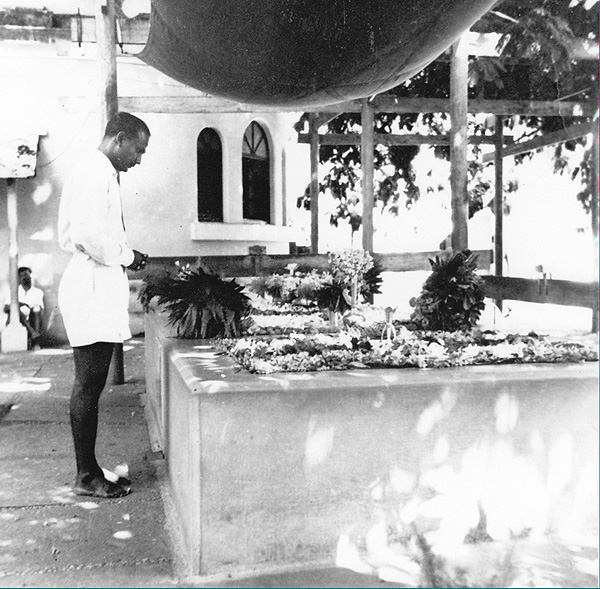
Here Chinmoy meditates before Sri Aurobindo’s Samadhi.


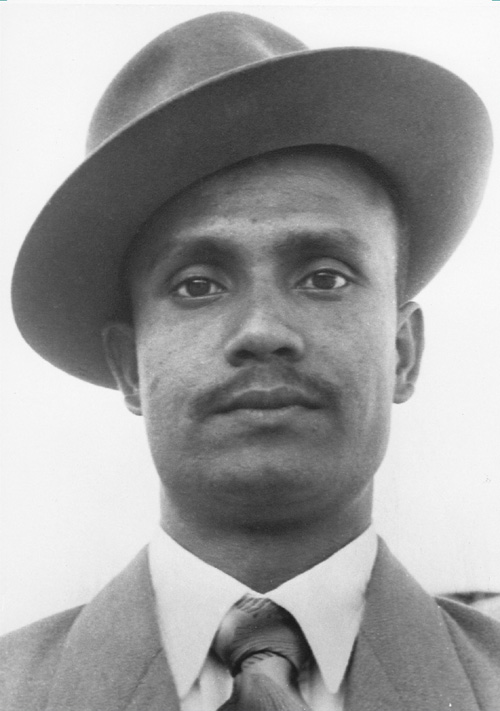
7. Chinmoy’s Passport Photograph


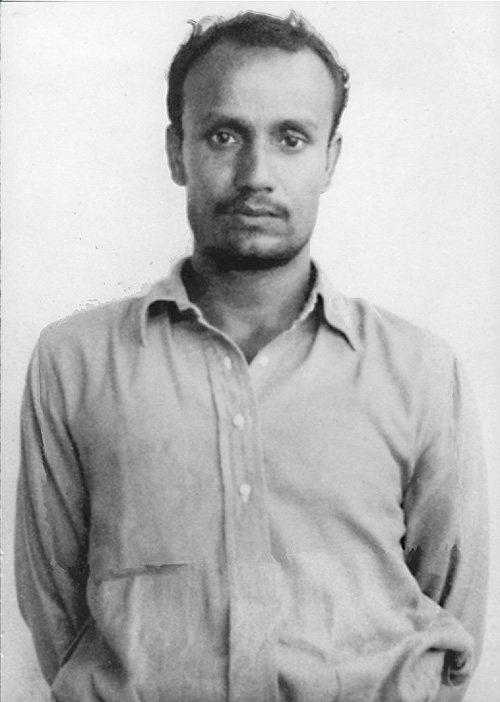
This beautiful and significant passport photograph was taken just a few weeks prior to Chinmoy’s departure from Pondicherry. Some years later, he commented that it represents Luminosity.


8. Not Long Before Leaving Pondicherry


This photograph was taken not long before Chinmoy left for Madras (from where he was to catch the plane to America). He has just finished dismantling his room and packing his humble belongings into boxes. He has yet to make his heart-wrenching farewells to his beloved brothers and sisters. The date is March 1964.


This photograph was taken just prior to Chinmoy’s departure. He is shown with his trusty bicycle, which he used to deliver messages from the Mother to various Ashramites and also to perform errands for Nolini-da.


Chinmoy wearing a suit and tie, possibly for the first time. He is 32 years old and ready to start a new life in an unknown land. [From the private collection of Dhrubha Hein]


Endnotes:
1 Sri Chinmoy, A Service-Flame And A Service-Sun, Agni Press,1974.
2 Sri Chinmoy, A Service-Flame And A Service-Sun, Agni Press,1974.


July 23

sri-chinmoy


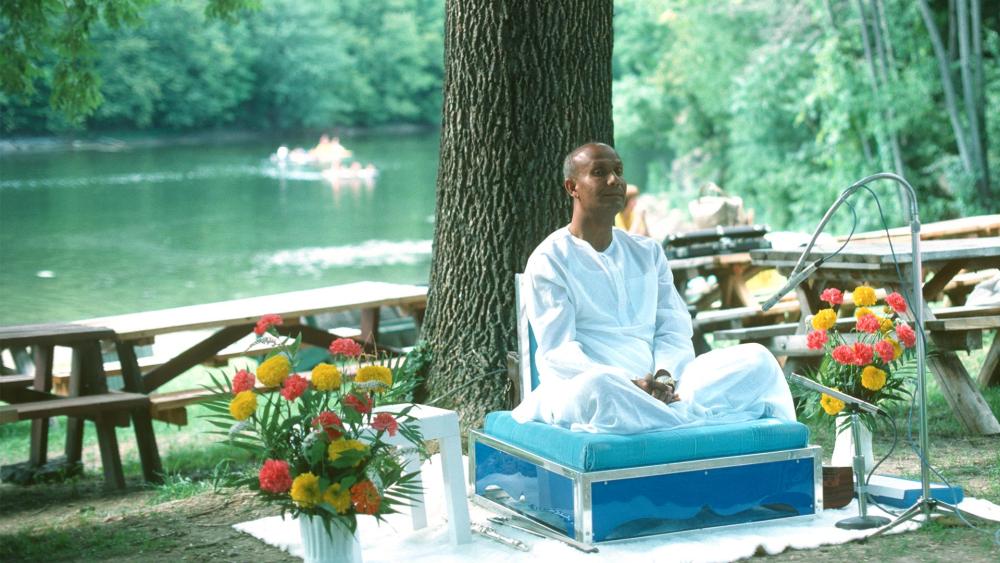
Sri Chinmoy holds a meditation for his students at a picnic area in Hidden Valley Park, near Woodstock, New York. He offers everyone bags of prasad containing 100 items in honour of the recent completion of his 100 ‘Everest-Aspiration’ talks.


July 17

Diary Entry

by Sri Chinmoy
while in residence at the Sri Aurobindo Ashram in Pondicherry, India

17 July

I said to Nolini-da: "It is very strange that the birth dates of Nicholas, Saint John of the Cross, Danton and Hilton are not available in any book."

"Did you consult a good Webster's?"

"Yes, I did. Let me go to the library and make further investigations."

In an hour I came back and said: "Except for Hilton, I found the birth dates of all."

"I am sure you will find his, too," he said.


Published in A Service-Flame and a Service-Sun


Everest-Aspiration Talks

by Sri Chinmoy

Charity

7:35 a.m.
Jamaica High School Track,
Jamaica, New York

Charity I do not like. I like concern, true concern. When someone shows me charity, I feel a sense of inferiority, and when I offer charity to someone, I undoubtedly feel a sense of superiority. I want neither a superior feeling nor an inferior feeling: what I want is an equal feeling.

The Christian world believes that charity means an open door to Heaven, but it is totally mistaken, utterly mistaken, hopelessly mistaken. Charity does not mark or determine a sense of true concern and true love, and when true concern and true love are wanting, the door of Heaven can never be open. It will always remain closed. It is not charity, but the feeling of oneness, that opens the door of Heaven. If there is no feeling of oneness, then no matter how much money-power, material wealth or anything I offer to someone, it is bound to take me to the ignorance-world where the dance of superiority and inferiority is going on.

When a part of my existence needs to receive or achieve something and another part comes to its rescue, their sense of oneness immediately opens the door of Heaven for me. If there is something beautiful, and if my mind immediately helps my eye to appreciate its beauty, then there is a oneness-feeling. If my mind wants to study something, and my legs carry me to the school or the library, then there is a oneness-feeling.

Charity cannot give me satisfaction. Charity cannot open the door of Heaven to me. It is only the feeling of oneness that can give me satisfaction, and this feeling of oneness has to be enlarged. When I give someone material wealth, money-power or something else, I have to feel that it is my very necessity to increase my own oneness-feeling for the length and breadth of the world. I have to feel that it is not I who am helping someone. It is I, on the contrary, who am being helped. This charity is not charity; far from it. It is my self-giving in order to realise my higher self totally, integrally, here in the world.

My oneness-offering not only opens the door of Heaven to me, but also opens the doors of Infinity, Eternity and Immortality, for oneness is God’s first Vision-Song and His ultimate, ever-transcending Vision-Reality-Dance. If I want to sing God’s Vision-Song, then my larger part and my smaller part have to be God’s Reality-Dance in this endlessly ever-transcending Reality.


Published in Everest-Aspiration, part 2

Examination

8:40 a.m.
Jamaica High School Track,
Jamaica, New York

“My Beloved Lord Supreme, do tell me only one thing to satisfy my curiosity. Do You try to examine me? You say that You do not try to examine me, but it seems to me that at times You do try to examine me. Am I correct in my feeling?”

“My child, to be very frank with you, I do not examine you. Examination is not a way of teaching anybody. Examination only creates fear, undue fear, in the student, no matter how brilliant the student is. The student fears that he will fail and be embarrassed, and then the world will look down upon him. What you call examination, I call illumination-game. I do not examine you to pass you or fail you. I just want to play the illumination-game with you so that you do not underestimate your capacity or overestimate your capacity. When you underestimate your capacity, unconsciously you cherish false modesty, and when you overestimate your capacity, you make friends with an exorbitant depression-ignorance. To underestimate one’s capacity and to overestimate one’s capacity are equally bad.

“In your life of aspiration and dedication, when you play the game of illumination, you have to feel the necessity of bringing your inner cry to the fore, and also your ignorance-lethargy to the fore. You have to surrender not only the divine part of your existence but also the undivine part.

“So My examination is not an examination in the true sense of the term. It is an offering for your self-perfection. In your present state of consciousness, ignorance and light, falsehood and truth your mind has cleverly accumulated in your body-consciousness and vital consciousness. I wish you to offer to Me all that you have and all that you are. It is integral self-offering which you must make. You will get illumination from Me through the process of purification and self-offering of all that you have. What you have to offer is your beauty-heart. It is the beauty of your own existence within and without, that you offer. The lesser beauty, which you call ignorance, and the higher beauty you have to offer to Me, and in return I will offer you self-illumination.

“This is the game I play with you. It is our illumination-game and never, never, never an examination — far from it! It is a joint illumination.”

Gifts

3:00 p.m.
In transit from Jamaica, New York
to Washington, D.C.

“My Beloved Supreme, I have some gifts for You. My first gift is my soulful cry. My second gift is my fruitful smile. My third and special gift is my oneness-heart. My fourth and extra-special gift is my gratitude-flame.”

“My child, I am all gratitude to you, and I have also a gift for you. This is My gift: I need you infinitely more than you can ever imagine. With you I started My Vision’s journey; with you I shall reach My Reality’s Satisfaction-Goal.”

Who is the Winner?

3:05 p.m.
In transit from Jamaica, New York
to Washington, D.C.

Who is the winner? Not he who wins, but he who has established his cheerful oneness with the result, which is an experience in the form of failure or success, a journey forward or a journey backward.

Who is the winner? Not he who wins the race, but he who loves to run sleeplessly and breathlessly with God the supreme Runner.

Who is the winner? Not he whose glory we sing, but he who embodies God’s Compassion-Light in abundant measure.

Who is the winner? Not he who has acquired tremendous name and fame and amassed a big fortune, but he who requires only one thing: God-satisfaction in God’s own Way.

Two Trains

3:10 p.m.
In transit from Jamaica, New York
to Washington, D.C.

Two trains: the train of desire and the train of aspiration. The desire-train starts at the nothingness-hunger-station and stops at the frustration-starvation-station. The aspiration-train starts at the soulfulness-thirst-station and stops at the illumination-feast-station.

If you are a passenger on the desire-train, you may not actually know what is good for you and what is bad for you. You will enter into the desire-train only to suffer. If you are a passenger on the aspiration-train, you do not have to know what is good and what is bad for you, for God Himself chooses for you. Therefore, once you enter into the aspiration-train, you will only prosper and prosper both in the inner world and in the outer world. The inner prosperity is your heart’s breathless cry. The outer prosperity is your life’s sleepless smile.

Who is Knocking?

3:15 p.m.
In transit from Jamaica, New York
to Washington, D.C.

Who is knocking? Satan? Do not bother me. Today I have many important things to do.

Who is knocking? Man? Please come at some other time. Unfortunately, I am quite busy now.

Who is knocking? God? Why do You embarrass me, Lord? Do You need my permission to enter into my heart-room?

“My son, perhaps you are not fully ready to receive Me. I am knocking just to inform you that I shall come again to visit your gratitude-room, your surrender-shrine and your perfection-self-offering. My son, you take your own time. I am not at all in a hurry. But I shall definitely come to pay you My blessingful Visit.”

Disobedience and Penalty

3:20 p.m.
In transit from Jamaica, New York
to Washington, D.C.

Disobedience and penalty: are they inseparable friends? Yes, they are. Our mother Eve disobeyed, and our father Adam disobeyed. They disobeyed once, only once, but they were forced to pay a severe penalty, and they did pay the penalty. Alas, what is worse, we who are their descendants are still paying the penalty, paying for their disobedience. Is it fair? Perhaps it is; perhaps it is not. In humanity’s eye the penalty was, is and remains unbearable. In Divinity’s Eye this penalty is more than negligible in comparison to the fathomless Love, Joy, Concern and Blessings that our parents, Eve and Adam, received from God before they descended, nay, before they helplessly and hopelessly fell from the Garden of Eden.

Our old family’s old friend was sin; but at long last we have mustered courage, inner and outer, to have two new friends: a self-giving cry and a God-becoming smile.

Secrets

3:25 p.m.
In transit from Jamaica, New York
to Washington, D.C.

God’s secret is a beginningless Silence. Man’s secret is an endless sound.

God’s secret is to give what He has: Compassion. Man’s secret is to possess from others what he does not have: material wealth, power and other things.

God’s secret is to create and divinely enjoy a new Vision-Light. Man’s secret is to destroy everything that he sees, to destroy everyone that he knows.

God’s secret is to forgive and forget constantly. Man’s secret is never to forgive, never to forget.

God’s secret is to cry soulfully before He smiles satisfactorily. Man’s secret is to cry before he dies and cry while he is dying so that he can reach God’s Heaven and be greeted by God Himself. At this, God does not know whether to smile or cry. Therefore, He laughs.

Something is Missing

9:10 p.m.
American University,
Washington, D.C.

Something is missing. What is it? Man’s gratitude-drop. Something is found. What is it? Man’s haughty pride. Who needs it? Nobody! No, not even the all-devouring death.

Something is missing. What is it? Man’s service-hands. Something is found. What is it? Man’s feeling of worthlessness. Who needs it? Nobody! No, not even the worst possible fool on earth.

Something is missing. What is it? Man’s responsibility-tree. Something is found. What is it? Man’s satisfaction-compromise. Who needs it? Nobody! No, not even the saint who is all forgiveness. The saint is willing to forgive ignorance, but he will never make any compromise with ignorance-illusion.


Published in Everest-Aspiration, part 3


My Peace-Life

A lecture by Sri Chinmoy
at Stockholm University in Stockholm, Sweden


Peace is an inner subject, but it is a subject that can be studied. As one studies history, geography and science, so also one can study peace. Since I am a seeker, I study peace at my heart-school every day. My teacher is my Lord Beloved Supreme. My Inner Pilot tells me to unlearn many, many things from my mind — such as fear, doubt, insecurity, jealousy and impurity — so that I can make fast progress in this subject.

From my prayer-life and meditation-life I have learnt the importance of belief. There are many things that I do not see, and I cannot prove their existence to the world at large; but I do know that they exist somewhere. Similarly, I may not feel peace in my day-to-day life, but I believe that it exists in the inmost recesses of my heart, and this believing will eventually turn into seeing and feeling. Although the sky may be overcast with clouds, there shall come a time when the sun will be visible. Right now ignorance-night has covered my mental vision, but eventually my inner sun will come to the fore and inundate my mind of doubt with light and delight.

I am a seeker. That means I pray and meditate, and I practise my peace-life. I consciously try to live a life of self-giving, for I know that this is the only way to get peace of mind. If I can walk soulfully, devotedly and unconditionally along the path of self-giving, then I will be a perfect stranger to frustration and self-contradiction. Right now my life is all self-contradiction. This moment my inner being is flooded with faith; the next moment teeming doubts are covering my entire mind. Always I hear the song of self-contradiction. But if I can offer my life to the Supreme in others consciously, devotedly and unconditionally, and become the very breath of self-giving, then I will have no frustration or self-contradiction.

As a seeker I know that I become a victim to helplessness from time to time. But I also know that there is a way to conquer and illumine this helplessness — by turning to a higher force. When I feel helpless, it is because I know that my capacity is extremely limited. But I can get the guidance and assurance I need from a higher force by virtue of my prayer-life, my meditation-life, my aspiration-life and my dedication-life.

Although I aspire for peace of mind, very often I surrender to ignorance-night. Then I become very clever and invoke my Lord Supreme to inundate my mind with peace while I, on my part, do nothing. But my Lord Supreme, out of His infinite Bounty, tells me, “No, My child, let us play together. I am ready to give you Peace in infinite measure, but you have to receive what I give soulfully. I shall play My part generously and you have to play your role devotedly by being soulfully receptive. I shall give you what I have and what I am, and you will receive it with your heart’s inseparable oneness, light and delight.”

I need peace within; I need peace without. Although I have created my own outer world, I am afraid of it. Because I am afraid of it, I have no peace of mind. But since I am the owner of my outer world, I must not be frightened while dealing with it. I must be fully in charge of my creation, my outer world.

My inner world also has a Creator. My Lord Beloved Supreme is the Creator of my inner world. Out of His infinite Bounty, He has created me. That means He loves me; He loves me far, far beyond my imagination’s flight. Therefore, I must not be afraid of my Creator. It is absurd! What He needs from me is not fear but unconditional love. My love for Him and His Love for me will make me feel that He and I are inseparable, and that we have been singing the song of inseparable oneness from time immemorial.


Published in The Oneness of the Eastern Heart and the Western Mind, part 1


Who Can Grant Me Peace?

A lecture by Sri Chinmoy
at Uppsala University in Uppsala, Sweden


I am soulfully offering my performance today to Dag Hammarskjöld. This most brilliant mind and most illumined soul is the pride not only of Uppsala but of the entire world. His heart’s magnanimity and his life’s luminosity remain forever synonymous with the loftiest heights and the deepest depths of the United Nations. To Dag Hammarskjöld the immortal soul and to Dag Hammarskjöld the dedicated life, my life of aspiration and dedication bows in soulful humility.

I want peace and need peace desperately. But how can I get peace? Where can I get peace? Who can grant me peace?

My Lord Beloved Supreme alone can grant me peace. But before He grants me peace, He wants something from me. What is that thing? My oneness-love. If I can offer Him my soulful and sleepless oneness-love, then He will, without fail, grant me peace in infinite measure in my inner life.

I know that God is omniscient, omnipotent and omnipresent. But these attributes quite often frighten the human in me. So I will not think of Him in these terms at the present stage of my spiritual development. I will only think of Him as the Supreme Dreamer, from whose Dream this reality came into being. If I can think of Him in this way during my prayer and meditation, then I will always feel His Sweetness, Beauty and Divinity. When I think of God as the Supreme Dreamer, and meditate on God as the Supreme Dreamer, He will grant me peace in boundless measure.

My outer life also needs peace. This peace I will get only when I can offer freedom to mankind. When I do not try to bind any human being, I get peace in the outer world. Also, I must try to think of myself in exactly the same way that God thinks of me. He thinks of me as a choice instrument of His who has come into the world to love Him, to serve Him and to manifest Him in His own Way. So in order to get peace from Him in the inmost recesses of my heart, I must gradually become an exact prototype of Him.

In my outer life, if I want to have peace, then I must think of myself the way other human beings think of me. Others think of me as someone striving for perfection but still far, very far from my goal. If I think of myself as an imperfect human being longing for perfection, then I perfectly fit in with all human beings. At that time there is no feeling of supremacy, no feeling of superiority or inferiority, no feeling of separation. I am one with them and I am one of them. Together we are going along Eternity’s Road with our teeming imperfections, but always aiming at perfect Perfection. If I can think of myself in this way in my outer life, then I can have peace of mind.

Again, I have to think of others the way they think of themselves. Each human being sees himself as a satisfaction-seeker. Either consciously or unconsciously, he is longing for satisfaction. If I can think of each individual on earth as a satisfaction-seeker, I will see that we are all sailing in the same boat, longing to reach the Golden Shore that promises complete, ultimate satisfaction. This also will bring me peace of mind in my outer life.

There is one more thing I can do to get peace in my day-to-day life. Early in the morning, before I pray and meditate, every day I must enter into my mind-jungle and discard one desire-thorn. My mind is filled with desire-thorns, but every day I shall try to diminish their number. Then I shall enter into my heart-garden and plant there another aspiration-plant. By decreasing my desire-thorns and increasing my aspiration-plants, I am bound to receive peace from within. And if I pray soulfully and meditate devotedly and unconditionally, I am bound to receive peace from Above.


Published in The Oneness of the Eastern Heart and the Western Mind, part 1

Stories by Sri Chinmoy

told at  Aspiration-Ground, Jamaica, New York


When I first realised God

A few weeks ago I was tempted to tell when I first realised God. Again, God-realisation is a very complicated matter. We can sit at the foot of the God-realisation-tree, and then we can climb up. When we sit at the foot of the tree, that itself is God-realisation. And when we climb up a few metres, that is also God-realisation. Then we go on, go on, go on.

When we look at the God-realisation-tree with our third eye, we see that the tree has no end. It goes up and up. With our human eyes if we look at a tree, we see that there is a limit. We know that we can see the topmost branch. Beyond there we cannot go. But when it is a matter of the God-realisation-tree, the third eye laughs at the human eyes.

Three weeks ago, I think it was, I was tempted to say when I first sat at the foot of the God-realisation-tree. Then of course I climbed up, and God knows where I am now. But my Inner Pilot immediately commanded me to keep silent. I know for certain when I saw God face to face for the first time. It was not in this incarnation. But God said, “No! Make this date absolutely uncertain.” I knew for certain, but He said, “No, I want you to keep it absolutely uncertain.” That is why I did not say.

Some spiritual Masters declare their God-realisation, like Sri Aurobindo, who gave the date when Lord Sri Krishna entered into him permanently. Before, Sri Krishna used to come and go, come and go. But from the 24th of November, 1926, Sri Krishna remained permanently inside him. That is the date Sri Aurobindo gave for his God-realisation.

Like that, some other spiritual Masters have declared their God-realisation. In my case if I have to be very honest, I will say that it was not in this incarnation. I realised God long before, long before. But as I said, first you sit at the foot of the tree. Then you climb up, up, up, up, up. According to what you see with your human eyes, you say, “Oh, this is the highest!” But as soon as you use the third eye, you will simply laugh at that so-called highest, because there is no limit to God-realisation.

If you show occult power

Unfortunately, some people show their occult power right in front of the public. When they show occult power, immediately people feel or think that they are God-realised. God-realisation has nothing to do with occult power. When you realise God, if God gives you occult power, that is one thing. But some people say, “If I amass occult power, then I will realise God.” That is absurd; it is impossible.

Swami Vivekananda was so great. When Sri Ramakrishna wanted to give him occult power, he said, “Will it help me in realising God?”

Sri Ramakrishna said, “No, it will not help you. But by showing occult power, you will be able to inspire people and work for humanity.”

Swami Vivekananda said, “I do not want it. First things first: I want to realise God.”

Some spiritual Masters never, never cared for occult power. While they were in the process of realising God or after they realised God, sometimes they compared occult power with cats and dogs. Cats and dogs come and bother us. Like that, occult powers can take away the seeker who is on the verge of God-realisation. Even for one who has realised God, these occult powers can stand as absolutely real obstructions. Those individuals cannot think of God; they can only display their occult power.

Sometimes God-realised souls do not want occult power. But just because they have been showing it, they continue. One of my uncles realised God, and he always used to use occult power in his village. He did millions of things. Finally he cried and cried to Mother Kali, “What am I doing? I am only feeding people’s curiosity.” He did not want to be bothered by people any more. Then deliberately he started saying wrong things. He knew what was true, but he used to make false statements. Then people stopped coming to him.

Some spiritual Masters are very wise. They use occult power secretly, inwardly, so that nobody can see it. They do not make any outer statement. As a matter of fact, there is not a single spiritual Master of the highest order who does not use occult power inwardly. But outwardly if you show occult powers, then you will be in serious trouble. You will not help anybody; you will only feed people’s curiosity. And tomorrow if you do not show or cannot show occult powers, then you will lose those followers.

Again, some people come to the Master not for a display of occult power. They love their Master so much. They say, “Who cares for occult power? Will it help me?” Never, never has occult power helped anybody to realise God. While one is realising God if occult powers come, then that individual will not misuse them. But some people pray to God only for occult power, not for spiritual power or spiritual wisdom. They pray and pray only to get occult power, and sometimes they do get some occult power, But that occult power has nothing to do with God-realisation. So many spiritual Masters are of the same opinion. Occult power if you use, you can make serious blunders. You can commit absolutely the worst possible blunder. But spiritual power does not do that. Spiritual power is totally different. Spiritual power will always take permission from the Absolute Supreme. Without permission, spiritual power one does not use. When people use occult power, they show off. They do not find the time to ask permission from the Highest, whether they will listen or not. If somebody comes to them with an immediate need, they want to show their compassion or their capacity.

Quite often I say that occult power is a mad elephant. But spiritual power is not like that. There is such a difference between occult power and spiritual power!

Everything is a mystery

Everything is a mystery in life. It may happen that, in order to expedite the inner, spiritual evolution of an individual, the Guru can appear to be very, very unkind on the outer plane. Perhaps the Guru wants renunciation from that person, because this world has played its role in his life. Now it is time for the seeker to go higher. We do not know when that time is going to come. If God wants to expedite an individual’s journey, if He wants to give faster progress to that person, outwardly the Master can seem to be very unkind. The human way is to find fault with the Master. We say, “Why did he not show compassion or consolation?” But we do not know what is happening in the inner world.

Look at Sri Krishna in the story about the widow and the cow. She had only the cow. Arjuna asked Sri Krishna to grant the old lady a boon, and Sri Krishna said the cow should die! Outwardly, how cruel Sri Krishna was! How could he wish for the cow to die? It was only with the cow that the old lady sustained her life. But Sri Krishna knew that she would pray to him much more if she did not have the cow. By pleasing her, by giving her an outer boon, Sri Krishna would not be able to expedite the old widow’s inner progress.

We have no idea at what point the Master will take this kind of action. We cannot understand, because we do not know the future. The so-called outer callousness can be inner compassion. We do not see the future, we do not know the future; but the spiritual Masters do know. They do everything for our good. Unfortunately, in our human life we always want affection and compassion in a human way. But these so-called boons can create real bondage. They may not help us in any way.

The spiritual Masters can definitely appear to be unkind, from the human point of view, on the human level. On the higher level, they are doing the right thing.


Published in My Golden Children


July 17


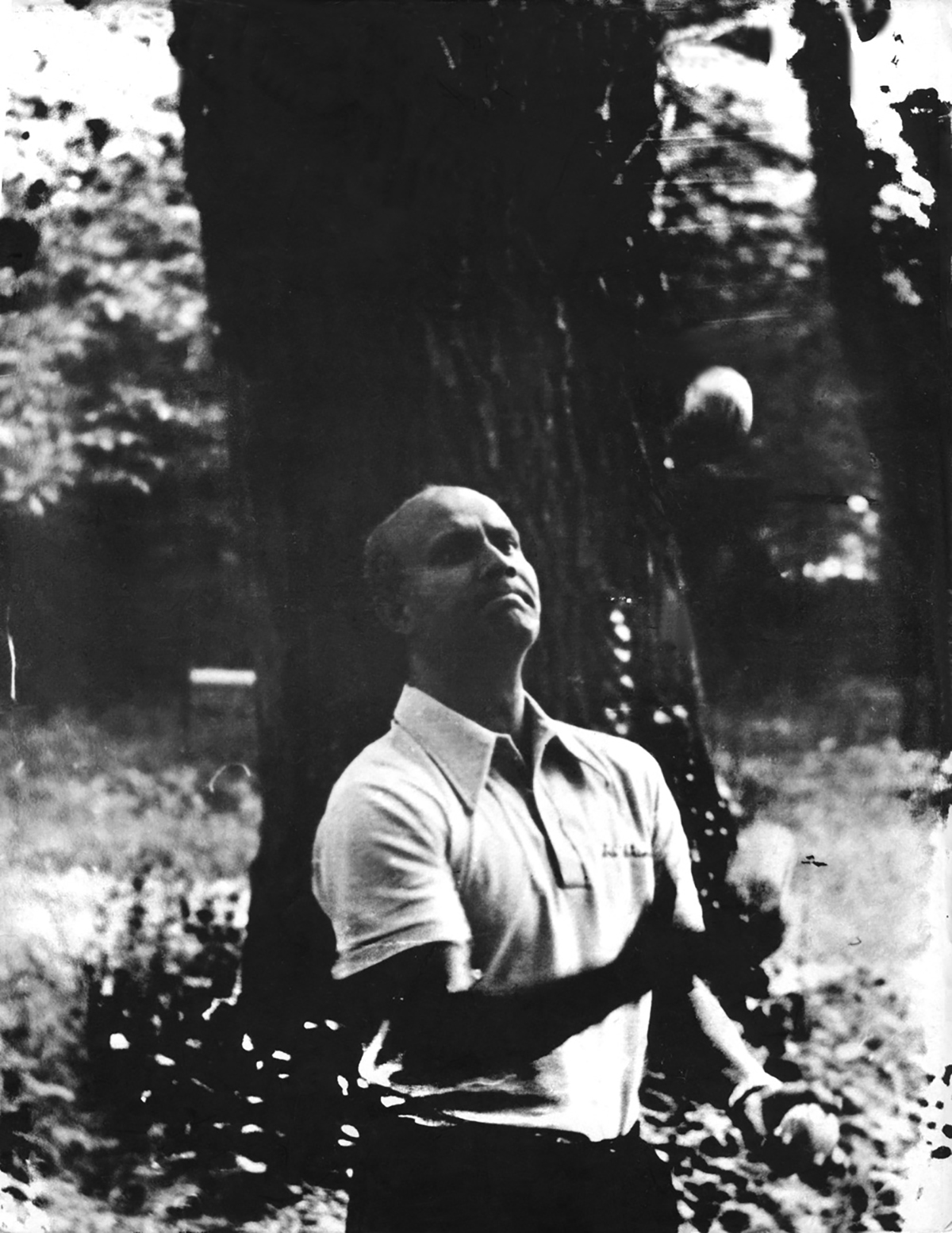
Sri Chinmoy juggles three balls over 450 times in Richmond Park, London, UK.


Sri Chinmoy offers the following prayer before the start of a running race in New York.

Learn more truth.
Earn more joy.
Be more perfect.

Be more perfect.
Earn more joy.
Learn more truth.

This message-light
Is for all.


Published in My Race-Prayers, part 2


July 17

sri-chinmoy


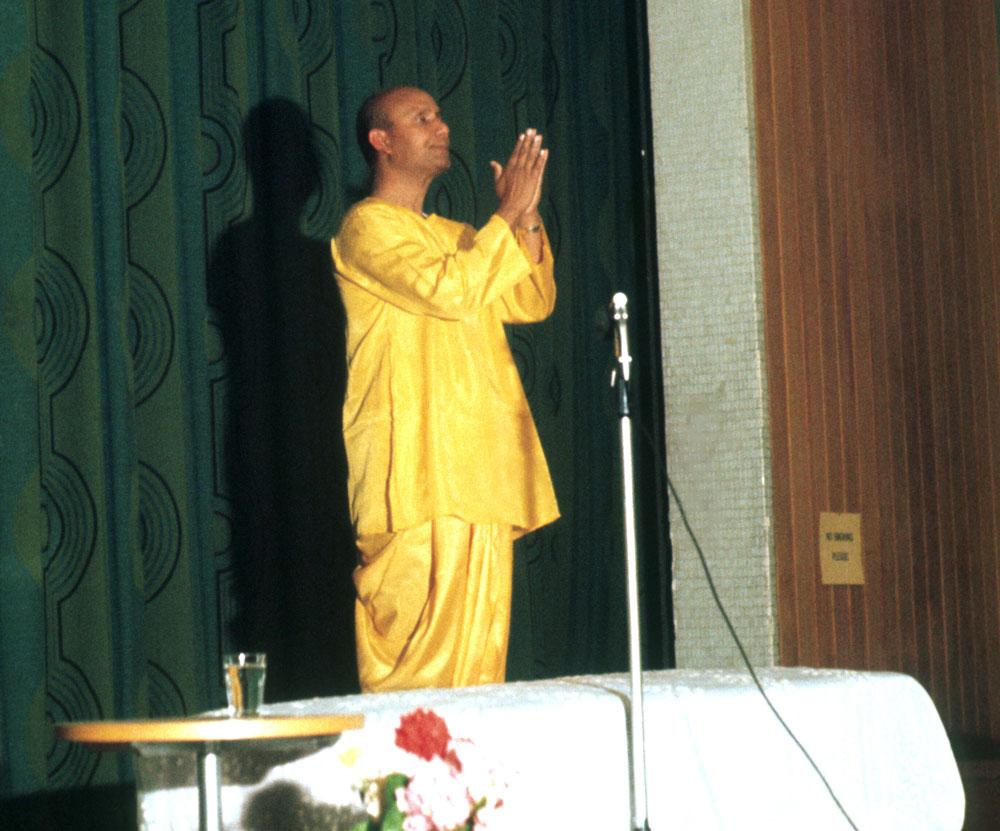
Sri Chinmoy delivers a lecture, entitled ‘Force’, at the University of Swansea, in Swansea, Wales, UK.

Photo by Pulak Viscardi


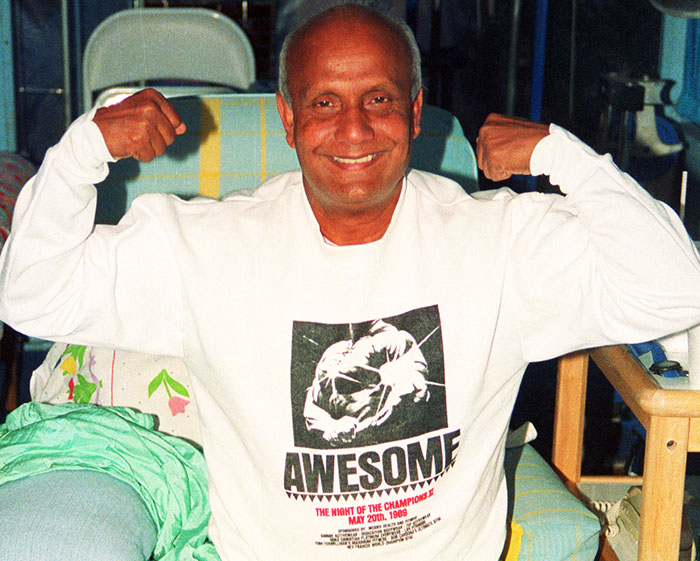
Sri Chinmoy, wearing ‘The Night of the Champions’ sweater, strikes a bodybuilding pose at Aspiration-Ground in Jamaica, New York.


Photographs


Early Athletics
Chinmoy – Star Athlete of the Sri Aurobindo Ashram

All the known photographs of Chinmoy participating in athletic competition in the 1950’s are gathered together for the first time. Also included are rare portraits of him holding his awards. Read more…
 

.
 

Chinmoy – The Ashram Years

In this rare collection of photographs from the years 1944-1964, we see the young Chinmoy blossom spiritually. An extraordinary luminosity is reflected in his eyes and, as the time of his eventual departure from the Ashram draws near, he seems to brim with vast inner gifts waiting to be manifested. Read more...
 

.
 

Chinmoy Returns to India after Five Years

In March 1969, after five long years in the West, Chinmoy returned to India for the first time to visit his brothers and sisters at the Sri Aurobindo Ashram in Pondicherry. He was 37 years old. Though a novice photographer, he took a number of photos of his family members, various Ashramites and friends during his visit. He is also included in several photographs.

Next to this plethora of outer manifestations, perhaps even more striking is the astounding height and depth with which Indian philosophy probes the nature of the Cosmos, the amazing subtlety of the vision of reality it espouses. Read more...
 

.
 

Visit to India 1972

In the summer of 1972, Sri Chinmoy returned to India. This time he took Lily, Arpita and Mantu on a trip to the north of India. Read more...
 

.

Peace initiatives


Niagara Falls – A Sri Chinmoy International Peace Falls

by Animesh Harrington

There are few places on earth that inspire the hearts and minds of man as does Niagara Falls. From the tranquil waters of the Great Lakes, the myriad currents gather in power and speed, culminating in the wonder and grandeur that is Niagara. Down through the centuries, people have been drawn to this special place to rejuvenate their spirit. To everyone who makes the pilgrimage, Niagara offers its boundless delight and peace. Read more…
 

.

Worlds Where Matter and Spirit Meet


In the fall of 1919 Albert Einstein received confirmation that light rays passing by the sun’s gravitational field were bent, and the degree of their deflection was in accordance with the predictions he had made from his General Theory of Relativity four years earlier.

In the course of a discussion with a student he was asked what he would have said if there had been no such agreement. Einstein’s reply? “Da könnt’ mir halt der liebe Gott leid tun. Die Theorie stimmt doch.”1 (Then I would have to pity the dear Lord. The theory is correct anyway.)
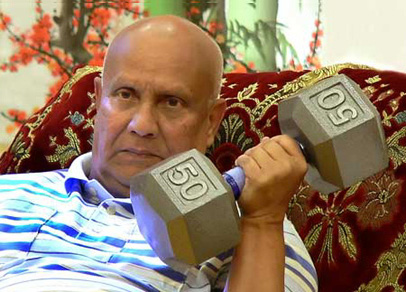
Einstein’s statement, far from scientific over-confidence, was merely confirming his innate faith in a universal order — the fact, as he once put it, that, “God does not play dice.” Nevertheless, his remark seemed to characterise the scientific method as an expression of a self-evident truth, that the universe can be described in terms of a system of immutable laws which yield neither to man nor God.

There is recent evidence to suggest, however, that the grand hypothesis upon which the scientific method has been founded may be in need of review.

We are apt to believe that any revolution in science must necessarily come from the frontiers of research, that the world of everyday experience is solidly confirmed as functioning within well-defined physical parameters.

It seems ironic that the scene of this new challenge comes not from the laboratories at MIT2, the space observatories of NASA3 or the linear accelerator at CERN4, but the suburbs of New York City where, day after day, many have witnessed an occurrence that may be regarded as violating the laws of natural science.

On August 21, 1986, Sri Chinmoy, a 55-year-old Indian spiritual master, proceeded to lift a weight of 320½ pounds (double his own body weight) above his head, using only one hand.

The chronicle of his rapid progress reveals a fascinating story of the possibilities of human achievement.

The single-arm weightlifting efforts of this slightly-built, self-effacing man of peace, who has astounded the best weightlifters in the world, began just a little over a year earlier with a lift of 40 pounds on June 26, 1985 and within four months he had exceeded 100 pounds (106¼ lb. on October 9).

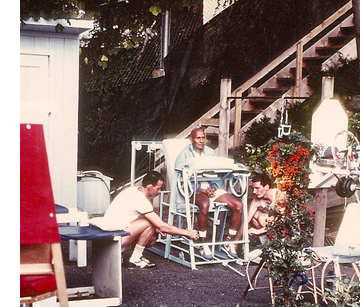
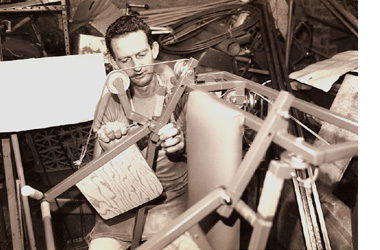
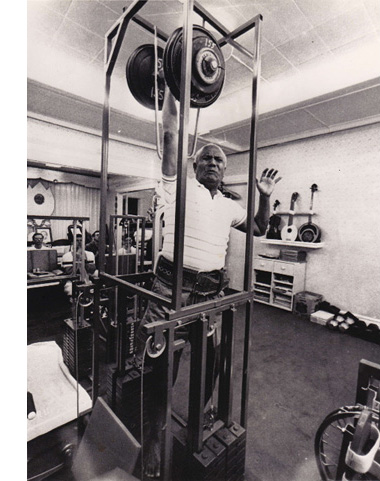
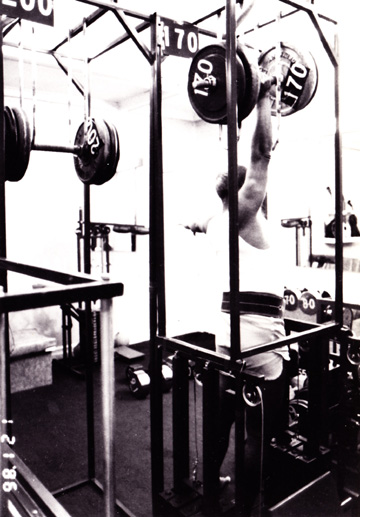
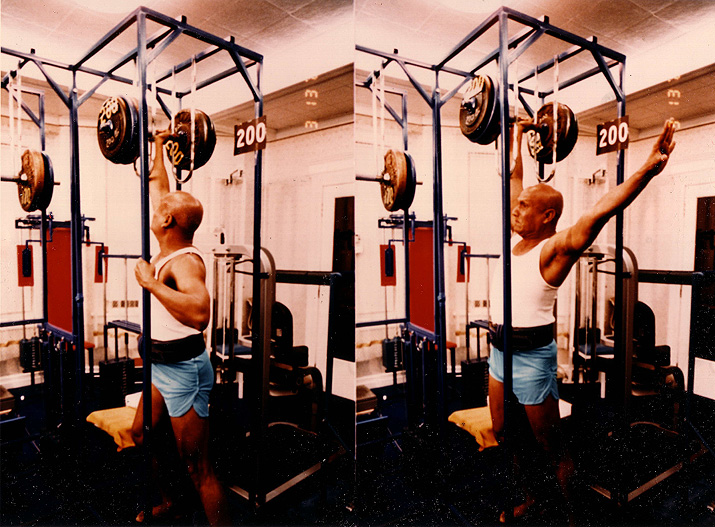
Up and until this point Sri Chinmoy had hoisted weights from the ground to a fully extended position above his head, by adapting a standard weightlifting technique called the ‘deadlift’. But because of a chronic back injury, he found it increasingly difficult to bend and it soon looked as though Sri Chinmoy’s weightlifting accomplishments might be at an end. However, an Australian student of his, Unmilan Howard, came up with an idea to suspend the weights in a completely enclosed rack with looped iron support guides, allowing Sri Chinmoy to start his lifts at shoulder height.

The ‘cage’ as it was affectionately known also added an important safety factor to his new method of lifting. The weights were now getting so dangerously large that one slip could have easily resulted in severe injury. With this innovative device, the huge weights if dropped would be caught by the metal support slings.

Sri Chinmoy was breaking new ground and many traditional weightlifters at first looked sceptically upon Sri Chinmoy’s new technique — until they saw the results:
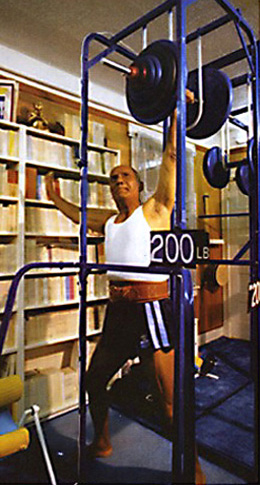
Sri Chinmoy's 200lb lift

By November 18, 1985, he had lifted the equivalent of his own body weight (155 pounds). On March 6, 1986, he had reached the 200-pound mark; by June 21, less than one year after he began, he could lift 240 pounds; and then on August 11, with his 212th attempt, he surpassed the 300-pound mark with a lift of 303¼ pounds. These were not easily won victories but they showed that he was now well on his way to lifting twice his own body weight. And on August 21, with the lift of 320½ pounds, he did just that.

Sri Chinmoy would supplement his heavy schedule of weight training by using various exercise machines at all hours of the day and night. He also included traditional methods of strengthening in his daily routine. At one time he recorded 2,230 push-ups in less than one hour; such was the dedication he displayed towards reaching his goal.

On September 5, Sri Chinmoy lifted 330½ pounds; on September 9, 340½ pounds; and September 11, 350½ pounds. Then, in two-day intervals from the 15th to the 19th of September, he proceeded to lift 360¼, 370¼ and 380½ pounds respectively. His next lift, against all predictions of athletic progress and unprecedented in weightlifting circles, was 400½ pounds on September 21.

As every athlete knows, there comes a point when approaching optimum performance, any increase in training will produce only a marginal increase in results. Given his age and experience, one would rightly assume that Sri Chinmoy’s lift of 400½ pounds would indicate that he was nearing his peak.

Apparently not. With a seemingly total disregard for the diminishing returns of physical performance, he decided to increase the weight of each progressive attempt by 50-pound increments. On September 26, he lifted 450 pounds and three days later, on September 29, he raised 503 pounds, not once but six times.

At the very beginning of Sri Chinmoy’s weightlifting journey, as he struggled to hold up 40 pounds, even though he had set no limit for himself, not many could have predicted his future achievements. But as the weights mounted an ultimate goal began to emerge — his aim was to lift 700 pounds.

Within one month, on October 27, the intermediate mark of 604 pounds was reached and 5 days later, on November 1, he surpassed his goal with a lift of 705¾ pounds.

In the 16 months since he started training he had managed to achieve what no man on earth had done before — to lift, with one hand, more than four times his own body weight.

As a philosopher and teacher, Sri Chinmoy has written hundreds of books — 700 in fact. Possibly this is why 700 pounds held such significance for him. Yet it came as no surprise to those who had read his writings on self-transcendence that “today’s goal” would become “tomorrow’s starting point”. Never one for mere dogma or platitude, he takes each new challenge as an opportunity to offer something tangible in the form of inspiration to mankind.

It now seemed as though his former achievements were mere preparation. He went on to lift 806¼ pounds on November 7 and on November 10 the 1,000-pound mark was surpassed with a lift of 1,007¾ pounds. By November 17, he had lifted 1,317¾ pounds and on November 24, 1,515¼ pounds.

One can perhaps be forgiven for harbouring reservations.

How is it physiologically possible for a man of such slight build (5’8” high and weighing 159 lb.) to lift weights never dreamed of?

“He has surpassed anything and everything that any weightlifter has ever done throughout the world. As far as I know, 600 pounds is more than the greatest weight anybody has ever held with one arm or two arms; 1,300 pounds is utterly incomprehensible.” — Jim Smith (BAWLA)5

How, at the age of 55, with just 16 month’s training and no prior background in weightlifting, is it possible to achieve, sustain and transcend world-class performances?

“If he can lift that much weight in that short a time he can inspire me to break that long jump record. I’m going to use his inspiration to help me reach my milestone.” — Carl Lewis (Olympian)6

How is it possible for the tendons and bones in the wrist and elbow, the shoulders and the spine to bear up under a force of such weight?

“The amount of weight Sri Chinmoy is doing is so unbelievable! I have never heard of anyone doing so much weight. It is so much pressure on the shoulders and lower back. It is unbelievable pressure on the body.” — Cliff Sawyer (AAU)7

“This man is of Godly strength. He is truly amazing. It is humanly impossible for the body’s joints to even budge this kind of weight. Just to support this kind of weight in any way is a miracle.” — Bill Pearl (former Mr. Universe)8

No, this is not a trick or some type of sideshow levitation act. There are no strings or misleading camera angles. Sri Chinmoy does actually lift these weights.

The effort is recorded well in the strain of trembling muscles, the involuntary screams of will, in the look of terror concentrated in his eyes and the bewildered agony on his face. It is etched within the sudden expression of relief, as the shifting mountain of metal is released to its inertial abode. It is revealed in all its sweetness in the faint smile of victory lying deep and silent beneath the mounting layers of fatigue.

He leaves his weightlifting room in utter exhaustion only to resume moments later, this relentless battle with inconscient matter. In one day he has been known to lift over 228 tons, (457,600 pounds to be exact) with repetitions of various size weights in training.

He is able to do this not through physical power but through spiritual power — the result of his years of intense prayer and meditation.

“The source of power,” he says, “is infinitely greater than the physical strength that any human being can have.”9

He describes “physical energy” as having “only one source, and that source is spiritual energy. As long as we are conscious only of the body, we are not aware of this, but when we go deep within through meditation, we see that spiritual energy is the source of physical, vital and mental energy.”10

“There are countless people on earth who do not believe in the inner power, the inner life. They feel that the outer strength and the outer life are everything. I do not agree with them. There is an inner life; there is spirit, and,” he states with experiential certainty, “my ability to lift these heavy weights proves that it can work in matter as well.”11

Outwardly Sri Chinmoy’s modest physical capacity would appear incapable of lifting such enormous weights, but he explained the simple method behind his success quite candidly at a press conference in Queens, New York, on August 12th, 1986: “I am trying to inspire people who are not praying and meditating. I am telling them that everybody has a vital, everybody has a mind, everybody has a heart, everybody has a soul. Only they are not using the help of these members of their family the way I do. Otherwise, if I had to depend entirely on the physical, I could do nothing. My bicep is not even 14 inches, whereas the bicep of other weightlifters is 21 or 22 inches. My calf is not even 13½ inches, and theirs is 20 inches. Their muscles are gigantic compared to mine. It is absurd! So if I can lift as much as I do, that means that I am taking help from within me. My other friends — the vital, the mind, the heart and the soul — are helping me from within.”12

Very early in his weightlifting career, Sri Chinmoy was asked, “how much of heavy lifting is mental preparation and how much is physical preparation?” He went on to answer this in a surprisingly unorthodox manner: “The great champions are of the opinion that 70 or 75 per cent of weightlifting is mental preparation. But in my case, 99 per cent is God’s Grace and God’s Compassion. For the remaining one per cent, three quarters is mental preparation and one quarter is physical preparation.”13 And even this fractional personal input, Sri Chinmoy maintained, was wholly due to God’s Grace and God’s Compassion.

By late November an amount of weight, exceeding 2,000 pounds, hung on the bar — still, lifeless, inert — waiting for a touch of inspiration. Regard this how you will, but before discussing further the source and manifestation of this well-documented phenomenon it might be appropriate to address some of the major concepts in western philosophical thought regarding the way we view our universe and compare them with corresponding philosophical ideas from the East.

***

Possibly the most far-reaching and ill-founded premise in determining our locus of comprehension is that the analytical mind, in its application to the scientific method of enquiry, has the means to subsume the totality of universal experience and as such lays singular claim to the lofty office of sole arbiter of objectivity.

The existence of any experience beyond the mind is, by the scientific community, at best admitted and regarded as subjective or completely dismissed as self-deception. The classic lines from An Enquiry Concerning Human Understanding by David Hume (1711-76) are still echoed by many contemporary academics:

“Does it contain any abstract reasoning concerning quantity or number? No. Does it contain any experimental reasoning concerning matter of fact and existence? No. Commit it then to the flames for it can contain nothing but sophistry and illusion.”

The scientist accepts a priori that the world is governed by definable physical laws and rejects any notion of experience beyond the material conditions — science is, by its own definition, a closed system.

The play of subtle forces which saints and mystics of all religions have purportedly explored for millennia, have remained unfamiliar to secular man; and even though, at times, these forces have impacted dramatically upon his world, they have eluded plausible causal definition.

The occasion to observe such interactions between matter and spirit does not readily present itself — the manifestation of spiritual forces seems so transient in comparison to the overwhelming permanence of the physical phenomena in which we live. Witnessed by the few, misinterpreted by the many, these infrequent occurrences pass, in time, from hearsay to folklore and legend.

But when the scientific world comes face to face with a phenomenon it cannot explain, a baffling occurrence that defies understanding, where the common utility of empirical reasoning ceases to account for experience, it raises the question — is the mind itself, which has served us so well in expanding our knowledge of the universe, now limiting our approach to a deeper truth?

While the main body of science is continually being renewed, our system of modern scientific enquiry has changed little since the days of Hume.

The particular has given way to the general. Newtonian physics has been encompassed by the broader theories of Albert Einstein; and Aristotelian logic has been embraced by the new logic of Bertrand Russell and Alfred North Whitehead. Yet one fundamental precept has not changed — our awareness of universal experience remains bound by the domain of the mind.

To accommodate these new challenges, a complete re-centring of scientific perspective must take place. A translation of the co-ordinates we use to locate our understanding is necessary for further progress.

Einstein saw more clearly than most, the manner in which our human consciousness is evolving. “The mind,” he declared, “can proceed only so far upon what it knows and can prove. There comes a point where the mind takes a leap — call it intuition or what you will — and comes out on a higher plane of knowledge, but never can prove how it got there. All great discoveries have involved such a leap.”14

This intuitive plane of which Einstein spoke is confirmed by Sri Chinmoy himself — it is indeed a higher level of consciousness, a plane of knowledge above that of the ordinary mind that occasionally reveals itself to receptive thought: “A scientific achievement need not be from the mind, not even from the intellect; the greatest scientific achievements come directly from the intuitive plane.”15

“Intuition is a very high step in the spiritual evolution of the mind,”16 but it is only one of a number of higher levels that the human consciousness can attain to.

He explains further: “We start with the physical mind — that is the mind that is governed by the physical — which is the lowest mind. In the physical mind it is all obscurity, impurity, imperfection, bondage, ignorance and limitation. This mind sees each object separately, plus it doubts the existence of each object. Real doubt starts here in the physical mind.

“A little higher is the intellectual mind, which deals with abstractions and more sophisticated thoughts. Doubt, confusion and contradiction reign here.

“Next we come to the vacant mind. The essence of formless ideas can be perceived here. But thought cannot enter into existence in this mind. Therefore, it has no opportunity of being assimilated and transformed.

“Next is the calm mind. It is like an expanse of sea. Wrong thoughts can enter here but they cannot grow in this calm mind. If bad thoughts enter, they are assimilated into good thoughts and divine willpower.

“Then comes the higher mind. In the higher mind thoughts are elevating, constructive, subtle and progressive.

“Next is the inner mind. In the inner mind the knowledge of creative thought and the wisdom of the inner light play together.

“Then there is the intuitive mind. The intuitive mind is the Vision-mind. From it we get dynamic and creative revelation, but not in the form of thoughts as we know them in the physical and intellectual minds. With the intuitive mind we see multiplicity in a creative form. With intuition we see all at a glance. We can see many things at a time; we see collective form.

“Then comes the overmind. Here form starts, multiplicity starts in an individual form. God is in infinite forms in the overmind.

“Then comes the supermind, where creation starts. The supermind is not something a little superior to the mind. No. It is infinitely higher than the mind. It is not the ‘mind’ at all, although the word is used. It is consciousness that has already transcended the limitations of the finite. There is no multiplicity, no diversity here, but a flow of oneness. Everything in the supermind is one, whole, complete.”17

These inner states of being have remained unexplored by western science because, in terms of a physically perceptible reality, very little of the inner universe is ever manifested. Knowledge, peace, power and even the more remote qualities like bliss, light or grace are essentially boundless; yet it is only in the inner world that the term infinity has any real meaning.

Through meditation the physical consciousness can gradually become aware of the inner reality. In the highest states of meditation, the ultimate source of knowledge can be experienced. Since there has never been a corresponding western term for this state of consciousness, it is known only by its Sanskrit nomenclature as ‘nirvikalpa samadhi’.

Christopher Isherwood, in Ramakrishna and His Disciples, a biography of the great 19th-century yogi Ramakrishna, proffers his explanation of this rarefied state:

“Like all but the merest handful of people alive in the world today, I have never come anywhere near experiencing it. And even those who have experienced it have had great difficulty in speaking of their experience. One may say, indeed, that it is by definition indescribable. For words deal with the knowledge obtained by the five senses; and samadhi goes beyond all sense-experience. It is in its highest form a state of total knowledge, in which the knower and the thing known become one … Outwardly samadhi appears to be a state of unconsciousness, since the mind of the experiencer is entirely withdrawn from the outer world … But, in fact, samadhi is a state of awareness unimaginably more intense than everyday consciousness.”

Naturally, the description of such states, in ordinary terms, remains awkward even for those who have experienced them. Nevertheless, for spiritual masters like Sri Chinmoy, these higher states of consciousness are first-hand knowledge, as observable and empirically verifiable as any scientific fact.

The implication here is obvious: it is not the mind that is at the centre of all universal experience, but consciousness. It is not an easy idea to accept, especially for those of us living within the comforting limits of the mind. Yet it is an inevitable step we must take. We cannot for the sake of our own convenience cling to a Ptolemaic world-view when faced with the Copernican cosmos.18

If we remain in the mind we cannot fail to agree with the existentialist view of Jean-Paul Sartre: “Things are entirely what they appear to be and behind them … there is nothing.”

There is, thankfully, another side to reality.

In a superficial way we identify and classify the finite features of our existence with the mind. “But,” says Sri Chinmoy, “you are not the body. You are not the senses. You are not the mind. These are all limited. You are the soul, which is unlimited. Your soul is infinitely powerful. Your soul defies all time and space.”19

He explains how it is possible to transcend the limits of the mind: “In order to realise that you are not the mind, that you are the soul, first you have to go beyond the mind. There are two ways to do this. One way is to go up through the various levels of the mind and then pass beyond. The other process is to bring down Light from the higher planes into the mind. When higher Light descends into the mind, at that time the mind does not remain an obstacle to our inner realisation of our conscious oneness with our soul’s existence.”20

To achieve this “conscious oneness”, meditation is necessary. Sri Chinmoy describes the process as a natural, progressive development of the human quest: “Meditation is dynamism on the inner planes of consciousness. … When we meditate, what we actually do is enter into a deeper part of our being. At that time, we are able to bring to the fore the wealth that we have deep within us.”21

Mediation and thinking, even what we call ‘deep thinking’, are not the same. According to Sri Chinmoy, “Thinking and meditating are absolutely different things — totally, radically different things. … The aim of meditation is to free ourselves from all thought.”22

“In meditation,” he explains, “we should not give importance to the mind. If there is no information coming, it is good. Real meditation is not information; it is identification. The mind tries to create oneness by grabbing and capturing you and this may easily make you revolt. But the heart creates oneness through identification. The mind tries to possess. The heart just expands and, while expanding, it embraces.”23

The ‘heart’ Sri Chinmoy speaks of is not the physical organ but the spiritual heart, a much subtler part of our being that identifies with the higher feelings of love, compassion and oneness. “The domain of the spiritual heart,” he says, “is infinitely higher and vaster than that of the very highest mind. Far beyond the mind is still the domain of the heart. The heart is boundless in every direction, so inside the heart is height as well as depth.

“The higher you can go, the deeper you can go. And again, the deeper you can go, the higher you can go. It works simultaneously.”24

Blaise Pascal, the great 17th-century mathematician and philosopher, caught a glimpse of this differentiation in his book Pensées when he wrote: “The heart has its reasons which reason does not know.”

“If you meditate in the heart,” says Sri Chinmoy, “you are meditating where the soul is. True the light, the consciousness of the soul permeates the whole body, but there is a specific place where the soul resides most of the time, and that is in the heart. I am not speaking of the human heart, the physical heart which is just another organ. The spiritual heart is located in the centre of the chest, in the centre of our existence. If you want illumination you will get illumination from the soul, which is inside the heart.”

Sri Chinmoy is, by his own definition, an ultramodern spiritual master. His unique path to self-realisation has taken on many positive aspects and perspectives of western culture yet his spiritual insight remains rooted in the philosophical traditions of ancient India.

The essence of India’s spirituality can be traced back over 4,000 years to the Vedas, the oldest documents known to mankind. They sprang from the oral spiritual tradition of India’s hoary past and were later written down and expanded upon by other great sages — seers who had realised within their own lives the existence of a vast universal reality, of which the mind conceived a very limited portion. Consciousness itself, they said, was infinite and what the mind could retain was only a fleeting awareness of transient forms.

***

Aside from these exalted revelations, the ancients of India also gave the world the indispensable mathematical concepts of infinity and zero, and what later became known as the Arabic numerical system — our modern number line25. The works of Plato and Pythagoras, too, had their inspiration in Vedic thought.

Just as the concept of the atom lay dormant for more than 2000 years from Kanada (India) and Democritus (Greece) to Dalton, so the theories of the origin and evolution of the universe as expressed in the Vedas have waited patiently for modern scientific interpretation. The Big Bang theory, first propounded by Georges Lemaître, and more recently expanded upon by the work of theoretical physicist Stephen Hawking and mathematician Roger Penrose, reflects the Vedic notion of an expanding universe emanating from a singularity. Though couched in the language of their times, there is an essential equivalence of perception of a timeless universal truth.

Penrose captured the view of universal discovery through mathematics with his words: “I have a sense of uncovering things that were there all the time … I am awfully tempted to use God in such a setting because one is kind of revealing God’s work.”26

Another of history’s great discoverers was trying to do the same thing, although some of his contemporaries didn’t see it that way.

In 1859, Charles Darwin published a book entitled On the Origin of Species by Means of Natural Selection, which changed the way we viewed the human race. We saw ourselves no longer as static creatures but as beings capable of transcending our own limitations, beings on a journey of evolution. Darwin’s grand theory detailed the process of physical evolution which, as it happened, remarkably paralleled the Vedic idea of the evolution of consciousness: As physical life has evolved from lower to higher forms, so too has consciousness evolved, through the primitive impulses of single-celled protozoa, to the human experience of feelings and perceptions, to the ultimate enlightenment of universal knowledge.

The ancient seers knew that that which preceded creation, or the manifestation of the physical universe, was a spiritual reality. And Sri Chinmoy, echoing the voice of timeless Indian wisdom, poetically describes the very process of creation: “The Self-Division of the Supreme proclaims the birth of creation. Creation is the descent of Consciousness.”27

The physical is the outermost layer in the manifestation of an essentially spiritual universe — a finite measure of an infinite multidimensional cosmology.

Vedic knowledge passed down through the centuries in its purest form through the lives of those who had realised its spiritual truths and by their own account verified and expanded upon its perimeters.

In one sense Sri Chinmoy can be seen at the forefront of this hallowed tradition. In essence he is, but in practice he is far removed from its antiquity. Whereas the ancient Himalayan cave dwellers contemplated the universal mysteries in solitude, rejecting contact with the secular world, Sri Chinmoy is very much involved with humanity’s cry for perfection.

In April 1964, Sri Chinmoy arrived in New York from his native India. He had spent 20 of his 33 years there in a spiritual community, practising meditation and related inner disciplines as well as track and field sports. An odd combination, one may think, but this unlikely synthesis of inner reflection and outer activity laid the foundation of his unique contribution to twentieth-century thought — the philosophy of self-transcendence.

“Our goal is always to go beyond, beyond, beyond. There are no limits to our capacity because we have the Infinite Divine within us,” he says. “When you transcend any aspect of yourself your spiritual qualities grow and expand. Now you see what is true for all human beings: We are all truly unlimited if only we dare to try and have faith.”

It is a theme, which is repeated in all of Sri Chinmoy’s endeavours. Weightlifting is for him a relatively new activity, which has been assimilated into an already busy life as a writer, artist and composer.

True to the request of what he terms an “inner voice” or his “Inner Pilot” he has followed his creative inspiration sleeplessly and at times with great personal sacrifice to produce one of the most extensive bodies of artistic work in history. The works of Milton, Picasso and Schubert, considered among the most prolific in their fields taken collectively, do not equal Sri Chinmoy’s output in magnitude.

He is, in the real sense of the term, a renaissance man, touching each area of human achievement with the new light of inspired genius. The contemporary conductor and composer, Leonard Bernstein, expressed it similarly: “You are a miraculous model of the abundance in the creative life that we lesser mortals seek … I can only hope that I may someday participate in that cosmic fountain of stillness and profound energy which you inhabit.”

When approaching Sri Chinmoy physically, one senses this subtle world of power in which he is absorbed. He responds with ease to conversation and circumstance but, for all the while, there is a warm detachment in his manner — a reminder that he is at once possessor and possessed of something infinitely more magnificent.

At times he will offer a smile of gratitude more engaging than that of one whose life has just been saved. At other moments, his eyes focused somewhere between the finite and the infinite, he bears the intensity of a man on the point of great discovery, entrusted with an irrevocable responsibility to the world.

He has the confidence and patience born of his private encounters with the beyond. And like Christopher Columbus, who spoke of strange new lands across the seas, or Galileo Galilei, who gazed upon the wondrous movements of the heavens, he must inevitably suffer the arrows of a sceptical world. Yet there is no dint in his resolve. He replies to intellectual conservatism with the magnanimity of a visionary:

“We have to go forward with new ideas. Every day science is making new discoveries. If we go on, with the same old book, although it may be a good book, an excellent book, it becomes boring. So if someone finds a new book, written in a different style, with different words then everybody is so delighted.”28

And strives to shine a light beyond the artificial borders of human discovery: “Anything that has been done in the past is recorded and is well appreciated. If a new idea or a new goal enters into a human being, then he becomes the pioneer in that particular field. When people normally speak about an era, they are talking about a period of time when an individual or a group of individuals has achieved certain things. An era depends entirely on the individual achievement or collective achievement that occurred during a number of years. But I see an era in terms of vision. I take an era as the vision of human beings for a certain period in life or in history. If somebody comes with new inspiration and new aspiration, he opens a new door for mankind to look forward and upward and offers a new vision. So ‘new era’ to me means the opening of a new door in our consciousness that allows us to go forward rather than stay with the past. Again, if there is something helpful in the past, we shall not discard it. The old way or traditional way or, let us say, the conventional way, we are not discarding. Because it is helpful and beneficial, we shall accept it. But if somebody discovers something new — a new method, a new approach to reality — then definitely he is embarking on a new discovery. And this new discovery itself brings in a new era.”29

***
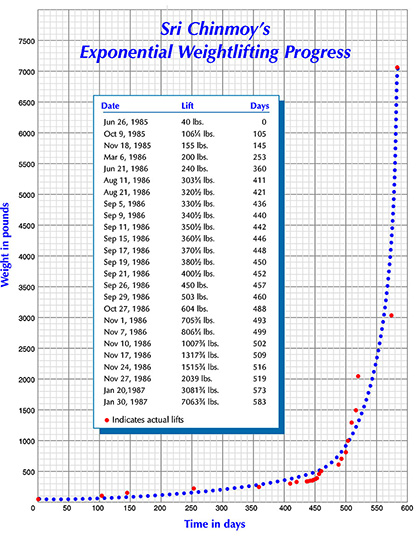
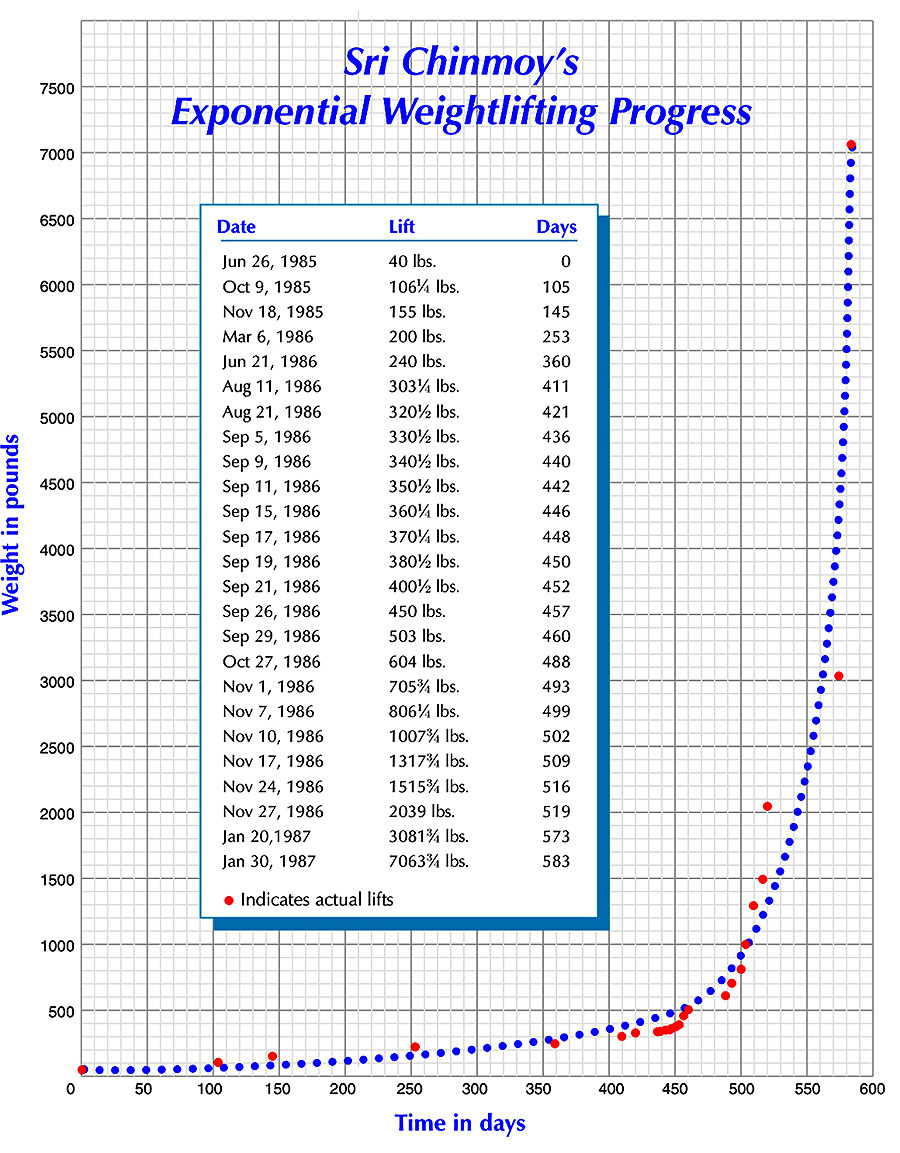
Graph of Sri Chinmoy's Weightlifting Progress

On November 27, 1986, Sri Chinmoy recorded what seemed to be his ultimate achievement — a lift of 2,039 pounds.

In mid-December Sri Chinmoy left New York for a concert tour of South America and for one month he was restricted to training with small stacks of portable weights. Still, he returned home with renewed enthusiasm, determined to lift more than 3,000 pounds.

But under the strain of this massive weight, the solid iron dumbbell-bar itself had begun to bend. It was obvious to everyone at that point, that a degree of radical engineering had to be adopted for Sri Chinmoy’s expedition into the uncharted realms of weightlifting to proceed any further.

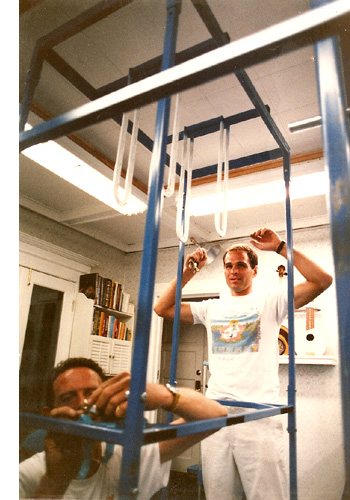
The idea of extra supports had been discussed but, with little time to calculate all the stresses involved, Unmilan Howard had to trust his intuition as a metalworker to provide the most practical solution. He quickly set about constructing a relatively lightweight tube-metal truss that would sit on top of the bar, providing enough structural integrity to keep it straight and rigid as the 100-pound plates were suspended from it. It worked! On January 20, 1987, Sri Chinmoy successfully lifted 3,081¾ pounds.

The final lift in this exponential climb to the stars was now just days away.

The constraint was no longer a matter of Sri Chinmoy’s fitness, but the physical time needed to construct the enormous supports which would have to stretch across the 15-foot length of the bar, to hold the expansive mass in place. And, there was another problem — the improvised gym on the ground floor of Sri Chinmoy’s house in Queens, N.Y. had outgrown its surroundings in both weight and dimension. A small team of builders and engineers worked around the clock on the project. Much of the room was cleared of other exercise equipment and the basement ceiling was reinforced with steel floor-jacks to support the gigantic apparatus that was to be installed.

Finally, just before midnight, one cold January New York evening, the structure was complete. Sri Chinmoy would not only have to raise the sixty-eight solid 100-pound plate weights, but also the supporting truss and bar, which themselves weighed an additional two hundred pounds. At 1.25 a.m., January 30, 1987, on his 3rd attempt, Sri Chinmoy lifted 7,063¾ pounds. Of the five attempts (1:03 a.m., 1:13 a.m., 1:25 a.m., 1:37 a.m. and 1:50 a.m.) the final three were completely successful — a combined weight of over 10 tons, held aloft by one human arm and an unfathomable will.

Jim Smith, from the British Amateur Weightlifters Association, who had been following Sri Chinmoy’s progress since he began, put it simply: “Sri Chinmoy is causing us to throw all our current beliefs in physics out the window. Sri Chinmoy is wrecking what we’ve always regarded as normal laws. Sri Chinmoy is rewriting the physiology books all over again!”
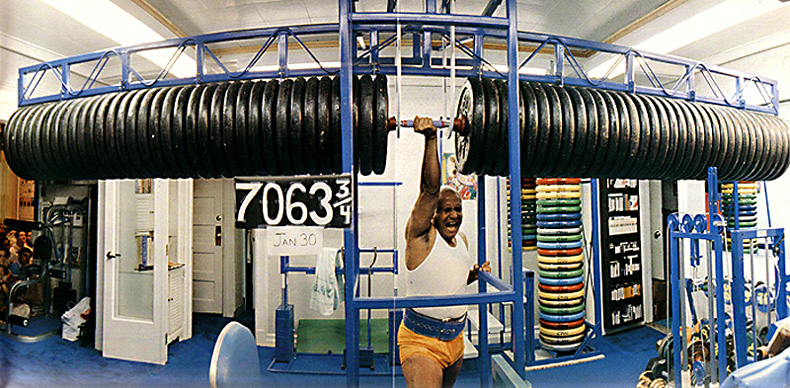


To many, Sri Chinmoy’s feats will forever remain inconceivable. They are challenging to all we hold valid in our traditional western view of the universe. Yet these undeniable achievements, if viewed with the light of consciousness, free from mental reinforcements and constraints, will undoubtedly one day form the basis for a new identification between our inner and outer lives.

On June 26th 1988 Sri Chinmoy, stepped on stage at Julia Richman Auditorium in Manhattan and demonstrated the ‘impossible’.

In a continuous exhibition of weightlifting, witnessed by the public and hosted by renowned weightlifting expert Bill Pearl, Sri Chinmoy lifted a variety of massive weights using different styles: one-arm, two-arm, seated calf-raise and standing calf-raise lifts. At times, as substitutes for the iron-plate weights, various groups of people (as many as 30 individuals plus equipment) were positioned on platforms. He lifted them in the same manner. The spectacular conclusion to the weightlifting display came when Sri Chinmoy, using only one arm, hoisted Bill Pearl (229 lb., including platform) overhead, momentarily suspending the Master of Ceremonies high in the air. The cumulative weight Sri Chinmoy lifted during the event was in excess of 20 tons.

Bill Pearl summed up the feeling of every person present that evening: “What this man has accomplished in weightlifting is phenomenal. He makes no claims, he needs no claims. That Sri Chinmoy lifted over 40,000 pounds in one hour and 45 minutes speaks for itself.”

Yes, Sri Chinmoy raises weights but he has also raised many questions regarding our scientific attitudes.

As the plane of intersection between the physical universe and the spiritual universe widens, we are drawn inevitably to address new concepts and to admit possibilities greater than the current scientific mandate will allow. Real progress in science will now depend not so much on improving research techniques or refining data analysis, but on broadening its philosophical base. The very fundamentals upon which the scientific method itself has been founded must be reassessed.

Sri Chinmoy has thrown open the door to a new dimension of discovery. It is a profound revolution indeed to consider a world-view where the material and the spiritual are one, where the highest divinity can be realised in and through the physical, where mankind itself is evolving towards an unlimited consciousness.

We have sent our messages to the stars, we have conquered the forces of the atom, but still we do not know ourselves. Who is this race of beings who would proclaim their dominion over the entire universe yet have sought in vain for their own identity? Even in the face of the enormous scientific progress of the last centuries, the words of the immortal Sir Isaac Newton are as relevant today as they were over 250 years ago:

“I do not know what I may appear to the world; but to myself I seem to have been only like a boy playing on the seashore, and diverting myself in now and then finding a smoother pebble or a prettier shell than ordinary, whilst the great ocean of truth lay all undiscovered before me.”30

Herein lies a challenge to us all, scientist and non-scientist alike: to leave the shore of our preconceptions and fears, to set out across the great ocean of truth in search of knowledge beyond the limits of the mind, to reach what Sri Chinmoy so prophetically refers to as the “Golden Shore of the ever-transcending Beyond.”


— End —

Endnotes:
1 Abraham Pais, Subtle Is the Lord: The Science and the Life of Albert Einstein, Oxford University Press, 1983, p.30.
2 Massachusetts Institute of Technology
3 European Organization for Nuclear Research
4 National Aeronautics and Space Administration
5 Registrar of Records, British Amateur Weight Lifters’ Association
6 Winner of four gold medals in track and field at the Los Angeles Olympics; World record holder for the long jump (indoors and at sea level)
7 AAU Physique Chairman and former Arm Wrestling Champion
8 Five-time Mr. Universe; World’s Best Built Man of the Century
9 Sri Chinmoy, Soul-Illumination-Shrine, Body-Preparation-Temple, Part 1, Agni Press, 1985
10 Sri Chinmoy, The Outer Running And The Inner Running, Agni Press, 1974
11 Sri Chinmoy, Aspiration-Body, Illumination-Soul, Part 1, Agni Press, 1993
12 Sri Chinmoy, Aspiration-Body, Illumination-Soul, Part 1, Agni Press, 1993
13 Sri Chinmoy, Soul-Illumination-Shrine, Body-Preparation-Temple, Part 1, Agni Press, 1985
14 Ronald W. Clark, Einstein: The Life and Times, Avon, Reissue edition (1999), p.622.
15 Sri Chinmoy, Art’s Life And The Soul’s Light, Agni Press, 1974
16 Sri Chinmoy, Mind-Confusion And Heart-Illumination Part 1, Agni Press, 1974
17 Sri Chinmoy, Mind-Confusion And Heart-Illumination Part 1, Agni Press, 1974
18 Ptolemy’s world-view was based upon a geocentric model, in that earth was considered to be at the centre of the universe and all other objects circled around it. This theory held sway for 1,400 years until the 16th century, when Copernicus presented a fully predictive mathematical model for a radically different heliocentric system whereby the planets, including earth, rotated around the sun. Interestingly, heliocentrism had been discussed by Indian astronomers in Vedic and post-Vedic texts such as Shatapatha Brahmana, many thousands of years before Copernicus.
19 Sri Chinmoy, Yoga And The Spiritual Life: The Journey of India’s Soul, Agni Press, 1971
20 Sri Chinmoy, Mind-Confusion And Heart-Illumination Part 1, Agni Press, 1974
21 Sri Chinmoy, Meditation: God’s Duty And Man’s Beauty, Agni Press, 1974
22 Sri Chinmoy, Mind-Confusion And Heart-Illumination Part 2, Agni Press, 1974
23 Sri Chinmoy, Mind-Confusion And Heart-Illumination Part 2, Agni Press, 1974
24 Sri Chinmoy, Flame Waves, Part 5, Agni Press, 1975
25 The decimal number system, with the inclusion of zero, was first introduced into Europe by Fibonacci (Leonardo of Pisa) in 1202 A.D.
26 Roger Penrose, The Emperor’s New Mind, Oxford University Press, 1989
27 Sri Chinmoy, Eternity’s Breath, Agni Press, 1972
28 Sri Chinmoy, Aspiration-Body, Illumination-Soul Part 1, Agni Press, 1993
29 Sri Chinmoy, Aspiration-Body, Illumination-Soul Part 1, Agni Press, 1993
30 Sir David Brewster, Memoirs of the Life, Writings, and Discoveries of Sir Isaac Newton, Volume II. Ch. 27., 1855


This article was originally written in 1987. Later references have been added in this version.


Copyright © 2008, Animesh Harrington.
All rights reserved under Creative Commons license.

 

Sri Chinmoy’s Weightlifting Adventure

by Unmilan Howard1


Who knows when this story began … and who knows when it will end? Like all adventures Sri Chinmoy embarks upon, the open invitation is always there for us to join him on his journey to the limits of human transcendence and beyond. This is a chronicle of a small part of one such continuing adventure – into the realm of Sri Chinmoy’s weightlifting achievements.

To say that this story began with Sri Chinmoy lifting 40 lbs. above his head with one hand on 26th June, 1985 is in fact only part of the truth. Sri Chinmoy has always stressed the importance of physical fitness and strength in our pursuit of spiritual progress. Ever since his days in the Sri Aurobindo Ashram, Sri Chinmoy has proved that he is not just a spiritual giant, but a force to be reckoned with in athletic endeavours, as well, a modern-day ‘Pandava’2 in every sense.
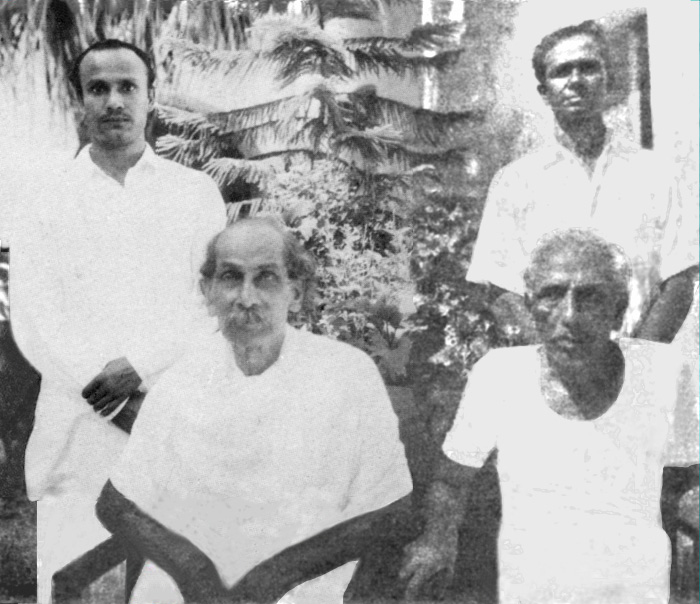
Sri Chinmoy’s success as an athlete is an inspiration to his spiritual sons and daughters, and, true to his nature, he is now breaking ground in the world of weightlifting, where no man has gone before.


Kishore Cunningham (right) and me adjusting one of our first exercise machines
for Sri Chinmoy at the tennis court at Illumination-Ground
(later known as Aspiration-Ground)


In August 1983, Sri Chinmoy asked for 50 exercise machines to be made. All his disciples who were inspired tried to make their machines and then present them to him for approval – or otherwise. Mostly it was otherwise. Kishore Cunningham3 had an idea for a machine and suggested that together we could make it. When the machine was finished, we presented it to Sri Chinmoy. He sat in it and within minutes had completely wrecked it. “Useless, totally useless!” was his comment.
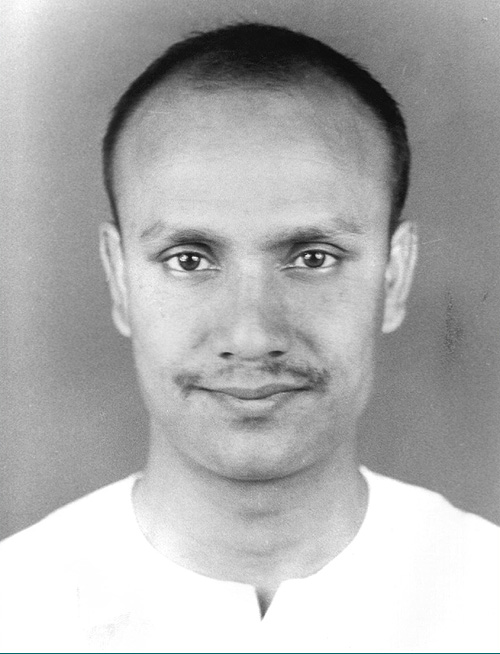
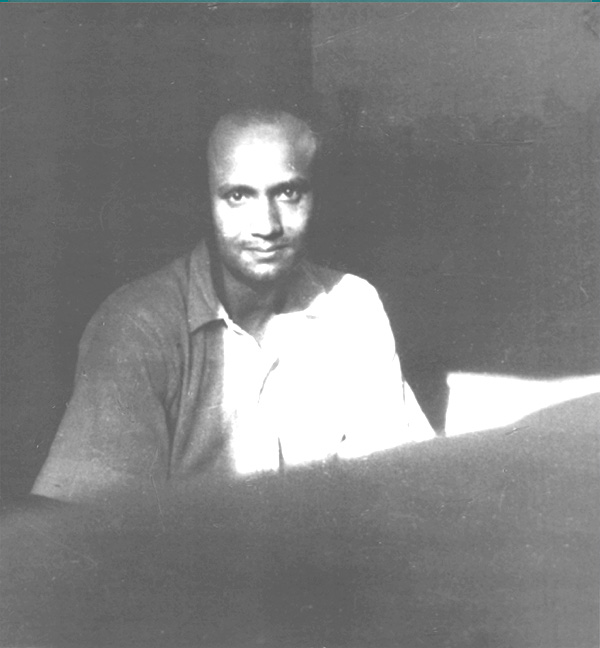
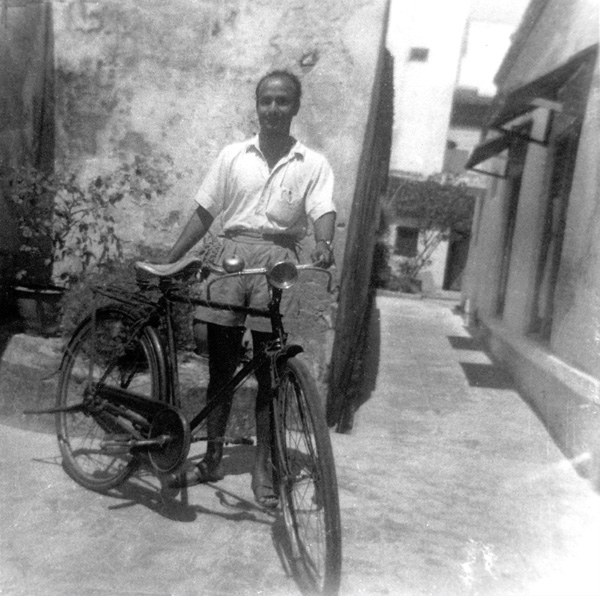
A few days later, he approached us again, laughing while saying, “That machine of yours was totally useless.” It was a challenge we could not refuse.

Instead of trying to find out what would inspire Sri Chinmoy, we asked a friend of ours to ask him what he specifically needed a machine to do. At that time, Sri Chinmoy was concentrating on his sprinting, and so “anything to improve leg strength” was the direction. We visited a couple of gyms, made quick sketches and then work began in earnest. Everyone we knew was caught up in Sri Chinmoy’s exercise machine inspiration, so it was no problem to find tools and a workshop (a subterranean store room in the basement of Agni Press4). In those few weeks the business of making exercise machines began. Little did I realise where it would eventually take me.

The first we knew of Sri Chinmoy’s serious weightlifting was when he rang his Australian meditation centres in late July, 1985. We were all gathered in Melbourne to help with two concerts which some of the good musicians among our group were performing there. Sri Chinmoy told us on the phone that he had entered into the exercise machine world with great enthusiasm and that when we came to New York the following month, there would be plenty of exercise machines to make. Just how much he was getting into weights and exercise machines was a surprise that was in store for Kishore and me.

On 7th July, just eleven days after he began this new adventure, Sri Chinmoy had progressed to lifting 50 lbs., with 60 lbs. coming shortly after, on 16th July, only nine days later. Before our arrival in New York, Sri Chinmoy was still making progress. He lifted 70 lbs. above his head on 30th July. The lift was called the ‘One-Hand Military Press’. On our arrival in New York, Sri Chinmoy quickly set us to work building machines, which always had to meet his requirements of being “cute, small, strong and yet look professional but not too complicated.”


At work in the basement workshop at Agni Press.
Photo credit: Nayak Polissar


So the ‘Sri Chinmoy exercise machine manufacturing headquarters’ was set up once again in the small room in the basement of Agni Press. This little room was to become home for the next six months. The ‘dungeon’, as it was affectionately known – since it was a room about eight feet square with a seven foot ceiling, no natural light and dripping water – was to become a hive of constant activity, producing machines with borrowed tools and resources, kindly lent by bewildered disciples. It was a world of its own, secure and friendly, where machines that were built had to be small, otherwise they wouldn't fit through the narrow door and up the stairs!

Before lifting heavy weights, Sri Chinmoy always warmed up first by lifting smaller weights or by working out on machines. The intensity with which he trained and wanted new machines was such that Kishore and I were only seen at the 1985 August Celebrations5 on four separate days. At one point, Sri Chinmoy said to us, “It is your job to make me strong. Making exercise machines will be your meditation.”

During Celebrations, he would often have competitions with the disciples to see who could lift the heaviest weight or else to see how many times he or the disciples could push a particular weight up and down. This gave him great joy and enthusiasm to continue his own rigorous training programme.

Sri Chinmoy was progressing steadily. On 13th August he lifted an 80-lb. dumbbell with one arm, followed by 85 lbs. on 6th September. His joy spilled over into the music world, and he composed several weightlifting songs for us to sing, and share in his achievements.

Sri Chinmoy liked to go to gymnasiums or sports stores to try out new machines which might develop his muscles. Some of these machines would have cost many thousands of dollars, so he would ask me “Can you make?” Out would come the pencil and paper and a few quick sketches and rough measurements were taken. He would also shop for novelty exercisers or just something new which would give him joy and a change from all the regular weights. He would go everywhere without the least bit of concern, which I have to admit was not exactly how I felt going into these places. Some of the gyms in those days were pretty rough. It's no wonder Sri Chinmoy said many people would prefer to train at home on their own exercise equipment, if they could.

Eventually a video machine was set up in Sri Chinmoy’s home gym so that he could record his workouts and see his progress. Sometimes he would show his disciples some of his best lifts, especially his new personal records. In this way, he was able to teach us the meaning of true determination (as well as frustration), and what concentration could do for us in our own self-transcendence. He often said that his mind does not believe what he has done, but his heart knows that it is true.

Sri Chinmoy would always meditate before attempting his lifts and he would always offer his gratitude prayer to the Supreme after his success or failure. It is all divine Grace, he used to say.

Because of Sri Chinmoy’s injured knee and bad back, it was difficult for him to lift weights from the ground. He wanted to know if there was any way that he could either repair or strengthen these weak points in his body.

Agraha6 found a place that tested leg muscles and knee joints and then showed how they could be strengthened. The tests revealed that Sri Chinmoy was weaker in his right leg and that his overall strength in his legs was such that an ordinary person in this condition would be getting around in a wheelchair or classified as a cripple! They gave Sri Chinmoy some exercises to do using very light weights strapped to his ankles or using weight shoes. (He had already been doing these exercises, but without the weights.) They stressed to him not to use heavy weights but to use very light weights and few repetitions for a short time, and to slowly increase the repetitions over a month or so and gradually increase the weight by five pounds as he got stronger. It sounded as though the process would take a very long time. Sri Chinmoy felt that if the muscles around his knee could become stronger, they would support him better so that he could lift heavier weights without feeling unstable.

We felt sorry for Guru. But, in return, he showed us how to overcome even the biggest obstacles. He asked Himangshu7 to make him extra heavy weight shoes, and another exercise machine had to be built to perform these same exercises. Sri Chinmoy was soon using 100 lbs. on the machine and doing lots of repetitions. His persistence once again defied scientific diagnosis and examination. They were inevitably defeated by heart-power and determination.

Because Sri Chinmoy was training so much, it was important to keep new machines coming so that he would not get bored or frustrated with his training. He always got inspiration as well as fresh enthusiasm and joy from new exercise machines.

Sometimes we would try hard to get another machine finished – only to be met by frustration and delays.

When Sri Chinmoy received a new machine, it instantly became a part of him and if we had to take the machine back for alteration, it would be like taking a child’s favourite toy away from him. It became a game to see if we could get the alterations done on the same day and deliver it back before he retired for the night. It gave us such joy to see our Guru happily experimenting with his new machine.

It was the job of Databir Watters8 to keep Sri Chinmoy supplied with metal weights and also to keep a lookout for any new exercise machines that he could find. Soon Databir noticed that in many cases the plates did not, in fact, weigh what they were supposed to, so he would weigh each one before buying them. How disappointing it would have been if Sri Chinmoy had lifted 100 lbs. only to find that it weighed 95 lbs.! That is why some of Sri Chinmoy’s lifts have the odd one pound or half a pound weight added to them.


Rupantar La Russo (right) and me installing the safety apparatus
known as the 'cage' in Sri Chinmoy's home.


He was starting to lift such heavy weights now that it was becoming hard for us to help him by manually handing him the dumbbells. Apart from it being dangerous, especially if we lost our concentration for even just a second, he wanted to be able to lift weights whenever he wanted to, and not just when we were available to help him. One day he asked if a machine could be made to replace us, and so was born ‘The Cage’.

If ordinary human beings lift a really heavy weight, we would usually be satisfied with lifting it once, but not so with Guru. His goal for Christmas 1985 was to lift 50 lbs. forty times. But he took everyone by surprise and became stronger so quickly that he was able to accomplish this goal on 6th October, two and a half months ahead of schedule.

So when one goal is reached, you set another. That is his philosophy. Now it was to be 50 lbs. lifted 50 times and 100 lbs. lifted from the ground above his head, both by Christmas.

September had departed and October was disappearing fast. It seemed that nothing could stop Sri Chinmoy, not even time itself. Disciples were kept busy trying to contact professional weightlifters and bodybuilders to find out their training tips to help Guru get stronger. He tried a number of their suggestions, even their eating habits, and slowly he began to formulate his own diet and training schedule. And, indeed, something was working, for he was losing weight and yet getting stronger. The spiritual and the physical were working in unison.

On 8th October 1985, Sri Chinmoy lifted 96½ lbs. 15 times, followed by a further 6 times and then another 20 times. Joy was in the air and he now felt confident that because he was able to lift this weight so many times, he could easily lift 100 lbs. at least once, if not more.

Sometimes he would play tricks on his mind, like using wrist weights while he lifted the big dumbbells and then telling himself that all he was lifting was a 90-lb. dumbbell instead of 91, 92 or 93 lbs.

Sri Chinmoy was always stressing that in anything we undertake, it is important to set a goal. When we reach that goal, we get such joy and enthusiasm that it will carry us to our next goal. But we should be careful not to set our goals too high and out of reach. We should have intermediate goals to reach our major goal. Otherwise, if we can’t reach our major goal, we will get frustrated and we might give up altogether.

Sometimes, while he was practising weights or doing some other thing, he would just stop and suddenly he would be in another world. You just knew that he had important inner business to attend to.

It was strikingly noticeable when some disciples were attempting to swim the English Channel that year. I could consciously feel Sri Chinmoy taking away their pain and fear so that they could accomplish their enormous task. I know Guru does this for all of us all the time, but it seemed so noticeable to me on that occasion. His concern knows no bounds.

Sri Chinmoy would train at all hours of the day and night. He wanted machines built to fit into his bedroom so that if inspiration struck at an odd hour (is there such a thing for a spiritual Master?) he would be able to work out without going downstairs.

Some professional weightlifters were commenting that his muscles were not growing in size because they were muscle-bound from too much exercise and not enough rest. But Sri Chinmoy kept up his intense training programme. He might not have had the muscle size of some of these body builders and weightlifters, but his strength was still rapidly increasing – to a point where he would soon overtake most of them in strength.

Sri Chinmoy would train early in the morning, while we were all asleep, and again at about 8:00 AM, not forgetting to go out for his regular walk and also to practise his musical instruments in between the two workouts. Later in the day, he would work out around 3:00 or 4:00 PM in the afternoon, and finally sometimes between 9:00 PM and midnight, when time and his busy schedule permitted. No other weightlifter, not even a super-athlete, could keep this intensity of training, six days out of seven, for months on end, with only two hours’ sleep a day to re-energise the body.

Sometimes it would happen that I was putting a machine together or altering one in Guru’s house and he would go upstairs to rest. I don’t know how much rest he would take, because soon the sound of weights could be heard going up and coming down with a gentle thud on the floor upstairs.

At Aspiration-Ground tennis court on 9th October 1985, he lifted 106¼ lbs. above his head with one hand, and then did several repetitions. This became the famous poster which many gymnasiums requested copies of. They felt it would inspire people to transcend their own efforts when they saw someone of Sri Chinmoy’s age lifting such a massive weight.

At this stage – and not knowing anything about weightlifting records – I was starting to wonder if he had nearly reached the goal he was aiming for. Besides, the exercise room in his house was now about as full as it could ever be with exercise machines and weights. But I still had a lot to learn about Guru’s determination. It was really only the beginning.

Until now Sri Chinmoy was still playing tennis and having evening meditations at Aspiration-Ground because the weather was quite mild. His tennis improved as he became stronger, especially his serve, and he was able to move around the court with an agility we had not seen for quite a while, not since the days when he was sprint training. But the vigorous games sapped his precious energy, energy much needed for his weightlifting, and so he cut back on tennis playing in order to use the energy for his weight training.

During Sri Chinmoy’s busy day – which included meetings, meditations, solving his disciples’ inner and outer problems and weight training – he still managed to find time to practise his music for upcoming Peace Concerts in the United Kingdom and Europe. And, even while he was on tour, he found time to train, using a leg exerciser at interval time and after a concert.

Bipin9 was particularly good at packing weights and dumbbells for travelling into little innocent-looking red tool boxes. One of these might weigh 50 lbs. or more, depending on the size of the dumbbell! And while Sri Chinmoy was away, machines were being converted from round weights to rectangular pin weights, so that he wouldn’t have to lift them on and off a machine to alter the poundage.


Assisting Sri Chinmoy with weight training after
a running race at Flushing Meadows Park, NY.


One day, shortly after Sri Chinmoy’s return from his European tour, he was sitting on the couch on his front porch, gazing out the window. It was a beautiful day outside and a jogger ran by. He turned and said, “There is nothing quite like running. When you run everything is inspiring you to run. The wind in your hair, the birds, the trees, flowers, grass …even the footpaths and houses are all urging you to run. But here I am lifting inconscient weight, something that I used to avoid doing in my Ashram days.”

He went on to say that the leg exercise machine was helping his lower back as well as his legs and he felt that one day soon he would be able to run again. Of all the machines we have made for Guru, I thank the Supreme for this one.

I couldn’t contain the joy of knowing that he might run again, and told several of my friends what he had said. They were overjoyed also, and at the first opportunity asked him if it was true. Guru’s answer was, “How do these rumours get started? Some disciples I can tell things and they don’t believe, but other disciples take everything I say as being true.” At first I felt embarrassed, but then I was filled with gratitude.

After Sri Chinmoy had successfully lifted the 106¼ lbs. above his head the first time, he continued using this weight to practise with. He asked me if it was possible to lower the weight cage so that the 106¼-lb. dumbbell would hang one inch closer to the floor, giving him a better starting position. All I could think of doing was to cut one inch out of each of the legs and re-weld them back together. But this would mean taking the cage away and bringing it back at a later time. Other things had to be done first, so I went away trying to think of an easier way to lower the cage.

Later in the day, Sri Chinmoy said, “Unmilan, we are both brainless! It is so easy to lower the weight. We just place a one-inch sheet of plywood on the floor for me to stand on.” He was laughing and then he said, “It is like when the dog barks. We run and run and run instead of climbing up the tree!”

Sri Chinmoy worked and worked with his weights until his muscles became too sore to work any more, and he would then take rest. During this rest period he used to practice his musical instruments. He would play four or five instruments and then work out again, take another rest and practise again. None of his other activities suffered while he kept pushing forward with his weightlifting manifestation. Things like music were just placed into another time slot.

Early one morning, I woke up feeling sad and depressed without knowing why. Later in the morning I found out that Guru had been working out on the hyper-extension machine (the roman chair) doing stomach and back exercises, when the machine lost balance and fell on top of him. The Supreme saved Guru from a nasty accident but Guru had hurt his calf muscles, and the next few days found him limping everywhere, just when it seemed that he would be running well again.

The injury eventually healed with the help of massage and he was soon walking and running again in the mornings. Guru maintained his exercise programme, minus the leg exercises, for a few days. The intense training on upper body muscles was continuing unabated, with Guru still practising instruments for the coming concerts, as well as writing new songs, poems and reading all his mail. It never stopped!

By October 29th, Sri Chinmoy was able to one-arm press 106¼ lbs. 12 times, followed by 28 times and 12 times. Then he had a significant inner experience. His soul told him that more repetitions were needed. So he set a programme to do seven reps seven times with the 106¼-lb. dumbbell.

Whenever he was about to lift his heaviest weight, or go for a ‘PR’, every noise in the house had to be stopped, and pin-drop silence maintained. These ‘transcendence lifts’ required every ounce of Guru’s powerful concentration. He says that he tells the weights to become as light as a feather so that he can easily lift them.

On November 1st, he successfully transcended his own record again by lifting 117 lbs. This was to become the starting point of his next goal, which was to one-arm press 150 lbs. while having a personal bodyweight of 150 lbs.

“Is there no limit to what Guru can do?” my mind asked.

Sri Chinmoy would occasionally have weightlifting competitions. He did it for the joy it gave to us all, and to see us struggling with weights that he had far transcended months ago. But he stressed that we should not try lifting these weights without him being there, unless we were already lifting weights seriously, since we could cause ourselves injury. He said that men should not lift more than 50 lbs. and women not more than 20 lbs.

In one of these competitions, Shephali10 defeated all the boys by lifting the heaviest weight in the calf-muscle machine. Then Sri Chinmoy got us to see who could lift a 120-lb. dumbbell from the floor to waist height. He himself could not perform this lift, but those of us that tried could. He felt embarrassed, but our success was only because our lower backs were stronger than his. “Sometimes embarrassment is good,” said Guru, “because it makes us try harder.” And so this became another goal he set for himself – to lift 100 lbs. from the floor to above his head.

The machines that were made for Sri Chinmoy all had weights in them that were well above his strength at that time. It seemed that he was having a competition with the machines to see how fast he could transcend their limits. As he got stronger and stronger, there was not one machine that did not require extra weights to be added to the weight stack. With some machines, it took Guru a matter of weeks to use up all the weights, some took only days, and one took only two hours for him to conquer!

Sri Chinmoy could now do a pull-over from behind his head with 120 lbs., and in the seated bench press machine he could press 140 lbs., 10 times. On November 3rd, he lifted 131½ lbs. in military press fashion, 22 times. This was only two days after lifting 117 lbs. When he completed the lift, he very soulfully spoke these words:

“The Compassion-Light of my Beloved Supreme has made me lift up 131½ lbs., 22 times. For everything in my life, I entirely, entirely depend and depend on the Grace of my Beloved Supreme, and this is what I would like all my disciples to do. For everything they should and they must entirely depend on the boundless and unconditional Grace of our Beloved Supreme.”

He went on to say that he never dreamed that one day he might be strong enough to be able to lift his own bodyweight with one hand – his Indian bodyweight was always around 131 lbs. from the ages of thirteen to thirty-one. Guru said, “I am so happy. Let my happiness enter into all my spiritual children, the same happiness. I would be grateful if they could transcend my happiness. First, they have to embody my happiness, and then they have to transcend it. Transcendence is our only goal.”

One day Sri Chinmoy was inspired to do a typical bodybuilder pose. Savyasachi11 took a photograph. The picture was blown up and then auctioned to the highest bidder. At a function to celebrate Sri Chinmoy’s 131½-lb. lift, Madal Bal bid the highest for this powerful, yet sweet and beautiful portrait.

In the course of time, every room in Sri Chinmoy’s home became an exercise room. If he wanted to exercise while talking with disciples, he would exercise on the porch using either exercise machines or free weights (dumbbells). If he wanted to do a serious workout, he would use the main exercise room. In the meditation room there sat a 100-lb. chromed dumbbell for lifts from the ground. And upstairs the second bedroom was also transformed into a small exercise room where he could work out. Even his main bedroom had an exercise machine in it.

He would tell us, “If you are inspired then you are energised and you do not need to sleep for so long. Your mind says to go to sleep and it will wake you up … but it never does. Instead, it tells you that you need more sleep.”

Sri Chinmoy only takes sleep for two hours each day and in this way he can accomplish the many things he has to do. He advises us to always play tricks on the mind and do what inspires you and not what the mind wants you to do. If you are tired, take a shower or wash your face, especially the ears and eyes, put on the TV in the background to create a noise, sing loudly and out of key – do anything to stay awake.

When Sri Chinmoy wakes up, he meditates before anything else. Then he warms up in preparation for lifting weights. His arms move from side to side, up and down, to loosen the muscles and get the circulation going. Then he takes his position underneath the dumbbell that is suspended in the cage. He simply holds the weight for a minute or two, concentrating and mentally preparing himself in pin-drop silence. Suddenly the concentration, determination and sheer strain all burst into action and a powerful groan signals the start of the upward journey of the weight. For a very brief moment, it is held up, at the top of his straightened arm. His shoulders are square, back perfectly straight and left arm stretched parallel to the floor. Then the weight comes down, only to be halted and then made to move upwards, again and again and again. Suddenly the surge is over and the weight comes back down for the last time into its cradle, crashing like thunder.

The strain is over and the look of pain on Sri Chinmoy’s face quickly changes to a smile and laughter. The power in the room is tangible. Then, prayerfully, he offers his gratitude to God.

This was the scenario on November 12th, 1985. He had just lifted 140 lbs. We had the feeling now that he was strong enough to lift anything he wanted.


    Sri Chinmoy lifting 155 lbs. on November 18th, 1985 at the age of 54.
    His bodyweight on that day was 154 lbs.


On November 15th, Madal Bal12 flew me to Germany and Switzerland for a week to prepare me for the job ahead – manufacturing exercise machines in Australia and exporting them to Madal Bal for sale in Europe. Before I left, Guru said he would wait until my return before he lifted his next goal: 155 lbs.

On November 18th, he telephoned me in Switzerland to tell me that he had lifted 155 lbs. 10 times and then another 14 times. He said, by way of explanation, “My determination could not wait for your return and so with your soul’s permission I lifted it early.” I was deeply touched and overjoyed.

Sri Chinmoy’s determination was such that he would keep trying for days and days to lift a weight, even if at first he could not budge it, and put full effort into trying until the capacity was there to do it.

After the 155-lb. lift, just like after the 106¼-lb. lift, the phones went wild with comments from all over the world. Weightlifters, bodybuilders, athletes, musicians, politicians, doctors and ministers were all eager to offer him praise and encouragement. Some were so overcome that they were lost for words. All this helped Sri Chinmoy to persevere and set new goals, especially comments like: “I see no limit to what this man can do because of his connection with God” or “he can easily go on to even larger weights with his power of concentration and determination.” For some, Sri Chinmoy’s spiritual height was forgotten or perhaps unseen, and the achievement was seen only in superhuman terms. But others knew and felt that it was his indomitable spiritual qualities that enabled him to perform such tremendous feats of power and strength. In Sri Chinmoy’s life, everything flowed from the inner to the outer.

In just under five months, he had progressed from 40 lbs. to 155 lbs. Meanwhile, his bodyweight had decreased through strict dieting to 155 lbs, and he was now poised to lift, with one arm, more than his body weight – a feat that all weightlifters agreed was bordering on the unbelievable. His goal was now to lift 170 lbs. With such heavy weights being used, a second cage was built to enable him to practise for the 170 lbs. by warming up with the 155-lb. weight first. It was hard for me to comprehend that 155 lbs. was once his goal, and now it was being used merely as a warm-up lift!

The remaining days of 1985 were very busy for Sri Chinmoy … on the anniversary of his paintings, he painted 150 small and 70 large new pieces; he continued to hold UN meditations and special meditations in Washington DC; he met with a number of important people and composed songs to honour them; he held a seven-hour meditation and concert where he played on 21 musical instruments; on Wednesday nights he held public meditations, and there were many more daily activities happening in the ten days after he lifted 155 lbs. It was Thanksgiving Day and he still had the 5-day ultra-race to direct and many concerts to perform before Christmas, but the intensity never for a moment caused him to pause in going for his 170-lb. goal. Quite the contrary, he thrived on the pace and the challenges ahead. “You have no idea how many times I have tried and how many times I have failed,” he said, “but I do not give up.”

Sri Chinmoy lifting 170 lbs.


By November 30th, twelve days after lifting 155 lbs., he had succeeded in lifting 170 lbs. with two hands four times, but he had not been successful in then changing to one hand to do repetitions. He commented, “My biceps are so weak, while my triceps are so strong. We try to hide our weaknesses but our weaknesses come forward so that we can strengthen them.”

Until now he had always lifted the weights with two hands. Then he would change to one hand at the top of the lift and begin to one-arm press. But on December 1st, using only one arm from start to finish, he lifted 101¼ lbs., 127 lbs. and 132 lbs. – all within an hour. This was a major breakthrough and a very special day for Sri Chinmoy. Three days later, he lifted 145 lbs. in the same way, using only one hand. At a function that evening, he showed a video of himself doing all these lifts and explained, “Today I have tried something new. Without taking any help from my left hand, I only used my right hand on the lift. Meditate. Identify with me. My aspiration and my Beloved Lord Supreme’s Compassion – how they go together.”

A book was made detailing all these lifts. Some of the pictures clearly show the pain and strain his physical body was going through.

The next day he was determined to lift 120 lbs. from the floor to his waist, while an audience looked on. He said, “So what if I am embarrassed, it helps us to become strong to fail now and again.” Sri Chinmoy did not have to feel embarrassed on this occasion. He made the lift and another goal had been reached.

Still I kept making machines, all day and sometimes all night. For me, nothing else mattered. Guru said to me, “Your devoted service and my determination have enabled me to lift these weights. Without these machines, there would be no joy.”

We are all divinely special and unique. While I was making machines for Guru, some disciples felt miserable that they couldn’t please him to the extent that I was at that time. But what they did not know was how envious I was of them, seeing how much they were spreading the news of Guru’s achievements across the world, while all I was doing was making machines. Such is our fate when we live in our minds, instead of our oneness-hearts!

In Si Chinmoy’s home, he now had 170 lbs. in one cage, and 127 lbs. in the other. Three times he would practice pushing the heavier weight upwards, using two hands. Then he would go to the 127 lbs. and pump it for five repetitions with one hand. Then back to the 170 lbs., this time trying to move it using only one hand. Bit by bit, it moved one inch, then four inches, then it finally surrendered.

Sometimes I would ask myself what I was doing half way around the world making exercise machines, sometimes working fifteen to twenty hours a day. Why was I doing it? The answer was simple … for a smile, a very special smile. To me, there was no smile on earth like this one. It was like the smile of the Beyond, filled with divine love and joy. In the ordinary life we work for money but we are never satisfied, and we soon want more money. When we get more, we are still not happy. But Guru’s smile was completely satisfying. There was nothing in the outer life that could give me that same reward, that indescribable feeling of oneness and gratitude.

Sri Chinmoy used to say that when we work for him it must be with a feeling of unconditional self-giving. And sometimes we work for a while with this attitude, until the mind consciously or unconsciously begins to demand something for our work, even if it is for him to smile at us. But if he smiles at us when we want him to, we may drown in our pride. He knows what we need to make the fastest progress, and he will supply us with that need at the right moment. In the battle of life we can embody the negative forces or the positive forces, whichever we choose.

The year was fast drawing to a close and it seemed that things were happening at a much faster pace. Boxes had to be made to take Sri Chinmoy’s weights to Japan, and he himself was extra busy preparing for the trip and practising for the concerts scheduled there.

On December 10th, Sri Chinmoy officially named his one-arm lift ‘The Body, Heart and Soul One-Arm Press’. He established a set of rules and guidelines that were printed along with some pictures illustrating the newly-founded lift, which is similar to the traditional one-arm military press. The main points of Sri Chinmoy’s lift are:

  • The dumbbell must be pressed overhead in a continuous motion to a full-arm extension, where it is held for three seconds.
  • During this manoeuvre, the spine must be erect and the torso may not rotate.
  • The knees may bend slightly, but not more than two inches from a vertical, straight-leg position.
  • If a power rack (cage) is used, the dumbbell must be free of contact with the rack at full arm extension.

On this same day, he changed his routine to cook a 13-course meal for a group of disciples who had been trying to guess when he would lift the 155-lb. weight. Guru was in a joyful and playful mood, and at one stage he was mixing and patting a very large pot of food with his hands, saying, “Food is God and so I am playing with God!”

There were two special dishes, one extremely hot and spicy dish for the boys, which he said would purify our minds and illumine our hearts, and an extremely bitter dish for the girls to take away their insecurity and jealousy.


Counting reps for Sri Chinmoy in Japan.


It was time for Sri Chinmoy’s trip to Japan. His luggage may have not looked big but it was weighty. Besides the ordinary luggage, which included a number of musical instruments and three entire exercise machines, there were seven small boxes and six small tool boxes, each weighing from 40 to 70 lbs., depending on the size of the dumbbell inside. So everyone got plenty of exercise when it came to moving Guru’s luggage, especially the baggage handlers at the airport!

On the plane trip, Sri Chinmoy did not rest. He did 700 push-ups in the aisle and also used several hand exercisers that he carried with him. In each location we stayed at, he had a separate exercise room to do his workouts, and a set of weights and exercise machines were set up in the hall where we gathered for functions.

When we first arrived in Japan we had to load everything onto buses. But Japanese buses don’t have luggage compartments and so the luggage had to fit around the seats of the passengers! Barely a space was left. The driver of the bus was laughing at the never-ending stream of luggage. Then along came the small tool boxes. He still laughed, but you could see the shock on his face as he helped to lift them, wondering how such a small box could weigh so much.

While he was in Japan, Sri Chinmoy did not get as much exercise as he might have at home in New York. But a combination of different types of exercises and the enforced rest probably did his body a lot of good. It did mean, though, that he couldn’t lift 170 lbs. while in Japan because there was no cage to protect him. Without the really big weights, we had no idea whether his strength was increasing or decreasing. But he did find several new exercise machines in Japan and a few of the ones we had left in New York soon appeared with the late arrivals.

Sri Chinmoy competed against himself on the new machines: using an exerciser that measures the amount of pressure it takes to squeeze the hand together, he went from 30 kg to 42 kg (approximately 70 lbs. to 95 lbs.). On another machine, he would stand and bend over, grabbing a handle which he pulled upwards. It measured the amount of weight he could pull up from the floor. He started on 60 kg (130 lbs.) and in thirteen days was able to lift 90 kg (close to 200 lbs.). Sri Chinmoy used to complain from time to time that he was losing strength because he could not work out in his gym, but I could see that he was definitely getting stronger in other muscles.

In all, he performed nine concerts in Japan, and was constantly active, meeting people, writing new songs, travelling, practising musical instruments, running and walking, and still finding time to fit in weightlifting. Moving from city to city, travelling on buses and trains did not stop this ‘divine dynamo’ from transcending. He had been practising lifting 86 lbs. from the floor to shoulder height for about ten days, and then for about five days lifting 91 lbs. to shoulder height. On January 5th, he lifted 91 lbs. from the ground to above head height and then one-arm pressed it five times.

On January 7th, Sri Chinmoy surprised us all by doing 2,230 push-ups in 59 minutes 34 seconds. I was one of three counters for this feat. While he was doing the push-ups, he asked some singers to sing fast spiritual songs. The whole audience remained in a soulful and prayerful consciousness. This was to be Sri Chinmoy’s first teeming surprise for 1986.

Sri Chinmoy arrived back in New York on January 13th. On January 14th, he attempted to lift the 170-lb. dumbbell – but it did not move. Guru said that he had used only 60 to 70 per cent of his strength. The next day he tried again. The weight started going up so fast we all felt that he would succeed, but it was as if the Supreme did not want it done on this day and so it never reached the top. On this day, Guru said that he used 90 per cent strength. He was smiling, as if to say, “It is only a matter of time.” The very next day the weight surrendered to him on his fifth attempt.

Sri Chinmoy said, “Prayer-power can do this. In any walk of life, concentration and determination have to be brought forward. Do not be satisfied with failure.” And, again, he often said, “How many people would just give up!”

All the fears he had about losing strength in Japan were swept away with this lift. But still his bicep muscles never increased their size of 14 inches when flexed. He longed for 15-inch biceps, but the growth of the muscles seemed elusive. There seemed to be no outer increase in size to match the increase in strength and power. Guru would do every exercise he could think of to increase their size. Then he would measure them again. Poor Guru would look at us and shake his head in disbelief.

Even mathematics did not apply to Guru. We tried unsuccessfully to predict when he might lift a weight, projecting a date from his past progress. But Guru being Guru, sometimes he would be weeks or even months ahead of schedule.

His muscles may have not measured any bigger, but they sure looked bigger. When he rolled up his sleeve to play esraj or cello, you could not help noticing his powerful arms. And when he was playing tennis, his legs looked just as strong and developed.

In all that Sri Chinmoy accomplished with weights, he never went backwards. In running you can go up and go down, losing fitness through injury or losing your edge, but with weights he went from strength to strength. He always warmed up first on lighter weights before he tackled the heavier ones, and this might be one of the reasons why he never suffered an injury while lifting. He knew intuitively what to do, and this was undoubtedly the best protection of all – the Supreme’s inner guidance.

“I do weightlifting and all that, but I have to be frank, compared to my inner power it is a drop,” Guru told us.


Sri Chinmoy reaches his 'goal' by lifting 200lbs. on March 6, 1986. But this was just the beginning…


On January 20th, Sri Chinmoy had the 170-lb. and 200-lb. dumbbells placed in the cages so that he could ‘warm up’ on the 170 and begin pushing on the 200. The next challenge was on again. When he first started lifting weights, who would have thought his goal would be as high as 200 lbs.? Only the Supreme knows where it will end.

I left New York for Australia after seeing Guru lift the 200-lb. weight up one inch. I felt that this 200 pounds of inconscient weight was on the move to meet its destiny with Guru’s goal. And then, six days into the miracle month of March, Guru transcended his own personal record yet again with a lift that surpassed all others – he lifted the 200-lb. dumbbell in the true style of the Body, Heart and Soul One-Arm Press.


– End –

Editor's Endnotes

1 Unmilan Howard is an Australian sheet-metal worker who was instrumental in every aspect of Sri Chinmoy’s weightlifting. He personally designed and built many of the machines that Sri Chinmoy used.

2 The Pandava brothers were heroic figures in the Mahabharata era of Indian history.

3 Kishore Cunningham is a sports event organiser, writer and editor from Melbourne, who assisted the author with the original manuscript, on which this article was based.

4 Agni Press is a small printing press in Jamaica, Queens. At that time, it was solely responsible for publishing Sri Chinmoy’s books.

5 Every year for two weeks during August, Sri Chinmoy’s students from all over the world gather in New York to celebrate his birthday, which falls on August 27th.

6 Dr. Agraha Levine, from Seattle, was another key figure in Sri Chinmoy’s weightlifting. He is also the author of many insightful articles about Sri Chinmoy’s various lifts.

7 Himangshu Kosachek is a former gymnast from the New York area who, at times, custom made running shoes for Sri Chinmoy.

8 Databir Watters, a former wrestling champion, assisted Sri Chinmoy in various aspects of his weightlifting.

9 Bipin Larkin was one of Sri Chinmoy’s close attendants and the major builder of Aspiration-Ground tennis court.

10 Shephali Burke is one of the three women who run Annam Brahma Vegetarian Restaurant in Queens, New York.

11 Savyasachi Brown was a close attendant and driver of Sri Chinmoy.

12 Madal Bal is a business enterprise run by Sri Chinmoy’s students in Switzerland, Austria, Germany, the Czech Republic and several other European countries.


Copyright © 1986, Unmilan Howard. All rights reserved.