
October 22


by SRI CHINMOY
(The following lecture was delivered at Princeton University on October 22, 1971, by Sri Chinmoy Kumar Ghose. Born in Bengal in1931, he joined at the age of twelve a spiritual community — Ashram — in South India where he remained for twenty years. There, his practice of intense inner disciplines led to his early attainment of the fullest spiritual enlightenment, the Realisation of God.
From earliest youth, he wrote poems in his native Bengali language, winning his first prize at the age of thirteen in nationwide competition with poets of mature years. His literary production soon expanded to include poetry in English, as well as plays and philosophical essays which were widely published and deeply appreciated throughout India where he was, in addition, recognized as a spiritual teacher of rare eminence.
Sri Chinmoy came to the West in 1964 and has made his home here since that time More than a dozen Sri Chinmoy Centres, dedicated to the Master’s teachings and ideals have been established in the United States, Canada, the Caribbean, Europe and the Far East.
Two years ago, Sri Chinmoy was invited to conduct regular weekly meditation for United Nations delegates and staff. His Tuesday noon hour meditation services at the United Nations Church Centre in New York are now widely recognized and have been the subject of several articles in The New York Times, New York Daily News, and other publications.
In the course of spreading his message, the Master has lectured at the world’s great universities, including Princeton, Harvard, Yale, Oxford, Cambridge, and Tokyo. He delivers the monthly Dag Hammarskjold Lecture Series, at the United Nations, and he has been a guest on a number of television and radio shows here and abroad.
A great teacher and philosopher, Sri Chinmoy has written extensively on Yoga, meditation and Eastern spirituality. Five publishing houses including Harper & Row have published his writings eleven — books in all.)
Sri Chinmoy’s entire lecture — The Upanishads: India’s Soul-Offering — is published in this issue of The Princeton Seminary Bulletin. And, is also published in his own book The Upanishads: the Crown of India’s Soul
with Sri Chinmoy
Andre Bernard: At this time we are privileged to have on the morning’s programme, Sri Chinmoy, who I have already told you is a painter, a composer, a musician, a writer and a spiritual leader. Sri Chinmoy is going to be giving a concert on Saturday, October 30 at 7:30 p.m. at St. Thomas Church on 5th Avenue and 53rd Street. It’s a free concert and we’re going to be talking with Sri Chinmoy about this concert and, as I said, about other things also. He’s going to give us a short preview of this concert, but before he does that I want to tell you just a little bit about Sri Chinmoy.
He was born in Bengal, India in 1931. Sri Chinmoy entered an ashram or spiritual community at about the age of 12 and spent the next 20 years practicing intense spiritual disciplines. During this period he achieved a rare state of knowledge which later formed the basis for his various creative achievements. Sri Chinmoy has expressed his inner realisations not only through painting, but also through literature and music. Since coming to the West in 1964 he has written nearly 300 books of spiritual poems and essays, short stories, plays, aphorisms and questions and answers. He also serves as Director of the United Nations Meditation Group, conducting meditations twice a week for UN delegates and staff.
I’m going to welcome Sri Chinmoy to our microphones by asking him to play a little of the music that he composes and plays, and then we will be talking with him.
Sri Chinmoy: Thank you. (Sri Chinmoy plays the esraj for a few minutes.)
Andre Bernard: That was Sri Chinmoy, who is going to be in concert playing music for meditation on Saturday, October 30. Sri Chinmoy, will you come closer to the microphone?
Sri Chinmoy: I am extremely happy to be here with you.
Andre Bernard: Thank you. I wanted to ask you about the instrument upon which you were playing. What is that called?
Sri Chinmoy: It is an Indian instrument called an ‘esraj’.
Andre Bernard: And is that a traditional instrument, or modern? It looks almost like a combination of a violin and guitar.
Sri Chinmoy: This is a traditional instrument, and it is played mostly in Bengal, West Bengal.
Andre Bernard: I couldn’t help but think, as I heard the lovely, restful music that you were making, of the difference in taste in music among at least the older generation in this country and in the East. It seems that we are very noisy people and our music reflects that. It is very noisy, loud, boisterous. Do you have any idea why this is? Is this a difference in temperament or in the people’s needs? Have you thought about that at all?
Sri Chinmoy: According to me it is a matter of personal preference. Whether it is actually a need is another question. When I prefer something, I try to do it. Whether I actually need it is a different matter. There are many things in life which we do just because we like them. But when it is a matter of need, the story may be totally different.
Andre Bernard: So we couldn’t say it was necessarily a need, but just a preference. That clarifies it, certainly. A man with your background, who is learned in all the arts practically, and who brings spirituality to the United Nations, (I mentioned that you conduct meditations there also, and I know you have been to many universities) have you noted any differences between the people you see in England, for instance, and in this country or in other countries, or do you see people as basically all the same?
Sri Chinmoy: People are basically all the same no matter where they are, for we are all children of God. We may say that God has many, many houses, countless houses and countless children. But just because we are all God’s children, we are all basically the same.
Andre Bernard: You were born in India and you’ve been all over the world. Now it seems that you spend most of your time in the West. Why have you chosen to do your work in the West in general and in New York in particular?
Sri Chinmoy: It was not left up to me. It was not my decision. My inner guide, whom I call the Supreme, commanded me to come to the West and to serve Him in the aspiring seekers here. It was not my personal choice.
Andre Bernard: We have a poet and writer — I’m sure you must be familiar with the English poet Rudyard Kipling — and he once said that, “East is East and West is West and never the twain shall meet.” Yet it seems that East and West are meeting now. I would like to get your opinion on that.
Sri Chinmoy: Well, I have read that poem many many times. As a child I learned it by heart. But this is also an individual experience. According to my own inner experience the West and the East have already met, precisely because both the East and the West are inside the Heart of the Supreme. We notice two significant qualities in the East and in the West. The East has inner poise, and the West has dynamism, illumining dynamism. These two divine qualities are already spreading and combining; therefore, I feel that in the outer world also, both the East and the West are already becoming one. The inner poise of the East and the illumining dynamism of the West are combining and synthesising in a proper manner.
Andre Bernard: And you are suggesting then, if I infer correctly from your comments, that each complements the other.
Sri Chinmoy: Absolutely true. They are like two complementary souls. What we have to offer, we are offering to you. What you have to offer, you are offering to us.
Andre Bernard: Let’s talk for just a moment, before we have to conclude our conversation, about the concert that you will be giving on Saturday, 30 October at St. Thomas Church. It is listed as ‘Sri Chinmoy in concert playing music for meditation.’ Would you like to say what is going to happen at that time? What do you do? Do you simply play and people meditate, or do you lead a meditation group?
Sri Chinmoy: I shall play, and at the same time I shall be in a meditative, contemplative mood. I expect the audience to be seekers, and these seekers will be supporting me with their own aspiration and meditation. When I play, when I meditate, I have only one objective in mind and that is to be of inner service to the aspirants. So when I play, I shall do it with the spirit of dedication and in the consciousness of soulful meditation which I always offer to the aspiring seekers.
Andre Bernard: Does your meditation technique have any special procedure or quality which differs from the meditation we are generally exposed to now? There are many people in our audience who are into meditation techniques. Does yours differ from the others, or does it have any special quality that you would like to mention?
Sri Chinmoy: I have no idea as regards other methods or procedures, but our method I can tell you briefly. Our path is the path of the heart. We meditate on the heart and try to offer divine love, divine devotion and divine surrender to the Supreme. Human love is all possession, human devotion is nothing short of attachment, and human surrender is either compromise or compulsion. When a slave surrenders to his master out of fear, he gets no joy. But when a seeker surrenders his whole existence to the Supreme, he does it cheerfully and unconditionally; therefore, he derives abundant joy. So it is divine love, divine devotion and divine surrender which we are trying to attain through our soulful meditation.
Andre Bernard: One final question. Not only have you traveled throughout the world but, as I have said, you lead a meditation group at the United Nations here in New York, so you come into contact with people who control the nations and guide the destinies of our various nations. We are living in a very exciting time, a time of change, a time of tremendous technological development. But it is also, at the same time, a very dangerous period. For the first time in the history of mankind we possess the technology to destroy ourselves. What do you see? Are you optimistic about the future? Do you think man will destroy himself, or will he achieve the true brotherhood which you espouse and which would eliminate that catastrophe?
Sri Chinmoy: It is my inner conviction that man will have a better future. Man will not be so destructive. The power that man has discovered will eventually be used for constructive purposes, not to destroy. God has created the world for satisfaction and not for destruction, so eventually there must be brotherhood. Brotherhood will reign supreme on earth. It is only a matter of time. As more people begin to pray and meditate sincerely, the life of faith and the life of love will come to the fore. Then a divine harmony, peace and light will flow throughout the length and breadth of the world.
Andre Bernard: Thank you, Sri Chinmoy. We have been speaking to Sri Chinmoy, who is a composer, painter, writer and spiritual leader. He leads meditation groups at the United Nations and all over the world, and he is going to be in concert on Saturday, 30 October, that’s a week from tomorrow, at St. Thomas Church at 5th Avenue and 53rd Street. The public is invited to attend and the concert is free. Thank you again, Sri Chinmoy, for being here.
Sri Chinmoy: Thank you.
Published in AUM – Vol. 4, No. 2, 27 February 1977
A lecture by Sri Chinmoy
a Princeton University, Princeton, New Jersey
India’s soul-offering is the perennial light of the Upanishads. The Upanishads offer to the world at large the Supreme achievement of the awakened and illumined Hindu life.
The Vedas represent the cow. The Upanishads represent milk. We need the cow to give us milk, and we need milk to nourish us.
The Upanishads are also called the Vedanta. The literary meaning of Vedanta is “the end of the Vedas.” But the spiritual meaning of Vedanta is “the cream of the Vedas, the pick of the inner lore, the aim, the goal of the inner life." The Muktikopanishad tells us something quite significant:
Tileshu tailavat vede vedantah supratishthithah.
"Like oil in the sesame seed, Vedanta is established essentially in every part of the Vedas."
The Upanishads tell us that there are two types of knowledge: a Higher Knowledge and a lower knowledge. Paravidya is the Higher Knowledge, and aparavidya is the lower knowledge. The Higher Knowledge is the discovery of the soul. The lower knowledge is the fulfilment of the body’s countless demands.
According to our Indian tradition, there were once one thousand one hundred and eighty Upanishads. Each came from one branch, shakha, of the Vedas. Out of these, two hundred Upanishads made their proper appearance, and out of these two hundred, one hundred and eight Upanishads are now traceable. If a seeker wants to get some glimpse of Truth, Light, Peace, and Bliss, then he must assiduously study these one hundred and eight Upanishads. If a real seeker, a genuine seeker, wants to get abundant light from the Upanishads, then he has to study thirteen principal Upanishads. If he studies the principal Upanishads, and at the same time wants to live the Truth that these Upanishads embody, then he will be able to see the face of Divinity and the heart of Reality.
The thirteen principal Upanishads are: Isha, Katha, Kena, Prasna, Mundaka, Mandukya, Chandogya, Brhadaranyaka, Taittiriya, Aitareya, Svetasvatara, Kaivalya, and Maitri.
"Tad ejati tan naijati tad dūre tad vad antike .....
That moves, and That moves not. That is far, and the same is near. That is within all this; That is also without all this."The Isha Upanishad has this special message for us. To the desiring mind, this message is vapid, nebulous, puzzling, and confusing. To the aspiring heart, this message is inspiring and illumining. To the revealing soul, this message is fulfilling and immortalising. Brahman, God, in His absolute aspect, is immutable; but in His conditioned aspect He is ever-changing, ever-transforming, ever-evolving, ever-revealing, ever-manifesting, and ever-fulfilling.
Again, the Isha Upanishad reconciles work and knowledge, the One and the Many, the impersonal God and the personal God, in a striking manner. Work done detached is real knowledge. When we consciously try to see God in everything and in everybody, we soulfully offer ourselves to dedicated action. This knowledge is action. The One and the Many: we need the One for our self-realisation; we need the Many for our self-manifestation. The impersonal and the personal God: when we live in the impersonal God we see Truth in its illumining Vision; and when we live in the personal God we see Truth in its revealing Reality.
The Son of God declared, “I and my Father are one.” The Chandogya Upanishad makes a bold statement, to some extent more daring, and at the same time more convincing:
"Tat twam asi.
That thou art."What does it mean? It means that you are no other than God. Who else is God, if not you?
A God-lover knocked at God’s Heart-door. God from within, said, “Who is it?”
The God-lover said, “It is I.” The door remained locked. The man knocked and knocked. Finally he went away.
After an hour he came back again. He knocked at God’s Heart-door. God, from within, said, “Who is it?”
The God-lover said, “It is I.” The door remained locked. The man knocked and knocked at the door in vain. Finally he left.
After another hour, again he came back and knocked at God’s Heart-door. From within, God said, “Who is it?”
The God-lover said, “My eternal Beloved, it is Thou.” God immediately opened His Heart-door.
When a seeker feels this kind of intimate and inseparable oneness with God, God opens His Heart-door to him and offers him His very Throne.
The Upanishadic Seers felt no necessity to go to any spiritual centre, no necessity to go to a temple, no necessity to hear a talk or a sermon or even to study books. God was their only outer book, and God was their only inner teacher. God-realisation was their only necessity, and God-manifestation was their only reality.
The great German philosopher, Schopenhauer, voiced forth, “In the whole world there is no study so beneficial and so elevating as that of the Upanishads. It has been the solace of my life; it will be the solace of my death. They are the products of the highest wisdom. They are destined sooner or later to become the faith of the people.”
The Upanishads offer us three lessons. The first lesson is Brahman. The second lesson is atman. The third lesson is jagat. Brahman is God, atmanis the soul, and jagat is the world. When we meditate on Brahman, our life grows into immortalising Bliss. When we meditate on the soul, our life becomes a conscious and speedy evolution. When we do not neglect the world, our life becomes fulfilling manifestation.
If you study the Upanishads, not in a cursory or perfunctory manner, but with the mind’s clarity, then you will see that God and you, you and God, are eternal. And if you study the Upanishads with your heart’s receptivity, you will see that God and you are equal. And finally, if you study the Upanishads with your soul’s light, you will come to realise that there in Heaven you are the realised and esoteric God, and here on earth you are the manifested and exoteric God.
"Nayam atma bala-hinena labhya.
This soul cannot be won by the weakling."The inner strength dethrones the idol which has been installed by fear and doubt. When your inner strength comes to the fore, the poltroon, the doubter in you, will be transformed into the soul’s effulgent light.
The Upanishads are the obverse of the coin of which the reverse is consciousness. There are three states of ordinary consciousness: jagriti, swapna, and sushupti. Jagriti is the waking state, swapna is the dreaming state, sushupti is the state of deep sleep. There is another state of consciousness which is called turiya, the pure consciousness of the Transcendental Beyond.
The Mandukkyopanishad offers us a most significant gift. It tells us about the Universal Soul. The Universal Soul has two aspects: vaisvanaraand virat. The microcosmic aspect is called vaisvanara; the macrocosmic aspect is called virat. Jagriti, the waking state; vaisvanara, the physical condition; and the letter ‘A’ from ‘ AUM,’ the sound symbol of prakriti, the primal energy, form the first part of Reality. Swapna, the dreaming state; taijasa, the brilliant intellectual impressions; and ‘U’ from ‘AUM’ form the second part of Reality. Sushupti, the state of deep sleep; prajna, the intuitive knowledge; and ‘M’ from ‘AUM’ form the third part of Reality.
But turiya, the fourth state of consciousness, at once embodies and transcends these three states of consciousness. On the one hand, it is one part of the four parts; on the other hand, it is the culminating whole, the end, the Goal itself. Turiya is the Reality eternal, beyond all phenomena. Turiya is the Transcendental Brahman. Turiya is satchidananda — Existence, Consciousness, and Delight. It is here, in turiya, that a highly advanced seeker in the spiritual life or a spiritual Master can actually hear the soundless sound, ‘AUM’, the supreme secret of the Creator.
The supreme wealth of the Upanishads is the Self:
"Yato vacho nirvartante aprapya manasa saha.
Whence the words, the power of speech, come back with the mind baffled, the goal unattained."This Self cannot be won by mental brilliance. It can be won only with an aspiring heart and a dedicated life.
This Transcendental Self is covered here in the world of relativity by five distinct sheaths: annamaya kosha, the gross physical sheath; pranamaya kosha, the sheath of the vital force; manomaya kosha, the mental sheath; vijnanamaya kosha, the sheath of the advanced and developed knowledge; and anandamaya kosha, the sheath of Bliss. There are three types of bodies corresponding to these five sheaths. These bodies are called sthula sharira, sukshma sharira, and karana sharira. Sthula means gross physical, and sharira means body. Sukshma means subtle, and karana means causal. The physical body, sthula sharira, comprises annamaya kosha, the material substance. Sukshma sharira, the subtle body, comprises pranamaya kosha, manomaya kosha, and vijnanamaya kosha. Karana sharira, the causal body, comprises anandamaya kosha, the sheath of Bliss.
"On a dark and tenebrous night the glow-worms appear. They offer their light and feel that it is they who have chased the darkness away. After a while, the stars start shining, and the glow-worms realise their insufficient capacity. After some time the moon appears. When the moon appears, the stars see and feel how dim and insignificant their light is in comparison to the light of the moon. In a few hours the sun appears. When the sun appears, the joy and pride of the moon is also smashed. The sunlight chases away all darkness, and the light of the glow-worms, stars, and moon pales into insignificance."
This is the planet sun. But each of us has an inner sun. This inner sun is infinitely more powerful, more beautiful, more illumining than the planet sun. When this sun dawns and shines, it destroys the darkness of millennia. This sun shines through eternity. This inner sun is called the Self, the Transcendental Self.
Published in The Upanishads: the Crown of India’s Soul
by Sri Chinmoy
at All Angels Church in New York
I wish to give a very short talk on the third eye; then we shall most soulfully concentrate, meditate and contemplate on the third eye.
The third eye fascinates curiosity seekers. Fortunately, we are not curiosity seekers. The third eye helps sincere seekers considerably on their way to self-discovery. Here we are all sincere seekers. The third eye fulfil’s God’s Dream in and through us precisely because we are true God-lovers.
The third eye is the eye of vision-light. What is vision-light? Vision-light is at once our self-transforming and self-transcending, God-revealing and God-manifesting reality. What else is vision-light? Vision-light is the capacity that we embody in order to differentiate our animal past and human present from our divine near future and our supreme distant future.
The message of our past was total destruction. The message of our present is conscious or unconscious division. The message of our near future is oneness, satisfaction in oneness. And the message of our distant future is perfection in satisfaction and satisfaction in perfection.
Some people are of the opinion that it is not advisable to open the third eye, for if it is opened prematurely, our inner progress will come to an end. They are of the opinion that it is not a boon — far from it — it is a veritable curse. But seekers must know that if they are really sincere, if they have the inmost cry, then God, the Author of all Good, will not open their third eye untimely. If they are sincere, God will do everything for them at the right hour. But if they are insincere, then naturally they may have to pay the penalty. Sincere seekers are those who have an adamantine will. They know perfectly well that there is only one way to achieve abiding satisfaction in life, and that way is to offer the results of all their actions to the Absolute Supreme soulfully, unreservedly and unconditionally.
Fear is the worst enemy of a seeker when he wants to open his third eye. On the one hand he is consumed with the desire to open his third eye. On the other hand, the moment the idea flashes across his mind that when his third eye opens he will see what he was in his past lives, he is afraid. What happens when an insincere seeker opens his third eye is most deplorable. If his past was not satisfactory, if it was most discouraging, then immediately he is shocked. He does not, cannot, see ahead. He curses himself. He loses all hope. He thinks that because he was so bad in the past, for him there can be no bright future. He is doomed to disappointment. His mental sky is overcast with clouds.
When an insincere seeker sees the future, the result is equally deplorable. If he sees something discouraging, frightening or saddening in the near future, then he is frightened to death. If he sees that one of his dear ones is going to die before long, then before the event actually occurs, he himself dies with fear and anxiety. For these reasons, the insincere seeker often feels it is not advisable to open his third eye.
But if a sincere seeker has the indomitable will right from the beginning to see the past and to enter into the future with a surrendering attitude, placing the results at the Feet of his Beloved Supreme, then fear cannot torture his life. If he sees that he was not aspiring in his past incarnation, so what? He knows that he has the golden opportunity to aspire in this incarnation. Just because he did not do something positive or constructive in the past does not mean that he cannot do it in the present. Just because he was not an honest man before, there is no reason why he cannot be honest now.
When our third eye is open, if we see that something is going to happen to someone in the immediate future, we have to remember who loves that particular individual more: we or the Source of all Love. Right now our love is very limited. We all know it. But there is Someone who has unlimited, infinite Love. We are right now praying to that Being or to that omniscient, omnipresent, omnipotent Reality. That all-loving Reality undoubtedly has more compassion, more vision-light than we have; therefore, it is our bounden duty to surrender to the Will of the Absolute Supreme. If we are ready to place the results, the capacities, the achievements, the fruits of our vision at the Feet of the Supreme, then we are safe. There is no other way to have the third eye open and at the same time to make the fastest progress in the spiritual life.
When the third eye opens up, it sometimes creates tremendous excitement. If we know that something good is going to happen, if we come to see that something most encouraging and inspiring is going to happen, then we become overexcited. This excitement quite often delays the event. It also takes away our mental poise. Then in the inner world again we become bankrupt. So when we get an encouraging message by virtue of opening our third eye, we should look around and see if there is anybody on earth who has achieved more love, more knowledge, more wisdom, more light than we have. If we are sincere, then we are bound to see that there are people, there were people, and there will be people who have achieved infinitely more than we. Then immediately our excitement pales into insignificance. We can be happy, but if we are overexcited at seeing what is going to happen, then we lose our mental poise. Once we lose our mental poise we cannot make further progress in the spiritual life. So we shall not be overexcited when we see that something good is going to happen and, at the same time, we shall not be depressed or disheartened when we see an inauspicious future or past with the vision of our third eye.
Before we accept the spiritual life we wallow in the pleasures of ignorance. When we sincerely accept the spiritual life we try to give up our bad habits, and sooner or later we do succeed in giving up our bad habits. This is the proof that we have made considerable progress. This is the proof that we do not belong to the past reality; we belong to the future reality, which is growing in the immediacy of our aspiring today.
We pray and meditate with the hope that one day we shall enter into trance, for each seeker feels that trance, which is nothing short of bliss, is necessary in the spiritual life; it is something most advantageous, most illumining and most fulfilling. Here I wish to say that if one can open the third eye, this facilitates or expedites the attainment of trance. When the third eye is opened, we can run the fastest along the mental road to God. The mental world is obscure, dark, impure and insecure. But when we open the third eye and walk along the mental road, immediately everything that is insecure is made secure, everything that is impure is made pure, everything that is undivine is made divine. Everything that is dark is illumined by the third eye.
Now, there is a slight difference between the third eye and the trance life. We have two ordinary, human eyes. When we use our human eyes, we see that the reality is at one place and the person who is watching the reality is at some other place. If you are sitting in front of me and I am looking at you, then you are the goal and I am the traveller. The destination and the starting point are at two different places. I am the starting point, and you are the goal. This is the understanding we get from our human eyes. But if we use the third eye, at that time the starting point and the destination are at the same place. They cannot be two; they are together.
Now, when we enter into trance, we get one experience which we usually do not get from the third eye. The third eye will show us that the starting point and the goal are together. But this vision of oneness may not give us immediate delight. If we can enter into trance, then immediately we get the universal Life and the transcendental Life together; therefore, we are flooded with delight.
When we enter into trance and we get abundant, boundless bliss, we are totally satisfied. But we do not know who embodies this infinite Delight. We cannot see the personal God who embodies both the transcendental Life and the universal Life. Just by entering into trance we cannot see the Owner, the Possessor. But if we can open the third eye, then we can see the Absolute Supreme in His subtle, personal aspect. Infinity is one thing, and the absolute Reality is something else. When we enter into highest trance, we enjoy infinite Peace, Light and Bliss. But He who embodies this infinite Peace, Light and Bliss will not be visible at all. Whereas, if we open the third eye, then we see the Transcendental Absolute, the Absolute Supreme. The Absolute Supreme is above, far above Infinity and Infinity’s Light, Delight, Peace and Bliss. So we get the utmost opportunity from the third eye.
Our aim, our goal, is to please the Absolute; therefore, we shall pray and meditate. If we feel that opening the third eye will help us so that we are not assailed by fear, doubt, anxiety and worry, then we should definitely meditate on the third eye, for the sooner we can clear away our mental jungle, the sooner we will reach our destination, which is the Golden Shores of the Ever-Transcending Beyond.
Now we shall concentrate on the third eye. The third eye is located in between the eyebrows and a little above. In this spot we shall concentrate, meditate and contemplate.
While concentrating, let us imagine for a few minutes just at the third eye a flame, a burning golden flame. What we call imagination is nothing short of an existence-reality, a world of its own. So let us concentrate, and while concentrating let us feel burning flames at our third eye. Please breathe in as slowly as possible, as quietly as possible, and while breathing in try to feel that you are not breathing in through your nose; you are breathing in through your forehead. While breathing out you are also breathing through your forehead. Then please feel the presence of burning flames inside your forehead, precisely inside the third eye.
Now let us meditate on the third eye. This time, also, please breathe in and out through your forehead, and now, imagine the planet sun or the inner sun, which is infinitely brighter than the planet sun. Please imagine at least one sun inside the forehead at the third eye, and inside that sun please imagine countless flames or rays of light. This time please keep your eyes fully open so that you can feel the vastness of the sun along with its light and power.
Now we shall contemplate. From the spiritual point of view contemplation is the sweetest form of inseparable oneness. This oneness is the oneness of the divine lover with the Beloved Supreme. The oneness that abides between the divine lover and the Beloved Supreme is called contemplation. It is by virtue of contemplation, proper contemplation, that we come to realise that we are not only divine seekers but also divine lovers, and that God is our Beloved Supreme. We are like tiny drops, while God is the ocean. Countless drops form the ocean, and again, the ocean embodies the drops. First we imagined flames, then the sun itself. When we can contemplate properly, we will become one with God Himself. When the seekers and God-lovers and God together play, sing and dance, at that time God is singing the song of multiplicity in unity. When the One Absolute remains in His transcendental aspect, and the seekers and God-lovers approach Him, then God is singing the song of unity in multiplicity. So let us contemplate on the third eye. For a few minutes let us feel that we are the lover-flames; then we shall feel that we are the Beloved-Sun. Thus we shall change our respective roles.
Published in AUM – Vol. 4, No. 1, 27 January 1977

Sri Chinmoy begins his poetry series Ten Thousand Flower-Flames by writing seventy poems during a Pan Am flight en route to Japan.
Who am I?
A completely long lost tornado-speed.
Yesterday my supremely uncooperative body
Ran the New York Marathon.
The lightning-arrows of anxieties
And worries did not attack me.
I must say, they have
Always
Been very kind to me.
They do not knock at my heart’s door.
No, not even by mistake!
But cramps,
My unfailing friends, came and
Shook hands with me gently
Even before I had covered eleven miles.
Usually they come to befriend me
At the eighteenth mile.
But this time, after fifteen miles,
They desired to lavish
Infinitely more affection on me.
So they embraced me most avidly
And most powerfully.
Alas, alas!
From fifteen miles on,
I dragged my ill-fated body,
At times with my compassion-smiles,
At times with my frustration-cries.
To my great joy and sublime relief,
The worst possible nightmare
Finally ended
At the end of twenty-six miles.
One marathon-world
Leads me into another marathon-world.
To satisfy this new marathon-world,
Or to be satisfied by this new one, will be
Infinitely — I really mean it —
More difficult.
For here it is not just twenty-six miles
and 385 yards to run,
But to sow the seeds
Of ten thousand flaming flower-poems
Which at long last I shall place
Devotedly, unreservedly and unconditionally
At the Compassion-Feet
Of my Beloved Supreme.
Published in Ten Thousand Flower-Flames, part 1
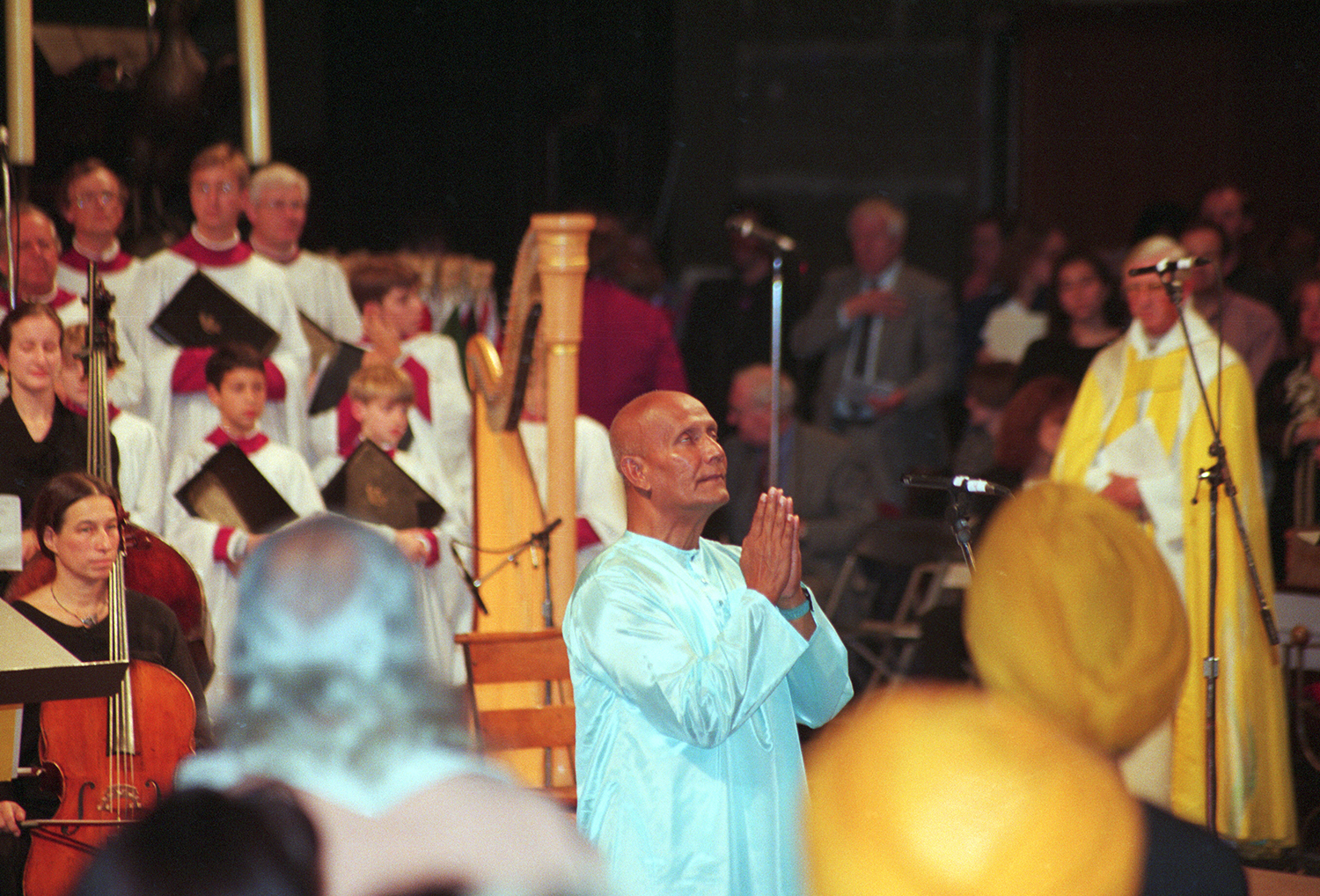
Sri Chinmoy holds the opening meditation at an interfaith celebration in honour of the United Nation’s 50th anniversary at the Cathedral of St. John the Divine in Manhattan, New York.

Sri Chinmoy runs the New York City Marathon in a time of 4:48:53 in New York, NY, USA.


Sri Chinmoy meets with Emil Zatopek (above), 1952 triple Olympic gold medallist for 5 km, 10 km and marathon, for the first time at the start of the New York City Marathon on Staten Island, NY, USA. Before the race, Sri Chinmoy also meets with ultramarathon champion Don Ritchie (below).
by Sri Chinmoy
I am trying to reach people in various walks of life who have inspired others — in sports, in literature, in science and in politics. Since they have inspired many people, I am trying with my limited capacity to encourage and inspire them. When someone does something great, he is cheered by his colleagues. They congratulate him. Here also I am trying to congratulate them with my prayerful meditation and inner oneness with them. I just lift them up to show my deepest appreciation of their achievements.
Published in Lifting Up The World With a Oneness-Heart

NEW YORK — Spiritual Master Sri Chinmoy led a team of 150 disciples in the New York City Marathon October 21.
Wearing dark purple shirts and pale blue shorts, the Sri Chinmoy Marathon Team was the largest team entry in the 26-mile race.
Dozens of other disciples, who didn’t run, assisted the race organisers before and during the run.
A group of disciples also added a touch of musical dynamism to the scene by singing several of Sri Chinmoy’s running songs over the loudspeaker just before the race began.
Prior to the start, Sri Chinmoy chatted with ultramarathoner Don Ritchie and Olympic triple gold medalist Emil Zatopek, who served as Grand Marshall of the New York Marathon.
Sri Chinmoy had met Ritchie this past June when the runner visited his spiritual Centre after setting a new world record in a 100-mile run in Flushing Meadow Park.
For Zatopek, the only athlete ever to win three gold medals for the 5,000-metre run, 10,000-metre run and marathon in a single Olympics (1952), it was his first introduction to Sri Chinmoy, whom he had heard a lot about.
“This is the best blessing I ever had,” he told the Master.
Sri Chinmoy, who regards running as a physical complement to the inner life, normally trains about 80 miles a week.
The New York marathon was his sixth this year. Only two weeks earlier, he had run the historic Marathon to Athens marathon in Greece.
Captions:
Emil Zatopek, Olympic triple gold medalist, greets Sri Chinmoy before the start of the New York Marathon, above.
Below, the Master chats with ultramarathon champion Don Ritchie.
And, pictures from a Marathon scrapbook, right.
Publsihed in Anahata Nada,Volume 5, Nos. 9-10-11, Sept.-Oct.-Nov. 1979

Sri Chinmoy completes the first 10,000 poems of Seventy-Seven Thousand Service-Trees in 9 months, in Jamaica, New York.
|
Published in Seventy-Seven Thousand Service-Trees, part 10
Prayers by Sri Chinmoy
at the Peace Concert at the Xcel Energy Centre in St. Paul, Minnesota
HERE and NOW
I have come to learn
That God’s Compassion
Is my only heart-compass.
HERE and NOW
I ask God:
My Lord,
Where can I find You?
“My child,
Inside My Blessing-Eye-Smiles.”
HERE and NOW
God asks me:
“My child,
Where can I find you?”
My Lord,
Inside my gratitude-heart-tears.
HERE and NOW
God asks me
To come out of my mind’s
Insecurity-cave
And show Him my heart’s
Most powerful
Light-delight sea-waves.
HERE and NOW
I have come to learn that
Only at God’s choice Hour
The mind retires for good
And the heart aspires
Throughout Eternity.
HERE and NOW
My soul wants me
To put an end to humanity’s
Widespread inner peace-starvation.
HERE and NOW
God tells me never to enjoy
Prayer and meditation-holidays
If I want to remain
A choice soldier of His
For His full manifestation
On earth.
HERE and NOW
God kindles in me
Limitless aspiration-heart-flames
To clasp His Divinity’s Feet.
HERE and NOW
When I give God my possessions:
Devotion-tears,
God gives me His Possessions:
Nectar-Embraces.
HERE and NOW
I have thrown my open heart
Into God’s
Compassion-flooded Eye.
HERE and NOW
My sleepless God-obedience
Has conquered
All my inner enemies.
To name a few —
Pride, insecurity, fear and doubt.
HERE and NOW
God tells me that it is quite easy
To satisfy and please Him.
He advises me to take every day
Just a few aspiration-steps,
Dedication-steps
And devotion-steps
Towards my ultimate Goal:
His universal Fulfilment.
HERE and NOW
God tells me:
“Cry not like a beggar
For your own liberation.
Smile and strive,
And strive and smile
Like a hero supreme
For My complete manifestation
Here on earth.”
HERE and NOW
I must terminate
My long-standing friendship
With ignorance-night.
HERE and NOW
I must become
A fathomless
God-faith-reservoir.
HERE and NOW
I must resolve
To take each and every day
As a God-service-day.
HERE and NOW
My crying breath
And streaming tears
Must enter into
God’s Heart-Room.
HERE and NOW
I must totally break
My ego-horn
Into millions of pieces.
HERE and NOW
I must push myself
Most powerfully
To reach a new
God-satisfaction-height.
HERE and NOW
I must dauntlessly stop
Impossibility
From blocking my Godward way.
HERE and NOW
I must offer
My gratitude-heart-present
To God.
HERE and NOW
I must end all my
Desire-tiger-attacks.
HERE and NOW
I have come to realise
That only when I end
My pride-exhibit
God will begin
His Pride-Parade.
What for?
Just to bless and crown me.
HERE and NOW
I give God what I have:
My weeping heart.
And God gives me what He is:
His Smiling Eye.
HERE and NOW
God tells me
That I can turn my head
Away from Him
If I want to.
But He will never allow me
To turn my heart
Away from Him.
HERE and NOW
All the desire-worlds
Have ceased
Running after me.
HERE and NOW
I have come to learn
That everything of mine
God loves,
But He loves
My devotion-heart-throbs
Infinitely more.
HERE and NOW
I must cast aside
The tears
Of my unaspiring days.
HERE and NOW
God tells me
That He can never be too busy
For His Heart-bound children.
HERE and NOW
God makes my God-realisation-hope
Stronger
And my God-manifestation-promise
Clearer.
Published in Here and Now
Twenty short poems
by Sri Chinmoy
| 1 |
|
| 2 |
|
| 3 |
|
| 4 |
|
| 5 |
|
| 6 |
|
| 7 |
|
| 8 |
|
| 9 |
|
| 10 |
|
| 11 |
|
| 12 |
|
| 13 |
|
| 14 |
|
| 15 |
|
| 16 |
|
| 17 |
|
| 18 |
|
| 19 |
|
| 20 |
|
Published in Two Divine Qualities: Confidence and Sincerity
Kuantan, Malaysia
Sri Chinmoy comments after Amritananda reads out his award-winning poem about the oneness of all God's children and the single mountain-top at which all paths converge, concluding with "Dedicated to Sri Chinmoy: The Peace Meditation at the United Nations, who has climbed the mountain, and understands, and teaches well."
My dearest Amritananda, I appreciate your poem, I admire your poem and I adore your poem.
One individual can be both the Heaven-ambassador of peace and the earth-ambassador of peace. A single individual can be the Heaven-ambassador of peace and the earth-ambassador of peace. And that ambassador is your soul, that ambassador is your heart. Your soul and your heart are both peace-ambassadors. You are the peace-ambassador of Heaven and the peace-ambassador of earth.
Not as a great educator, not as a great religious newscaster, but as an individual who has combined the mental approach and the spiritual approach to new peace-building, you are at once the hope-bearer and promise-fulfiller. You start with hope and you enter into the promise-world. Then you keep your promise.
This world of ours should have known much, much more about you, for in you I find a real synthesis of the mind and the heart. The wisdom of the heart and the knowledge-intelligence of the mind you have in infinite, infinite measure.
You are telling the world, “Do not give up hope, do not give up hope!” Hope is there. Hope is inside our heart, hope is inside our mind, hope is inside our life; and this hope eventually takes us to our promise. Hope shows its sweetness-beauty, and its slow and steady progress to promise. Promise says, “If you are with me, O hope, then I am destined to bring about world peace.” Hope and promise are like two wings of the same bird. This bird is constantly reminding us, “Stop not! Do not think you are a failure, even for a fleeting moment. You are the eventual winner of the peace-world.”
My dearest Amritananda, your soul is flooded with hope and promise. Similarly, your hope permeates each and every cell, every limb of yours. We feel that your message to the world is something beautifully blooming, sacredly blooming, and soulfully and powerfully blooming. Now you are in the blooming stage, but there shall come a time when your soul’s promise and your heart’s love for the world will be manifested here in the heart of the world.
I am all love for you, all love for you, all gratitude, gratitude, gratitude to you and all pride in you, pride you, my dearest Amritananda.
Published in My Golden Children
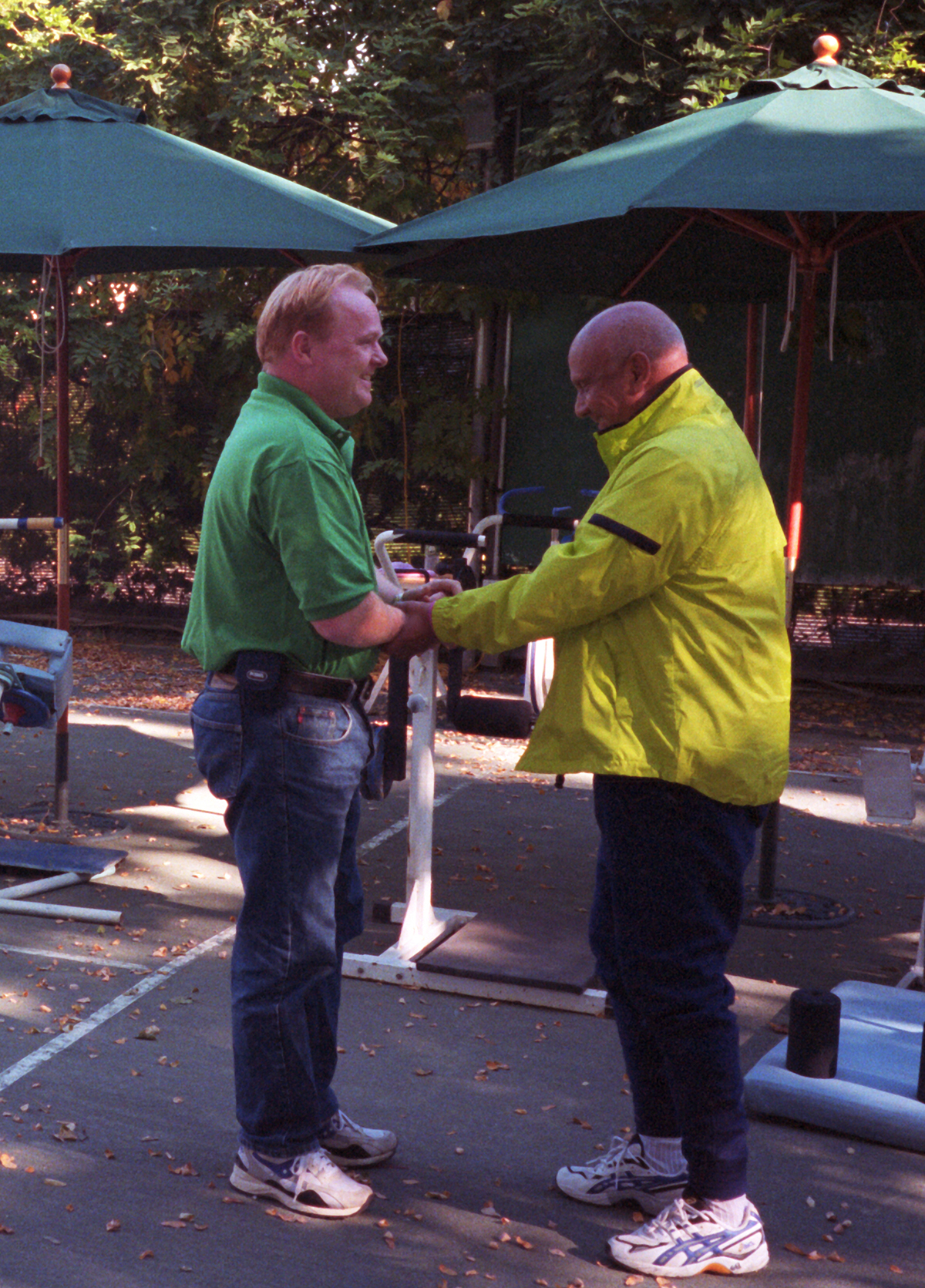
Per Sandberg, a Member of the Norwegian Parliament, visits Sri Chinmoy at Aspiration-Ground in Jamaica, Queens, New York.