December 3
Sri Chinmoy, out for a morning walk in the hotel grounds in Solo, Indonesia. He also offers the following prayer before a two-mile Self-Transcendence Race.
|
Published in My Race-Prayers, part 1
Sri Chinmoy, out for a morning walk in the hotel grounds in Solo, Indonesia. He also offers the following prayer before a two-mile Self-Transcendence Race.
|
Published in My Race-Prayers, part 1
A lecture by Sri Chinmoy
at Harvard University, Boston
In the silent recesses of the Upanishadic heart we see and feel a splendid combination of the soul’s spirituality and life’s practicality. In the world of imagination, in the world of aspiration, in the world of realisation, in the world of revelation, and in the world of manifestation, the soul of the Upanishads has the divine effrontery to assume the sovereign leadership, because that is its natural role. Its understanding embraces all the foibles of weak humanity. Its universal love is the song of self-offering.
The Upanishads are at once the heart’s aspiration-cry and the soul’s experience-smile. They have the vision of Unity in multiplicity. They are the manifestation of multiplicity in Unity.
The message of the Upanishads is the life divine, the life of transformed humanity, and the life of an illumined earth-consciousness. The Upanishads tell us that the renunciation of desire-life is the fulfilling enjoyment of world-existence. This renunciation is neither self-denial nor self-rejection. This renunciation demands the transcendence of ego to breathe in freely the life-energy of the soul and yet to live a dynamic and active life in the world where one can achieve Infinity’s Height, Eternity’s Delight, and Immortality’s Light.
Each major Upanishad is a pathfinder in the forest of experience that comprises human life. Each major Upanishad offers us the intuitive knowledge and the inner courage to find our way through the labyrinth of curves and dead ends, doubts and subterfuges. We come to realise that life is a glorious adventure of the aspiring heart, searching mind, struggling vital, and unsleeping body. We explore the hidden places of illumining individuality and fulfilling personality. Gone is our mind’s obscurity. Gone is our heart’s poverty. Gone is our vital’s impurity. Gone is our body’s insincerity. The train of Light has arrived. The plane of Delight is come.
The Upanishads teach the seeker that Delight is the manifestation of divine Love, Consciousness is the manifestation of the soul-force, and Existence is the manifestation of Being. In Delight Brahman is Reality. In Love Brahman is Divinity. In Consciousness Brahman contemplates on the Vision of perfect Perfection. In the soul-force Brahman becomes the achievement of perfect Perfection. In Existence Brahman is the Eternal Lover. In Being Brahman is the Eternal Beloved.
For God-realisation we need a Guru. The Katha Upanishad says, “A seeker cannot find his way to God unless he is told of God by another.” The Mundaka Upanishad says, “A seeker must approach a Self-knower for his inner Illumination.” The Prasna Upanishad says, “O Father, you have carried us over to the Golden Shores.” The Katha Upanishad says, “Arise, awake! Listen to and follow the great ones.” The Mundaka Upanishad says, “A guru is he whose outer knowledge is the Veda and whose inner knowledge is the contemplation of Brahman.”
A seeker who studies the Upanishads and leads a life of self-enquiry and self-discipline is not and cannot be a mere player on the stage of life, but is rather a spiritual art director and a real divine producer. Further, he has two broad shoulders and does not mind the burdens of the world. He feels that it is his obligation to assuage the bleeding heart of humanity. His life is the independence of thought and spirit. His heart’s dedicated service receives rich rewards from above. He has mastered his own philosophy of life, which is to please Divinity in humanity.
Tach chaks ur debahitam...
May we, for a hundred autumns, see that lustrous Eye, God-ordained, arise before us ...
To live a hundred years is not just to drag out our existence here on earth. One has to fight against ignorance. Desultory efforts cannot carry us to God. It takes time to realise God. It takes more time to reveal God. It takes even more time to manifest God. That is why the Seers of the Vedas prayed for sound health, long life, a life beyond a hundred autumns. They also warned us that anything that is deleterious to our health has to be avoided.
Uru nastanve tan Uru ksayaya naskrdhi Uru no yandhi jivase
Give freedom for our bodies.
Give freedom for our dwelling.
Give freedom for our life.
Vivekananda, the great Vedantin of indomitable courage, voiced forth, “Freedom — physical freedom, mental freedom, and spiritual freedom — is the watchword of the Upanishads.”
In order to achieve freedom, we need energy, power, and spirit. And for that, here is the mightiest prayer:
Tejo joh si tejo mayi dhehi...
Thy fiery spirit I invoke. Thy manly vigour I invoke. Thy power and energy I invoke. Thy battle fury I invoke. Thy conquering mind I invoke.
The Upanishads always hold the intrepid view of life. Progress, constant progress, is the characteristic of the Vedic and Upanishadic age.
Prehi, abhihi, dhrishnuhi.
Go forward, fear not, fight.
Fight against what? Bondage, ignorance, and death. Life is ours. Victory must needs be ours too. Anything that stands in the seeker’s way has to be thrown aside without hesitation. His is the life that knows no compromise.
The main longing of the Upanishads is for the Ultimate Truth. This Truth can be achieved by a genuine seeker who has many divine qualities, and whose love of God preponderates over every other love. The seeker needs three things: vrate, self-dedication; kripa, grace; and sraddha, faith. These three qualities embodied, satya, truth, is unmistakably attained.
Who wants to remain alone? No one, not even the highest, the first-born, Viraj. There came a time when He felt the need of projecting the cosmic Gods. He projected the Fire God, Agni, the only brahmin God, from His mouth. Indra, Varuna, Yama, Ishana and others were projected from His arms. These are the kshatriya Gods. Then He projected the Vasus, the Rudras, the Maruts. and others from His thighs. These are the vaishya Gods. He projected Pushan from His feet. Pushan is the sudra God.
A brahmin embodies knowledge. A kshatriya embodies strength. A vaishya embodies prosperity. A sudra embodies the secret of self-dedication. These four brothers are the limbs of the cosmic Being. Although they are outwardly distinguishable by their quality and capacity, in spirit they are inseparably one.
Brahman, or the Supreme Self, is the greatest discovery of the Upanishads. No human soul knows or will ever know when ignorance entered into us, for earth-bound time itself is the creation of ignorance. Still, a man swimming in the sea of ignorance need not drown. The Seers of the hoary past, the knowers of the Brahman, in unmistakable terms tell us that all human beings can and must come out of the shackles of ignorance. The knowers of the Transcendental Truth also tell us that the individual soul is in reality identical with the Supreme Self. The only problem is that the individual does not remember its true Transcendental Nature. Finally they tell us that “to know the Self is to become the Self.” On the strength of his direct realisation, a knower of the Brahman declares, “aham brahmasmi, “I am Brahman.”
In concluding this talk on the Upanishads, “The Crown of India’s Soul,” my realisation declares that the mind-power, the heart-power, and the soul-power of the Upanishadic consciousness are boundless. In the realm of philosophy, Shankara embodies the mind-power; in the realm of dynamic spirituality, Maharshi Ramana, the great sage of Arunachala, embodies the mind-power. The Christ, the Buddha, and Sri Chaitanya of Nadia, Bengal, embody the heart-power. Sri Krishna and Sri Ramakrishna embody the soul-power. In Sri Aurobindo the vision of the mind-power reached its zenith, and the realisation of the soul-power found its fulfilling manifestation on earth. These spiritual giants and others are steering the life-boat of humanity towards the Transcendental Abode of the Supreme.
Published in The Upanishads: the Crown of India's Soul

A talk by Sri Chinmoy
at the Lake Placid School of Art in Lake Placid, New York
In all walks of life — especially in the athletic world — from the spiritual point of view the whole man represents perfection; the whole man represents satisfaction: perfection for satisfaction and satisfaction in perfection.
Present-day human life, unfortunately, is a far cry from perfection for satisfaction and satisfaction in perfection. Indeed, it offers us a most deplorable picture. Man the body is ignorance. Man the vital is arrogance. Man the mind is doubt. Man the heart is insecurity. But there is also man the soul. The soul, which is inside the body yet far beyond the earth-bound body-consciousness, is the direct representative of our Inner Pilot. Man the soul is aspiration-flight. And finally, man the God is Satisfaction-Delight.
Here we are all seeker-athletes. All athletes, without fail, are potentially great and good. A great athlete is a little man tirelessly inspired. A good athlete is a simple life sleeplessly awakened. The great athlete in us seeks excellence. The good athlete in us seeks transcendence. Excellence quite often arrives at a dead end. Transcendence always reaches an ever-new beginning and an ever-new dawn. Excellence is success and transcendence is progress. The athlete in us is the discoverer of success and the inventor of progress. The outer world is success-thirst. The inner world is progress-hunger.
What about the poor and ill-fated athlete in us? O poor, ill-fated athlete, your prayer will one day change your attitude towards God’s Will. Your ultimate oneness with God’s Will will give you infinitely more happiness than the supremely successful athlete can ever hope to achieve.
There are two worlds: the outer world and the inner world. Even so, there are two competitions: the outer competition and the inner competition. The outer competition begins and ends. The inner competition has a beginningless start and an endless finish. In the outer competition, we compete with the rest of the world. In the inner competition, we compete with our fear, doubt, anxiety, worry and so forth. In the inner competition, we compete with our ignorance of millennia.
Just because time and again we have had deplorable defeats and failures, we must not retire from the athletic world. No, only we have to aspire more soulfully, more devotedly and more unreservedly. We are the connecting link between our aspiration and our inspiration. Aspiration we are; inspiration we offer.
Our aspiration-longing is our ultimate becoming. Because we long for something, eventually we become that very thing. Our longing is our self-transcendence. Transcendence always will lead us far beyond the domain of cancerous fear and poisonous doubt. Freed from fear, we become great. Freed from doubt, we become good. Greatness influences the outer man. Goodness inspires the inner man. Greatness, no doubt, eventually triumphs; but goodness eternally reigns supreme in the heart of aspiring mankind. Greatness haughtily and incorrectly says, “I have everything, I am everything.” Goodness humbly and soulfully says, “My Beloved Lord Supreme is all Compassion for me. Out of His infinite Bounty, at His choice Hour, He will grant me what He has and what He is.”
Let us all aspire. To aspire is to widen our horizons. Our eternal journey’s eternal cry is man the God. Our infinite Goal’s infinite Smile is God the man. Let us share this unparalleled wisdom with the rest of the world and thus liberate bondage, radiate love, lengthen peace and strengthen oneness. Oneness manifests fulness, and fulness is the whole man. Since we are primarily dealing with the athletic world, let us go to its source: the Olympics. The Olympics is an unprecedented, auspicious, glorious and precious Greece-Vision. And what is this Vision? This Vision is nothing other than world-happiness. Happiness is love bubbling forth into the newness and fulness of true life, illumining life and fulfilling life.
The Olympics towers above all man-made differences. It is infinitely bigger than race. It is eternally brighter than colour. It is supremely better than religion. It is not only constantly one with the evolution-hunger of aspiring mankind but it is also humanity’s satisfaction-meal and perfection-nourishment.
The human athlete in us clings to great expectation. The divine athlete in us clings to an existence — life which is surrendered to God’s Will, Him to please in His own Way. The Supreme Athlete in us is God. God the Supreme Athlete has three members in His immediate family who walk in His Footsteps: His son, Speed; His daughter, Skill; and His son, Strength. Skill helps her brother, Speed, and this way Speed achieves supreme victory and supreme glory. When necessity demands, Skill also helps her brother, Strength, and Strength achieves boundless glory and boundless victory. Again, when it is necessary, the sister helps both the brothers together to achieve supreme victory and supreme glory. Meanwhile, all the time the Father watches. While watching, He blesses His daughter, Skill, inside the gratitude-hearts of His sons, and the three children, in return, offer to the Father their victory’s breathless silence and deathless sound.
Published in The Oneness of the Eastern Heart and the Western Mind, part 3
Sri Chinmoy offers the U Thant Peace Award to Jorge Illueca, President of the UN General Assembly, Foreign Minister and Vice-President of Panama (1983), in Jamaica, Queens, New York.
“It is our duty as individuals who have higher aspirations to lead the way by achieving a spiritual awareness. We are blessed with the splendid example of Sri Chinmoy. His life is a symbol of holiness. He is an ambassador of peace whom every people can claim as their own. His very presence brings to us in the United Nations new possibilities, new ideas and new hopes.” — Jorge E. Illueca, President of the Thirty-eighth Session of the United Nations General Assembly and President of Panama
Sri Chinmoy receives a congratulatory letter from former President of the United States, Jimmy Carter.
I am proud of the contributions you have made in revealing the inner joy and peace of a true and lasting world. — Jimmy Carter, 39th President of the United States
Sri Chinmoy meets with his good friend Father Tom at Annam Brahma restaurant in Jamaica, Queens, New York.
A lecture by Sri Chinmoy
at the Dag Hammarskjöld Auditorium
United Nations, NewYork
Western dynamism lives in its searching mind and manifesting vital. Eastern spirituality lives in its crying heart and illumining soul.
Spirituality is the inner urge of an Eastern seeker to see God face to face and realise God in His totality. Dynamism is the vital urge of a hero Westerner to reveal God and manifest God here on earth. Dynamism serves God. Spirituality loves God.
The body's dynamism is regularity. The vital's dynamism is punctuality. The mind's dynamism is clarity. The heart's dynamism is purity. The soul's dynamism is certainty.
The body's spirituality is simplicity. The vital's spirituality is sincerity. The mind's spirituality is humility. The heart's spirituality is spontaneity. The soul's spirituality is Reality.
A dynamic man is quick on his feet to reach his destined Goal, the Goal of the Beyond. A spiritual man is quick with his answers and pleases God, the Inner Pilot, in His own Way.
Dynamism is the life's capacity. Spirituality is the soul's necessity. The aura of outer success surrounds a dynamic man. The aura of inner progress surrounds a spiritual man.
A dynamic man is a Karma Yogi. He devotes himself to the path of action, disinterested action, with implicit devotion and surrendered service to God. A spiritual man is a Jnana Yogi. He tries to live in the knowledge of God with his awakened and illumined mind and heart. Dynamism invites God. Spirituality receives God. Yoga achieves God.
Western dynamism wants to shoulder the responsibility of the entire world. Eastern spirituality tries and cries to know what God's Will is and what God wants.
Western dynamism needs the aspiration of Eastern spirituality in order to please God in the inner world. Eastern spirituality needs the inspiration of Western dynamism in order to please God in the outer world.
Western dynamism has to learn the secret of Eastern spirituality: Love is God, God the Supreme Lover. Eastern spirituality has to learn the secret of Western dynamism: God is the Supreme Warrior, the Supreme Victor over teeming ignorance and darkening death.
God needs Western dynamism to offer His Omnipotence-Light to the world at large. God needs Eastern spirituality to offer His Ocean of Love and Peace to the world at large.
Western dynamism and Eastern spirituality are the two wings of God the Eternal Bird, who will carry the message of earth's aspiration to the highest Abode of the Supreme, and who will bring down the message of infinite Compassion from the highest Abode of the Supreme to the aching, crying consciousness of Mother Earth. When Western dynamism and Eastern spirituality become inseparably one, God will be known as a fulfilled Man, and man will be known as a perfect God.
Published in The Garland of Nation-Souls
by Sri Chinmoy
at Pangkor Island Beach Resort in Malaysia
The national anthem of Bangladesh is sweeter than the sweetest, and most difficult! Please come and sing it. It is such a sweet song, and it was written by a Bengali, Tagore. He is the only one who can claim two national songs to his credit. No other poet can make that claim. Tagore is the only one who has two national songs to his credit — for India and for Bangladesh.
Such a sweet song, such a sweet song! It is a sweet and melodious description of Mother Bengal.
When you sing my song Amar Sonar Bangla, you have to get the sweet, emotional Bengali feeling. Please read the translation and get the feeling, so that it will appeal to the Indian and Bangladeshi ears. Sweetness has to be flowing; tender feeling has to be flowing. It has to be very tender. It does not need at all the power-aspect. There is no power involved — not even one line is powerful. It is all a description of Mother Bengal. It is all sweetness, softness and mellowness. It does not need power at all.
The boys should use their natural voice, and the girls should show their sweet aspect. The real feminine voice is sweeter than the sweetest. Boys should not adopt a feminine way of singing. That becomes unnatural. You are all excellent singers. Boys should sing in their normal voice and girls should use their normal voice. Do not interchange your voices.
If you fold your hands and touch your heart, if you feel your heart-breath, you will do infinitely better meditation. Sometimes you will be able to hear your heartbeat. Then you will do the best meditation. If your folded hands touch your chest, you will do far better meditation. Inside the chest is the heart, and inside the heart is the heartbeat.Please make it a point to touch your chest. Some people are holding their hands away from their chest. If you want to have the best result, please put your hands right up to your heart.
In my Ashram days I always, always held my hands like that. Now I do not; perhaps I have achieved something. When we were meditating inside the meditation hall at the Ashram, we did it. When we were in a long queue, with two hundred people in front of us, we also held our hands like that. When people came to the meditation hall, all their aspiration they brought forward in this way. I was one of those, and like me, many, many used to do the same. Most of the disciples came with folded hands, folded hands.
Spirituality is heart, not head. I am not telling you to put your hands on your head! Put them right here, on your heart. Heart and spirituality cannot be separated. They are inseparable. Inside the heart is the living Presence of God.
The disciples of one Master may not appreciate another Master, but I do not want my disciples to be like that. You should have the deepest appreciation and admiration for other spiritual Masters if they are of the highest rank, like Sri Krishna, the Lord Buddha, the Saviour Christ, Sri Chaitanya, Sri Ramakrishna, Sri Aurobindo and Ramana Maharshi. Of course, when I say Sri Aurobindo, the Mother is included; and when I say Sri Ramakrishna, Sarada Devi is included. These are real, real Masters. Swami Vivekananda is also included. Although he is not of their calibre, he is a real spiritual giant.
If you have most sincere appreciation, admiration and even adoration for these genuine spiritual Masters, I will not mind — on the contrary!
We read books about spiritual Masters, and so many stories are true, absolutely true. If you read them, you have to believe them. You may not be able to go up to reach their spiritual height, but what they say outwardly, you have to take seriously. When God chose them at a particular time to be His representatives, His direct representatives, God definitely said many, many, many things that were absolutely divine and supreme.
Some seekers are disciples of one Master, let us say, and that Master has written many books. It may happen that somehow those particular seekers are sulking, they are depressed. At that time, alas, they may not read their own Master’s books, but they may read books written by other Masters, or books containing the utterances of other spiritual Masters of lofty heights. When they read those books, what happens? The disciples of the first Master start shedding tears. All their love and devotion for their own Master comes back. Then their aspiration is renewed, their dedication is renewed — as a matter of fact, it goes even higher. One can get that kind of help by reading the books of other genuine Masters.
Let us say that your path is not fulfilling your desires, so you become very sad and depressed. All of a sudden you snatch up a book written by another spiritual Master. As soon as you see the devotion of the disciples of that Master, all your own devotion and everything else that is good and divine in you comes to the fore. Then you no longer think of that book, you no longer think of that Master; you come back to your own Master with renewed aspiration, dedication and love. Everything divine in you is not only renewed — it increases.
Some may find it difficult to believe; but I am sure there will be people who have had this experience.
Published in My Golden Children
by Sri Chinmoy
at Pangkor Island Beach Resort in Malaysia
There was a very, very famous king who was kindness incarnate, compassion incarnate and self-giving incarnate.
Usually it is impossible for any one person to please everyone but, in his case, all his subjects were extremely pleased with him, extremely grateful to him and extremely proud of him. The king’s name was Ambarish.
The king was a very great and very sincere devotee of Lord Vishnu. Once he decided to fast and pray and meditate for three days without rest in order to receive blessings from Lord Vishnu. It was a special religious rite that he wanted to perform.
For three days Ambarish fasted and prayed and meditated. Then he was so elated and so grateful that he had been able to fulfil his desire that he decided to fulfil the desires of all his subjects.
“Since it will be difficult for me to bring all my subjects to my palace, let me start with the priests,” said Ambarish. “We have so many priests. Since they are spiritual people, I want to please them first.”
The king invited all the priests to an elaborate banquet. After the banquet, he was planning to give boons to each guest. Ambarish himself did not want to take even a morsel of food or a single drop of water. Nothing at all! He was not fasting unto death; there was no threat involved. Ambarish was trying to win Lord Vishnu’s special blessings by performing this penance.
The priests were all ready to begin eating. All of a sudden the great sage Durvasha appeared. Durvasha was known for his very quick temper. In a second, he could destroy anyone. This kind of occult power he had, and he misused it millions of times.
Everyone was shocked to see Durvasha. King Ambarish greeted him very respectfully. “O great sage,” he said, “we are honoured by your presence. You are our guest of honour. Please allow me to serve you first.”
“No, Ambarish,” replied Durvasha, “I am going to bathe in a nearby river. After I have washed myself completely, I shall come to eat.”
Durvasha went to the river. Half an hour passed, then an hour, two hours, three hours. He was enjoying himself. Even after four hours, there was no sign of his return. For the special kind of worship that King Ambarish was performing, one has to resume eating at a certain hour, after having completed the fast. One of the priests said to Ambarish, “O King, if you do not eat during this special hour, you will commit a sin, according to our Shastras.”
“What am I going to do?” asked the king. “If I do not wait for Durvasha and offer him food first, he will curse me. And if I do not eat during this most auspicious hour, I shall be committing a sin.”
The priests held a consultation, and then they advised the king, “You are such a good, kind-hearted king. We do not want you to suffer. This anger-flooded sage should suffer! Drink just a drop of water. Then you will be able to say to Durvasha that you have not eaten, but at the same time you will be able to please God because you have taken something.”
Ambarish put a little drop of water in the palm of his hand and was about to drink it when, lo and behold, Durvasha appeared. He was furious. “What kind of audacity is this?” he shouted. “I am such a great sage. How dare you drink without giving me food first? I curse you!”
From his matted hair, Durvasha removed a few strands and turned them into a chakra, a disc. He released the disc, and it flew very fast towards Ambarish to kill him. Ambarish prayed to Lord Vishnu, “O Lord Vishnu, what have I done? I did not want to drink, but my priests said I should. They said that otherwise I would be committing a sin because I would not fulfil my vow. Now I have to face Durvasha’s wrath.”
Lord Vishnu immediately sent his Sudarshan chakra to intervene. This chakra came down from Above and broke Durvasha’s chakra into pieces. But that was not enough. Vishnu’s all-conquering Sudarshan chakra started chasing Durvasha here, there and everywhere. Durvasha ran for his life. He even ran into the river, thinking that the disc would not follow him there, but no matter where he went, Vishnu’s Sudarshan chased him. At any moment, he was about to lose his life.
Finally, the sage went to Brahma, the Creator, and pleaded, “O Brahma, please, please, save me, save me! Vishnu’s chakra is about to kill me.”
“You fool!” Brahma replied. “How will I dare to challenge Vishnu’s chakra? I am not going to do anything.”
Then Durvasha went to Lord Shiva. Shiva is so fond of Vishnu. Shiva became furious with Durvasha. “Just run away from here!” he said. “Otherwise, I will destroy you! You will not have to wait for Vishnu’s chakra. I am going to destroy you here and now! What an unthinkable thing you have done to Vishnu’s devotee! Our devotees are dearer than our lives themselves.” Shiva scolded and insulted Durvasha mercilessly.
In our Indian philosophy, if a Master has a very sincere and excellent devotee, he is ready to sacrifice his own life for the devotee.
Then the helpless, hopeless and useless Durvasha went to Lord Vishnu for forgiveness. “Am I going to forgive you?” said Vishnu. “Ambarish is dearer than the dearest to me. He is dearer than my life itself. I am not going to help you. How could you do such an unthinkable thing to such a good king? Go and beg Ambarish for forgiveness!”
Poor Durvasha had to go to Ambarish and beg for forgiveness. “Please, forgive me, forgive me, forgive me! Save me!” he wept.
Ambarish said to Durvasha, “I have no power. I can only pray to my Lord Vishnu. He is the one who is about to kill you.” Ambarish prayed to Vishnu, “My Lord, please, please, forgive him.”
Vishnu said, “Only because of you, I am forgiving him. Because you are so dear to me, I will always listen to your request, but not to his request.”
Then Vishnu forgave Durvasha and Vishnu’s chakra stopped chasing him. Durvasha asked Ambarish, “How is it possible? Brahma did not dare to challenge Vishnu’s chakra. Shiva did not dare. On the contrary, they both insulted me and scolded me brutally. And Vishnu himself did not forgive me. But your forgiveness immediately produced results.”
“O Durvasha, you know that it is not my power,” replied Ambarish. “It is my Lord Vishnu’s Compassion-Power. I prayed to him only to become a better king. That is why I observed that particular religious rite of fasting for three days. It was nothing. Anybody could do it — just three days of fasting. I did not drink, I did not eat anything. But my Lord Vishnu’s Compassion is infinite. His Love for me is infinite. It is his Love for me that wanted to punish you. It is his Compassion for me.”
In India, there are millions of mythological stories about this kind of injustice and retribution. If someone does something wrong to a sincere devotee, then from Above not only these three main Cosmic Gods — Brahma, Vishnu and Shiva — but others also punish the culprit. Whenever their super-excellent devotees are in trouble, the Cosmic Gods immediately take their side.
This is an authentic story of how Lord Vishnu wanted to glorify Ambarish because, as a king, Ambarish was kindness incarnate, compassion incarnate and self-giving incarnate.
Teacher, or Guru, was teaching religious as well as regular studies in ancient India. In India, even a school teacher is called a Guru. In the morning, about fifteen or twenty young boys used to go to their Teacher’s school to study and play, and in the late afternoon they used to come back home.
One day the Teacher asked a particular boy to do something. What was it? While the students were playing, the Teacher summoned the young boy and said to him, “Throw my child into the well.” The Teacher’s child was only five or six years old, but the student did not hesitate, even for a fleeting moment. He grabbed the child and threw him into the nearby well. The other students noticed it and came running. Two or three entered into the well and brought the child back out, and other students thrashed the particular student who had thrown the child into the well. The student did not say a word. Meanwhile, the Teacher was watching the whole situation. He also did not say anything.
A few months later, while the students were playing, the Teacher summoned the same boy and said to him, “Set fire to my house.” Again, the boy did not hesitate for a second. He immediately set fire to his Guru’s own house. The Guru’s wife was inside, and she was shouting and screaming. Then, as before, the rest of the students struck him mercilessly, saying, “How did you dare to set fire to our Guru’s house?” Again, the boy did not say a word. He did not say that his Guru had asked him to do this, and the Teacher also was silent, not saying anything. The other students could not fathom it: how could the Teacher be so indifferent?
As the days ran into weeks, the weeks into months, and the months into years, there came a time when the students grew up and entered into their own way of life. By this time, the Teacher had become very, very old, so he invited all his various students, past and present, to come and see him. They all came, and the Teacher started blessingfully giving them some material objects, such as plots of land and other things. Whatever he had, he wanted to give away to his students. They were all very happy. Then they noticed that for some reason, that particular student did not receive anything, perhaps because the Guru felt that he had not been a good student. The others were wondering why the Guru had not given him anything.
At long last, the Teacher said to the boy, “I have nothing to give you on the material plane that will equal your obedience. I have never seen, and I will never see, anybody who is so devoted to his Teacher. I have never seen anybody as obedient as you are, and whatever I give on the material plane will not be equal to your obedience.”
Then the Teacher said, “I am giving you a boon. The boon is this: in a few years, the Lord Himself will come to you as your student. Lord Krishna will come and be your student. This is the greatest gift that I can give you. I am the happiest person to tell you that the Lord Himself will come and study with you.” The name of this particular student was Sandip Muni. He became the Guru of Sri Krishna. He had this kind of obedience to fulfil his Teachers requests.
Later Sri Chinmoy tells his students, “This is a most significant story. I shall be grateful if you occasionally read this particular story. Then you will know the real meaning of obedience.”
Published in My Golden Children
Sri Chinmoy offers a Peace Concert and New Year’s Concert at Washington Irving High School in New York.
Sri Chinmoy runs the Jersey Shore Marathon in a time of 4:33:55 — at an average pace of 10:27 per mile — in Asbury Park, New Jersey. The race is Sri Chinmoy’s 7th marathon completed in the first nine months of taking up the sport.
Reprinted in The Expanding Light, pages 54 and 55
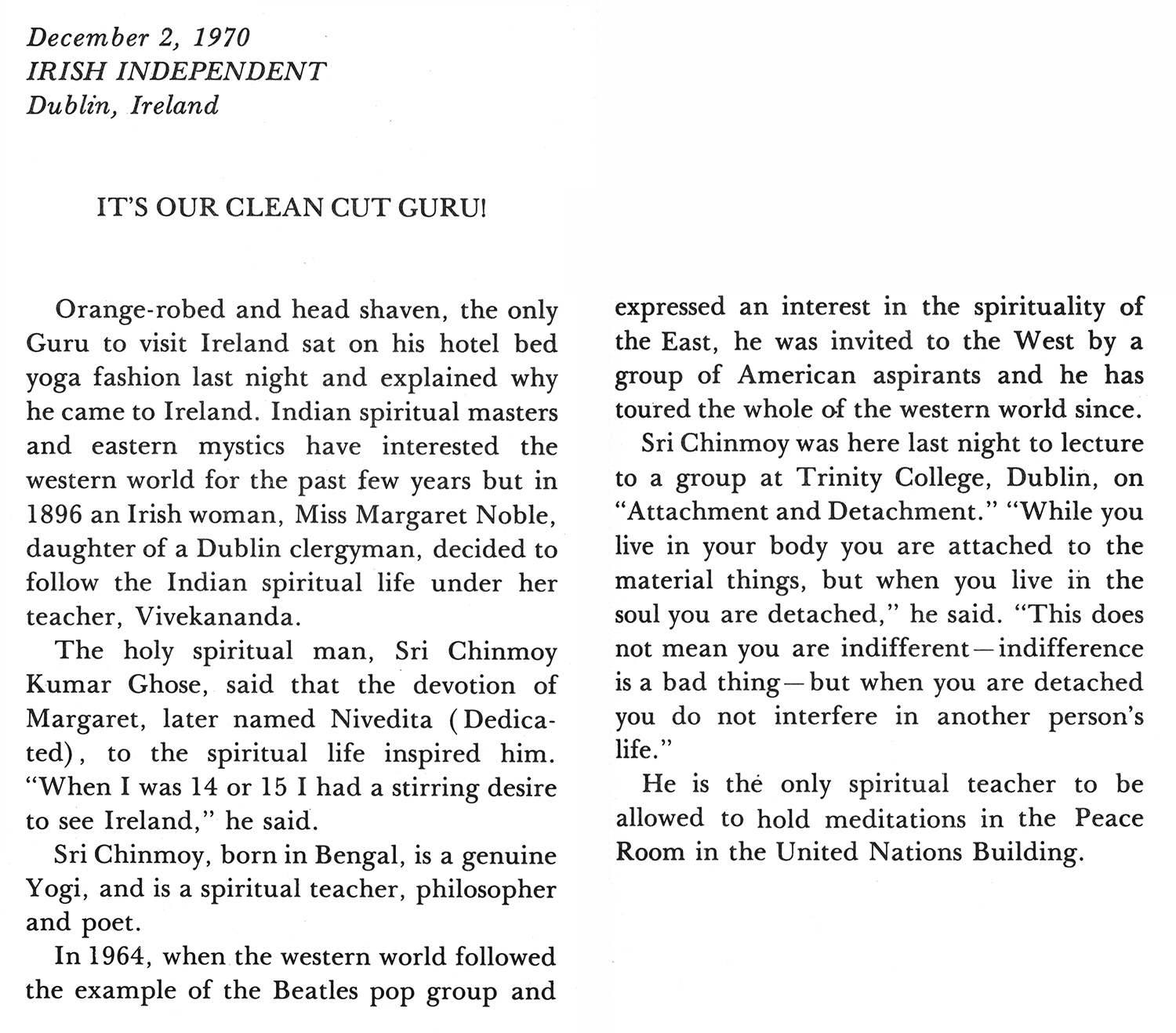
Orange-robed and head shaven, the only Guru to visit Ireland sat on his hotel bed yoga fashion last night and explained why he came to Ireland. Indian spiritual masters and eastern mystics have interested the western world for the past few years but in 1896 an Irish woman, Miss Margaret Noble, daughter of a Dublin clergyman, decided to follow the Indian spiritual life under her teacher, Vivekananda.
The holy spiritual man, Sri Chinmoy Kumar Ghose, said that the devotion of Margaret, later named Nivedita (Dedicated), to the spiritual life inspired him. “When I was 14 or 15 I had a stirring desire to see Ireland,” he said.
Sri Chinmoy, born in Bengal, is a genuine Yogi, and is a spiritual teacher, philosopher and poet.
In 1964, when the western world followed the example of the Beatles pop group and expressed an interest in the spirituality of the East, he was invited to the West by a group of American aspirants and he has toured the whole of the western world since.
Sri Chinmoy was here last night to lecture to a group at Trinity College, Dublin, on “Attachment and Detachment.” “While you live in your body you are attached to the material things, but when you live in the soul you are detached,” he said. “This does not mean you are indifferent — indifference is a bad thing — but when you are detached you do not interfere in another person’s life.”
He is the only spiritual teacher to be allowed to hold meditations in the Peace Room in the United Nations Building.
Published in the IRISH INDEPENDENT Dublin, Ireland, December 2, 1970