December 31

A New Year’s Message

Sri Chinmoy delivers a talk in person
to his disciples of the Aum Centre in Puerto Rico

A New Year dawns. A new year, a new aspiration, a new dedication, a new realisation enter into us. Let us enter into the Supreme with a new joy, a new achievement and a new, constantly surrendering attitude. We are always fond of the “new”. Tomorrow, on New Year’s day, that new newness will enter into us. What can we expect from tomorrow? We expect that which we do not have right now: freedom from bondage, freedom from limitation, freedom from disease, freedom from death. Our expectation is not enough. In addition to our expectation, we must cultivate deep within us the firm determination that we shall have it, that we are bound to have all these divine qualities.

I always say, “The past is dust.” Once again I repeat, “The past is dust.” Why? The past has not given us what we have been striving for. So the past is of no use. It is the present and the golden future that enters into the present and make us feel what we are going to be, nay, what we truly are. We are not children of the past, but the children of the glorious future. There are many things we want to do, we want to achieve. But unfortunately we have not been able to achieve them. Why? Because our aspiration is not intense, our determination is not firm, our cry, our inner cry is not genuine. There is no end to the progress we can make and each New Year comes and stands in front of us and reminds us of that very fact: that there is no end to our progress, both the inner progress and the outer progress.

How can we transcend ourselves? We can transcend ourselves the moment we feel that Self-realisation or the conquest of the self is our birthright, our divine heritage. It is not that somebody has to come and thrust upon you this divine heritage. We have to leave aside, cast aside, throw aside doubt, one of our greatest enemies. Doubt does not allow us to go one inch forward or one inch backward. When we want to look forward, doubt says, "No, you are not so good." And when we want to look back, a kind of subtle doubt again tells us, "No, you cannot be so bad." Doubt never, never allows us to see the truth, to know where we actually stand. We stand right in front of God. Where are we seated? We are seated in the Lap of the Supreme.

Let us cry. The world needs seekers who will cry like a child for the Mother. We have forgotten how to cry. We know how to talk, how to impose truth on others, how to convince others of what we have acquired or what we have learned. From today on, let us cry from the innermost recesses of our hearts, Him to possess and Him to reveal. Without the Supreme, we do not exist. It is an unpardonable foolishness on our part when we say that we exist. No, we do not exist, we can never exist even for a second without Him. If you really, sincerely, whole-heartedly care for the Truth, my fervent request to you is to go deep within and try to discover your own divinity.

I am there to be your eternal slave. I shall wash the very dust of your feet the moment you feel that you are prepared to cry, cry whole-heartedly for the Supreme.

All of us present here, all our true members of the family here, must, once and for all, cast aside doubt. We must always feel that we are the children of the Supreme. We are growing together, we are fulfilling the Supreme together. The Supreme is entering into us to inspire us to dive into the deepest, to fly into the highest, to run toward the farthest.

In the name of the Supreme, I bless each and everyone present here and all those who are in my Boat, who need my help, my guidance, my assistance. It is not just for a year but forever, for eternity. I shall be a loving, dedicated servant, a slave, to all of you who care for the Supreme and for the Supreme alone. If one says or feels that the Supreme is his or hers, then at that very moment that very person can rest assured that I am there to serve the person, to be of immediate service. For me there can be no greater joy, no greater pride than to serve the seekers of Truth. And this is my soul’s promise to each of you on the eve of the New Year.


Published in AUM — Vol. 4, No. 6, Jan. 27, 1969

Questions and Answers

after Sri Chinmoy’s talk on the New Year.


Question: If somebody wants to choose one time of the year to make a new start — such as your birthday, or the anniversary of our joining the Centre, or our own birthday, or the beginning of the New Year — are each of these times equally good?

Sri Chinmoy: My birthday, your own birthday, the anniversary of your becoming a disciple, the day I came to America — all these are most significant days. Every hour cannot be the same. The way you can meditate early in the morning at six o’clock, you will not be able to meditate at twelve noon, unless you are an expert. Early in the morning, it is quite easy. Later in the day, it is not so easy. It is not impossible, but it is not easy.

When we remain here, in the earth-bound life, we cannot say that every day is equally important. No, every day is not equally important. Some days are bound to be more important than other days. That is why we observe anniversaries and birthdays. When a birthday comes, at that time we say to ourselves, “Why did I come here? Have I made any progress since I accepted the spiritual life? In some fields I have made progress; in other fields I have not made progress, or I have gone backwards.”

In your case, you have made so much progress in music. But again, you are losing your spontaneity and childlike consciousness. I am telling you about your progress and backward march for your good. You have made progress in one thing and gone backwards in another. If you had maintained your childlike consciousness, it would have given tremendous joy to your soul. Like this, everybody is a culprit. People have made considerable progress in one thing and in another field they have lost their previous standard and climbed down instead of up.

So you can choose any date you want to make a new start, but once you start, then you have to continue. Otherwise, on your birthday you will try to meditate very soulfully and the day after your birthday you will say, “Yesterday I meditated so soulfully. So today I do not have to meditate.” Our human life is like that. We eat voraciously one day and the following day we do not want to eat. But in the spiritual life, we have to eat every day because our capacity to eat is unlimited. God’s Affection, Love, Blessings, Concern and Compassion are unlimited, so God gives us unlimited receptivity.

Question: I used to meditate for half an hour every morning, but recently I have only been meditating for fifteen minutes. Is it better to meditate longer?

Sri Chinmoy: If you can continue, certainly. Do you think if you meditate more than fifteen minutes and still maintain your height that it will not be better? If you can meditate for half an hour instead of for fifteen minutes, certainly it will be better for you.

Some people just wait to see when fifteen minutes are over. They meditate on the hands of the clock rather than on their hearts. Instead, if you want to try to hear the sound of your heartbeat, that will be very good. Then, after you develop the power of concentration, you can meditate on your heartbeat in any part of your body. If your mind is bothering you, you can bring the hammer — the heartbeat — there and strike the mind so that it will be good.

Question: Every time you give a special talk, I become so inspired. Then, after a few days or a week, it goes away. Is there any way I can remain inspired?

Sri Chinmoy: The question is whether you really want to maintain that inspiration. Edmund Hillary climbed up Mt. Everest, but he did not do it in one stroke. For a week he halted and then he started again.

You say that you are not maintaining the same inspiration and aspiration after a week. What you have to do is see how far you have come during that week and then look up to see if there is any space for you to go higher. You will see that the distance which you have covered is next to nothing, whereas the distance you have yet to cover is very great.

What actually happens is this: the disciples, after climbing up five feet, think that is enough. They get a complacent feeling, and this complacent feeling is their worst enemy. They are so happy that they have climbed up five feet, but they have to feel that they have to climb up five million metres! They have to feel, “Oh, if only I had climbed up seven inches more, I would have been still higher. So let me continue.”

The very fact that you climbed up five feet should give you enthusiasm and inspiration to go higher. In the spiritual life, we cannot remain at one place. In the ordinary life, you can reach a certain point and stay there for ten or twenty years, or for the rest of your life. But in the spiritual life, every day you have to make a new attempt. Otherwise, you will come back to your same old, stupid self.

If you want to maintain your enthusiasm and determination, you have to feel that no matter how far you have come, it is practically nothing compared to the distance you have to go. And also you have to feel that if in one week you had the capacity to climb up five feet, then you have the capacity to climb up another five feet the following week. In this way, you will be able to climb up to the highest height. But human beings usually do not do that. Either they become tired or they look around and see how far they have come. Then they feel that this distance is enough for the rest of their lives.

So maintain your hunger and thirst. Otherwise, you will go back to your ordinary life and your mind will again become totally unspiritual. When you take part in a tug-of-war, so many times you come back five inches and then go five feet forwards. Such a struggle goes on — forwards and backwards. Like that, you have to continue to struggle in order to make progress in the spiritual life.

Question: Sometimes the outer conditions make it difficult to meditate.

Sri Chinmoy: Everybody has the same problem: it is too hot or too cold, or something else. Unfortunately, the world is like that. If you are inside the meditation room, it is too hot. Again, outside the sun is very bright. Either way there is a problem. The place is not good; the sun is bothering you; there is too much noise — in addition to the inner difficulties that you face! But instead of thinking of the difficulties, try to think of it the other way: think of the opportunities. One approach is to think of the hurdles that you face in life. Another approach is to think of the joy that you will get after crossing over the hurdles. You have to say, “If I cross over the hurdles, which I can and I must, then I will be so happy.” This way of seeing things increases your inner and outer capacity.

Sometimes the outer conditions make you feel absolutely miserable when you are meditating. You can easily surrender and say, “It is not my fault. It is nature’s fault.” In this way, you can justify your surrender very nicely. But the other way is to say, “If I can meditate in spite of this opposition, then I will become a better, stronger disciple.” Instead of surrendering to those obstacles, regard them as opportunities to make progress.

Spiritual people are supposed to be warriors. When we face obstacles, we have to conquer them. This has to be our attitude all the time. Otherwise, if we surrender to circumstances, we will never be able to do anything. So if you think of the happiness you will get when you conquer the obstacles that you are presently facing and if you can bring that happiness forward, it will give you added strength. And that strength will give you the capacity to meditate more peacefully.


Published in Sri Chinmoy Answers, part 34


Three Stages of the Mind

by Sri Chinmoy
 

Question: Does my mind have any special message for me?

Sri Chinmoy: The mind goes through three main stages. First is the sleeping stage, when the mind is fast asleep. Then comes the stage when the mind is awakened, and finally there is the stage when the mind becomes illumined. Again, there are many levels within each stage, but these are the three main categories.

Definitely your mind is not asleep anymore. You are not in ignorance-sleep. Your mind is between the awakened stage and the illumined stage. When you are in the illumined mind, when your soul’s light is powerfully working in your heart and inside your mind, at that time you are saying the right thing to the right person and doing the right thing for the right person. You are telling the right person to do the right thing, but the wrong person you are not telling this. It is not because the wrong person is your enemy or because it is beneath your dignity to tell him. No, only the wrong person’s hour has not struck, and if you tell him to do what for somebody else is absolutely the right thing, it will only expedite the other person’s destruction.

Again, when you are just in the awakened mind, at that time you show kindness and sympathy to people who not only do not deserve it but also misuse what you are offering to them. You will say that once you are kind to them, your task is over. But you have to know that your kindness can be used in a very wrong way. If somebody comes to you and asks for a dollar, because you have a big heart you will give him the dollar. But you have no idea whether the person is good or bad, or what he plans to do with the money. Perhaps he will use it to take a subway or taxi to a church, where he will pray and meditate and try to become a better person. That is very good. Again, perhaps the person will go to a bar and drink and lower his consciousness. Then who is the culprit? You are so happy that you have shown your generosity and charity, but you have actually made a mistake.

You may try to escape by saying, “I did not know.” But an unconscious mistake is still a mistake, and it can produce bad results. Even if unconsciously I touch fire, I will still burn my hand. Similarly, unconsciously you have helped someone become worse than he otherwise might have been. If you had not helped that person, at least for a short while he would have been a slightly better person.

In your case I will give you an example of what is happening. You are showing compassion to people who are misusing it and thus heading towards even greater destruction. When some people give up their spiritual life, you feel sad and miserable. You feel that perhaps if you had not said this or if you had said that, they would not have left the spiritual path — as though you are responsible for their leaving. God cannot save that person from destruction, the Master cannot save that person; but you think that perhaps if you had done something or said something, in some way you could have prevented or delayed that individual’s departure. That is a real mistake. I am saying “you,” but this applies to many people.

It is far better to remain in the awakened mind than in the mire of ignorance-sleep. But the awakened mind may not always have the necessary wisdom to do the right thing. You are awakened to the point where you want to be kind and nice to people. I am not asking you to be indifferent to people — far from it! But kindness has to be accompanied by inner light. If kindness does not carry inner light, then it can be misused very badly.

The awakened mind believes in charity, patience, compassion and so on. Because it is awakened, it feels a vast consciousness entering into it. It is like what happens when somebody’s flower-heart blossoms; at that time the heart becomes big. So the awakened mind immediately looks to this side and that side and tries to do the right thing. Unfortunately, it does not always know what the right thing is or how to use its expanded consciousness correctly.

So it is always good to use the mind that has got direct light from the soul, which comes through the heart. That is the mind that will save you. If you cannot use the illumined mind, then try to remain between the awakened mind and the illumined mind. But do not remain directly in the awakened mind. If you have got a big mind, and with your big mind you are trying to be generous, kind and hospitable, then you will be in trouble.

I am catching your mind; you have made mistakes. You have to know that, when the hour strikes, people come; and again, when the hour strikes, people go. We cannot make them stay on the spiritual path. It is very difficult, because our heart’s magnanimity comes to the fore and we want to use kindness. We see that so-and-so has been with us for so many years. For years and years somebody was on the top of the tree eating most delicious fruit. Now that particular person has come down, and there is every possibility that a hungry wolf or tiger will be waiting at the foot of the tree to devour him. But what can we do? Only at the top of the tree can he be safe.

I tell you, I make the same mistake; but in my case, I do not give up. In your case, you make the mistake and after two days you give up. But because I deal with the soul, I struggle and struggle and struggle. Some people who left our path ten or twelve years ago still very kindly show up at my heart’s door. At that time, my door is still not closed. Are you thinking of someone who left the path ten years ago? For you, enough is enough. But I go on trying to help them.


Published in Sri Chinmoy Answers, part 1


Prayers for the New Year

by Sri Chinmoy
very early in the morning
in Qingdao, China

4.

The new year bravely
Wakes up.

5.

Happy New Year,
Happy New Year!
Be brave, be brave!
No fear, no fear!

6.

Happy New Year,
Happy New Year!
Go forward,
Fly upward,
Dive inward!
No fear, no fear!

7.

Happy New Year!
God the Eye you claim,
God the Heart you claim
And God the Life you claim.
Claim, claim, claim, claim God.
No fear, no fear! 


Published in My Early Morning Prayer-Journeys, part 2


December 31

Sri Chinmoy runs the Sri Chinmoy Marathon in a time of 4:33:43, in Okinawa, Japan.


Photo by Adarini Inkei


Sri Chinmoy offers prasad after the morning 2-mile race in Curitiba, Brazil.


Race Prayer

by Sri Chinmoy
in Curitiba, Brazil

My Lord,
You are commanding me
To join You
In Your beginningless
World-transformation-task.
Therefore, my heart is all gratitude
To You.


Published in My Race-Prayers, part 1


December 31

Photo by Pulak Viscardi


Sri Chinmoy lifts 37 people including Remang ak Japar (right in the top photo; left in bottom photo), an 86-year-old headhunter and renowned Iban jungle warrior from the Iban tribe in Sarawak, who was awarded the George Cross by Great Britain for his great valour and heroism during WW II, at the Holiday Inn in Kuching, Borneo, Malaysia. The lift was the Sri Chinmoy’s 1,000th in his ‘Lifting up the World with a Oneness-Heart’ programme.

Sri Chinmoy also lifted the chief of the Dayak tribe Bansing ak Usah (left in the top photo; right in bottom photo), who was so moved by the experience that he presented Sri Chinmoy with his most prized possession, his grandfather's ring, and made the Master an honorary chieftain.

Afterwards, Sri Chinmoy called the two tribesmen:

”Divine warriors fighting against ignorance.

“You and I are sailing in the same boat, seeking to become good human beings so that God can utilise us in a very, very special way."


The Honorary Chief

The oldest living head hunter (long ago retired) came to see me in Borneo. He was 85 years old.

Then the chief of the tribe came to see me. The chief liked me so much that he gave me his grandfather’s ring. He put it on my finger and said, “I am making you an honorary chief of the Iban tribe.”

I gave the old man a shirt and the young Iban chief an ocarina. They were both very happy.

I also gave each of them six pictures that I had taken myself when they were dancing. Long live my camera!

Both the old man and the chief had tremendous receptivity.

— Sri Chinmoy
6 January 1989


Published in The World-Experience-Tree-Climber, part 7


Sri Chinmoy lifts 54 students and teachers from Toul Kork Primary School at the Intercontinental Hotel in Phnom Penh, Cambodia.


December 31


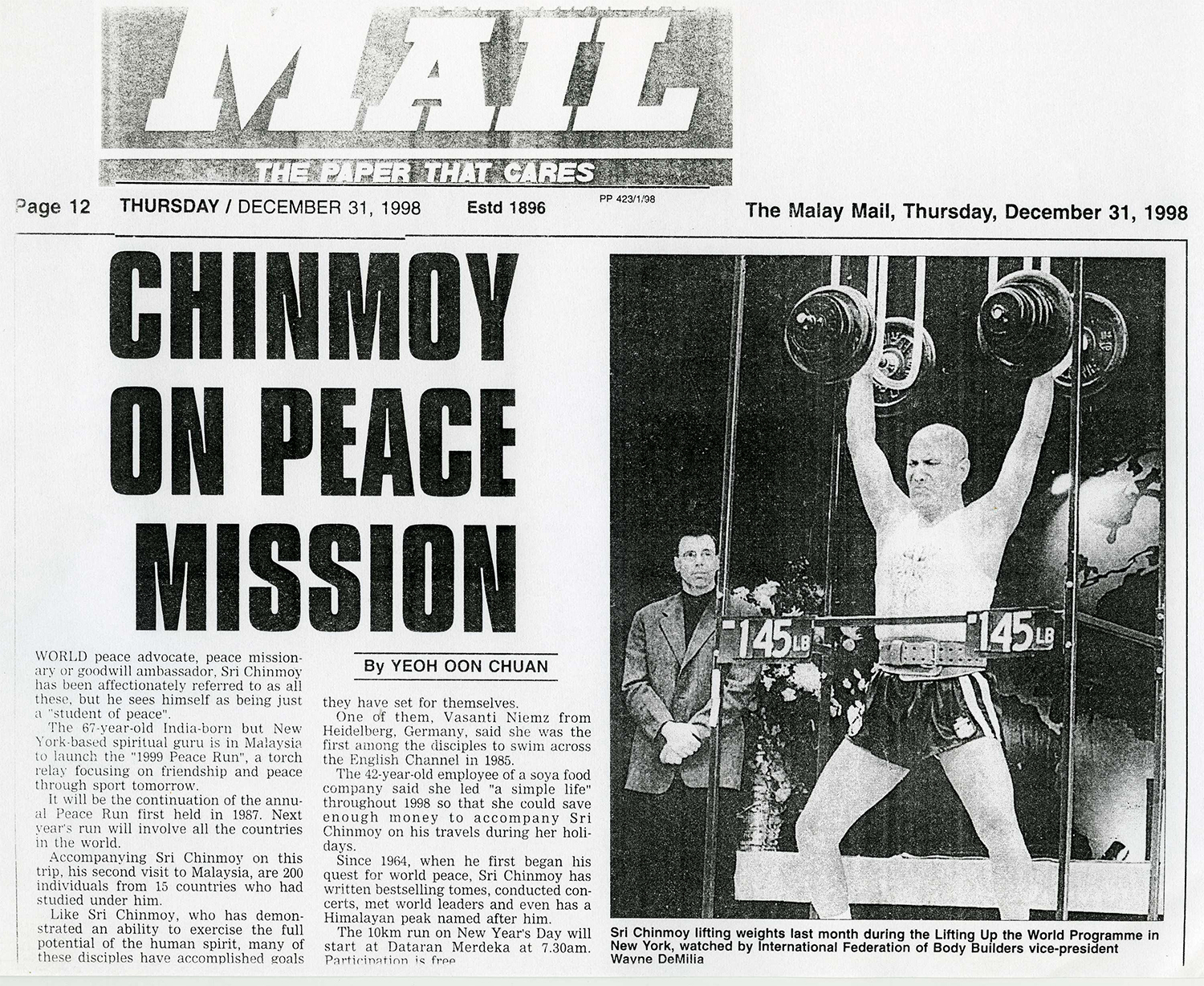
CHINMOY ON PEACE MISSION

By YEOH OON CHUAN


WORLD peace advocate, peace missionary or goodwill ambassador, Sri Chinmoy has been affectionately referred to as all these but he sees himself as being just a “student of peace”.

The 67-year-old India-born but New York-based spiritual guru is in Malaysia to launch the “1999 Peace Run”, a torch relay focusing on friendship and peace through sport tomorrow.

It will be the continuation of the annual Peace Run first held in 1987. Next year’s run will involve all the countries in the world.

Accompanying Sri Chinmoy on this trip, his second visit to Malaysia, are 200 individuals from 15 countries who had studied under him.

Like Sri Chinmoy, who has demonstrated an ability to exercise the full potential of the human spirit, many of these disciples have accomplished goals they have set for themselves.

One of them, Vasanti Niemz from Heidelberg, Germany, said she was the first among the disciples to swim across the English Channel in 1985.

The 42-year-old employee of a soya food company said she led “a simple life” throughout 1998 so that she could save enough money to accompany Sri Chinmoy on his travels during her holidays.

Since 1964, when he first began his quest for world peace, Sri Chinmoy has written bestselling tomes, conducted concerts, met world leaders and even has a Himalayan peak named after him.

The 10km run on New Year’s Day will start at Dataran Merdeka at 7.30am. Participation is free.

Caption:

Sri Chinmoy lifting weights last month during the Lifting Up the World Programme in New York, watched by International Federation of Body Builders vice-president Wayne DeMilia 


Published in The Malay Mail, page 12, Thursday, December 31, 1998


December 31

Photo by Prashphutita Greco


Sri Chinmoy views his Soul-Bird drawings at a gallery in Tokatoka Hotel, Nadi, Fiji. During the day, Sri Chinmoy completes another 15,706 birds, bring his overall total to 826,603.


Video by kedarvideo


December 31

Photo by Sarama Minoli


Sri Chinmoy offers a 7-hour non-stop performance of 100 new Bengali songs, later published as Supreme, Teach Me How To Cry, at the United Methodist Church in Port Washington, NY, USA.


Earth-Planet-Traveller-Pilgrim-Soul

Lyrics:

O my long-short Eternity’s
Earth-planet-traveller-pilgrim-soul,
In your Borneo life-days
You played a splendid head-hunter-Dayak-role.
You passed through ignorance-tunnel-night
Speedily to reach God-Kingdom-Height.


Published in My Aspiration-Heart’s Country-Life-Salutations


Published in Enthusiasm, Part 5, song no. 26


Spirituality and Art

October 6th, 7th and 8th 1975 saw a three-day exhibit of Sri Chinmoy’s art at Manhattan’s prestigious School of Visual Arts. The brief showing was viewed by hundreds of artists, art lovers, art students and art teachers. On the last day of the exhibit Sri Chinmoy gave a short talk on art and spirituality, and answered questions. The Dean of Students, Brian Gormley, who attended the lecture, was later inspired to write a commentary. Sri Chinmoy’s speech and Dean Gormley’s comments are reproduced below.


Sri Chinmoy: Dear Dean Gormley, a few minutes earlier I had the unique occasion to speak with you. Your purity, simplicity, clarity and integrity have touched the very depth of my heart. Today you have given me the golden opportunity to be of service to the God-lover in the artists and art lovers here at this illustrious school. To me, there can be no difference between a true God-lover and an art lover. I offer my most soulful gratitude to you for giving me this opportunity to be of service to seekers of Truth and Light and lovers of universal art.

Before I give a short talk on spirituality and art, I wish to sing a devotional song.

[Sri Chinmoy sang ‘Dipto Madhuri’, a Bengali song written and composed by himself.]


Spirituality and art

Spirituality is realisation, realisation of one’s universal oneness with the Absolute Reality. Art is manifestation, manifestation of the cosmic consciousness, which each human being embodies. Spirituality is transcendental joy. Art is universal beauty. Joy is the source; beauty is the source. We came into this existence from boundless joy. In joy we grow, and at the end of our journey’s close, into joy we shall retire. This joy we experience only when we live in the soul, in the world of the real Reality. If we live in the outer world, our life is nothing but excruciating pangs.

Spirituality is the essence of an ideal. This ideal illumines the world, the world that cries to elevate its consciousness. Art is the expression of an idea. This idea inspires the world to dive deep within and to move forward constantly. Spirituality is an upward movement and art is a forward movement. Spirituality is a soaring bird and art is a running athlete.

Spirituality has a friend: aspiration. Art has a friend: inspiration. Our aspiration-friend tells us that when we reach our destined goal we not only see the face of our goal but we also grow into the very image of our goal. Our inspiration-friend tells us to run forward, for there is the goal. That goal is awaiting us. At God’s choice Hour we are destined to reach that goal.

A seeker tells his artist-friend, “Not this, not this, my friend. Something else here on earth and there in Heaven.” The artist-friend tells the seeker, “This is it. This is the thing that you actually want. I have precisely what you want.”

There is real spirituality and false spirituality, real art and false art. Real art does not imitate anything, not even nature. Real art does not imitate; it only represents. Real spirituality does not reject anything; it only accepts and transforms. Real spirituality is not asceticism. It does not advocate living in hermit caves. Real spirituality is based on vision. Real spirituality tells us to accept life and to transform the undivine in life. Today’s imperfection need not be the imperfection of tomorrow. Tomorrow’s perfection can dawn provided we cry soulfully, ceaselessly and unconditionally for illumining light.

Human art and divine art. The human art is social and commercial success. The divine art is constant outer and inner progress.

Success and progress. Success stimulates us. Progress energises and immortalises us. Success is a short-lived life. Progress is an abiding life. Success can easily be followed by frustration, and inside frustration looms large destruction. But when we make progress in our inner and outer life, we feel a sense of satisfaction. Progress is of paramount importance in our life here on earth.

The human artist and the divine artist. The human artist has as an aim: greatness. The divine artist has a goal: goodness. Greatness consciously or unconsciously creates supremacy. If I have greatness, I must needs be much higher than you. This is the only way I can exercise supremacy and lord it over you. Goodness does not do this. If I have goodness, I can establish my inseparable oneness with you. But if I am higher than you, then I cannot establish my oneness with you on the same footing. To the desire-loving world, God is great. To the aspiration-loving world, God is good.

A divine artist always tries to establish oneness with art, music, poetry. He feels that it is oneness that can offer satisfaction, not separativity or a sense of duality.

With your kind permission I wish to say a few words about my own art. I have been a seeker from the dawn of my life, praying and meditating to realise the ever-transcending Reality. I have been serving seekers regardless of their religion for many years. Service is an outer manifestation of the divinity within us. Inner divinity can easily he manifested through soulful art. My art, which has been on display here at your school for the past few days, is another form of my service to all of aspiring mankind.


Commentary on
Sri Chinmoy’s speech ‘Spirituality and Art’

by Brian Gormley
Dean of Students, School of Visual Arts, Manhattan
October 1975

Upon hearing Sri Chinmoy’s speech given at the School of Visual Arts on Spirituality and Art, I was deeply moved by what I heard. I do not believe I understood all of what was said that day but I was struck with one startling concept: that true art and spirituality are indeed one.

It is important here to first explain how I perceived the definition of terms in the speech. I believe that art, as Sri Chinmoy states, is the artist’s manifestation of reality. It is the spiritual expression of oneness between the “person” and the “subject.” In this way, art, as a manifestation of oneness, is also a symbol of universal oneness. Thus Sri Chinmoy states that art is a “manifestation of the cosmic consciousness which we embody ... Art is the universal beauty.”

When I say art is spiritual I am referring to the union. This union, this oneness which takes place between the artist and the piece, and the viewer and the piece, cannot take place on a physical level; it must transcend. As Sri Chinmoy states: “Art is the expansion of an idea. This idea inspires the world to dive deep within and to move forward constantly.”

However, as Sri Chinmoy points out, all artists do not recognize the spiritual nature of their work. The artist, through his intentions, may choose not to be receptive on this level. This is what Sri Chinmoy calls “human art.” It is art bound by the ego, confined to the physical level by physical goals.

In his book, The Oneness of Experience, Claudio Naranjo states that, “This (expressing or realizing ourselves) represents another aspect of the value of the arts in the developmental process, especially when not taken as a means to an external end but as an occasion for self-discovery.” Sri Chinmoy states:

The human artist has an aim; it is greatness. The divine artist has a goal; it is goodness. Greatness consciously or unconsciously creates supremacy. If I have greatness, I must needs be higher than you ... If I have goodness, I can establish my inseparable oneness with you.

But this is a very pragmatic time in our society and there are many who feel that this definition of art could deprive artists of motivation (i.e., by removing the goals of greatness and commercial success) or even deprive art of validity (i.e., What does it accomplish?) This is especially true of those who equate spirituality with religiosity, which they see little value in.

I do not believe this is true for several reasons. Firstly, “divine” art or art seen as self-discovery is just as likely, or perhaps even more likely, to be accepted by critics of the art world. Thus, the artist could achieve greatness without it being the goal. Secondly, art gains new validity when seen as a means to attain a mystical, religious and psychological goal. I say this because spiritual or divine art is perfectly defendable from a psychological point of view.

It is generally agreed in the field of psychology that a person who has a “psychiatric disorder” exhibits inappropriate behavior caused by some manner of inner conflict, contradiction or split. Freud saw this behavior as a result of inner conflict between the superego, ego and id. Horney referred to the “central conflict” between the actual self and the idealized self, while Jung saw the problem as a conflict between our basic functions such as thinking, feeling and intuiting. In all of these approaches we see the conflict arising from a deviance from reality. And in each of these different approaches the goal is to enable the patient to see the conflict and then to work through it to a unity between the self and reality – a “conciliation of opposites” as Jung said. Once the patient sees that his real self is harmonious with reality (indeed, one with reality) he is considered healthy.

It is this same state of unity which the mystic or religious seeker hopes to achieve, although they emphasize a great deal of reflection or meditation within this state to carry the integrated feeling to a peak experience. And it is this same unity that can be achieved through art.

Sri Chinmoy has stated that his own art is a manifestation of the reality he perceives in a spiritual state, that is, while meditating. Using this pure inspiration, Sri Chinmoy translates the joy and freedom experienced in the meditative state into color and form. The results are paintings which possess child-like innocence and purity.

To Sri Chinmoy, the very act of creating is an intrinsic part of the piece itself. His painting sessions are a constant flow of ideas, color and form. This artist will paint for days at a time without interrupting his artistic flow. During one twenty-four hour period, Sri Chinmoy completed over 16,000 paintings.

Sri Chinmoy’s art might be said to represent the difference between human art and spiritual art. His work is born out of harmony with the aim of goodness.

At a recent show in one of New York’s Soho galleries, one could see from people’s reactions that Sri Chinmoy’s artistic aim is accomplished. One could not help but feel the harmonious and joyful quality of the thousands of paintings displayed. Artist Edith Montlack described this by stating, “I feel that his art has a tremendous way of inspiring and uplifting the viewer ... that his art is extremely important to the twentieth century. I think it will leave a very great mark in the world of art for the future.”

I have stated that art is a union between the artist and his piece, a manifestation of oneness and cosmic consciousness. This “experience” puts a person in touch with himself and reality, indeed, they become one. Sri Chinmoy states, “A divine artist always tries to establish oneness with art, music or poetry. He feels it is oneness that can offer satisfaction and not separativity and not the sense of duality.” It is duality which draws us into conflict because it involves disunity, splitting and oppositions.

As in psychotherapy, the individual cannot “cure” himself instantly through a sudden realization of the “truth” or an “understanding of reality.” The artist, the patient in therapy and the mystic must strive “soulfully, ceaseless and unconditionally ...The divine art is constant outer and inner progress ... when we make progress in our inner and outer life, we feel a sense of satisfaction. It is of paramount importance in our life here on earth.”

I would like to thank Sri Chinmoy for the seed of thought which he placed in my mind. Although I am not a disciple of his, I feel I am one with him and his quest.


December 30

Photo by Sarama Minoli


Sri Chinmoy offering flowers after meditation at The Sherwood Hotel in Bermuda.


December 30

Sri Chinmoy composes 50 songs on ‘Forgiveness’ (25 Bengali and English pairs) — later published as Khama Karo ‘Forgive Me’ – on a train ride from Santiago to Valdivia in Chile.


Khama Tumi Karbe Jani

Lyrics:

Khama tumi karbe jani
Ei barashai achi

Translation:

You will forgive me.
With that hope
I am still alive.


Published in Khama Karo ‘Forgive Me’


Bedanai Bhara Jibana Khanire


Lyrics:

Bedanai bhara jibana khanire
Rekhechi tomar charane
Shanti kothai tripti kothai
Pabo ki go hai marane

Translation:

My Lord, I have placed my life
Full of pangs at Your Feet.
Oh, where is peace, where is satisfaction?
Will I get peace and satisfaction
Even in my death?


Published in Bhorer Pakhi, Part 4


Sri Chinmoy Answers

a question about this song
on 8 November 1997
at Annam Brahma restaurant in Jamaica, New York 


Question: Some of your Bengali songs have extremely beautiful melodies, but when I learn the meaning, I am not inspired to sing them. Sometimes they embody a degree of helplessness — for example, Bedanai bhara jibana khanire. For me, songs that have a more positive meaning are easier to sing.

Sri Chinmoy: I do not blame you. Most of the time I say to take the positive aspect. I say, “Go forward, go forward!” But there comes a time when we do feel helpless; we feel that we are like a babe in the woods. I wish to say that this helplessness is not a negative aspect. In fact, on rare occasions this helplessness is of great help to us.

The mind very often does not want to accept our helplessness. Knowing perfectly well that it is doing everything wrong, the mind runs to this side and that side like a mad elephant. The mind does not want to admit that it can make any mistake. So the mind has to come to a point where it is totally tired, completely exhausted. Then it says, “I have tried in every other way. I am helpless. Now let me try to invoke God.” At that time helplessness helps us.

The heart can never be helpless because it always identifies itself with divinity. It has the capacity to identify itself with the Source, with the Supreme. That is why the heart is always positive. But the vital and mind sometimes become helpless. When the vital and mind become sincerely helpless, we can make progress. So from time to time if you can sing Bedanai bhara and other songs that express the idea that life is full of suffering, songs which are very painful, even pathetic, then it will help you. On rare occasions, if the mind can recognise its helplessness, then you will go forward.

The mind never wants to surrender. Even if you bring light in front of the mind, the mind does not want to surrender to the light. The mind has to be dealt with in various ways. If it does not want to accept light the way the heart accepts it, then there should be another way to make the mind feel that you are useless, you are hopeless. That is where some songs in which helplessness is being expressed — not only my songs, but songs by Ramprasad and others — can help us tremendously.

Even when we are helpless and useless, the mind does not want to acknowledge it. The heart, on the other hand, does acknowledge it. The heart surrenders very quickly, but the mind does not surrender. These songs about helplessness help the mind to surrender. True, if you know the meaning, there is no positive aspect in them, but I would not say they are negative. In a special way there is tremendous sweetness in them.

There are so many Indian devotional songs where you will be disheartened if you know the literal meaning. But their sweetness gives them a different meaning for the seekers. For example, there is one song that I play on my cello.

       Ami phire ogo pather sandhane
       patha nahi dekha jaibo

The meaning is, “I am looking for a road. Still I have not found it. I am all in darkness.” For years and years I have been playing this song. It is not my tune, but I get tremendous joy while I am playing it. You may ask what I am doing. Have I not found the road, not only for myself but also for my spiritual children? But this song has so much sweetness that it gives me boundless joy. In my childhood I learned some songs like this one, and still I play them. In that particular song the meaning gets worse at the end! It says, “All the light is engulfed by infinite darkness.” This is the song that I start with on my cello.


Published in Sri Chinmoy Answers, part 32


Photo by Pulak Viscardi


Sri Chinmoy gives an esraj performance after lifting 7 people at Hai Tian Hotel in Qingdao, China.