January 8
My Morning Friend
Words and music
by Sri Chinmoy
Lyrics:
My morning friend
Is my meditation-silence.
My evening friend
Is my surrender-peace.
Published in My Song-River-Heart, Part 1
Words and music
by Sri Chinmoy
My morning friend
Is my meditation-silence.
My evening friend
Is my surrender-peace.
Published in My Song-River-Heart, Part 1
answered by Sri Chinmoy
at the United Nations in New York
Question: Unless the peoples of the world aspire collectively, will there ever be abiding peace in the world?
Sri Chinmoy: Collective aspiration need not or cannot take place all at once. Aspiration has to be spontaneous. You will begin to aspire when the hour has struck for you, and somebody else will begin to aspire two months or two years later, when his own hour has struck. Each day, if some human beings can achieve perfection in the inner world, then it means that these particular human beings are freed from imperfection. No longer are they quarrelling and fighting. Peace will come about in the world from the perfection of individuals. When ten individuals have achieved perfection, then it becomes a collective perfection.
Certainly, it is the ideal for the world to aspire collectively. But the world is not ready. Collective aspiration has to come about slowly — one person at a time. When a number of individuals have established peace in themselves and are ready to bring down peace into the world atmosphere, then you can say that is collective aspiration.
Published in My Meditation-Service at the United Nations for Twenty-Five Years
by Sri Chinmoy
The founder of Sikhism, Nanak, was meditating one day with a group of disciples near a Hindu temple. When Nanak wanted to enter the temple along with his disciples, the guards would not allow him; they mistook him for a Muslim. He had a long beard, long hair and a long moustache, and his whole face seemed to be a Muslim face. His disciples told the attendants that he was not a Muslim but the great Master, Guru Nanak. But the guards were so ignorant that they had never heard of him and they refused to allow him to enter.
The disciples were very sad and mad, but they were helpless. They were afraid that if they did anything, the police would come and arrest them. So they left the temple and went to a nearby beach. Evening had set in, and Nanak asked them to meditate with him. They all meditated for some time, but the meditation was not deep, for they were still harbouring anger and humiliation. Nanak felt very sad. It was not because he had been prevented from entering into the temple, for he knew that ignorant people will always do that kind of thing. No, he was sad because he had become one with the sadness of his disciples. He said to them, “Look at the sky. See how beautiful and vast it is. Look at the moon, look at the stars. How beautiful they are! Let us be inwardly and outwardly as vast and beautiful as the sky, the moon and the stars.” On other days the disciples would have all cheerfully become one with their Master, but on this day they were still mad, and they were not showing any kind of cheerfulness.
Nanak said, “In this world there will always be people who will insult us, but we should be above their insults. The attendants were not nice to us, but I tell you that the god of that temple is pleased with us. He will do something for us.”
To their wide surprise, while Nanak was talking two large dishes full of fruits and Indian sweets appeared before them. They could not account for this, but Nanak said, “It was the presiding deity of that temple who brought this food. I saw him with my inner vision, but you did not see him.”
But the disciples were not satisfied. They said, “No, it cannot be.” They thought that one of the disciples had gone out and brought these things for them.
“Is this the kind of faith you have in me?” Nanak asked. On other days the disciples would have believed their Master. But today they were doubtful, because they felt that their Master should have shown his spiritual and occult power and entered into the temple. But Nanak did not do anything when the guards insulted him.
“What do you want?” Nanak asked. “Do you want me to show you another miracle? I have shown you so many miracles, but have any of them changed your life? No! Again, if you want one more miracle I can show you, but I tell you it will not change your nature. It will only increase your curiosity. But perhaps in this way you will be silenced. Go and taste the water of the sea.”
Some of the disciples hesitated, others went. The water was full of salt. Nanak asked those who had drunk the water to come and sit before him, and those who hadn’t drunk to sit elsewhere. Then he asked those near him to drink the sea water again. This time, when the disciples drank, the water was as sweet as honey.
“Really you have performed a miracle!” they cried. “Just two minutes ago it was all salty. We were about to vomit. But now it is all honey, so sweet.”
So the people who drank were satisfied with this miracle, and both they and those who, out of fear, didn’t drink the water, remained silent.
Nanak said, “I have pleased your curiosity, but I wanted something else from you: compassion-forgiveness, forgiveness-compassion and, the most important thing of all, oneness with the Will of God.”
A great seeker named Bamadav was known throughout the land for his unparalleled kindness and compassion, not only towards humanity but towards all earthly creatures. Although he was extremely poor, his was the heart of magnanimity and generosity.
One day, Bamadav was preparing his simple evening meal. He had put butter on two pieces of bread, but had not yet buttered a third piece. He was about to eat the two buttered pieces when all of a sudden a dog started barking outside the door to his small cottage. When Bamadav opened the door, the dog ran in, grabbed the unbuttered piece of bread and ran away.
Bamadav ran after the dog, pleading with it to stop: “O dog, I am asking you to return my piece of bread only so that I can butter it and give it back to you. You are a guest, and guests should be treated with utmost affection and love.”
As soon as Bamadav said this, the dog changed into a human being full of luminosity, and said to him, “I am the Supreme Deity. I came to you to see your oneness with my entire creation.”
Bamadav was overwhelmed with joy and fell at the Supreme Deity’s Feet. The Supreme Deity blessed the great seeker, saying, “You saw Me in a dog. Others would have beaten the dog, instead of begging to get the piece of bread back in order to butter it. Your oneness with the animal world, your oneness with all the worlds, your oneness with My entire creation — all have pleased Me beyond your imagination. Therefore, I am granting you the supreme realisation: Eternity’s Peace, Infinity’s Light and Immortality’s Life.”
One day the great seeker Ramdas met the God-realised soul Tulsidas and prayed to him, “O great soul, do help me realise God. I have been praying and meditating for years and years, but still God-realisation is a far cry. Do help me realise God.”
Tulsidas said, “I shall not only help you to realise God, but I shall make you see God tomorrow.”
Ramdas said, “Tomorrow? O great soul, perhaps you are cutting jokes with me. Am I fit for God-realisation?”
“Yes, you are more than fit,” answered Tulsidas. “Tomorrow, God will come to you. Keep your house clean, prepare nice, delicious food for God and pray and meditate the whole day most soulfully. God will definitely come to you.”
The next day Ramdas brought many beautiful flowers to decorate his room and made a delicious meal for God. He remained soulful the whole day and prayed and meditated.
But O God, the whole day passed, and there was no sign of God. Ramdas was lamenting like anything. “Why has God not come? How could such a great soul like Tulsidas deceive me? But there is no sign of God.”
All of a sudden Ramdas saw a buffalo standing near his door. He was so mad. “How could that buffalo come here? Where did it come from?” he said.
The buffalo entered into his house and began eating the food and destroying the flowers. The animal ate many of the fruits which Ramdas had kept so devotedly for God. Ramdas was so furious that he took a stick and started beating the buffalo. But the buffalo just kept eating to its heart’s content and then ran away.
“Is this my fate?” cried Ramdas. “I wanted God and instead a buffalo has to come and ruin everything. O Tulsidas, is this your God? Tomorrow when I see you, I will give you a piece of my mind!”
The next day he went to Tulsidas, but the God-realised soul was in a very high mood. For some time Ramdas did not dare to speak. Then Tulsidas said, “So, God came to you?”
Ramdas said, “God came? A buffalo came!”
“A buffalo?” asked Tulsidas.
“Yes,” answered Ramdas. “It came and ruined everything.”
“You fool!” Tulsidas said. “It was not a buffalo. It was God in the form of a buffalo. He wanted to examine you to see if you had established your oneness with his entire creation. If you had been in a very high consciousness, you would have seen and felt that it was not a buffalo but God Himself. God took the form of a buffalo and examined you. You have mistreated God so mercilessly that now it will take a very long time for you to realise God. So you may as well forget about God-realisation.”
Ramdas cried and cried before Tulsidas, “How could I have known God would take the form of a buffalo and thus play a trick on me?”
Tulsidas said, “Pray more soulfully, more devotedly, more unconditionally and more unreservedly. Then you will know everything: where God is and who God truly is.”
Ramdas said, “From now on, I shall try to be worthy of one day receiving God in God’s own Way.”
Published in Great Indian Meals: Divinely Delicious and Supremely Nourishing, part 1
One day an old man walked a long distance to see how the rice was growing in his paddies. When he came home, he was dead tired. His son, who was very, very spiritual, began to devotedly massage his father’s feet while the old man was resting. The father was relaxing with his eyes closed, appreciating his son’s devotedness and the good massage. After about half an hour, the father fell fast asleep.
All of a sudden the son saw Lord Krishna standing right before him, watching his devotedness with appreciation and admiration. For a few seconds the son folded his hands and then he continued massaging his father’s feet.
He said to Krishna, “O Lord, I am so happy that you have come to see me. I pray to you every day most soulfully, but now you have come at a time when I am massaging my father’s feet. Look, there is a chair over there. Would you kindly get the chair and sit down? At this moment I cannot bring it to you.”
Krishna said, “No, I have been sitting for a long time. I can’t sit anymore. And you are massaging your father’s feet, so you are unable to come over here to me.” The son said, “Krishna, I see your presence inside my father. Since I have already started massaging him, will you not forgive me?”
“What is there to forgive?” asked Krishna. “Nothing pleases me more than to see someone do his duty. You have received illumination. In your father you see my presence, so you don’t have to come to me.”
While this conversation was going on the father woke up. “What are you doing?” he asked his son. “With whom were you speaking?”
“I was speaking with Lord Krishna,” replied the son.
“Lord Krishna! Where is he?” said the father.
The son said, “He appeared here. And I did not go to him because I was massaging you.”
The father said, “You fool! I have been crying to see Lord Krishna and you have actually talked to him without even offering him something to sit on.”
The son explained, “I did ask him, but he said he was not tired, and he appreciated my devotedness to you.”
“What kind of son do I have?” lamented the father. “I am only a mortal, an ordinary human being. The Lord Himself came, but you could not go and see him. O Lord Krishna, forgive my son and forgive me for having such an idiot in the family.”
The son said, “Say what you want. But you know that in you I always feel the presence of my Lord Krishna. So when I didn’t go to him, he did not mind. On the contrary, he was very proud of me because I was doing my duty. Krishna said that nothing pleased him more than to see someone doing his duty.”
The father said, “If what you are saying is all true, then I am really blessed that I have such a nice, wise, soulful and devoted son who can bring Krishna to us. But blind I shall always be. It seems I shall never see him. Even if my eyes had not been closed, perhaps I would not have seen him with my naked, human eyes. You were able to see Krishna because he opened your third eye, the eye that sees. I am so proud that at least my son has seen him. But how I wish I could know for sure that this is all true.”
At that moment Krishna appeared and said, “It is all true, all true. It is because of your son’s faithfulness and one-pointed devotedness to you that today you are seeing me. In you your son saw me, and that is the supreme realisation. Now you, the father, try to see me also in your son. Then you will also be blessed with the supreme realisation that I am in all, with all and for all. I am the creation, I am the Creator; I am the life of the creation and the Light of the Creator. Again, I am the one who is all light, all life, all compassion, all oneness, all satisfaction and all perfection. See this and feel this in all, and then grow into this realisation.”
Both father and son fell down at Krishna’s feet and said, “Krishna; O infinity’s Lord, you have come to us with a finite form so we can touch you, feel you and become like you. Infinite is your greatness, eternal is your goodness.”
Published in Great Indian Meals: Divinely Delicious and Supremely Nourishing, part 2

a story by Sri Chinmoy
at Novotel Palm Cove Resort, Cairns, Queensland, Australia
When I was five years old, we had three servants. The youngest was famous! His name was Kailash. The second was Phani. Phani itself means snake, but when it becomes Phanindra it means Lord Shiva. The name of the third servant has escaped me now. He used to suffer from asthma. He was kind enough to teach me some Sanskrit mantras. How did he learn those mantras? He did teach me and when I grew up, I found that the words were correct.
[Sri Chinmoy recites a mantra, invoking the Goddess Saraswati.]
This mantra I repeated and repeated thousands of times daily. It is addressed to Mother Saraswati. It helped me tremendously. They say Sanskrit is like Latin, a dead language, but I disagree with those critics. The language as such may be buried in oblivion, but still the words maintain such a strong power. When you recite something in Sanskrit, your whole body is inundated with power or devotion or light.
Alas, alas, if you recite the same mantra in any other language, you do not get that same power. If you take some slokas from the Bhagavad Gita, when you recite them in Sanskrit, there is such power! Even if the translation is perfect, super-perfect, you do not get that feeling when you recite them in another language. Sanskrit has such a great power because it conveys Lord Krishna’s direct utterances. When others translate mantras into Bengali or any other languages, the words do not embody that power. Translation is like that.
If you translate something from English into French or vice versa, perhaps there is not the same problem. But between Sanskrit and any other language, there is an unbelievable difference. Sanskrit is the root of all our Indian languages. Even if you translate exactly, word for word, there can never be the same power in the translation; there can never be the same depth; there can never be the same inner esoteric message. What can you do? If you do not know Sanskrit, if you do not know French, if you do not know German, what do you do? You have to be satisfied with the English translation. If you do not know English, you have to be satisfied with some other language; but the original is the original.
I have translated quite a few songs of mine from Bengali into English. I know I am really faithful to my original Bengali, but faithfulness has nothing to do with it. The sweet feeling, the immediate appeal of the Bengali words I cannot capture, although I know English very, very well. It is not lack of vocabulary that is creating the problem.
Sri Sri Ramakrishna Kathamrita, by Mahendranath Gupta (“M”), has been translated as The Gospel of Sri Ramakrishna. If you read the Bengali original, it will immediately melt your heart. The joy that you get, the immediate joy, from Sri Ramakrishna’s Bengali words, you will not get in English — never, never, never! Swami Nikhilananda translated M’s book so devotedly and he was extremely well educated; but if you read the whole conversation in the original Bengali dialect, there is an enormous difference, an enormous difference.
Published in I Wanted to be a Seeker of the Infinite
by Sri Chinmoy
at the Sheraton Hotel, Cancún, Mexico
Today I spontaneously set to music 201 Bengali songs during our four-hour meditation in the grounds of the Sheraton Hotel. Sometimes I was singing alone, and then the disciples were learning the song and singing with me. I was having a wonderful meditation. While we were singing, the sky made a solemn promise to meditate on our behalf. The disciples were not looking at the sky, but I saw that the sky was meditating on our behalf.
When we pray to God and meditate on God, everything helps us. When Lord Buddha realised God at the foot of the boddhi tree, the tree itself was helping him. Today the vastness of the sky was helping us. The silence-swing of the sky was cradling us.
* 201 Bengali songs is the most songs Sri Chinmoy had composed in one day.
Published in The World-Experience-Tree-Climber, part 8
Questions from TV stations about his Peace Concerts
at the Bourbon Hotel, Foz do Iguaçu, Brazil
Question: What are the objectives of your Peace Concerts?
Sri Chinmoy: I offer Peace Concerts so that I can be of service to the people who are aspiring for a better life.
Question: In the last Millennium there were many wars. What do you expect from the New Millennium?
Sri Chinmoy: This new century, the Twenty-First Century, will see the beginning of world peace. It may take time, but slowly and steadily this world of ours will have peace, lasting peace.
Question: How many instruments do you usually play at a Peace Concert?
Sri Chinmoy: It depends on the Peace Concert. When it is a very big concert, with thousands and thousands of people, at that time I play about twenty instruments. Today, because it was a smaller concert, I played about twelve instruments.
Question: One of our upcoming lectures will be about how people can fulfil their dreams. This is the objective of many people. In your view, how can people fulfil their dreams?
Sri Chinmoy: People can fulfil their dreams only through prayers and meditations. If we can pray and meditate regularly, then all our dreams will be fulfilled. Again, sometimes we have good dreams; sometimes we have bad dreams. Good dreams mean that we want to become better human beings, we want to fulfil God’s Dream on earth. Bad dreams are those in which we would like to be very great so that we can rule the whole world. One is the dream of desire; the other is the dream of aspiration. With the desire-dream we want to govern the world. With the aspiration-dream we want to love the world and become very good citizens of the world.
Question: How do you explain your philosophy in a few words?
Sri Chinmoy: My philosophy is the acceptance of this world. We shall have to accept this world as it is now. Then we have to pray and meditate to make the world better. We shall not go away from the world because the world is not good. No, we shall have to be in the world to make the world better. Our philosophy is to make the world better with prayers and meditations.
Published in Only Gratitude-Tears
of Negeri Sembilan, Tuanku Ja’afar Ibni Al Markhum, at the Sultan’s Palace in Seremban, Malaysia
Stories by Sri Chinmoy
When I met the Sultan in Kuala Lumpur, immediately I got a very good vibration from him. In a previous incarnation I had known his soul quite well. At that time the Sultan had a very, very close connection with me, but our relationship was totally different.
The Sultan also felt something in me. He was so kind and affectionate from beginning to end. He showed me the same kind of affection that Dan Lurie, the physical fitness proponent, shows me.
In the newspaper he had seen the picture of my lifting Samy Vellu. So when he saw me, he immediately said, “Do you want to lift me?” Of course I did! The whole time I was lifting him, he was in a trance; he was so happy.
When the singers were singing, the Sultan’s soul was deeply moved — especially when they were singing the song I had composed about him — “Number One.” His soul was getting such joy from “Number One”!
After visiting the Sultan, we had to go to the airport to catch a plane. Unfortunately, our bus driver was nowhere to be found.
The Sultan immediately began ordering his people, “Get their driver!”
Then the police went into the town and found the driver having a cup of coffee with his friends.
The World-Experience-Tree-Climber, part 7
Sri Chinmoy attends the dedication ceremony of Mactan–Cebu International Airport becoming a Sri Chinmoy Peace Airport, in Cebu, the Philippines.
a Sri Chinmoy Peace Airport
I bow and bow and bow and bow to the soul, the heart, the mind, the vital and the body of the Mactan-Cebu International Airport. My esteemed brother-friend Captain Oppus, my esteemed brother-friend Mayor Weigel, and my dear sister Mrs. Erediano, to each of you I offer my heart of love, oneness and gratitude.
To start with, in all sincerity I wish to tell you all that I am not a teacher of peace and I am not an ambassador of peace. What I am is a student of peace. A student of peace has the opportunity to learn and unlearn. A student of peace learns how to receive divine qualities from his Inner Pilot and he learns how to listen in the inmost recesses of his heart to the blessingful Messages of his Inner Pilot. Again, he unlearns the experiences of division and supremacy that the mind has given him over the years. The mind has taught us the song of supremacy as well as many other undivine lessons. The mind has given us many unfortunate experiences. As a student of peace, these lessons and experiences I try to unlearn.
The experiences of the heart strengthen us, expand our horizons, make us feel that we are all one family and we have only one home. Our life-tree has countless branches, flowers and fruits. Each individual is a beautiful, beautiful flower with fragrance. Each individual is a sweet, delicious fruit of that life-tree.
Here we are at the International Airport. An airport is the home of aspiring, evolving humanity. From this home we start our journey. Again, we come back here to this home at the end of our journey’s close. This home teaches us the importance of speed. Faster than the fastest its child, the aeroplane, takes us to another part of the world. This home gives us the message of adventure. From here we go to another part of the world with enthusiasm and love to experience the beauty, divinity and fragrance of people from other countries and to become inseparably one with their joys and sorrows.
Aspiration and dedication are the two wings of our soul-bird, the inner reality. We aspire to fly higher and highest and we dedicate ourselves to become one, inseparably one, with the rest of the world. Each individual is a pilgrim. With his ever-new dream he is flying in the sky of hope, in the sky of promise. So this International Airport is our soul’s promise and our heart’s love. With our love we shall see the world and feel the world as our own, very own. With our promise we shall increase the beauty and divinity of each and every human being and each and every nation.
My esteemed brother-friend, the Mayor, spoke about the League of Nations and the United Nations. I am extremely fortunate to be a servitor of the United Nations. I have been serving the United Nations for about a quarter of a century. These last 23 years I have been serving the United Nations with my prayers and meditations. Twice a week I go to the United Nations. About 60 students of mine work at the United Nations, and also there are many seekers, right from the highest officials — ambassadors, delegates and diplomats — down to the general staff, who come to pray and meditate with us. The League of Nations was a tiny plant. Now the plant has grown into a huge banyan tree, the United Nations. The United Nations is the hope of mankind. There the representatives of various countries come and offer their goodwill and exchange their lofty ideas on how all the people of the world can become inseparably one.
Unfortunately, peace is still a far cry. This world of ours has not yet seen the face or felt the heart of peace. Why, why, why? Precisely because we are trying to bring about world peace with our mind’s brilliance, splendour and scientific capacities. As long as we try to establish world peace on the strength of our mind’s capacities, we shall sadly fail. We shall succeed only when we exercise our heart’s capacities.
The very nature of the human mind is division. The mind gets pleasure only in lording it over others, in exercising its supremacy. When I live in the mind, I always want to be at least one step ahead of you, or I want to be a few inches above your head. But as long as I am ahead of you or higher than you are, I will never be able to give you the real happiness, and inside this happiness is peace. We have to walk side by side, or we have to carry the other individuals inside our heart-garden. At every moment we must see the aspiration and dedication of all world-citizens. Each citizen is a flower and his heart is its fragrance.
I am a student of peace; I am a student of the heart. I pray to God to expand my heart at every moment. This heart alone will be able to make me feel that each individual on earth is not only mine but also an ever-climbing oneness-breath.
Peace does not have to remain a far cry. Now we are like patients in a mental hospital, but we have to come out. We can only come out of the mental hospital if we use the proper medicine, and this medicine is the feeling of oneness. This oneness we can feel only when we claim the entire world as our own, very own. By dividing the world, we are only taking ourselves away, far, farther, farthest, from our Source, which is Immortality.
The way of the heart has no U-turn. Once we start our journey, we only walk, march, run and sprint along Eternity’s Road. Here each step reminds us of what we eternally are: happiness, happiness and happiness. Happiness and peace are inseparable. They are the obverse and reverse of the same coin. Happiness is the beauty of our soul, and peace is the fragrance of our soul. Our soul is the direct representative of our Absolute Lord Supreme, who is at once omniscient, omnipotent and omnipresent.
Let us pray and meditate to be the beauty of our heart-flower and fragrance of our heart-flower. It is in the beauty and fragrance of our heart-flower that we shall have peace, abiding peace, infinite peace, that will inundate the length and breadth of the entire world.
I wish to offer my heart’s very special gratitude to all those who serve this august airport. Each server plays a most significant role in welcoming, in helping and in giving joy to thousands of pilgrims who come to this home to be blessed with hope, promise and fulfilment.
Published in Peace-Blossoms on the Philippine Life-Tree
DATUK S. Sarny Vellu is, without doubt, a heavyweight in local politics, being president of the MIC.
But spiritual strongman Sri Chinmoy lifted all 87kg of the Works Minister in a feat which had onlookers gasping.
Performing a feat which others at his age would think twice about, Sri Chinmoy also lifted muscleman Malek Noor and 10 others in a demonstration in Kuala Lumpur on Thursday night.
Sri Chinmoy is a renowned Indian spiritualist and a man of peace.
Sri Chinmoy, aged 57 and weighing 70.9kg, has lifted 1,000 people overhead with one arm in the past six months using a specially built platform.
The occasion, called Lifting up the World with a Oneness-Heart, honours individuals for their dedication and inspiration or recognises specific cultural or national groups.
Among those already honoured are sprinter Carl Lewis, singer Roberta Flack and director of the United Nations Children’s Fund James Grant.
Published in the Straits Times, Saturday, January 7, 1989, Kuala Lumpur, Malaysia
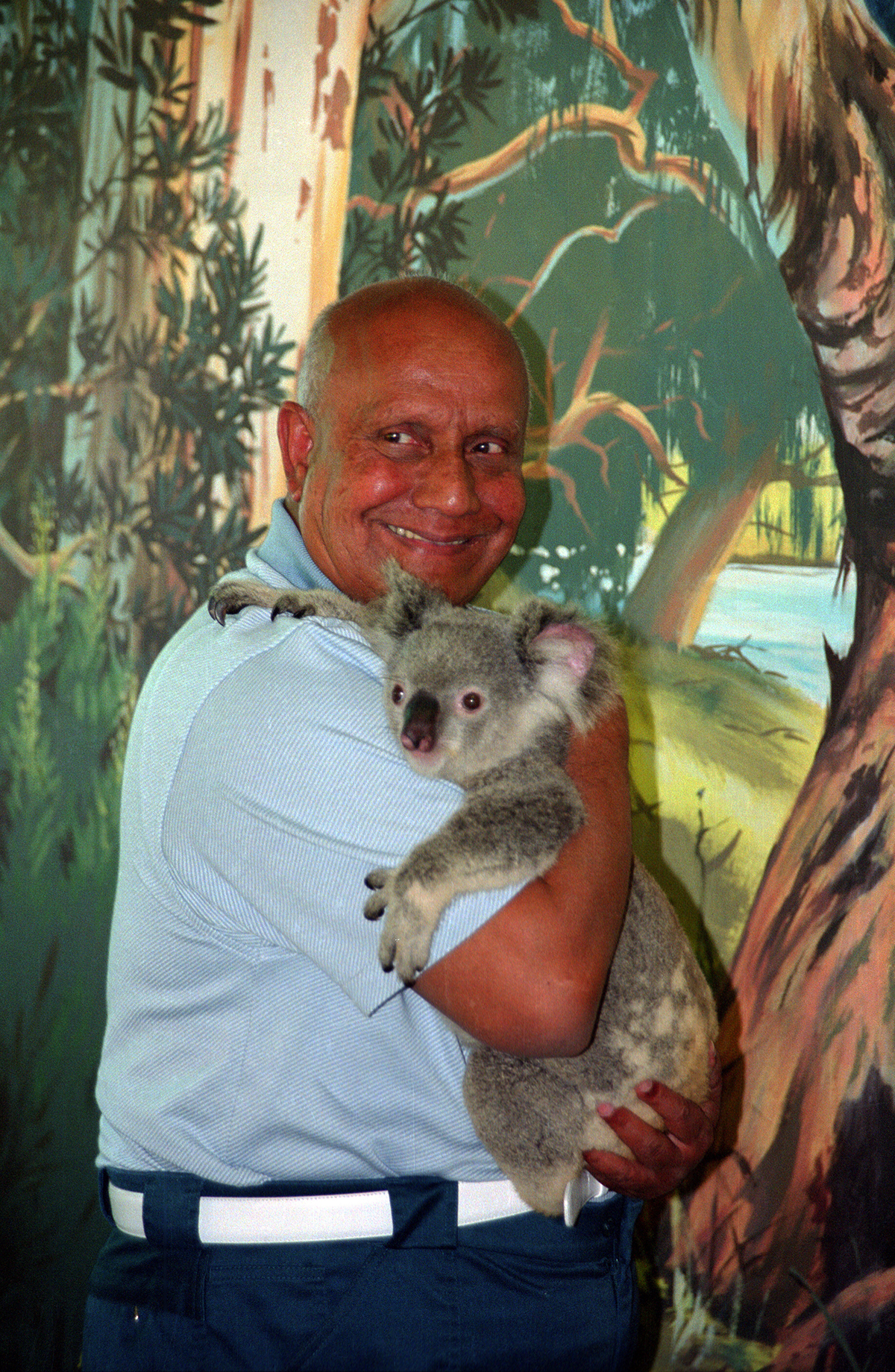
Sri Chinmoy visits ‘Wild World’, a native wildlife sanctuary in Palm Cove near Cairns, and holds one of Australia's iconic animals – the koala.
* With the increasing loss of habitat, koalas are now considered vulnerable to extinction.
Sri Chinmoy dedicates his book of 401 rhyming poems ‘From the Source to the Source’ to his brother Chitta who inspired him in the poetry-world.
Right from my infancy my brother Chitta has inspired me, encouraged me and taught me lovingly and unreservedly how to devotedly and successfully enter into the poetry-world. Therefore today with my heart's boundless gratitude I am offering my seeker-poet's flower-gathering to him, the Source of my poetry-world.
Chinmoy
7 January 1978
Published in From the Source to the Source
In the morning, Sri Chinmoy gives the following prayer:
My ever-increasingly
Compassionate Lord Supreme,
I am praying to You
With my heart’s silence-tears.
Do accept the cheerful surrender
Of my mind’s freedom.
In the evening, Sri Chinmoy hands his disciples a card with this prayer and his soulful request printed on it:
As old as you are, in silence most soulfully, most soulfully, recite this prayer and, I assure you, you are going to get results in terms of happiness, achievement and fulfilment. And it is my wish that every year on the 7th, no matter where you are, do this prayer. Every year, as long as you are on earth.*
Listen to Sri Chinmoy reciting this prayer
Recorded during the 1998/99 Christmas trip
* The number of times to recite this prayer is equal to your age in years.
Remarks by Sri Chinmoy
in Cancún, Mexico
On January 7th, we had our first seven-hour meditation for this year. I do hope that we can have a seven-hour meditation on the 7th of every month.
During the meditation, when the disciples were singing “Nimne dharanir,” the great spiritual Master Gorakshanath came to me in the inner world and said, “When I was on earth I performed so many miracles.”
Gorakshanath had tremendous occult and spiritual power. Because of him, for months there would be no rain. If I say there should be no rain, immediately there will be a downpour!
The higher you go, the less you perform miracles outwardly and the more you perform miracles inwardly. Again, sometimes a hero-warrior has to examine whether his swords are sharp or not, if they are blunt or if they are still working. He has to see if they are in good condition. Otherwise, they can be rusty and dusty. But, in the case of most spiritual Masters, all this takes place inwardly. — 9 January 1998
Published in The World-Experience-Tree-Climber, part 8
story told by Sri Chinmoy
at the Inter-Continental Hotel in Phnom Penh, Cambodia
While talking with the wife of an Indian family, Sri Chinmoy asked her the names of all the family members, commenting:
I had a friend, a very, very, very close friend whose name was Mavinehandra. He was from Gujarat. In your case, you are not from Gujarat.
Mavinehandra is a Gujarati name, and you are from Bombay. In Bombay they do not usually give that name. Only in Gujarat they give it. In 1950, this Mavinehandra was a very, very, very close friend and a great admirer of mine.
Regarding the name Dilip:
In ancient days there was a king whose name was Dilip. There is no actual meaning to the word Dilip. Only because he was a very, very, very great king, many, many people have the name Dilip. But the name itself has no actual meaning. The meaning is only that he was a very mighty, powerful king. From his time, people started giving the name Dilip. The meaning is only that he was very powerful and very kind-hearted.
I am very happy that your whole family has come here on our Christmas Trip. Some day we may see you in New York, if possible.
To the wife, while addressing the whole family:
You are from Bombay.
To the husband:
You are from Maharashtra. I am very happy that you have read my book on Shivaji. When I was a schoolboy, our teacher asked us to write an article on Shivaji. I am a great admirer of Shivaji and Ramdas, his Guru. Our school teacher used to give marks out of four, not out of one hundred. My teacher was so pleased with my article on Shivaji that he gave me eight out of four! I have great admiration for Shivaji. He was a great king.
Bengalis are very proud. They do not like to follow others! But our India’s greatest poet, Rabindranath Tagore, asked the Bengalis to join together with the Marathis and say, “Victory to Shivaji!”
Sri Chinmoy recites a poem in Bengali:
Tagore wrote that immortal poem. It is such an excellent poem.
Bengalis have the greatest admiration for Shivaji, and also for his Guru, Ramdas. Shivaji had a spiritual guide, a spiritual Master, and he obeyed his Master. Once Shivaji said, “I do not want this kingdom any more. I want to give it up.”
Ramdas said, “No, you have to be king.” Then he gave Shivaji a piece of his ochre cloth and said, “This will be your flag, this colour.” Shivaji kept that flag. He always took advice from his Guru, Ramdas.
To the husband:
Your father-in-law’s name is Ghanashyama. Very sweetly you say the word Ghanashyama! “Shyama” means Lord Krishna and “Ghana” is dark or very dense. “Ghana” is something very thick, very deep, intense and dark. Ghanashyama is another name, an epithet, for Lord Krishna, because his skin was not as fair as that of Rama and others.
Published in Only One Power
by Sri Chinmoy
at the Novotel Palm Cove Resort, Cairns, North Queensland, Australia
Once I was walking in the gully at Aspiration-Ground, and I saw myself as a skeleton in a past life. I was practising such austerity at that time! I was absolutely all bones. I looked so ugly! My appearance was what you would call ugliness incarnate. I saw only my bones — I was thinner than the thinnest. I passed the austerity-examination in that incarnation.
What good does austerity do? If I want to go to God, shall I cut off my legs and say, “See how much I love You, God! See, I have cut off my legs! Without legs I am coming to You.” God will say, “Why did I give you legs?”
God has given us air. Some people meditate while practising severe breath control. God will say, “Why did I give them air? Why did I create things that are not going to be used?”
In every aspect of life God says, “Be normal, be natural. Be normal and natural. Then go forward, go forward, go forward and enter into the divine life.”
Not by cutting off our legs, not by practising austerity shall we go forward. Those days in the Himalayan caves belong to the past. Those austerities do not apply now.
Sri Ramakrishna said, “You have to cross the water. The boat is in the water, but the boat is not affected by the water.” The boat is carrying people across the water. The boat will not sink. Do we need to go under the water in order to prove that we care so much for our destination? No! Wisdom saves us by telling us to enter into the boat.
Again, wisdom may tell us, “Recite this prayer fifty times or seventy times once a year.” * But it may happen that even that we cannot do! Then God says, “I need a special kind of yoga for these people.” He is simplifying, simplifying and simplifying the course to the extreme, but we want more simplification. God is so kind to us. He has already simplified the game for us to such an extent. Even so, He says, “All right, all right, you people are not serious enough in your spiritual life, but at least do this much.” Even that if we do not do, God says, “I shall have to create another course for you that is easier than the easiest!”
* Here, Sri Chinmoy refers to his special prayer for January 7th (above), which he composed in 1992.
Published in Our Sweetest Oneness
Lyrics:
|
Published in Paradise is Where I Bend My Knees
Sri Chinmoy sets music to this prayer while on a Christmas trip in Cancún, Mexico. The prayer was written on December 18, 1997, while he was staying at Lake Atitlán in the highlands of Guatemala.
“This prayer embodies the meaning of our Path. We did not create this prayer, but God created it so that He could teach us how to pray to Him.” — Sri Chinmoy
Sri Chinmoy asks his disciples to recite the prayer or sing the song during morning meditations, saying that this would help them “immensely” in their spiritual lives.
Listen to Sri Chinmoy singing
Recorded during the 1998/99 Christmas trip
Twenty First Century, the New Millennium!
No more the old sorrows and joys-compendium
God’s Heart, God’s Eye, a new hope and a new promise!
O run and dive and fly — Bliss, Infinity’s Bliss!
The world shall cheer the road with a God-surrender-song.
Creator’s Silence-Hearts, creation’s sound-lives throng.
Published in The New Millennium
Comments by Sri Chinmoy
14 January 1998, during a bus trip from Cancun to Merida, Mexico
One second before you sing the “New Millennium” song, if you see and feel what you are singing, then it will be much better. First you have to see, and then feel. Look at a tree: you will immediately feel that the tree is inside you. Then you can express the beauty of the tree. See and feel, and then express it. Then your singing will be completely different. Sing each and every song like that!
Published in Only Gratitude-Tears
by Sri Chinmoy
14 January 1998, in Merida, Mexico
Life’s dynamic spirit I need in this song, from the beginning to the end! People who were in my bus sang and sang and sang this song to my satisfaction. It has to be full of spirit and vigour, right from the beginning to the end.
With this song we shall end our Peace Concerts from now on. Everywhere that will be our anthem, and it will be full of dynamic spirit.
It is an English song. First, try to envision the meaning of the words. As soon as you think of the Twenty-First Century, the New Millennium, try to imagine it. Your vision and realisation have to precede your revelation and expression. When you are singing each line, try to see each word first, then feel it and finally express it.
Published in Only Gratitude-Tears