January 24

The Heart of Australia Award


I am pleased to have been asked to support “the Heart of Australia Peace Award” for Sri Chinmoy, for his service and dedication to peace in the world.

The people of Australia have always cherished and sought to preserve peace and harmony not only without our own continent but also to encourage and foster peaceful endeavours and projects worldwide.

Australia has a proud history. Our nation has shown concern for human rights at home and overseas and has played a leadership role in promoting peace.

In my role as Federal Member for Adelaide, I have joined with school children and community leaders in activities such as the Sri Chinmoy Peace Run to raise awareness in the community. It is fitting to acknowledge the role played by Sri Chinmoy in promoting peace with “the Heart of Australia Peace Award.”

— The Hon. Trish Worth, Federal Member for Adelaide
January 24, 2001


Sri Chinmoy receives the Heart of Australia Award, dedicated by Federal Member of Parliament Trish Worth.


A library wing holding 2,400 of Sri Chinmoy’s books is dedicated in a ceremony at Tirupati, Andhra Pradesh, India.


January 24

Photo by Adarini Inkei


Sri Chinmoy at the ping pong table at the Grand Bali Beach Hotel in Sanur, Bali.


January 24

The Future of the Marathon

A talk by Sri Chinmoy

(Just two days earlier he finished the Orange Bowl Marathon in Miami, Florida)


Often people say they will never run a marathon again. During or after the race they say that this is their last marathon. Then after four days they start thinking about their next marathon.

In ten or twenty years, people will regard the marathon the way we regard a ten-mile race today. People will consider forty miles or seventy miles or a hundred miles as long distance. Long distances will be as popular as the marathon is today. People will pay more attention to fifty-milers and hundred-milers.

Now people are doing so well in the marathon. In four or five years the best runners will run the marathon in under two hours. In twenty or thirty years people will run at a five-minute pace for fifty or a hundred miles. The children of people who are running the marathon now will run at the present marathon pace for thirty or forty miles, and then even farther. They will have such stamina. Sports are like that. Roger Bannister’s four-minute-mile record lasted for years. Then the hundred-metre record stayed for years. Jesse Owens’ long-jump record stayed for twenty years before it was broken by Bob Beamon. But ultimately all records are broken.


Published in Run and Become, Become and Run, part 13


Sri Chinmoy does repetitions with a 50-lb dumbbell in Bandung, Indonesia, as weightlifting assistant Unmilan Howard looks on with an eye to safety.

Earlier in the morning, Sri Chinmoy offers two payers before lifting:

At 4:51 a.m., he lifts 400 lbs. two hundred and eight times with one arm. (108 right, 100 left in five sets).

My Supreme, my Supreme, my Supreme,
May I worship You sleeplessly
And breathlessly
In my love-devotion-surrender-delight-
Temple-heart.
My Supreme, my Supreme, my Supreme!

At 5:05 a.m., using the double-arm machine, he lifts up to 160 lbs. with each arm simultaneously from a standing position.

My Supreme, my Supreme, my Supreme,
Today I am determined
To smash asunder
My mind’s long and strong
Desire-train-chain.
My Supreme, my Supreme, my Supreme!


Published in My Morning Soul-Body Prayers, part 2


January 24

Bhulite Diyona Tomar Charan

Lyrics:

Bhulite diyona tomar charan
Bhulite diyona tomar nayan
Bhulite diyona tomar bachan
Bhulite diyona tomar swapan
Amar jibane amar marane
Ogo mor prananath
Laho laho pranipat
Bhulite diyona bhulite diyona bhulite diyona

Translation:

My Lord Absolute Supreme,
Do not allow me to forget Your Feet.
Do not allow me to forget Your Eye.
Do not allow me to forget Your Message.
Do not allow me to forget Your Dream.
In my life and in my death,
O Lord of my heart,
Do accept my prayerful obeisance
My Lord, do not allow me to forget You.
Do not allow me to forget You, do not.


Published in One Thousand Lotus Petals, Part 1


Recorded at Sri Chinmoy’s home in October 1999...
 

“I have sung these songs according to my inspiration. However, I advise others who wish to sing them to follow the original notation found in my songbooks.” — Sri Chinmoy


Sri Chinmoy composes his 11,000th Bengali song Tumi Amar Sneher Putul Amar Ranjana.


January 24

Great Indian Stories

by Sri Chinmoy


The future grows in the present

There was a very rich man who had a slave. One day the slave saved the rich man’s only son from drowning. His master was extremely pleased with him and set him free. Not only that, but he also gave him lots of gifts and money plus a large sailing boat.

Now that the ex-slave had money, he hired some people to work his boat and set out on a voyage across the ocean.

Alas, one day there was a terrible cyclone. The boat sank and everybody drowned, except this former slave. He began swimming towards a nearby island. When he reached it, he saw that many people were waiting for him, crying with delight, “The King has come! The King has come!”

The man said, “Why are you calling me King? I have lost everything except this loin cloth that I am wearing.”

Everyone said, “This year you will be King. Every year we have a new king. You are King for this year.”

“But I don’t understand,” said the man.

“We appoint a new king every year and now it is your turn,” they said.

“Why are you so kind to me?” he asked. Then he said to himself, “Perhaps God, out of His infinite Bounty, is doing this since I have lost my boat.”

So he turned to the crowd and asked, “Tell me only one thing. Is it only for a year?”

“Yes,” came the reply.

“Then what will happen?” he asked.

They said, “Well, we shall throw you off of the island.”

He asked, “Then where shall I go?”

They answered, “We only know that the King rules for one year. Then he must leave the kingdom.”

The ex-slave asked, “Please, send me the wisest man in the kingdom.” When the man came, the new King asked, “Is it true that each king rules only for a year and then must leave the island? Then God alone knows what happens to him. Is there any advice you can give me so that at the end of a year I don’t become a beggar again?”

“Yes,” said the wise man. “Now that you are King, try to make yourself another kingdom on a nearby island. Transform another island into a kingdom by sending your people to make roads, gardens, houses and so forth. Do everything in this one year. When you have established another kingdom, why do you have to worry? At the end of the year you can go there.”

“How is it that my predecessors did not do this?” the man asked.

The wise man explained, “I told them, but they did not listen to me. They kept saying, ‘In a few weeks we shall do it.’ Then, two months before their reign was up, I used to tell them again, but they didn’t think of their future.”

The King said, “I will definitely listen to you. People will go find a new place where they will build another kingdom like this.” The wise man said, “Will you do it, or will you have the same fate as your predecessors?”

“No,” said the King, “I won’t allow myself to have the same fate. I will start from today to send people to do the needful.

“Always we have to think of the future. Always we have to remember that the future grows in the present. If there is a gap between the present and the future, if we do not think of the future, then some calamity will always take place.”

So the King sent out his subjects to build a new kingdom, and at the end of a year, the King went there and started ruling it.


The poet and the King

There was once a King who used to appreciate poets and learned men in his kingdom. He would always shower gifts upon them and hold various contests in which he would give them awards.

There happened to be a poor poet who was poor not only in his outer life but also in his poetry. Everybody used to go to the palace and recite poems they had written about the King, and appreciate and flatter the King. But this particular poet would not or could not go.

His wife was very upset over this, and she kept telling him, “One day you have to go. How long can we remain poor? We have children, and we cannot meet with our expenses. You must go!”

The poet did not want to anger his wife because she had a bad temper and he was afraid she might do something drastic. So he went to the King and said, “I have written an excellent poem on you.”

The King said, “All right, leave it here and come back tomorrow.”

“Tomorrow?” the poet asked. “You won’t read it today?”

“No, tomorrow,” the King said.

The following day, when the poet returned to the palace, the King was giving away alms to the poor. Many people were standing in line, and each one came up and received something from the King. Then the King started calling the poets to come to him. But the King did not call out the name of this particular poet. The poet was puzzled and surprised, but he did not know what to do.

At long last the King turned to this particular poet and said, “I have given my alms for today. It is all over. We have had a wonderful meeting and everything is all over. You go home and take a shower and have something to eat.”

The poet said, “When shall I come again?”

The King said, “Why will you have to come again? Don’t you have a copy of the poem which you have left me? When I have time, I just read the poems. I have already read your poem. It is not necessary for you to come back.”

The poet said, “Lord, Lord, I am very poor.”

The King said, “I know you are very poor. You told me some sweet words in your poem, and I am also telling you some sweet words: please go home, take a shower and eat.”

The poet said, “I have come here not to have appreciation for my poems, O great and rich man. I have come for something else.”

“O poet,” the King said, “your poem was beautiful, the metre was perfect, everything that a good poem needs your poem had in every way. Your poem about me was perfect. You have tremendous capacity, but you should not waste your capacity in writing such beautiful poems about a human being. You must write about God. He is the Creator, the Almighty. You have got divine capacity so you have to utilise it only for God. This kind of flattery I don’t deserve. If it is sincere then I don’t deserve it. If it is flattery, I don’t need it. Only God deserves this kind of praise, and infinitely more. Since you have the capacity, you write about God; write about the Supreme Poet Himself. By writing about Him, you will get more capacity and you will write infinitely better poems.” The King then threw away the poem which the poet had written about him.

The poor poet said to himself, “Alas, alas what am I going to tell my wife? To please her I came. To make her rich, I came. Now I have not got a rupee from the King. O God, bad luck is everywhere. He who is cursed with bad luck will have the same fate everywhere, for bad luck knows how to dog a human’s fate.”


The golden swan

The Buddha told this story as something that took place in one of his previous incarnations. At that time, he was a simple man with a wife and three daughters. He was always kind to people and was dearly loved by his family. Unfortunately, he died before he could marry his daughters so he felt very sad. When he entered into the soul’s world, he observed what was happening on earth, and saw that his family was almost poverty-stricken.

So he returned to his family as a beautiful golden swan and said to his wife, “I have come to you in this form. Once a month I shall come and leave one of my gold feathers for you to sell. In this way you will easily be able to meet with all your expenses.”

So every month he used to come and leave a golden feather.

The wife was very happy, and the daughters also were so delighted when they saw their father. The swan used to stay for a few minutes and then leave.

One day an idea entered into the wife’s mind: “My husband may not come regularly, or he may change his mind and stop coming, or he may grow old and die. The best thing is for me to catch him and strangle him the next time he comes, so that I can take away all his feathers.”

The daughters were simply shocked: “How can you do this kind of thing, Mother?”

The wife said, “All right, I won’t strangle him. But I will take away all his feathers. If he cannot fly anymore, no harm. You will take care of your father.”

The daughters pleaded with their mother, “Please, we love our father so deeply. He is so kind to us. He could have stayed in the soul’s world, but he comes in the form of a swan to help. Look at his love for us.”

But the mother would not listen. The next time the bird came, she caught hold of him by the neck and took away all his feathers, one by one.

It was most painful to the swan and he cried and screamed most pitifully: “What are you doing? I have been so kind to you.”

When she was finished, the bird was suffering like anything and it could not fly anymore. Then all of a sudden all the golden feathers turned into ordinary white feathers: they no longer were made of gold.

The greedy wife felt miserable and the daughters were smitten with grief. But what could the daughters do? Their mother was so cruel. Then the mother went inside her room and opened a box where she had been keeping the gold feathers that she had accumulated but had not yet sold. She knew that she still had many gold feathers, enough to meet her family’s expenses for at least six months. But as soon as she opened the box, she found that these feathers, too, had turned into ordinary white feathers; they were no longer gold.

The three daughters, with great love and affection, each day fed the poor swan and showed him tremendous concern. The mother was now helpless; she hated her fate. “This is what happened because of my greed,” she said to herself.

The daughters said to her, “This is what you have done! Even if our father had not come for six months or one year, we could have lived comfortably on the golden feathers that you had saved in your box. Now father does not have golden feathers anymore.”

The father said, “This is your fate, my fate.”

Slowly and steadily the feathers of the swan grew back again, but this time they were pure white, so the wife did not bother to take them from the bird. Finally the bird was able to fly away. The children were very happy that the bird was released. Now their father would be happy. They said, “He will be able to do everything in his own way.”

The mother felt miserable, not because the bird had gone away, but because of her stupidity. She was not going to get any more golden feathers and once again she was poor.


Published in Great Indian Meals: Divinely Delicious and Supremely Nourishing, part 5


You have the Golden Chance

A talk by Sri Chinmoy
about the New Year to his students, in New York


My dear children, this is my most and most blessingful request to each and every one present here. Each night before you go to sleep, while seated on your bed, only for three to five minutes please pray and meditate. Also, please sing or recite the new song, Bhulite diyona. This is the translation:

My Lord Absolute Supreme,
Do not allow me to forget Your Feet.
Do not allow me to forget Your Eye.
Do not allow me to forget Your Message.
Do not allow me to forget Your Dream.
In my life and in my death,
O Lord of my heart,
Do accept my prayerful obeisance.
My Lord, do not allow me to forget You.
Do not allow me to forget You, do not.

Those who have learnt the song and those who are good singers can sing the song, and others can just recite it.

Once more I am making my most blessingful request to each of you. At six o’clock in the morning, please meditate for ten minutes. Only wash your eyes, face, nose and especially your ears. When we meditate, at that time the cosmic sound reverberates in the depths of our aspiration-heart, so our earthly ears may get some benefit from the cosmic sound AUM, the soundless sound.

Then at night, whenever you go to bed — at ten-thirty, eleven-thirty or midnight — please meditate for three minutes at least while seated on your bed.

My dear children, my sweet children, what I am saying applies also to those who are not physically here. This year either we will be able to offer our supreme victory to our Lord Beloved Supreme, our Eternity’s only Goal, or we will offer Him the worst possible defeat. Remember, it is up to you to offer Him the worst possible spiritual defeat or your supremely glorious victory.

Please remember this poem:

I never want to count
My heart’s aspiration-moments.
I just want to multiply
My life’s dedication-hours.

Your life’s dedication-hours please multiply this year. Make yourself worthy of your inner life, your spiritual life. Dear ones, it is up to you. Take every moment seriously.

When I came to America, when I came to the West, the Supreme in me did expect to have supremely chosen instruments to manifest His Victory here, there and everywhere. My oneness with your heart, my oneness with your life, I shall never be able to make you feel — never, never. But if you yourself dare to feel my oneness with your heart and with your life, then you are bound to feel that your victory is my victory, and your defeat is my defeat, for I am one with you, inseparably and eternally. Because I have accepted each of you, your defeat is my defeat, and your victory is my victory.

You have the golden chance to be the pioneers of this divine vision that I embody, the divine vision that I have entrusted you to spread all over the world. I am extremely, extremely fortunate to have your souls — such beautiful, such loving, such self-giving souls — for my supreme cause. There is not a single soul that is not one hundred per cent sleeplessly for me. All your souls, according to their individual development, are here on earth only to love the Supreme in me, only to serve the Supreme in me, only to fulfil the Supreme in me. If you can dive deep within and if you can get just a glimpse of your soul for a brief moment, then you will see the inseparable connection and oneness that your soul has established with me to manifest the Light, the Peace and the Divinity of our Lord Beloved Supreme. I want that Light, that Peace and that Divinity to manifest in and through your lives.

I beg of you, I beg of you, I beg of you not to fail yourselves, not to fail your souls. Make me the happiest person both on earth and in Heaven by pleasing me and fulfilling me here on earth, for I am your own highest. Your absolute highest is your Master, Sri Chinmoy. If you have faith in me, you have faith in your soul. If you have faith in your soul, you have faith in me. We are inseparable.

Swami Vivekananda gave his Inspired Talks at Thousand Island Park in 1895. The West may not have accepted, or could not accept his light, but I know that millions and millions of Indians received boundless inspiration, boundless encouragement and boundless enthusiasm from his Inspired Talks. Over the years, I have also given many, many, many inspired talks. I know that those talks have helped you enormously in your inner life of aspiration and in your outer life of dedication. Again I am telling you now, please take your life of aspiration and your life of dedication as supremely important. I am begging you to dedicate more of your life. If you have the capacity, then give talks, here, there and everywhere. Give classes and, in as many ways as possible, inspire people. Work together, work together.

A great Indian figure happened to be a disciple of a spiritual Master of the highest order. Once, at a time when this particular disciple was suffering from one of the worst possible attacks of doubt — doubting his Master, doubting himself and doubting the spiritual life — he was asked by a seeker to talk about his Master. He spoke so soulfully, so powerfully and so profoundly that, while speaking, he brought his own tears of gratitude to the fore.

Then the disciple wrote to his Master, “I have been doubting you, Master, so much. I have been doubting my spiritual life. I have been doubting the whole world. Even a few hours ago, my existence had no value; everything was negative. But in speaking about you, Master, I have made everything positive, and I have made myself happy. How can it be? Surely I am the world’s worst possible insincere person. I am a hypocrite!”

The Master replied, “My child, how proud I am of you! While you were speaking about me, your soul got the opportunity to come to the fore and manifest your own divinity and your own light in the heart of that sincere aspirant. When you feel that you are doomed to disappointment, when all the negative forces are coming to you, at that time if you speak highly of your Master, highly of your spiritual life, highly of your path, do not think that you are a hypocrite, that you are fooling yourself or fooling the sincere seekers—far from it! During your mind’s darkest hour or your life’s darkest hour, your soul, on the strength of its inseparable oneness with the Supreme and with your Master, got the golden opportunity to convince your mind, which was either in the barren desert or in the thick forest. Your soul was able to grab your body, vital and mind and bring them into your own heart-garden to see how beautiful you are and how fragrant you are.”

These are my interpretations. The Master did not use these exact words, but I know what that particular Master actually meant. I am telling you all this because I see that some of you are at times sad and depressed; you may have all kinds of vital and mental problems. The golden way to overcome these problems is to talk to people about the spiritual life. If you feel that your consciousness has descended, then sing my spiritual songs or talk to your friends about the spiritual life.

Like today’s song, Bhulite diyona, all my soulful songs are bound to help you. If you want your own light to come to the fore, sing a few songs or listen to a tape of my voice. My voice has a very special connection with your soul and with your heart. No matter whether I am singing well or not, my singing voice has a very, very, very special connection with your soul, with the divine in you. Please listen to my voice or my flute or some other instrument of mine that you like.

This is God’s universal Game. When we play a game, who wants to accept defeat? We will do our very best to be the winners. In this case, who is our opponent? It is the undivine, unlit, destructive forces that are trying to threaten us and devour us. We call them hostile forces. Again, the Supreme has kept inside each human being a roaring lion. We must bring to the fore the roaring lion in us, and roar and roar to manifest the divine light that we already have. The more we can be of service to mankind, even if we only offer an iota of light to an individual, the more the Supreme is bound to bless us with His abundant Light. And when we offer our abundant light to others, then He will be able to give us infinite Light.

In my heart-garden I have employed you with my boundless love, boundless affection and boundless fondness. You are my helpers, and I want each of you to bring a few more plants with your aspiration, with your dedication. Try to make our heart-garden as vast as possible, as beautiful as possible, as fragrant as possible. My children, you have the capacity and you are the capacity. I want each one of you to offer the supreme success, supreme glory and supreme victory to our Lord Beloved Supreme.

I do not mind if you are not proud of me, but in all sincerity, I want to tell you how proud I am of your souls, for they know who I am and they know what I stand for. Their soul-lives and soul-breaths at every moment are for me, for me, for me. Your outer life may not be for me. It may be for yourself, for other human beings, for your career or something else. But your soul has a breath, Eternity’s Breath. Your soul’s breath is for me, for me, for me, only for me. Therefore, how grateful I am to your souls, how proud I am of your souls, you cannot imagine. It is far beyond your imagination the love, devotion and surrender that your souls have for me, for they know who I am and who they are. They are my supremely chosen instruments. In your souls is my life-breath.

I am begging each and every one of you to give me the opportunity and to give me the assurance to be inside your life-breath at every moment. I have you inside my heart. Unfortunately, some of you do not have me inside your heart. If you see me and feel me, my living presence, inside your heart, you will not be able to do even one thing wrong, discouraging or displeasing. The moment you do not feel my living presence or my nectar-smile, the moment you fail to see me inside your heart, alas, alas, you fall victim to self-doubt, lack of faith, frustration and other undivine forces.

I am telling you, I see inside you the living Presence of my Lord Beloved Supreme. Him I see and Him I feel at every moment inside you. Therefore, at every moment I am dealing with my own Guru inside your heart. Please feel my smile, my tears, my gratitude, my pride in you.

How many good things you have done for me over the years! I will not be able to count how many good things you have done for me. I am requesting all of you only to think of how many good things you have done for me, not how many good things I have done for you. I am begging all of you to think of how many good things you have done for me since you joined the path. Think of how many ways you have pleased me, how many ways you have loved me, how many ways you have served me, how many ways you have fulfilled me over the years. You will be so proud of yourself. Right from the day you joined our path, try to remember the special ways you have offered your love, devotion and surrender. Think of my oneness-divinity with your heart, with your life, with your soul. Then any discouraging forces that have now become part and parcel of your life are bound to disappear, for your golden moments are the most pleasing fragrance-perfume in your life and in my life. Forget about how many good things I have done for you. I am only telling you to remember and to count in how many ways you have pleased me over the years. Then all your divine qualities once more will come forward.

Do not think, even for a second, about whether you have disappointed me in any way inwardly or outwardly. I am begging you to take the positive side. Think in how many hundreds and thousands of ways you have pleased me with your love, devotion and surrender. Only remember where, when and how. I assure you, you will be inundated with your own divinity. It is you who are going to prove that you are, without fail, my supremely chosen instruments. You are not only for yourselves; you are for the entire Creation of our Lord Beloved Supreme. God the Creator is inside you, and He wants you to serve and fulfil God the Creation around you.

My dear ones, I am inspired and I shall remain inspired. I do hope my inspiration-light, which I have just now brought down from the highest Heaven to offer to you, has entered into you, and you have become a totally different person from this moment. I am a beggar for your smiling heart radiating on your face and from your eyes. The eternal beggar in me wants you to be happy, divinely happy, supremely happy, so that your happiness radiates on your face and from your eyes. From your outer life, it has to radiate all over the world to illumine the world.

I know who I am. Unfortunately, I cannot make you see and make you feel who you truly are, who you are to me, who you are to the Supreme. But if we work together, then I shall definitely be able to make you feel who you are to me and who I am to you. We need each other. I need you for the manifestation of the Supreme here on earth. You need me for the highest realisation. I will be known as the tree, and you will be known as the flowers and fruits. Immortality’s flowers and Immortality’s fruits I want to dedicate to aspiring humanity. Again, I am the bird and you are the wings.

Whatever I have said has gone very, very far, because it has entered into the Universal Consciousness. These words I get from the Transcendental Consciousness and I offer them to the Universal Consciousness. You are part and parcel of the Universal Consciousness, plus you are nearer than the nearest to me.

The most important thing I have said is for you to think of how many good things you have done for me. Only remember in how many ways you have shown your love, devotion and surrender to the Supreme in me. Think how readily, happily, cheerfully, willingly and eagerly you have pleased me over the years. You will be so proud of yourself. Just try to remember those golden moments. It will take a few months to count them! All your depression, frustration, feelings of uselessness and other negative qualities will disappear. Any kinds of spiritual fevers that you may have now, which are making you absolutely miserable and paralysed in the spiritual life, will disappear. You will no longer remain inside the dry, barren mental desert that you have been walking through, or the thick forest that you have created for yourself. You will come back again to your own heart-garden. Again you will be able to run faster than the fastest.

And also try to feel my presence. The way I feel your presence inside me, inside my heart, I want you to feel my presence inside your heart at every moment.

By remembering how many good things you have done for me, I shed tears of gratitude. I swim in the sea of my gratitude-tears. In how many countless ways you have served the Supreme in me, loved the Supreme in me and fulfilled the Supreme in me! Those are your possessions, your own divinity-manifestations.


Published in Live in the Eternal Now


Sri Chinmoy begins a new poetry challenge, Seventy-Seven Thousand Service-Trees, in Cancún, Mexico. Read more…


Sri Chinmoy’s First Poem

My Lord,
You have commanded me
 To offer You
 Seventy-Seven Thousand Service-Trees.
I shall obey Your absolute Command.


Published in Seventy-Seven Thousand Service-Trees, part 1


My Supreme’s Absolute Command

In the small hours of this morning, my soul was in my transcendental consciousness and my heart was in my universal consciousness.

My Supreme, my Supreme, my Supreme stood in front of me and said to me, “No retirement, no retirement, no retirement for you, My child!”

I said to my Supreme, “What more do You want from me, what more?”

He said to me, “Seventy-seven thousand.”

Immediately I said to Him, “Is it Your Wish, is it Your Request, is it Your Will or is it Your absolute Command?”

He said, “It is My absolute Command.”

Then I said to Him, “I do not think I am going to live on earth that long.”

He said to me, “My child, I command you to start, I command you to start. You know and I know how long you are going to be on earth, but I want you to start. This is My absolute Command.”

“My Supreme, my Supreme, I shall obey Your Command, I shall.”

— Sri Chinmoy
24 January 1998


Published in Seventy-Seven Thousand Service-Trees, part 50


Fifty Oneness-Heart-Songs of a Perfect God and a Perfect Child

Sri Chinmoy speaks about the book and answers questions in Huangshan, China


Sri Chinmoy: When I wrote this particular book, I was really, really in a childlike consciousness. With a childlike consciousness, there is no mind involved. If we can approach children’s hearts, if we can be at their level, how sweet it is! In this respect, sometimes grandparents are so good. They are seventy or eighty years old and their grandchildren are little, but they never think of the age difference; they never try to give the little ones advice. On the contrary, they would like to be as simple and as spontaneous as their little ones.

If teachers can teach their students with the same feeling, the students will get tremendous joy from learning. In a child’s game, if a grown-up who is very strong and stout joins, and if this person just shows off and scolds the other players, then the children will get tired of playing with him. Why do they need him? But if the same grown-up comes and plays with enthusiasm, and if in spite of being an excellent player he makes mistakes, then the children get such joy. Similarly, when you are teaching children, you have to feel that you are seven years old. Do not feel that you are the oldest and wisest person. Do not think of your power-aspect. Think of your love-aspect.

Children are our dreams. Children are our heart-flowers. If we can welcome them with our hearts, it is to our great advantage.

Question: In your book, you present an ideal vision of childhood. What of those people whose childhood experiences were not sweet?

Sri Chinmoy: You are saying that in some countries, because of their poverty, children perhaps have not got sweet experiences from their childhood, from their parents. But, in general, even if they are poorer than the poorest, those children have received affection. There is not a single country where children are not shown affection.

In wartime it is different. During a war, there are horrible stories. There may be a dearth of food. But these stories are very rare. In general, no matter how poor a country is or how poor a family is, as soon as a child takes birth it receives affection. Affection does not depend on material prosperity.

I tell you, many poor people in India have more affection for their children than some wealthy people in America, forgive me to say. I come from Bengal, India. There, in one of the poorest countries, we have more affection and love than many people in the so-called rich countries. In America and in other Western countries, people have money. They can have a maidservant, this and that. Then the parents can go out to work and the children will be with the maidservant in the home. But in India it is not like that. When the children are born, the mothers give up their jobs. No matter how poor the family is, it is a matter of heart. What I am saying is a matter of heart.

If circumstances are adverse, the children may not get sweet experiences; but I wish to say that ninety-nine times out of a hundred, children have got sweet experiences in their childhood.

Question: What if your childhood experiences were of suffering rather than sweetness?

Sri Chinmoy: If you feel that your parents were not nice, if you did not get good treatment from your parents right from your infancy, then you have to take your imagination as a reality. Imagine once again your childhood. You were brought up in one family, but right around you, in your vicinity, some parents were extremely, extremely nice to their children. Identify with them, identify, identify! This is not a false approach. Your parents brought you into the world, true, but I wish to say that imagination is a reality of its own.

Always try identification. You did not receive love and affection, perhaps, but now you can definitely apply your imagination and imagine love and affection. Just think of one particular family where the parents were so indulgent to their children. That imagination will definitely give you sweetness, happiness and a feeling of inner fulfilment. Just spread your imagination-wings! You are like a bird. Spread your wings and just fly to a country, imagine a village and see a particular place. What you are seeing is so true!

Again, you cannot separate your existence from your parents. You were born into a particular family. Definitely you had a father and a mother. If you are dissatisfied with them, with their way of being, you will go your own way. Children grow up and start their own families. But after going their own way, can they say that their parents are no longer their parents? Never!

Now I am coming back to the question. If your parents were not kind, just imagine sweetness, sweetness, sweetness. Early in the morning, look at a flower, look at the dawn. If you can identify yourself with nature, you are getting tremendous joy. At that time, are you thinking about how your parents struck you black and blue? You are the same person, but your wisdom has to work. You have to bring forward sweet memories, sweet memories, sweet memories. If you do not have sweet memories in your immediate family, that cannot prevent you from getting sweetness from your childhood.

Now that you are mature, you have to use wisdom at every moment. Exercise wisdom, wisdom, wisdom! Sometimes in a family, parents get angry. They stop their children when they want to go to university, or they do not pay the costs. Then days turn into weeks, weeks into months and months into years. In the end, if one accepts the spiritual life, it means one has to forgive them. It is very difficult sometimes, when we do not forgive a person, to bring sweetness out of our memories of that person.

If your parents were not nice, first forgive them. By harbouring bitter memories of your parents’ so-called misconduct, you will never be able to bring your own inner sweetness to the fore. You have to forgive your parents and forget the sad experience. If absolute necessity demands, you may even have to forget about your parents. Only try to imagine yourself, with your consciousness as a seven-year-old, to see how children elsewhere were given tremendous affection, sweetness and fondness.

Question: How much does our childhood influence us?

Sri Chinmoy: It depends on the family, it depends on the parents, it depends on the environment. If you come of a religious family, a spiritual family, then there is every possibility that this will be stamped on your forehead, or it will be written on the tablet of your heart. There is every possibility that the seed that was sown by your parents will germinate and become a huge tree with many flowers and fruits.

It all depends on the individual. There are many people who have received tremendous, tremendous affection as children. It is stamped in them. I was mischievous to the extreme, I was notorious, but this did not prevent my parents from showing me affection. I still have the source, the inner source. My parents were good, kind and compassionate.

Sometimes, at the very end of one’s life, the parents’ affection and compassion remains because they have influenced the person’s life so much. Again, after fifteen or twenty years, some people do not care for their father’s good qualities or their mother’s good qualities. They want to stay on their own.

One particular disciple is one of those who thought of their parents’ strengths. She was not yet on the wrong side of fifty when her father died. Look how much affection she had for her father! By that time, he was unable to see; he was blind. How lovingly she took care of him! If she had not been a good daughter, she could have said that she had her own life, she had her own husband and children to look after. But the affection and love which she received from her father when she was a little child became so solid and permanent in her heart that at the very end of his life she was full of gratitude to him. Otherwise, during those last years of his life she could have said, “Oh, no — I have other things to do now.”

Many children keep no connection with their parents. When they hear that their parents have gone to the other world, only then they come for two or three days. Even for one day some children will not come. And, to my greatest astonishment, even if they live in the same state it may happen that they do not come. Even for two or three weeks at the very end, they cannot take care of their parents. They think that somebody else will do it, their brothers or their sisters will do it. They feel that they have played their role and the parents have played their role.

Everything depends on the individual — how much the individual wants to retain the affection, love, sweetness and fondness from his parents. In some cases, no matter how much you give to the parents, they want more and more and more. Their demands never end. Then what can you do? I have seen a few cases like that. At every moment the parents will expect something from their children. Even when the children are thirty, forty or fifty years old, even when they have their own families, the parents do not give them freedom. They will phone up in the morning and say, “Do this for me, do this for me, do this for me.” What can you do at that time? There is no hard and fast rule. Some parents make constant demands. They say, “Because I am your mother” or “Because I am your father you have to do this.” These parents have to think of their children’s new life as well.


Published in You Belong to God


January 24


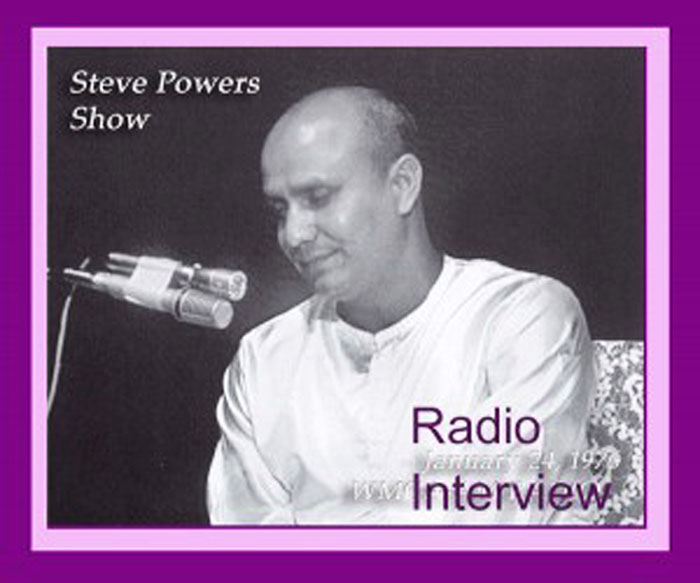
Sri Chinmoy is interviewed on ‘The Steve Powers Show’ on WMCA-AM Radio in New York.


Listen to the interview...


Excerpts from the Interview

broadcast on the Steve Powers Show, WMCA-AM Radio in New York City


Steve Powers: I’d like to introduce you to a special guest. His name is Sri Chinmoy. I welcome you, Sri Chinmoy. My first question is: When did you feel that you wanted to devote your life to spirituality?

Sri Chinmoy: When I was quite young, I felt deep within me an inner urge to realise God and to be of service to God.

Steve Powers: Do you think that is in every person?

Sri Chinmoy: Yes, it is within every person, but one has to cultivate this reality. It is like a muscle. If you take exercise, then you develop the muscle.

Steve Powers: Why is that not more natural to us? Shouldn’t that just come naturally?

Sri Chinmoy: It comes naturally, but the difficulty is that we have been wallowing in the pleasures of ignorance for millennia. Then there comes a time when we start walking along the right path. Once we are well established in our path, it becomes normal and spontaneous.

Steve Powers: Why do we have so many problems finding that path? Especially in our society today, people are awfully confused. People do not know which way to go, what to believe in, what not to believe in, what is the truth, what is not the truth, what is good and what is evil. And there is such tremendous input into our minds of new ideas that it’s difficult for us to know what is good and what is not.

Sri Chinmoy: Unfortunately, most people are living in the mind. In the mind, the question of good and bad thoughts, divine and undivine thoughts, plays a considerable role. But if we live in the heart where we find oneness and identification, then we go beyond duality. We suffer from confusion and live in confusion because we live most of the time in the mind — the doubting mind, suspicious mind, intellectual mind, sophisticated mind. If we can live in the heart — the loving heart, the aspiring heart, the oneness-heart — then this confusion will not arise.

Steve Powers: You are not an anti-intellectual as such, are you? You do believe in the intellect?

Sri Chinmoy: I do believe in the intellect. I have tremendous faith in the intellect. But at the present time, many intellectuals criticise feelings, inner feelings. Most intellectuals adopt a snobbish attitude. It is not that I am saying that intellectuals are bad or the intellect is very bad, no. But right now the intellect does not care for the light that illumines the world. Those who live in the intellect are satisfied with what they feel they have, and what they feel they have is a superior sense of reality. At times they look down upon those who live in the heart and who feel the necessity of the heart. But if the intellectuals feel the necessity of the light that we see in abundant measure in the heart and if they want to embrace that light, then we feel that they are doing the right thing. For the divine light has to play its role inside the intellect.

Steve Powers: Many people get up in the morning, swallow a quick breakfast, run out of the house and go to their subway, get to work and get completely involved with everyday survival. And before the end of the day it’s pretty tough to sit back and take a spiritual view of what’s going on because you have to go out there and hustle. You have to earn a living. Is there a way of integrating the spiritual life into what we call the economic life?

Sri Chinmoy: Our philosophy is the philosophy of wisdom: first things first. Most human beings are wanting in peace, peace of mind. They enter into the hustle and bustle of life right in the morning, and during the whole day they do not have even an iota of peace. We feel that if we can do first things first we are being wise. Early in the morning, if we can pray to God for at least a few minutes, that means we are doing first things first.

We feel it is money-power, material wealth, that will give us satisfaction. But it is not material power; it is the inner power, spiritual power, that gives us real satisfaction. If God the Almighty Father is satisfied with us, if He is pleased with us, then He will grant us peace of mind. And once we have peace of mind, no matter where we go and what activities we enter into, still we feel a sense of satisfaction. Right now satisfaction is a far cry. But early in the morning if we pray to God and meditate on God for a few minutes, then we get peace of mind to some extent. And this peace of mind is undoubtedly true satisfaction in life.

Steve Powers: Do you believe that God provides?

Sri Chinmoy: God does provide. He is the Creator and He is the creation. How can you separate the Creator from the creation? When you write a poem or when you compose a song, you feel your identification and oneness with the creation itself. God has created us, so how can He separate us from His own reality?

Steve Power: Now, let us go to our phones. Good morning, you are live on WMCA.

Caller: When I choose a particular Guru, should I look at him as a person or should I try to see him as just a pure channel of God?

Sri Chinmoy: If you have a teacher, then it is best for you to look at the teacher as a channel, as an instrument of God. You are an instrument of God and your teacher is also an instrument of God. But the difference is that the teacher has become a conscious instrument of God whereas right now you are an unconscious instrument of God. So by listening to the teacher, you will eventually become a conscious instrument of God, as the teacher is right now.

Steve Powers: When you say, Sri Chinmoy, that someone should look at his Guru as an instrument of God, are you saying that he should accept whatever the Guru tells him without question?

Sri Chinmoy: It entirely depends on his faith. If he has implicit faith in the Master and if he feels that the Master is really sincere, then it is advisable to listen to the Master all the time. But I don’t want him to make a mistake, a blunder, by blindly following the teacher when he does not have implicit faith in him.

Caller: If you learn peace and serenity from a Guru, you may have peace and serenity in your own mind and heart, but what do you do about people in the street who are not the same way?

Sri Chinmoy: If I practise spirituality, then I get peace of mind; and if you practice spirituality, then you get peace of mind. If he practices spirituality, then he gets peace of mind. So in this way the number increases. Today you get peace of mind, tomorrow your friends, your relatives, your acquaintances get peace of mind. Again, we believe in vibrations. When we see a spiritual person, a seeker or a saint, immediately we feel a kind of inner purity inside him and we get inspiration from deep within to lead a better life ourselves. Then, we also believe in the theory that birds of a feather flock together. If we become sincere and spiritual, then we shall be mixing with other spiritual and sincere people. In this way we can increase the number of good people here on earth.

Caller: How do you know whether you are speaking to God or just speaking to yourself and saying it’s God?

Sri Chinmoy: Satisfaction is the only thing that you want, that he wants, that I want. Satisfaction is of paramount importance. Now, I have eaten a mango. If I am satisfied, then it is more than enough for me. If you ask, “How do you know that you have eaten a mango?” then my answer will be: “If you want to see, then next time I am going to eat, you can be my guest. I will invite you to be with me and see for yourself whether I am eating the mango or whether I am fooling myself or fooling you.”

Steve Powers: In other words, experience it in part yourself?

Sri Chinmoy: Yes. If you want a history professor to teach you history, then you have to come and sit in his class. Also, you have to have some basic knowledge about history. Only then will the professor be able to teach you. I am a spiritual teacher. If somebody comes and says, “How do you know that you have realised God?” then I will ask that person to come to me with the basic knowledge, the basic requisites of sincerity and purity. You come to me with sincerity and purity in a meditative mood for a few minutes, and I shall make you feel whether what I am saying is true or not.

Steve Powers: I think one of the callers was asking, in effect: If I become sensitive and mellow and spiritual, will I not get eaten up on the street by the sharks? Do you know what I mean by that?

Sri Chinmoy: I know. If I am one with you, then how can you destroy me? Just because I am not one with you, you can do some harm to me. Oneness is strength. When we identify ourselves with a higher reality, how can we be destroyed? How can we be devoured? A child identifies himself with his father. The father is strong; he is a man of knowledge. The child feels that nothing will harm him because his father is there. On the strength of his oneness with his father, the child feels he is quite safe; he can go anywhere he wants to because he has a father with wisdom, strength, capacity. So here also, if one practises spirituality, then one is consciously identifying oneself with the highest omnipotent Power. So how can we be devoured in the street? Identification solves all our problems. If we identify ourselves with a higher Source, a higher Reality, we have to know that this higher Reality definitely has enormous power, boundless power.

Steve Powers: One of the problems I think people have is that even if they pray and meditate or if they just try to be good, when they go out into the world they find there are people there just waiting to rip them off. They see no justice.

Sri Chinmoy: There is justice, but we do not know what God’s Justice is, or how it operates. Again, God’s Justice and His Compassion are inseparable. Good people and spiritual people can pray and meditate for divine protection, and also to illumine mankind. If we are assailed by undivine people when we go out, we can easily pray in the morning not only for our own protection, but also for the illumination of unlit people. If we can sincerely pray for the transformation of the undivine people in the world, then this world of darkness and chaos cannot remain as it is.

Steve Powers: You are telling me we can transform humanity as the direct result of prayer?

Sri Chinmoy: Prayer and meditation can solve all our problems. But we cannot expect immediate or overnight results. Everything takes time.

Steve Powers: But don’t you think people are living in very difficult circumstances who do pray, and then watch their children fall prey to drugs and crime and all sorts of abuses in our society?

Sri Chinmoy: Unfortunately, many people feel that this is their only life. Some people feel that this incarnation is the first and last. But we believe in reincarnation. There is a Sanskrit word, karma, the law of action and reaction. Who knows what we or our children did in our previous incarnations? Now we are totally oblivious of these former lives. Sometimes we do something wrong and only after a few years do we pay the penalty. But we do not realise that we may also have to pay the penalty for things we did wrong in previous lives. That is how God’s Justice works.

Caller: I was brought up in my daily life to ask God to help me with the things that I wanted out of life. But I find that I don’t have any of the things I wanted, and now God is asking me to do things for Him rather than to expect things from Him.

Sri Chinmoy: God will never demand from us more than we can offer Him. We are His beloved children. The mother will not place a heavy load on the shoulders of a small child. Even an ordinary earthly mother knows how much a child can carry. If the mother sees that the load is too much for the child, then she will not ask him to carry it. God is our eternal Father and Mother. He is everything to us. He will not demand of us something we cannot do. God is not imposing on you. God does not impose. Either you are making yourself feel that God expects something from you, or you are making yourself feel that you do not have the capacity to fulfil His expectations.

Caller: I have tried for several years to become a more spiritual person in my own way, with very little knowledge of it. I had one or two experiences which have frightened me. I don’t understand them and yet I believe in them. I would like to ask Sri Chinmoy how I could continue to further my knowledge and develop myself so that I could begin to experience more.

Sri Chinmoy: It is a matter of sincerity — how sincerely, how earnestly and how desperately you need to go beyond the experiences that you have already had. If you continue practising spirituality, which you have been doing for a number of years, then I assure you that you will make progress. It is a matter of regular practice. You have to practise regularly, soulfully and devotedly what you have been doing it is your regular practice that eventually will give you higher and deeper satisfaction.

Steve Powers: Sri Chinmoy, I know people who are most kind and gentle and yet have no belief in God. They seem to be fine human beings even though they have no interest in spirituality. From your point of view, do they need realisation of what you are talking about?

Sri Chinmoy: From my point of view, they do need realisation. They are kind, they are good, they are sympathetic, they are sincere, they are pure, they have magnanimous hearts. These are the divine qualities they have got from the highest Source. But this is not enough. These things do not and cannot complete our human illumination. For our total illumination, we need conscious and constant oneness with the highest Source.

Caller: I was trying to give some healing to my father who was not too well, and I felt some energy moving in my hands. Am I right to feel that this and other kinds of experiences that I’ve had may be coming from God?

Steve Powers: You are asking about healing? I guess first we have to establish whether you believe that there is a force of healing.

Sri Chinmoy: I do believe in the force of healing.

Steve Powers: And the source of the force?

Sri Chinmoy: The source of the force is God, the all-Good. God is omnipotent; again, He is all Love. So it is from His Love that the healing power comes into existence.

Steve Powers: If there is a healing power, why do we need specific methods in order to heal? In other words, let’s assume that God is the Source and He is capable of healing whomever He wishes. Why do certain people feel that they have to go through a number of incantations, wave the hand over the disturbed area four times to the right, three times to the left and so on? Why these systems?

Sri Chinmoy: It is a matter of faith. Some people feel that if they do particular things, then someone will be cured, while others feel it is not necessary. You are dealing with individual faith. Some people use incantations in order to reach a higher state of consciousness, while others feel it is all within them, so it is necessary only to pray and meditate. You pray to God to give you the capacity to please Him in His own Way, and God will do the rest.

If I pray to God for His own fulfilment in and through my life, naturally He will do what is best for me. Some people pray to God, “God, grant me this. If I have this, then only will I be able to become a good instrument of Yours. I am now suffering from a headache and stomach upset. If You cure me, I will be able to have a good meditation.” But others say, “No, I wish to please You in Your own Way. If it is Your Will that today I do not meditate, if You have something else for me to do, if You want to give me an experience of suffering, then this is best for me. I do not know what is best for me. What is best for me only You know.”

Caller: I have intellectual pursuits, but I do believe in a very, very deep spiritual life and I have become much more of what I would call a human being. But the more you become that, the more you are eaten, as you said before, by the sharks, by the life around you. What is to be done?

Steve Powers: That’s a very important question in our society. This woman feels that the more she allows herself to become sensitive, the more pain she feels and the more vulnerable she is to the sharks who seem to be constantly circling her.

Sri Chinmoy: I sympathise with her, I sympathise with you. But I wish to say that sometimes we see a dark tunnel before we see sunlight. Before dawn, the hour is the darkest. Right now we are experiencing the world as a harsh reality. The world is torturing us. We are trying to be good, kind, sympathetic, spiritual in every possible way, but in return we are being tortured by humanity. But we have to continue in our faith that God is all Power and that He is going to have a perfect creation. If we have faith in our own gradual perfection, then we will have the same kind of feeling about others. Right now if I look at myself and see what I am, as compared to what I was ten years ago, I would definitely notice an improvement. Ten years ago I was not, let us say, as divine as I am now. Ten years ago I was also, let us say, undivine. But I cried and I tried and my Lord was pleased with me, so He has granted me some light, some peace, some divine qualities. That’s why today I have become a better human being. So if I can make progress, I feel that others can also make the same progress. Today they are undivine, but tomorrow, like me, they can become divine. Not what one is right now, but what one will eventually become is what is most important. So these people who are now a threat to us need not and cannot remain a threat all the time because it is God’s Will that we make progress.

Caller: If God is all-loving, why does He permit suffering?

Sri Chinmoy: ‘Suffering’ is a term we see in the dictionary. When we suffer, we feel tremendous pain inside us; there is no joy inside us. But I wish to say that suffering is a state of consciousness. When we practise spirituality and yoga, we feel that this suffering is nothing but an experience. And when we dive deep within, we feel it is not we who are having this experience of suffering; it is God Himself. He is the Creator; He is the creation. He is the Doer; He is the action itself. So the more we identify ourselves with the Source, the more we feel that what we call suffering is not suffering at all. It is an experience that God Himself is having in and through us for the fulfilment of His infinite Vision. I call it suffering, you call it suffering, but God does not call it suffering. He calls it an experience. It is a state of His own infinite Consciousness.

Steve Powers: Nonetheless, the person who is suffering, in the common sense of the word, is in pain.

Sri Chinmoy: He is in pain because he has identified with the earth-reality. But if he identifies with God, then the suffering itself will be turned into delight.

Steve Powers: If I drop a hammer on your foot, will you feel suffering or will you feel delight?

Sri Chinmoy: If I remain in an ordinary consciousness, then I will feel it as suffering. But if I am in a divine consciousness, then either I will take it as delight or I will take it as an experience of God in and through me. At the age of eight or nine I had a serious operation. I told the doctor I would like to watch the operation. The doctor said it was a serious operation, but I said, “No!” Right before the operation I put a very concentrated force on it, and during the operation itself I was smiling at the doctor. The doctor was horrified. On the strength of our concentrative power, we can transform suffering into delight itself if it is God’s Will. And again, if we want to experience the suffering and take it as an experience, we can do this. But if we do not transform suffering into delight, and if we do not take it as an experience of God in and through us, then it will hurt us deeply.

Caller: I recently made a decision to change my lifestyle and let my family and friends know I was living a spiritual life. Instantly I was besieged with a barrage of complaints and criticisms.

Steve Powers: What you are talking about is the reaction of the people around you to your spirituality. I think that when people try to live a more spiritual life, there is a negative reaction from the people around them, who say such things as, “What, are you out of your mind?”

Sri Chinmoy: It is a matter of choice. If I really want God and if I really feel that my goal is situated to the north, then I shall walk to the north, no matter what others say. Others have not given me satisfaction, but now I feel that there is something or someone else that will be able to give me satisfaction. Those who are criticising you in no way have given you satisfaction. Now you are looking for satisfaction deep within by praying and meditating. If they criticise you, if they ridicule you, you must not pay any attention to them. In this world there will always be people to criticise us, and again, there will be people to sympathise with us and inspire us. So the best thing is to know what you want. If you want satisfaction, then you walk along the road of prayer and meditation.

Caller: I had a deeper study of religion for about seven years, which gave me a closer relationship to God. I tried to see the good in everyone around me, always to see them as God, as spiritual beings, as good children. At this time I lost a son in an accident. How am I supposed to accept this in my life? Is it God’s plan, or is this my reward for being good?

Sri Chinmoy: If we really sincerely pray to God, then we develop a specific quality within us of oneness with God. Eventually, we develop the capacity to say soulfully and sincerely, “Let Thy Will be done.” We ultimately feel that it is for a necessary experience that we have had a catastrophe in the family. After all, God loves the child whom we have lost infinitely more than we do. When we love God, we realise that His capacity for Love is infinitely greater than ours. You are God’s child, and the son whom you have lost is also God’s child. The Supreme Father always knows what is best for each individual.

Steve Powers: But don’t you still suffer the loss on a human level?

Sri Chinmoy: We do not suffer very much if our identification and oneness with God is complete. On the strength of our oneness we shall feel that for a few years God gave us another person to stay with us, and now he is needed somewhere else. We will suffer very little if our oneness is complete. But if we have established only a little oneness with God, then we shall suffer miserably on the human level.


Published in Truth’s Fountain-Melody


January 23

Photo by Pulak Viscardi


Sri Chinmoy meditates during a Peace Concert at Durban City Hall that hosts an exhibition of his Jharna-Kala artworks.


January 23

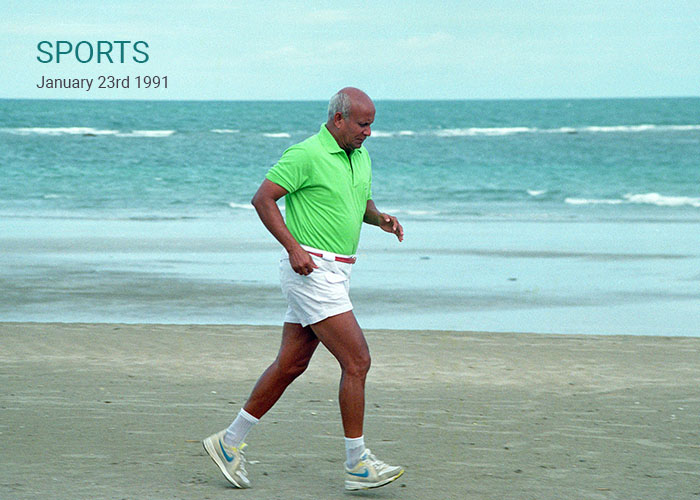
On the Beach in Bali


Photos by Pulak Viscardi


Sri Chinmoy finds the beach just outside the Kartika Plaza Hotel in Kuta, Bali, ideal for all kinds of sporting activities. Read more...


January 23

Diary Entry

by Sri Chinmoy
while in residence at the Sri Aurobindo Ashram in Pondicherry, India

23 January

Nolini-da said to me: "Chinmoy, today you have to do two things for me. First of all you have to find an article I have misplaced. This article is going to be included in the new edition of my book Narir Katha, which the Ashram Press is going to print. I don't remember the name of the article, but I am sure you will be able to find it."

I searched for fifteen minutes and found the article, which was entitled E Juge Narir Adarsha.

"Now, your second task, Chinmoy, is to try to find the third part of em>Matri Bani. As far as I remember, I wrote it in a grey notebook."

I searched for the notebook in various places, ransacking all the drawer files and bookshelves. But Matri Bani was not to be found.

"Where could it have gone? Where could it have gone?" he exclaimed.

I said to him: "Nolini-da, perhaps you have given it to someone."

He concentrated for two minutes and then said: "No, definitely not! I have not given it to anyone. Look for it. You will find it."

He was right. In five minutes, to his great joy, I did find it.


Published in A Service-Flame and a Service-Sun


Indian Stories

by Sri Chinmoy


The tragedy of Dasharatha

There was once a great King named Dasharatha. He was the father of the great Ramachandra, one of India’s Avatars. King Dasharatha was an expert in the art of archery and his teacher, Bhargava, was extremely pleased with his student. There was only one particular knowledge which Bhargava did not impart to his student. It was a special type of archery in which it is not necessary to even see the prey. By just hearing the sound of the animal, no matter where it is, the archer can shoot it. This secret knowledge Bhargava did not want to give Dasharatha because he was a Kshatriya. Although Kshatriyas are very spirited, courageous and determined, they have one weakness: they lack a disciplined life and sometimes they become a victim of restlessness. Therefore, Bhargava was unwilling to give Dasharatha the necessary skill.

But Dasharatha begged and begged his teacher. Repeatedly he declared, “I will not misuse it, I will not misuse it. I promise you.”

Finally, Bhargava acceded to the King’s entreaty. “All right,” he said, “I will give it to you, since you are begging me. But I am afraid that one day you will bring a serious calamity to yourself and to the members of your family and also to some innocent victims through your unfortunate use of this knowledge. However, as you are begging me so earnestly, how can I displease you, my son?” So Bhargava gave the secret knowledge and secret capacity to his dearest student, Dasharatha.

Dasharatha was now extremely happy and delighted, for he knew that he had mastered all the strategies of archery.

A few years passed and one day a strong desire entered into Dasharatha’s mind. He said, “Let me go into the deep forest and test the secret capacity that Bhargava has given me. Then I shall be able to discover whether I actually have learnt how to aim at animals without seeing them.”

So Dasharatha went into the forest. When evening came, a sound reached his ears, which he was sure was the trumpeting of an elephant. Dasharatha immediately pulled back his bow and let the arrow fly. Then lo and behold, this time a human sound came back to him in the night: “Mother, Mother, I am finished.”

Dasharatha followed the sound to its source and what did he see? He saw a little boy of nine who had come to fetch water from a pond. The little boy’s father, a great sage, was blind. His mother was all affection and love for her only child, her darling son. Because his parents were old, the son helped them in many ways, even at this early age. This particular evening his parents had been thirsty, so he had come to draw water from a pond near their cottage. As he was approaching the pond, the arrow came flying towards his heart and struck him down.

When Dasharatha came and saw the scene, he felt intensely miserable at what he had done. He cried out piteously, “Oh, Guru Bhargava, you were right, you were right! I was not meant for this sacred, sacred knowledge, these extraordinary capacities.”

The little boy turned his eyes to Dasharatha and said to him, “I am dying. No harm, I shall die. But do me a favour, will you? Will you go and carry this pitcher to my parents? My parents are thirsty and they are expecting me at any moment. Please, please do me this last favour. Don’t you worry about me. This is my fate, but please go and give water to my parents. They are thirsty, extremely thirsty.” Then the little boy, Sindhu, turned his face to Heaven and died.

Dasharatha burst into tears. With one hand he took up the dead body of the little boy and with the other he carried the pitcher, full to the brim. Slowly, and with a heavy heart, he made his way to the cottage of Sindhu’s parents.

When Sindhu’s father heard the sound of footsteps he said, “Sindhu, Sindhu, my Sindhu, you have come! We are waiting for you. What happened to make you so late today, my child? Both your mother and I are pinched with thirst, and you have come to quench our thirst. You are our dearest child, our only darling. Please, please, always try to be on time. Do not waste any time when you go on errands that take you away from us. We need you badly at every moment.”

Dasharatha could remain silent no longer. He said, “Oh sage, I am the wretched Dasharatha. Forgive me, forgive me. Your dearest, sweetest child, Sindhu, is no more. I have come and brought your son. But, alas, he is without life. Now, although I am the King, I am at your mercy entirely. Do anything you want with my life.”

The father and mother could not believe their ears. As soon as the mother saw her son lying dead in Dasharatha’s arms, she fainted and immediately her husband followed her. In an hour’s time, when they had both recovered, they said to Dasharatha, “O King, please do us the kindness of arranging for a pyre to be made straight away. Our last request of you is this: As soon as the pyre is lit, we wish to join our son on it. As soon as the fire starts blazing, we shall place our son on it first and then we shall also enter into the climbing flames.”

In great distress, the King said, “No, no, no! That cannot be done. One soul has died. Already I am responsible for one human being’s losing his life, and at such a tender age! Now must I be responsible for two more? Oh no, no! Please forgive me, I am the King. I will do everything that is within my limited human capacity to console you, but this thing I cannot do.”

With one voice the parents answered him. “No, King, stay we cannot. We cannot be dissuaded from joining our son. He was dearer than the dearest to us. Without him our life is meaningless and will always remain meaningless. Therefore, let us go with him.”

“Then,” Dasharatha said, “what will be my punishment?”

“No punishment,” the mother replied. “Why should we blame you? This is our fate. We forgive you. Our son forgave you and we also forgive you.”

Her husband, the sage, said, “Wait! My son has forgiven him, you can forgive him, but I cannot. Although I have done yoga and practised austerities all my life — infinitely more than my son and you — I cannot forgive him. I simply cannot!

“Dasharatha, you are responsible, totally responsible, for our son’s death and I am compelled to curse you. You too, will one day miss your son the way I am missing mine. You will be obliged to send your son into the forest because of your foolish fondness for one of your wives and, through this unthinkable behaviour, you will lose your dearest, eldest son.”

At the time of these events, Dasharatha didn’t have a son. But when he heard the curse he cried out, “O God, O God, don’t give me a son, don’t give me a son. I don’t need one, I don’t need one. It is better not to have a son and not to miss the son than to send the son into the forest to be killed. But I cannot conceive how this death could take place. How could it happen? Why would it happen? Who among my wives would be so unkind as to compel me to send my son into the forest? Impossible, impossible! Yet the curse of the sage may come true. O God, I beg You either to give me a son who will escape this curse or to give me no son at all. For to lose a son and enjoy the kingdom would be simply impossible for me. O Lord Supreme, forgive me, forgive my misdeed. Let this curse remain unfulfilled, I pray.”

But, alas, how can the curse of a great sage pass unfulfilled? There came a time when Dasharatha was indeed compelled by his second wife, Kaikeyi, to send his son, who was dearer than the dearest to him, into the forest and there the inevitable happened. It was simply impossible for Dasharatha to bear the shock of his son’s death and, lamenting the loss, he died.

The defeat of Britrasur

God alone knows when this particular story took place. As you know, the gods and asuras always fight. They fight over Heaven, since they both want to possess it. Sometimes the asuras possess Heaven, and sometimes the gods do.

Why does it happen so? The gods lose Heaven when they misuse their freedom and enter into the enjoyment-life. At that time they are driven out by the asuras, or undivine forces. Then, when the asuras misuse their capacities and become extremely wicked, they are driven out by the cosmic gods. While we can expect this kind of undivine behaviour from the asuras, it is really painful when the cosmic gods also enter into the life of undivine enjoyment and are compelled to lose Heaven.

Now, each time the gods are driven from Heaven, they pray like anything in order to win back Heaven. They pray and pray and meditate and meditate, and gradually they regain their power. Then they drive out the asuras, who have been losing their capacities because of the undivine life they have been leading in Heaven. Then everything is reversed. The asuras pray and meditate and become stronger, while the gods become weaker because they have entered into the enjoyment life. Then finally the asuras drive out the cosmic gods. It has been going on like this from time immemorial.

Thousands of years ago there was a most powerful asura named Britrasur, who was the King of the asuras. Britrasur was able to drive the gods out of Heaven, and then he ruled Heaven mercilessly. Gradually, his subjects became very undivine and cruel, and they lived a very undivine life.

It happened that the King’s wife developed a strong desire. She wanted to bring Indra’s wife, Sachi, to her palace and make Sachi her maid. Indra was the King of the cosmic gods, but he had been driven away by Britrasur along with the other gods.

Britrasur said to his wife, “It is an excellent idea, my dear. I am sending my soldiers to arrest Sachi, and she will definitely become your maid. Your happiness is my happiness.”

When news of this reached Indra, he became furious. He said, “What an insult! My wife, my Queen to become the maid of Britrasur’s wife! True, I have been driven away by him. True, he is stronger than I am right now; he is stronger than any of the cosmic gods. But how does he dare to even think of taking my wife away from me? Such an insult I will not brook!”

So saying, Indra went to Brahma, the Creator. “O Brahma,” he pleaded, “save me, save me. Look at the audacity of Britrasur! He wants to take my wife away from me and make her his own wife’s slave.”

Brahma replied, “Indra, when you suffer from a disease, you need medicine to cure yourself. You have all enjoyed life in a way that was beyond all proportion. Now you have to pay the penalty.”

“That is true,” Indra admitted. “But Lord Brahma, how long can they torture us? And this kind of audacity — to take my wife, of all people! How can I tolerate it?”

Brahma said, “When you suffer, you come to realise others’ suffering. I am not saying that your wife should be taken away by Britrasur; far from it. But I am telling you, you must not enter and remain in the world of restless, base enjoyment. I tell you, Indra, you can get back Heaven only if a great sage offers you his boon.”

“Who will do this kind of thing?” Indra asked. “Is there anyone who can offer me such a boon?”

“Yes, yes, there is such a person,” said Brahma. “Dadichi, the son of Chyaban, can and will do it. This great son of Chyaban will offer you his boon. Your wife and your friends should go and take shelter at Dadichi’s and Chyaban’s house.”

So Indra immediately went with his wife and army to their house and related all that had passed to Dadichi. Dadichi assured him, “Do not worry, I shall do the needful.”

Upon hearing that Indra and his wife had taken shelter at Dadichi’s house, Britrasur sent his soldiers there to arrest Indra’s wife. If necessity demanded, they would arrest Indra too. But it was not so easy to arrest Indra’s wife. Since the task was proving so difficult, Britrasur himself, the leader and King of the asuras, decided to personally come to seize her. Dadichi was waiting for Britrasur when he came and said to him, “Let us see whether you can take Indra’s wife away from here. Let us see whether you can contend with my occult and spiritual power. Let us see who can destroy whom. I warn you, Britrasur, if you don’t give up this foul and base desire of yours, I shall destroy you and all your friends and soldiers with my third eye — completely and utterly.”

Britrasur remained silent but his wife said, “Oh no, I have come to take Sachi. She will massage my feet; she will become my slave, my perfect slave. What a perfect slave she will make!”

Calmly and quietly and with a broad smile, the sage Dadichi said to them, “All right, I am going to bathe in the lake and then I will return. But I tell you, before I come back if you take away Indra’s wife, then I shall destroy you all immediately. Yonder is the lake in which I shall bathe. When I return, I shall do the needful.”

So Dadichi went to the lake. An hour, two hours, a day, two days went by, and still Dadichi did not return from the lake. The days ran into weeks, with still no sign of him. Finally, Indra and his army went to the lake to see what was going on. When he did not find Dadichi, he jumped into the lake to see whether Dadichi had given up his life and was at the bottom. It was true. Dadichi had taken away his life-breath while in trance. Indra found the body of Dadichi and brought it to the surface. But although it was dead, it was full of power; it emanated power. On seeing the dead body, Britrasur took fright and ran away. Indra at first chased him. But then Brahma himself intervened and asked Indra to take a particular bone from Dadichi’s body and make a special mace, which was then known as Vajra. After the mace was completed, it flew up high into the air and from there it descended upon Britrasur’s head, destroying him at the spot where he was standing.

This is how the cosmic gods regained Heaven and were spared the loss of Indra’s wife, Sachi Devi. Indra and his soldiers and Sachi Devi all bowed down to Brahma, the Creator, with gratitude-hearts everlasting.

Arjuna inspires Ekalavya

The young Pandavas and the young Kauravas used to learn archery from Dronacharya. Dronacharya was the supreme archer and everybody admired him not only for his skill but also for his lofty spiritual height. He taught the young Pandavas and the young Kauravas with utmost concern and love and instilled into them character, strength and manly vigour.

There came a time when the young Pandavas and Kauravas had to sit for an examination. In actuality, it was more a display of prowess than an examination and everybody was given the opportunity to show his capacity.

The grand winner was the third Pandava, Arjuna. All the people who had come to watch the events appreciated and admired Arjuna’s matchless precision and expertise. Among the spectators were an old man and his son. The son was so deeply moved by Arjuna’s capacity that he said to his father, “Father, I want to become an archer like Arjuna. I admire him so much.”

His father answered, “Ekalavya, there is nothing wrong in that, my son. You practise hard and you will also be a fine archer.”

“But how can I practise archery? I have to learn it first,” reasoned the son.

“Agreed. You have to learn.”

“But who will be my teacher? I wish to have Dronacharya as my teacher!”

“No son,” the father said. “He will not become your teacher. We come of a low caste, so how will he become your teacher?”

But his son insisted, “What is low caste, what is high caste? I see he is a very kindhearted man.”

The father said, “Yes, he is kind-hearted, but when it is a matter of teaching low caste people, he won’t do it. He will only teach the Brahmins and Kshatriyas. I tell you, we are Sudras, so he cannot teach you.”

The young man was very sad that he would not get Dronacharya as his teacher. On the way back home, he suddenly said to his father, “No, I am going to ask Dronacharya all the same. Who knows, perhaps he will teach me. So Father, you go home. I will come back alone.”

His father said, “All right, you go if you must, but let me wait for you here. You go and see.”

After his son had left, the father said, “How inspired my dear Ekalavya has been by the matchless Arjuna! I can clearly see that because of his aspiration and determination, my son is destined to become a great archer, whether Dronacharya agrees to teach him or not. It is only a matter of time.”

God will teach you

Inspired by Arjuna’s peerless archery skill at a royal competition, Ekalavya approached Arjuna’s archery teacher, Dronacharya. “Sir, sir, venerable sir, will you please teach me archery? I want to become just like Arjuna. I have such tremendous admiration for Arjuna. Will you teach me archery?”

Dronacharya replied, “Yes, I will teach you. But please tell me who you are.”

The young man said, “My name is Ekalavya and my father is the chief caretaker.”

Dronacharya looked disturbed. “Oh, you come of a very low family. I am sorry, but you have to forgive me, I cannot teach you.”

The young man protested, “High caste, low caste! You are such a learned man, such a man of wisdom, and yet you are saying things like this. I was born in a low family, but if I do good things — great and mighty things — will it not compensate my birth?”

“You are speaking like a true philosopher, and let me say that I admire your philosophy. It is not your fault that you came into a low caste family. And if you have aspiration and determination, then naturally you are bound to succeed.”

The young man said, “That is what I am saying. It was my fate. What can I do if I was destined to take birth in a low caste family? But if, with my aspiration and determination, I do something great and good, will it not please the world? Will it not please God?”

“Yes, certainly it will. I appreciate your philosophy. I see eye to eye with you. But I cannot fulfil your desire. I cannot teach you. You try! With your heart’s aspiration and your unfaltering determination, you try. You will succeed one day, my boy. Of that, I assure you. If I do it, the Brahmins and my friends will all hate me. They will throw me out of society. I am an old man. At this age I don’t want to be thrown out of society. So, make no mistake, I fully agree with your philosophy, but I am telling you that I am unable to fulfil your desire. You can call it my weakness or anything you want, but society is made like that. It has its own way of thinking. I do not want to be the one to justify it. I don’t want to go into the reasons why the Kshatriyas and the Brahmins should not and must not mix with lower caste people. That will be a very long story, and it will be a painful one for you. So I don’t want to tell it. You please go, and with your own aspiration and determination you will succeed.”

Sorrowfully, the young man turned towards home. When he came upon his father, who had been waiting for him, he said, “Father, you were right. This old man will not teach me. Caste, caste, caste! Father, why were you born in a low caste?”

“What could I do,” his father said. “My parents brought me into the world as I brought you into the world. Did I know I was going to take birth in a low caste family? Son, if we love God, then God will always please us and fulfil us. So if you want to learn the skills of archery, pray to God. God Himself will teach you.”

“Yes, Father,” Ekalavya said, “You are right. I have faith that because of my devotion to Dronacharya, God will definitely teach me.”

Ekalavya worships Drona

The young Ekalavya was determined to become a great archer. Although the master-archer Dronacharya could not teach him because he was of a low caste, the young man was adamant.

“I will pray to God,” he said to his father. “Day and night I will pray. Drona’s heart is good, but his mind was not good when I approached him. His heart sympathised with me, but his mind was afraid of what society would say if he taught a Sudra. But I want to have him as my teacher.

“So I have resolved to make a statue of Drona out of mud and clay, and I shall worship that statue as my teacher, my only teacher. From this statue I will get inspiration and be able to learn.”

His father said, “That is a wonderful idea. If you retain that kind of faith in your teacher, my son, I am sure you will succeed.”

So the young man made a statue that looked exactly like Drona. Constantly he used to pray to Drona and receive inspiration from him through the statue. In this way the young man was able not only to acquire the skills of archery, but to so master them that he became absolutely unique. He even learned how to stop the barking of dogs in such a way that his arrow pierced the dog’s mouth and stuck there. He had that kind of capacity. He was an unparalleled archer and the feat that he could perform with dogs not even Arjuna himself could dream of doing.

One day Ekalavya was meditating in the forest. A dog started barking and it was disturbing his meditation. So he picked up his bow and shot some arrows into the dog’s mouth. The dog, silenced, but not bleeding, ran away.

It so happened that Arjuna and the Pandava brothers were also in the forest, amusing themselves. When they saw the dog passing by, no one paid any attention to it. But Arjuna noticed to his astonishment that the dog had arrows inside its mouth but was not bleeding. He said, “Who can be such a great archer?” Overcome by curiosity, he followed the dog, which took him directly to Ekalavya, who was in a meditative consciousness.

Arjuna approached Ekalavya and, pointing at the dog, inquired, “Who has done this?”

“I have done it,” Ekalavya said.

“You! You have such capacity? Who taught you?”

“My Guru.”

“Who is your Guru?”

“My Guru is Drona,” said Ekalavya.

“Drona is your Guru in archery!” Arjuna exclaimed. “He is my Guru!”

“Yes, Drona is also my Guru.”

“When did he teach you, then? He is always with us in the kingdom.”

“Oh no,” said Ekalavya. “Here he is. Look, I have made a statue of him and I worship him in this statue. It was he who gave me the inspiration and the capacity to do this.” Arjuna said quickly, “Thank you. I am very happy, very happy. I am very proud of you.”

Although Arjuna felt sad that Ekalavya had far surpassed him in skill, he was very moved by the devotion and faith that the young man had for Dronacharya.

For his dearest disciple the Master will do everything

When Prince Arjuna discovered that the untouchable, Ekalavya, who lived in the forest, was more skilled in archery than he was, he was very disturbed. He left the forest and ran home, furious. He went straight to Dronacharya and said to him, “You have deceived me.”

“Remain calm and quiet, my son,” said Dronacharya. “Why are you shouting and screaming?”

“You have deceived me! I have just seen someone who knows archery far better than I do. You told me that I was the best archer and now, look, you have deceived me, you have fooled me!”

Dronacharya affirmed, “No, I can never deceive you; I can never fool you.”

“But you have done it,” declared Arjuna. “In the forest there is a young man by the name of Ekalavya. He has made a statue of you which he worships. From the statue he has derived such a unique capacity. With his arrows he can stop the barking of a dog, which I can’t do. And then, something else! He is able to shoot arrows through the mouth of a dog without making the dog bleed. Look at his capacity! I don’t have that capacity. You told me I was the best! Now what can I do? I feel miserable, miserable.”

Then Drona said, “Come with me, my son.” And he took Arjuna into the forest to where Ekalavya lived. Drona went up to Ekalavya and said, “You have such capacity in archery. Who taught you? I have heard from Arjuna that you have stopped the barking of a dog.”

“Yes,” replied Ekalavya. “I was meditating most soulfully on you and the dog was bothering me. Therefore, I got annoyed with the dog and punished it so that it could not bark. But, in all sincerity, I did not know that the dog would not bleed. I was also surprised when I saw that there was no blood. So, this is all your grace, Dronacharya. I give all credit to you.”

Drona said, “I am so proud of you, my boy. Now tell me, if it is true that I have done everything for you, then will you not give me a sacerdotal fee? You know that when you learn from a teacher, the teacher gives everything to the student. So it is customary for the student to give the teacher a reward.”

“Yes, yes, I will give, I will give,” Ekalavya replied earnestly. “Anything you want you may have. I am so grateful to you, so grateful to you.”

“Are you sure that you will give me anything I want?”

“Yes, without any difficulty whatsoever. Unreservedly and unconditionally I shall give.”

“Then give me, my son, your right thumb,” said Dronacharya.

“My right thumb!” cried Ekalavya. “If I give you my right thumb, then what am I going to do? Will I remain an archer anymore? No, I must keep my promise. You take my right thumb. You be happy. I am so grateful to you. You gave me the capacity to become an excellent archer and I will be so proud that I am able to fulfil your desire. So please, please, take my right thumb. I am giving you my right thumb.”

With these words he cut off his right thumb and gave it to Dronacharya. Then he said, “As an archer I could have been known the world over. Everybody would have come to know of me. But now I will be known as a devotee of yours. I am sure that to be a devotee is infinitely more meaningful and fruitful in my life than to be an archer.”

Arjuna felt miserable that this took place because of him. He said to Ekalavya, “Please forgive me, I am the culprit, I am the culprit.”

But Drona interrupted him, “No, you are not the culprit. I want to tell you one thing, I want to tell both of you. Arjuna, my son, today I wanted to show you that you have always been my dearest disciple — dearer to me than my own soul. In order to prove to the world that I can do everything to please my dearest disciple, I transformed you into an archer without equal in this land. But here also I wish to say that, in the inner worlds, Ekalavya will forever remain immortal because of his supreme sacrifice. No other human being could have made this kind of sacrifice.”

Patience illumines

There were two sisters, Kadru and Binate, who were both married to the sage Kashyapa. The sisters were extremely fond of each other. Kashyapa used to spend most of his time in meditation while his wives did the housework. Everything they sacrificed gladly, and Kashyapa was very pleased to have them as his wives.

Once, Kashyapa left for a few days of serious meditation. While he was away, the two sisters were talking, when unfortunately they entered into a serious dispute over the colour of Indra’s elephant, Oirabat. Binate said it was white while Kadru said it was black. Each was so certain of being right that both agreed that whoever was wrong would become the slave of the other. This was the agreement they came to.

Kadru, who had three sons, asked them about that particular elephant. “You have seen Indra’s Oirabat so many times. Can you tell me the colour of that elephant?”

The sons said, “Yes, Mother, it is white, pure white, like the moon.”

Kadru cried out, “O God, what have I done? Now I have to become the slave of my sister. Save me, save me!”

“How can we save you?” they asked. “Why did you make that kind of promise? We are extremely sorry, and we will feel very miserable when you become Mother Binate’s maid, but we are helpless.”

“You are not helpless,” Kadru said. “Do me a favour. Tomorrow morning Indra’s elephant will come to the lake. You and a few friends must wear black garments and carry black pieces of cloth with you. Then, when the elephant starts approaching, cover it with the black. When Binate and I come to see it, I will say, ‘Look, it is definitely black.’ We will hear the sound of the elephant, but from a distance it will look black.”

Early in the morning while it was still somewhat dark, the elephant came to the lake. Binate saw the pieces of cloth in front of the elephant. “Yes, it is black,” she cried out. “I have lost!”

Kadru said, “Now you have to be my slave, my maidservant, for life.”

When Kashyapa returned from his few days of meditation, he saw that Binate had become Kadru’s slave and was sad and miserable. Kashyapa himself felt so sad. “How can this kind of thing happen?” he asked.

When Kashyapa heard all about it, he said to Binate, “Kadru’s sons have deceived you. Actually, the elephant is white.”

Binate could not believe her ears. “I am so sad to hear that my dear sister Kadru and her sons have deceived me. But now it is too late. I have committed myself to being her slave. A promise is a promise.”

Kashyapa said, “Binate, you should have had more patience and waited for the elephant to come nearer. Then you would have discovered their trick and not committed yourself to be her slave forever.”

Binate cried, “What shall I do now?”

“Wait for the hour,” Kashyapa consoled her. “Although it is unfair, be patient. One day you will also have one or two sons. Your children will either take revenge or do something to illumine Kadru and her sons and make the family happy again.”

In three or four years Binate was blessed with a child, but the birth was premature. Binate became very upset: “This is the result of my patience?” she cried. “How can I have a premature child? This child is supposed to save me. It is impossible.” In her anger she kicked the child and the child became deformed.

“What have I done? What have I done?” she screamed.

Again Kashyapa consoled her. “You should have had more faith in my prophecy. Still my prophecy will one day prove true. Have patience: wait and see. Your sons will save you.”

“I don’t need any more children,” she said. “I am ready to remain all the time a slave to my sister.”

When her son was still very young, he said to Binate, “Mother, I fully understand that the reason you kicked me was because you were mad with grief. Torture yourself no longer about what you have done, and do not feel sad that you have become your own sister’s slave. First Kadru and you were sisters, then you were married to the same sage. You were very happy, and now your life is all suffering and misery. But a time will come when you will be free from this bondage.”

Two years later, Binate was blessed with another son, Arun, who was extremely bright spiritually. Binate was very happy to have this son.

Kashyapa said, “This son will really help you.”

Indeed, the brightness of the child frightened and tortured Kadru and her children and they were terribly jealous of him. As Arun grew older, his illumination compelled the stepbrothers to surrender, and they began leading a divine life.

One day Binate said to her son, “Arun, I know you have the power to compel my sister to free me from my promise. But please, let your older brother be cured by you instead. I am ready to remain a slave forever.”

But his older brother said to Arun, “No, I am ready to remain deformed. Let my mother be freed. You must not save me; save my mother.”

Arun replied, “There is no reason why you, Mother, have to remain a slave. My stepbrothers have become divine. Kadru, too, is ready to receive illumination.”

Very soon, Kadru freed Binate from her old promise, and again the two sisters became very close. The stepbrothers and brothers also became very fond of each other, and in a short time the oldest son of Binate was cured.

Kashyapa said, “Because of your patience, Binate, one of your sons has freed you, as I predicted. He has transformed and illumined Kadru and her sons. You lost the feeling of oneness over an elephant. But the past is dust. Now let us again enjoy the happiness of a oneness-family.”

Immediately Indra’s elephant Oirabat appeared outside Kashyapa’s home, and his two wives bowed down at the sage’s feet: “O Kashyapa, O great sage, we clearly see now that in spite of our ignorance you have illumined us. You have shown us that patience illumines and oneness ever lives in the heart of God’s creation.”

The Goddess Ganga descends to earth

The greatest of all sacrificial rites is Ashwamedha, the horse sacrifice. In performing Ashwamedha, the owner of a horse will meditate most soulfully and offer some mantras to the horse. Then he will allow the horse to leave his home and roam all over the countryside. The owner has to fight with whoever captures the horse and bring him back. Then only the sacrifice can take place.

Once a great king named Sagar wanted to perform this rite. Already King Sagar had performed Ashwamedha ninety-nine times and this was to be his hundredth time. Indra, the King of the Gods, had only been able to perform this particular sacrifice one hundred times, and he became terribly jealous of the King.

Since Indra wanted to ruin the King’s sacrifice, he stole the horse. Sagar sent his son, with a large army, to find the culprit and Indra was afraid he would be caught. So he entered into the nether world, first tying up the horse near a great sage who was meditating. After some time, Sagar’s soldiers saw the animal near the sage, and they thought it was the sage who had stolen the horse.

The soldiers said, “This sage is so unwise to keep the horse tied so close to him. He should have at least let the horse go away. Now it is obvious who the thief is.” So they started beating the sage most mercilessly. Suddenly the sage opened up his third eye and in a fleeting minute he killed Sagar’s son and the entire army of six thousand soldiers.

When his son and the army did not return, King Sagar sent his grandson to find out where they were. The grandson looked for the horse and finally found the animal near the sage. The sage told him what had happened.

“Please, you have to return the horse,” the boy said.

“No,” said the sage. “Tell your grandfather, the King, that I won’t tolerate this kind of thing. His soldiers struck me mercilessly, thinking I was the thief.”

The boy asked, “O sage, what is to be done now? So many good men have died.”

The sage replied, “Only if the river Ganga comes down from Heaven and touches these dead bodies with its water will they be revived. But for that you will have to pray and meditate for years.”

The grandson returned to the King with the sad news. King Sagar immediately agreed to pray and meditate to please the Goddess Ganga. He began praying and meditating intensely, but in a few years’ time he died.

Then the grandson, Angshuman, began meditating, but in a few years he also died. His son, Dilip, prayed and meditated for a few years and also died. Then his son, Bhagirath, also began praying and meditating most earnestly, and finally his prayer was heard by the Goddess Ganga.

Ganga appeared before him and said, “Before you, your father’s father and also his grandfather all prayed to me. Their accumulated prayer and your prayer have touched the very depth of my heart; therefore, I am going to come down. But if I descend to earth with my tremendous speed, I will destroy the world. There has to be someone who is spiritually very great to hold back my speed and power, and that can only be Shiva.”

Bhagirath then went and prayed to Shiva: “When Ganga descends most powerfully to rescue my family’s army, please restrain the flow of her waters. Only you are powerful enough to perform this feat.”

Shiva was very pleased with Bhagirath’s prayer and he agreed. “I will hold her back with my matted hair.”

When the Goddess Ganga began descending most powerfully, Shiva held her back with his matted hair. But his hair was so thick that Ganga’s waters could not flow down to earth at all, and the dead bodies were not being revived.

So Shiva took out one of the hairs from his head so that the water could flow through. The flow was not as powerful as it would have been if Shiva had not interfered, but it was still very powerful. It descended and passed near a cottage of a sage named Jahnu, and began washing away his cottage.

The sage got mad and started drinking the water, until he had drunk the entire amount that had descended. So all the water entered into Jahnu and none of it touched the soldiers. Bhagirath begged Jahnu to release the water. So Jahnu emptied the water through his mouth and the river continued flowing. Finally it touched the spot where the dead bodies were.

As soon as the water touched them, all the soldiers revived. They were exactly the same age as when they had died.

Because of this story, other names of the Ganga are Jahnabi and Bhagirathi.


Published in Great Indian Meals: Divinely Delicious and Supremely Nourishing, part 5



Sri Chinmoy completes his epic poetry series Twenty-Seven Thousand Aspiration-Plants in Cancún, Mexico. Read more…


Sri Chinmoy’s 27,000th poem*

My Twenty-Seven Thousand
Aspiration-Plants,
My Lord Beloved Absolute Supreme
Has given me to give you
The Sun-Smile-Blossoms
Of His Heart.

My Twenty-Seven Thousand
Aspiration-Plants,
You have given humanity
A sleepless God-thirst
And
A breathless God-hunger.


Published in Twenty-Seven Thousand Aspiration-Plants, part 270.


* Sri Chinmoy completed the final poem just after 1:00 a.m. on January 24th. However, he counted it as part of January 23rd.


The Time has Come for Our Lotus to Blossom

A short talk by Sri Chinmoy
at the Rex Hotel, Ho Chi Minh City, Viet Nam


All those who are in a position to run a marathon, kindly pass by me. This year we shall launch our own marathon. The time has come for our lotus to blossom petal by petal. It is my wish to have as many runners as possible! All the Centres should be informed. If you have the capacity and do not run, then I will be sincerely and sincerely sad. If you do not have the capacity, what am I going to say?

Dear ones, sometimes it is really, really good to be sincere to oneself. Now, what will you do? On a regular basis you should run. Please remember, you are making a promise to your Master, so there should be some sincerity involved. We shall have our cut-off time, but if you have friends to handle you, to take care of you, you will have no problems. Six-thirty-three is my worst marathon time, so I am giving you one more hour.

The first time if we can have seven hundred runners, I will be thrilled! Seven hundred people if we can get for our first attempt, then gradually we shall become very well known. Participants from the running world will see our treatment in comparison with the treatment they receive at some other races. Our treatment will be excellent in every way! We shall give the runners the utmost attention and concern.


Published in Our Sweetest Oneness


Fifty Oneness-Heart-Songs of a Perfect God and a Perfect Child


Sri Chinmoy begins writing this collection of meditative aphorisms in China, during a bus ride from Xi'an to Huangshan, and he finishes it the same day upon his arrival in Huangshan.


1.

I pray to God
Every day.


2.

My mother
Is beautiful.


3.

My father
Is powerful.


4.

My mother’s beauty
Thrills my heart.


5.

My father’s power
Drills my life.


6.

I love
Everybody.


7.

I hate
Nobody.


8.

I think everybody
Is good.


9.

The morning
Gives my eyes joy.


10.

The evening
Gives my heart peace.


11.

The sun invites me.
I am afraid to go to the sun,
Because it is too far.


12.

The moon invites me.
I am afraid once I am there
My parents will miss me,
And I, too, will miss them.


13.

The stars and the planets invite me.
I am afraid once I go to them,
They will keep me with them
To play with them,
And not allow me to come back
To my poor parents!


14.

Every morning
I see a most beautiful rose
Inside my heart.


15.

Every evening
I see a most peaceful tree
Inside my heart.


16.

I shall never want to know
What doubt and jealousy are.


17.

I shall never in my whole life
Want to feel
Insecurity in my heart
And impurity in my mind.


18.

Every night
God comes to see me
In my dream.
He tells me:
“My child,
You are a very good child.
Remain so all your life.”


19.

One most important thing
God has taught me:
If I really love God,
Then I shall not be afraid of Him.


20.

One more important thing
God has taught me:
If I really need Him,
Then He will do everything
To please me.


21.

I never speak ill of others.
Speaking ill of others
Is very bad!


22.

My parents are so kind to me!
They have told me
To think of God first
Before I say anything
And before I do anything.


23.

My parents have told me
Never to tell lies.
I obey them.


24.

My parents have told me
Never to quarrel,
Never to fight.
I obey them.


25.

I just love
My mother’s affection,
Love and concern for me.


26.

I just love
My father’s confidence
And determination.
He assures me that I shall have
Both confidence
And determination like him —
Even more.


27.

My mother has told me
What prayer is:
Prayer is a cry
To see God’s Eye.


28.

My father has told me
What meditation is:
Meditation is
To feel God’s Heart
Inside my heart.


29.

My parents have told me
To forgive others —
This will make me very, very happy.
They are so right!
I am the proof.


30.

I do not like at all
My noisy mind.


31.

I love so much
My rosy heart.


32.

God and I
Completely trust each other.
God does not forget my heart
Even for a moment.
I also do the same —
I never forget God’s Heart.
Never!


33.

I do not make complaints
Against anybody.
This has made me so happy.


34.

God tells me that
My tears and His Smiles
Are equally important.


35.

God wants me
To live in the heart
All the time.
He is so proud of me,
For I can easily do it.


36.

When I jokingly tell God
That my life is a secret book,
God smilingly and proudly adds,
“A sacred book too.”


37.

I know that God’s Grace
Has made me good.
God smilingly and proudly adds:
“Not just good,
But very, very good!”


38.

God tells me
Not to make
A very serious mistake.
I must love
My mother and my father
Equally.
I tell God:
“I do, I do, I do!”


39.

My father tells me
That my beauty
Is inside my eyes.


40.

My mother tells me
That my fragrance
Is inside my heart.


41.

God, when You look at me,
I get tremendous joy,
But when You look
Into my heart,
I get terribly frightened!

“Why, my child, why?
You have not done
Anything wrong!
Be happy, and remain happy,
Whenever I look
Into your heart.”


42.

Quite recently,
I have seen a beautiful garden
Inside my heart.
I have started praying
And meditating
Inside that garden,
And I am all excited
And delighted.


43.

My mother has advised me
To pray to God
For a big heart —
A very big heart.
I am doing it,
And I feel so good, so good!


44.

My father has advised me
To pray to God
For a small head —
A very small head.
I am doing it,
And I feel so good, so good!


45.

Today I am quite inspired
To give away
My prayer-secrets
And meditation-secret


46.

When I pray to God,
I fold my hands and bring them
Right up to my chest
And try to hear my heartbeat.
I look upward to find a spot
Ten feet, at least,
Higher than my head level.
When I have completed all this,
I start praying.
To tell the truth, I get fantastic results!


47.

When I meditate on God,
I do the same thing with my hands,
Only instead of looking upward,
I look inward.
I look into my heart and then I look
For a secret and sacred, silent spot
Inside my heart.
When all this is done,
I start meditating.
I tell you, the results are unimaginable.


48.

God, You have made me
A perfect child of Yours.
What can I give You in return?
I am a little child;
I have nothing to give You.


49.

“My child,
I need only one thing from you:
A sweet and cute smile.”


50.

“I also need another favour
From you:
You will tell your parents
How happy and grateful
You are to them
For bringing you into this world.
Still one more favour I need,
And this is the last favour
You will have to do for Me,
My child.
You will have to claim Me
All the time,
Not missing a second,
As your own, very own.”

God, I have already started.


Published in Fifty Oneness-Heart-Songs of a Perfect God and a Perfect Child