January 26

Diary Entry

by Sri Chinmoy
while in residence at the Sri Aurobindo Ashram in Pondicherry, India

26 January

In the morning, while I was going through the money order coupons, Nolini-da said to me: "This evening I shall read out something very special and significant about my first meeting with Sri Aurobindo and then I shall read out Amrita's autobiography. Sisir has asked me to read out the English version of my meeting with Sri Aurobindo. Sisir feels that if it is read in English, the non-Bengalis can also enjoy it. What do you think of this idea?"

"Your Bengali will always be matchless," I said. "When you read out your articles in Bengali, I get tremendous joy, and when you read out your English articles, I also get tremendous joy. But when you read out others' translations of your Bengali articles, unfortunately I do not get the same joy. I feel something is missing, though I don't know what it is."

He said: "You do know what is missing from my writings which have been translated by others. It is my original depth. Anyway, what can I do? This time I shall listen to Sisir's request. Next time I shall definitely read in Bengali.

"Today is Republic Day. More than half a century ago we tried to bring about independence in our own way. I shall read out to the Ashramites about our revolutionary activities."

After reading out his article he said: "Now I am going to read out Amrita's story of how he met — rather, did not meet — Sri Aurobindo for the first time."

At the end of his reading, Nolini-da's comment: "Indeed, it is an excellent experience, but Amrita stops very abruptly. It is just like eating half a rasgulla. I hope later on we will be supplied with a full one."

On the way back to Nolini-da's room, Yogananda-da and I were following him. I was carrying his thermos. He said to me: "I am glad that you brought the thermos today, and I am also glad that Yogananda gave me water to drink the moment I needed it so badly."


Published in A Service-Flame and a Service-Sun


Ego

A discourse by Sri Chinmoy


To feel the absence of ego is as difficult as to feel the presence of God in one’s heart. To feel the absence of ego is as difficult as to feel the presence of God in one’s self.

Man is ‘I’. God is ‘We’. Similarly, the ego is ‘I’; the soul is ‘We’. On the strength of its absolute oneness with God, the soul feels the entire universe as its very own. The soul knows and feels the omniscient, omnipresent and omnipotent God is within us. The soul sees and feels that it can sooner or later manifest the infinite Truth here on earth.

The ego does not see the truth; it does not feel the truth. The ego binds. The ego separates. The ego casts asunder the wisdom in us. When the ego expresses itself through self-delusion, it tells us that we can do nothing. Again, before we have achieved our soul’s liberation and perfection, the same ego tells us we are everything, we can do everything.

Ego is selfishness. He is lucky indeed who has freed himself from selfishness. God is in self-dedication, in selfless service. At the same time, he is blessed who sees God emerging from selfishness itself. In the process of evolution we have to go beyond selfishness, beyond the ego. But we have no right to deny the existence of God in the ego. Even in the ego God abides. He also abides in doubt, in fear, in ignorance and in bondage, but that does not mean that we will cherish fear, doubt, ignorance and bondage. No, God’s Consciousness in these things is extremely limited. We have to transcend our limitations. Today’s achievements are not enough. We are the children of tomorrow. There is no end to our progress. There is no end to our soul’s journey. We are running towards Infinity, and the shore of Infinity always transcends itself. There is no limit to our realisation.

No doubt we are infinitely superior to the wild beasts. Yet we consciously drink two bottles of ignorance-wine. One is the bottle of ego. The other is the bottle of self-doubt. Self-doubt has to be transcended. Ego has to be transcended. Man uses the terms ‘I’ and ‘mine’ because he feels that these things constantly feed him. But the real God-lover wants to be fed by God’s Grace and God’s Compassion. A true seeker of God, a true lover of God, will use the terms ‘Thou’ and ‘Thine’. He dines with illumination and God’s Compassion. He drinks the nectar of divine delight. He enjoys the bliss of oneness.

There are many thieves, but the worst of all these thieves is undoubtedly our ego. This thief can steal away all our divinity. Not only are our experiences afraid of this ego-thief, but even our realisation, our partial realisation, is afraid of it. We have to be very careful of this ego-thief.

Our human ego wants to do something great, grand and magnificent. But this unique thing need not be the thing that God wants us to do. It is always nice to be able to do great things, but perhaps God has not chosen us to do that particular thing. God may have chosen us to do something insignificant in the outer world. In the Eye of God, he is the greatest devotee who performs his God-ordained duty soulfully and devotedly, no matter how insignificant it may seem. Each man is a chosen child of God. Similarly, each man is destined to play a significant part in God’s divine Game. But each person has to know what God wants from him. When one becomes aware of God’s plan for him, then he abides by God’s decision. When God sees that particular person performing the role that He chose for him, then only will God be filled with divine Pride. Our ego will try to achieve and to perform great things, but in God’s Eye we can never be great unless and until we do what God wants us to do.

Ego comes to us in the form of self-flattery. When we remove the mirror of self-flattery from our eyes and in its place we hold the mirror of truth, what do we see? We see that we are nothing but semi-animals. We are afraid of seeing the truth face-to-face. Truth seems painful. But the ultimate Truth is not painful. It is our ego, our doubt and our self-styled pride that make the truth painful. The truth seems destructive, but that is not the real truth. Truth is sweet. Truth is harmonious. Truth is all-fulfilling. But we do not see truth the way truth has to be seen. We see truth according to our self-conceived ideas. Truth has to be seen in its own way.

The ordinary, common human ego feels that it has achieved everything and that it knows everything. This reminds me of an anecdote which Swami Vivekananda related to the Parliament of Religions in Chicago in 1893. It is called “The frog in the well”. It happened that a frog was born and brought up in a well. One day a frog from the field jumped into the well. The first frog said to the other, “Where do you come from?”

The second frog said, “I come from the field.”

“Field? How big is it?” said the first frog.

“Oh, it is very big,” said the second.

So the frog from the well stretched its legs and said, “Is it as big as this?”

“No, bigger! Much bigger!” said the frog from the field.

The other frog jumped from one end of the well to the other and said, “This must be as big as the length of a field.”

The second frog said, “No, the field is infinitely vaster.”

“You are a liar!” said the first frog. “I am throwing you out of here.”

This kind of thing is also the tendency of our human ego. Great spiritual Masters and sages speak of Infinity, Eternity and Immortality. The beginner who is just starting his spiritual life will immediately doubt. “Is Infinity a little larger than the sky?” he will ask. The sage will say, “No, Infinity is infinitely larger than your imagination, larger than your conception.” Immediately the sage will be criticised and will become an object of ridicule, because our ego binds us and makes us feel that what we have seen and what we have realised can never be surpassed by the realisation and experience of others. The ego does not like to feel that someone else has more capacity or that someone else can do something which it cannot do.

I am sure all of you have heard of Shankara, the great Vedantin. A Vedantin is one who follows the truths embodied in the Vedas or the Upanishads and who has realised the Vedic Law, the Vedic Truth. The great Vedantin Shankara, after a bath in the Ganges, was walking home along the street. It happened that a butcher carrying a piece of meat brushed against him. Shankara became furious and said, “I am a Brahmin! How dare you touch me! I am absolutely pure!”

The butcher said, “O Shankara, you are the Self, I am the Self. The Self does not touch anybody, and at the same time the Self is not touched by anybody.” Shankara came back to his senses.

In our day-to-day life, each human being feels that he is purer than others. He may do absurd things, he may be the prince of emotional affairs, but still he feels that he is superior to others in the realm of purity. Now, who is responsible for his foolishness? It is again his ego. If we live in the soul, we do not have problems of superiority or inferiority because the soul immediately makes us feel that we are one, absolutely one with the entire world.

Brahmosmi means in Sanskrit, “I am the Brahman.” It is the expression of the soul which has attained conscious oneness with the Absolute. But the tricky ego sometimes makes us say, “I am God.” Shankara had a disciple who used to imitate him in every way. When Shankara realised God, the absolute Brahman, he started saying, “I am the Brahman.” So this disciple also used to say, “I am the Brahman.” All the other disciples used to mock and scold him. “You must not dare to say that you are the Brahman,” they said. “Master Shankara can say this, for he has realised God, but you must not.” But the disciple would say that he wanted to imitate his Master in every way. One day Shankara asked this disciple to follow him. They came to a foundry and Shankara took a lump of molten gold and devoured it. Then he told his disciple, “Since you imitate me in everything, you should imitate me in this, too.” The disciple was scared to death and left the place. The other disciples then knew that they had been right, and they must never utter the word Brahmosmi unless and until they had actually attained that conscious and inseparable oneness. When that disciple transcended his ego and his emotions, he became a real, intimate devotee of Shankara. But first he had to get rid of the ordinary human ego and enter sincerely into the world of aspiration and realisation.

If we try to imitate the words and actions of the great Masters while we are still immersed in the ordinary life, it will be sheer foolishness. We have to grow in the field of spirituality first. This field is full of experiences. After that we can enter into the field of realisation. Then we will also be able to say, “God and I are one.” Right now we are not one with God consciously. In the realm of the soul we are one, but not in our day-to-day life. In our daily life we feel that God is somebody separate from us. Eventually we are bound to discover that this very God is inside us. One day we will be able to realise Him; we will be able to see Him and feel Him constantly. It is sheer foolishness and stupidity on our part to say that we are one with God while we remain in utter ignorance. We have to come out of ignorance and soulfully and devotedly become one with God. Then, if it is the Will of God, in order to teach humanity, in order to arouse humanity from its age-long slumber of ignorance, we can proclaim that we are one with God, that we are God’s chosen children, here on earth to fulfil God in His own Way.

At one time ego will make us feel that we are nothing and at another time ego will make us feel that we are everything. We have to be very careful of both our feelings of importance and our feelings of unimportance. We have to say that if God wants us to be nothing, then we will gladly be nothing and if God wants us to be everything, we will be everything gladly. We have to surrender unconditionally and cheerfully to the Will of God.

If the ego tells us that we are only God’s slaves, this also has to be renounced. We have only to pray to God to make us what He wants. If He wants us to be His peers, we shall be. If He wants us to be His slaves, we shall be. If He wants us to be His true representatives on earth, we shall be. “Let Thy Will be done.” This is the greatest prayer that we can offer to God. In the sincere depths of this prayer is the extinction or transformation of ego.


Published in Two Devouring Brothers: Doubt and Ego


The Journey’s Start, the Journey’s Close

A lecture by Sri Chinmoy
at Cornell University, Ithaca, New York

AUM

The journey’s start and the journey’s close. Human aspiration is the journey’s start. Divine manifestation is the journey’s close. Birthless is the journey’s birth, and endless is the journey’s end.

We came; we shall return. We came from the Supreme Being. To the Supreme Being we shall return. We embody the earth-consciousness and the Heaven-consciousness. The earth-consciousness inspires us to meditate on the transcendental Truth and realise the transcendental Truth in the soul of Heaven. The Heaven-consciousness inspires us to meditate on love and manifest love in the heart of earth.

We know, we grow, and we become. We know in Heaven. We grow here on earth. We become the transcendental Truth. What we know is Reality. What we grow into is Immortality. What we eventually become is divinity’s Perfection. Reality embodies Immortality and Divinity. Immortality and Divinity manifest Reality.

The Upanishads teach us the significant truth that each individual seeker must have inner peace and outer freedom. It is in inner peace that we can have true outer freedom. From the Upanishads we learn how to discover God, the inner man, and see man, the revealed God. The Upanishads tell us that the dedicated human beings, the surrendered human souls are God’s necessity, and each realised human being is given God’s unreserved infinite capacity.

Here is the secret of the Upanishads: love, serve, and become. Love God’s Life in man, serve God’s Light in man, and become God’s perfect Perfection here on earth.

In two words we can sum up the message of all the Upanishads: aspiration and manifestation. Aspiration is the way, and manifestation is the Goal. Aspiration is the song of the infinite eternal Consciousness abiding within us. Manifestation is the dance of unity’s multiplicity within and without us. Aspiration is the height of our Delight, and manifestation is the light of all-nourishing and all-fulfilling Delight.

AUM

Each soul needs involution and evolution. When the soul descends, it is the soul’s involution. When the soul ascends, it is the soul’s evolution. The soul enters into the lowest abyss of inconscience. The soul evolves again into satchidananda — Existence, Consciousness, Bliss — the triple Consciousness.

The soul enters into inconscience. For millions of years it remains there, fast asleep. All of a sudden one day a spark of consciousness from the ever-transcending Beyond opens its eye and then the hour strikes for self-enquiry. “Who am I?” it asks. The answer is /tat twam asi,/ “That thou art.” The soul is thrilled. Then again it falls asleep. Again it enters into self-oblivion. More questions arise after some time: Whose am I? I am of That. Where have I come from? From That. To Whom am I returning? To That. For Whom am I here on earth? For That.

Then the soul is satisfied. The soul now is fully prepared for its journey upward — high, higher, highest. At this moment the soul sees the Self, an exact prototype of the Supreme Being here on earth, and the evolution of the soul starts properly. The soul, from the mineral life enters into the plant life, from the plant to the animal life, from the animal life to the human, and from the human into the divine life. While in the human, the soul brings down Peace, Light, and Bliss from above. First it offers these divine qualities to the heart, then to the mind, then to the vital, then to the gross physical. When illumination takes place, we see it in the heart, we see it in the physical mind, in the vital, and in the gross physical body.

The Upanishads are also called Vedanta. Vedanta means the end of the Vedas, the cream of the Vedas, the essence of the Vedas. It is said that Vedanta is the end of all difference — the point where there can be no difference between the lowest and the highest, between the finite and the Infinite.

Our journey starts with aspiration. What is aspiration? It is the inner cry, inner hunger for the infinite vast. Aspiration has a most sincere friend — concentration. How do we concentrate; where do we concentrate? We concentrate on an object, on a being, on a form, or on the formless. When we concentrate with the help of the mind, we feel that eventually we shall see the vastness of the Truth. When we concentrate with the help of the heart, we feel that one day we shall feel the intimacy with the universal consciousness and God the eternal Beloved. When we concentrate with the help of our soul’s Light, we feel that man is God in His preparation, and God is man in his culmination.

The unaspiring mind is our real problem. The human mind is necessary to some extent. Without it we would remain in the animal domain. But we have to know that the human mind is very limited. The human mind is insufficient. In the human mind there cannot be any abiding Light, Life, or Delight. The human mind tells us that the finite is the finite, the Infinite is the Infinite. There is a yawning gulf between the two. They are like the North Pole and the South Pole. Whatever is Infinite can never be finite, and vice-versa. Infinity, the human mind feels, is unattainable. When something is finite, it is simply impossible for the human mind to feel that that, too, is God. Also, this mind quite often feels that because of His greatness God is aloof and indifferent.

When we meditate in the heart we come to realise that God is infinite and God is omnipotent. If He is infinite, on the strength of His omnipotence He can also be finite. He exists in our multifarious activities; He is everywhere. He includes everything; He excludes nothing. This is what our inner meditation can offer us. Our heart’s meditation also tells us that God is dearer than the dearest and that He is our only Beloved.

Inspiration, aspiration, and realisation — these are the three rungs of the spiritual ladder. When we want to climb from the finite to the Infinite with God’s boundless Bounty, the first rung is inspiration, the second rung is aspiration, and the third rung is realisation, our destined Goal.

To achieve the Highest, we become inspiration, aspiration, and realisation; and to manifest the Highest here on earth, we become Compassion, Concern, and Love. This is how we start our journey; this is how we end our journey. Again, when we become one with the Inner Pilot, inseparably one with the Inner Pilot, there is no beginning, there is no end. His cosmic lila, divine Game, is birthless and endless.

In human realisation, God within us is aspiration and realisation bound by earth-consciousness, bound by earthly time. But in divine Realisation, God is the Beyond, the ever-transcending Beyond. He plays the Game of the ever-transcending Beyond. He Himself is the aspiration of the ever-transcending Beyond, and He Himself is the manifestation of the ever-transcending Beyond. When we consciously know Him, realise Him, become inseparably one with Him, we too play His divine Game, the Game of Infinity, Eternity, and Immortality.

AUM. AUM. AUM.


Published in The Upanishads: the Crown of India's Soul


January 26

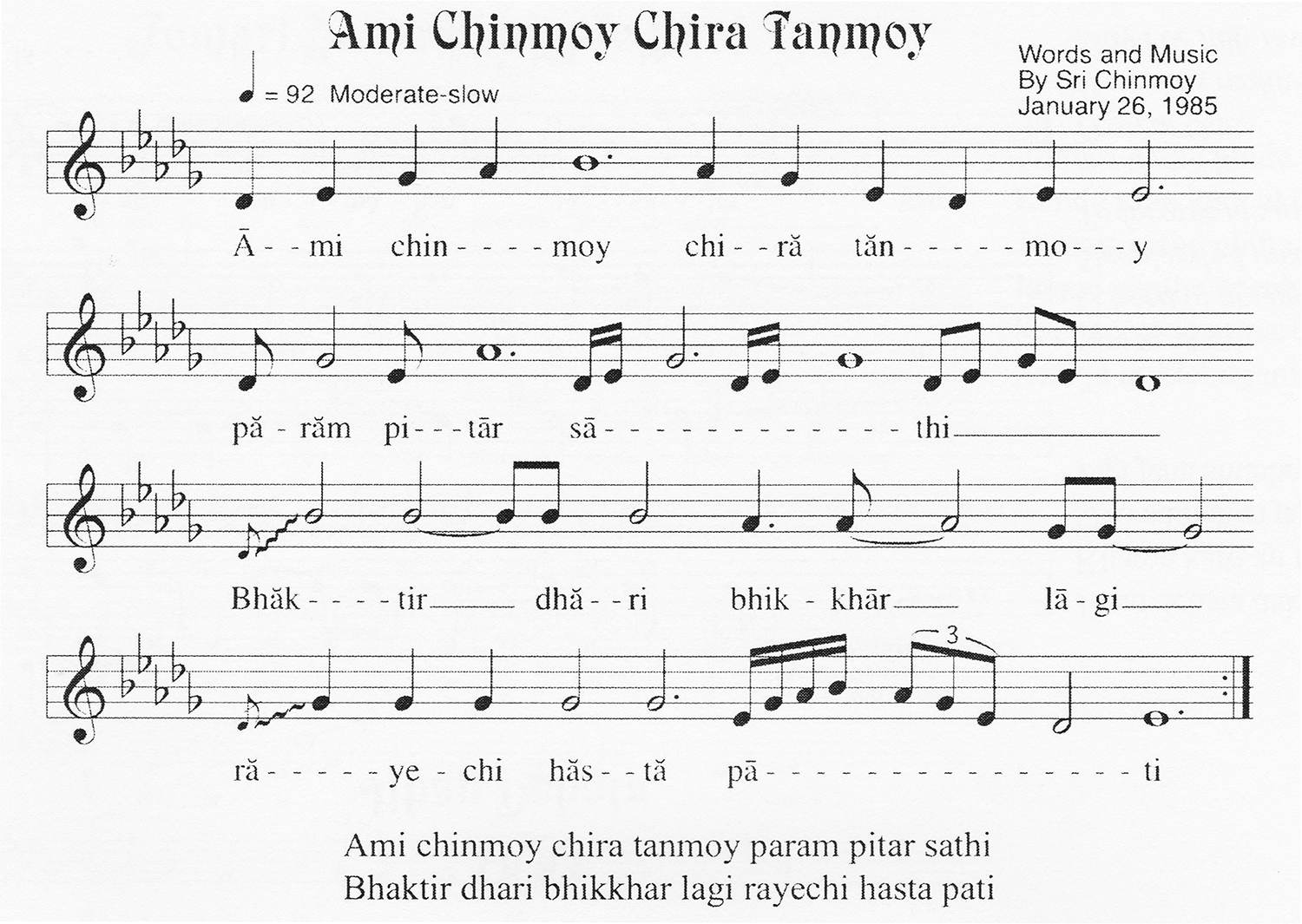
Chalbo Ami Parama Pita


Lyrics:

Chalbo ami parama pita
Tomari pathe
Samarpaner giti geye
Dibasha rate

Translation:

O my Beloved Father Supreme,
Singing the song of my constant self-offering,
All day and night
I shall walk along with You.


Note:

Chalbo Ami Parama Pita was considered to be Sri Chinmoy’s 2,000th Bengali song. However, in 2007 Sri Chinmoy revised the listing to make Jiban Debata number 2,000.

Published in AUM — Vol.II-5, No. 1, January 27, 1978

Published in Journey’s Goal, Part 9b


Three thousandth Bengali song


Published in German Boys Songs, Part 2


Sri Chinmoy’s Peace Concert

Closing remarks at the Peace Concert in Manila, Philippines


“I have been in the Philippines for over a month, and on various occasions I have offered my deepest love and gratitude to the soul and heart of the Philippines. Also, I was extremely fortunate to have met with the most beloved son of the Philippines, President Fidel Ramos. Personally I was able to offer my deepest love, my deepest gratitude and my deepest admiration to him.

“With utmost humility I am once again offering my heart's boundless love and joy to the most beautiful heart and most powerful soul of the Philippines. From the inmost recesses of my heart I am offering my gratitude, gratitude and gratitude.”


Published in Meetings with Luminaries in the Philippines


January 26

Long Island Press


GURU COMES TO LI

He Offers ‘Transcendental Peace’


BY TINA FERGUSON


The smell of burning incense fills the air, the light of flickering candles illuminates the darkness and the eerie stillness is broken only by the soft footsteps of Sri Chinmoy as he moves among his followers “bringing down transcendental peace.”

Chinmoy is a Far Eastern yogi, more commonly known to the Western world as a guru.

But, while such notables as the Beatles and Mia Farrow traipse off to India to seek salvation from the Western stress, Sri Chinmoy Kumar Ghose brought his “path toward God realization” to Long Island.

“The Supreme commanded me to come to the West to help the sincere seekers serve the Supreme in humanity,” the soft-spoken guru explained as he sat in “lotus position,” his eyes half-closed, in his Aum Center at Jamaica.

How does the “sincere seeker” serve the Supreme?

“Through the path of meditation, love, devotion and surrender — the way God wants us to,” the guru said.

CHINMOY’S PRETTY little white-frame house looks like any of the well-kept homes in the Jamaica Hills area.

But, while the exterior is typical, what takes place inside the Aum Center is indeed strange — to the Western world. Twice a week Chinmoy’s disciples gather at the center for silent meditation, lectures, blessings and private consultations.

A Thursday night visitor is instantly struck by the almost sleepy peacefulness that prevails as 30 men and women, some in “lotus position” on the living room floor, others seated upright on card chairs in the adjacent dining room, enter into a “deep plane of consciousness.”

No heads pop up, no eyes search a stranger as he walks among the “sincere seekers” to find an empty seat. He is awed by the serenity and dares not creak his chair lest the spell be broken.

He smells the incense. He looks around the room.

THE WALLPAPER is a non-descript leaf pattern. There is little furniture, only the card chairs, a big gold brocade chair and a few tables with candles, flowers and a photograph of Chinmoy in “highest spiritual form.”

His eyes scan the crowd. They rest upon a young girl in pink leotards sitting cross-legged, a bearded man in his early 20s, a stocky middle-age woman with her head between her knees, an elderly gentleman nattily dressed.
An hour passes unnoticed before a word is spoken ...

THE FIRST SOUND is the barely audible voice of Chinmoy. Seated in “lotus position,” his hands above his head “embodying divine compassion,” the guru whispers: “I am bringing down [unconditional] peace, love and bliss.”

The stillness, more strange, returns ...

A song to the Supreme, a Sanskrit chant and a few announcements conclude the session.

Sri Chinmoy, 37, came to the U. S. almost five years ago. He had spent the preceding 20 years in a “spiritual community” in India.

When he first arrived in the U. S., Chinmoy worked for the consulate general of India. At the same time he set up his first Aum Center in a walk-up apartment in Manhattan’s Upper East Side. His disciples bought him the Jamaica Hills house last July.

“Those who support me take responsibility for my physical needs as I take care of their inner needs,” Chinmoy said, stressing there is no fee for his “inspiration.”

CHINMOY THEN WENT on to discuss his discipline.

“It’s not a religion, but a form of spirituality that leads to God-realization. It transcends religion,” he said.

The “lotus position,” he explained, is the most important posture of spiritual discipline in yoga.”

The flower, according to the yogi, stands for “purity which enters into us in the form of fragrance conveying our love.” The incense signifies “aspiration — we get inspiration to aspire to the highest.” And, he continued, the flame “illuminates darkness into light, imperfection into perfection and obstruction into immediate help.”

Chinmoy also explained the meaning of AUM: “an original sound which stands for God in three aspects — the creator, the preserver and the transformer.”

Chinmoy has close to 65 devoted followers who come to the Jamaica center regularly — from as far away as Philadelphia and Mahopac, Although he spends most of his time in Jamaica, the guru also visits his disciples in Miami, the West Indies, Puerto Rico and the Virgin Islands.

WHAT KIND OF people are Chinmoy’s followers?

“All types but mostly middle-age,” the guru responded. And, interestingly, he said, they are of all religions.

“I do not accept everyone as a student,” he explained. “I make the decision on the strength of their inner wisdom.”

For example, as a rule he does not accept alcoholics, drug addicts, sexual perverts or hippies.

“I feel it is like a contagious disease,” he said.

How do Chinmoy’s followers feel about their guru?

“I was completely relieved to find there was something true in the world,” an Astoria mother, who is also a biology researcher, described her first reaction to Chinmoy.

SHE ADMITTED SHE had been “very wary of this kind or off-beat spiritual group.” The 40-year-old mother of two, is separated from her second husband. She said she had been “very disillusioned” before she met the guru.

“The future was black. It seemed like people were going down hill,” she continued, slowly. “Now,” she said, “I have the feeling there is a stability and security in the world. People aren’t just rushing around blindly in the dark.

“One of the most important things about guru,” she went on deliberately, “is that although he’s concerned with spiritual matters, he is also concerned with living in the world. Guru’s philosophy is completely balanced. He has clairvoyant powers.

“Whatever he tells you actually works,” she emphasized, explaining that her financial position has improved “as guru said it would,” and she has found an apartment “just as guru said.”

“HE’S NEVER MADE a mistake as far as I’m concerned,” said an enthusiastic 35-year-old salesman from Mahopac. He claims his job has improved and he has resolved some marital problems since he joined Chinmoy and his followers nine months ago.

“This has produced an awareness I never had before — an awareness of what one is rather than what one could do, he said.

The Westchester resident, who says he attends Lutheran church regularly with his wife and three children, admitted he was “hesitant in the beginning.” But, he quickly added, “On seeing him for the first time, it was like meeting an old friend again.”

Chinmoy speaks of “love, devotion, and surrender to the Supreme.” But his disciples, who view him as the “Supreme messenger” talk of “love, devotion and surrender” to their guru as seen in the few lines from a poem written to Chinmoy:

There you stand
Like a torch
That is always burning
For all that looks
And turns to thee
Transcending the form
Perceive
The CHRlST in you ...

Captions:

Left: Sri Chinmoy Kumar Ghose, in “lotus position,” his eyes half-closed, joins his disciples in silent meditation at their Aum Center, Jamaica Hills.

Right: His hands in prayer position, “embodying divine love and aspiration,” Sri Chinmoy brings down “transcendental peace, love and bliss” for his followers during a Thursday night session at the Aum Center. On the table to the right is a picture of the guru “in highest spiritual form.”


Published in the Long Island Press, page 34, Sunday, January 26, 1969


January 25

Photo by Pulak Viscardi


Sri Chinmoy is interviewed in Brasilia on the morning of Brazil being dedicated as a Sri Chinmoy Peace-Blossom-Nation.


January 25

Photo by Pulak Viscardi


Sri Chinmoy outside the Legião da Boa Vontade (Legion of Good Will) building in Brasilia, Brazil.


January 25

Time

A lecture by Sri Chinmoy
at Marlboro College, Marlboro, Vermont


Dear brothers and sisters, dear spiritual seekers, this morning I wish to give a talk on time.

 Time is love.
 If we love time,
Then time gives us what we want: pleasure.

 Time is love.
 If we love time,
Then time gives us what we need: joy.

 Time is love.
 If we love time,
Then God accepts from us what we have: Ignorance.

 Time is love.
 If we love time,
Then God gives us what He has: Light.

Pleasure. Pleasure on the physical plane, the vital plane and the mental plane is very short-lived, but during its brief span pleasure injures the real in us. The real in us is our cry for God, for Truth, or Light — our cry for Infinity's heart, Eternity's body and Immortality's soul. Today's pleasure ends in tomorrow's frustration and destruction. Tomorrow's frustration and destruction end in the total eclipse of our inner divinity. Therefore, a sincere seeker of the transcendental Truth tries to avoid pleasure.

Joy. In the spiritual life, joy is of paramount importance.

 Joy grows, joy flows and joy soars.
 God the climbing Tree grows with our joy,
our inner joy.
 God the dancing River flows with our joy,
our fulfilling joy.
 God the flying Bird soars with our joy,
our illumining joy.

If a spiritual seeker remains in a cheerful frame of mind he makes very fast progress. Joy means confidence in his life of aspiration. Joy is self-discovery and self-fulfilment.

Ignorance. When we go deep within, we see that we have nothing to give to God but ignorance. This ignorance God accepts from us most gladly, most devotedly and most unconditionally. Our life of ignorance we offer to God, and in return God offers to us a life of beauty, a life of plenitude, a life of infinitude.

Light. Light is self-revelation. Self-revelation grows into self-manifestation, and self-manifestation grows into self-perfection. Self-perfection and God-perfection are one and the same thing, operating on two different levels. We notice self-perfection in the heart of the finite. We notice God-perfection in the body of the Infinite.

Time is our oneness with God, our conscious oneness with God. We establish our conscious oneness with God on the strength of our inner cry. Mother Earth offers us her wealth: patience, sacrifice and compassion. Father Heaven offers us His wealth: love, wisdom and illumination. With the help we get from Mother Earth, we prepare ourselves for salvation. With the help we get from Father Heaven, we prepare ourselves for divine glorification. Salvation we get from earth, and divine glorification we get from Heaven. When we receive salvation, we feel that we are growing into the very image of our Beloved Supreme. When we are offered glorification, we feel that our Beloved Supreme is playing in and through us. In the finite He is singing His Song Celestial, His song of infinite Beauty, Light, Melody and Harmony.

The animal in us does not care to know about time. The human in us knows that there exists something called time, but it does not value time. The divine in us utilises time most effectively and divinely. The Supreme in us, the Inner Pilot, fulfils His dream and His reality here on earth through time.

Here on earth a child has no time even to eat his candy. A young boy has no time to study. A young man has no time to think. An old man has no time to rest. But a seeker knows that his God has the time to eat candy, to study, to think, to rest. His God has time for everything. The seeker also knows that God has the time to do everything because He takes the help of time. Only with the co-operation of time can He achieve everything in and through His aspiring, devoted and surrendered children.

Unaspiring human beings do not enlist the help of time. They do not know the value of time. They think that achievement is of paramount importance, and not the time required for the achievement. So they do not care for time; they neglect time. They do not realise that time is the bridge that will carry them to the other shore. If they do not use the bridge, they cannot go on to the other shore where there is Light, Peace and Bliss in boundless measure.

But the aspiring person, the seeker, appreciates time and utilises it. When it is time to eat, he will eat; when it is time to think, he will think; when it is time to study spiritual books, he will study; and when it is time to rest, he will rest. For him, each day is a new challenge, a new opportunity. He enters into the battlefield of life to conquer darkness, limitation, bondage and death. He has to fight and rest at the appropriate times. He has to do all the things that are necessary to invoke Peace, Light and Bliss from Above in infinite measure so that he can bring to the fore his inner divinity and offer it to the world at large.

There are two types of time in the spiritual life: earth-time and Heaven-time. Earth-time is necessity, and Heaven-time is reality, while necessity's reality is God-intoxication. The seeker in us feels that it is of supreme necessity for him to see the face of reality. And when he sees the face of reality he becomes a God-intoxicated soul. Reality on its part enters into our necessity and fulfils our necessity by illumining us within and without.

A God-intoxicated soul comes to realise that he has to achieve the eternal Truth first and then serve the divinity in humanity. First he has to achieve the Highest, the Absolute, and only then can he serve the Absolute in mankind. In this way he will be able to grow into the transcendental reality. God's Reality, on the other hand, feels that since it already is eternal, it must always serve its own all-pervading consciousness. The tree feels that it is its bounden duty to fulfil the needs of the branches, leaves, flowers and fruits. It also knows that it has the capacity to do this. So Reality starts serving its infinite manifestations immediately, for it knows that it has what it requires: consciousness in infinite measure. So the one climbs up the tree and then brings down the fruit to share it with humanity, while the other, who is already seated on the top of the tree, comes down immediately and shares the fruit with the aspiring humanity.

In the spiritual life, a sincere seeker knows that there is a God-appointed hour, a God-ordained hour. We call it God's Hour. This hour we can neither pull towards us nor push aside, but we can expedite it. We can shorten our road to God-realisation provided we are ready to sacrifice ourselves, to offer to the Divine at every moment all that we have within us — our ignorant, undivine and unaspiring qualities, as well as our aspiring qualities.

There is one thing in our physical that is unwanted now and forever, and that is lethargy.

In the vital there is something that we have to get rid of, and that is aggression, or the feeling of superiority and supremacy.

In the mind there is something that we must get rid of, and that is doubt. We doubt others and we doubt ourselves. When we doubt others, nothing happens to them. They go on perfecting themselves through their daily experiences. It is we who suffer each time we doubt, for we eclipse our inner sun. This is the sun that is ready to offer us its light in abundant measure; it is ready to kindle the flame of aspiration within us so that we can climb up high, higher, highest into our transcendental Divinity.

In the heart we also have something to get rid of, and that is insecurity. Very often we feel that we are helpless, we are hopeless, we are useless. But this wrong notion we must not cherish. Once we become sincere seekers on the path of Truth and Light, we know that deep within us is the Inner Pilot. It was He who inspired us to walk along the road of Infinity, Eternity and Immortality. If He Himself had not inspired us, we could not have launched into the sea of spirituality. But He did inspire us, and He continues to inspire us every day. So we can never be helpless, we can never be insecure. We know there is Light within us. Just because we do not now have the Light at our disposal, we cannot say that this Light will remain always a far cry. On the contrary, today's impossibility is tomorrow's destined achievement. There is simply no such thing as impossibility in our spiritual life.

We know that we are aiming at a Goal, the Goal that has everything divine for us in infinite measure. We are trying to establish our conscious oneness with Someone who is infinite, eternal and immortal — our God. Since He is our Source, since He is our Goal, how can our ultimate achievement be limited? Everything that we want to achieve, everything that we want to grow into, needs time; and our time is determined by God. We shall not pull God's Hour. We shall not push God's Hour. We shall simply play our role. We shall pray, we shall meditate the way we feel best from deep within. And God will select His Hour to illumine us so that He can fulfil Himself in and through us. In His fulfilment is our real achievement and real perfection.


Published in Fifty Freedom-Boats to one Golden Shore, part 1


Power

A lecture by Sri Chinmoy
at Luther I Bonney Hall, University of Maine, Portland, Maine


Dear sisters and brothers, dear seekers of the ultimate Truth, I wish to give a talk on power. We all know what power is. Everyone from a child to an octogenarian can tell us what power is. But I wish to say a few words on power from the spiritual point of view, based on my own inner experiences.

Life is action and action is power. Now, whom does this power belong to? Is it mine? No, never! Were it my power, I could use it at any time. But there have been many times when I wanted to use power and could not, precisely because this power does not belong to me. This power does not belong to any individual. It belongs to some higher realm.

Why do we want power? We want power because we feel that it will satisfy us in various ways. Within us we have the animal, the human and the divine. Although we have come out of the animal kingdom, we still have a good many animal propensities in our life. Although we are aspiring for a divine and higher life, the unlit, the obscure, the undivine animal and human in us are still predominant. To satisfy the animal in us, we want power to destroy the world. To satisfy the human in us, we want power to gain supremacy over others and lord it over them; we want power so that we can bring others under our control and make them extol us to the skies. To satisfy the divine in us, we want power so we can identify ourselves with all and sundry. The divine in us wants to become inseparably one with all human beings on earth. With the divine, there is no question of destruction, no question of supremacy; there is only the universal song of oneness.

Here we all are seekers. Before we entered into the inner life, the life of self-discipline, we noticed quite a few things about the members of our family: body, vital, mind and heart. We discovered that our body was exceedingly weak, impotent; our vital was extremely aggressive, dangerous; our mind was constantly confused, obscure, doubtful; and our heart was continually insecure. We stayed with our weak body, aggressive vital, unlit mind and insecure heart for a good many years.

Then something deep within prompted us to enter into the spiritual life, the life that could give us the message of the Infinite, the Eternal and the Immortal. Now that we have started making progress in the spiritual life, we have come to realise that this very body of ours can become most powerful. Our vital, our mind and our heart can also become most powerful. But we must know that the power of the body is not the power that we outwardly see, the power that takes the form of destruction. The infinite Power that we now see in the body is expressed in the body’s self-dedication to the Supreme Lord. The boundless Power that we now see in the vital is expressed in the vital’s dynamic, enthusiastic urge to welcome the vast world as its very own. The infinite Power that we now notice in the mind is expressed in the mind’s clear, perfect vision of the ever-transcending Beyond. Finally, the infinite Power that we now notice in the sun-vast heart reveals that there, in the heart, our divinity grows and our reality constantly fulfils its own immortality.

There are three types of power usually seen in the present-day world: machine-power, man-power and soul-power. Machine-power is to some extent blind. It takes tremendous joy in destroying the world. Although machine-power is unconscious, even in its unconsciousness we notice that, in a subtle way, it enjoys destruction. But we must remember that this machine-power is utilised by man-power, by the power of man's fertile brain. So machine-power can easily be brought under our control if we use our human brain-power or, preferably, our heart-power. Heart-power is the power of love, the power of oneness. If we use the power of our love and the power of our oneness, then the power of destruction can easily be nullified.

Our soul-power is constantly, incessantly trying to come to the fore and guide our outer consciousness, our outer life. Unfortunately, right now we do not pay any attention to the soul-power; but once we go deep within and become familiar with it, we shall be able to use it most effectively. The soul-power is the power of universal oneness. The soul-power is the power of real fulfilment and complete perfection in our aspiring lives.

There is a negative power and there is a positive power. Negative power we see in our idleness. When we live a lethargic, tamasic life, we tell God that we are tired and exhausted, that we do not want to budge an inch. We say, "If it is true that You are all Compassion, then please offer us what You have: Peace, Light and Bliss." But if an idle person invokes God in this way, God is not going to listen to his prayer. Never! Again, a rajasicperson, a man of unpolished, undisciplined dynamism — or, rather, aggression — wants to pull down Peace, Light and Bliss from Above by dint of his unillumined will for power. If he succeeds, it will be a disaster; for when something is achieved untimely, it is never given due value or utilised for a divine purpose. If we utilise power for an undivine purpose, we invite destruction into our life of aspiration. If we utilise power for a divine purpose, we shall be fulfilled in a spiritual, divine and immortal way.

Positive power can be all-fulfilling. The Upanishads, the sacred Vedic lore of India, tell us that a weakling can never realise the highest Absolute.

"Nayam atma bala hinena labhyo
The soul cannot be won by the weakling..."

If we at all want to dive into the inner life, if we want to be guided and moulded by the soul, then we have to be extremely strong. The strength we need is not so much physical strength, but the strength of self-discipline, the strength of self-enquiry, the strength of self-withdrawal from the life of the senses, the strength of self-effacement in the world of offering and self-fulfilment in the world of aspiration and meditation. The Upanishads again inspire us most profoundly:

"Uttisthata jagrata prapya varan nibodhata...
Arise, awake, realise and achieve the Highest with the help of the illumining, guiding and fulfilling Masters.
The path is as sharp as the edge of a razor, difficult to cross, hard to tread — so declare the wise sages."

But the Upanishads in no way want to discourage us. On the contrary, this sacred message will always inspire us to run towards the Goal. But we have to know that only he who is awakened can run towards the ultimate Goal. The Goal, God-realisation, cannot forever remain unattained or unattainable. Today's impossibility will not always remain an impossibility. No! If the seeker's cry is strong and powerful, the Smile from Above is bound to dawn.

In our day-to-day life we constantly exercise power, either in accepting or in rejecting reality. When we use power to accept reality with a view to transforming it, if necessity demands, then this power is called the soul's power, the power of the Source. But if we exercise power to reject the world-situation, to reject the possibilities of the world, to reject this world because we feel that its sufferings and turmoil are past correction, then our own transformation and illumination will always remain for us a far cry.

Each human being gets the opportunity to invoke power in various ways. Every day he gets the golden opportunity to invoke power with his hope. Hope is nothing but concealed power. When we cherish hope, we must know that we are consciously or unconsciously invoking an inner or higher power. Today's hope turns into tomorrow's actuality. Today's dream is bound to be fulfilled in tomorrow's reality. 

As hope is a power, so also is expectation a power. We expect many things from ourselves and from the world. We feel that today's expectation is going to bring down tomorrow's realisation. But in the spiritual life, we play the role without any expectation whatsoever. We feel that our role is to perform divine service, but not to expect the fruits thereof. If we can love, serve, pray and meditate with utmost sincerity, purity and self-offering, then our God-appointed realisation is bound to dawn. It will far transcend our highest expectation and far surpass the flights of our loftiest imagination.

In the spiritual life we deal with silence and we deal with sound and finally, we deal with a Consciousness which is beyond both silence and sound. Silence is power. This silence creates the world within us and without. Sound, the cosmic sound, is also power. As the transcendental Silence creates the world, so does the cosmic Sound sustain and maintain the world. Finally, the Consciousness which transcends both sound and silence immortalises the seeker's aspiring being.

We cannot separate the Power of God from His other divine aspects. Power is one aspect of God; Love is another. In the ordinary life, power is power and love is love. But in the spiritual life, in God's Life, Power and Love are inseparable; they are like the obverse and reverse of the same coin. Now, if we do not properly understand the power of love and the love of power, we run into the most deplorable difficulties. Before we realise the highest transcendental Truth, what we have is the love of power. But after we realise the Truth, we come to feel that there is only one thing in our life, and that is the power of love. As long as we remain in the world of desire, we cherish the love of power. But the moment we enter into the world of aspiration, dedication and illumination, we come to realise the power of love. The love of power destroys the Palace of Truth within us. The power of love builds the Palace of Truth within us and creates the Kingdom of Heaven within and without us, bringing down Infinity to play in the heart of the finite. When the power of love replaces the love of power, man will have a new name: God.


Published in Fifty Freedom-Boats to one Golden Shore, part 2


I Can Have Peace

A talk by Sri Chinmoy
at Columbia University, New York


I must simplify my complicated life so that I can have soulful peace. I must purify my doubting mind so that I can have powerful peace. I must intensify my aspiring heart so that I can have fruitful peace.

In the small hours of the morning, I meditate on peace. During the day, I try to transform my peace-dream-light into my peace-reality-delight.

I can have immediate peace the moment I sincerely feel that I am not indispensable either in the inner world of aspiration or in the outer world of dedication. I can have immediate peace when I can put an end to my self-aggrandisement. I can have immediate peace when I can devotedly feel that each human being, either consciously or unconsciously, is heading towards perfection and that, at God’s choice Hour, each human being will reach the acme of perfection.

I can have divine peace only when I can feel in the inmost recesses of my heart that I am of God’s Compassion-Heart and that I am consciously, constantly, devotedly and unconditionally for God’s Satisfaction-Life. I can have supreme peace when I can feel unmistakably that my existence-light is only for God’s Satisfaction-Life.

May the seeker in each human heart pray to the hidden Lord Transcendental to appear, so that when He appears, He will appear with His revealed universal Peace.


Published in The Oneness of the Eastern Heart and the Western Mind, part 3


January 25


Sri Chinmoy holds the Peace Torch with Olympic 800-metre gold medalist Joaquim Cruz at the beginning of the Sri Chinmoy Oneness-Home Peace Run in Brasilia, Brazil.


Race Prayer

by Sri Chinmoy
at the morning 2-mile race in Bali, Indonesia


The outer world
Is time-bondage-imprisonment.
The inner world
Is Eternity’s
Freedom-enlightenment-achievement.


Published in My Race-Prayers, part 1


January 25

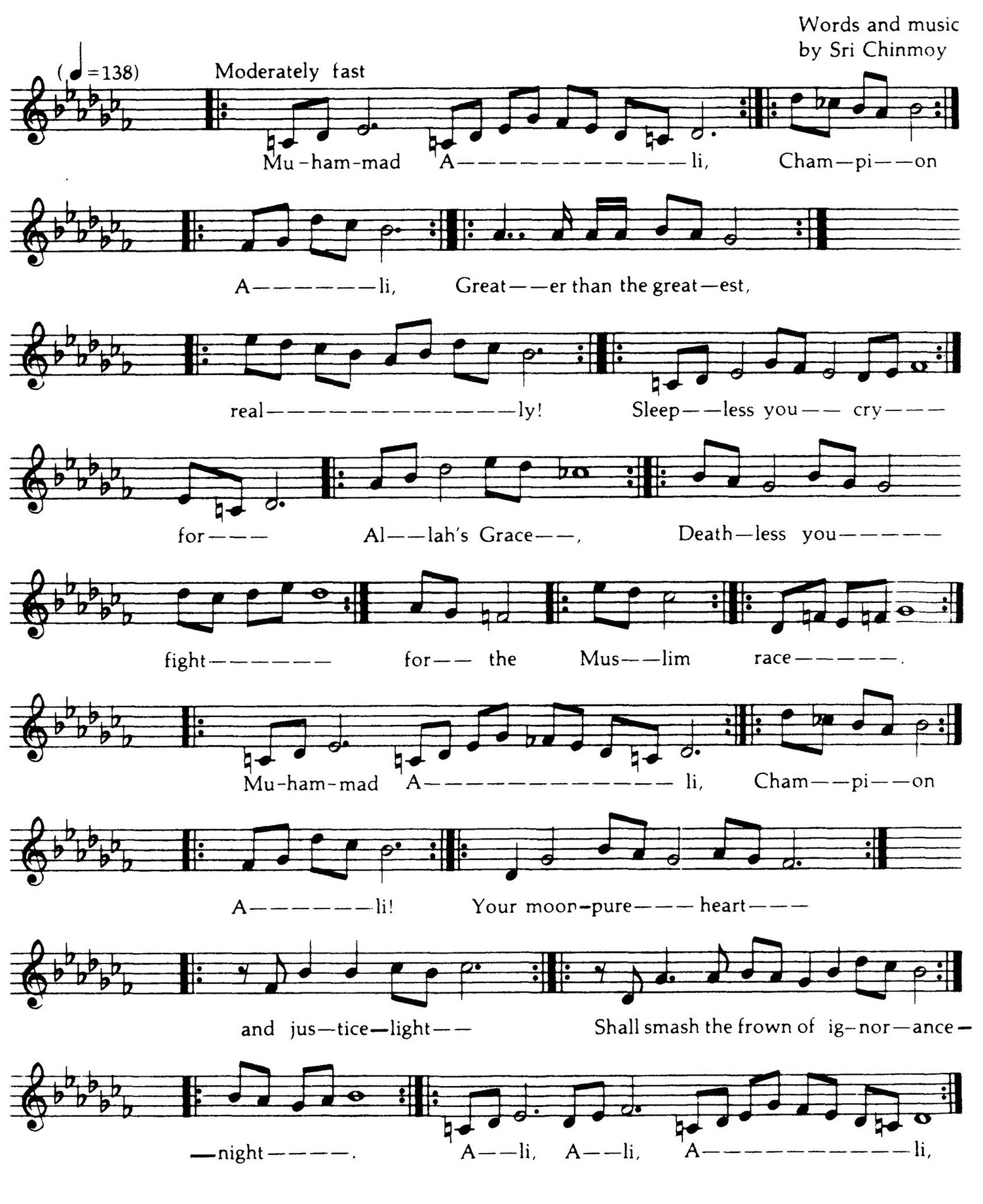
Muhammad Ali


Lyrics:

Muhammad Ali, Champion Ali,
Greater than the greatest, really!
Sleepless you cry for Allah’s Grace,
Deathless you fight for the Muslim race.
Muhammad Ali, Champion Ali!
Your moon-pure heart and justice-light
Shall smash the frown of ignorance-night.
Ali, you are Eternity’s pride.
Your victory’s smile is the pole-star guide.


Published in Blue Waves of the Ocean-Source


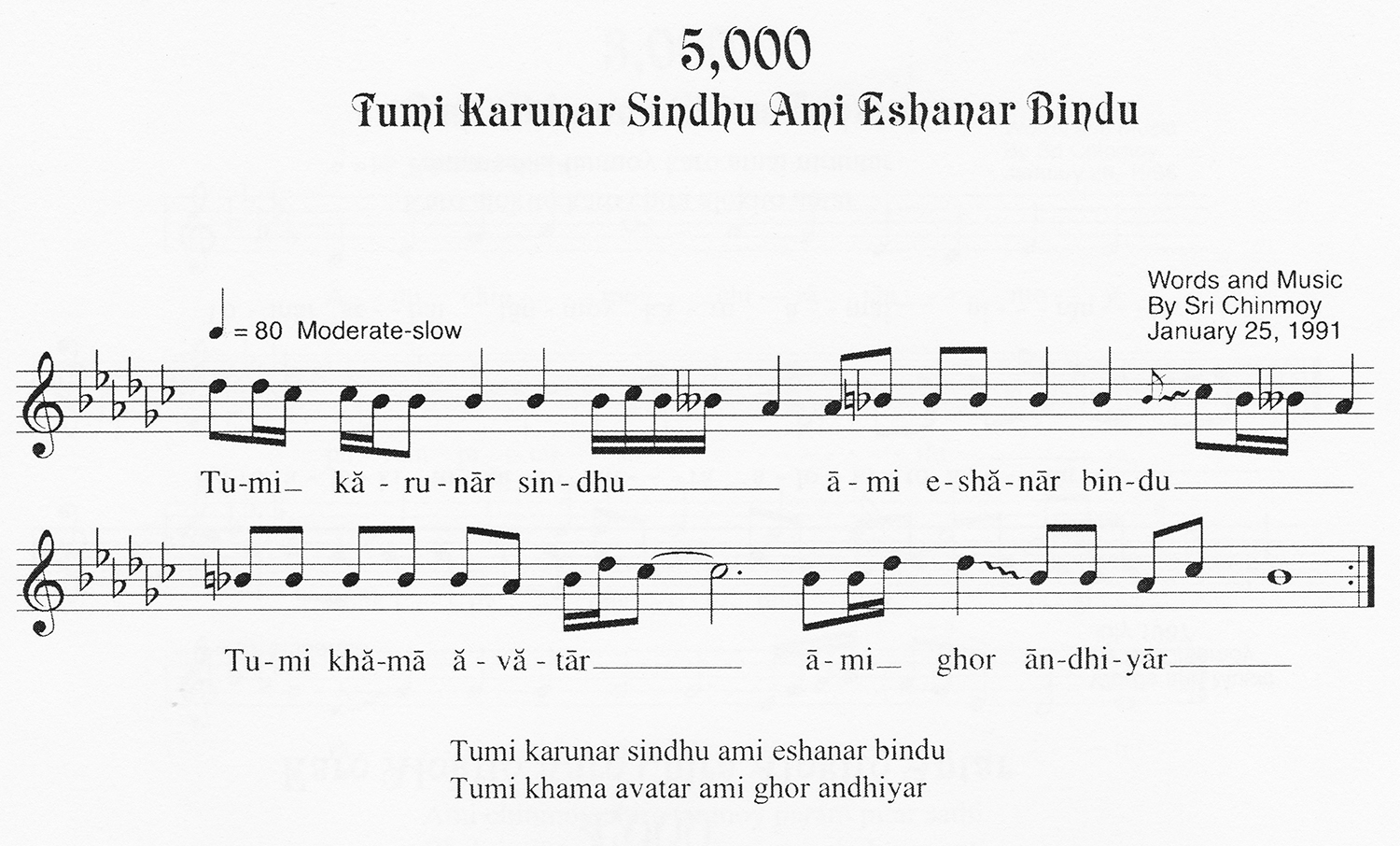
Sri Chinmoy composes his 5,000th Bengali song Tumi Karunar Sindhu Ami Eshanar Bindu.


Photo by Pulak Viscardi


Sri Chinmoy plays the piano at the Legião da Boa Vontade (Legion of Good Will) building in Brasilia, Brazil.