February 11

Body, Mind and Spirit Magazine Interview


Sri Chinmoy is interviewed in Washington, D.C. by Body, Mind and Spirit magazine during the ‘Heart-to-Heart’ Festival.


Question: In your own words, who are you?

Sri Chinmoy: If anybody asks me who I am, immediately I say I am a Truth-seeker and a God-lover.

Question: Tell me about your weightlifting.

Sri Chinmoy: I believe that we have to be integral. The spirit and the body must go together. If I have peace of mind in my inner life, then I shall not quarrel with you and fight with you. Nations, like individuals, are insecure. If one nation has peace within, then that particular nation is not going to challenge other nations. It is because we do not have an iota of peace that we quarrel with others, we speak ill of others, we find fault with others. Peace of mind gives us joy in boundless measure.

When I lift up these weights, I try to unite both the inner world and the outer world with my inner peace. I am a student of peace. Every day, since my childhood, I have been praying and meditating. From the life of prayer, I get peace and this peace gives me strength. My weightlifting is the manifestation of my inner strength. This is my soulful service that I have been offering to humanity.

Question: You are saying that weightlifting is the manifestation of an inner strength?

Sri Chinmoy: Yes. Because of my prayer-life and meditation-life, God, out of His infinite Bounty, has given me inner strength. So this inner strength I am trying to manifest through matter.

Question: How do you lift people?

Sri Chinmoy: With a oneness-heart. I have lifted people from all walks of life to offer my oneness to them. We all belong to one family. In a family, somebody is a doctor, somebody is an engineer, somebody is a football player. But they are all brothers and sisters of the same family. So here also, on the strength of my oneness with people from various fields, I am lifting them up. My sole objective is to be of service to mankind.

Question: How do you feel about the attention that you get? Is that sometimes a hindrance for you?

Sri Chinmoy: No, because I know that I am not the one who is getting the attention. I know that I am not the doer. If somebody offers me love or admiration, I know that it is my Inner Pilot who is receiving it. I am only an instrument.

Question: So it is not Sri Chinmoy?

Sri Chinmoy: It is not Sri Chinmoy. It is the One who, according to my receptivity, according to my capacity, is manifesting Himself in and through me. So if you speak highly of me, I know I am not the one who deserves it, I am not the right person. But there is Someone who has given me the capacity to draw your appreciation and that Person deserves the credit, not me. I am not the doer; I am only an instrument, a channel. So if you appreciate me, this appreciation is going directly to the Source and not to me.

Question: So it is a measure of how successful the Source has been?

Sri Chinmoy: Yes, according to my capacity and receptivity. The One who is inspiring me and trying to manifest in and through me I call my Inner Pilot. Your appreciation directly goes to Him.

Question: You have had this special relationship with God since you were a child?

Sri Chinmoy: I have been praying and meditating since the age of four. Now I am 57.

Question: So you have always known?

Sri Chinmoy: I came from a religious family and I was fortunate enough to follow in the footsteps of my brothers and sisters.

Interviewer: Well, you have been very gracious to meet with me and I want to thank you very much for taking the time. I wish you well.


Published in The Upanishads: the Crown of India’s Soul


February 11

Weightlifting Questions

Answered by Sri Chinmoy
in Washington, D.C.


Question: I am a little curious why you do not choose some more standardised feats to demonstrate your philosophy. Would it not be easier then for a larger body of athletes to judge your performances?

Sri Chinmoy: I have not come into the world to compete with anybody else, only to compete with myself. I am trying to transcend myself and I ask my students to do the same. I am not going to compete with a third person. But I know my capacity or incapacity. If I know what my capacity is, tomorrow I will try to transcend it. In our philosophy, transcendence is perfection. Transcendence is not something stagnant, like a pool. No, transcendence is like a river; it is always flowing. So I always compete with myself. If I can lift 40 pounds, then I will try to lift 50 pounds, then 60 pounds. If I can write one soulful poem, then I will try to write two poems.

I get joy from competing with myself. And I think that by competing with myself, I am making myself a better person. Others do the same perhaps. Again, who am I to talk about others? If they want to compete with the rest of the world, that is fine. In my case, I derive satisfaction from my self-transcendence. I know what I have and what I am. I feel that what I have and what I am is nothing, nothing, in comparison to the goal that I have set for myself. So if I want to reach my goal, then I have to transcend and transcend.

And then the goal itself is also transcending. There was a time when my goal was to learn the alphabet. Then it became something higher. In life also, no matter which subject we study, either an inner subject or an outer subject, there is no end to our wisdom.

Question: I see, but if there are no standards of what is typical, how do we know what is beyond typical?

Sri Chinmoy: I am not an authority on others; I only want to be an authority on my own improvement. God will take care of others the way God is taking care of me. I want to be a student all my life. I want to learn everything from my Inner Pilot and the same suggestion I am offering to my students all over the world.


Published in The Inner Meaning of Sport


Photo by Pulak Viscardi


Sri Chinmoy running at a track on the Gold Coast in Queensland, Australia.


February 11

Photo by Sarama Minoli


Sri Chinmoy meditates at a function with his students in Boston, Massachusetts.


Photo by Adarini Inkei


Sri Chinmoy takes a brief pause at a lifting event in Chiang Mai, Thailand.


February 11

Existence, Non-Existence, and the Source

A lecture by Sri Chinmoy
at the University of Connecticut, Storrs, Connecticut


Sat and asat are two terms in Indian philosophy which one very often comes across. Sat means existence, and asat means non-existence. Existence is something that becomes, that grows, and that fulfils. Non-existence is something that negates its own reality and its own divinity. Existence is everywhere, but existence has its value or its meaning only when divinity is visible in it. If divinity does not loom large in existence, then that existence is useless. Divinity is the life-breath of existence. Divinity fulfils our aspiring consciousness and reveals our own immortality here on earth only when we see divinity as something infinite and eternal.

Existence is cherished by the aspiring consciousness and by God’s own highest Reality. Reality and existence have to go together. Reality without existence is an impossibility, and existence without reality is an absurdity. Divine Reality and Divine Existence always go together.

Existence expresses itself only through Truth. This Truth conquers everything that is untruth. India’s motto, ‘satyam eva jayate,’ means ‘Truth alone conquers.’ What is this Truth? This Truth is at once the Depth of God’s Heart and the Height of God’s Head.

Truth is our inner promise. Our inner promise, soul’s promise, is that in this incarnation we will realise God, not by hook or by crook, but under the able guidance of our spiritual Master, because we feel that this is what the Supreme within us wants. What for? So that we can serve Him in His own Way.

The highest way of feeling this Truth is to feel this: “If He does not want me to realise Him in this incarnation, but in some future incarnation, I am fully prepared to abide by His decision.” But the seeker must have a dynamic feeling. If he just says, “Oh, let me play my role. Let me be nice, sincere, truthful, obedient, and when the time comes, He will do it all,” then relaxation comes. Very often when we say, “Let me play my role, and God will take care of my realisation,” God does take care of our realisation. But if we feel that if we can become fully realised as soon as possible, then we can be of real help to God, then we are bound to get our realisation faster.

If we have Peace, Light, Bliss, only then can we be of real service to mankind. The idea of God-realisation at God’s choice Hour must come from the very depth of our heart, and not from our mental knowledge. Unfortunately, it usually does not come from the heart, it comes only from the clever mind which says, “I have read in books and I have heard from the Master that if I do not want anything from God, then God will give me everything.” It is better to pray to God to give you peace of mind so that you can see the Truth in totality. To ask God for peace of mind is not a crime. If you do not have peace of mind, wherever you are, whether in the subway, or in the country, or in Times Square, there will be no God there for you. God has given us some intelligence. In the morning if you say, “God, it is up to You whether I eat or not. I will just stay here in bed,” God is not going to put food into your mouth. No, God has given you the necessary intelligence to know that you have to put forth some effort. You have to leave the bed and take a shower and eat by your own effort.

In the inner life, if you want purity, humility, peace of mind, and other divine qualities, then you have to make an effort to get them. It is true that if you don’t pray to God for anything then He will give you everything, but this truth has to be understood in its highest way. If you don’t pray to God, or aspire for God-realisation, or even think of God, then how do you expect God to give you everything? He will give you everything on the strength of your absolute faith in Him combined with your sincere inner cry.

The Upanishads come from the Vedas. Now what is the difference between the gifts which we get from the Vedas and the gifts which we get from the Upanishads? The Vedas are like a storehouse — everything is there, but it is not kept in proper order. Also, in it there are quite a few things which are unimportant for the modern world, for present-day life, for evolved human beings, for the intelligent or developed mind. The Upanishads come to our rescue. They take the inspiration and aspiration from the Vedas, but they have their own originality. All that is good in the Vedas the Upanishads gladly take and offer in a special manner.

Without the Vedas, the Upanishads do not exist. The Vedas are the source. But the wealth of the Vedas can be offered properly to the generality of mankind only through the Upanishads. The Upanishads have the capacity to enter into the source, and the capacity to offer the illumining, fulfilling wealth of the source in a way that can be accepted and understood by humanity at large. They are the end or cream of the Vedas; they are called Vedanta. On the mental plane, on the spiritual plane, on the psychic plane, on the moral plane, all of India’s achievements come from the polished, developed, aspiring, and illumining consciousness of the Upanishads.

Buddhism is a form of Vedanta philosophy. But Buddha’s philosophy emphasises a special aspect of Vedanta. We speak of Buddha as the Lord of Compassion. We speak of Buddha’s moral ethics. Where did all this come from? From Vedanta. But while expressing the Vedantic or Upanishadic truth, Buddha offered his own inner light in a specific way. That is why ordinary human beings find it difficult to believe that Vedanta was the original source of Buddha’s teachings.

In the Western world we have Pythagoras and Plato, two great philosophers. You can see that the philosophy of both of them, and especially of Plato, has been greatly inspired by Upanishadic thought. Unfortunately, people believe that the Western world did not accept anything from an Eastern source, but it is not true. Sufism, this emotional or psychic mysticism of the West — where does it come from? Again, from the Upanishads, the same source.

The world has received many significant things from the Upanishads, but unfortunately the world does not want to offer credit to the source. No harm. A child takes money from his parents and tells his friends that it is his money. Friends of his age believe that it is his, but adults will say, “He does not work. Where can he get money?” They know that he has got it from his parents. Millions of people have been inspired by the Upanishadic lore, consciously or unconsciously. In India and in the West there are many paths, many religions, which have taken abundant light from the Upanishads. But they find it hard to give credit to the source.

The Upanishadic Seers abide within us. They do not need any appreciation or recognition. What do they want? What do they expect? From the genuine seekers and followers of Truth, what they want and expect is the application of the Truth which has been offered. If the Truth is applied in our daily lives, no matter where it came from, divinity will loom large in us, and divinity will offer appreciation, admiration and glorification to the source. Even God does not expect or demand anything more from us as long as we apply the Truth in our own lives consciously, constantly, devotedly, soulfully, and unconditionally.


Published in The Upanishads: The Crown of India's Soul


Self-Discovery and World-Mastery

A lecture by Sri Chinmoy
at 3:30 p.m. in the Marvin Center, George Washington University, Washington, D.C.


Self-discovery is an inner movement. World-mastery is an outer movement.

Self-discovery is an inner journey. World-mastery is an outer journey.

Self-discovery is an inner adventure. World-mastery is an outer adventure.

Self-discovery is an inner experience. World-mastery is an outer experience.

Self-discovery is an inner perfection. World-mastery is an outer perfection.

Movement, journey, adventure, experience and perfection.

The inner movement is the vision of the silence-life. The outer movement is the vision of the sound-life.

The inner journey knows the goal even long before it has arrived at the goal. The outer journey knows the goal only when it has reached the goal.

The inner adventure is inspired by aspiration and sustained by dedication. The outer adventure is inspired by imagination and supported by determination. 

The inner experience is: God and I are one; we are eternally one. The outer experience is: God need not and cannot remain always a far cry; He is within our easy reach and if we look for Him we are bound to see Him, feel Him and grow into Him.

The inner perfection is "I am." The outer perfection is "I have."

The inner journey of self-discovery encounters on the way an adversary by the name of doubt. Doubt delays our self-discovery indefinitely. The outer journey of world-mastery encounters on the way an adversary named fear. Fear delays our world-mastery indefinitely. Doubt tries to destroy the cosmic seed within us. Fear does not allow us to see either the cosmic seed or the cosmic tree.

We need meditation and we need concentration. For self-discovery what we need is meditation, a life of meditation. For world-mastery what we need is concentration, the power of concentration. Our meditation longs for Infinity's reality. Our concentration longs for reality's immediacy. Concentration wants something here and now, in the twinkling of an eye. Meditation wants everything slowly, steadily and unerringly. Concentration gives utmost importance to speed, while meditation gives utmost importance to silence.

Self-discovery shows us a road. This road is between our spirit's involution and life's evolution. Spirit is involved in matter and now it is trying to evolve itself. There is a road between the involution of spirit and the evolution of life. This is what we learn from self-discovery. Now, there is another significant road, the road between our revelation and our manifestation here on earth. This road is the road of world-mastery. We reveal what we have within and then we manifest our revelation. How do we do it? We do it on the strength of our world-mastery. We walk along the road between our revelation and our manifestation when we have world-mastery.

He who has discovered his highest Self is an instrument of God, conscious and illumined. He who has acquired world-mastery is also an instrument of God, conscious and fulfilling. He who has realised God in the inner world is undoubtedly a better instrument in the inner world than he who has only acquired mastery in the outer world. But he who has acquired mastery in the outer world is a better instrument in the outer world of dedication than he who has only acquired self-discovery in the inner world.

There are some spiritual figures who give more importance to self-discovery than to world-mastery, while there are others who give more importance to world-mastery than to self-discovery. Both are right in their own way. They feel that self-discovery is aspiration and world-mastery is dedication. But aspiration and dedication should go together. Again, when we dive deep within, we feel that in aspiration also looms large the life-breath of dedication; similarly, in dedication the life-breath of aspiration also looms large. They are one. They should be inseparable, like the obverse and reverse of the same coin. He who has discovered the highest in himself, he who has discovered his Source and at the same time has acquired world-mastery, is undoubtedly an unparalleled instrument both here on earth and there in Heaven.

In order to become a perfect instrument in the inner world and in the outer world, one has to practise both aspiration and dedication. Aspiration is the inner wealth, inner achievement and inner secret. Dedication is the outer wealth, outer achievement and outer secret. Both are of paramount importance. But at the time of the seeker's very start in the spiritual life he has to practise aspiration first, then dedication. When the seeker has been in the spiritual life for some time, then he can practise both simultaneously. At that time he sees they are like complementary souls. But at the very beginning, at the journey's start, it is always better for the seeker to pay utmost attention to his aspiration, and then to dedicate himself later. Once he is safe in his aspiration, then it is of paramount importance for him to practise self-dedication, too.

When we aspire, when we dedicate ourselves, we eventually discover what we eternally are: our eternal Self. And when we dedicate ourselves, we attain world-mastery. It is through our world-mastery that we can inspire our fellow citizens, our brothers and sisters of the world, to enter into the life of aspiration and self-discovery.


Published in Self-Discovery and World-Mastery


The World Within and the World Without

A lecture by Sri Chinmoy
at 5:30 p.m. in the Marvin Center, George Washington University, Washington, D.C.


Silence is the world within. Sound is the world without. Silence is the seed-message of the world within. Sound is the fruit-message of the world without. Silence eternally is. Sound eternally becomes.

Progress is the world within. Success is the world without. Progress consciously liberates the finite. Success unconsciously dominates the finite. Progress devotedly and soulfully embraces the world at large precisely because it is an inner awakening, inner revelation and inner manifestation. Success unconsciously and sometimes deliberately tries to lord it over the world at large. Success quite often sees a yawning gulf between its own achievement and the world's lack of achievement; therefore, success quite often assumes the authority of superiority.

Perfection is the world within. Manifestation is the world without. Perfection is cherished and treasured by both the finite and the Infinite, by man and by God. Manifestation is measured by both man's expansion and God's transcendence. Perfection is the voice of the inner world. Manifestation is the voice of the outer world. The inner voice tells us that what we see and feel today is the reality that we are going to possess and grow into tomorrow. It tells us that everything is at our disposal, that there cannot be anything in God's creation which we cannot claim as our own, very own. The outer voice quite often tells us that what we see, we may achieve; but there is no surety, there is no guarantee. Still, the outer voice says, "Try, it is good to try. There is no harm in trying, but I can't assure you of success."

The world within inspires us first to dive deep and then to look around. This is what we hear from the world within. When we dive deep within and look around, to our wide surprise we see Immortality's life awaiting us with boundless love, boundless concern and boundless pride. The world without inspires us to go forward and look around. When we go forward and look around, to our wide surprise we see Infinity's beauty awaiting our arrival.

The world within tells us that to love God is our supreme responsibility, our sole responsibility and our bounden duty. The world without tells us that to serve God, the Supreme Authority, is our bounden duty.

If we live in the outer world and do not aspire at all, then we shall be plagued by many questions. The first and foremost question will be, "Who is God?" The answer will be given by the inner world, but we will not hear it. The inner world's answer is, "Who is not God?" This is the unmistakable answer we will get from the inner world. Although it is also a question, inside the question looms large the answer: everybody is God, God in the process of self-preparation, self-revelation and self-manifestation.

There are mature seekers and there are immature seekers. There are aspiring people on earth and there are unaspiring people on earth. The unaspiring people will tell us that the inner life is worthless. They will say that spiritual seekers are running after a goalless shore. There is no goal; it is all mental fantasy, mental hallucination and self-deception. Aspiring people who are not mature from time to time try to make others feel that they are mature. They offer their own wisdom and judgement. They say that the outer world is nothing short of a mad elephant, that aggression reigns supreme, destruction reigns supreme. They feel there is no soul, no goal, no reality, but only a mad elephant or a devouring tiger that is destroying the outer world.

But seekers of the supreme Truth who have some light know unmistakably that the inner world and the outer world are both God's creation. When we think of the inner world, we are at once reminded of God the Creator. When we think of the outer world, we are at once reminded of God the creation. The Creator and the creation must go together. God feels that He is complete and perfect precisely because He has creation within Him, with Him, around Him and for Him. Creation feels that it is perfect because God, who is all Perfection, is the Source. Without the assistance and capacity of the inner world, one cannot make progress; he is blind. He needs inner light in order to walk along the road of perfection or he cannot reach his destination, which is far, very far. Again, if one does not offer due value to the capacities of the outer world, to the achievements of the outer world, then he will not be able to make progress, for he will have no legs. Both eyes and legs are needed, both the inner world and the outer world are necessary in order to become perfect. The inner world embodies vision, which is the real reality. The outer world embodies power, the dynamic power, which is also indispensable. Light is necessary and indispensable for realisation in the inner silence-world and dynamism is necessary and indispensable for manifestation in the outer sound-world.

The world within and the world without. He who wants to grow into Infinity's Life, Eternity's Reality and Immortality's Beauty must offer due attention to both worlds. Both worlds are of paramount importance: the inner seed-world and the outer fruit-world. It is from the seed that we get the fruit and from the fruit that we get the seed. In the inner world God claims us and eternally keeps us as His very own. In the outer world we try and cry to claim God eternally as our very own and reciprocate God's Love for us.

When we pray and meditate, when we dive deep into the inmost recesses of our being, we not only feel that we are in the inner world, but we also feel that we are the inner world itself. When we make our outer existence into a helping hand, a serving heart and a loving life here, there, everywhere, when we become an all-loving existence — not only do we live in the world without, but we become one with the world without in all its reality's height.

In the world within there is an immortal, invaluable treasure, and that treasure is constant inner cry to know the Highest and to grow into the Absolute. In the world without there is also an invaluable, immortal treasure, and that treasure is smile, illumining smile. The seeker smiles at God's vast creation. His smile is the identification-oneness of his own existence-reality with God's entire creation. Both in his inner world and in his outer world the seeker cries and smiles devotedly, soulfully and unconditionally. He cries to reach the absolute Height in God's own Way, at God's choice Hour. He smiles in order to see, feel and manifest God. He sees God, feels God and manifests God, the Supreme Reality, in the way God wants him to see, feel and manifest Him.


Published in Self-Discovery and World-Mastery


Transcendence and Perfection

A lecture by Sri Chinmoy
at 7:30 p.m. in the Marvin Center, George Washington University, Washington, D.C.


Transcendence and perfection are two supreme realities. At this moment transcendence plays the role of the seeker and perfection plays the role of the goal. The next moment perfection plays the role of the seeker and transcendence plays the role of the goal, the ever-transcending goal.

Perfection and transcendence at times play hide-and-seek. Transcendence searches for perfection. When perfection is caught, perfection surrenders and offers to transcendence its infinite wealth, which is the delight of Light. Perfection searches for transcendence. When transcendence is caught, transcendence offers to perfection its infinite wealth, which is the light of Delight. In this way both perfection and transcendence enjoy continual satisfaction.

What is perfection? Perfection is not and cannot be a finished product; it cannot be an ultimate height that defies transcendence. Perfection is something that continuously transcends its own reality, its own height, its own goal. Perfection is like a river that flows constantly to the ever-expanding, ever-transcending sea. It is not like a stagnant pool or lake; it is a dynamic river that flows towards the ever-transcending Beyond.

Here on earth we observe perfection in two sublime realities: cry and smile. When a child cries soulfully, in his soulful cry we observe perfection. When a child smiles soulfully, in his soulful smile we observe perfection. Perfection is bound to be there where the existence of the soul looms large. The soul is the direct representative of God, the conscious messenger of God. The soul is the harbinger of new life, new light, new dawn, new realisation, new perfection on earth.

There is an inner perfection and there is an outer perfection. The beauty of a flower is the outer perfection; the fragrance of the flower is the inner perfection. Anything that has to be transcended inwardly is bringing us the message of perfection in the inner world. Anything that has to be increased, illumined and fulfilled outwardly is bringing us the message of perfection in the outer world. 

When we can feel and really see each individual being as another God, at that time we observe perfection in the inner world. To see each and every individual on earth as another God is to see nothing but inner perfection. Again, to see and feel God's presence in each human being is to see outer perfection. In inner perfection we see each individual as another God. In outer perfection we see God and nobody else inside each individual.

What is transcendence? Transcendence is a never-ending climbing process, a dynamic reality. The Goal also is a transcending reality. Why do we want to transcend? We want to transcend precisely because we need satisfaction within and satisfaction without. How do we achieve satisfaction? We achieve satisfaction by becoming a mounting flame of aspiration. And when we become a mounting flame of aspiration, satisfaction is achieved by the God-lover in us, the truth-server in us.

Our world has two realities which we use in order to transcend ourselves. Ignorance-night is a reality and wisdom-light is a reality. Ignorance-night we conquer. By conquering it we transcend the reality that we have been forced to embody for millennia.

Wisdom-light we inwardly are. When we become aware, fully aware, of the wisdom-light within us, we transcend the reality which we already are and we grow into a higher reality. Ignorance we conquer, and by conquering ignorance we derive satisfaction. Knowledge we increase, and by increasing knowledge we derive satisfaction.

Transcendence and perfection give us one most significant thing: satisfaction. This satisfaction is in God, it is of God, it is for God and, finally, it is God Himself. In our world of reality, there are quite a few rungs of the satisfaction-ladder. It starts with imagination, then inspiration, then aspiration, then realisation, then revelation and then manifestation.

Imagination is a world of its own, which embodies reality. A scientist enters into this world of imagination and discovers something unknown. Then the scientist offers satisfaction to the members of the world-family.

Inspiration is a world of its own. It is a world of movement. Either this world enters into us or we enter into this world. Forward, upward, constantly it wants to move, and it invites us to move along with it. It tells us, "Movement is satisfaction. Movement is the harbinger of perfection."

Aspiration is a world. In the world of aspiration, God, who was at the very beginning one, wanted to become many. When He wanted to become many, He sang the song of self-transcendence. By fulfilling Himself in the world of multiplicity, He offers us the dance of perfection. It is in the aspiration-world that we see God the One and God the Many, God the eternal Silence and God the infinite Sound.

Realisation is a world. In the world of realisation, perfect realisation, we see that the finite and the Infinite are inseparable. Here on earth the finite unconsciously and consciously wants to maintain its sense of separativity. It is afraid of the Vast, of the Infinite; it feels that only by remaining alone is it safe. The infinite says to the finite, "Brother, by remaining alone you will never see the face of supreme satisfaction. I am within you and I wish to serve you. Allow me to do the needful. The supreme satisfaction is also within you. Only surrender your ignorance-vision, your ignorant way of seeing the truth. Feel that the Lord Supreme has a special message to fulfil in and through you. He is inside the tiny ant and He is also inside the universal creation. But there is a specific message which He wants to fulfil in and through the finite. Be conscious of His message and thus become perfect. The world of realisation is the world of perfection in God's tiniest possible creation and also in God's largest possible creation."

The world of revelation is the hyphen between the realisation-world and the manifestation-world. It unites both realisation and manifestation. It is aspiration that feeds revelation. It is on the strength of aspiration that revelation can grow into manifestation. If aspiration is taken away from the inmost recesses of the revelation-reality, realisation will become soulless and manifestation will become hopeless.

At our journey's start what we need is aspiration; at the end of our journey's close what we need is aspiration. Aspiration is the mounting flame which has neither beginning nor end. It is a birthless, deathless reality. There comes a time in the march of world-evolution when we grow into this ever-mounting flame of aspiration which is always transcending its already achieved goals. It is aspiration which is the real satisfaction in transcendence, and it is aspiration which is the real satisfaction in perfection. With aspiration God commenced His journey and with aspiration He will eternally continue His journey, for aspiration is constant transcendence, constant perfection and the ever-increasing satisfaction of His infinite Vision and eternal Manifestation.


Published in Self-Discovery and World-Mastery

 

A Talk at United Nations Gift Centre

 by Sri Chinmoy
 

As far as I know, I was not scheduled to give a talk today, but with your souls’ kind permission I wish to say a few words.

Dear friends, dear sisters and brothers, dear seekers, when I use the term “seeker”, please do not be scared to death. Some of you are afraid of the term “seeker”, while others may be attracted to it out of sheer curiosity. Still others may feel something haunting or illumining in the term.

A seeker may be aware of what he is doing, or he may be totally unaware of it. There are conscious seekers and unconscious seekers, but we are all seekers here. This world of ours is quite vast. There are many, many places on earth where you could have worked for your living and gained earthly and heavenly experiences, but you have chosen this particular place. Why? Some of you or even all of you may give outer reasons, but actually it is your souls that have brought you to the United Nations. Some of you may outwardly convince your minds that because of this or because of that you wanted to work at the United Nations. But I wish to say there is only one inner reason and that is that your heart cares for union and oneness with the world at large. Your heart of aspiration wants to be inseparably one with the rest of the world. Therefore, you found a job here or your soul decided on your behalf to accept a job at the United Nations. You represent not only this beautiful, meaningful and soulful gift shop; you represent not only the United Nations, but you represent also the Almighty Father’s Oneness-Heart here, there and everywhere.

Every day people come to this shop from various parts of the world. They come here to identify themselves with the large, larger and largest world. Let me give you an example. I come from a tiny, obscure village in Bengal, India. If I buy something from this place and take it back to my little home and show it to my friends, immediately a new world dawns before them — a world of vastness, a world of oneness, a world of satisfaction. The tiniest possible world is my village, Shakpura, in Bengal, India. The tiniest world comes into this shop and gets a gift which comes from another part of the world. Perhaps that part of the world where the gift was made may also be a small village. But my coming to this shop from one tiny place and your offering this gift from another tiny place makes a happy union between the two places.

We come to the United Nations to be united and to serve humanity with one heart, with one soul and with one body. In this way the little, little worlds become one with the big world; and again, the big world gives to the little worlds what it has and what it is. There are countless drops in the ocean. Each drop is a world of its own, by virtue of its very existence. When all the drops are together inside the ocean, they represent the world itself. So the ocean is the largest world and each tiny drop is also a world, but a little world. This moment the union of countless drops makes the vast ocean and the next moment the vast ocean feeds and nourishes the tiny little drops.

Here in this shop at the United Nations you have ample opportunity to unite the little worlds with the big world, the finite with the Infinite. Each little gift that you sell represents the beauty of the finite and, at the same time, welcomes the Blessings of the Infinite. By welcoming, by invoking and by imploring the Blessings of the Infinite, the little beautiful gift becomes immortal. Then it flies from one part of the world to another, from here to the so-called most insignificant village on earth; it covers the length and breadth of the entire world. The United Nations is extremely fortunate to have you and you are also extremely fortunate to have the United Nations, for from here you offer your heart’s magnanimity and your mind’s luminosity to the world at large.

In conclusion, I wish to say a few soulful words about your leader-boss, June. She has been with our little spiritual family for about a year. With all my heart’s sincerity and my soul’s effulgence, I wish to say that she is an extremely sincere, devoted and earnest seeker. In her there is a very rare and unusual combination of the aspiring heart and the illumining mind. There are many, many, many good qualities of hers which I am sure all of you know, for you work with her. But the thing that strikes me most is that she practises what she preaches. Her life of illumining discipline is at once the embodiment of what she has and is and the revelation of what she has and is. Some of you may think that she is a strict disciplinarian, but I wish to say that this very discipline she practises in her own life for the betterment of her own life and the world-body.

The word “discipline” frightens the physical mind and the human in us. But the divine in us knows that inside the so-called earthly discipline there is boundless joy and boundless satisfaction. Punctuality is discipline. We know that our goal, let us say, is three metres ahead of us. If we are punctual, then we go towards our goal. By virtue of the regularity of our course we cover one metre, two metres, three metres. Then we reach our destination. Until we reach our goal there is no satisfaction at all. When we reach our goal we get tremendous satisfaction. So satisfaction looms large inside discipline.

Punctuality is severe punishment if we remain in the mental world. But if we remain in the heart-world, then immediately we will feel that punctuality is just an outer means to reach our goal. It is like our legs. If we are supposed to walk, we desperately need our legs in order to reach our destination. So discipline is the way to reach our destination there can be no other way.

June’s heart of aspiration and her life of dedication both are exemplary. In the union of her aspiring heart and dedicated life, she has been contributing something very soulful, meaningful and fruitful, both to the tiniest possible world, the tiniest village in a corner of the globe, and also to the largest possible world, to this earth-planet. Her dedicated service is undoubtedly satisfaction to the soul of the United Nations. All those who are working with her are sailing in the same boat. They are doing the same thing, pleasing the soul of the United Nations in a most significant manner. By pleasing the soul of the United Nations you are pleasing the Real in you, and this satisfaction is the supreme satisfaction of God, our Heavenly Father. Satisfaction He infinitely has and satisfaction He eternally is, and this Existence-Oneness-Reality of His He wants to share with us.

[To the shop’s magager Ms Henneberger]

My heart’s boundless light and my soul’s infinite blessing I am offering to you. What I said about you is all from the very depth of my heart. You are uniting the little world and the big world, the finite and the Infinite. It is a most significant achievement of your soul, far beyond your imagination, which we are placing at the Feet of our Eternity’s Beloved Supreme.


Published in The Seeker's Mind


How do I Know?

An inspirational prayer
given by Sri Chinmoy
at the United Nations in New York


How do I know  
That I shall have a better opportunity tomorrow  
To pray to God and to meditate on God?

How do I know  
That I shall have the same opportunity tomorrow  
To pray to God and to meditate on God?

How do I know  
That I shall have any opportunity tomorrow  
To pray to God and meditate on God?

How do I know  
That God will stay with me tomorrow  
In spite of my lengthening lethargy?

How do I know  
That God will stay with me tomorrow  
In spite of my increasing insecurity?

How do I know  
That God will stay with me tomorrow  
In spite of my staggering impurity?

Such being the case,  
I shall have to depend only on today.  
Even today is too much.  
Stark temptation and wild frustration  
May kill me if I wait for God-realisation  
Until the end of the day.

To be sure, there is no tomorrow, not even a today.  
All I have is now.  
All I can ever have is now.

With now, my preparation begins.  
In now, my realisation dawns.  
For now, my perfection glows.  


Published in United Nations Meditation-Flowers and To-morrow's Noon


February 11

‘Enthusiasm’ Singing Group

Sri Chinmoy speaks
to a group of young girl singers who sing his special English songs, at Nexus Resort Karambunai, Kota Kinabalu, Sabah, Malaysia


These English songs help your soul and heart, even your mind, your vital and your body. What more do you need? These songs help all parts of the being. I get such joy, such joy, when I listen to this group! This joy is nothing but progress. If you believe in progress, then when you sing these songs, you definitely make progress. Learn them, learn them! The songs you performed the day before yesterday were so sweet.

As far as the members go, it is up to the leader whomever she wants to take. Again, I feel that if you invite really good singers, they will take the joy away from the rest. Your group has to have a speciality of its own. If you take too many good cooks, they will spoil the broth and your group’s speciality will disappear. But if you have some friends who are third-class or even no-class singers, then you can take them. If you accept super-excellent singers because of your friendship with them, then the pristine beauty and fragrance of this group will disappear, along with the special joy that you give to the audience. Right now you are all singing in oneness. You have to be careful not to make the group too big.

This is our Enthusiasm group. Enthusiasm is very colourful. When you have enthusiasm, all the colours come to you, to help you. In that way enthusiasm is full of many different colours, and it helps us considerably. Kindly make your costumes very colourful and charming. In April when you perform, your costumes should be beautiful, colourful and gorgeous!


Published in Only Gratitude-Tears


Photo by Kedar Misani


Sri Chinmoy plays the esraj for 23 monks and novices after lifting them at Wat Chedi Luang, Wat Pra Sin and Wat Suan Dok, in Chiang Mai, Thailand.


February 10


UNMG COMMEMORATES LINCOLN’S BIRTHDAY


UNITED NATIONS — Sri Chinmoy joined ambassadors from Israel, Panama and Liberia February 10 in a programme commemorating Abraham Lincoln and the emancipation consciousness.

The Jewish people, who have been fighting for liberation since the time of the ancient Pharaohs, have felt especially attracted to Lincoln, declared Ambassador Soffer of Israel.

They see Lincoln not only as the emancipator of the Negro slave, but also “as a dreamer of peace and as the spokesman of a way of life,” he declared.

Ambassador Illueca of Panama said Third World countries feel that “the symbol of Abraham Lincoln and his emancipation consciousness are a permanent source of inspiration, strength and positive action.”

Ambassador Thomas of Liberia spoke of how Lincoln urged Congress to recognise his nation in 1862, when it was one of the world’s only two black republics.

Lincoln’s own life, he declared, exemplified “the spirit of freedom and justice for all.” Ambassador Young of the U.S. was unable to attend because he was involved in negotiations over South Africa. A representative of the U.S. Mission declared, however, that his “absence is a living proof that America still has that commitment to civil rights, human rights, social rights and freedom of all peoples.”

This programme, which was sponsored by the United Nations Meditation Group, was opened with a short meditation and musical dedication by Sri Chinmoy.


CONCERT SERIES AT STATE UNIVERSITIES


Sri Chinmoy has begun a statewide series of concerts and lectures that will bring him to each of New York’s thirty-seven universities.

The series began Feb. 10 a Columbia University, where the Master spoke on prayer.

“My prayer is a two-way conversation between my heart’s soulful cry and my Lord's blessingful Smile.” he said.

Identifying with the aspiring seeker, he said: “My life is a combination of my unanswered prayer and my unoffered prayers. My unanswered prayers are blessings in disguise .... But it is my unoffered prayers that pain me constantly.”


Published in Anahata Nada, March 1, 1978, Volume 5, Number 2


February 10

Photo by Bhashwar Hart


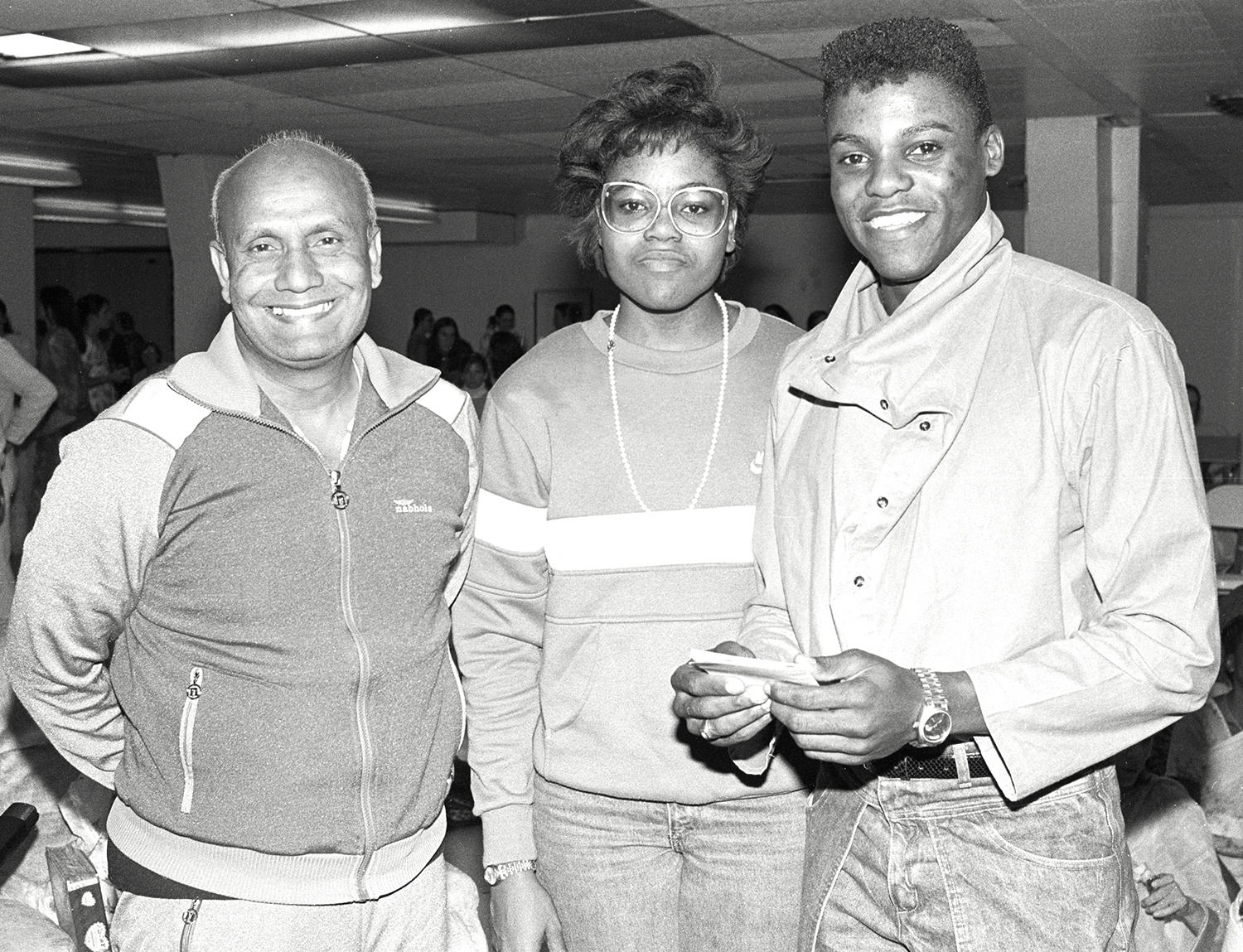
Sri Chinmoy hosts a special function to honour Sudhahota Carl Lewis and his sister Carol at Progress-Promise in Jamaica, Queens, New York.


Sri Chinmoy requests questions from his students:

Question: Are you aware of the other competitors in a race as short as 55 metres, or do you just run as fast as you can?

Sudhahota: I’m aware of them being there, but I’m just trying to go as fast as I can. Those races are so short that you can’t make any mistakes. You have to be aware of the competition so that, if you’re behind, you can make quick adjustments. In the 100 I wouldn’t try to make adjustments; I’d just run my own race. But if I’m behind in the 55 metres, I may do this or that because I don’t have much time to waste.

Question: Carol, do you and your brother help each other at meets?

Carol Lewis: Sometimes we help each other. But since our coach travels with us everywhere, we usually leave everything to him. But if he’s not with us, we’ll help each other when we compete by looking out for little things. When we go some place we’ll jog together and do things like that, but when you get out there into the competition, it just has to be you yourself.

Question: Carol, could you tell us about your Olympic experiences — what you enjoyed most?

Carol Lewis: I had a really good time meeting the athletes from the other countries. I had a sprained ankle going into the Games, and I just wanted to have a good experience. I knew that I was young enough to compete again some other time. I didn’t compete very well there, but I wasn’t really upset because I tried the best I could and that’s all I could do.

Sri Chinmoy: Last time you helped your brother in the long jump. You were holding the take-off board. This time where were you?

Carol Lewis: This time they used a hammer and nails to keep it down. Last time they didn’t think they’d need that, and Carl didn’t think it would slide as much as it did. So I decided to hold it just in case. Better safe than sorry!

Sudhahota: It was kind of fun! Carol and I came to the meet, and Carol said, “I want to hold the board again.”

Carol Lewis: I wanted to get in the newspaper. I wanted to get some press, so I said I’d hold the board.

Sri Chinmoy: This time, why were you in such a hurry in your long jump? Last time you were concentrating and invoking the spirit and all that. But this time you were in a hurry at the start.

Sudhahota: After the Olympics and all the travelling I did last year, I didn’t really get into the indoor season. That’s why I wanted to cut it off early and get ready for outdoors.

Sri Chinmoy: You can’t concentrate on anything at Madison Square Garden. When you started running, the pole vaulter also started running — disturbing you. It was like a five-ring circus! The competitors can’t concentrate and the spectators can’t enjoy. Your starting has improved a lot. In previous years your starts were just a little slow, but with your tremendous speed you went ahead of the others anyway. Now you don’t have that problem at all.

Sudhahota: I’ve been working extra on my starts. For the last year and a half, I hadn’t taken very many gun starts in practice. This year I have been practising more gun starts, and I think that has helped.

Sri Chinmoy: Now that you have won four gold medals, which was your goal, do you feel that it has given you more inner and outer confidence? Or has it added more pressure on you to maintain the highest height? When you run with your colleagues, do you get more confidence at the starting block because you have won, or more worries and anxieties?

Sudhahota: For me it has opened a whole new positive thing. Winning those four medals was something that I had wanted to achieve all my life. When you set a goal for yourself and achieve it, you feel, “That’s done, so what’s the next one?” Every new goal that I achieve makes me feel more confident that I can achieve the next goal I set. So I just keep going and setting higher and more challenging goals.

Question: Have you ever had an incredible jump in practice that you know would have broken the record if it had been for real?

Sudhahota: When we train, we don’t put the approach and the jump together, so that couldn’t happen. There was one meet last year where I think I beat the world record, but I fouled. Before that, there was one other meet where I put a jump past the world record, but I fouled then too. So in meets I’ve done it, but because of little mistakes the jumps were disqualified. It’s a very, very small mistake — one inch in 50 metres — that I have to correct. It’s a challenge to work it out.

Question: What athletes do you admire in track and field today?

Carol Lewis: (Joking) I was going to say me, but…

Sudhahota: That goes without saying! I admire all of them because it’s such hard work whether you’re a great athlete or not. I admire the very idea of trying to be the best you can be. This I admire rather than the person. Evelyn Ashford, for example, I admire very much because she works so hard. This year she won an Olympic gold medal and was able to defeat her arch-rival despite suffering an injury last year. I admire the struggle, the desire, the training and the working to come to that moment when you run the best race you can.

Sri Chinmoy: When you run, is there a little gap between your fingers or do you hold them tight?

Sudhahota: I leave them just a little open to keep them relaxed. So my fingers move around a little bit when I run.

Sri Chinmoy: It was so nice and kind of you to wear our T-shirt at Madison Square Garden. So, with all my heart’s loving joy and gratitude I am giving you these T-shirts. (Presenting a cake) And this is for yesterday’s victory. (Presenting cake to Carol) This is our heart’s gift.


Published in Carl Lewis: The Champion Inner Runner, part 2


February 10

Photo by Bhashwar Hart


Sri Chinmoy, deep in concentration, paints Jharna-Kala at Progress-Promise function hall in Jamaica, Queens, New York.