August 3

Photo by Adarini Inkei


An exhibition of Sri Chinmoy’s 70,000 Dream-Freedom-Peace-Birds at 66 Crosby St, Soho, New York, NY, USA.


Questions on Art

answered by Sri Chinmoy at the Jhatna-Kala exhibition


Question: How do you find the time to draw, to write, to do everything you do?

Sri Chinmoy: As you know, where there is a will, there is a way. I pray to God and meditate on God. Out of His infinite Compassion, He has given me the capacity to accomplish quite a few things. These creations of mine are not my personal belongings or my personal possessions. These are my dedicated offerings to my Inner Pilot. Out of His infinite Bounty He has given me the capacity, and it is He who receives the fruits.

Question: I notice the drawings are all birds. Why birds?

Sri Chinmoy: I am a man of prayer and meditation. For me, birds have a very special significance on a spiritual level. They fly in the sky, and the sky is all freedom. So when the birds fly in the sky, they remind me of the soul’s infinite freedom. The soul has come from Heaven. When we think of birds, we are also reminded of our Source, and this gives us enormous joy. I feel that if people come here to view these birds, their inner hunger to fly in the sky of infinite freedom will be fed.

Question: I come from Puerto Rico and I was wondering if you could say something about the Spanish culture.

Sri Chinmoy: The most significant event in my life during the years I have lived in the West took place in San Juan, Puerto Rico. I came to America in 1964, and at the end of 1966 we established our first Centre in San Juan. So my aspiration, my dedication and my vision started in Puerto Rico. I am eternally grateful to Spanish culture and Spanish spirituality, for it accepted me first.

Question: When you first went to Puerto Rico, was it difficult for the people to accept you or difficult for you to get accustomed to them?

Sri Chinmoy: No, because they used their hearts and I used my heart. My philosophy is founded upon the heart and not upon the mind. The Puerto Ricans have such a simple mind and pure heart, and my life also tries to be all simplicity, purity and oneness. So when I went to Puerto Rico at the end of 1966, immediately they accepted me and I also found it extremely, extremely easy to accept them as my own.

Question: What gives you the most satisfaction?

Sri Chinmoy: I get the most satisfaction when I am able to please my Beloved Lord Supreme in His own Way. Also, when I see that somebody else is really happy, it gives me the greatest joy; immediately I try to identify myself with that person. When children are moving around and not using their mind, there is no tension, no jealousy, no insecurity, no doubt, no impurity. When I look at the children, they give me immediate joy.

Question: Among your disciples are there people who not only share your beliefs but also whom you are very proud of?

Sri Chinmoy: I am proud of many, many of my spiritual children because not only do they have talent, but also inside their talent they have an inner hunger. If I see that they have an inner hunger, then I deeply appreciate them. Otherwise, there are many, many talented people on earth who are not practising the spiritual life. So, from the strict spiritual point of view, we cannot appreciate them. Our way is that God comes first. If someone puts God first in his life, and then if he is also endowed with capacities, well and good. Again, there are many simple-minded, pure-hearted human beings who do not have outer capacities, but at every moment they are thinking of God and praying to God to become good citizens of the world. So I appreciate them, admire them and love them deeply.

Question: In the span of a 24-hour day, how many hours do you meditate, how many hours do you paint, how many hours do you write and how many hours do you have left for leisure?

Sri Chinmoy: In my case, I fill the time in different ways. And each time I change my activity, I get tremendous satisfaction. Each time I do something new, I feel that I am getting an extra supply of energy to give me joy. I meditate early in the morning — from two or two-thirty until five o’clock. That time is very peaceful. Again, when I enter into the hustle and bustle of life, when I am playing tennis or talking to people, at that time also I can inwardly pray and meditate. It is like being an expert. When someone is an expert, he can do more than one thing at the same time.

Question: What is the most important message that you want to offer to humanity?

Sri Chinmoy: I wish to offer only one message: Pray to the Supreme, meditate on the Supreme Lord, our Heavenly Father, to be of service to Him, most soulfully, most devotedly and most unconditionally. Each and every human being is praying to God in his own way, but there is usually some condition: “God, if You do this for me, then I shall pray to You.” Or someone is praying to God only to fulfil his personal goals — to make him the world’s best singer or the world’s best artist. So most of the time we are praying with conditions. But we have to pray to God unconditionally and meditate on God unconditionally to fulfil God in God’s own Way. Then it is up to God whether or not He wants to fulfil our prayers. We should not pray to God to make us great or unique. No, our goal must be only to please God in God’s own Way. This is my supreme message. It was the same yesterday, it is the same today and it will be the same tomorrow: to please and fulfil God in God’s own Way.


Published in Sri Chinmoy Answers, part 3


August 3

Ekatar Unmilan

Words and music by Sri Chinmoy


Sri Chinmoy sings and whistles 15 of his own Bhajan songs — ‘My Heart-Whistle-Birds’ — in Jamaica, New York.


O Mount Everest

Words and music*
by Sri Chinmoy

Lyrics:

O Mount Everest, O Mount Everest
You are the cosmic deities’ treasure-nest.
You teach us how to climb and touch the sky,
And fly with God’s Self-Transcendence-Freedom-Will, fly!


Published in Peace-Blossom Songs

* Song score pending


August 3


Photo by Adarini Inkei


Tevin Campbell, American singer, songwriter and actor, holds the ‘Lifting Up the World with a Oneness-Heart’ award after being lifted at Aspiration-Ground in Jamaica, New York, by Sri Chinmoy.


sri-chinmoy
Photo: Pulak Viscardi

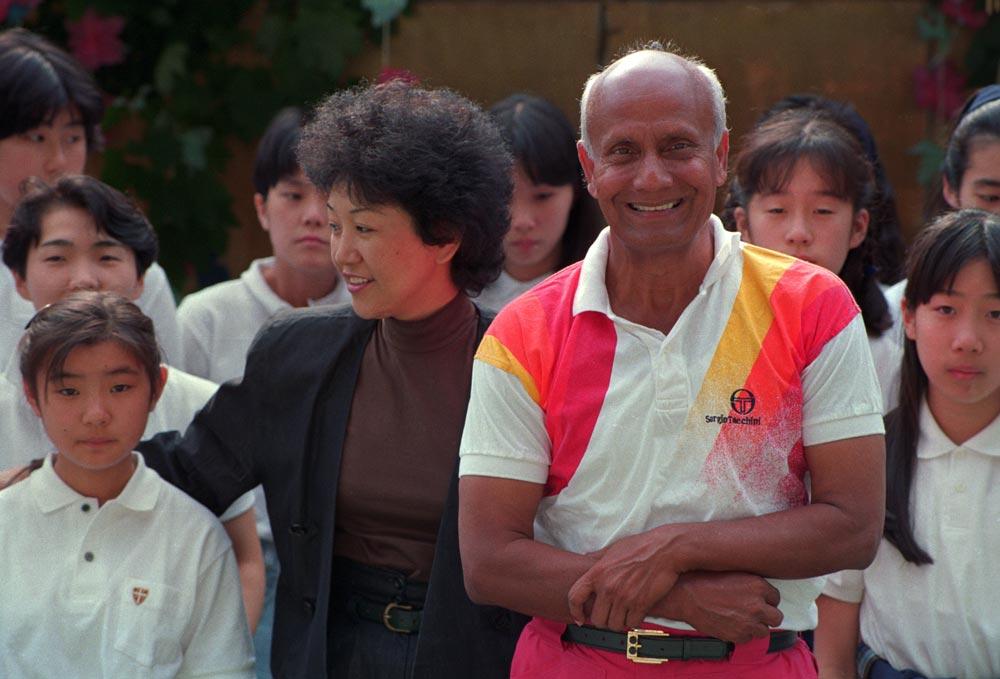
Private performance by the "Little Singers of Tokyo" at Aspiration-Ground, New York after their appearances at the UN and UNICEF

No mind


The way.

2 thousand years ago somebody proclaimed ‘I am the way and the goal.’ His revealed aspiration was the way. His manifested realisation was the goal. Humanity’s first and foremost achievement is the way. His first and foremost achievement is the goal. There is a way to shorten the way. There is a way to bring the goal close to the starting point. In order to shorten the way we must increase our receptivity. In order to bring the destiny near we must unconditionally surrender to God’s Will. How do we increase receptivity? We can increase receptivity through constant self-giving. How do you make our unconditional surrender? We make our unconditional surrender in .... our supreme


our supreme satisfaction and He ( ) supreme satisfaction. 


2. Truth is [the] eldest son in God’s family. Right after truth is peace. They are extremely fond of each other. They complement each other. T. offers its Transcendental head to peace so that it can see their father’s height. Peace offers its universal heart to Truth so that it can see their father’s limitless space. When the two sons offer their unique quality and capacity to each other God smiles and tells them without them his creation would collapse. He says to Truth: My earth needs you to proceed. He says to peace: My earth [needs you to] succeed. They said to their Father, true earth needs us to proceed and succeed but we ( ) anymore our


( ) to become and bec. We wish to receive your message to carry earth’s heart of suffering into the soul of heaven and heaven’s soul of delight into the heart of earth. Father says: so be it.


The life.

Life means responsibility. This is the human realisation. Life means opportunity. This is the divine realisation. An unaspiring person does not shoulder responsibility. He does not want to shoulder his one responsibility. A divine seeker feels if he can (perform?) his duty by fulfilling his ( ) responsibility


God will be happy with him. To please God in his own way he ( ) Each time he does his duty well he feels he is coming closer to God. R. and duty – these words annoy the unaspiring man. To an aspiring person responsibility is nothing but one’s conscious and dedicated service to God. What we want from life is ( ) dedication – a life of dedication can alone shorten the life of ( ). A life of dedication can teach us that one is for many, many are of one, unity and multiplicity — . . . . . . . . .


Note:

The above draft formed the basis of Sri Chinmoy’s lecture, entitled ‘The Way, the Truth, the Life’, which he delivered at the University of Glasgow in Scotland on 29 June 1974. The lecture was subsequently published in My Rose Petals, Part 3, by Agni Press in 1974.


Hope


Hope

H. is our preparation. H. is our aspiration. H. prepares [us] for the unknown; aspiration for the Unknowable. Unknown is man’s ultimate achievement. Unknowable is God’s Eternal Now.


Hope is an inner effort to see something new, to feel something new, to say something new, to do something new, to learn something [new]. When I smile I see something new. When I cry I feel s. new. When I pray I say something [new]. When I meditate I do something new. When I surrender I become something new. My newness is my self-transcendence. My self-transcendence is God’s pride; God's pride and gratitude.


2. H. nourishes faith. Faith treasures hope. Hope dreams of God-beauty in God-Reality. Faith dreams of dreams of God-Reality and God-Beauty. H. pulls the heart of tomorrow into today’s body. Faith pushes today’s body into the heart of tomorrow. When Tomorrow’s heart enters into today’s body the earth-aspiration is crowned with success. When today’s body enters into tomorrow’s heart Heaven’s vision is crowned with success. Earth-success is the victory of God’s Compassion-Will. Heav.-success is the victory of God’s aspiration-will.


3. To hope is to see with the eye of the heart. To hope is to make the heart captain of the mind, vital and heart.


To hope is to send darkness-life into exile. To hope is to feed the inner sun to give birth to the outer sun. The inner sun is, the outer sun becomes. The inner sun is the silence-height of God. The outer sun is the sound-length of God.


4. My h. [hope] is my humility's light and my h. [humility's] light is my divinity’s birthright. My d. [divine] birthright is God’s Eternity’s height, Infinity’s delight and Immortality’s life.


5. Humanity is forced humility. D. [Divinity] is spontaneous beauty.


Humility is God’s satisfaction-beauty in man. Humility is man’s perfection-necessity in God.


Note:

The above draft formed the basis of Sri Chinmoy’s lecture, entitled ‘Divine hope’, which he delivered at the University of Edinburgh in Scotland on 28 June 1974. The lecture was subsequently published in My Rose Petals, Part 3, by Agni Press in 1974.


Death


— Death —

What is death? The eternal pilgrim’s short rest. What is death? A necessary experience of the finite at the present stage of evolution. What is death? A shattering blow aimed at the desiring man and an awakening hand for the aspiring seeker.


2. There are two types of desiring men. One type thinks death is evil because death does not allow them to fulfil their teeming desires on earth. Another type thinks that the fruits of their desire are very painful. The more they desire the more they will suffer. The more they stay on earth the more they will desire. When the desires are fulfilled


they are unhappy. When the desires are not fulfilled they are unhappy. And as long as they stay on earth, they will be compelled to remain unhappy. Therefore they want to embrace death.


There are two types of aspiring men. One type feels that death must be conquered so that they can manifest the kingdom of heaven on earth. And that the human life must be divinely transformed into the divine life and flooded with divine light! The other type feels it is not the human body that has to be transformed but the earth-bound human consciousness that has to be transformed


into the heaven-free consciousness. In order to do that one has to stay on earth indefinitely for a long time. 

                  (?) - - (Bengali word)
It is the divine con. that will transform earth-reality and manifest divinity and Immortality.


2. He who does not aspire . . . Aspi is new life. Aspiration . . .


3. To an unaspiring man, death is destruction. To an aspir. man, death is a mystery. To a greatly advanced seeker, death is a short rest. To a God-realised yogi,


[death is] an instrument of God. This instrument consciously frightens the unaspiring men and unconsciously inspiring men. To expedite its spiritual journey so that then before the arrival it achieves something quite significant for the mother earth.


4. The unaspiring people never live. Their constant fear of death never allows them to live. The aspiring man never dies for his inner life has consciously established an inner connection with the Eternal Life.


Every moment divinely used is a powerful contribution to life and an added life. Every moment undivinely used or wasted is a powerful contr. to and (?) stretching span of death. Death knocks at our door when we try to make friends with the discouraging disappointing and unfulfilled past. Life makes friends with us when we consc. try to bring down the golden future into the immediacy of today and in the core of the Eternal Now.


Earth-life is preparation. Death-arrival is relaxation. Heaven-life is aspiration. God-love is realisation. Man-perfection is God-satisfaction. God-satisfaction is the beginnging of his silence-life and the (?) of his sound-life.


Note:

The above draft formed the basis of Sri Chinmoy’s lecture, entitled ‘Death’, which he delivered at the University of Newcastle in England on 27 June 1974. The lecture was subsequently published in My Rose Petals, Part 3, by Agni Press in 1974.


Conscience


1. Conscience is the inner voice, the voice of light. This voice tells us to say the right thing, to do the right [thing] and become the right thing. What is the right thing to say? God is for all. What is the right thing to do? To love God in every human being. What is the right thing to become? To become a cheerfully and devotedly unconditional instrument of God.


2. When we say the right thing, God smiles at us. When we do the right thing, God blesses us. When [we] become the right thing, God embraces us.


3. Conscience warns us: not to go back to the animal life. Conscience asks us to lead the real human life, the life of morality, and then c. inspires us to listen constantly only to the dictates of the Inner Pilot. Animal life is destruction. Human life is frustration. Divine life [is] dedication. There was a time when we lived the life of destruction. Now we are living the life of frustration and in the future we hope to lead the life of dedication. Dedication is the secret art of giving what we have and what we are.


What we have is an inner cry to realise the absolute supreme. What are we? We are the chosen inst. [instruments] to manifest God on earth.


4. A life of con. is a life of divine confidence. A life of confidence is a life of perfect a life of earth-perfection. A life of earth-perfection is a life of God-satisfaction. For us God-satisfaction is the only thing that the aspiring man in us needs. Pleasure satisfaction is the only thing that the desiring man in us needs.


The desiring man wants to devour the whole world. But before he devours he is compelled to starve by the cosmic forces and then death comes [and] devours him. The aspiring man wants to love the world, serve the world. Before he loves the world, he realises that the world has already started loving him soulfully. Before he serves the world, he sees that the world has already started serving him devotedly.


5. C. is creative and conscious evolution. Who is evolving? God the ascending man. Who is descending? God the loving Saviour and illumining Liberator.


When we are in the process of creative evolution, we come to realise our discovery of God is eternally old and our invention of God is eternally new. When we are in the process of conscious evolution, we see no one but God within us and nothing but God-Light without us. The difference between God and God-Light is this God becomes and God-Light is. To each seeker God becomes a diff[erent] person and different reality according to his power of receptivity. But to each [seeker] God-Light or (?) God is the same – Love-flood and Compassion-flood.


6. When c. is our guide, we do not make a mistake. When we do not make any mistake, we do not become a victim to despair. A life without despair means a life of achievement and fulfilment. Here the seeker


the seeker does not live in the dreamland. He lives in the reality-country. Here his heaven hope-hunger is sumptuously fed. Here his earthly dream-boat has reached the heavenly reality-shore. Here his aspiration-kite flies in the realisation-sky. Earth-life is nothing but compromise. In the festival of compro[mise] conscience is never to be found. Conscience feels it is imperative that one has to accept God-light and Truth totally and unconditionally. If one is for both God and ignorance, then he is a fool. Neither God nor ignorance can nor will claim or even accept him on their own. If one wants to remain neutral, that means inwardly


he has chosen one side. Owing to (?) fear and difficulty one does not dare to declare his feeling, (?) and his support. But we must know that conscience is for spiritual people, people who consciously and constantly need God. Therefore when c. plays its role one has to be a hero-warrior, he has to work dynamically and heroically without paying any attention to the results of his endeavour. Who cries for the success-result from our action. The beggar in us. Who cries for the progress-result from our action. The seeker in us. Who cries for the cheerful surrender-result from [our action]. The divine Lover in us.


Who is the divine Lover in us. God. Who is the divine beloved in us? God. God the Lover flies from the finite into infinite into the Infinite to see the (?) of unity – and God the Beloved [flies] from the Infinite into the finite. . .


Note:

The above draft formed the basis of Sri Chinmoy’s lecture, entitled ‘Conscience’, which he delivered at Sherwood Hall Boys School in Mansfield, England on 26 June 1974. The lecture was subsequently published in My Rose Petals, Part 3, by Agni Press in 1974.


Is spirituality an art?


Is spirituality an art?

Spirituality is not only an art but a divine, illumining and fulfilling art. The human artist expresses his personality, his indiv [individuality] through his art. In a sense he expresses himself through his art. The divine artist expresses God the Beauty, God the Divinity and God the reality through his art. To a human artist art is the expression of his desire-life. To a divine artist art is God-manifestation-aspiring life.


2. Hu. [Human] art either surrenders to fate or revolts ag [against] fate.


D. [Divine] Art accepts fate [and] transforms fate. D. art is inspired by and energised by God’s supernal vision and energised by his adamantine will.


3. Art is creation. Creation is art. In the divine art there is no forced physical effort, no vital effort, no mental effort. There is only [one] effort and that effort is called psychic effort. The body, the vital and the mind may co-operate with the psychic art. When they consciously co-operate the art reaches an acme of perfection [and] becomes perfect perfection.


4. Emerson: in art the hand can never execute anything higher than the heart can inspire.

In the divine art, the heart can never execute anything higher than the soul can aspire. Of course there is a yawning gulf in the ordinary art [between the] heart-capacity of receptivity and the hand-capacity of expression. In the spiritual life the soul-capacity of assimilation and the heart-capacity of revelation perfectly complement each other.


5. In a human being the divine artist and the human artist play quite often hide and seek. When the human artist appears he wants to fascinate the world


with his artistic capacity. When God the artist appears He wants to (   ) illumine and nourish human consciousness and earth consciousness.


6. Both spiritual art and unspiritual art deal with beauty. In the unspiritual art beauty is the effect of a (   ). In the spiritual art beauty is. In the uns. [unspiritual] art beauty is a (   ) power. In the spiritual [art] beauty is an illumining power. The human in the artist feels beauty is skin-deep. (   ) beauty is not only soul-deep


but God-deep.

The soul-deep reality opens our heart to the ever-transcending Beyond. The God-deep reality reveals to us the ever-tr. beyond in the eternal Now.


Note:

The above draft formed the basis of Sri Chinmoy’s lecture, entitled ‘Spirituality as an Art’, which he delivered at the University of Birmingham in England on 25 June 1974. The lecture was subsequently published in My Rose Petals, Part 3, by Agni Press in 1974.


Confidence


1

— Confidence —


1. What is confidence? Confidence is the combination of God-Compassion and self-reliance. Confidence is the expression and revelation of the divine will through the human heart, mind, vital and body. Confidence. Confidence is God-beauty in us. Confidence is truth-unity and truth-multiplicity in us. Confidence is life-acceptance, life-transcendence, earth-transformation and God-manifestation by us.


2. Confidence is not pride. Confidence is not hyperbole. Confidence is not the precursor of destruction. Confidence is the conscious awareness [of] one’s heights and depths. Confidence


is actually where we stand in the battlefield of life. Confidence is the harbinger of achievement, a plethora of achievements.


3. Confidence is the contentment of knowing what to enjoy, whom to enjoy, how to enjoy, when to enjoy, where to enjoy, why to enjoy. What to enjoy? God’s Smile. How to enjoy? Through self-giving. When to enjoy? When our body, vital, mind and heart are pure. Where to enjoy? In the depth of our devoted hearts. Why to enjoy? Precisely because God the Supreme Enjoyer wants us to enjoy like Him. Needless to say, we are talking about divine enjoyment and not about human enjoyment. What is the difference between human enjoyment and divine enjoyment? Human enjoyment is self-indulgence. Self-indulgence is vital pleasure


of the lower self. Divine enjoyment is the taste of divine ecstasy in the higher self. The lower self binds us, incarcerates us. The [higher self] liberates us, illumines and offers us the message of Infinity’s bliss, Eternity’s light and Immortality’s life.


4. Confidence can be developed like muscles with regular spiritual discipline. If you do not have confidence right now, do not be doomed to disappoint[ment]. Slowly, steadily and unerringly you can develop confidence by uniting your will consciously and soulfully with the will of the Supreme during your meditation.


5. We have two giant friends: confidence and faith.


Faith can and will read the silence-message of God. Confidence can read and hear the sound-message of God. With the help of the silence-message we can reach our Source, the Goal of all goals. With the help of the sound-message we divinely and soulfully perform our God-ordained task on earth, we supremely manifest God on earth.


6. Confidence is a superior and supernal form of belief. It lives in the soul-light of the heart. Confidence is not a mental belief. Mental beliefs can easily be battered and shattered by the tornado of undivine doubt and


suspicion forces. Confidence is the heart’s spontaneous claim of dynamic truth and light. Confidence is the hero-warrior in us to fight against teeming undivine and hostile forces in the battlefield of life and establish God’s light, God’s beauty, God’s perfection on earth so that today’s crying and bleeding earth can turn into smiling and dancing heaven for the liberated souls and the Cosmic Gods to perform their divine roles on earth.


7. Finally confidence is Truth-cognition in us, Heaven-vision with us and God-decision for us while marching along Eternity’s Road.


Note:

The above draft formed the basis of Sri Chinmoy’s lecture, entitled ‘Confidence’, which he delivered at the University of Oxford in England on 25 June 1974. The lecture was subsequently published in My Rose Petals, Part 3, by Agni Press in 1974.