
September 9

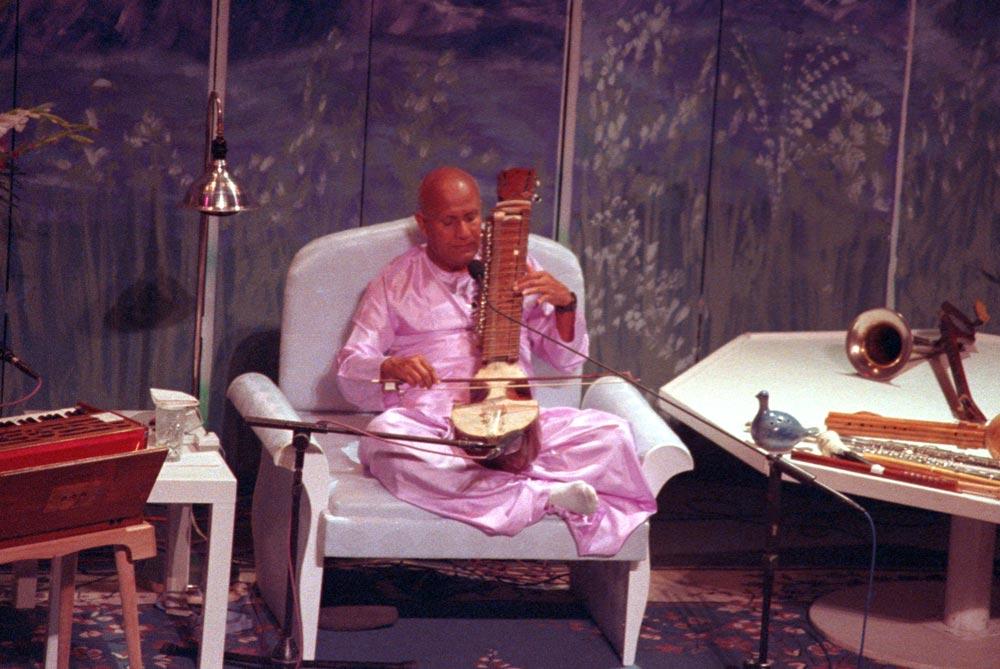
Sri Chinmoy plays the esraj at the Jharna-Kala gallery at Grand Central Station in New York.
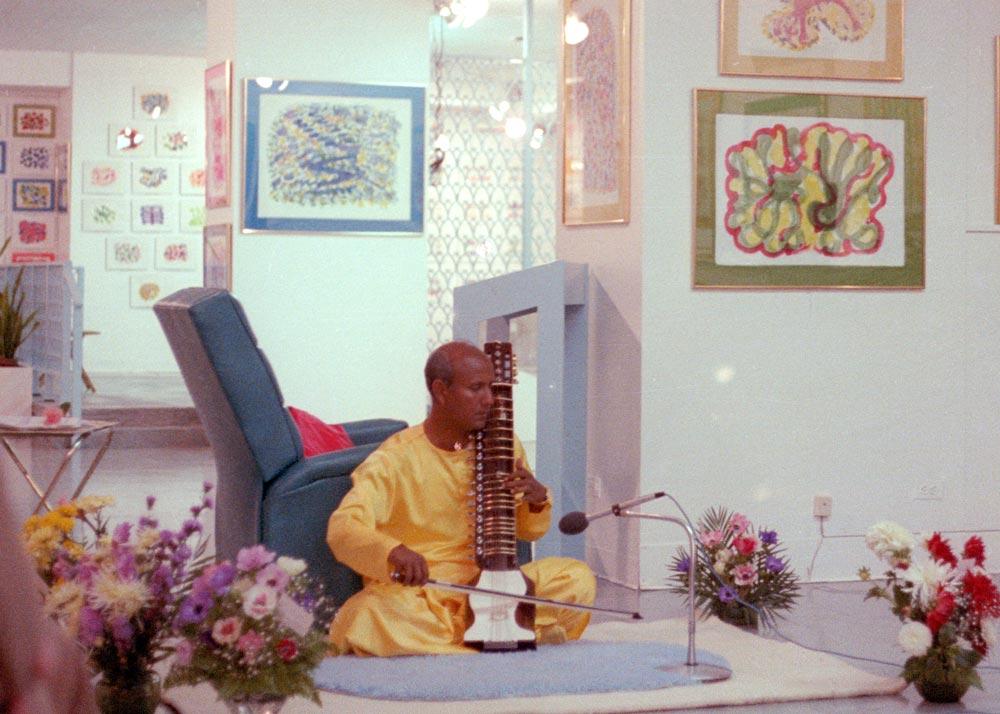
Photo: Sarama
Sri Chinmoy plays the esraj at the Jharna-Kala gallery at Grand Central Station in New York.
Photo: Sarama
A talk by Sri Chinmoy
in the Peace Room
of the Church Centre for the United Nations
We all know about your President Woodrow Wilson. He had a daughter named Margaret Wilson. Here we have someone who happened to be her childhood friend, Mrs Pearce K Drake. Mrs Drake, today I wish to speak about your friend, Margaret Wilson.
Many years ago she read a book written by the great spiritual Master, Sri Aurobindo. The book Essays on the Gita, is about Sri Krishna's conversations with Arjuna in the Bhagavad-Gita. Sri Krishna was the divine soul and Arjuna was the aspiring human soul. We have many, many scriptures in India, but the Bhagavad-Gita is our matchless scripture. The quintessence of all our other scriptures can be found in the Bhagavad-Gita it is India's Bible. Sri Aurobindo wrote some most beautiful, luminous essays on the Bhagavad-Gita. Once Margaret Wilson happened to find and read the book. She was extremely moved and wanted to meet the author. But in those days the author of the book was in complete seclusion; he never left his room. But nevertheless, Margaret Wilson went to the Sri Aurobindo Ashram and stayed there permanently. Four times a year she used to see the Master, as others did, for two or three seconds each time. But she was deeply moved by Sri Aurobindo's books, by Sri Aurobindo's philosophy, by Sri Aurobindo's yoga. So she stayed in his ashram.
Sri Aurobindo eventually gave her the name Nishtha, which means faith — divine faith, intense faith. One who has total faith in the Divine, in God, in the Supreme, is Nishtha. Nishtha became the perfect embodiment of divine faith. She led an exemplary life full of devotion and had a surrendering attitude towards the inner, spiritual life.
Unfortunately, we are all susceptible to disease. In her later years Nishtha developed a serious illness. The Indian doctors, in spite of their best efforts, could not cure her. So one of the doctors suggested to her: "Why don't you go back to America? American doctors are far more advanced than we are in the medical field. If you go back to America, the doctors there will take care of you and cure you." But Nishtha's immediate answer was: "True, the doctors in America can take care of my body, but who will take care of my soul? My soul is infinitely more important to me than my physical body. I shall stay here." So she stayed in Pondicherry. She delayed death for a few years more while leading a most dedicated, most spiritual life. Then she passed away.
What do we learn from Margaret Wilson? The soul is infinitely more important than the physical body. But again, in the physical is the soul. We have to give the necessary importance to the physical, but when it is a matter of comparison, when it is a matter of choice, the soul is far more important. If we care for the body all the time, then we shall lead a most ordinary human life. We shall live on earth to no avail. In Indian villages there are farmers who are more than one hundred and fifty years old. But they have no aspiration. Just to live here on earth and count the years on the calendar is of no avail. But if we can stay on earth for even forty or fifty years and can bring the soul's light and divine qualities to the fore and try to manifest them here on earth, then life is meaningful. But for that, we have to live in the soul, not in the body. If we live in the body, we become constant victims to teeming desires.
Today's meditation said that God works in our teeming desires. But again, we have entered into the spiritual life, so for us God is in our climbing aspiration. And tomorrow, in the future, we all shall realise God, and at that time God will be in our glowing realisation. Margaret Wilson knew what desire is. She was brought up in America, so desire was not foreign to her. But she left America for India, and there she lived the spiritual life, the life of aspiration. And what she wanted was realisation and liberation, the third and last step. We can all learn from her. We started our journey with desire. Now all of us here live at least sometimes in the world of aspiration. And in the future, near or distant, we all are bound to enter into the world of realisation.
Nishtha had a Corona typewriter. She typed on that machine for many, many years. But when she passed away, after a few years I was given that typewriter to use. It is not a coincidence that out of two thousand or so disciples, admirers and followers of Sri Aurobindo in the ashram, it was I who was given that particular machine, Nishtha's type writer, to use. Thousands and thousands of times I have typed on Nishtha's machine. And whenever I typed, my soul used to show loving concern and sweet gratitude. From my highest concern, I used to bless her soul.
Thrice I visited her home in the cemetery; three times I paid my soulful homage to her soul there. The cemetery was three and a half miles from the place where I lived. According to our Indian tradition, one has to go to the cemetery with utmost love, concern, purity, simplicity; and finally, if one has real concern for the person's soul, then one has to go barefoot. One cannot carry an umbrella, one cannot wear shoes or sandals and one has to walk. So I walked all the way barefoot. And you can well imagine the scorching heat of South India! Three times I paid my deepest homage to Margaret Wilson. 'Faith' in its purest, simplest and highest form, this is Nishtha. I wish to say that all of us can have this kind of faith. It is already within us. We do not have to invent or create faith in ourselves. We have just to discover it. It is not something unknown or foreign or inconceivable or unimaginable to us. No, it is deep inside us. We have only to search, and then we will be able to discover our own treasure. If we have faith in God, then there is no such thing as impossibility.
If one does not have faith in oneself, then one can never, never have real faith in God. This faith in oneself is not arrogance or a showing off of what one can do or say. This faith is the conviction of one's inseparable oneness with the highest Absolute: "I can do this, I can say this, I can go into this, I can become this precisely because deep inside me is my Supreme Lord. It is on the strength of my identification with the Highest Supreme, the Inner Pilot, that I can do this, I can say this, I can become this, I can help the world because God has made me His conscious instrument."
Faith in oneself and faith in God must run together. Otherwise, if one has faith in God and not in oneself or if one has faith in oneself and not in God, then progress will always be unsatisfactory and transient. But if we have faith in ourselves, if we can feel that God has chosen us and we are His chosen instruments, if we can feel that He is with us, in us, of us and for us, then here on earth we can achieve the message of Immortality in our consciousness and the message of universal Perfection in our day-to-day lives. Let us try. We shall succeed.
Published in Reality-Dream
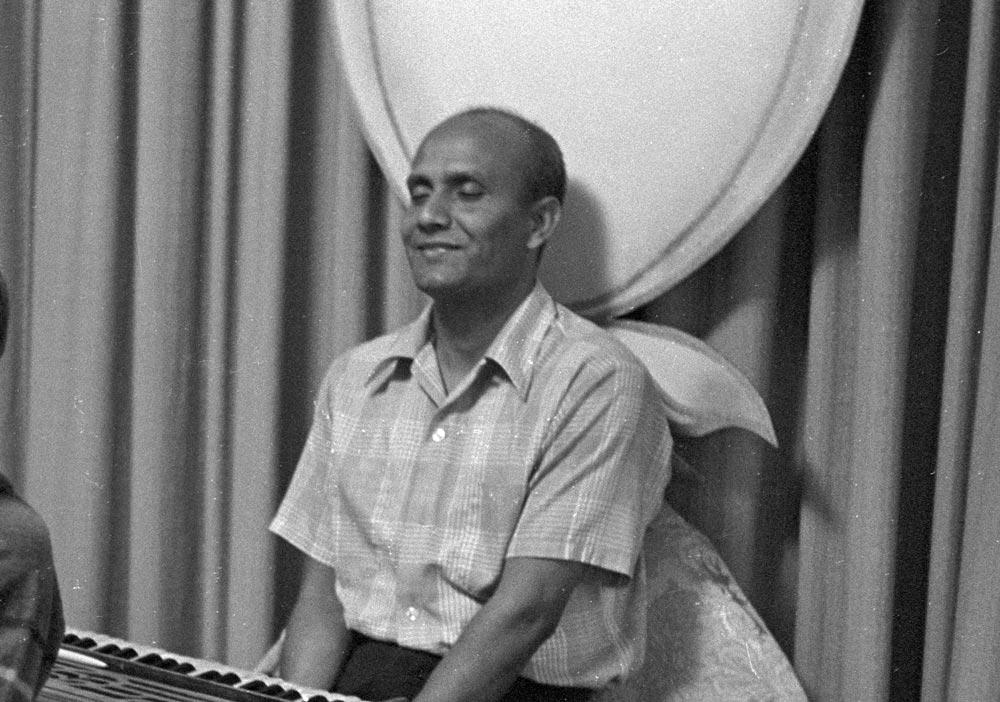
Sri Chinmoy meditates. Photo: Sarama


A small version of 85-45, Sri Chinmoy’s house, stands trackside at the Sri Chinmoy 700-1000-1300-Mile Ultra-Distance Trio, in Randalls Island, Manhattan New York.

Sri Chinmoy observes the scoreboard at the Sri Chinmoy 700-1000-1300-Mile Ultra-Distance Trio, in Flushing Meadows Park, in Queens, New York.

Sri Chinmoy inspects the catering section, which provides around-the-clock food for the runners.
|
Sri Chinmoy offers this prayer at 9:13 a.m. before doing 620-lb. seated double-dumbbell lift — a new record.
Published in My Morning Soul-Body Prayers, part 16
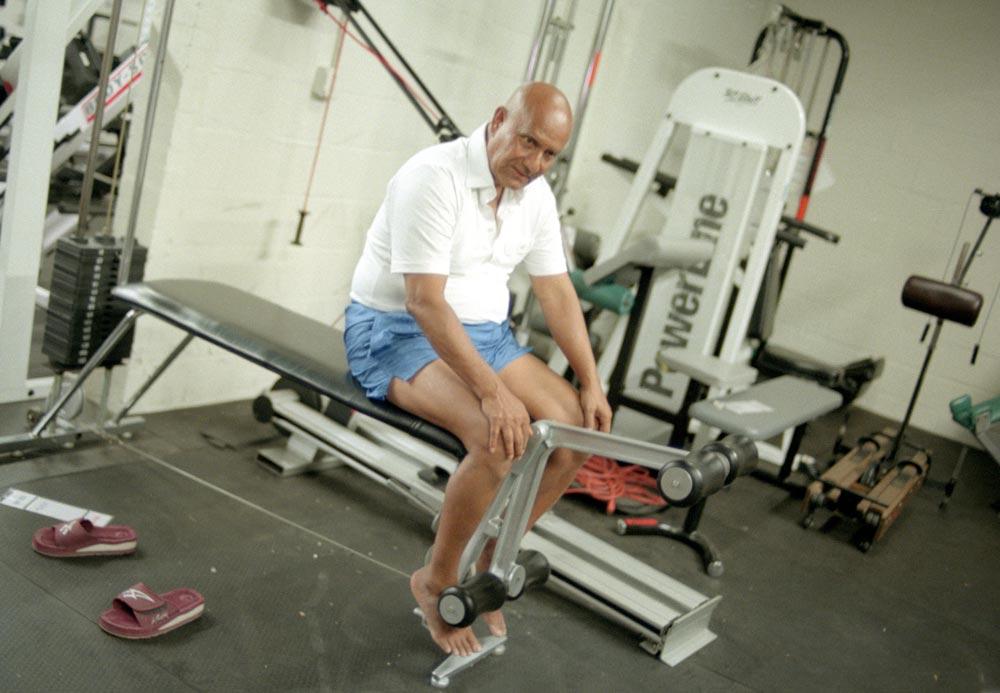
Sri Chinmoy tries new gym equipment. If Sri Chinmoy liked a particular machine but they were prohibitively expensive, he would sometimes have his photo taken and a custom machine to reflect its likeness would be built by Unmilan and others.
Photo: Dhanu
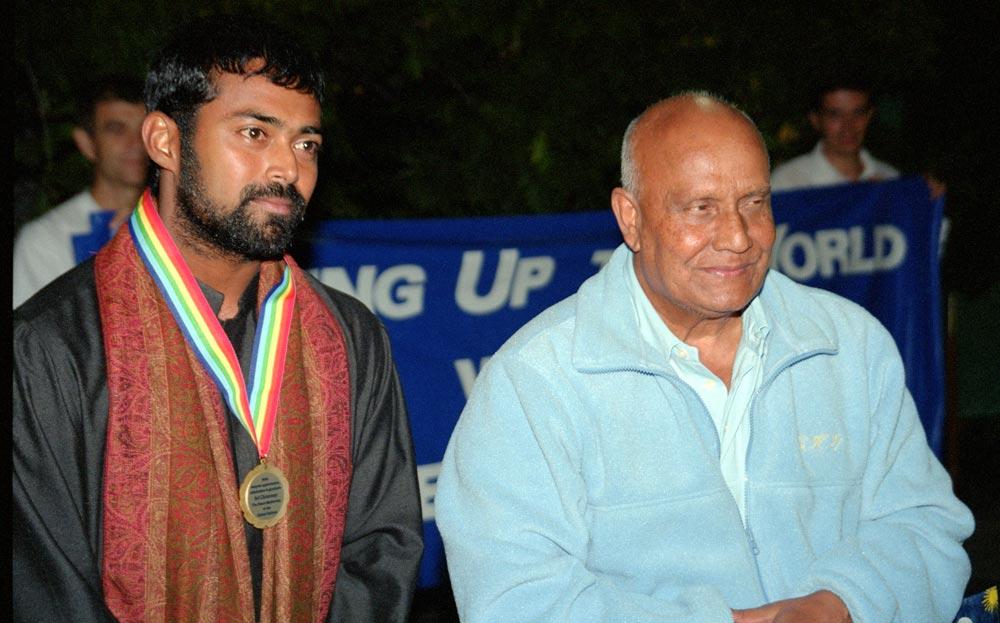
Sri Chinmoy lifts Indian tennis player Leander Paes.
Photo Maral
Sri Chinmoy award the U Thant Award to former Puerto Rico Governor, Rafael Hernández Colón.
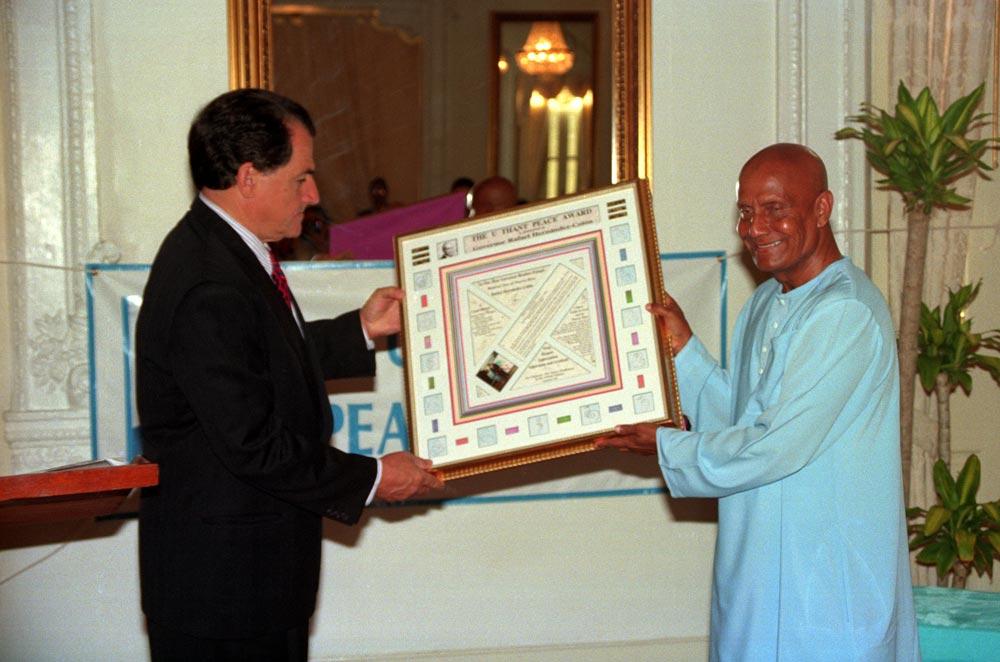
Photo: Maral Siegel.
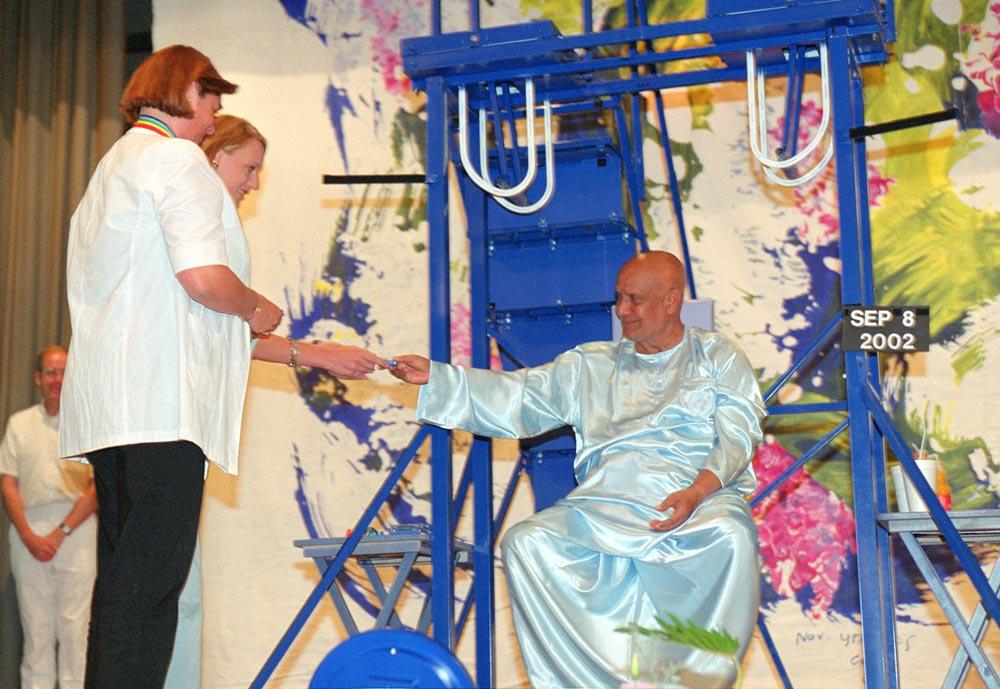
Sri Chinmoy lifts 32 people at Hotel Salmen in Zurich, Switzerland. Photo: Pulak

Sri Chinmoy honours composer and Oscar nominee Philip Glass by lifting him as part of the ‘Lifting Up the World with a Oneness-Heart’ programme at Aspiration-Ground in Jamaica Queens, New York.
Peace Concert New Haven. Photo: Sarama

Go to your Master, go to your Master, go, go, go, go, go!
Tahar majhe nitya nache param prabhur dyo dyo dyo
Published in God Answers Prayers

Sri Chinmoy signing one of his many Jharrna-Kala paintings.
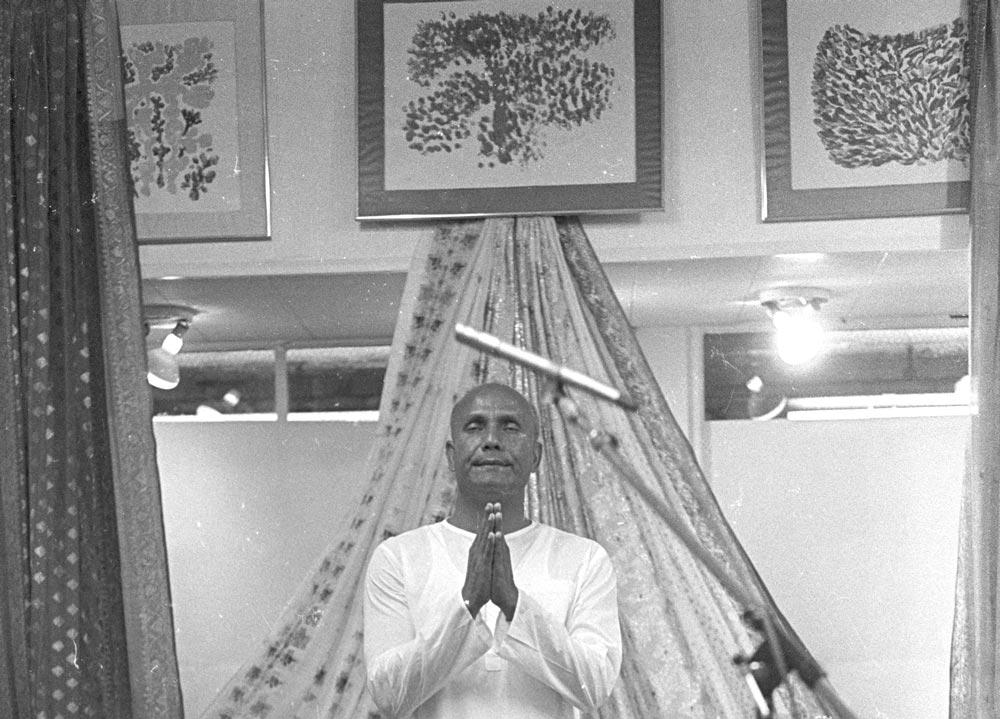
Sri Chinmoy visits Jharna Kala Gallery. Photo Shraddha Howard
(probably Lake Placid School of Art, Lake Placid, New York - TBC)
Sri Chinmoy asks each of his visiting disciples who have not yet returned home after his birthday celebration, to give him one spiritual word which he would then enlarge upon.
Sri Chinmoy: Sleeplessness for the Supreme is the beginning of conscious oneness with the Supreme.
Sri Chinmoy: God has created infinite things on earth, but a human heart of devotion will always remain sweeter than the sweetest in His Heart of Satisfaction-Delight.
Sri Chinmoy: The purity of the body tells us where God is. The purity of the heart tells us how God is. The purity of the soul tells us who God is.
Sri Chinmoy: A heart of continuous gratitude is the most difficult thing for a human being to offer to the Beloved Supreme.
Sri Chinmoy: When you surrender your human will to God's Will, you immediately come to learn that God will not only do everything for you, but in reality He has already done everything for you.
Sri Chinmoy: There is only one strength in the inner world, and that eternal strength is constant love of God in God's own way.
Sri Chinmoy: Sincerity is the fulfilling sweetness in the world that becomes. Sincerity is fulfilment in the world that eternally is.
Sri Chinmoy: When you offer your heart's purity to the divinity in humanity, God immediately blesses you with His infinite tears of Light and Delight.
Sri Chinmoy: Love the truth. This is human illumination. Become the truth. This is divine illumination. You are the truth. This is supreme Illumination.
Sri Chinmoy: Smile inside your heart. You will see the face of purity. Smile with your heart. You will see the soul of purity. Smile with your soul. You will meet with purity's all-illumining sister: divinity.
Sri Chinmoy: Purity is the height of aspiration, the length of dedication and the depth of illumination.
Sri Chinmoy: A seeker with a heart of purity does not have to run. God himself runs for him constantly, unreservedly and unconditionally.
Sri Chinmoy: Humility is the pioneer quality that beckons the rest of the divine qualities to see the universal Light of the Absolute Supreme and to grow into the infinite Delight of the Beloved Supreme.
Sri Chinmoy: A heart of dynamism at once embodies the Creator's cosmic Vision and His cosmic Manifestation. A heart of dynamism is an illumining and fulfilling reality which unfolds God the Supreme in His own way.
Sri Chinmoy: There are two types of purity. One is pure purity; the other is sure purity. Pure purity comes from continuous spiritual discipline. Sure purity comes from the eternal child that dwells in the inmost recesses of our heart, fulfilling cheerfully, devotedly, consciously and unconditionally the dictates of the Supreme.
Sri Chinmoy: There is no other way to see God's Face of Beauty than to offer your heart's purity to God constantly and unconditionally. Purity is the seed of your aspiration. Purity is your peerless companion which will never fail you.
Sri Chinmoy: Constant aspiration tells you that God is both finite and infinite. You can see God, clasp God and become God precisely because He appears before you as a divinely finite reality. God stands before you, loves you, illumines you and fulfils you precisely because He is infinite in His universal self-giving Reality and also He is infinite in His self-transcending transcendental Reality.
Published in AUM – Vol. 3, No. 9, September 27, 1976
– Sri Chinmoy |
Published in My God-Hunger-Cry

Sri Chinmoy at Aspiration-Ground after playing tennis.

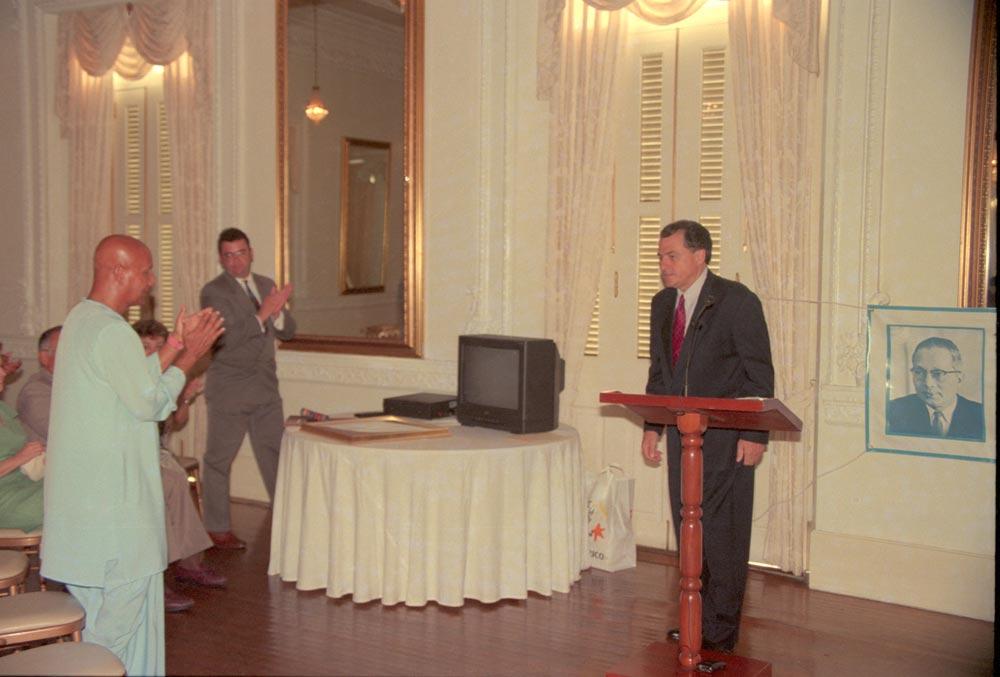
Sri Chinmoy meets with Puerto Rico’s Governor Rafael Hernández Colón at the Jharna-Kala gallery in Manhattan, New York.
