Jesse Owens and Sri Chinmoy


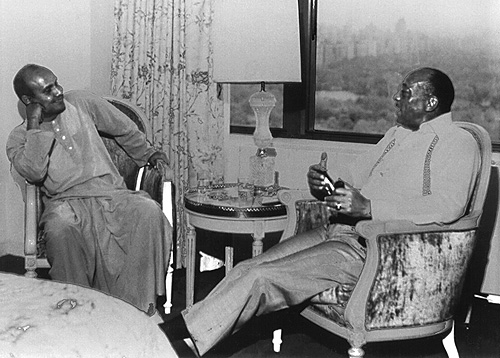
Jesse Owens and Sri Chinmoy meeting in New York – 1972


There is a certain indefinable feeling about visiting an Olympic stadium. Home to an entire era of sporting glories, it holds within its walls the essence of the athletic aspirations of its time, that words alone can never express.

The stands are now empty, the track is bare, there are no flags waving or cheers to be heard, yet the Olympic feeling lives on, in treasured memories of inspired deeds; in powerful images of men and women who ran like gods, who sacrificed all and won, taking humanity a little closer to the skies.

It is March 24th, 1985, Berlin stadium. Sri Chinmoy has come to honour the memory of the legendary Jesse Owens. At the entrance to the arena, he surveys, with gentle silence, the grand dimensions of the grounds.

The stadium was built for the 1936 Olympics. It was a showpiece for the Nazi regime, a spectacular complex capable of seating 110,000 people. The grandeur of the display was intimidating in its blatant anticipation of an Aryan victory.

As Sri Chinmoy begins to slowly circle the 400-metre track, he is still quietly absorbed.

One day in 1936 the world saw a humble young American black man crush the theories of Hitler's Aryan supremacy. Consistently, and often under protest from the German Game's officials, Jesse Owens beat the world's best athletes to win an unprecedented four Olympic gold medals. He became not only the hero of America but of every country that cherished freedom.

Jesse Owens at the 1936 Berlin Olympics

For an aspiring young sprinter in a small East Bengali village, just the name of Jesse Owens created a wondrous awe. In 1936, Sri Chinmoy was only 5 years of age but in his formative years as his interest in running developed, Jesse Owens became his athletic idol.

Down the straight Sri Chinmoy now walks, Jesse broke to the lead of the 100-metre final. In a relentless burst to the finish line, he was clocked at 10.3 seconds, breaking both the Olympic and the World records.

To the left, the running broad jump (long jump) pit. The sand, undisturbed, lies in waiting for the footprints of Jesse Owens to record another Olympic record. Sri Chinmoy seems to take his time, reflecting on the drama of that particular event.

The German officials had fouled Jesse's first two jumps and the crowds were restlessly awaiting Jesse's third attempt. It seemed the officials were ready to disqualify him wherever he placed his feet. Then a German competitor, Luz Long, someone who should have welcomed the thought of Jesse's disqualification, risking not only his athletic career but also his life, walked over and placed his towel one foot before the starting line of the jump. He told Jesse to place his foot on the towel when he jumped. His footprint on the towel would be the evidence that he did not foul. Jesse agreed and even though he had to step off one foot behind the board, his jump recorded a distance of 26 feet 5½ inches, the first time anyone had broken 26 feet in the history of the Olympics. The crowd was ecstatic. Hitler left the stadium in disgust.

Jesse Owens later said, "It took a lot of courage for him to befriend me in front of Hitler. You can melt down all the medals and cups I have and they wouldn't be a plating on the 24-karat friendship I felt for Luz Long at that moment. Hitler must have gone crazy watching us embrace."

Over 5,000 athletes from 52 countries competed in the 1936 Olympics, but none shone as brightly as Jesse Owens. The records he broke represented the efforts of the finest athletes the world had ever produced.

After the Olympics, Jesse Owens travelled and gave talks at various institutions. He was determined to help his brothers, white and black. He was a man of peace and he spread his message with anyone who would listen.

Sri Chinmoy and his childhood athletic idol Jesse Owens relaxed in conversation – 1972.

Sri Chinmoy was never able to meet Jesse Owens when he came to India in 1955, but he recalls with special fondness their meeting on November 2, 1972, in New York. At that time, Jesse Owens was 59 years old, but still lacked nothing of his urge to serve humanity. He saw in Sri Chinmoy, a kindred spirit – someone who understood the importance of striving to make the world a better place. "I believe very much in what you are doing. I am an admirer of yours," he told Sri Chinmoy, "I will preach my belief in your philosophy. You are inspiring people, motivating them to the bigger, better side of life."


Sri Chinmoy (barely visible – top centre of photo) offers a soulful salute to the memory of the great Jesse Owens


Sri Chinmoy walking quietly around the historic Berlin Stadium track


Jesse Owens had a vision of a world at peace, a world where every person had the opportunity to reach their highest potential. He was a man of courage who was willing to challenge the blind ignorance of Hitler's ideology and the prejudice of even his own countrymen.

From the athletic oval looking high into the stands, the central point of focus is the box from where the Führer observed the Games. Hitler never acknowledged Jesse Owens' victories in those turbulent days of 1936.

Today Sri Chinmoy looks out over the historic site from the same viewing box. His face is charged with an expression of gratitude and admiration. He lifts his arm slowly and offers his soulful salute to the immortal Jesse Owens. It is a tribute that has waited 50 years – a tribute to a great champion of peace.

– End –

Notes:

This article was first published in Runners: Oneness-World Harbingers magazine, pages 18-19, Jul-Aug 1985.

Associated articles: The Immortal Jesse Owens and Travelling the Inner Road


Copyright © 2009, Animesh Harrington. All rights reserved under Creative Commons license.


U Thant Peace Award

Anahata Nada, Vol. 33 — August – Mid-December 2002.

Ravi Shankar Gets U Thant Peace Award

Del Mar, CA – Legendary Indian sitarist Ravi Shankar was presented with the U Thant Peace Award Sept. 20 by Sri Chinmoy on behalf of The Peace Meditation at the United Nations.

“Your music not only elevates our consciousness...very, very high but also intensifies our aspiration...very, very deep,” Sri Chinmoy declared.

“Something more, to our greatest delight, we see divinity streaming from your God-dreaming eyes, lightning-speed fingers and towering confidence-hands and arms.”

Ravi Shankar replied, “I am so overwhelmed and emotionally I feel choked with the love that you have shown towards me and by this great honour that you have given me.”

“Afterwards, Sri Chinmoy lifted Ravi Shankar, his wife Sukanya and his daughter, Anoushka.

As he was leaving, Ravi Shankar told the audience of Sri Chinmoy’s students, “You are so lucky to have him as your guide in life.”


Note: Anahata Nada was the longest running newsletter of the Sri Chinmoy Centre. It was first published on January 1, 1974, and chronicled Sri Chinmoy’s life and activities for over three decades until 2007.

Pilgrims of Eternity


Sometimes, as human beings, we seem to be afloat on the sea of time. The days and even the years merge together. This was one such occasion. The date was September 20th. The year? Ah, that is where we must pause and consider the facts. If the year should prove to be 1973, then we could quite accurately say that the events of which I speak occurred in Queens, New York. There two sons of India met for the first time. Their identities? The legendary sitar player Pandit Ravi Shankar and spiritual Master Sri Chinmoy.

If, however, we should vault twenty-nine years to September 20th, 2002, then it would be an entirely different matter. Why, then we would find ourselves in Del Mar, California, where Ravi Shankar and Sri Chinmoy were once again scheduled to meet. And, lest you imagine such reunions to be their habitual practice, I must point out a most remarkable fact: this was to be their second only meeting.

So let us cross the ocean of time, immense in its breadth and full of trackless paths, and arrive at September 20th, 2002 – a day when history repeated itself.


Del Mar Hilton Hotel:

The sun glides towards the limitless blue rim of the Pacific, causing trees and humans alike to cast long, cool shadows as they witness its glorious descent. Sri Chinmoy stands framed in the doorway of the Hilton Hotel ballroom, watching the exquisite scene and waiting for Ravi Shankar and his family to arrive. It is no coincidence that Ravi literally means ‘the golden sun’.

A sudden quickening of activity indicates that the moment has come. Ravi Shankar, his wife Sukanya and their daughter Anoushka, approach and Sri Chinmoy offers them his soulful pranams. At age 82, Ravi Shankar is eleven years older than Sri Chinmoy, who affectionately addresses him as ‘brother’ and later as ‘dada’, meaning ‘elder brother’ in their shared Bengali language.

By virtue of Ravi Shankar’s legendary musical genius and his pivotal role in bridging the musical cultures of East and West, he seems larger than life, a lion among men, in spite of his diminutive stature.

As human beings, many of us stand in the reflected light of some great personage, our lives are ennobled far beyond our imagination by this contact. But when two such giant souls meet together, each one basks in the light of the other. So it is with Ravi Shankar and Sri Chinmoy.

“A drop has arrived at the heart-door of the ocean to receive affection and compassion from the ocean.” 1

With these words, Sri Chinmoy greets his guest, adding that he is “absolutely enamoured of [Raviji’s] nectar-flooded music.”

While offering Ravi Shankar the ‘U Thant Peace Award’, Sri Chinmoy elaborates:

“Every single day, your colossal music soul swiftly travels the universe and prayerfully gathers a huge bouquet of twinkling stars to place at the Feet of the Absolute Lord Beloved Supreme … Ravi Shankar the musician and God the Supreme Musician sleeplessly communicate with each other through the language of love.”

Deeply moved, Ravi Shankar responds:

“Sri Chinmoy, my brother, I am so overwhelmed and emotionally I feel choked with the love that you have shown towards me.”

Sri Chinmoy now introduces an aspect of the programme that has become almost a personal signature for him in his meetings with men and women from all countries and diverse walks of life. He wishes to honour Ravi Shankar by lifting him overhead with one arm. Clearly enthralled by this unique request, which has something of a child’s playfulness about it, Ravi Shankar springs to his feet and approaches the metal lifting apparatus. He then steps onto a small elevator and is transported to the top of the machine. “It’s nice up here!” he quips on arriving at the top.

For Sri Chinmoy, this is a particularly light lift, given that in the past he has lifted many individuals weighing in excess of 300 pounds. But he approaches it in the same prayerful mood that he has shown in each of his previous lifts. We realise anew that for each lift, light or heavy, this spiritual teacher relies fully upon God’s unconditional Grace.

With a surge of power, he raises his left arm to full extension and the platform travels upwards. Sri Chinmoy holds Ravi Shankar aloft for nearly a full minute and then lowers the platform with infinite care and tenderness. Afterwards, as he garlands Ravi Shankar with a special medallion, Ravi Shankar says, “It is I who should honour you in this way.” Sri Chinmoy next invites Sukanya and Anoushka to ascend the platform and he lifts them simultaneously, one in each hand.

Following the lifting portion of the ceremony, Ravi Shankar tells the audience of more than two hundred of Sri Chinmoy’s students:

“You are so lucky to have him as your guide in life – and what wonderful work is being done! Please keep it up. We are all so tired of the violence and all the negative things, all the discord that is happening. Amidst that, people like him and those who love him and follow him are doing wonderful work.”

Ravi Shankar’s heartfelt testimony reminds us that he and Sri Chinmoy are kinsmen – not only Indians, but Bengalis, among whom there exists the strongest of bonds. It is a bond of the land, a bond of culture, of history and, above all, of spirituality, for Bengal has been the cradle of so many spiritual luminaries in India’s past – Sri Chaitanya, Sri Ramakrishna, Sri Aurobindo, Swami Vivekananda, Lahiri Mahasay, Sri Yukteshwar, Swami Yogananda, Anandamayee Ma and many others. All these saintly figures comprise the rich and living spiritual heritage of Bengal. Sri Chinmoy’s meeting with Ravi Shankar is eloquent with the silent presence of such great souls.

Fittingly, Sri Chinmoy has celebrated Raviji’s life in song and he and his students have recorded their arrangements on video. As the first strains of music fill the air, we watch the maestro tapping gracefully with his forefinger in time to the rhythm and listening intently to catch the Bengali words. This is Sri Chinmoy’s exquisite tribute to him, translated into English by the composer:

Ravi Shankar, to you I offer my soulful obeisance.
You are the lion-sitarist.
In the hallowed world of music-pilgrimage,
Immortal you are in every heart.
From high Heaven the Cosmic Gods descend and garland you.
At every moment, they illumine your life-road.
Two sleepless friends you have:
Heaven’s Fragrance, Heaven’s Glory.
Rapt in dance at the Feet of the Absolute Lord Supreme
Is your outer frame. 2

It is a monumental and majestic song, prompting Ravi Shankar to exclaim, “Sri Chinmoy’s voice has such expression!” The programme continues for several hours, with many surprises for Ravi Shankar and his family. Finally, the time arrives to exchange parting words.

“First Swami Vivekananda came to give India’s spiritual wealth to the West. Then came Paramahansa Yogananda. Now Sri Chinmoy has come,” reflects Ravi Shankar.

“I shall treasure in the inmost recesses of my heart your blessing-light,” replies Sri Chinmoy.

“Go on giving as much as you have been giving all the time,” says Ravi Shankar to Sri Chinmoy, in a final benediction.


Queens, New York:

Having found each other again after twenty-nine long years, neither Ravi Shankar nor Sri Chinmoy can afford to allow another twenty-nine years to elapse before their next meeting. After all, both of them are now in the evening of their lives. This time, the magnetic pull of their inner connection charts a direct course across the ocean of Time.

Sri Chinmoy expresses a soulful and prayerful wish for Ravi Shankar and Anoushka to offer a private concert for him and his students in New York. Ravi Shankar immediately accepts the invitation and a date is set for October 11th.

“Love, and do as thou wilt,” wrote St Augustine. So, like a bird of passage, Ravi Shankar sets his sights on the distant horizon of New York and flies east with his family.

For the next few days, Sri Chinmoy and his students entertain them with music, singing, conversation and stories. Ravi Shankar’s comment on the experience is a single Bengali word: abhutpurba, meaning ‘unprecedented’.

Later, he enthuses:

“What Sri Chinmoy does is God-given. He has such a tremendous and fantastic creative urge.”

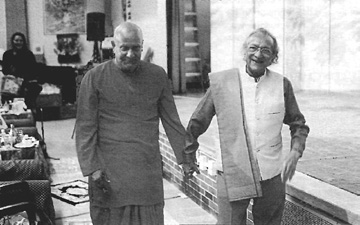
At the close of one function he leaves the hall, walking side by side with Sri Chinmoy, holding his hand. The maestro and the master – two highly venerated human beings and, at the same time, two simple Bengali village boys.

Friday, October 11th – the day of Ravi Shankar’s private concert – is ushered forth under a patina of grey clouds and persistent rain. It is Sri Chinmoy’s wish that Ravi Shankar perform at Aspiration-Ground, Sri Chinmoy’s little meditation park. Because of the inclement weather, Sri Chinmoy has arranged for a huge white marquee to be erected. Wooden boards are laid over the ground and, if one peers between them, it is possible to see that the water level is now several inches deep. The whole of Aspiration-Ground is literally flooded and the marquee reposes on it like a barge on Dal Lake. Sri Chinmoy then requests his students to decorate the interior so that it resembles “a rishi’s abode – full of purity and simplicity.”

When Ravi Shankar visits the marquee during the afternoon for a sound check, he confides to an assistant, “I knew Sri Chinmoy would do something extraordinary for my concert.”

By early evening, a bright panoply of umbrellas in the driveway indicates the arrival of Sri Chinmoy’s special guests for the occasion: Mrs Mariam Chowdhury, wife of United Nations Under-Secretary-General Anwarul Chowdhury; H.E. Vijay Nambiar, Indian Ambassador to the United Nations, and his wife Malini; H.E. Ananda Guruge, former Sri Lankan Ambassador to the USA, France and the UN, and his wife Darshanika; local councilman Jimmy Gennaro and many others.

Among Sri Chinmoy’s students, many have flown in to be present at this historic concert, some from as far away as Iceland, Norway, Sweden, Australia, Hong Kong, Switzerland, Germany, Hungary, England and France. The seats inside the marquee rapidly fill up and still people continue to pour in, choosing to stand at the back rather than miss out on the performance. Still others sit outside on bleachers in the rain, cocooned under umbrellas, fully prepared to participate in this momentous event aurally, if not visually.

Sri Chinmoy arrives and greets his special guests. Then he takes his seat, not more than three feet from the stage itself. There is a hush as everyone waits for the maestro to arrive. Suddenly, word spreads that Ravi Shankar has entered the marquee. He is walking slowly down the aisle from the rear entrance. The crowd bursts forth in a thunderous standing ovation.

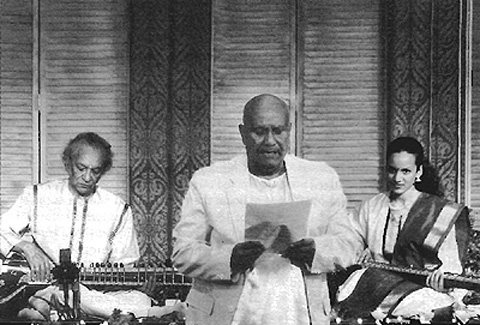
Ravi Shankar and Anoushka seat themselves on the stage, side by side, flanked by the two tabla players – Tanmoy Bose and Bikram Ghosh. The two tanpura players, Kenji and Premik, are positioned to the rear, one on each side. Behind this cluster of musicians, the maroon archways and coconut palm decorations create the illusion that the musicians are, indeed, seated on the porch of an ancient rishi’s abode.
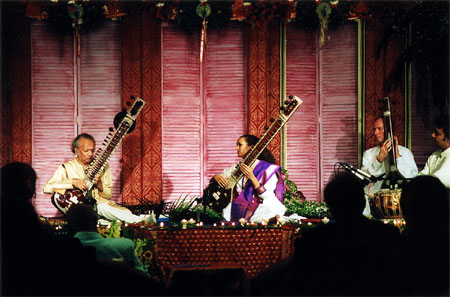


The moment has come. The great maestro places his plectrum on his right index finger and commences the alap. A trained Indian classical musician could perhaps describe in more detail the experience of the next one and a half hours. Most of us could only listen with all our hearts and souls and allow ourselves to be washed away by the river of sound that Ravi Shankar created.

Ravi Shankar has written:

“The raga reflects the spiritual hopes of the people, the constant struggle for life. It is drawn out of the moods of the seasons, the prayers in our temples, for our music is not written down; it is passed from heart to heart.”

Some members of the audience feel that the music has become a capsule of Indian history, weaving together strains of Kashmiri folksongs, Bengali baouls, ghazals and South Indian carnatic music. Others feel that the music expresses the mood of India, especially her seasons. Definitely, the steady thrumming of the rain on the roof of the tent and the occasional crack of thunder confirm this impression.

Moreover, as Ravi Shankar plays faster and faster, his left hand moving like lightning up and down the teak stem of the sitar, the steady beat of the rain seems to intensify more and more, until it is literally beating down on our flimsy shelter. I have heard of Tansen and other legendary musicians of old who could cause fire to break out or rain to fall depending on which raga they played. But this is literally happening before our eyes.

With the fingers of his right hand mimicking the pitter-patter of the raindrops, Ravi Shankar urges the two tabla players to recreate the sound of the rain on their instruments. Their duet chimes perfectly with the pelting tattoo above our heads. As Ravi Shankar plays with ever-increasing speed, he signals Anoushka with a nod of his head to repeat his breathtaking musical arabesques. She looks spellbound by her father’s brilliance. His musical genius, ever unpredictable and always original, has reached new and dizzying heights and she abandons herself to his lead. It takes supreme courage and consummate skill to perform like this. Forgetting his age, forgetting time, forgetting anything external to the moment itself, Ravi Shankar soars on wings of purest inspiration to realms that others can only dream of.

Suddenly the music finishes and the entire audience springs to its feet in rapturous appreciation. Sri Chinmoy approaches the maestro with a beautiful garland but Ravi Shankar is too humble to allow Sri Chinmoy to place it around his neck. He and Sri Chinmoy clasp hands lovingly, the garland suspended between them.

At dinner together later that evening, Sri Chinmoy recounts to Ravi Shankar an experience that he had during the concert:

I prayed and meditated. Then I asked God, “God, please tell me, where is Heaven?” God’s immediate answer was, “Are you blind? Where else is Heaven, if not inside Ravi Shankar’s heart?” I asked God another question: “God, where are You?” He said, “Are you deaf? Are you blind? Can you not see where I am? I am inside Ravi Shankar’s music.” Then God said, “I am not only inside his music, but also I am his music as well.”

During the dinner, Sri Chinmoy also reveals to Ravi Shankar that he first heard him perform around 1947 when Ravi Shankar visited the Sri Aurobindo Ashram in South India. Sri Chinmoy was then a young boy of fifteen or sixteen and he was fortunate to sit on the floor only a few metres away from the maestro. He never forgot that sublime experience.

Ravi Shankar, in turn, tells Sri Chinmoy that very few times in his life has he played with such enthusiasm and inspiration as he had at Aspiration-Ground. He says that he was getting such joy from the spiritual atmosphere; it reminded him of ancient India. Nowhere could he trace the feeling of modern India. He praises Sri Chinmoy for evoking the real atmosphere and spirituality of ancient India.

Anoushka comments that she has never before seen her father indicate to the tabla players to try to imitate the rain. It is something totally new and improvised. Sri Chinmoy offers his own spiritual interpretation of the weather conditions that prevailed during the concert:

“Instead of calling it torrential rain, let us call it the tears of Mother Earth for Father Heaven to descend. Ravi Shankar represents Heaven and here Mother Earth cried and cried for Heaven to descend. So this rain was nothing but the tears of Mother Earth for Heaven to descend. Heaven descended in response to the ceaseless tears of Mother Earth.”

Still later that same night, long after his illustrious guests have departed, Sri Chinmoy reflects:

“For me, it was an unforgettable experience, a truly unforgettable experience. In my memory, it will remain forever. Ravi Shankar’s performance was absolutely unique. He played and played with all his heart, wholeheartedly, absolutely like a young man. At the age of 82, he played really like a young man. We were all transformed.”

Indeed, as the days pass and the memory of that evening lingers, we realise the truth of Sri Chinmoy’s words. We are all transformed, transformed forever.


Copyright © 2002, Vidagdha Bennett. All rights reserved under Creative Commons license.

 

Concerts in New York

Anahata Nada, Vol. 33 — August – Mid-December 2002.


Sri Chinmoy and Ravi Shankar leave P.S. 86 after the spiritual Master's Oct. 10 performance.

It was an exchange of feeling, a sharing of the heart’s love.

On October 10, Sri Chinmoy and his students performed for Ravi Shankar and his wife, Sukanya. at P.S. 86 in Queens.

Sri Chinmoy played on a new esraj-like instrument that Sumadhur, one of his students, built for him. Ravi Shankar later blessed and named the instrument “Chinmoy Beena”. There were also several musical performances by Sri Chinmoy’s students.

The following evening, Ravi Shankar and his daughter, Anoushka, reciprocated, performing a special concert for Sri Chinmoy, his students and invited guests under a huge tent at Aspiration-Ground.

At the start of the concert, Sri Chinmoy told the classical virtuoso: “When you play, your heart becomes Heaven-climbing flame ... and your Inner Pilot speaks to you from His transcendental Summit.”

He added: “Each time you play, you unreservedly inspire us to drink deep Nectar-Delight far beyond this world.”

To Anoushka he said, “When you play, your aspiration-heart becomes a God-Beauty-revelation and your dedication-hands become a God-Duty-manifestation.”


Left, Sri Chinmoy introduces Ravi Shankar and Anoushka before the concert.
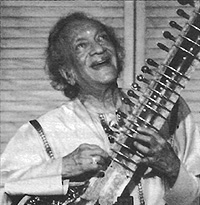
Above, Ravi Shankar during his performance.


Note: Anahata Nada was the longest running newsletter of the Sri Chinmoy Centre. It was first published on January 1, 1974, and chronicled Sri Chinmoy’s life and activities for over three decades until 2007.


The Jewels of Happiness

.

Words by Sri Chinmoy. Narrated by Archbishop Desmond Tutu and others.

Ever since he led the Peace Meditations at the UN, the power of Sri Chinmoy’s initiatives have been praised by world leaders and influenced thousands of individuals. Here, his insightful words, elegant prose, and shrewd aphorisms form a wonderful tapestry of inspiration for people from all walks of life. Read more…


The audio book was launched at the United Nations in New York on Tuesday, March 19, 2013, and reported in Business Standard:


Book by Sri Chinmoy released at UN headquarters

Business Standard

An audio book containing poems and prose by Indian spiritual guru Sri Chinmoy was released at the United Nations headquarters here on the eve of the first UN International Day of Happiness.

The Audio Book "The Jewels of Happiness" contains chapters read by Nobel Peace Laureate Archbishop Desmond Tutu, singer Roberta Flack, Olympic champion Carl Lewis, musician Michael Walden, actress Judith Light and musician Boris Grebenshikov.

The event was opened by Anwarul Chowdhury, Special Advisor and Ambassador of Bangladesh to the United Nations for many years.

"These sweet gems of wisdom by my dear friend Sri Chinmoy are timeless truths full of encouragement, love and goodness," Nobel Peace Laureate, Archbishop Desmond Tutu, said in a video message.

A special message from peace activist Ela Gandhi, granddaughter of Mahatma Gandhi, and former Member of Parliament in South Africa, was also read out.

Chinmoy began teaching meditation in the West when he moved to New York City in 1964. A prolific author, artist, poet, athlete and musician, he is known for holding public events on the theme of inner peace.

Press Trust of India  |  New York 
 March 20, 2013 11:15 IST


August 7

Sri Chinmoy draws ‘The Golden Boat’ (the Sri Chinmoy Centre emblem) in Jamaica, NY, USA.

Sri Chinmoy participates in field events — discus, javelin, shot put and long jump — at the try-outs for Sports Day, held at Jamaica High School track in Jamaica, New York, NY, USA.

Sri Chinmoy paints a three-dimensional Jharna-Kala artwork on an octagonal gazebo in 3 hr. 20 min. in his Jharna-Kala gallery at 937 Madison Ave, New York, NY, USA.

Sri Chinmoy runs a personal best for 4 miles in 30:33 (7:38 pace) at the ‘Summer Blahs’ race in Central Park, New York, NY, USA.

Sri Chinmoy lifts Gary Ackerman, U.S. Congressman from New York State, in Jamaica, NY, USA.

Sri Chinmoy participates in the closing ceremony of the second Peace Run, along with Mayor-elect David Dinkins and over a dozen UN dignitaries at the Dag Hammarskjöld Plaza in New York, NY, USA.

Sri Chinmoy performs a number of athletic, musical and spiritual events 60 times between 7-17 August to celebrate his upcoming 60th birthday on 27 August. Some of his items include: lifting 60 people into the air ... lifting a 60-pound dumbbell 60 times (with each hand) ... performing on 60 different instruments ... spontaneously composing 60 songs ... answering spiritual questions from his Russian disciples for 60 minutes ... doing 60 walking meditations along the tennis court at Aspiration-Ground in Jamaica, NY, USA.

Sri Chinmoy offers a Peace Concert (366) — the 28th of 39 concerts held in honour of Swami Vivekananda — at Aspiration-Ground in Jamaica, NY, USA.

Sri Chinmoy meets with Dr. Elena Vladimirskaya, Deputy Director of the Research Institute of Pediatric Hematology in Moscow, and her husband, a retired military officer, at Annam Brahma Restaurant in Jamaica, NY, USA. During the course of the meeting, Sri Chinmoy answers a number of spiritual questions from his guests.

Sri Chinmoy offers a Peace Concert (415) — the 15th of 50 concerts held in honour of the 50th anniversary of the United Nations — at Aspiration-Ground in Jamaica, NY, USA.

Sri Chinmoy receives a letter from Princess Diana — at Kensington Palace, London, UK — thanking him for his recent encouraging and supportive letter to her.

Sri Chinmoy meets with President Gorbachev’s granddaughters, Ksenia and Anastasia at the Mövenpick Hotel in Münster, Germany.

Sri Chinmoy lifts 22 people, including Lamuel Stanislaus, Ambassador of Grenada to the United Nations, in Jamaica, NY, USA.

Niue is declared a Sri Chinmoy Peace-Blossom-Nation.

Sri Chinmoy lifts 34 people in Jamaica, NY, USA.

Sri Chinmoy lifts 24 Bengali nationals in Jamaica, NY, USA.

Sri Chinmoy inaugurates ‘The Panorama of my Silence-Heart’ — a vegetarian and vegan café on Parsons Blvd. in Jamaica, New York, NY, USA. At his home, he draws a ‘soul-bird’ artwork that he dedicates to the café.


August 6

Before returning to New York, after spending one month on the island of Puerto Rico, Sri Chinmoy holds a final meditation with his students at the AUM Centre in San Juan, Puerto Rico.  

Sri Chinmoy begins a series of free Wednesday night public meditations at 7:30 p.m. at All Angel’s Church, 81st St. and West End Avenue, in Manhattan, New York, NY, USA.

Sri Chinmoy asks his disciples what they think is the highest reality offered by this world. Many try to guess, but no one comes close. He answers in a talk, entitled ‘The Only Absolute Certainty’, in Jamaica, New York, NY, USA. 

Albany, the capital of New York State, USA, welcomes the participants in the ‘Aspiration-Plants and Gratitude-Leaves of New York’ non-stop relay walk as it passes through, on its 700-mile journey around the State.

An exhibition of paintings by Sri Chinmoy opens in the Exhibition Space, 112 Greene Street, Soho, New York, NY, USA. The exhibition runs until 14 September.

Sri Chinmoy offers a Peace Concert (157) at Dalhousie Arts Centre in Halifax, NS, Canada.

Sri Chinmoy offers an organ recital at St. Mary’s Basilica in Halifax, NS, Canada.

Sri Chinmoy offers a piano performance at Rebecca Cohn Auditorium in Halifax, NS, Canada.

Sri Chinmoy lifts Raul Sicilia Salgado, President Municipal De Tula, State of Hidalgo, Mexico, in Jamaica, NY, USA.

Sri Chinmoy offers a Peace Concert (199) at Aspiration-Ground in Jamaica, NY, USA.

Sri Chinmoy is interviewed by The New Yorker magazine at an exhibition of his 70,000 Dream-Freedom-Peace-Birds, Soho, New York, NY, USA.

Sri Chinmoy meets with Pir Vilayat Khan, Leader of the Sufi Order in the West at the United Nations in New York.

Sri Chinmoy achieves a 2,200-lb standing calf raise; and a 1,300-lb seated calf raise, in Jamaica, NY, USA.

Sri Chinmoy receives the Heart of Sierra Leone and the Heart of Swaziland Awards.

Sri Chinmoy achieves an 800-lb, double-platform, double-arm lift in Jamaica, NY, USA.

Sri Chinmoy composes 20 Bengali songs and, two days later, composes 8 English songs for the Parliament of the World’s Religions, in Barcelona, Spain, subsequently published in I Bow to the Soul of the Parliament of Religions. An article about Sri Chinmoy at the Parliament of the World’s Religions is published in Indian Reporter.

Sri Chinmoy offers a Peace Concert at the Church of St. Paul the Apostle in New York, NY, USA.

Sri Chinmoy recounts anecdotes — from his time as a youth while at the Sri Aurobindo Ashram, in India — to his students, at his home in New York, USA.


August 5

Sri Chinmoy delivers a talk, entitled ‘A Spiritual Goal For The United Nations: Is It Practical?’, in the Dag Hammarskjöld Auditorium at the United Nations in New York, NY.

Sri Chinmoy presents an afternoon (3 p.m.) concert of music for meditation at the Palace Theater in Albany, NY, USA. It is held in conjunction with the 700-mile relay walk, ‘Aspiration-Plants and Gratitude-Leaves of New York’, which will pass through Albany on Monday, 6 August, at 9:30 a.m. on State and Swan streets. After the concert, Sri Chinmoy holds an informal gathering for his students at St. Patrick’s Church in Albany, where he meets with Friar Charles Murphy.

Sri Chinmoy runs 800 metres in 2:59.9 at the New York Road Runners’ Summer Track Event on Randall’s Island, New York, NY, USA.

Sri Chinmoy runs a one-mile race in a time of 6 min. 54 sec. at the Sri Chinmoy Grand Prix, held at Jamaica High School Track environs, in Jamaica, NY, USA.

Sri Chinmoy delivers an inspirational talk ‘Why Do I Meditate?’ and offers a special concert and meditation for the diplomatic community, held in the Dag Hammarskjöld Auditorium at the United Nations in New York. He also answers a series of spiritual questions regarding meditation, the spiritual life and the inner life.

Sri Chinmoy runs a one-mile race in 7:10, and offers a concert in Woodstock, NY, USA.

Sri Chinmoy offers a Peace Concert (566) at Aspiration-Ground in Jamaica, NY, USA.

Sri Chinmoy reads out a letter declaring 101 Sri Chinmoy Peace-Blossoms in India to date, in Jamaica, NY, USA.

Sri Chinmoy lifts 1,005 lbs. using a seated calf raise with a knee platform, in Jamaica, NY, USA


August 4

Sri Chinmoy delivers a talk, entitled ‘Confidence’, in the Peace Room of the Church Centre for the United Nations, at the United Nations in New York.

Sri Chinmoy composes a song in honour of the ‘New York Road Runners Club’.

Tributes for Sri Chinmoy’s 50th Birthday are read into the Congressional Record at the United States House of Representatives in Washington, DC, USA.

Sri Chinmoy meets with Sardar Dhillon, India’s High Commissioner to Canada, at the United Nations in New York. The photo of this meeting was chosen by Sri Chinmoy to on the cover of his book ‘Ten Thousand Flower-Flames, part 53.’

Sri Chinmoy is named ‘Peace Ambassador in Puerto Rico’ by Governor Rafael Hernández Colón of Puerto Rico.

Sri Chinmoy lifts 7040¼ lbs. using only his left arm, in Jamaica, NY, USA.

Sri Chinmoy offers a Peace Concert (365) — the 27th of 39 concerts held in honour of Swami Vivekananda — at Aspiration-Ground in Jamaica, NY, USA.

Sri Chinmoy meets with Russian Cosmonaut Gennadi Strekalov at Aspiration-Ground in Jamaica, NY, USA.

Sri Chinmoy completes the English translation of ‘August 15, 1945’, Dyulok Chariye, his epic 180-line Bengali poem written at the age of 13 and dedicated to Sri Aurobindo for his birthday, in Jamaica, NY, USA.

Cambodia is declared a Sri Chinmoy Peace-Blossom-Nation.

Sri Chinmoy visits an exhibition of his Jharna-Kala artworks at Newark International Airport in New Jersey, USA.

Sri Chinmoy lifts 34 people, including Dr. Kul Gautam, Deputy Executive-Director of UNICEF; Lindy Remigino, 100 m Olympic gold medallist, in Jamaica, NY, USA.

Sri Chinmoy lifts 36 people, including several members of the family of the late Jesse Owens, legendary Olympic gold medallist — Beverly Owens Prather and Marlene Owens Rankin, two of Jesse Owens’ daughters, and his grandson, Stuart Rankin, Jr.; Ted Erikson, 3-time English Channel swimmer; Adolf Kiefer, 1936 Olympic gold medallist in backstroke; Willye White, Olympic silver medallist in the long jump and 4 x 100 m relay, at Palmer House Hotel in Chicago, IL, USA.


August 3

The ‘Aspiration-Plants and Gratitude-Leaves of New York’ 700-mile walk begins at the Sri Chinmoy Church in Bayside, NY, USA.

An exhibition of Sri Chinmoy’s artworks opens at 170 Thompson St., Greenwich Village, in New York, NY, USA.

Sri Chinmoy lifts 3,070 lbs. with his left arm, in Jamaica, NY, USA. The 2nd, 3rd, 4th and 5th attempts are all good lifts.

Sri Chinmoy is interviewed by a journalist from Art Speaks magazine at his exhibition of 70,000 Dream-Freedom-Peace-Birds at 66 Crosby St, Soho, New York, NY, USA.

Sri Chinmoy sings and whistles 15 of his own Bhajan songs — ‘My Heart-Whistle-Birds’ — in Jamaica, NY, USA.

Sri Chinmoy offers a Peace Concert at Palmer House Hotel in Chicago, IL, USA.

Sri Chinmoy lifts Tevin Campbell, American singer, songwriter and actor, and presents him with the ‘Lifting Up the World with a Oneness-Heart’ award, at Aspiration-Ground in Jamaica, NY, USA.