August 31


People in The Sun


Sri Chinmoy, an Indian guru who teaches meditation to delegates and staff at the United Nations, celebrated his 48th birthday this week by leading his disciples in a 47-mile run around a New York high school track. He is trying to persuade about 200 of them to run 90 miles a week to get ready for the New York City marathon.

Caption:

Sri Chinmoy ... celebrating his 48th


Published in The Sun, Lowell, Mass., Friday. August 31, 1979


August 30


Sri Chinmoy at the start of the 100-metre event at the Pan American Track & Field Masters Championships in San Juan, Puerto Rico. He runs a time of 16.01 seconds.


Filmed and edited by Kedar Kedar Misani


The first Sri Chinmoy Self-Transcendence Marathon is held in Rockland Lake State Park, Congers, NY, USA, attracting over 700 runners. It becomes an annual event.


Photo by Adarini Inkei


Sri Chinmoy lifts his own small car in the driveway of Aspiration-Ground in Jamaica, New York.


August 29


Sri Chinmoy meditates at a concert given by Boris Purushottama Grebenshikov at the United Nations in New York. Sri Chinmoy gave the Russian musician and songwriter the name ‘Purushottama’, which means, “the Highest, He who transcends all limits.”


August 29


Sri Chinmoy receives the ‘The Light of India’ Award in recognition of “his ceaseless and selfless efforts for universal brotherhood, understand­ing, friendship and peace,” from Bharatiya Vidya Bhavan USA, at the World Music Concert in honour of the 50th anniversary of India’s independence.


August 29


Sri Chinmoy at the Jharna-Kala gallery in New York.


August 28

Poetry-Reading at the Jharna-Kala Gallery


Sri Chinmoy holds a poetry reading in the Jharna-Kala Gallery at 220 Mercer Street, Greenwich Village, New York. Before reading his selections from the writings of some of the world’s great poets, he gives a short talk on the significance of spirituality in poetry.


O lovers of poetry, you are not only lovers of poetry, you are also lovers of spirituality, for poetry and spirituality go hand in hand. They are inseparable. True poetry and true spirituality are always inseparable. It is said that poetry is next to spirituality. To me this is an understatement. I feel from deep within that poetry, if it is spiritual and divine, without fail houses spirituality, and true spirituality must needs house poetry.

A poet is he who envisions the ultimate absolute Truth. On the physical plane, vital plane, mental plane, even at times on the psychic plane, when we notice a particular poet offering to the world at large his contribution, we appreciate him, we admire him. But if we can see the seeker in the poet, the truth-lover in the poet, the real reality in that poet’s vision, then we shall go one step farther. We shall discover our inseparable oneness with the poet.

It is said that a poet has no character of his own. Now I wish to say, why should a poet have a character of his own? A poet identifies with truth. If he has to express anger through his poem, then naturally he will identify himself with the anger-consciousness. If he has to express love, then he will have to identify himself with love-consciousness. On the strength of his identification with the reality that he has envisioned, he reveals to the world his inspiration and aspiration.

A poet sees the truth from various angles. He is not obligated to see the truth always from one angle. A poet can speak of one particular subject in various ways. This moment he may praise and invoke death and the next moment he may criticise death. That does not mean that the poet is a man of no principles. Far from it! When he stays in a particular plane of consciousness, according to the capacity and receptivity that he has at that time, he sees death in one form. When he stays in another plane of consciousness, he may see death in a different way, with a different aspect. At one time he will see death as something very nice, very kind. When the world is torturing him, when the world is not giving him due attention, he prays to death to come and embrace him. But the same poet is a human being. When name and fame are being showered on him and all worldly achievements are at his feet, when the whole world listens to him and he sees beauty within and without, at that time if death knocks at his door, naturally he sees death as an enemy and begs death not to capture him. He does not need or want death.

There have been some poets who have offered to the world at large some soulful and prophetic utterances. Their poems have attained planes of consciousness that are high, very high, but their outer lives were not in keeping with their prophetic utterances. They lived undivine lives, unaspiring lives; therefore, many, many people do not pay attention to their soulful utterances. They say, “He wrote this, but who cares for him? He lived a worse than ordinary life, an undivine, animal life.” But I wish to defend the cause of the misunderstood poets. Here we are all seekers. We know that we are supposed to realise God as soon as possible, but during the twenty-four hours of each day, how many minutes do we remain in a divine consciousness and how many hours do we remain in an undivine or an ordinary consciousness? We remain for a few fleeting minutes in a divine consciousness, and the rest of the day we are in an absolutely ordinary or even an undivine consciousness. But in those few divine minutes what do we actually do? We establish a free access to some higher planes of consciousness. Similarly, when a particular poet enters into high, higher, highest planes of consciousness, he sees and becomes for a while the reality, the truth-essence of those planes of consciousness. And like the climber, he climbs down the reality-tree and offers the fruits to the world. Then he again enters into the world of pleasure, vital life and so forth, if he wants to. But his achievement on the highest plane was absolutely true. Just because he is now wallowing in the pleasures of ignorance, we cannot discard his achievements on the higher planes of consciousness. When we pray and meditate, we grow into divinity. When we don’t pray and meditate, we remain undivine. But just because we don’t pray and meditate all the time, we cannot say that we are unspiritual. We are spiritual, but we do not or cannot, at the present stage of our development, practice spirituality all the time.

There are many, many poets who have enjoyed, according to us, emotional life, vital life, but they have offered us something striking nevertheless. They have offered spiritual truths of the highest magnitude to us. I see their achievement. I value their achievement deeply, wholeheartedly. A day will come in the course of time when they will care more for their nature’s transformation. Eventually they will enter deeper into spiritual life, conscious one-pointed spiritual life. Each individual soul that has taken human incarnation will, without fail, manifest the absolute Truth here on earth, for that is the Vision of the Supreme. For the transformation of the body-consciousness and earth-life, each soul will descend onto earth again and again until perfection has dawned in that particular soul. So we should pay utmost attention to the poets’ achievements in the world of reality and divinity which they so soulfully offered to mankind for the elevation and transformation of human life.

A poet is he who envisions the inner reality, who brings to the fore the inner wealth. A poet is the harbinger of God the supreme Musician. A poet sees the cosmic Game before the rest of the world. He watches the cosmic Game and participates in it and he invites the rest of the world to participate in this cosmic Game, as well. If we can separate the soulful utterances of the poets from their outer lives, we will be able to gain considerable inner wealth from them. Who said the words is not the important question, but what the utterance means. There are many poetic lines and stanzas which, if we soulfully repeat them, will without fail carry us into a higher plane of consciousness. Each individual seeker can identify himself or herself with the poet’s soul-stirring utterances. On the strength of that identification, the seeker can easily achieve for himself something divine, illumining, fulfilling and immortalising.

This evening, with your kind permission, I shall read out some of my favourite poems. Today I shall not pass any comments. In the very near future it is my sincere wish to offer my spiritual comments on these soulful utterances of the poets who have contributed much to the spiritual world, the world that we are trying to live in. I have been a poet all my life, and I have been a spiritual seeker as well. Inside my heart I feel two eternal players, the poet and the seeker, who can easily exchange their names. I can call the poet the seeker and the seeker the poet. I can easily change and transfer their names, and still I will see the same reality. My poetry and my spirituality are inseparable. They are like the obverse and the reverse of the same coin. They cannot be separated. Each has contributed to or fulfilled the other most soulfully and most fruitfully.

I wish to start with Tagore, Rabindranath Tagore.

"In one salutation to thee, my God, let all my senses spread out and touch this world at thy feet."

— Rabindranath Tagore

"Like a flock of homesick cranes flying night and day back to their mountain nests, let all my life take its voyage to its eternal home in one salutation to thee."

— Rabindranath Tagore

I started with Tagore and I would like to end with Sri Aurobindo. I wish to quote the last stanza from his immortal poem “Invitation”.

"I am the lord of tempest and mountain,
I am the Spirit of freedom and pride.
Stark must he be and a kinsman to danger
Who shares my kingdom and walks at my side."

— Sri Aurobindo


Published in AUM – Vol. 2, No. 8, 27 August 1975


August 28

Photos by Adarini Inkei


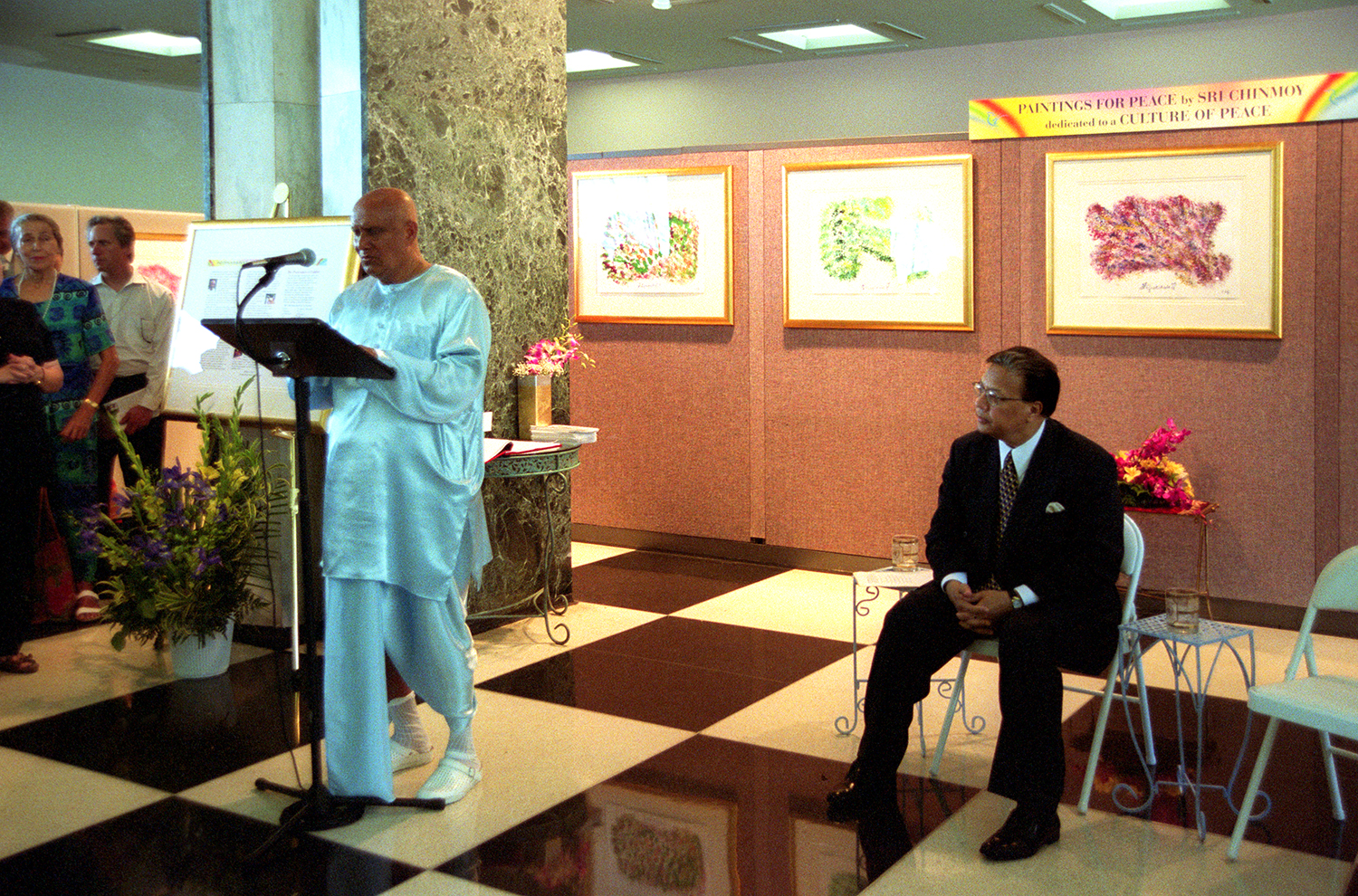
An exhibition of ‘Paintings for Peace’ by Sri Chinmoy dedicated to the ‘Culture of Peace’ opens at the United Nations in New York.


August 28


Video by kedarvideo


Sri Chinmoy holding the opening meditation at the Parliament of the World’s Religions in Chicago.


August 28


Sri Chinmoy offers a concert with his disciples, called ‘Sri Chinmoy with his Music Family’, at 7:30 p.m., at Manhattan’s High School of Art and Design in New York.


Photo by Bhashwar Hart


Sri Chinmoy offers a Peace Concert at New York City’s Town Hall in Manhattan, New York. 


Photo by Prashphutita Greco


Sri Chinmoy plays the esraj at Aspiration-Ground in Jamaica, Queens, New York.


August 28

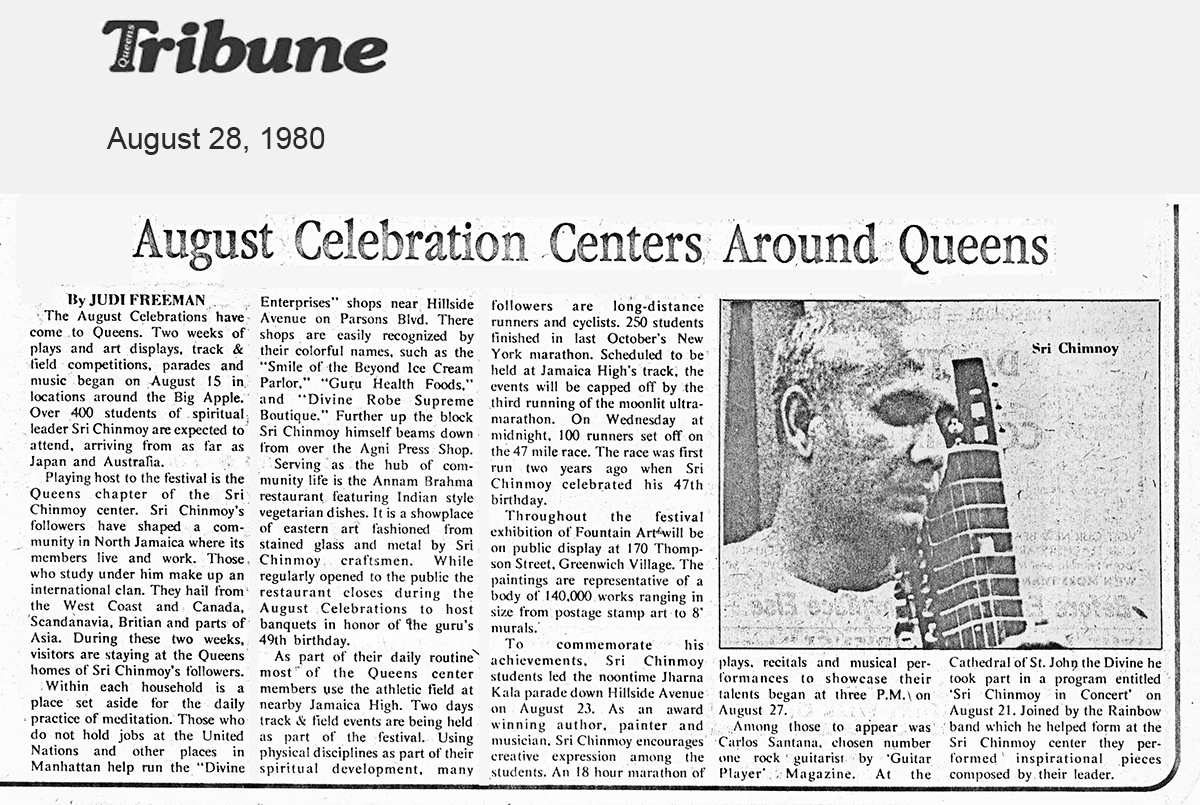
August Celebrations Centers Around Queens

by JUDI FREEMAN

The August Celebrations have come to Queens. Two weeks of plays and art displays, track & field competitions, parades and music began on August 15 in locations around the Big Apple. Over 400 students of spiritual leader Sri Chinmoy are expected to attend, arriving from as far as Japan and Australia.

Playing host to the festival is the Queens chapter of the Sri Chinmoy center. Sri Chinmoy's followers have shaped a community in North Jamaica where its members live and work. Those who study under him make up an international clan. They hail from the West Coast and Canada, Scandinavia, Britain and parts of Asia. During these two weeks, visitors are staying at the Queens homes of Sri Chinmoy’s followers.

Within each household is a place set aside for the daily practice of meditation. Those who do not hold jobs at the United Nations and other places in Manhattan help run the “Divine Enterprises” shops near Hillside Avenue on Parsons Blvd. Their shops are easily recognized by their colorful names, such as the “Smile of the Beyond Ice Cream Parlor,” “Guru Health Foods,” and “Divine Robe Supreme Boutique.” Further up the block Sri Chinmoy himself beams down from over the Agni Press Shop.

Serving as the hub of community life is the Annam Brahma restaurant featuring Indian style vegetarian dishes. It is a showplace of eastern art fashioned from stained glass and metal by Sri Chinmoy craftsmen. While regularly opened to the public the restaurant closes during the August Celebrations to host banquets in honor of the guru's 49th birthday.

As part of their daily routine most of the Queens center members use the athletic field at nearby Jamaica High. Two days track & field events are being held as part of the festival. Using physical disciplines as part of their spiritual development, many followers are long-distance runners and cyclists. 250 students finished in last October’s New York marathon. Scheduled to be held at Jamaica High’s track, the events will be capped off by the third running of the moonlit ultra­marathon. On Wednesday at midnight, 100 runners set off on the 47 mile race. The race was first run two years ago when Sri Chinmoy celebrated his 47th birthday.

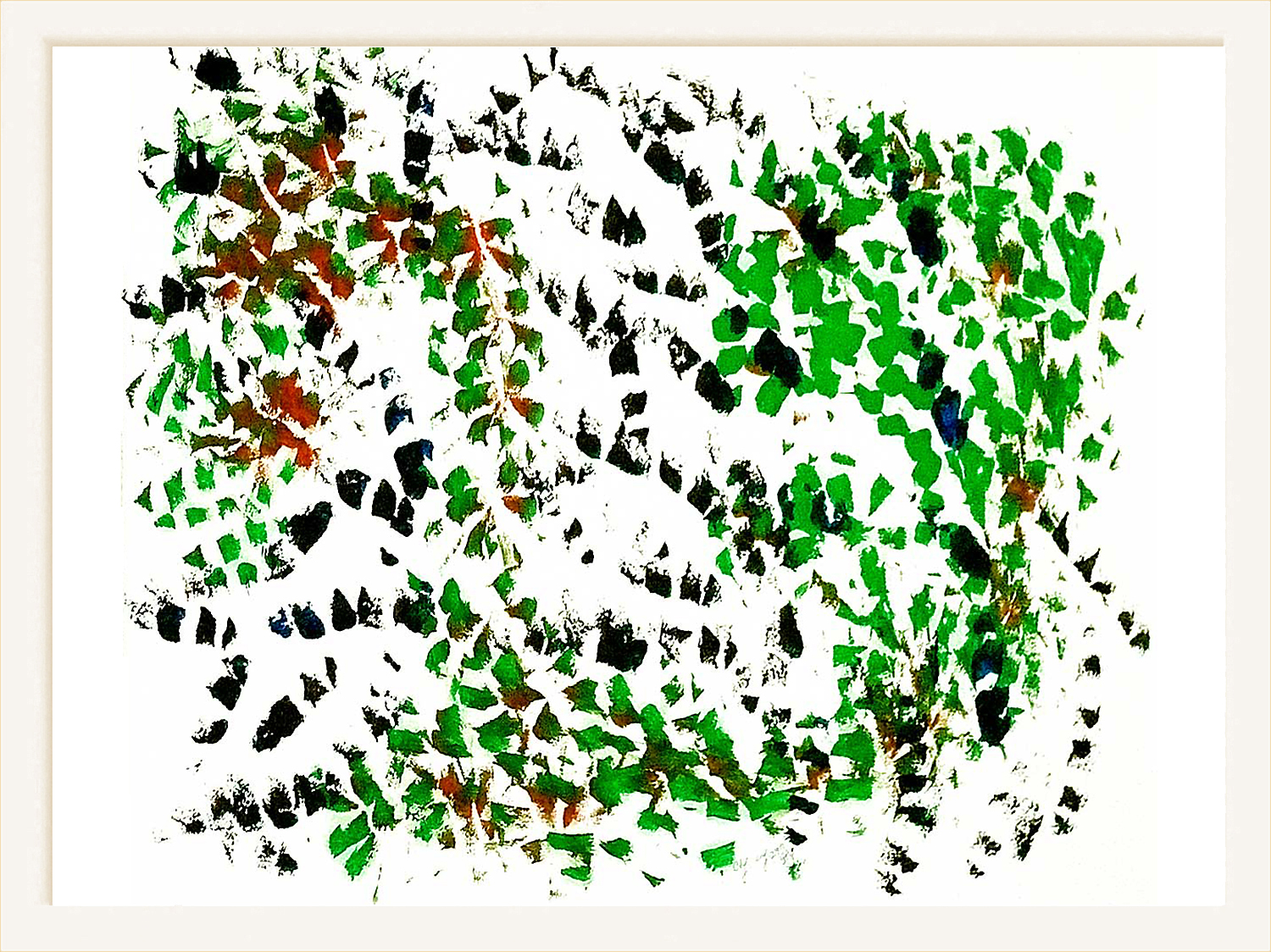
Throughout the festival exhibition of Fountain Art will be on public display at 170 Thomp­son Street, Greenwich Village. The paintings are representative of a body of 140,000 works ranging in size from postage stamp art to 8' murals.

To commemorate his achievements, Sri Chinmoy students led the noontime Jharna-Kala parade down Hillside Avenue on August 23. As an award winning author, painter and musician Sri Chinmoy encourages creative expression among the students. An 18 hour marathon of plays, recitals and musical performances to showcase their talents began at three P.M. on August 27.

Among those to appear was Carlos Santana, chosen number one rock guitarist by ‘Guitar Player’. At the Cathedral of St. John the Divine he took part in a program entitled ‘Sri Chinmoy in Concert’ on August 21. Joined by the Rainbow band which he helped form at the Sri Chinmoy center they performed inspirational pieces composed by their leader.


Published in Queens Tribune, August 28, 1980


Interview with Sri Chinmoy

by an independent filmmaker in Chicago in connection with his participation in the World Parliament of Religions.


Question: What do you feel is the significance of this Chicago Parliament of Religions, which may be the largest gathering of the world's religions ever to be held?

Sri Chinmoy: The spiritual significance of this Parliament, according to my aspiring heart, is interdependence. The one and the many have to realise their interdependence. Just as the tree and its branches, leaves, flowers and fruits are interdependent, so we are all interdependent. Here many religions are meeting together to sing the oneness-heart-song.

Question: This centenary of the Parliament of Religions is, for many, associated with the name of Swami Vivekananda, one of the major figures of the Parliament that was held one hundred years ago. You have spent much of the past year giving concerts in his honour. Who was Swami Vivekananda, and what did he offer to the world?

Sri Chinmoy: I strongly feel that today’s centenary of the Parliament of Religions is taking place precisely because of Vivekananda. He was the dreamer, the lover and the possessor of a truly universal spirit. People came to the original Parliament of Religions from various religions and various cultures. In most cases they came to preach or speak about their respective religious beliefs. But Vivekananda came as a lover of humanity to sing the song of a oneness-world-home. He did not come here to propagate the views of his Hindu religion. He came to propagate the one religion that is known as Man. He spoke of the individual man who is evolving into the universal man and consciously accepting the world as his own, very own. Vivekananda was at once an ancient silence-heart and a modern dynamism-life.

Question: What does Swami Vivekananda mean to you personally?

Sri Chinmoy: Swami Vivekananda is the indomitable spirit who tells us how to love and worship God the creation. Without loving God the creation, who can ever fulfil the Message of God the Creator?

Question: There is a growing sense that spiritual values are necessary if we want to achieve peace or even survive in the future.

Sri Chinmoy: Spiritual values are of paramount importance if we want to achieve peace, for it is spirituality that consciously embodies peace. Without peace there can be no future.

Question: Which spiritual values in particular do you feel are most important in the world today?

Sri Chinmoy: Not only in the world today, but also in the world of the hoary past and in the world of the future, there are only two things that we sleeplessly need: prayer and meditation.

Question: How do you believe world peace can be achieved?

Sri Chinmoy: World peace can be achieved only through prayer and meditation. It is from our prayer and meditation that we can establish the feeling of a oneness-world-home.

Question: How, in practical terms, can spirituality actually be effective for change? This seems to be the most difficult challenge.

Sri Chinmoy: According to my inner conviction, spirituality is not something theoretical; it is something practical. Who can be more practical than God Himself? He created the world to give Himself joy and fulfilment. Spirituality is definitely practical; likewise, prayer and meditation are definitely practical. For prayer and meditation to be effective, we need only one thing: the indomitable, heroic spirit that can conquer the pride of impossibility.

Question: The average person may feel that you are exceptional and that all your achievements have nothing to do with him or her.

Sri Chinmoy: This is not true. We are all God’s children. What God wants and needs from us is receptivity. If we can be receptive or if He can make us receptive, then He will be able to accomplish in and through us whatever He wants to.

Question: What is the spiritual significance of music, which is something that every culture on earth has and cherishes?

Sri Chinmoy: There is an outer existence and an inner existence. Music touches immediately the inner existence, the existence that aspires to become happy and, at the same time, tries to share its happiness with the rest of the world. Music touches the depths of our being and brings to the fore what it discovers there. The melody and the harmony of music are not only giving joy to mankind but are also helping mankind to reach the highest state of consciousness, which is filled with peace, love, joy and fulfilment.


Published in Sri Chinmoy Answers, part 6