November 8


Sri Chinmoy meets with Consul General Lakhan L. Mehrotra (his former boss at the Indian Consulate in New York) at the Indian Consulate in San Francisco, California. The Consul General and his wife soulfully accept Sri Chinmoy’s gift of one of his Jharna-Kala paintings.

“I felt deeply inspired by the spiritual atmosphere generated by you and your devotees ... and wish to congratulate you for your growing achievement in bringing the message of India to the distant shores of America in the tradition of Swami Vivekananda.”  — L.L. Mehrotra

November 7

Photo by Adarini Inkei


Sri Chinmoy lifts Brazilian long-distance runner Marílson Gomes dos Santos — winner of the New York City Marathon just two days earlier — at Aspiration-Ground in Jamaica, Queens, New York.


November 7

The Revelation of India’s Light

A lecture by Sri Chinmoy at the
University of California at Berkeley in California


Each Upanishad is the unfoldment of the supreme knowledge which, once spiritually attained, is never lost. According to the Upanishads, the entire universe of action, with its ephemeral means and ends, lives in the meshes of ignorance. It is the knowledge of the supreme Self that can destroy the human ignorance of millennia and inundate the earth-consciousness with the Light and Delight of the ever-transcending and ever-manifesting Beyond.

As we have the heart, the mind, the vital, the body and the soul, so also the Upanishads have a heart, a mind, a vital, a body and a soul. The heart of the Upanishads is self-realisation, the mind of the Upanishads is self-revelation, the vital of the Upanishads is self-manifestation, the body of the Upanishads is self-transformation, and the soul of the Upanishads is self-perfection.

What is of paramount importance right now is self-realisation. For self-realisation we need only four things. First we need the help of the scriptures, then a guide, then yogic disciplines and, finally, the Grace of God. The scriptures tell the seeker, “Awake, arise! It is high time for you to get up. Sleep no more.” The spiritual Master tells the seeker, “My child, run! Run the fastest! I am inspiring you. I have already kindled the flame of aspiration within you. Now you can run the fastest.” Yogic disciplines tell the seeker, “You are practising the spiritual life, and I am giving you the result of your practices. I have made the road clear for you. Now you can run the fastest on a road that is empty of danger.” Then something more is required, and that is God’s Grace. One may run the fastest, but one may not reach the Goal even if there is no obstacle on the way, because human beings very often get tired. Before they reach the Goal they feel that they are totally exhausted. At that time what is required is God’s Grace. Without God’s Grace one cannot complete the journey. God’s Grace tells the seeker, “Lo, the Goal is won.”

To be sure, God’s Grace starts right from the beginning. When we study the scriptures, God’s Grace has already dawned on us. Had there been no Grace from God, we could not have launched into the spiritual path in the first place. And had there been no Grace from God, we could not have found our spiritual Master. It is out of His infinite Bounty that God brings a seeker to the Master. Then the seeker and the Master must play their respective roles. The Master will bring down God’s Compassion, but the seeker has to practise spiritual disciplines. His task is to aspire, and the Master’s task is to bring down Compassion.

In the inner world, one thing that everybody must have is aspiration. Here on earth the tree offers us an example of this aspiration. It remains on earth with its roots in the dirt, but its aim is to reach the Highest. We are afraid of staying on earth. We feel that if we stay on earth we cannot reach the Highest. But the tree shows us how absurd this is. Its root is under the ground, but its topmost branch is aspiring towards the Heavens. In the Upanishads we come across a tree called the asvattha tree. Unlike earthly trees, this tree has its roots above and its branches below. It has two types of branches. One type enters into the meshes of ignorance and then starts struggling, fighting and trying to come out again into the effulgence of Light. The other type of branch always tries to remain in the Light. Its movement is upward; its aspiration is upward.

Here on earth each human being has capacity. A human being sees ignorance within and without, but he has the capacity to remain beyond the boundaries of ignorance. How? Through aspiration. Why? Because he needs constant satisfaction. And it is aspiration alone that can give us this constant satisfaction. Why do we aspire? We aspire for delight, Ananda. Delight is self-creation and self-experience. Delight in the Highest, absolute Highest, is known as Anandapurusa. There the Delight is Infinity, Eternity, and Immortality. There is another type of delight which is called Anandatma, when from infinite Delight, Delight takes shape and form. In the earth-bound consciousness, delight is called Anandatma.

When Delight actually descends into the obscure, impure, unlit, imperfect nature of man to transform human nature, it finds constant resistance. Then we see that Delight loses its power because of teeming ignorance, and pleasure, short-lived pleasure, looms large. In the Highest, the triple consciousness — Saccidananda — Existence, Consciousness, and Delight go together. But when they want to manifest themselves, they have to do it only through Delight.

When Delight descends, the first rung that it steps on is called the Supermind. The Supermind is not something a little superior to the mind. No, it is infinitely higher than the mind. It is not ‘mind’ at all, although the word is used. It is the consciousness that has already transcended the limitations of the finite. There creation starts. Form begins one rung below. This rung is called the Overmind. Here form starts, multiplicity starts in an individual form. The next rung is the intuitive mind. With the intuitive mind we see multiplicity in a creative form. With intuition we see all at a glance. We can see many things at a time; we see collective form. From the intuitive mind, Delight enters into the mind proper. This mind sees each object separately. But although it sees everything separately, it does not try to doubt the existence of each object. Next, Delight enters into the physical mind — that is, the mind that is governed by the physical. This mind sees each object separately, plus it doubts the existence of each object. Real doubt starts here in the physical mind.

After it has descended through all the levels of the mind, Delight enters into the vital. In the vital we see the dynamic force or the aggressive force. The force that we see in the inner or subtle vital is dynamic, and the force that we see in the outer vital is aggressive. From the vital, Delight enters into the physical. There are two types of physical: the subtle physical and the physical proper. In the subtle physical, Delight is still descending, and we may still be conscious of it. But in the subtle physical we cannot possess or utilise the Truth; we can only see it, like a beggar looking at a multimillionaire. Finally, when we come to the gross physical, there is no Delight at all.

Delight descends, but we do not see even an iota of it in the gross physical. What can we do then? We can enter into the soul on the strength of our aspiration, and the soul will consciously take us to the highest plane, to Saccidananda — Existence-Consciousness-Bliss. At that time our journey can become conscious. We have entered into the triple consciousness, and we can begin descending consciously into the Supermind, the Overmind, the intuitive mind, the mind proper, the physical mind, the vital and the physical. When we are successful in the physical, that is to say, when we can bring down Delight from the highest plane and the physical can absorb and utilise this Delight, the life of pleasure ends. At that time we come to realise the difference between the life of pleasure and the life of Delight. The life of pleasure is followed by frustration and destruction. The life of Delight is a continuous growth, continuous fulfilment, continuous achievement and continuous God-manifestation in God’s own Way.

The Mundaka Upanishad has offered us two birds. One bird is seated on the top of the life-tree, the other on a branch below. The bird seated on the low branch eats both sweet and bitter fruits. Sweet fruits give the bird the feeling that life is pleasure; bitter fruits give the bird the feeling that life is misery. The other bird, seated on the top of the tree, eats neither the sweet fruit nor the bitter fruit. It just sits calmly and serenely. Its life is flooded with peace, light and delight. The bird that eats the sweet and bitter fruit on the tree of life is disappointed and disgusted; disappointed because pleasure is impermanent, ephemeral and fleeting; disgusted because frustration ends in destruction. Unmistakably disappointed and utterly disgusted, this bird flies up and loses itself in the freedom-light and perfection-delight of the bird at the top of the life-tree. The bird on the top of the tree is the Cosmic and Transcendental Self, and the bird below is the individual self. These two beautiful birds are known as Suparna.

In some of the Upanishads we see a continuous rivalry between the Cosmic Gods and the demons. The self-resplendent ones are the Gods; and the self-indulgent ones are the demons. The Gods and the demons are the descendents of Prajapati, the Creator. When the Gods win the victory, the light of the soul reigns supreme. When the demons win the victory, the night of the body reigns supreme. Originally the gods and the demons were the organs of Prajapati. The organs that were energised by the divine Will, illumined by the divine Light and inspired by the divine Action became Gods.

The organs that were instigated by the lower thoughts and were eager to live in the sense-world and enjoy pleasure-life, and were aiming at lesser and destructive goals, became demons. Needless to say, it is infinitely easier to reach the lesser goals than it is to reach the Goal Supreme. This is precisely why the demons greatly outnumbered the Gods. But we, the seekers of the infinite Light and Truth, need the quality of the Gods and not the quantity of the demons.

Once the Gods made a fervent request to the organ of speech, the nose, the eyes, the ears, the mind and the vital force to chant hymns for them. All sang successively. The demons immediately realised that the Gods would, without fail, gain supremacy over them through these chanters, so they secretly and successfully contaminated them with the blatant evil of strong attachment to sense objects and the life of pleasure. They immediately succeeded with the organ of speech, the nose, the eyes, the ears and the mind. But to the vital force they lost badly. The vital force broke them into pieces and threw them in all directions. The vital force won the victory for the Gods. Their existence was inundated with Divinity’s eternal Light. They became their true selves. The chicanery of the jealous demons was exposed, and their pride was smashed.

This vital force is called ayasya angirasa. It means ‘the essence of the limbs’. The vital force was victorious. It was also kind, sympathetic and generous:

The vital force carried the organ of speech beyond the domain of death. Having transcended the region of death, the organ of speech became fire, and this fire shines far beyond death.

The vital force carried the nose beyond death. The nose then became the air. Having transcended the boundaries of death, the air blows beyond death.

The vital force carried the eyes beyond death. The eyes became the sun. Having transcended the region of death, the sun perpetually shines.

The vital force carried the ears beyond death. They then became the directions. These directions, having transcended death, remained far beyond its domain.

The vital force carried the mind beyond death. The mind then became the moon. The moon, having transcended death, shines beyond its domain.

The Brhadaranyaka, or ‘great forest’ Upanishad, offers to humanity an unparalleled prayer:

       Asato ma sad gamaya
      Tamaso ma jyotir gamaya
       Mrtyor mamrtam gamaya

      Lead me from the unreal to the Real.
      Lead me from darkness unto Light.
      Lead me from death to Immortality.

The unreal is the frown of death; the Real is the song of Immortality. Darkness is the colossal pride of death; Light is the life of the illumining and perfecting power of Immortality. Death is the message of nothingness. Immortality is the message of humanity’s liberated oneness with Divinity’s Transcendental Height.

Published in The Oneness of the Eastern Heart and the Western Mind, part 2


November 7

Photo by Sarama Minoli


Sri Chinmoy plays the esraj at Public School 86 in Jamaica, Queens, New York.


Although There Is Nobody in the Audience


Lyrics:

Although there is nobody
In the audience,
God the Lecturer
Every day delivers a lecture
On peace.


Published in Lord, I Thank You For Your Smile


November 8


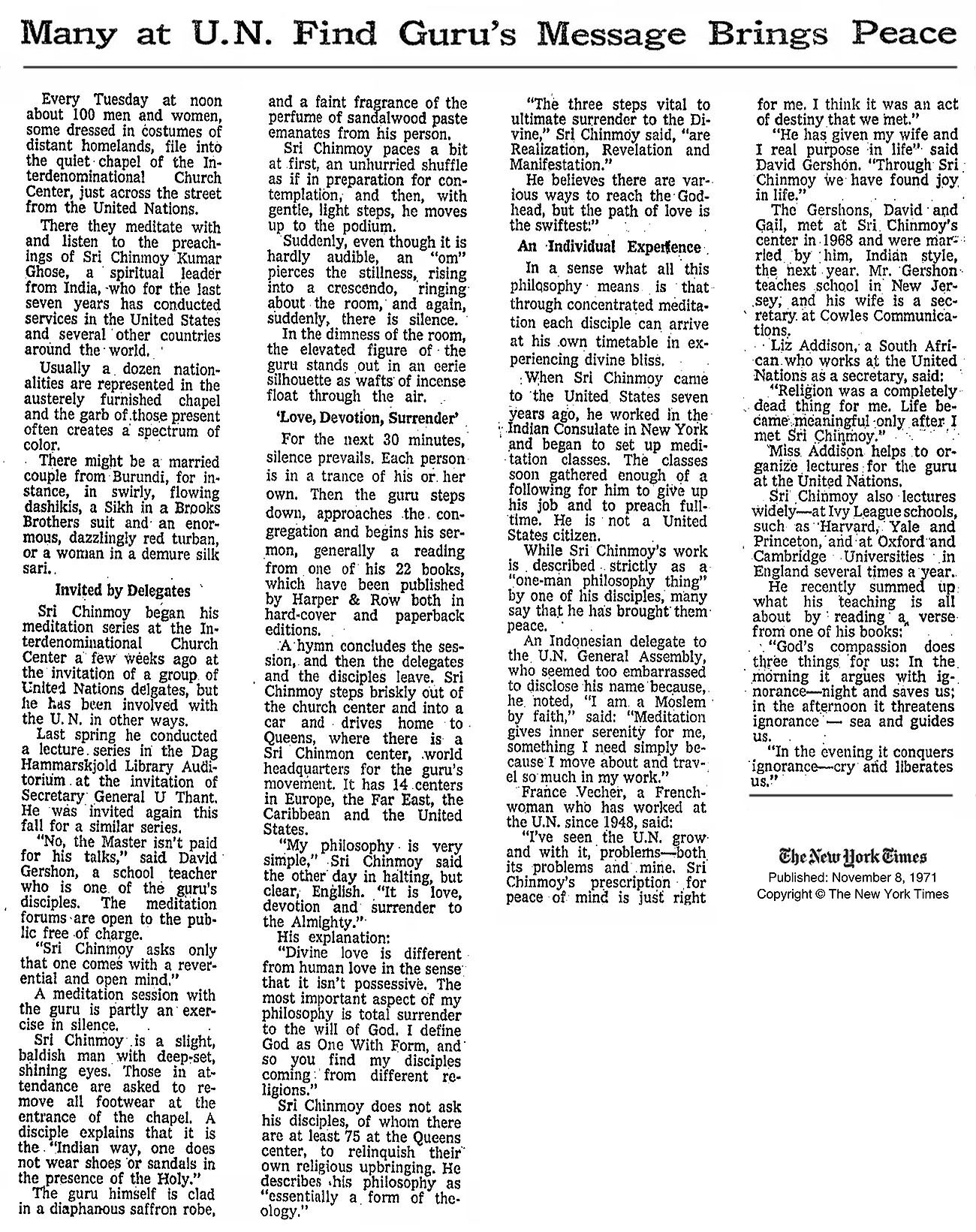
Many at U.N. Find Guru’s Message Brings Peace


Every Tuesday at noon about 100 men and women, some dressed in costumes of distant homelands, file into the quiet chapel of the Interdenominational Church Center, just across the street from the United Nations.

There they meditate with and listen to the preachings of Sri Chinmoy Kumar Ghose, a spiritual leader from India, who for the last seven years has conducted services in the United States and several other countries around the world.

Usually a dozen nationalities are represented in the austerely furnished chapel and the garb of those present often creates a spectrum of color.

There might be a married couple from Burundi, for instance, in swirly, flowing dashikis, a Sikh in a Brooks Brothers suit and an enormous, dazzlingly red turban, or a woman in a demure silk sari
 

Invited by Delegates

Sri Chinmoy began his meditation series at the interdenominational Church Center a few weeks ago at the invitation of a group of United Nations delegates, but Chinmoy has been involved with the U.N. in other ways.

Last spring he conducted a lecture series in the Dag Hammarskjold Library Auditorium at the invitation of Secretary-General U Thant. He was invited again this fall for a similar series.

“No, the Master isn’t paid for his talks,” said David Gershon, a school teacher who is a disciple of the guru. The meditation forums are open to the pub­lic free of charge.

“Sri Chinmoy asks only that one comes with a rever­ential and open mind.”

A meditation session with the guru is partly an exercise in silence.

Sri Chinmoy is a slight, baldish man with deep-set, shining eyes. Those in attendance are asked to re­move all footwear at the entrance of the chapel. A disciple explains that it is the “Indian way, one does not wear shoes or sandals in the presence of the Holy.”

The guru himself is clad in a diaphanous saffron robe, and a faint fragrance of the perfume of sandalwood paste emanates from his person. Sri Chinmoy paces a bit at first, an unhurried shuffle as if in preparation for contemplation, and then, with gentle, light steps, he moves up to the podium.

Suddenly, even though it is hardly audible, an “om” pierces the stillness, rising into a crescendo, ringing about the room, and again, suddenly, there is silence.

In the dimness of the room, the elevated figure of the guru stands out in an eerie silhouette as wafts of incense float through the air.
 

‘Love, Devotion, Surrender’

For the next 30 minutes, silence prevails. Each person is in a trance of his or her own. Then the guru steps down, approaches the congregation and begins his sermon, generally a reading of his 22 books, which have been published by Harper & Row both in hard-cover and paperback editions.

A hymn concludes the session, and then the delegates and the disciples leave. Sri Chinmoy steps briskly out of the church center and into a car and drives home to Queens, where there is a Sri Chinmoy center, world headquarters for the guru’s movement. It has 14 centers in Europe, the Far East, the Caribbean and the United States.

“My philosophy  is very simple,” Sri Chinmoy said the other day in halting, but clear English. “It is love, devotion and surrender to the Almighty.”

His explanation:
“Divine love is different from human love in the sense that it isn’t possessive. The most important aspect of my philosophy is total surrender to the will of God. I define God as One With Form, and so you find my disciples coming from different religions.”

Sri Chinmoy does not ask his disciples, of whom there are at least 75 at the Queens center, to relinquish their own religious upbringing. He describes his philosophy as essentially a form of theology.

“The three steps vital to ultimate surrender to the Divine," Sri Chinmoy said, “are Realization, Revelation and Manifestation.”

He believes there are various ways to reach the God-head, but the path of love is the swiftest.
 

An Individual Experience

In a sense what all this philosophy means is that through concentrated meditation each disciple can arrive at his own timetable in experiencing divine bliss.

When Sri Chinmoy came to the United States seven years ago, he worked in the Indian Consulate in New York and began to set up meditation classes. The classes soon attracted enough of a following for him to give up his job and to preach full-time. He is not a United States citizen.

While Sri Chinmoy’s work is described strictly as a “one-man philosophy thing” by one of his disciples; many say that he has brought them peace.

An Indonesian delegate to the U.N. General Assembly, who seemed too embarrassed to disclose his name, because, he noted, “I am a Moslem by faith,” said: “Meditation gives inner serenity for me, something I need simply because I move about and travel so much in my work.”

France Vacher, a French woman who has worked at the U.N. since 1948, said:

“I’ve seen the U.N. grow, and with it, problems — both its problems and mine. Sri Chinmoy’s prescription for peace of mind is just right for me. I think it was an act of destiny that we met.”

“He has given my wife and I real purpose in life,” said David Gershon. “Through Sri Chinmoy we have found joy in life.”

The Gershons, David and Gail, met at Sri Chinmoy’s center in 1968 and were married by him, Indian style, the next year. Mr. Gershon teaches school in New Jersey; and his wife is a secretary at Cowles Communications.

Liz Addison, a South African, who works at the United Nations as a secretary, said:

“Religion was a completely dead thing for me. Life became meaningful only after I met Sri Chinmoy,”

Miss. Addison helps to organize lectures for the guru at the United Nations.

Sri Chinmoy also lectures widely at Ivy League schools, such as Harvard, Yale and Princeton, and at Oxford and Cambridge Universities in England several times a year.

He recently summed up what his teachings are all about by reading a verse from one of his books:

“God’s compassion does three things for us: In the morning it argues with ignorance-night and saves us; in the afternoon it threatens ignorance-sea and guides us.

“In the evening it conquers ignorance-cry and liberates us.”


Published in The New York Times, November 8, 1971


November 7

Photo by Maral Siegel


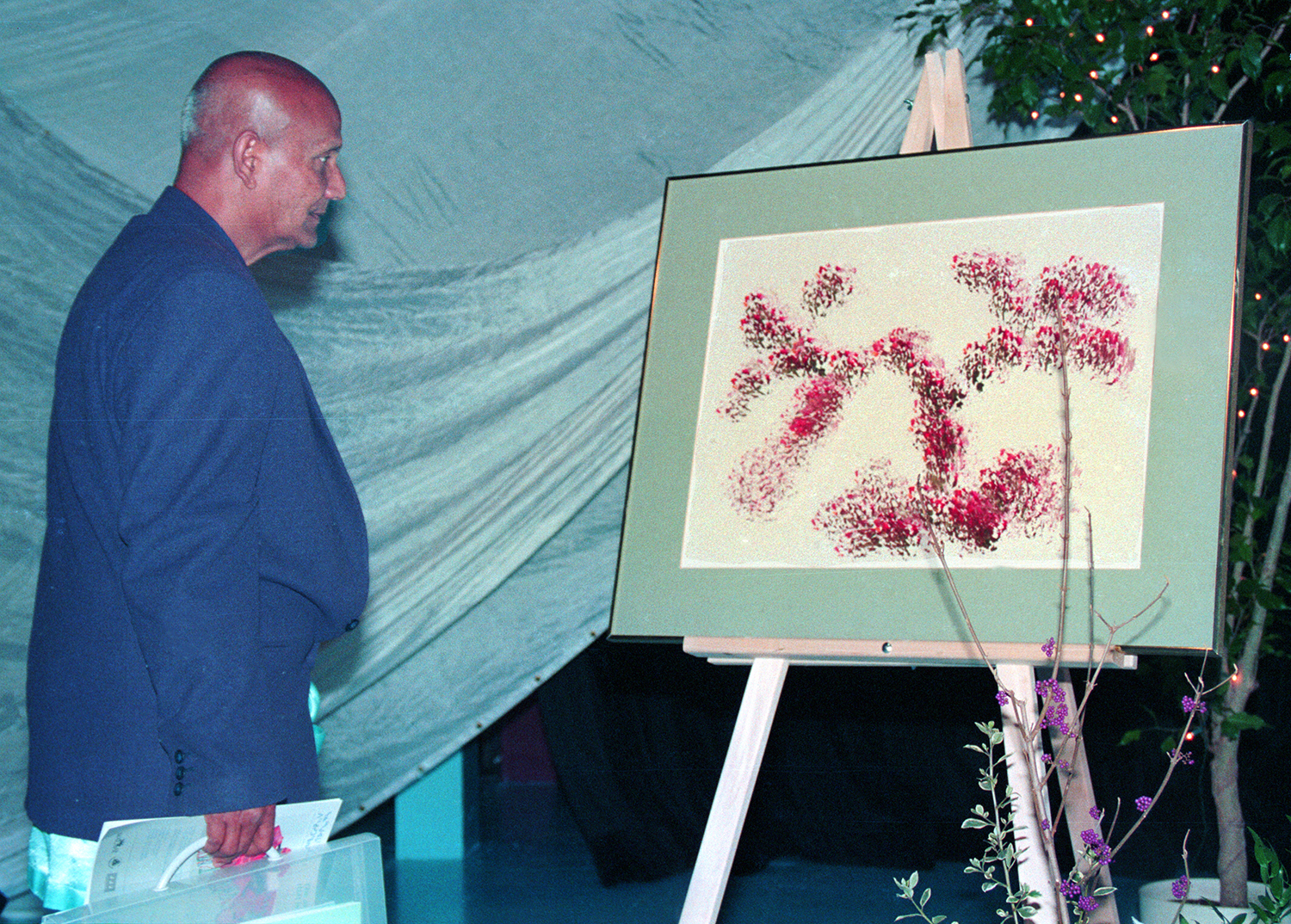
Sri Chinmoy observes one of his paintings at the gallery in the Heritage Building, Ottawa, Canada, where 100,000 of his Soul-Bird drawings are on display.


November 7

806¼-lb lift


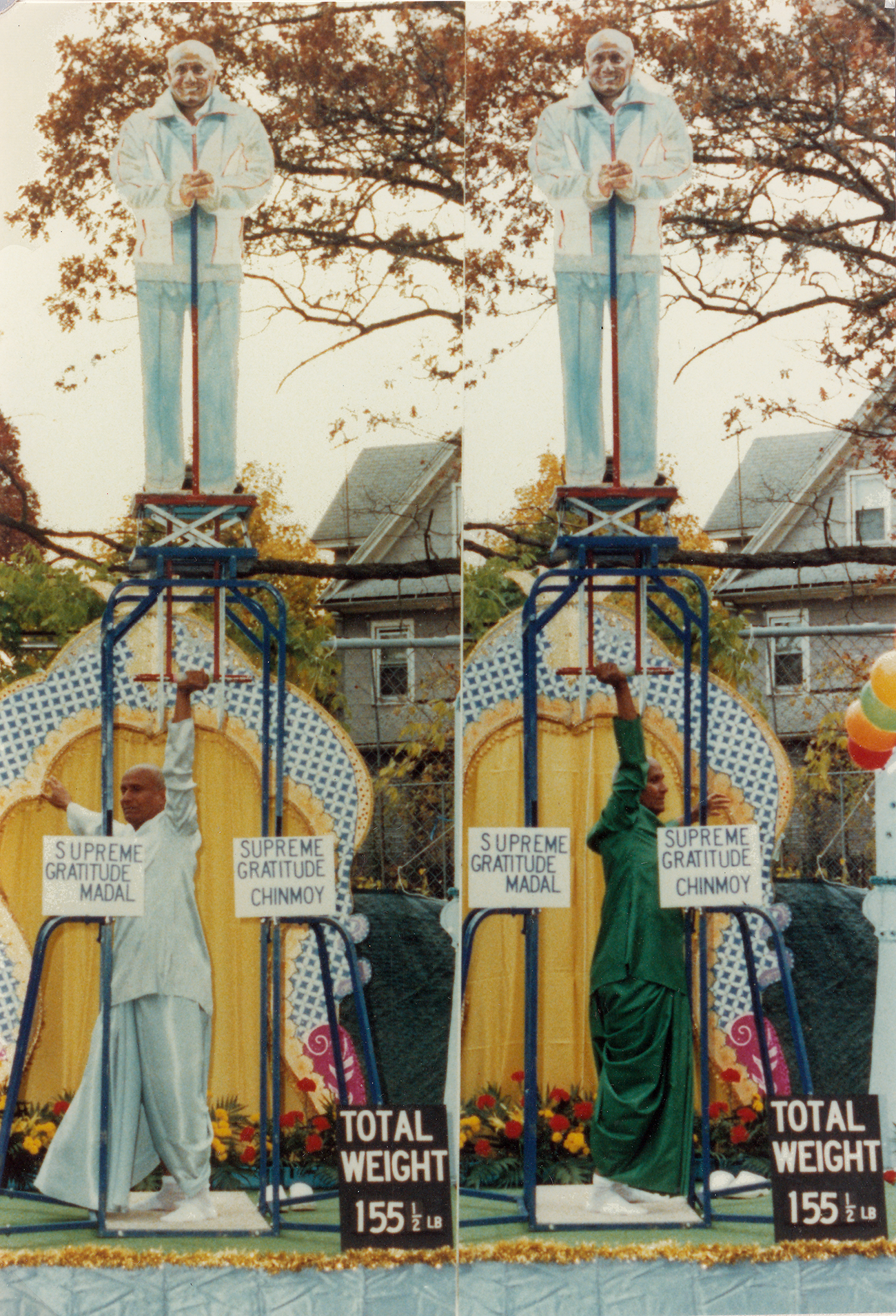
Sri Chinmoy lifts 806½ lbs., using only his right arm, in Jamaica, Queens, New York.


All Credit To Mother Kali

by Sri Chinmoy

This morning when I was attempting to lift 800 pounds with one arm, Mother Kali was right in front of me, full of compassion and power. When I was about to make my fourth attempt, Mother Kali said to me, “My son, it is already done.” Then I did lift 800 pounds.

So for both 700 and 800 pounds, all credit goes to my dearest Mother Kali.


Published in My Weightlifting Tears and Smiles, part 2


Sri Chinmoy celebrates ‘Lifting Up the World with a Oneness-Heart’ by lifting his own body weight of 155½ lbs., 100 times in 68 minutes 23 seconds, using alternate arms, in Jamaica, NY, USA.


Lifting up the world
With a oneness-heart
The Hour of God
And His Victory Start


Mother
Kali

Madal
Chinmoy
C.K.G.
Sri Chinmoy
Guru

Supreme


November 7

Photo by Sarama Minoli


Sri Chinmoy at John F. Kennedy Airport in New York on his way to London to begin his first European lecture tour.


Photo by Bhashwar Hart


Sri Chinmoy offers a public meditation in the Communications Building at Wagner College on Staten Island, New York.


November 7

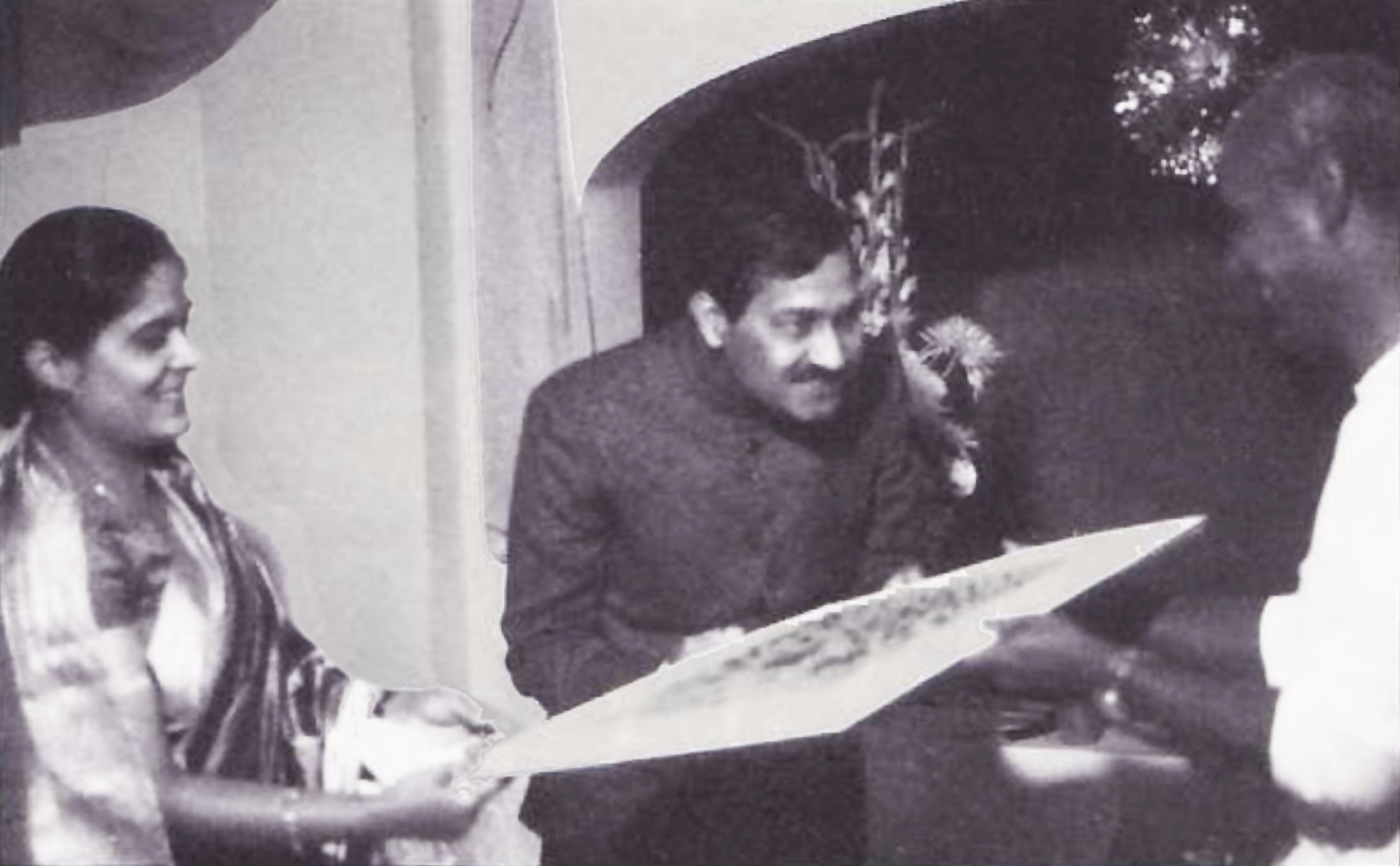
A Yogi in USC

SPECIAL REPORT


Sri Chinmoy Kumar Ghose a well-known yogi, gave a lecture* on the “Philosophy of Yoga” last October 30 in the AV Room.

The speaker pointed out that yoga is often equated with the body discipline, which is only the preliminary to the real practice. Yoga proper, he explained, is composed of concentration, meditation, and contemplation on the Transcendental Reality — God (Aum).

There are many paths to the goal of spiritual union with the Transcendent Being and the most common are: KARMA Yoga (the way of action), the BHAKTI Yoga (the way of devotion), the RAJA Yoga (the way of meditation), and the JHANA Yoga (the way of knowledge, which educates the mind to free it from all illusions).

Sri Chinmoy’s path, he disclosed, is the path of love, compassion and, complete surrender. ''There are many roads that lead to Rome and my path is a shortcut,” he said.

Sincerity is the quality that he values most among his disciples. He admitted that he was “very strict” in his teaching and it is only after a four-month trial period that prospective disciples are given a personal interview. He is not interested in mere numbers and “I do not take hippies or alcoholics among my students,” he explained. 

Chinmoy Ghose was on his Far Eastern tour when he passed by the Philippines on his way to Singapore. He has given lectures in leading American universities like Princeton, Cambridge, Yale, Harvard, and Radcliffe. He has a spiritual center in New York as well as in Puerto Rico, Jamaica, and Japan. He said that more centers are soon to be established.

The Guru’s disciples belong to various religions as he looks at every religion “as a branch of the mighty tree which is the Truth.” Such is the attitude of the spiritual leader who came here to speak of Yoga which, he said, is neither philosophy nor religion. It transcends religion and philosophy; at the same time, it houses both. 

— Marlinda Roa Angbetic

* The lecture referred to here is later published under the title, ‘Self-Knowledge’.


Published in the UNIVERSITY BULLETIN, Vol. 14 No. 16, November 7, 1969, Pages 1 & 3
Weekly Publication of the University of San Carlos, Cebu, Philippines


Interview with the San Francisco Examiner


Examiner: Do you have any disciples in India?

Sri Chinmoy: Here in America I have four or five Indian disciples. But I do not have any spiritual centre in India. I have quite a few admirers and followers in India, but I do not consider them to be my actual disciples.

Examiner: A few weeks ago I interviewed Baba Ram Das, and he contended that the spiritual teachers Americans get come here for a different reason than the spiritual teachers the Indians get. In this country we get the people who are still attached to power or wealth or the idea of doing a lot of good for a lot of people, which is still an attachment, he claimed. What is your comment on that?

Sri Chinmoy: What he thinks, he will say. I will say what I know. I am not trying to contradict his philosophy, but I know much better than anybody else does, what I am and what I stand for. But I have no idea why other spiritual Masters have come to the West. It is up to the individuals to answer this statement. In my case, I definitely listened to the dictates of my Inner Pilot. He wanted me to be of service to Him in the sincere seekers in the Western world, who are my spiritual brothers and sisters. He is like a father. A father has every right to have many homes, and if the father wants a particular son of his to go to some other house, and help or serve him inside the aspiration of his other children, then he is perfectly entitled to do so. And the son who is devoted to the father must listen to him. So America is one home of our Father Supreme; India is one home; Russia is one home; Japan is one home. All the countries are the homes of our Eternal Father. And being the Father, He has every right to ask His children to move from one home to another to help His other children.

Examiner: How did you get involved with the United Nations?

Sri Chinmoy: I had a student who worked at the United Nations. She spoke to the authorities and got permission for me to be of service to the United Nations by conducting meditations there. There are now over eighty seekers who attend these meetings. They are delegates, diplomats and U.N. staff. Twice a week we pray and meditate there. Sometimes I give talks and answer spiritual questions.

Examiner: I understand you recently met with Mrs. Lillian Carter. What was the reason for your visit?

Sri Chinmoy: The reason was very simple. She was in India for two years, and she is extremely sympathetic towards India. The suffering India, the poverty-stricken India, has received considerable compassion and assistance from her. Therefore, I wished to offer her my personal gratitude for what she has done for India.

Examiner: I understand that you don’t accept everyone who wants to be your disciple. But you do want to get the word out to those who might want to be. Is that it?

Sri Chinmoy: Yes, certainly. This world belongs to the Supreme, and He has many spiritual children who are in a position to be of help to sincere seekers. Now, there are some seekers who will be able to go much faster if they take help from somebody else, rather than from me. If I just accumulate them and keep them in my family for the sake of numbers, their progress will not be satisfactory, so I would be doing an act of injustice to their souls. But the ones who are meant for our path should be encouraged and accepted, for they will make the fastest progress on this path. I will never say that if somebody cannot follow our path, he is not spiritual, or he is not a sincere seeker. Far from it. But they are also my spiritual brothers, and if I know that by following some other path, they will go much faster, then I should advise them to follow that path. I want everybody to reach the Goal as soon as possible.

Examiner: Are you familiar with some of the more popular spiritual paths from the East that people are following in this country?

Sri Chinmoy: Familiar in the sense that I have read about them and heard a little about them from some seekers. But I am not in direct contact with other Masters, either inwardly or outwardly. Only I have a close connection with Pir Vilayat Khan, the head of the Sufi order. We are good friends.

Examiner: He was here recently.

Sri Chinmoy: Yes, I think he was. But I have regards for all the sincere spiritual Masters.

Examiner: Do you think there are a lot of people who will claim to be Masters, but who aren’t?

Sri Chinmoy: In this world there are good people and bad people. In God’s creation there is day and there is night. But I am not in a position to say who are good teachers and who are bad teachers. Only I wish that the sincere seekers will get the good teachers. If they are really sincere, they will not remain with false teachers.

Examiner: How is someone to know who’s good and who isn’t?

Sri Chinmoy: Well, there are a few easy ways to recognise a false Master. If somebody says that he will be able to grant you God-realisation overnight, in the twinkling of an eye, then you have to discard that Master. Nobody can realise God overnight or in a matter of days or weeks. And if somebody says that he will be able to grant you God-realisation if you give him a large sum of money, this is absurd. Like that, a few people claim that they will be able to teach you realisation or spiritual powers for a sum of money. If they make it sound like instant tea or coffee, then it is absurd. Those teachers are undoubtedly not real ones.

Examiner: I’ve often heard lineage mentioned as an important characteristic for a teacher — that a teacher has to have had a teacher.

Sri Chinmoy: He who was the first to realise God, whom did he get as his teacher? It is good to have a teacher, but it is not absolutely indispensable. I always advocate having a teacher. A spiritual Master is like a private tutor. He teaches the student privately so that he will pass the ignorance-test, not fail it. So it is good to have a spiritual Master, but it is not obligatory. There are many who have realised God without having spiritual Masters. But if you get a good one, it is very good; you are lucky.

Examiner: How do you find time to accomplish so much in the way of artistic creation — all the paintings, all the writings, all the compositions?

Sri Chinmoy: It is all through unconditional divine Grace. My mind will not believe it. I will be the first one to doubt it and suspect it. But it is the unconditional Grace that acts in and through me. I am not the doer. Had I been the doer, I would not have accomplished so many things. But I constantly try to be a simple, devoted instrument of His. On the strength of my receptivity, My Beloved Supreme acts in and through me.

Examiner: How many hours sleep do you get each night?

Sri Chinmoy: Sometimes two and a half hours, sometimes three, sometimes more, sometimes less. Sometimes for days and weeks I don’t actually sleep.

Examiner: What about food?

Sri Chinmoy: I am a strict vegetarian. Of course, some people will say that if you take eggs, then you are not a strict vegetarian. I do take eggs and milk, but I do not eat any meat, fish or fowl.

Examiner: Do you do any kind of physical practise of Hatha Yoga, or is that not part of your path?

Sri Chinmoy: No, Hatha Yoga is not part of my path. But I do advise my students to take exercise. Physical fitness considerably helps us in our spiritual journey, so I ask them to run. Recently, about 30 of my disciples ran in the marathon in New York City. I do advise them to run.

Examiner: Your background is athletic too, as I recall?

Sri Chinmoy: I was a champion sprinter and decathlon champion in the community where I lived. According to Indian standards, I was quite good, but according to the world standard I was nowhere.

Examiner: So you’ve always had this interest in athletics?

Sri Chinmoy: Yes. It helps us. If we are physically fit, then early in the morning we will be able to get up and meditate. But if we constantly suffer from headache, stomach upset and other physical ailments, then we will not be inclined to get up early in the morning and pray and meditate. We will tend to be lazy and lethargic, whereas spiritual progress requires dynamism. So in this way physical fitness helps us considerably in our spiritual life.

Examiner: Is it possible to be artistically creative without being spiritual?

Sri Chinmoy: Certainly. Some creative people have free access to the inner world of creativity, but if they are not spiritually aspiring, they are not aware of it. But the spiritual people are bound to be aware of whatever they are doing in their everyday life. Whether they are painting or singing or writing, they will be aware of the depths and the heights of their existence-reality-life. Those who are creative without being spiritual will often find that their creativity is not at their command. That is to say, they cannot create at their sweet will. But those who are consciously aspiring will find that their creative inspiration is tremendously increased, and also that they can invoke the inspiration-bird to come to them whenever they need it.

Examiner: On your path, do you expect that after a certain amount of time the disciple will achieve enlightenment? I think traditionally a disciple is taught for twelve years, and then he graduates or something.

Sri Chinmoy: Our Indian spiritual institutes have four orders of life; four different stages we call it. After childhood the first 12 years is student life. Then they enter another phase. They accept earthly life and become householders. Then after 12 years they go into the forest to lead spiritual life most seriously, and after 12 years of that they become renunciates. First student life, then householder’s life, then proper spiritual life, then renunciation life. But I feel that everything can be done in one life. There is no need to separate them in this way. If you can pray and meditate soulfully, you don’t have to go through these traditional four stages of life.

Examiner: Do you expect that you will be able to produce enlightened disciples?

Sri Chinmoy: I do expect it. If we can’t produce enlightened disciples, then how can we succeed? This is not my mission; this is not my vision. I am merely an instrument of my Beloved Lord Supreme. Similarly, He will make others instruments also, who are right now my students. He will grant them illumination, liberation and realisation, which He has already given to me out of His infinite Bounty. I prayed, I cried, so He granted me this boon. Similarly, if my students are sincerely trying, then at God’s choice Hour, He will grant them the same boon.

Examiner: Is there anything you’d like to tell me that we haven’t gone into?

Sri Chinmoy: I think we have covered everything. This has been a fruitful interview. I am extremely grateful to you for your kind questions, and I am sure many, many people will derive spiritual benefit from our interview.

Examiner: Thank you very much.


Published in AUM – Vol. 5, No. 5,6, May-June 27, 1978