November 13

Video by kedarvideo


Finland is inaugurated as a Sri Chinmoy Peace-Blossom-Nation at Hesperia Park in Helsinki, Finland.


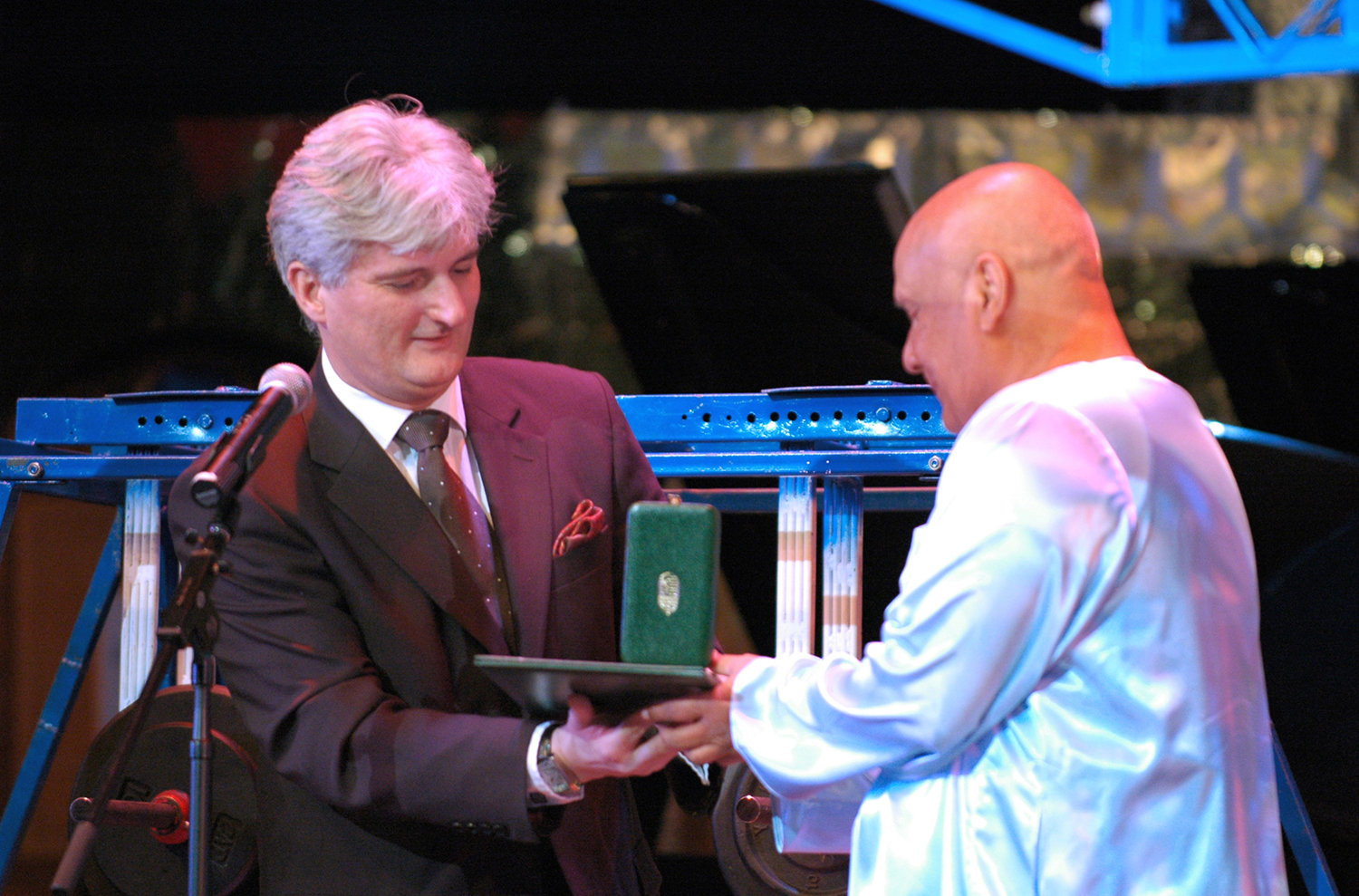
Hungary’s highest national award, the Order of Merit of the Hungarian Republic, is conferred by President Ferene Mádl upon Sri Chinmoy on behalf of the entire Government of Hungary. The award is officially presented to Sri Chinmoy at a special ceremony in New York by Hungary’s Ambassador to the United Nations.


November 12

Sri Aurobindo: A Glimpse

A lecture delivered by Sri Chinmoy
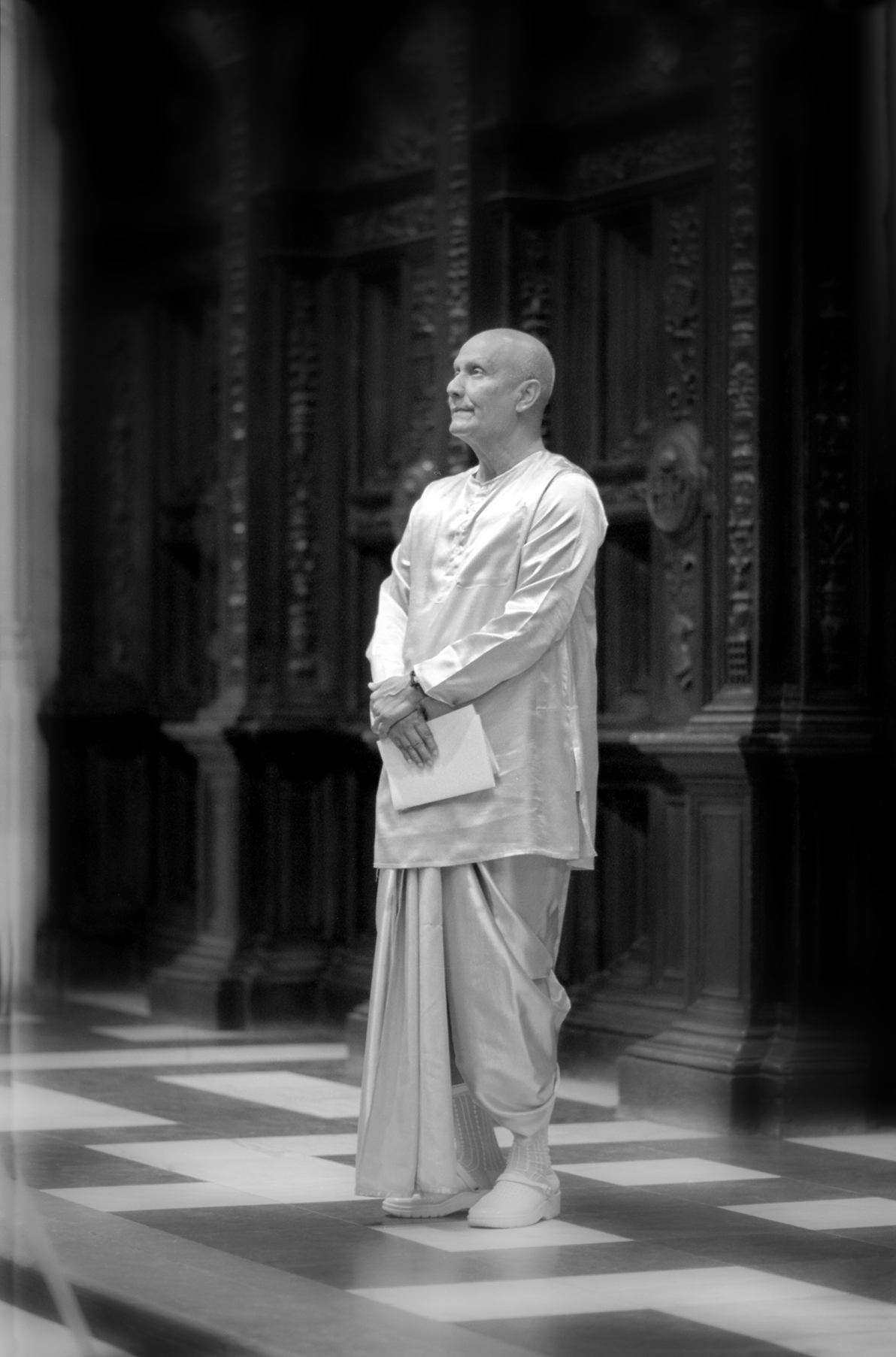
at King’s College Chapel, University of Cambridge


“Slowly the Light grows greater in the East.”

Savitri — Sri Aurobindo


On August 15th, 1872, Sri Aurobindo took human birth in Calcutta, Bengal, to awaken Mother Earth from her somnolence deep and lead her to the heights of God-rapture-fire. For seventy-eight fleeting years did this mightiest of souls live among us, accepting the world pain and making sacrifice after sacrifice to transform humanity’s age-old ignorance into perfect Perfection. (“My God is Love and sweetly suffers all.” Savitri — Sri Aurobindo)

When Aurobindo was just seven years old, his father took him and his two older brothers to England to receive their education. Aurobindo was to remain in England for fourteen years, far removed from his parents and his homeland. He attended St. Paul’s School in West Kensington, London, and was accepted into King’s College, Cambridge, as an Indian Civil Service (I.C.S.) probationer. Aurobindo was at Cambridge from October 1890 to October 1892. At the end of his studies, Aurobindo secured a First Class result in Latin and Greek, but was disqualified from the open I.C.S. examination for failing to present himself for the riding test. In later years, Sri Aurobindo revealed that he was wandering the streets of London at the time of his appointment. He had resolved to bring about his rejection from the I.C.S. because he felt no call for the administrative life. He preferred poetry, literature, the study of languages and patriotic activities.

At this time, he was introduced to the Gaekwar of Baroda, who offered him a position in his State Secretariat. Aurobindo accepted the position and decided to sail for India in January 1893. Aurobindo’s father was extremely attached to this son, whom he had not seen for fourteen years. He had almost intuitive high hopes that his Auro was to brighten the face of India. Alas, the ship which was to carry Aurobindo sank off the coast of Portugal. On the assumption that his son must have perished with the lost ship, his father died of a broken heart. But Aurobindo had boarded a second ship and he reached India safely in February 1893.

As soon as Aurobindo stepped on India’s soil at Apollo Bunder, Bombay, he had a most significant spiritual experience. His entire being was inundated with peace. The all-pervading Presence of the Infinite he felt. This lofty experience came to him unsought. Aurobindo’s father had been an atheist and his children’s upbringing in England did not encompass spirituality. Aurobindo’s spiritual experiences came to him gradually.

Aurobindo spent thirteen years in the Baroda State Service, first in the Secretariat, later as Professor of French and English, and finally as Vice-Principal of the Baroda State College. When one of his students ventured the question, “How can nationalism be developed?” Aurobindo replied, pointing to a wall map of India:

“Look at that map. Learn to find in it the portrait of Bharat Mata. The cities, mountains, rivers and forests are the materials which go to make up Her body. The people inhabiting the country are the cells which go to make up Her living tissues. Our literature is Her memory and speech. The spirit of our culture is Her soul. The happiness and freedom of Her children is Her salvation. Behold Bharat as a living Mother, meditate upon Her and worship Her in the nine-fold way of bhakti.”

Consecrated to India’s independence from his Cambridge days, Aurobindo devoted his spare time at Baroda to learning Indian languages, absorbing Indian culture and practising yoga. He conducted secret societies for work towards independence and wrote articles constructively criticising the thinking of India’s political leaders of the National Congress.

In 1906 Aurobindo left Baroda for Bengal. He became the Principal of the Bengal National College. He entered into the vortex of the Bengal national movement. Aurobindo was at once the cynosure and the sanctum sanctorum of Bengal’s heart-shrine.

While Principal of the Bengal National College, he conducted the journals Bande Mataram in English and Yugantar in Bengali. A leader of the secret societies, he also worked ceaselessly, publicly and behind the scenes, sowing the seeds of love of country and her independence in the national mind and heart.

As Aurobindo’s stars were ascending in Bengal politics, India’s greatest poet, Rabindranath Tagore — a patriot and nationalist of the supreme height — proudly and unreservedly voiced forth from his unhorizoned vision-eye:

“Aurobindo, do accept Rabindranath’s salutations! O my friend, O our country’s friend, You embody the living message-image-light Of our Mother India’s soul.”

(translated from the original Bengali)

In 1907 Aurobindo resigned from the Bengal National College. At his farewell party, his dear students made a loving demand of him to bless them with encouraging and illumining advice as to how they could become choice and worthy sons of Mother India. He responded with a most significant speech, saying:

“There are times in a nation’s history when Providence places before it one work, one aim, to which everything else, however high and noble in itself, has to be sacrificed. Such a time has now arrived for our Motherland when nothing is dearer than Her service, when everything else is to be directed to that end. Work that She may prosper. Suffer that She may rejoice.”

On May 4th, 1908, Aurobindo was suddenly arrested on charges of sedition and imprisoned in Alipore Jail. He was to remain there for twelve months. This period of enforced seclusion was actually a blessing in disguise for Aurobindo. It enabled him to carry on his yoga uninterrupted and he passed hour after hour in his cramped cell in silent contemplation. For fifteen days he vividly heard the voice of Swami Vivekananda speaking to him about the Supermind. As Aurobindo Ghose progressed towards his God-realisation, he had the vision of Vasudeva, Lord Krishna, everywhere and in everything. Sri Krishna assured him that He would work in and through Aurobindo’s junior counsel, Chitta Ranjan Das, to secure Aurobindo’s acquittal.

There would be no need for Aurobindo even to involve himself in the trial. Lord Krishna advised him to remain silent. Aurobindo felt in the inmost recesses of his heart that each surrender-step of his to Lord Krishna would become an entirely new creation. In this way, Aurobindo conquered once and for all his imprisonment-release-doubt-troops.

Sri Krishna also gave Aurobindo direct assurance that India’s independence would be achieved — but that the rest of the work towards that end would be carried out by others, while he himself would have to work for a higher Cause. While concluding the case for the defence, C.R. Das said:

“My appeal to you is this — that long after this turmoil, this agitation will have ceased, long after he is dead and gone, he will be looked upon as the poet of patriotism, as the prophet of nationalism and the lover of humanity. Long after he is dead and gone, his words will be echoed and re-echoed not only in India but across distant seas and lands.”

Shortly after his acquittal on May 6th, 1909, Sri Aurobindo delivered his historic Uttarpara Speech in which he vividly described his direct experiences of God in Alipore Jail. He concluded by saying:

“It is the Sanatan Dharma which for us is nationalism. This Hindu nation was born with the Sanatan Dharma, with it it moves and with it it grows. When the Sanatan Dharma declines, and if the Sanatan Dharma were capable of perishing, with the Sanatan Dharma it would perish. The Sanatan Dharma, that is nationalism. This is the message that I have to speak to you.”

In order to give a wider voice to his views and those of other nationalists, Sri Aurobindo started two publications: the Dharma in Bengali and the Karmayoginin English. In 1910 he received an Adesh or ‘Command’ from Above and abruptly quit all his political activities. He retired into seclusion, first at French Chandernagore, then at French Pondicherry, to work for the greater Cause of the world’s spiritual transformation and divinisation.

From 1910 to 1920, from his base at Pondicherry, Sri Aurobindo conducted the Arya, a philosophical monthly into which he poured his spirituality-flooded message. These writings formed the basis of his major works: The Life Divine, The Synthesis of Yoga, Essays on the Gita and many more. He also wrote essays on poetry and literature, including The Future Poetry, Hymns to the Mystic Fire and two volumes of Collected Poems and Plays. His last and greatest work is Savitri, the epitome of spiritual autobiography. It is an epic of 23,814 lines, far surpassing in height, depth and length any epic in Greek, Latin, English, Italian or German. It is, indeed, a new Veda for the New Age.

On November 24th, 1926, Sri Aurobindo attained to his spiritual perfection. He withdrew from all contacts and put into the hands of his spiritual Collaborator, the Mother, the disciples who had gathered around him. This marked the beginning of the Ashram at Pondicherry.

For over twenty-four years, with the Mother working in front, he continued with his yoga, not caring to rest on the laurels of his first Victory, but pushing upward till he found himself within sight of his supreme and final Victory which alone could achieve the end of his Mission: the descent of what he called the Supermind into the very cells of his physical body.

India’s independence was won on August 15th, 1947. Most significantly, this was Sri Aurobindo’s own Birth Day. He was requested to offer a message to the free nation, and he began:

“August 15th, 1947 is the birthday of free India. It marks for her the end of an old era, the beginning of a new age. But we can also make it, by our life and acts as a free nation, an important date in a new age opening for the whole world, for the political, social, cultural and spiritual future of humanity.

August 15th is my own birthday and it is naturally gratifying to me that it should have assumed this vast significance. I take this coincidence, not as a fortuitous accident, hut as the sanction and seal of the Divine Force that guides my steps on the work with which I began life, the beginning of its full fruition.”

At the age of seventy-eight, for purposes of his own, Sri Aurobindo decided to part with his body, and he carried out this decision on December 5th, 1950, after a brief “illness.”

And now, with the kind permission of your souls, I would like to share with you some of my most precious outer possessions and memories. When I joined the Ashram in 1944 as a young boy of twelve years old, I received from Sri Aurobindo a copy of his book Kara Kahani (Tales of Prison Life). Sri Aurobindo had blessingfully written down my name, Chinmoy, in his own handwriting. Needless to say, I was overjoyed.

At the Ashram I had many mentors who encouraged my literary attempts. In 1946 I was inspired to render one of Sri Aurobindo’s Bengali stories about the Vedic sages Vasishtha and Vishwamitra into Bengali verse. Sri Aurobindo’s story is called “Kshamar Adarsha” (“The Ideal of Forgiveness”). My poem ran to about two hundred lines. Timidly and devotedly, I submitted it to the Mother. Out of her infinite compassion for me, the Mother gave it to Sri Aurobindo. In a few days’ time, at four-thirty in the afternoon, I was on my way to the volleyball ground. One of Sri Aurobindo’s dearest attendants, Mulshankar, stopped me and said, “Chinmoy, Nirod is reading out to Sri Aurobindo your long poem and Sri Aurobindo is smiling.” When I heard this, I was in the seventh Heaven of delight! A few hours later, Nirod-da sent for me and returned the poem. He told me that Sri Aurobindo had remarked: “It is a fine piece of poetry. He has capacity. Tell him to continue.”

In 1948 I translated one of my Bengali poems about India’s independence into English and, as usual, with utmost timidity, I gave the Mother the poem. Smiling, Mother said to me, “I know it is for Sri Aurobindo that you are giving it to me.” She took it from me to give to Sri Aurobindo.

In 1958 I began writing a play about the Life of Sri Aurobindo, entitled The Descent of the Blue, and I was told by Champaklal, Sri Aurobindo’s sleeplessly self-giving assistant, that the Mother enjoyed hearing my play. It was published serially in the Mother India.

In 1959, on my birthday, the Sri Aurobindo Ashram manager, Amrita, a pioneer-pillar-disciple whose name, meaning ‘Nectar; Immortality’, was bestowed upon him by his Lord Sri Aurobindo himself, presented me with a Parker fountain pen.

“Chinmoy, I am giving you my most precious and my most treasured possession. This was the pen our Lord gave me on one of my birthdays many years ago, long before you were born. He himself used it many, many times.”

Finally, my prayerful heart is all gratitude to the Divine Mother for granting me the invaluable blessing-opportunity to be allowed to meditate every morning very early in front of the Mother’s and Sri Aurobindo’s pictures at the place where they used to give Darshan four times a year and also at the two doors of Sri Aurobindo’s main room. This unimaginable privilege started in 1958 and continued until 1964 when I came to America.

No more about myself. Aurobindo’s Cambridge and Sri Aurobindo’s Mother India more, ever more!

Sri Aurobindo and Sri Aurobindo’s mind saw and studied England.

India and India’s heart received and treasured Sri Aurobindo.

The world and the world’s soul adored and loved Sri Aurobindo.

The Universe and the Lord of the Universe claimed, claim, and forever and forever shall claim Sri Aurobindo.

Sri Aurobindo: Eternity-Infinity-Immortality-Vision-Reality’s ONENESS-HOME.


Published in The Mind Loves the Heart, the Mind Becomes the Heart, part 2.

 

November 12

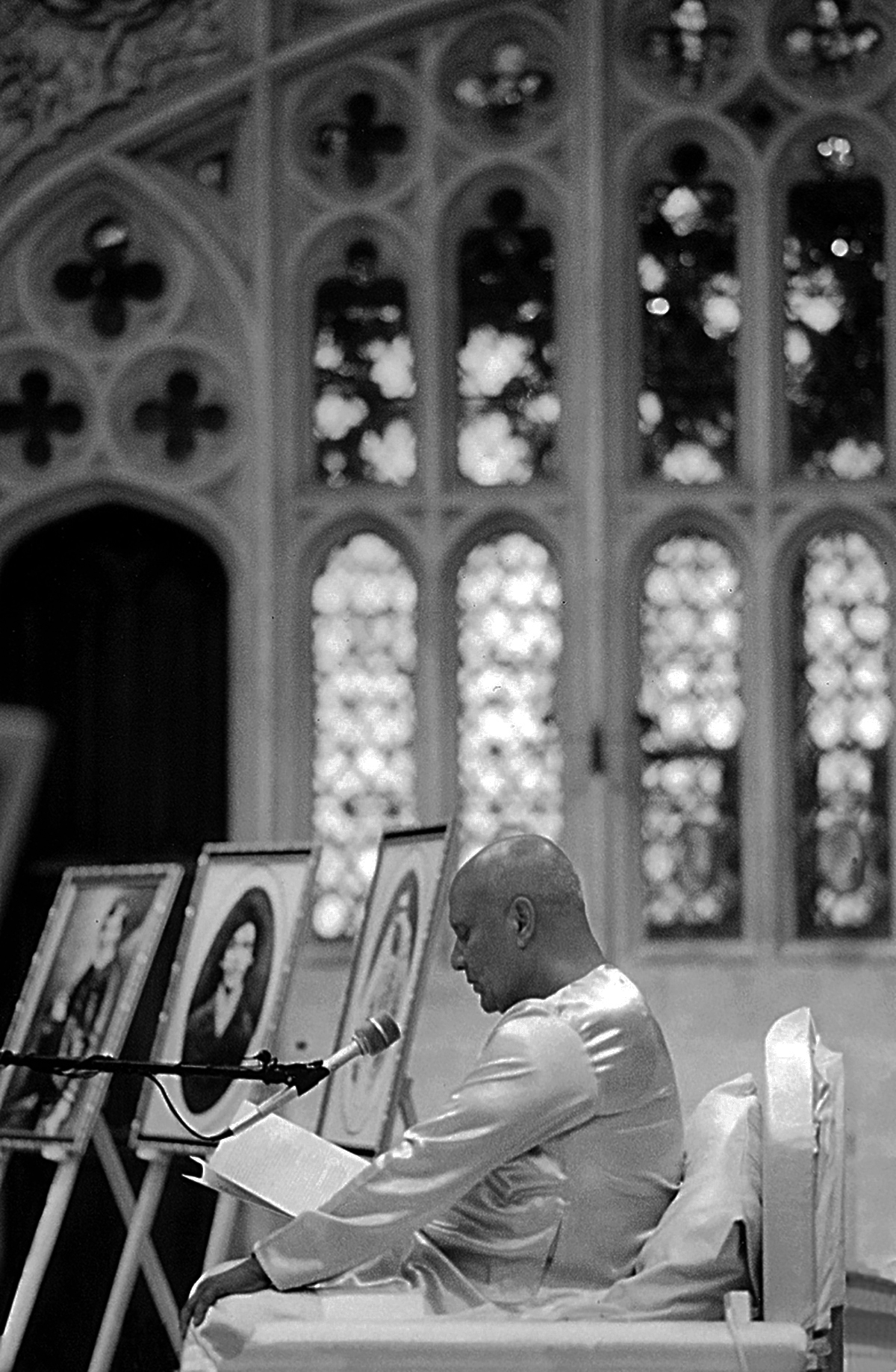
Photo by Dhanu Alaimo


Sri Chinmoy meditating at King’s College Chapel in Cambridge University, England.


November 12

Photos by Adarini Inkei


Sri Chinmoy honours Tatyana Lebedeva, Russian long jump and triple jump world champion, by lifting her as she sits on top of an Asian elephant, at Aspiration-Ground in Jamaica, Queens, New York.


November 12

Photo by Sarama Minoli


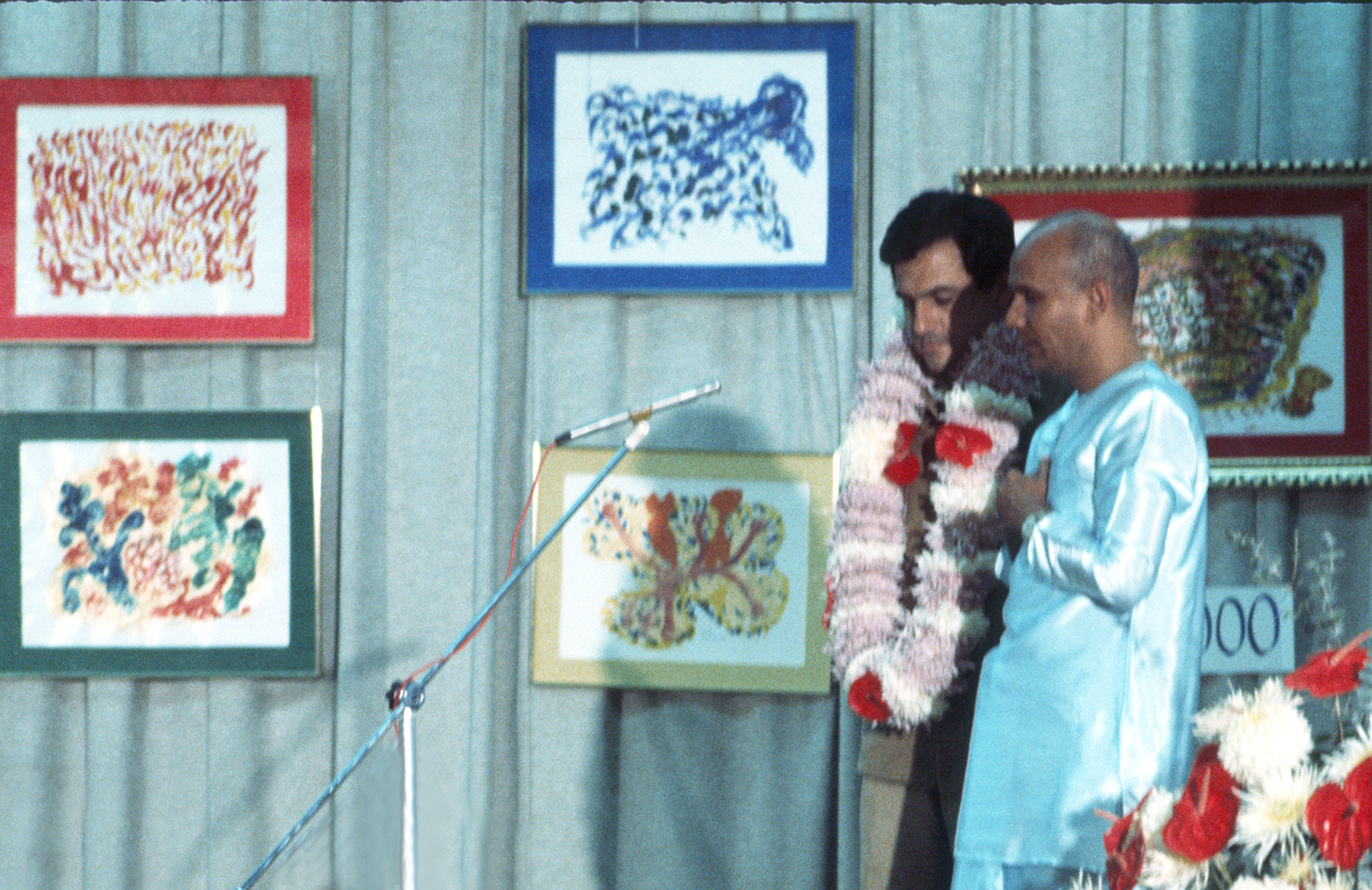
Sri Chinmoy’s original Jharna-Kala paintings are displayed at a reception hosted by Sri Chinmoy for Governor Rafael Hernández Colón of Puerto Rico, held at Public School 86 in Jamaica, Queens, New York.


November 12


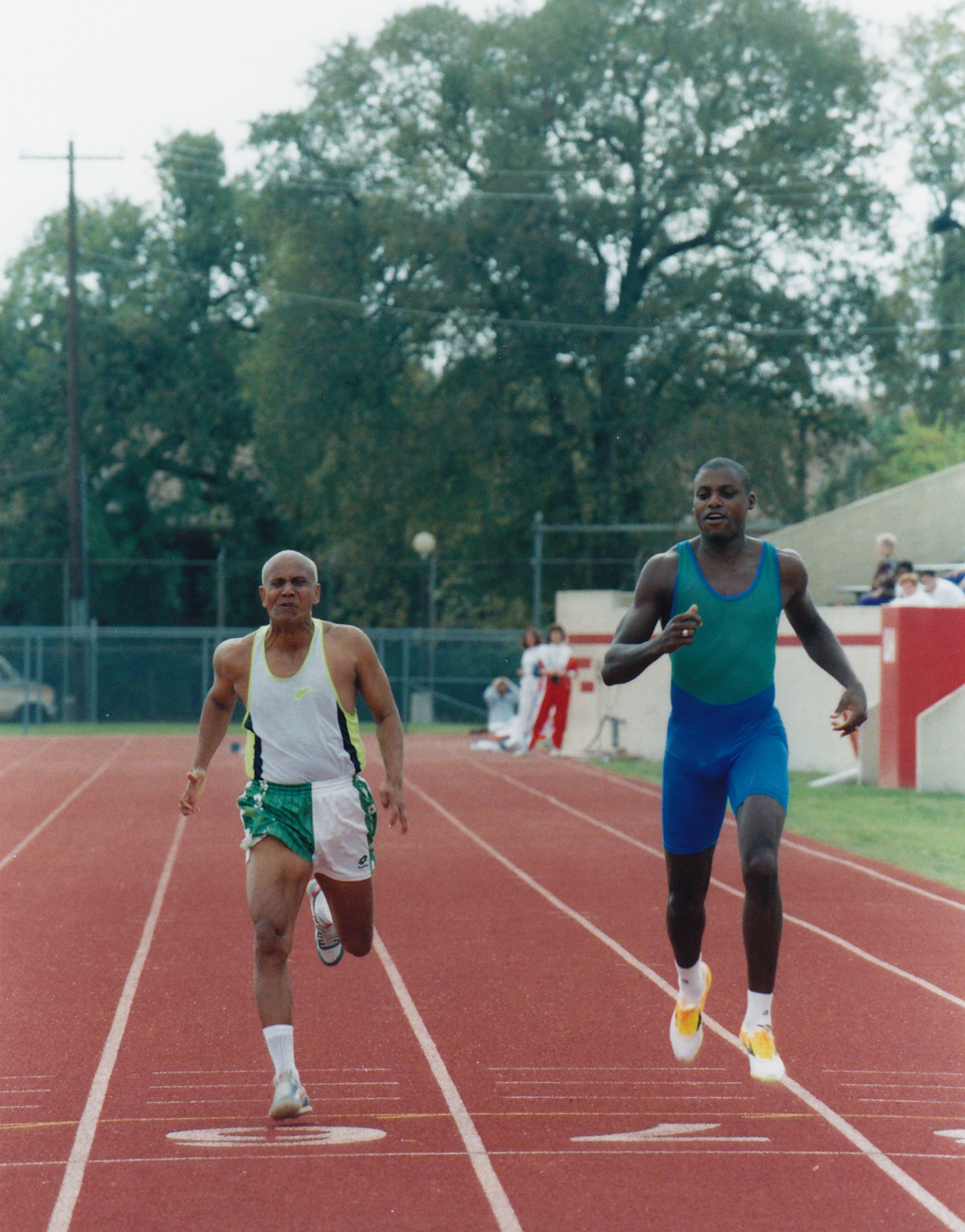
Sri Chinmoy runs the 100 metres side by side with Sudhahota Carl Lewis twice at the University of Houston’s Robertson Stadium Track where Lewis’ Santa Monica Track Club trains.


November 11

Photo by Adarini Inke


Sri Chinmoy honours Sudarhota Carl Lewis at the Oneness-Peace Mile Celebrity Relay. Pictured from left to right are Sri Chinmoy, Ambalika Evelyn Lewis (mother), Carol Lewis (sister), Sudhahota Carl Lewis and Addwitiya Roberta Flack.


November 11

Perfection-Goal

A lecture by Sri Chinmoy
at the University of London


Perfection is the seeker's fulfilling realisation and fulfilled manifestation. Everything else has dawned on earth save perfection, perfect Perfection.

Perfection is the tree.

Perfect Perfection is the fruit.

Man's speculation about perfection is his ignorance. Man's concentration on perfection is his knowledge. Man's meditation on perfection is his wisdom. Man's contemplation on perfection is his world-illumining, world-transforming inner eye.

God's Message is Perfection. Man's message is temptation.
God's Message is Perfection. Man's message is frustration.
God's Message is Perfection. Man's message is destruction.

Perfection-Goal and the freedom-soul go together. He who reaches the state of freedom-soul has conquered his inner life and immortalised his outer life. He is the chosen instrument of God. He is the direct channel of God. He is the representative of God here on earth.

Cry and try.

When we cry to see the transcendental Light and when we try to perfect our outer nature, our perfection does not remain a far cry. Perfection is ours.

Exert and control.

When we exert the divine in us and control the animal in us, perfection begins to dawn within us. The flower of perfection blooms.

See and be.

When we try to see the truth with the Eye of God, not with our eyes, and when we consciously try to be the surrendered instrument of God, perfection in no time dawns. The Golden All of perfection beckons our aspiring hearts. It is true that perfection cannot be achieved overnight. Realisation cannot be achieved all at once. It takes time.

Let me tell you a story. A young seeker once came up to a spiritual Master for initiation. He was duly initiated by his Master. Then the following day he said to his Master, "Master, now that you have initiated me, you have to give me realisation. I want to see God." The Master said, "My child, how is it possible for you to realise God in one day?"

Again two days later, he said, "Oh, I want to realise God." The Master said, "You are not ready." A few days later, again the same question. "Master, I want to realise God." He has not completed his task. He has not launched into the spiritual path properly. Just the other day the Master initiated him, but now he is crying for realisation without following the proper method. Without swimming in the sea of aspiration, he wants to realise God.

The Master was going to the Ganges for a dip and he invited this particular disciple to come with him. The disciple followed. So the Master and the disciple entered into the water and the Master pressed the head of the disciple down into the water for a couple of minutes, then he released it. The Master asked, "What did you feel when I pressed your head into the water?" "Master, I was dying. I was gasping for air. I was practically dying and I thought I would die. The moment you released me, I got my life back." The Master said, "If you can come to that particular state of consciousness, that without God you cannot live even for a few minutes, you will realise God. You will realise God at that moment on the strength of your highest aspiration. Your inmost inner flame has to be kindled, and then you have to cry, cry for God as a child cries for his mother. Then only God-realisation is possible."

The disciple got the lesson. Truly and soulfully he entered into the spiritual life. He listened to his Master's dictates at every moment. Wholeheartedly he launched into the spiritual life. He felt the necessity of freedom from the domain of desires. He felt the necessity to grow into the mounting flame which is called aspiration, constant aspiration. Then realisation for him was not a far cry. He did realise God.

When we use the term "Heaven", we feel Heaven is all light, delight and perfection. But where is that Heaven? It is deep within us, in the inmost recesses of our hearts. High Heaven, higher Heaven and highest Heaven are all within us.

When we offer our soulful thoughts to our brothers and sisters, we live in high Heaven.

When we offer the results of our soulful actions to mankind, we live in higher Heaven.

Finally, when we offer our soulful existence to humanity at large, unreservedly and unconditionally, we live in the highest Heaven.

We can live in the highest Heaven every day. God has given us the capacity. He has given us the potentiality. It is we who have to manifest our inner potentiality and capacity. We all are surcharged with indomitable inner courage. Unfortunately, we do not use our inner unlimited capacity. We use our outer limited capacity. We are afraid of diving deep within. Inside is the treasure. Inside is the key. We do not know where we have kept the key. We have totally forgotten. We do not know where the treasure lies.

Here at this point is the necessity of a spiritual Master who knows where the key is and where the treasure lies. He does not give something of his own to the seeker. He only brings to the fore the seeker's inner wealth. God-realisation is not his sole monopoly. Everybody has to realise God without fail. It is a matter of time. One realises God today on the strength of his highest realisation. Another realises God tomorrow on the strength of his sincere aspiration. Everybody has to realise God, at God's choice hour. Again, the sincere seekers can expedite their journey. We can walk towards our goal. We can march towards our goal. We can run towards our goal. If we run, naturally we shall reach the goal sooner than one who is walking towards his destination.

Perfection-Goal. Perfect Perfection here on earth has to be manifested, but how? We have to start our journey with inspiration. We have to feel deep within us every day in all our activities the necessity of inspiration. No inspiration, no proper achievement. Then we have to go one step ahead. After inspiration we have to feel the momentous necessity of aspiration. Inspiration is not all. We have to aspire to reach the Golden All, to see the Golden Shores of the Beyond, the ever-transcending Beyond. This is what we expect from aspiration, the mounting flame within us.

Then, aspiration is also not enough. We have to meditate. Aspiration includes meditation. When we meditate, we have to feel that we are entering into infinity, eternity, and immortality. These are not vague terms — infinity, eternity, and immortality. These are our possessions. To enter into our own divine possessions, infinity, eternity and immortality, is our birthright.

Then, when we are advanced in our meditation, when meditation starts offering its fruit to us, we enter into the realm of realisation. We realise the highest Truth in this body, here on earth. We do not have to go elsewhere to realise God. We do not have to enter into the Himalayan caves or sit on the snow-capped mountains in order to practise spirituality. No. Here on earth, in the hustle and bustle of life, we have to practise spirituality. We have to accept earth as it stands, as it is. If we are afraid of earth, if we fight shy of earth, then God-realisation will always remain a far cry. Here on earth we have to realise the highest Truth.

Then, realisation is also not enough. After realisation we have to reveal our realisation. If we do not reveal our realisation, we act like a miser; we want to hoard our treasure. No. We have to offer our realisation in the form of revelation to mankind.

Revelation is also not enough. We have to enter into the domain of manifestation. If we do not manifest what we have realised here on earth, if Mother Earth does not receive the fruit of our realisation, and if She does not have it for good, we can never be truly fulfilled. Mother Earth has to be fed with the fruits of our realisation. Here on earth the manifestation of realisation has to take place, and when manifestation takes place, perfection is bound to dawn. Perfect Perfection is nothing other than the absolute manifestation of God's Transcendental Will here on earth.

We are all seekers of the Infinite Truth. It is our bounden duty to rise high, higher, highest. Each human being has come into the world with the message of perfection. No human being on earth will remain unrealised. No human being on earth will remain unfulfilled. No human being on earth will remain imperfect.

Realisation, fulfilment and perfection — these three are brothers. Realisation is the youngest, fulfilment is the middle, and perfect Perfection is the eldest in the family. These three brothers must go together. They have to walk along the field of aspiration. They have to swim in the sea of meditation. They have to fly in the sky, the blue welkin of contemplation.

God-realisation, God-revelation and God-manifestation can take place only when man feels that he has to transcend himself. His goal of today is not the ultimate Goal. Today's goal has to be transcended tomorrow. Today's goal is the foundation-stone. Every moment we have to transcend ourselves, and while transcending, deep within us we shall cherish the message of perfection.

Perfection is bound to loom large and important in all our activities if we feel that aspiration is the only thing we need, the only thing we are striving for.

In aspiration is the key that can ultimately open up the door of perfect Perfection.


Published in My Rose Petals, part 1


December 25


Sri Chinmoy meditates in front of a display of 200 of his published books at a Christmas celebration held at the United Methodist Church of Port Washington.


The Christ’s Blessings

Remarks by Sri Chinmoy
in Guatemala City, Guatemala


Today is a very happy day. The Saviour came to bless us, so let us remember him always with gratitude. He also suffered, and his end was so painful. Again, when spiritual Masters come to earth, they may suffer, but they leave behind happiness, infinite happiness, for the world. This happiness always comes from our inspiration and aspiration.

Today is the Birthday of Jesus Christ the Saviour. He left the body at the age of 33. Poor me, I am double his age. I am 66. What I have accomplished and what I have not accomplished, God alone knows! Can you imagine? I am exactly double his age.


Published in The World-Experience-Tree-Climber, part 8


Preserve Silence, Silence, Silence

A talk by Sri Chinmoy
in Christchurch, New Zealand


Silence prevails. Sound ultimately fails. I shall tell you a funny story. Some of you perhaps have heard it, but most of you have not. This story happened when I was eight or nine years old. Because of the Second World War, nobody knew what would happen next. So my brother Chitta went to the market and bought rice and dhal and other things in a very large quantity. He and I were standing at a particular place in the market. We were not selling anything. Only we were standing there.

My brother was reciting passages from the Upanishads, sacred mantras. I heard these mantras many, many times when I was a small child, but at that time I did not pay much attention because I was restlessness incarnate. Only four or five years later, when I was in the Sri Aurobindo Ashram, my restlessness completely disappeared and I was the one to recite them loudly thousands of times, sometimes millions of times.

Anyway, my brother was reciting most soulfully. All on a sudden, a middle-aged man came up to us and he started screaming at my brother, “Your father borrowed money from me, and he has passed away. Now who is going to give me the money back? You! You have to give me the money.”

This man happened to be the manager of a circus. Why would my father borrow money from the manager of a circus? My brother did not pay any attention to the man and his shouting became loud, louder, loudest. He was almost ready to strike my brother. I was getting so annoyed that I was about to do something. But then the man suddenly left. I continued pumping my football with a pump. Then I was ready to go.

In ten or twelve minutes’ time, the man came back. Once again, my brother did not pay any attention to him. On his part, there was only silence, silence. The man came and fell flat at my brother’s feet. This time he was not shouting but crying. Why? My brother did not have to return any money. It was this man who had borrowed money from my father! He thought my brother would ask him for the money, but my brother was not even aware of it. My brother knew nothing about it. When the man saw the saintly qualities of my brother, his conscience came to the fore. Then he had to come back and beg for forgiveness. He said, “I was the one to borrow money from your father. But I do not have any means to return the money.”

My brother again remained silent. He did not say a word. Then the man went away. He knew that my brother was not paying any attention to him.

So here you can see how silence acts. As much as you can, try to preserve silence, silence, silence. In the beginning, the barking dogs disturb us so much. But when we have poise, inner poise, the barking dogs surrender. Quite often we are advised by our Inner Pilot that when people bite us ruthlessly, we cannot come down to their level to bite them. There should be some difference between a dog biting and a man biting. The very nature of a dog is to bark and bite. But, after some time, the dogs stop biting because their ego starts operating. It is beneath their dignity to bark when the man is not responding.

I have said many times how we can know whether it is a friend or an enemy who is knocking at the door. The friend will knock a few times, and the friend will think, “He is doing something important. Otherwise, he would have definitely opened the door for me. He has such love for me, I have such love for him.” Then the friend will wait patiently.

The enemy will knock hard for a few minutes. Then the enemy’s ego will come to the fore and he will say, “It is beneath my dignity to knock at his door. Who needs him? I will have nothing to do with him.”

So the enemy disappears, but the friend stays because the friend knows there is something important going on inside. That is why you are not opening the door.

A fly sits on your hand and you brush it away. Then it comes back and again you brush it away. Twenty or thirty times it returns. Then you decide that you want to compose a beautiful song or you want to write something. You cannot pay attention to those flies. What happens? You see that the flies have all disappeared. Why? It is their inborn ego. You are not paying any attention to them, so why do they have to stay?

Enemies always try to draw attention by hook or by crook. When you ignore, ignore, ignore, these enemies disappear. They go and knock at somebody else’s door. When you pay attention to them, it only creates more problems.

So silence is the answer. That is also the theme of my famous story Silence Liberates.


Published in Sri Chinmoy Answers, part 38


Stories about the Christ

Read by Sri Chinmoy
in Christchurch, New Zealand


Video by kedarvideo