December 7

Photo by Pulak Viscardi


Sri Chinmoy offers his annual New Year’s Meditation and Peace Concert at St. Paul the Apostle Church in Manhattan, New York.


Video by kedarvideo


Sri Chinmoy offers a Peace Concert and delivers a lecture at the University of Hawaii (afternoon) in Honolulu, HI, USA. He also receives the Dreamer of a Peace-Filled World Award on Pearl Harbor Day.


My Omnipresent Soul Watches

A talk by Sri Chinmoy
Pangkor Island, Malaysia

For me it is a great relief when I compose songs! The higher the number of songs, the greater is my joy, and the greater is my relief that my task is done. Then I see people are practising the songs here and there. In a sense, it is joy right from the beginning. After I have set my words to music, you are learning, learning the songs. Learning means that you are identifying with my inner presence, my joy and my gratitude.

When you practise, I tell you most sincerely, my soul’s presence will always be there. I have many, many, many inner beings. They will be there. When my disciples do anything to please me, either my soul or one of my inner beings will be there, to add to their joy. When you sing a few songs most soulfully, most soulfully, my inner beings take my soul to hear them. It has happened many, many times. When some groups sing most sincerely and correctly, plus soulfully and self-givingly, my soul watches them. Believe me! My omnipresent soul watches them inwardly and appreciates and appreciates them. I do not tell, I cannot tell who they are — that will create serious trouble for other groups. I know that some groups in general practise very, very soulfully.

Some groups simply shout! They sing, but soulfulness and selflessness they need in greater measure. Again, all the groups that are practising deserve my very, very special attention, affection and gratitude.

These songs are helping you. Outwardly it may seem very difficult or tedious or monotonous to practise. A monotonous feeling unfortunately comes into some singers even when they start singing. From the outer point of view, after fifteen or twenty songs, that kind of boring, monotonous feeling is understandable. You feel that if you can do something else, you will get more joy. But if you can continue, if you can sing for five or ten minutes, then you will get back your joy. In the beginning, perhaps you are lacking in joy. But after five or ten minutes, I am sure you will get joy. While you are singing, instead of feeling that it is monotonous, you will see that you are getting joy. It is the presence of one of my inner beings that is giving you joy.

In the case of some singers, as soon as they start singing, all their hesitation comes forward. It is not unwillingness; that I do not want to say. But they hesitate at every moment. They do not know if they are doing the right thing or not. In one part of their existence they want to sing, but another part finds it difficult to be absorbed in the music-world. Even here, where so many disciples are singing, some do not sing soulfully. Alas, they sing like parrots! They look at the music in their notebooks, but soulfulness is not there, eagerness is not there. Again, some people, I must say, do have eagerness and soulfulness. They are singing correctly, singing soulfully, and everything that is needed for them to make inner progress is definitely there.

You have no idea how much progress you make when you sing my songs soulfully. Even if you do not meditate well, your singing helps you tremendously, tremendously. My inner existence keeps a record of who is singing soulfully. Inwardly I give marks when I hear the reports from my inner existence, or when I see you singing right in front of me. Singing means identification with my soul or my inner existence. If you can identify yourself with my inner existence, do you think my inner existence will give you nothing in return?

You are giving me such joy by singing the songs! You may not know the meaning of the Bengali words, but your soul and your heart know the meaning. That is why you are able to sing these songs so beautifully, so soulfully. Your heart and your soul know the meaning. They are singing in and through you all, singing and singing. Soulful and prayerful singing is in no way inferior to prayers and meditations.

Music is so important. Our songs are so important. On our path, each and every singer deserves my gratitude and gratitude, my pride and pride.


Published in My Golden Children


December 6

Photo by Bhashwar Hart


Sr Chinmoy battles uphill against a ferocious wind at the Jersey Shore Marathon. He runs ten miles of the course.


When I ran ten miles in the Jersey Shore Marathon today, the wind was so bad. The trees were half bent. Three or four times I had to stop. — Sri Chinmoy


Published in Run and Become, Become and Run, part 8


End of a Weightlifting Year


Today is the end of my weightlifting for this year. I started with 40 pounds once, and today I have done 40 pounds 40 times with strict military press style.

Next year my Inner Pilot has to decide whether I will continue with heavy weights. Perhaps He will allow me to practise with light weights. I don’t know. But today my weightlifting officially closes for this year. — Sri Chinmoy


Published in My Weightlifting Tears and Smiles


December 6

Hinduism: the Journey of India’s Soul

A lecture by Sri Chinmoy
at the Hewlett-East Rockaway Jewish Center
Long Island, New York


Hinduism is an inner experience; it is the experience of the soul. Hinduism is not a religion. It is the name of a culture — a self-disciplined, spiritual culture. The word religion, in fact, is not to be found in the dictionary of a Hindu. His dictionary houses the word ‘dharma’. Dharma, no doubt, includes religion, but its long arms are stretched far beyond the usual conceptions of religion. Dharma means the inner code of life, the deeper significance of human existence. Dharma is a Sanskrit word which derives from the root ‘dhri’, to hold. What holds man is his inner law. This inner law is a Divine, all-fulfilling experience that frees man from the fetters of ignorance even while he is in the physical world. Religion, on the other hand, is derived from the Latin verb ‘ligare’, to bind. The ancient Romans saw religion as a force which binds and controls man. But the ancient Indian seers felt that religion, nay, dharma, must release man from that which binds him, that is, his own ignorance. Man’s awakened consciousness must do away with ignorance, or to be precise, transform ignorance into the knowledge of Truth.

“Dharma,” says Sri Aurobindo, “is the Indian conception in which rights and duties lose the artificial antagonism created by a view of the world which makes selfishness the root of action, and regain their deep and eternal unity. Dharma is the basis of Democracy which Asia must recognise, for in this lies the distinction between the soul of Asia and the soul of Europe. Through Dharma the Asiatic evolution fulfils itself; this is her secret.”

In days of yore, Hinduism was known as the Arya Dharma. Strangely enough, even now people are not quite sure from which part of the globe the Aryans entered India. Some, indeed, are of the opinion that the Aryans did not come from outside at all. Swami Vivekananda heads the list of these firm believers.

The origin of the word ‘Hindu’ is very strange. It is closely associated with the river ‘Sindhu’, the present Indus. But the ancient Iranians, desiring to call the Aryans by the name of the river on which they lived, pronounced it ‘Hindu’. The Aryans seemed to like the name and we, who are their descendants, are enamoured and proud of the name "Hindu."

Hinduism or the Hindu Dharma is founded on the spiritual teachings of the Hindu seers. The Hindu shastras or scriptures which govern Hindu life and conduct are illumined and surcharged with the light and power of the hallowed teachings of the ancient seers.

Many are the Hindu shastras. Each has made a singular, powerful contribution to the whole. The oldest and foremost of all these are the Vedas. These are considered the oldest written scriptures since the dawn of civilisation. The other scriptures have the Vedas as their only fount. The Vedas have another name, ‘Shruti’, that which is heard. They are so called because they are based on direct revelation. The authority of the Vedas rests on direct, inner spiritual experience that is married to Divine Reality. A Hindu feels in the inmost recesses of his heart that to doubt the inner experiences of the Vedic seers is to doubt the very existence of Truth. ‘Vid’, to know is the Sanskrit root of the word Veda. Veda actually means the knowledge of God. As God is infinite, even so is His Knowledge. We observe in the Vedas, with surprise and delight, that the Truth-Discoveries are infinitely more important than the Truth-Discoverers. Unfortunately, the order of the day is the reverse. The Vedas are four in number: Rig Veda, Sama Veda, Yajur Veda and Atharva Veda. Each of the Vedas consists of two sections: Samhita and Brahmana. Samhita embodies the hymns or mantras, while Brahmana expounds their significance and appropriate application.

All other Hindu Shastras cherish their great indebtedness to the Vedas. They are proud of the fact that they owe their authority to the Vedas and to the Vedas alone. These scriptures are known as Smritis. ‘Smriti’ literally means anything that is remembered. Smriti is a scripture other than the Vedas proper. It has traditionally exercised great authority in laying down social and domestic laws, plying its boat between the shores of Vidhi (injunctions) and Nishedha (prohibitions) of the Hindu society.

Now let us focus our attention on the Upanishads ‘Upa’ means near, ‘ni’ means down, ‘shad’ means sit. ‘Upanishad’ refers to pupils sitting at the feet of their Teacher, learning their spiritual lessons. The Upanishads are the philosophical and reasoned parts of the Vedas. They are also called "Vedanta," End of the Veda. There are two reasons for this. One is that they present themselves toward the end of the Vedas; the other is that they contain the spiritual essence of the Veda, which is all Light and Delight. The actual number of the Upanishads still remains unknown. One hundred and eight have been faithfully preserved. Of these the most significant are: Isha, Kena, Katha, Prashna, Mundakya, Aiteriya, Chhandogya, Brihadaranyaka and Shwetaswatara.

God-realisation abides in meditation; never, in books. This is the supreme secret of the Upanishads. The sages and the seers in the Upanishads asked their pupils to meditate, only to meditate. They did not even advise their students to depend on the Vedas as an aid to realising God. Meditate, the Brahman is yours! Meditate, Immortality is yours! At the beginning of the journey of human soul, the Upanishadic seers cry out, “Utthishtata jagrata…” — Arise, awake, stop not until the Goal is reached." At the journey’s end, the same seers cry out once again, “Tat twam asi” — That Thou art.

Now let us come to the Sad-Darshana, the Six Systems of Indian Philosophy. These are the various schools of thought, later introduced by some of the Hindu sages. The sage Jaimini’s system is called Purva Mimansa; others are Vyasa’s Uttar Mimansa or Vedanta, Kapila’s Sankhya, Patanjali’s Yoga, Gotama's Nyaya, and Kanada’s Vaisheshika. If one studies the Nyaya first, then it becomes easier to fathom the other systems of thought.

All of the Six Systems were written in "sutras" or aphorisms. The seers did this because they wanted, not to expound the philosophy, but to express in the briefest possible sentences their soul-stirring revelations and have these engraved on the memory of the aspirant. Through the passage of time, the aphorisms have been significantly adorned and armoured with countless notes and commentaries.

It is high time for us to invite Professor Max Muller to join us in today's momentous journey.

"If I were to look over the whole world to find out the country most richly endowed with all the wealth, power and beauty that nature can bestow — in some parts a very paradise on earth — I should point to India... If I were asked under what sky the human mind has most fully developed some of its choicest gifts, has most deeply pondered on the greatest problems of life and has found solutions of some of them which well deserve the attention even of those who have studied Plato and Kant — I should point to India. And if I were to ask myself from what literature, we here in Europe, we who have been nurtured almost exclusively on the thought of Greeks and Romans, and of one Semitic race, the Jewish, may draw their corrective which is most wanted in order to make our inner life more perfect, more comprehensive, more universal, in fact more truly human, a life not for this life only, but a transfigured and eternal life — again I should point to India."

To walk along the royal path of the Six Systems of Philosophy, is difficult. That path is for the learned and the select few. The common run needs an easier path. It is here that the Puranas come into the picture. The Puranas teach us the Hindu religion with inspiring and thought-provoking stories, anecdotes and parables. The Puranas present Hinduism in an easy, interesting, charming and convincing manner. The major difference between the Vedas and the Puranas is that the Vedic Gods represent the cosmic attributes of the One, while the Puranic Gods represent His "human" attributes.

Now the Bhagavad-Gita or the Song Celestial demands our immediate attention. It is the scripture par excellence. The Gita is the life-breath of Hinduism. The Gita tells us not only to realise God, but also how. The Gita introduces three principal paths toward God-realisation: Karma Yoga, the path of action; Jnana Yoga, the path of knowledge, and Bhakti Yoga, the path of devotion Emotional devotion and philosophical detachment not only must but can run abreast to fulfil the Divine here on earth. This sublime teaching of the Gita knows no equal. Without hesitation, a devout Hindu can say that the Gita has been the solace of his whole life and will be the solace of his death.

Certain people are heartily sick of our rituals and rites. To them, these are nothing, but cheap, confused and showy affairs. But these critics will have no choice but to revise their opinions when they come to know why we perform these. Needless to say, we want spirituality to govern our lives, both inner and outer. Without the purity of the mind, there can be no true spirituality. And to have that purity, the performance of rituals is often an invaluable necessity. We know that when the mind, is pure, illumination dawns. The subtle truths that lie beyond the range of our senses enter into our consciousness directly through the pure mind. Participation in rituals greatly aids this process. Granted, rituals are externals. But we have to know that it is the externals that bring home the truth to individuals. Rituals eventually touch the very core of our consciousness. Rituals permeate every aspect of Hindu life.

Rites, too, have been in vogue since the days of the Atharva Veda. Rites, if performed with an inner urge, with an aspiring heart, can help us considerably to conquer the hostile forces, avert untold misfortunes, fulfil life in its divine plenitude. Indeed, this is the divine attitude. The fear of a spiritual fall threatens us only when we use the rites, or rather the magic or lesser rites, to gain selfish and undivine ends.

A word about images and symbols. We do not worship images and symbols. We worship the Spirit behind them. This Spirit is God. It is so easy to feel the presence of God in and through a concrete form. Through the form, one has to go to the Formless, through the finite to the Infinite.

We worship nature. They smile at our folly. We laugh at their ignorance. Why do we worship nature? Because we have discovered the truth. We have discovered the truth that God manifests himself not only through nature but also as Nature. “A thing of beauty is a joy forever,” said Keats. Beauty is soul. Soul is all joy. A Hindu seeker cannot separate the aspiration of Nature from the beauty and joy of the Soul. Nature’s aspiration and the soul’s delight together create an all-loving, all-embracing and all-fulfilling perfect perfection.

“Look at the zenith of Hindu folly,” they say, “for of all things in God’s creation, a Hindu has to worship animals, trees, even snakes and stones!” Alas, when will these men of so-called wisdom come to learn that we do not worship the stones as stones, the snakes as snakes, the trees as trees, and the animals as animals. What we do is very simple, direct and spontaneous. We worship the Supreme behind all these; nothing more and nothing less. With this attitude a Hindu desires to worship each and every object of the world, from the mightiest to the tiniest. Let us speak of the caste-system, the object of ceaseless ridicule. What is caste? In the deepest sense of the term, caste is unity in variety. No variety, no sign of life. Variety is essential to the cosmic evolution. All individuals cannot have the same kind of development: physical, vital, mental or spiritual. Neither is such similarity imperative. The thing of paramount importance is that each individual must be given infinite opportunity and freedom to develop along his own line of growth.

In this lofty ideal, there is only one idea. To serve and to be served. Each individual has his rightful place in this ideal. The caste-system is to be treated as the functioning of one’s limbs. My feet are in no way inferior to my head; one complements the other. Brahmin (priest, teacher and law-maker), Kshatriya (king and warrior), Vaishya (merchant, trader and agriculturalist) and Shudra (labourer, servant and dedicated hand) are all united by their mutual service. Caste is not a division. It is the secret of proper understanding. And it is in proper understanding that we fulfil ourselves fully. A Hindu feels this sober truth.

True Hinduism abjures all that divides and separates. It dreams of the Supreme Truth in absolute freedom, perfect justice in an all-embracing love, and the highest individual liberation in the unconditional service of humanity.

Hinduism gives due importance to all spiritual figures of the world. It recognises a great harmony in their teachings. Down through the ages, the firmament of India has sent forth the message of Peace, Love and Truth. It has fostered and encouraged the synthesis of all world religions. Further, Hinduism affirms that the highest end of life is not to remain in any particular religion, but to outgrow it, and realise and live in the Eternal Truth.

Hinduism is the embodiment of certain lofty, infallible ideals. These ideals within us live and grow, grow and live, and because of this fact, Hinduism is still a living force. It lives to lead. It leads to live.

To know Hinduism is to discover India. To discover India is to feel the breath of the soul. To feel the breath of the soul is to become one with God.


Published in AUM – Vol. 2, No. 6, January 27, 1967

 

Stories from Malaysia

by Sri Chinmoy
at Pangkor Island Beach Resort, Malaysia


How God saves us!

One day Vinaya was driving me. First we went to Kennedy Airport, where I take exercise by walking inside one of the terminals. Afterwards in the car I said, “Today let us go this way.” We went a totally different way while coming back. Alas, in fifteen minutes, while we were still in the car, Vinaya heard on the radio that a plane had crashed in the place where we usually drive. How God saves us! The following day we went to see how much destruction had taken place.

Our Indian theory is that whomever Lord Krishna wants to save, nobody can kill. And if Lord Krishna wants to kill someone, nobody can save that person. Rakhe Krishna mare ke, Mare Krishna rakhe ke: “Whom Krishna saves, who can destroy? Whom Krishna destroys, who can save?” If God wants to save us, nobody can put an end to our life. But if it is not God’s Will, if it is time for us to leave this world, then nobody will be there to save us.

There are some trustworthy people!

The other day, I do not know how or why, I left my wallet on my bed here in the hotel. I know I was taking out some bills, and I left it open on my bed. I was out for at least three or four hours. When I came back, I saw the wallet on my bed. It was still slightly open. Then I concentrated and concentrated on it. My inner being told me that the lady who cleaned my room had not touched anything in the wallet. The wallet was there, where I had placed it. She had not touched anything. She is Tamil, and I know her language very well, but only the language for the servant class. My Tamil is not for the upper class! At the Ashram we dealt only with Tamilians of the servant class. This lady is of that class, so I was able to speak to her.

She said, “No, no, no, I did not take anything!”

I was very pleased. Then I said to her, “On the day I depart, I will leave a very large amount of money for you, since you are so honest.” She was very, very happy. Today she saw me when I was leaving my room. She came up to me and said, “Guru, please give it to me in my hands. Here people steal money, so please do not leave money for me on your bed. Somebody else will come and take it away.”

I said, “I left so much money on my bed, and it was not stolen! All right, before I leave I shall give you money. I shall place it in your hands.” Then she was so happy. She had absolutely not touched the money. My wallet was open, and she did not remove one bill. There are some trustworthy people!

On our departure day, this lady was looking for me and I was looking for her, because I did not want to leave without giving her money. When I went into my room for the last time, I saw her. In Tamil I said, “Please wait, wait, wait a short time!” I said to myself, “How many ringgit should I give her?” I decided that I must give her 800 ringgit.

On the top of the envelope I wrote “800 ringgit.” When I gave her the envelope, her eyebrows touched the ceiling! She was so sincere, so sincere.

Yesterday this lady came to meditate with me, with the hotel staff. She came with the last batch. I recognised her, but I was desperately trying not to give her more attention than the others, so that they would not be disturbed. The manager was also there! He was seated in the front row. The way I smiled at the others, I smiled at her also — exactly the same way. She is such a nice lady.

Some of the hotel workers meditated very well. They looked at me and they went into a very high world.

My ‘Invocation’ and ‘Supreme’ notebooks

Every day I play “The Invocation” and “My Lord Beloved Supreme,” and I also write “The Invocation” and “Supreme.” In one notebook I write “Supreme” in two columns, side by side, and I write the date. In another notebook I write “The Invocation.” I have decided that I am supposed to do it every day, the way I play the music and sing. But I play a nice trick! I tell my Lord Supreme that I want to go a little faster. I go on, past the actual date. I go five, six or seven days ahead, for both “The Invocation” and “Supreme.” Then I am very happy. After all, it is I who am writing it, so there is nothing wrong if I go ahead of the actual date.

The funniest thing happened! When I came to this place, for the first few days I was writing “Supreme” and “The Invocation.” But my table had so many things on it: my artwork, my largest Tote-a-Tune, my picture of Mother Kali, and my acrylic paints. All kinds of things were on my table. It was absolutely a jumble. I said to myself, “I am sure I have gone a few days ahead,” so I put those two notebooks inside the drawer. I said, “I will remember them. I will take them out every day.” But my remembering became all forgetfulness! When I finally remembered the two notebooks, I said, “O God, what have I done? Why did I put them inside the drawer? I should have kept them on top of the table!”

I was finding fault with myself. I said, “How could I do this?” I opened up the drawer and saw the two notebooks. I got the happiest surprise when I saw where I had stopped. Can you imagine — both days I had stopped at the page dated December 7th, which is tomorrow! I was so thrilled to see that I was still ahead by one day. Again tomorrow I will fool myself and go four or five days ahead, and in that way I will save myself. But I am not going to keep my notebooks inside the drawer any more. Then they will draw my attention.

For three or four years Minati was the one who kept the account of my repetitions when I was doing japa. It started with Minati. Then Paree used to take down the number. I started with 4,000, then I went to 6,000 and 7,000. Finally I did japa 15,000 times.


Published in My Golden Children


December 6

Sri Chinmoy performs an esraj concert at the Unitarian Church in Philadelphia, Pennsylvania.


Sri Chinmoy offers a New Year’s concert at Washington Irving High School in New York.


Sri Chinmoy offers a Peace Concert in the Dag Hammarskjöld Auditorium at the United Nations in New York.


Sri Chinmoy offers a Peace Concert in the Dag Hammarskjöld Auditorium at the United Nations in New York.


Sri Chinmoy offers a Peace Concert in the Dag Hammarskjöld Auditorium at the United Nations in New York. The address is given by C.V. Narasimhan, Chef de Cabinet for UN Secretaries-General Dag Hammarskjöld, U Thant and Kurt Waldheim.


Sri Chinmoy offers a Peace Concert at Public School 86 in Jamaica, Queens, New York.


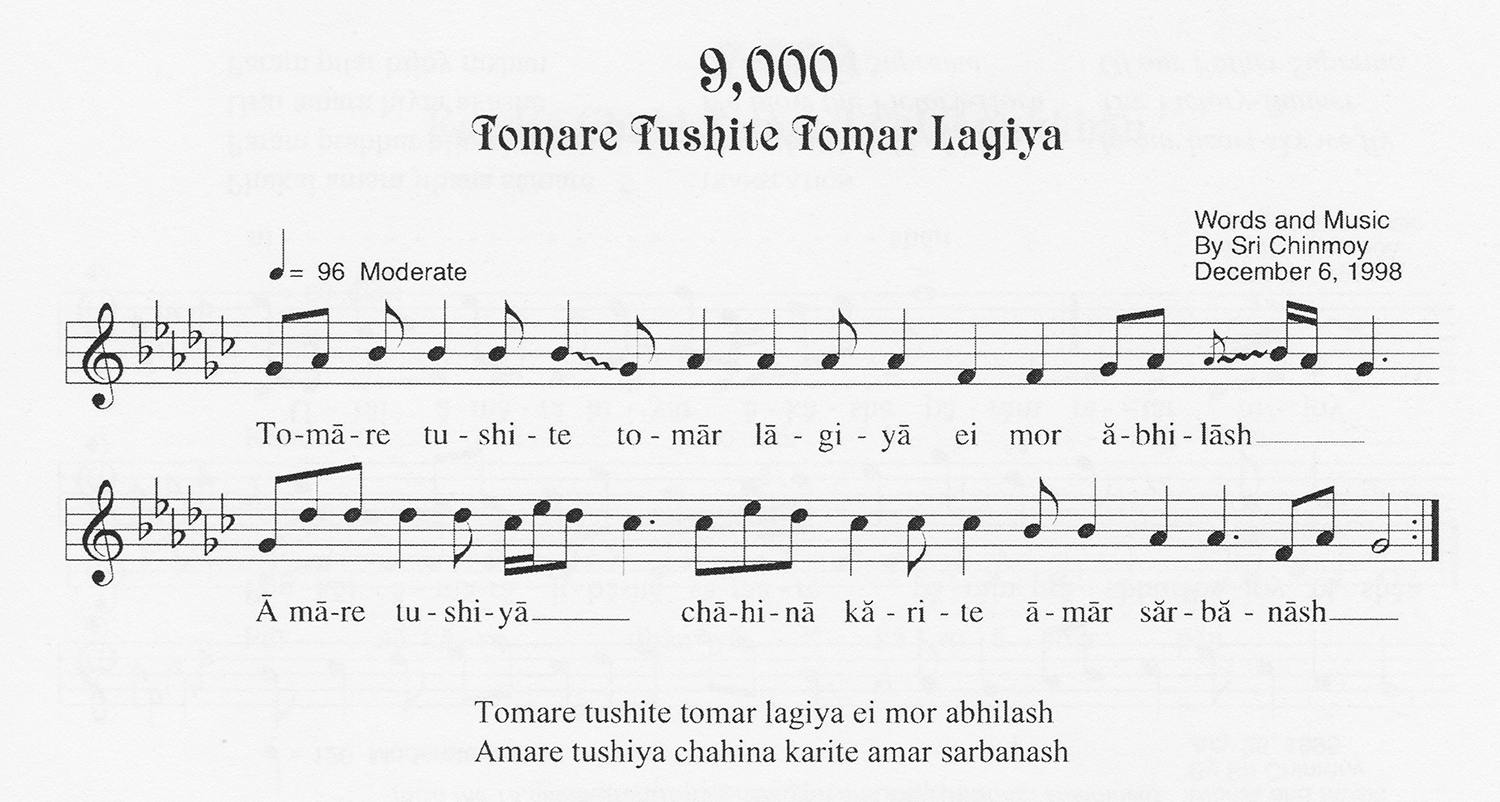
Sri Chinmoy composes his 9,000th Bengali song Tomare Tushite Tomar Lagiya in Honolulu, Hawaii.


December 6


Sri Chinmoy meditates with U.N. Secretary-General Perez de Cuellar following a UNESCO meeting at the United Nations headquarters in New York.


December 5


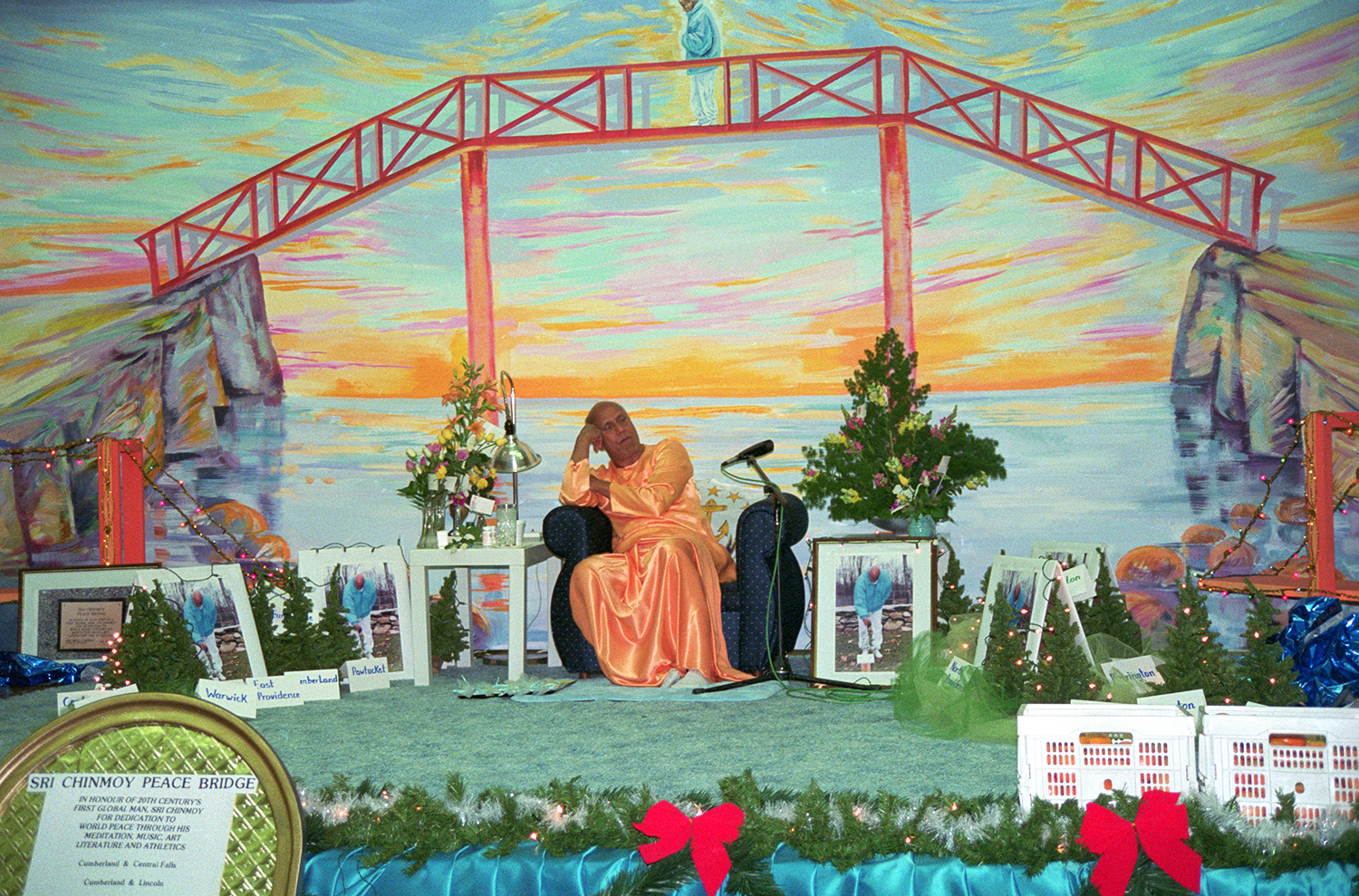
Sri Chinmoy at a celebration in Jamaica, Queens, New York, for the first bridge — connecting the towns of Cumberland and Central Falls on Rhode Island — becoming a Sr Chinmoy Peace-Blossom.


December 5

Stories from the Bahamas

by Sri Chinmoy
at the Nassau Beach Hotel in Nassau, Bahamas


One unhappy experience

A thousand times one can be nice to someone. The Master can be nice to a disciple a thousand times or a million times. But if on one occasion the Master is upset, that very incident the disciple will remember. He will say to himself, “On that date, at that place, the Master was displeased with me; he was angry with me.” The Master also suffers when the disciple gives infinitely more value to that experience, although thousands and thousands of times the Master has been extremely compassionate and affectionate, extremely grateful, extremely proud.

The poet who wrote Tomari hok joy for the Mother was with the Sri Aurobindo Ashram. Later I set his words to music. The Mother was very kind to that poet. She gave him the inspiration and the capacity to write such beautiful poems. The Mother was very, very kind to him, but on a certain day she expressed some displeasure. He said that he suffered for years because of that one-day experience. Then he said he counted how many times the Mother had given him the brighter than the brightest smile and all her affection. He wrote down all the times the Mother was nice to him. Finally, with the Mother’s smile and the Mother’s affection he was able to conquer that experience.

One unhappy experience of the Mother’s displeasure he had, and for years it lasted. After such a long time his recollection of the Mother’s pleasure, the Mother’s happiness and the Mother’s pride in him conquered that experience.

I meditated in Sri Aurobindo’s room

One ashramite who is ninety-four and a half years old, Nirod, is begging me to give talks on Sri Aurobindo! He read the talk on Sri Aurobindo that I gave at Cambridge. He said, “You are so qualified to speak on Sri Aurobindo. You have to speak on Sri Aurobindo!”

In my talk at Cambridge, I mentioned that I used to meditate in Sri Aurobindo’s room. There I had personal experiences. There were two or three very important incidents in my life. Only four or five persons knew about them, and one of them is still alive. He is my friend.

During my last visit to the Ashram I was meditating only a metre away from Sri Aurobindo’s bed and his statue. I was standing. I could not bend because of my knee problem. With folded hands, very seriously, I went very high. One guard came up to me and opened up my palm. He put two flowers in my hands. This particular guard never saw me meditating in Sri Aurobindo’s room in my younger years, but the other guard had seen me many times. When the first guard came and gave me two flowers, the second guard came from the other side and put another flower in my hands. So I got three flowers, while I was meditating very seriously. They blessed me with flowers! This is their affection.

I surrendered to her weapon

Nirod knew that the Mother and I had some differences after I came to America. He asked me what happened. I said, “The Mother used a weapon which conquered me. I surrendered to her weapon.”

He asked, “What kind of weapon was it?”

I said, “It was very powerful.”

Again he asked, “What was it?”

I said, “You know that the Mother said one thing and I said something else. We had a wonderful disagreement. Finally the Mother wrote to someone in red ink, ‘Tell Chinmoy that I am still his Divine Mother.’ That weapon really killed me! That weapon was too difficult for me to fight against. I shed tears.”

In this particular story, after I came to America, the Mother wrote to an Ashram member in New York, “When you see Chinmoy next time, show this to him.” That was in ordinary black or blue ink. But in red ink she wrote, “Tell Chinmoy that I am still his Divine Mother.” That was the Mother’s weapon that conquered me.

A new incarnation

One of the prominent disciples in the Ashram has taken a new incarnation. He is now our disciple in the Oneness-Dream-Boat-Shore. He was one of the pillars of the Sri Aurobindo Ashram. He was as prominent in those days as Subhas Bose, Netaji.

After leaving India, Netaji became extremely popular almost overnight, although in India he was not so popular. This man was his compatriot. He could have become a great Minister, but he gave up his political life and joined the spiritual life. He had tremendous faith in Sri Aurobindo.

Sri Aurobindo said to him, “We have only one Bengal. There should be no East and no West.” That was Sri Aurobindo’s dream. The disciple wanted to leave the Ashram and unite the two Bengals, East and West.

The Mother told him not to go, but he left. Because he did not listen to the Mother, he quoted an Indian proverb: “How can a thief listen to religious discourses?” He compared himself to a thief!


Published in The Feet of the Supreme’s Compassion


It Is God Alone Who Teaches Us

A talk by Sri Chinmoy
Pangkor Island, Malaysia


I wish to say a few words. There is only one spiritual Teacher, and that spiritual Teacher is God. My students and I call Him by one Name and you may call Him by a different Name, but it is the same Person.

Some people are good in a particular subject. Somebody is an excellent soccer player, let us say; somebody is a great musician, and somebody else shines in a different field. When it is a matter of spirituality, prayer and meditation, in this incarnation I started at the age of seven. In previous incarnations also I studied, so perhaps I know the subject well. After practising spirituality for many, many years, one can know one’s previous incarnations. From spirituality we get this capacity. If I am a good basketball player or volleyball player or any other sports player, I will not be able to know who I was or who you were in a previous incarnation. This is an advantage that we get from spirituality.

Spirituality will be able to give us peace of mind. No matter how great one is as a sportsman, as a musician, as a singer or as a champion in any field, that person will not have peace of mind. For peace of mind we have to pray and meditate. Nothing else will give us peace of mind. If you are the greatest manager of the world’s greatest hotel, you will have so many problems! The greater you become, the more responsibility you get. But if you pray and meditate, then worries and anxieties will not assail you.

I have nearly seven thousand disciples in at least sixty countries. I am fully responsible for them. At the same time, I place their problems at the Feet of God. I pray to God. I am offering God my prayers, and all the problems I place at the Feet of God. In that way I get peace. This is what we learn in our meditation: peace, peace.

There are three families for each person. Your own family, with children, father and mother, is one family. Your small family includes your own relatives. Then comes your beloved country, Malaysia. You have to take Malaysia as your family. This is your beloved country, which becomes your second family. Suppose you were born in China. Then your beloved country will be China. Some people here were born in India. Their beloved country will be India. For each individual, a particular country will be his second family. Whether you are Malaysian, Chinese or Indian, first comes your own family. Then comes your country as your second family. Your third family is the whole world.

I was born in a tiny village. I went to South India to pray and meditate for twenty years, and then I went to America to be of service to the spiritual seekers. Whatever I do, I do not say that I “teach.” It is God alone who teaches us; we only serve. I serve you. Your God, if you are a Muslim, is your Allah. If you are Chinese or Indian, you also call your God by a particular Name. It is the same God, whether we call Him Allah or any other Name.

We pray to God to give us joy. We pray to God to keep us always physically in good condition and morally and spiritually awake, so that we do not make mistakes. Many, many mistakes we have made. We all make mistakes. Some people do not pray to God for forgiveness, while others do. If we pray to God for forgiveness, He will forgive us. Some people do the wrong thing, but they do not pray to God for forgiveness. They feel that it is not necessary. But if we do not pray for forgiveness, it will be very, very difficult for us to be happy in life.

I am very grateful to you all. My blessing is my prayer, my meditation. I do not use my hands to bless an individual in the traditional way. I feel that only God can put His Compassionate Hands on our head. I know a little more about spirituality than you do. You know much more than I do about business and other subjects. I am praying to God to bless you. Again, I do not bless anybody in India’s traditional way, and I do not want people to touch my feet. I am not worthy of it, but sometimes people come up to me and touch my feet. That is traditional, but I do not want it. I take you all as my young brothers and young sisters. The older brother knows a little more than the youngest ones in the family. The one who was born first knows where the father is, where the mother is. He tells the little ones, “Come, come — I will be able to show you where our parents are.” At that time his job is over. Then the little ones will be able to speak to the mother and to the father, and they will be able to learn many, many things about the inner world and the outer world.

Again and again I am saying that when I pray with you, you will get Blessings from God. I call Him the Absolute, and I use the term “Supreme.” It is the same God, but I like that Name. Your children call you by one name, like “Daddy” and “Mommy.” When they grow up, they will call you “Father” and “Mother.” And other people, your friends, will call you by your proper name. Whether you are a magistrate or a senator, or you hold some other important post, you are the same person, but for someone you will be a friend, for someone you will be a parent, for someone you will be a sister or brother. But you are still the same person, same person. Like that, God is the same, no matter what Name we use for Him.

Now I am inviting each of you to kindly sit in front of me and meditate with me for one or two minutes. If your relatives are with you, if your wife or husband is with you or your child is with you, then you may come together. But if you are alone, if you have not brought your wife or your husband or your children, then do please come alone.

Now please come, one by one, and kindly look at me. Rest your hands comfortably. Our prayer, our meditation is not severe or austere — no, no, no! God does not appreciate it if I go to Him in an austere position. God will say, “You fool! Who asked you to become unnatural?” We should approach God in a normal way, a natural way. Some people torture their body when they pray, and God feels sorry. If I want to go to my Father, do I have to suffer? That is sheer stupidity. God will say to me, “My child, come to Me as you are.”


Published in My Golden Children


December 5

Running Anecdotes

by Sri Chinmoy

Big mouths

Quite often a fat lady who walks with a cane greets me during my run. She has two dogs and she likes me very much. Whenever she sees me, she always has the same question: “Hey, don’t you feel cold?” Each time I give her a smile and say, “No, no.” By that time, I have run past her. Even if she sees me twice in the same day, she greets me with this same question, and I tell her the same thing.

This morning, at around 7:15 on our street, I saw this fat lady and her dogs having a real fight with another lady and her dog. The other lady was thin and seemed to be a little aristocratic. Let us say the fat lady is my friend, since she sees me every day and she likes me and talks to me. When the dogs started coming near each other, my friend said to the thin lady, “Don’t you dare come near me.” The thin lady replied, “Shut up, you big mouth!” Then, the fat one, my friend, threw her cane at the other one and said, “To hell with you!”

I finished my run and stood there watching them. As the thin one was leaving she said to her own dog, “You also have a big mouth!”

Now I had to sympathise with the fat lady because she was my friend. I went about 15 metres over to her cane and picked it up and gave it to her. She was very nice to me and said, “I knew all along you were a nice guy.” She was giving me a compliment. By that time the other lady had gone away.

The power of a smile

The first time I ever did seven miles, I was running alone in Flushing Meadow Park. After three or four miles an old man who was also running saw me and gave me a smile. There was such power in his smile that I went practically half a mile without feeling any pain, just joy.

Then, when I was coming back after having completed six miles, I was breathing heavily: “Ahh, ahh.” An old, fat lady who was waiting for the bus saw me and started imitating me in a joking way: “Ahh, ahh.” In silence I was saying, “Oh, if you had run six miles!”

The man was so nice and the lady was so bad!

Running late

There is a very nice black lady who helps school children cross 150th Street. Every morning she sees me running and appreciates my style. The other day I was coming back from my run later than usual because I had run four miles instead of my usual two miles at that hour. She thought that I had run only two miles, but had taken more time because I was tired and exhausted. When I came near her she said, “What is wrong with you? Why are you coming so late?”

She had been talking to a man and she told me, “I was just telling my friend that today you have new shoes and you look so nice. Why are you late?” I went twice as far, but this lady thought that I should have come back sooner. She has her own time!

Child’s advice

One day while running, I was talking to myself in Bengali, in my Chittagong dialect: “I can’t go any farther.”

What could I do? I was dying! I kept saying, “I won’t be able to go any farther.”

Then, a child about eight years old came up to me and said, “Don’t talk. It will make you more exhausted. Don’t talk.”


Published in Run and Become, Become and Run, part 1


The San Juan Marathon

An anecdote by Sri Chinmoy


At our marathon in Puerto Rico the runners had to run three times around the stadium at the start of the course. Our singers had taped running songs that were played over the loudspeaker, and they inspired the runners considerably.

Because of the heat, many people suffered after completing the race. For many it was a very painful experience.

The man who won had a time of around 2:30, and his wife stood first among the women. So husband and wife stood first together, with one hour difference.

The former champion finished in 2:51. I had a long talk with him, and many pictures were taken. He said this was his worst time in ten years. He blamed the heat. Also, the day before he had eaten Kentucky Fried Chicken, and he said that ruined everything. So remember, don’t eat chicken before a marathon!


Published in Run and Become, Become and Run, part 17


Sri Chinmoy ran the Sri Chinmoy Marathon in 5:12:00 in San Juan, Puerto Rico.


December 5

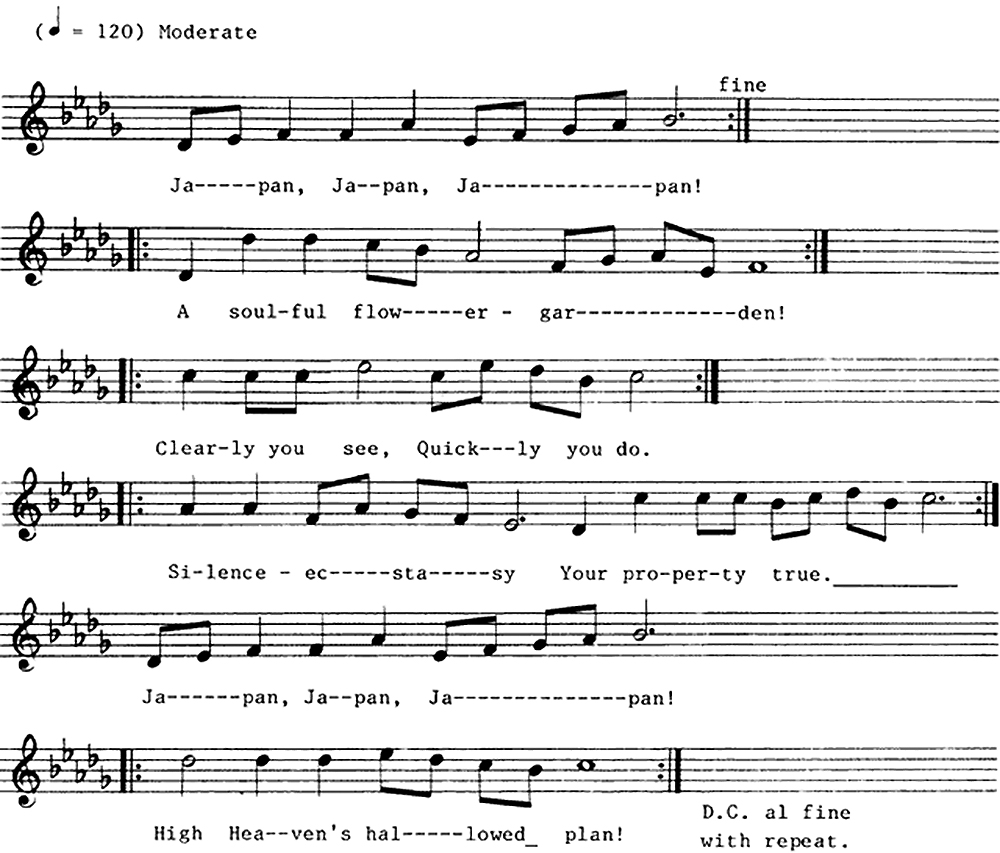
Japan, a Soulful Flower-Garden

Lyrics:

Japan, Japan, Japan!
A soulful flower-garden.
Clearly you see,
Quickly you do.
Silence-ecstasy
Your property true.
Japan, Japan, Japan!
High Heaven’s hallowed Plan.

Translation:

Nihon, Nihon, Nihon!
Tamashii no hanazono!
Chiebukaku shunbin na,
Chinmoku no hooetsu
Shinjitsu no tamamono.
Nihon, Nihon, Nihon!
Tenkai no seinaru nagare!


Published in My Aspiration-Heart’s Country-Life-Salutations


Sri Chinmoy performs on 107 instruments during a 9-hour, 19-minute concert (including breaks), at Public School 86 in Jamaica, New York.