
March 25


Sri Chinmoy offers a public concert at the Ethical Culture Society of New York.
Sri Chinmoy offers a public concert at the Ethical Culture Society of New York.
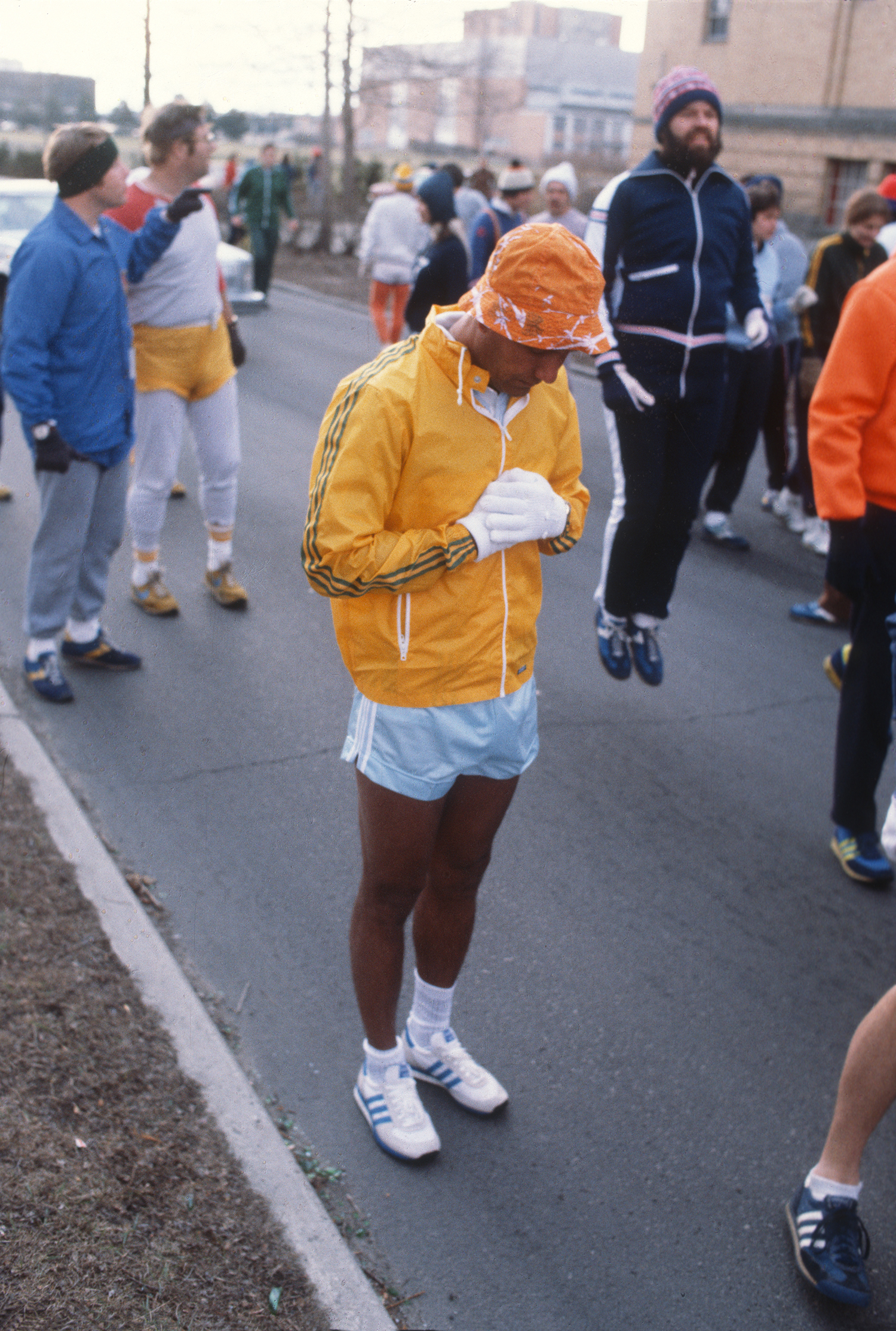
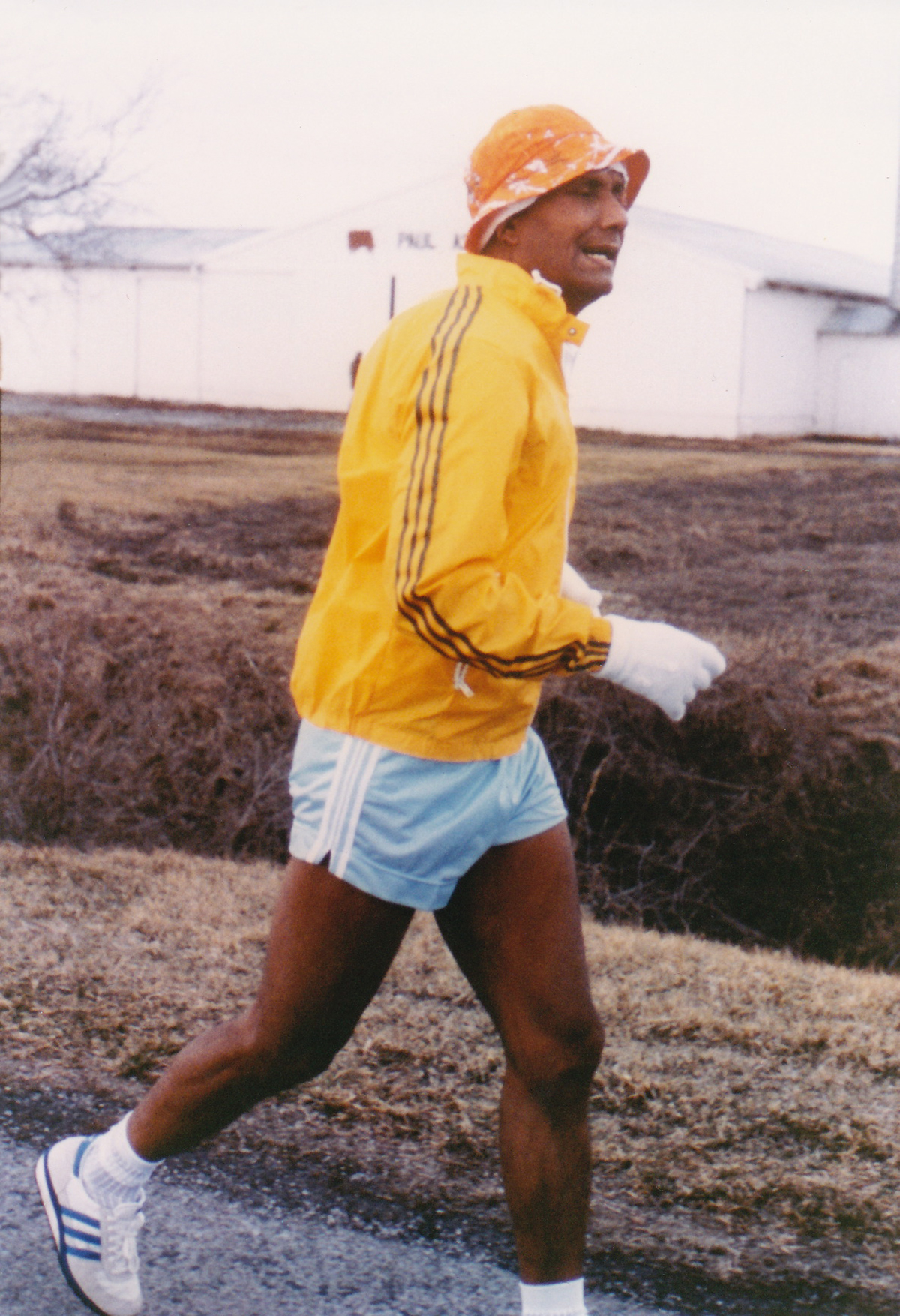
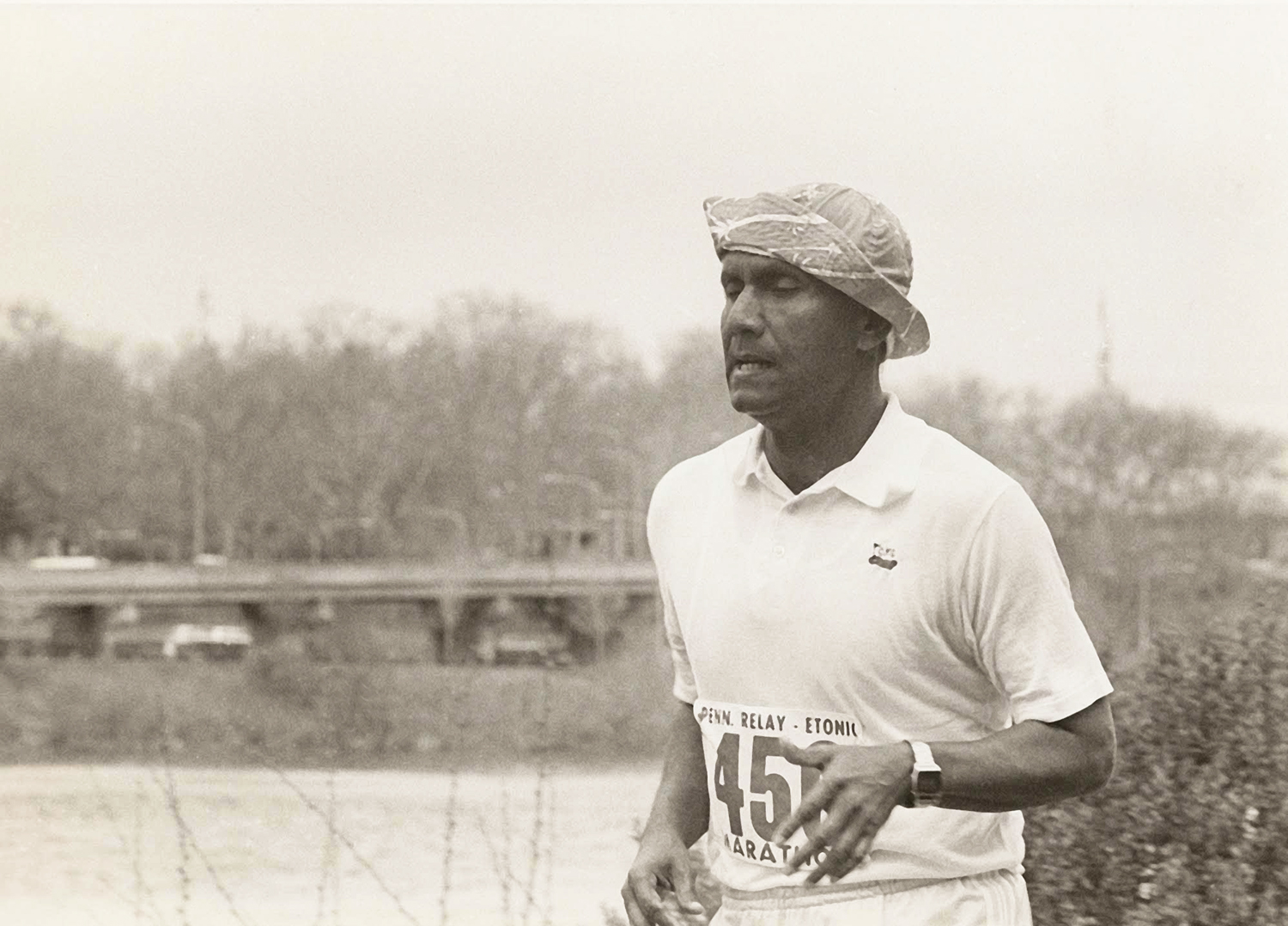
Sri Chinmoy runs a personal best for the marathon in a time of 3:55:07 (8:58/mile pace) at the Heart-Watchers Marathon in Toledo, Ohio.

An extemporaneous talk by Sri Chinmoy
at Harvard University, Cambridge, Massachusetts
Seventy-three long years ago, precisely on this very date, the great spiritual giant, Swami Vivekananda, dynamically blessed this University, the University unparalleled in the whole of the United States of America, with his august presence. He spoke on the Vedanta Philosophy. And today I am invited to speak on the same lofty subject. Seventy-three springs later, call it a mere stroke of fate, call it a destined, divine dispensation, on this most fruitfully significant day, both spiritually and historically, I am at once proud and blessed to associate my humble name with him, Swami Vivekananda, a spiritual hero of the Himalayan peak.
Thomas Jefferson, on being made Envoy to France, remarked, "I succeed him (Benjamin Franklin), no one could replace him." With all the sincerity at my command, I dare neither to replace nor to succeed Swami Vivekananda, but, as a son of Bengal, I wish to bask in the unprecedented glory of Sri Ramakrishna’s dearest disciple, a unique son of Mother-Bengal.
O Harvard University, I tell you a sweet secret of mine. Perhaps you have heard about the Royal Bengal Tigers. The fear of these tigers ruthlessly tortured my infant heart. O Harvard, your very name used to create almost the same fear in my mind in my adolescent days. But today, to my extreme surprise, you have awakened enormous joy in my heart.
Vedanta means "the end of the Vedas"; indeed, this is purely a literal meaning. Otherwise, Vedanta has a reservoir of countless meanings: religious, philosophical, moral, ethical, spiritual, earthly human and heavenly divine. Vedanta reveals guideposts for a spiritual pilgrimage — a pilgrimage towards the absolute Truth. This pilgrimage welcomes all those who soulfully cry for the Transcendental Brahman. The earth-bound mind is too feeble to enter into the Truth Absolute.
"“The words return with the mind fruitlessly endeavouring to express what Truth is."
This truth sublime we learn from the Vedas.
Sarvam Khalvidam Brahma (Verily all this is Brahman). A true lover of Brahman must needs be a true lover of mankind. Never can he see eye-to-eye with Samuel Johnson, who voiced forth: “I am willing to love mankind, except an American.” Needless to say, the teachings of Vedanta are marked by a rare catholicity of vision. Always.
Vedanta welcomes not only the purest heart, but also the scoundrel of the deepest dye. Vedanta invites all. Vedanta accepts all. Vedanta includes all. Vedanta’s inner door is open not only to the Highest, but also to the lowest in human society.
India’s Shankaracharya is by far the greatest Vedantin that our Mother-Earth has ever produced. At the dawn of his spiritual journey, before he had attained to the Consciousness of the Absolute Brahman, a certain feeling of differentiation plagued his mind. Hard was it for him to believe that everything in the universe was Brahman. It happened that one day Shankara, after having completed his bath in the Ganges, was returning home. He chanced to meet a butcher — an untouchable. The butcher, who was carrying a load of meat, accidentally touched Shankara in passing. Shankara flew into a rage. His eyes blazed like two balls of fire. His piercing glance was about to turn the butcher into a heap of ashes. The poor butcher, trembling from the sole of his foot to the crown of his head, said, “Venerable Sir, please tell me the reason of your anger. I am at your service. I am at your command.” Shankara blurted out, “How dare you touch my body which has just been sanctified in the holiest river? Am I to remind you that you are a butcher?”
“Venerable Sir,” replied the butcher, “who has touched whom? The Self is not the body. You are not the body. Neither am I. You are the Self. So am I.” The Knowledge of the One Absolute dawned on poor Shankara. People nowadays in India claim that the butcher was no other than Lord Siva who wanted Shankara to practise what he was preaching. Also according to many, Shankara was an incarnation of Lord Siva.
However, by no means should we neglect the body. The body is the temple. The soul is the Deity therein. Have we not learned from Vedanta that it is in the physical that the spiritual disciplines have to be practised.
Lo and Behold, Walt Whitman is powerfully knocking at our heart’s door: “If anything is sacred, the human body is sacred.”
The five cardinal points of Vedanta are: the Oneness of Existence, the Divinity in Man, the Divinity of Man, Man the Infinite and Man the Absolute.
Vedanta expresses itself through three particular systems: Advaita or Non-Dualism, Vishishtadvaita or Qualified Non-Dualism and Dvaita, Dualism. These three ancient systems developed large sects in India, which were later shaken by the arrival of Buddhism. Buddhism shook the Vedic-Upanishadic tree. India is eternally grateful, therefore, to Shankara for the revival of the Non-Dualistic system, to Ramanuja for the Qualified Non-Dualistic System and to Madhava for the Dualistic System.
Shankara’s Advaita or Monism: There is only one Reality. And this Reality is Brahman. Brahman and Brahman alone is the Absolute Reality. Nothing does or can exist without the Brahman. To our sorrow, the world has misunderstood Shankara. He is being misrepresented. If one studies Shankara with one’s inner light, one immediately comes to realise that Shankara never did say that the world is a cosmic illusion. What he wanted to say and what he did say is this: the world is not and cannot be the Ultimate Reality.
Shankara saw the light of day in the eighth century A.D. In those days, spirituality was on the wane in India. The Indian spirituality or, should I say, the Hindu spirituality, was undergoing a serious operation while a good many pseudo-religious sects were growing like mushrooms. The Supreme commanded Shankara’s appearance on Indian soil to cast these unhealthy sects aside and re-establish one religion, the religion of the Vedas, the sanatana dharma, the eternal religion. Shankara advocated monism. This monism is the oneness absolute of the universe, man and God.
The Buddha stole God’s Heart and Compassion; Shankara, God’s Mind and Intellect; Chaitanya, God’s Body and Love; Ramakrishna, God’s Soul and Vision; Vivekananda, God’s Vital and Will.
India’s champion philosopher, Shankara, founded modern philosophy in India. Europe’s champion philosopher, Spinoza, founded modern philosophy in Europe. America’s champion philosopher, Emerson, founded modern philosophy in America.
Shankara’s Kevala Advaita is above all dualism. In his monism, there is no room for relative things, relative values, the pair of opposites, for all these come and go, appear and disappear. What is eternal is the Transcendental Brahman. Ekam eva advitiyam (“That is one without a second.”)
Shankara’s philosophy has dealt considerably with Maya. Maya literally means “illusion”. But what it really means is measurement of extension; it refers to a kind of conception. When we want to conceive and express the Truth, with our incapacities or our very limited capacity, Maya offers its help and comes to our rescue. But the Brahman, being Infinite, escapes both our conception and expression. Maya is the power that causes the world to be really real and, at the same time, distinct from the Universal Soul, to be part of God and at the same time, distinct from God. Maya is a power, a mysterious power, a power always inconceivable.
To quote Swami Bodhananda: “Shankara confesses his ignorance about this power, but he assumes it as a fact. Just as we assume electricity as power, but we don’t know what electricity is. He accepted Maya as a power, as a fact. Centrifugally it is the becoming of the one, this absolute spirit, into the many and centripetally the rebecoming of the many into that one. So, in this way Maya is an eternal power. By this power Brahman projects Himself in the forms of God, man and universe. These are inseparable from Maya, as well as from Brahman.”
Shankara and Vedanta will always go together down the sweep of centuries. They are like twin souls.
Ramanuja’s Vishishtadvaita or Qualified Non-Dualism
According to Ramanuja, the world is real, absolutely real. But it is wanting in perfection. At the same time, it does not care for perfection. It has no destined goal. The world was created by God’s inspiration, is sustained by His concern and will be dissolved by His Will. The world is God’s playground. He performs His Lila (drama) here. This eternal Sport of His is His constant movement, spontaneous expression in endless repetition. Man is real. But he has to depend on God. The world is real. But it has to depend on God. Without God, both man and the world are meaningless futility. Man can be released and will be released from the meshes of ignorance one day and is bound to realise God. But there will always remain some difference between man and God. Man will remain eternally below God. Hence he always has to worship God. Ramanuja’s path is mainly the path of Devotion. He stands firm against the theory of Shankara’s undifferentiated Kevala Advaita. To him, the Brahman is and can only be personal. A true aspirant can realise the Highest Truth and achieve the Knowledge Infinite while he is still on earth.
Madhava’s Dvaita, Dualism
Madhava’s philosophy affirms the complete duality between the Brahman and the self (the small self). God, man and the world have a permanent existence. But man and the world have to depend solely on God for their existence. God is at once above the universe and in the universe. God has a divine body that transcends all our human imagination. Nothing can be done on earth without God’s immediate concern, direct approval and express command from the inner planes. The Supreme Will of the Supreme guides the world. It pilots the world to its destined goal. Man can be free from the shackles of ignorance only when it is the Will of the Supreme. Liberation is not only possible, but inevitable. What is absolutely essential for liberation is man’s loving adoration of God.
Now I wish to tell you what I feel about Vedanta. Just utter once soulfully the word Vedanta. Immediately you will have the effect of a magic spell on you. Sooner than at once your heart is inspired, your consciousness elevated and your life illuminated.
To my sorrow, in the consciousness of the Western world the idea of sin is extravagant. A Vedantin’s dictionary does not house the word sin. What he knows within and without is a series of obstacles — doubt, fear and desire. He feels that he must not doubt the Divinity within him. No earthly fear does he allow to take birth in him. No desire, significant or insignificant, can ever blight the purest heart in him. We are very often inclined to see ignorance all around, while a Vedantin is justifiably apt to see the underlying Truth here, there and everywhere.
Religious people, especially the spiritual ones, cherish abundant joy in their feelings that they live in God’s world, in one undivided world. Each individual is a true brother to them. The sense of brotherhood reigns supreme on their all-loving heart. A Vedantin’s heart is fully at one with them. He goes one step ahead. He sublimely addresses: Tat Twam Asi, That Thou Art. He sees and feels each human being as the embodiment of the Absolute Brahman.
Vedanta means freedom, freedom from limitations, freedom from bondage and freedom from ignorance. America is the land of matchless freedom. The American soil is exceptionally fertile for God to grow the Vedantic truth in measureless measure. Vedanta's freedom is the inner freedom. When the inner freedom comes to the fore and guides and directs the outer freedom, the outer freedom unmistakably and gloriously runs towards its destined Goal, the Goal of manifestation of God’s infinite Truth, Peace, Light, Bliss and Power here on earth. The inner freedom is the realisation of the Eternal. The outer freedom is the manifestation of the Infinite. When the inner freedom and the outer freedom soulfully and divinely run abreast, today’s man changes into tomorrow’s God.
I wish to conclude my talk with a word about your universally cherished student John F. Kennedy. I would like to offer to his hallowed memory and his soaring aspiration today’s talk, our collective dedication, our unifying love and our united achievements.
Published in AUM – Vol. 5, No. 4, 5, Nov. – 27 Dec. 1969
A talk by Sri Chinmoy
in the Peace Room of the Church Centre for the United Nations in New York
You have renounced world-bondage to please God;
Therefore, God is pleased with you.
I really mean it.
I have accepted world-suffering to please God;
Therefore, God is pleased with me.
I do hope that you know it.
You have pleased God
By crying for His Self-transcendence Height.
I have known it all along.
I have pleased God
By loving His compassion-fulfilling earth-life.
I am informing you in case you did not know it.
You and I have pleased God soulfully and triumphantly;
Therefore, we are divinely human and humanly perfect.
Published in AUM – Vol. 2, No. 5, 27 May 1975
An introduction by Sri Chinmoy
at a meeting with parents of his German disciples in Cologne, Germany
My name is not Sri Chinmoy. My name is gratitude. I am your Indian son. Your Indian son is speaking to you from the very depths of his heart.
God is our Father, God is our Mother, God is our Brother and God is our Sister. God is everything to us and everyone to us. There is only one God. My God and your God are both the same God. I am not God. God is Someone who is inside my heart, inside your heart, inside everybody’s heart. And I am not the Guru. God is the only Guru, for it is He who illumines us, liberates us and makes us perfect instruments of His.
As you know, in a family, there is an eldest member and a youngest member and again, quite often there are a few in between. But they are all children of the same parents. Even so, in a spiritual family, there will be someone who is the oldest, someone who is the youngest and others in between.
In a family, the eldest member is often asked by the parents to take care of the little ones — to help them, guide them and tell them about their parents. The oldest one knows many more things than the younger ones, so the father or mother asks the eldest child of the family to tell the young ones about their parents.
In the same way, I am being asked by God to tell my younger brothers and sisters about Him. Your children are my younger brothers and sisters, so it is my bounden duty to speak to them about our Heavenly Father, God. Being the eldest member of this spiritual family, I am being asked to tell my dear brothers and sisters about our Father and where He can be found. Our Father is here, there and everywhere. But my goal is to show them where the Father can be seen and felt most powerfully and convincingly, and to take them to the Father. That is my only goal.
I am not the Father, but I am the brother of your children, their eldest brother. You do not mind when your oldest son or daughter speaks to the younger ones about you and gives them more knowledge, more information, more wisdom about you, for you know that they are all your children and they are all for you. You get tremendous joy that they are yours — your children, your creations. As I mentioned before, you are my dear German parents and I am your Indian son. So we are all your children, and we are all in one boat. We call this boat the Golden Boat, and our Pilot Supreme is steering the Boat. We, His children, are seated in His Boat, and He is taking all of us to the Golden Shore, where there is no suffering but only light and delight.
Alone, I cannot do anything and I will never be able to do anything in this world. Yesterday you saw that thousands of people came to our Peace Concert. It was like a family gathering where all the members came together to celebrate. All my German brothers and sisters helped me far, far beyond my imagination to have this concert, this spiritual family reunion.
Your dear and sweet children yesterday accomplished something most significant for our Beloved Supreme. It was an unparalleled achievement, and it was all done by virtue of tremendous, tremendous loving sacrifice from your own children. The parents’ creation is their children. In their children’s joy will always be the parents’ joy. If a child gets joy from playing with dolls, then the parents will get joy from watching their child play with dolls. They will get tremendous joy on the strength of their identification with their child. Therefore, I am sure that on the strength of your inseparable oneness with your children, you are also receiving the same kind of joy and satisfaction that they are experiencing now.
You have already proved your inseparable oneness with your children by coming to Cologne. Some of you have travelled hundreds of miles. In this way you have already proved your oneness with your children. Your hearts’ love for them is boundless and their hearts’ gratitude to you today is also boundless. To each of you, my German parents, I am offering my heart of love and my heart of gratitude soulfully and unconditionally. My German parents, your greatness has surprised me, and your goodness has nourished my heart, my inner being. In a few days I shall be leaving Germany, but I shall not go back home alone. I shall carry you all inside the very depths of my gratitude-heart.
Published in Sri Chinmoy Answers, part 33
Question: I find everything about your path nice, but I do not understand why something from another culture has to come in.
Sri Chinmoy: For me, there is no such thing as Germany, India, America or Africa. For me, there is only one country, and that is God’s entire creation. God’s creation is nothing other than God Himself, for God the Creator and God the creation are one.
Suppose that God has four sons and they are all living in different places. One is in Germany, one is in Japan, one is in Italy, and one is in India. Just because they live in different countries, they will keep different things in their houses, they will follow different cultures and have different ideas. But, since they are all brothers and sisters, they will share what they have with one another. One brother will go to another brother and say, “This is what I have for you.” Then the second one in turn will give the first brother what he has. It is only an exchange. It is not a question of bringing in a new culture. There is only a feeling of oneness that all the brothers share.
I am an instrument of God, a servant of God, a child of God. Today God is telling me to go to a particular place and be of help to one brother. Tomorrow He may say, “Now go to some other country and help another brother of yours. You have many brothers and sisters, and I want you to go and help them all.” All these countries are the Father’s creation. It is all oneness.
For me, there is no such thing as an Indian God or a Christian God. For me, there is only the Absolute Supreme. When I pray to God, at that time I do not say, “O my Indian God.” When you pray to God, you do not say, “O my Christian God.” We both say, “O my Heavenly Father.” At that time, Heaven is not divided into pieces. We do not say, “This is India, this is Germany, and this is France.”
Question: My son studied chemistry and now he wants to open a health food shop. Do you not feel that he should use his talents in a higher profession?
Sri Chinmoy: God is all joy. He wants to give us joy in our own way. If someone gets more joy by working in a restaurant instead of becoming a great doctor or lawyer, then God will say, “Do what gives you joy. If this is what you want, then do it.” Again, there are many lawyers and doctors who are extremely happy in their profession because they wanted that profession. But, who knows, perhaps there are some who are very unhappy because they made the wrong choice.
If your son does not get happiness by working as a chemist, and if he receives tremendous joy by working at a health food store or in some other field, then I feel he should do what gives him joy. Otherwise, even if he becomes a great chemist, he may be very unhappy.
Our mind may think that a shopkeeper is inferior to a doctor or lawyer. In God’s Eye, we are all one. In a drama, somebody plays the role of a king, somebody else plays the queen, and somebody else is a servant. If everybody plays the role of a king, and there are no ministers or servants, then there is no play.
Whether I am a doctor or a shopkeeper, what really matters to God is whether I am a good person. If I am a good person, then no matter what I do, I am far better than a bad person. If I follow the spiritual life, it does not matter whether I am a businessman or a doctor or a lawyer or a school principal. All that matters is that I am getting joy. If I get joy by being a businessman, then I am doing the right thing. If I get joy by being a doctor or a lawyer, then I am doing the right thing. God only wants us to be happy.
The whole world loves and adores the Saviour Jesus Christ. Why? Because he gives boundless inner joy, peace and love to everybody. Does it matter that earlier in his life he was only a simple carpenter? Not in the least. In India also, there are many spiritual figures who came of humble origins, but still they are loved and worshipped. Sri Ramakrishna, for example, came of a very, very poor village family. Later he worked as a priest in a small temple. But the world remembers him and spiritual Masters like him because of who they were and what they did spiritually, not because of their profession. If someone is a good person and loves God, whatever job gives him the most joy is the best.
Published in Sri Chinmoy Answers, part 33

COLOGNE, Germany – An overflow crowd of 8,500 came to Cologne’s giant Sports Hall March 24 to hear the first in a series of peace concerts Sri Chinmoy is offering around the world this year. Some were unable to enter for lack of space.Coming from all over Germany as well as neighbouring countries, the audience listened in near pindrop silence as the Master played and sang a selection of his own compositions.
The concert was entitled “Peace: God’s Beauty in His Oneness-Home.”
At the end of the three-hour event, the Master told the audience: “Beloved Germany, breathlessly I am bowing to your soul. Soulfully I am loving your heart. Devotedly I am admiring your life. To me, stupendous is your soul, generous is your heart and precious is your life.”
He said that since Germany has offered to the world the universal music, “music is, therefore, your universal birthright. An unconditional oneness-heart is also your birthright.”
For Sri Chinmoy, the Cologne concert was the beginning of a long journey, with 19 more peace concerts to come. It was also a fitting tribute to an even longer journey that began 20 years ago when he first came to the West.
Published in Anahata Nada, Volume 10-11, December 1983-March 1984
by Sri Chinmoy
This is a cock-and-bull story. When I was a child in Chittagong, my family usually had two servants — one young and one old.
After tonight’s concert, one boy came up to meditate with me after the concert. While we were meditating together, his soul said, “Madalia, you cannot recognise me?”
Not only did he use the nickname from my childhood, Madal, but he said it with an endearing term. I said, “Who can call me by my Chittagong name with this kind of endearing term? In my house, even my sisters and brothers didn’t call me that, and here this young German boy is addressing me this way!”
Then the soul said that he had been our servant in Chittagong and he gave his former name. Then vividly I could see and remember him. I had heard that he had died, and now I see that he has taken a new incarnation in Germany. I was looking into his eyes and his soul recognised me.
There was another lady who came to see me after the concert. When I was in the Ashram, I was close to her brothers and her sister. But she was only four or five years old at that time, and during my 20 years at the Ashram I never had any occasion to speak to her.
Her sister had been the Ashram athletics champion. She had even learned how to box. She used to study with me. One of her brothers had been a wrestler. Once he injured his neck while wrestling and for three weeks was in the hospital. Her youngest brother once climbed up a tall coconut tree when he was three or four years old. Then he got frightened and couldn’t climb down. He was crying and screaming because he was afraid.
The lady’s name is Purnima. She started talking to me in Bengali. Then she introduced her husband to me. But she had forgotten the Bengali word for husband, so she said it in Hindi and added, “I have forgotten the word.”
Then I was able to tell her the word in Bengali.
In the comments book for the Hamburg concert, someone wrote a comment in Bengali. His name is Himangshu Shekar Vadra. He called me ‘Chinmoy-da’ and said he was overwhelmed and deeply moved by the concert.
He and I knew each other so well. My brothers and sisters also knew him. We were brought up together; right from childhood we knew one another.
His brother used to run with me; he was our third best runner.
Published in The World-Experience-Tree-Climber, part 4

A bitterly cold day in New York, near St. Paul’s Chapel at Columbia University. In the front line with Sri Chinmoy (from left to right) are Adhiratha Keefe, Sunil Davidson, Chidananda Burke and Dhrubha Hein.
A talk by Sri Chinmoy
at a Centre meeting with his disciples
While I was standing in front of you today during the meditation and I was about to bless you in the inner world, there was a tremendous attack. A very strong hostile force was going to attack my dearest X. While I was looking at him I noticed this. Immediately I took that force into myself for a few seconds and then I threw it into the Universal Consciousness.
I tell you people, unless one is fully realised, one should not accept any disciple or play the part of a Guru. The force was following X, but immediately I took it because he is so dedicated, so devoted, so close. I took it here and then I threw it into the Universal Consciousness. That power I have. And where is the Universal Consciousness? It is in my possession. But if somebody else had tried to deal with that force, he would immediately have fainted or done something extremely frightening. Please forgive me, I am only telling you people that to deal with disciples without being fully realised is to make the greatest mistake. Also, it is a great injustice to the disciples.
Very often, when I stand in front of some of the disciples, consciously or unconsciously they hurl arrows at me. If you entered into the inner world, you would see that my whole body is bleeding profusely. Actually, I swim in a sea of blood. I do it, but immediately I have the power to throw all these arrows into the Universal Consciousness. If I did not have the power, by this time I would have been in the other world. All the spiritual Masters must have this power if they have accepted disciples in the true sense. If they have not accepted any spiritual disciples, if they have only accepted human beings as members of their organisation, then they can have thousands and millions of followers and there is no responsibility on their part.
Many times, before a disciple is about to be attacked, the force comes and strikes me as hard as possible. Why? Because my identification, my oneness with the disciple is so thick. It is just like when somebody wants to strike the child in front of the mother, because the child has done something wrong. Immediately the mother comes and says, "I know that my child has done something wrong, but don't beat my child. He is mine. Beat me instead." In my case also, I do the same for my spiritual children. But this is only true of those who have accepted me fully and unreservedly. Otherwise, in spite of my best intentions, the Supreme will not allow me to do anything for you.
Published in Perseverance and Aspiration
The final in a series of four lectures by Sti Chinmoy
at Vanderbilt Hall, New York University, New York
Out of His infinite Bounty, boundless Love and deepest, soulful Concern, Sri Krishna has unveiled the secret supreme — that He is in everything and He embodies everything. Arjuna’s stark delusion has been removed and dispersed. He now enjoys his soul’s translucent peace.
Sri Krishna speaks out of the abundance of His Love. Arjuna listens to Him with his heart’s loftiest devotion, and believes in Him unreservedly and soulfully. Arjuna’s singular belief cries for its transformation; his aspiration cries for an experience. His mind understands the Truth. But his heart pines to vision the Truth and to live the Truth. Hence, he needs this experience, unavoidable and inevitable. In chapter 11 of the Gita, Sri Krishna graciously and immediately grants it, the experience unparalleled.
“O Arjuna, behold in My Body the entire universe.” Arjuna’s physical eyes naturally fail to vision it. The Lord grants him the eye of supernal vision, the eye that sees the unseen — the Yogic eye.
The body that the Lord speaks of is a spiritual body. Hence, to see the spiritual body, Arjuna must needs be endowed with a spiritual eye. The body signifies form. The formless abides in this form. The Vision Transcendental and the Reality Absolute play in unison in and through the Cosmic Form. The body of flesh and blood undergoes innumerable vicissitudes, but not the body of unlimited, divine form and deathless substance. This divine body is the embodiment and revelation of Truth’s Divinity, Infinity, Eternity and Immortality.
Sañjaya says to Dhritarashtra, “O Rajan, Krishna, the supreme Master of Yoga, the Almighty Lord, reveals to Arjuna His Form divine, supreme. Arjuna now sees Krishna as the Supreme Godhead, Parameshwara.”
Arjuna sees the many in the One Supreme possessing myriad mouths, numberless eyes, limitless marvels, wielding divine weapons, wearing divine garments and jewels, bearing celestial garlands of supernal fragrance. The effulgence of a thousand suns bursting forth all at once in the skies will hardly equal the supreme splendour of the Lord. Arjuna beholds Infinity in multiplicity in the divine person of Sri Krishna. Overwhelmed, ecstasy flooding his inmost being, with his hands folded, his head bowed, he exclaims, “O Lord, in Thee, in Thy Body, I behold all gods and all grades of beings, with distinctive marks. I see even Brahma seated resplendent on His lotus-throne and seers and sages all around, and symbolical serpents — all divine.”
When we go up with all our heart’s snow-white flaming aspiration, we enter into the Cosmic Consciousness of the Seers. This path is an upward path. It is the path of embodiment and realisation. There is another path known as the path of revelation and manifestation. This path is the downward path. Here our consciousness flows down through the cosmic energy, the symbolic serpents, circling and spiralling.
Verses 15 to 31 eloquently and psychically describe what Arjuna saw in Sri Krishna with his newly acquired Yogic sight.
The fight is yet to start. The mighty warriors are ready and eager to fight. To his greatest surprise, Arjuna sees the utter extinction of the lives of the warriors in Sri Krishna. Before the birth of the fight, he sees the death of the warriors. Destroyed they are. As he sees the fires of Sri Krishna’s flaming and all-devouring mouth, his very life-breath quivers. The disciple cries out, “Thy Compassion, my Lord Supreme, I implore. I know Thee not. Who art Thou?”
“Time am I. Time, the mighty destroyer, am I. Doomed they are. Whether you fight or not, they are already dead. Even without you, your foes will escape no death. Arise, O Arjuna, arise! Victory’s glory and renown you win. Conquer your enemies. Enjoy the vast kingdom, enjoy. By Me is ordained their lives’ surrendered hush. You be the outer cause. Just be My instrument, nothing more.”
“Nimitta matram bhava — Be thou a mere instrument.”
There can be no greater pride, no better achievement, than to be God’s own instrument, for to be an instrument of God is to be infallibly accepted as His very own. In and through the instrument-disciple, the Master-Guru sees and fulfils God’s divine Purpose.
Sri Krishna is the all-devouring Time. This vision, according to our outer eyes and understanding, is terrible. But, according to our inner vision and inner comprehension, it is natural and inevitable. Sri Aurobindo says,
"Time represents itself to human effort as an enemy or a friend, as a resistance, a medium or an instrument, But always it is really the instrument of the soul. Time is a field of circumstances and forces meeting and working out a resultant progression whose course it measures. To the ego it is a tyrant or a resistance, to the Divine an instrument. Therefore, while our effort is personal, Time appears as a resistance, for it presents to us all the obstruction of the forces that conflict with our own. When the divine working and the personal are combined in our consciousness, it appears as a medium and condition. When the two become one, it appears as a servant and instrument."
Krishnaprem, the great seeker, says,
"It is impossible to state in words this wondrous insight. All things remain the same yet all are changed. Time flashes bodily into Eternity; the streaming Flux itself is the Eternal, which, though It moves unceasingly, moves not at all."
The Upanishadic lore echoes and re-echoes in our aspiring hearts: “That moves and yet That moves not. That is far distant and yet That is close and near…”
Time houses Truth. Sri Krishna tells the Truth, the Truth Eternal, about Himself. Here we can recollect the significant words of Virginia Woolf: “If you do not tell the truth about yourself, you cannot tell it about other people.” Conversely, if you know the spiritual truth about yourself, you must needs know the truth about others. Sri Krishna showed the divine Truth that was Himself.
We can also cheerfully walk with Marcus Aurelius: “I cannot comprehend how any man can want anything but the Truth.”
To doubt the spiritual Master before one’s own illumination dawns is not uncommon in the spiritual history of the world. Even some of the dearest disciples of great spiritual Masters have done so. But for the seeker to leave the Master precisely because doubt haunts him is an act of sheer stupidity. Stick, stick unto the last. The blighted doubts will disappear into thin air. The splendour of Infinity and Eternity will blossom in the bosom of Time. Your mounting aspiration will accomplish this task.
Arjuna’s throbbing heart voices forth, “Thou art the primeval Soul.” He cries for Sri Krishna’s forgiveness. Owing to his past ignorance, he had not realised Sri Krishna in His divine nature. His past was full of wrong deeds, what with ignorance and what with carelessness. He begs with a throbbing heart for forgiveness for his acts of omission and commission rendered unto Sri Krishna.
“Bear with me as father with his son, as friend with his friend, as lover with the beloved.” Sri Krishna no doubt forgives Arjuna. He assumes his normal, natural and familiar form.
Arjuna comes to realise that it is only the Grace divine that has endowed him with the Yogic eye to see the Unseen, the Glory supreme of the Lord, the present, past and future.
He also learns from the Lord that “neither the study of the Vedas, nor sacrifice, nor alms, neither austerity nor study can win this cosmic vision.” Even the Cosmic Gods yearn for a glimpse of this Universal Form which He has just shown to Arjuna out of His boundless Compassion.
Faith, devotion, surrender. Lo! Sri Krishna is won. No other way Him to realise, Him to possess.
Published in The Oneness of the Eastern Heart and the Western Mind, part 2
A lecture by Sri Chinmoy
at McMaster University, Hamilton, Ontario, Canada
Dear seekers of divine truth and divine beauty, I wish to give a talk on beauty, from the spiritual point of view.
Beauty is the inner voice of silence. Beauty is the duty of the loving heart. Beauty is the perfection of the aspiring life. Beauty is the message of the illumining soul. Beauty is the Reality-embrace of God.
Beauty is inspiration. Beauty is aspiration. Beauty is realisation. Inspiration runs, runs to the farthest Beyond. Aspiration flies, flies to the highest Beyond. Realisation consciously becomes what it has eternally been in the inner world, in the world of silence. The mind needs illumined inspiration. The heart needs inseparable union which is founded upon aspiration. The soul needs the integration of life and the realised perfection of the entire being. Sincerity is our evolving beauty. Purity is our illumining beauty. Humility is our fulfilling beauty.
Beauty is freedom. We can gain real freedom only by establishing a free access to our inner reality, by consciously and constantly listening to our soul's inner dictates, by being conscious of our highest and most illumined part, which is God.
Beauty is peace. A life of beauty is a life of peace. Peace is not merely the absence of quarrelling and fighting; peace is the manifestation of our inseparable oneness with all. This oneness is not the oneness of the finite with the finite, but the oneness of the finite with the Infinite. When the finite identifies itself with the Infinite, the Beauty of the Infinite transforms the very breath of the finite, and earth's beauty and Heaven's Beauty are joined. Earth's beauty is a soulful cry; Heaven's Beauty is a soulful smile. When earth's cry and Heaven's Smile meet together, beauty's perfection dawns.
Beauty is in unity's multiplicity and multiplicity's unity. When we look at a beautiful flower in its entirety, the flower offers us the beauty of oneness, of multiplicity's unity. When we look at the same flower petal by petal, we see unity's multiplicity offering us its beauty supernal.
When we observe a beautiful flower, we feel that our life should he as beautiful as a flower, because there is someone whom we have to garland with our life's gratitude-beauty. That person is our eternal Beloved, our Lord Supreme. When we look at a burning incense stick, we feel immediately the beauty of purity. The fragrance of the incense purifies our inner existence and transports our aspiring consciousness to a higher plane. When we observe a candle flame, immediately we notice inside us another flame which has been burning from time immemorial, and this inner flame is God's eternal Beauty.
We look at the blazing sun, and immediately the divine warrior in us is surcharged with power divine. This power energises us to fight against ignorance. This power constantly makes us feel that we are the chosen warriors of the Supreme, chosen to fight against teeming ignorance-bondage, chosen to establish divinity's perfection here on earth. We look at the moon, and its beauty immediately inspires us to become divine lovers of God. It is only with our devoted love and unconditional surrender to the supreme Beloved that we can grow into His very image.
"A thing of beauty is a joy forever." This immortal utterance of Keats can easily be cherished and treasured in the hearts of all sincere seekers. Beauty is a divine expression of the true Reality. Reality and divine beauty are inseparable, like the obverse and the reverse of the same coin. Beauty expressed is divinity manifested in our life of aspiration and realisation.
It is said that physical beauty is skin-deep. But from the spiritual point of view I wish to say that the Divine Father often expresses Himself through beauty in the gross physical, the subtle physical and the vital as well as in the mind, heart and soul. But when we observe beauty in the physical, beauty in the vital, beauty in the mind or beauty in the heart, we have to use our soul's eye — that is to say, our soul's light. If we use our soul's light, we see beauty even in outer ugliness, even in darkness, imperfection and bondage.
A spiritual seeker uses his heart and his soul to see the world within and the world without. He does not use his outer eyes. He has seen time and again that the vision of his outer eyes is limited precisely because this vision is guided by the subtle or unconscious operation of the unlit, unillumined mind. It is simply impossible for the outer eyes to identify themselves with the quintessence of beauty. But if we use the heart, immediately we become part and parcel of the substance and essence of what we are seeing.
Beauty and the duty of the heart must go together. The duty of the heart is to become one with the reality of the outer world and with the reality of the inner world. Those who do not aspire try consciously or unconsciously to separate the outer beauty from the inner beauty. But a sincere seeker has discovered the truth that the outer beauty has a source of its own, and that source is the soul. The soul expresses itself outwardly through beauty. When we embody our divine duty, automatically we express and reveal pure beauty all around us. Duty is our dream-boat. We have been sailing this dream-boat through Eternity. Beauty is the Reality-shore, the shore of Immortality, which we are destined to reach. If we consciously, devotedly and unconditionally please the Inner Pilot, then He accelerates our journey, He leads us, He carries us in His Boat toward the Golden Shore of the Beyond.
A genuine seeker has discovered the secret of secrets: from the inner beauty we have to enter into the outer beauty. The inner beauty will have to go from the soul to the heart, from the heart to the mind, from the mind to the vital and from the vital to the physical. If we know what the source is and where the source is, and if we commence our journey from the source, our journey is safe. We reach the shore, and we are convinced of the reality of our attainment.
An unaspiring human being thinks that his ignorant pleasure-life is the only source of his satisfaction. But for sincere seekers, for true lovers of God, Delight is the source. Beauty is Light and Light is Delight. This Delight is the harmony, peace and satisfaction of the Absolute. We can treasure this divine wealth only when we appreciate, admire and adore the inner beauty. When the inner beauty comes to the fore, the world of darkness will immediately be transformed into the world of luminosity.
When we pray, we offer the beauty of our heart's intensity to the Supreme. When we meditate, we offer the beauty of our inner silence to the Supreme. When we love the outer world, knowing that the outer world is the manifestation and expression of the Supreme, then we offer the beauty of our universal oneness to the Supreme.
When a sincere seeker prays and meditates, he radiates beauty. This beauty comes directly from his inner existence, his soul. All human beings, without exception, are the manifested Beauty of the Supreme; but spiritual aspirants are trying to be the perfectly and consciously manifested Beauty of the Supreme.
In ugliness there is beauty, in imperfection there is beauty, in everything that exists in God's universe there is beauty. Again, beauty has its degrees, and when we become conscious seekers, we aim at the highest beauty, at the perfect perfection of beauty. This beauty looms large in us only when we become conscious and constant divine soldiers of self-giving. When possessiveness leaves us and selflessness takes its place, the beauty of the transcendental Height enters into our life of aspiration. Today what we call self-giving, tomorrow that very thing we call God-becoming, which is beauty unparalleled. Self-giving is the flowering of our love divine. God-becoming is the ultimate blossoming of our dedicated, devoted and unconditional surrender to the Inner Pilot.
Published in My Maple Tree.
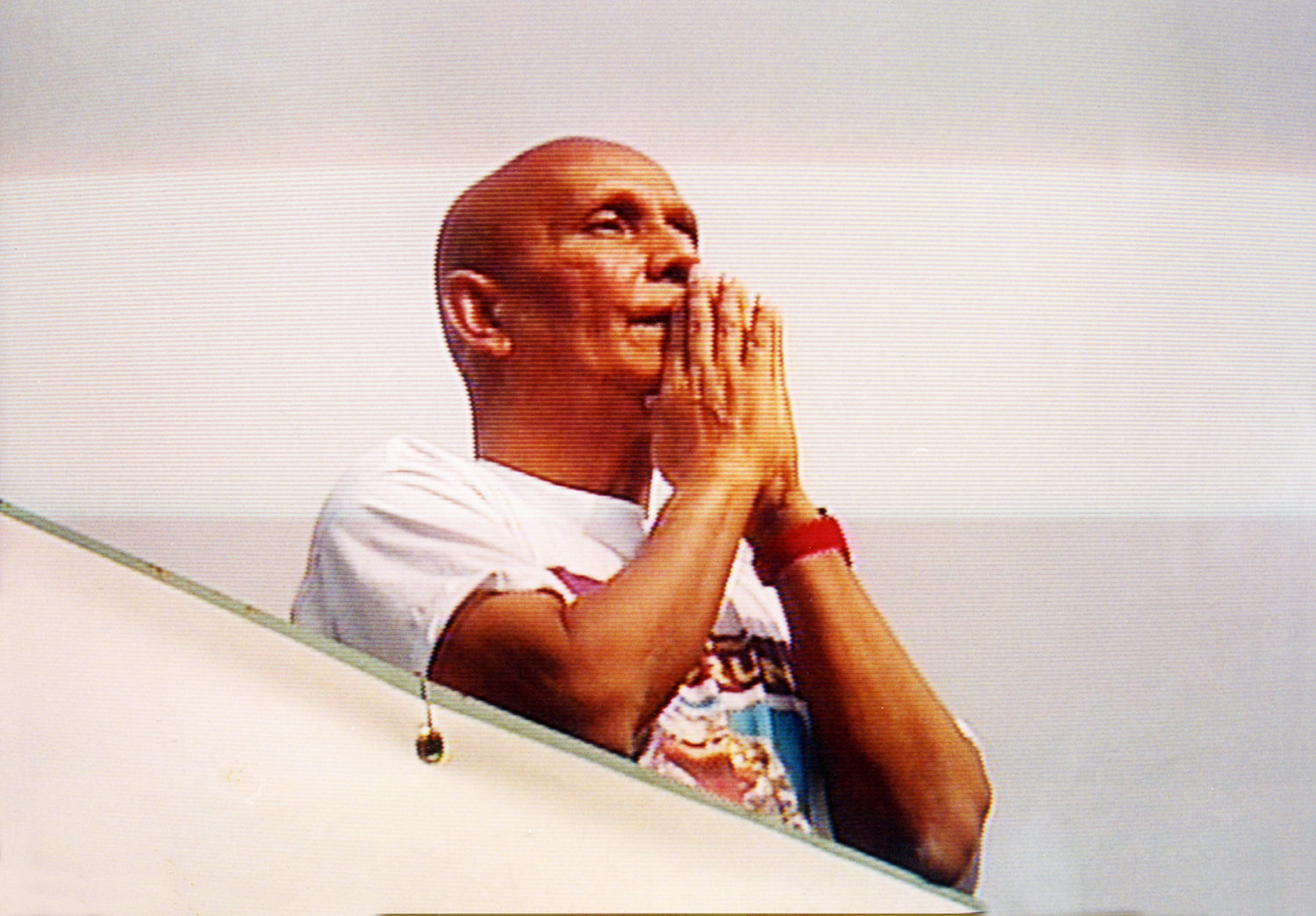
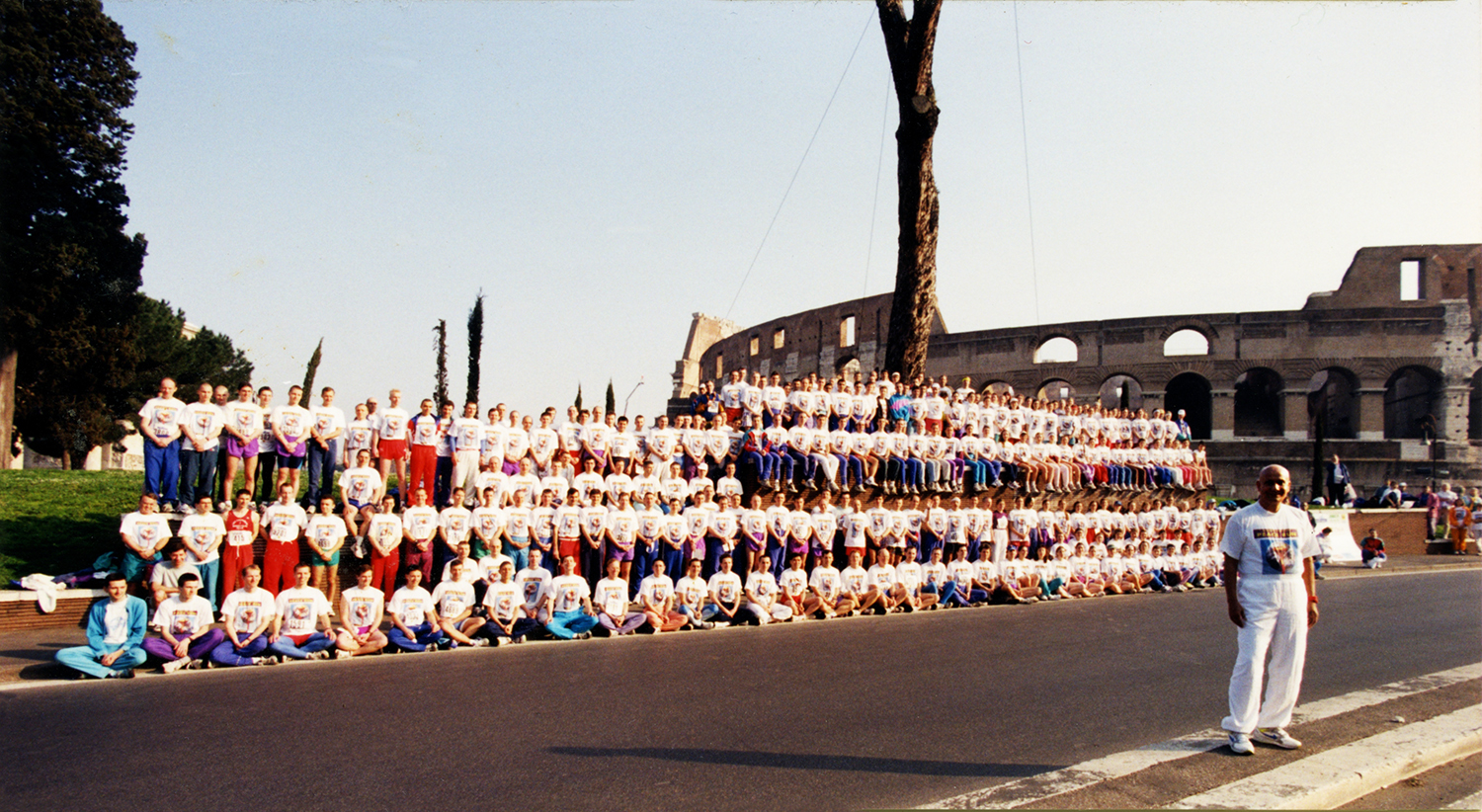
At the request of race director Umberto Silvestri, Sri Chinmoy offers the opening meditation at the Rome City Marathon in Italy. The race has 16,000 participants, including 340 of Sri Chinmoy’s students.

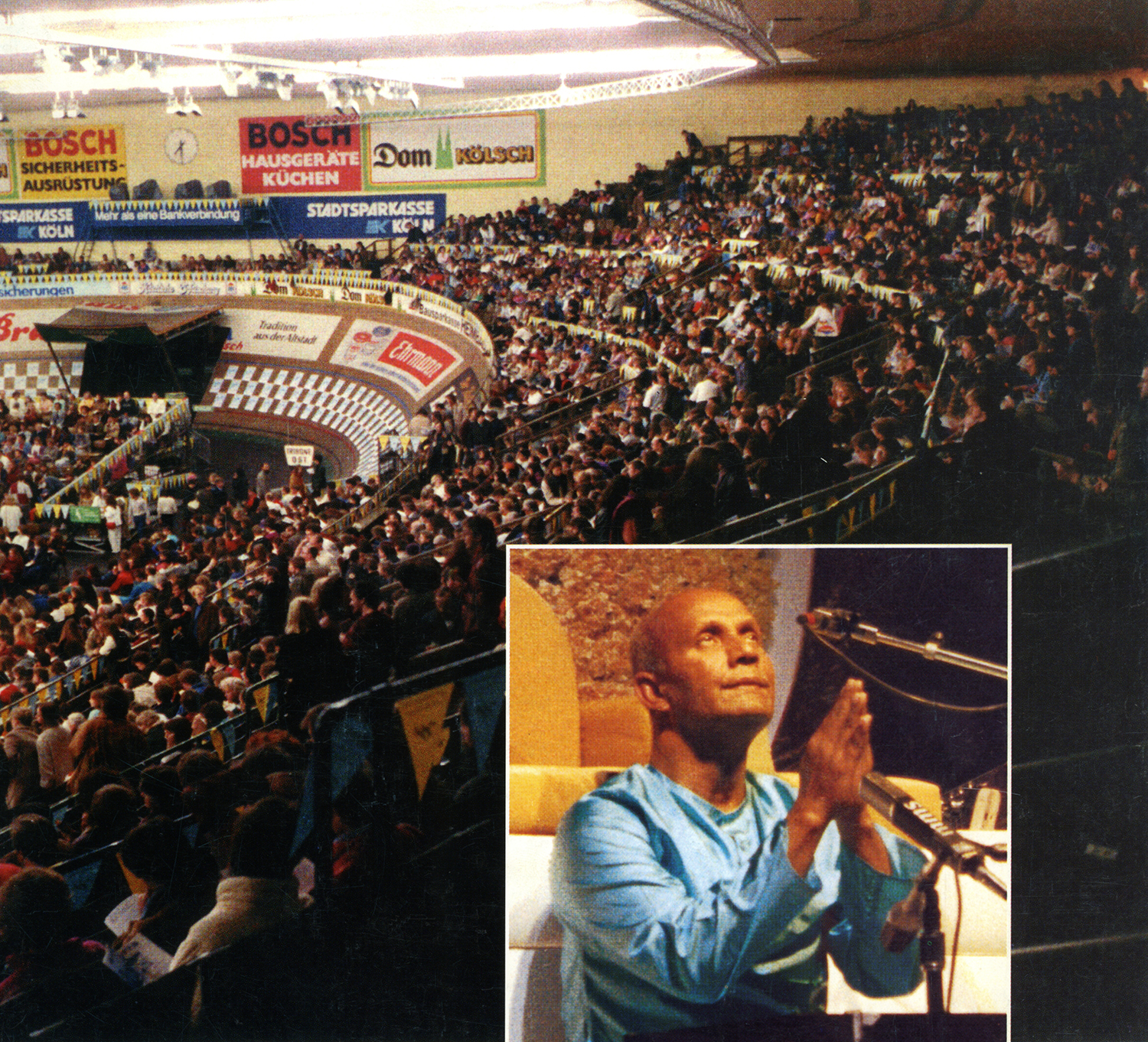
Sri Chinmoy offers his first Peace Concert to an audience of over 8,000 at the Sporthalle in Cologne, Germany. Watch the full-length video of the concert... Listen to the CD recording of the concert...
Address to the audience at the conclusion of the concert:
“Beloved Germany, breathlessly I am bowing to your soul. Soulfully, I am loving your heart. Devotedly, I am admiring your life. To me, stupendous is your soul. Generous is your heart and precious is your life.... My beloved Germany, to you my aspiration-heart and my dedication-life bow and bow and bow.” — Sri Chinmoy
Listen to Sri Chinmoy’s Peace Concert address

