March 30

I Watch, I Pray

A lecture by Sri Chinmoy
at C.W. Post College, Long Island University
Greenvale, New York


I watch before I pray. I watch if there are undivine thoughts trying to assail my mind. Needless to say, I do not surrender to these undivine thoughts.

I watch before I pray. I watch if there are divine thoughts trying to inspire my heart. Needless to say, I welcome these thoughts with my open mind, open heart and open arms.

I pray, and then I watch. I watch and see if the jealous world is trying to rob me of the peace, light and bliss that I have acquired from my prayer. Needless to say, my conscious awareness prevents the jealous world from robbing me.

I pray, and then I watch. I watch to see if there are sincere seekers who would like to have the peace, light and bliss that I have acquired from my prayer. Needless to say, to them I immediately offer my peace, light and bliss devotedly, soulfully and unreservedly.

God watches me pray. Through my prayer He expects me to change for the better: to have a better consciousness, better aspiration and a better realisation.

God watches me pray. Through my prayer He expects me to become a more soulful instrument of His, Him to serve unconditionally in His own way.

God watches me pray. Through my prayer He wants me to become an unconditional seeker, an unconditional server and an unconditional lover.

Before God created this world, He watched and measured the ascendance of His Silence-Height. Now that God has created the world, He watches and measures the excellence of His Sound-Might.

I pray, I watch, I accept and, finally, I embrace the Feet of my Beloved Supreme with my heart's purity. God meditates, accepts and, finally, embraces my heart with his constant Self-giving Reality and Self-giving Divinity.


Published in Wisdom-Waves in New York, part 1


A Promise was a Promise

A brief talk by Sri Chinmoy
at his home in New York


Centuries ago, in the Vedic seers’ time, a promise was a promise. If you made a promise, the story was finished. Even at the time of the battle of Kurukshetra, a promise was a promise. They believed in their promise, and they would kill themselves to keep their promise.


Published in Not Every Day, but Every Moment: Illumining Questions and Answers, Comments and Talks


March 30

Photo by Pulak Viscardi


Sti Chinmoy poses for a photograph with a very happy Indian family who had just been lifted at Public School 86 in Jamaica, Queens, New York.


March 30

An Honour to Run with You

A story by Sri Chinmoy


During the seven-mile race today, one man was with me for the entire time. I followed him and he followed me.

After three miles he took two glasses of ERG and offered one to me.

At one point, he went five or six metres ahead of me. I said, “Where is he going?” Then I ran fast and caught him.

He finished just a little ahead of me.

Then he shook hands with me and said, “It was such an honour to run with you.”


Published in Run and Become, Become and Run, part 3


The Past is Gold

A story by Sri Chinmoy
on 20 September 1981


I always say that the past is dust. In my case the past is gold. For inspiration I was watching a videotape of my best seven-mile race performance in Connecticut on 30 March 1980. That day I ran at a 7:19 pace. So the past for me is not dust; it is gold.

Five minutes before the race, Wally brought me a cup of coffee and I got strength from it in the beginning of the race. But later on it stopped working.

One man ran next to me. He was Mohan’s brother-in-law. He gave me drinks along the way. Then he went ahead of me at the last moment. At the end, after finishing, he congratulated me.


Published in Run and Become, Become and Run, part 7


Sri Chinmoy runs personal bests for 3, 4, 5, 6 and 7 miles – his 3-mile split time is 21:31 (7:10/mile pace); 4-mile split time is 29:04 (7:16/mile pace); 5-mile split time is 36:39 (7:20/mile pace); 6-mile split time is 44:09 (7:21/mile pace); and 7-mile time is 51:18 (7:20/mile pace – at the Sri Chinmoy 7-mile Race in Fairfield, CT, USA.


Nature Will Help Me

A story by Sri Chinmoy


This morning I went to our Runners Are Smilers race. I walked the two miles in 38 minutes and 56 seconds. Unfortunately, my knee was extremely painful. In the afternoon Saroja made a special compress for me. I gave her the recipe. It consisted of eggplant, cabbage, onion, cauliflower, squash, pumpkin, avocado, mango, mushrooms, ginger, garlic, tamarind paste, chilli and a few spices. She blended them into a paste and then heated them together to make a poultice. I really feel that nature will help me.


Published in Walking-Challenging-Becoming, part 1


March 29


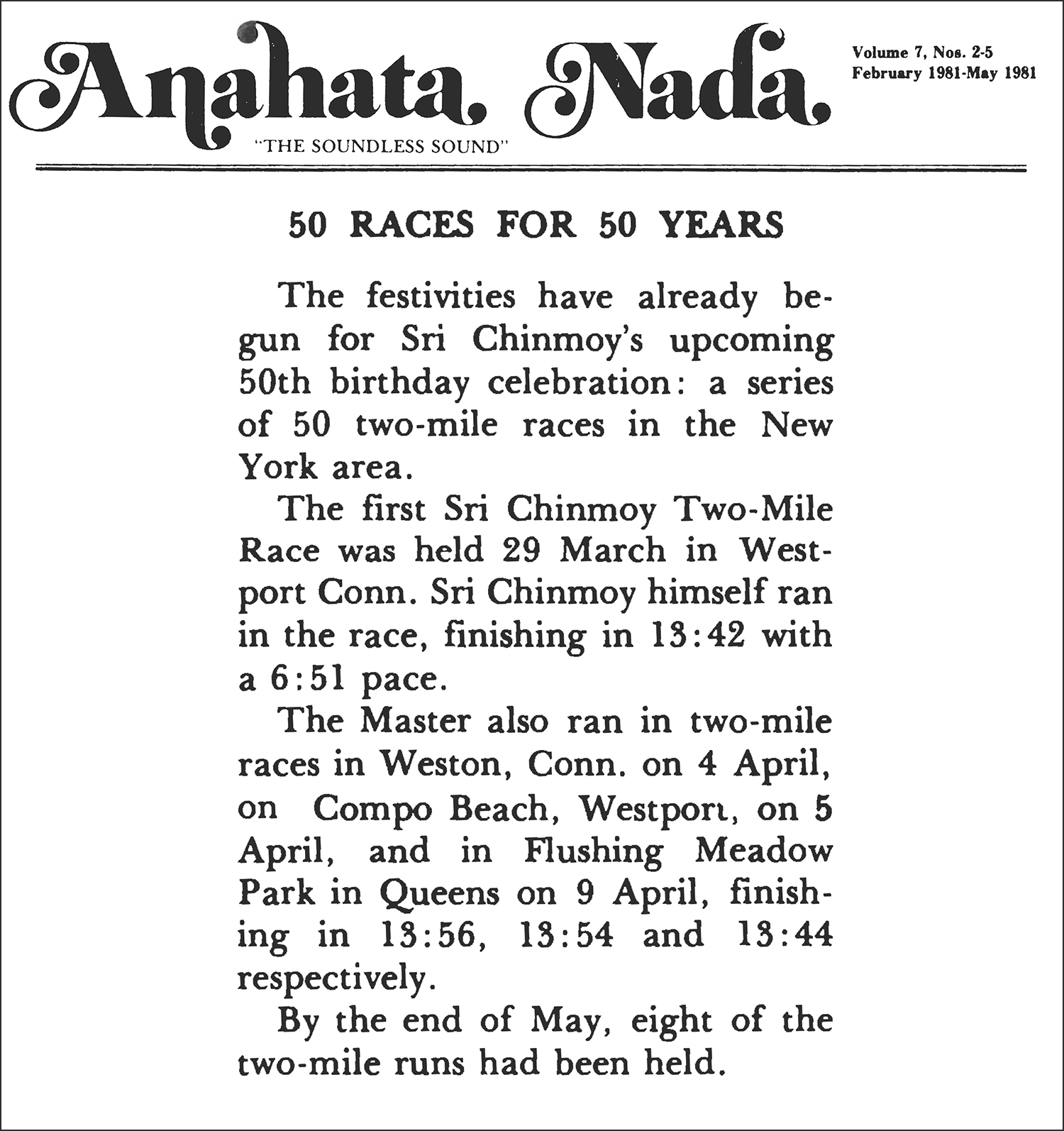
50 RACES FOR 50 YEARS


The festivities have already begun for Sri Chinmoy’s upcoming 50th birthday celebration: a series of 50 two-mile races in the New York area.

The first Sri Chinmoy Two-Mile Race was held 29 March in Westport Conn. Sri Chinmoy himself ran in the race, finishing in 13:42 with a 6:51 pace.

The Master also ran in two-mile races in Weston, Conn. on 4 April, on Compo Beach, Westport, on 5 April, and in Flushing Meadow Park in Queens on 9 April, finishing in 13:56, 13:54 and 13:44 respectively.

By the end of May, eight of the two-mile runs had been held.


Published in Anahata Nada, Volume 7, Nos. 2-5, February 1981-May 1981


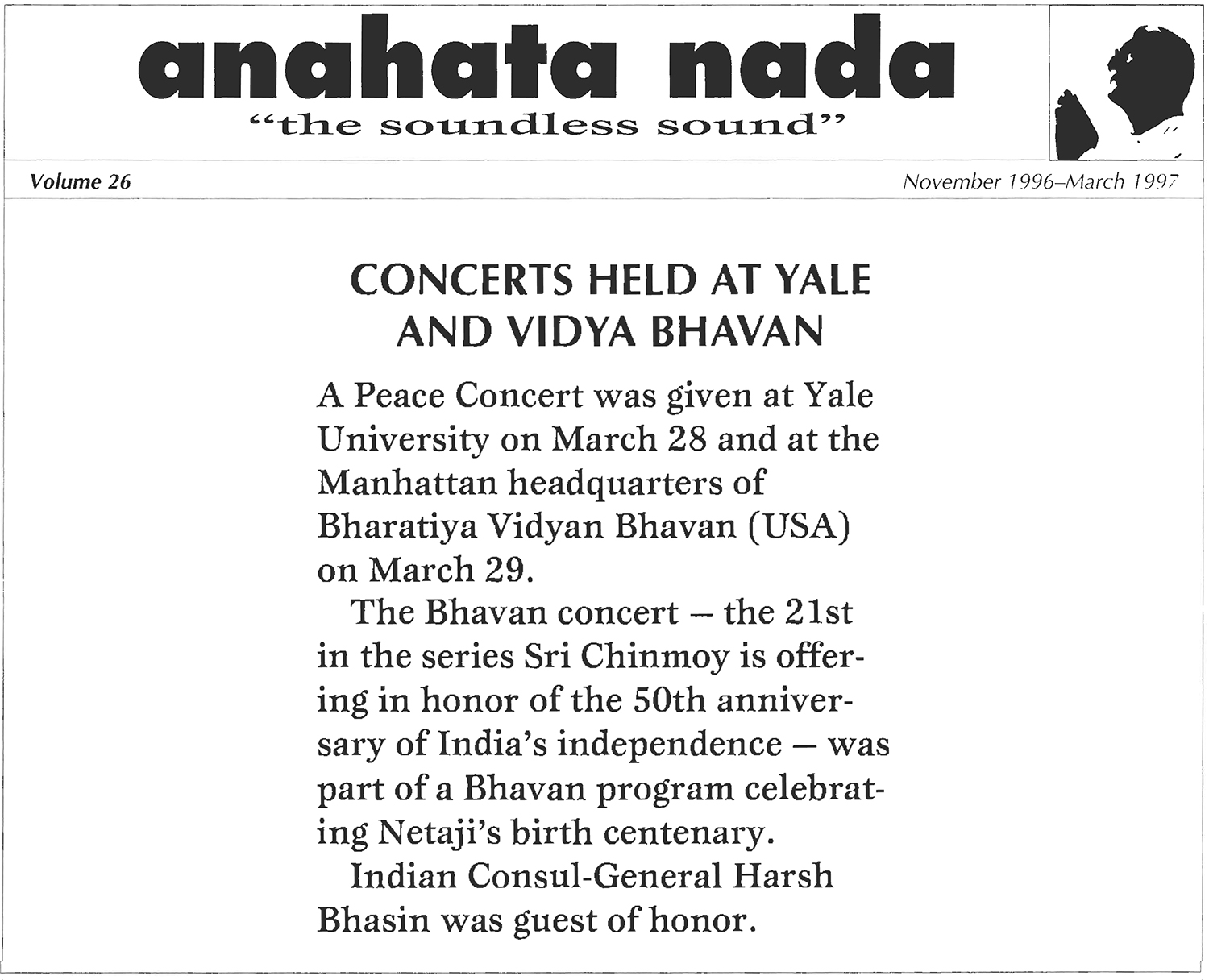
CONCERTS HELD AT YALE AND VIDYA BHAVAN


A Peace Concert was given at Yale University on March 28 and at the Manhattan headquarters of Bharatiya Vidyan Bhavan (USA) on March 29.

The Bhavan concert — the 21st in the series Sri Chinmoy is offering in honor of the 50th anniversary of India’s independence  — was part of a Bhavan program celebrating Netaji’s birth centenary· 

Indian Consul-General Harsh Bhasin was guest of honor.


Published in Anahata Nada, Volume 26, November 1996-March 1997


March 29

Photo by Pulak Viscardi


Sri Chinmoy signs a Jharna-Kala for one of his guests in Pilgrim-Museum at Aspiration-Ground in Jamaica, Queens, New York.


March 30

Photo by Adarini Inkei


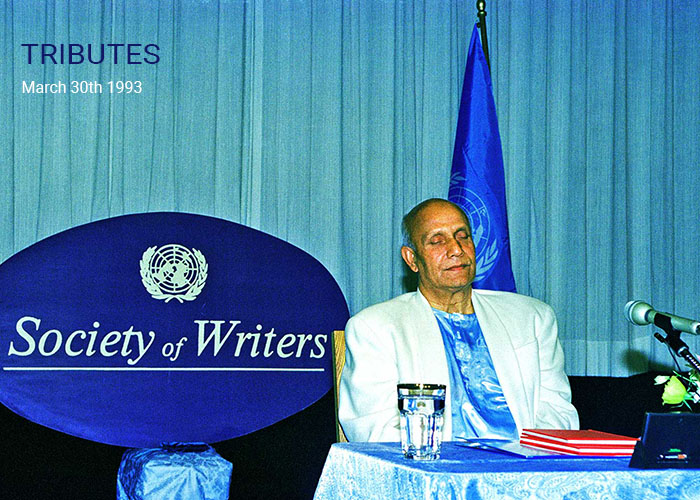
Sri Chinmoy receives the Award of Excellence from the UN Society of Writers (the society’s highest award) for the completion of his 900th book, Love, Compassion, Forgiveness, which he had dedicated to President Gorbachev. Sri Chinmoy then reads two of his poems — his very first poem in English, ‘The Golden Flute’ written c. 1952-53, and a poem he had written just a few hours prior to the award ceremony held at the United Nations in New York. Sri Chinmoy concludes with a note of gratitude to his hosts and a short talk, entitled ‘American Freedom In My Poetry


My Aspiring Heart’s Poetry-Flames

A talk by Sri Chinmoy after receiving
the Award of Excellence


I do not know how I can possibly be worthy of this blessingful honour. I am known as a truth-seeker and a God-lover. But today I have become a poet as well.

May I read out to you the very first poem that I wrote in English?

The Golden Flute

A sea of Peace and Joy and Light
Beyond my reach I know.
In me the storm-tossed weeping night
Finds room to rage and flow.

I cry aloud, but all in vain;
I helpless, the earth unkind!
What soul of might can share my pain?
Death-dart alone I find.

A raft am I on the sea of Time,
My oars are washed away.
How can I hope to reach the clime
Of God's eternal Day?

But hark! I hear Thy golden Flute,
Its notes bring the Summit down.
Now safe am I, O Absolute!
Gone death, gone night's stark frown!

So that was my very first attempt — over forty years ago. And this particular poem that I am going to read out is only three hours old. You will see the difference. You can call it either my most deplorable degradation and say that I have gone "downhill", or you can say that I have made progress in a different way.

There was a time
When the poet in me
Prayerfully desired to roam and roam
Inside my heart-garden.

The poet in me now sleeplessly cries
To clasp the flower-beauty
Of my heart-garden.

And before long, the poet in me
Will meditatively grow into
The nectar-fragrance-delight
Of my heart-garden.

I have been living in America for the last twenty-nine years, so I am enjoying American freedom in my poetry. When I embarked on my poetic career many, many years ago, I was compelled from within and without to learn English metre well. I had to learn iambic, dactylic, trochee, anapaest — endless English metre — as well as rhyme. But now I enjoy full freedom: I do not need metre; I do not need rhyme — nothing, nothing! It is a flow. When I was writing poems in those days, I felt that I was playing on the flute. Now when I write poems, perhaps I am striking gongs or playing on the synthesiser. But I feel that light and power are inseparable. They are the obverse and reverse of the same universal reality.

In my family, almost everybody has written poems. My father wrote about thirty poems; my two older brothers, one to a hundred; and my eldest brother, two or three thousand. I am the youngest and also, it seems, the most greedy. Over 50,000 poems go to my credit. My critics justifiably criticise me for having written so many poems. They say that I believe only in quantity and not in quality. They are perfectly right in their own way or according to their own judgement. But I feel that quantity is necessary as well as quality. I visit the supermarket quite often. The supermarket has many varieties of food, and I am able to choose what I need or want. If the supermarket had only one thing, I would be disappointed along with hundreds of other customers. So quality and quantity must go together.

It is very difficult to be a real judge of quality. I am an artist. Over 140,000 paintings I have completed. Some of my paintings I sincerely feel are not good at all. But to my utter astonishment, some people immensely appreciate those particular paintings, and I feel they are sincere in their appreciation and judgement.

A tree produces beautiful flowers as well as countless leaves. If we only care for the beauty and fragrance of the flowers and pay no attention to the leaves, then we are making a deplorable mistake, a Himalayan blunder, for the leaves also have beauty in their own way. A tree is beautiful and fruitful only when we look at it right from the ground to the highest branch. Only when we look at the tree as a whole and try to appreciate what it has and what it is can we do proper justice to its beauty, its compassion and its perfection.

I am extremely grateful to this distinguished Writers Society for bestowing upon me this signal honour at a time in my life when I am not as well known in the world of poetry as in the world of truth-seekers and peace-servers. People know me as a student of peace, as a truth-seeker, a God-lover and a world-server. But here my friends and colleagues have found an entire sun inside some of the climbing, aspiring poetic flames I have created. And for that I am extremely, extremely grateful to them.

It has happened in many cases that the world is apt to appreciate someone only when he is already known in a particular field. The world waits and waits until he is famous before appreciating him. I wish to tell you a most deplorable incident in the life of India's greatest poet, Rabindranath Tagore, the Nobel Laureate. Only two weeks before he received the Nobel Prize for Literature in 1913, the editor of a significant and popular magazine in Bengal printed one of Tagore's poems and mercilessly criticised it from the first line to the last line. The Bengali editor found nothing beautiful, nothing soulful, nothing fruitful in the poem. Then, after Tagore got the Nobel Prize, the same poem was printed in the same magazine. But this time the editor extolled that particular poem to the skies. Not only each line but each word came down directly from Heaven — that was his proud comment! So we see what the Nobel Prize can do. Because Tagore had been accepted by great literary authorities, immediately the editor changed his mind.

This year is the centenary of the World's Parliament of Religions. Swami Vivekananda was a great friend of Tagore. As you know, Swami Vivekananda's most significant utterances were made in Chicago when he addressed the world conference. Before he spoke at the world parliament, he was nobody, absolutely nobody, in India. But after he became famous overnight in America, immediately Bengal and the entire India accepted him.

Unfortunately, only when the outer world or some well-established authority praises someone or justifiably acknowledges his merit is everybody else apt to appreciate that person. Although I am not known as a poet, still you are recognising the poet in me. For that I am deeply grateful to you. Who knows, in the future, with a stroke of good luck, I may be known as a poet. At that time I will feel that you saw something in me long before others were able to see it.

I have already spoken to you about quality and quantity. This particular book happens to be my 900th book — Love, Compassion, Forgiveness. I have dedicated this book to my beloved President Gorbachev. About two weeks ago I received a letter from him appreciating me for dedicating this book to him. Also, he said he wants to congratulate me personally in the near future.

Reading the dedication of the book: "Lovingly, affectionately and gratefully I am dedicating this book to the President Gorbachev, the Himalayan Peace-Dreamer on earth."

I wish to say a few words about President Gorbachev. To me, he is a universal figure. To me, he is the highest embodiment of world peace. He is the greatest world peace-dreamer and world peace-distributor. If the present-day world has made considerable progress, or any progress, then he deserves the utmost gratitude from the heart of the present-day world. He is the champion of champions to unmistakably improve the world situation.

In India it is said that a real Brahmin does not have to show his sacred thread to the public in order to prove that he is a real Brahmin. Similarly, I feel that President Gorbachev does not have to show the world his credentials to prove who he really is. He is loved and adored by the aspiration of the length and breadth of the world. He does not need a particular crown or a particular throne in order to prove to the world at large that he is, indeed, a king. President Gorbachev lives in the aspiring heart of mankind. I feel that Gorbachev is a universal king who lives inside the gratitude-heart of the peace-dreaming world. He definitely does not need an outer crown, an outer throne, to lovingly and compassionately guide the evolution of humanity. His inner achievements are so enormous that they can perfectly lead and guide us to our supreme destination, the Golden Shore. For him, peace is not a mere dictionary word. In him, peace is a living reality, a sleepless and all-illumining reality that lovingly and self-givingly inspires the mind and feeds the heart of humanity.


Published in Blessingful Invitations from the University-World


March 29


Sri Chinmoy offers two Peace Concerts — afternoon and evening — to audiences of 2,000 and 2,400 respectively, at Deutsches Museum in Munich, Germany.


Twenty-First Century, No More Hungry Penury

Lyrics:

Twenty-first Century,
No more hungry penury.
Twenty-first Century,
A newness-fulness-glory.
Twenty-first Century
World-transformation-story.


Published in The New Millennium


Marcrh 29

Desire and Aspiration

A lecture by Sri Chinmoy
at New York University in New York


America’s fond child is New York. New York’s fond child is New York University. This evening I wish to offer my sincere affection, true admiration and humble dedication to you, O fond children of the New York University.

Desire is a wild fire which burns and burns and finally consumes us. Aspiration is a glowing fire that secretly and sacredly uplifts us, our consciousness, and finally liberates us.

Thirst for the highest is aspiration. 
Thirst for the lowest is annihilation.

Desire is expectation. No expectation, no frustration. Desire killed, true happiness built. Aspiration is surrender. Surrender is man’s conscious oneness with God’s Will.

As war brings the commerce of a country to a standstill, even so our tremendous inclination to the pleasures of ignorance brings all our inner spiritual movements to a standstill.

Already as things exist at present, our very birth compels us to be far away from God. Why wallow deliberately in the pleasures of the senses and move farther away from God? Indeed, to satisfy the imagined necessities of our human life and cry for the fulfilment of the earthly pleasures cannot but be self-torturing evil. But to satisfy God’s necessities, real and divine, in us and through us, is self-illumination.

Poor God, ill-lit men always take you amiss. They think that you are merciless. Yet when you fulfil their lecherous desires, they think that nobody on earth can surpass you in stupidity.

Now poor man, look at your most deplorable fate. In the apt words of Bernard Shaw: “There are two tragedies in life. One is not to get your heart’s desire, the other is to get it.”

Desire means anxiety. This anxiety finds satisfaction only when it is able to present itself before solid attachment. Aspiration means calmness. This calmness finds satisfaction only when it is able to present itself before the all-seeing and all-loving detachment. In desire and nowhere else abides the human passion. Human passion has a dire foe called judgment, the judgment of the divine dispensation.

In aspiration and nowhere else dwells man’s salvation; man’s salvation has an eternal friend called Grace, God’s all-fulfilling Grace.

Desire is temptation. Temptation nourished, true happiness starved. Aspiration is the soul’s awakening. The soul’s awakening is the birth of supernal delight.

A true seeker of the infinite truth never can gain anything from Oscar Wilde’s discovery. He says: “The only way to get rid of a temptation is to yield to it.” The seeker has already discovered the truth that it is only through high, higher and highest aspiration that one can get rid of all temptations, seen and unseen, born and yet to be born.

Wilde says something else and this is quite significant. “I can resist everything except temptation.” Needless to say, nobody blames him for that for temptation is a universal disease. For a mortal without aspiration, temptation is unmistakably irresistible. But a true seeker feels and knows that he can resist temptation, but what he cannot resist is transformation, the transformation of his physical nature, his entire consciousness in the bosom sea of Time. Of course, the transformation of his physical nature, his entire earthly consciousness — never did he resist and never will he. On the contrary, that is what he is on earth for.

Look at the strength of a bubble of desire! It has the power to encage our entire life for its absolute use. Look at the strength of an iota of aspiration. It has the power to make us feel that God the Infinite is absolutely ours. And something more, God’s infinite Love, Peace, Joy and Power are for our constant use.

The objects of the senses and man’s attachment to them are inseparable. But the moment they see the smile of God, they fail to admit their intimacy. What is more, they become perfect strangers.

Fulfil your body’s demands and you lose your self-control. Fulfil your soul’s needs and you gain your self-control.

Don’t desire vice. In refraining, you will possess something more valuable — self-control. What is self-control? It is the power that tells you that you have not to run towards your goal. The goal has to come to you and it shall.

The capital of the outer world is money, which very often changes itself into poisonous honey. The capital of the inner world is aspiration which eventually transforms itself into self-realisation.

The acme of human desire is represented by Julius Caesar: Veni, vidi, vici. (I came, I saw, I conquered). The pinnacle of divine aspiration was voiced forth by the son of God. “Father, let Thy Will be done.”

Passion’s slave is man. God’s child is likewise man. What do you want to be? God’s child, or passion’s slave? Choose. One selection leads you to utter destruction, the other to immediate salvation. Choose, you are given the golden and unconditional choice. Choose, choose you must. Here and now.


Published in AUM – Vol. 5, No. 1, 27 Aug. 1969


Yoga and Faith

A lecture by Sri Chinmoy
in the Ross Building at York University in Toronto, Ontario, Canada


Dear sisters and brothers, two weeks ago I came to Canada from the United States. The seeker in me desired to offer its dedicated service to the soul of Canada. Today I will be offering the last of my sixteen talks. It is said that morning shows the day, and in our case it has proved to be so. Right from our journey's start, by the Infinite Grace of the Almighty, we have been able to offer our dedicated service devotedly and soulfully to the soul of Canada. Tomorrow I shall be leaving for America. The physical in me will go back to the States, but my loving heart will remain here in Canada. The soul of Canada has given me ample opportunity to be of service to her, and for that, again and again, I wish to offer my deepest gratitude from the inmost recesses of my aspiring heart.

Here we are all seekers. In the life of a seeker, aspiration is of paramount importance. Now, aspiration is a most complicated word for those who wallow in the pleasures of ignorance. But aspiration is something natural, normal and spontaneous for those who want to simplify their life. How can we simplify our life and, at the same time, receive God's boundless Bounty so that ours can be a life of complete satisfaction? The answer lies in the acceptance of yoga.

Yoga is a Sanskrit word that means union, conscious union with God. Now, there is a vast difference between conscious union with God and unconscious union with God. The seeker who practices yoga becomes consciously aware of his union with God. He constantly feels that he is of God and for God. An unaspiring person, on the other hand, does not know or care to know who his Source is or what his role should be here on earth in God's cosmic Game.

Yoga is love. We love God because He is all Love. We love human beings because we feel that God abides in each human being, and that we and they are sailing in the same Boat, the Boat of Love. We all have a destination, and this destination is perfect Perfection.

In India there is a well-established path of renunciation. Aspirants who walk along this path say, Neti, neti — "Not this, not that." What do they want from life? They want something abiding, something sempiternal. From the finite they want to go to the Infinite; from the mortal they aspire to reach the Immortal. These seekers are not satisfied with what they have or what they see around them. They want to live in the flow of the ever-transcending Beyond.

Now I wish to tell you an amusing anecdote: there were once two friends, an atheist and a believer. One day the atheist said to the believer, "Brother, I am so surprised at your renunciation. This world is full of pleasure, full of comfort, but you have renounced all of it! Just for God you have renounced all these enjoyments. You are really great." The believer replied, "If I am great, you are infinitely greater than I am. God is infinite Love, infinite Joy, infinite Peace — not only for me, but for the entire world. Look at your capacity for renunciation! You have renounced all this merely for the enjoyment of a few fleeting earthly pleasures. So your renunciation is far greater than mine!"

We know that there are millions of people here on earth who do not believe in the existence of God. But they do believe in something; they believe in negation. They believe that there is no God, no God whatsoever. Yet even in that 'no' we feel the presence of the living God. In their negation of divine Truth and Light, of God Himself, we feel an affirmation of our divine Beloved, precisely because we see in their negation the seed of faith — even if, right now, it is faith in their denial.

Now, in addition to the atheist, we have another friend, the agnostic. Our agnostic friend doubts the existence of God. He asks us, "Where is the proof? Prove God's existence, and then I will have faith in God!" Let us just ask him one thing: "Do you believe in anything?" He is bound to reply, "Yes, I believe in my body, in my mind, in my vital." Then we shall say, "Stay with your belief. According to our wisdom, your belief in your body is your belief in God, your belief in your mind is your belief in God, your belief in your vital is your belief in God. It may not be my God, but it is your God. I am so glad that you have faith in something."

In this world, sooner or later everybody feels the necessity of sincerity. Today an individual may try to fool the world, but tomorrow something within him, some inner urge, will compel him to be sincere, precisely because inside him Divinity does exist. Now, a doubter has faith in his body-consciousness, but he doubts the existence of God. I tell the doubter to have faith in his body. But there will come a time when the body will tell him that it cannot constantly satisfy him. There are many things that he wants from life which the body cannot give him. Naturally he will someday go to somebody else who will be able to give him satisfaction. The body will tell him, "I have tried my best to satisfy you, but my capacity is limited. Now please go to the soul. There you are bound to see and feel satisfaction."

The soul is the conscious representative of God, but the soul itself is not God. A child has wealth, but the source of the child's wealth is his parents. God the Father and God the Mother are the soul's parents. The soul, being totally illumined, tells the seeker who was formerly a doubter but who, with the grace of his own aspiring body consciousness, came to discard his doubt, "Come, I will show you my Father and my Mother. They are God the Father and God the Mother."

Now, in the spiritual life, there is another way to approach a doubter besides telling him to believe in the body. We can say, "Instead of doubting, just give a chance to your heart. Right now you feel that the highest member of your inner family is the mind. If the mind asks you to do something, you immediately do it. On rare occasions you may revolt, but most of the time the mind is your lord. Now give your heart a chance. It is a higher member of your family."

In order to know the reality, we have to approach it in a specific manner. If God is the Reality that we would like to experience, then we need to approach Him through faith and love. If we can develop faith, then inside this faith, divinity is bound to loom large.

Faith is for those who have consciously, soulfully, devotedly and unconditionally begun to walk along the path of Truth. Faith is of paramount importance in the life of a seeker. A seeker needs faith in his own life of aspiration and he also needs implicit faith in God.

The mother tells the child, "This is your father." Immediately the child believes. The mother tells him, "This is the alphabet and this is the letter A." immediately the child believes. "This is fire," she explains. The little child does not argue with his mother. Then, when he grows up, he understands for himself who his father is, what the alphabet is and what fire is. In the spiritual life also, we start our journey with faith and we grow with faith.

When a man of faith completes his journey, he has a special realisation. In the beginning, before his God-realisation, he thinks that he has worked very hard. He realises that his personal effort and God's Grace go together, but he feels that his effort brought about ninety-nine per cent of the result, and God's Grace perhaps one per cent. But when he realises God, immediately he comes to know that God's Grace did ninety-nine per cent and his personal effort did one per cent. And then, because he knows what God's Compassion and infinite Bounty did for him as a seeker, he comes to realise that even the one per cent of his own aspiration and progress was the result of God's Grace. In his immediate family he sees that there are individuals who are still wallowing in the pleasures of ignorance. How is it that he is fully awakened? It is the Grace of God operating in and through him that has made him realise God while others are still fast asleep.

There is a false yoga and there is a true yoga. One reason that many people are reluctant to accept yoga is that they have misconceptions about it. False yoga will tell us we have to enter into the Himalayan caves in order to realise God. False yoga will tell us that God-realisation can be achieved overnight. False yoga will tell us that if we offer millions of dollars to a particular spiritual Master, he will grant us God-realisation immediately. False yoga will tell us that we have to renounce everything — everything that we have and everything that we are.

True yoga will tell us that we do not have to go to the Himalayan caves in order to realise God. We will be able to realise God wherever we are, for God is realised in the heart. The heart is not only the best place for God-realisation, but the place. True yoga will say that God-realisation cannot be attained in the twinkling of an eye; it is a long, arduous process. True yoga will say that we do not have to renounce anything; we have only to transform. If we have night within us, we shall transform this night into Light. Many people are frightened to death when the idea of renunciation enters into their mind. But I wish to say that the people who are afraid of renunciation are bound to discover one day that there is no such thing as renunciation; there is only the transformation of ignorance into knowledge, of darkness into light, of earthbound frustration into Heaven-free Delight.

In order to get a Master's degree, which gives us only earthly knowledge, earthly wisdom, we have to study right from childhood for perhaps twenty years. Now, God-realisation is also a subject. When we realise God, what we achieve is Peace, Light and Bliss in boundless measure in our inner being. At that time, we are not dealing with limited knowledge, but with Infinity, Eternity and Immortality. Naturally it will take us many years, many incarnations to reach this supreme Goal.

When God wants to expedite our progress, He becomes the ever-compassionate Father and brings into our life a spiritual Master. When we first hear of a spiritual Master, immediately our human ego comes to the fore. "Why do I need a teacher?" it asks. "Can I not be my own teacher?" Now, this ego is ignorance. To learn something we always need a teacher. We can go to a bookstore and buy the texts that are studied in school, and we can study at home alone. But when we read these books without the help of a teacher, we are at times confused. We may feel that what we are learning is untrue or incorrect. So we go to a teacher for expert help and proper guidance. He convinces us of the truth of what we learn. In the spiritual life also, a teacher is of paramount importance. It is true that the first person on earth who realised God had no human guru. But we know that from time immemorial, all spiritual Masters have taken help from their predecessors.

Today we are students, but we will not remain students forever; someday we ourselves will be teachers. We shall realise the Truth as our Master has already done. If we are wise, we want to expedite our spiritual journey. We feel that time is a great factor. If we can achieve something today, we shall not wait for tomorrow. To go from New York to Canada, I chose to travel by airplane rather than car, because the airplane is much faster. After an hour's flight, I touched down on Canadian soil. Right after my arrival I started my journey, and I have been able to serve the Canadians according to my capacity in many cities during my two-week stay. In the spiritual life, we feel that speed is of tremendous importance.

The first and foremost goal for us right now is the realisation of Truth. Let us forget about the word 'God.' It often creates tremendous problems for us. But if we are very sincere, we cry for Truth. There is nobody who will deny the existence of Truth. We want to be sincere, and the proof of our sincerity is that we want to see the face of Truth. First we see the face of Truth, then we try to reveal the face of Truth and finally we try to manifest the face of Truth. The sooner we can attain to this Truth, the better, for the realisation of Truth is not the end of our spiritual journey. Revelation is necessary and manifestation is necessary. Only when we can manifest the Truth will satisfaction dawn in our life.

Madhuman me parayanam
Madhumat punarayanam

"Sweet be my departure from home. Sweet be my return."


Published in My Maple Tree


Sri Chinmoy reads his poetry at a programme with Pulitzer Prize Authors at the United Nations in New York.


Listen to Sri Chinmoy reading his poetry.


There was a time
When the poet in me
Prayerfully desired to roam and roam
Inside my heart-garden.
The poet in me now sleeplessly cries
To clasp the flower-beauty
Of my heart-garden.
And before long, the poet in me
Will meditatively grow into
The nectar-fragrance-delight
Of my heart-garden.


Published in Twenty-Seven Thousand Aspiration-Plants, part 184, poem no. 18369