April 3


An exhibition of 12,000 of Sri Chinmoy’s artworks, all created in the previous sixteen months, opens at 224 Mercer Street in Greenwich Village, lower Manhattan, New York.


The Creator and the Creations

A short talk by Sri Chinmoy
at Public School 86 in Jamaica, New York


Daily I draw about four thousand birds. While meditating I draw them. They are real birds. These birds are from my concentration and meditation.

At six o’clock every morning I go out. Vinaya drives me. I come back at 7:30. Then, from 7:30 to 8:30, I draw birds in four different notebooks. They give me such joy! The creator and the creations simply become one.

Aspiration, dedication and manifestation: these three go together.


Published in Only Gratitude-Tears


April 3


JHARNA-KALA GALLERY OPENS


NEW YORK (April 3) — The children stood in rapt silence, their hands folded in prayer, as the artist drew each of them a special painting.

As the paintings were handed out, one by one the small faces broke into broad grins.

The painter was Sri Chinmoy, and the children and their parents were attending the opening celebration of their Guru’s new Jharna-Kala gallery.

The block-long gallery, located right next door to the former Jharna-Kala gallery in the Soho art district, was given to the disciples free-of-charge in exchange for renovation and painting work.

The transformation of the building from a printing and greeting card warehouse into a sparkling new gallery took place in a week’s time, with disciples working almost round-the-clock.

The exhibit will be open through the end of April.

Captions:

BEFORE ... renovating an old warehouse

AFTER ... into the new Jharna-Kala gallery


Published in Anahata Nada, Vol. 3, Number 3, April 1 1976


Sri Chinmoy’s Interview

with The New York Times
at Annam Brahma restaurant in Jamaica, Queens, New York


Interviewer: Sri Chinmoy, I was watching a video where you spoke of oneness and your drawings. What do seven million birds mean when you speak of oneness?

Sri Chinmoy: To me, each bird signifies a new hope, a new inspiration, a new journey. Each bird, according to me, embodies oneness. Birds fly in the firmament. They are free. While they are flying, we see that they have an inner openness and an inner oneness. If we have openness and oneness, like the birds, we can enter into various fields of activity.

If you say that I am a jack of all trades and master of none, I will fully subscribe to your view. I draw, I sing, I write, I do weightlifting and quite a few other things. In my case, my life-tree has quite a few branches, but I do feel the oneness of the branches with the trunk, with the tree proper. Each branch has its own significance. Each branch can offer something new, although it belongs to the same tree.

I am a student of peace, and I try to learn my subject by offering it to the seekers who are also longing for peace. I feel we are sailing in the same boat. A student always wants to learn. If he becomes a teacher or a professor, he may not be inclined to learn anymore. But if he remains a student, then he constantly learns new things.

Interviewer: How did you come to Queens?

Sri Chinmoy: I came to America in 1964. I lived in Manhattan for a year or so, and then I lived in Brooklyn. I have been in Queens for about 30 years, in Briarwood. Truth to tell, it was difficult for me to adjust to Manhattan. The hustle and bustle of life was not congenial to my life’s activities. It is not that I dislike Manhattan — far from it! I go to Manhattan twice a week to offer my peace meditations at the United Nations, but I feel that Queens is more peaceful in comparison.

Interviewer: When do you meditate at the United Nations?

Sri Chinmoy: I meditate at the United Nations on Tuesdays and Fridays from one to two o’clock. We have been offering these peace meditations for the last 27 years. When the United Nations celebrated its 50th anniversary, our peace meditation group celebrated 25 years of dedicated service to the United Nations. We are half the age of the United Nations. Our meditation sessions originated under the late Secretary-General U Thant, who was very kind to me.

The first Secretary-General was Trygve Lie, then Dag Hammarskjöld, then U Thant. He came from Burma. He was a close friend of mine, and he inspired me to start the peace meditations at the United Nations. The delegates and staff who are interested come and meditate with us. Over the years we have organised many, many programmes honouring the countries that long for oneness and peace. I have also given many talks about world peace, oneness and harmony at the United Nations.

Interviewer: Are your activities for the staff and delegates?

Sri Chinmoy: Yes. When we have special functions, quite a few ambassadors and delegates from different countries come. Each country, like each branch, has something unique to offer to the world.

Interviewer: You seem to do so many things!

Sri Chinmoy: Life is activity. It is like the ocean. The bottom of the ocean is peaceful, but on the surface it is all tumultuous. Activity and life go together. If we want to become good citizens of the world, we have to be part and parcel of the world. We cannot enter into the Himalayan caves and ignore the world. If I consider my fellow citizens to be members of my family, then there has to be mutual give and take. I give you what I have; you give me what you have. One person does not and cannot have everything. But if we are united, I offer you my goodwill, good wishes and whatever I have, and you offer me what you have. Only in this way can we establish a oneness-world-family.

I have been to many parts of the world and met with world leaders. This same theme we have discussed: how we can bring about world peace. We sincerely try. Still world peace is a far cry, but we have made an attempt. There is nothing wrong in making attempts. If we fail, we fail. I take failures as the pillars of success. Yesterday we failed; today we are failing. That does not mean that tomorrow also we are going to fail.

It is the same in all spheres of life. Last year, at the Olympics, it seemed that Carl Lewis would fail in the long jump. He was not even among the first three places. Then all of a sudden he became the gold medallist.

Interviewer: Do you play basketball?

Sri Chinmoy: In India I used to play basketball. Now I practise taking free throws from the penalty line. Usually I throw a hundred times, and then I take a little rest before throwing another hundred times. I practise on a regular basis when the weather permits it. My highest score is 79.

Interviewer: No kidding — 79 out of 100!

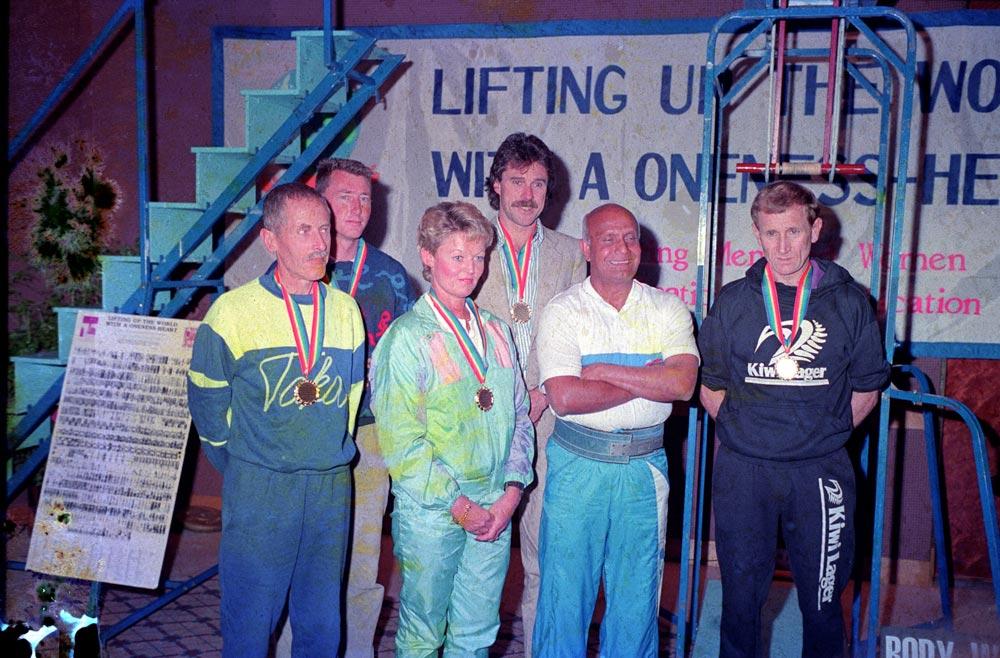
Sri Chinmoy: In India I also played soccer. For many years I was captain of the soccer team in our spiritual community. I was also a volleyball captain and instructor. Here in New York I have played tennis. Some great tennis players have been very kind to me. They have come and played with me here at our court in Queens. Monica Seles, Steffi Graf, Ilie Nastase and Ramesh Krishnan came at different times to encourage me. After playing a few sets, I lifted each of them with one arm using a special apparatus. I have lifted people from many walks of life, and they all got joy. We call the programme Lifting Up the World with a Oneness-Heart. These world-citizens are great in their own fields, so I have honoured them in my own way. In India, whenever people do something great, they are lifted up on the shoulders of their colleagues.

Interviewer: So this has a symbolic meaning?

Sri Chinmoy: Yes, it is symbolic.

Interviewer: May I ask you about your bird drawings? This idea came to you about six years ago?

Sri Chinmoy: Yes, in December 1991, to be precise.

Interviewer: Was it a dream, a vision, an understanding?

Sri Chinmoy: It was a special inspiration. It came to me in a flash, but it did not come from my mind. I do not use my mind to know what I am supposed to do from one moment to the next moment. Being a seeker, I only pray to God to guide me in His own Way. I pray: “Please make me a choice instrument of Yours. Do utilise me. Please give me the capacity to inspire people and at the same time enable me to be of better service to You.” That is my prayer.

This year my Beloved Supreme has inspired me to offer fifty concerts honouring India’s independence. India achieved her independence fifty years ago.

Do you come from Japan?

Interviewer:  I was born there, yes.

Sri Chinmoy: This year I was there for two months. My most favourite place is Lord Buddha’s statue at Kamakura. I have been there seven times, and two or three times I have given concerts in front of the Lord Buddha.

Interviewer: Sri Chinmoy, who are the living or historical men whom you admire most?

Sri Chinmoy: Among the world figures of our time, there are many whom I admire, but first and foremost is President Gorbachev. After him come Mother Teresa, the present Pope1 and President Nelson Mandela. There are other world figures whom I have met and greatly admire, like Archbishop Desmond Tutu, President Vaclav Havel and several Secretaries-General of the United Nations.

I would like to say something about my first few choices. In Mother Teresa I find two aspects: the mother and the sister. One moment she is the mother of compassion; the next moment she is the sister of affection. When I see her and talk to her, she blesses me as a mother blesses her child, and again she shows me the utmost sisterly affection.

The Pope also has two aspects: that of a father and that of a grandfather. According to me, he is not only the Holy Father, but also the Holy Grandfather. A father believes in justice. If his children do something wrong, the father will be upset, and he may take action. But the grandfather is all forgiveness for his grandchildren. In his eye, the grandchildren cannot do anything wrong. In this respect, the Pope is like a grandfather.

In my humble opinion, President Gorbachev is the world’s greatest man. He could have acted like his predecessors, like Stalin and others, but his heart came to the fore. Now there is one Berlin; previously there were two Berlins. He was the main instrument to liberate Hungary, Czechoslovakia, Poland and so many other countries in the Eastern Bloc. I am not saying he was the only instrument, but he was the main instrument to liberate those countries. I know how difficult it is to unite two countries, but he has done it. Because of him, there is now one Germany. But his greatest service has been in his own country. He has opened the door to the West. You may call it democracy or something else, but there is an openness now which did not exist previously. How far he has succeeded is up to God and humanity to decide. Humanity will always misjudge us. What is important is how we are judged in God’s Eye.

Before President Gorbachev came to power, world peace was only a dictionary word. Discussion about disarmament and reducing nuclear weapons all came from him. He started it; he was the pioneer. Many people did not trust him in the beginning, but he proved he was sincere. When President Gorbachev took over, for a few years he could have acted like an autocrat, the way his predecessors did, but he did not do this. Instead, he introduced perestroika, glasnost and democracy.

To be frank, politics is not my forté. I am a spiritual seeker. But if I see that somebody is trying to elevate the consciousness of humanity, then I offer that person my wholehearted support. President Gorbachev showed how human beings can be united. In his case, he acted. Many other political figures, forgive me, only talk about peace. One moment they propose world peace; the next moment they drop bombs somewhere. They use the term ‘nuclear weapon reduction’; then we see that they are increasing their weapons. But in President Gorbachev’s case, when he said something, he did it. That is why I take him as the world’s greatest living figure.

Another rare quality President Gorbachev has: he is sincere and brave enough to say that he has made many Himalayan blunders. There are many political leaders who will never admit that they have made any mistakes. President Gorbachev writes in his memoirs that he has made mistakes and now he is trying to rectify them. We are human beings. To err is human; everybody makes mistakes. But there are some who admit that they have made mistakes, while others do not want to admit this. People who admit that they have made mistakes are, according to me, not only great but good people.

Interviewer: Let me ask you about spirituality. I don’t know so much about President Gorbachev, but can I assume that you are admiring him from a spiritual point of view, the way that you admire Mother Teresa and the Holy Father?

Sri Chinmoy: Spirituality has two wings. One we call aspiration, and the other we call dedication. With our aspiration, we pray to God. With our dedication, we serve Him. In the case of the Holy Father and Mother Teresa, we see that they are aspiring. They are praying every day to God. Again, they are also dedicating their lives to humanity.

In President Gorbachev’s case, the whole world can see and feel how many things he has done to serve mankind. He may not pray to God early in the morning like Mother Teresa or the Holy Father, but his very life he has dedicated not only to Russia, to the Soviet Union, but to the entire world. Now he is in Turkey; last week he was in Argentina. He goes to so many places. Why? They invite him because they see something very special in him. They see that he has light. That is why each country adores him. Again, a prophet is not honoured in his own country, so he lost the election very badly. But wherever he goes, people appreciate him. They see that he sincerely means what he says. For him world peace is a reality in his life. His dedication aspect we accept as part and parcel of the spiritual life. He may not pray in the Christian way, like the Pope or Mother Teresa, but he is getting messages from within, and he is trying to express and reveal these messages to the world at large. That is why, for me, he is truly spiritual.

Interviewer: Did you say, “He who serves, prays?”

Sri Chinmoy: Certainly! We serve others because we see them as the embodiment of God. God manifests Himself in and through each human being in a particular way. In a family each and every one may have a different vocation: one will be a doctor, another a musician and so forth. But they are one family. In the evening they come and eat together. Each individual is unique in his own way, and this uniqueness has to be utilised for the betterment of the world.

It is absolutely true that he who serves God is also praying, and in the same way, he who prays is also serving God. Let us say that someone is praying inside a cave in the Himalayas. If he becomes a good person, there will be one less undivine person on earth. In that way, the person praying in the Himalayan caves is also serving humanity.

Again, he who is offering his service is also praying in a special way. An unaspiring person will not dedicate his life even for a fleeting second. A good person will dedicate his entire life. This dedication is nothing other than aspiration. One who embodies light cannot be separated from one who offers his light to the world at large.


Published in Sri Chinmoy Answers, part 11


April 2


SIPRA SPEAKS OUT WITH A FIERY TONGUE


BRISBANE, Australia — Sipra, a 39-year-old schoolteacher, has never been one to mince words, and when she decided to express her spiritual teacher’s philosophy of self-transcendence on April 2, she set off a lot of sparks.

She set a new world record for fire-eating by “consuming” 7,095 burning sticks in two hours, breaking the previous record of 6,606.

“The mind is always limiting,”  explained Sipra, a disciple of Sri Chinmoy. “But when we get out and do something, we find we do have the capacity to transcend ourselves beyond that limit.”

She was aided in her feat by the inner presence of her spiritual Master, Sri Chinmoy, whose photograph she frequently glanced at and whose music was playing on a small tape recorder. Also of help were the heaping spoonsful of ice cream fellow-disciples handed her whenever she burned her tongue.

Sipra did the fire-eating in honour of the upcoming anniversary of Sri Chinmoy’s arrival in the West from his native India on April 13, 1964.


Published in Anahata Nada, Volume 10, Nos. 2-5, February – June 1983


April 2

Photo by Adarini Inkei


Sri Chinmoy plays the esraj for world-renowned war photographer James Nachtwey after lifting him at Aspiration-Ground in Jamaica, Queens, New York.


April 2

Sri Chinmoy Meditates with Nuns

and the Mother Superior of the Benedictine Monastery Heiligenkreuz in Cham, near Zug, Switzerland.


After the meditation at Heiligenkreuz Monastery

Sri Chinmoy: From the depths of my heart I wish to offer my most soulful gratitude to the Mother Superior and to the Sisters of this convent for having given me this blessingful opportunity to pray and meditate at their most beautiful and soulful chapel.

Mother Superior: This reminds me of my visit to South Korea, where we also have Sisters. We had contacts with Buddhist monks and we tried to be one in meditation together.

Question: How can we better manifest the peace and joy that we feel in meditation in our day-to-day life?

Sri Chinmoy: From our prayer and meditation we get solid peace, joy and love. If we can see God the Creator and God the creation as one, if we can feel the same Father inside each and every heart, we will claim the whole world as our own. Then naturally we will be inspired to offer our brothers and sisters the peace, joy and love that we have received from Above. The joy and peace that we receive from the Supreme we can offer to the Supreme in others through our dedicated and selfless service.

Question: What is the difference between prayer and meditation?

Sri Chinmoy: When we pray, we ask for and receive something good and divine: God’s Protection, Compassion, Love and Blessings. But when we meditate, we become those very things. We get God’s Compassion, God’s Love and so forth from Above and assimilate them. Once we become these things, it is our bounden duty to give them to our sisters and brothers in the world. But we cannot give unless we first become. Both prayer and meditation are equally necessary. When we pray, we receive; when we meditate, we become. Then, once we become, we claim God the creation as our own and give back to God the creation everything that we have received from God the Creator.

It is like going to a garden and picking some beautiful flowers. We place these flowers on the altar and pray to Lord Jesus Christ. While we are praying, the fragrance and divinity of the flowers enter into us and, in the depths of our heart, we become this fragrance and divinity. Afterwards, when we go out on the street, people see and feel something in us — although they may not know what it is. And what they see and feel in us they also receive from us. When they see us, they enter into our heart-garden, where they also can get the beauty and fragrance of these most beautiful flowers.

Question: I would like to know your opinion about Jesus Christ.

Sri Chinmoy: I have the utmost love and devotion for the Saviour Christ. The Father is in Heaven and the Son, who represents humanity, is on earth. Again, the Son said, “I and my Father are one.” So, this moment, when the Christ’s consciousness is with humanity, he is the Son; and the next moment, when the Christ becomes one with his Father, he is the Absolute Father — the omnipotent God, who is the Lord of the Universe.

I am an Indian, but I have the same God that you have. He is not the God of Switzerland or of India but the Lord of the universe. So when Christ the Saviour becomes inseparably one with the omnipotent God, he is none other than my Father in Heaven, and my prayer and meditation — like everybody else’s — are going to him. Again, when he is one with humanity, when he is praying and meditating with us and teaching us how to grow into our own highest divinity, at that time I feel that he is like a brother lifting me up to the Father. But when he is in his own highest consciousness — inseparably one with the omnipotent, omniscient, omnipresent Supreme — at that time I feel that he is the Lord of the universe.

It depends on my own consciousness how I approach him: as the one who lived on earth for 33 years or as the one who has existed for all Eternity. This moment I get tremendous joy when I claim him as the Son and feel that he has become one with crying humanity. The next moment I get tremendous joy in seeing him as Lord of the universe, inseparably one with the Father.

Question: What do you say about the Holy Spirit?

Sri Chinmoy: I take the Holy Spirit as the connecting link between the Father and the Son. On the one hand, the Holy Spirit represents earth’s climbing cry. This climbing cry from the depths of the Son’s heart passes through the Son and carries him to the Father. Again, the Holy Spirit is also Heaven’s descending Smile. It brings the Father’s highest Consciousness down to the Son’s earthly consciousness. The Father and Son are being united by the Holy Spirit.

Question: What is the spiritual meaning of the colour blue?

Sri Chinmoy: From the spiritual point of view, the colour blue has several meanings. First of all, blue signifies the vastness of Infinity. Human beings are full of worry, jealousy, fear, doubt and various other negative qualities, which constantly bind us. At the same time, deep within us we have vastness. When we look at the vast sky or the vast ocean, we feel our own inner vastness. Through prayer and meditation we are able to free ourselves from our fears, worries and other limitations and become one with the vastness inside ourselves.

Blue can also be the predominant colour of a person’s aura. Each human being has an aura. It is through our aura that we manifest our divinity. Ordinary people who do not pray and meditate have only one aura. But people who pray and meditate and become spiritually developed are blessed by God with more than one aura.

I have been praying and meditating since my childhood. So God, out of His infinite Compassion, has blessed me with quite a few auras. But the most important and most significant aura, in my case, is blue. It is through this colour in particular that I offer my peace, joy, love and goodwill to mankind.

Question: Did you grow up as a Christian or as a Hindu?

Sri Chinmoy: Up until the age of eleven, I was raised as a Hindu. Then I went to a spiritual community where I prayed and meditated most sincerely and soulfully. After a few years, I went beyond the boundaries of any one particular religion and said, “Now I have only my sincere love of God.”

Hinduism, Christianity, Judaism, Islam and all the other religions are like houses. Everybody is born in a particular house. But after a time we leave our house and go out into the world and mix with our brothers and sisters. If anybody now asks me what my religion is, I will not say Hinduism. I will say that my religion is my constant, conscious and sleepless love of God. Our love of God is the living breath in us, and that is the one universal religion.

Question: In that case, is Christ like a prophet or somebody like Gandhi for you?

Sri Chinmoy: The Christ and Gandhi cannot be put on the same footing; they cannot even be pronounced in the same breath. Gandhi was a leader of suffering India, a saint; the Christ is the Saviour of the whole world. To compare the Christ and Gandhi is like comparing the ocean with a single drop of water.

For me, Krishna, the Buddha, the Christ and a few others are all one; only they go by different names. More than seven thousand years ago, God sent His son to earth and called him Krishna. Then, after some time, He sent the same son to earth and called him the Buddha. About two thousand years ago, He again sent His son to earth and called Him the Christ. But they are absolutely one. Only they came at different times to save and uplift the consciousness of mankind. The Heavenly Father sent them down to carry humanity to His highest Height.

Question: Do you believe in reincarnation?

Sri Chinmoy: Yes, I do believe in reincarnation. God wants us to realise Him. God wants us to be perfect. But in one incarnation we cannot realise the Highest or become perfect. Thirty or forty years ago, let us say, we had so many desires. Then we entered into the life of aspiration and started praying and meditating. At first we had a very small amount of peace, joy and love. Gradually these increased. At the same time, our desires began to leave us. We started decreasing our desires and increasing our aspiration for light, peace and other divine qualities. But this process cannot be completed in a single lifetime. In order to realise God and become perfect, we have to come back to earth many, many times. That is why reincarnation is necessary.

Question: It is the Christian belief that because Christ died on the Cross, we will all reach salvation after our death. What is your view of this?

Sri Chinmoy: When the Christ was on the cross, he became inseparably one with humanity’s suffering, bondage and ignorance, and these things he carried to the highest world. At that time humanity was at a particular stage of development. But the creation has not stopped; God is still creating. As long as creation is taking place, ignorance continues to reappear.

When we speak of God granting us salvation, we are speaking of salvation from sin. Let us say that we have got salvation and we no longer have sin. But that is not enough, for sin is not the only wrong force that we have inside us. It is only one aspect of ignorance. We have many bad qualities, and they all need to be transformed into good qualities. We have to grow from our earthbound desire-life into the vastness of our real Self. For this, we have to be completely liberated from ignorance. In our philosophy, we do not use the word ‘sin’ at all. We speak only of bondage or ignorance. Because we have ignorance, we have to pray and meditate so that Christ’s Consciousness will descend into us and liberate us.

Mother Superior: Tomorrow you are going to see our Federal Councillor, Flavio Cotti. As a final question, I would like to know if you are going there as a private person or as a spiritual leader.

Sri Chinmoy: I am not going there as a spiritual leader. I am a student of peace. Wherever I go, I try to offer the lessons that I have learned from my prayer and meditation. I am going there as a seeker of truth and as a lover of God. Since I pray and meditate, I would like to pray and meditate with him for world peace.

I am so grateful to you, Mother Superior, for allowing me to be here. Twenty-three years ago I visited a chapel in Puerto Rico. Some Sisters saw me and became disturbed and annoyed that a Hindu was in their chapel. They went and called the Mother Superior. At first she was furious that a Hindu had come into the chapel, but when she saw me praying with folded hands in front of a picture of the Christ, she said, “This fellow has devotion for our Lord. Let us forgive him.” Then she said to me, “You must never, never come to this place again, because you are a Hindu.”

Look at your heart’s magnanimity. You were born a Christian and I was born a Hindu, yet you have given me a place in your heart. You have invited me here to offer my prayerful service. Look how the world is progressing! One Mother Superior scolded and insulted me, and you have asked me to offer my soulful prayers. This is how we make progress and please our Heavenly Father.


Published in Sri Chinmoy Answers, part 4


Sri Chinmoy

Dear Friend!

I know that you will soon mark yet another, 39th, anniversary of the beginning of your activities in the United States. Please accept my most heartfelt congratulations on this day, which is so special to you. Throughout all these years your noble peace mission has met with response in the most distant corners of our planet. Today, when blood is being shed once again in the world, your humanitarian activities take on a particular value for all people of good will. 

I wish you and all your students more successes in your work to the benefit of peace and all the best. 

Respectfully,
(signed) M. Gorbachev
April 2, 2003


Photo by Adarini Inkei


Sri Chinmoy lifts world-renowned war photographer James Nachtwey at Aspiration-Ground in Jamaica, Queens, New York.


April 2

Poet and Poetry

A lecture by Sri Chinmoy
in Kane Hall at the University of Washington, Seattle


A poet has three very special names: yesterday's delight-seeker, today's delight-seer and tomorrow's delight-harbinger.

There are three types of poets: ordinary poets, great poets and seer-poets. Ordinary poets grow like mushrooms in infinite number. The great poets are few and far between and are also known as born poets. The seer-poets are of the supreme heights. A seer is he who envisions the present, the past and the future all at once.

Poetry has three very special names: inspiration-mind, aspiration-heart and beauty-life.

God wanted to have a very, very special garden of His own. He asked His poet-son to be the gardener. He also asked the gardener to create a garden as beautiful as possible and, at the same time, as small as possible.

The poet-gardener devotedly asked God if there was any esoteric purpose for the garden to be smaller than the smallest and beautiful, more beautiful, most beautiful.

God said to His newly appointed poet-gardener, "What is poetry, if not My real Beauty? Do you not recall what My English poet-son Keats' immortal utterance is: 'A thing of Beauty is a Joy forever'? Beauty and Infinity are inseparable. I want to reveal the Infinity that I am through the finite that I equally am. Therefore, I am asking you to make Me a garden of beauty unfathomable and beauty unsurpassable."

God further said to His poet-gardener, "My son, once you have accomplished your task to My Satisfaction, I shall entrust you with another task. You will be the only flute player in My garden. Infinity's Beauty-lovers from the four corners of the globe shall visit and drink deep the beauty of our garden."

The difference between a prose writer and a poet is this:

A prose writer is a marcher. He marches and marches along Eternity's Road to arrive at Infinity's Goal.

A poet is a singer. He sings and sings along Eternity's Road to arrive at Infinity's Goal.

The prose writer has thunder-legs.

The poet has lightning-feet.

Arriving at the destination, the prose writer declares,

"I have become."

Arriving at the same destination, the poet whispers,

"I eternally am."

I have been writing prose and poetry for over half a century. I am very happily and proudly sailing in the boat of Coleridge:

"I wish our clever poets would remember...Prose: words in their best order. Poetry: the best words in the best order."

Again, it is illumining to read a comment by Rabindranath Tagore, the master poet of India, who won the Nobel Prize for literature in 1913. He writes:

"I wonder why the writing of pages of prose does not give anything like the joy of completing a single poem. One's emotions take such perfection of form in a poem, they can be taken up by the fingers, so to speak. While prose is like a sackful of loose material, incapable of being lifted as you please."

Poetry I read to lighten my mind and enlighten my heart.

Poetry I read to sweeten my bitter mind.

Poetry I read to replace my heart's sorrows with my soul's ecstasy.

Poetry I read to transform my human mind-jungle into my divine heart-garden.

Poetry I read to fathom my own inner worlds and to scale my own higher worlds.

Poetry I read to see and feel Divinity's Beauty inside the heart of humanity.

Poetry I read to watch the hide-and-seek of my heart's tearing tears and my soul's blossoming smiles.

Poetry teaches my heart infinitely more than it preaches to my mind.

Ancient poetry pined for inner freedom. Modern poetry hungers for outer freedom.

Since, according to many, I am a modern poet, I do not know how I can escape from Goethe's irrefutable observation of modern poets: "Modern poets mix too much water with their ink."

Ancient poetry paid more attention to the Unknowable than the knowable. Modern poetry maximises the power of the knowable and allows the Unknowable to remain a stranger, a perfect stranger.

The ancient poetry-boat was quite often overloaded with poetry-passenger-readers. The modern poetry-boat is quite often empty of poetry-passenger-readers.

Now what about those who are not poetry-lovers at all — no, not even poetry-readers? They do not care in the least either for ancient poetry or for modern poetry. Dear audience, with your soul's permission, I am crying ditto to a statement by Anthony Hope Hawkins:

"I wish you would read a little poetry sometimes. Your ignorance cramps my conversation."

Ancient poetry loved to swim in the sea of tears. Modern poetry loves to surf in the ocean of laughter.

Poetry tells the world, "O world, I am a flower. Appreciate my beauty if you want to. Enjoy my fragrance if you want to. But do not expect from me anything more than my beauty and my fragrance. If you expect anything more, you will be doomed to disappointment."

Poetry tells the world, "O world, I can teach you how to smile, even while you are crying."

In my case also, I have my own ancient poetry and modern poetry. My ancient poetry embodied my inner cry:

A sea of Peace and Joy and Light
Beyond my reach I know.
In me the storm-tossed weeping night
Finds room to rage and flow.

My modern poetry reveals my inner smile:

I am flying and flying
On Immortality's Wings
In Infinity's Sky.

When I started my poetry-journey, my inner experiences and realisations spontaneously expressed themselves through the power-aspect:

No mind, no form, I only exist;
Now ceased all will and thought.
The final end of Nature's dance,
I am It whom I have sought.

...

My spirit aware of all the heights,
I am mute in the core of the Sun.
I barter nothing with time and deeds;
My cosmic play is done.

As I continue my poetry-journey, my inner experiences and realisations spontaneously express themselves through humility and devotion-aspects:

My Lord,
Your Love has entrapped my eyes,
My heart, my life and my all.
May I be allowed to entrap
The hallowed dust of Your Feet?

Throughout my poetry-journey, my poetry-tree has cherished various branches: philosophy, prayer, religion, spirituality, my love of Nature's beauty, my love of word-making, which the English language indulgently allows me to explore, and my abiding love, concern and hope for this world of ours.

When nationalism captures my mind, I soulfully sing:

I dearly love my India
And her age-old silence-peace.

When internationalism embraces my heart, I offer my sleepless and breathless prayer-song to God:

My Lord, do give me the capacity
To wipe every tear
From every heart.

Wherever I go, Nature's beauty enters into me and feeds me with abundant inspiration:

The sky calls me.
The wind calls me.
The moon and stars call me.
The green and dense groves call me.
The dance of the fountain calls me.
Smiles call me, tears call me.
A faint melody calls me.
The morn, noon and eve call me.

Everyone is searching for a playmate.
Everyone is calling me, "Come, come!"
One voice, one sound, all around.
Alas, the Boat of Time sails on.

It was Horace who offered us the following illumining definition of poets: "Poets, the first instructors of mankind."

May I add,

Poets, the first God-Beauty-lovers
of God-Nature-creation.

Poetry is not something to be understood.
Poetry is not something even to be felt.
Poetry is something to discover one's universal Reality.
Poetry is something to uncover one's transcendental Divinity.

I am deeply honoured to be talking to you in this august hall dedicated to Theodore Roethke, the esteemed American poet who was a beloved professor and poet-in-residence at this university. According to my humble opinion, Theodore Roethke was truly a God-Beauty-lover in God the creation. I would like to end my talk today by invoking the presence of his bright illumination-soul: "The Light Comes Brighter," which celebrates the simultaneous arrival of Spring in nature and in the mind:

"...soon a branch, part of a hidden scene,
The leafy mind, that long was tightly furled,
Will turn its private substance into green,
And young shoots spread upon our inner world."

My highly esteemed Chairman Shawn Wong, my lovingly revered Professor Charles Johnson, your university is unique for its motto: "Lux Sit," "Let there be Light." Your love of light, both the light of the soul and the light of the mind, is supremely unparalleled. Today you are kindly, compassionately and blessingfully honouring me with The Light of Asia Award. In silence-secrecy-ecstasy I am sowing the seeds of my heart's gratitude-tears and gratitude-smiles in your beauty-non-pareil-heart-gardens.


Published in Blessingful Invitations from the University-World


Listen to Sri Chinmoy’s lecture...


April 2


Sri Chinmoy completes 27 Jharna-Kala paintings in 27 minutes in Jamaica, NY, USA.


April 1

Diary Entry

by Sri Chinmoy
while in residence at the Sri Aurobindo Ashram in Pondicherry, India

1 April

I was working in Nolini-da's room near his bed, sitting on the floor. Ranju-da came inside and said to his father: "X. Datta has criticised Rabindranath mercilessly."

Nolini-da said: "It always happens like that. People are so ungrateful. He and Basu have become well known in the literary world by virtue of Rabindranath's grace. Now look how ungrateful they are! They speak ill of Rabindranath." Then he turned towards me and said: "Chinmoy, I once got a few reprints of my article "Rabindranath, O Uttar Pakkha."Do you know where the article was published?"

"Yes, it was published in Rabindra Bharati and the editor of the magazine is A. K. Ghose."

"Ah," he said, "now it is your turn to retrace them."

It took me about fifteen minutes to find the reprints. He was very happy that I had found them. He said to me: "Why do I waste my time searching for things? Why do I not wait for you? Why do I make the same mistake again and again?"


Published in A Service-Flame and a Service-Sun


Mahatma Gandhi

A lecture by Sri Chinmoy
at the University of West Indies in Mona, Jamaica


Sri Chinmoy is invited by Dr. Varraa on behalf of the Ministry of External Affairs of the Government of Jamaica, West Indies, to address the public during Jamaican’s Centenary celebrations of the birth of Mahatma Gandhi.


Mohandas Karamchand Gandhi, better known as Mahatma Gandhi. "Mahatma" means "Great-Souled One", His followers and admirers adorned him with this significant title, but the Mahatma’s soulful humility vehemently disclaimed the title. To be absolutely correct, Mahatma Gandhi had two more names: Ahimsa, Non-Violence and Satyagraha, Soul-Force.

Gandhi announces: "The votary of nonviolence has to cultivate the capacity for sacrifice of the highest type in order to be free from fear. He recks not if he should lose his land, his wealth, his life. He who has not overcome all fear cannot practice nonviolence to perfection."

Gandhi proclaims: "Satyagraha is a force that works silently and apparently slowly. In reality, there is no force in the world that is so direct or so swift in working."

Gandhi was born with a silver spoon in his mouth, but both of his parents cared nothing for the so-called material wealth. They did care for something else and it was the inner wealth. In his life, his father’s indifference to material wealth, his father’s politically oriented brain, tremendous will, his mother’s piety, purity, simplicity, sincerity, inner hunger and conscience of the soul and his wife’s inspiration, dedicated service and constant sacrifice loomed large.

He went to England to study law when he was nineteen years old. Three years later he returned to India and started practising law. Alas, in those days, in his legal practise, he received not the garland of victory, but of sad failure. Such being the case, he wanted to be a high school teacher in Bombay. Here too, God denied him this new career. Gandhi’s application to be a teacher was not favoured with acceptance. But in 1893, opportunity knocked at his life’s door. The heart of this young barrister cried with his fellow-countrymen, who were victims of ruthless injustice in South Africa. He left for Africa. He defended their case, their cause. He helped them and served them. There, in Africa, he gradually became a lawyer of the superlative degree. Mahalakshmi, the Goddess of Beauty and Plenty, blessed his heart with Her beauty and his outer life with plenty. Money, the bird, flew towards him and sweetly sat on his hand. Success, the dog, ran towards him and faithfully sat at his feet. Behind the bird and the dog, a human being from a far-off land came and inspired his aspiring heart and illumined his searching mind to fulfil life’s ideals. Gandhi’s life became the perfect expression of Tolstoy’s inspiration. With a view to practising his ideals, he cast aside the crown and throne of his outer achievements. He embraced Ahimsa, He embraced Satyagraha. He was one of those who awakened the slumbering nation and inspired the oppressed and depressed country to come out of the foreign yoke. He was successful. By this time, his frail body was no longer a stranger to inhuman brutalities. He had to undergo, several times, severe prison sentences. On being imprisoned for the first time, on January 11, 1908, he remarked:

"We shall feel happy and free like a bird even behind the prison walls. We shall never weary of jail-going. When the whole of India has learned this lesson, India shall be free. For, if the alien power turns the whole of India into a vast prison, it will not be able to imprison her soul."

His release from last imprisonment was on May 6th, 1944. He spent no less than two thousand three hundred and thirty-eight days in jail.

His outer life suffered. His inner life triumphed. His life and his soul’s conviction became indivisible. His country’s independence became the object of his soul’s concern. His country’s ‘untouchables’ became the object of his heart’s concern. Bharat Mata placed her hands of Infinite Bounty on the head of her devoted son. His country’s untouchables discovered their haven in his boundless heart.

For the redemption of the untold sufferings of the untouchables Gandhi’s heart of supreme sacrifice voices forth:

"I do not want to be reborn, but if I have to be reborn I should be reborn an untouchable so that I may share their sorrows, sufferings and the affronts leveled against them in order that I may endeavour to free myself and them from their miserable condition."

We all know the supreme necessity of humility in a seeker’s life. No humility, no realisation of the Infinite Truth. One must needs be as humble as the dust. But Gandhi’s humility does not want to stop even at this point. He says: "The seeker after truth should be humbler than the dust. The world crushes the dust under its feet, but the seeker after truth should so humble himself that even the dust could crush him. Only then and not till then, will he have a glimpse of truth."

The world, especially the Christian world, is afraid of the consequences of sin. A Christian is more concerned about his sin than any other man on earth. The Indian heart in Gandhi speaks about sin: "I do not seek redemption from the consequences of sin, I seek to be redeemed from sin itself."

Again a Vedantin, a student of Vedanta, will proclaim that there is no such thing as sin. It is merely a play of ignorance.

Gandhi throws abundant light on conception and continence: "I think it is the height of ignorance to believe that the sexual act is an independent function necessary like sleeping or eating. The world depends for its existence on the act of generation and as the world is the playground of God and a reflection of His glory, the act of generation should be controlled for the ordered growth of the world. He who realises this will control his lust at any cost, equip himself with the knowledge necessary for the physical, mental and spiritual well-being of his progeny and give the benefit of that knowledge to posterity."

Mother Earth is truly proud of her son Gandhi’s sincerity. He said: "For me the observance of even bodily brahmacharya has been full of difficulties. Today (1929) that is to say, at the age of sixty, I may say that I feel myself fairly safe, but I have yet to achieve complete mastery over thought, which is so essential."

Gandhi married at the age of 13, He was blessed with four sons.

Fasting played a major role in Gandhi’s life. His sound advice is "eat only when you are hungry and when you have laboured for food." This reminds me of a Zen story:

The Chinese Zen master, Hyakujo, used to work very hard with his disciples, even at the ripe old age of eighty. He used to prune the trees, clean the grounds, trim the garden and so forth. His disciples were extremely shocked at these exertions. They knew well that it would be of no use to suggest to him to stop working, for he would turn a deaf ear to them. A brilliant idea flashed across their minds. They hid away his tools. The Master played his part. He stopped eating. This went on for several days. The disciples discovered why he was not eating. They returned his tools to him. With a smile, he took the tools and exclaimed, "No work, no food!" He began eating as usual.

Gandhi often fasted to get things done in his own way. Let me tell you two amusing but significant incidents in Gandhi’s life. His wife once saved up twenty-five rupees to spend for a special purpose. When Gandhi came to know about it, he brought his poor wife’s conduct to the attention of the public. He was furious. He exposed her in his weekly Young India under the caption, "My shame, my sorrow," and observed a three-day fast! He had taught his wife that there should be no personal belongings and no hoarding up of money.

On another occasion Gandhi took a vow that he would fast unto death. Tagore immediately said to his countrymen having realised the gravity of Gandhi’s vow: "He has come after a thousand years. Shall we send him back empty-handed again?"

Gandhi’s Gurudev, Rabindranath Tagore, once remarked:

"I differ with Gandhi in many respects, but I admire and revere the man highly." In one aspect of life at least, we see the difference between these two great souls. In renunciation, Mahatma found his deliverance, while Tagore found his deliverance in the fruit of fulfilment. Tagore sings, "Deliverance is not for me in renunciation, I feel the embrace of freedom in a thousand bonds of delight." The Upanishadic seers sing through the heart of Mahatma, "Tena tyaktena bhunjita" "Enjoy through Renunciation",

Prime Minister Nehru, during his speech to the Congress of the United States on October 13, 1949, spoke about the Father of the Indian Nation:

"In India there came a man in our own generation who inspired us to great endeavour, ever reminding us that thought and action should never be divorced from moral principle, that the true path of man is the path of truth and peace. Under his guidance we laboured for the freedom of our country, with ill will to none and achieved that freedom. We called him reverently and affectionately the Father of our Nation. Yet he was too great for the circumscribed borders of any one country and the message he gave may well help us in considering the wider problems of the world."

Four days later, on October 17, while addressing Columbia University, Nehru again spoke about his mentor, guide and master:

"The great leader of my country, Mahatma Gandhi, under whose inspiration and sheltering care I grew up, always laid stress on moral values and warned us never to subordinate means to ends. We were not worthy of him and yet to the best of our ability we tried to follow his teaching. Even the limited extent to which we could follow his teaching yielded rich results."

Krishnalal Shridharani, the well-known author of "My India, My America" has something amusing but striking to share with us:

"Once I was invited by a decidedly liberal minister to address a church group. After my speech on Gandhi and his non-violence, we withdrew to my host’s office. He was full of praise for Gandhi’s character as a man, his high ideals, his conduct, but he sincerely doubted that Gandhi could ever enter heaven until the burden of the Hindu saint’s sins was delegated to Christ. I answered that according to my way of thinking, Gandhi’s life had been the nearest approximation of the "Christ life" and I also expressed some fear about the chances of the rest of us modern morals if Gandhi were to be denied heaven!"

Now let tis hear from Gandhi what he has to say about his own salvation or about his going to heaven:

"It was impossible for me to believe that I could go to heaven or attain salvation only by becoming a Christian. When I frankly said to some of the good Christian friends, they were shocked. But there was no help for it."

Gandhi says about religion: "After long study and experience, I have come to the conclusion that (1) all religions are true; (2) all religions have some error in them; (3) all religions are almost as dear to me as my own Hinduism."

Each individual has the right to have a God of his own. He is competent enough to define God according to his inner receptivity and outer capacity. Gandhi’s God is nothing other than truth. He says: "There are innumerable definitions of God, because His manifestations are innumerable. They overwhelm me with wonder and awe for a moment stun me. But I worship God as Truth only."

Some of the world figures have called him the Saint Paul, Saint Thomas and Saint Francis of Assissi of the modern era and I call him the Pacific Ocean of Heart’s Love and Soul’s Compassion. Perhaps I am wrong. Perhaps I am right. But I am adamant in my assertion that Mahatma Gandhi is not the exclusive treasure of India, but a peerless pride of mankind and will remain so, down the sweep of centuries.


Published in AUM – Vol. 4, No.11, June 27, 1969


Sri Chinmoy holds a copy of his 412th book, Earth’s Cry Meets Heaven’s Smile, part 3.