April 30

A New Record

by Sri Chinmoy


Yesterday [30 April] I tried lifting 250 pounds with each arm for the first time, and my second and third attempts were successful. Unfortunately, I did not use the video. Today was my second day with this weight.

When I made my first attempt, the camera started clicking and then it ran out of film. But both the dumbbells did move considerably.

When I was making my second attempt, Alo came and I invited her to sit down and watch.

My third attempt was absolutely the best, specially the final push.

— 1 May 1999


Published in A Mystic Journey in the Weightlifting World, part 3


Photos by Pulak Viscardi


Sri Chinmoy observes the 6-10-day race from his car at Flushing Meadows Park in Queens, New York.


April 30

Intellectual versus Spiritual

A lecture by Sri Chinmoy
at Harvard University in Cambridge, Massachusetts


He is intellectual. What does it mean? It means that the weight of his head far surpasses the weight of the rest of his body.

You are spiritual. What does it mean? It means that the weight of your heart far surpasses the weight of the rest of your body.

There is a striking difference between his head and your heart. His head quite often does not love his body. His head belittles the body’s capacity and the needs of the physical. But you have a different story to tell. Your heart loves your body. Your heart inspires your body to love God. From its own personal experiences your heart tells your body that there is only one way to be happy and fulfilled and that is to love God and serve God in every way.

Although his head does not care for God the infinite Light, infinite Energy, infinite Compassion, infinite Delight, still his head wants to capture God, measure God, bind God, scrutinise God. It is impossible, but his head wants to break and cut asunder God, the evolving Cosmic Tree.

But your heart does not want to capture God, bind God and measure God, for your heart knows that God is infinite, God is immortal. Your heart wants only to love God and surrender its very existence to God and God alone. Your heart cries for God and tries to live in God.

Inside his head there is the intellect. This intellect wants the world to kiss the dust of its feet. It wants to prove that its existence on earth is something meaningful and valuable.

Inside your heart is the light that tries to illumine the world within and without. Inside your heart is the love that unifies the inner world with the outer world. Inside your heart is the delight that immortalises your existence here on earth and there in Heaven.

Being an intellectual man, he tries to inform the world at large. Being a spiritual man, you try to transform the world within you and around you. An intellectual man tries to compel the world around him to see what intellect can do. A spiritual man tries to offer to the world around him only what God wants him to offer and reveal.

My intellect-friend and my spirituality-friend play their respective roles. My intellect-friend fascinates me; my spirituality friend illumines me. My intellect-friend has all the time in the world to criticise my shortcomings. My spirituality-friend forgives me day in and day out and accepts my mistakes as his very own. My spirituality-friend accepts me as I am. Slowly, steadily and unerringly my spirituality-friend carries me into the world of self-transcendence, where I eventually become inseparably one with the Beloved Supreme.

The intellect has an intimate friend: the reasoning mind. This reasoning mind is unfortunately quite often assailed by the doubting and suspicious mind. The mind of destruction has a free access to the suspicious mind. In the reasoning mind there is rarely any happiness. In the doubting and suspicious mind happiness is never to be found at all. On the contrary, there we notice the dance of destruction, total destruction.

Spirituality has a true friend: faith. This faith abides in the inmost recesses of our hearts. This faith embodies God, reveals God and manifests God. In the conscious embodiment of God, our faith brings us to our first destination. In the revelation of God our faith carries us to our second destination. In the manifestation of God, our faith carries us to our third and ultimate destination.

In our day-to-day life, in our ordinary multifarious activities, what we need is intelligence. When we go one step forward in our outer life, we see that we need intellect. If we do not have intelligence, we cannot survive. If we do not have intellect, we cannot see the truth in minute detail. Both intelligence and intellect know what ignorance is, but they do not consciously try to come out of ignorance-night.

In our inner life we have a bosom friend: Intuition. Intuition is the life of the soul; intuition is the express train that expedites our Godward journey. Again, intuition’s flame burns the past. It burns our undivine previous life. It illumines our present life. It brings to the fore the remote future within us. With our intuitive power we create a new life within us. With our intuitive power we grow into the very image of our Beloved Supreme.

The so-called intelligence, a seeker of the highest Truth does not need. Nor does he need the so-called intellect. What he needs is an inner cry. On the strength of his inner cry he can easily have a free access to the world of intuition. And inside intuition there looms large salvation, liberation and perfection.

The intelligence which we get from book knowledge cannot help us discover our inmost reality. It cannot help us reach the highest pinnacle. It is our inner cry that helps us dive into the deepest realm of our consciousness, that helps us climb up to the ever-transcending consciousness.

In India Sri Ramakrishna and other spiritual Masters of the highest order did not care for earthly knowledge or intellect. They cried only for God, like children, and intuition became their immediate friend, their constant and eternal friend. Here in the West the Christ also had intuition at his disposal. With his intuitive power he realised his Father and distributed his Father’s Light to the world at large. Intellect is of paramount importance when the physical in us no longer wants to remain submerged in lethargy, in darkest night. Intellect is a beginning rung in the evolving ladder of consciousness. But the intuition-rung is infinitely higher than the intellect-rung.

A seeker of the ultimate Truth may start his journey with knowledge and intellect, or he can start his journey directly from intuition. His inner cry can easily carry him to the intuition plane without entering into the intellectual world.

My intellect-teacher eventually tells me that he does not know the answer. My spirituality-teacher tells me that he knows everything. He tells me something else: he tells me that it is God alone who knows everything in and through him.

My intellect-friend is a mental giant. He wants to devour the world. My spirituality-friend is also a giant, a soulful giant. The soulful giant friend of mine wants to unburden God’s imponderable burden, God’s immeasurable burden. He wants to unburden God according to his capacity, according to the power of his receptivity, which God has granted him out of His infinite Bounty.

One giant frightens the world and wants to devour the world. Another giant wants to put an end to the world’s excruciating pangs, wants to change the face and fate of the world radically so that here on earth the Kingdom of Heaven will become a living reality.

Eventually the intellectual giant will be transformed into a spiritual giant. When we are transformed, we feel that this world of ours need not and cannot remain always in ignorance-dream — that it need not and cannot consciously wallow in the pleasures of ignorance forever. In the transformation of the physical the reality of the Beyond claims us as its very own. In the transformation of the vital our aggressive animal qualities are transformed into the dynamism of the soul’s light. In the transformation of the mind the finite loses its very raison d'ętre in the Light and Delight of Infinity.


Published in Earth-bound Journey and Heaven-bound Journey


The Bengali-speaking American

An anecdote by Sri Chinmoy


As I ran past my 700-metre mark, I saw a middle-aged man riding a bicycle. He had his helmet on. He stopped cycling and came up to me and said, in Bengali, “Keman ache?” which means, “How are you?”

I said, “Bhalo, bhalo.” I thought that perhaps he knew only one phrase, so I added in English, “Good morning!”

Then, still in Bengali, he said, “Suprabhat,” which means good morning in Bengali. He looked like an American. How did he know Bengali?

Then I smiled and went away. This happened on 150th Street and 84th Drive. He lives there. He spoke to me in pure Bengali and I had to tell him good morning in English!


Published in Run and Become, Become and Run, part 20


April 30

Peace in the World’s Oneness-Home


Lyrics:

Peace in the world’s oneness-home
Is the supreme fulfilment
Of humanity’s birthless
And deathless promise to God.


Published in My Aspiration-Heart’s Country-Life-Salutations


Photo by Adarini Inkei


Sri Chinmoy offers a Peace Concert for flautist Paul Horn, who was lifted earlier the same day in Jamaica, New York.


April 29

Photo by Pulak Viscardi


Sri Chinmoy at Aspiration-Ground in Jamaica, New York.


April 29

Photo by Pulak Viscardi


Sri Chinmoy presents the awards for the Sri Chinmoy Tennis Classic at Aspiration-Ground in Jamaica, New York.


April 29

Photo by Adarini Inkei


Sri Chinmoy performs a special duet with cellist Scott Terzaghi at PS86 in Jamaica, New York.


Listen to Sri Chinmoy and Scott Terzaghi
playing Kata Gan Ami Geyechi Dharai


April 29

Photo by Pulak Viscardi


Sri Chinmoy is interviewed by Monsignor Thomas Hartman (Father Tom) for his television show in New York.


April 29


Sri Chinmoy meets with French savant Paul Richard at his home in Flatbush, Brooklyn, New York. Paul Richard was a barrister, a candidate in the French Legislative Assembly elections, a philosophical anthropologist, a supporter of Indian independence, and friend to Sri Aurobindo. He was also the second husband of Mme. Mira Alfassa (Mother of the Sri Aurobindo Ashram).


A meeting with Paul Richard

One day a colleague of mine asked me if I would like to meet the great French savant Paul Richard, the husband of the Mother of the Sri Aurobindo Ashram. I could not believe that he was still alive. I was under the impression that he had passed away many years ago.

On 29 April 1967 I went with my friend to an apartment on Flatbush Avenue in Brooklyn, and there I had a three-hour interview with Paul Richard. He was so nice to me, so affectionate, so compassionate.

In his room, he kept a small picture of Sri Aurobindo. He told me that Sri Aurobindo always used to call him “Brother,” and he also used to call Sri Aurobindo “Brother.” He had such love and respect for Sri Aurobindo.

He served the French Government. I believe that he was the French Consul in Algeria at one time. In 1910 he came to see Sri Aurobindo for the first time. In 1914 both he and his wife visited Sri Aurobindo. Then after four or five years, she came back alone.

In his later years, Paul Richard came to America to be with his sons, who were teaching here at a university.

He showed me a window in his room and said, “I vividly saw my Brother standing here.” One day before Sri Aurobindo passed on in 1950, he appeared to Paul Richard to bless him.

After the interview, I wrote everything down in Bengali. It filled thirty pages. Later I sent a photograph of our meeting to my family in the Ashram. When Paul Richard died not long afterwards, I wrote directly to the Mother to inform her.

He was an excellent writer. He wrote many books on India, and quite a few articles appeared in India appreciating his writings.

— Sri Chinmoy


Published in My Consulate Years


April 28


LITERARY TRIUMPH: 360 POEMS IN A DAY


JAMAICA, N.Y. — In an unprecedented literary achievement, Sri Chinmoy has written 360 poems during a single 24-hour period.

Using his yogic powers of concentration developed during 20 years of meditation in an Indian ashram, Sri Chinmoy accomplished the feat “just for the joy of it.” He said he wanted to show the remarkable limits of human capacity when guided by inner willpower and the soul’s Light.

Beginning at the stroke of midnight April 28th, Sri Chinmoy wrote continuously around the clock at the gruelling pace of one poem every four minutes.

This easily topped his previous record of February 2nd, when he wrote 208 poems in a little over 22 hours.

That time a small group joined Sri Chinmoy midway during his task to type up his manuscripts and prepare them for printing. But this time disciples worked alongside him right from the beginning, and the entire book was typed, proofread, printed, collated and bound by the next day.

The following evening, during a large outdoor celebration honouring the book, Sri Chinmoy explained why he titled the book The Goal Is Won. “About 20 years ago the sprinter in your Guru won the race,” he said, referring to the time he became decathlon champion in his Indian ashram. “And yesterday the poet in your Guru again won the race.”

He went on to say how he often uses the symbolism of the Dream-boat and the Golden Shore. “Our first series of poems was entitled The Golden Boat. But this book now has touched the shore.”


Published in Anahata Nada, May 27, 1974, Vol. 1, No. 6


The First Estate:
Religion in Review

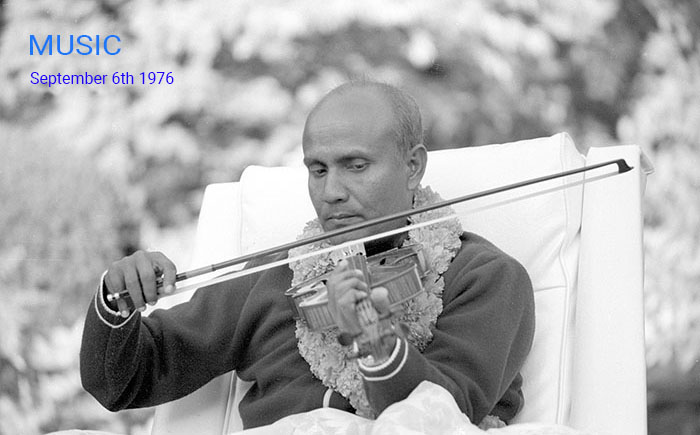
Sri Chinmoy is one of three guests interviewed on the weekly WNBC television series “The First Estate: Religion in Review” which is hosted by Dr. Russell Barber. The program begins with Sri Chinmoy playing the esraj, and after the three interviews are over, while the program credits are being shown, Sri Chinmoy plays again, in place of the program’s usual theme music.

Following is a transcription of Sri Chinmoy’s portion of the program.


Dr. Barber: That very peaceful music you have just heard Guru Sri Chinmoy play is one of over 1,000 of his original musical compositions for meditation. Sri Chinmoy is a spiritual teacher and leader of a world-wide religious organisation that is dedicated to an active outer life of service to humanity and a fruitful inner life of prayer and meditation. He is a prolific writer and artist, having written over 300 books and, in a single 24-hour span, 843 poems. He also created 100,000 paintings in just over eleven months. Since 1970 he has served as Director of the United Nations Meditation Group, conducting interdenominational meditation services for U.N. delegates and staff. And he is with us today to help us better understand the phenomenon of meditation. Welcome, Guru. It's a pleasure to have you with us. Guru, what is meditation, and what is its ultimate objective?

Sri Chinmoy: Meditation is our conscious awareness of God and constant oneness with God. When we meditate, our ultimate objective is to be constantly and consciously one with God. This has to be our main objective.

Dr. Barber: Does it differ from prayer in some way?

Sri Chinmoy: Yes, it does differ from prayer. Although prayer and meditation lead us to the same goal, their approaches are different. When we pray, we speak to God, and when we meditate, God speaks to us. When we pray, we offer our prayer to God for something, and God listens to our prayers. And when we meditate, we hear God’s Command; we try to hear God’s dictates from above.

Dr. Barber: Guru, can everybody benefit from meditation, or is it something that only a gifted person can have?

Sri Chinmoy: We are all God’s children, so everybody can meditate. It is not for the selected few. If one is sincere enough, then one can meditate. Meditation is not the sole monopoly of any individual. Anybody can meditate, provided he has some sincerity in his heart.

Dr. Barber: Still, there are those who are given special gifts, and you, for example, as a teacher or Guru, must have realised at an early age that you did have some special religious gift. Could you tell me about that?

Sri Chinmoy: At the age of twelve I had quite a few major experiences, and these experiences have led me to what I am now. I went beyond the domain of the physical mind that doubts and suspects, the mind that is never satisfied with anything. I went beyond that mind, and also, by God’s infinite Bounty, I was in a position to have a free access to the Supreme Reality within me.

Dr. Barber: What kinds of special techniques are used by people who practice your form of meditation?

Sri Chinmoy: I ask my students to have a mind totally freed from thoughts. This is the first technique I offer. Then, after some time, I tell them to welcome only good thoughts, divine thoughts, the thoughts that are progressive, illumining and fulfilling. This is how I advise them to start their meditation, especially in the preliminary stages.

Dr. Barber: Well, for example, do they use a mantra, or a word to meditate on?

Sri Chinmoy: No, in our path we do not advocate mantra, incantation. We feel that our prayer and meditation are most effective. At the same time, we do not have a word to say against mantras. It is necessary for those who want to follow certain other paths. In our case love, devotion and surrender to God’s Will is the way to approach the Supreme Reality.

Dr. Barber: I understand that not everybody can be a disciple of yours; that you look into a person’s eyes and you can tell whether or not that person should be able to follow you. Would you look into my eyes and tell me whether or not I could be a disciple of yours?

Sri Chinmoy: I do not want to say in public.

Dr. Barber: I’m afraid it’s negative…

Sri Chinmoy: No, it is not for that, but then it will have a kind of commercial feeling. These things are very intimate, very soulful. When a seeker comes to me, at that time I have to take full responsibility of his entire life, as he has to dedicate himself totally to the inner command, to the Supreme within. So here on television, if I accept or reject someone, it will be an act of injustice to our spiritual belief, and your soul will not permit me to do this kind of thing on television. You have a very fine soul, and your soul will not believe in this kind of commercial acceptance of seekers.

Dr. Barber: Let me ask a question that is related to that. Is it possible for somebody of a particular religious faith — say a Jewish person or a Christian person — to be a disciple of yours and still maintain their faith?

Sri Chinmoy: Certainly. One can belong to any religion he wants to. Religion is like a house. He has to remain in his house. Then he has to come out to study. He has to go to school. We have implicit faith in all religions. Each religion is a house. You have to stay in your house; I have to stay in my house. But both of us are students. We can go to a common teacher.

Dr. Barber: So there are many paths?

Sri Chinmoy: Many paths that lead to the same realisation. Each religion represents a house.

Dr. Barber: Tell me for a moment about your work at the United Nations. How does meditation aid in the pursuit of world peace?

Sri Chinmoy: When we meditate, we acquire peace of mind, and once we have peace of mind, we simplify our outer life. Our mind is full of complicated thoughts and ideas, and it is constantly assailed by fear, doubt, anxiety and worry. But if we can soulfully meditate early in the morning, we see that there is a way to simplify our life and, at the same time, to see the Reality face to face.

Dr. Barber: How many disciples do you have, Sri Chinmoy?

Sri Chinmoy: I have about 900 disciples.

Dr. Barber: And of course your work goes on all over the world, doesn’t it?

Sri Chinmoy: Yes.

Dr. Barber: But your headquarters is here in New York?

Sri Chinmoy: It is in New York.

Dr. Barber: And do you find that you have many new converts to your brand of faith here in New York? Are there many new people coming in all the time?

Sri Chinmoy: Not all the time. As you know, I am very fussy, I am very strict, so I do not get disciples as some of the Masters get, as easily as possible.

Dr. Barber: Well, I know that you have met with religious leaders all around the world, and I’m very pleased that you’ve come to meet with us and our audience on The First Estate. Thank you very much for being with us.

Sri Chinmoy: Thank you, I am so grateful to you.


Published in AUM — Vol. 4, No. 4, 27 April 1977