
December 23

Sri Chinmoy’s performance on the Grand Organ at the Sydney Opera House, November 30th, 1987
by Prachar Stegemann
BA (Music), Canberra School of Music

Towering high above the stage in a shell-like concrete chamber 50 feet high, 43 feet wide and 27 feet deep, the ten thousand pipes of the Grand Organ dominate the magnificent interior of the Concert Hall, the largest of the Sydney Opera House’s famous white shells.
Like the building it inhabits, the Grand Organ is regarded with a mixture of apprehension and awe.
Apprehension – because ten years’ labour and over 3 million dollars for a musical instrument seemed a bit extravagant to taxpayers who had seen the construction expenses of the Opera House balloon to such an extent in the late sixties that the State Government had to institute a special Opera House lottery to raise the funds.
And awe – because this 37-tonne colossus is the largest mechanical-action organ1 in the world and, certainly, the most intricate. While most organs fall into a particular category (one hears of the “German Baroque organ” or a “late French Romantic organ”), the Opera House organ covers all likely options, simply by containing a lot of all the different sorts of pipes, and some amazing ways of combining the various sounds. It also has a generous complement of ancillary stops – bronze hand bells, two types of bird-call (cuckoo and nightingale), and even an eerie drum-roll reminiscent of distant thunder.
It is an instrument designed to cater to every conceivable musical demand, concealing within its endless combinations and permutations myriad marvellous possibilities.
For Sydney organ-builder, Ronald Sharp, the Grand Organ was the fulfilment of a life’s dream: his darling child. When the organ was not ready for the opening of the Opera House in 1973, he continued his painstaking perfectionist work under mounting pressure and criticism for six further years, until the organ was finally inaugurated in 1979. Even a decade later, it was difficult to separate him from his instrument; he was often to be found making minute adjustments to tiny pipes and, indeed, he was doing just that at 6:30 p.m. on Monday, November 30th, 1987, when Sri Chinmoy arrived...
***
When first smitten with the idea of Sri Chinmoy playing on this great instrument, we had commenced by approaching organists who were familiar with the Grand Organ to see if they would endorse an application for Sri Chinmoy to be allowed to perform on it. As a general policy, the organ is only made available to organists of considerable renown, and an application from someone with only six months playing experience would not normally be considered!
Our strongest supporter was the Chairman of the Department of Organ and Sacred Music at the most prominent music conservatorium in Sydney, David Rumsey. He was also organist with the Sydney Symphony Orchestra and a touring organist of distinction. Having heard recordings of Sri Chinmoy‘s earlier organ performances, he even informed all his students that they could not afford to miss such an important performance. At this time, Opera House administrators were saying that only three people, including Sri Chinmoy, would be admitted to hear the performance. David Rumsey had readily and eagerly agreed to be the one to introduce the organ and its many particular features to Sri Chinmoy, so he would certainly be one of the three. Yet he was determined to find a way around these restrictions so that his students and others could be there!
Once the authorities had confirmed that permission was granted for Sri Chinmoy to have a ‘private rehearsal’ with two other people in attendance, it began to seem very sad that such a momentous occasion would only reverberate through the vast emptiness of the Concert Hall. This was something the whole of Australia, and eventually the world should hear!
We once again consulted with David Rumsey, who gave us the name of the Head of the Music Department of the ABC, Australia’s [then] only national FM broadcaster. This lady immediately expressed interest in the idea of recording Sri Chinmoy‘s performance and began to formulate the concept of building an entire program around Sri Chinmoy, which would include an interview. As an afterthought, she mentioned that she knew of someone who would do an excellent interview, if only he were available... she mentioned the name of David Rumsey! The intricate threads of destiny were being unravelled.
After some weeks of discussion, the ABC proposal became definite, the Opera House agreed to this new arrangement and granted official recording rights, thereby enabling a much larger crowd to attend.
David Rumsey, the organist who was to show Sri Chinmoy the mechanisms of this famous instrument led the way up the stairs. Sri Chinmoy, resplendent in red dhoti, followed – quietly, purposely, serenely. Through each door, there would be more stairs, spiral stairs and straight stairs. Each trodden stair heightened the anticipation in the air, the sense that our destination was far more than an organ loft... It seemed word had already gone out in the higher worlds that Sri Chinmoy was to give a momentous performance. Sri Chinmoy’s expression was inward, absorbed – mystical moments.
We had arrived at the loft and passed through to the organ itself. The vast, silent auditorium was dotted with the upturned faces of expectant souls. Sri Chinmoy eased onto the seat and watched attentively as the various stops were pointed out to him. He took particular note of the bell stops and the “full organ” button.
Then the moment for which Time itself had been preparing – Sri Chinmoy began to meditate.
On tiptoe, we departed the console. Clearly, there would not be time to descend all those stairs and be in the auditorium in time for the performance. As the only way for us to depart the organ console was back through the organ itself, and not wanting to be moving around at this juncture, I found myself sitting cross-legged on a kind of wooden platform.
In the silence of Sri Chinmoy’s meditation, I became aware of my surroundings. There were pipes to the right, pipes to the left, pipes above and all around, neat row upon row of pipes, tiny flute pipes, larger reed pipes, hooded brass pipes, metal pipes, wooden pipes, massive pedal chorus pipes. It was as though this legion of pipes were themselves silently meditating, inwardly preparing for this moment of destiny, each pipe wholly responsible for only one note, which would be executed wholeheartedly and perfectly.
The first chord voiced forth from somewhere just above and to the right, plunging me into a breathtaking sound-adventure of three-dimensional ecstasy.
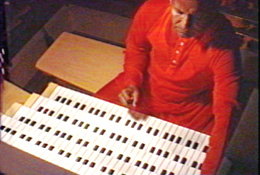
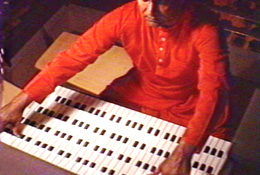
These pictures were taken by a fixed video camera placed above Sri Chinmoy in the organ loft.
Sri Chinmoy’s directions to his pipe-army were being relayed via a bewildering network of levers and tracker rods, which were being subjected to a breathless workout keeping up with his rapid-fire fingers. An incessant storm of clucking, bumping, clicking, clumping and thumping, each moving part operating in perfect co-ordination with every other at speeds faster than the eye could follow, was witness to a superlative effort of precision machinery stretched to its capacity in the task of bodying forth the sounds of Sri Chinmoy’s transcendental vision.
Just by my left elbow was a huge bellows that only got called into service when the larger pipes sounded. To get sufficient air rushing through a thirty-two-foot pipe takes tremendous lung capacity and, when Sri Chinmoy would suddenly call all the big pipes into action, these bellows would hurtle into a tremendous flap of intense exertion.
Sri Chinmoy seemed to be surcharging the instrument with his own force, the whole living organ bent on transcending its physical capacity in a supreme effort to render Sri Chinmoy’s phenomenal fingerwork with utmost clarity and, at the same time, convey the unprecedented power of the loud sections – it was a non-stop blur of exhilarating activity.
When Sri Chinmoy would toy with the delicate flute pipes, or weave subtle counterpoint against the cuckoo or the bells, the bulk of the levers and the bellows would lie dormant, getting their breath back for the next explosion of power. During these quiet passages, one melody might sound from a distant upper corner of the loft, answered by another reverberating right in front of me, at eye level.
The teeming multitude of sounds streaming forth from this ordered mass of metal and wood, sounding above, below, all around and, seemingly, within – this all-encompassing flood of power, joy, beauty, surprise, delicacy, wonderment and awe – was at once a source of deep mystery and elation.
Invisible behind it all was Sri Chinmoy, in trance-like Lord Shiva, but at the same time, ordering and instigating every tiniest twitch of each little lever – the omniscient, omnipotent creator embodying and igniting his vision-creation. For thirty-six timeless minutes, this organ became the universe itself, while the supreme musician revealed his cosmic music through ten thousand thrilled voices.
***
Retracing the interminable stairs that led back down to the earth-plane, Sri Chinmoy spoke about his performance. These are not his exact words, but a recollection:
“So much was happening... one moment Indian melody, then this world, that world – the beings from different worlds would come and invite me to their world, and the music would come from that world... then other beings would be there. Like this, all the time going from one world to another, to all the seven worlds.”
The following morning, back at his hotel in Melbourne, after listening through headphones to several minutes of the performance, Sri Chinmoy exclaimed: “There are forty people playing!”
Right after Sri Chinmoy had finished his immortal performance – lasting 36 minutes and 14 seconds and taking a monumental physical, not to mention spiritual effort – while still in the organ loft, he was interviewed by one of Australia’s foremost organists, David Rumsey, for ABC (Australian national) FM Radio.
Following is a full transcript of that interview...
David Rumsey: Thank you very much, Sri Chinmoy, for coming to the Sydney Opera House this evening and playing for us. You have a very unique style of playing the organ. As many other musicians have said, you combine a kind of Eastern as well as a Western style. Your own style is, perhaps we might say, Eastern; whereas, the organ itself is very Western. For many centuries, the organ has served the Christian church as a spiritual kind of musical instrument. Do you also find spirituality in the organ?
Sri Chinmoy: Yes, I find spirituality in the organ, more than I find it in any other instrument. Here I see that the organ is not only the King of all the musical instruments but it is also the Queen of all the instruments. It has a very subtle, delicate touch at the same time. When you think of a king, you think of somebody who is very powerful, like a sovereign and, when you think of a queen, there is softness and sweetness, a delicate touch. So the organ combines both God the Man and God the Woman.
David Rumsey: So, in your music, you are finding an expression of God, which comes from within you and is expressed by the organ, sometimes as king, sometimes as queen?
Sri Chinmoy: Yes.
David Rumsey: They are very beautiful sentiments. I‘ve seen you on videotape talking about soulful music. Do you find the organ is, what we might call, a “soulful” instrument?
Sri Chinmoy: It is soulful and, at the same time, powerful. Sometimes the soul does not express power. But I see that the soul of the organ expresses power as well. In the case of an individual, he can express his inner capacities through power, or through love or other divine aspects. But the organ has the capacity to express many divine qualities at the same time.
David Rumsey: Do you find that, through the organ and the sounds that it makes, there is a kind of awakening of spirituality, an expression of spirituality?
Sri Chinmoy: Not only the awakening, but also the expression and the revelation of the inner being.
David Rumsey: Since you are a poet as well as a musician, I find it very interesting to compare the inner spirituality of poetry with the inner spirituality of music. In the Western tradition, for example, they have gone almost separate paths for the last two or three hundred years. Maybe four hundred years ago, music and poetry were rather more similar and, when we go back to the ancient Greeks, music and poetry were almost one thing. Now, in your poetry and your music, do you find a similar kind of spirituality?
Sri Chinmoy: Yes. In my case, I find poetry and music go together. Poetry has the vision and this vision is expressed through music. We have the vision, let us say, of tomorrow’s dawn. But, although we have the vision, there is no way to reveal and manifest that vision. So here comes the music! Music expresses the vision that poetry embodies. First we have the vision of reality deep within us and then music brings that vision to the fore.
David Rumsey: Regarding the improvisation which you just played, did it have a particular title or any particular ideas?
Sri Chinmoy: No, there was no particular idea. I don’t use my mind. I see myself as a child playing in my own heart-garden. In the garden, there are many beautiful plants and I play hide-and-seek. I move around, I play with the leaves and plants and flowers. I enter into my heart-garden and I enjoy Nature’s beauty deep within me. So, I do not use my mind. A child does not use his mind. He just plays with the flowers, with toys and dolls. In my case, also, I play with the flowers, leaves and fruits.
David Rumsey: It is just creativity, just being creative...
Sri Chinmoy: Creation for creation’s sake. There is no set method, there is no hard and fast rule that I have to do this, I have to do that. A child uses his heart, he does everything spontaneously. So, in my case also, I try to do everything spontaneously, like a child.
David Rumsey: Your spontaneity comes through very clearly in your music. You have also been quoted as saying that, alongside meditation, music is the next thing for a spiritual person or words to that effect.
Sri Chinmoy: Music and spirituality must go side by side. A Truth-seeker and God-lover pays more attention to God the Creator. Twenty-four hours a day he is ready to pray and meditate. He wants to embody God’s infinite Light. A seeker is more conscious of God, fortunately or unfortunately, than a musician. A musician has the universal language deep within him but he does not know that the source of the universal language is silence. Language is not the source. Silence is the source. Sound is not the source. The source is silence. Meditation helps us dive deep within. Silence is the source and sound is an expression. It is the outer form.
When we enter into a temple, we see the shrine inside it. For me, meditation is the shrine inside the temple. Music is the temple. Without the temple, there can be no shrine and, again, without the shrine, there can be no temple. So, music and spirituality have to go together. Spirituality reminds us of God the Creator and music reminds us of God the creation. Universal Beauty we get through music but Silence, transcendental Silence, we get from meditation. They are like the obverse and reverse of the same coin. But we have to know which one has to be brought forward – the inner divinity or the outer reality. Inner divinity has to come forward to express the outer reality.
David Rumsey: Over the last two or three thousand years, there have been periods of Western civilisation – such as the times of the ancient Greeks and the Renaissance – where it has been considered important to look at all the things that make up a completely rounded person, a whole man: intellectual life, sport, music and so on. Many people have spoken of you, with all your interests, as a kind of Renaissance man.
Sri Chinmoy: I am jack-of-all-trades, master of none!
David Rumsey: I think it’s not just a question of being a jack-of-all-trades, though. It‘s something that you have been able to use, in a sense, to transcend yourself. You set yourself a certain goal and you move in a certain direction – just as, in music, you’ve taken up the organ only relatively recently. Previously, you’ve played the Indian esraj, the bamboo flute and many, many other instruments.
Sri Chinmoy: Tomorrow I will be playing about thirty instruments in Melbourne.
David Rumsey: Do you find that the organ, then, is a kind of transcendence in your own life?
Sri Chinmoy: In my case, the organ seems to be the highest peak. I have been playing quite a few instruments for the last ten years. Sometimes I go up to one hundred instruments. Usually I play thirty instruments in my concerts. But the organ is like the highest pinnacle, it is the culmination.
When I play organ, I feel myself complete. It is something deep within me. It is like the blossoming of the tree, a fully blossomed tree. Whereas, when I play other instruments – flute or cello or violin or viola – there I see a few beautiful flowers on a particular branch, a few most beautiful flowers. But when I play the organ, I feel that the whole tree has blossomed fully and gloriously to my satisfaction. Here I feel my hunger, musical hunger, is satisfied completely.
David Rumsey: Well, Sri Chinmoy, thank you very much for granting us this interview. You have been very gracious and thank you very much once again.
Sri Chinmoy: You have been extremely kind to me. My heart is all gratitude to you. I have heard so much about you and I am extremely, extremely grateful to have been allowed to play here and to be here with you. My heart is all gratitude to you.
David Rumsey: Thank you, Sri Chinmoy, thank you very much.
David Hindler, the Chief Producer for the ABC FM Radio programme that included both the performance and the interview, is himself an organist of some distinction. He made the following observations a few days after the event:
I was in an unusual position during Sri Chinmoy’s performance, in that after setting up the recording booth I then had to prepare the mikes and so on for the interview afterwards. So I was actually behind the organ area. However, I was quite amazed by Sri Chinmoy’s facility on the organ and the ideas that he was conveying. His music has quite a sophisticated form, which is all the more amazing when one considers that he has come to the organ only relatively recently. Tell Sri Chinmoy that I consider there was a very deep message in his improvisation.
After I had set up the interview, I was waiting behind the organ area. When it had finished, Sri Chinmoy went by me and, as he passed, he nodded at me and said goodbye. I felt a wave of spirituality coming from him, it was like a kind of magnetism, and my immediate thought was: ‘There is tremendous good in this man’. I was very, very glad to have met him.
Immediately following the interview Sri Chinmoy drove ten minutes to the Sydney Town Hall, where he gave another immortal performance on the famous organ there. Both performances are presented on the CD Heart-Power-Victory.
On hearing the CD, music reviewer for New York’s Pulse Magazine Lee Underwood was moved to write:
‘Heart-Power-Victory’ is a live recording of a concert guru Sri Chinmoy performed at Australia’s Sydney Opera House in November, 1987. Playing one of the world’s largest pipe organs, Chinmoy improvises a divinely inspired music that shatters standard academic conventions and raises the soul to the heavens.
To be sure, orthodox and mentally ‘busy’ listeners will find themselves nonplussed at Chinmoy’s leaping, jabbing, fluttering, poking approach to the keyboards. However, adventurous listeners who are inwardly quiet and fully-present while listening will discover the music of genius.
Through dissonance and external speed, Chinmoy creates in the receptive listener a profound internal sense of ecstatic peacefulness. As he dashes from cluster to cluster, obliterating western harmonic relationships, he pours forth a veritable river of spontaneous enharmonic joy.
Chinmoy’s ‘Heart-Power-Victory’ improvisations, born in the deep quietude of meditation, manifest extraordinary spiritual power and intensity – accessible to all who have the ears to hear in new ways, to all who have the courage to explore previously uncharted worlds within.
– End –
Endnotes:
1 A mechanical action is one where the message from the depression of each key is conveyed to its destination pipe or pipes by mechanical means, i.e. by wires, cords, levers and rods, and air is forced through each pipe not electronically, but by mechanically activated bellows.
Copyright © 2009, Prachar Stegemann.
All rights reserved under Creative Commons license.

NEW YORK — Sri Chinmoy offered his message for the New Year at a public meditation here Dec. 19, and then handed out prasad, or “blessing-food,” to each of the seekers and disciples present.
Sri Chinmoy’s New Year’s Message for 1976:
“The new year will be the year of destruction, frustration and satisfaction.
“The animal in us will unimaginably be destroyed. The human in us will unreservedly be frustrated. The divine in us will supremely be satisfied.
“The animal in us is self-doubt. The human in us is self-indulgence. The divine in us is self-offering.”
Caption:
Sri Chinmoy conducts a public meditation in New York (photo by Sarama)
Published in Anahata Nada, Vol. 2, No. 12, Jan. 1, 1976
By the staff of the international monthly newspaper Hinduism Today, Sri Chinmoy visits and blesses their premises on the Hawaiian island of Kauai. Satguru Sivaya Subramuniyaswami and his disciples lovingly welcome Sri Chinmoy and some of his students to their ashram for a traditional puja and a tour of the beautiful grounds, followed by a special luncheon. Afterwards, Sri Chinmoy is interviewed by the Editor of Hinduism Today, the Reverend Sivasiva Palaniswami; the Managing Editor, the Reverend Arumugaswami; and other senior editors. These are excerpts from Sri Chinmoy's answers to their soulful questions.
Sri Chinmoy: You sow the seed of light everywhere. Your own dedication is touching the very heart of humanity’s aspiration.
Editor: We only live and exist because of people like you, believe me.
Rev. Palaniswami speaks briefly about the publication and then Sri Chinmoy’s students perform the song that Sri Chinmoy composed for Hinduism Today.
Editor: How precious that is! This definitely is a first in our editorial offices. I wonder, in the spirit of that glorious benediction, if you might say a few words that could help guide our efforts. Every order of Hindu monks has something — perhaps an eye clinic or a school for children or orphans — to balance their contemplative enterprises. You are the great example of “giving back.” Hinduism Today is our contribution, and we need to know from you how to do it better — what you would like to see. What does the Hindu heart and soul need from all of us?
Sri Chinmoy: No hyperbole, your Hinduism Today not only embodies the supreme wisdom-light of the hoary past, but also reveals and manifests the infinite Compassion, the infinite Concern and the infinite Blessings of the Indian Trinity, Brahma, Vishnu and Shiva: Brahma the Creator, Vishnu the Preserver and Shiva the Transformer. According to Indian theory, Lord Shiva plays the role of the destroyer. But according to my aspiring heart, he never destroys anything; he only transforms. He transforms our ignorance-night into wisdom-light. Not only the Blessings, Compassion and Concern of the Trinity, but also the Blessings of the Indian cosmic gods and goddesses I see and feel when I read your Hinduism Today.
Over the years I have studied many, many books on Hinduism written by scholars, professors, truth-seekers and God-lovers, and before I pass behind the curtain of Eternity, I shall read and study many more. Also, I personally have offered my tiniest drop of aspiration to the infinite ocean of Hinduism. But among all these books, your magazine stands unparalleled. I use the term ‘magazine’, but it is not merely a magazine. It is not just a few pages of paper with ink. It is not something that is read just to stimulate our vital or feed our curiosity — far from it! Your Hinduism Today is a divine and sumptuous feast that is nourishing the God-hungry heart of the entire aspiring mankind.
When I read Hinduism Today, I definitely see the divine dances of the Indian cosmic gods and goddesses and hear their celestial music. The loftiest vision of the Indian gods and goddesses you are so devotedly, lovingly and self-givingly offering to the world at large with utmost humility, which is absolutely the best quality that we human beings can ever dare to aspire for. Your Hinduism Today is flooded with supernal humility.
We are living in the scientific age of computers. The poor Vedic seers did not have computers; they did not even dream of them. Another reason I appreciate and admire your Hinduism Today is that it offers the ancient lore of the Vedic seers but distributes it in the ultra-modern way. The twentieth century demands a different type of treatment, and you are combining the inner world of silence and the outer world of sound most perfectly. Both worlds you are bringing to the fore and keeping together.
I am so happy to learn that this magazine will touch many parts of the world, and especially India, where Hinduism had its origin. In Hinduism, the truth-seeker and God-lover claims each creation of God as his own, very own. By virtue of his prayers and meditations, he offers to the world at large the Message-Light and the Nectar-Delight of the ever-transcending Beyond.
Hinduism Today, to your all-illumining soul I bow and I bow. Hinduism Today, to your all-loving heart I bow and I bow. Hinduism Today, to your all-serving life I bow and I bow.
Editor: Thank you, Guru. The staff has assembled a number of queries. I think each one of them has some questions.
Sri Chinmoy: I would be most happy to be of service to you. Nothing would give me a greater sense of satisfaction than to be of service to other aspiring human beings, because in our hearts we are all the time growing together and in our souls we are all the time glowing together.
Question: Our paper is called Hinduism Today, which you so beautifully rendered into song. There is one question we ask everybody when we start. We ask, "Are you a Hindu?"
Sri Chinmoy: If I use my mind, then I will say I am a Hindu. But the real in me is my aspiration, my love of Truth, my love of God. Therefore I am neither Hindu nor Christian; I do not belong to any religion. When I am wholeheartedly aspiring, I am not a member of any religion; at that time I am cosmopolitan. I am a seeker of Truth and a lover of God, and all the religions I claim as my own.
Each religion is like a home. You live in Hawaii, someone else lives in California and I live in New York. Your home is perfectly right for you and my home is perfectly right for me. But when we pray and meditate, we leave our respective homes and study in the same inner school. At this inner school we come together to pray in the small hours of the morning. We raise our aspiration and see our heart’s inner cry climbing up high, higher, highest. Our Teacher is none other than the Absolute Lord Supreme.
I am a Hindu in the sense that I was born into the Ghose family. But when I am dealing with the world of aspiration, at that time I do not need my surname; I am just Chinmoy. Similarly, once we enter into the spiritual life proper, we do not need Hinduism or Christianity or any other ‘ism’. All the time we are only expanding our oneness. Every day, on the strength of our heart’s cry and soul’s smile, we are trying to serve God the Creator and God the creation.
Again, we have to know that Hinduism is not a man-made religion that binds and blinds humanity, claiming supremacy and sovereignty; it is the code of life. To me, Hinduism is Divinity’s Oneness-Heart-Home. In this Home, Infinity’s beauty at every moment blossoms and Immortality’s fragrance blesses us most powerfully and significantly. To me, a true Hindu is he who can prayerfully claim that he came, he lived, he loved and he became. He came into the world to realise the Absolute Truth of the Absolute Lord Supreme in the Supreme’s own Way. He lived only to please and fulfil God in God’s own Way. He loved God the Creator and served God the creation in God’s own Way. And he became a perfectly surrendered instrument of our Beloved Lord Supreme. To please God in His own Way at every moment, a Hindu life is born.
Question: One of the things that you talk about a lot in your writings is self-transcendence. We were talking to Ashrita about his breaking the brick-carrying world record, which was certainly an example of self-transcendence. He said that after he had walked around the track with a nine-pound brick for forty miles, he was on the verge of collapsing. Then you came and your presence and a few things you said put him into a state of self-transcendence. What do you do? How can you catalyse a person, or how can a person catalyse himself to transcend what he believes are his normal limitations?
Sri Chinmoy: Self-transcendence is not only possible, but practical and practicable, provided we sincerely feel in the very depths of our heart that we are not the doer but Somebody else is the Doer. Who is that Somebody else? It is our highest part, our Absolute Lord Supreme.
In our Bhagavad Gita, the Song Celestial, Lord Sri Krishna taught us, nimitta matram bhava savyasachin — “Become a mere instrument.” In my case, I tell my students never, never to think that they are the doers, because only God is the Doer. They should only offer their gratitude to Him at every moment because He is acting in and through them to do something special for Him.
There are many feats that Ashrita has performed over the years that are far beyond my own imagination-flight. He has succeeded because he has implicit faith in me and I have implicit faith in the Supreme, who is my students’ Guru, my Guru, everybody’s Guru. I always tell my students, “I am not your Guru. There is only one Guru on earth and in Heaven, and that is the Absolute Lord Supreme. He is our Eternity’s All.”
I tell all my students that I am like the elder brother in our spiritual family. As the elder brother, I know where our Father is. My job is to bring my younger brothers and sisters to the Father. Then my role is over and the younger ones can deal with the Father directly. On the strength of my inner awakening and realisation, I can say that I have been praying for quite a few years, even centuries. So I know an iota more about aspiration and realisation than Ashrita does, and I try to create faith inside him so he will come and follow me to the Father. I try to increase his own faith in himself so that he will see and feel that he is a supremely chosen instrument of God.
I am praying to God to bring to the fore only one quality in each individual: the faith that he is a special member of God’s family with a special purpose in life. Through each individual God is trying to manifest something unique. God does not want each and every human being in this world to perform the same task. No, He wants multiplicity in unity. A tree has one trunk but so many branches, flowers and fruits.
Our philosophy, as you so kindly mentioned, is self-transcendence. I happen to be an athlete. Let us say I have reached a certain standard and I am very proud of myself. But the moment I look around, I will see that somebody else can defeat me easily. So if we enter into the world of competition and try to defeat the whole world, we will be doomed to disappointment. Perhaps this moment we will stand first, but the next moment there will be somebody else to defeat us. So in the world of competition there is no peace; always there is somebody who is better. But if we try to compete only with ourselves and continually improve our own standard, then we are always happy.
In the spiritual life also, we are always trying to transcend and go beyond. If today I do twenty things wrong, then tomorrow I will try to do only nineteen things wrong. I will constantly try to improve myself, and in this way I will get a tremendous sense of satisfaction. I am not competing with anybody other than myself. This is how I can feel that I am arriving at perfection. Again, today’s perfection is only the starting point for tomorrow’s higher perfection.
Question: I understand you spent time at Sri Aurobindo's Ashram. I was very impressed that all the members of the Ashram are celibate at all ages. Even married, they practise brahmacharya, or continence. I've noticed that many of your devotees don't have children. I'm wondering how you instruct them or inspire them or talk about this area of brahmacharya in marriage.
Sri Chinmoy: It is all based on my personal experience in the inner world, which grew out of my prayer and meditation. Each spiritual Master entirely depends on the adesh, or divine command. At the age of 32 I was commanded by my Lord Supreme to come to America to be of service to seekers here. Most of my students are unmarried. I ask them what they actually want from life: joy or pleasure. There is a great difference between the two. Pleasure-life is always followed by frustration, and frustration is followed by destruction. Once we are really frustrated, our destruction is imminent. But if we get even an iota of bliss from our prayer and meditation, immediately our inner being is swimming in the sea of light and delight. During our meditation, if for five seconds we get a glimpse of divine light, the whole day we are flying in the sky of Infinity and swimming in the sea of delight.
I tell my disciples, “I did not touch your feet and beg you to join our path. No, you saw and felt something in me and I also saw and felt something in you. It was not one-sided — no, no, no! I felt in you a real inner hunger and you felt in me a real elder brother who would show you utmost love and compassion. Once upon a time you were wallowing in the pleasures of ignorance, but now you are aspiring and consciously crying for light. So the only thing that will really satisfy and fulfil you is the inner joy that you will get from your prayer and meditation.”
Fifteen or twenty years ago, before they came to our path, some of my students were taking drugs. Once they saw me, when I was giving talks or answering questions or meditating with them, they gave up their drug-life because they realised that this food would not nourish them anymore. They wanted something else. A child of one or two will take mud and clay as his food. Whatever he sees around him, he will eat. His mother will scold him and teach him to eat proper food. Then, when the child grows up, he will want to eat only proper food. In exactly the same way, once we enter into the spiritual life we stop eating the mud and clay of pleasure-life and drink only the inner nectar of divine joy.
Every second we can go higher or go lower, depending upon what we see, do and enter into. I go to many Indian restaurants and eat spicy food; the human in me may like this. But today’s food has pleased the divine in me immensely because it was so sattvic. From today’s food I got real, divine nourishment, not only because the food was so pure, but also because I am here with Gurudeva and his dearest devotees. In other Indian restaurants I do not hear the Vedic chants; instead I get rock and roll or other undivine music. I am trying to eat, but the lower vital forces and bad vibrations there are trying to pull me down, so I am all the time on tenterhooks. But here I do not have to worry, for who is going to bring whom down? On the contrary, here we are only lifting each other up.
Editor: Are you saying in a subtle way that you feel brahmacharya is important to spirituality?
Sri Chinmoy: Absolutely, but for some I cannot expect it to happen immediately. If somebody is studying at the high school level, I cannot expect him to suddenly take a Masters degree. Also, this is the twentieth century, and I try to be practical with my students. To people who are married, I say, “Do not try to become celibate overnight. Slowly and steadily reduce your physical, earthly hunger.”
Again, there are some who are ready to run very fast in their spiritual life. Perhaps they were born into a spiritual family, and their parents and older brothers and sisters are already practising spirituality, so they have that background. People who are already awakened are more than ready to follow the strict discipline of a celibate life. I tell them, “It is up to you how fast you want to run along Eternity’s Road. If you are eager to go the fastest, if you are thirsting for light, then you have to do the things that are absolutely necessary to increase your speed.”
Editor: What are those things?
Sri Chinmoy: Our philosophy is:
Asato ma sad gamaya
tamaso ma jyotir gamaya
mrityor ma amritam gamayaLead me from the unreal to the Real.
Lead me from darkness to Light.
Lead me from death to Immortality.As an individual I know what is binding me, you know what is binding you, he knows what is binding him. We can call it temptation or ignorance or something else, but it reveals itself in various ways. What is preventing one person from making progress is different from what is preventing somebody else from making progress. Somebody is suffering from jealousy; somebody else is suffering from insecurity or impurity. But whatever our problem, we can always find the solution by surrendering the problem to God, our Inner Pilot.
Let us say that somebody is suffering from impurity. I tell that person, “Think of yourself as a child of six or seven. You went out and played in the mud, and now your whole body is smeared with dirt and clay. But you know that there is somebody who can immediately make you clean again, and that is your mother. So you run to your mother and she cleans you.” When a child runs to his mother, he is not ashamed or embarrassed. He just goes to her and is immediately purified.
Similarly, no matter how many impure or undivine things we have done, there is always a Person we can come to for purification, and that is God, our Beloved Supreme. He is ever ready to help us, for this is His bounden Duty. God can never be satisfied if His child, His chosen child, is dirty and filthy. So if I have done something wrong, then I will go to the right Person to be saved, and God will immediately purify me. If a mother sees that her son has done something wrong, she immediately and secretly rectifies it because she wants the neighbours to say, “Oh, he is a very nice boy!”
We try to hide from God, but how can we hide from someone who is omnipresent? God is so affectionate and compassionate, but He tries to hide it. This is how He plays His Cosmic Game. But we have to know that at every moment God is trying to make us perfect. This is the task that He has taken upon Himself. We can never, never become worthy of God’s Compassion, but He has accepted the challenge. We have not challenged God; God has challenged Himself. Our task is only to have implicit faith in Him, plus gratitude and surrender.
We all pray — you and I and everyone. Can there be a better, higher, more illumining or more fulfilling prayer than “Let Thy Will be done”? That prayer touches the supreme heights. Peace begins when expectation ends. If I do a favour for you, immediately I expect a favour in return. And if you do not reciprocate, I start finding fault with you. But when we are praying to God, our prayer has to be unconditional. That unconditional feeling is what will save us. I tell my students that it is their bounden duty early in the morning to pray and meditate, but then they have to leave it up to God to do what He feels is best, for He knows what we need in order to make the fastest progress.
Let us say a child finds a dime on the road and comes running to his father to give it to him. His only possession is that one dime, but happily he gives it to his father. So what will the father do? The father knows that with this dime his child could have bought something, or he could have hidden it like a miser. But happily and cheerfully he gave it to his father because he has such love for his father and such faith in his father. The father is so pleased with his child that he will give the child ten dollars. Because the child came to the right person, he received much more than he would otherwise have gotten.
When we offer our prayer soulfully, lovingly and unconditionally, then we get infinitely more than we can ever imagine. But our prayer has to be unconditional. We will do the right thing, but without any expectation. I tell my students, “Why do you have to expect? Are you a beggar? If you know your Father is all for you and if you claim your Father as your own, very own, then how can you not have faith that He will give you whatever you need?” A small child knows only how to cry. If he is hungry, he cries, and his mother comes running to him no matter where she is. The child does not use the term ‘milk’; he does not ask for anything in particular. His job is only to cry. Then his mother comes running with milk because she knows what he needs.
Similarly, we have to cry only for God to make us a good instrument of His. In our prayer we will say, “I am at Your Feet. Just make me a good instrument.” In order to make me a good instrument, God will definitely make me simple, sincere, pure and self-giving. How can I be a good instrument of His if I do not have those qualities? But those good qualities I do not have to specifically mention — far from it! Only I will cry to become a good instrument of His, and the things that are needed to make me a good instrument, God will definitely give me.
Again, we have to know that there is such a thing as God’s choice Hour. We sow the seed and immediately we expect the tree, but it takes time. We have to let the seed germinate. It must first grow into a tiny plant before it becomes a huge banyan tree. Spiritual seekers often make the mistake of looking for an immediate result. But we have to know that everything takes time. It is like turning on the flame of a stove. You can keep on turning the handle, but until it reaches a certain point, there is no flame. So I tell my students that they have to wait for God’s choice Hour. That Hour comes only when God gives us the capacity. I will pray, but He will fulfil Himself in and through me only at His choice Hour.
All of us need and want freedom. This is not the freedom of a Caesar or a Napoleon, who wanted to conquer the world, but the freedom of Jesus Christ or Lord Krishna or Lord Buddha, who wanted only to love and serve the world. It is oneness-freedom that we are trying to have. We have to feel that the whole world belongs to us, that we are part and parcel of the world and destined to serve the world. If this is our feeling, and if we pray soulfully and unconditionally to God, then definitely we shall grow into good and perfect instruments of His.
Editor: We'd like to ask you to offer your advice to the average person or to someone who is just beginning to acquaint himself with meditation as to how he can make it a more integral part of his life.
Sri Chinmoy: Prayer is one road and meditation is another road. In the East, in India, meditation is part and parcel of people’s living existence, whereas prayer is part and parcel of people’s living existence in the West. When we pray, we talk to God; and when we meditate, we listen to God. In the West people find it easy to talk to God, but meditation they find more difficult. In meditation God is entering into us and inundating us with His Peace, with His Light, with His Bliss. But if it is difficult for us to feel the Presence of God, then we should start with prayer. If we find it difficult to listen to God, we should start by talking to God. Once we have established communication, we can have a two-way conversation.
If we go up and knock at God’s Door with our prayers, then He will definitely come down with His Blessings, with His Love, with His Compassion. Once we start to feel His Blessings, His Love, His Compassion in our lives, we will be able to immediately enter into meditation without first going through prayer. Again, some people find even prayer difficult. These people should start with japa. If they like Shiva, they will chant, “Shiva, Shiva, Shiva.” Or they can chant “Supreme.” After doing it a few hundred times, they will see how much benefit they get.
If japa is too difficult, seekers should spend time mixing with people who can do japa, who can pray, who can meditate. If they cannot do it themselves, then let them come to this place, for example, and just sit at the feet of Gurudeva. People can start anywhere they want, according to their own standard. If they are meant for japa, then Gurudeva will advise them to do japa. If they are ready for prayer, then he will teach them how to pray. He can teach kindergarten as well as the university course.
If someone wants to go directly to meditation without first starting with japa or prayer, then he has to know that there are three rungs to the ladder: concentration, meditation and contemplation. If it is very difficult for someone to meditate [Sri Chinmoy demonstrates meditation], then let him start with concentration [Sri Chinmoy demonstrates concentration]. Most people cannot meditate well because uncomely and uninspiring thoughts are entering into their minds. We are thinking of what we ate yesterday for breakfast, or what we are going to eat tomorrow. Concentration is like a naked sword that will not let us be distracted. So let us pave the way with concentration. In concentration, we do not allow an iota of thought, whether good or bad, to enter into our mind. Somebody is knocking at our mind’s door, but we do not know if it is a good thought or a bad thought, if it is a friend or an enemy. So the best thing is to keep the door bolted.
When we see that there is not even an iota of thought trying to enter, when we have passed our own examination on the strength of our sincerity, at that time we are ready to meditate. Finally, if we are advanced, after some time we will enter into contemplation. In contemplation, the divine lover and the Supreme Beloved are one. We are observing our Highest, and at the same time, we are our own Highest observing ourselves. At this moment I am the God-lover and my Beloved is right before me. The next moment we change roles, and He is the lover whereas I am the Beloved [Sri Chinmoy demonstrates contemplation].
Question: We're interested in hearing a little more about what made you decide to come to the West.
Sri Chinmoy: For me, there is no India, no America, no Europe; there is only God’s House, God’s Mansion, God’s Palace. At one moment God asks me to stay and work in a particular room of His House, which is called America. The next moment He can easily tell me to go and work in another room, which is called India. The following moment he can order me to go and work in England or Germany or some other place. My task is to accept His Command cheerfully, readily and willingly at every moment. My task is only to be at His Feet and surrender my very existence to Him unconditionally.
I do not obey God because I am afraid that He will punish me if I disobey Him. No, I listen to God’s Commands because I love God. His Love-aspect is drawing me towards Him like a magnet. If God asks me to go somewhere to work for Him, out of love I will go. For me, God is God because He is all Love, not because He is all Power. The Power-aspect of God does not enchant me. What can be more powerful than Love itself? Human beings are all the time giving importance to power. But when we accept the spiritual life, we come to realise that it is the power of love that we need.
So for me, there is no India and no America. For me there is only one thing: God’s Command. When I pray and meditate, I receive this Command or Message in the inmost recesses of my heart. Then I try to be of service to my Lord Supreme happily, cheerfully, willingly and, most importantly, unconditionally. Only if we serve God unconditionally can we be really fulfilled. No matter what we have, no matter what we grow into, no matter what we become, we can never be satisfied unless and until we are able to love God and serve God unconditionally.
You are physically in Hawaii, but God is asking you to serve the whole world from here. In my case also, physically I am based in New York; but spiritually, by virtue of my aspiration, I am not limited to New York. My aspiration takes me everywhere. When we live in the world of aspiration, we are everywhere. But when we live in the world of desire, we are nowhere, because desire is all the time binding and limiting us.
When I was born, my whole world was my father and mother. Then, when I grew a little older, my tiny village was my whole world. Then my town, my city, my province and my country became my whole world. Each time I became more awakened or developed, my consciousness expanded. Now if you ask me, “Where do you live?” the human in me will say, “I live in New York.” But the divine in me will say, “No, I live inside the heart of aspiring humanity. My real home is inside the heart of my spiritual brothers and sisters, just as they also live inside my heart.”
Question: You have gathered around you in Jamaica, Queens a very special group of souls. One thing always impresses us: every one of your students that we meet is completely committed to the spiritual life. It's a wonderful change from some of the semi-seriousness that we see in other groups. How do you see that little enclave of aspiring seekers gathered near you? They're out on their own, but also nearby, although not in your ashram or home. I don't think there's another group like it.
Sri Chinmoy: It is most kind of you. If we want to become better citizens of the world, we feel that we have to grow together. My disciples have accepted me as their spiritual father and I have accepted them as my spiritual children, so we belong together. I have implicit faith that my students are willing and eager to walk, march and run with me along Eternity’s Road. Again, they have faith that I will be able to help them, guide them and lead them to the destined Shore. So everything is based on mutual faith.
I give them what I am and what I have. They also give me what they are and what they have. This is how I am with them individually and collectively — not only in Jamaica, but in various parts of the world. I tell them one thing: see always the good things in others and try to increase those things. If I give importance to the dawn that breaks early in the morning, then my whole consciousness will be flooded with light. Again, if I want to think of the darkness that precedes the dawn, then my mind will be enveloped by darkness.
I always tell my students to see the positive aspect of life, not the negative aspect. I tell them to love others and try to bring forward not only their own good qualities, but also others’ good qualities. I say, “If you see that someone has two good qualities and one bad quality, appreciate and admire him for his good qualities. Then he himself will be embarrassed to have that bad quality and he will try to get rid of it. But if you go and tell him, ‘Oh, you have that bad quality’, then he is not going to change. You are only making yourself into his enemy.”
Question: Do your students have the opportunity to come to you privately at home?
Sri Chinmoy: They can come to me privately for short interviews, either in my home or at our tennis court, where I have a private room. I am an avid tennis player and I allow my students to play tennis there, because the message of tennis is “love and serve.” Tennis starts with love and then goes to service. If you serve well, then you get a point. Similarly, if you love the Supreme and serve the Supreme in mankind, you are doing absolutely the right thing.
Many times my disciples have asked for interviews, and I have granted them. But very often on the day that their interview is scheduled, early in the morning they find that their problem is solved, so the interview is no longer necessary. It has happened many times that I did not have to give an interview at the appointed hour because the disciple’s problems had already been inwardly solved.
Just two weeks ago the parents of five of my disciples died, and the disciples came to me for consolation. Individually they came and sat in front of me to pray and meditate. Most lovingly and most compassionately I told them, “Life and death are two rooms, side by side. This room, where we are physically and mentally active, we call life. This is where we stay during the day. Then, in the evening, we go to the other room to take rest. If you pray and meditate, you will see the door connecting the two rooms.
“Right now you are not able to go inside the other room, but there is Somebody who can go there, and that is God. Please pray to Him to most blessingfully do the needful for your mother and father. God will definitely listen to your prayers. God is the One who created your mother and father, and He is fully responsible for them. It is His Duty to take care of them; your only task is to pray to Him for His inner Guidance.
“So let us pray together and offer our gratitude to our Lord Supreme that for sixty or seventy years He kept your father and mother in the living room. Now the same Beloved Supreme has asked your father and mother to do something for Him in the other room. Right now you have no access to that room, but your prayer will go to God and He will most blessingfully do whatever is needed for your father and mother.” This is how I consoled them.
Question: Why is it that you so seldom give talks these days?
Sri Chinmoy: Over the years I have talked so much; I have spoken sixteen to the dozen! Over 900 books I have written, and many are based on my talks. But now I feel that silent meditation is the best approach, for the result of my silent meditation is extremely fruitful. Again, people cannot meditate for two hours at a stretch, so I also play soulful and prayerful music. When I meditate in silence and play a few instruments, I feel that the faces of the people in the audience are literally shining.
Editor: At the World Parliament of Religions in Chicago, your silence spoke louder than all the other speakers.
Sri Chinmoy: Believe me, at least seven or eight times the authorities there begged me to say a few words, but I did not want to. In India I wrote considerably about Swami Vivekananda, and easily I could have spoken about him. But instead I gave thirty-nine peace concerts in honour of the thirty-nine years he was physically on earth. Silence is infinitely more productive than the outer speech.
Editor: Why is it that the people in Hawaii could force you to speak, but the people in Chicago couldn’t? After your recent concert at the University of Hawaii’s Manoa Campus, you gave a lecture before the Matsunaga institute for Peace presented you with a peace award.
Sri Chinmoy: Sometimes it happens that I am at the mercy of my disciples because of promises they make to the authorities. Otherwise, I could have taken the award in silence, and in silence I could have offered my gratitude. But when my students promise that I am going to speak, or when people approach me in a particular way and I am caught off guard, at that time I open my big mouth and say, “Yes, I will speak.” Then afterwards I get no joy because I know that the people in the audience would have derived much more benefit from my silence.
When someone talks, he feels that he is a better person than his listeners. He feels, “I have all the wisdom and you have come here to receive an iota. If you do not listen to me, you will remain in ignorance-night.” When someone gives a lecture, he feels superior. He never thinks that the audience is doing him a big favour by bringing to the fore his good qualities. In theory a teacher will say that he also learns when he teaches. But in the back of his mind, the teacher thinks that he is only sharing his superior knowledge with his students. He believes that his listeners are beggars and he is giving them everything.
Again, when a teacher meditates with his students, neither he nor his students feel that the students are beggars. The teacher is lifting up his students and his students are also lifting him up. In silent meditation, who will say who is superior and who is inferior? It is a oneness-family. When a father is walking down the street and his little child is following him, the father is not thinking, “Oh, you are a little boy. What are you doing here? Do not come with me.” No, the father is so happy and proud that his little child is following him. And the child is not afraid of his father’s height or strength, for he knows that one day he will grow up to be as tall and strong as his father.
If your aspiration is stronger than mine, so what? If I have one drop of aspiration, I shall offer it to the ocean. If you have ten, twenty or a hundred drops, you will also pour them into the ocean. When a drop enters into the ocean, it loses its identity and becomes one with the infinite ocean. In our case also, when you offer your drops and I offer mine, we both become part and parcel of the ocean of aspiration.
Question: Do you think that the kind of extended family that is found in India, in which fathers, mothers, aunts and uncles all live together, could create a more stable society in the West?
Sri Chinmoy: It entirely depends on the consciousness of the individual members. Again, something can be applicable to a particular part of the world while it is not applicable at all somewhere else. Because of the way Western society came into existence, I feel in America the extended family is not needed. America has to grow in its own way by cultivating more love. In Indian society, the family members live together and grow together; there is a togetherness. But in America the sense of freedom is always taking the family members away. At first there will be four members of a family living together, and then it becomes three members and two members as the children move away. Sometimes the two remaining members very nicely get divorced. They are not satisfied with what they have and what they are. They try to get joy from separation, but there is joy only in oneness. One by one, about each family member they say, “He is not dear to me; she is not dear to me.” Finally they come to the point where there is nobody in their life.
I am not saying that Indians are satisfied with the extended family — far from it. But the qualities of the heart generally are more predominant in India than in the West. Indians make many blunders, but at the same time they try to make themselves feel that they belong to one family. In America, when the father becomes eighty or ninety years old, the son has nothing to do with him. The son is supposed to visit his father once a week, let us say, but on that day he will go to a movie or go on a picnic. In India, no matter how bad the father is, the son feels that it is his bounden duty to take care of him. Even if the children are poorer than the poorest, they will always take care of their parents according to their capacity.
For so many years the parents give the children everything that they have. They shower their children with affection and help them go to college. If their children have become great today, it is because the parents have helped them to become great. But in return the children often give their parents their indifference. The parents are sent to a nursing home and the children lead their own lives.
We have the body, vital, mind, heart and soul. If today I renounce my body, if tomorrow I renounce my vital and if the day after tomorrow I renounce my mind, then what will I have left? If I have a pain in my arm, shall I amputate my arm? Then afterwards I will have nothing! This is what the Western world does — cut off, cut off, cut off! But the positive approach is to say that if something is defective, then I will try to cure it and make it perfect. If my mind and vital are bad, then I will transform and illumine them.
Published in Sri Chinmoy Answers, part 2

XlAMEN, China — Sri Chinmoy performed on the esraj and flute before an audience of schoolchildren on Dec. 20 at Xiamen Middle School No. 5.A thousand of the children sang Sri Chinmoy’s new song, I am a Great Chinese Boy, I am a Good Chinese Girl in both English and Chinese, and Xiamen’s Minister of Education gave a brief talk.
Afterwards, the torch from the newly established World Harmony Run was passed from hand to hand among several hundred students.
This was the first event held in connection with the global Run, which is scheduled to be launched in April.
Published in Anahata Nada, Volume 37, December 2004 – March 2005

OVER 400 SONGS COMPOSED IN CHINA
During his three-month visit to China, Sri Chinmoy composed 419 Bengali and English songs.
Among those were a song to Hu Jintao, China’s President, as well as his immortal I am a Great Chinese Boy, I am a Good Chinese Girl song composed Dec. 17 for the children of China.
He also set to music a poem dedicated to the tsunami victims, written by Chinese Foreign Minister Li Zhaoxing.
In addition, he composed and performed 27 quotes from Sri Aurobindo’s epic poem Savitri.
Published in Anahata Nada, Volume 37, December 2004 – March 2005


