Lifting Up The World With a Oneness Heart

Submitted by super_admin on


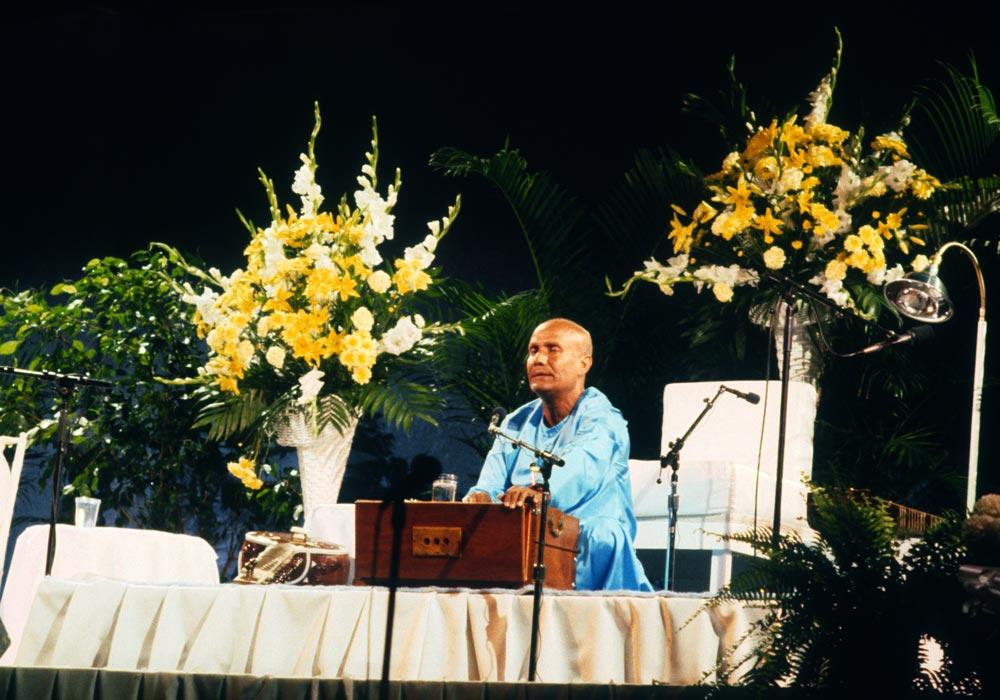
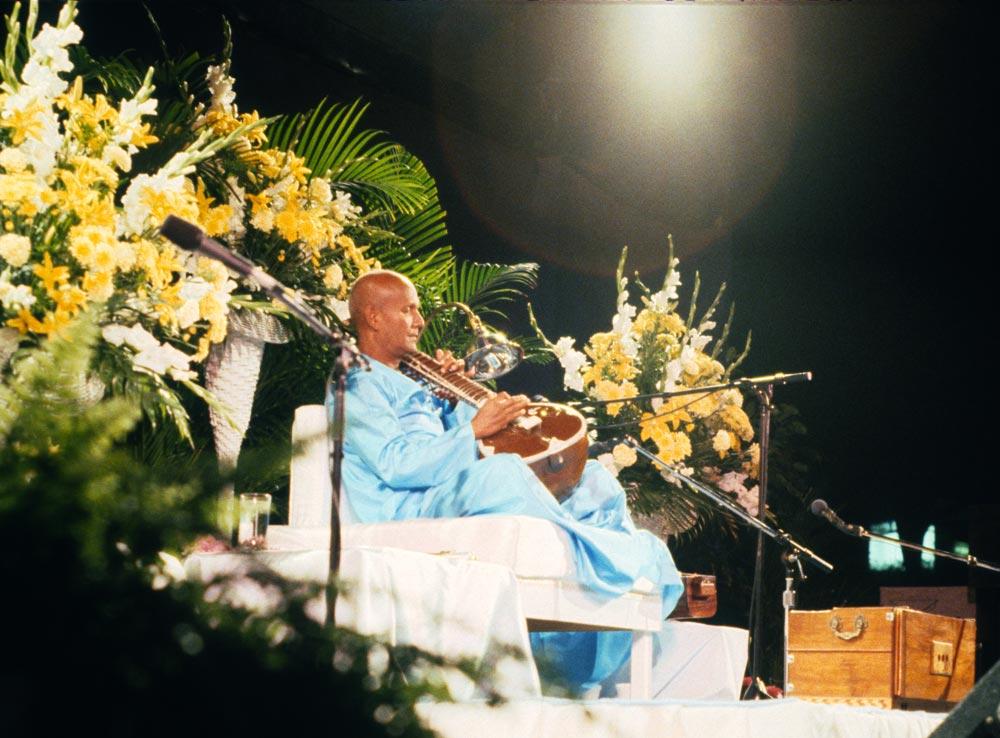
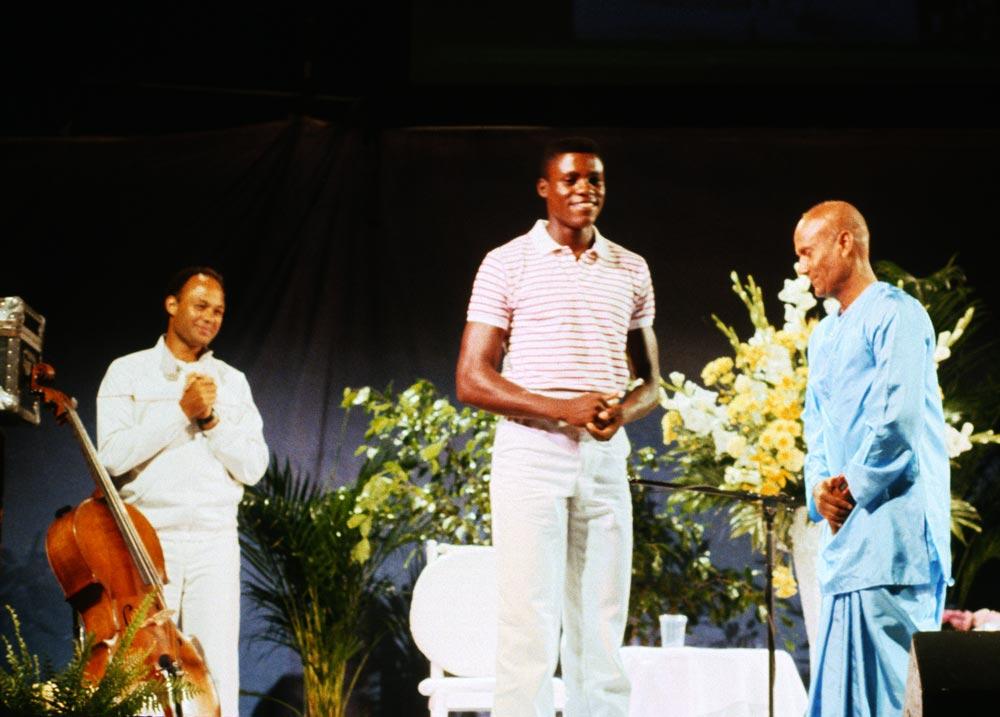
The "Lifting Up the World with a Oneness-Heart" program is a unique award that was offered by Sri Chinmoy to recognise individuals from all walks of life who had inspired and uplifted humanity. Sri Chinmoy lifted the recipients overhead either with one arm or both arms, using a specially constructed platform in a symbolic gesture of oneness with their uplifting achievements.

sri-chinmoy-bill-pearl
Bill Pearl. Five times winner "Mr Universe". Photo: Pulak

The programme began on 26th June 1988. The first person to be lifted was Mahamsarat Bill Pearl, a former Mr Universe and "World's Best-Built Man of the Century". Explaining his motivation for this programme, Sri Chinmoy said:

"I am trying to reach people in various walks of life who have inspired others — in sports, in literature, in science and in politics. Since they have inspired many people, I am trying with my limited capacity to encourage and inspire them. When someone does something great, he is cheered by his colleagues. They congratulate him. Here also I am trying to congratulate them with my prayerful meditation and inner oneness with them. I just lift them up to show my deepest appreciation of their achievements." (1)

Sri Chinmoy's initial goal was to lift 700 individuals. He achieved this on 3 November 1988, just a few months after beginning. Five days before the celebration of this first milestone, Sri Chinmoy remarked:

My immediate goal is to lift 700 individuals who have inspired mankind in all kinds of ways, in all walks of life. But my ultimate goal is to love God the Creator and serve God the creation sleeplessly and unconditionally until I breathe my last. (2)

lifting-up-world-ph-dhanu
7 Nov 1988, celebration of first 700 people to be lifted. Photo Dhanu

Over the next 29 years, Sri Chinmoy would lift 8,300 people in this way. It included heads of state, senior diplomats, sportsmen and cultural figures, but also ordinary people who had made a contribution to making the world a better place.

PM-steingrimur
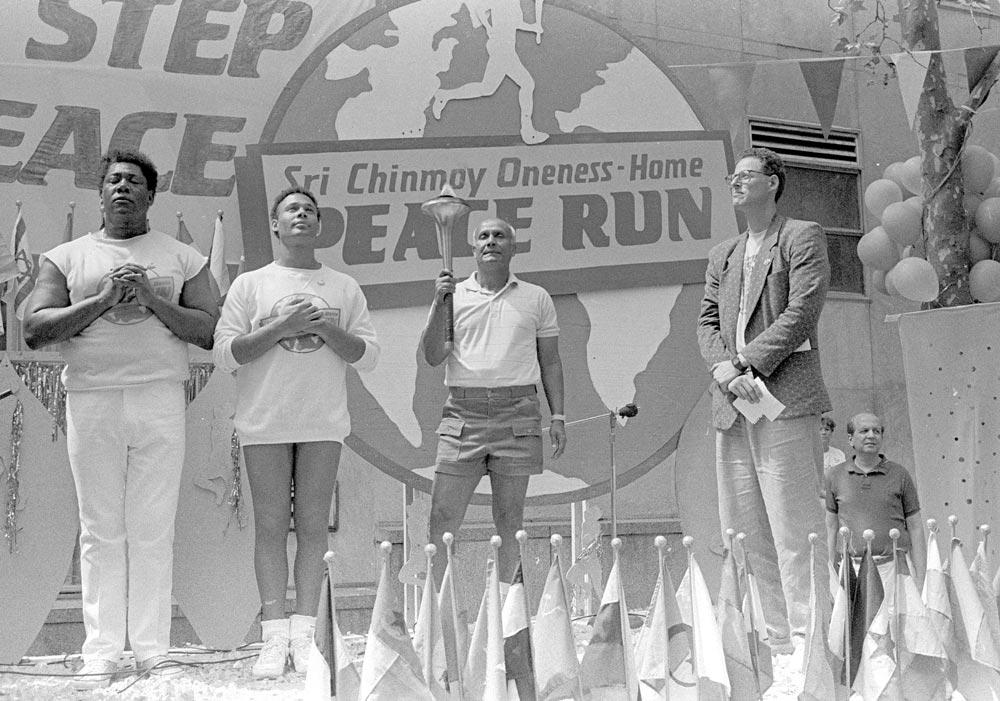
PM Steingrímur Hermannsson of Iceland holds aloft the Peace Torch whilst being lifted.

A seated one-armed lift is one of the hardest weightliftin,g challenges as the arm needs to do most of the lifting. The feats of Sri Chinmoy lifting people heavier than his own bodyweight, are impressive in their own right. Sri Chinmoy was always keen to emphasise that the essence of "Lifting Up The World With a Oneness-Heart" was the feeling of oneness.

As you can see, I am not a bodybuilder; I am not a weightlifter. I do not have the muscle mass of a bodybuilder; I do not have the strength of a weightlifter. But I am a truth-seeker and a God-lover. I pray and meditate so that I can establish my oneness with each and every human being in the whole world. My lifting is all done on the strength of my heart's oneness with the world. I do this in the spirit of my soulful and devoted service to humanity.

Sri Chinmoy also offered this most significant revelation of the significance of his Lifting Up the World programme on 28 July 2005.

 Sri Chinmoy: I lift people to offer my gratitude, gratitude to the Lord Supreme. So many children, so many world leaders, so many I lift.

Whom do I lift? The living Presence of God I lift. Not the name, not the form, but the real Divinity inside – that I lift with my aspiration. The living Presence of God.


Heads of State

lifting-up-world
lifting-up-world
lifting-up-world

From left to right.
President Nelson Mandela (South Africa, 9 March 1999)
President Ranasinghe Premadasa (Sri Lanka, 4 January 1990)
President Jorge E. Illueca of Panama - 21 July 1989

United Nations

lifting-up-world
lifting-up-world
lifting-up-world

From left to right. 
Javier Pérez de Cuéllar, 5th Secretary General of the United Nations, 26 May 2005
Vladimir Petrovsky, Former Director-General of the United Nations in Geneva, 12 October 2002
Professor Ibrahim A. Gambari, Under-Secretary-General of the United Nations, 4 March 2002


Sport

carl-lewis
billie-jean-king
lifting-up-world

From left to right. 
Sudhahota Carl Lewis, Olympic champion - 10 September 2001.
Billie Jean King, tennis champion - 22 May 2003.
Tegla Laroupe, Marathon champion - 4 November 2004


Cultural/Music

lifting-up-world
lifting-up-world
lifting-up-world

From left to right. 
Ravi Shankar, 20 September 2002
Susan Sarandon, 23 April 2003
Roberta Flack, 29 October 1988


Religious/spiritual figures

basil-hume
lifting-up-world
lifting-up-world

From left to right.
Cardinal Basil Hume, 19 October 1990
Rabbi Marc Gellman, 23 May 2001
Buddhist monk, 23 May 2001


Kind Words for Lifting Up The World With a Oneness-Heart

lifting-up-world

"I am very happy you are here. I feel deeply honoured to be a part of your worldwide organisation and to take part in this wonderful programme. I am happy this moment has come. Your powerful group carries an equally powerful message for the world."

PRESIDENT NELSON MANDELA
South Africa, March 9th, 1999 (The 2,000th person to be lifted by Sri Chinmoy)


lifting-up-world

"You spread the ideas of non-violence, tolerance and harmony among people. All of us are inhabitants of the same planet. We are members of one family. And you spread the idea of one family all over the world."

VLADIMIR PETROVSKY
Former Director-General of the United Nations in Geneva, October 12th, 2002 (The 5,000th person to be lifted by Sri Chinmoy)


lifting-up-world

"To be lifted once in a lifetime, I think, is good enough for most. To be lifted twice is an honour I cannot forget. I am overwhelmed. I want to thank Sri Chinmoy for this tremendous honour. By honouring me, you are honouring more than just me. You are honouring the town from which I come in Nigeria, the country from which I come, the continent from which I come, and the United Nations, where I work. Sri Chinmoy is a wonderful human being whom I am proud and privileged to know. There is no higher calling, no higher pursuit than peace. This is what Sri Chinmoy symbolises."

PROFESSOR IBRAHIM A. GAMBARI
Under-Secretary-General of the United Nations, Special Adviser to the Secretary-General on Africa, March 4th, 2002


lifting-up-world

"Who can imagine what Sri Chinmoy does! He does it through his spiritual strength, his power, putting his faith in God and understanding that anything can be achieved. I think it is a message that is strong to everyone about where to direct their attention or meditation and that they can achieve anything they set out to do."

SUDHAHOTA CARL LEWIS
9-time Olympic Gold Medallist in track and field, November 17th, 1999


lifting-up-world

"Sri Chinmoy has no one to look at and say that such things are impossible. The only thing he can do is to feel what is inside him. For Sri Chinmoy there are no limits to the human body. To get beyond that is a wonderful feeling, because no one else has ever done what he is doing. But just because no one else has done it does not mean that it is impossible. Sri Chinmoy is the proof. Sri Chinmoy is exposing the wonderful mystery of what we are. He is exposing capabilities that humans have never tapped before. He has placed aside all barriers. To overcome the difficulties and go beyond limitations is the sign of someone very great. No one has been where Sri Chinmoy is now. Sri Chinmoy is a pathfinder for humanity."

AL OERTER
4-time Olympic Gold Medallist in the discus, February 18th, 2000 (lifted with his wife Cathy)


lifting-up-world

"First Swami Vivekananda came to give India's spiritual wealth to the West. Then came Paramahansa Yogananda. Now Sri Chinmoy has come."

MAESTRO RAVI SHANKAR
Legendary Sitar Player, September 23rd, 2002


lifting-up-world

"Sri Chinmoy was in San Diego recently, so Christine and I went to see him. This was the first time Christine had met the Guru, and he lifted us together along with dozens of athletes in attendance. I was amazed at how his shoulders had grown and upper back had become wider from the overhead lifting. At 71 years of age, Sri Chinmoy continues to work out and lift more weight. I spoke a few words to the gathering before we left and got a standing ovation as I recited a stanza from a song I wrote about him years ago...Feeling very inspired afterwards, I was in high spirits all day."

FRANK ZANE
3-time Mr. Olympia, 3-time Mr. Universe, Mr. America, September 24th, 2002 (lifted with his wife Christine). Comments reprinted from the Autumn 2002 issue of his magazine Building the Body


lifting-up-world

"When Sri Chinmoy lifts, the feeling that you have starts from inside. It's a wonderful thing. It's as if you feel yourself being lifted by someone from inside first...Sri Chinmoy is trying to give people a chance to actually see the spirit. The way he does the lifts is with God's Power and Strength and Support."

ADDWITIYA ROBERTA FLACK
6-time Grammy Award-winning vocalist, July 29th, 2001


Helen Hunt on David Letterman


Stories about Lifting up the World With a Oneness-Heart

Related

Photo credits: Pulak Viscardi, Dhanu Alaimo, Maral Siegel, Adarini Inkei, Abakash Konopiaty.

Video credits: Mridanga Spencer, Kedar Misani

The First Sri Chinmoy 3100 Mile Self-Transcendence Race

Submitted by super_admin on

Follow Your Dreams

by Sahishnu Szczesiul, Associate Race Director, Sri Chinmoy Marathon Team

3100-sri-chinmoy
Photo: Pulak Viscardi

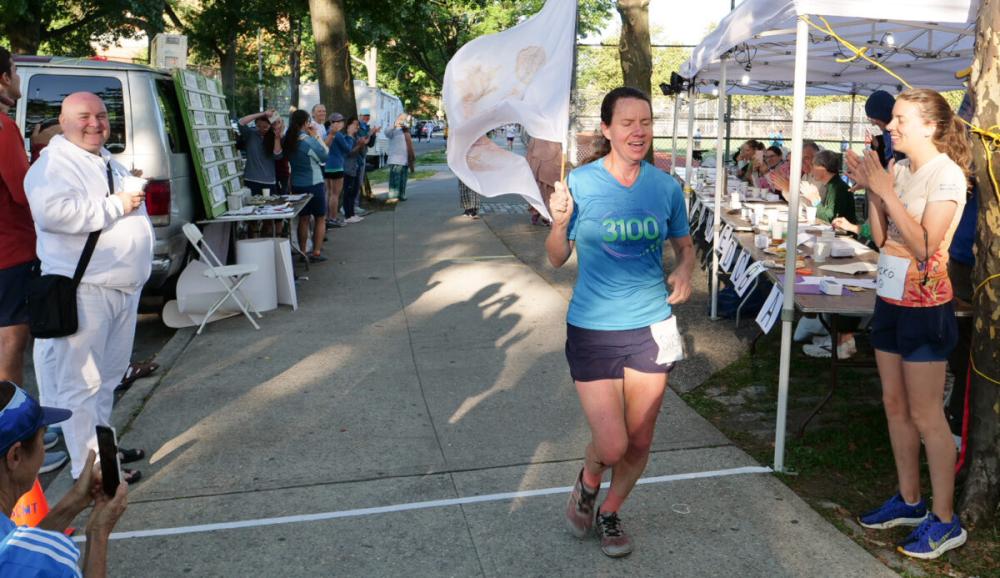
At 6:05 am on Thursday, June 12, 1997, five runners stepped up to the starting line on the sidewalk near Thomas Edison Vocational High School in Jamaica, to try and circumnavigate a slightly more than half-mile (.5488 miles or 883.2079 meters) course 5,649 times. The first annual Sri Chinmoy 3100 Mile Race was to begin on the same course that the 1996 event had five runners reach their goal of 2700 miles. Three of those lucky five were back to experience their own escape from the humdrum world. They had 51 days to complete their journey.

A race designed for runners with high mileage capabilities and fast recovery, the 3100 had an evening curfew from midnight to 6:00am. The rest of the time you ran your best. You had to be a master of mileage to even think of starting: 60.78 miles per day was the required average. Fifty miles a day kept you in the race. This was perhaps the longest race ever done on a closed course; certainly the longest race available nowadays. The runners slept in apartments near the racecourse, and brought everything they needed for each day. Meals were delivered at regular times each day, and a constant supply of liquids and snacks was available. When they finished at night, a car whisked them away to home for rest.

The Runners

Edward Kelley, 39, was a part-time actor and former track coach living in Long Beach, California. "I came to win this thing, I'm determined to finish, and I expect to average close to 70 miles a day," he said. Kelley had finished second in the 1996 2700 Mile Race, trailing Latvian world record holder Georgs Jermolajevs by over 100 miles. "People ask me why I do these races. I tell them because I am good at it. I love to race and compete. Obviously the distance scares people. But I have run across the country five times, had two non-finishes, plus ran 2700 miles last year. I know I can do better. The 3100 distance intrigues me and inspires me."

Georgs Jermolajevs, 54, arrived from his native Latvia only 14 hours before the race began. Having endured another rough winter in the former Soviet republic, Jermolajevs was eager to begin his journey of 10 million steps, free of the constraints and pressures of his then-destitute homeland. The physical education instructor and odd-job worker claimed normal fitness, but hoped to be in top shape after a week or two of road toughening. The previous year he had run 2700 miles in 40 days 15 hours, averaging 66.7 miles per day to dominate the race.

Istvan Sipos of Hungary arrived amid rumours that he had not run a step since his victory in the 1000 Mile Race in 1996. Istvan took the offer to come to New York, hoping to run himself into shape while keeping the others within sight. In 1993 he had set the world best for 1300 miles and 2000 km, and many recalled his easy victory in the 1994 Trans America Race, when he glided through the hottest first three weeks on record and was never challenged in the 64-day stage race (3000 miles).

Suprabha Beckjord, 41, toed the line for her 20th multi-day race of five days or more in the last 12 years. She had been brilliant in the 2700, finishing first woman and third overall in 43 days, 0 hours, 46 minutes — an average of 62 miles per day. Fearless and confident, Beckjord came with her health and fitness intact, ready to push her limits again. She was the lone woman in the race, but a relentless competitor nonetheless. Her years of experience and great ability of concentration would surely propel her to the finish line.

Aleksandar Arsic, 32, from Nis, Yugoslavia, was the youngest runner in the field — limited in experience but showing good potential. He had completed four other multi-days but had never passed 903 miles. He would need to average at least 50 miles a day to stay in the race, and hoped the other talented four would pull his young legs along to new heights.

The Start

sri-chinmoy
Photo: Pulak Viscardi

After a powerful silent meditation by Sri Chinmoy, the runners left the line in a clockwise direction around the concrete course.

Photo: Maral Siegel

 Ed Kelley took the lead from the gun, hoping to strike hard at his competition and set the tone for the race. Georgs ran and walked to stay close, but Edward widened his lead by the end of the first day. After completing 88.9 miles on day one, Kelley was nearly 12 miles ahead of Georgs, 17 miles ahead of Suprabha and 27 miles ahead of Istvan. But competition is not the only thing that a race of 3100 miles is about. Consistency, patience, poise and good health are the hallmarks of multi-day success.

The Early Weeks

As the miles began to pile up and days passed, one could notice the slimmer look of each runner. Effort showed on their faces, but cheerfulness still remained a part of their demeanour. They seemed to have a great awareness of everything around them — they were actually enjoying this race.

On Day 7, hot, humid weather moved into the region, with temperatures rising into the 90s. Unlike the unusually cool weather of the previous year, the summer began heating up quickly. After one week, Ed Kelley led with 485.6 miles (69.2 per day), firmly ahead of Georgs (454.4 miles), Suprabha (444.5) and Istvan (405.5 miles). Even Aleksandar averaged 56 miles a day.

Kelley had once remarked that you should expect two or three major crises during a run of this magnitude. By Day 11, Georgs — having fallen 40 miles behind Edward — had some mental struggles, stopping early one evening at 43.9 miles, saying he couldn't sleep in the heat. Istvan, meanwhile, suffered a serious right quadriceps injury; walking slowly and in great pain, he was forced to withdraw from the race on Day 12, a victim of a torn quadriceps muscle.

Ed mounted a counter-attack and by the end of two weeks had totalled 943 miles. But he was not immune to problems — breathing difficulties in the stuffy, humid air saw his internal temperature rise to 102°, with spells of dizziness and weakness. On Day 15 he barely made 50 miles, yet his resolve carried him through. One day Sri Chinmoy told Edward that a champion always shows his true colours. Kelley passed his first major test.

During the hottest stretch, Suprabha ran extremely well, recording the highest daily mileage in the field on four of the six hottest days. She slipped ahead of Georgs into second place, at one point drawing within 22 miles of the lead. Meanwhile, Georgs' Achilles tendon became tender, forcing him to adapt his footwear and lacing to allow the tendon to heal while he continued.

On Day 21 Suprabha encountered her own crisis — a slightly pulled muscle in her upper thigh. She walked the remainder of the day, still totalling 56 miles, but fearful of her long-term chances. Luckily the injury proved minor, and with a good night's rest she was back running the next day. This would prove to be her only day below 60 miles for the entire race.

What Drives Them On?

What made these runners continue when they had already covered thousands of miles, with thousands more to go? To even toe the line for a race of this magnitude is an act of courage. An ultra-runner is someone who can overcome fits of boredom, fatigue, discomfort and endless hours of running — alone with their thoughts, alone with themselves for days and weeks on end.

Suprabha often said she was exploring new boundaries of her inner self as well as her physical limits, using her meditation practice as a catalyst for discovering her true inner capacity. Ed Kelley used his charitable connections with children's disability as a stimulus to cover the miles and reach new goals. Their spirit is perhaps more remarkable than their talent.

The Last Three Weeks

As the race passed the four-week mark, the finishing order became clear. Edward Kelley and Suprabha Beckjord were destined to finish within the 51-day time limit. Ed passed 2000 miles in 30 days 14 hours; Suprabha followed at 32 days 3 hours. All the runners had to endure a typical New York summer — hot and humid, with little air movement and infrequent thunderstorms.

One particular storm on July 18th was a little too close for comfort. A heavy downpour in the afternoon was followed hours later by black clouds and red-tinted thunderheads. Within minutes the sky blackened, the wind shifted, and the full force of the storm broke loose. Suprabha and Aleksandar donned raincoats and continued running; Ed and Georgs took shelter in the vans. Branches and trees came down, hailstones clattered on the vehicles, and a large tree fell near the course. Winds reached 70 miles an hour, closing the two local airports, and a mini tornado touched down less than ten miles away. Yet still the two runners circled the track. Numbers from the scoreboard were found two blocks away.

Georgs began to put up more respectable numbers in the final weeks, learning valuable lessons about survival and acceptance even as victory slipped away. He passed 2000 miles on Day 36 — nearly six days slower than Kelley's split. Aleksandar, still in the race past the four-week mark, was quietly putting pressure on Georgs from behind.

As the remaining quartet approached forty days, Edward Kelley was almost assured of victory. He reached 3000 miles in 46 days 6 hours — the first man to pass this milestone in a certified race. On Tuesday, July 29th, he became the first man to reach 3100 miles, finishing in 47 days 15 hours — 130 miles ahead of Suprabha. 

photo: pulak
Photo: Pulak

A crowd of nearly 100 people witnessed his historic triumph. Forty minutes after reaching 3100 miles, he returned to the course to record 13 more laps, passing 5000 km in 47 days 19 hours — three world firsts in a single race. He averaged 65+ miles per day for 47 days, his steely determination carrying him to the goal.

Suprabha Beckjord crossed the line on Friday, August 1st, completing 3100 miles in 50 days, 2 hours — averaging 61.9 miles per day. When she finished, friends showered her with gifts, bouquets and placards. A modest, humble and supremely talented athlete.

suprabha
Suprabha finish. Photo: Pulak Viscardi

Georgs Jermolajevs stopped with 2717 miles — far from his own expectations, but much fitter than when he started. Aleksandar Arsic reached his personal pinnacle of 2700 miles on the final day, grateful for the experience and ready for the next challenge.

aspiration-ground-ceremony
Photo: Pulak Viscardi. Note, in the background, there is mention in 1996, there was a 2,700 Mile Race - the precursor to the 3100. In 1998, there is a question mark, but Sri Chinmoy confirmed that the final distance of the longest race would be 3,100 Miles.

"This 3,100 miles is an unprecedented journey in our world-peace-manifestation-dream. World-peace can come into existence only when we are inundated with patience and perseverance. Infinite patience we need in our inner life, and perseverance we need in our outer life.

"These 3,100 miles remind us of one divine and supreme reality: we can and must do everything at our command to transform the world of lethargy and unwillingness to be dynamic. Willingness to give, willingness to achieve, willingness to grow and glow should be the message of our souls.

"To Ed, Suprabha, Georgs and Aleksander, my soul's summit blessingful love, blessingful joy and blessingful pride I am offering unreservedly and unconditionally. Whenever I passed by you running, you reminded me of our souls' eternal, birthless and deathless journey and you reminded me of Eternity's choice runners."

— Sri Chinmoy, at the awards ceremony, 2 August 1997

Final Results

Sri Chinmoy 3100 Mile Race — June 12 to August 1, 1997 — 5 starters
Course: .5488 mile loop (883.2079 meters), paved sidewalk, certified
Curfew: 12:05am – 6:05am (Actual start: 6:05:00am EDT)

  1. Edward Kelley, 39, Long Beach, CA, USA — 3100 miles in 47 days + 15:19:56
  2. Suprabha Beckjord, 41, Washington, DC, USA — 3100 miles in 50 days + 02:09:56
  3. Georgs Jermolajevs, 54, Riga, Latvia — 2717 miles in 49 days + 13:15:26
  4. Aleksandar Arsic, 32, Nis, Serbia — 2700 miles in 50 days + 06:49:34
  5. Istvan Sipos, 37, Szeged, Hungary — 582.27 miles in 11 days + 00:59:05 (withdrew, injury)

A multi-day runner is always assured that when the race ends, he is never the same person that he was when he started. These lucky five runners had gone through ups and downs, never falling victim to doubt. As Sri Chinmoy often said: "Today's goal is tomorrow's starting point."

3100 Mile Race website

More articles about the early history of the 3100 Mile Race.

Sri Chinmoy's Tennis

Submitted by super_admin on

Sri Chinmoy began playing tennis on or around 13 June 1977, at the age of 45. Despite a late start, he displayed a great eagerness to develop and improve, often playing a variety of opponents for many hours. 

sri-chinmoy-tennis
Photo: Kedar Misani

The spiritual message of tennis

The spiritual message of tennis: 
Love, serve 
And finally surrender 
To the Supreme in the winner. 
The loser who cheerfully surrenders 
To the Supreme in the winner 
Becomes himself a real winner 
In the inner world.

- Sri Chinmoy (FF-8902)


Footage of Sri Chinmoy playing tennis from the late 1980s to 2005. Includes meeting with Ilie Nastase and awarding of "Lifting Up the World With a Oneness-Heart". Footage courtesy Mridanga Spencer.


Tennis Stars

Over the years Sri Chinmoy invited many top tennis players, such as Billie Jean King, Steffi Graf, Monica Seles, Mats Wilander, Ilie Năstase, Martina Navratilova and Ramesh Krishnan to his own tennis court at Aspiration-Ground, New York. 

Sri Chinmoy with Monica Seles. Photo: Maral


Billie-jean-king
Photo: Dhanu. Sri Chinmoy, Billie Jean King. 22 May 2003

Lifting Up The World With a Oneness-Heart

sri chinmoy
martina-navratilova
mats-wilander

Sri Chinmoy would often honour tennis players as part of his "Lifting Up the World with a Oneness Heart" programme. 

From left to right. Steffi Graf (11 Nov 1989), 
Martina Navratilova (30 August 2005), 
Mats Wilander (17 March 1990)


Sri Chinmoy Tennis Classics

sri chinmoy- tennis-classic
Photo Pulak. 8 June 1989 

Sri Chinmoy and his students also organised tennis competitions, known as Sri Chinmoy Tennis Classics. This included a tennis competition for the UN, and in the above example, an interfaith tennis classic.

Question: Guru, when we put on Sri Chinmoy Tennis Classics in our cities, how can we make it an experience that will be beneficial to the inner life and not just another tennis tournament?

Sri Chinmoy: First of all, we should not give the players prize money. Then, whoever is the organiser could give a five-minute talk. He could say that in order to do anything successfully in life, you always need friends. It is like a tug-of-war: if you have more people on your side, then you are bound to win. It is the same in tennis. You already have talent as a friend. You also have parents, dear ones and so on. One more friend that you can have is a good thought. A good thought can be your best friend. If you have good thoughts and good will towards your opponent, then these realities will enter into him and you will also receive good thoughts and good will from him. (Continue reading at Sri Chinmoy Library)

Watching Sri Chinmoy play tennis

sri-chinmoy-tennis
Photo: Pulak. Sri Chinmoy playing India tennis star Ramesh Krishnan at Aspiration-Ground, 1988

From 1978 to the early 2000s, Sri Chinmoy spent many hours playing tennis at Aspiration-Ground. Sri Chinmoy said, it could be an excellent opportunity for his students to be in a meditative consciousness whilst he was playing tennis.

You can learn so much from tennis. Whenever I play, please watch very soulfully.

When I strike the ball, see how the ball surrenders and goes wherever I want it to. Each time I strike the ball, please identify yourself with the ball, and feel that you are surrendering to the will of the Supreme in me. Inwardly you can say the word “surrender”. And no matter in which direction I hit the ball, unconditionally it goes there. So feel that you are making your surrender unconditional.

Then when I am serving, please feel that you are serving the Supreme in your Guru. Whenever I serve, please feel that you are serving the Supreme in me with utmost love and devotion.

If you can do these two things, you will get tremendous joy and make tremendous progress when you are watching me play tennis. (I Play Tennis Every Day, Sri Chinmoy Library)

Mahiyan - Playing tennis with Sri Chinmoy

(Video footage Sri Chinmoy - Kedar. Interview: Tejvan)

Mahiyan Savage was a former professional tennis player who became a disciple of Sri Chinmoy in the early 1970s. Mahiyan played many hours of tennis with Sri Chinmoy. 

Stories of playing tennis with Sri Chinmoy

Audio file

Databir, Bipin and Rupantar talk about playing tennis with Guru. In particular, they explain Sri Chinmoy's preferred method of scoring, which led to quick games with minimal interruptions.

sri chinmoy

I Play Tennis Every Day

I Play Tennis Every Day - Sri Chinmoy Library

Question and answers, talks and poems about the spiritual significance of tennis.

Articles on Sri Chinmoy's Tennis


Sri Chinmoy’s Peerless Tennis Achievement

by Vidagdha Bennett

Watching Sri Chinmoy play tennis on a summer’s morning in New York, it is hard to believe that a little over four years ago the game was unfamiliar to him. Today, approaching fifty years of age, he moves about the court with the natural ease of one who has attained a sure and certain mastery of what must be one of the most demanding and skilled of sports. Sri Chinmoy’s strokes are smooth, even and powerful; his timing excellent; his rhythm relaxed. It is at once clear that a lifetime of dedication to sport lies behind the beauty and grace of his style. Read more...


.
 

Sri Chinmoy’s Peerless Tennis Achievement, Part Two

by Vidagdha Bennett May, 1984

Three years have elapsed since the first part of this article appeared. If one were to graph Sri Chinmoy’s progress in tennis during this time, it would show a steady escalation, which was particularly intensified during the warmer months from April to September. Read more...

Photos of Lifting up the World with a Oneness-Heart. Steffi Graf, Adarini Inkel; Mats Wilander, Dhanu; Martina Navratilova, Pulak

The Eternal Peace Flame

Submitted by super_admin on

On 9 June 2001, Sri Chinmoy inaugurated the Eternal Peace Flame at the Pier of Honour, in Oslo, Norway. The flame was symbolically lit using the Peace Run Torch. Sri Chinmoy was joined by Svenn Kristiansen, Oslo's Deputy Mayor and several other dignitaries in attendance. There was also a large crowd of well-wishers who offered their own prayers and meditations for this symbol of peace.

srichinmoy
Photo: Pulak, 9 June 2001

 Sri Chinmoy inaugurates the Eternal Peace Flame at the Pier of Honour in the Port of Oslo, Norway.

The Eternal Peace-Flame, 
Mankind’s oneness-game. 
Here in Norway’s Oslo 
The smiles of the world glow. 

- Sri Chinmoy, (Sri Chinmoy Songs)

sri-chinmoy
Photo: Piyasi

Runners from the Sri Chinmoy Oneness-Home Peace Run were in Oslo for the occasion.

sri-chinmoy
Photo: Maral

The inauguration of the Peace Flame was part of a week-long activity dedicated to peace in Oslo. It included a concert, art exhibition, lecture and running events.

Video

Video by Kedar Misani

The statue's permanent home

sri-chinmoy
Photo: Kedar Misani

After its temporary position, the Eternal Peace Flame now has a permanent place in the beautiful surroundings of Holmenkollen — overlooking the city. Next to the flame, there is now also a statue of Sri Chinmoy - a powerful work of art to represent the peace-loving life and spirit of Sri Chinmoy, the founder of the Oneness-Home Peace Run.

Related

Canada's Oneness-Heart

Submitted by super_admin on

canadas-oneness-heart


Long before the advent of the Sri Chinmoy Oneness-Home Peace Run, Sri Chinmoy encouraged his disciples to bring to the fore the unique qualities of their country in various ways. For Canada, he composed the song “O Good Canada’s Oneness-Heart” and, over the next few months, teams of runners demonstrated this oneness with some epic relay runs.

O Good Canada’s Oneness-Heart

O good Canada’s Oneness-Heart,
In you I see the perfection-start.
Your blue vision-worlds run and sail,
Your gold reality-worlds never fail.
Your beauty’s soulful cry succeeds.
Your duty’s fruitful smile proceeds.
Beyond within your vastness-chart,
O good Canada’s Oneness-Heart.
        – 9 May 1976

On 28 April 1976, thirteen Canadian disciples embarked on a 360-mile, non-stop relay run to celebrate the anniversary of Sri Chinmoy’s completion of 360 poems in 24 hours.

On 24 June 1976, a team of relay runners set off from Ottawa carrying a flaming torch. Their destination, more than 500 miles away was the Statue of Liberty in New York. Sixty-six hours later, the runners of Canada’s Oneness-Heart completed their relay which demonstrated their love and support for their American brothers and sisters and their feeling of oneness with the American Bicentennial spirit. 


With the arrival of the Canadian team, a group of American runners, called Liberty Torch, would begin their own non-stop run through all 50 U.S. states in honor of the 200th anniversary of the founding of America.

Photo: Bhashwar

Sri Chinmoy, the inspiration for both historic groups, said:

"Today Canada’s Oneness-Heart is claimed at once by humanity’s soulful cry and divinity’s fruitful smile. History will bear witness to the Supreme fact that Canada is not for Canada alone."

- Sri Chinmoy


Questions and answers

Before the Canadian runners set out on their journey to the Statue of liberty, they had the opportunity to ask Sri Chinmoy questions about the significance of Canada’s Oneness-Heart.

Question: What is the inner and outer goal of Canada’s Oneness-Heart?

Sri Chinmoy: The goal is to bring to the fore all the divine qualities that Canada has. Good qualities you have in abundant measure. All these qualities can be brought to the fore, and all unaspiring qualities can be transformed into aspiring qualities. 

So, this is the goal: to come to the fore, to be in the vanguard of humanity’s progress. Here again, not with a competitive spirit but with our pure, aspiring life. The goal here is very broad, very wide, very lofty, illumining and fulfilling. There is no end to this goal. As you mentioned, it is only the starting point for each succeeding goal. There is no fixed goal. Right now, Canada’s Oneness-Heart has to prove itself in all the Centres in Canada – Halifax, Quebec, Montreal, Ottawa, Toronto, Victoria. Among the Canadian Centres there should be no competitive spirit. 

Question: What are the spiritual qualities that are most important in Canada’s Oneness-Heart?

Sri Chinmoy: Until you have realised what oneness is, then the next best thing is sacrifice. Oneness has to be established; this is the goal. Right now, you are using the term ‘Canada’s Oneness-Heart’, but if you do not feel that Oneness-Heart immediately the moment you say ‘oneness’, then you have to achieve that oneness. How can you achieve it? Only on the strength of sacrifice, self-sacrifice. But again, there is no such thing as self-sacrifice. When my hand does something for my leg, it is not sacrifice because the hand knows that my leg is part of my entire body; the next moment my leg will do something for my hand. So, until you have realised that we are all one, then you have to make sacrifices to make yourself feel that we all are one. How do we make ourselves feel that we all are one? On the strength of self-sacrifice.

Oneness is satisfaction, oneness is perfection. If we are not satisfied, if we do not feel a sense of satisfaction inside us, then we have to come to oneness through self-sacrifice. How do you sacrifice? To make sacrifice you have to be pure – pure in the body, vital, mind and heart, in the inner life, in the outer life. It takes confidence, security in the Supreme for the Supreme.

In the outer life, it is very difficult for us to feel that we are of the Supreme. At times, we do feel that we are for the Supreme, that we are not merely a stranger on the street, but we do not feel it at every moment. If we can feel that we are of the Absolute Supreme, then there are many undivine things we will not do. If we feel we are of the One who is universal, transcendental, how can insecurity, jealousy or other undivine qualities enter into us? No matter how imperfect we are, we can be for the Supreme. When you think you are for the Supreme, you become more alert to what is happening now. 

If you do not feel immediately what oneness is, then start with sacrifice. In order to sacrifice, you have to have inner purity and outer confidence. This confidence needs the support of the vital and mind for inspiration. 

Question: What does the Supreme think of Canada’s Oneness-Heart?

Sri Chinmoy: He does not think! He has no brain. He does not use brain-power. He holds the ultimate Vision, and he knows what the ultimate Vision is. He is nurturing the seed, he knows how the seed will germinate, how it will become a plant, how it will become a tree, a great banyan tree. All that He knows inwardly. In our case, we do not know; it is all calculation, addition, subtraction, multiplication and division; this is our life.

But in His case, there is no such thing as addition and subtraction because He knows the Ultimate is unfolding. In His ultimate Vision, it is all One. Therefore, we can either go straight, sideways, upwards, inwards. We feel that we are flying or diving. But the Supreme sees clearly when we are flying, when we are diving and when we are running also.

The Supreme does not think, He does not feel. He knows. It is His own Self-Expansion. He is Infinite; therefore, He enters Infinity. He is all Oneness. As I say, He is transcending. He is infinite; He is eternal. If we use the mind, Infinity puzzles us, Eternity puzzles us. But if we use the soul, there is no problem. Infinity is a state of consciousness that can be expanded and which lasts. There is nothing but God Himself. He is always Progress. He is Perfect Perfection – He is Infinite Perfection.

At every moment, He is Transcending His Divinity, His Infinity, His Eternity, His Immortality, so that we can never catch Him. It is a game He plays and when we do catch Him, He immediately dances before us, He embraces us and then He runs away, and again we run after Him. We run after Him and then we become tired. He waits for us secretly, unmistakably, carefully. He waits most soulfully. Then He comes and again the game starts. It is the cosmic hide-and-seek game He is playing.
 

Further reading

Talk about Canada's Oneness-Heart, 12 February 1977.

Sri Chinmoy London Peace Mile

Submitted by super_admin on

The first Sri Chinmoy Peace Mile was inaugurated at Battersea Park, London on 15 March 1986. The idea of the Peace Mile was to offer runners and walkers the opportunity to have a dedicated mile which also served as an opportunity to remember and appreciate the ideals of peace. The Peace Mile programme was also initiated to celebrate the United Nations International Year of Peace (1986). Speaking at the inauguration in Battersea Park, Sri Chinmoy said:

“To me, this Peace Mile in my name is at once a blessingful gift from God and a soulful honour from man. God has countless children on earth, but his fondest Child, Peace, is not yet born. From time immemorial, humanity has been dreaming of Peace, God’s Peace Child. At God’s Choice Hour, this fondest child of God, Peace, will take birth and for that all we human beings have to prepare ourselves. We have to create a oneness-home from where peace can reign supreme.”

“Now we are dreaming of peace and so we must love peace as our very own. When we can claim peace to be our own, when it becomes an inseparable existence-reality in our lives the Kingdom of Heaven will descend. Let us pray for a oneness-family and inside this oneness-family, the beauty, divinity and immortality of peace will abide.”

- Sri Chinmoy, London, Peace Mile, 15 March 1986.

Peace Mile Video

Footage of Sri Chinmoy speaking at the inauguration of the Peace Mile.


peace-mile
Sri Chinmoy at the Peace Mile plaque. Photos: Dhanu

In a spirit of oneness, many Peace Miles were established around the world to serve as a reminder of the common bond all peoples share in their love of sports and desire for global harmony. Shortly after the first Peace Mile in London, a second Peace Mile was established in West Berlin, directly in the shadow of the Berlin Wall—a poignant reminder of the need to work for international understanding. 

pagoda
Sri Chinmoy with the Mayor of Wandsworth

The Peace Mile was inaugurated by Sri Chinmoy and the Mayor of Wandsworth Council, London. The Peace Mile also runs past the Buddhist Peace Pagoda. A temple which has four faces of the Buddha.

buddhist
Sri Chinmoy meditates soulfully on the statue of Lord Buddha.


peace-mile
Sri Chinmoy with young runners by the River Thames.

The event included one mile races along the course of the Peace Mile, which is located by the edge of the River Thames.

singers

During the event, children singers offered songs on the theme of peace to the audience.

sri-chinmoy-pagoda

Sri Chinmoy interviewed by the local British media. The Peace Pagoda is in the background.

Invited guests to the event included Members of Parliament, British running champions, and dignitaries representing the Greater London Council, and the United Nations Association. The programme included several races, ending with a peace walk around the course, led by Sri Chinmoy.

walk

On returning to New York, Sri Chinmoy remarked on how successful the event was and how much happiness he felt. Writing later in "Run and Become, Part 18" Sri Chinmoy wrote

Thirty metres away from the starting line there were four golden statues of Lord Buddha in a peace pagoda. Right near the start was the River Thames, which runs along about 800 metres of the course. It was all very beautiful!

I always speak about enthusiasm. This time the British have shown enthusiasm from beginning to end. How cheerfully they worked together! In terms of happiness, enthusiasm, warmth and oneness, this race far surpassed all the races we have ever held, including those in New York. I always say, “Become, and then go beyond.” So they have become one with all the good qualities that New York offers in its races, and they have gone far beyond.

The big shots who came were so nice! How kindly and respectfully they talked to me. I was so deeply moved.

- Sri Chinmoy, Run and Become, Part 18

  • Photos by Dhanu
  • Video footage: Mridanga/Pavitrata

Hriday Ranjan Ghosh

Compiled by Vidagdha Bennett

“My brother Hriday’s philosophy and wisdom
I have inherited.” 1
  — Sri Chinmoy
 

Hriday Ranjan Ghosh was Sri Chinmoy’s eldest brother and the firstborn child of Shashi Kumar Ghosh and his wife Yogamaya. Hriday was born in the family home in the village of Shakpura, East Bengal, circa 1911. I have prepared this selection of stories about this most remarkable liberated soul in anticipation of his birth centenary in 2011.

The name ‘Hriday’ means ‘heart’, while ‘Ranjan’ means ‘delight’. One can only imagine the joy that greeted the arrival of this first son and he soon acquired the nickname ‘Khoka’, which means ‘the darling of the family’.

It is the custom in Indian families for nicknames and even given names to be used only by the parents and others in the family who are older than the individual concerned. Younger members of the family, therefore, referred to Hriday variously by the deeply moving and respectful title ‘Baro-da Mani’, meaning ‘jewel of an eldest brother’,2 or ‘Dada’ or, quite simply, as ‘Da’.

Hriday passed away at the Sri Aurobindo Ashram in Pondicherry, South India, on April 7th, 1976, at the age of 65.


Table of Contents


Part One: 1911-1932

Hriday’s Youth
“My Uncle’s Love for Hriday”
Hriday’s Gift for Astrology
The Inner Call

Part Two: 1932-1942

The Question of Questions
The Family Response
Hriday at the Sri Aurobindo Ashram
Hriday's Connection with Swami Vivekananda
Sri Aurobindo's Diplomacy
Family Visits

Part Three: 1942-1944

Hriday Returns to Chittagong
The Stray Cow
Yogamaya's Passing
Hriday Becomes Madal's Schoolteacher
Hriday Receives Permission to Bring Chinmoy to the Ashram

Part Four: 1944-1976

July 23rd, 1944
Chinmoy's First Darshan
The Lives of Two Brothers are Spared
Hriday's Sorrow
Hriday's Faithful Service
Hriday Scolds Chinmoy
Nolini-da's tribute to Hriday 
Photos of Hriday
Dedications to Hriday
Chinmoy Offers a Family House
Hriday Knew all Along
Hriday's Complaint
Hriday's Blessing
Hriday's Prediction
Hriday's Passing

Part Five: Insights

Hriday's Poems
Hriday's Letters
The Invocation in Sanskrit
Surabhi's Reflections
Sri Chinmoy's Inner Experiences
Sri Chinmoy's Family Songs
Conclusion


Part One 1911–1932

Hriday’s Youth

Hriday was a taller than average, handsome youth who resembled his father in stature and appearance. He had no inclination towards sports or physical activities, but was blessed with a profound, scholarly nature. He was greatly attracted to the ancient Indian scriptures – the Vedas, the Upanishads and the Bhagavad Gita – and, in due course, he became proficient in Sanskrit, the language in which they are recorded. Hriday memorised many Sanskrit mantras and would spend hours every day meditating and chanting.


This photo was taken in the village of Kelishahar, the ancestral home of Sri Chinmoy’s mother. The photo was taken before Sri Chinmoy’s birth, possibly around 1925. In the back row, standing, are Chitta and Hriday. Yogamaya is seated on the far left, in the centre is her mother and on the far right is her younger sister Charubala, whose nickname was ‘Bhuti’. Yogamaya’s three daughters – Ahana, Lily and Arpita (left to right) – are seated at her feet. Next to Yogamaya is her sister-in-law Chapala, wife of her brother Revati. This couple was childless and when Ahana was a little older, they looked after her. The other lady, seated between Yogamaya’s mother and her sister, is Yogamaya’s other sister-in-law, Savitri, wife of her eldest brother Ambika. Savitri is holding her infant daughter Shephali. The two children at her feet are Pushpita, the daughter of Charubala, and Vijali, her own daughter. Over the next few years, Mantu and Madal would be born to Yogamaya, and Savitri would have another daughter, Dipali.


After completing his middle schooling, Hriday went on to study for his BA in Chittagong town. I think we can accurately presume that he undertook his studies at Chittagong College, which was the first college in the greater Chittagong area.3 When the University of Dhaka was established in 1921, Chittagong College became registered as a Degree College under this university.

It was to the field of philosophy that Hriday was drawn and he became an authority on Eastern philosophy and, in particular, on Hindu mysticism. 4 Hriday was extremely fortunate to study in a college whose Philosophy Department was at the leading edge of advances in the field. Moreover, in 1926, the College had become co-educational and, in that same year, student dormitories were established. Since it would not have been feasible for Hriday to commute to the College from his tiny village each day, it is quite likely that from the years 1929-1932 he either stayed at the College or lodged with his second maternal uncle and his wife. He may even have stayed in town from a much earlier date in order to complete his middle schooling.


“My Uncle’s Love for Hriday”

When Sri Chinmoy first published this next biographical story about Hriday, he substituted fictional names for all the main characters.5 This is the story that touches on Hriday and his maternal uncle, Ambika Charan Bishwas, in its original version. Presumably, the story took place in 1932, when Hriday was 21 years of age.

Madal’s eldest brother, Hriday, was extremely close to this uncle’s eldest son, who was named Kulai.6 Both Hriday and Kulai were many years older than Madal. It happened that Kulai became sick and had to go into the hospital. After two or three weeks, his case became very serious. Then, early one morning he died.


On that particular day, Hriday was supposed to take his final examination at college. Madal’s uncle knew that if Hriday came to learn that his dearest friend had died, he would feel sad and miserable and not do well in his examination. So he cleverly, wisely and compassionately kept his son’s death a secret.

On the morning that Kulai died, the cook in Madal’s house did not appear. So this uncle started cooking for Hriday. While cooking, he was smiling so happily. He told Hriday, “When you come back from the examination, I will have a most delicious meal for you. I will also cook a second meal for your dearest friend, Kulai, and you can bring it to him.”

Then he pretended that Kulai was making a surprising recovery. Hriday was so delighted to hear that his friend had taken a turn for the better and he was looking forward to visiting him that evening. So he was doubly happy when he took his examination. He always stood first, but on that day everything came easily to him. Because of his unimaginable happiness, he finished his examination in a very short time!

That evening, after eating the meal that his uncle had cooked, he brought the second meal over to the hospital for Kulai. There he heard the sad news that his dear friend had passed away earlier that morning. In the Indian system, the body has to be burned on the day of death. So already the body had been taken to his maternal uncle’s house. Hriday cried and cried as he went to his maternal uncle’s house to see his dearest friend for the last time. Madal’s maternal uncle had fooled Hriday only because of his tremendous love and affection for him. Otherwise, how could a father do this kind of thing?7


Hriday’s Gift for Astrology

In India, astrology is a highly respected and ancient practice and Hriday, with his love for the wisdom of the past, was greatly attracted to it. Perhaps it puzzled him that this young child Madal should come into their family. After all, the age difference between him and Madal was twenty years. Hriday sought to shed some light on the future of Madal, but the answer the astrologer gave must have mystified him even further. Sri Chinmoy writes:

In India, there are quite a few systems of casting horoscopes. The Bhrigu system is most significant. It was introduced thousands of years ago and now there are volumes upon volumes written about it, with everything recorded. You just give your chart to the Brahmin, the astrologer who is dealing with this system, and he will turn the pages in front of you and tell you everything about your life. Very often it is true. Your life history has been written there. If the proper chart has been drawn, then he does not even have to cast a horoscope. It is already written there.

My eldest brother, who is an astrologer, went to an astrologer who was conversant with this system and who had all the old, sacred books where everything is written. When he showed my chart to this astrologer, the astrologer said that after the age of twelve, my horoscope would not function any more. He was absolutely correct, because at the age of thirteen, I realised God and became immune to all the astrological laws.8

Clearly, Hriday must have shared this information with the rest of the family and perhaps they pondered over the significance of what the Brahmin astrologer had said. On another occasion when Sri Chinmoy narrated this story, he said:

In my case, Bhrigu says that at the age of twelve I will go to my Satguru and from that time onwards astrology will not apply to my life because my Guru would be responsible. Whatever was destined to happen would not happen because my Guru would change my fate.


The Inner Call

At the end of 1932, after he had sat for his final BA examinations, but before the results were announced, Hriday abruptly left Chittagong to join the Sri Aurobindo Ashram in faraway Pondicherry – a decision that took his parents by surprise and was a source of tremendous disappointment for his father, who had high hopes for his eldest son to become successful in the academic field.

What happened to this retiring scholar, then, while he was at Chittagong College to precipitate this sudden, dramatic renunciation not only of his home and family, but also of his cherished academic life? After all, Hriday had a towering intellect and could easily have become another Surendranath Dasgupta, authoring scholarly works that aspired to unravel the great Sanskrit texts.

In one of Sri Chinmoy’s stories, written in 1971,9 he indicates in vague terms what might have transpired in Hriday’s case. The story is not strictly biographical, but there are certain indications that he is referring to his eldest brother. The story begins:

There was a most sincere seeker who, right from his childhood, used to pray regularly to God. When he was seven or eight years old he started praying to Mother Kali, because she was his family deity. He was very fond of Mother Kali.

He read and studied spiritual books, and he learned that Sri Ramakrishna was the dearest child of the Mother Kali. So he started praying to Sri Ramakrishna, and he became Sri Ramakrishna’s disciple inwardly. He became friendly with some of Sri Ramakrishna’s disciples but unfortunately he did not see Sri Ramakrishna physically, because Sri Ramakrishna had left the body long before. Later, this seeker began reading spiritual books written by other Masters, and finally he came to realise who his own spiritual Master was, and he went to live at his Master’s Ashram.

Here Sri Chinmoy suggests that his brother was initially drawn to Sri Ramakrishna. This is very understandable, as Sri Ramakrishna [1836–1886] was also a Bengali. Even as late as 1930, there were still a number of the Master’s direct disciples alive, as well as many devotees who had seen Sri Ramakrishna or Swami Vivekananda in person. Swami Vivekananda had visited East Bengal in 1901. Moreover, one of Sri Ramakrishna’s greatest householder disciples – Nag Mahashoy – hailed from East Bengal. Branches of the Ramakrishna Mission had been established in Dhaka, Sylhet, Faridpur and several other towns, but not, it seems, in Chittagong. Nevertheless, the whole province literally throbbed with Swami Vivekananda’s fiery, man-making spirit.

However, the strongest pull for Hriday towards Sri Ramakrishna came from within. According to Sri Chinmoy, his brother had been a direct disciple of Sri Ramakrishna in his previous life. On one occasion, Sri Chinmoy borrowed my book Sri Ramakrishna: A Biography in Pictures10 and turned the pages intently, looking for a photograph of his brother in that incarnation. He could not find the one he was looking for. However, since Hriday was born around 1911, we can perhaps deduce that he passed away around the turn of the century, which would limit the number of possibilities. One thing is clear and that is Hriday was searching for a spiritual Master who was in the physical body.

Sri Aurobindo, another Bengali, had formerly been in the vortex of the revolutionary movement and had been incarcerated in Alipore Jail, Calcutta, for a year – from May 1908 until May 1909. In February 1910, upon receiving information that the British intended to arrest him again, Sri Aurobindo was forced to quit Calcutta for the French territory of Chandernagore. In April of that year, an inner command urged him to sail south and seek refuge in Pondicherry, also a French territory. There he retired altogether from his political activities and concentrated on his meditation. On November 24th, 1926 he attained his God-realisation and the Sri Aurobindo Ashram may be said to have formally started from this date.

And so it was to Sri Aurobindo that Hriday felt the strongest magnetic attraction. According to his younger brother Mantu, both Hriday and Chitta learned about Sri Aurobindo from a gentleman named Manodhar-da, who later joined the Ashram:

Manodhar-da came from Comilla. He lived in Chittagong and my father appointed him to teach our eldest brother Hriday-da and Chitta-da. He used to practise music then. It was he who told my brothers about Sri Aurobindo for the first time. He had learned a few songs from Dilip-da. In the Ashram, he allowed Chinmoy to play his harmonium, which was given to him by Dilip-da. Manodhar-da was also a poet and a painter.11

Perhaps around this time, during his philosophical studies, Hriday also came into contact with some issues of the magazine Arya. Sri Aurobindo’s principal work on yoga, The Synthesis of Yoga, was originally published in serial form in Arya between 1914 and 1921, and his Essays on the Gita was published as a separate book in 1928. For a keen student of philosophy, like Hriday, these writings must have acted like an irresistible summons.

Some time after 1930, Hriday presumably corresponded with the Mother of the Ashram and asked to join the Ashram. Not all seekers who applied were accepted. However, the invitation came. Somehow, Hriday managed to gather sufficient funds to purchase a train ticket and he left Chittagong around December 1932, when his youngest brother Madal was only one year and three months old. It seems that he did not advise his parents in advance of his intended course of action and they did not learn of it for two weeks. To have their eldest son disappear without a trace must have been harrowing for them and, no doubt, they were deeply hurt that he had not sought their permission before choosing to go so far away. Like many an ardent seeker with close family ties, Hriday seems to have made every effort to maintain secrecy and avoid being challenged about his decision.

Again, in our day and age, when long-distance travel is very much the norm, we may not appreciate the enormous courage required for a young Indian village youth to undertake such an epic and, in a sense, irreversible journey in quest of a Master whom he had never seen. Many years later, his dramatic decision would be echoed in his youngest brother’s decision to leave Pondicherry and go to America.


Part Two: 1932-1942

The Question of Questions

Hriday’s zeal for inner illumination is revealed in the following story about his very first day in the Ashram, which Sri Chinmoy was fond of recounting:

My brother Hriday was a direct disciple of Sri Ramakrishna in his past incarnation. In this life, the very first day he entered the Ashram, he said to the Mother: “I believe that here there are some souls who have realised God and have come here to serve you, and some who will realise God in this incarnation. So please tell me which category I belong to.”

What a question! The Mother blessed him, this 22-year-old boy, and said, “I cannot say whether you have realised God or not, but I assure you, if you have not realised God, in this incarnation you will be able to realise God.”

My brother really tried very hard, plus he got so much encouragement from Sri Aurobindo. In our family, Hriday did Yoga for everybody. Hundreds of hours in front of the shrine he spent, and he was always occupied, working here and there, studying the Vedas. In comparison to him, we were just jokers.

To hear from the Mother’s lips at the outset of his spiritual sadhana that he had the capacity to realise God in this life must have been a wonderful boon for the young man.


The Family Response

The immediate result of Hriday’s departure was a huge upheaval within the family. Within a few months, his parents, siblings and various other relatives descended upon the Ashram with the sole aim of taking Hriday back home with them. To add to the emotional scene, Yogamaya was frail from fasting and she had her infant son Madal in tow. What firstborn Indian son could resist such pressure? Here are the dramatic events and their significant ramifications as recorded by Sri Chinmoy:

When I was only one year and three months old, my eldest brother, Hriday, left the house and went to join the Sri Aurobindo Ashram in South India. It was a terrible shock to my parents. My brother had just graduated from Chittagong University, and he was thoroughly versed in Indian philosophy. Right from his childhood, Hriday had been spiritually inclined, and he used to pray and meditate all the time. So he disappeared and became a disciple of Sri Aurobindo.

When my parents came to know his whereabouts in two weeks’ time, my mother begged my father to take her to the Sri Aurobindo Ashram. She was convinced she would be able to change her son’s mind and bring him back.

My father was so sad and mad that he refused. He said, “He can desert us. I do not need him. I do not want him.”

When my father did not want to go to the Ashram, my mother started fasting. She fasted for a day and a half. Then my father’s heart melted. A day and a half was enough; then he agreed.

He brought the whole family to the Ashram. My father used to get free railway passes since he was head inspector of the Assam-Bengal Railway Line. He would get free passes for eleven in our family plus two servants. On other occasions, people who were not our relatives became our relatives for the ride. Young girls and boys from our village would pass as daughters, sons and cousins. After my father’s death, we went only once to the Ashram and, at that time, we had to pay.

In those days, if you were not seven years old, you were not allowed to come to the main building of the Ashram. We stayed in a rented place, and I was not allowed to come to the main building. Every day the Ashram Mother used to come to the balcony and people used to meditate with her. I used to cry a lot, so my cousin, Nirmala-di, would take me three or four blocks away, making the sacrifice so that my mother could see the Divine Mother.

My mother was overjoyed to see my brother, but my brother was miserable because he knew my mother had come to take him away. The day came for my mother to have an interview with the Divine Mother. My mother was all prepared to beg the Divine Mother to give her eldest son back so that she could take him home. My mother did not know English. But luckily one of my sisters who knew English was behind her. With the Mother was her General Secretary [Nolini Kanta Gupta].

My mother said in pure Bengali, “I am so grateful to you, Divine Mother, that you have taken responsibility for my eldest son. He is now at your feet. Now I am praying to you to take care of all my children. They are still quite young, but when they grow up, please promise me that you will take full responsibility for all of them, as you have taken my eldest son under your protection and guidance.”

The Mother of the Ashram immediately said, “Yes, they are all mine.”

Look what happened! My mother had gone only to take her son back. Instead of that, she was begging the Divine Mother to take care of the rest of her children when they grew up.

When my sister and mother came back to the house where we were staying, my mother said, “Look what I did! I went to take my eldest son back home. Instead of that, I have offered all my children to the Mother.”

Everybody laughed and was so deeply moved. Even my father was deeply moved that his wife was so devoted to the Mother.

So the heart says one thing; the mind says something else. I always say that the heart will eventually win. The mind came to take the eldest brother away, and what did the heart do? The heart did just the opposite.

And the Divine Mother did keep her promise. Over the next eleven years, all of us went to the Sri Aurobindo Ashram and became permanent members.12

Somehow Hriday remained firm in his resolve. He withstood his father’s silent disapproval and his mother’s tears. Indian sons find it extremely difficult, if not impossible to refuse any request their mothers may make. In the great Hindu epic, the Ramayana, Lord Rama tells his brother Lakshmana:

Janani janmabhumishcha swargadapi gariyasi
“Mother and motherland are superior to Heaven itself.”
 

Hriday would have been steeped in this belief and still he resisted his mother’s entreaties. Had she not had that remarkable experience in the presence of the Divine Mother of saying the exact opposite of what she intended, there is every possibility that Hriday would have had to accede to her request and return home. But it was not to be. His parents and all the relatives who accompanied them eventually departed without the object of their quest to make the long train journey home and I imagine that it was with something akin to a sigh of relief that Hriday settled into his new life.

In 1988, Sri Chinmoy learnt the exact date that he was brought to the Sri Aurobindo Ashram for the first time: the 8th of August 1933, when he was one year, eleven months and nineteen days old. On August 8th, 1988 he observed the 55th anniversary of this most significant day in his life and said:

My parents and my elder sisters and brothers brought me to the Ashram and the spiritual life – the place of my heart’s awakening and my life’s oneness-realisation with the highest Absolute Supreme. Nothing can be more important, more significant, more meaningful and more fruitful in the life of a seeker than to go and sit at the feet of one’s Master.

There is an additional possibility that if the family arrived on August 8th, they would have stayed for the Darshan of Sri Aurobindo and the Mother on August 15th, just one week hence. Although the youngest children would not have been able to participate, Hriday’s parents, his brother Chitta and perhaps even his sister Arpita would have been eligible. Again, this is only conjecture.


Hriday at the Sri Aurobindo Ashram

The number of sadhaks and sadhikas at the Sri Aurobindo Ashram in 1933 numbered only around 150.13 Those who entered the Ashram were expected to offer the Ashram their worldly goods, since the Ashram would be taking full responsibility for both their spiritual and their physical wellbeing. Because he was only a student, and had left without his parent’s permission, in all likelihood Hriday did not have money of his own to offer. Some other young men were in the same situation, particularly those who had been with Sri Aurobindo during his revolutionary days.

Hriday was provided with a room in a rented house near the main building where Sri Aurobindo and the Mother dwelt. Meals were partaken in the dining hall and, on the first of every month, the Mother would distribute necessities to each Ashramite – such as soap, oil, towels, tea, and sugar – all packed in a cardboard box. On that day, she also gave each person two rupees as pocket money. She assigned Hriday daily work in the bakery, doing physical work, grinding the flour. Then he used to work in the kitchen, carrying heavy pots containing vegetables and curries, and washing bananas. They were incongruous jobs for the scholar-philosopher, but he did not complain and continued carrying heavy pots until around 1973, at which time the Ashram kitchen was feeding around two thousand people twice a day. He took it as part of his sadhana and consciously did not seek a job that might have involved greater importance or responsibility.14 Meanwhile, he pursued his meditation discipline under the guidance of Sri Aurobindo.

The main events of the calendar year in the Ashram were the three Darshan Days when Sri Aurobindo and the Mother would sit side by side and the Ashramites would pass by them in silence and receive their blessing. The Darshan Days took place on February 21st, the birthday of the Mother; August 15th, the birthday of Sri Aurobindo; and November 24th, the day of siddhi. These were the only opportunities when the Ashramites were able to see Sri Aurobindo. In 1939 a fourth Darshan Day was added: April 24th, the day of the Mother’s final arrival in Pondicherry.

Even though Sri Aurobindo was in seclusion, he took an active interest in every aspect of his disciples’ lives, and from the year 1933 until his accident in 1938 he would answer their written questions through extensive correspondence. Hriday received over two hundred handwritten letters from his Master. Some of them are in a very elevated style. By way of answering Hriday’s searching questions, Sri Aurobindo would expand on lofty philosophical themes and also on the meanings of certain Sanskrit passages from the Vedas and Upanishads. He referred to Hriday as “my philosopher-disciple”.

In other letters, Sri Aurobindo would enquire after Hriday’s health, expressing concern even when Hriday suffered from a slight headache.15 Such touching words of love and affection from the Master were treasured by Hriday and eventually by the entire family.16 In later years, Sri Chinmoy often recalled Sri Aurobindo’s boundless love for his family and especially his eldest brother:

Sri Aurobindo gave Hriday much affection. Hriday was extremely devoted to Sri Aurobindo, and he meditated for hours and hours every day. Hriday was in his most fruitful years at that time. He used to write about Sri Aurobindo, and Sri Aurobindo encouraged him and appreciated his writings highly. He wrote hundreds of poems and many articles about his experiences. Sri Aurobindo always encouraged him, inspired him, and also deeply appreciated his experiences.


Hriday’s Connection with Swami Vivekananda

Sometimes spiritual Masters give their close ones glimpses into the intricate world of connections and affinities that link various souls. In Hriday’s case, Sri Aurobindo said something momentous. He sent a note in his own handwriting to Hriday. It read: “The soul that created Vivekananda has a direct connection with your soul.”

It seemed destined that Hriday’s life would be moulded along the same lines as that of Swami Vivekananda, who embodied Sri Ramakrishna’s light and manifested it to an unimaginable degree. We can see the glints of Vivekananda’s indomitable spirit in Hriday’s dramatic gesture to leave Chittagong. In a small way, it parallels Vivekananda’s sudden decision to set sail for the West. Again, even as Vivekananda sheltered hundreds of souls, so Hriday sheltered and protected his entire family.

Thus we can conjure up a picture of Hriday, in his mid-twenties, at the dawn of his spiritual life, brimming with endless possibilities and guided by his Master at every moment. We can imagine him living in the sacred atmosphere of the Ashram, free from the responsibilities of the outer world and the ties of family, performing his simple, dedicated service in the Ashram kitchen, and spending endless hours in meditation and in reading the sacred writings of his Master.


Sri Aurobindo’s Diplomacy

Sri Chinmoy reveals this amusing incident in Hriday’s life where the Master said one thing to him and something entirely different to others:

Sri Aurobindo was so diplomatic. My brother wanted to learn singing. Sri Aurobindo told him, “Singing is not good. Singing is only for people who live in the vital. You do not have to learn music – and the teacher is useless!” My brother was so happy – he is spiritual, music is so bad. Then, to the singers, Sri Aurobindo said that my brother could not carry a tune. He would ruin everything. This is how Sri Aurobindo used to make everybody happy.


Family Visits

Hriday’s family had not forgotten their darling. Somehow Yogamaya and various members of the extended family managed to undertake the epic four-day train journey from Chittagong to Pondicherry three more times – in 1936, 1939 and 1941.17 It was a round trip of approximately 4,915 km (3,054 miles), including segments that could only be negotiated by steamer or ferry.

When the family arrived in Pondicherry, they would stay in a guest house. It is not known whether their visits coincided with one of the special Darshan Days, when they might have been able to pass before Sri Aurobindo and the Mother, but there is some evidence that the Mother and Sri Aurobindo were not unaware of the visits. Perhaps, from behind the scenes, they observed the six younger Ghosh children growing up, showing more and more inclination towards the spiritual life, taking to the quiet routines at the Ashram naturally and spontaneously. Chitta, in particular, was only three years younger than Hriday and already had tremendous spiritual maturity.

Again, it is also possible that the family had to apply for permission to visit Hriday and this would also have brought them to the attention of the Mother and Sri Aurobindo. It is not known whether Yogamaya had any subsequent interviews with the Mother of the Ashram but, since the family was quite wealthy by Indian standards, it is highly probable that Shashi Kumar made a substantial monetary love-offering to the Ashram each time he came to see his eldest son.

One further thing to note is that the last two visits – in 1939 and 1941 – were undertaken during wartime, although the theatre of operations did not move to Southeast Asia until December 1941.

It seems that Shashi Kumar made each of the trips up until 1941. He is not in the photograph that was taken during that visit of Yogamaya and her four sons.18 Since this was not long before his passing, he may already have been unwell. Yogamaya was also suffering physically. She had developed a large goitre on the left side of her neck. Sri Chinmoy once remarked that in the photograph taken in 1941 she has deliberately draped her sari over her head in such a way as to hide the goitre.


In this photo taken at the Sri Aurobindo Ashram in 1941, Hriday is standing on the far left. His age at the time would have been 30. Next to him is his mother, Yogamaya, and his brothers Mantu and Chitta. Chinmoy is in the front row in front of Chitta, while Hriday is holding the young brother of one of his Ashram friends.


The family visit of 1941 was a turning point of sorts for Hriday. He realised that he would not see his father again and that his mother, too, was not long for this world. Somehow, Yogamaya extracted a promise from Hriday that when she or Shashi Kumar was dying – whomever went first – he would return to Chittagong to perform the obsequies, put the family affairs in order and take care of the little ones. As the eldest son, Hriday could not escape these family responsibilities.


Part Three: 1942-1944

Hriday Returns to Chittagong

In 1942, Shashi Kumar Ghosh passed away and it was now incumbent upon Hriday to return to Chittagong and shoulder his responsibilities as head of the family. He applied to Sri Aurobindo and the Mother for temporary leave from the Ashram and they gave him permission to return to Chittagong so that he could fulfil his promise to Yogamaya. Their magnanimous decision reflects not only their humanity, but also indicates their inner confidence that Hriday would return and eventually bring the entire family back with him to the Ashram. In fact, almost as soon as Hriday arrived home, Chitta expressed his own urgent desire to go and join the Ashram.19 This is Sri Chinmoy’s recounting of that time in his family’s history:

When my eldest brother Hriday came back to Chittagong for a few months, my middle brother Chitta went to replace him at the Ashram. This is how it happened. Hriday had promised my mother that if she or our father died, he would return for a few months to take care of the family. When my father passed away, Hriday came back to Chittagong with the permission of Sri Aurobindo and the Mother. They gave permission so that my brother could keep his promise.

When Hriday arrived, my mother was very sick. The family knew that she would soon follow my father to the other world. Hriday said to my mother, “I will stay here as long as you want me to.”

She said, “Then stay for a year.” He was so happy that she only said one year and not more.

Then Chitta wanted to go and join the Ashram. He said to my mother, “Now that my eldest brother has come back, I would like to go to the Ashram.”

My mother was so sad. She said to him, “Can you not see how sick I am? I am dying. It is only a matter of months. Will you not feel sad if I die in your absence? And I will feel miserable if you are not here with me.”

Chitta immediately said, “All right, I will not go.”

My mother asked him, “Did you buy the ticket?”

He said, “Yes, I bought the ticket to go on [such and such a date], but definitely I am not going. I will cancel it. I do not want you to die in my absence” So Chitta returned the ticket. My mother was so happy that Chitta had postponed his departure, but she knew that after she passed away, all her children would go to the Ashram.

Chitta totally forgot about the date on which he had planned to leave, and he did not mention it again. But my mother did not forget. Two weeks later, when that particular day came, the day he was supposed to go, my mother was so sick. She was lying down. Even then she had to think of him. She called my brother to her side and said, “You are not going today?”

Chitta said, “How can I go? You told me not to go, so I cancelled the ticket. I wanted to fulfil your last desire.”

My mother said to him, “No, I want to fulfil your desire. Who am I? I am only an ordinary human being. I want you to go, I want you to go.”

My brother said, “I have returned the train ticket.”

My mother said, “I want you to buy another ticket and go. I want you to go to the Divine Mother. I am your physical mother, but I know your Divine Mother has to take care of all of us.”

That was her heart’s wish. She said, “Now that your eldest brother is here, and your other brothers are here, this is the time for you to go and be in the presence of the Divine Mother. You should go, you should go.”

So my mother compelled my brother Chitta to go to the Sri Aurobindo Ashram. This is my mother’s heart. He wanted to please her and she wanted to please him. You see what a compassionate mother I had. And he went on that day. A few months later, she passed away.20

As each of the Ghosh siblings came of age, they longed to follow Hriday’s example and join the Sri Aurobindo Ashram and consecrate their lives to Sri Aurobindo and the Mother. Chitta, Arpita and Lily joined after Hriday returned to Chittagong, which only left Ahana, Mantu and Madal to follow.


The Stray Cow

This next incident occurred after Hriday returned home for his mother’s final days on earth. It shows that comedy and tragedy are never far apart. Sri Chinmoy recaptured the story across the great divide of more than six decades:

This is a very funny story from my childhood in Chittagong. One of our neighbours, a boy of fourteen or fifteen years old, took a cow to the field. Unfortunately, the cow entered into our property to eat the grain. Our servant happened to see the cow in our field. He rushed to the scene and he struck the cow. Then he and the boy who was with the cow had a wonderful fight. I was at home that afternoon, but I did not come out of the house.

Our neighbours brought a court case against our family. They did not bring the case against our servant. They claimed that I was directly involved. They said that I was the one who had not only struck the cow, but also beaten the boy very badly. In India, cows are extremely sacred. To strike a cow is a most serious crime.

That was not enough. The elder brother of the boy who was with the cow struck the boy and wounded his arm. The boy was bruised black and blue. The elder brother did it so that there would be a nice case against us. How that young boy suffered!

When my father was alive, he was the honorary judge of one village court. But he had died two years earlier. My eldest brother, who had been in the Sri Aurobindo Ashram for twelve years, had made a promise to my mother that if she was very sick, bed-ridden, he would come to see her and also to take care of the family. My mother’s case became very serious, so this brother of mine arrived home.

The court decided that our family had to pay a fine of twenty-five rupees or I would be in jail for three days. I was only twelve years old at the time. My mother cried and cried.

My brother said, “Twenty-five rupees is nothing! Let us pay it.”

But my mother said, “No, they may change their minds. They will take the money and then put my son in jail.”

I was supposed to go to court, but my mother would not allow me. So my eldest brother said, “All right, I will go. Let me see if I can deal with it.”

My brother went with twenty-five rupees to the court to defend me. The judge was a Muslim. He happened to be a great admirer of my father but, since it was a court case, he had to remain impartial. The boy who was struck was there, but our servant did not go. There was no case against him and also nobody would have taken him seriously. Only my brother Hriday went.

When the judge saw Hriday, he asked, “How did you come too be here? You were far away, in the south of India.”

Hriday said, “I came to see my mother. She is dying, so I came back to see her and take care of the family.”

The judge was quite fond of Hriday because Hriday was deeply spiritual. So he asked my brother a few questions about his spiritual life. He was so moved by what my brother told him about Sri Aurobindo and the Mother. Then the case was dismissed because my brother’s honesty and spiritual life pleased the judge. Hriday did not have to give twenty-five rupees to the neighbours who had lied. The poor boy was beaten by his own brother for nothing.


Yogamaya’s Passing

While Hriday was absent from the Ashram, he maintained contact with certain sadhaks to whom he had grown close. It seems that he corresponded with Nirodbaran, a medical doctor who was also from Chittagong. Nirodbaran was one of those select few who personally attended Sri Aurobindo and so he was in the unique and very privileged position of being able to speak to the Master every day. Moreover, unlike others, Nirodbaran did not hesitate to ask the Master questions which might seem impertinent. Thus we find him one day interrogating Sri Aurobindo directly as to why he did not exert his spiritual force to cure Hriday’s mother:

Sri Aurobindo had two or three secretaries. One of the secretaries was a former doctor. His name was Nirodbaran. He was a great poet, author and supreme authority on Sri Aurobindo and the Mother. One day he said to Sri Aurobindo, “Hriday’s mother has been suffering for such a long time. Can you not cure her?”

Sri Aurobindo said to him, “What can I do? Her time has come. It is God’s Will for her children to come here.”

My eldest sister, Arpita, was at that time a permanent member of the Ashram. On that same day, while she was enjoying her siesta, she had a dream. In the dream, she saw that my mother had passed away.

That day, at the very hour when Sri Aurobindo said, “Her time has come,” my mother passed away in Chittagong.21

In November 1997, Sri Chinmoy added:

That was the thing he said and that very day, at that very hour, my oldest sister – who was living in the Sri Aurobindo Ashram – had a dream that my mother had died. Then, in the evening, a telegram came from Chittagong saying that my mother had passed away. The music teacher, Manodhar-da brought it to Chitta. As soon as he saw the telegram, my brother Chitta said, “I know what it is.” He did not need to open it.

Meanwhile, Madal narrates what occurred hundreds of miles away in Shakpura on his mother’s last day:

On the day of my mother’s passing, I was at my maternal uncle’s house, five and a half miles away from our house. Early in the morning, my mother said, “This morning I am leaving the body. Where has Madal gone? Send for him.” Then a cousin of mine came to give me the message. My cousin knocked at my uncle’s door and said that my mother was dying. I had known that her case was serious, but now she was dying.

As soon as I got the message, I started running. Right from the start, tears were running down my cheeks because I was afraid I would not see my mother’s last breath. Finally, I reached our house and went into her room. My mother’s life could be measured in minutes. She was unable to speak, but as soon as I was at her side, she took my right hand very gently. She could not lift my hand, but she held my hand and then she placed my hand in my eldest brother’s hand. That meant she was telling my eldest brother to take responsibility for my life.

My eldest brother said, “Yes, I will take responsibility.”

Then my mother gave me a smile, her last smile, and in a few seconds she passed away.22

Yogamaya entrusted Hriday with the full responsibility for the care of his youngest brother. It was a responsibility that he took with utmost seriousness. What is also most enthralling about these two stories is that they took place within hours of each other, yet hundreds of miles apart. They show how intimately involved Sri Aurobindo was in each circumstance of the Ghosh family.


Hriday Becomes Madal’s Schoolteacher

Hriday was instrumental in helping to reduce Madal’s suffering after his mother’s death. He saw that his little brother was being tortured by other children and so he took him under his wing and placed him in the school where he was acting as headmaster. This story also gives us an insight into the relationship between the two brothers. Madal had never lived with his eldest brother before and he looked on him with awe. He felt shy in his brother’s presence and Hriday, on his part, seemed to have maintained a certain distance from the family as he continued to practise his spiritual disciplines.

When my eldest brother Hriday came back from the Ashram, he used to pass the whole day chanting from the Vedas and the Upanishads. He was in his own world. We could not mix with him freely, as we did with Chitta.

At that time, his dearest friend opened up a school for young girls and asked Hriday to be the Headmaster. Hriday had his Bachelor’s Degree from the University of Chittagong and he was a great scholar. So some of Hriday’s time was occupied with teaching.

When my mother died shortly after Hriday came back, I was not being treated well at school. The other children were mocking me. In India, when your father or mother dies, you have to perform so many austerities. For one month, you cannot eat meat or fish. You cannot sit on a chair, you cannot use a bed or pillows. You have to wear a thick cord from your shoulder to waist and shave your head. We had examinations at the time, so I had to sit on the floor and write my paper. There were more than one hundred students and everyone was making fun of me. They looked at me like a stranger. The teachers were very kind and compassionate to me. They knew that I was suffering. They would scold the other students, but then, in two minutes, when the teachers walked to the back of the room to check that nobody was cheating, again those boys would start mocking me.

Here I was, the darling of the family, and I was being treated like an outcaste. Tears were welling in my eyes and falling on my papers. I will never forget. Even then, somehow I managed to pass my examination. And these are the same boys who came and ate at our place after one month when we observed the obsequies. At that time they behaved well.

My older brothers and sisters did not suffer in the same way because people of their age were full of concern and affection for the members of our family. But my family knew that I was being tortured, so my eldest brother said to me, “Come and study with me for a few months at our school.” Even though the school where he taught was for girls, a few selected boys were allowed.

I studied under my brother for three months, up until we left for Pondicherry. Many years later, two girls from that school came to Pondicherry. They remembered me because I was the youngest brother of the Headmaster, but I did not remember them at all. Their names were Minu and Pakhi. After staying at the Sri Aurobindo Ashram, they went back to Chittagong and got married.23

Madal was placed in the unique position of being able to observe his eldest brother’s behaviour in many situations. One incident that made a deep impression on him was when Hriday met with his former primary schoolteacher and showed this gentleman the utmost gratitude. Hriday’s humility is, indeed, remarkable.

Gratitude towards the schoolteacher is not at all unusual in India. In my own family, my eldest brother, who is now a great scholar, touches the feet of his primary schoolteacher with great reverence. Unfortunately, here in the West, this kind of experience is very rare.24


Hriday Receives Permission to Bring Chinmoy to the Ashram

As World War II unfolded, Sri Aurobindo and the Mother were acutely aware of the deteriorating situation in East Bengal and the danger to their devotees in that region. In an unprecedented move, they decided to open the Ashram doors to children and, towards the end of 1943, they accepted the first batch of children. On December 2nd, 1943, the Mother opened a school for about twenty children25 and this paved the way for Hriday to apply for special permission to bring Madal and Mantu with him. Madal reveals that it was an anxious time of waiting both for him and for his eldest brother:

Every week Chitta used to write to us from the Ashram and tell us all the news. I used to go two miles to the Post Office and get his letter. Of course, I would read the letter on the way home!

One day, while reading the letter, I saw two English words followed by the names of our family members. The first word was ‘permission’, but I did not know the second word at all. Poor me, my English was only Chittagong primary school standard. In Bengali, we also use the word ‘permission’, so that is how I was familiar with it.

I knew that Chitta had applied to the Divine Mother of the Sri Aurobindo Ashram for us to be accepted into the Ashram as permanent residents, but I could not tell from his letter whether his request had been accepted or denied. So for two miles I was worrying and worrying. On the one hand, I did not see the word ‘not’, so there was hope that we had been accepted. But, on the other hand, I thought there might be another English word which meant that we had been refused.

When I arrived home, I rushed to my brother Hriday and gave him the letter. I was full of apprehension. Then I saw my brother smile. He was so happy. The second word was ‘granted’. The Mother was allowing our whole family to come and join the Ashram.

To the end of his life, Sri Chinmoy remained supremely grateful to the Mother for her magnanimity. In Mantu’s reminiscences, he reveals that the addition of children to the Ashram community gave fresh energy to the older sadhaks:

During the war, many parents wrote to the Mother begging Her to allow them to bring their children to the Ashram for protection. At this time, Japan was dropping bombs on various parts of India. The Mother gave Her permission. Because of the children’s presence at the Ashram, a school was established and also a playground was procured.

Nolini-da wrote: “Because of the young generation, our old, dry life-tree once again has blossomed.” The Mother’s special Blessings descended upon the young generation and because of this the older generation also felt new life.


Part Four: 1944-1976

July 23rd, 1944

There was now considerable urgency with regard to Hriday’s preparations to leave Shakpura. From May 1942, the Allied Forces had been pushed back into India from Burma by the Japanese and there was a sharp spike in Japanese air activity over East Bengal. Air raid sirens frequently sent townsfolk and villagers alike scurrying into makeshift air raid shelters. On March 25th, 1944 there was a huge Japanese aerial attack on Chittagong. Five medium bombers and thirty fighter planes targeted the area.26

Chittagong, with its convenient airfield and large harbour, had become a major base for allied operations and full-scale offensives were being launched against the Japanese in nearby Burma. Moreover, the Allied Forces had appropriated much of the food resources, leading to widespread famine throughout East Bengal. Hriday realised that the situation had become too dangerous for him to delay their departure any longer.

He gathered together the group that would be travelling with him to Pondicherry: Ahana, Mantu and Chinmoy; then there was his widowed maternal aunt Charubala, known to the family as Bhuti, and her daughter Pushpita; his maternal uncle Revati Charan Bishwas with his wife Chapala; and his cousins Nirmala and Soma. There may have been as many as eleven in the party. With the passing of Shashi Kumar Ghosh, the era of free travel on the Indian Railway system was over and Hriday would have had to pay the fares for the entire family. His father had left various bank accounts and was not a poor man by any means. So we may assume that when Hriday realised his father’s assets, there was a fair sum remaining which Hriday would eventually give to the Ashram.27 On the other hand, his father’s property, which was considerable, was not sold, but was provisionally entrusted to the care of some distant cousins who were permitted to live there.

The extended family group arrived at the Ashram after their long train journey on July 23rd, 1944. There they were reunited with Chitta, Lily and Arpita. Chinmoy was given a bed in the same room as his brother Chitta, while Mantu stayed in a room with Hriday at another place. The girls were in houses reserved for sadhikas. Mantu gives more precise details:

I got a room in Subon. My eldest brother Hriday and myself were staying in the room where at present Ashok Dey is staying. Chitta-da and Chinmoy got a room which is now at present our photographic exhibition room.

The Mother welcomed the orphaned family with immense love. She expressed this by giving them permanent status almost immediately:

After we arrived in Pondicherry, in two weeks the Mother made us permanent members. Usually it takes two to three years to become permanent.28

In 1995 Sri Chinmoy commented, “Our family is responsible for at least fifteen people to come to the Ashram.”


Chinmoy’s First Darshan

Chinmoy29 could easily have been compelled to wait for several months before he had the opportunity to see his spiritual Master face-to-face for the first time. Fortunately, however, he only had to wait just over two weeks. The next Darshan Day was on August 15th – Sri Aurobindo’s 72nd birthday.

This Darshan of his Master was the most significant event to this point in the life of the young boy and, in later years, he told the story of that day many times. It was indelibly printed on his heart and in his memory. One can imagine him queuing up with the other aspirants. Perhaps he was in the line sandwiched between his elder brothers and sisters. Then the moment came when he left his sandals at the door and entered the room, to stand alone before Sri Aurobindo and the Mother. The Mother broke her accustomed silence to say a few words about Chinmoy to Sri Aurobindo. Then, anxious that the young boy would continue to stand there indefinitely, Sri Aurobindo’s secretary/attendant Nirodbaran stepped forward, grabbed Chinmoy by both his shoulders and showed him the way to leave the room.

Here is Chitta’s version of the story:

In 1944, during the Darshan time, the Mother herself introduced Chinmoy to Sri Aurobindo, saying, “Hriday’s youngest brother, Chinmoy...” Usually the Mother never did this kind of thing.

Although some of us came long before Chinmoy and joined the Ashram, Mother used to refer to us as Chinmoy’s brothers and sisters. Always Mother used to introduce me as “Chinmoy’s brother”. We have been in the Ashram now for at least forty years. Even now, when they talk about us, many members in the Ashram say, “Chinmoy’s brothers and sister”. Such affection, such love he enjoyed both from the Mother and the members of the Ashram.30


The Lives of Two Brothers are Spared

Sri Chinmoy told this dramatic story from 1947 a number of times. First, his own life was spared and then, the very next day, Hriday was physically attacked by hooligans. Hriday was saved by his faith in his Master Sri Aurobindo:

There was a disciple of Sri Aurobindo named Mulshankar. He was a Gujarati man, about forty-five years old. I liked him very much. Mulshankar was a nurse, and he was also Sri Aurobindo’s attendant. He did everything that was needed for the Master. Mulshankar was a purity-flooded soul. Indeed, his entire being was flooded with purity.

One year, on the 15th of August – Sri Aurobindo’s birthday – Mulshankar was on his way to his own home. In one hour more, he would come back again to be at Sri Aurobindo’s service. In those days, the people of Pondicherry stood against the Sri Aurobindo Ashram. They were threatening to kill us, the residents of the Ashram. Many young, strong boys of the Ashram were stationed at different places. We were patrolling in various groups. We all had fixed hours and places where we were supposed to be. For an hour or so, five or six boys would walk along the street together. But while we were stationed at one particular place around the main building, we would be alone.

How the Supreme saved me! I was at a corner of the main building. Just one or two minutes before the incident took place, I went to respond to nature’s call. I went to the bathroom in the main building. Mulshankar happened to be standing at exactly the same corner where I had been standing. O God! He was stabbed! A man came with a big knife and stabbed Mulshankar in the back of his neck. Immediately he was taken to the hospital, where he was pronounced dead.

Many, many Pondicherry police gathered in front of the main building. I was coming out of the building after using the men’s room. The news spread that I had been killed. Nobody was giving the correct news that it was Mulshankar who was killed because I had been seen at exactly the spot where he was killed. My life was saved.

My aunt happened to be inside the main building. She was screaming like anything, even when I went and stood right in front of her. She was seeing me and, even then, she was crying. She had such a shock that she was still crying. This is my aunt who lived to be 103 years old. Can you believe it? This is the real love and affection that she had for me. I shall never forget her crying.

My sisters were so horrified when they heard about this incident. “Rakhe Krishna mare ke, mare Krishna rakhe ke.” This Sanskrit verse means, “Whom Krishna saves, who can destroy? Whom Krishna destroys, who can save?” Mulshankar happened to be at the very spot where I was assigned. He was such a good and nice man. How pure he was! That was how his life ended.

The following day, around 4:30 in the afternoon, my eldest brother was attacked by eight or ten people. They wanted to kill him. He was working at that time in the botanical gardens. While he was going home from the botanical gardens, he was attacked.

Hriday shouted and screamed at the top of his voice, “Sri Aurobindo! Sri Aurobindo!” Over and over he screamed his Master’s name. He screamed so loudly that all of his attackers left. His life was saved.

After that, my aunt would not allow Hriday to work at the botanical gardens. She cried and cried, so he had to quit his job there. Then he started working at the dining hall washing bananas.31


Hriday’s Sorrow

Around 1948 or so, Hriday’s beloved youngest sister Ahana got an attack of tuberculosis. She was only 22 years old at the time. The whole family was deeply concerned. Her maternal uncle and aunt in Chittagong, who had raised her as their own daughter, offered to pay for her to go back to Chittagong to receive medical treatment. The family was united in feeling that no effort should be spared to save her.

However, due to a series of unfortunate circumstances, for which Hriday was not responsible, Ahana was not taken for medical treatment. Her health deteriorated steadily, until she reached the stage where she could no longer get up from her bed. Among the Ashramites, there were four or five excellent medical doctors who had their degrees from England. Two of them examined Ahana at the Mother’s request, but they found that the disease was far too advanced to save her. They informed the family that it was a hopeless case. In another fifteen or twenty days, she went to God.

Ahana passed away at the tender age of 24. Sri Chinmoy told us that after her death, his brother became almost insane with grief. Impulsively, he decided to leave the Ashram and go far away. Sri Chinmoy continues:

[Hriday] was leaving the Ashram. My sister’s body was not yet taken to the cremation ground. Then our relatives and dear ones grabbed him. They said, “What are you doing? Think of your younger brothers and sisters. If you go away, the whole family will be shattered.” Then they gave him philosophy, philosophy. In this way, they convinced my brother to stay and gradually he calmed down.

Just four months later, when the family was still reeling from the loss of Ahana, Sri Aurobindo left his body. She died in July 1950 and Sri Aurobindo entered Mahasamadhi on December 5th.


Hriday’s Faithful Service

One of the most touching stories about Hriday’s love and concern for his youngest brother is connected with Hriday’s work at the dining hall. Knowing that his brother was habitually late, Hriday would save food for him. Here is the story as Sri Chinmoy told it on July 9th, 1998:

Every morning I was allowed to go and meditate in Sri Aurobindo’s room. At first, I stayed for three minutes, then five minutes. Then, in the space of one week, I went up to fifteen minutes, then half an hour, then one hour. I would start at six o’clock and go to seven, or a quarter past seven. Then it became six to eight o’clock regularly. My brothers were so proud that their youngest brother got this opportunity.

At half past seven in the morning, the dining room would close. My brother Hriday used to work there and so he used to stay and wait for me. He would take a plate of food for me and wait until I came. He himself would not eat until I came. He was waiting, waiting. Never did he scold me when I was late, unlike my sisters. My brothers were all very civilised. They never scolded me for my misbehaviours.

In the meantime, I would finish meditating in Sri Aurobindo’s room and then I would go to the Samadhi. Around nine o’clock I would come to the dining room in a very relaxed way. At half past nine, I had to start work in Nolini-da’s room, so I would spend time eating and chatting with my brother. He would be sitting like a gentleman, cross-legged, and my legs would be wide open, relaxed, while I ate. We were two brothers together.”


Hriday Scolds Chinmoy

This next fascinating anecdote was a great favourite of Sri Chinmoy’s. It not only reveals Hriday’s insight into his youngest brother’s occult powers, but also shows that he wanted to instil restraint in his youngest brother with regard to their application.

My maternal aunt Charubala had a daughter named Pushpita. It was to Pushpita that I showed my occult power for the first time. It happened in 1952 or ’53. I have told this story many times. Every day, around three or four o’clock in the afternoon, I used to go to my cousin’s house to eat. My three sisters used to live in the same house for some time. Since I did not have a mother, my cousin and my sisters used to take it in turns to give me food.

Alas, I was a vagabond. On this particular day, I was late by an hour and a half or so. My dinner was spoilt and my cousin had a very important appointment. So, when I finally arrived, my cousin scolded and insulted me ruthlessly. In the morning, she had told me to be on time because she had something to do.

Since I was her junior, for her to scold me was as easy as drinking water. Her scolding never stopped: “Why are you such a vagabond? Why are you always late?” And so it went on. This happened around five o’clock or so. While she was scolding me, I practically finished eating. Then I said to her, “You have given me food. You can stop scolding now.”

Still she continued. While she was scolding me, she started washing dishes near the sink. In the beginning, I had tolerated her scolding. Then I became furious. I said to her, “Look here, you will not be able to take one more step.”

She was holding onto the tap. She said, “I can come and kick you.”

I challenged her. “Then kick me,” I said. “Just come forward one step.” She lifted her leg up in the air. I was standing seven or eight metres away. Immediately I used my fastest occult power, and she could not lower her leg. She was stuck. Her mother was the eyewitness.

Then Lily came home and said, “What are you doing?”

I repeated, “What am I doing?” I was still angry.

After ten or fifteen minutes, my eldest brother Hriday came. Pushpita was telling him how bad I was. She told them the story how I had turned her into stone and they were absolutely horrified. Still she could not move her leg. It was absolutely paralysed in front of her. Then I felt sorry for her and released it.

I said to my eldest brother, “Now you come with me. Only walk with me for five minutes, and then we shall see a paddy field. You will see people working there. I will turn one of the human beings into a lamb. Then I will turn him back again and he will not be afflicted at all. Do not worry. I will take care of him.”

My brother said, “Tsch! Tsch!”

I said, “I am begging you to come and see.”

Then my brother made me sit down and he started lecturing me. “I have to go and see this kind of thing? Yes, you do have that kind of occult power, but who asked you to use it in this way? My own brother will turn a human being into a sheep? No, no, it is horrible. Please, never misuse occult power.”

“No, I will not misuse it,” I promised. “I just want to show you this first and last time. I did not beg God to give me occult power.”

He said, “All right, God gave you occult power. But why do you have to use it? It does not help your spiritual life.”

“It does not help, but it gives me a little relaxation and joy,” I answered.

Hriday knew I had that kind of occult power, but he did not take the trouble of coming with me and so I could not show him. I had literally begged him to see my occult power. At that time, I had occult power and I wanted to show it. Now I do not have it, so I do not have to worry about it!


Nolini-da’s tribute to Hriday

Aside from Sri Aurobindo and the Mother, the main pillars of the Ashram were also familiar with Hriday’s expertise in the Vedas and referred to him for assistance in this field. Nolini Kanta Gupta, the General Secretary of the Ashram, pays tribute to Hriday’s knowledge in this excerpt from Chinmoy’s diary of December 22nd, 1962. Chinmoy was then the literary secretary to Nolini-da but, as we can see from this brief glimpse into his daily schedule, his duties involved much more general work, as well as numerous errands.

Nolini: “Chinmoy, I have something for you to do. Go to Sahana and tell her that when they sing ‘idam shrestham...’ in that particular sloka they are making a mistake. I shall point out the mistake. You go to Sahana with my correction.”

When I came back from Sahana-di, Nolini-da gave me a big orange and said: “Here is your reward. Now you have to do something else. Go and tell Hriday [my eldest brother] that I wish to have the eighth ‘ashtaka’ of the commentary on the Rig Veda by Sayana. I need it badly. I tell you, there are very few people in the Ashram who study the Vedas. Hriday’s interest in the Vedas is considerable.”

That afternoon when I gave him the book, he said to Rajen-da, who happened to be there: “With this book from Hriday, my collection of the Rig Veda is complete.” Then he said to me: “This morning I gave you a reward. Now I wish to give you a beautiful picture which shows the natural beauty of Japan. I am sure it will inspire you.”32


Photos of Hriday


This photo was taken while Chinmoy was still a permanent resident of the Sri Aurobindo Ashram, but the year is not known. It is quite likely that it was in the mid 1950’s. Seated in the front row from left to right are Arpita, Hriday, Chitta and a friend of the family. Standing in the back row, from left, is Jyotish (Chinmoy’s dearest friend), Mantu, Chinmoy and Lily.


The date on the back of this photo is September 8th, 1966 and it is stamped “Sri Aurobindo Ashram Photographer Lakshmipati”. It is possibly a photo that the family members arranged to have taken specially to send to their brother in America as a keepsake. The siblings from left to right are Mantu, Lily, Hriday, Arpita and Chitta. It is significant that Hriday is standing in the middle as head of the family.


Image
hriday
exclude
No

Niagara Falls

Sri Chinmoy meditating at the dedication of Niagara Falls as a Sri Chinmoy Peace-Blossom.


There are few places on earth that inspire the hearts and minds of man, as does Niagara Falls.

From the tranquil waters of the Great Lakes, the myriad currents gather in power and speed, culminating in the wonder and grandeur that is Niagara.

Down through the centuries, people have been drawn to this special place to rejuvenate their spirit. To everyone who makes the pilgrimage, Niagara offers its boundless delight and peace.

Peace has been a dream of mankind from time immemorial. Likewise there have always been people of vision who turn the dream into reality.

There are few people on earth who have been able to inspire the hearts and minds of their fellow man as has Sri Chinmoy.

Throughout the world this man is regarded as an ambassador of peace, who has worked tirelessly to place before the international community a higher ideal for humanity.

His meetings with world leaders like Mikhail Gorbachev, Popes John Paul I and II, Nelson Mandela, John Major and others; his work at the United Nations, where he has conducted peace meditations twice a week for the past 22 years; and his continued inspiration of the worldwide biennial Peace Run, demonstrate a life-long commitment to Peace. In recognition of this, various places around the world have been dedicated to Peace in his name.

The tributes have taken many forms. Plaques on bridges, ships, trains, planes, schools and parks in over 30 countries give millions of people the opportunity to reflect, if even for a moment, on the great goal which lies before us all: that of establishing peace on earth.

Sri Chinmoy affectionately calls these tributes: Peace-Blossoms.

Some of the most prominent Sri Chinmoy Peace-Blossoms include Teide National Park in Spain; New York State Capital, Albany; the Grand Coulee Dam in Washington State; the Queen Sofia International Airport in Tenerife; and the Sri Chinmoy Peace Miles in London’s Battersea Park and Gorky Park in Moscow.

Today April 15, 1992, Niagara Falls is being dedicated as a Sri Chinmoy International Peace Falls.

“With its thunderous majesty, Niagara reminds us of the boundless and energising power of a higher force . Such will one day be the power of peace on earth. When human beings everywhere aspire and strive for peace based on love and the feeling of oneness, the cascading power of peace will transform the fate of humanity.” – excerpt from the plaque's inscription.


Sri Chinmoy and Chairman Pamela Walker of the Canadian Niagara Parks Commission hold the ‘Peace Torch’.


Thanks to the efforts of people like Chairman Pamela Walker and General Manager Dennis Shafer of the Canadian Niagara Parks Commission, Niagara Falls now becomes a focal point of peace and international brotherhood. Pamela Walker speaks at the dedication with heartfelt appreciation for Sri Chinmoy's commitment to peace:

"The Commission was captivated by the application for a plaque for this purpose, and it stood out among all the others we received, because we recognise that all of us, all over the world, have in common a great many things, more than we have differences. We have the common recognition, as Ralph Waldo Emerson said, that what lies behind us and what lies before us are tiny matters compared to what lies within us.

"We have an opportunity today in dedicating this site as a peace site for Sri Chinmoy, an opportunity to continue to inspire the visitors who come here every year to feel as we do that peace begins with each one of us, and we can only offer to others what we have ourselves."

Sri Chinmoy responds with soulful respect for the inspiration that is Niagara Falls:

“O Canada’s Niagara Falls, to you I bow, to you I bow and to you I bow. You are indeed Infinity’s power, Eternity’s silence and Immortality’s delight.

“O Canada’s Niagara Falls, you at once feed not only the curious mind and eyes of humanity but also the aspiring heart of humanity.”

As the crowd is hushed in silent contemplation, gazing out over the vast majestic scene, the ceremony concludes with an international choir singing the song Sri Chinmoy has especially composed for the occasion. The melody drifts effortlessly, borne high upon the mist and eddies of the thundering falls, and ferried away, it would seem, to the far reaches of time itself:

"Niagara Falls, Niagara Falls,
Heaven’s Immortality fully and sovereignly blossomed.
Canada is Canada’s God-awakening.
Canada is Canada’s God-illumination.
Canada is Canada’s nectar-peace-offering cheerful and measureless.
Sri Chinmoy Peace Falls, the Compassion-Light-descent
of the Absolute Supreme.
Sleeplessly sings the Creator’s Victory-Song,
Inspiring and elevating the four corners of the globe."

*Translation of the original song Niagara Falls Salil Prapat

The permanent bronze plaque is not only a tribute to Sri Chinmoy, as a harbinger of peace, but also to peace-lovers throughout the world who visit the falls.

The seeds of peace were sown on earth long before our time. They were tended caringly by those who cherished great hopes for humanity’s future.

And today, as we see the peace of nature reflected in the human heart and mind, we see the blossoming of peace the world over. Niagara Falls – A Sri Chinmoy International Peace Falls – is a glorious Peace-Blossom in humanity’s heart-garden.

– End –


Video by the Sri Chinmoy Centre


This article formed the basis of the script for a video, first produced in May 1992.


Copyright © 1992, Animesh Harrington. All rights reserved under Creative Commons license.


exclude
No
Image
niagra

The Third Eye

THIRD EYE CENTRE1
350 Sauchiehall Street, Glasgow, Scotland

June 16, 1976

Transcription from the original live recording.

Duration of talk: 28 min.

  0:57   Sri Chinmoy meditates.

  8:58   Sri Chinmoy sings his composition Hiya Pakhi (“O Bird of My Heart”).

  11:37   Sri Chinmoy sings his composition Nami Juga Avatar (“I bow to Thee, O Avatar of the Era”).

  18:04   Sri Chinmoy chants AUM three times.
 

  18:43   Dear seekers, I am extremely happy to be here with you. I am extremely happy to be at this centre. This centre is called the Third Eye Centre. I wish to give a short talk on the third eye.

  19:28   I wish to invoke the third eyes of all the seekers here; therefore, I wish to make a fervent request to all of you, if it is possible, and if you want to, to invoke the third eye. There is a special way to invoke the third eye, and that is to chant AUM. We have six major centres. Each centre has a secret and sacred seed name. The third eye has a secret and sacred seed name. [The] seed name is AUM. Before I give a short talk, I wish the seekers to join me to chant AUM three times.

  20.53   AUM . . . AUM . . . AUM . . .

  21.50   AUM is a Sanskrit word. It is actually a syllable. It is the combination of three letters: A, U, M. A represents God the Creator. U represents God the Preserver. M represents God the Transformer. There was a time when the seekers felt that God the Creator needed God the Preserver, and God the Preserver, as necessity demanded, would need God the Destroyer. But, in the spiritual process of evolution, the seekers of the highest magnitude have discovered that God does not destroy; He only transforms. Anything that is unlit, obscure, impure in us, [He] transforms it into purity, beauty and divinity. So, when we chant AUM, we at once invoke God the Creator, God the Preserver and God the Transformer.

  23:47   The third eye is located between the eyebrows, a little above. [Sri Chinmoy places his fingers on his forehead.] This is the place. This eye is also called ‘the commanding eye’. It commands. It commands our past, immediate future and distant future. Or you can say, past, present and future is at its command. It is the commanding eye. The third eye, when it envisions the past, it feels, it sees the beginning of humanity’s evolution. When it enters into the present, into the immediacy of today, it sees the capacity and receptivity of humanity. And when it enters into the near or distant future, it sees not only the possibility but [the] practicability, the inevitability of humanity’s progress, perfection and satisfaction.

  26:00   There are quite a few ways one can open up the third eye — by following quite a few ways — but two significant ways are the prayer and the concentration. If one soulfully prays to the Absolute Lord in order to open up the third eye, the Lord Supreme opens up the third eye. Or if one concentrates on the third eye soulfully, devotedly and consciously, then one can open up the third eye. But, I must say, that here the seeker has to depend ninety-nine per cent on divine Grace, otherwise the sincere effort one cannot make. Although one wants to become sincere, sincerity does not come to the fore all at once. It takes a very, very long time. Therefore, in spite of being insincere, the seeker can open up the third eye. Here sincerity means absolute oneness with God’s Will.

  28:10   There are some seekers who have opened up, or opened before, the third eye by virtue of a dynamic will, but, unfortunately, they have not purified the vital. When the third eye is open without having a purified vital, the third eye creates tremendous problems for us. The impurity of the vital enters into our vision and then it blinds our divine, heavenly vision. And it compels the human being, at times, to act like a mad elephant.

  29:20   The third eye for the sincere seekers, advanced seekers and the seekers who have totally surrendered to God’s Will is a veritable blessing. If a seeker of that type has opened up his third eye, then this third eye is a great boon. But if the seeker has still earthly desires to fulfil, then it is nothing but a curse.

  30:10   There are many seekers who have made considerable progress before their third eye was open. And then, when the third eye was open on the strength of their eagerness, not on the strength of their surrender to God’s Will, their progress stops almost immediately.

  30:51   Somebody wants to know the past. He has seen his past. He sees that in his past life he was an atheist. Despondency assails him; he feels that if he was not even a believer of God, how could he realise God in this incarnation?

  31:40   I must say that the opening of the third eye does not determine God-realisation at all. Some people may think that if the third eye is open, that means he is realised. No. The third eye can see the Face of God, but it does not indicate that complete oneness with God is established.

  32:17   If the past was not satisfactory, the third eye can create problem for the seeker. And if the present, the immediate present, the distant future is not promising, the seeker will be doomed to disappointment. And if the distant future is threatening and frightening, then the third eye may create tremendous problem. When the third eye is opened in accordance with God’s Will, no matter what the seeker did in the past, no matter what is going to happen today or tomorrow, no matter what will take place in the distant future, the seeker will not be affected, for God’s Will will illumine him, perfect him, liberate him and immortalise him.

  33:53   The easiest and the safest way to become aware of God’s Will is to become aware of the heart centre. If one opens up the heart centre first, then he becomes inseparably one with God’s Will. At that time, if his third eye is opened up, he cannot make any mistake. His past, his present or future cannot create any problem for him. The happenings of the hoary past or the immediate present or the ultimate future can no longer create any problem for him, for he becomes inseparably one with God’s universal Vision and transcendental Reality. Inside God’s universal Vision and God’s transcendental Reality, all the things that he sees, feels and grows into can be perfectly housed without any problem whatsoever.

  35:36   Some of you may be curious to know what actually happens before the third eye opens? Before the third eye actually opens up, the seeker feels a kind of sensation on the third eye. In the beginning, the seeker may feel a tiny ant, sensation of a tiny ant, moving around. A few days or a few months later, the seeker inwardly will envision a disk. It rotates from the left to the right. And when it starts rotating very fast, from the left to the right, it changes its motion from the right to the left. Then it’s done – it rotates from left to right, right to left, it goes.

  36:50   And once, after a few months or a few years, you may notice that a fully illumined sun – like a bright sun, midday, noon – you see the sun on the forehead. This sun indicates the total opening of the third eye. Once the third eye is opened up, the infinite Vast, the eternal Height, the immeasurable Depth you can see inside the third eye. You can see yourself as the seed of the entire creation, you can see yourself as the tree of the entire creation, you can see yourself as the fruit of the entire creation. The seed is the past and the tree is the present and the fruit is the future.

  38:31   There are some spiritual Masters who tell their students that it is not advisable to open up the third eye. What is of paramount importance is, right from the beginning, to surrender to God’s Will.

  36:08   If so is the Will of God, God will grant the Vision which He Himself is. If God wants to give Vision to a certain seeker, He will grant. Why? Just because He wants to make a perfect instrument of that person. The hour has struck. But if a seeker untimely pulls the Reality, the Vision-Reality, of the third eye, it will create tremendous disaster for the seeker. On the one hand, the third eye is the eye of illumination for sincere seekers. On the other hand, for the curiosity-mongers, the third eye is nothing but temptation. By the third eye, I mean the opening up of the third eye.

  40:31   The third eye is like a toy that a child plays with. Then, after a few years he gives up; he does not play with toys any more. He studies for knowledge; he prays and meditates for inner wisdom. Here, the seeker, after he has played for a few years with the third eye — the toy — he wants to acquire infinite wisdom-light. This wisdom-light he gets on the strength of his constant surrender to God’s Will and by virtue of his inmost cry.

  41:47   The third eye can see the past, present and future. It can command, also, the past, the present, to do something. But it cannot change humanity’s cry into Divinity’s Smile.

  42:15   We see something, but we don’t have the capacity to change it. If we can’t change it, then it remains imperfect. But if we see something and have the capacity to perfect it, then it is worth seeing. But if one has discovered himself, has realised the highest Truth, then if he sees something and if it needs perfection, then he can perfect it. So, it is the self-discovery that can be of real help to the third eye. When the third eye observes something and it needs perfection, the third eye gets the necessary help from the self-discovery.

  44:18   Two earthly eyes, human eyes, are side by side together, but they do not, cannot see each other. Here there are two eyes — one cannot see the other. Why? Because of the limitations, because of the bondage that each eye embodies. The nearest thing it cannot observe. But if we stand in front of a mirror, then we at once see both the eyes at our sweet will. And we see how one helps the other.

  45:24   Similarly, when we stand in front of our highest Reality — God — and see God with our third eye, then only, the life, human life, reaches its acme [of] perfection. Otherwise, the third eye will see, but it will not offer any satisfactory result, abiding satisfaction, to the seekers of the ultimate Truth. But if it sees God, if it sees infinite Truth, Light, and if it can embody all the time God’s divine Presence, and if it can feel God’s universal Reality inside its Vision, then only the perfection of the opening of the third eye takes place.
 

  46:42   Sri Chinmoy meditates.

  49:06   Now I wish to answer a few spiritual questions. I wish to be of dedicated service to all of you. But I wish to make a sincere request to you that I shall accept only spiritual questions. In your life of aspiration, if you have any question, please ask me. I shall be of devoted service to your life of aspiration. Spiritual question, please. Would you kindly raise your hand?


Questions and Answers
 

  50:13   Could you explain karma, please, and reincarnation?

  50:25   Reincarnation. There are some people who believe in reincarnation, while others don’t believe. In my case, I do believe in reincarnation. I believe in reincarnation for various reasons, but the most important reason is this: that in one incarnation one cannot achieve everything, or the highest thing.

  51:03   Suppose you had a desire at the age of four. That desire may take forty or fifty years for its fulfilment. An ordinary, earthly, human desire can take forty, fifty years before it is fulfilled. Now, this is the world of desire. Here we are dealing with the world of aspiration. Aspiration deals with Infinity, Eternity and Immortality. So, if one wants to realise the infinite consciousness within him, or the eternal reality within him or the immortal vision within him, naturally it will take many, many years. Therefore, the seeker will need quite a few incarnations.

  52:20   Now, each incarnation is a forward march. It is like a rung of a ladder, spiritual ladder. Each incarnation for a seeker is a great opportunity to realise the highest, to reveal the highest and to manifest the highest. Each incarnation is an opportunity, and it is through the process of reincarnation that we ultimately reach our ultimate Destination.

Next please . . .
 

  53:34   Do you go through the emotion to the spirit?

  53:48   Emotion? Yes, now, there are two types of emotion. One is earth-bound emotion, where attachment looms large, where we hear the song of possession, emotion that wants to possess and that wants to be possessed. There is another type of emotion. It is a liberated emotion, Heaven-free emotion. That is: I belong to God. He is Infinite, He is Eternal, He is Immortal. It does not become me, it is beneath my dignity to wallow in the pleasures of ignorance, to mix with ignorance, falsehood. No. So that emotion is divine emotion. Here we identify ourselves with the Eternal, with the Infinite, with the Immortal. If we are one with Infinity, Eternity and Immortality, then there are millions of things we can’t do, we won’t do, because it is simply impossible for us to do. We have taken the side of Light and we cannot change and go and take the side of ignorance.

  55:19   So, emotion that is Heaven-free, that is to say, the emotion that makes us free, liberated and vast is good. But the emotion that is attached to the outer life, to the human feelings, and that attachment is constantly playing its role deliberately, that emotion is not the emotion that should be encouraged. But the other emotion, which is founded on oneness with something vast, something illumining and fulfilling, that emotion one has to welcome, for that is the right way. I am God’s child, how can I do this? I am God’s child, I must do this. He is waiting for me. As I need Him, He also needs me. I need Him because I need illumination. He needs me for His manifestation. Therefore, we need each other.

  56:47   Here, oneness is saying — oneness of will — with my will, oneness-will, I will realise my highest, which He Himself is. And then, with His Will He will try to manifest Himself in and through me. That is, my instrument. God will say that I as a seeker [am] His instrument. And I will say I as a seeker [am] His instrument. So, the emotion that is divine, the emotion that liberates us or brings us the message of vastness, oneness with each and every individual, is the divine emotion and that emotion is necessary to reach one’s destination.
 

  58:19    You frequently talk in your work about listening to the inner voice and following the dictates of the inner voice. How can you be sure that it is the inner voice of truth that you are listening to and not the inner voice of the illusions of the ego? How do you distinguish?

  58:41   Yes. If it is the real inner voice, then you will feel a kind of satisfaction within you. Now, this satisfaction you will get from the result of an incident or an action. But if you feel the result, if the result is satisfactory, that is why you are getting satisfaction and if the result is not satisfactory, you will not be satisfied, then that is not the inner voice. An inner voice will give you message and then inside that message there will be action and reaction, or action, or the result thereof. Now the result will be either in the form of success or failure. But if you can take both success and failure, whatever will come, with the same type of cheerfulness then it is the inner voice that you are getting. Otherwise, sometimes it will be mental hallucination, vital delusion. You are getting the inner voice if it is satisfactory to your desire, then you will say that it is the inner voice, and if it does not fulfil your vital demands, you will immediately discard it. No.

 1:00:15   If it is a message of the inner voice, the inner voice will give you the necessary strength to be cheerful, [with] both the results. Results will come in one form, either in the failure or success. And you will be able to identify yourself with the failure to such an extent that failure itself is not a failure, it will be an experience. And it if is a success, you will identify with success. Not as something to boast or to glorify yourself. But it is an experience that God wants to give you.

 1:01:01   So, if you are able to assimilate the results in a divine way and from the results you are able to proceed onward towards your destination, ultimate goal, then it is the inner voice, the dictate of the inner voice. Otherwise, it is like the action of an opportunist, you are waiting only for the opportunity. If it is satisfactory, you accept it. If it is dissatisfactory, unsatisfactory, then you discard it, reject it. That will be wrong.

 1:01:49   The inner voice only fulfils God’s Will. The inner voice is the messenger. It only brings messages directly from Above. And, whatever the message is brought down by the inner voice, the seeker must accept it cheerfully and soulfully. Then the seeker is bound to know that it is from the highest Authority that the message has come down. So, if one really loves the highest Authority, no matter what the Authority gives, one has to be satisfied with it. For that is the only way to become inseparable with the highest Authority, the Author of all good.
 

 1:02:55   Is there a true and a false illumination?

 1:03:00  Yes, there is false illumination, true illumination. If it true illumination, if it is real illumination, then one is bound to have universal oneness with God’s entire universe — if it is proper illumination. But if it is false illumination, then one will see oneself as the only reality and the rest of the world will be, to him, a false reality. He is the only one, he is the only one, who has got illumination, or who has realised the truth, and nobody else has seen it and nobody else has been illumined — then that is false illumination.

 1:03:56   True illumination is with all, for all, inside all. But false illumination is only the satisfaction of one’s own vital. I am the only possessor, the rest are all beggars. I have everything, the rest are all beggars. That is false illumination. Here one is aggrandising one’s ego. Whereas, when one sees oneself inside everyone and sees that everybody is inside him and he is inside everyone, that is universal oneness, that is true illumination without fail.
 

 1:04:47    Sri Chinmoy chants AUM and concludes with a meditation.


— End — 

Endnotes:

1 The Third Eye Centre was founded in 1974 by the Scottish Arts Council with the renowned playwright, poet and musician Nityananda Tom McGrath as its first director. It soon became the hub for Glasgow’s alternative arts scene, regularly hosting visiting performers such as Allen Ginsberg and Whoopi Goldberg. In 1992 it became the Centre for Contemporary Arts (CCA).

Image
sri-chinmoy
exclude
No