
AN EVENING FOR LEADERS OF THE VIDYA BHAVAN
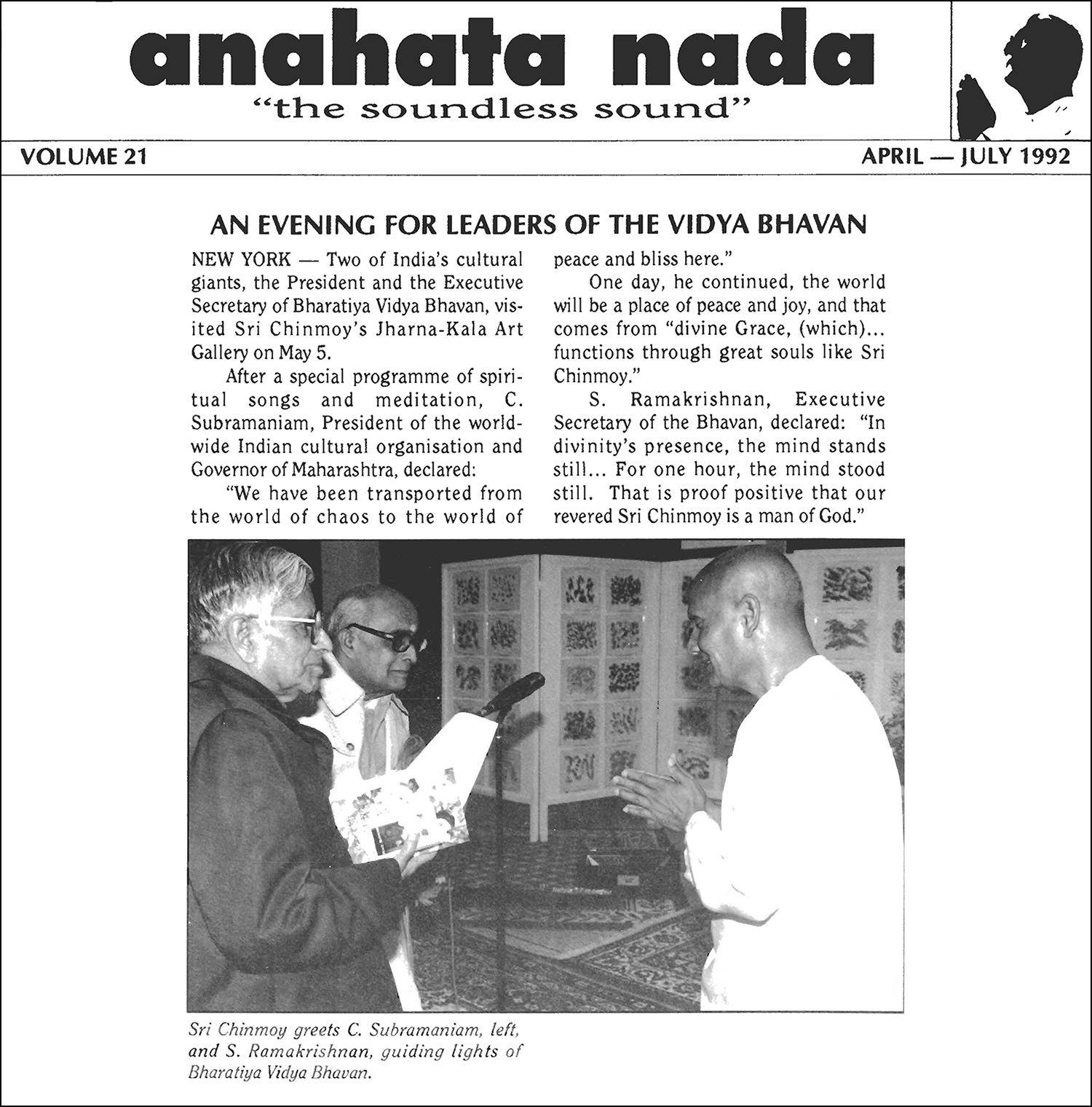
NEW YORK — Two of India’s cultural giants, the President and the Executive Secretary of Bharatiya Vidya Bhavan, visited Sri Chinmoy’s Jharna-Kala Art Gallery on May 5.
After a special programme of spiritual songs and meditation, C. Subramaniam, President of the worldwide Indian cultural organisation and Governor of Maharashtra, declared:
“We have been transported from the world of chaos to the world of peace and bliss here.”
One day, he continued, the world will be a place of peace and joy, and that comes from “divine Grace, (which) ... functions through great souls like Sri Chinmoy.”
S. Ramakrishnan, Executive Secretary of the Bhavan, declared: “In divinity’s presence, the mind stands still ... For one hour, the mind stood still. That is proof positive that our revered Sri Chinmoy is a man of God.”
Caption:
Sri Chinmoy greets C. Subramaniam, left, and S. Ramakrishnan, guiding lights of Bharatiya Vidya Bhavan.
Published in Anahata Nada, Volume 21, April-July 1992
Questions from Catholic Digest (Holland)
Sri Chinmoy answers a series of written questions submitted by Joop Koopman, Editor-in-Chief and Associate Publisher of Catholic Digest (published in Holland). Sri Chinmoy meets with Mr. Koopman and offers him the ‘Lifting Up the World with a Oneness-Heart’ award the following day.
Joop Koopman: Sri Chinmoy, you had important friendships and spent significant moments with Pope John Paul II and Mother Teresa of Calcutta. You are effusive in your praise of them, depicting them as wonderful, powerful and colourful beings. In the East, the celebration and appreciation of holy men and women is the norm. The charisma of leaders is experienced as real and palpable. The mainstream of Judaism and Christianity is more cerebral. We think of our leaders as good people, but not necessarily as living saints whose very touch or glance can heal. Can you please describe John Paul II and Mother Teresa in this regard?
Sri Chinmoy: Let me start with the Holy Father, Pope John Paul II. The Holy Father was for all religions. He was not confined to Christianity. That is why it was possible for me to receive from him unbounded compassion, affection and encouragement. I had the golden opportunity in this lifetime to be blessed by him six times. Each time I was in his presence, I did feel many of his divine qualities, qualities which are very rarely found in other individuals.
The Holy Father was at once a friend to some, a father to some and a grandfather to still others. As a friend, he wanted people to understand the real meaning of life. The real meaning of life is compassion, concern and sympathy.
As a father, he was strict with those who are wanting in morality, those who are not abiding by the laws of truth, plus those who are hungry for power and supremacy. Pope John Paul II warned his spiritual children that if they do not have concern for mankind, there will be a very serious crisis. The standard of mankind, instead of going up, will descend and descend into an abysmal abyss.
As a grandfather, he was all affection and, to some extent, indulgence to human beings. He felt that human beings are by nature weak. If he became strict with them, it might do more harm than good. He felt the necessity of going very slowly with those human beings who are already very weak. His concern for them was unbounded, and he felt that a little bit of indulgence would eventually awaken them to the Light. Once they are in Light, they will not deliberately enter into the thick darkness of ignorance.
To the Holy Father, I offer my heart's infinite and infinite gratitude. Each time I met with him, a new experience I had. In the evening of his life, while he was quite frail and his hands were shaking, he most affectionately touched my arm and blessed me with utmost compassion.
Unlike other popes, he was both practical in the activities of the outer world and also a visionary of the most sublime height in the inner world. His inner vision and outer action most gloriously complemented each other.
Mother Teresa was not only for the poor and the needy; she was for the entire humanity. She was her bleeding heart for the helpless and the hopeless world. She was her sacrificing life to save others' lives. Her life-boat plied between the compassion-shore and the concern-shore. Fear was not born when she saw the light of day.
Faith in the Saviour Jesus Christ she had in infinite measure.
To me, she was this moment a real mother and the next moment a real sister. As a mother, she blessed me with her blessingful eyes. As a sister, she loved me with her compassionate heart.
Again, Mother Teresa was encouragement incarnate. Not once, not twice, but thrice she asked me to accompany her to China. It was her fervent wish to do something great and good for China and the Chinese people. But, alas, her desire was not granted. Heaven summoned her before her desire could be fulfilled.
Recently I spent practically three months in China, remembering many, many times her blessingful request to accompany her there.
Mother Teresa: a daring soul, an all-loving soul and an all-sacrificing soul. The world desperately needs many more God-chosen servants like Mother Teresa to change the face and fate of the world.
Joop Koopman: What do you make of the great interest in spirituality in the US, much of it in the form of the pursuit of, if not quasi-religions and movements, then a sometimes vague New Age-ism?
Sri Chinmoy: Spirituality in the United States is a very complicated matter. It is like the huge waves of the ocean: they go up and down. Perhaps a similar experience we get everywhere. There was a time thirty or forty years ago when the young generation showed much more interest in accepting and following the spiritual life. To my great sorrow, I do not see and feel the same inner urge today. I may be utterly mistaken. In no way am I criticising the young generation. I am one hundred per cent with them in their hearts and lives.
There is another factor. In those days, anything new that took place was supported by encouragement. The young people felt encouragement from deep within when they embarked on something new, challenging and illumining. But nowadays, it seems nothing significantly interests human beings in the way it did thirty or forty years ago.
People need new light and new consciousness. They want to come out of the old achievements, or you can say out of the quagmire of life, but they do not know which way to turn. They feel that the past has failed them. Now they are afraid of the future. They do not want to attempt anything new, precisely because uncertainty and fear loom large in their lives.
The love of the New Age movement was much more powerful in the past. Anything that is new, we should welcome. It may not remain or cannot remain new. If we want to achieve anything or become anything new, then we have to be very, very strict with our inner prayers and meditations.
Success depends on our determination and will-power. Progress depends on our surrender, inner and outer, to God's Will while we are praying and meditating most soulfully and serving humanity most lovingly.
Each moment presents itself to us with a new dream, a new reality, a new inspiration, a new aspiration and a new achievement.
Joop Koopman: How do you look for the good in various traditions?
Sri Chinmoy: If I sincerely pray to God for the fulfilment of God’s Will, then my prayer is bound to teach me how to see good realities in every human being. If each tradition hungers for God’s Love and Light, then everything that is good will come to the fore for the betterment of the world.
Today we see good qualities in others. If we appreciate them unreservedly, then those good qualities try to blossom inside our own life like a lotus — slowly, steadily and unerringly.
Without prayer and without meditation, it is almost impossible to appreciate good qualities in others and not be ruthlessly attacked by jealousy-snake.
Each tradition is right in its own way. We need a cosmopolitan heart to appreciate, admire and value all the traditions and to become a world citizen — inspiring, encouraging, illumining and fulfilling each tradition.
Joop Koopman: You think of Jesus Christ as “an unparalleled Prophet and the beloved Son of God, but also as a supreme Oneness-Friend of mankind.” What does “Oneness-Friend of mankind” mean?
Sri Chinmoy: The Christ said, “I and my Father are one.” Again, the Christ said, “I am the Way. I am the Goal.” Outwardly, it is difficult to comprehend how one person can be the possessor of the Way and the Goal. But we know that when there is complete oneness with the Highest Absolute, one can be anything or anyone, plus one can go far beyond duality.
Friendship means the expansion of oneness. As a supreme Son of God, the Christ knew that he was not only the Son of God the Creator. He knew well that God the Creator and God the creation are one.
When we think of the terms 'concern, encouragement, inspiration' and so forth, we feel the supreme necessity of friendship. If there is no friendship, this world will day by day sink into the ocean of oblivion.
It is friendship that keeps us alert and awakened to the realisation that we do not belong only to ourselves. We belong to all those who are around us, with us and for us. Around us is the whole world, and it is here that we must establish friendship, so that together we can bear the burden of the entire world. If there is no friendship, the world will not march forward. It will only go backward.
The Christ played the role of the Creator when he said that he and His Father are one.
Then, when he asked, “Father, why have You forsaken me?” he played the role of the creation. Creation desperately needs help from the Creator.
On the strength of his oneness with the creation, the Christ felt the suffering of humanity as his own. This suffering can be shared by one and all. Suffering exists, but when others come into the picture to alleviate the burden of their friends, then it definitely helps each and every human being to see the light of oneness. Oneness is self-expansion. If there is true friendship, then oneness blooms and blossoms.
Christ was the supreme Friend. He became the oneness, not only of the Heaven, but also of the earth.
As an unparalleled member of Heaven, he brought down Compassion in infinite measure to Mother Earth. Again, as a member of Mother Earth, he distributed the Compassion that he received from Father Heaven unreservedly and unconditionally to elevate the consciousness of the world and to show the world that there is Light, the Light that longs for the establishment of Truth here on earth.
Christ the Son received. Christ the Friend distributed.
Christ the Son received from Above.
Christ the Friend blessingfully distributed everything he had and everything he was to his world-citizen-friends.
Joop Koopman: What are the most significant points that Christianity and Hinduism have in common?
Sri Chinmoy: Not only Christianity and Hinduism, but also all the religions have in common one thing: love of God. They all value truth, compassion and forgiveness. These divine qualities loom large in the very depths of all religions. The followers of each respective religion are supposed to bring to the fore these divine qualities and practise them lovingly, cheerfully and wholeheartedly in their outer lives for the betterment of humanity. In this way, together we can weave a beautiful and fragrant garland of nation-souls.
Joop Koopman: What areas are the greatest challenges in our interfaith relations?
Sri Chinmoy: I have had the occasion to be part of several interfaith meetings. I have prayed and meditated in silence for a minute or two at these meetings. Quite often, we are apt to extol our own religions to the skies. I feel that the best thing will be for us to accept the extraordinary achievements of each faith as our own, very own. In this way, the entire humanity can derive benefit from the combined achievements of all faiths.
Joop Koopman: What are the most urgent lessons the East can teach the West?
Sri Chinmoy: The East can teach the West the power of silence. The West can teach the East the power of science.
The East is introvert. The West is extrovert.
There will be a meeting place where the East and the West can come together. Together they can say, “We have and we are,” and not “I have and I am.”
Published in Conversations with Sri Chinmoy