
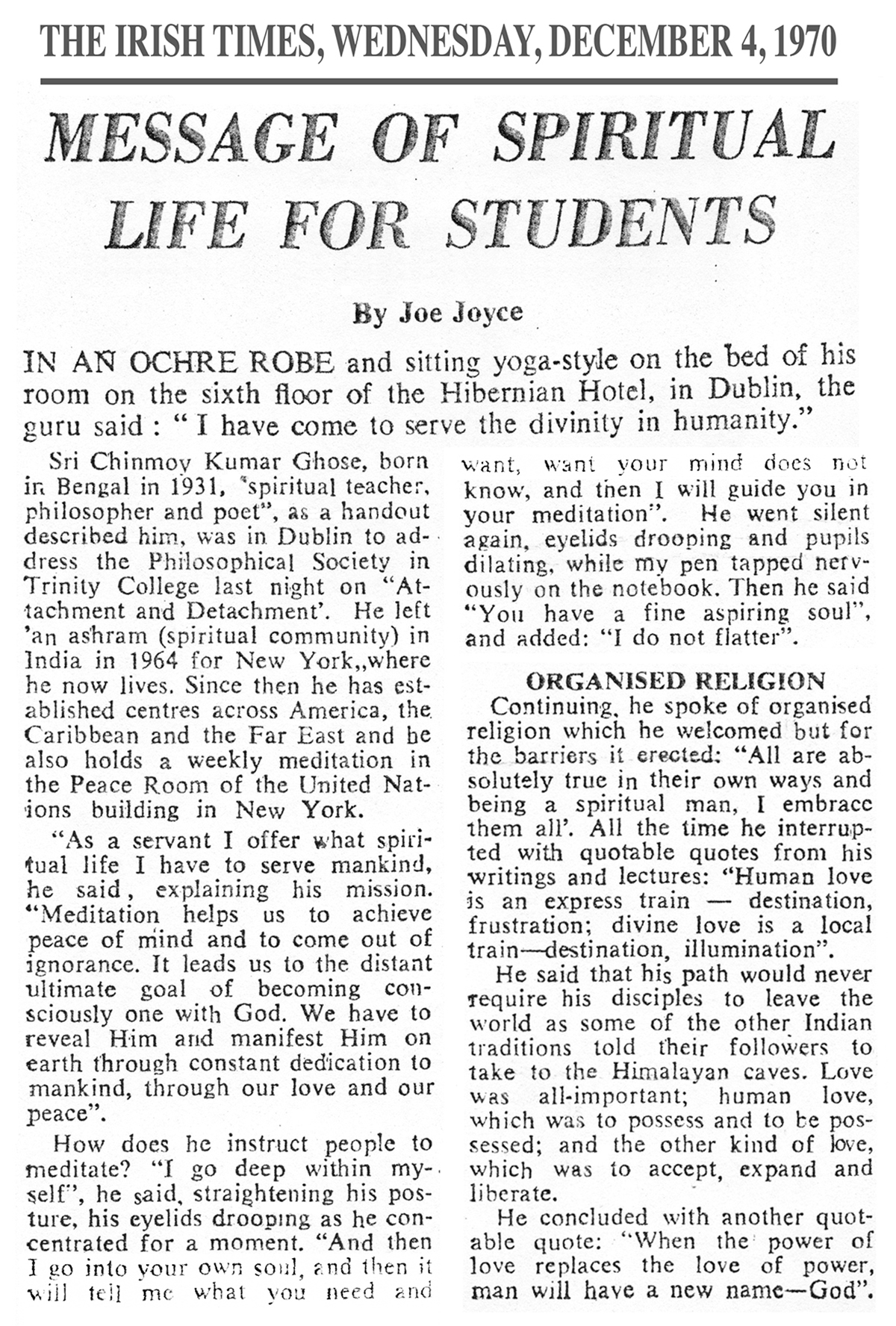
MESSAGE OF SPIRITUAL LIFE FOR STUDENTS
By Joe Joyce
IN AN OCHRE ROBE and sitting yoga-style on the bed of his room on the sixth floor of the Hibernian Hotel, in Dublin, the guru said: “I have come to serve the divinity in humanity.”
Sri Chinmoy Kumar Ghose, born in Bengal in 1931, “spiritual teacher, philosopher and poet,” as a handout described him, was in Dublin to address the Philosophical Society in Trinity College last night on ‘Attachment and Detachment’. He left an ashram (spiritual community) in India in 1964 for New York, where he now lives. Since then he has established centres across America, the Caribbean and the Far East and he also holds a weekly meditation in the Peace Room of the United Nations building in New York.
“As a servant I offer what spiritual life I have to serve mankind,” he said, explaining his mission. “Meditation helps us to achieve peace of mind and to come out of ignorance. It leads us to the distant ultimate goal of becoming consciously one with God. We have to reveal Him and manifest Him on earth through constant dedication to mankind, through our love and our peace.”
How does he instruct people to meditate? “I go deep within myself,” he said, straightening his posture, his eyelids drooping as he concentrated for a moment. “And then I go into your own soul, and then it will tell me what you need and want, what your mind does not know, and then I will guide you in your meditation.” He went silent again, eyelids drooping and pupils dilating, while my pen tapped nervously on the notebook. Then he said, “you have a fine aspiring soul,” and added: “I do not flatter.”
ORGANISED RELIGION
Continuing, he spoke of organised religion which he welcomed but for the barriers it erected. “All are absolutely true in their own ways and being a spiritual man, I embrace them all.” All the time he interrupted with quotable quotes from his writings and lectures: “Human love is an express train — destination, frustration; divine love is a local train — destination, illumination.”
He said that his path would never require his disciples to leave the world as some of the other Indian traditions told their followers to take to the Himalayan caves. Love was all-important; human love, which was to possess and to be possessed; and the other kind of love, which was to accept, expand and liberate.
He concluded with another quotable quote: “When the power of love replaces the love of power, man will have a new name — God.”
Published in THE IRISH TIMES, WEDNESDAY, DECEMBER 4, 1970