
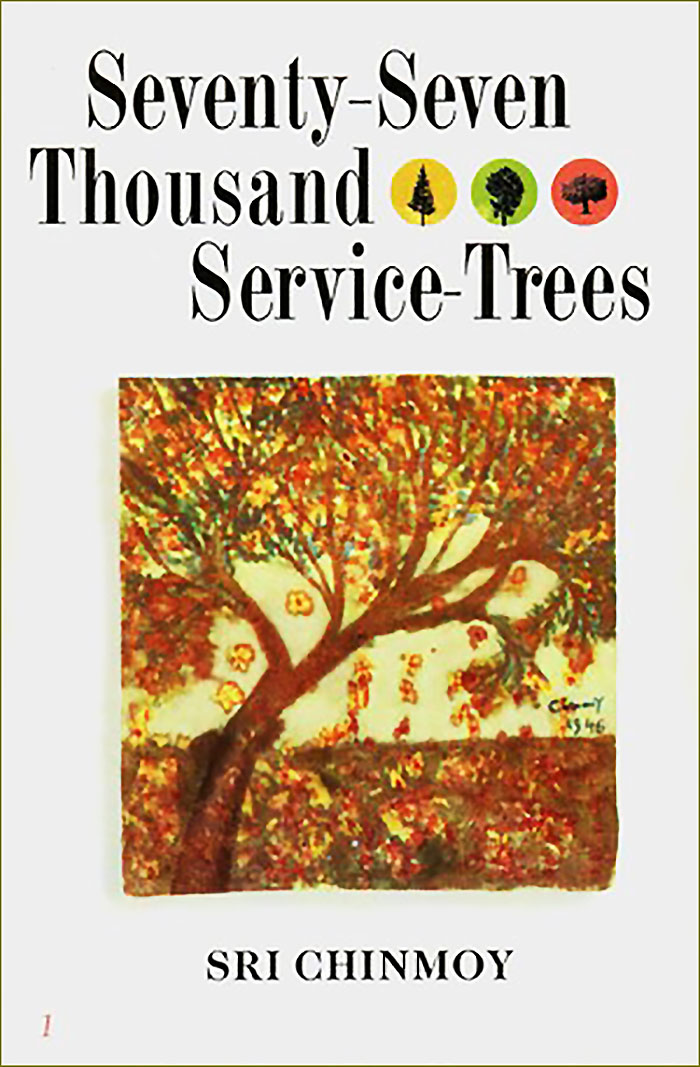
The first volume of Sri Chinmoy’s series Seventy-Seven Thousand Service-Trees is published.
Poem 1
My Lord,
You have commanded me
To offer You
Seventy-Seven Thousand Service-Trees.
I shall obey Your absolute Command.
Published in Seventy-Seven Thousand Service-Trees, part 1.
Poem 1,000
My Lord,
My Absolute Lord Beloved Supreme,
You have commanded me to write
Seventy-seven thousand service-tree-poems.
I have just completed one thousand.
My heart, my mind, my vital, my body
And I
Are most sincerely tired.
“My child, My own Divinity’s child,
Tiredness is unacceptable.”
Published in Seventy-Seven Thousand Service-Trees, part 1
Bengali Words for ‘Heart’
by Sri Chinmoy
Nexus Resort Karambunai, Kota Kinabalu, Sabah, Malaysia
Bengali can be quite complicated. In prose, the word paran is used for ‘vital’, but in poetry, quite often it is used for ‘heart’. Chitta can mean ‘heart’ and hriday is ‘heart’. Hiya is also ‘heart’. In poetry, paran can be used as ‘heart’. In prose it has to mean ‘vital’. The actual word is pran, but in poetry the form paran is used. It is complicated. Each language has some complexity. Otherwise, how can it be unique? At some point, we are challenged by all languages because of complexity.
Hiya will never be used colloquially; hiya is used only in poetry. Hriday can be used in poetry and prose. Antar also can be used in prose and poetry. Hiya will never be used in prose or colloquial speech. While we are talking, we cannot use the word hiya. We can use antar, hriday or chitta. Again, chitta we use in poetry for ‘heart’. But in Sanskrit, chitta means ‘mind’. In Sanskrit, chitta is written as chit.
From where to where language goes!
Published in Only Gratitude-Tears
Shaking Hands
by Sri Chinmoy
Nexus Resort Karambunai, Kota Kinabalu, Sabah, Malaysia
In the East we greet each other with folded hands, but the Western world knows only how to break the hands! When I am compelled to shake hands with people, very lightly and delicately I do it, but they try to show how strong they are. They really press my hand hard and then I suffer. I also have a little strength in my hand, but they quite often press very hard, very hard.
Fifteen years ago, when I returned to India, one of my main mentors said to me, “Oh, you lift weights! Let me see.” He grabbed my hand so hard and started pressing and pressing.
The Western way is to shake hands. The Hindu way is to greet one another with folded hands. Muslims touch their heart. Immediately they enter into their heart. Their heart’s feeling they are offering to us as they invoke Allah. Russians go another way: they embrace. Again, our Hindu way is to fold our hands and say Namaskar or Pranam. We do it even on the phone, when we speak to our dear ones. We do not say “Hello”; we start with Namaskar.
The Western method for us is very funny! Of course, in a sense it is better. When two people shake hands, they are on the same level. You and I are on the same level, no matter how great you are or how insignificant I am. We are at that time not on the psychic level, not on the heart level; everything is taking place on the dynamic vital level. When the Muslims touch their heart, it is only on the heart level; and when we Hindus fold our hands, it is on the heart level. That is my way of understanding. You can have your own way of understanding it, but that is what I feel.
So many times after lifting people, when I give medallions, I see that they want to shake hands. Even yesterday, one man asked, “May I shake your hand?” I said, “Fine!” Then I gave him my hand and he grabbed it and pressed it quite hard. I had lifted him up and he weighed 180 or 200 pounds. He wanted to show me that he was also strong!
Published in I Wanted to be a Seeker of the Infinite