January 21

The Quintessence of Mysticism

A lecture by Sri Chinmoy
at the American University, Washington, D.C.
Sponsored by a student organisation, ‘University in Revolution’


There are three principal paths that lead to God-Realisation: the path of Selfless Service, the path of Love and Devotion and the path of Knowledge and Wisdom. Raja Yoga (Mysticism) is a significant stage in the Yoga of Knowledge (Jnana Yoga). The knowledge Supreme is something infinitely more than mere philosophical knowledge. Mysticism is experience. This experience is the direct and intimate experience of Truth. After covering a great distance in the path of knowledge, philosophy gets tired. It takes rest. It stops. Mysticism begins when and where philosophy ends. The seers, after having the personal experience of the knowledge of Truth, reveal it to the world at large.

The seer sings:

"I have known, Him have I known, the Being Supreme,
Refulgent, luminous as the Sun beyond darkness,
Far beyond the embrace of devouring gloom."

The seer teaches us that the Transcendental Reality and the All-Embodying Existence are one and the same.

A mystic takes both unity and diversity as one. He further sees unity in diversity. He tells the world that the One and the Many are one. The One is Many in its universal form. The Many are One in their Transcendental form. In our spiritual life, we come across two significant words: occultism and mysticism. Occultism is secrecy and cries for secrecy. It wants to house everything in top secrecy. Mysticism is not like that. Mysticism is ready to offer its achievement, transcendental knowledge, to all those who cry for it.

The difference between a philosopher and a mystic can be noticed in the fact that a philosopher, with the greatest difficulty, from a striking distance sees rather imperfectly, the body of Truth, whereas a mystic enters into the very soul of Truth at his sweet will and he can live there as long as he wants to and he is also permitted by the Supreme to bring to the fore the vast wealth of the soul and share it with the seekers of Truth.

Mysticism affirms that the knowledge of the Divine is universal.

Let us for a moment enter into the lore of the supernal mystery of the Vakin the Vedas. Vak is The Word. Vak at once embodies and reveals the Truth. In its embodiment of Truth, it receives creative inspiration in infinite measure from the Supreme. In its revelation of Truth, it offers to mankind the Supreme, the Liberator Supreme. Vak is the connecting link between two worlds: the world that has not yet realised and fulfilled itself and the world that has already realised itself and is fulfilling itself.

Mysticism has a language of its own. Its name is Intuition. In it, no mind, no mental analysis can ever exist. A mystic sits on the wings of the Intuition-Bird and flies towards and reaches the Ultimate Real. Intuition reveals the perfect oneness of the Transcendental Vision and Absolute Reality. A mystic is sincere enough to tell the truth. He says that it is next to impossible for him to interpret his inner experience. No word, no thought has he, that can do justice to his experience. Here, at this point, the Vedic seer cries out: "What shall I speak, what verily shall I think?" Poor mind, poor senses are no longer alive. They have collapsed in their race towards the Unknown. Not for them, the mind and senses, the Ultimate Mystery of the Universe. Not for them, the knowledge of the Beyond. Mysticism emphasises the unity of all souls in the Universal Soul. When we look at the universe, we see it as the scene of conflict between good and evil, darkness and light, ignorance and knowledge. Needless to say, this struggle commenced its journey long before the appearance of man. It still continues. The light works in and through the aspiring soul; the darkness works in and through the unaspiring soul. The real transformation of human nature comes not through the austere, ascetic life and the complete withdrawal from the world, but through the gradual and final Illumination of one’s life. And for that, one needs aspiration. Aspiration and Aspiration alone is the precursor of this Illumination.

A mystical experience is the aspirant’s inner certitude of truth. This certitude rests on revelation. Revelation is inner authority. Inner Authority is final; who has this authority? Certainly not he who is a merciless victim to logic but he who has the experience and who has now grown into the experience itself. Logic is the reasoning and reasoned truth, which is the pride of the finite. Mysticism is the revealing and revealed Truth, which is the pride of the Infinite. If we believe in mysticism, which we really do, then we must realise that the Ultimate Truth is not only above reason, but is contrary to reason. If we believe something by reason, we enter into the life-torturing path of plurality, unconscious plurality of separateness. But when we believe something by our inner, mystic faith, we enter into the life-giving and life-fulfilling path of unity’s Transcendental Reality.

Martin Luther vehemently distrusted the effectiveness of reason. Nor did he have any faith in ritual or in mere work as a means to salvation. In his mysticism, we see the smiling and convincing face of faith. Faith alone can bring about salvation. Faith alone has the key to salvation.

Existence and Essence live together. They are one. In the thirteenth century Meister Johannes Eckhart dynamically asserted this view. We have to realise that essence is singularly manifest in the divine qualities of the human soul, whereas existence is gloriously manifest in the human qualities of the divine soul. The journey’s end of the human soul is in its complete union with God. The journey’s end of the divine soul is in its absolute manifestation of God.

Mysticism tells us that God-Realisation cannot be attained by the practice of ideas, but by the constant feeling of oneness with the Truth. An idea, at best, indicates the passive aspect of the sense world because a mental formation is directly or indirectly caught by the sense-world, whereas the feeling of oneness with Truth easily transcends the sense-world and indicates and ascertains the active and dynamic aspect of life’s evolving process in the flowing stream of Eternity.

A mystic tells the world that God’s body is wisdom and God’s soul is Love. A worldly man feels that his body, his physical activities fashion the soul. A mystic smiling says that it is the soul that moulds the body and transforms it into the unlimited consciousness-light of the soul.

According to Santayana, "Mysticism is not a religion, but a religious disease." Santayana is perfectly right when he says that mysticism is not a religion. In my opinion, mysticism is the highest aspiration that religion embodies. And as for the "religious disease", I can never be at one with Santayana in his profound realisation.

I want to say with all the spiritual confidence at my command that mysticism serves as a panacea, not only to those who cry to see their Beloved God’s face, but to those who are afraid of seeing God’s face in His Omniscience and His Omnipotence. And finally to those who are at once mercilessly and unpardonably unbelievers and disbelievers in the very existence of God.


Published in AUM – Vol. 4, No. 9, 27 Apr. 1969


Spiritual Power, Occult Power and Will Power

The first of seven lectures by Sri Chinmoy
at the Marvin Center, George Washington University, Washington, D.C.


Spiritual power is vastness. Occult power is swiftness. Will power is readiness.

Spiritual power says to the seeker, “Eternity is at your disposal.” Occult power says to the seeker, “Here, here and now.” Will power says to spiritual power and occult power, “We are friends. Both of you are perfectly right; therefore, I wish to help you, serve you, manifest you and fulfil you in your own way.”

Spiritual power is the sea. Occult power is the river. Will power is the current of the river and the tranquillity of the sea.

Spiritual power is self-awareness. Occult power is self-confidence. Will power is self-experience.

Slowly, steadily and unerringly the spiritual power within us grows until eventually it reaches the destination. Occult power speedily, dynamically and amazingly reaches its destination. Occult power has the speed of a deer. It runs very fast and reaches its goal quickly, but that goal is not the ultimate goal. Will power has faithfulness and devotedness. It is devoted to occult power and, at the same time, it is devoted to spiritual power. With its devotedness and faithfulness, will power reaches its destination. We can safely say that will power acts like a faithful dog.

The seeker who is far advanced in the spiritual life tells us that he uses his spiritual power in order to climb up high, higher, highest. The seeker who is far advanced in the spiritual life tells us that he uses his occult power in order to run fast, faster, fastest. The seeker who has tremendous will power, who is inundated with will power, energises the seeker who has spiritual power and the seeker who has occult power. The role of the seeker who is inundated with will power is to help the seeker who has spiritual power and the seeker who has occult power.

Spiritual power almost whisperingly tells us that right is might. If you have the divine right, inside that right you must feel the divine power. If you have the right, then use your power. Occult power bravely tells us that might is right. If you have the capacity, that is your right. Occultism is simple. But the seeker with tremendous will power will tell us that the cry of Mother Earth is the might of Mother Earth and the smile of Father Heaven is the right of Father Heaven. We need only one might and that is the inner cry of Mother Earth. We need only one right and that is the smile of Father Heaven.

How do we acquire spiritual power? We acquire spiritual power by self-giving, constant self-giving. How do we acquire occult power? We acquire occult power by self-examining. How do we acquire will power? We acquire will power by self-affirming. In self-giving, what do we give? We give what we have and what we are. What we have is love of God and what we are is concern for mankind. In self-examining, what do we examine? We examine sincerely our capacity and our incapacity. We examine our incapacity in order to transform it into capacity and we examine our capacity in order to make it absolutely perfect. In self-affirming, what do we affirm? We affirm ourselves. But we have to know that this self-affirmation is not like the self-affirmation of Julius Caesar, who declared, “I came, I saw, I conquered.” Our self-affirmation will be: “I came, I loved and I became.” This is our divine self-affirmation: “I came into the world, I loved all human beings and I established my inseparable oneness with all human beings.”

If we properly use spiritual power, then we can live here on earth in immortality’s Reality. If we properly use occult power, then the Universal Reality is always at our disposal. Nothing will be able to hide from an occultist’s vision. Anything in the creation will be within an occultist’s reach sooner than at once.

If we misuse spiritual power, we shall be extremely, extremely poor in the spiritual life. Sometimes it has happened that advanced seekers, after misusing spiritual power, have become poorer in aspiration than they were right at the beginning of their spiritual journey. Similarly, if an occultist misuses his occult power, then he becomes totally blind in the spiritual life. This blindness is not physical blindness; it is a much more serious blindness. It is a loss of his inner vision. This seeker will not be able to see the truth anymore. And something worse: when occult power is misused, the power that is misused eventually comes and attacks the occultist. In the case of spiritual power, he who misuses it sometimes escapes the attack of the misused spiritual forces; but when occult power is misused, the person who has misused it will eventually be attacked and punished by the forces that were once upon a time his own and at his beck and call.

With will power, what can we do? With will power we can identify ourselves with God’s creation; we can identify ourselves with God’s Reality. Will power is conscious identification with the reality that exists or with the reality that is going to blossom. Each individual here has a certain amount of will power. But will power can also be cultivated. As we develop our muscles, even so we can develop our will power. But while developing will power, we have to know whether we are going to use this will power only to build in ourselves the temple of truth, the temple of light, the temple of peace, the temple of delight. If this is our goal, then will power will always be ready to help us, mould us and shape us into perfect perfection. Otherwise, will power can also be a true obstacle in our spiritual path.

Spiritual power tells us in unmistakable terms, “I am, I eternally am.” Occult power tells us unmistakably, “I can, I immediately can.” Will power unmistakably tells us, “I enjoy, I divinely enjoy, I supremely enjoy. I enjoy, not in a human way, but in a divine way, in a supreme way.


Published in Spiritual Power, Occult Power and Will Power


Great Indian Stories

by Sri Chinmoy


Gandhi Buri's supreme sacrifice

There was an extremely patriotic old lady who was 73 years old. She was the greatest admirer of Mahatma Gandhi; his very name used to give her a sea of inspiration. She wanted the British government to leave India, and she did many patriotic things that were extremely inspiring to the women of India. Because of this lady’s extreme admiration for Mahatma Gandhi, everyone used to call her Gandhi Buri, “buri” meaning “old lady.”

In 1942, Gandhi was arrested, and all of India became furious. In many places people held processions, using the slogan “Quit India,” which was Mahatma Gandhi’s offering to his brothers and sisters of India. The day after Gandhi’s arrest, Gandhi Buri was involved in a march to a police station. The people in the procession wanted to take down the British flag, the Union Jack, from over the police station and hoist up the Indian flag.

The police stood in the way and warned the protesters that if they came forward one more step, they would shoot.

All the marchers stopped except Gandhi Buri. She snatched India’s flag from one of the young boys in the procession and ran towards the police station. The police first laughed at her. “Enough, enough! No more! Go away from here, old woman. We don’t want to kill you,” they shouted.

But Gandhi Buri cried, “Kill me. I am not afraid of you. I want to free my Mother India.”

She ran towards the staircase that led to the top of the police station. Before she reached the stairs the police shot her. With her right hand she was still holding the flag as she chanted a few times, “Bande Mataram, Bande Mataram, Bande Mataram: ‘Mother, I bow to Thee.’” Then she left the body.

This old lady of 73 years was so courageous that she gave her life for her beloved country. There were some young boys in the procession who were shouting and screaming things against the British, but when the time came for them to sacrifice their lives, they hesitated. But Gandhi Buri devotedly and proudly gave her life. From that day on, people who were in that procession became more inspired to dedicate their lives totally to the freedom of India.

The fire of freedom burns all-where

Thousands and thousands of people died for the freedom of India. They wanted freedom so badly that their lives were nothing for them, absolutely nothing. In 1928, patriots marched in Lahore in a big procession under the leadership of Lala Lajpat Rai, an old patriot of supreme height who was adored by all India.

The police charged the procession with big sticks, and Lala Lajpat Rai was beaten and killed. The whole nation became extremely angry, and everyone wanted to kill the person who was responsible for his death. They came to know that the British police officer, Mr. Scott, was the culprit.

Someone made an attempt on Scott’s life. Alas, this person killed the wrong police officer, a Mr. Saunders, instead. As a result, many patriots were arrested, for the British didn’t know who the actual culprit was.

In 1929 one of the great patriots, Jatin Das, was arrested. He was deeply shocked that a leader such as Lala Lajpat Rai had been killed, so he took a vow that he would not eat unless the British asked for forgiveness. “Something has to be done,” he said. “I shall fast unto death unless they apologize. They have to apologize!”

At first the British mocked at Jatin Das, but then they became afraid that if he died, the Indian patriots would become more furious. So they tried in so many ways to get him to eat. At first they were kind and polite; then they became rude and threatening and tried to force him to eat.

He kept on saying, “I will not eat!”

After sixty-three days he died, and the members of his family and his fellow patriots were thrown into a sea of tears. They were so sad that such a great hero had passed away. Then they became infinitely more determined to throw off the British rule in India.

The members of Jatin Das’s family received a telegram from Ireland. It was from the family of Terence MacSwiney, a young man who had died while fighting for the freedom of Ireland. His wife sent a telegram to the parents of Jatin Das saying, “We the members of MacSwiney’s family are deeply grieved at your loss. At the same time we are extremely proud of your son’s death. You will get your independence without fail.”

The fire of freedom — where it burns! It burns everywhere. Where is Calcutta and where is Ireland? Here this letter shows the oneness-song that is sung all over the world where freedom is denied. Freedom is of paramount importance. Every country should be independent, each soul should be free. Then only nations and individuals will make the fastest progress.

Only to please you, Mother

Raja Rammohan Ray was one who had indomitable faith in his own will power. Everywhere he was hailed as a hero supreme. He always used his heroic qualities in a divine way; he never misused his heroic qualities.

One day, when he was a young boy, something most significant happened in his life. His family, which was very, very rich, was having a Durga Puja. India’s Durga Puja is a most inspiring time when devotees worship Mother Durga most soulfully.

It happened that Rammohan saw a man making the Durga idol out of straw and clay, and he helped the man build it. In a few days’ time, the idol was placed inside the temple and everyone came to worship it as the supreme goddess, Mother Durga. Everybody was bowing down to the Mother Durga, but this little boy wouldn’t bow down.

The priest could not believe his eyes: “Why are you not bowing down, my boy?” he asked.

Rammohan replied, “Why do I have to bow down to an idol made of straw and clay?”

This was nothing short of blasphemy! The boy’s father was so furious: “I have this kind of son! He is an atheist!”

Rammohan’s mother was afraid that some serious calamity would take place in the family if the boy did not bow to the idol. She ran to her son, pleading, “For God’s sake, bow down! Otherwise, something will happen to us.”

But Rammohan only said, “I know this idol is made of straw, clay and mud. I can’t bow down before mud and clay.”

Then the mother started crying helplessly before her son. “If you don’t bow down to the statue, then I will stay here and cry all day and night,” she said.

Rammohan said, “Mother, I can tolerate anything, but I will not be able to take your tears. Since you are begging me, I will bow down to the statue of Durga. But remember, I am bowing down to your goddess, since you see something in this idol. I am doing this only to please you, but not with the hope that I will get something from it. I am bowing down only to please you.”

Rammohan soulfully bowed down to Mother Durga, and his family left the temple extremely moved by the young boy’s words.


Published in Great Indian Meals: Divinely Delicious and Supremely Nourishing, part 4


Rammohun keeps his prestige

The Governor-General of India was an Englishman named Lord Bentinck. He was very strict and everybody was frightened to death at the very mention of his name.

Raj Rammohun Ray at this time was very well known as a man of knowledge and a great patriot. He was also a linguist who knew many languages.

One day, the Governor-General sent a messenger to Rammohun with the message: “The Governor-General wants to see you immediately.”

Rammohun said to the messenger: “I know he is the Governor-General of India, but that does not mean that I have to listen to him and come immediately.”

The messenger was shocked. “What do you mean?” he said.

“I will come if I have to, but in my own time,” said Rammohun.

“I cannot believe this,” said the messenger. “Even in my dreams I would not be able to believe this kind of thing. You Indians are at our feet, and yet you are acting so proud and haughty. You will see what kind of punishment you will get from Lord Bentinck.”

Rammohun only said, “I am fully prepared. I know what kind of punishment I shall get, but also I know what I have to do with a foreign boss.”

On hearing the story, Lord Bentinck became furious. But he said to himself, “By becoming furious, what am I going to accomplish. I need some help from Raj Rammohun Ray, so let me be wise. Since I am the needy one, I have to be very careful.”

He wrote a very polite letter to Rammohun: “I am ready to see you at any time that is convenient for you. I will send my car to bring you here. Please let me know when you can come. I will be extremely happy and honoured to receive you.”

The messenger came with the letter, and as soon as Rammohun read it, he said, “I am ready to see the Governor-General.”

Rammohun explained to Bentinck when he saw him, “My skin may be dark, but I do have my own sense of prestige. You asked for me to come to see you immediately, but I did not come because my pride and prestige were hurt. When you wrote me a polite letter, then I felt sympathy for you. You may feel that the Indians are inferior, but you cannot treat us in that way.”

The Governor-General shook hands with Rammohun and agreed, “I know it is absolutely necessary to preserve one’s prestige. It was wrong on my part to address you in that way.”

Rammohun said, “Your nobility has touched the very depths of my heart.”

Wherever Rammohun went, he played the role of a leader most successfully. Everybody admired and adored him. The great poet Tagore wrote of him, “He is the traveller of India.”

Indeed, Rammohun was the traveller who spread India’s love-message, wisdom-message and oneness-message all over the world.


Published in Great Indian Meals: Divinely Delicious and Supremely Nourishing, part 4


Comments about Acting

by Sri Chinmoy
to his students at the Rex Hotel, Ho Chi Minh City, Viet Nam

Acting

You are all infinitely, infinitely better at acting than your Guru! When I was five or six years old, I had one line in a play, but I became nervous. I was playing the part of Sahadeva, and I had to appreciate Arjuna. My problems started in the dressing room. We had to wear a type of dhoti that they wore in Mahabharata times. It was almost like a girl’s sari. It was too much for me! I cried and cried.

My cousin was playing the role of Arjuna. He was older than I was. He was so fond of me. Alas, on the stage I had to say something to Arjuna, but I forgot the line. Arjuna was prompting me. He was even telling me the line, but I could not hear what he was saying because of my nervousness.

At the Ashram, when I was fourteen or fifteen years old, I wrote a play about Sri Ramakrishna in Bengali. I played the role of Sri Ramakrishna and did very, very well. In that play, I had many, many lines, plus I had to sing two songs: Sundara Hate and Tamasa Rate. At that time there was no nervousness. What happens when you are five or six years old, and then when you are fifteen years old — this is the difference.

Hidden capacities

People have such hidden capacities and qualities! Each play of mine that you perform reveals your capacities. Each time you perform, you reveal your inner talents.

Do not think that you are a bad actor. In informal, spontaneous performances, so-called bad actors give me abundant joy. When people forget their lines, they give me such joy. And when they say somebody else’s lines, and that person declares, “Those are my lines,” at that time also I get such joy!

Sometimes, the less you practise, the better. Spontaneous performances are so good!

I just plant a little seed. You have the capacity to cultivate it. First it becomes a tender plant, and then it turns into a huge tree with countless beautiful flowers and delicious fruits. See how you transform the little seed! The same thing we have to do in our spiritual life.


Published in Our Sweetest Oneness


Swami Vivekananda and the Poisoned Coffee

Story by Sri Chinmoy


Mani Sankar Mukherjee is a very great Bengali writer. He has written a wonderful book about Swami Vivekananda. I have read about Vivekananda all my life, but in Sankar’s book I read many, many things for the first time. This is one incident that Sankar himself told me when he came to New York.

After the Parliament of Religions in Chicago in 1893, Swami Vivekananda became world-famous overnight. Here in America, a few religious fanatics stood dead against him. They were trying to destroy his reputation by defaming him everywhere.

Once Vivekananda and six or seven of his admirers were invited to dinner by a very distinguished lady. During the meal, they were all talking and talking about ‘cabbages and kings’. It was nothing to do with spirituality. They were in the seventh heaven of worldly talk.

The hostess came and asked everyone, “Now would you like to have a cup of coffee?” Vivekananda used to drink tea sometimes twenty times a day. He also drank coffee a few times, Sankar told me. And his friends and disciples also drank tea and coffee.

On this day, they were served coffee. Everybody started drinking it. As soon as Vivekananda lifted the cup to his mouth, he vividly saw his Master, Sri Ramakrishna. Sri Ramakrishna said to him, “Naren, stop, stop! There is poison inside your cup.”

The fanatics had bribed the cook to put poison inside Vivekananda’s cup. Many others were drinking the coffee and nothing happened. But Vivekananda’s coffee was examined and it was found to have poison inside. And where was Sri Ramakrishna at that time? In Heaven.

This was the Master’s love for his dearest disciple. Sri Ramakrishna stopped him immediately. Otherwise, he would have died. Those fanatics were so ruthless.


Published in My Book of Tea and Coffee Experiences


Our Philosophy

Remarks by Sri Chinmoy
to his students at the Awana Kijal Golf, Beach and Spa Resort, in Kijal, Malaysia


We have just seen a play about the Lord Buddha.

The Lord Buddha did not speak about life after death, but he said many things about his previous incarnations. He was a duck; he was a goat; he mentioned many incarnations. About life after death he did not speak; but from what he said about his past, we can easily know his philosophy about reincarnation. If he was this animal and that animal, then naturally, after one life ended, the next one came. From the reincarnation point of view, he made his philosophy very clear.

After Lord Buddha came the Christ. The Lord Buddha said, “Keep quiet; remain silent.” But the Saviour Jesus Christ went one step forward. He said that if somebody strikes you on one cheek, you should give him the other cheek also.

I follow Sri Krishna’s philosophy. He said, “If somebody attacks you unnecessarily, you have to fight for the right.” In the Mahabharata, in the whole Kurukshetra war, he practised what he believed. In common language, people say “tit for tat.” In our case, we shall not do anything against others. But if somebody unnecessarily strikes us, and we allow him to continue, then we feel that we are helping him to increase his ignorance. In this way our philosophy has a different approach.


Published in Only Gratitude-Tears


January 21


Published in the major, regional Mexican daily newspaper, Diario de Yucatán


January 21


Sri Chinmoy participates in the Sri Chinmoy Masters Games in Stade Pater, the national stadium of Tahiti, French Polynesia. His time for 100 metres is 15.29, and his time for 200 metres is 34.03.


January 20

Corazon de Oro

Words and music by Sri Chinmoy
composed at the Heart of Gold Award
in Mexico City, Mexico


Lyrics:

Corazón de Oro, Corazón de Oro, Corazón de Oro!
O Heart of Gold, O Heart of Gold, O Heart of Gold!
Infinity’s oneness-delight you ever enfold.
Your song-beauty, music-fragrance, treasured by God’s Core.
Your culture-heritage is the summit-pride of the Golden Shore.

Translation:

by Gil Rivera

Corazón de Oro!
El deleite de la unidad del infinito
Los envuelve a ustedes siempre.
La fragrancia musical de su bella canción
Es atesorada por el centro de Dios.
Su herencia cultural
Es la cima de su orgullo.


Published in A Peace-Collecting Pilgrim-Soul


Video by kedarvideo


Sri Chinmoy offers a Peace Concert at the Taman Budaya Art Centre in Denpasar, Bali, Indonesia.

January 20


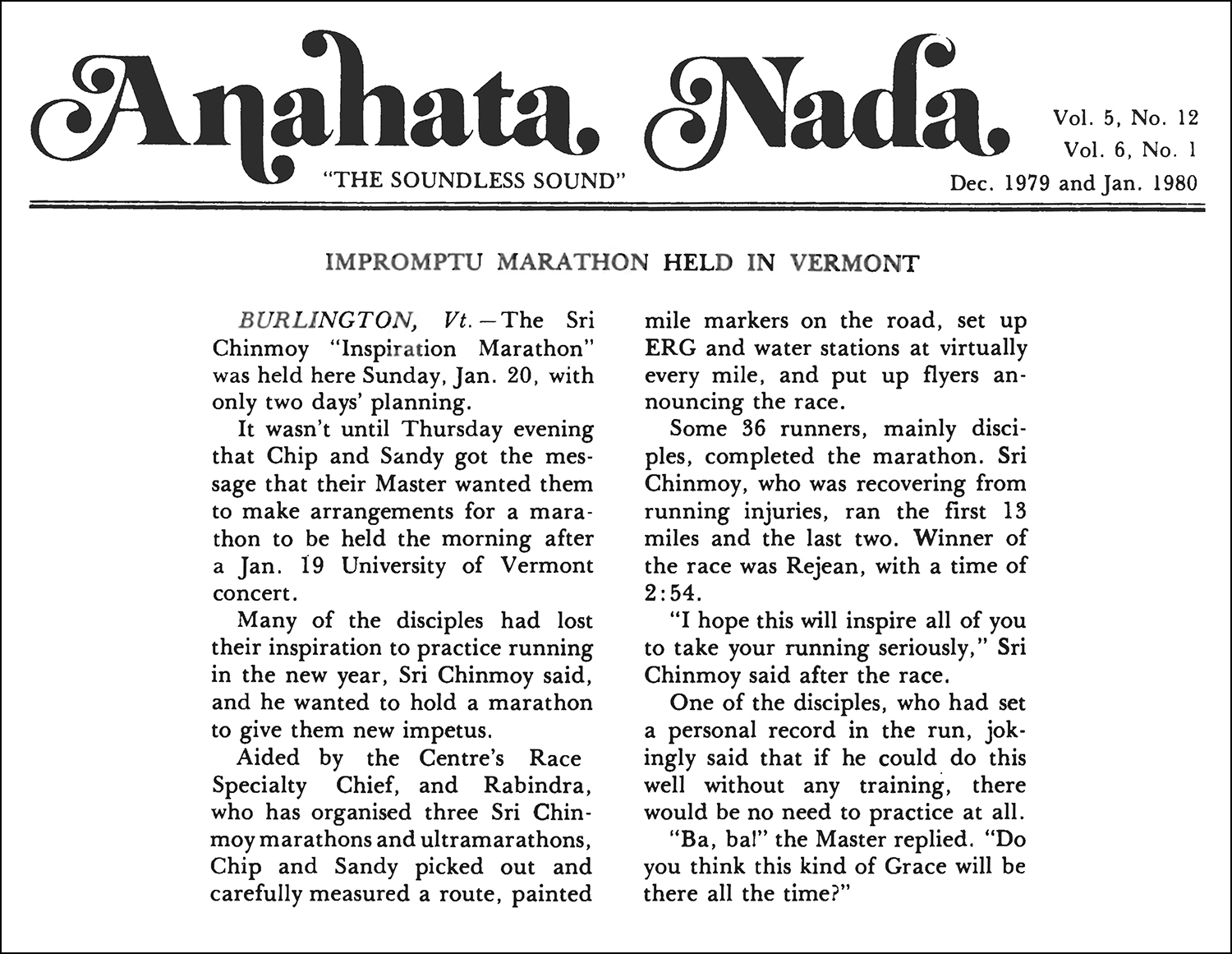
IMPROMPTU MARATHON HELD IN VERMONT


BURLINGTON, Vt. — The Sri Chinmoy “Inspiration Marathon” was held here Sunday, Jan. 20, with only two days’ planning.

It wasn’t until Thursday evening that Chip and Sandy got the message that their Master wanted them to make arrangements for a marathon to be held the morning after a Jan. 19 University of Vermont concert.

Many of the disciples had lost their inspiration to practice running in the new year, Sri Chinmoy said, and he wanted to hold a marathon to give them new impetus.

Aided by the Centre's Race Specialty Chief, and Rabindra, who has organised three Sri Chinmoy marathons and ultramarathons, Chip and Sandy picked out and carefully measured a route, painted mile markers on the road, set up ERG and water stations at virtually every mile, and put up flyers announcing the race.

Some 36 runners, mainly disciples, completed the marathon. Sri Chinmoy, who was recovering from running injuries, ran the first 13 miles and the last two. Winner of the race was Rejean, with a time of 2:54.

“I hope this will inspire all of you to take your running seriously,” Sri Chinmoy said after the race.

One of the disciples, who had set a personal record in the run, jokingly said that if he could do this well without any training, there would be no need to practice at all.

“Ba, ha!” the Master replied. “Do you think this kind of Grace will be there all the time?”


Published in Anahata Nada, Vol. 5, No. 12 Vol. 6, No. 1, Dec. 1979 and Jan. 1980


January 20

Heart of Gold Award

Sri Chinmoy's remarks
after receiving the award at the Society of Authors and Composers of Music of Mexico at their Society's headquarters in Mexico City, Mexico


The Society's Board of Directors bestowed upon Sri Chinmoy its prestigious Corazon de Oro (Heart of Gold) Award for his "great altruistic service in the cause of world peace." Previous recipients of the award include Pope John Paul II; opera legend Placido Domingo; Mexican poet and singer Juan Gabriel; and Arpad Bogsch, Director-General of the World Intellectual Property Organisation. On 17 April 1998 Maestro Roberto Cantoral, President of the Society, and his colleague, Mr. Rafael Buelna, Head of International Activities, presented the Golden Heart replica to Sri Chinmoy at the United Nations in New York. Details of both ceremonies are here included.

I bow to the soul, heart and life of "Corazón de Oro", the "Heart of Gold". I wish to offer gratitude to this august organisation from the inmost recesses of my heart.

I am a man of prayer. For me, music is a true form of prayer. Each song is a beautiful flower with fragrance exquisite.

I am a singer and musician of no consequence. But I have been blessed over the years by Himalayan-height musicians, composers and singers. Today I am extremely happy and extremely grateful to be in the immortal galaxy of Mexican composers. Music is the heart of universal oneness. It is also the language of universal oneness. I do not know Spanish, but I have heard over the years many, many, many Spanish songs, and they have touched the very depth of my gratitude-heart and my music-loving soul.

On the way to Mexico City, in the plane, I composed a song about this great award. With your kind permission, I wish to recite the words:

Corazón de Oro, Corazón de Oro, Corazón de Oro!
O Heart of Gold, O Heart of Gold, O Heart of Gold!
Infinity’s oneness-delight you ever enfold.
Your song-beauty, music-fragrance, treasured by God’s Core.
Your culture-heritage is the summit-pride of the Golden Shore.

I am also very happy to have set to music your motto, “In harmony with the universe.” This motto is a momentous message, a universal message. With harmony we can be true choice and perfect instruments of God. This world of ours is lacking in harmony; therefore, we are suffering. We are suffering excruciating pangs because we have not yet established harmony in our lives. Your message is at once hopeful, illumining and fulfilling.

Finally, to my musical friends, composers and singers, I wish to offer my heart’s prayerful and soulful joy and love. We are sailing in the same boat, and our destination is the Golden Shore. Yours is a heart of gold; our destination is the Golden Shore, where we will have peace, light and bliss. My happiness-heart and my gratitude-life to each of you I am offering prayerfully, soulfully and lovingly.

[Sri Chinmoy’s students perform his song dedicated to Mexico. Sri Chinmoy then plays the esraj, after which his students perform his song In Harmony with the Universe. Sri Chinmoy then teaches the song Corazón de Oro to his disciples, who sing it for the audience.]


Published in A Peace-Collecting Pilgrim-Soul


Sri Chinmoy Answers

questions at the Awana Kijal Golf and Beach Resort in Malaysia


Question: We were listening today to some of your writings that sound like reminiscences and I was wondering if you will release these writings? Are you preparing your own autobiography?

Sri Chinmoy: I have said so many things about my life, specially about my outer life. About my inner life I cannot say, because after God-realisation, every day is a big volume in the inner world. Before God-realisation, you can write your autobiography. But once you realise God, every day becomes such a thick volume that nobody will be able to write it down. Every minute, things are happening here, there, everywhere.

The inner biography or autobiography is simply impossible to write. Only a few experiences I have told and in some of my earlier poems, my highest experiences I have tried to describe. Again, the highest spiritual experiences you cannot express in words — never! Nobody has been successful, nobody since the beginning of creation. No matter how great a poet the person is, no matter how great a writer he is, the highest experiences are far beyond the capacity of the human mind to grasp. Even the same person who had the highest realisation cannot grasp it with the mind. And for the hand to write it down is simply impossible, impossible. Higher than the highest experiences can never be described in words. To make an attempt is simply a joke. There are very few inner experiences that the mind can grasp, spiritual Masters say. That is why the highest experiences can never be written down in words.

In Sri Aurobindo's case, his autobiography was gathered from here and there, from his letters and conversations and others gave it the name 'autobiography'. In my case, the things that I have said many, many times will eventually be printed in book form. True, at that time my own words will be there, so it will become an autobiography. But if other writers use their words to describe my life, then it will be a biography.

Question: A few months ago my grandfather died. When he was on his deathbed, I was singing your songs to him. I was just wondering, how much can our family members appreciate our path?

Sri Chinmoy: When your grandfather was dying, at that time he was very receptive. It has happened in a number of cases. Recently, the mother of one of my disciples was on her deathbed. She was seeing me all around, everywhere, but her daughter, who was in the same room, could not see me. The one who was dying was seeing me everywhere, but the one who had been praying for years, my disciple, could not see me. Her mother was telling her, “Look here! Your Master is looking at me! I am seeing him.”

Question: The other day you told a story about how in the inner world a soul came to you and you said, "Oh, I have not seen you for such a long time!" I always thought that the souls who are close to you are always in your world or your universe and they see you all the time.

Sri Chinmoy: I was speaking in an affectionate way. Sometimes, if your daughter does not come to see me every day, if she misses two or three functions, then I say, "For years I have not seen you!" If I see her seat is empty, then when she appears, I say that. In that kind of affectionate way I speak with those who are in my circle.

In the inner world, some souls have a free access to come and see me. But if I do not see them for a week or two weeks, or for a month or so, then I exaggerate the fact by saying that I have not seen them for ages, the way I exaggerate on the physical plane. It is an affectionate way of speaking. It has nothing to do with reality, with the actual facts.

Question: What are souls doing in the inner world?

Sri Chinmoy: They have many things to do. In the inner world, the disciples of spiritual Masters pray for the Victory of God, the way they consciously strived for the Victory of God while they were on earth. Ordinary people pray for the fulfilment of their desires. On a daily basis they do not pray for the Victory of God.

Sometimes, when we pray to God for His Victory, our mind will think stupid things. The mind will say, "Since God is omniscient and omnipotent, what can our prayer add to God's Victory?" But God feels, "Here is someone who cares for My Victory." When we pray to God, God will give us a Smile. But when we pray for God, for His Victory on earth, then He is more pleased, infinitely more pleased. When we pray to God, "Give me this," we are caring only for ourselves. But when we pray to God for God's Victory, then God cares for us more, because we are caring for Him.

Question: I was just wondering if you could tell us something about your spiritual vision.

Sri Chinmoy: With my physical vision I cannot see who is sitting at the back of the room. That far I cannot see. Physical vision is so limited. But inside the physical vision is the inner vision. When you have inner vision, at that time you can see very far. Clearly you can see the farthest distance and also you can see events that happened in the past.

In my case, my soul sees in and through me. My soul shows me certain things. It is like a telescope. The other day I was fooled! The subtle body of one disciple from Scotland took his physical form. He came and meditated right in front of me. His subtle body I could see so vividly and he did absolutely the best meditation. Alas, when I was asking for him afterwards, I discovered, to my great surprise, that he was not physically here; he was at home in Scotland.

Question: Over the millennia, has God's attitude towards humanity changed in any fundamental way?

Sri Chinmoy: God is like a mother. Her son may be dying; it may be a matter of only a few minutes or a few hours, but the mother still cherishes the hope that he will recover. Even until her son's last breath, the mother will say, "My son will be all right, my son will be cured." When we are very upset with the behaviour of human beings, when we are extremely disappointed and disgusted, when we have lost all hope, then we say stupid things. We declare that God has given up hope and God does not care for humanity the way He cared many years ago. Sometimes, when the governments of some countries are bad, we take it as proof that God has given up. But actually, as long as God keeps His Creation here on earth, He maintains the same hope, even to the last moment.

Some spiritual Masters over the years have predicted that there will be another period of destruction. They say the whole world will be destroyed because we are acting so badly. Because of mankind's misdeeds, they say, God has lost all interest in earth, so He will destroy the whole world. In all sincerity, I must disagree with these spiritual Masters. This world of ours is very vast. Even if there are numberless disasters, tsunamis and so forth, the world will not be destroyed.

God keeps hope as long as He keeps His Creation. As I said before, if the son is about to die, even then the mother maintains the hope that he will be all right. As long as God keeps this Creation, this earth planet, He will never give up hope, never give up hope.

It is we who lose hope because we want to see the truth in our way, but, alas, the truth comes and stands before us in a totally different way. We give undue importance to the way we see the future of the world. We feel that it is going to come to an end. But, I assure you, it is not true. As long as God wants to keep this earth planet alive, He will keep the same Hope, because He knows inside His Hope there is His Promise. In our hope, there is no promise. As soon as our hopes are shattered, we are doomed to disappointment. There is no promise inside our hope, but in God's case there is Promise. Promise looms large in His Hope, so He knows what is going to happen.

We do not know what is going to happen in the next moment, whereas God knows what is going to happen even in the distant future. That is why God never, never gives up hope. We human beings give up. If things do not go well in our own way, we lose hope immediately. In God's case, God never gives up Hope. If He had given up His Hope, then we would not exist here on earth.

Question: It almost seems like you have to do your spiritual work all by yourself in the inner world. Is there anyone helping you?

Sri Chinmoy: There are many, many who are helping me unconditionally from the inner world. If the inner world had not been helping me on a regular basis, I would have been, by this time, in the inner world myself. I am being very, very frank. I am being helped, supported, by many, many inner beings, plus spiritual Masters of the highest order. They are all helping me, supporting me. Otherwise, this body would not have lasted.

Question: How can we develop a real inner hunger for God's Victory?

Sri Chinmoy: It is a matter of necessity. If we are hungry, we eat. Similarly, if you are really hungry for God's Victory, that hunger will be fed by God Himself. Sincerity is involved here. We feel we can be sincere only to some extent and beyond that, it is not within our capacity. But that is not true. Sincerity can have its own intensity. It is not something vague. Everybody wants God's Manifestation, God's Victory, true. But how much intensity is there? How much eagerness is there? Sincerity is just a term, but inside sincerity there should be tremendous willingness and tremendous intensity. When that intensity is there, then automatically we are willing to pray for God's Victory far more than we ever imagined.

Question: Many years ago, when I was extremely ill, I saw you in a different way. I could not see you as my Guru. I only saw your divine form. My question is, was I having that experience because I was partly in the other world, because I was half alive but also half on my way out?

Sri Chinmoy: It is very interesting. Some disciples know the Master's height. Even when the Master is relaxed, they go beyond the physical. A few disciples, on the other hand, see only the physical. I cannot believe that, in the case of some of my disciples, when I wear my dhoti, my Indian garment, their devotion increases! But in other cases, no matter what I wear or what I do, even when I scold and insult the disciples, they see my highest height and my deepest depth. In the past, spiritual Masters like Ramana Maharshi and others of the highest order even wore loincloths, but their disciples still saw the divinity in them.

It depends on the attitude of each individual, not on what I wear or what I do or say. To those who accept me implicitly, I do not have to prove my divinity — far from it! They see it immediately. They do not see the imperfection of my outer body, that I am lame and so forth. They see that my divinity has completely percolated through my physical body. It depends on the individual capacity.

To see Infinity inside the physical: that is what some poets have written about. Tagore wrote an excellent poem in which he said, "You are so sweet, Lord, because You are inside the finite. You are the Infinite, but You can stay inside the finite."

Again, some people separate the two. For them, the finite is finite, the Infinite is infinite. How can the Infinite be in the finite? Their mind will not allow it. But if you go beyond the mind, then everything is possible. These are merely terms: Infinite and finite.

Inside the Infinite to see the finite is very easy. But inside the finite to see the Infinite is very difficult. As soon as you see the ocean, you are seeing that it is infinite. Then if you want to see a few drops inside the ocean, it is so easy. But for you to see the ocean inside a tiny drop is impossible. You cannot imagine how the finite will hold the Infinite.

But if you go beyond the mind, you will see that everything is possible. One drop is so big that it can easily embody the Infinite. Beyond the mind, everything is possible. Within the mind, it is very limited. Once you go beyond the mind, it becomes a game, like contemplation. One moment God is there and I am here; the next moment I am there and God is here. Together we play hide-and-seek. One moment I am a human being and the next moment God makes me God and He Himself becomes a finite human being. We exchange our roles. Can you believe it? I am a human being. God has created me; He is God. But in real contemplation, there is an interchange. He tells me to play the role of God and then He becomes the human being. Go beyond the mind; it is all possible.

Question: So many times in classical music the soundless sound is mentioned. You have also written about it. How does what you say relate to what is said in books about classical music?

Sri Chinmoy: I cannot say. I can only tell you my personal experience of the soundless sound. Sound is sound and silence is silence; that we all know. But soundless sound the mind cannot understand. If it is sound, then how can it be silence? And if it is silence, how can it be sound? It seems to be contradictory, on the face of it. We can only understand sound and silence when we separate them. But the soundless sound refers to something infinite — infinite in Power, infinite in Light and infinite in Delight. These things the mind cannot imagine, let alone describe. There are millions and billions of things the mind will not be able to believe, will not be able to comprehend. This happens to be one of them. In my case, when I say 'soundless sound', that soundless sound refers to infinite Peace, infinite Light and infinite Bliss.

Question: How can we develop the closest and strongest connection with our Master for this incarnation and all the rest of our incarnations?

Sri Chinmoy: Think of this incarnation. Future incarnations forget! Our future incarnations we do not know. There we are dealing with the unknowable. But in this incarnation, prayer and prayer and prayer and prayer is the only answer to your question.

There are so many disciples who made tremendous, tremendous progress right at the very beginning of their spiritual journey. Now they have been enjoying sabbatical leave for years and years and years. Again, there are some who came many years later who far surpassed them. Then they, too, started enjoying vacation.

Then again, there are some newcomers who are going very, very fast, but we do not know what will happen to them after four years or six years or ten years. It is not guaranteed that one person will reach the goal just because that person is running very fast. It is like a 100-metre race. Somebody may be running very, very fast at the front, but an experienced runner may go ahead of him before the end. There is no hard and fast rule in the spiritual life.

Sri Aurobindo's own Guru, Vishnu Bhaskar Lele, took seven full years to make his mind calm and quiet. Sri Aurobindo did it in three days! Who announced it? The Master himself. Look at this! And there have been some cases where the spiritual Master has become old and the Master's only prayer to the disciple is, "I know you will far surpass me in this incarnation. Promise to me that in my next incarnation you will be my Guru." Can you imagine? In this incarnation, the Guru is praying to the disciple, saying, "I can clearly see you will go far, far beyond me. Promise to me that in my next incarnation, you will be my Guru." Now this present disciple is puzzled. When will he surpass his Master? And then, when will he get his own disciples? But the Master knows. The Master knows that the disciple is going to surpass him. Like this, so many curious things happen.

Sri Ramakrishna brought down another spiritual figure, another great giant like Swami Vivekananda. Alas, he could not find him. For Sri Ramakrishna not to find the other soul! Swami Vivekananda accomplished so much, but Sri Ramakrishna said, "Another Naren would have been here, but I could not find him. He is in darkness and ignorance." Sri Ramakrishna could not trace him. Believe it! Sri Ramakrishna begged Swami Vivekananda's soul to come down from Heaven, from the Highest and he came down. Sri Ramakrishna got Naren for only six years, while he was quite young. The other soul he could not even find.

Question: I read in an article about a Japanese scientist who did an experiment on water crystals. He observed the crystals from different environments in the world and he discovered that when water is in a very spiritual environment, the crystals are very beautiful. But when the water comes from a very polluted environment, the crystals change forms to become very ugly. He put 'love' on a glass of water overnight and 'hate' on another glass of water overnight. In the morning, he observed that the crystals with the word 'love' had become very beautiful and those with the word 'hate' had become very ugly. Is there any spiritual significance to this experiment?

Sri Chinmoy: Absolutely it happens in the crystals! I have heard it, but I have never practised it. How to interpret the experience? The person who is dealing with the experiment is the right person to do that. I will not be the right person to give an adequate answer because I have never tried it. But it is true, absolutely true, that these things happen.

Question: Nature can be such an inspiration to us. Is there anything we can do to help nature?

Sri Chinmoy: If your government does not help, what can you do? If your government wants to destroy nature in order to build factories and other things, it will do so. The only answer is prayer. We have to pray to God for nature's protection. We have to pray to God to change the minds of those in government. After all, God is omnipotent, so if we approach the Omnipotent to preserve the beauty of nature, then at His own Time, He will listen to our prayer. To preserve the beauty of nature, the only way is to pray to God, the way we pray to God for everything else.

Question: It is said that Sri Ramakrishna on a special occasion became the kalpataru, the wish-fulfilling tree, for his disciples. I would like to ask you if you could say something about this state of consciousness when a spiritual Master becomes the kalpataru for his disciples and I would like to ask you if you also have become the kalpataru for your disciples?

Sri Chinmoy: No, no, I do not become the kalpataru. The kalpataru is from an Indian mythological story. Some people are so devoted to their Master that they say, "Whatever we wish, Master fulfils it." Their devotion runs riot.

There are millions of desires of the disciples that spiritual Masters cannot fulfil or do not want to fulfil. A real spiritual Master will do only the things that are needed for the progress of the disciples. He will not fulfil all their desires. Otherwise, he will be doing a great disservice to the disciples. He will only be adding to their desire-hunger. If the spiritual Master is wise, he will give the disciples only those things from which they will derive benefit. Otherwise, if kalpatarus fulfil everything, then they will only delay the progress of humanity.

We cannot fulfil somebody else's desires, but God can do so. Why does He not fulfil their desires? Because God is very wise. He knows that by fulfilling one desire he is encouraging the seeker to have a larger desire. Perhaps the seeker desired one car and God granted it. Then the seeker's wish was for two cars and God granted it. Then it became ten cars. The seeker cannot manage even one car, so God knows that if he gets ten cars, it will not help him at all. At that time, God says, "Be satisfied with only the one car."

Question: How do your forgiveness, compassion and protection operate in our present, past and future lives?

Sri Chinmoy: I can do nothing. I am nothing. But the Supreme, my Beloved Supreme, who is your Guru, my Guru, everybody's Guru — the Guru of every human being and even the Guru of spiritual Masters — it is He who makes the decision about past, present and future.

We pray to God, "Protect me, protect me!" But then God sees that something is going to happen to us in six years or ten years, so sometimes God offers protection for the future, not only for the present. Most of the time we pray to God to protect us in the present or the immediate future. We never pray to God to protect us against what will happen in twenty years' time. But God, out of His infinite Bounty, can give protection even to prevent something that is going to happen twenty years from now.

When it is a matter of spiritual Masters, I have to say that God is often indulgent to them because they have pleased God to such an extent. Sometimes a spiritual Master may plead with God to alter the fate of a particular person. The ordinary mind will say, "Why are you trying to change God's Will? If you are so surrendered to God, why do you have to pray to God? Whatever He has decided, let it be." Sometimes God scolds the spiritual Master: "Why are you trying to break My Cosmic Law?" But sometimes, because the Master has realised God and has become inseparably one with God, God grants the request.

Question: Three times Sri Ramakrishna told Naren to ask Mother Kali for material things for his family, but Naren did not want gourds and pumpkins. Was that disobedience on the part of Naren, or was it a test, or something else?

Sri Chinmoy: No, it was not disobedience on Naren's part. Sri Ramakrishna was clever. Sri Ramakrishna was asking him to make demands of Mother Kali, but inwardly he had told Mother Kali, "Do not fulfil his desire." When Naren was saying, "Give me knowledge, renunciation and discrimination," his soul and his heart were coming to the fore. But Sri Ramakrishna had already answered his prayer in the inner world. Sri Ramakrishna knew what a great soul Naren was.

It all happened because Naren's father had died and people were suing the family, even people whom the father had helped financially. People were saying that Naren had gone to the dogs, that he was mixing with bad people, this and that and he no longer believed in God. Sri Ramakrishna wanted to show that they were wrong, absolutely wrong. His Naren could not fall. His Naren was only for God.

Look how much Naren was suffering financially! So many times he would tell his mother lies: "Today so-and-so has invited me to eat." It was not at all true, but he would come home late without eating because he knew how little food his mother had and he wanted his younger brothers and sisters to eat.

Swami Vivekananda was such a great, great soul. He was like thunder, absolutely like thunder. Sri Ramakrishna wanted to show that Swami Vivekananda's inner life was all for God. Outwardly he was suffering, his mother was suffering, his little, little brothers were suffering. But when it is a question of the human and the divine, the divine will always win. The divine is bound to win.

Look at my physical mother. She came to the Sri Aurobindo Ashram to take my eldest brother, Hriday, back to Chittagong. She came fully prepared, even to the last moment. On the final day, she had an interview with the Mother of the Ashram. My mother was speaking in pure Chittagong dialect and my sister Arpita had to translate it into proper Bengali. Then, from proper Bengali, Nolini had to translate it into English for the Mother.

The first thing my mother said was, "Mother, I am so grateful that you have taken full charge of my eldest son. Please promise to me that you will take care of all my children. I place them at your feet."

Look at this! She came to take her eldest son away. And now she was telling the Mother to take care of all her children. Her mind was dying to take her eldest son away, but her heart was begging the Mother to accept all of us. And the Mother kept her promise. The Mother said, "I will take care of your children." And, when the time came, she took care of us. My mother said something that was completely contradictory to what she had planned to say. This is what happens when the soul is mature.

Once my mother went to see a play about Sri Chaitanya. There Sri Chaitanya was taking sannyasa. The son was leaving the mother and in the audience my mother started crying and crying and crying. Why? What did she have to do with Sri Chaitanya? My brother Chitta said to her, "Mother, do not worry. We will be householders. We are not going to renounce the world."

Then my mother had to tell Chitta, "You fool! I am crying because I want to have children who will do the same. Like Sri Chaitanya, I want my children to devote themselves to God."

When the heart comes to the fore, people say just the opposite of what the mind intended.

Question: Are the gods that appear in all the different world religions all the same, like Quan Yin in China and the ancient Greek gods and the cosmic gods and goddesses of India?

Sri Chinmoy: No, no, no. They have their own roles. They have their own separate existence. Indian cosmic gods will not work in and through other gods and goddesses that we hear about. They have their own respective roles. Each one has its own form and its own duty.

Question: When you give us a score for our meditation, I was wondering what the score was mainly based on and how we can all improve the overall score.

Sri Chinmoy: Collectively when you pray and meditate, I feel sad that still I have not been able to give one hundred out of one hundred to any group, either to the boys or to the girls. But I do hope one day I will be able to give that mark. The figure that I give is not mine. I ask the Supreme to tell the figure and He tells me. Before that, I never form the idea that I will give eighty-four or eighty-three — no. I only listen to Him. I have that kind of access to Him. And when it is a matter of the individual who does the best meditation, the person whom I choose, I do not actually choose. My Lord Supreme comes and appears before me and tells who has done the best meditation.

Question: I have seen you in different forms, but it is you and I recognise you. When I was in India recently for one month, every evening I climbed a small hill covered with trees. It was all wilderness. Every day I wanted to go there because the very first day, I saw you coming from there, far away. After that, every day whenever it was not raining, if I walked, I saw you many, many times. Was that hallucination, or was I really seeing you?

Sri Chinmoy: It is absolutely true! Quite a few times, in the inner world, I went to Bangalore to see you. And it happened that three or four times, I was about to call your husband to ask how you were. Then my inner being reminded me that I have a direct connection with you, so why do I have to ask him how his wife is doing? Since I have the direct line, why to ask him? It was absolutely a true experience that you had.

Like that, whom God wants to show, He can show. Once, at the Ashram, somebody was crying to see Swami Vivekananda and I immediately showed him to that person. Her husband was sitting beside me, in between his wife and me, but the husband did not see Swami Vivekananda. I invoked Swami Vivekananda and then I touched the husband's knee and he touched his wife's knee. His wife immediately saw Swami Vivekananda and she started crying with joy. Afterwards the husband said, "You were touching me. How is it that I did not see him?"

I said, "This experience was not meant for you. She cried for Swami Vivekananda. He is her Guru. Your Guru is Sri Aurobindo."

The husband became the connecting link. If the current was there — I was touching someone, he was touching someone else and that person was able to see — then how is it that the person whom I was touching was not seeing anything? This experience was not meant for him. The spiritual current was between me and the wife, through him; it was not between me and him. He was simply the intermediary.

Question: Both my husband and I have seen you in your previous incarnations with different clothes and different ornaments. It was perhaps a few hundred years back or maybe a thousand years back. Once you were giving a concert. Afterwards, my husband asked me, "Did you see what I saw?" Then I said, "You are talking about Guru's new earrings?" "Yes," he said. "Yes." Then when you came out, when the concert was over, you appeared as normal. But throughout the concert you were wearing a different costume from a different time period. That was amazing.

Sri Chinmoy: It is absolutely true!

Question: A lot of times we know in our minds that you love us more than anyone else does. But many times I feel that someone understands me more than you do. What is the problem?

Sri Chinmoy: You say that I love you more than anybody else does, but there is somebody else who understands you more than I do. I wish to say that understanding is in the mind. It is on a much lower plane, whereas love is on a much higher plane. Divine Love is on the high, higher, highest plane. Understanding is in the mind, so it is very limited.

Let us say you are suffering for some reason, so you approach someone who is on your level. As the sufferer, you are clearing your mind. The one who sympathises with you is giving you some advice. According to his limited knowledge, he is helping you. This moment you are taking his advice as true. The next moment you will say, "This silly fellow, what does he know? Has he understood me properly?"

My way is in the heart, from the heart to the heart. That is on a much higher level. Divine Love is something infinitely higher and deeper than human understanding. But when it comes to understanding, when one person is suffering, somebody who is on the same level can sometimes be of better help than somebody who is on a much higher level.

Question: When a soul comes to you for blessings, is its appearance similar to the physical form of that person?

Sri Chinmoy: No, no, it does not have to be the same. The soul can take the form of a flower or something else. Sometimes the soul comes with the same human face, but it is not at all necessary. Just a few days ago your husband's soul came to me for special blessings and on that very day, a few hours later, I came to learn that his father had just passed away. At that time, your husband's soul did not come with its physical human form. It came as a beautiful flower. As soon as I looked at the flower, I knew that it was his soul.

The outer appearance has nothing to do with the soul's form. Quite often the soul takes the form of the subtle body for us to recognise it, but sometimes the soul does not have to take the human form. It can take any form — a flower or plant or tree or anything, anything. But as soon as you see that form, you recognise the soul. It is like a dress. Whatever a person wears, immediately you recognise that person. The form the soul takes may have nothing to do with the physical form that we have been acquainted with for many years.


Published in My Heart-Door I Have Kept Wide Open


January 20


Sri Chinmoy offers a soulful meditation at the Sri Ramakrishna Temple in Durban, South Africa.


Video by kedarvideo


January 20

Photo by Bhashwar Hart


The first Sri Chinmoy Inspiration Marathon is held in Burlington, Vermont, with only two days’ planning. It takes place the morning after Sri Chinmoy’s concert at the University of Vermont.

Thirty-six runners complete the marathon distance. Sri Chinmoy, who is recovering from running injuries, runs the first 13 miles and the last 2 miles.


Observations at the Marathon

by Sri Chinmoy


The Smiling Runner

Savita was smiling all the time during the marathon. Usually, when you see people running, you can tell who are the helpers: they are the ones smiling. But Savita smiled for twenty-six miles.


Hashi’s blessing

For fifty metres during the inspiration Marathon, I was blessing Hashi like anything. How? I was ten or fifteen metres behind her. Each time I saw her shadow, bang! I put my left foot on her head. For fifty metres I did it. It was at the twelve-mile point.

I was ten or fifteen metres behind her. She is so short, but her shadow was quite long. Then, the second time Hashi started running with me, she went so fast.


Published in Run and Become, Become and Run, part 3


Sri Chinmoy lifts 3,081¾ lbs. using only his right arm, in Jamaica, Queens, New York.


Sri Chinmoy carries an olive branch as he runs the final lap — in the Olympic Stadium in Athens — of the Sri Chinmoy Peace Marathon Relay held on Pheidippides’ original marathon route from Marathon to Athens in Greece.

Ten years earlier, Sri Chinmoy ran the official Phidippides Marathon over the same course in a time 5:39:41.


February 2

Sri Chinmoy delivers a talk, entitled ‘Freedom’, at the United Nations in New York.

Sri Chinmoy completes 200 poems in 22 hours — from 12:01 a.m. to 10:01 p.m. — (published in parts 2, 3, 4 and 5) and then in the next few minutes spontaneously dictates a further 8 poems (published in part 6) as part of his series The Golden Boat, in Jamaica, New York. The 200 poems are printed in four volumes by noon the following day. (Part 1, also containing 50 poems, was written a few days earlier on 29 January.)

Sri Chinmoy Meditation at the United Nations sponsors a special programme to pay respects to Nelson Rockefeller who passed away on 26 January. Sri Chinmoy opens the tribute with a short meditation and meets with distinguished speakers John Lindsay, Mayor of New York City and Jacob Javits, Senator from New York.

Sri Chinmoy and the meditation group at the United Nations hold a centennial tribute to United States President Franklin D. Roosevelt in the Dag Hammarskjöld Auditorium at the UN. The programme also includes the performance by the meditation group singers of two songs dedicated by Sri Chinmoy to Franklin and Eleanor Roosevelt. 

Sri Chinmoy offers a Peace Concert and delivers a lecture, entitled ‘The Message of Peace’, at Brown University, Providence, RI, USA.

Sri Chinmoy composes the song ‘Yehudi Menuhin: O Soul-Smile Rare’ in preparation for his meeting with the Maestro the next day.

The Great Barrier Reef Marine Park off the coast of Queensland in north-eastern Australia is dedicated as a Sri Chinmoy Peace-Blossom.

Sri Chinmoy lifts Xiao Wu Nan (Woolf Shaw), a Deputy Minister in the Chinese Government and China’s Vice-Chairman for Social, Economic and Cultural Communication. Mr. Shaw presents Sri Chinmoy with two Chinese scroll paintings, at the Hilton Hotel in Nanjing, China.


February 1

Sri Chinmoy answers questions on the topic of Purity at the Sri Chinmoy Centre in Connecticut, USA.

The first ‘Sunrise Meditation’ recorded by Sri Chinmoy is broadcast on the Dave Herman Show on WNEW Radio in New York at 7:10 a.m. During the two-minute segment, Sri Chinmoy does a brief reading and the background music is by Mahavishnu John McLaughlin. The show is scheduled to be broadcast every weekday morning at sunrise.

Sri Chinmoy delivers a talk, entitled ‘The Soul-Love of the United Nations’, in the Dag Hammarskjöld Auditorium at the United Nations in New York.

Sri Chinmoy delivers a talk, entitled ‘The Voice of Silence’, in the Dag Hammarskjöld Auditorium at the United Nations in New York.

An article on Sri Chinmoy’s seven-hour meditation (held 31 January) appears in The New York Times.

Sri Chinmoy inspires the formation of a United Nations Meditation Group in Geneva, Switzerland.

Sri Chinmoy gives a short inspirational talk, entitled ‘Now is the Only Time’, during a meditation he holds at the United Nations in New York.

Sri Chinmoy holds a meditation at St. Paul’s Chapel, Columbia University. Later, at Annam Brahma restaurant, he signs copies of the new booklet, A Galaxy of Luminaries.

Sri Chinmoy race-walks a solo marathon in a time of 6:01:27 (13:48/mile pace) on a three-mile course near his home in Jamaica, Queens, NY, USA.

Sri Chinmoy delivers a talk, entitled ‘Food and God’, in the Dag Hammarskjöld Auditorium at the United Nations in New York.

Sri Chinmoy runs the 2nd Annual Inspiration Marathon in a time of 5:22:11 (12:17/mile pace), in Hampton Beach, NH, USA. The course is fast and flat — a favourite among runners, as 27 men and 1 woman qualify for the Boston Marathon, and a total of 40 PBs are recorded.

Sri Chinmoy runs the Runners are Smilers 2-mile race in a time of 17:57 (8:58/mile pace) at Flushing Meadows Park, Queens, New York. NY, USA.

Sri Chinmoy offers a Peace Concert at Public School 86 in Jamaica, New York, NY, USA.

Sri Chinmoy offers the ‘U Thant Peace Award’ to Girija Prasad Koirala, Prime Minister of Nepal at his official residence, in Kathmandu, Nepal.

Sri Chinmoy receives the Heart of Iceland and the Heart of Tanzania Awards.

Sri Chinmoy pays tribute to his dear friend Aleksandr Razvin in a talk at the Orchid Garden Hotel in Brunei Darussalam.

Sri Chinmoy lifts 26 Australian residents at the Watermark Hotel at Surfers Paradise on the Gold Coast, QLD, Australia.

Sri Chinmoy offers an evening Peace Concert at the Sheraton Mirage at Main Beach on the Gold Coast, QLD, Australia.

The iconic American TV game show ‘Jeopardy’ features a question about U Thant Island, opposite the United Nations in the East River, New York, NY, USA. In 1977, members of ‘Sri Chinmoy: The Peace Meditation at the United Nations’ leased it from New York State and unofficially renamed it after the third UN Secretary-General U Thant. On 7 October 1982, the island was officially recognised as U Thant Island.