May 3

Photo by Pulak Viscardi


Sri Chinmoy offers a Peace ConcertPeace: Divinity’s Dream on Earth — at the First Church in Cambridge, in Cambridge, Massachusets. Listen to the CD...


May 3

Photo by Adarini Inkei


Sri Chinmoy offers the opening meditation at the Symposium on Science and Human Values at the Bharatiya Vidya Bhavan in New York.


Carl Lewis: Spirituality's Heart-Home

A tribute by Sri Chinmoy
to the nine-time Olympic gold medalist Sudhahota Carl Lewis


The champion of champions Carl Lewis is singularly spiritual precisely because every single day he prays to God the Creator and serves God the Creation. Soulfully he prays and self-givingly he serves.

King Carl of the athletics' world not only knows but also has humility in abundant measure. Our king is also hallowedly endowed with a clarity-mind, simplicity-life and purity-heart.

Thinking at each hush-gap positive thoughts is his birthright.

Upon his sympathy-winging heart-bird he goes to the southern sea and southern sky of the continent of Australia from his own America the Beautiful to unreservedly offer his soul-stirring, heart-elevating and life-fulfilling inspiration, concern and encouragement to fulfil the fondest dream of a little dying boy. His is a bleeding heart that he offers to save the lives of kidney and other vital organ failure-victims by imploring the world of compassion-flooded generosity to cure the unimaginably ill-fated sufferers.

Sleeplessly and breathlessly, Carl's lifeboat plies between God-reliance-shore and God-manifestation-shore in challenging the destructive injustice-volcanoes and fighting for the conclusive establishment of justice-light in the world of athletics — Numero Uno and Supremo, Carl stands unsurpassable.

The Roman emperor Julius Caesar proudly declared: "Veni, vidi, vici" — "I came, I saw, I conquered." Our emperor Carl prayerfully, sweetly, softly and charmingly whispers, "I came to love, I came to serve, I came to become a humbly chosen instrument of God to love Him and serve Him in His own Way lovingly, self-givingly and unconditionally."

For a universally great individual to accept spirituality is almost an impossible task. But, to our greatest delight, our Carl's Himalayan high greatness has in genuine humility surrendered to his ocean-vast goodness.

Carl, spirituality's Divinity is in your heart's beauty. Carl, spirituality's Immortality is in your soul's fragrance.

Carl, I admire your lightning-champion-speed-legs, I adore your streaming God-tears-heart, I love your ever-blossoming God-smiles-soul.

Finally, I salute you, Sudhahota, my Sudhahota, my students' Sudhahota, unity's Sudhahota, unity in diversity's Sudhahota, Divinity's Sudhahota, the unparalleled sacrificer of Immortality.


Published in The Inner Meaning of Sport


May 3


PEACE AWARD

Canadian honored 

The Associated Press
UNITED NATIONS

Canadian businessman and environmentalist Maurice Strong was presented the U Thant Peace Award on Thursday for his commitment to the United Nations and his efforts to promote environmental protection.

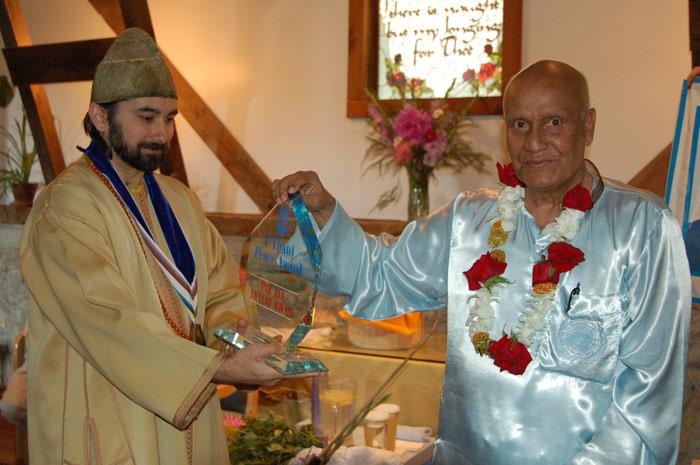
The award is presented annually by the Sri Chinmoy Centre, a non-governmental UN organization, in memory of former UN Secretary-General U Thant.

Previous winners have included Mother Teresa, South African President Nelson Mandela, former Soviet president Mikhail Gorbachev and Archbishop Desmond Tutu of South Africa.


Published in Calgary Herald – Friday, May 3, 1996


May 3


Sri Chinmoy records a standing vertical jump of 35 inches at his home in Jamaica, New York.


Sri Chinmoy lifts 270 lbs. with both arms simultaneously, for a total of 540 lbs., in Jamaica, New York.


The First Time in My Career

by Sri Chinmoy


Today I lifted 270 pounds in each arm for the first time in my weightlifting career. The total is 540 pounds. I lifted it eight times and number six is the best. There the dumbbells travel so visibly. There is such dramatic movement. Number six gave me such satisfaction. I do hope Dhanu’s camera has caught it!

This 270 pounds I will do for three or four days and then I will try to go higher.


Published in A Mystic Journey in the Weightlifting World, part 3


Sri Chinmoy lifts 1,200 lbs., using a seated calf-raise machine, in Jamaica, New York.


May 3

Each Nation in its Place is Great

A lecture by Sri Chinmoy
in Conference Room 9 at the United Nations


A nation is a limb of the universal body. Each limb is necessary, essential and indispensable. Each nation represents humanity’s hope, humanity’s promise and humanity’s progress. Hope was our yesterday’s treasure. Promise is our today’s treasure. Progress shall be our tomorrow’s treasure.

Each nation can be great by virtue of a few divine qualities. A nation can be great by virtue of its simplicity. A nation can be great by virtue of its sincerity. A nation can be great by virtue of its humility. A nation can be great by virtue of its sense of duty, both national and international. A nation can be great by virtue of its prosperity, both inner and outer. Finally, a nation can be great by virtue of its generosity, constant and supreme generosity.

A great nation is that nation which offers inspiration to other nations. A greater nation is that nation which offers concern to other nations. The greatest nation is that nation which offers heart’s love, spontaneous love, to other nations. With inspiration we begin to form our universal family. With concern we strengthen our universal family. With love we feed and fulfil our universal family.

The divine greatness of a nation lies in its self-offering today. The divine greatness of a nation lies in its God-becoming tomorrow. The divine greatness of a nation lies in its God-revelation today. The divine greatness of a nation lies in its God-manifestation tomorrow.

Self-offering, God-becoming, God-revelation and God-manifestation are possible through each individual nation. Each individual nation can be a perfect example of self-offering, God-becoming, God-revelation and God-manifestation. How? If a nation lives in the heart, then self-offering is not only possible but also inevitable. If a nation lives in the soul, then God-becoming is not only possible but also inevitable. If a nation tries and cries for the transformation of the whole universal family of nations, then God-revelation can no longer remain a far cry. God-revelation then is not only possible, but practicable and inevitable as well. Finally, if a nation cares sincerely, devotedly, soulfully and unconditionally for the perfect Perfection not only of its own existence, but also of the entire universe, then God-manifestation is bound to take place.

In size, in capacity, in receptivity, all nations may not have the same status. But each nation is indispensable in its own way. Each nation is like a drop, a tiny drop or a mighty drop, in the vast ocean of divine, fulfilling, fruitful consciousness. It is all the drops combined that make up the ocean. Again, it is the ocean that manifests or fulfils its existence through the different drops, small and big alike.

Each nation is humanity’s conscious cry for perfect Perfection. It is in and through each nation that humanity can make the ultimate progress. This ultimate progress is spiritual brotherhood, divine Reality and immortal Life in the life of the mortal and infinite achievement in the heart of the finite.


Published in The Tears of Nation-Hearts


The Quintessence of Patriotism

A lecture by Sri Chinmoy
at Station Chapel, Naval Air Station at Willow Grove, Pennsylvania


[Albert Marcantonio welcomed Sri Chinmoy.]

Sri Chinmoy: Dear Albert, I wish to offer you my blessingful gratitude for having given me the opportunity to be of service to the aspiring souls here at Willow Grove.

Dear Captain and Mrs. McDonell and Chaplain Roberts, I wish to offer my Indian salute to the Supreme in you, for having given me the opportunity to be of service here.

[Sri Chinmoy folded his hands before his forehead and bowed.]

Dear Captain McDonell, unlike most human beings, you are a most intimate friend of the sea and the sky. Your loving heart, your aspiring heart, your God-fulfilling heart is synonymous with vastness above, vastness below. The spiritual significance of water is consciousness. The sea represents consciousness. Consciousness is the link between man and God. An awakened consciousness, which you unmistakably are, is a direct and immediate link with God. The sky embodies freedom. Here on earth we see human freedom, but when we aspire, when we grow into divine reality, we come to realise that there is another type of freedom. That freedom is called divine freedom. Divine freedom is unlimited, birthless and deathless. The divine freedom which you, Captain McDonell, are is at once God’s blessingful Choice and God’s fruitful Voice.

I wish to give a short talk on the quintessence of patriotism. I wish to offer my prayerful talk to the memory of those patriots, hero-warriors, lovers of their country, who fought divinely and supremely in Vietnam to abide by the divine principles of their country. India’s greatest spiritual figure, Lord Krishna, taught mankind that people who die for their country, who offer their lives for the principle that their country believes in, immediately go to Heaven. The great poet Byron offered to the world at large a significant message: “He who loves not his country can love nothing.”

Who is a patriot? A patriot is he who loves his country dearly. A patriot is he who loves his country more than he loves his own life. A patriot is he who intuitively feels and infallibly knows that there is nothing and there can be nothing as significant as his own country. A patriot is he who honours and treasures his soul’s earth-bound and Heaven-descending vision. A patriot is he who fulfils devotedly and untiringly the supreme promise to God, the Absolute Supreme, which he made while he was in the realm of the soul, before entering into the earth-arena. A patriot is he who has discovered the true truth that Heaven is in no way superior to earth. Earth and Heaven are equal. At times a patriot even goes to the length of saying, Mother and Mother-Earth are superior to Heaven. Heaven is great precisely because Heaven has the unparalleled capacity to smile at God-manifestation on earth. Earth is great precisely because earth has the capacity to cry for God’s transcendental Height.

What is true patriotism? True patriotism is not something that declares war in order to prove its supremacy. True patriotism is not unlit, impure self-assertion. True patriotism is one’s genuine love of one’s country. True patriotism is loving what one already has. To be precise, true patriotism is real love for what God has already given us out of His infinite Bounty. True patriotism realises the undeniable fact that an individual patriot and his country are but pure instruments of the Absolute Supreme.

To destroy a country we need power. This power is undivine, unillumined and ill-founded. To love a country we need a great power. This great power is our pure and constant concern for our country. To serve a country devotedly and untiringly we need a greater power. This greater power is our intuitive and self-offering psychic light. To claim all nations as our very own, one and inseparable, we need the greatest power. This power is the all-illumining, all-immortalising, all-fulfilling God-Power, which is always crying and trying, trying and crying, to come to the fore from the inmost recesses of our heart.

To have a national feeling is good. To have an international feeling is better. To have a universal feeling is best. Nationalism, internationalism and universalism. Nationalism shows me what I have. What I have is true love for my country. Internationalism gives me the opportunity to place my country in the galaxy of nations. If it is the Will of God, internationalism places my country in the vanguard of nations so that my country can offer its capacity and light to help awaken the slumbering nations that still exist on earth. Universalism tells me that my country and I are nothing but unconditional instruments of God, seeking to please Him constantly, soulfully, devotedly and unconditionally in His own way.

Many people, many patriots, have offered most significant messages to the world at large with regard to patriotism, founded upon their own inner feelings. Here I wish to quote a few words from a great patriot who eventually became a spiritual Master of the highest order — Sri Aurobindo. He said, “Patriotism is not a mere political programme. It is a religion from God.” Now, what is this religion? This religion is the beauty of today’s self-giving and the duty of tomorrow’s God-becoming. For me to speak about American patriots is unnecessary. Nevertheless, with your kind permission, I wish to quote two sublime sayings, one from Nathan Hale, one from President Kennedy:

"I only regret that I have but one life to lose for my country."

"My countrymen, ask not what your country can do for you; ask what you can do for your country."

One life to lose, one life to offer to one’s own country. If this action is not based upon divine reality, the human in us will not dare to sacrifice its life. But the divine in us knows that this life is not a mere short span of fifty, sixty or seventy years. The divine in us knows that this life is part of the eternal Life. Here we enter into the earth-arena to play our respective roles for a few years. Then we enter into another world for a short rest. We may call it death or some other thing. Then again we enter into this world to play the role of dedicated souls and serve God in His own way. We are walking along the road of Eternity with a divine, unending, ceaseless, birthless life to manifest the divinity within us. We have to offer to our country what we have: love, sacrifice and the feeling of oneness. The moment we have offered to our country our unalloyed love and pure sacrifice and have established our inseparable oneness with the soul of our country, to our wide surprise we see that our country has already immortalised us. For our country has chosen us out of millions, billions and trillions of souls to take birth on her shores. Our country has played her role long before we thought of offering something to our country. What we offer to our country is, at best, an iota of love, whereas our country has already inundated us with boundless love. This is the love our country has already achieved and received from the Absolute Supreme.

War and peace. Darkness and light. War we invent. Peace we discover. War we invent from without. Peace we discover from within. War forgets peace. Peace forgives war. War is the end of the life human. Peace is the birth of the life divine.

A new day, a new era has dawned. Peace has dawned. Now let us try to swim in the sea of peace, peace, peace. Peace on earth, peace in Heaven, peace in God’s Vision of the transcendental Beyond, peace in God’s all-fulfilling Reality.

Shanti.

Albert Marcantonio: Sri Chinmoy, we thank you wholeheartedly for the seeds of spiritual awareness and enlightenment which you have planted here today.


Published in AUM – Vol. 2, No. 5, 27 May 1975


May 3

Jharna-Kala News


On 3 May 1976 Mr. Henry Geldzahler, Curator of the 20th Century Collection at the New York Metropolitan Museum of Art, visited the Jharna-Kala Gallery to see Sri Chinmoy's paintings and choose some of them for a possible travelling exhibition. Following are excerpts from Mr. Geldzahler's comments about the paintings.

Comments

Mr. Geldzahler: Did you know you were going to be a painter?

Sri Chinmoy: No, I call it God’s unconditional Grace or Compassion. In my family nobody was an artist. Everyone was in the literary line. They didn’t have the capacity even to appreciate painting.

Mr. Geldzahler: Did you have images in the back of your mind when you began?

Sri Chinmoy: No, I had no liking for any particular painting, or style of painting. I grew up in a spiritual community, and I had no opportunity to see much art work. I once visited an art museum, but my ignorance did not allow me to appreciate the paintings.

Mr. Geldzahler: It is like learning a language. It takes awhile to learn how.

Sri Chinmoy: Yes, you have to develop the capacity.

Sri Chinmoy: (Pointing to his pastel birds) It takes only a few seconds to do these, but I like them very much.

Mr. Geldzahler: I am nervous about choosing paintings in front of you. I don’t like this fluorescent lighting at all. First of all, it makes a reflection, and also I feel it brings a bad vibration down. It is unnatural. (Pointing to Sri Chinmoy’s second largest painting.) This one is very successful. (Speaking about painting No. 27,001) I like that one very much, but it doesn’t need the heavy gold frame. I would like it better without the frame.

Sri Chinmoy: After completing 27,000 I did it in front of my students. And that one (pointing to another painting) was number 100,000. This one (pointing to the rose) was the first painting I did on that rainy day in Ottawa when I started. I did this one (referring to his largest canvas) about four days ago. Would you kindly advise me in regard to it? How can we store it?

Mr. Geldzahler: Keep the surface unvarnished. If you go to move it around, cover it with clean cloth and roll it around a tube. Plastic, if it gets very hot, may stick.

Mr. Geldzahler: (Putting orange dots on paintings he was selecting as possibilities for the traveling exhibition.) Can we put two dots if we like a painting very much? This one is just perfect. … I think this one has real energy. (Commenting on a vertical painting in the series done for eleven years in the West) I like the landscaping in this one very much, but to me the horizontal ones are more successful than the vertical. How do you do them?

Sri Chinmoy: I stand on a chair so I can reach the top. As a matter of fact, sometimes we change the position after I have done them. We see how they will look better.

Mr. Geldzahler: As I’m choosing, I see one and I look down and see another. ... How strong that one is! … I was just at an exhibit of two thousand paintings, but of course by two thousand different artists. But here it is a different experience. Twelve thousand paintings by one artist! It is a much more unifying experience. … Again, I maintain that if I went through them again I would make a slightly different selection. (Speaking about the calendar paintings) You have the most consistent success in that format in which the works are divided by the month. But I don’t want to pick too many of these because I don’t want to make the selection unbalanced. You work on them in a very unified way. When they’re not in crayon, when they’re in paint, these are the most successful. They’re the most consistently good, and my tendency would be to pick a lot of them. But you’ve done so many other kinds that I want my selection to be balanced.

(Yvonne Hanneman pointed out Sri Chinmoy’s earliest drawings.)

Mr. Geldzahler: These have the charm of the work of a student thirteen or fourteen years old. It would be an interesting thing to exhibit them, but it would take a block of words to explain them. I don’t know if you would want that.

Sri Chinmoy: I’d like to know your opinion on one particular kind of painting. (Pointing to a yellow circular fan-brush painting) I am extremely fond of this kind of art.

Mr. Geldzahler: The references are the brain, the cabbage, the cauliflower, the flower, what you see when you look at the sun and then close your eyes. In art that kind of configuration has appeal.

Sri Chinmoy: When I do it I immediately feel that a flower is blossoming.

Mr. Geldzahler: I noticed that that circular form appears very often in your work. It is the moment when the flower opens.

(Harit asked Mr. Geldzahler to comment about the largest painting.)

Mr. Geldzahler: It is extremely hard to talk about this one. I don’t know what to say. It is much more unified than most of the others around it, which is unusual for such a large painting, and part of the reason is that the white is allowed to remain visible. It’s not clouded or dense or impenetrable. It sweeps one way and then the other. It is unified in that way. And all the way around it has not only an edge, but a way of referring or moving.

Harit: It has an infinite quality.

Mr. Geldzahler: But it’s also finite, and that’s important. There is something eternal going on, but it also has to law a shape about it, otherwise no one would be able to understand it.

Sri Chinmoy: Here it is quite dense, and here it is different.

Mr. Geldzahler: It’s fine; it folds in. In order to see this painting it would be much more interesting if it could be carried down there and seen from a distance. (After the painting was moved) One can see the unity better from a distance. You can see that the area that is light blends with the darker parts above it and around it. You can’t be sure of it when you stand too close.

I’ve explained to them how to store this big painting. Some of the big paintings at the Metropolitan have to be carried out the front door and up Fifth Avenue. It’s like a sail, and if there is a wind blowing…

Now it looks like a completely different painting. So you have made two paintings — one from close up and one from far away. I’d like to see how it looks in natural light. Can we have the fluorescent lights turned off?

(After the fluorescent lights were turned off.) I think this is much more subtle. Fluorescent light makes everything even, highlights everything evenly, whereas here the dark and the light all look different. This kind of light doesn't emphasise the white so much. It brings forward the colours. Now the colours are the unifying factor instead of the white spaces.

Sri Chinmoy: It has much more strength now. It is my own painting, so now I am bragging.

Mr. Geldzahler: Before, the point was that the white part was unifying it. Now the point is the contrast of the different colours and the brush strokes. It is stronger and more subtle.

Picasso said you have to know when to paint and you have to know when to stop painting. The trouble with many art students is that they keep working on a painting and working on it, and never know when to stop. This one is amazing. One universe; compact.


Published in AUM – Vol 3, No. 7, 27 July 1976


Sri Chinmoy paints a 6’ x 8’ canvas dedicated to the United Nations entitled, ‘United Nations: the Heart-Home of the World-Body’, which was later exhibited at the UN and galleries around the world – Jamaica, New York.


May 15

Sri Chinmoy first writes 50 poems in one day, in Jamaica, NY, USA. They are later published in The Dance of Life, part 7.

Sri Chinmoy delivers a lecture, entitled ‘A Seeker’, at Fredonia State College in Fredonia, NY, USA.

Sri Chinmoy delivers a lecture, entitled ‘Oneness-Reality and Perfection-Divinity’, at Buffalo State College in Buffalo, NY, USA.

Sri Chinmoy delivers a lecture, entitled ‘Progress-Delight’, in Lady Mitchell Hall at the University of Cambridge, Cambridge, UK.

At the invitation of Dr. Bernard Carr from the Society of the Common Life, Sri Chinmoy offers a concert and delivers a lecture in Lady Mitchell Hall, Cambridge University, Cambridge, UK.

Sri Chinmoy offers concerts at Aberdeen and Dundee in Scotland, UK.

Sri Chinmoy offers a Peace Concert in the Veterans Memorial Hall of Snug Harbor Cultural Center in Snug Harbor, Staten Island, NY, USA.

Sri Chinmoy offers a Peace ConcertPeace: Divinity’s Dream on Earth — at the University of Maryland in College Park, MD, USA. Listen to the CD...

Sri Chinmoy offers a Peace Concert at Lehman College in the Bronx, NY, USA.

Sri Chinmoy offers a Peace Concert in Jamaica, NY, USA.

Sri Chinmoy lifts former Presidents of the United Nations General Assembly: Imre Hollai of Hungary, President of the 37th UNGA; Jorge Illueca of Panama, President of the 38th UNGA; Humayun Rasheed Chowdhury of Bangladesh, President of the 41st UNGA; and Amara Essy of Côte d’Ivoire, President of the 49th UNGA, in Jamaica, NY, USA.


May 14

Sri Chinmoy offers his thirteenth talk on the Bhagavad Gita, entitled ‘The Field and the Knower of the Field’, at his apartment in Manhattan, New York, USA.

The Sri Chinmoy Centre sponsors an Inter-religious Observance of the National Day of Prayer at Hunter College in New York, USA. Prayers are received from the First Lady, Mrs. Ford, and a number of religious figures. Sri Chinmoy conducts the concluding meditation and his students perform scenes from his play The Sacred Fire.

An exhibition of Sri Chinmoy’s Jharna-Kala artworks opens at Habitat in Vancouver, BC, Canada.

Sri Chinmoy offers an esraj concert and delivers a lecture, entitled ‘A Seeker’s Resolution, Revolution and Evolution’, at the State University of New York in Buffalo, NY, USA.

A musical piece by classical Swiss composer Heinrich Schweizer, entitled ‘Chinmoy’, premieres at a Lincoln Center concert in New York, USA.

Sri Chinmoy holds a special vigil for Pope John Paul II at the United Nations in New York.

Sri Chinmoy offers a concert in Aberdeen, Scotland, UK.

Sri Chinmoy runs 2 miles in a time of 32 min. 30 sec. (16:15/mile pace) at Runners Are Smilers in Flushing Meadows Park, New York, USA.

Sri Chinmoy performs 200 Bengali and 200 English songs, the most he had ever sung in a public recital, at Buchman Hall, NY, USA. Sri Chinmoy had composed all the songs and recorded them earlier in the month. Directly after the concert, lasting seven hours, he releases the previously recorded songs in a 4-part cassette series, which he titled, ‘Four Hundred Blue-Green-White-Red Song-Birds’ parts 1, 2, 3, 4. Listen to the songs...

Sri Chinmoy hosts the finals of the United Nations Tennis Tournament, held at Aspiration-Ground in Jamaica, New York, USA.

Sri Chinmoy receives the Heart of Portugal Award.

Sri Chinmoy offers a Peace Concert for the 31st anniversary of Sri Chinmoy: The Peace Meditation at the United Nations, at the United Nations in New York.

Sri Chinmoy answers questions from those who have been following his path for over thirty-three years, at Aspiration-Ground in Jamaica, NY, USA.


May 13

Sri Chinmoy gives a talk entitled ‘Meditation: Individual and Collective’ – the sixth in a Spring series of classes on Yoga – at the apartment of Sam Spanier and Eric Hughes in Greenwich Village, New York City, NY, USA.

Sri Chinmoy delivers a talk, entitled ‘Peace is Our Birthright: How Can We Have It?’, in the Dag Hammarskjöld Auditorium at the United Nations in New York, NY.

Sri Chinmoy offers a concert in Edinburgh, Scotland, UK.

Sri Chinmoy performs his first double-dumbbell lift – a two-arm lift of 120 lbs. with both arms simultaneously – a total of 240 lbs., in Jamaica, NY, USA.

Sri Chinmoy holds a public meditation for spiritual seekers in Buchman Hall in Manhattan, NY, USA. He meditates in silence, plays music and answers questions. Three other similar programmes were held at the same venue during April.

Sri Chinmoy offers a Peace Concert (184) together with a piano performance and delivers a lecture, entitled ‘Happiness: My Dream-Fulfilled Reality’, at Johns Hopkins University in Baltimore, MD, USA.

Sri Chinmoy presents the U Thant Peace Award to L.M. Singhvi, Indian High Commissioner to the UK, at the Indian High Commissioner’s residence in London, UK.

Sri Chinmoy offers a Peace Concert (405) — the 5th of 50 concerts held in honour of the 50th anniversary of the United Nations — introduced by Indian High Commissioner L.M. Singhvi, at the Wembley Conference Centre in London, England, UK.

Sri Chinmoy offers a Peace Concert (463) in honour of the 76th birthday of His Holiness Pope John Paul II, in the Dag Hammarskjöld Auditorium at the United Nations in New York.

Sri Chinmoy lifts Jacob Zuma, Executive Deputy President of South Africa, at John F. Kennedy International Airport in Long Island, New York, USA.

Sri Chinmoy offers a Peace Concert at San Diego State University in San Diego, CA, USA.