October 2

’Earl’ the squirrel seems very much at home on Sri Chinmoy’s hand at Wards Island in New York, scene of the Sri Chinmoy 700, 1000, 1300 Mile Ultra-Distance Trio.
’Earl’ the squirrel seems very much at home on Sri Chinmoy’s hand at Wards Island in New York, scene of the Sri Chinmoy 700, 1000, 1300 Mile Ultra-Distance Trio.
Sri Chinmoy visits the Naval Base in San Diego and meets with Admiral J.E. Lawgille, Commandant of the 13th Naval District. The following is a transcript of their meeting:
Admiral: Do you have time for some coffee or tea?
Sri Chinmoy: We just had our breakfast a few minutes ago.
Admiral: Ah, I understand. Would you like to sit down a moment then? It’s a great view here. How long have you been in San Diego? Did you just arrive?
Sri Chinmoy: We arrived yesterday.
Admiral: How long will you be here?
Sri Chinmoy: Only a few more hours and then we will go to Los Angeles.
Admiral: I understand you are going to receive the keys to the city of Los Angeles. It will be a great honour. Have you been in Los Angeles before?
Sri Chinmoy: Yes. I have been there three or four times.
Naval Aide: He’s giving a presentation a little after noon so his schedule is a little tight. The chaplains are standing by, so we’ll have an opportunity…
Admiral: It will be very impressive to see the young men and how much we do with them in a period of about seven weeks. We will now reduce our basic training. And the women, of course…
Sri Chinmoy: Now women are also allowed?
Admiral: Yes. Women are now allowed in the Navy. You will see women recruits being trained, which is novel, if you will. We’ve been taking women in the Navy for some time, and we probably will increase the number of women — not just because of the emphasis on equal rights in our country, but because we need the woman power to supplement the man power.
Sri Chinmoy: Is it because of special talents or simply because of equality of rights?
Admiral: It’s really because of both of those reasons. But more than that, we’re facing a shortage in the male population in the United States. The birth rate is dropping off in the United States, and we no longer use the draft in our country. We depend upon volunteers. With the competition from industry and the competition from the rest of the military, we find that we need the woman power. I believe we have 20,000 women in the Navy now. Were going to probably double that to 40,000 women. We’re now looking at how we’re going to put them aboard ships — some of the ships that don’t go into combat, such as the service ships, the tenders and those types of ships. It should be an interesting experiment.
Sri Chinmoy: Have they already displayed some special capacity?
Admiral: Well, of course, women are able to do a number of jobs in the Navy quite well. And we’ve used them already for things like air control — to control air traffic. They’re very good in the area of computers — computer operations. Of course, we always used them in such things as nursing and we find that there are a number of other things that they do very well.
Naval Aide: Of course, the women that we have here are in communications.
Admiral: Yes. Communications in this building. We have a lot of women that are good in things like communication.
Naval Aide: The Admiral even has a woman here on this staff. She just happens to be out right now.
Admiral: Oh yes. I don’t normally have a driver, and we borrow a driver from the naval station. This happens to be a very nice black woman who is now actually my driver. She drives the Admiral’s sedan.
Sri Chinmoy: They also have the same sense of responsibility that men do?
Admiral: Yes. In fact, the unauthorized absentee rate, the desertion rate — which all services have problems with — is lower with the women than it is with the men. So, one must say that they probably have more responsibility in that sense, if you will, sir.
Of course, we’ve had women at sea in hospital ships. But we no longer have any hospital ships. We also have had women at sea aboard the transport ships. And now we will have them in our auxiliaries, in some of the destroyer tenders. And I think that one of our research ships will probably have some aboard.
Naval Aide: There’s one of the ships going out…
Admiral: That’s the Portuguese tall ship, Cyprus. She’s a tall ship, a square rigger… It’s a pleasure to have you visit us in San Diego.
Sri Chinmoy: It’s a great joy and honour for me. Our philosophy and your philosophy go together. You are working with the sea. For us, the sea represents vastness. Water is consciousness and a boat represents our journey. At every moment, we’re travelling along Eternity’s road. There’s no beginning and no end. It is our birthless and deathless journey. So a boat constantly reminds us of our eternal journey along Eternity’s road.
Admiral: Also, it reminds us of the unknown part of the sea, like the kind of thing we experienced this past week with the death of Pope John Paul.
Naval Aide: Or the tragic airplane crash we had here in San Diego. We all felt that here — especially in all the churches this past week — in the big ceremonies and the big memorial services.
Admiral: Yes. Yesterday afternoon Mayor Wilson had to leave the Portuguese festival to go to the funeral services for the 151 people that were killed when the plane crashed just a few blocks away.
Naval Aide: I had the privilege of showing our guest here our little chapel.
Admiral: Ah, yes! I go there to pray when I can. It’s nice to have a spiritual retreat like that in this big building.
Sri Chinmoy: Yes.
Naval Aide: Well, now we will show you some big chapels.
Admiral: I think you will find that interesting. And perhaps you will have the opportunity to see both the young Navy men and women, and also the young Marine men and women that we drill. They put on a ceremony yesterday. The young recruits that have only been there for seven weeks or less came out and did a very high-precision drill, in which they marched and threw their rifles up in the air and swung them around and then exchanged rifles while they were spinning — with the bayonets on the end. It takes a tremendous amount of discipline to be able to do that in a short period of time. It was very impressive to all the people who were watching, particularly the Portuguese.
Naval Aide: I think if you want to make Los Angeles, we’d better move along.
Admiral: Ah, yes. Well, thank you so much for coming by.
Sri Chinmoy: Thank you.
Admiral: I wish you continued success in your endeavours. Thank you.
Published in The Vision-Sky of California
Deputy Mayor: I apologize for being out. I read that you are an expert in the world of meditation. I had the discomfort of being with an elected official 10 minutes ago, who gave a half an hour speech. I couldn’t get away. It’s nice of you to come to visit our city.
Sri Chinmoy: It is very kind of you to present me with this key. Los Angeles is a foremost city, one of the most famous places in the world.
Deputy Mayor: Thank you. We appreciate your coming to visit our city. We’re very proud of it as a city. We have a diverse culture and a diverse population. I myself am a third generation San Franciscan, as opposed to Los Angeles. I marvel at the fact that our city has the largest population of people of Hispanic, Mexican-American background in any city outside of Mexico. We have the largest Jewish population in this city, except for New York. Also a very large Asian population, including Japanese. Virtually every part of the world has added to the strength of our city.
Sri Chinmoy: It has a cosmopolitan view and a very large heart. It can accommodate all souls, all personalities.
Deputy Mayor: We need all the help we can get. This diversity has characterised the uniqueness of the city. It has a relatively small Black population. As major cities go, our city is only about 16 or 17 percent Black. Yet we have a Black mayor, and there are three Black members of our City Council. We like to think that our community elects people because of their skills rather than their racial, social or ethnic background.
A major issue, as you may know, has been our attempt to integrate our school system. Various and good people in all parts of our community were required in that process. Moving children from one school to a separate segment or separate part of our city in order to upgrade their education is very difficult socially and economically. We have at least been able to do that without violence.
Sri Chinmoy: You have succeeded in doing so? You have already succeeded?
Deputy Mayor: No, I don’t think I could say that. I think our city has succeeded in dealing with a very difficult social issue without community violence. There still is great resistance amongst the people, particularly amongst the white population: fear about the quality of education, fear about the safety of their children. But at least we have been able to deal with this in honest, open debate — through the judicial structure, as opposed to dealing with it in the streets. I know the mayor feels really proud of the city. That’s good. If we could only clean up our air and make the air a little more breathable! And if we could improve our transportation system and provide more job opportunities for people who want to work then we will have achieved an awful lot.
Sri Chinmoy: It will definitely happen in the course of time.
Deputy Mayor: You’re involved in the United Nations. How does that work?
Sri Chinmoy: It works very peacefully and soulfully. I pray and meditate, and quite a few significant people — delegates, diplomats and visitors — come to pray and meditate with us. They feel the necessity of the inner life. The political world, as it stands now, is constantly quarreling and fighting. Peace of mind is badly needed in the outer life. So they come and meditate for about half an hour or so. Then they feel a kind of inner peace.
Deputy Mayor: Very essential, very essential. Sometimes I criticise myself for not spending more time on that sort of thing. But so many things go on in a day that one doesn’t stop and think through what the day should be.
Sri Chinmoy: We believe that if we can pray and meditate in the morning, then the rest of the day will be prayerful and meditative. But if the morning is not soulful, then the rest of the day will have a very hectic vibration and we may not get peace of mind at all. It is like saving money. When we meditate in the morning we acquire spiritual wealth. Then, when the necessity demands, during our multifarious activities we can draw on our spiritual wealth. If we have enough spiritual money saved, then easily we can deal with our problems.
Deputy Mayor: I suspect it’s nice to have a spiritual bank account to draw upon from time to time. But I suspect that our country doesn’t save too much of that kind of money.
Sri Chinmoy: I have been here for fourteen years, and I feel that most people do pray and meditate. There is a soulful inner cry in America. There is an inner cry for justice, for truth. This Watergate incident has really helped America considerably. I feel that the standard of America has gone much higher now and the world has seen something unique in America.
Deputy Mayor: Watergate presents many contrasts for our country. It presented a view of some things that could have been very, very wrong. One of the lasting contributions of Watergate could be that the system of justice is very important in our country. It is strength that our country will always have.
Published in The Vision-Sky of California
A lecture by Sri Chinmoy
Syracuse University, Syracuse, New York
I would be true, for there are those who trust me;
I would be pure, for there are those who care;
I would be strong, for there is much to suffer;
I would be brave, for there is much to dare.— Howard Arnold Walter
To be true, pure, strong and brave, what we need is the Inner Voice. Our Inner Voice is the Truth-Power within us. Our outer voice is the money-power without. Man is not pure enough to see the Truth-Power operating in his outer world of desires and demands. Man is not fortunate enough to see the money-power operating in his inner world of aspirations and needs. The Truth-Power used for humanity and the money-power used for divinity can and will change the face of the world. Truth-Power will awaken and illumine slumbering and unlit humanity. Money-power will serve and fulfil the yet unfulfilled divinity on earth.
The Inner Voice is the heart's wealth. When an aspirant uses this wealth, it soulfully smiles. When an unbeliever and disbeliever in God attempts to use this wealth, it is mercilessly suffocated.
The Inner Voice tells us to help the world only in accordance with God's express Will. If help is rendered otherwise, it is bound to turn into dire calamity later on. He is not only divinely liberal but supremely blessed whose help to another is God-inspired and God-ordained.
To give on second thought a thing requested is to give once. To give a thing for the asking is to give twice. To give a thing unsought is to give thrice. To give a thing when God wants it to be given is to give the thing for good, along with one's own body and soul.
We shall never hear the Song of the Inner Voice if we consciously or unconsciously make friends with anxiety. What is anxiety? Anxiety is the destructive breath of life's poverty.
There can be no greater choice or higher prize than to listen to the Inner Voice. If we wilfully refuse to listen to the Inner Voice, our false gains will lead us to an inevitable loss. And if we listen soulfully to the Inner Voice, our true gains will not only protect us from imminent destruction but will surprisingly hasten our realisation of the transcendental Truth.
An aspirant must realise that the Inner Voice is not a gift, but an achievement. The more soulfully he strives for it, the sooner he unmistakably owns it.
Sincerity tells man he should be truly proud that he has the all-discerning Inner Voice. Humility tells man he should be supremely proud that the wrong-shunning, the right-performing and the good-fulfilling Inner Voice has him.
The Inner Voice is at once man's untiring guide and his true friend. If a man goes deep within, the Inner Voice will tell him what to do. If he goes deeper, the Inner Voice will give him the capacity. If he goes still deeper, the Inner Voice will convince him that he is doing the right thing in the right way.
There is a word that is very sweet, pure and familiar to us. This word is conscience. Conscience is another name for the Inner Voice. Divinely inspired is the utterance of Shakespeare: "I feel within me a peace above all earthly anxieties, a still and quiet conscience."
Conscience can live in two places: in the heart of truth and in the mouth of falsehood. When conscience strikes us once, we must think that it is showing us its unconditional love. When it strikes us twice, we must feel that it is showing us its unreserved concern. When it strikes us thrice, we must realise that it is offering us its boundless compassion to prevent us from diving deep into the sea of Ignorance.
Rousseau says something quite striking: "Conscience is the voice of the soul, as passion is the voice of the body. No wonder they often contradict each other."
Conscience and passion need not contradict each other if man aspires to offer his heart's light to his passion and his heart's surrender to his conscience. In this way, he can easily transcend this apparently irreconcilable contradiction. Once man has transcended all contradiction, he can powerfully sing with Whitman: "Do I contradict myself? Very well, then I contradict myself. (I am large, I contain multitudes.)"
If you want to be a good man, then contradict yourself when sincerity demands. If you want to be a great man, then don't contradict yourself even when necessity demands.
Fear asks, "Is it safe?" Doubt asks, "Is it true?" Conscience asks, "If not God, who else? What else?"
The Inner Voice is the Temple within us. The Inner Voice is the Deity within us. The Inner Voice is the divine Duty within us. The Inner Voice is the supreme Necessity within us.
God has commanded the Inner Voice to be the friend of aspiring souls and the judge of unaspiring souls.
The Inner Voice is not only constant constancy, but also perfect perfection.
Published in Eastern Light for the Western Mind
A talk by Sri Chinmoy
at 2:00 p.m., San Bernardino State University, San Bernardino, California
Desire-life and aspiration-life. The negation of the desire-life is not and cannot be the aspiration-life. The starvation of the desire-life is not and cannot be the aspiration-life. The extinction of the desire-life is not and cannot be the aspiration-life.
The salvation of the desire-life is indeed the aspiration-life. The illumination of the desire-life is indeed the aspiration-life. The liberation of the desire-life is indeed the aspiration-life. Our bondage needs salvation. Our darkness needs illumination. Our ignorance needs liberation.
A man of desire loves life when his teeming desires are fulfilled. But the moment his desires are not fulfilled, he dislikes life; he even goes to the length of hating life. When life fulfils him, at that time life is beautiful, fruitful and meaningful, according to him. When life does not fulfil him, life becomes his true adversary. Poor life! Life is only a field. Here in the battlefield it is the soldier that has to fight against teeming darkness, falsehood and ignorance. We cannot blame life as such for our deplorable mistakes or defeats.
A man of aspiration loves life, for he sees in life the very Presence of God and inside God he sees the presence of life. Life and love, and also life and God, are inseparable in his life of aspiration, in his life of dedication and in his life of realisation. He sees and feels life as God’s manifestation in each individual being. God the life is all responsibility. Life the God is all beauty. This realisation he treasures in the inmost recesses of his heart.
A man of aspiration also feels that there shall come a day when he will be able to establish a free access to God’s Transcendental Height and Universal Reality. He feels that he will achieve this through his prayer and meditation, and by virtue of his dedication to both his inner and outer life. And for this, what he needs is divine love, divine devotion and divine surrender.
The aspiring seeker’s love constantly expands. Thus it creates large, larger, largest receptivity inside the depths of his heart. The larger his receptivity-vessel, the greater, the higher, the more illumining and the more fulfilling the Peace, Light and Bliss it will be able to hold.
Devotion is the intensification of the seeker’s dedication to the supreme Cause. His whole life becomes an altar of intensification. Everything that he does, he does with an intensification of his dedicated, devoted, unreserved and surrendered heart.
Finally, a seeker surrenders to the dictates of his Inner Pilot. He feels that this surrender is nothing short of perfection. What he needs is perfection, both in his inner life and in his outer life. Perfection is of paramount importance, for perfection is satisfaction. So in order to achieve perfection, he surrenders his entire being to the Inner Pilot. He offers to the Inner Pilot what he has and what he is. What he has is an aspiration-cry and what he is is a dedication-life. On the strength of his aspiration-cry and his dedication-life, he feels that one day he will become inseparably one with his Inner Pilot and grow into the very image of his Pilot Supreme.
Published in The Vision-Sky of California
A talk by Sri Chinmoy
at 8:00 p.m., San Diego State University, San Diego, California
The heart flies, the mind sighs, the vital cries and the body dies. Why, why, why, why? The heart flies precisely because it loves. What does it love? It loves oneness — oneness within, oneness without, oneness with the Inner Pilot — its Beloved Supreme. Just because it loves oneness, and just because it loves its Beloved Supreme constantly, unreservedly and unconditionally, it is able to fly at every moment in the firmament of all-illumining Conscious-ness.
The mind sighs precisely because the mind suspects the rest of the world. It suspects the world within and the world without. Finally, to its wide surprise, it suspects its own reality-existence. Suspicion is poison. It is a poison that spreads all over the domain of the mind. Finally, this poison corrupts us, our mind. The mind sighs. It recognises its folly, the height of its folly, and then it heaves a heavy sigh. The mind is failure itself. The vital cries. It cries for name and fame. It cherishes a quenchless thirst for name and fame. It wants to remain all the time in the desiring world. Always it wants something more than it has achieved. Either by hook or by crook, it always tries to have something more. It proves to be a veritable beggar — always crying for something and always dissatisfied with what it has and what it is. A beggar right from the beginning to the end, it cries. Shamelessly it cries. Constantly it cries for something more, for a little more name and fame. And when it achieves something, it is still not satisfied. It wants something else. Nothing pleases the vital. Therefore, the vital cries.
The body dies. Why? The body does not aspire. It always wallows in the pleasures of ignorance. It does not want to budge an inch. Lethargy is another name for the body, the body-consciousness. The body does not move. It does not want anything from either the inner world or the outer world. It feels no necessity to achieve anything. Always it is satisfied with its limitations, with its weaknesses, with its shortcomings, with its failures and deplorable defeats. The body is always lethargy-prone, and it does not want anything. Just because it is lethargic, just because it is always wallowing in the pleasures of ignorance, the body dies. There is no longing for heavenly realities — for truth, light, peace or beauty. So the body dies. The body that we are referring to here is the physical body.
There are many human beings on earth who physically live for a long time but do not aspire. They take physical exercises or they make friends with the Mother Earth and the cosmic energy. Unconsciously they draw energy from the Universal Consciousness, but they do not aspire. If an individual does not aspire, if his soul finds difficulty in illumining the body, or in aspiring in and through the physical body, then we call him a dead soul. But the spiritual body will always aspire. Inside the Atman-life it discovers a Heaven-free life, the life that is birthless and deathless at the same time.
There is another member of our earthly and heavenly family, and the name of that member is the soul. The soul is an exact prototype of our Inner Pilot. It embodies in quintessence all the qualities and capacities that our Beloved Supreme has and is. The soul sails its reality-boat in the Eternity-river. It sails the boat between Immortality’s life and Infinity’s beauty and delight.
Each individual seeker has the capacity to listen to the dictates of the soul. When the seeker listens soulfully to the dictates of his soul, he eventually grows into the very image of his Beloved Supreme.
Where is God? Who is God? How to realise God? All these questions can easily be answered when we listen to the dictates of the soul. With ritual prayer and meditation we can dive deep within and hear the constant message of and from the soul — the perennial message of Light, Truth and Bliss. Through our prayer and meditation we can embody Peace, Light and Bliss in infinite measure and then, like the soul, we can also enjoy Immortality here on earth as we enjoy it already in Heaven.
Published in The Vision-Sky of California
Recollection by Sri Chinmoy
at Aspiration-Ground in Jamaica, New York
It is said that the world’s most attractive place is Bali. Many years ago the astronauts or the cosmonauts found that Bali was the most beautiful place on earth.
As soon as I hear the word “Bali,” I get such a sacred, sacred feeling in the depths of my heart.
Published in My Golden Children

Sri Chinmoy during the Sri Chinmoy 700, 1000, 1300 Mile Utlra-Distance Trio at Flushing Meadows Park in Queens, New York.
by Sri Chinmoy
Sri Chinmoy attends the ‘Self-Transcendence Race’ in New York — one of the weekly 2-mile races held each Saturday morning. At the conclusion of the event, he offers this prayer.
|
Published in My Race-Prayers, part 2
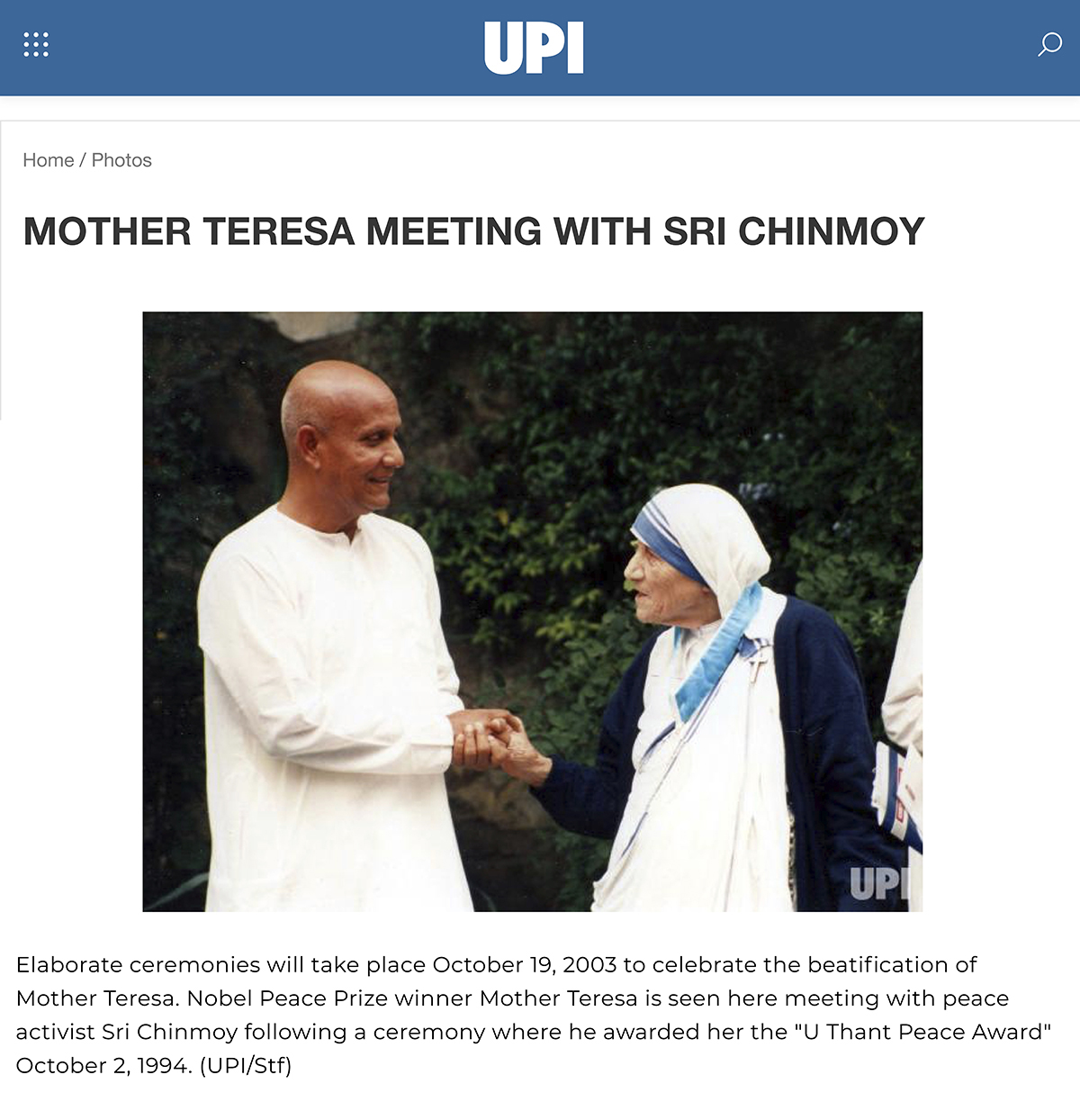
Elaborate ceremonies will take place October 19, 2003 to celebrate the beatification of Mother Teresa. Nobel Peace Prize winner Mother Teresa is seen here meeting with peace activist Sri Chinmoy following a ceremony where he awarded her the “U Thant Peace Award” October 2, 1994. (UPI/Stf)
Published in UPI online

Video by kedarvideo
Sri Chinmoy presents Mother Teresa with the ‘U Thant Peace Award’ at her Missionaries of Charity House adjoining San Gregorio Church in Rome. The two spiritual leaders also hold the Peace Torch together.
by Sri Chinmoy
“We were sitting at a very small table. My hands were folded over my heart. After a few seconds, Mother reached out and pulled my left hand towards her. Then she started pressing my fingers, one by one, from the tip of the finger to the wrist.
“When she finished with my left hand, she took my right hand from my heart and did the same thing…
“One moment Mother was acting like a mother, the next moment like an elder sister and the third like a younger sister. It was like a brother and sister having a family gathering. No other world figure has shown me this kind of affection!”
Published I Mother Teresa: Humanity’s Flower-Heart, Divinity’s Fragrance-Soul, part 2
Mother Teresa receives Sri Chinmoy at her Missionaries of Charity House, adjoining the Church of San Gregorio in Rome, Italy. Mother Teresa and Sri Chinmoy speak privately inside first. Mother Teresa showers her infinite love and affection on Sri Chinmoy, and he offers her his boundless love, admiration and gratitude.
Then Sri Chinmoy presents Mother Teresa with the prestigious U Thant Peace Award on behalf of the Peace Meditation at the United Nations. Sri Chinmoy has led twice-weekly meditations at the UN in New York for diplomats and staff since 1970 at the invitation of Secretary-General U Thant.
Mother Teresa enthusiastically holds the Peace Torch from the international Sri Chinmoy Oneness-Home Peace Run. She gives a most beautiful talk on serving God in the poor and offers her favourite prayer to Sri Chinmoy and each of the singers from the Sri Chinmoy Centres. Her prayer card she charmingly calls her “business card.”
Published in Mother Teresa: Humanity’s Flower-Heart, Divinity’s Fragrance-Soul, part 2,
to Sri Chinmoy, in Rome
1 October 1994
“I am so pleased with all the good work you are doing for world peace and for people in so many countries. May we continue to work together and to share together all for the glory of God and for the good of man.”
Published in Mother Teresa: Humanity’s Flower-Heart, Divinity’s Fragrance-Soul, part 2

By Tim Miejan
“The word ‘peace’ is not simply a grouping of letters, but a living entity which must be nurtured if it is to flourish .... With every blossom that Sri Chinmoy helps to foster, the dream of world peace becomes a more viable reality." — Sen. John Kerry, Massachusetts
Sri Chinmoy, an inspired artist, author, composer and musician, has been an advocate of peace throughout his lifetime. A student of the world's great religions, he has embraced the wisdom and light of each one, and Sri Chinmoy’s efforts to instill peace on Earth has been acknowledged by spiritual and secular leaders from around the world.
He returns to the Twin Cities Oct. 21 to present the Twin Cities Peace Concert, an event that will take place in the new Xcel Energy Center in St. Paul. His free peace concerts are an experience of music, heart-openings and joy. Admission is free but tickets are required.
Born in Bengal, India, in 1931, Sri Chinmoy was raised in a deeply spiritual and loving family atmosphere. He spent his later youth, until the age of 33, in a progressive spiritual community in southern India. His early training included a Western-style education and much involvement in athletics.
He arrived in America in 1964, devoted to the cause of peace. He seeks to inspire people to seek the deepest fulfillment in life and to offer their highest capacities to the world family. As an inspiration of what can be created, he has composed more than 15,000 songs, authored more than 1,300 books, has painted more than 150,000 works of art and has created more than 11 million peace-bird drawings representing the flight and freedom of the soul. He is an advocate of physical fitness, himself a tennis player, marathon runner and weightlifter.
Sri Chinmoy spoke with The EDGE from his office in Queens, New York.
Why are you returning to Minnesota?
Sri Chinmoy: I love Minneapolis. I love the people and I love to serve mankind, so I would again like to be of service there.
Is there a special inner quality that you associate with Minneapolis?
Sri Chinmoy: I came to Minneapolis for the first time in 1965, I believe. I have a very dear friend in Minneapolis named Mrs. Ida Patterson and she invited me to visit. She is very, very kind and compassionate to me. Since then I have gone back three or four times. In Minneapolis, people were extremely kind to me and they showed tremendous love and concern for my spiritual service to mankind. Even during my first visit, they had so many interesting questions to ask me. I was very pleased to be of service to them.
What is the purpose of your Peace Concert?
Sri Chinmoy: There is only one purpose: I try to be of service to mankind. When thousands of people gather together, I feel that we are working together. I am not the only one who serves. The people who come to listen to my music or to join me in praying are also doing something most significant. We are all trying to bring about world peace. It is teamwork.
So, everybody resonates peace together?
Sri Chinmoy: We are all working together. It is not that I am going to give peace to others — far from it! We shall work together. We are all in a boat sailing together towards the destination, which we call the Golden Shore.
What can somebody who comes to the concert expect to experience?
Sri Chinmoy: It is my prayer that they will get inspiration in abundant measure. Then, the following morning, they will be inspired to do something better in their life. My sole purpose in giving these Peace Concerts is to be of inspiration to others.
The same is true of my heavy weightlifting. When people see me doing this heavy lifting, they say, “Look what a 69-year-old can do!” I do it only to be of service to mankind. Again, I have written many books and I have drawn millions of birds. Everything I do only with the hope that I can be of service to mankind in the form of inspiration. In this world, people give up hope, and that is what I do not like. There is always hope, as long as we are alive. Until we breathe our last, we must have hope and promise.
There are many people who are sad and fearful. What first step can they take to find peace and happiness?
Sri Chinmoy: We are sad and fearful because we are not trying to identify ourselves with the rest of mankind. We are afraid that others will hurt us. We are afraid that they will speak ill of us. We cannot take them as members of our own family. But if we pray and meditate to establish our oneness with the rest of the world, our fear goes away, because we identify ourselves with something vast.
The finite is always afraid of the Infinite. It is like a tiny drop and the vast ocean. I am a tiny drop, and if I throw myself into the ocean, I feel that I will lose my very existence. But what actually happens is that I become the ocean itself. In exactly the same way, we are fearful because we take somebody else as separate from our own existence. But if we take others as members of our own family, naturally there will be little ones and grown-ups in the family. In a family, the smallest is not afraid of the father. The father is so tall, stout and strong, but the little one knows that it is his father, and so he is not afraid. His father is all affection for him, and he is all affection for his father.
In exactly the same way, if we can feel that our friends, relatives, and neighbors are our own, very own, then there can be no fear. And when there is no fear, there can be no sadness.
How do you define peace?
Sri Chinmoy: Peace is something that has to be experienced by each individual. Each one has to feel peace the way God wants him or her to feel peace. In my case, peace is the fullness of human existence on earth. Without peace, we are not complete.
Without peace, no matter what we achieve, we will not have satisfaction. There is no abiding satisfaction in anything that we achieve without peace. Peace is the completion of our journey. We can have name, fame and everything else, but in these things there is no abiding peace. But even if we do not have anything to show to the world at large, we are the most fortunate human beings if we have peace of mind. Peace of mind is of paramount importance. If we do not have peace of mind, no matter what we achieve in this lifetime, we will not have happiness. Peace gives us happiness, peace gives us satisfaction, and peace gives us fullness.
Is peace just part of the journey, or is there something beyond peace?
Sri Chinmoy: Our philosophy is self-transcendence. For us, there is no end, for we sing the song of self-transcendence. At every moment we are transcending, we are going beyond our previous capacities. So, peace is something that can be increased. Today we know that we are supposed to have an iota of peace. Tomorrow, on the strength of our prayers and meditations, we can try to increase the amount of peace that we have. We cannot say that if we have peace today, that is enough. No! We have to see how much peace we actually have.
Do we already have peace in abundant measure or boundless measure?
Sri Chinmoy: We are all following the path of self-transcendence, so whatever we achieve today is not the final end. We have to go beyond and beyond and beyond.
When did you first experience peace?
Sri Chinmoy: I first experienced peace many years ago, when I was 11 or 12 years old, in India. My parents happened to be religious and spiritual. My brothers and sisters, who were older than I, went to live in a spiritual community, and I followed them.
So they showed you the way?
Sri Chinmoy: They showed me the way. My oldest brother went to that spiritual community in India in 1933, and I joined him in 1944.
Why have you chosen in this lifetime to be a teacher and leader of peace?
Sri Chinmoy: I have not chosen to be a leader and I never declare myself a teacher of peace. I am a student of peace. I have been telling the whole world that I am a student of peace. I go everywhere to learn, and while I am learning, people feel that I am giving something. In the process of learning, we feel that the teacher and student give something to each other. While the student is learning, the teacher also learns something from the student.
As a student of peace, I have been to many places over the years to pray and meditate. It is not something that I have chosen. My Inner Pilot has commanded me to be of service to Him. God is the Creator and God is the creation. My Inner Pilot, God, has asked me to be of service to God the creation. That is why I go here and there to be of service to mankind.
And there are many places around the world that are dedicated to peace in your name [Minneapolis is dedicated as a Sri Chinmoy Peace City, St. Paul is a Sri Chinmoy Peace Capitol and the Lake Street/Marshall Avenue Bridge uniting the two cities is a Sri Chinmoy Peace Blossom].
Sri Chinmoy: Yes, but that is also a source of mutual inspiration. We are all working together. People are so kind to me. They are becoming part and parcel of our peace movement. We feel that if we get inspiration, then we can eventually become better citizens of the world.
Do you feel that there is a growing peace on the planet?
Sri Chinmoy: Definitely, definitely! Over the years, I have observed that peace is growing. I have been here in the Western world for 36 years. Previously I saw dozens of times that peace was only talk. We were only talking and talking about peace. Now people are praying to have peace in the depths of their heart. Talking has now given way to experience. In many parts of the world, people are experiencing peace. So the world has made tremendous improvement! Of course, we cannot say that in today’s world there is no conflict, there is no fight, there is no confusion. There is conflict, but in comparison, it is less.
Previously we were afraid that there would be a Third World War. Now, we do not foresee that possibility. The First World War destroyed us and the Second World war destroyed us, but we do not see any possibility of a Third World War. There is mutual compromise, and this is a sign that people want peace. Otherwise there could have been a Third World War by this time.
And peace eventually begins in each person’s heart, right?
Sri Chinmoy: Definitely! It starts in the heart, and then only it will come into the mind. Now we have peace in the soul and peace in the heart, and this peace has to be brought into the mind.
And how do we do that?
Sri Chinmoy: There is only one way: by virtue of our prayers and meditations. We have to pray to do something good, to become something good. If we really want to become good citizens of the world, then we have to pray, we have to meditate. There is no other way.
How can the quality of music convey peace?
Sri Chinmoy: Music is the universal language. We do not have to learn any particular language to communicate with others if we can play soulful music. Soulful music is next to meditation, and it carries the beauty and fragrance of silence, the message of the inner worlds and higher worlds. When we play spiritual music, people enter into the world of inspiration and aspiration. When we aspire through music, at that time we do not need any earthly language, whether English or French or German. The heart itself becomes the universal language. The heart is receiving the beauty and light of the higher worlds.
You perform on the flute. Why?
Sri Chinmoy: The flute gives me joy. I play many instruments, because each instrument is like a flower in a garden. If you have only one rose, everyone may not appreciate it. But if there are many flowers, then people enter into the garden to appreciate them. They see such a beautiful garden where there are so many types of flowers. That is why I play Western flute, Indian flute and so many other Eastern and Western instruments.
They are like many, many beautiful flowers of different types. In a garden, we appreciate the beauty and fragrance of all the flowers, and then again we choose whichever flower we like best. In the supermarket, also, there are millions of things. You will choose whatever you need and I will choose whatever I need. When I play many instruments, there are some people who appreciate my flute while others appreciate my piano or some other instrument. So, it is a matter of individual choice whether people prefer the flute, the cello, the esraj, the viola or the piano. It is entirely up to the seekers who are coming to receive inspiration and give inspiration. Again, I also try to become an instrument of God. As I said before, we are all working together. If people get inspiration from my western flute, then it will help them in their own inner search.
And to experience peace in your outer life, you must find peace within first?
Sri Chinmoy: Definitely! If you sow a seed under the ground, eventually it germinates. Then it becomes a plant, and finally it becomes a huge banyan tree. Similarly, peace has to be established in the depths of our heart first. Then only it will come to the fore.
What would you like everyone to know about himself or herself?
Sri Chinmoy: That they embody God, they embody Truth, they embody Light. Each individual should feel that he or she embodies God: God’s Divinity, God’s Eternity, God’s Immortality.
Published in The EDGE, October 1, 2000


Video by kedarvideo
Sri Chinmoy offers two Peace Concerts at the Austria Center Vienna, in Vienna, Austria — to an afternoon audience of 4,200 and an evening audience of 4,700.