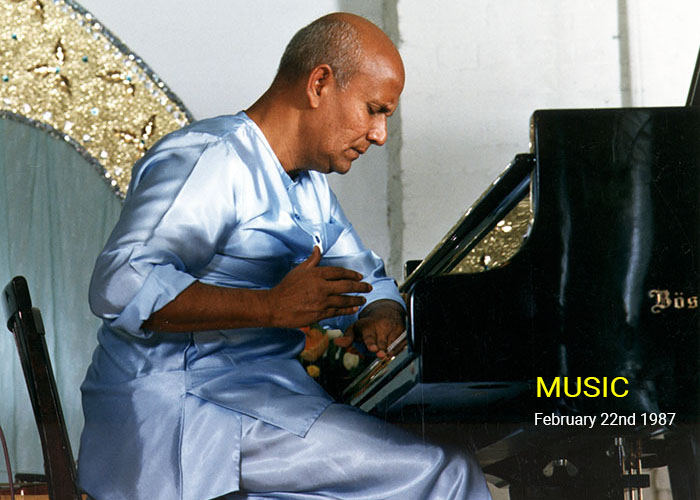
February 23
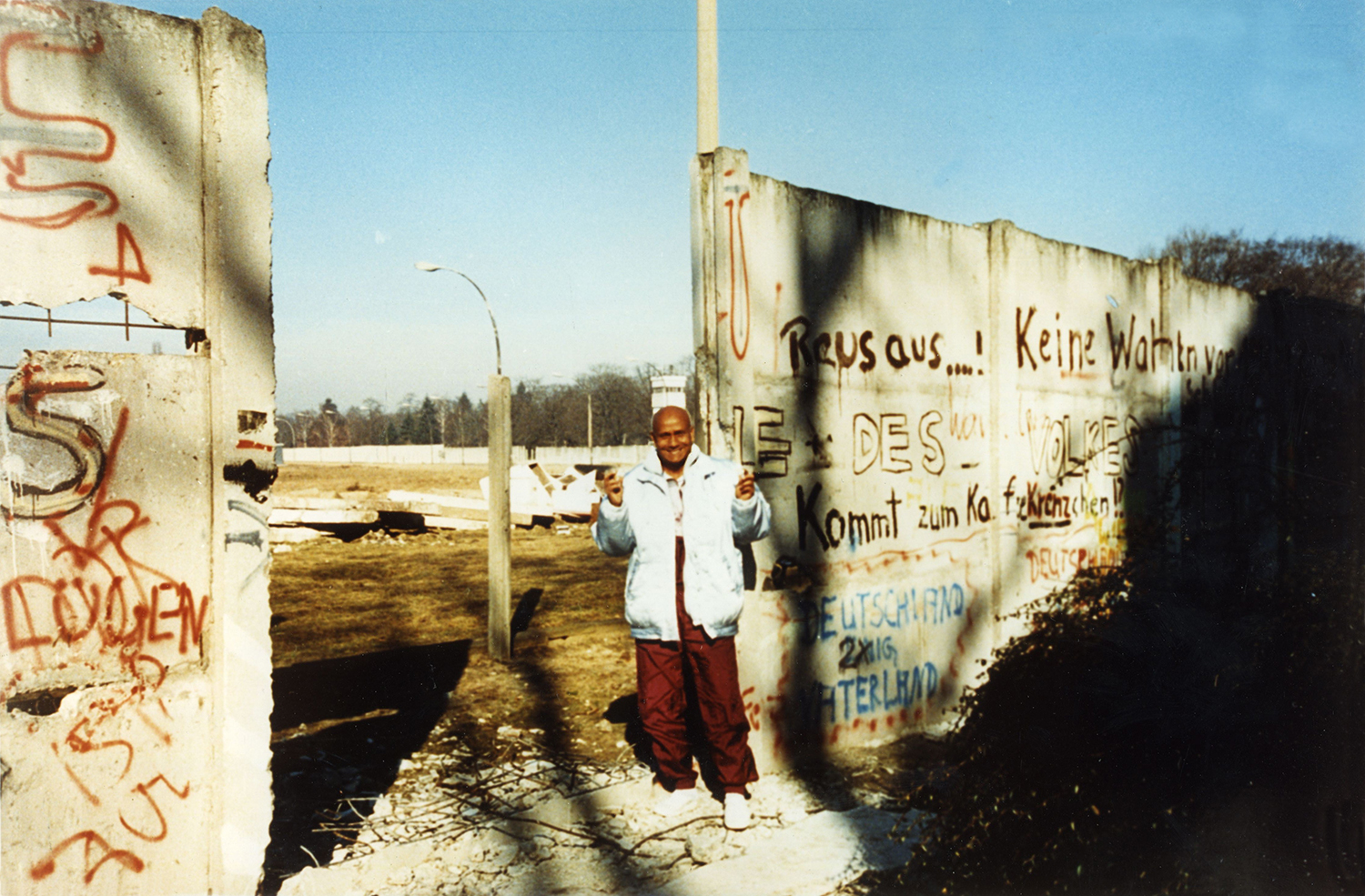
Sri Chinmoy at the Berlin Wall.

Sri Chinmoy at a former guard tower in East Germany. (Though the Berlin Wall has fallen, German reunification does not formally take place until October 3, 1990.)
Sri Chinmoy at the Berlin Wall.
Sri Chinmoy at a former guard tower in East Germany. (Though the Berlin Wall has fallen, German reunification does not formally take place until October 3, 1990.)

Vaslli Mochanou spray paints the finishing touches on a Canadian flag made from 27,000 snowballs in Ottawa Sunday. About 50 volunteers took six hours to make the flag in honor of poet Sri Chinmoy and his 27,000 poems.
Published in the Calgary Herald, Canada

Sri Chinmoy running on the course of the Inspiration Marathon in Hampton, New Hampshire. A month earlier, on 1 February, Sri Chinmoy ran the event in a time of 5:22:11.
A lecture by Sri Chinmoy
at the University of Massachusetts in Amherst, Massachusetts
I had decided to give thirteen talks on the Upanishads. Today I will be giving my thirteenth talk on the Upanishads. That means that today we are at the end of the race, the divine race. We are nearing the goal. When we reach the goal, we shall offer our most devoted gratitude to the Inner Pilot.
When we think of the Upanishads, immediately our minds enter into these particular subjects — philosophy, religion, spirituality and Yoga.
The philosophy of the Upanishads is the vastness of the mind.
The religion of the Upanishads is the oneness of the heart.
The spirituality of the Upanishads is the Immortality of the soul.
The Yoga of the Upanishads is the total manifestation of God here on earth.
The vastness of the mind needs God the infinite Consciousness.
The oneness of the heart needs God the supreme and eternal Beloved.
The immortality of the soul needs God the ever-transcending Beyond.
The total manifestation of God needs man’s constant inner hunger.
God is Purity in the vastness of the mind.
God is Beauty in the oneness of the heart.
God is Life in the Immortality of the soul.
The philosophy of the Upanishads tells me, “See the Truth.”
The religion of the Upanishads tells me, “Feel the Truth.”
The spirituality of the Upanishads tells me, “Grow into the Truth.”
The Yoga of the Upanishads tells me, “Become the Truth.”
God tells me, “You are the Truth.”
When I see the Truth, I know what God’s Compassion is.
When I feel the Truth, I know what God’s Love is.
When I grow into the Truth, I know what God’s Concern is.
When I become the Truth, I know what God’s selfless Life is, and what His unconditional Duty is.
When I realise that I am the Truth, the full manifestation of Divinity’s Light begins.The Upanishads offer to each aspiring heart countless messages. There are quite a few messages which are at once most significant and most fulfilling. Here is a stupendous message about life and death. Before death and after death, what happens? This is the message of the Upanishads:
Before death, life is a seeker.
After death, the same life becomes a dreamer.
Before death, life struggles and strives for perfection.
After death, the same life rests and enjoys the divine Bliss with the soul.
Before death, life is God’s Promise.
After death, life is God’s inner Assurance. This Assurance of God’s we notice while we fulfil God in our future incarnation.Life for each individual is an act of inspiration and revelation. Life is an experience; even so, is death. Our human life is God’s sacred flame mounting towards the highest Source. Human death, the so-called death, is a secret play of God’s Will.
When we study the Upanishads, we start with the concentration of the mind. This concentration of the mind is the most difficult thing that we can ever think of. We know what the mind is, we know what concentration is, but when it is a matter of concentration of the mind, it is extremely difficult to do.
Once some spiritual aspirants went to their Master and said, “Master, we have been meditating for so many years — for ten long years. How is it that we cannot control our minds?” The Master said, “My children, God-realisation is not so easy. Had it been easy, you would have by this time controlled your minds. God-realisation is extremely difficult — here is the proof. We consider the mind to be our best instrument. We consider it to be the highest, most developed part in our human life. But look at its helplessness.” Then he went on to say, “You are all standing before me. Now if somebody stands up right on the shoulders of one of your spiritual brothers, what will happen? Immediately your brother will be irritated, he will feel disturbed. His prestige will be hurt. He is also a human being. How does someone dare to stand on his shoulders? The same thing happens to the mind. When the mind is agitated by our thoughts — low, undivine, uncomely thoughts — it does not allow us to become calm, quiet and serene enough to meditate on God.”
The origin of the mind is divine; the mind itself is divine. But unfortunately, the mind that we are using right now is the physical mind, which cannot help us at all in our upward journey. This mind has consciously or unconsciously accepted three undivine friends: fear, doubt and jealousy. I said in the beginning of this talk that the vastness of the mind is the philosophy of the Upanishads. Now, when vastness wants to appear before the physical mind, the physical mind is horror-struck. It is afraid of the vastness. Further, it looks at its own insufficiency, its own limited capacity, and says, “How is it possible? I am so weak; I am so impotent; I am so insignificant. How can the vastness accept me as its very own?” First it is afraid of vastness, then it doubts. It doubts the very existence of vastness. Then, by God’s infinite Grace, fear leaves the mind and doubt leaves the mind. Alas, now jealousy comes in. The mind looks around and sees that there is some fulfilment in the vastness, whereas in its own existence there is no fulfilment, there is no joy. Jealousy starts. Fear, doubt, and jealousy — these three undivine forces — attack the mind and make it meaningless, helpless and hopeless in our upward journey. When the mind is attacked by fear, doubt and jealousy, something else consciously and deliberately enters and feeds the mind, and that is our ego. With ego starts the beginning of our spiritual end.
We have to go beyond the domain of the physical mind with the help of philosophy, religion, spirituality and Yoga. The seeking mind operates in philosophy. The crying heart operates in religion. The illumining soul operates in spirituality. The fulfilling Goal operates in Yoga.
There are two approaches to the Goal. One approach is through the mind; the other is through the heart. The approach of the mind is not safe; it is not secure. But one eventually can reach the Goal this way. It is not that if you approach God through the mind you will not realise God. You will realise God, but the road is arduous. You may doubt your aspiration, you may doubt God’s Compassion for you. Hence, it may take you hundreds, thousands of years to reach the Goal. But the approach through the heart is safe and sure. We can do one of two things: either we can identify ourselves with the subject or the object — with the Supreme Pilot, the Eternal Beloved — or we can surrender our existence at every second to the Inner Pilot. Either we have to become totally one with the Will of the Inner Pilot, or we have to surrender totally, unconditionally to the Inner Pilot. When we approach God in either of these ways, His Infinity, Eternity, Divinity and Immortality we feel immediately as our very own.
If we follow the messages of the Upanishads step by step, if we start first with philosophy, then with religion, then with spirituality and finally with Yoga, then God-realisation need not and cannot remain a far cry. God-discovery is our birthright. If we really want to discover God, then we can start right from the beginning: philosophy, religion, spirituality and Yoga. When we fulfil the demands of philosophy, religion, spirituality and Yoga, God fulfils all our demands. Their demands are very simple: aspiration and self-control. Our demands are God’s Gifts: Peace, Light, Bliss and Power.
Do we really care for God’s Gifts? If we really care for God’s Gifts, then God will offer us the capacity to receive His infinite Wealth. In our ordinary life, when we want something from somebody else, that person will not give us the capacity to receive it. He will demand our own capacity. If we have the capacity, if we work for one day, then the boss will give us the salary. But in the spiritual life, God wants to know whether we really want the salary — Peace, Light and Bliss. If we want them, then He Himself will energise us and be our aspiration and self-control. He will work in and through us. He will work as the seeker within us and, at the same time, He will work as the Pilot for us. He Himself will be both Employer and Employee. If we really want God, God will play at once both the roles. He will be the Giver and the receiver. He will be the seeker and the Fulfiller.
Published in The Oneness of the Eastern Heart and the Western Mind, part 2
by Sri Chinmoy
At the top of the head is the Crown centre — Sahasrara chakra we call it. Imagine that this centre is opening up seven times — imagine, but don’t count them. Each time it opens, it rotates one full circle. While it is rotating, chant either “peace” or “AUM” or “Supreme”, or you can try two of the three.
Afterwards, please see me seated on the top of the snow-clad Himalayas. I am seated at the top, the way you see Lord Shiva meditating on the top of a mountain, and you are at the foot. Do not chant “Supreme” or “peace” or anything else at that time. Only try to observe me there at the top of Mt. Kailash. Above me is only the moon, and below are all of you meditating most soulfully.
At the Third Eye try to imagine a disc. Imagine that the disc is rotating clockwise, and seven times chant “light” or “AUM” or “Supreme”, whichever you want.
Then inside that rotating disc please imagine seven very very bright flames. Try to imagine me playing with those seven flames, and at times try to see that I have become one with those tiny flames, instead of playing with them.
Please imagine a disc rotating around your Heart centre. Now you will chant “delight” or “AUM” or “Supreme.” Inside that circle, which is the Heart centre, Anahata Nada, where the soundless sound comes from, please imagine that your heart is a flower-garden, absolutely larger than the largest. Inside that large garden try to see a most beautiful swimming pool, very big. The water of the swimming pool is silver. There you are swimming, diving, and doing all sorts of things that give you joy. Then see inside the swimming pool the Golden Boat. Enter into the Golden Boat, and while you are entering it, please try to imagine that your entire being has become totally golden.
Published in AUM – Vol. 6, No. 4, April 1980
Sri Chinmoy recounts stories to his students in New York after his two-week visit to his homeland, the first time in 42 years
From Dhaka I went to Chittagong by car; it took six hours. I wanted to visit all the places that I had read about in history and geography books. I wanted to see those sacred places where Sri Ramachandra and others were supposed to have visited. Now they have become places of pilgrimage. But in the end I was only able to visit my family homes in Chittagong and Shakpura.
I came back from Chittagong by train. I was in an Indian first-class car, which is like an American third-class car, or worse. They played very loud music, which was almost like jazz.
While in Calcutta, for four days I tried to get in touch with my family. But the line was always out of order. There is something called a ‘lightning call’, which costs eight times more than a regular call. I said, “I am ready to pay.” But even the lightning call was not successful.
So I flew to Madras without informing them. Every time I go home, my brothers and sisters arrange to have a car from the Ashram meet me. An Ashram driver comes to Madras and takes me to Pondicherry. I know the driver well. It is usually a three-hour drive. But this time, because I could not get in touch with them, I had to hire a car. It was the biggest mistake!
Somebody came and said, “I have a car.” When I went to the car, that person disappeared and I saw somebody else there — a driver with two helpers.
As soon as I entered into the car, I thought, “This car is older than the oldest. But I can’t get out now. My things are inside the trunk.”
The driver tried to reassure me. He said. “Oh, no, no, this is a very good car.”
We started out at 8:30. The car broke down three times over the next four hours. Around 12:30 we had gone only 70 miles and still had 40 miles to cover. Then they had to change the tire!
They were saying that we were delayed because there was a flood and there were no bridges.
I said, “Where is the flood? I don’t see water here.”
They said, “No, two weeks ago there was a flood.”
I said, “Two weeks ago there was a flood, and that’s why you can’t drive now?” What can you do with people like this!
At 1:15 I was only five miles away from our house in Pondicherry. The driver said he could not go any farther because he didn’t have a Pondicherry license.
So the two friends of the driver took another car and went to a nearby hospital and brought back a car and driver with a Pondicherry license. Usually drivers charge five rupees to go to our house from there; 10 rupees maximum. But this driver said, “At this hour you have to pay 75 rupees.”
He was shamelessly overcharging, but 75 rupees is only a little more than five dollars. I was so happy that I would finally arrive at my destination that I gladly agreed to pay him.
The Ashram charges only 200 or 225 rupees to take me from Madras to Pondicherry. I had told the driver at the airport that I would give him 450 rupees for the ride. That is about double what the Ashram charges.
But even then, that man didn’t trust me. “In case anything happens, could you give me some money in advance?” he asked. What was going to happen? But to prove my innocence, I gave him 100 rupees.
But then look what happened! After so many hours, still he could not take me all the way to Pondicherry. I gave him his full 450 rupees, but I was so disgusted.
The man who asked for 75 rupees said, “You should not give him the whole amount since he is unable to take you the whole way.”
Meanwhile, the three who had brought me from Madras wanted a share of this man’s 75 rupees. They said, “You have to give us something because we found you a passenger.”
The two drivers had a serious argument because the second driver didn’t want to give them anything. He said, “I am saving you because you can’t drive into Pondicherry.”
I said, “No, you are not saving them. You are saving me.” Then I begged him to take the 75 rupees and just drive me home.
When we arrived, I gave him 80 rupees.
The first time I went back to India, I took a taxi from Madras to our house in Pondicherry. A young couple was going to the Pondicherry area also, so I said, “You don’t have to pay. You come with me. I will sit with the driver and you can sit in the back.” They were so moved by my generosity and very grateful to me.
In those days I carried my money in a little bag with no strap. When we finally arrived at my house, I was filled with such joy that I just opened the car door and practically ran to my house. O God, I didn’t realise that I had left my bag on the seat next to the driver.
The driver drove away and had gone about half a block when the wife noticed that I had left my bag there. She was very short, so God knows how she saw my bag. Her husband was tall, but he didn’t see it. So the wife told the driver and he brought the car back. Then the husband came out of the car and gave me the bag. The driver had known that the bag was there, but he didn’t want to say anything.
So I did them a favour by saving them 300 or 400 rupees for a taxi ride, but they did me a much bigger favour. I had so much money in my bag, as well as my passport. It is because there are good people like this on earth that we still exist. Some divine forces always protect me in time of need; still the divine forces are not sleeping!
During my visit to India, we went to some sacred caves called Elephanta, where they keep Lord Shiva’s statue. To get to the caves, we took a boat from Bombay, and then a little ferry to the island. You have to go up hundreds of steps to get to the sacred area, but there are strong young men there who will carry you up in a chair if you are too weak to go up the stairs yourself. In my case, I climbed up the stairs, but I paid to be carried down by four men. It was a frightening experience, because the chair slants downward when they are carrying you, and they go quite fast.
A lady at the caves begged me to take her picture. Then afterwards, she wanted me to give her five rupees for allowing me to take her picture.
Published in The World-Experience-Tree-Climber, part 5


Sri Chinmoy in animated conversation with his disciples at his home in New York.
by Sri Chinmoy
Today I was supposed to be at the Taj Mahal. My students got permission for me to play there on my most favourite instrument, the esraj, but circumstances prevented me from going. The authorities said that whenever I am able to go, I will be welcome to play.
Two students of mine from Goa went to the Taj Mahal. It was quite easy for them to get permission for me to play, because about six years ago the Taj Mahal became one of our Peace-Blossoms. The authorities of the Taj Mahal became part and parcel of our Peace-Blossoms movement.
Japan I like so much! When I visit Japan, I feel everything is natural there — everything. There is something in the atmosphere. It is in the culture, in the spiritual aspect of life. When I look at the Japanese people, I see something unique. I have a special feeling for Japan.
During my first visit I was there for about four or five days. An assistant editor came to interview me at the hotel. The following day there was an article in the Japanese daily newspaper. I asked a policeman if it would be possible for me to buy a copy of the newspaper. He left his post, ran one hundred metres and got me a copy of the newspaper, and he did not charge me for it! That incident I will never forget.
Then it started raining. An elderly woman saw me in the rain, and she gave me an umbrella.
The Japanese people I see are ready to mould their culture. They can give it shape, as a potter shapes a pot. Japan is not fossilised!
Some countries are now making progress in science and technology. They have their own depth, and there is a synthesis between the inner and the outer, no doubt. But some of those countries may not accept anything deeper from any other country. They feel they are self-sufficient. But with Japan, I do not feel that is the case. Japan is still hungry, hungry, hungry! Japan is like a child who is in a garden. He runs from one plant to another, and he is ready to appreciate everything.
When I think of Japan, I feel it is a fresh flower. When I think of some other countries, the flower is already fully blossomed. To me, a flower that is blooming and blossoming petal by petal is sometimes more beautiful than a flower that is already fully blossomed. Japan is blooming, and it will be blossomed.
It is like the rising sun. In the morning when the sun is rising, its beauty gives me much more joy than at noon, when the sun is fully risen. The power-aspect of the sun is there at noon; we cannot deny the power-aspect. But the beauty-aspect gives me much more joy. In the morning, such joy I get from the rising sun.
Again, the setting sun also gives me much more peace than the noon sun. The rising sun gives me boundless joy; the setting sun gives me boundless peace. In between, when I look at the sun, it is all power. The power-aspect is very difficult for human beings to appreciate. We are always afraid of the power-aspect. We admire the power-aspect at a distance, but we are afraid of nearing the power. But the rising sun and the setting sun have something very, very special to offer: joy and peace.
When we look at the rising sun in Japan, we feel something new, a new creation. We all like a new creation. The new creation in Japan is most inspiring. It is more visible than in some other countries. The rising sun in Japan is something very, very special.
I have seen the rising sun in India also countless times. And when I used to observe the Indian moon, it was not because I was young, but there was something special. When I observed and appreciated the full moon, I used to feel that everything was calling me. There also I looked at the sun and I saw that somebody was beckoning me, beckoning me. I saw beckoning hands, and something was calling me, calling me, calling me.
I am an Indian, so I think of India! One appreciates one’s own country more than any other country. In my case, Japan is not my native land, but I do feel something special Japan has, and something special it is offering to mankind.
For many days I have made it a point to meditate on your ailment to bring down light.* I leave the results at the Feet of my Absolute Lord Supreme. I have not missed one day, but the results you are not yet getting. In the Bhagavad-Gita, our Song Celestial, Lord Krishna said that we have the right to pray, but we have no right to the fruits of our prayer. The fruits you are not yet getting, but my prayer I do continue.
I have not given up, because I never take anything as a hopeless case. We feel that fate can be changed. There is nothing impossible in God’s creation. “Impossibility” is found only in the dictionary, and in the mind. Once we can go beyond the domain of the mind, there is no such thing as impossibility. With regard to your ailment, I still keep the same hope. More than that, it is determination, or will-power. As far as the regularity of my prayers for you is concerned, I have not failed even once. I do hope that something will happen.
There are two types of surrender. One type is the surrender of a lazy man. He has already given up. His surrender is only to say, “Let Thy Will be done.” He does nothing to make any improvement. Another type of surrender is to work very, very hard for improvement, for progress. If someone works very hard for his success and progress, even if success does not take place, in the inner world he gets real Blessings from Above.
One individual gives up; another individual continues and continues. There may be no success as yet, but the Inner Pilot is truly pleased with the one who has not given up. The first individual may declare, “I have not given up,” but is he consciously doing anything to meet his objective? Sometimes we do not give up, but we only keep a kind of wishful thinking that some improvement will take place. But on a regular basis if we pay attention to what we actually need in our life, then I feel that, even though God may not fulfil our desire in our own way, He has His own Plan. In His own Way He can accomplish in and through us something most special.
Let us say that I want a mango, my favourite fruit. For some reason, although the mango is my most favourite fruit, God feels that some other fruit will be good for me. Again, perhaps it is not that some other fruit will be good for me — God is examining me to see how much surrender I have made to His Will. I can say that, if a mango comes for me, well and good; in this case I am not making any effort. Again, if I sincerely strive for a mango, and God gives me another fruit, I may not be satisfied, but somehow in the inner world I will be much more fulfilled. When I dive deep within, I will feel that God did not give me the mango, but He examined me to see whether I was ready to accept what He wanted to give me, happily and cheerfully. If we get something unexpected from God, and if we can accept it happily and cheerfully, then He does something special in and through us — something infinitely more significant than giving us the mango.
One thing is to say, “Let Thy Will be done.” But for how many hours, for how many seconds do I consciously offer that prayer to God? Early in the morning, when I get up, I say, “Let Thy Will be done.” Then again at night, before I retire, I say it. But if I say it only twice a day, it is not going to register in my conscious memory; whereas if I say it a few hundred times, it will register. If I turn the knob of the stove only to a certain extent, there will be no flame. But if I turn it a little more, and still more, then I will see the flame; the fire will start. Similarly, if I say, “Let Thy Will be done” only once or twice a day, nothing may happen; whereas if I do it many more times, then it is as if I am turning the knob to such an extent that there will be a flame.
Every day we do the same thing; we do this much. This is what we human beings do! But if it is necessary for us to go farther, we do not go that far. Our problem is that our effort is limited.
Every day I am ready to walk half a mile; then I am fully satisfied. But I am not getting the result that I need for my body. If I go one full mile, then I will see that there is a great difference between half a mile and one mile. Similarly, when we say, “Let Thy Will be done,” consciously we are doing it; but we do not do it many times during the day. If we can say it even twenty or thirty or forty times a day, it will help us tremendously. We do not have to repeat it 7,000 or 8,000 or 20,000 times — no, no! Let us try to do it even once every hour. Out of twelve hours, if we keep our mind alert and spend two or three minutes every hour to offer this prayer, then I feel that we will get better results.
Each time we pray we can do the same thing, but the number of times is also a factor. In India when we do japa, we repeat it 108 times or more. Again, some people do it thousands and thousands of times, but sometimes it may become mechanical. At that time there is no freshness, there is no newness, there is no joy in it. That we do not want. We do not want to go to that extreme. Some people recite a prayer or mantra like a parrot. But if we can do it soulfully, most soulfully quite a few times during the day, and if we can feel that our prayer is touching the very depths of our heart, then we are bound to get results.
“Let Thy Will be done” is one prayer. But if you have some other sacred or secret prayer, you can offer it. It does not have to be a prayer to God to cure your ailment, but it can be something special. You have a spiritual Master and you practise spirituality, so if you feel that you can do something inwardly, then kindly do that very thing. You have been praying for thirty or forty years, but you are not getting the result that you need or deserve. But I wish to say that you can do a little more, a little more.
If we are not getting the result of our prayer, we can do one of two things. One approach is to say that we need patience, like a farmer. He sows the seed, but he does not expect the bumper crop overnight. The seed has to germinate and become a plant. Another approach is that if we feel we are doing the right thing, then we have to do it more.
If I feel that I am doing something absolutely correct but I am not getting the result of my action, I can say that I am leaving the result at the Feet of God. I have done my duty; what I was supposed to do, I have done. Now I say, “Let Thy Will be done.” That is true. But again, I have to know to what extent I have done the right thing. If I have the capacity to continue a little more, a little further, then I should do it.
In your case, you have been doing your regular prayer, secretly, for a long time. But after you have finished your prayer, please do not add a desire to it. Just feel that you have pleased God. You may think that, since you have pleased God, God will do the needful. That is true. But there is nothing wrong in doing more!
I will see in my body if there is anything defective. The body, like the soul and the heart, has to become perfect; everything has to be perfect. Let us say that my knees are hurting. I am praying and praying to God, but I am not begging Him to cure my knees. After I have prayed, I feel I have pleased God.
In your case, after you pray, if you consciously see that something is not perfect in your body, you can just concentrate on that defective part, that imperfect limb of your body. There is nothing wrong in it! At that time you are not praying, but the cosmic energy you are drawing upon yourself. You are not begging God, “God, I have prayed for Your Victory for so many years. Can You not cure my ailment?” No, no; that is not the way. While praying to please God in His own Way, you can draw upon yourself some cosmic energy.
When I look at your eyes, when I look at your face, I see that you do draw this cosmic energy. This cosmic energy if you just apply, what is wrong in it? It is your own cosmic energy. If you have money, you can spend it. If you have some cosmic energy, and if you apply it to your physical problem, there is nothing wrong in it. You yourself have acquired it. You did not even pray to God for cosmic energy. You prayed to God to please Him in His own Way.
While praying, you are inundated with some spirit or energy — I call it cosmic energy. There is nothing wrong in applying that energy if you feel that something is not perfect in your body. That means you are curing yourself, let us say. I see that you do have the capacity. It will help you! That cosmic energy you are so often using for your creativity. Many, many times when I look at your picture, I see that cosmic energy. You are using the cosmic energy that you have got from your prayer and meditation. It is right in front of you, in front of your eyes and nose. I see it! Even when I looked at a picture of you when you were standing in an ordinary way, I saw all cosmic energy. This cosmic energy you are using for your creative life. But there is nothing wrong if you use it for something else also, because cosmic energy cures everything. This energy cures us of all imperfections.
You say that, while playing music, you surrender. But before you surrendered, either a few hours earlier or on the previous day, you did something. You thought of what you were going to play, or you concentrated and meditated on it. At that very moment, perhaps you did not pray or meditate or do anything special, but it was like opening a door. When you open a door, immediately light goes into the room. While you are playing, you have surrendered; you have asked God to play in and through you. But before asking God to play through you, if you have made no previous preparation, God is not going to do anything in and through you. While you are playing, because you have already done the preparation, you surrender everything to God’s Will. At that time God is acting in and through you. By virtue of your surrender, you are playing. But I am saying that, to come to that stage of surrender, you need preparation. We walk a certain distance and then, when we feel that we cannot go any farther, we say, “God, help me!” But if we do not do anything, if we just say to God, “I have surrendered,” that is called the surrender of the lazy.
In your case, you are not lazy! You are a seeker. You have a Master and you have prayed and meditated for so many years. From those good things that you have been doing for so many years, you have got the message of surrender. You have got the message “Let Thy Will be done” from your prayers and meditations for God knows how many years. After so many years of sincere effort, you are offering your surrender. Your surrender will be most effective because you have prayed, you have meditated; you are a seeker.
There are many who will try to say the same thing: “I surrender.” But what are they going to surrender? What have they done, first of all, to surrender? We have to do something to please God. Then we can say, “I surrender.” In our Bhagavad-Gita it is said that we must first do the work, and then surrender. Doing the work is the preparation, not the performance. At the time of your performance, you are surrendering. But if you had not done the preparation, you would not have got the message of surrender.
Again, with regard to your physical problem, I have said that when you pray and meditate you get some energy. This energy is not coming from the body. It is coming from outside, from above. Then, you can distribute it. If you see that one part of your body is not doing well, it is not functioning well, you can apply the energy that you have acquired. You are not borrowing this energy from someone. You have pleased God by praying and meditating, and God has given you the capacity. God may not use it right away, in this particular spot, but you yourself can use it.
It is like father and child. The father has given money to the child, and the father says, “Now use it.” If the son feels like buying a piece of candy, he will buy it, because his father has given him the money. The son does not say, “My father has given me the money. Now, if it is his will, let him give me a piece of candy also.”
God says, “I gave you this wealth, and now I am telling you to use it!” But you do not use it, or you use it for something else. The thing that you feel you need most, as a child needs a piece of candy, you are not buying. You are buying something else, something else.
This is not advice that I am giving you! All this I am saying on the strength of my oneness, oneness, oneness, absolute oneness with your soul and with your heart. I am sincerely, most sincerely trying to do something for your physical problem. Now, when I say that there is something you can do on your part, in no way is it advice that I am giving. In a tug-of-war, if two persons are on one side and on the other side there is only one individual, there is every possibility that the two persons will pull harder and win the game. In the same way, you and I are pulling together.
Do you approve of my philosophy? You are a seeker, a great seeker! That is why we are in the same boat. I am a seeker and you are also a seeker. We are in the same boat.
I know for sure there is only one Master, the Inner Pilot. Others only guide us; they take us a few steps and then they have to surrender, because they are not the Inner Pilot.
There are two ways, they say: the monkey-way and the kitten-way. The baby monkey is usually holding on to the back of the mother monkey, while the kitten is hanging from the mother’s mouth; the mother is carrying it. The one that is held by the mother is safer than the one that is seated on the back of the mother.
It is the same with father and child. If the child is holding the father’s hand and then he sees something exciting, he may release his father’s hand and fall down. Then he gets hurt. But if the father has hold of the child, no matter what happens, even if something very exciting takes place, he will not let go of his child. Then the child is safe. The father sees what is going on and the child also sees. The child has the same experience, the same excitement, but he is safe, because his father is not going to let go of the child’s hand.
In the same way, if someone has greater capacity, and if that person holds on to a second person, that second person is safe. In the spiritual life, if there is somebody who can hold on to you, then you are safer than you would be if you were holding on to him.
Do you see the difference? Something exciting is going on. But if somebody else is there to hold on to you, then you can enjoy the same experience, but you are safe. The same excitement is going on, but there is no danger. The person who is holding on to you, if he has inner strength and inner joy, may or may not be excited himself, but he is not going to release you. Then, like the child, you are safe.
That is why we use the term “Inner Pilot.” We can be seated at His Feet, but if temptation arises, then we may disappear. But again, if He ties us to His Feet, then He will not allow anything to happen to us. If we want to welcome temptation, He says, “I am not going to allow you!” But if we just sit at His Feet, or at the feet of our Master, and something happens, we may just go away, because we are not tied. This tie we call protection.
You give me immense joy — immense! — in every sense of the term. Thank you.
* Sri Chinmoy meditates with a dear friend who has a serious health problem.
Transformation — transformation of nature, transformation of life — is the most difficult subject in the entire world!
We may be sixty, seventy, eighty or even ninety years old, but if we want to see how much we have transformed our nature, sometimes we cannot give ourselves a mark of more than zero. For ninety years we may live on earth, but it may happen that, in terms of transformation, we have made no progress. Again, in the case of some people, right from the beginning, from the dawn of their life, we see that they are making progress, making progress.
Earthly age is no indication of our transformation. It entirely depends on the inner cry. Only the heart’s inner cry can transform us. Otherwise, year after year we are only adding earthly years to our life; transformation is not taking place. Transformation comes only from the inner cry.
The most difficult subject in human life is the transformation of our nature, and for that, how many centuries, how many lives we have taken, and how many more we shall have to take!
Note: Annam Brahma is a vegetarian restaurant in Jamaica, New York, which has been operated by Sri Chinmoy’s students since 1971. Many times over the years, Sri Chinmoy has held meditations, talks and meetings with visiting dignitaries at this specially chosen venue.
Published in His Compassion Is Everything To Us

Sri Chinmoy performs his first public piano improvisation – ‘The Battle of Kurukshetra’ – at a Peace Concert at Buchman Hall in Manhattan, NY, USA. Read more…
On hearing a recording of Sri Chinmoy’s debut performance, Jazz percussionist Milford Graves declares:
“It is ‘out of earth’ music. It is cosmic music, beyond this galaxy. Sri Chinmoy’s sense of harmony and rhythm is fantastic. You have to have the wisdom of the innermost Truth to play like this. Sri Chinmoy is doing what other musicians would like to but can’t because they are so moulded. His music is the ultimate!”
Listen to Sri Chinmoy’s original performance...

Chinmoy in the Kuppelsaal
A Phenomenon, Sri Chinmoy, a New York Meditation teacher of Bengali origins, is also a musician and a Messenger of peace…
2800 listeners followed his call to a “Peace Concert” at the Kuppelsaal in Hanover, and were transported away from their daily routines by his Indian sounds and gave restrained applause between the pieces (ovations would have destroyed the atmosphere) when the Master changed to flute or synthesizer.
“In the silence there is power,” his friends say. And what strength he developed through training and spiritual concentration, Chinmoy proved before the concert. With a special rack, he lifted members of the audience into the air with one arm; Guests from the GDR particularly appreciated this gesture. Chinmoy wrote a song for them, by the way.
It is about “Oneness-Happiness”.
Published in Neue Presse, Hannover, Thursday, February 22, 1990


Sri Chinmoy sets a new record of 140 lbs. for a seated, two-arm lift, in Jamaica, Queens, New York.
Sri Chinmoy’s comment
Today for the first time I lifted 140 pounds with both arms together from a seated position. For me, this is a great accomplishment — like the 100-metre dash. The most important thing is the wrist. If I do not get the proper push from my wrists, then finished.
Published in A Mystic Journey in the Weightlifting World, part 2