
Greatness and Goodness
A lecture by Sri Chinmoy
at Oxford University, Oxford, England
I wish to give a very short talk on greatness and goodness. Here we are in Oxford. Oxford is a place of greatness and goodness. Oxford, I bow to your greatness and I bow to your goodness. Your greatness is divinely meaningful and your goodness is supremely soulful. Anything that is great in England is to be found here in microcosm. Greatness and goodness combined are what Oxford is.
Students who want to cultivate mental knowledge of the highest degree come here from all over the world to achieve greatness. Then they go back to their respective countries to offer the knowledge-light that they have achieved from here. This knowledge-light that they spread is goodness.
To have greatness is to have faith in oneself: in one's physical, in one's vital, in one's mind and in one's heart. If one has a strong body, he has faith in his physical strength. If one has a dynamic vital, then he has implicit faith in his vital. If one is blessed with a brilliant mind, then he has faith in his mind. And if one is blessed with a pure heart, a pure and unalloyed heart, then he has tremendous faith in his heart.
Goodness is faith only in God, in Truth, in Light. When one becomes part and parcel of Truth, then one takes the side of Truth and Light. And when one is always for God, this is nothing but goodness. Goodness always has faith in God, Truth and Light.
Greatness is a universally acknowledged fact. Goodness is also a universally acknowledged fact. But it is something more. It is universally loved reality. Greatness we observe in our outer life. Goodness we observe in our inner life. With our human eyes, we observe greatness around us, all over the world. With our divine heart, we feel goodness within us and within others.
God is great because He has created this world. This is a fact that we have been taught by our parents, by our friends, by the world body. God is also good, kind, compassionate. He is our Source within us; He is for us, eternally for us. He wants to liberate us, He wants to illumine us, He wants to grant us realisation, satisfaction and fulfilment. He is the Author of all good. This is God the Goodness. God the Creator is Greatness and God the Lover of His creation is Goodness. We love God not because He is supremely great, but because He is universally, transcendentally good. Greatness astonishes us. Goodness illumines us, liberates us from the shackles of bondage.
Greatness we can express in an animal way when we quarrel, fight and try to destroy one another. When we stay together in a family and love one another, then greatness is expressed in a human way. When we try to elevate one another and help one another reach the highest heights, at that time greatness is expressed in a divine way. Finally, greatness is expressed in the supreme way when we tell the world that God the Eternal Reality is also eternally good; He is the Source. He is waiting for us, Him to please in His own way. Here we reach greatness, supreme greatness, on the strength of our conscious and constant surrender to God's Will.
Usually our human mind craves greatness, whereas our divine heart longs for goodness. Sometimes we notice a yawning gulf between the mind and the heart, between the goal that the mind wants to reach and the goal that the heart wants to reach. The mind tries to see its goal by separating one reality from another. Everything it wants to see in an infinitesimal measure, whereas the heart wants to see the goal, the reality, as a unit, one and inseparable. The mind and the heart approach reality in different ways, but they cannot always remain separated. They have to be unified in order to achieve the highest truth. There are two kinds of mind: the physical mind and the illumined mind. The physical mind is bound by the physical world. It wants to lord it over the world. It wants to stay at least an inch above others so that it can dominate others. Consciously or unconsciously, willingly or unwillingly, it gets tremendous joy from its sense of separativity. The illumined mind is totally different. It longs for vastness within and without. It wants nothing but vastness; and inside vastness, it wants to grow and glow.
The human heart, which is very near the vital centre, is quite often insecure. It does not want to house others inside it. It feels that when others want to take shelter in it, they may break the vessel. It feels it is too small. Therefore, the human heart is quite often insecure, timid. And just because it is quite near the vital, unconsciously or consciously, like a magnet it pulls impurity from the undisciplined vital. But there is also the spiritual heart. This heart is always united with the soul; it has established its oneness with the soul. The soul, which is the direct representative of the Lord Supreme, has Light in boundless measure. And the spiritual heart has a free access to the soul. Therefore, it can easily bring down the soul's light into its system.
The oneness of the spiritual heart and the vastness of the illumined mind must be brought together. Oneness we can establish with another individual or with some tiny object. But if we have vastness along with the oneness, if we can establish our oneness with God's vast creation, then we become perfect. Likewise, vastness without oneness is of no avail. God's creation is very vast, but if we fail to establish our oneness with this vastness, then vastness remains a barren desert. In order to become perfect, we have to create within us vastness and oneness, and we have to grow into both vastness and oneness.
There are two worlds. One is the world of desire; the other is the world of aspiration. When we remain in the desire-world, greatness looms large. But when we remain in the aspiration-world, goodness looms large. Just because we are seekers, we are consciously trying to come out of the domain of the desire-world and establish our abode in the aspiration-world.
The desire to know the world and the desire to know oneself are totally different things. When we want to know the world around us, without caring for our oneness with the world, unconsciously we are aiming at greatness. And this greatness, without fail, separates us from the world. But when we want to know ourselves implicitly, what we realise is that we are part and parcel of the whole, of the integral reality. Even if we start with the desire-world and try to become great, no harm. It is far better than remaining in the world of lethargy and somnolence. But there shall come a time when we see that our greatness has not given us an iota of satisfaction; for inside greatness what we see is frustration. There comes a time when our greatness is challenged. An individual feels that he is a great singer. But sooner or later his pride is smashed when he sees that another singer is far better than he. Then what does he do? He resorts to goodness.
Goodness is not in competing with the world around; only it offers the message of self-transcendence. If we at all have to compare, then the comparison is with ourselves. If we at all have to compete, then we will compete with our own previous capacities. Here there is no other world. There is only our own world of constant and continuous progress. We try only to transcend ourselves. In the desire-world there is comparison and competition. But in the aspiration-world, we do not want to make others feel that we are superior. No. When we feel that we have an iota of light, we aspire to have abundant light, infinite Light. Only by virtue of our constant aspiration do we transcend our own capacities. We feel that the more we increase our capacity and the more we utilise our capacity to please the Inner Pilot in His own way, the sooner we become His perfect instruments.
Published in My Rose Petals, part 6
Questions after the Lecture
answered by Sri Chinmoy
Question: If I pray for my father, will this benefit his soul's evolution despite the fact that he does not lead a spiritual life?
Sri Chinmoy: If one does not lead a spiritual life and another member of his family prays and meditates for him, naturally it will help. But if the person consciously rejects the love and the spiritual help that he is getting, then he won’t get any benefit. Suppose a member of your family does not accept the spiritual life, but you have accepted it soulfully and you are praying for that person just because he is a member of your family. Your prayer will definitely work provided he does not reject it. He may say, “I am too lethargic. I don’t want to do it, but if you do it for me, I will be grateful. I am hungry, true, but I don’t want to go to the kitchen. Will you bring me some food?” Then you can go to your kitchen and open up your refrigerator and bring food. Just because he is lazy you are bringing him food. But if you bring him food and he just throws it aside and becomes annoyed, then what are you going to do? So it is up to him. When you bring him food, he should at least eat it. If he eats, then he will be nourished. At that time it doesn’t matter whether he went to the kitchen himself. But if he rejects your food, then no matter how sincere you are, how well-meaning you are in bringing the food to him, you are wasting your time. It entirely depends on his acceptance or rejection. If he accepts, then naturally you will feel that the power of your prayer, the fruit of your prayer, will go to him. But if he rejects it, then it is impossible.
Question: What happens to geniuses like Bach or Shakespeare after they die?
Sri Chinmoy: It depends on God’s Will and also the eagerness of the soul. If Bach played his role as a great, supreme musician, and if he does not want to manifest any more music, and if it is the Will of the Supreme, then he will give up that life totally. In his next incarnation he may enter into the field of literary activity. If Shakespeare has finished his role as a great writer and if he wants to enter into music, he can do it. Again, if Shakespeare and Bach feel that they have not played their roles satisfactorily, that they could give more to the literary world or to the musical world, then they will continue in the same field in their next incarnation.
We feel that Bach composed such great music. Who could be a better musician than he or who could be a greater writer than Shakespeare? But only the souls of these two great figures know whether they contributed to the fullest extent what they embodied and what they came here to give us. If they have given everything, then they don’t have to go through literary life or music life any more. But if they have not given everything and if they want to continue, and if the Will of the Supreme is for them to continue and give more of their soul-stirring music or soul-elevating literature, then they will give. Again, they may not want to continue this particular game. On the sports field, a game lasts for forty-five minutes or an hour. If one plays for forty-five minutes and then becomes tired, he may say, “I do not want to play this game anymore; I am ready to play some other game. I was playing football and it was very exhausting; now I want to play something else, some indoor game.” And then God may say, “All right, you don’t have to play that game. You can play some other game. I am offering you My Compassion.”
Usually great geniuses like Shakespeare and Bach have completed their roles. Then, God may take them into science or spirituality. In the case of Bach, he had already accepted spirituality, whereas Shakespeare had not consciously accepted spirituality. So Bach’s music is full of spirituality. But Shakespeare’s higher ideals are not spiritual; they are something else. Spirituality is everywhere, true, but you have to know what spirituality you are aiming at. The one has already touched spirituality; the other has not properly touched the real spirituality. It is entirely up to God’s Will what they will do next.
Question: Is there any question you cannot answer?
Sri Chinmoy: If I use my mind, there will be millions of questions that I cannot answer. But if I use my oneness-heart with the Absolute Supreme, there will be no question that I will not be able to answer, if it has to do with spirituality. Thousands of times I have answered questions, believe me, and when I heard it on the tape or read it in the book, I could not believe that it was I who had said it. Or after I have answered a question, when everything is all done and my physical mind gets the message of the answer that I have given, I cannot believe that I have answered that question. When I try to understand the question afterwards, I cannot understand it. It has happened to me once or twice that I have answered a question one hundred per cent correctly; but if I use my mind in order to know what the question is, I do not even understand the question. So how many times I have answered questions most correctly on the strength of my heart’s oneness with God’s Will. My heart immediately becomes one with God’s Will. Many times it has happened that before the question is even formulated, just when the person opens his mouth, the question has already come to me. You are standing with the question and you have completed two or three words, but your question has already come to me and the answer has already come to me. Then you go on, go on, using so many words; but it is all unnecessary. When you open your mouth, the question and the answer both have come together, and I am just waiting for you to complete your question.
Question: Why is it that some religions do not mention reincarnation?
Sri Chinmoy: Some religions say, “Our Father is in Heaven. He is there and we are here, in hell.” So naturally they try to go to Heaven, where He is. And then, once they are there, they say, “Oh, He is our Beloved. Are we such fools that we will come back to earth? Who needs reincarnation?”
But if we know that He is in Heaven and also here on earth, then naturally we will come back. Wherever we are, God, poor fellow, is also there; He is bound to be with us. If we are on the ground floor, in the basement, He is also there. And also when we are on the top floor, in the attic, He is with us. So if you accept God’s Universality, then you know that reincarnation is absolutely real. But if you accept only God the Transcendental Height, then you will only stay with Him upstairs. You shall not come back. When people say that God is only in Heaven, it creates a problem. But if we say He is both in Heaven and on earth, then this problem doesn’t arise.
Question: Does the vibration of the city reflect the aspiration of its inhabitants?
Sri Chinmoy: At times the vibration of a city is like the aspiration of its inhabitants. And also, the inhabitants may have a vibration of their own. It is like a house. A house has a vibration of its own and the inhabitants also have a vibration of their own. The inhabitants have a vibration and they are giving it to the house; and the house has some vibration, which it is giving to the inhabitants.
Question: Are there delicate and beautiful worlds of the psychic imagination that the artist should try to seek access to for inspiration?
Sri Chinmoy: Yes, there are many, many beautiful, delicate psychic worlds. You are using the term “imagination”, but this is absolutely wrong. These are not imagination; they are psychic realities. What you call imagination is not imagination as such; it is a reality in another world. Here on earth we call it imagination. But when we go to a higher plane, where we get the message of creativity, the light of creativity, it is not imagination at all. It is real. Only we don’t see its reality in the physical form here. We are on the first floor and a flower is on the second floor. We don’t see the flower because we are on the first floor. But when the fragrance comes down, we know there is a flower, a source, and the source is on the second floor.
So imagination is a world of its own, a reality-world. But here we don’t see it because it is stationed a little higher. The good artist must always seek access to the higher worlds for inspiration, for if one wants to create something, one has to get something from a higher plane. Then only will the world be illumined and fulfilled. Anything that comes from above has more beauty in it, more purity in it, more reality in it. Our goal is to bring down from above divinity, reality, beauty — everything that is divine.
The imagination-world is not a mental hallucination; it is reality-world far above this physical world. Let us try to have an access to this world so we can get inspiration and create something new, something unprecedented.
Published in Sri Chinmoy Speaks, part 10
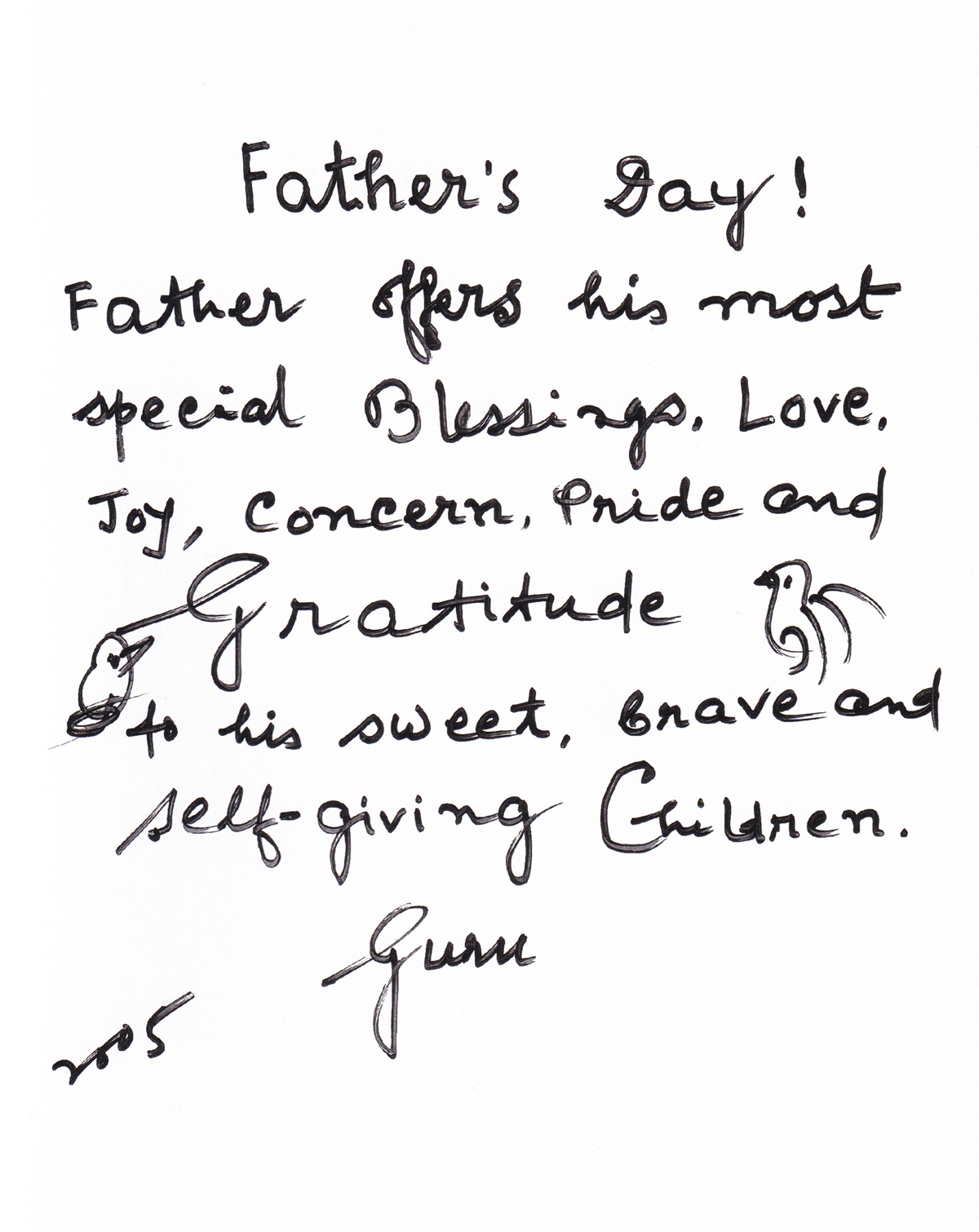
Father's Day!
Father offers his most
special Blessings. Love
Joy, Concern, Pride and
Gratitude
to his sweet, brave and
self-giving Children.Guru
2005
See Your Master in Everybody’s Heart
by Sri Chinmoy
at Aspiration-Ground in Jamaica, New York
When it is a matter of sleepless selfless service, I have a disciple for whom there is no day, no night. Whenever I need something, he is ready. And what is absolutely unbelievable is that he does this kind of service not only for me, but for all and sundry. If anybody wants his help, he is always ready. He does not judge whether the request is coming from a first-class disciple, a second-class disciple or a third-class disciple. As soon as anybody needs something, he is ready, ready. I wonder how many disciples are of that type. Some may perhaps grumble, fumble and stumble if they are asked to help so many individuals.
To this disciple I wish to say, “Continue, continue! Inside everybody’s heart, see me, see me. See your Master in everybody’s heart. Then you will be able to keep up your exemplary service.”
Published in The Temple and the Shrine